




Abstract
Although previous research has found trait emotional intelligence (TEI) to be a moderate predictor of bullying behaviors in adolescents, this work has limited generalizability. The current study is the first to use a multidimensional approach to both TEI and bullying behaviors when looking at their relationship in high school students. The study employed two samples: 1,517 adolescents from three high schools in central Ontario, Canada and a subset of 35 bullies and 35 non-bullies from another school in the same region. Participants in both samples completed the Youth Version of the Emotional Quotient Inventory (EQi:YV). In addition, the first sample completed the Bully-Victim Questionnaire, which measures four types of bullying behavior: social, physical, verbal, and electronic. TEI was found to be a significant negative predictor for all types of bullying behaviors. In addition, being a male adolescent and having low interpersonal and stress management scores were the strongest predictors of bullying behaviors. Overall, bullies were found to have significantly lower TEI scores across all dimensions. Based on the findings, TEI should be considered as an addition to current anti-bullying programing.
School bullying is a type of violence in which a student, or a group of students, intentionally cause harm to another student who is more vulnerable (Olweus, 1993). Traditional forms of school bullying include physical, verbal, and social bullying, although cyberbullying has emerged as another common type given the pervasive use of electronic media by children and adolescents (Kowalski et al., 2014). Bullying is a global public health issue and evidence suggests that exposure to this type of violence in childhood creates a greater risk of experiencing economic hardships, criminal involvement, decreased quality of life, and poorer mental and physical health during adulthood (Brimblecombe et al., 2018; Li et al., 2024; Klomek et al., 2015). Bullying prevalence rates vary significantly among studies, largely because of differences in how bullying is measured and defined. However, in a meta-analysis by Modecki et al. (2014), which included a total sample of over 300,000 students aged 12 to 18, the average prevalence was found to be 35% for traditional bullying (encompassing both perpetrators and victims) and 15% for involvement in cyberbullying.
Given these high rates of bullying behaviors in schools, it is not surprising that a great many programs and strategies have been developed to prevent and reduce this problem. Systematic reviews and meta-analyses now cover several decades of research exploring the efficacy of specialized programs targeting school bullying (e.g., Gaffney et al., 2021; Smith et al., 2004; Ttofi & Farrington, 2011). While the review literature has consistently found that school-based programs can be effective in reducing both bullying perpetration and victimization, it is also important to note that the effect sizes of existing programs are rarely more than “modest”. A common recommendation is that more research is needed to better understand the “specific components of antibullying programs that work best to reduce bullying behaviors” (Gaffney et al., 2021, p. 89).
Although more research is needed, there are strong trends in the existent literature about what components of antibullying programs seem to have better impacts than others. Programs that focus on improving self-oriented personal competencies like self-regulation (the ability to manage one’s emotions effectively in various situations) or other-oriented social competencies like empathy (the ability to understand and share the feelings of others) appear to be most impactful (Zych et al., 2019). These are also the same type of personal competencies that appear to act as protective factors later in life from the negative consequences of being a bully or being victimized as a student (Ttofi et al., 2014). These findings are also consistent with the relatively small literature that has explicitly explored the relationship between school bullying and emotional intelligence—a broad construct with conceptual links to self-regulation and empathy. More importantly, from the perspective of developing more impactful antibullying intervention programs, there is a sizeable literature documenting that the competencies linked with key EI-related models are quite amenable to being developed and enhanced via school-based programs (Crane et al., 2020; Durlak et al., 2011; Storey-Hurtubise et al., 2022).
Emotional Intelligence and Bullying Behaviors
Emotional intelligence (EI) has been defined as a collection of socioemotional competencies that involve how effectively a person understands their own emotions and the emotions of others, as well as how well a person manages and adapts to these emotions (Salovey & Mayer, 1990). Petrides and Furnham (2001) introduced the important differentiation between ability and trait models of emotional intelligence. Ability EI measures typically evaluate an individual’s highest levels of various emotion-related skills, often through tasks or simulated scenarios. Trait EI (TEI) is generally assessed with self-report measures of emotional skills and behaviors (i.e., competencies). Since most of the research on the links between EI and bully behaviors has used TEI measures (García-Sancho et al., 2014; Vega et al., 2022), this paper focuses primarily on TEI. Theoretically, individuals with high TEI are equipped to effectively manage their emotions and better cope with daily stressors (Bar-On, 1997). Not surprisingly, TEI has been linked to a variety of important life outcomes: educational attainment (Dave et al., 2019), career achievement (Di Fabio & Saklofske, 2014), health (Chamorro-Premuzic et al., 2007), and successful interpersonal relationships (Parker et al., 2021).
Various meta-analytic studies have shown that, across different ages, cultures, and types of aggression, there is a negative relationship between violent and aggressive behaviors and TEI (García-Sancho et al., 2014; Vega et al., 2022). Looking more specifically at bully behaviors in youth, Mavroveli et al. (2009) found that children (8–12 years old) with higher levels of TEI were less likely to be perceived as a bully by their peers. In a study with young adolescents, Lomas et al. (2012) found that students who had poor understanding of the emotions of others (a key competency included in most TEI models) were more likely to engage in bullying behaviors. Another key facet connected to most TEI models—emotion regulation—has also been linked to bullying behaviors in children and adolescents (Baroncelli & Ciucci, 2014; Rueda et al., 2021; Schokman et al., 2014).
While these findings are quite suggestive of a link between TEI and bully behaviors in youth, there are several limitations to this prior work to highlight. Some of this work treats bullying behaviors as unidimensional in nature, rather than exploring relationships with different types of bully behaviors, especially cyberbullying which has become a growing problem in youth (Kowalski et al., 2014). At the same time, there is also a need to explore the relationship between types of bullying behaviors and a broad set of TEI-related competencies. Much of the existent work has focused on very specific competencies (e.g., empathy vs. stress management) rather than exploring the potential unique impacts of different TEI-related competencies. When bullying behaviors are treated as multidimensional in nature it is also possible that specific TEI competencies may differentially predict different bullying behaviors. Since important age and gender differences exist for both bully behaviors and TEI-related competencies in youth (Carbone-Lopez et al., 2010) research needs to be conducted with samples large enough to explore potential age and gender effects (as well as potential interactive effects).
The Present Study
Using a relatively large sample of male and female high-school students, relationships among different types of bullying behaviors (i.e., social, physical, verbal, and electronic) and TEI was explored. The study also used an assessment tool for TEI connected to one of the more widely accepted models of TEI (Bar-On, 1997). This multidimensional model conceptualizes TEI as a combination of four core dimensions (Bar-On, 1997): intrapersonal (how well one understands, expresses, and communicates their feelings and needs), interpersonal (how well one maintains relationships through listening, understanding, and appreciating the feelings of others), stress management (how well one resists impulsivity and emotionally responds to stressful events), and adaptability (how well one manages change by being flexible, realistic, and positive) (Bar-On, 1997). The present study also aimed to explore the relationship between TEI and both self-reported and observed bullying behavior. Using observer data is crucial for addressing the low occurrence rates noted in some research and overcoming the limitations of self-reports, which can be affected by false responses due to fear of consequences or social stigma (Branson & Cornell, 2009; Lomas et al., 2012).
Methods
Participants
Sample 1
Participants were 1517 adolescents from several high schools in central Ontario (45.02% male adolescents, 54.98% female adolescents) that ranged in age from 14 to 18 years (M = 16.24, SD = 1.18). The majority of students in the schools (85.4%) identified themselves as White, 5.7% as Asian, 2.4% as Black, 1.2% as Hispanic, 5.3% as other.
Sample 2
Participants were a subset of 35 bullies and 35 non-bullies (51.43% male adolescents, 48.57% female adolescents) extracted from a larger sample of 537 participants (35 bullies, 502 non-bullies) from a different high school in the same region of Ontario as Sample 1. The majority of students in the school identified themselves as White, with proportions for self-reported ethnicity groups closely matching those in Sample 1.
Procedure
Participants in both samples were recruited via presentations to teachers, school staff members, parents, and students. Students and parents signed participant consent forms describing the study. All students completed the study materials in small group settings under the supervision of teachers and/or members of the research team.
For Sample 1, participants completed the EQi:YV (Bar-On & Parker, 2000) and the Bully-Victim Questionnaire (BVQ; Olweus, 1996), as well as a brief demographic questionnaire.
For Sample 2, participants completed the EQi:YV (Bar-On & Parker, 2000), the same demographic questionnaire used with Sample 1, and measures used for a separate study. Participants also gave permission to match study variables with various school records (e.g., GPA, attendance, discipline referrals) for the same academic year (September to June). The bully group consisted of 35 students (18 male adolescents, 17 female adolescents) who had participated in at least one documented bullying incident based on school records. The bullies and non-bullies were randomly matched on gender and age. The EQi:YV scores of the 35 non-bullies did not significantly differ from the 467 non-bullies not matched with the bully group.
Measures
Trait Emotional Intelligence
Participants in both samples completed the EQi:YV (Bar-On & Parker, 2000) which is a 60-item self-report measure of TEI with four subscales: intrapersonal (e.g., “It’s hard for me to understand the way I feel”); interpersonal (e.g., “I’m good at understanding the way other people feel”); stress management (e.g., “I believe that I can stay on top of tough situations”); and adaptability (e.g., “My approach in overcoming difficulties is to move step by step”). Total TEI is calculated by summing the four subscales together. Respondents rate items using a 4-point Likert scale, ranging from 1 (Very seldom true of me) to 4 (Very often true of me). Higher scores reflect higher TEI self-perceptions. The EQi:YV has demonstrated good internal reliability with Cronbach’s alphas ranging from 0.81 to 0.90 for all dimensions in male and female adolescents aged 13 to 18 (Bar-On & Parker, 2000).
Bullying
Participants in Sample 1 also completed the Bully-Victim Questionnaire (BVQ; Olweus, 1996) which is a self-report measure of bullying and victimization. This measure includes a total bully scale and four subscales (social, physical, verbal, and electronic). The BVQ presents a detailed definition of bullying followed by items about how often they have bullied others; respondents are asked “How often have you taken part in bullying another student(s) at school the past couple of months?,” followed by nine questions related to various forms of bullying (e.g., “I called another student(s) mean names, made fun of or teased him or her in a hurtful way,” “I hit, kicked, pushed and shoved him or her around or locked him or her indoors,” “I bullied another student(s) using a mobile phone”). All questions are answered with a 5-point Likert scale, ranging from 1 (I haven’t bullied others in the past couple of months) to 5 (Several times a week). Higher scores reflect higher levels of bullying behaviors.
Participants in Sample 2 did not complete the BVQ, however a bully group was created based on school records regarding documented bullying events.
Statistical Analyses
All analyses were conducted in JASP (JASP Team, 2024). For Sample 1, correlations were calculated separately for boys and girls, followed by two mixed model ANOVAs to determine if there are gender differences in bullying types and for TEI dimensions. A series of hierarchical regressions were then conducted to determine if EQi:YV subscales differentially predict various types of bully behaviors. The four EQi:YV subscales were entered as predictor variables for separate regressions, with the four types of bullying behaviors and total bullying as the outcome variables. For Sample 2, a mixed model ANOVA was used to determine if TEI scale scores differ across bullying type and gender.
Results
Gender Differences for Sample 1
Table 1 presents weighted item means, standard deviations, and Pearson’s product moment correlations between the TEI and types of bullying behavior (separately by gender). A mixed model gender by TEI dimension (intrapersonal, interpersonal, adaptability, or stress management) ANOVA was calculated using mean-item TEI scores as dependent variables. A significant main effect was found for TEI dimension, F(2.63, 3983.64) = 719.83, p < .001, η2 = 0.213, and for gender F(1, 1515) = 6.50, p < .05, η2 = 0.001. The interaction between gender and TEI dimension was also significant, F(2.63, 3983.64) = 47.22, p < .001, η2 = 0.014. Planned contrasts revealed that girls had significantly higher interpersonal scores than boys (p < .001), yet boys had significantly higher stress management scores than girls (p < .001). There were no significant differences in intrapersonal or adaptability scores across gender.
Pearson’s r Correlations for All Variables, Separately by Gender.
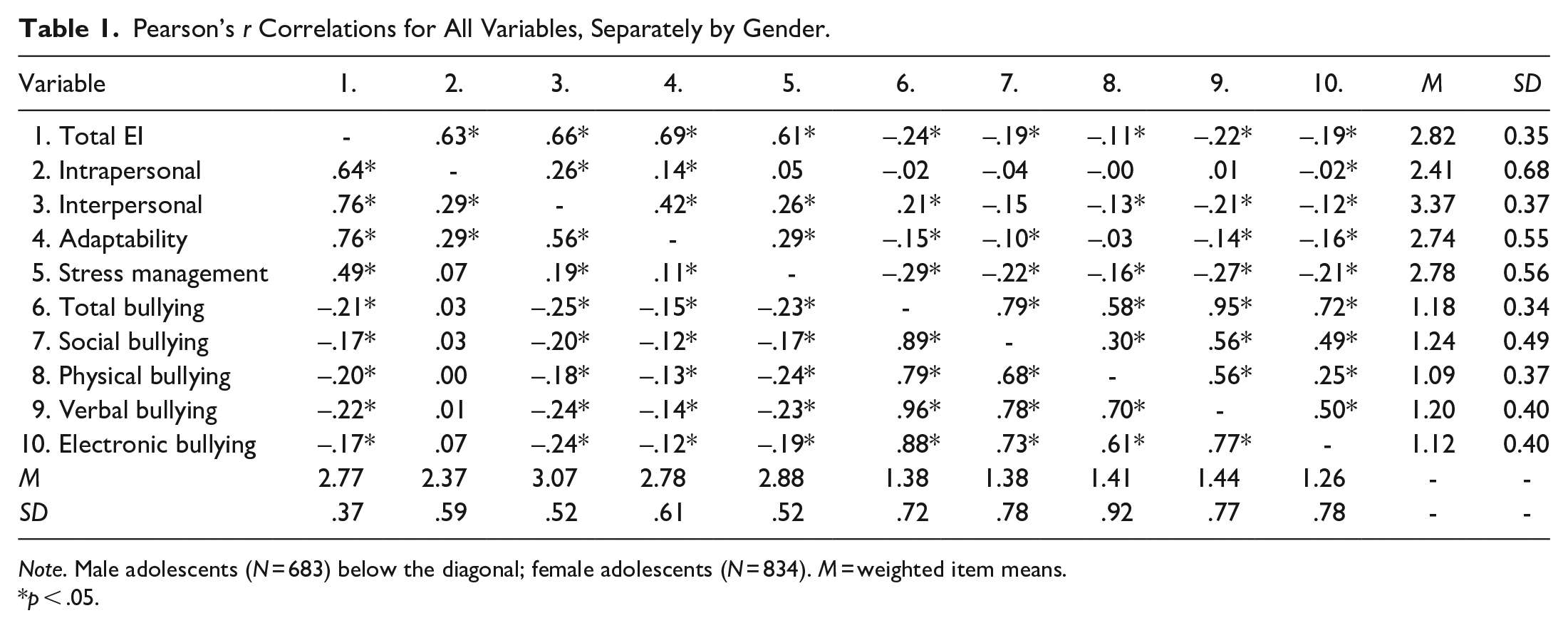
Note. Male adolescents (N = 683) below the diagonal; female adolescents (N = 834). M = weighted item means.
p < .05.
A mixed model gender by bullying type (verbal, social, physical, or electronic) ANOVA was also calculated using mean-item bullying scores as the dependent variables. Mauchly’s Test of Sphericity (Mauchly, 1940) indicated that the assumption of sphericity had been violated (p < .05), so a Greenhouse-Geisser correction (Greenhouse & Geisser, 1959) was used. A significant main effect was found for bullying type, F(2.68, 4065.75) = 8.30, p < .001, η2 = 0.007, and for gender F(1, 1515) = 58.35, p < .001, η2 = 0.027. The interaction between gender and bullying type was also significant, F(2.68, 4065.75) = 47.22, p < .001, η2 = 0.014. Planned contrasts revealed that boys scored significantly higher across all bullying types (p < .001).
Relationships Between TEI and Bullying
As shown in Table 1, all bullying scales correlated negatively with total EI, interpersonal, adaptability, and stress management dimensions. A series of hierarchical regressions were done with the four TEI scales as predictor variables and each of the five bullying scales as outcome variables (total bully, social, physical, verbal, and electronic), while controlling for age and gender. A summary of the regressions is presented in Table 2.
Summary of Hierarchical Multiple Regression Results from Separate Standard Regressions of the EQi:YV Dimensions Predicting Bullying Dimensions.
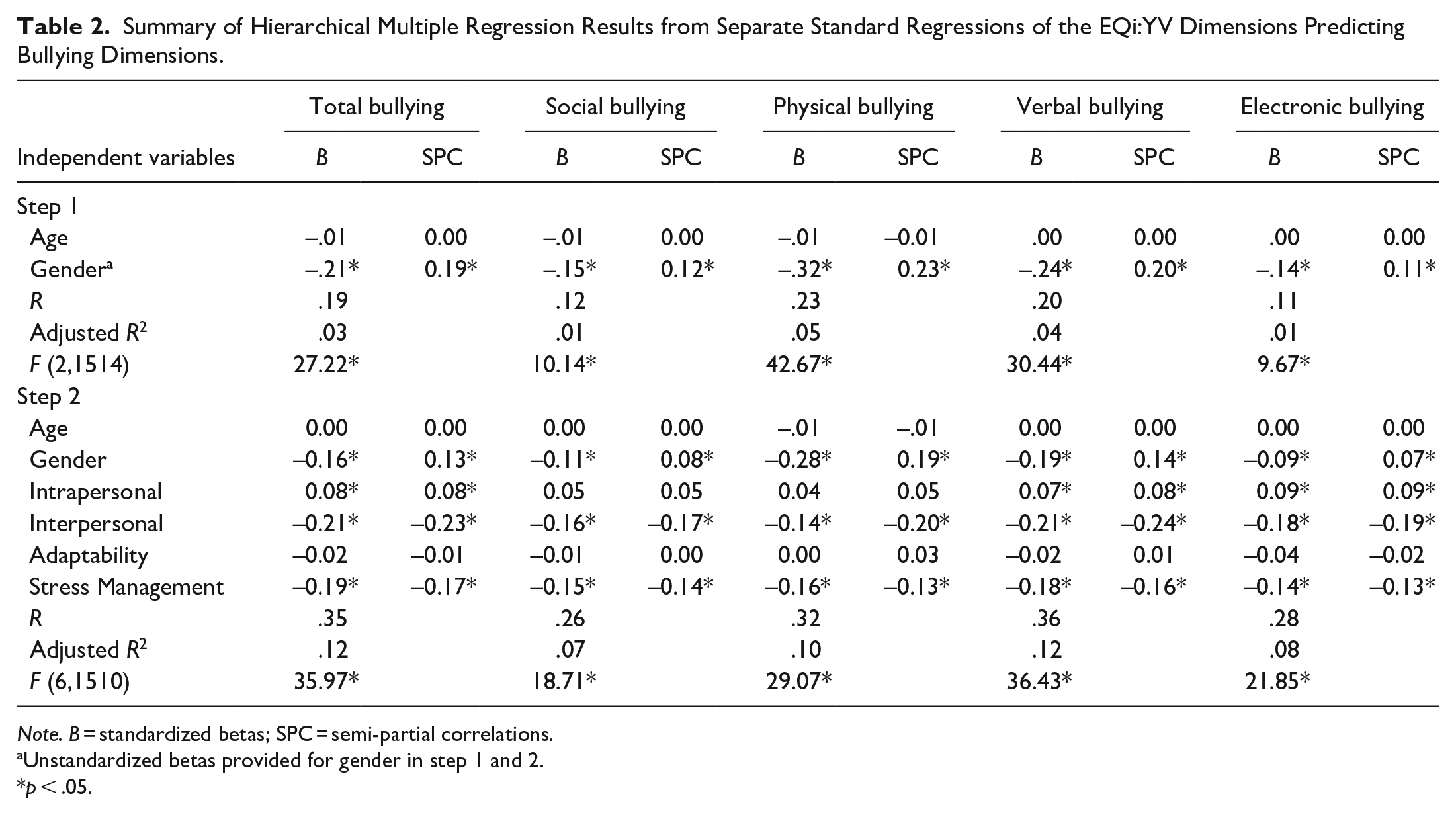
Note. B = standardized betas; SPC = semi-partial correlations.
Unstandardized betas provided for gender in step 1 and 2.
p < .05.
The hierarchical multiple regression for total bullying scores was found to be significant at step 1, with gender contributing significantly to the regression model, F(2,1514) = 27.22, p < .001, and accounting for 3.3% of the variability in total bullying. Age did not significantly add to the model. At step 2, a significant regression equation was found, F(6,1510) = 35.97, p < .001, and accounted for an additional 9.0% of the variability. When all six independent variables were included in step 2, neither age nor adaptability were significant predictors. The strongest predictors of total bullying were gender (male), intrapersonal, interpersonal, and stress management, which accounted for 12.2% of the variability.
The hierarchical multiple regression for social bullying was found to be significant at step 1, with gender contributing significantly to the regression model, F(2,1514) = 10.14, p < .001, and accounting for 1.2% of the variability in social bullying; age did not significantly add to the model. At step 2, a significant regression equation was found, F(6,1510) = 18.71, p < .001, and accounted for an additional 5.6% of the variability. When all six independent variables were included in step 2, neither age, intrapersonal, nor adaptability were significant predictors. The strongest predictors of social bullying were gender (male), interpersonal, and stress management, which accounted for 6.5% of the variability.
The hierarchical multiple regression for physical bullying was found to be significant at step 1, with gender contributing significantly to the regression model, F(2,1514) = 42.67, p < .001, and accounting for 5.2% of the variability in physical bullying; age did not significantly add to the model. At step 2, a significant regression equation was found, F(6,1510) = 29.07, p < .001, and accounted for an additional 5.0% of the variability. When all six independent variables were included in step 2, neither age, intrapersonal, nor adaptability were significant predictors. The strongest predictors of physical bullying were gender (male), interpersonal, and stress management, which accounted for 10.0% of the variability.
The hierarchical multiple regression for verbal bullying was found to be significant at step 1, with gender contributing significantly to the regression model, F(2,1514) = 30.44, p < .001, and accounting for 3.7% of the variability in verbal bullying; age did not significantly add to the model. At step 2, a significant regression equation was found, F(6,1510) = 36.43, p < .001, and accounted for an additional 8.8% of the variability. When all six independent variables were included in step 2, neither age nor adaptability were significant predictors. The strongest predictors of verbal bullying were gender (male), intrapersonal, interpersonal, and stress management, which accounted for 12.3% of the variability.
The hierarchical multiple regression for electronic bullying was found to be significant at step 1, with gender contributing significantly to the regression model, F(2,1514) = 9.67, p < .001, and accounting for 1.1% of the variability in electronic bullying; age did not significantly add to the model. At step 2, a significant regression equation was found, F(6,1510) = 21.85, p < .001, and accounted for an additional 6.7% of the variability. When all six independent variables were included in step 2, neither age nor adaptability were significant predictors. The strongest predictors of electronic bullying were gender (male), intrapersonal, interpersonal, and stress management, which accounted for 7.6% of the variability.
TEI and Bullying Incidents
Table 3 presents means and standard deviations for the TEI dimensions across bully group and gender for Sample 2. A mixed model gender by bully group by TEI dimension ANOVA was calculated using mean-item TEI scores as the dependent variable. A significant main effect was found for TEI dimension, F(3,198) = 39.20, p < .001, η2 = .196, and for bully group F(1, 66) = 16.08, p < .001, η2 = .086. No significant main effect for gender was found, and the various interactions were also not significant. Planned contrasts revealed that bullies had significantly lower scores on all four TEI subscales: intrapersonal t(191.23) = 2.34, p = .02, interpersonal t(191.23) = 2.31, p = .02, adaptability t(191.23) = 3.04, p = .003, and stress management scores t(191.23) = 3.82, p < .001.
Means and Standard Deviations for EI Dimensions by Bully and Gender Groups.
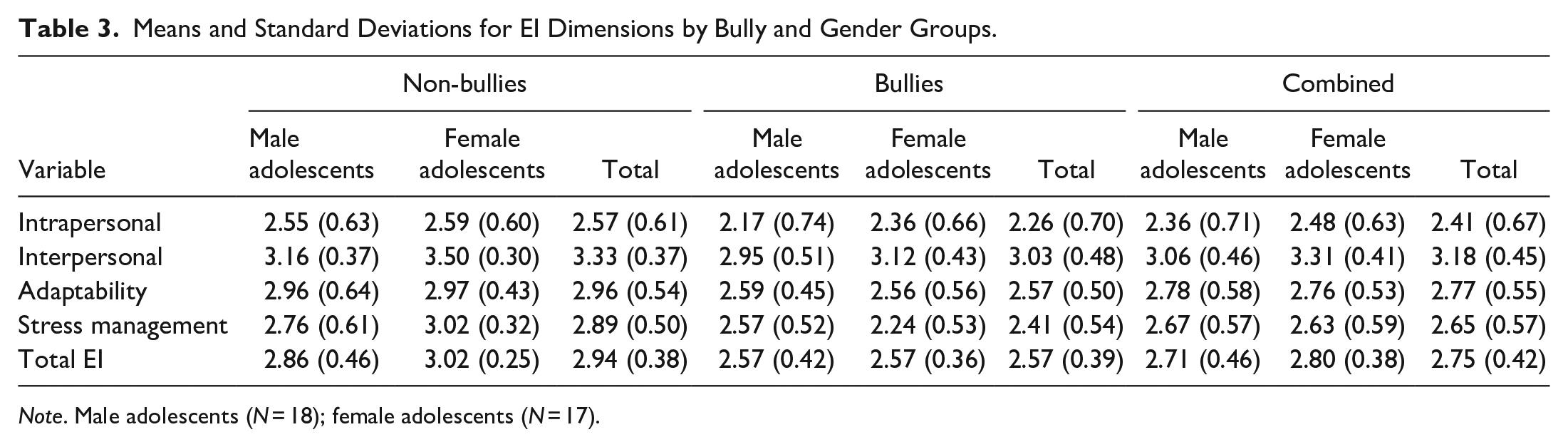
Note. Male adolescents (N = 18); female adolescents (N = 17).
Discussion
The purpose of this study was to use a large sample of male and female high-school students to study relationships among different types of bullying behaviors (i.e., social, physical, verbal, and electronic) and TEI. The study used an assessment tool for TEI that allowed for a broad range of TEI-related dimensions to be explored (connected to one of the more widely accepted models of TEI; Bar-On, 1997). The core finding was that both male and female students (as well as older and younger participants) with higher levels of TEI are less likely to engage in bullying perpetration of any sort (i.e., verbal, physical, social, electronic). Conversely, gender was found to be a significant predictor across all bullying types, with the likelihood of being a bully increasing for boys.
Previous research on the link between TEI and bully behaviors has relied almost exclusively on self-report measures of bullying perpetration, which are known to be vulnerable to response biases, such as social desirability biases (Branson & Cornell, 2009). To address this, we compared a sample of school-documented adolescent bullies with an age and gender-matched non-bully sample. We found that individuals with school documented instances of bullying had significantly lower TEI scores. Our findings provide robust support, free of response biases, that bullies lack key emotional and social competencies compared to individuals who do not engage in bullying behaviors.
For Sample 1, the relationship between TEI and bullying maintained similar patterns of significance across all bullying types, with interpersonal and stress management being the strongest predictors. These findings are in line with previous research on the importance of social skills, specifically, understanding and recognizing the emotions and feelings of others (Lomas et al., 2012; Rueda et al., 2021) in the development of bullying behaviors. Individuals with a general disregard for the emotions of others, and those unable to foresee and relate to others’ emotions, are more likely to engage in aggressive interpersonal conduct. Although it has been proposed that highly developed social skills are needed to bully peers effectively (Björkqvist et al., 2000), our results suggest that individuals with higher self-perceived interpersonal competence are less likely to bully. Greater understanding and recognition of the emotions of others may decrease the likelihood that an adolescent will engage in bullying behaviors, plausibly due to heightened awareness of the potential consequences of this behavior for the victim.
Increased levels of self-perceived stress management were found to be associated with lower levels of self-reported bullying perpetration. This is consistent with the idea that individuals with poor regulatory abilities are more likely to externalize negative affect in maladaptive ways, including bullying behaviors, as a method of coping (Saarni, 1999). It also corroborates existing findings (e.g., Lomas et al., 2012; Polan et al., 2013), indicating that stress tolerance and impulse control may act as protective factors against the development of bullying behaviors in adolescence.
Girls had higher total TEI scores than boys, consistent with gender norms (Pérez-Díaz et al., 2021; Schutte et al., 1998). However, across the TEI dimensions, girls only scored higher on interpersonal competencies, whereas boys scored higher on stress management, though the effect size for these gender differences was small (η2 = 0.01). No differences in adaptability or intrapersonal competencies were observed. Also consistent with bullying norms, boys had higher bullying scores than girls across all bullying types (Carbone-Lopez et al., 2010).
The regression results which shows that self-perceived intrapersonal skills significantly predicted electronic, verbal, and total bullying, was unexpected. Given the small effect sizes (standardized betas ranging from .07 to .09) and the weak correlations between this TEI variable and the bullying scales (ranging from −.01 to .07), this finding is likely spurious. In other words, this predictor is likely influencing the dependent variable through mechanisms such as interaction, suppression, or multicollinearity with other variables in the model.
Although the study did include a sample with corroborated bullying incidents, most of the relevant analyses relied on self-report instruments for both TEI and bullying. Additionally, the sample of documented bullying perpetration cases was relatively small and could not be categorized in different types of bully behaviors. Future studies would benefit from the use of larger samples and the adoption of methodological variations that stray from the traditional use of self-report (e.g., observer- or peer-report measures).
Relevance to the Practice of School Psychology
The results of the present study will be of interest to those connected to school-based intervention programs for bully behaviors, whether to those developing new programs, or those responsible for existing programs. Our finding that students with higher TEI competencies are less likely to engage in bullying behaviors of any sort helps to explain why intervention programs that target TEI-related competencies like empathy and emotion regulation have greater impact than programs that focus on other skills (Zych et al., 2019). The evidence that EI-related competencies can be effectively taught through school programs (Crane et al., 2020; Durlak et al., 2011; Storey-Hurtubise et al., 2022) suggests that anti-bullying initiatives should focus on developing these competencies.
Footnotes
Declaration of Conflicting Interests
The author(s) declared no potential conflicts of interest with respect to the research, authorship, and/or publication of this article.
Funding
The author(s) received no financial support for the research, authorship, and/or publication of this article.
