



Abstract
This study examined whether the assessment of executive function (EF) added a unique contribution to second language (L2) reading comprehension in children in French immersion. Participants were 8- to 9-year old children who completed a collection of measures assessing French reading (i.e., word reading, decoding, and reading comprehension ) and EF (working memory, inhibition, and shifting). After controlling for word-level reading, measures of shifting explained the most variance in reading comprehension compared to the variance accounted for by working memory and inhibition. The results add to the growing evidence of EF’s contribution—especially shifting—to reading comprehension within the context of early literacy learning in the L2.
Immersion language programs, like French immersion (FI), integrate the teaching of content and language placing parallel emphasis on academic achievement and second language (L2) acquisition (Lyster & Genesee, 2019). Concurrent L2 and literacy learning requires children to recruit, activate, and fortify cognitive control processes (Babayiğit et al., 2022; Taboada et al., 2021). These cognitive control processes constitute the executive function (EF) construct, a collection of top-down mental processes associated with pre-frontal functioning that control, organize, and direct cognitive ability and behavior when performing a task (Diamond, 2013; Miyake et al., 2000). Children in an L2 immersion context are simultaneously learning to speak, read, and to write in a societal non-dominant language that may also differ from the home language (Birke Hanson et al., 2017; Genesee & Jared, 2008). In the presence of competing lexical representations activated from either language, research suggests that EF provides a supervisory system of component processes that update, inhibit, and flexibly shift attention between languages (Bialystok, 2015; Green, 1998; Taboada et al., 2021). As Babayijit et al. (2021) also noted, the demands on this system may be even greater when children are not only controlling the activation of both languages, but also the coordination of reading processes and skills in the L2.
Miyake et al. (2000) model of EF as a collection of higher-order control processes distinct from each other, but not entirely independent, has informed the corpus of research on EF and the relations between EF and reading comprehension (RC). This “non-unitary” view of component EF processes includes working memory (WM) (i.e., maintaining and updating information), inhibition (i.e., focusing on the relevant and the deliberate suppression of attention to the irrelevant), and cognitive flexibility or shifting (i.e., shifting between mental sets, stimuli attributes, or strategies as task demands change) (Diamond, 2013; Miyake et al., 2000). RC involves the integration and coordination of multiple component processes and skills in forming mental representations of connected text passages (Butterfuss & Kendeou, 2018; Kendeou et al., 2014). The Simple View of Reading (SVR) considers RC the byproduct of word-level decoding and linguistic comprehension (Gough & Tunmer, 1986; Tunmer & Hoover, 1992) and decoding is a strong predictor of RC in beginning readers (see García & Cain, 2014; Gough & Tunmer, 1986).
Various EF measures are associated with individual differences in RC (e.g., Altemeier et al., 2008; Cain et al., 2004; Follmer, 2018; Locascio et al., 2010; Nouwens et al., 2021; Sesma et al., 2009). WM coordinates and consistently updates the multiple components of the RC process from word-level to text level integration, access to background knowledge, and meaning-making (Kintsch, 1998). Children’s lower WM performance is associated with lower recall and RC ability (e.g., Just & Carpenter, 1992; Linderholm & van Den Broek, 2002) and individual differences in WM predict RC outcomes (e.g., Christopher et al., 2012) beyond the contribution of word-level skills (e.g., Sesma et al., 2009
Method
Participants
Third grade children in FI from one school were recruited to participate. The school is in a middle-class neighborhood of a mid-size city on Canada’s west coast where English is the dominant language. FI presents non-francophone Canadian children the opportunity to acquire proficiency in both official languages (French and English) within their Kindergarten to Grade 12 public education. From a sample of 47 children in three classrooms, parental consent was obtained for 35 children (21 girls; 12 boys; mean age = 8.65 years) who were all native English-speakers. One child with suspected reading difficulties achieved scores well below age-expectations on the reading measures in French and was thus excluded from the sample reducing the final sample to 34 participants. In the FI program at Grade 3, children’s formal instruction, including their literacy instruction is exclusively in French; thus, they are concurrently developing French L2 oral proficiency and literacy skills. By third grade, children are expected to have developed accuracy and fluency in reading texts in the L2, and developing RC through strategies aimed at activating prior knowledge, using elements within the text to enhance understanding (e.g., character, setting, etc.) (B.C. Ministry of Education, n.d.).
Measures
A measure of oral English vocabulary was administered to all children as a proxy for native English proficiency. The measures used across each of the three components of EF (WM, inhibition, shifting) have been validated with the age range of participating children (Serpell & Esposito, 2016) and are commonly used indicators in EF research (Karr et al., 2018). EF measures were administered in English and reading measures were administered in French by French-speaking examiners. Three of the measures included scaled scores (M = 10; SD = 3) which were converted to standard scores to align with the other measures (M = 100; SD = 15) for subsequent analyses. Assessments were conducted according to standardized procedures during the spring of the school year. Starting and stopping rules for all tasks were based on the basal and ceiling rules described in the test manual an raw scores were converted to standard scores.
Oral Receptive Vocabulary
The Peabody Picture Vocabulary Test, 4th Edition (PPVT-4; Dunn & Dunn, 2007) was administered to gage children’s oral English language skills in their L1. This task required children to match a picture to a spoken word. A high internal consistency estimate of .97 for 8- to 9-year-olds are reported in the test manual.
Word-Level Reading
French word-level reading accuracy was assessed with the Lecture de mots subtest from the French version of the Wechsler Individual Achievement Test-2nd Edition (CDN-F; WIAT-II) (The Psychological Corporation, 2005). Children read aloud individual words that gradually became more difficult. Internal consistency estimates based on coefficient alpha are reported between .92 and .95 for 8 to 9-year olds.
Decoding
Children completed the Décodage de pseudo-mots subtest from the WIAT-II-CDN-F where they were required to accurately pronounce a list of non-words according to French phonetic rules that gradually became more difficult. Internal consistency estimates ranged from .95 to .97 for children 8 to 9 years old.
Reading Comprehension
The Compréhension de lecture subtest of the WIAT-II-CDN-F was administered to assess children’s comprehension of French texts. Children read a series of passages and answered orally posed questions about what they had read with the text available for reference. The questions covered the content of the passages (e.g., main idea, story details), inferences derived from the story’s content, and the meaning of certain words within the text. The internal consistency reliability of the RC subtest is high, with alpha coefficients ranging from .94 to .96 for ages 8 to 9.
Working Memory
The Digit Span Backward subtest of the Wechsler Intelligence Scale for Children, Fourth Edition (WISC-IV; Wechsler, 2014), was administered to assess WM. This task required children to orally repeat increasingly longer number strings in the reverse order than presented. The internal consistency reliability alpha coefficient ranges from .78 to .86 for children between the ages of 6 and 8 years.
Inhibition
Children completed Condition 3 of the Color-word Interference Test from the Delis Kaplan Executive Function System (DKEFS; Delis et al., 2001) where they were required to name the color of the ink in which the letters were printed and not the word (e.g., responding “blue” to the word “red” printed in blue ink). This task reflects the classic Stroop paradigm and captures children’s inhibition of a prepotent response (naming the word) to produce a conflicting response (naming the color). Raw scores are based on completion time. Split half estimates across the four conditions for ages 8 to 9 years is reported to be .79 to .72.
Shifting
The following three measures were used to assess shifting: (1) The Trail Making Test (DKEFS) where children completed three conditions assessing their ability to connect numbers in sequence displayed on a page (Number Sequencing), connect letters in alphabetic sequence on a page (Letter Sequencing), and alternately switch between connecting numbers and letters in sequence (Number-Letter Switching). Raw scores are based on completion time. Split half estimates across four conditions for ages 8 to 9 years is reported to be .78 to .72. Children’s performance on the switching condition (Number-Letter Switching) was used in the analysis. (2) The Letters-Numbers-Colors condition of The Rapid Automatized Switching (RAS) task from the RAN/RAS (Wolf & Denckla, 2005) was also administered. This task required children to name a series of letters, numbers, and colors randomly displayed quickly and accurately on a page. Raw scores are based on completion time. (3) The non-computerized 64-card version of the Wisconsin Card Sorting Test (WCST-64; Kongs et al., 2000) was the third measure assessing shifting. Children were asked to sort cards “along an unspecified dimension” (e.g., color). They were not told which sorting rule was in effect but were provided with immediate feedback on the accuracy of their sorting match. Following 10 consecutively correct sorting matches, the rule changes (color, shape, or number) without alerting the child. Raw scores are based on the number of perseverative errors. Perseverative errors reflect the persistent use of a previous sorting rule despite feedback that the rule no longer applies and have been used by others as an indicator of shifting (e.g., Kieffer et al., 2013; Miles et al., 2021). Reliability estimates based on Spearman r indicate a correlation of .74 between total errors and perseverative errors for children and adolescents.
Procedure
All the tasks were completed in a quiet room in the children’s schools in 1 hr-long session. Tasks were completed in counterbalanced order across two blocks (EF measures and reading measures) with a fixed order of tasks within blocks.
Results
Normality estimates based on skewness and kurtosis for the sample standard score distributions (M = 100, SD = 15) ranged within acceptable limits (−0.05 to 0.05). Tolerance indices were also within acceptable limits (all estimates > 0.714). Descriptive statistics are presented first, followed by the results of the correlational analysis. Finally, two sets of regression analysis were run: The first examined the contribution of WM and inhibition to L2 RC after controlling for L2 word-level reading and decoding skills. The second analysis examined the contribution of shifting based on the three measures included once children’s word-level skills were controlled. A word-level composite score was computed for regression analyses based on children’s mean score on the French word reading and pseudoword decoding measures. Table 1 shows the scores across the reading and EF measures. This group of children in FI had strong English oral vocabulary skills, as indicated by an overall mean standard score above age-expectations on the receptive vocabulary measure. Performance across the RC and EF measures were all well within the average range for children’s ages. French word reading and decoding skills fell just below the average range overall likely because the measures used were normed on a francophone (not FI) population. Available achievement measures normed on the FI population are scarce.
Descriptive Statistics for Oral Vocabulary, Reading and EF Measures.
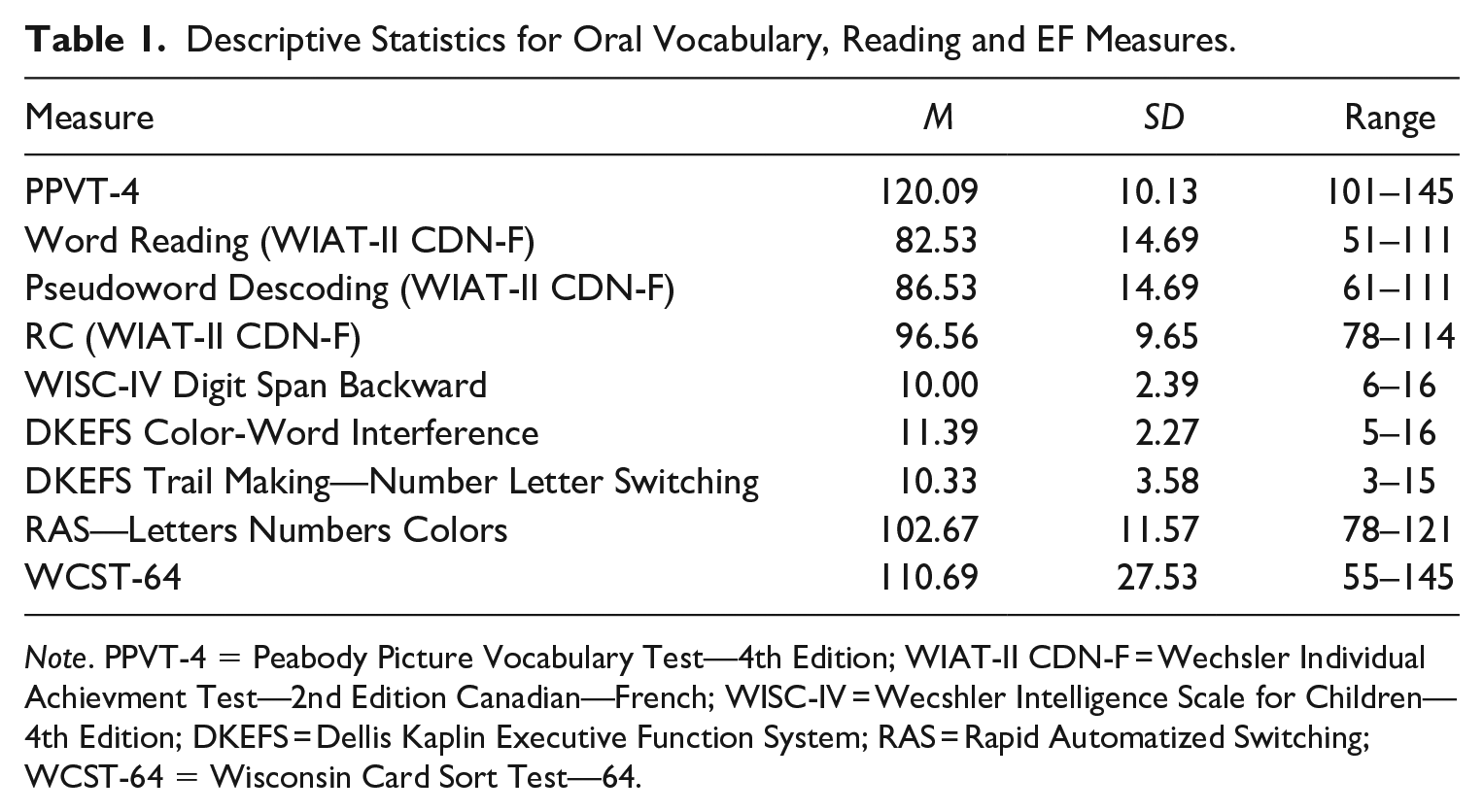
Note. PPVT-4 = Peabody Picture Vocabulary Test—4th Edition; WIAT-II CDN-F = Wechsler Individual Achievment Test—2nd Edition Canadian—French; WISC-IV = Wecshler Intelligence Scale for Children—4th Edition; DKEFS = Dellis Kaplin Executive Function System; RAS = Rapid Automatized Switching; WCST-64 = Wisconsin Card Sort Test—64.
The results of the correlation analysis are shown in Table 2. Children’s oral language skills assessed with the PPVT-4 in English were significantly related to French RC, but not to word or pseudoword reading in French. Performance on the PPVT-4 also significantly correlated with children’s scores on the inhibition measure (color-word interference). Of the EF measures, only inhibition and one of the shifting measures (RAS) significantly correlated with the reading measures: inhibition with word reading and RC (but not pseudoword decoding). RAS also significantly correlated with the inhibition task. There were no other significant correlations.
Correlations Among Reading and EF Measures.
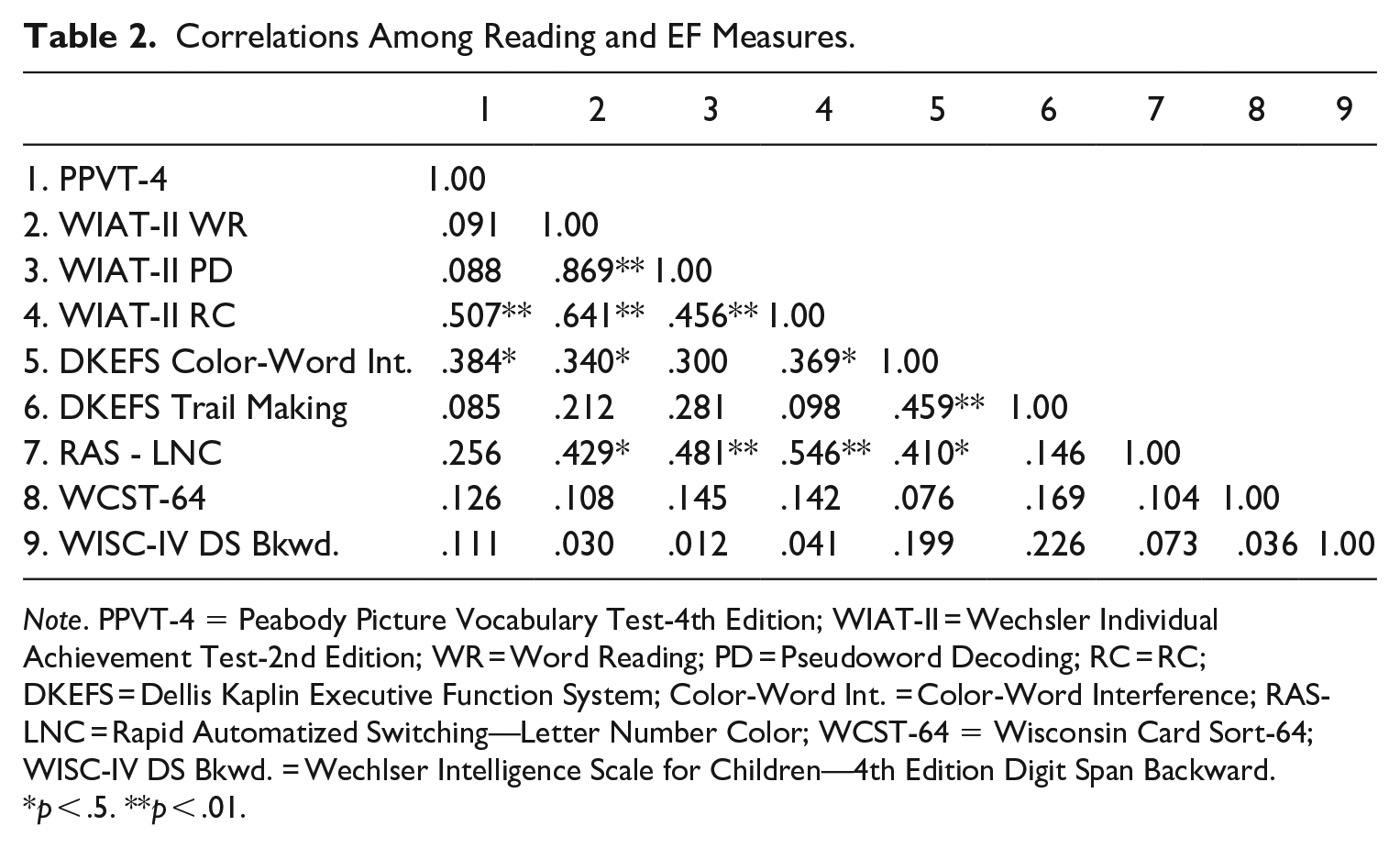
Note. PPVT-4 = Peabody Picture Vocabulary Test-4th Edition; WIAT-II = Wechsler Individual Achievement Test-2nd Edition; WR = Word Reading; PD = Pseudoword Decoding; RC = RC; DKEFS = Dellis Kaplin Executive Function System; Color-Word Int. = Color-Word Interference; RAS-LNC = Rapid Automatized Switching—Letter Number Color; WCST-64 = Wisconsin Card Sort-64; WISC-IV DS Bkwd. = Wechlser Intelligence Scale for Children—4th Edition Digit Span Backward.
p < .5. **p < .01.
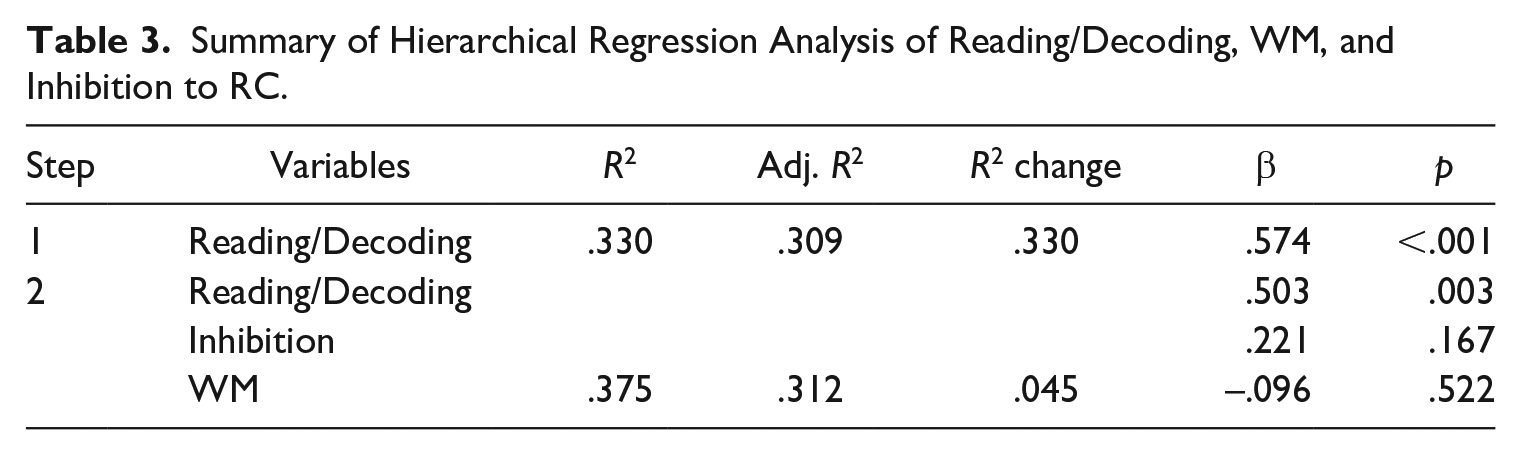
Finally, we examined the contribution of EF to L2 RC above and beyond the influence of L2 word level reading and decoding. Two hierarchical regression analyses were conducted with word level reading/decoding entered at Step 1 in both analyses: the first included WM and inhibition entered together at Step 2 (see Table 3) and the second included the three shifting measures entered together at Step 2 (see Table 4). As shown in Table 3, after controlling for children’s word level reading/decoding skills, inhibition and WM accounted for an additional 4.5% (R2 change = .045) of the variance in RC, but this contribution was not significant. As shown in Table 4, the combination of shifting measures together accounted for an additional 16.5% of the variance in RC (adj. R2 = .425) due mainly to the influence of RAS, the automatized switching measure (β = .372, p = .019) and to a lesser extent the WCST-64 (β = .261, p = .065).
Summary of Hierarchical Regression Analysis of Reading/Decoding, WM, and Inhibition to RC.
Summary of Hierarchical Regression Analysis of Reading/Decoding and Shifting Measures to RC.
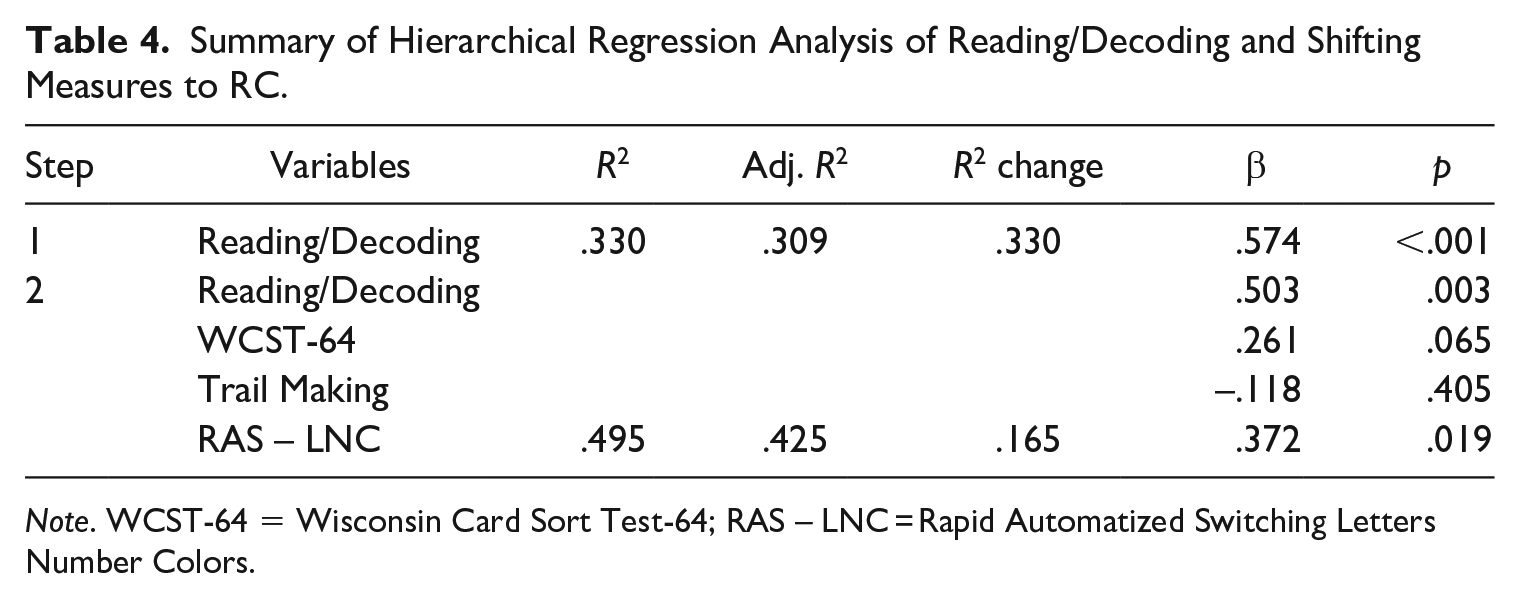
Note. WCST-64 = Wisconsin Card Sort Test-64; RAS – LNC = Rapid Automatized Switching Letters Number Colors.
Discussion
Although overall French word reading and decoding skills fell slightly below average, children’s RC skills assessed in French were within age expectations. We found evidence of cross-linguistic association (r = .63) beween children’s L1 vocabulary skills and their L2 RC, which may explain the stronger mean peformance on the latter task than on L2 word reading and pseudoword decoding, neither of which were strongly correlated with L1 vocabulary. Others have also reported correlation coefficients of a similar magnitude (r = .64) between an earlier version of the same measure in English (PPVT-III) and French RC in slightly older Canadian children (Grades 4 and 6) in FI (e.g., Bérubé et al., 2022). Our findings align with those of Bérubé’s et al’s as suggestive of linguistic interdependence across L1 language and L2 literacy (Cummins, 1991; Uchikoshi & Marinova-Todd, 2019).
Performance across all of the EF measures was also within age-expectations. As children’s performance was compared to English L1 norms, our results add to the growing evidence of limited or no EF advantage in children who are L2 speakers (Gunnerud et al., 2020; Nichols et al., 2020; Paap et al., 2015). Inhibition as measured by color-word interference was significantly correlated with L2 word reading and RC (but not with pseudoword decoding). Likewise, only one of the shifting measures (RAS) significantly correlated with all of the reading measures. RAS was also significantly correlated with the inhibition task. Performance on digit span backward (WM), trail making, and WCST-64 (shifting) was not significantly correlated with any of the reading measures. The fact that RAS had the strongest association with RC among the three shifting measures and that the inhibition measure (color-word interference) was also significantly correlated with RC may be due to the task-specificity in relation to reading of these EF tasks, as suggested by others (e.g., Cartwright et al., 2016). Both measures place demands on children’s rapid access to lexical information. Color-word interference requires the suppression of a prepotent lexical response (naming the color of the ink and not reading the color word) and performance on the RAS task requires rapid access and shifting of names codes in memory (between colors, numbers, and letters). Children’s performance on color-word interference was also significantly correlated with their PPVT-IV performance, providing further indication of the activiation of lexical retrieval processes for task completion. Performance on the WCST-64, considered a domain general shifting measure (Hund et al., 2023) had the smallest correlation with RC and placed the least demands on lexical access for task completion, however. The correlation between color-word interference and RAS is also indicative of some shared variance, consistent with Miyake et al.’s (2000) view that measures capturing underlying EF components are not entirely independent.
It was somewhat suprising to find that WM was not significantly correlated with RC given the exant literature on such an association (e.g., Butterfuss & Kendeou, 2018; Carretti et al., 2009; Follmer, 2018). Georgiou and Das (2018) suggested that RC places greater demands on higher level cognitive processing than the rather shallow processing and storage demands of the digit-span backwards task. Tasks measuring WM in the language domain (i.e., domain-specific tasks) are consistently reported to be better predictors of children’s RC than tasks measuring WM in non-language domains (e.g., visual/spatial tasks; Shah & Miyake, 1996).
Based on the hierarchical regression analyses and after controlling for the variance in word-level reading skills, WM and inhibition explained an additional 4.5% of the variance in RC and together the shifting measures explained an additional 16.5% of the variance in RC. That most of the variance in reading comprehenion was subsumed by children’s French L2 word level reading skills is unsurprising given the critical role that code related skills have in early reading development (García & Cain, 2014) and for children in the FI context (e.g., Bérubé et al., 2022). Inibition (i.e, stroop task) has been reported to contribute 5%−6% of variance to RC in younger (e.g., Conners, 2009) and older (e.g., Parker, 2022) children and our findings are consistent with these estimates.
A main objective of the current study was to examine how the assessment of of shifting contributes to L2 RC. RAS and WCST-64 explained additional variance in children’s RC beyond word-level reading. What is noteworthy is the nature of the tasks included with one (RAS) considered a “reading specific” measure and the other (WCST-64) considered a domain general EF measure, as already noted. In a longitudinal study, Altemeier et al. (2008) also used the RAS task as a measure of shifting and reported its unique prediction of RC in Grades 2, 3, and 5 after accounting for inhibition, and explaining 10% to 18% of shared variance in RC across grades. Our findings replicate the contribution of RAS as a measure of shifting to RC. Likewise, using a multivariate path model analyses and measuring shifting with the WCST-64, Kieffer et al. (2013) reported that performance on this task made a direct contribution to performance to RC in 9- to 10-year olds beyond phonological awareness, word recognition, oral language, processing speed, and WM. The present results add to the growing empirical support for the role that shifting has to RC and provides evidence of its contribution in the FI context in relation to the coordination of word-level and text-level processing demands of the L2 reading task (Bialystok, 2015). The results also highlight the importance for researchers and psychologists to consider the task specificity of EF measures in relation to reading when conducting assessments.
In addition to limited power due to sample size, our sample was also drawn from a relatively homogenous population of English oral language dominant, FI children, limiting the study’s generalizability. Although we did not set out to test the SVR, it would have been interesting to have included a French listening comprehension measure and to have examined the contribution of EF components beyond those (decoding/listening comprehension) specified in the model and EF components (Duke & Cartwright, 2021). Given the ubiquity of curriculum based reading measures in practice and their recent inclusion in models evaluating reading and EF (e.g., Hund et al., 2023) future research on the comparison of various reading measures and assessment approches (norm-referenced, CBM, criterion-referenced, etc.) would be valuable and informative to research and to practice. There are substantial differences in stimuli and task demands of a variety of measures purportedly measuring RC (Cutting & Scarborough, 2006) as there are in those capturing the EF construct (Karr et al., 2018; Miyake et al., 2000). There is also promising research on incorporating reading specific shifting activities into RC instruction, particularly for children experiencing RC difficulties (e.g., Cartwright et al., 2020) that is in need of further study. Of particular interest to school psychologists, it will be interesting to see whether the effects of such interventions generalize to children experiencing reading diffiuclties within the FI or other language immersion (e.g., Spanish) contexts.
Footnotes
Author Note
We extend our sincerest appreciation to the teachers and students who participated in this study, and to Leslie Haberl for helping with data collection and scoring.
Declaration of Conflicting Interests
The author(s) declared no potential conflicts of interest with respect to the research, authorship, and/or publication of this article.
Funding
The author(s) received no financial support for the research, authorship, and/or publication of this article.
