




Abstract
To achieve educational equity for Indigenous students, school psychologists need to consider the implications of using solely Westernized and Eurocentric educational standards of success. With current practices criticized as limiting and biased, a fitting alternative is the use of holistic frameworks of success aligned with Indigenous peoples’ perspectives on lifelong learning. This paper details a community-led process to define success for Indigenous youth in Aklavik, Northwest Territories inspired by the Canadian Council on Learning Inuit Holistic Lifelong Learning Model. Several key lessons, including the need for ensemble mentorship, emerged from this community-led and strengths-based project that can inform school psychologists seeking to better Indigenize their practice and work toward culturally aligned practices.
Over my tenure as an Indigenous administrator, I have been afforded the great honour of working with our Elders who have provided guidance, insight, and support for the required changes that we needed to look at to ensure Moose Kerr School was a community school. This entailed looking within for solutions and working from the inside moving out. We had to start from ground zero and the overarching question the Elders imposed was very indicative of systemic racism being challenged in an indirect approach. Why do these teachers or southern people say our kids are bad in school? When we see them in their natural environment, out on the land, they are very skilled and talented young people, they have a lot of knowledge to offer. Why do others see our students differently when it is the same student within and outside the school walls?
Velma ILLasiak Domoff (Gwich’in Nation, personal communication, April 2022)
The need to consider the implications of using solely Westernized and Eurocentric educational standards of success with Indigenous students and communities is essential for achieving educational equity in these times of hoped-for reconciliation (Lacerda-Vandenborn, 2020; TRC, 2015). Measures such as standardized achievement tests, graduation rates, and dropout rates are useful given their link with social well-being and economic prosperity (Mendelson, 2006), they are also criticized as limiting and even biased when compared with holistic measures of success set out by First Nation, Métis, and Inuit communities. The Canadian Council on Learning’s (CCL, 2007, 2009) holistic lifelong learning models constitute a significant advancement in providing a culturally appropriate and complete assessment of student success based on Indigenous peoples’ perspectives on learning where “the full range of learning opportunities that occur across the life cycle (from infancy through to the senior years) and in a variety of settings (school, home community, workplace and the land)” (p. 4) is acknowledged.
Inspired by the CCL (2007, 2009) Inuit Holistic Lifelong Learning Model, collaborative efforts were undertaken by the remote northern community of Aklavik (a-klah-vihk) supported in various ways by us, the authors of this paper, to identify how the CCL model might be employed and adapted to reflect the wisdom and guidance of local Elders, parents, and educators in redefining educational success for their youth (Wick, 2016). The story that follows explores how Velma ILLasiak Domoff, a visionary community leader from Aklavik, led the redefining of success in this far northern community supported by an emerging student researcher who was in turn supported by a collaborative team of education scholars. We share the story of this community-led process from the perspective of Aklavik to detail what is involved in asserting a vision of self-determination in education with the hope that this deeply collaborative work can inform the field of school psychology as it strives to better Indigenize their practice.
The Aklavik Story
Understanding the role and power of education to move community interests forward, the topic of schooling within the Beaufort Delta region of the Northwest Territories has been tumultuous since contact. The discussions in Aklavik have been no different, yet they hold the additional complexities inherent in a mixed population of Gwich’in, Métis, and Inuvialuit residents. This diversity, beautiful in its complexity and inclusiveness of First Peoples as well as resident non-Indigenous trappers and whalers, has made the articulation of a shared educational vision a considerable challenge. Still, as Aklavik’s early history attests, the community has long prided itself on its ability to meet the needs of all people who called, and continue to call, this place home.
As part of the wider colonial strategy of forced assimilation through education (Battiste, 2013; Smith, 2012), the All Saints Anglican Residential School set down roots in Aklavik in 1919 and the Aklavik Roman Catholic Residential School opened its doors in 1925. With the eventual closing of these schools in the 1950s, another form of colonial schooling arose in the form of federal day schools where students were separated from their families for the school year. These colonial schools have left a deep and lasting wound with the First Peoples of the north, experiences that have scarred multiple generations. The schooling stories of Aklavik mirror the painful stories revealed through the painstaking work of the TRC (2015). Alongside the abuses, these schooling institutions managed to strip any measure of educational success for northern learners, including those from Aklavik.
Some promising initiatives arose in Aklavik’s schooling system in the late 20th century but, significantly, did not shift any markers of success. The first of these was the opening of the current Moose Kerr 1 School in Aklavik in 1969 which allowed students to remain home for their early and middle school years. Still, the older students had to travel far from home to attend school and this residential school-like situation persisted until 1996. Graduation rates remained low during this period with the majority of these students opting to return home rather than finish their studies so far from home. In the years 1990 to 1999, Aklavik reported only three graduates, one a non-resident Indigenous student and two non-Indigenous students. In response, the federal and territorial governments began phasing high school extension programs into remote community schools starting in the late 1980s and continuing to the early 1990s.
Along with low graduation rates, the colonial schooling system in Aklavik had fostered challenges and inequities, including: lack of cultural understanding and empathy, along with limited support from non-Indigenous teachers and staff who were placed in leadership roles; high teacher and administration staff turnover; limited to no parental support or input; and an overall lack of understanding and collaboration between students, staff, and the local community. The hiring of the first ever Indigenous principal in 1996 was perceived by the community as another promising move; however, the serious issues raised by colonial influences meant she stayed only 1 year. It was clear more had to be done to achieve success.
Initial Steps Toward Self-Determination in Education
In 1996, the work of reclaiming education began in earnest with Velma ILLasiak Domoff who held a vision of self-determination for her community. Recruited first as school counselor and then later as principal of Moose Kerr School, Velma initiated the process of re-defining what student success and lifelong learning meant for Aklavik residents. Intuitively, Velma went back to local cultural teachings and practices to guide her. She formed an Elders Advisory group who gathered regularly to discuss local challenges and set out strategies that could move students forward. With restoration of community pride in mind, focus was given to sharing, honoring, and prioritizing traditional ways as the basis for reinforcing students’ sense of personal worth and their role and responsibility as learners. The Elders set out foundational principles that would help guide learners: self-responsibility, honesty and integrity, love and regard, humility and caring, respect, sharing, and friendliness and kindness.
The reclamation of traditional ways extended to leadership and mentorship roles. Teachers were given increased leadership opportunities that empowered their potential. Incoming teachers were acculturated to the community through an “Adopt A Teacher” initiative that paired them with a community member who would guide and advise on local community traditions and protocols. Mirroring traditional practices of mentorship, younger students or learner-apprentices were mentored by more experienced learners who in turn were mentored by master teachers. Students engaged in a form of reciprocity with the wider community, watching, observing, and helping where possible. Students then applied these newly acquired leadership skills to their own school programming, thereby shaping them into the next generation of leaders.
Under Indigenous leadership, school relationships were developed and nurtured in a space that was familial and personal; in essence, school became an extension of home. Parents were invited to open houses at the school and teachers visited family members in their homes. The rigidity of students progressing from one grade to another as a cohort was abandoned and schooling was re-envisioned as a personal journey where students took the time needed to complete their studies in their own way.
These community-led efforts set out a more promising pathway to success than previous initiatives. The idea of working from the inside out to create new understandings for moving forward in education was the guiding intention for the Elders Advisory group. They acknowledged how colonial injustices had damaged the collective psyche of the community and how student pride and ownership over learning had to be restored. Under these conditions, Moose Keer School’s graduation rates soared to 104 graduates between 2000 and 2014 and staff regularly heard young students excitedly making plans for their own graduation.
Although the school culture had positively shifted, not all community members were on board. Some remained distrusting of the school’s efforts to redefine success on local terms given their own personal struggles with education. Knowing these challenges, Velma believed formal research would validate their efforts at redefining success on their terms. When the school’s grade two teacher, Meghan Wick (née Watson), elected to complete a master’s degree in school psychology, Velma saw an opportunity to meet local needs.
The Community-Led Journey of Redefining Success
Having worked together for several years, both Velma and Meghan agreed that a research project focused on redefining success premised on Indigenous relational practices was needed. The value-driven practices implemented in the school would be reflected in their research partnership as Velma’s mentoring ensured Meghan remained focused on what the community wanted and needed. Velma also ensured space was made for all community stakeholders to express ideas that would ultimately contribute to a shared vision of success defined through Aklavik’s diverse community voices.
Although less visible at the community level, the ensemble of mentors supporting this project also included Meghan’s academic mentors. As a faculty member in school psychology, Michelle Drefs was confronted with the task of how she might best support Meghan in the Aklavik project. Although Michelle held much experience in school psychology and working in an on-reserve school, she felt an Indigenous co-supervisor would ensure a culturally appropriate approach. Through a process of meeting with several potential co-supervisors, Meghan felt most connected with Yvonne Poitras Pratt, an Indigenous professor at Werklund, whose doctoral work had focused on supporting the needs and aspirations of her Métis settlement community.
The three came together to discuss options that would best support Aklavik in their wish to move beyond Western modes of assessment in education. Yvonne shared how the CCL (2007, 2009) lifelong learning models, specific to First Nations, Métis, and Inuit peoples, served as exemplars of community-defined visions of success. The presence of relational, holistic, experiential, respectful, and spiritual ways are prominent within and across the three CCL models and are reflective of a robust and collective community engagement process. Excited by the possibilities of what the Aklavik community would think of the Inuit Lifelong Learning Model, we all agreed—Meghan would take the model forward.
The Aklavik community responded positively to the CCL Inuit-specific model and quickly took up the challenge of making the model their own. The focus of their efforts was to explore the factors that defined success according to the Gwich’in, Inuvialuit, and Métis people in Aklavik. This community-led work spanned a total of 4 years, beginning with Meghan’s thesis work and continuing in the community under Velma’s direction. The following model, adapted from the original CCL version, represents years of investing in an educational vision that culturally aligns with how the community of Aklavik understands educational success and reflects the diverse values and beliefs of its Inuvialuit, Gwich’in, and Métis residents (Figure 1).
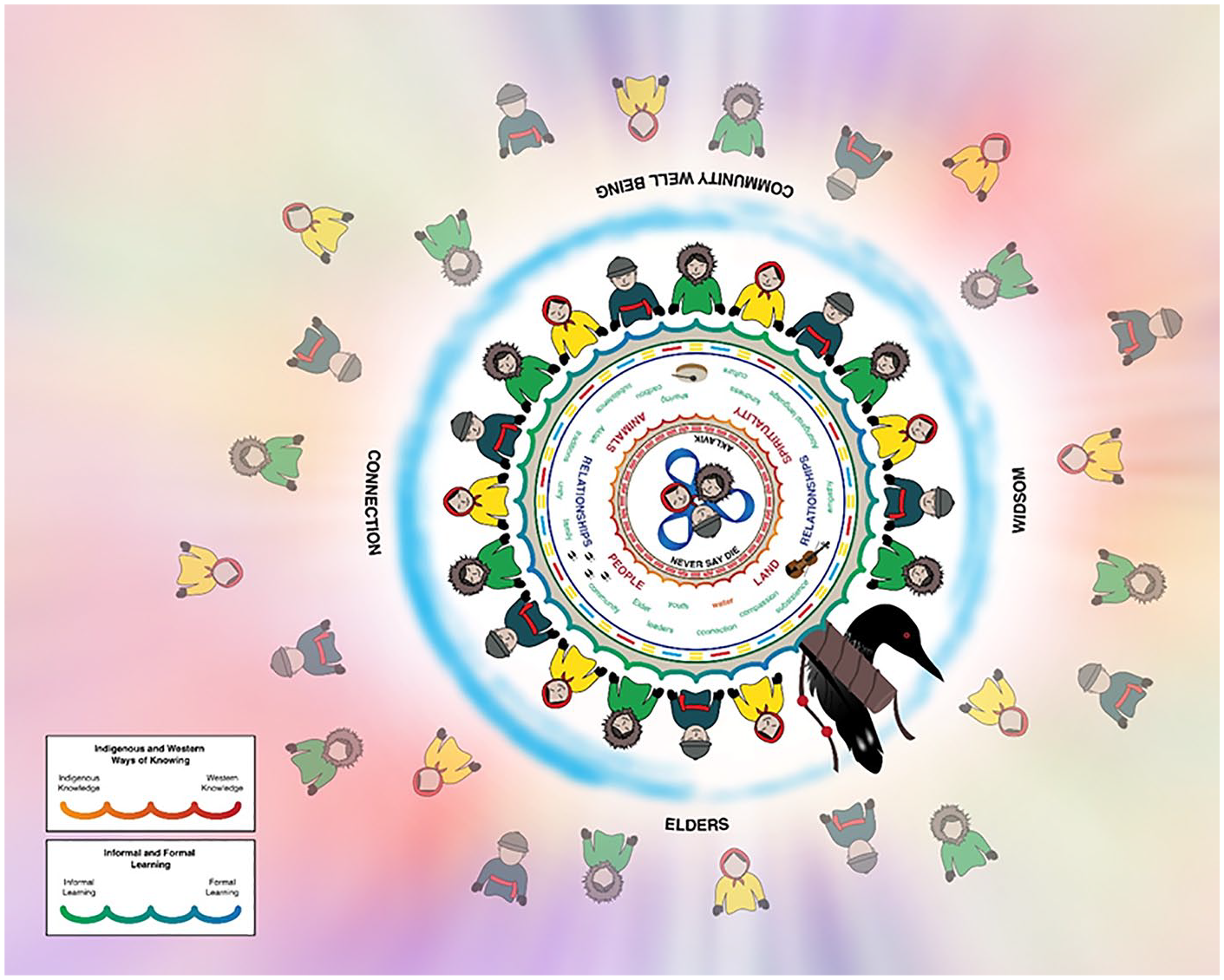
Pilgu-Giniidhan Student Success and Lifelong Learning Model.
The Pilgu (bil - goo)–Giniidhan (genee - thun) Student Success and Lifelong Learning Model 2 derives from the combination of the Inuvialuit word for “being able to” or “can do it” and the Gwich’in word for “you can do it” or “able to do it.” This collective “representation of being able or capable and that a person is able to/can do it no matter their background or their future desires” (ILLasiak & Wick, 2018, para. 3) is reflective of the traditional values Velma had championed early on. In setting out key aspects of the Inuvialuit, Gwich’in, and Métis worldviews, the model represents the collective ideals and uniqueness of the community of Aklavik. 3 The articulation of lifelong learning measures is clearly distinct from mainstream measures of success and is evidenced by the inclusion of unique elements such as land, animals, and spirituality, as essential components of learning.
Also captured in the model is the value placed on experiential ways of knowing, being, and doing that make space for complex and dynamic relationships comprised of land, animals, extended family, and spiritual guidance. The mentoring provided by these unanticipated teachers, two-legged, four-legged, even those of other forms, are honored as an essential part of a student’s successful lifelong learning journey. The model also represents an ethos of collectivism as each person’s individual gifts and talents are needed to lift the individual learner up; in turn, the contributing of individual gifts and talents benefits the community overall.
The Aklavik story is one of deep and intense collaboration between Elders, parents, and local community members working alongside school educators, yet the question remains: How can school psychologists take key lessons from this experience forward in their practice when similar circumstances do not exist and Indigenous ways of knowing, being, and doing lie outside their realm of professional training or experience?
Incorporating Indigenous Models of Success Within the Practice of School Psychology
There is increasing attention given to understanding how psychology can best serve the First Nations, Métis, and Inuit populations in Canada. With the issuance of Psychology’s Response to the Truth and Reconciliation Commission of Canada’s Report jointly by the Canadian Psychological Association (CPA) and the Psychology Foundation of Canada (PFC) in 2018, an important direction for this work is set out. Their provision of guiding principles is intended to provide “practical direction in the day-to-day work” (p. 14) of psychology, yet anecdotally we have found in-service and in-training school psychologists remain uncertain in how they might translate these recommendations into practice. The concerns are real so we cannot continue waiting for the perfect moment—the time for action is now (Regan, 2010).
As the Aklavik story demonstrates, the act of defining success specific to a particular community is hard, intensive work that can span years. The introduction of the CCL Inuit Model of Lifelong Learning in Aklavik involved an appropriate ensemble of community members and specialists with the requisite amount of time to move away from a Westernized model of practice toward a community-centered, holistic approach. Certainly, adopting a similar approach to that outlined in this paper is not readily feasible for practitioners. To assist school psychologists in their efforts to Indigenize their practice and work toward culturally aligned practices, we believe there are several key lessons to be gained from the Aklavik project that can translate more broadly to school psychologists working with Indigenous students or communities. This work starts by asking: Who holds the power to set out markers of success? And, from whose perspective is this definition of success being defined?
Foundational Knowledge: We Are All Learners
Given the colonially biased education that most Canadians have received, it is essential that non-Indigenous school psychologists start to fill this gap in their learning by gaining foundational knowledge of Indigenous peoples (Poitras Pratt & Danyluk, 2019). This means respecting the unique worldviews and longstanding traditions of Indigenous peoples, including their longstanding advocacy for language and cultural revitalization (National Indian Brotherhood, 1972; Royal Commission on Aboriginal Peoples, 1996). It also means starting where you are at—both in terms of assessing your own knowledge around Indigenous peoples and perspectives and by starting with local Indigenous groups. If school psychologists are committed to taking action that can have a positive impact on Indigenous learners, then they must be willing to engage in learning that will guide them in repositioning their professional practices to align with more culturally appropriate approaches.
A good place for school psychologists to start, in terms of gaining foundational knowledge specific to how Indigenous peoples define success in lifelong learning, is becoming acquainted with the three CCL Holistic Lifelong Learning Models. These models represent foundational and authentic bases for a more culturally aligned approach to understanding what success means to the Indigenous students, families, and communities they work with and is further strengthened by the nation-wide involvement of the original participants who not only understand, but live within, these communities.
In taking up this commitment to learn and do better, school psychologists must be willing and able to reflect on their own positionality and inherent biases (see the work of Sensoy & DiAngelo, 2012). This vulnerability requires the courage to engage in open discussions about power and privilege with an Indigenous colleague or with an Elder advisor from the community. Approaching this work in a respectful and collaborative manner allows you to not only demonstrate respect for worldviews different from your own, but there is also much to be learned from Indigenous peoples if space and time is made for their voices to be heard.
Meeting Professional Practice Needs Through Ensemble Mentorship
In addition to taking up the CCL Holistic Lifelong Learning Models and translating these models to professional practice, we see value in the adoption of an ensemble mentorship model. By bringing our individual gifts together, we are as Métis Elder Angie Crerar describes it—“braver together” (lives in Grande Prairie, Alberta, personal communication, November, 2021). In this non-hierarchical relational model premised on Indigenous principles and adapted for educational purposes (Poitras Pratt et al., 2021), the task of defining success for Indigenous students requires a strongly collaborative approach wherein relevant stakeholders, Indigenous and non-Indigenous, each bring their own gifts and unique worldviews in service of how best to support students. By sharing power and control amongst all parties, the standard expert-protégé mentorship model is leveled and extended to include those who are invested in the future success of the student. The deliberate and intentional inclusion of Indigenous experts and professionals who carry specialized knowledge in areas that the non-Indigenous school psychologist may be lacking in or just learning about is essential if culturally appropriate practices are being sought. The ensemble may also include “extended family members and asking them what would be helpful for the person being assessed” (CPA & PFC, 2018, p. 17).
Within this ensemble mentorship, the inclusion of an expert Indigenous community member is essential. In the absence of such a specialist, school psychologists can seek the advice of Indigenous scholars—either through a personal connection or through their scholarship. Indigenous peoples serve as cultural mediators and translators who can advocate for the inclusion of strengths-based Indigenous knowledge traditions within complex social, health, economic, political, and educational environments. They also understand the importance of cultural and spiritual knowledge, including the involvement of Elders, in guiding the work in a good way. With the requisite cultural expertise in hand, Indigenous people can help guide the school psychologist in terms of respectful and relevant approaches to defining what success means. Their inclusion is especially critical for those non-Indigenous psychologists “who do not have appropriate cultural training. . .[as the] risk of misdiagnosing or misdirecting individuals to improper treatment or interventions” (CPA & PFC, 2018, p. 16) is particularly high.
In this model, non-Indigenous school psychologists can provide advice and guidance around how best to navigate and negotiate current structures as the majority of current professional practices and standards are mired in Western understandings. Their role is to see what is possible but, as the CPA and PFC (2018) report points out, non-Indigenous psychologists are working in a profession that is viewed with much apprehension and mistrust so not only must they demonstrate transparency and sincerity in their relational practices, but they must also work to share power. Intellectual humility means they must be ready to put their interests aside in service of the community’s needs and interests and to respect the fact that the community will decide what is best. Bearing in mind the many structural oppressions facing Indigenous students, including racism, poverty, suppression of Indigenous identities, and gender violence, to name just a few (Harper & Thompson, 2017; Louie, 2018), non-Indigenous school psychologists need to question why these inequities exist and why they are allowed to persist.
This type of relationship-building takes time and school psychologists, who are often facing professional pressure in terms of timelines and efficiency, may view the extra time needed to build trusting relationships with families, teachers, students, and community members as untenable (Leonard & Leonard, 2003). Yet, echoing what the Aklavik Elders have shared, Savage (2015) reminds us of the importance of school connectedness emphasizing, “It’s all about relationships; nothing else matters if we don’t connect with the people we serve in schools” (para. 2). Given the extra time and resources that are required for proper and full implementation of the recommendations contained within the CPA and PFC (2018) report, education around the implementation of best practices in support of Indigenous peoples is needed for those who set policy and direction. Importantly, the ensemble grows.
Moving to Culturally Appropriate Assessment Practices
Although the above work broadly applies to all aspects of school psychology practice, particular attention needs to be given to the discipline-specific practice of assessment given the continued centrality of this activity to our profession (Hussar, 2015) and general recognition that “psychological assessment instruments and interpretive methods are culture specific” (American Psychological Association, 2020, p. 20). Commonly endorsed approaches to reduce bias and achieve accurate results when assessing culturally diverse populations, such as the use of local norms, interpreters, and non-standardized administration procedures (CPA & PFC, 2018; Laher & Cockcroft, 2017), fail to address the primary issue with contemporary psychological tests—that being, most remain narrowly grounded in Westernized perspectives of intelligence and normality (CPA & PFC, 2018). In fact, we would argue that contemporary psychological assessment practices are the crux of the compelling question posed at the outset of this paper: “Why do others [i.e., school psychologists] see our students differently when it is the same student, within and outside the school walls?”
Aligning contemporary assessment instruments and practices to be reflective of Indigenous models of success is not an easy undertaking. It requires the vulnerable work of becoming grounded in existing sources of foundational knowledge and working to apply such knowledge to practice through the creation of an ensemble mentorship that will collectively meet professional and community needs. As the Aklavik story demonstrates, our work in Aklavik was deeply rooted in discussions with community members. Similarly, we encourage school psychologists to begin this work by opening up a dialog with family and other community members asking: How would you define success, or successful outcomes, for your child?
Adopting a collaborative approach is essential to doing this work in a good way and school psychologists need to be keenly aware of when they do not hold the requisite expertise in culturally specific practices such as spiritual beliefs and traditions. Ethically speaking, we cannot assess what we do not know. This is where the acquisition of foundational knowledge and the formation of an ensemble mentoring team will prove essential as school psychologists come to understand that they don’t know what they don’t know. Indigenous community members are experts in their knowledge traditions and practices and ultimately their inclusion represents the balance that is needed to achieve culturally appropriate ways forward.
Concluding Remarks
Our fulsome account of how the northern community of Aklavik has been able to implement initiatives that work to define success from their unique perspective is shared as an exemplary practice. By implementing teaching and learning strategies aligned to traditional understandings of success, educational leaders such as Velma have worked alongside community members to reclaim meaningful forms of education. The Aklavik project holds valuable lessons for school psychologists in their day-to-day practices as we bear witness to how sharing power and control—whether that be with a community, a parent, or a student—can make a significant difference in not only assessing, but supporting, successful learning outcomes. For school psychologists and other educational professionals, the adoption of more holistic measures of success affords greater opportunity to identify strengths and achievements that are more culturally and ethically aligned.
Footnotes
Declaration of Conflicting Interests
The author(s) declared no potential conflicts of interest with respect to the research, authorship, and/or publication of this article.
Funding
The author(s) received no financial support for the research, authorship, and/or publication of this article.
