




Abstract
The use of competition to motivate students is common but debated. The purpose of the study was: (a) to examine to whom teachers attribute the common emphasis on competition and (b) to explore the reasons teachers give to minimize competition or not in their classrooms. Teachers attribute the focus on competition least to teachers and then increasingly to students, principals, parents, and school boards. Teachers who try to minimize competition identify the importance of learning and individualization, and those who do not, promote competition as healthy and helpful. Results are discussed in terms of classroom practices and future research.
Introduction
Teachers utilize a variety of teaching practices in an effort to increase student motivation in the classrooms. These practices can include putting a star at the top of a student’s test, allowing students to choose a topic for a project, integrating pop culture into their lessons, letting students work together, and building relationships with students. However, these strategies have different effectiveness and consequences. Some strategies, like utilizing graded tests and assignments to externally motivate students, are linked to an increase in student stress, anxiety, procrastination, and academic dishonesty (e.g., Kanat-Maymon et al., 2015; von der Embse et al., 2018). Alternatively, strategies that intrinsically motivated students, wherein students’ inherent inclination for novelty and challenge are supported, can help students experience more interest, enjoyment, and satisfaction in their learning (Hennessey et al., 2015; Ryan & Deci, 2017). The intentional use of competition and social comparison as one way to extrinsically motivate students is a particularly contentious practice and is the focus of this paper.
The debate among educators about the use of competition and its associated heightened social comparison is longstanding (Tauer & Harackiewicz, 2004). Individuals on the pro-side suggest that the world is full of competition, and thus it is a necessary preparation for students (Shindler, 2009). Individuals on the con-side highlight negatives associated with competition including heightened student anxiety, fear of failure, and decreased intrinsic motivation (Shindler, 2009). Although the debate continues in individual classrooms, the education system on the whole remains entrenched in competition and comparisons marked by standardized assessments and school rankings (Daniels et al., 2020). Indeed, an emphasis on social comparison and competition seems to permeate all aspects of a modern school system to some extent. Teachers post exceptional work on the board or have students compete in review games in preparation for an upcoming exam. Parents attend parent-teacher conferences to discuss their child’s performance relative to the other students. Moreover, principals and school boards worry about annual rankings (Alberta Teachers Association [ATA], 2009). For example, the Fraser Institute has been around since 1974, providing school rankings for decades (Fraser Institute, 2021). While Fraser Institute school rankings are only used in British Columbia, Alberta, Quebec, and Ontario, we highlight them here as the current study was conducted in Alberta.
Research on Classroom Practices and Student Motivation
Researchers have been offering theoretically-grounded classroom practices that are designed to enhance students’ intrinsic motivation for decades. Amongst the many do recommendations, there is only one recommendation researchers consistently recommend teachers avoid: competition and social comparison. For example, of Pintrich’s (2003) five design principles for motivating students one explicitly suggested: “less reliance on social comparison or norm-referenced standards” (p. 672). In an updated set of recommendations, Linnenbrink-Garcia et al. (2016) likewise suggested teachers should “[e]mphasize learning and understanding and de-emphasize performance, competition, and social comparison” (p. 233).
Teachers’ practices, however, may or may not align with recommendations. To explore this, Daniels et al. (under review) asked practicing teachers to describe what they do to motivate their students. Most of the teachers’ practices aligned with researchers’ recommendations, except teachers did not indicate de-emphasizing performance, competition, and social comparison. However, they did mention the use of rewarding students. When Daniels et al. (under review) had a second sample of teachers rank Linnenbrink et al.’s design principles the portion specific to de-emphasizing students’ performance, competition, and social comparison was the least likely to be ranked first and the most likely to be ranked last. The authors speculated that the omission by the first sample of teachers may have been methodological because they asked teachers about actions they take; however, the second ranking made it clear that de-emphasizing competition and social comparison is low on the lists of practices teachers use to support student motivation.
The Current Study
The purpose of the current brief report was twofold (a) to examine to whom teachers attribute the emphasis on performance, competition, and social comparison and (b) explore the reasons that teachers provide when asked about intentionally minimizing performance, competition, and social comparison or not in their classrooms. The results of this brief report can provide important information to school personnel, school psychologists, principals, and other administrators on performance, competition, and social comparison in the classroom.
Method
Participants and Procedures
We collected self-report data from a convenience sample of 475 teachers at a 2-day mandatory teacher’s convention. The full paper and pencil survey contained 85 items; however, only 12 items pertained to performance, social comparison, and competition. Due to the narrow research question and small scope, the items were created by the research team and explicitly used the words performance, social comparison, and competition from Linnenbrink-Garcia et al. (2016). Additional information about the items is provided below. After completing the survey, which required 5 to 15 minutes, participants entered their names into a draw for one of three $100 gift cards to a vendor of their choice. Ethics approval was obtained from the Human Ethics Research Office at the researchers’ university.
Measures
Demographic measures (five items)
To describe the sample, we asked participants to indicate their gender, ethnicity, age, years of teaching experience, and teaching level. The sample identified as predominantly female (72%) and of Caucasian (79%) background. Teachers ranged in age from 21 to 71 (M = 37.25), identified having a wide range of years teaching experience (0–50, M = 11.24) in either elementary (grades K-6, 53.5%) or secondary school (grades 7–12, 46.5%).
Source of competition (five items)
To determine where teachers believed the focus on performance, competition, and social comparison originated, we asked them to indicate the extent to which five members of the school community had this focus. Participants were prompted with the statement: “School is a place that always has some amount of focus on performance, competition, and social comparison. To what extent do you think each of the following groups of people is focused on performance, competition, and social comparison (i.e., who did better than whom, scores, rankings, etc.)?” They responded for students, parents, teachers, principals, and school boards on a scale from 1 (not very focused) to 4 (very focused).
Intentional reduction of competition (two items, one open-ended)
Teachers responded to the forced-choice question “Do you try to intentionally reduce the focus on performance, competition, and social comparison in your classroom?” Then, they wrote a brief explanation (e.g., They all learn different at different rates.) why or why not in an open-ended response.
Results
Source of Competition
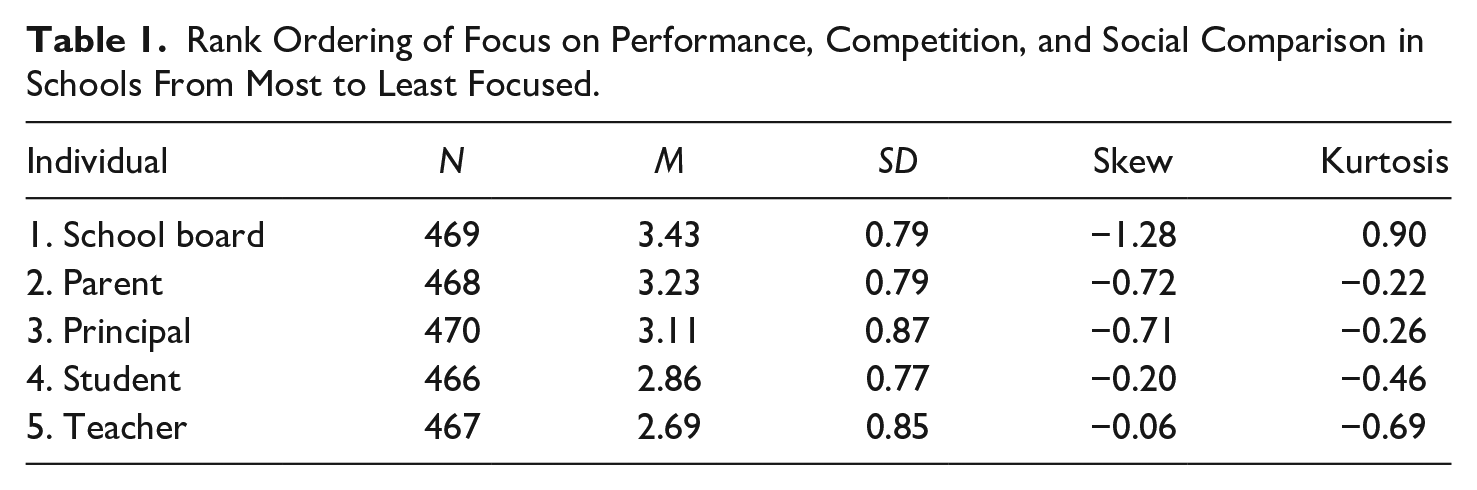
We ran descriptive statistics to determine the rank order of the five sources of performance, competition, and social comparison in schools. From greatest to least participants indicated: school board, parent, principle, student, and teacher (see Table 1).
Rank Ordering of Focus on Performance, Competition, and Social Comparison in Schools From Most to Least Focused.
Intentional Reduction of Competition
About 82% of participants indicated “yes” and 18% indicated “no” to the forced choice question about intentionally reducing the focus on performance, competition, and social comparison in their classrooms. We examined the open-ended responses from “yes” and “no” teachers separately using an online word cloud software (https://wordart.com). Word cloud software is considered to be a quick and easy way to analyze and display the frequency of words in qualitative data such that more frequent words are presented in larger font (e.g., Cidell, 2010; DePaolo & Wilkinson, 2014; Hinkle et al., 2020; Meehan & Howells, 2019), making it appropriate for a brief report on limited data. High-frequency non-specific words like “the,” “because,” and “and” were automatically removed and we manually excluded the word “student.” The word cloud for both groups are presented in Figure 1, with the 10 most frequent words for each group provided in Table 2 with examples. We use direct participant quotes to describe the results below (Elo et al., 2014).
Do You Try to Intentionally Reduce the Focus on Performance, Competition, and Social Comparison in Your Classroom?
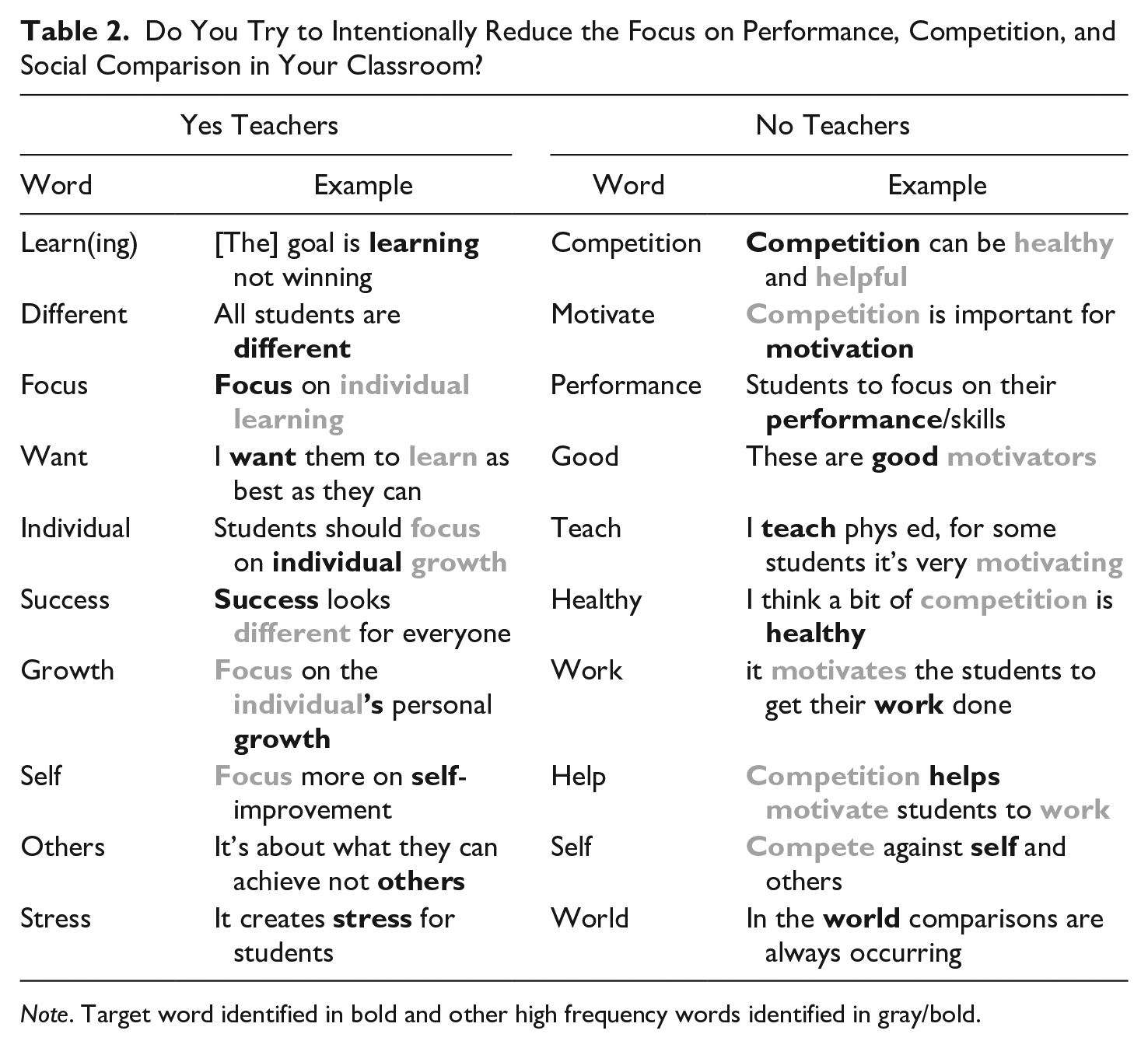
Note. Target word identified in bold and other high frequency words identified in gray/bold.
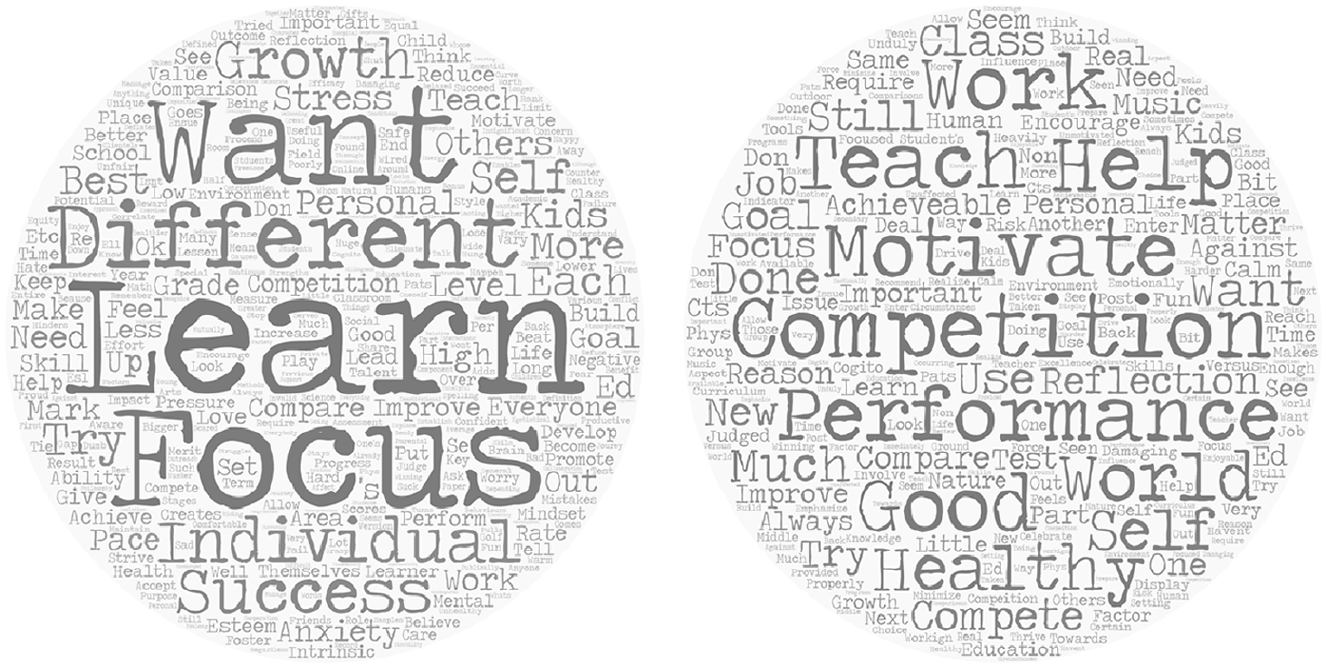
Word cloud for responses from teachers from question. Do you try to intentionally reduce the focus on performance, competition, and social comparison in your classroom? Left = yes and right = no.
“Yes” teachers
Learn or learning was the most commonly extracted word in the reasons given by teachers who indicated yes. These teachers explained their decision to intentionally minimize competition with statements such as “because school then becomes about marks and not learning.” Different was also a commonly used word, as teachers said “success is different for each and every student.” The belief that students are different can also be seen in the use of the word individual, for example, “everyone is individual and has different strengths.” Despite this individual focus, the word others emerged as a high frequency word. Here, the explanations highlighted the shift away from comparison and back to the self, for example, “because students progress at their own pace regardless of others.” This is also supported by a wide range of self-terms utilized in their responses such as, self-concept, self-efficacy, self-esteem, self-improvement, and self-reflection.
Teachers also mentioned what they focused on instead of performance, competition, and social comparison in their classrooms and what they want for their students, with focus and want also being words used regularly in their answers. For example, “I want them to focus on their own growth and be proud of that.” The word growth often co-occurred with focus when teachers explained their decision: “focus on the individual’s personal growth.” Similarly, teachers mentioned how they define success for their students in their reasoning, for example, “students achieve success at their own pace.” Lastly, these teachers highlight stress as reasons to minimize competition: “it [competition] stresses out students.”
“No” teachers
Competition was the most common word in the reasons given by teachers who indicated no to intentionally reducing the focus on performance, competition, and social comparison in their classrooms. These teachers explained “sometimes competition can be good.” Indeed, how they saw competition as beneficial was associated with many other high frequency words. For example, competition was associated with motivation, in that “it motivates the students to get their work done and do a good job.” Work and good were also regularly used words. Also, the teachers said “competition can be healthy and helpful,” highlighting two additional frequently used words. Some teachers rooted these benefits to competition as part of the world: “[in the] real world there is competition,” Performance was also a commonly used word in the responses. The teachers remarked that “performance is an important and enjoyable” for students. Moreover, performance was connected to the courses that they taught, for example, “I teach music and we are always working towards performance.” As such, teach was also a high frequency word. Interestingly self was the only high frequency word for both groups of teachers; however, with the no group, they reflected on the importance of “compet[ing] against [one’s] self,” rather than utilizing various self-terms such as self-concept or self-esteem.
Discussion
Our research examined teacher perceptions about performance, competition, and social comparison in the school. In this discussion, we focus on how these findings expand our current understanding and explore potential avenues for further research with recommendations for school personnel such as psychologists and administrators.
Emphasizing Performance, Competition, and Social Comparison
Based on our results, teachers ranked the schoolboard as the most focused on performance, competition, and social comparison in the school with the remaining categories decreasing from parent, principal, student, and finally teacher. Therefore, teachers ascribed more focus to those individuals outside the school than those within. Bronfenbrenner’s (1979) Ecological Systems Theory offers a useful framework to understand these results because it suggests that the environment is made up of various systems in which an individual interacts. The individual is situated at the center of the model, with layers of circles indicating different systems that decrease in impact on the individual as they move away from the center. Applying this systems approach to a classroom, teachers and students would be situated in more inner circles with the remaining individuals at different points in the layers with the schoolboard being the furthest away. It is important for administrators to know that teachers perceive the focus as something originating outside their classroom and somewhat contrary to their own lesser focus on performance, competition, and social comparison.
Moreover, these differences in focus could be influenced by the emphasis placed on standardized testing and school rankings. Indeed, schoolboards in Alberta, where this research was conducted, are often concerned with their schools’ annual Fraser Institute ranking, which is based on the standardized testing performances of their students (Fraser Institute, 2020). These results are often communicated in the media and highlights those schools that were the top performers. Alternatively, the ATA (2009) suggests that these tests are used to “sort and rank students rather than support student learning.” An open-dialog between the various school personnel about the role of standardized testing and its impact on students in the classroom could provide a meaningful space to discuss views on competition and social comparison and implications for student motivation.
Minimizing Performance, Competition, and Social Comparison
The ranking of teachers as least focused on competition is reinforced by 82% of the teachers surveyed suggesting that they intentionally attempt to minimize the focus on performance, competition, and social comparison in their classrooms. Therefore, teachers’ behaviours are consistent with the theoretically-grounded classroom practices outlined by Printrich (2003) and Linnenbrink-Garcia et al. (2016) that suggest de-emphasizing performance, competition, and social comparison in the classroom. Nevertheless, this means that teachers are trying to reduce something they perceive as originating outside their own classroom, further supporting the need for a meaningful discussion between school personnel as to the use of competition and social comparison in the schools.
Based on the open-ended responses, these teachers instead focused on the importance of learning, which was the most frequently used word. Moreover, the importance of accepting individual differences in the learners was noteworthy as was seen in the use of the words like different, individual, and self. These values may stem from the importance placed on inclusive education in recent years (Government of Alberta, 2021). Indeed, inclusion is a learner-centered approach to classroom decision making that “anticipate[s], value[s] and support[s] diversity and learner differences” (Government of Alberta, 2021). Again, Ecological Systems Theory (Bronfenbrenner, 1979) can explain this result because teachers have the closest proximity to students in the classroom and therefore can see them more as individuals whereas individuals further removed from the classroom like principals and boards may lose their focus on the individual student for the collective whole.
More than explaining why they do intentionally reduce the focus on performance, competition, and social comparison in the classroom, these teachers explained what they do instead. For example, these teachers accentuate intra-individual competence or success, where competence is measured not relative to others, but rather based on the students’ own growth, understanding, and mastery of the material. This can encourage students to adopt mastery goals that have been shown to lead to positive processes and outcomes such as deep-processing learning strategies, persistence, and adaptive help-seeking (for review see Murayama & Elliot, 2019). Alternatively, a focus on social comparison can lead to more extrinsically motivated students which can lead to more negative outcomes such academic dishonesty (Kanat-Maymon et al., 2015). Moreover, similar to the findings of von der Embse et al. (2018), the teachers in the yes group explicitly mention reducing focus on performance, competition, and social comparison because of the potential stress it creates.
Nevertheless, teachers’ rationales for not intentionally reducing competition are often logical. Teachers commented that some subjects do require an emphasis on performance, competition, and social comparison, which is evident in how they use the word like competition and performance in their open-ended responses. For example, music class requires students to perform a new song that they learned, or during physical education, there can be competition when students are engaging in team sports, or competing in events like tournaments. Therefore, the debate about the use of competition in the classroom might not be simply about intentionally reducing these components or not, but being aware of when they are present and how best to navigate those situations in support of student learning and intrinsic motivation (Shindler, 2009). In these instances, the principles of Pintrich (2003) and Linnenbrink-Garcia et al. (2016) could be reviewed and implemented where possible. A potential avenue for professional development could be to review these motivational principles, and engage in a discussion about the role of performance, competition, and social comparison in the school specifically as it relates to student motivation.
Limitations and Future Directions
The results of our study provide some important information as to how teachers view performance, competition, and social comparison in their classrooms. We mention three limitations that should be noted and addressed in future research. First, teachers who participated were a homogenous group from one Western Canadian province. Future research should not only examine additional provinces or countries but consider racial, ethnic, gender, and socio-economic influences on the construct of performance, competition, and social comparison. For example, an examination of teachers’ views from an individualism (e.g., self-direction and achievement) or collectivism (e.g., conformity and group harmony) perspective could impact their opinions on performance, competition, and social comparison (Imada, 2012). Within the current study, Alberta can generally be considered more toward individualism than collectivism (Blasetti, 2020). As such, a comparison from a more collectivism perspective could provide important additional information.
Second, we utilized a single self-report questionnaire to examine teacher perspectives in a fairly prescriptive way. Although this was sufficient for our precise research questions, it prevented us from further exploring teachers’ perspectives on performance, competition, and social comparison as fluid constructs that change over time and context. For example, some teachers said they do not reduce competition in the class because they do not see the amount of existing competition as unreasonable. Follow-up surveys or interviews could allow such statements to be further explored to understand the right amount of competition and social comparison or contextual influences on this type of statement. Additionally, the survey used direct single item questions. Using measurement strategies that allow a focus on psychometric properties would strengthen future research. Likewise, future research could consider observing teachers in their classrooms to determine if what they say they do is consistent with what they actually do in the classroom (Flick, 2004). These types of longer and in-depth research designs can make an important contribution to bringing about structural reform by identifying times when performance, competition, and social is beneficial for learning. Moreover, this type of research could inform a discussion on norms and the relationship between assessments as social comparison.
Third, we sought teachers’ perspectives on minimizing performance, competition, and social comparison without considering other members of the learning community. Future research should consider the perspectives of students, parents, school psychologists, principals, and/or other school administrators on competition and social comparison, to compare and contrast with the findings here. This could also facilitate an examination of who decides the right amount of competition. This future research could also address the challenge with social desirability by utilizing multiple perspectives, particularly when it comes to who is emphasizing performance, competition, and social comparison in the schools.
Conclusion
The perspectives of teachers when it comes to performance, competition, and social comparison were investigated to examine who teachers attribute this focus to and to explore their reasons for reducing or not reducing the emphasis of these elements in their classroom. The perspectives here inform the ongoing debate around competition. Our results show that teachers view themselves as least focused on performance, competition, and social comparison with increasing focus from students, principals, parents, and school boards. Moreover, teachers provided several reasons why they intentionally reduce the focus on these elements, most often commenting on being focused instead on learning tailored to the individual students in the classroom. Nevertheless, some teachers acknowledged there are instances where performance, competition, and social comparison are not intentionally reduced, and thus future research could investigate these instances recognizing that the debate on competition as being good or bad needs to be navigated in complex classroom situations.
Footnotes
Declaration of Conflicting Interests
The author(s) declared no potential conflicts of interest with respect to the research, authorship, and/or publication of this article.
Funding
The author(s) disclosed receipt of the following financial support for the research, authorship, and/or publication of this article: This work was supported by a Social Sciences and Humanities Research Council of Canada (SSHRC) Grant (435-2015-0216) awarded to the second author.
