



Abstract
Achievement Goal Theory (AGT) is one of the most popular theoretical frameworks in motivation research. Despite its application to a variety of contexts, including, school, work, and sport, it has not yet been referenced in the field of school psychology. First, we review the theoretical underpinnings as told through the theory’s evolving models, explore its impacts on cognition, emotion, and behavior, and introduce a multiple goals perspective. Second, we outline the leading research supporting AGT, both in terms of structural and individual intervention studies. Third, we apply the principles of AGT to the primary tasks of school psychology professionals, including assessment, intervention, and consultation practices. The students we support can greatly benefit from gearing our approaches toward ones that foster self-improvement and interest.
Keywords
Achievement Goal Theory has never been studied in the context of the practice of school psychology and yet educational psychologists would identify it as one of the most prolific approaches to the empirical study of student motivation. A Google Scholar search of “achievement goal theory students” returned 2,850,000 possible references (March 23, 2021) and some of the seminal papers are individually cited between 5,000 and 12,000 times (e.g., Ames, 1992; Dweck & Leggett, 1988; Elliot & McGregor, 2001). Given that the work of school psychologists largely focuses on helping children move toward goal-directed outcomes, it seems that a theory designed precisely to operationalize and examine the role of students’ goals in an achievement context likely has some relevance to the practice of school psychology. This theoretical review paper aims to describe achievement goal theory and review existing research in a way that is tailored to the needs of school psychology professionals in order to highlight its potential pertinence to this kind of applied work.
Review of Theory
Basic Concepts and Evolving Models
Achievement goals have long been integral to achievement motivation research. With over 30 years of study, Achievement Goal Theory has been conceptualized in numerous models and the constructs have correspondingly evolved with each subsequent presentation (Maehr & Zusho, 2009). Despite the ever-evolving models, researchers largely agree upon the construct of competence as being central to the theory. In this case, competence is viewed as the ability to do something effectively, sufficiently, or successfully. According to Achievement Goal Theory, achievement goals are future-oriented and are viewed as cognitive representations of desired outcomes (Hulleman et al., 2010). These internal goals direct behavior in specific ways that differ through how competence is conceptualized by the individual. Therefore, achievement goals help researchers and practitioners understand the reasons students engage in achievement settings. Although a large portion of the achievement goal literature measures goals as being trait-like, more contemporary perspectives, including intervention research, view these cognitive representations as malleable and context-dependent (Hulleman et al., 2016), making them particularly relevant for practicing psychologists looking for motivational constructs that they can enhance.
The first achievement goal model was dichotomous and distinguished only between the basic mastery and performance goal constructs. Mastery goals are generally defined by wanting to increase competence; whereas, performance goals are generally defined by wanting to demonstrate competence relative to others (Elliot, 1999). In this initial model, both types of goals were understood to help students focus on approaching or moving toward success. Students holding a mastery goal were seeking to improve over time and develop skill. In contrast, students holding a performance goal were aiming to outperform others and demonstrate skill. What the dichotomous model overlooked is a more nuanced understanding of the valence of competence—in other words, that achievement contexts include both chances for success and failure (McClelland, 1951).
To address valence, researchers began distinguishing approach and avoidance in goal pursuit as either working to approach success or striving to avoid failure. Approach motivation is defined as behavior directed toward a positive or desirable outcome; whereas, avoidance motivation is defined as behavior directed away from a negative outcome (Elliot, 2006). Approach/avoidance distinctions permeate various aspects of psychology including coping literature (e.g., Skinner) and development (e.g., Erickson and Bowlby) and have made a similarly important contribution to Achievement Goal Theory. An updated trichotomous model (Elliot & Harackiewicz, 1996) applied the approach/avoidance distinction only to performance goals to help explain inconsistent relationships with students’ achievement. Performance-approach goals were defined as aiming to demonstrate competence in comparison to one’s peers. Alternatively, performance-avoidance goals were defined as aiming to avoid demonstrating incompetence relative to others. In some newer enhancements to achievement goal theory, performance-approach goals have been further divided into two components: a normative component and an appearance component. Like the previous broad definition of performance-approach goals, the normative component refers to wanting to outperform others, whereas the appearance component refers to the focus on appearing talented to others (Bardach, Yanagida, et al., 2020; Hulleman et al., 2010).
Shortly thereafter, researchers proposed the 2 × 2 framework which fully crossed competence and valence in the conceptualization of achievement goals, meaning mastery were also bifurcated (Elliot & McGregor, 2001). Mastery-avoidance goals are defined as avoiding tasks that give rise to inner feelings of incompetence. See Table 1 for sample items on how researchers measure the 2 × 2 achievement goals as well as a description of how the goal may be noticed in specific students.
2 × 2 Matrix of Achievement Goal Theory.
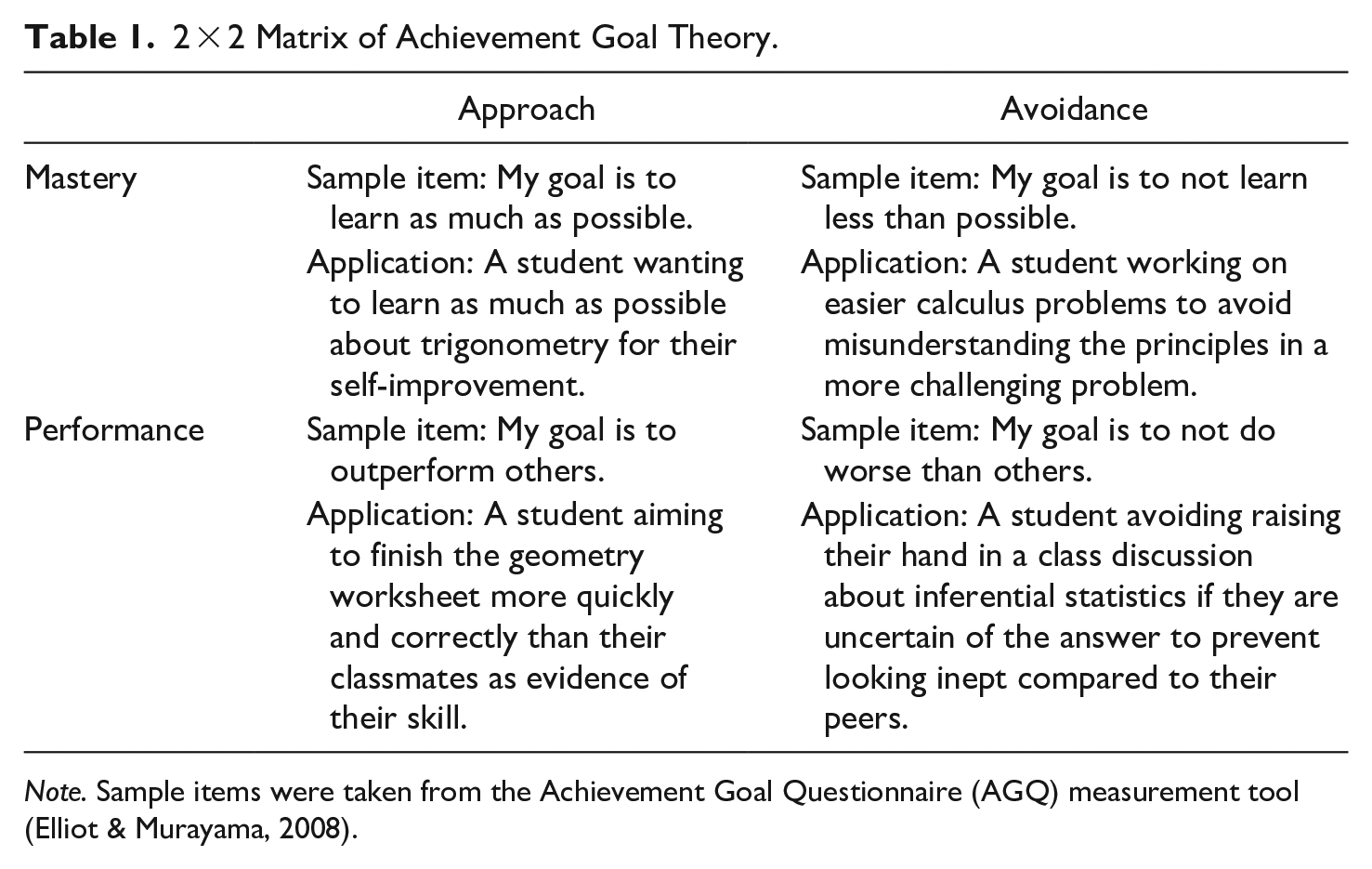
Note. Sample items were taken from the Achievement Goal Questionnaire (AGQ) measurement tool (Elliot & Murayama, 2008).
Although the 2 × 2 still has wide application, Elliot et al. (2011) proposed a 3 × 2 conceptualization of achievement goals that disentangles the reference for competence in much the same way the 2 × 2 model did for valence. Instead of mastery and performance, the three possible references for competence are task, self, and other. Task-based goals refer to engaging in behavior to meet the demands of the task itself, whether this be getting a problem correct or gaining a thorough understanding of a concept. Therefore, competence is defined through the task demands. Self-based goals define competence through intrapersonal standards such as aiming to answer a greater amount of problems correctly than on a previous attempt. The standard of competence is relative to personal past conduct. Other-based goals define competence on interpersonal standards much the same way the original notion of competence was enacted in performance goals. Elliot et al.’s revision was based on the critique that mastery goals assumed that the task and the self were always in agreement, when in fact there are times this is not the case. The 3 × 2 model crosses each of these three standards of competence (i.e., task, self, other) by the valence of competence (i.e., approach, avoidance), creating six distinct goals: task-approach, task-avoidance, self-approach, self-avoidance, other-approach, and other-avoidance.
Researchers deem that more recent models of Achievement Goal Theory are not necessarily superior to their predecessors, nor make them obsolete, but rather should be selected for use in light of the fit to the specific research questions being posed (Elliot et al., 2011). As researchers have found school-aged children to endorse mastery-avoidance goals as distinct motives in achievement settings, the 2 × 2 model is referred to as the best fit model to describe the achievement goal responses of this young age group (e.g., Bong, 2009). Therefore, for the purpose of this theoretical review and application to school psychology, we draw primarily from the 2 × 2 model due to its practical relevance, rich literature base, and its utility in predicting learning outcomes (Huang, 2012).
Impacts on Cognition, Emotion, and Behavior
Each of the four types of achievement goals exerts different effects on students’ cognitions, emotions, and behaviors across all grade levels (for a recent review see Urdan & Kaplan, 2020). Students who endorse high levels of performance-approach goals tend to attribute success to uncontrollable factors (Seifert, 1995) such as innate abilities or intelligence rather than due to effort or persistence. They are also likely to adopt shallow cognitive strategies (e.g., rehearsal; Ho & Hau, 2008), demonstrate an unwillingness to seek help (Butler, 2006), display academic dishonesty (Van Yperen et al., 2011), experience increased negative achievement emotions (Huang, 2011), and have low perceptions of success (Daniels et al., 2008). Despite these associations with less than desirable processes, meta-analyses reveal consistent positive small associations between performance-approach goals and academic achievement (Huang, 2012 ȓ = .13; Hulleman et al., 2010 ȓ = .14). With consistent positive effects on grades, arguably the main indicator of success in the education system (York et al., 2015), it becomes hard to discourage performance-approach goals. However, it is important to acknowledge that although these students might perform at the top of their classes, they do so while experiencing maladaptive cognitions and emotions (Daniels et al., 2008)—outcomes that may be particularly relevant for school psychologists to consider alongside academic gains.
Students who endorse high levels of mastery-approach goals are more likely to hold a growth mindset, believing that their ability to learn is not innate but can be improved through hard work and persistence (Buluş, 2011; Grant & Dweck, 2003). Researchers also find that students holding mastery-approach goals tend to utilize effective cognitive strategies that help them grasp deeper insight into a subject and retain maximum knowledge/skills (Huang, 2011). As such, these students tend to be better equipped to apply their learning to new settings as opposed to rote memorization of a task that is quickly forgotten. Additionally, these goals are associated with finishing a task properly and experiencing sustained interest (Senko & Harackiewicz, 2005), as well as feeling more pleasant and fewer negative emotions (Huang, 2011). In contrast to performance-approach goals, the relationship between mastery-approach goals and grades tends to be indirect through these beneficial processes (e.g., Mouratidis et al., 2018); although, meta-analyses do recognize a consistent small direct effect when mastery-approach goals are operationalized according to the 2 × 2 model (Huang, 2012 ȓ = .10; Hulleman et al., 2010 ȓ = .14).
A meta-analysis by Baranik et al. (2010) reveals that overall both performance-avoidance and mastery-avoidance goals tend to be linked to an array of maladaptive outcomes for students. Based on 33 unique samples, they found mastery-avoidance and performance-avoidance goals were negatively associated with cognitive ability, grades, and help-seeking behaviors, whereas positively associated with negative emotions/affect. Students who endorse high levels of performance-avoidance goals tend to have a high threat appraisal and view new opportunities, not as a chance for development, but instead as a risk of failure (Van de Walle, 2004). Students who endorse high levels of avoidance goals have also been found to procrastinate and be more likely to give up following a setback (Senko & Freund, 2015). Finally, meta-analyses reveal consistently small negative associations between mastery-avoidance and performance-avoidance goals and academic achievement (Huang, 2012 mastery-avoidance ȓ = −.10; performance-avoidance ȓ = −.13).
Multiple Goals Perspective
Although the effect of achievement goals is often examined independently on outcomes, some researchers argue for a multiple goal perspective (Pintrich, 2000b) in which the combinations of achievement goals held by students are most relevant to outcomes. Individuals might strive for different goals at the same time or work toward a desired result for a variety of reasons. For instance, a student might invest effort in a project due to enjoyment of the task itself as well as interest in improving their overall grade. Proponents of multiple goals argue that mastery and performance goals are not in direct opposition to one another and instead can be held simultaneously. Indeed, meta-analyses of associations amongst the 2 × 2 operationalizations of achievement goals show significant positive correlations ranging from ȓs = .13 to .51 (Baranik et al., 2010; Huang, 2012).
Much of the multiple goals research relies on some form of person-centered analysis rather than variable-centered. For example, Tuominen-Soini et al. (2008, 2011) used latent profile analyses to show that some students adopted primarily mastery or performance goals, whereas others held these in combination, with some showing a higher preference for avoidance-based goals and others displaying disengagement through low scores on all achievement goals. Researchers explain that when students hold both performance-approach goals and mastery-approach goals they may not only reap some positive outcomes usually restricted to mastery-approach goals, like task interest and sustained attention, but the maladaptive outcomes associated with performance goals alone seem to be buffered. In particular, Linnenbrink-Garcia et al. (2018) found the highest levels of engagement among students who solely endorsed mastery-approach goals and those who held mastery-approach and performance goals, both approach and avoidance. The positive outcomes associated with these two different goal profiles did not differ significantly.
There are also interesting insights regarding emotions and behaviors when examined from a multiple goals perspective. For example, in an early person-centered analysis with first-year university students, Daniels et al. (2008) used cluster analysis to identify four naturally occurring groups of university students. Students in the multiple goals (high mastery and high performance), mastery, and performance groups showed equivalent levels of academic achievement (i.e., final grades and GPA). However, students in the performance group were significantly more psychologically and emotionally vulnerable than the multiple goals and mastery groups. As expected, students in the low-motivation group (low mastery and low performance) demonstrated the least adaptive cognitions, emotions, and academic achievement. More recently, Lo et al. (2017) showed that middle school students could be classified into three latent groups at the beginning of the school year described as maladaptive (high mastery/performance avoidance), indifferent (no dominant achievement goal), and success-oriented (high mastery approach and high performance approach). In terms of their resultant motivation, cognition, and performance, students in the success-oriented group had higher scores than those in the indifferent group. In turn, these outcomes were more adaptive than those of students in the maladaptive group. In short, even when students hold multiple achievement goals, mastery-approach goals continue to hold certain advantages.
Review of Achievement Goal Theory Interventions
Because achievement goals can be viewed as cognitive representations of desired outcomes (Hulleman et al., 2010), they can differ across situations and change over time. The majority of interventions based on Achievement Goal Theory are designed to adjust the structures of the learning environment to create mastery-approach classrooms that will facilitate the adoption of personal mastery-approach goals by students. However, because achievement goals are more akin to beliefs that can be adjusted than they are to permanent traits, it is also possible to directly target students’ achievement goals at the individual cognitive level. In both instances, the desired outcome is to cultivate mastery-approach achievement goals relative to other goals. Here we review a broad scope of some of the theory’s central intervention work targeting both the classroom context and the individual.
Classroom Level Interventions
The lion’s share of Achievement Goal interventions aims to promote a mastery-oriented classroom goal structure (Ames, 1992). Researchers applying classroom-level interventions most often do so with the principles summarized in the acronym TARGET. Teachers should make tasks meaningful to the students and present various degrees of challenge so that differences in ability are not highlighted. Authority should be shared between students and teachers in deciding classroom rules and making decisions. The teacher should privately recognize students’ progress, effort, and creativity, rather than publicly commenting on a student not making mistakes or performing well without effort. Teachers should not group students based on ability level or performance. Instead, through mastery-approach structuring, students are grouped according to a domain of interest or to student differences that may enable learning. Evaluation should also be done privately with a focus on progress rather than relative class performance. Finally, students thrive when class/assignment time is flexible so that they have the opportunity to work at their own pace. In a recent meta-analysis, Bardach, Oczlon, et al. (2020) indeed found a strong positive association between mastery-approach classroom structures and students’ personal mastery-approach goals ȓ = .494 (95% CI [0.461, 0.526]). While this was one of the largest associations, it is important to note that mastery-approach classroom structures were associated with small positive effects for the other three types of achievement goals as well. One reason for this may be the wide range of ways to interpret and actualize the full TARGET recommendations in the classroom.
TARGET interventions are particularly popular in sport and physical education (Cecchini et al., 2014). According to a meta-analysis in this domain (Braithwaite et al., 2011), interventions that focused on implementing the full TARGET strategies to create conditions that favor mastery goals, had small to moderate effects relative to control groups for students’ affective, behavioral, and cognitive outcomes. These results were most pronounced for elementary school students relative to higher grades. Considering a specific example, Wadsworth et al. (2013) randomly assigned elementary physical education classes to either be taught using mastery or performance-based instruction in accordance with the principles of TARGET. Each participating teacher taught half of their classes with each goal orientation in mind. Specifically, mastery-based instruction offered students autonomy, delivered feedback in a private manner, and framed evaluation in terms of task standards. Performance-based instruction afforded students limited options, delivered feedback in a public manner, and used other students’ performance as the standard of evaluation. The researchers concluded that irrespective of the teacher, students who received instruction based on the tenants of mastery spent less time sitting, more time engaged in vigorous activity, required less class management, and experienced more enjoyment than students who received performance-based instruction.
Some researchers argue for the idea of social relationships being a seventh addition to the TARGET intervention and propose the use of an updated acronym: TARGETS. Results from survey and observational data suggest the importance of upholding strong social relationships in a classroom to help promote personal mastery-approach goals. For example, teachers that create a positive interpersonal class environment by demonstrating positive affect, encouraging students’ growth, and fostering mutual respect are found to be more likely to lead high mastery-focused classrooms (e.g., Miller et al., 2017; Patrick et al., 2011). These findings are in line with other achievement motivation research that highlights the importance of supporting students’ needs for relatedness and connection (Ryan & Deci, 2017).
Individual Interventions
Individual interventions that target specific cognitions to direct students toward mastery-approach goals, and away from performance-approach goals, are under-represented in Achievement Goal Theory. However, because achievement goals share a nomological net with many motivation constructs, researchers have tested how cognitive interventions from related theories may influence the adoption of personal achievement goals. We review the one direct explicit individual mastery-approach intervention we located (Martin, 2008) and a few examples rooted in Attribution Theory and Mindset Theory.
Martin (2008) had high school students independently work through 13 modules explicitly encouraging the adoption of mastery-approach goals through learning about components relevant to motivation and engagement. Each component had a reflective section where students consolidated their learning by making the key messages personally relevant. Students in the control condition received no intervention. Students in the experimental group reported increases in mastery orientation, task management, persistence, and valued learning experiences. They also showed decreased levels of negative achievement emotions and self-handicapping behaviors, whereas students in the control condition reported increases in these domains.
Attributional Retraining (AR) is a common individual intervention technique derived from Attribution Theory (Graham & Taylor, 2016) that enhances students’ sense of control over the outcomes in their environments. In an academic context, it can help students adopt adaptive causal attributions for failure, such as attributing a poor test grade to lack of effort as opposed to lack of ability, through a brief one-time video or handout intervention (see Perry & Hamm, 2017). From an attribution perspective, the intra-individual nature of mastery-approach goals allows them to be theoretically associated with controllable attributions like effort relative to performance-approach goals which are theoretically more similar to uncontrollable ability attributions. Thus, some researchers have used this framework to enhance achievement goals. For example, Haynes et al. (2008) implemented an AR intervention with first-year undergraduate students that consisted of watching a short video explanation and receiving a handout describing how academic performance can be influenced by causal attributions. Next, the participants engaged in a short writing consolidation exercise and then completed a post-test questionnaire. Compared to a no-treatment control group, students who received the AR intervention had significantly higher levels of mastery motivation at the end of the school year and this increase also mediated the relationship between AR and GPA. Hamm et al. (2014) used a similar AR technique making it explicitly known to students that grades increase when controllable attributions are made for a given failure. They found students who endorse high levels of performance goals to especially benefit from AR through increased levels of mastery motivation.
Similar interventions are popular in the field of Mindset Theory (Dweck & Master, 2009) where beliefs around the malleability of capabilities like intelligence are the target. Because researchers have found that a fixed mindset (i.e., the belief that intelligence is innate and cannot be changed) is associated with low endorsement of mastery-approach goals (De Castella & Byrne, 2015), it seems that interventions that try to shift students to a growth mindset may also increase mastery-approach goals. As a case in point, DeBacker et al. (2018) created a one-time mindset intervention for students in ninth grade that demonstrated how the brain can grow with use, akin to a muscle, and had participants synthesize their understanding of this concept through a comprehension check. Students in the intervention condition not only demonstrated increased growth mindset beliefs (i.e., that intelligence can be developed) but also higher levels of mastery-approach goals and lower levels of performance-avoidance goals. In other words, students who learned about the malleability of intelligence were more likely to focus on improving their skills and learning at school as is part of mastery-approach goals and less likely to be concerned about appearing incompetent in comparison to their peers, as would be the case with performance-avoidance goals.
These types of “direct appeal” individual interventions are under-represented in the Achievement Goal Theory literature and yet may be particularly relevant for application to the practice of school psychology. Next, we apply the achievement goal principles to various tasks associated with the work of school psychologists. Future empirical research will be needed to evaluate the effectiveness of these recommendations because, although they extend logically from the empirical research and are suitable for psychologists and other mental health professionals working with children in education, they are currently based solely on the complementary evidence reviewed above.
Relevance to School Psychology
Achievement goal theory provides an excellent framework to understand how students can be focused on either personal improvement as prioritized by mastery-approach goals or relative standing as prioritized by performance-approach goals. As such, this theoretical perspective has relevance for school psychologists as they assess students, design intervention, and consult and support school professionals.
Assessment Practices
In psychoeducational assessments, it is almost common practice for psychologists to focus on a student’s performance in relation to the norm group. Many stakeholders want to know whether the student is in the “very low,” “low average,” or “average” range compared to their peers for coding and funding purposes. However, when students are compared to age-based peers, psychologists (and teachers and parents) can lose substantial information about the individual student’s learning process and growth. In line with practices that encourage students to have mastery-approach goals, school psychologists should make efforts to frame both the assessment process and their results to highlight how a student can gain competencies as opposed to underscoring relative deficits. For example, school psychologists should make it a priority to genuinely highlight students’ strengths throughout their written reports. Additionally, they can describe how the student’s capabilities may be utilized to support areas of challenge. School psychologists may even incorporate strengths-based assessment tools such as the Behavioral and Emotional Rating Scale (BERS; Epstein, 2000) to enrich their assessment. It may also be worthwhile to place some focus in the report on teacher recommended strategies that outline ways to structure a classroom based on the principles of mastery-approach goals. For example, encouraging teachers to provide students with choices based on their strengths and interests, tailored feedback to improve areas of challenge, and reduce peer comparison (Svinicki, 2010).
TARGET for Intervention Design and Delivery
The TARGET structures may be used to inform intervention design and delivery to similarly promote mastery-approach goals (see Table 2 for an overview).
TARGETS Recommendations Applied to the Practice of School Psychology.
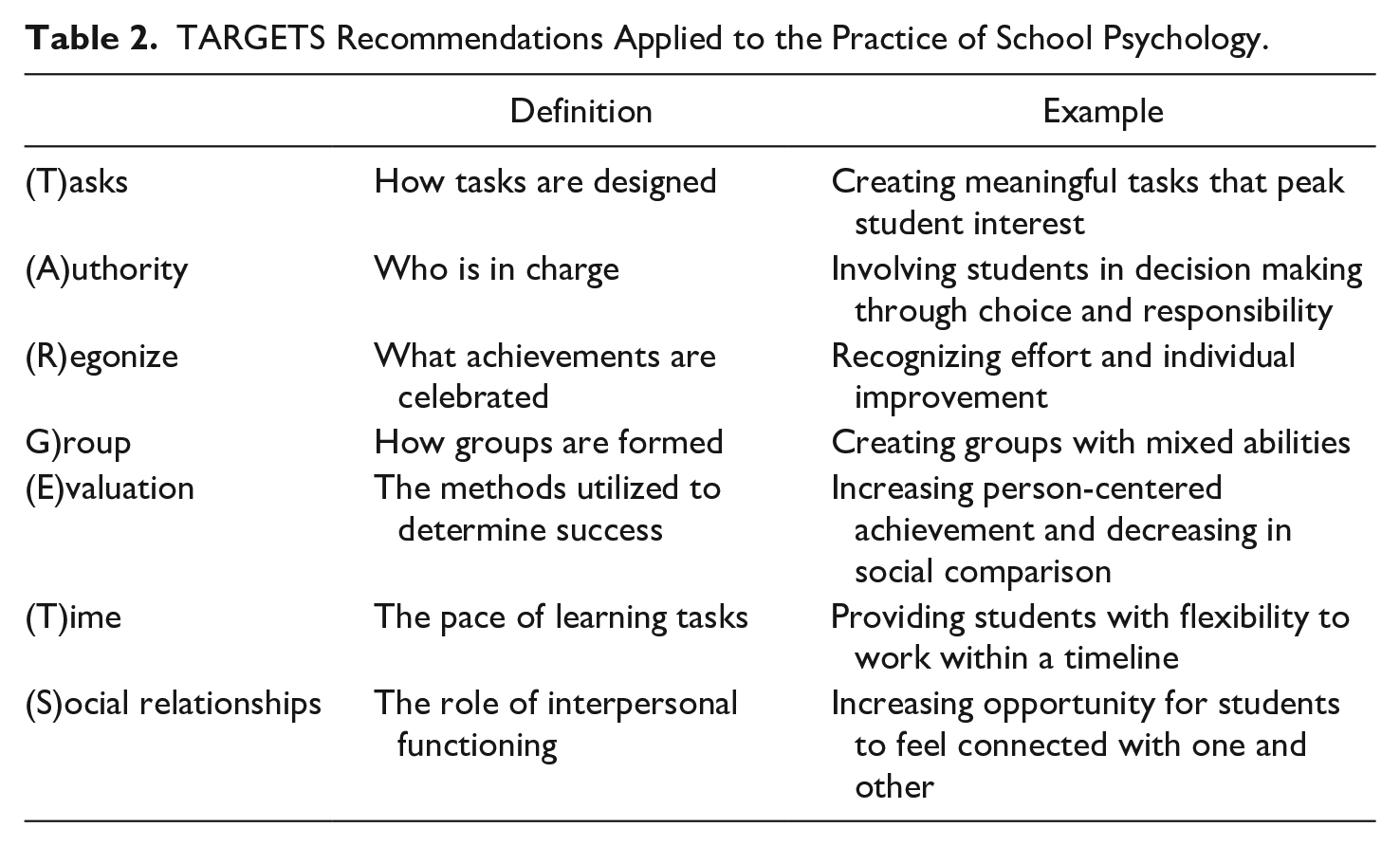
Like classrooms, intervention work is an achievement context (i.e., there are things to do and goals to meet) and thus motivation and goals are relevant. School psychologists can select intervention tasks that are personally relevant to the child as opposed to having a sole focus on those in line with parent or teacher generated goals (e.g., reducing disruptive behaviors). School psychologists should aim to present tasks and activities in a captivating manner, in line with students’ interests and personal goals (e.g., making friends). Moreover, the level of goal agreement between psychologist and client has been shown to relate to positive therapeutic outcomes (Tryon et al., 2018), which therefore necessitates the child’s active involvement in goal setting—or a shared authority between child and psychologist. Such sharing does not come naturally to this relationship because, in addition to the general age difference in the child/psychologist pairing, therapy-like intervention creates an inherent vulnerability that can exacerbate a power imbalance. Without intentionally shared authority, a space much more conducive to performance-approach goals may emerge in which children might engage simply to please the psychologist or receive praise. Although sessions may be led by the psychologist, it does not preclude students from being involved in decision-making. For example, shared authority could be realized by providing the student with an array of choices for activities that all target a common goal, giving rationales or explanations, determining shared guidelines for intervention, and exuding acceptance toward the child.
Mastery goals can be further reinforced through the psychologist giving recognition to the risks taken by the child and the effort they invest in the intervention process. Students are more likely to take risks and try new approaches and strategies when they endorse mastery-approach rather than performance-approach goals (Clifford, 1991). If rewards are used in intervention work with children, they should primarily be used to reinforce information about their personal growth, rather than being contingent on natural ability. In a similar light, psychologists may want to be intentional and flexible about the grouping of students when doing group intervention work in classrooms. Some group work can benefit from heterogeneous ability grouping and other times it may be advantageous to group students similarly—in either instance the psychologist can be intentional about building a space for the group to value mastery-approach goals and putting structures in place to minimize comparisons.
Finally, the practice of psychology can be seen as involving high levels of evaluation (Eabon, 2013), and, as such, the purpose, direction, and tone of such evaluation can be considered from the perspective of Achievement Goal Theory. For example, to work from a mastery-approach perspective, psychologists should use evaluations that have a greater focus on identifying the child’s inner strengths and resources, to be built upon and drawn from, than attending to perceived deficits (Rhee et al., 2001). It is equally important to evaluate the growth that occurs during intervention work in reference to where the child began as opposed to in comparison to their peers’ functioning or normative standards. Furthermore, nurturing mastery-approach goals during intervention work requires time. If available, it is ideal to plan for more intervention sessions than needed to ensure the child does not feel rushed. Allowing this time permits the child to develop the skills and consolidate new learning at their own pace, consistent with mastery approach goals. It also provides the opportunity for deeper reflection and debriefing that intervention work entails. If time is limited, a child may feel more inclined to have to demonstrate their growth to promptly move on, setting the stage for a performance oriented space.
Consultation
Given that consultation is one of the pillars of school psychologists’ work (Bramlett & Murphy, 1998), principles of Achievement Goal Theory could help professionals frame the guidance they provide to teachers, support workers, administrators, and parents. As consultants are often privileged with being able to work with members of both the student’s home and school contexts, they can provide psychoeducation where necessary to ensure there is agreement and consistency in goal endorsement across settings. Additionally, schooling tends to become more competitive over the years with a greater focus on evaluation in relation to a group standard as opposed to a personal one. This condition can push students into exchanging mastery-approach goals for performance-approach or even avoidance goals over time (Anderman & Anderman, 1999; Anderman & Midgley, 1997). School psychology consultants might recommend non-competitive learning structures, built on effort and mastery, that frame ability as something that is ever-growing and acknowledge failure as an essential part of the learning process. Moreover, although some parts of the curriculum necessitate the rote learning of facts (e.g., multiplication tables), as much as possible, advising for a greater emphasis on teaching students to develop broad learning skills, such as problem-solving strategies, favors the thinking process over those that require trait-like aspects of ability such as processing speed. Consultants might recommend and highlight the benefits of formative assessment throughout the learning process as they emphasize students’ personal growth, which maps directly onto a mastery approach goal endorsement, in addition to that of summative assessments that can be more performance oriented. Formative assessments allow students to feel more comfortable making mistakes and can help them see the utility of challenging themselves for their personal development. School psychologists’ consultation may also consider helping providers cultivate avenues of student success and sources of self-worth external to academic performance, like the feeling of satisfaction and pride after hard work.
Conclusion
As future school psychologists, we see the tremendous utility Achievement Goal Theory can bring to our work with children, families, and schools, through our assessment, intervention, and consultation practices. Highlighting the adaptive qualities of mastery-approach personal goals and contextual structures and minimizing the detrimental impacts of a comparative/performance perspective can contribute to the wellbeing and achievement of students engaged in psychological support. As professionals in school psychology, we believe our work can be more meaningful and evidence-informed by aligning our day-to-day practices with the years of theoretical and intervention research championing Achievement Goal Theory.
Footnotes
Declaration of Conflicting Interests
The author(s) declared no potential conflicts of interest with respect to the research, authorship, and/or publication of this article.
Funding
The author(s) received no financial support for the research, authorship, and/or publication of this article.
