




Abstract
This study assesses the specific anxiety symptoms that are present in the context of perceived ethnic discrimination in 696 (M age = 13.3, σ = .77, 57% girls) seventh and eighth-grade students with immigrant backgrounds from four different Canadian high schools. Multiple hierarchical linear regressions were conducted to determine the association between perceived ethnic discrimination and specific anxiety symptoms. Results demonstrate that perceived ethnic discrimination is significantly associated with more anxiety symptoms, such as panic/somatic, generalized anxiety, social phobia, and school phobia. Findings provide a better understanding of the association between perceived ethnic discrimination and anxiety symptoms reported by adolescents with an immigrant background. These findings could help school-based mental health professionals in the implementation of prevention and intervention measures aimed at reducing specific anxiety symptoms that are often present in the context of perceived ethnic discrimination.
Keywords
Introduction
In western countries, a substantial and growing number of children and adolescents have experienced immigration or have a parent who migrated (Motti-Stefanidi, 2018). The international migration rate in 2017 comprised of 258 million individuals, of which 30 million were children and adolescents (UNICEF, 2020). In Canada, the percentage of school-aged students with an immigrant background is around 41%, of which 34% are first generation immigrants (born outside of Canada) and 38% are second generation immigrants (who were born in Canada, but have at least one parent who was born outside of Canada), which is significantly higher than the Organization for Economic Cooperation and Development countries average (OECD, 2018). Immigration, or having parents who immigrated, requires a psychosocial adjustment to cultural gaps, which may significantly impact the mental health of some individuals with an immigrant background (Esses et al., 2001). Despite ideals and beliefs about global interdependence, openness, and acceptance, perceived ethnic discrimination still exists. Adolescents with an immigrant background regularly perceive to be the object of ethnic discrimination which can subsequently have deleterious effects on their mental health (Benner et al., 2018; Ellis et al., 2010; Huynh & Fuligni, 2010; Weeks & Sullivan, 2019). Ethnic discrimination can have a meaningful impact on adolescents’ mental health since adolescence is a crucial and pivotal period in the quest for identity and development that have long-term impacts on an individual’s well-being. Nonetheless, few studies have examined the impact of ethnic discrimination on the mental health of adolescents with an immigrant background in the Canadian context.
Ethnic Discrimination
Ethnic discrimination is a multi-contextual phenomenon as it can occur in stores and restaurants (e.g., receiving poor restaurant service), in institutions (e.g., being discouraged from enrolling in an advanced level course), and in social situations (e.g., being called out racially insulting names) (Fisher et al., 2000). Perceived ethnic discrimination (PED) is the subjective perception of unfair treatment of an ethnic group or its members, based on racial and ethnocentric prejudices (Jackson et al., 1998). A growing number of studies in psychology and the field of epidemiology demonstrated strong and persistent associations between PED and the deleterious effects on the physical and psychological health of individuals from different ethnic minorities living in Western countries (Banerjee et al., 2018; Benner et al., 2018; Byrd, 2015; Harrell et al., 2011; Paradies, 2006; Priest et al., 2013; Ying & Han, 2007). Exposure to PED can occur at different life stages, with varying intensities concerning psychological stress (Paradies, 2006).
Adolescents with Immigrant Backgrounds and Ethnic Discrimination
Previous studies on PED have mostly focused on adult populations in the United States. Nevertheless, adolescents with an immigrant background are more at risk than any other population to report PED. Adolescents regularly perceive to be the object of ethnic discrimination, whether from their peers or from the adults around them (Ellis et al., 2010; Huynh & Fuligni, 2010). A multitude of studies suggests that adolescence is a sensitive developmental period characterized by rapid cognitive/neuronal and social changes that could place adolescents with an immigrant background at particular risks (Côté, 2009; Dahl, 2004). Adolescence is a critical developmental period where much importance is attributed to peer perception, identity development, and sense of belonging. Despite challenges related to identity development, adolescents with immigrant backgrounds also face additional challenges such as adaptation, social integration, and ethnic discrimination, which can lead to impacts on mental health. A recent meta-analysis found that the impacts of PED on adolescents’ socioemotional distress and well-being (e.g., anxiety, depression, self-esteem) are comparable and sometimes even higher than those observed among adults with an immigrant background (Benner et al., 2018). The likelihood of reporting PED increases in adolescence since at this stage of development, adolescents begin to understand and integrate the importance of their ethnicity (Fisher et al., 2000; Sellers et al., 2006). Adolescence is often a time of assimilation into the peer group and identification with one’s own ethnic identity, as well as an observation of how others perceive their ethnic group (Seaton et al., 2009; Umaña-Taylor, 2016). Consequently, adolescents seem to be more sensitive to the perception of discriminatory treatment and can be strongly affected by the presence of PED, which can have an impact on their well-being and socioemotional distress (Benner & Graham, 2011; Benner et al., 2018).
Association Between Ethnic Discrimination and Anxiety Symptoms
Little is known about the internal processes that generate distress resulting from PED (Thompson Sanders, 2006). However, Clark et al. (1999) proposed that the perception of an environmental stimulus as discriminatory results in exaggerated psychological and physiological effects in response to stress, which are influenced by socio-political, socio-demographic, psychological and behavioral factors, and different coping responses.
The most common association between PED and health is the negative impacts on psychological health (Priest et al., 2013). Ethnic disparities in health and well-being potentially emerge in adolescence and can have repercussions throughout an individual’s lifetime (Sanders-Phillips et al., 2009). A longitudinal study in an African American population demonstrated that an increase in PED in men between ages 20 and 23 subsequently predicted an increase in anxiety and depression symptoms 12 years later (Assari et al., 2017). Thus, the consequences of PED have a marked and lasting impact on psychological health (Assari et al., 2017).
PED is associated with poorer psychological health in adolescents. A meta-analysis demonstrated that 76% of mental health-related outcomes highlighted the negative impact of PED on psychological health, showing more anxiety and depression symptoms (Priest et al., 2013). A study among Filipino-American adolescents also found that intergenerational conflict and PED in school settings increased depression (Ying & Han, 2007). Another more recent study carried out among 60,700 children and adolescents obtained a moderately high effect size for the relationship between different forms of PED and the presence of internalized symptoms (Weeks & Sullivan, 2019).
Despite some studies among adults, few studies have looked at the presence of specific anxiety symptoms (e.g., generalized anxiety symptoms, somatic/panic symptoms) among adolescents in the context of PED. However, adolescents, which are known to show a great deal of importance to peer judgment and acceptance, are not immune to presenting mental health symptoms when facing PED, such as anxiety symptoms. Among studies with adult participants, significant associations were found between PED and the presence of anxiety disorders, such as generalized anxiety, panic, and social disorders (Chou et al., 2012; Levine et al., 2014; Rodriguez-Seijas et al., 2015; Soto et al., 2011). Hearld et al. (2015) found that the more adult respondents reported being treated as dishonest, less intelligent, or disrespectful, and threatened or called by names, the more they met DSM (Diagnostic and Statistical Manual of Mental Disorders) criteria for a panic attack. Everyday discrimination was also associated with social anxiety disorder in adults with an immigrant background living in the United States (Levine et al., 2014). Studies show that anxiety disorders, such as generalized anxiety disorder and panic disorder, are often present in adults with an immigrant background who report PED. In light of the studies in the adult population and the knowledge around the fact that adolescence can be a stressful developmental period, it is possible to think that adolescents from an immigrant background who are experiencing PED can be at risk of presenting generalized, somatic/panic, and social anxiety symptoms. Additionally, it is possible to think that school phobia (a simple phobia) would be present in the context of PED. School phobia can be defined as an irrational fear or anxiety about going to school. Some of the symptoms of school phobia are worrying and being scared about going to school, as well as somatic complaints such as headaches and stomachaches when at school (Birmaher et al., 1999; Heyne, 2006). Unlike the transdiagnostic approach in the current literature on PED impacts on adolescents’ mental health, knowing the specific anxiety symptoms present in the context of PED would allow to better target treatment interventions in reducing specific anxiety symptoms.
Objectives and Hypothesis
The objective of this study is to look at the association between PED and reported anxiety symptoms (generalized anxiety, somatic/panic, social phobia, and school phobia symptoms) in adolescents (first and second generation of immigration) controlling for age, gender, self-esteem, and generation.
We decided to control for age since older adolescents can be more likely than their younger counterparts to report PED and anxiety symptoms (Seaton et al., 2009). Gender differences can be observed when looking at ethnic discrimination and anxiety since men report more PED than women (Banks et al., 2006; Kessler et al., 1999; Sellers & Shelton, 2003), and women report higher levels of anxiety than men (Banks et al., 2006). Furthermore, PED can have a negative effect on self-esteem (Verkuyten, 1998) and adolescents with greater self-esteem tend to have better mental health (DuBois et al., 2002). Generation is also essential to take into consideration since the prevalence of psychological disorders varies according to generation (Georgiades et al., 2018).
Based on current literature, we hypothesized that PED would be significantly and positively associated with the presence of anxiety symptoms in adolescents with an immigrant background. Despite the small number of studies, research within the adult population shows a significant correlation between PED and the presence of anxiety disorders, such as generalized anxiety, somatic/panic, and social anxiety disorders (Chou et al., 2012; Hearld et al., 2015; Levine et al., 2014; Rodriguez-Seijas et al., 2015; Soto et al., 2011). No previous research has looked at the presence of school phobia in the context of PED. However, it is possible to think that PED could be associated with school phobia since PED experiences probably occurs mainly at school.
Method
Participants
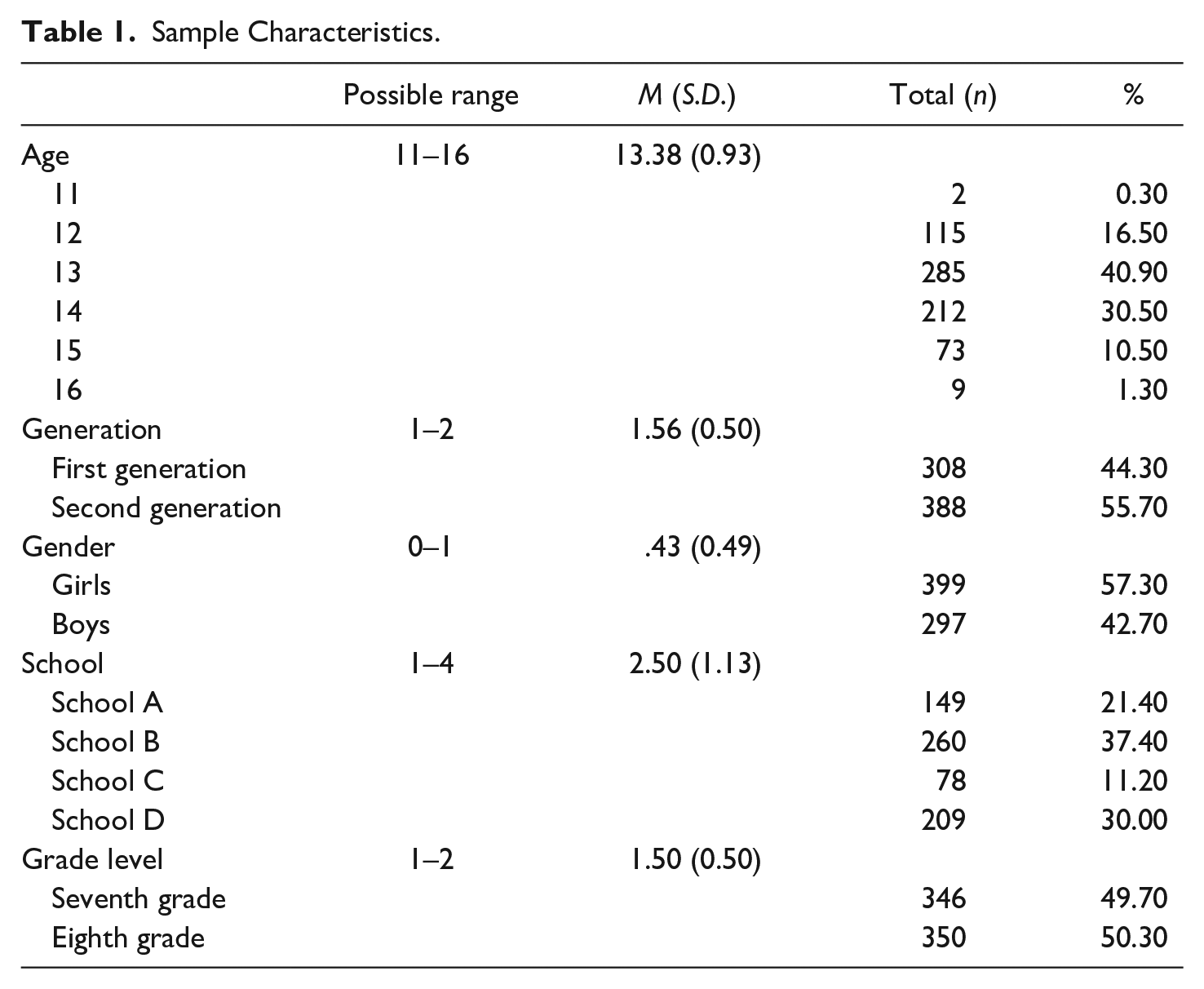
The data used for this longitudinal study are taken from a larger research project entitled Tout un village led by Pr. Tardif-Grenier. Based on this study’s objectives, adolescents indicating that they were from first and second generation of immigration were included in the study. A sub-sample of 696 students in 7 and 8-grade of four schools in Montreal and its surroundings were selected for this study. Among these high school students, 308 are first generation and 388 are second generation. The participant’s age varies between 11 and 16 years (M = 13; σ = .77). Of these adolescents, 57% identified themselves as girls (n = 399). More details on the sample can be found in Table 1.
Sample Characteristics.
Procedure
In spring 2018, trained research assistants introduced the project to students at participating schools while handing out consent forms. Students who returned their completed consent form, whether the response was positive or negative, were eligible for a draw of three gift certificates redeemable for movie tickets. Participating students then completed online questionnaires using a computerized platform (LimeSurvey) at each school’s computer room or using laptops in the classroom. These questionnaires were administered in spring 2018 and took about 45 minutes to complete.
Measures
Socio-demographic data
High school students provided socio-demographic information through a questionnaire designed for this study (e.g., age, gender, self-esteem, generation).
Anxiety symptoms
To assess the presence of anxiety symptoms, participants responded to different items of a validated French version of the Screen for Child Anxiety Related Emotional Disorders (SCARED; Birmaher et al., 1999). The instrument comprises of 41 items to assess the presence of anxiety symptoms related to anxiety disorders, as presented in the DSM-IV (American Psychiatric Association [APA], 1994). The SCARED includes five scales that assess the presence of anxiety symptoms. However, the four following scales were included for the purpose of this study: panic/somatic disorder (13 items, e.g., “when I’m afraid, I have trouble breathing”) (α = .84), generalized anxiety (nine items, e.g., “people say I worry too much”) (α = .87), social phobia (four items, e.g., “it is hard for me to talk with people I don’t know well”) (α = .80), and school phobia (four items, e.g., “I am scared to go to school”) (α = .62). Each item is assessed according to the self-reported frequency of symptoms presentation in the past three months (Likert scale, ranging from 0 = almost never to 2 = often).
Perceived ethnic discrimination
Perceived ethnic discrimination was assessed using a French translation (and back-translation) of the Adolescent Discrimination Distress Index (ADDI; Fisher et al., 2000). The scale includes 15 items that assess the frequency of perceived ethnic discrimination experienced by adolescents with an immigrant background (e.g., “you were disciplined or detained after school without a valid reason”). For each item, students were asked to indicate whether they perceived to have experienced this type of discrimination because of their ethnicity (Likert scale, varying from 1 = not at all to 5 = extremely).
Statistical Analyses
Statistical analyses were performed using the IBM SPSS version 27. Firstly, Pearson’s correlations were performed to explore the data. Afterward, multiple hierarchical linear regressions were conducted to assess the association between PED and the different anxiety symptoms. The first step included only the controlled variables (age, gender, generation, self-esteem). In the second step, the independent variable was included (PED).
Results
The prevalence of anxiety symptoms in our sample is 50.9% for somatic/panic anxiety symptoms, 31.6% for generalized anxiety symptoms, 27.6% for school phobia, and 11.3% for social phobia. PED was mostly reported in the educational context. Items commonly reported were receiving a lower grade than deserved, being wrongly disciplined or given after-school detention, or perceiving that people expected more from them than they expected of others their age, all because of their ethnic background. Correlation matrices are presented in Table 2. Correlations tend to be higher between somatic/panic and generalized anxiety symptoms (r = 0.59, r2 = 0.35, p < .01), as well as between self-esteem and generalized anxiety symptoms (r = − 0.44, r2 = 19, p < .01). Results from the hierarchical multiple linear regressions are presented in Table 3. When all variables are included in Model 2, PED is significantly and positively associated with somatic/panic anxiety (R = .47, F(1, 690) = 69.46, p < .001), generalized anxiety (R = 0.52, F(1, 690) = 40.05, p < .001), social phobia (R = .22, F(1, 690) = 5.31, p < .05), and school phobia symptoms (R = .43, F(1, 690) = 55.97, p < .001). Stronger associations were found with somatic/panic, generalized anxiety, and school phobia symptoms compared to social phobia.
Correlations (Total Sample, n = 696).
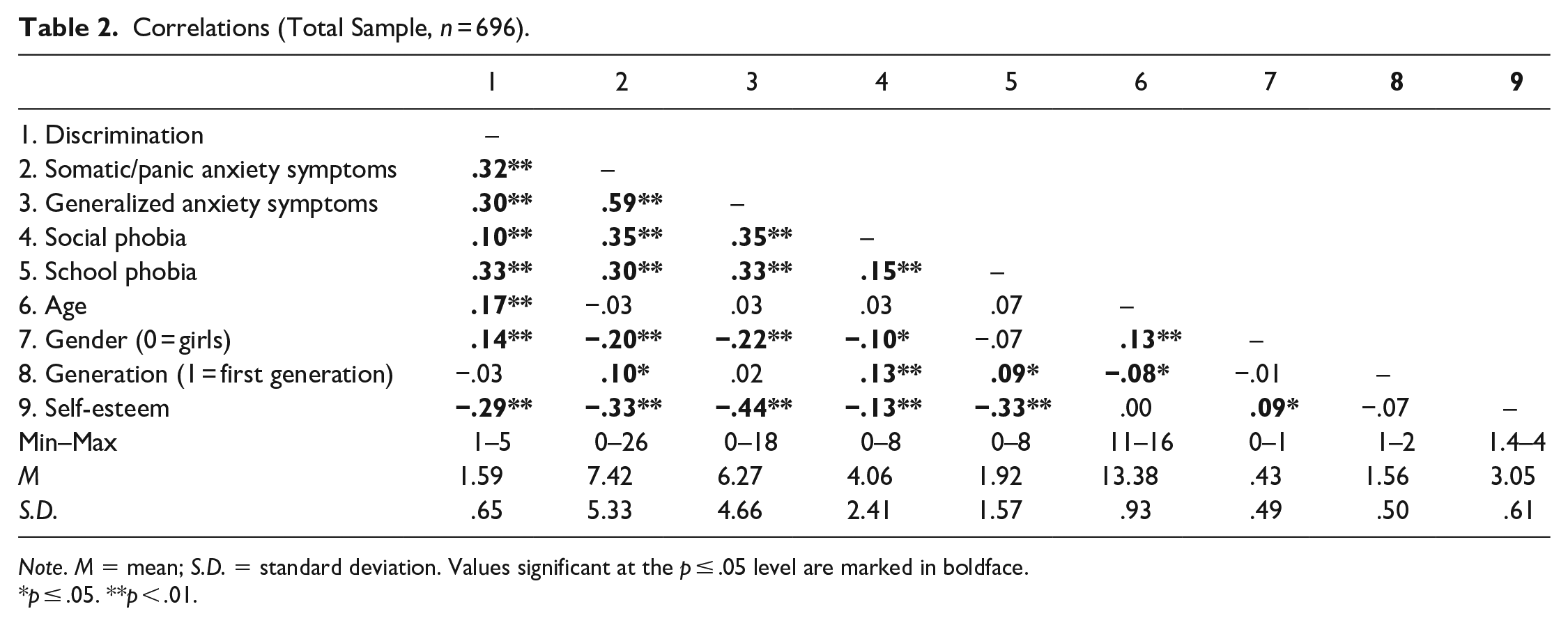
Note. M = mean; S.D. = standard deviation. Values significant at the p ≤ .05 level are marked in boldface.
p ≤ .05. **p < .01.
Hierarchical Multiple Linear Regressions Predicting the Association Between Perceived Ethnic Discrimination and Anxiety Symptoms.
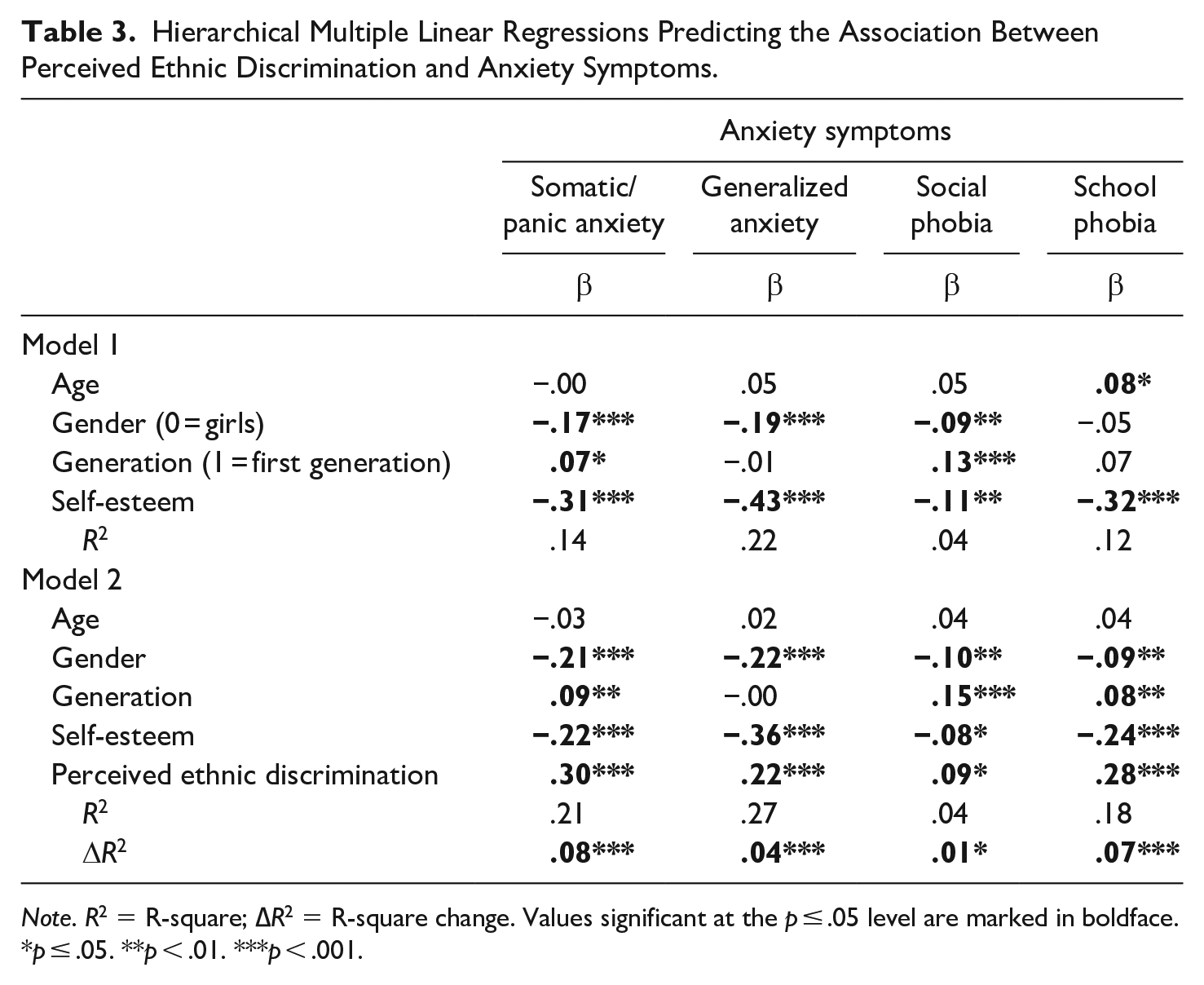
Note. R2 = R-square; ΔR2 = R-square change. Values significant at the p ≤ .05 level are marked in boldface.
p ≤ .05. **p < .01. ***p < .001.
Discussion
This study aimed to determine the association between PED and levels of reported specific anxiety symptoms in high school students with an immigrant background. The results demonstrated that PED is significantly associated with anxiety symptoms, supporting this study’s original hypothesis.
More specifically, PED is significantly associated with more anxiety symptoms such as panic/somatic anxiety symptoms, generalized anxiety symptoms, social phobia, and school phobia. In other words, adolescents who were perceiving ethnic discrimination, such as receiving a lower grade than deserved, being wrongly disciplined or given after-school detention, or even perceiving that people expected more from them than they expected of others their age all because of their ethnic background, also reported more anxiety symptoms. The anxiety symptoms that were mostly reported by the adolescents from this study were (1) somatic/panic symptoms such as fast heartbeat, feeling weak and shaky, and feeling frightened for no reason, (2) generalized anxiety symptoms such as worrying about the future, about knowing if they are doing things right, and about things that happened in the past, (3) social phobia symptoms such as disliking being with people they don’t know well, and (4) school phobia symptoms such as disliking going to school.
As hypothesized, this study’s results demonstrated that PED is associated with mental health outcomes in high school students with an immigrant background. As shown in previous studies among adults, the perception of being the victim of discrimination based on ethnicity was associated with more reported anxiety symptoms such as panic disorder, generalized anxiety disorder, and social anxiety disorder (Chou et al., 2012; Hearld et al., 2015; Levine et al., 2014; Rodriguez-Seijas et al., 2015; Soto et al., 2011). School phobia was not previously studied among adolescents with an immigrant background. However, it is interesting to see that, in this study, PED was associated with school phobia (e.g., fear of going to school) since it gives a better idea of the distress that is associated with PED and the implications that it can have on adolescents’ academic performance and motivation. It is not too surprising to see that PED is associated with a fear of going to school since the vast majority of the PED adolescents with an immigrant background experience occur most probably mainly in the school context. Indeed, previous research shows that the perception of being a victim of PED in the school context generates negative impacts regarding achievement and motivation (Banerjee et al., 2018; Byrd, 2015; Ying & Han, 2007). This could also be explained by the fact that during this stage of identity development, it is not always easy as a high school student from an immigrant background when family and personal standards/expectations differ from those of the new country that are transmitted and learned at school (Kouider et al., 2014). Although PED was associated with all anxiety symptoms studied, stronger associations were found with somatic/panic, generalized anxiety, and school phobia symptoms compared to social phobia.
The results of this study highlight the deleterious effect PED can have on adolescent’s mental health. Adolescence is a crucial and pivotal period in the quest for identity and development where a great deal of importance is accorded to peer judgment and acceptance. Therefore, it is not surprising to see that facing PED is associated with anxiety symptoms such as panic/somatic, generalized anxiety, and social and school phobia symptoms. Anxiety symptoms are part of one of the most common mental health disorders and are often comorbid with other psychological problems, therefore understanding its association with PED can help understand the implications PED can have on adolescent’s mental health.
Strengths, Limitations, and Future Directions
The use of validated instruments is one of the strengths of the present study. Moreover, PED in adolescents with an immigrant background is an understudied topic. This study included participants with many different ethnic backgrounds to have better generalizability of the results and adaptability in diverse community settings. Nevertheless, this is also a limitation of this study since we did not control for the region of origin of participants because the subsamples by region of birth were too small to do so. This study also used a cross-sectional design which limits the ability to determine causality and temporal effect of exposure to PED. The completion of questionnaires on sensitive topics in school settings could have had an impact on data collection. The sample was limited to Montreal schools and used active consent protocols, limiting the generalizability of the results.
Although our study focused on a sample of adolescents with an immigrant background who are often overlooked in research, replications of this study in different settings could help with the generalizability of the results. It would also be interesting to look at gender and generational differences in terms of the association between PED and anxiety symptoms. Future studies focusing on tailored interventions to reduce anxiety symptoms present among adolescents perceiving to be the subject of ethnic discrimination are needed.
Relevance to the Practice of School Psychology
PED and its impact on psychological outcomes, such as anxiety symptoms, have some particular implications for school-based mental health professionals, given that schools are the largest provider of youth mental health services and that adolescents spend much of their time at school (Crespi, 2009). Knowing the specific anxiety symptoms reported by high school students with an immigrant background can help school-based mental health professionals provide better support while targeting interventions aimed at reducing specific anxiety symptoms and to add interventions that specifically address ways to manage PED. Examples of culturally adapted interventions aimed at reducing anxiety symptoms in the context of PED could focus on cognitive restructuring, identifying experiences of discrimination to help deconstruct perceived implications, a strength-based approach aimed at empowering adolescents (e.g., resilience, sense of belonging, coping strategies), and reducing risk factors and stress in the school environment (Patel & Reicherter, 2016). Prevention measures such as teachers’ consultations or workshops would be useful to learn more about PED, its implication with mental health, and ways to better manage PED among students. Psychoeducation on PED will not only help school-based professionals in better understanding adolescent’s day-to-day discrimination experiences, but will also allow them to form better relationships with students.
Footnotes
Declaration of Conflicting Interests
The author(s) declared no potential conflicts of interest with respect to the research, authorship, and/or publication of this article.
Funding
The author(s) disclosed receipt of the following financial support for the research, authorship, and/or publication of this article: This study was funded by Fonds de recherche société et culture Québec (FRSCQ) (n° 2018-NP-205005).
