




Abstract
Keywords
Introduction
In the last decade, public health palliative care has gained recognition and momentum globally, and has been advocated for communities to improve the experience of health, dying, and bereavement. 1 Advance care planning (ACP), traditionally advocated for the elderly or those diagnosed with a life-limiting condition, has seen a gradual shift in global and national policy2,3 encouraging people to think about planning ahead regardless of their age or condition.
Advance care planning allows individuals to define, plan, and record their wishes and preference for future medical treatment and care. 3 It aims to help ensure individuals obtain the care they desire that is consistent with their values, goals and preferences when they no longer have the capacity to make any care decisions for themselves. 3 In the last two decades, Western cultural practices have led the understanding, delivery, and practice of advance care planning across the world.4,5 This may have resulted in many such initiatives being Western-driven with little consideration of the needs of different ethnic groups.
However, international migration and diasporic populations have led to rapidly changing demographic characteristics across Western society. Debates on the accessibility and applicability of health care by different groups have raised questions regarding the provision of culturally appropriate healthcare in general.6,7 Evidence suggests that mainstream healthcare and palliative care often do not serve ethnic populations effectively7-9 with barriers related to culture, language, awareness, and adaptation reported.7,10,11
The Chinese community represents the biggest and fastest-growing ethnic community around the globe, 12 yet engagement with advance care planning remains low, 13 similar to that of other ethnic minorities.14-16 Some authors attribute this to differing cultural, sociodemographic, and health-related factors.13,17 Lee et al 17 in their review, emphasized the appropriateness and importance of collectivism and familism as major decision-making influences among Chinese people from Eastern and Western cultures rather than individual autonomy and self-determination.
However, there are few advance care planning public health campaigns exist that are tailored to the multicultural society in which they live.18,19 It therefore could be argued that the developmental experiences of advance care planning in Western countries may not be aligned with ethnic minorities. A previous review by Jia et al 13 systematically synthesized the evidence regarding advance care planning among Chinese communities and recommended the need for campaigns to consider the Chinese communities’ traditional social norms and culture. However, to date, there is a lack of evidence exploring the empirical and gray literature to inform a fuller picture relating to Chinese diaspora engagement and understanding of advance care planning. Consequently, this study aims to review and synthesize the evidence regarding Chinese diasporas’ understanding and experience of advance care planning, and factors influencing their engagement with it.
Methods
Design
A systematic integrative review was conducted, guided by Whittemore and Knafl 20 methodological approach enabling the integration of evidence from multiple designs. 21 This review was reported in accordance with Preferred Reporting Items for Systematic Reviews and Meta-Analyses (PRISMA) guidelines. 22
Search Strategy
A comprehensive literature search was carried out for peer-reviewed papers published in English and Chinese from January 1990 to March 2022. The start date reflects the introduction of terms relating to advance care planning, such as advance directives and living wills. 23 Seven bibliographic databases were searched (Embase, CINAHL, Web of Science, Medline (OVID), SCOPUS, PsycINFo, The Cochrane Library (Cochrane Central Register of Controlled Trials, Cochrane Methodology register).
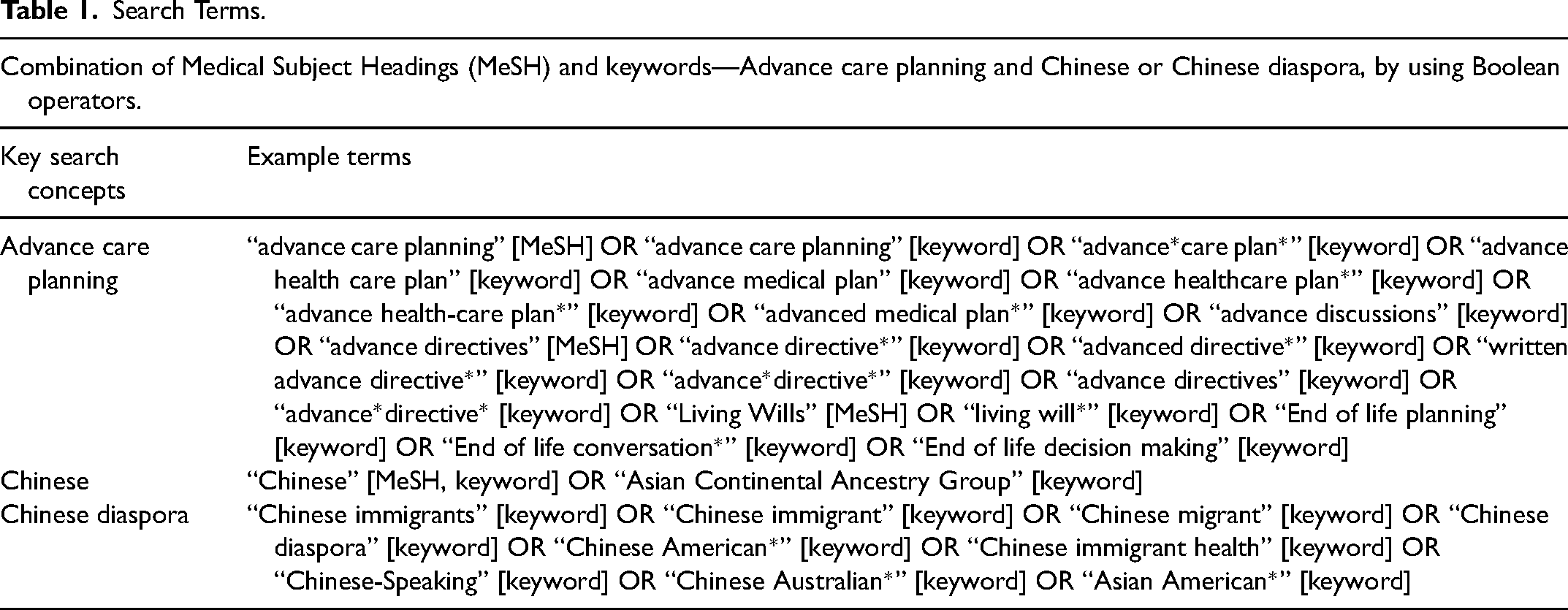
The electronic search was supplemented by hand searches of gray literature from the reference lists of included studies and other gray resources including EThOS, ProQuest Dissertations and Theses Global, OpenDOAR, and GreyNet. The search terms included a combination of two key terms, namely “advance care planning,” “Chinese Diaspora,” combined with medical heading terms and text words (see table 1). As “advance care planning” and “advance directive” are terms used interchangeably, 3 the term “advance directive” and related terms were also included to assure the recall ratio. Search strategies were tailored for each bibliographic database (see Appendix 1 for CINAHL search strategy).
Search Terms.
Inclusion and Exclusion Criteria
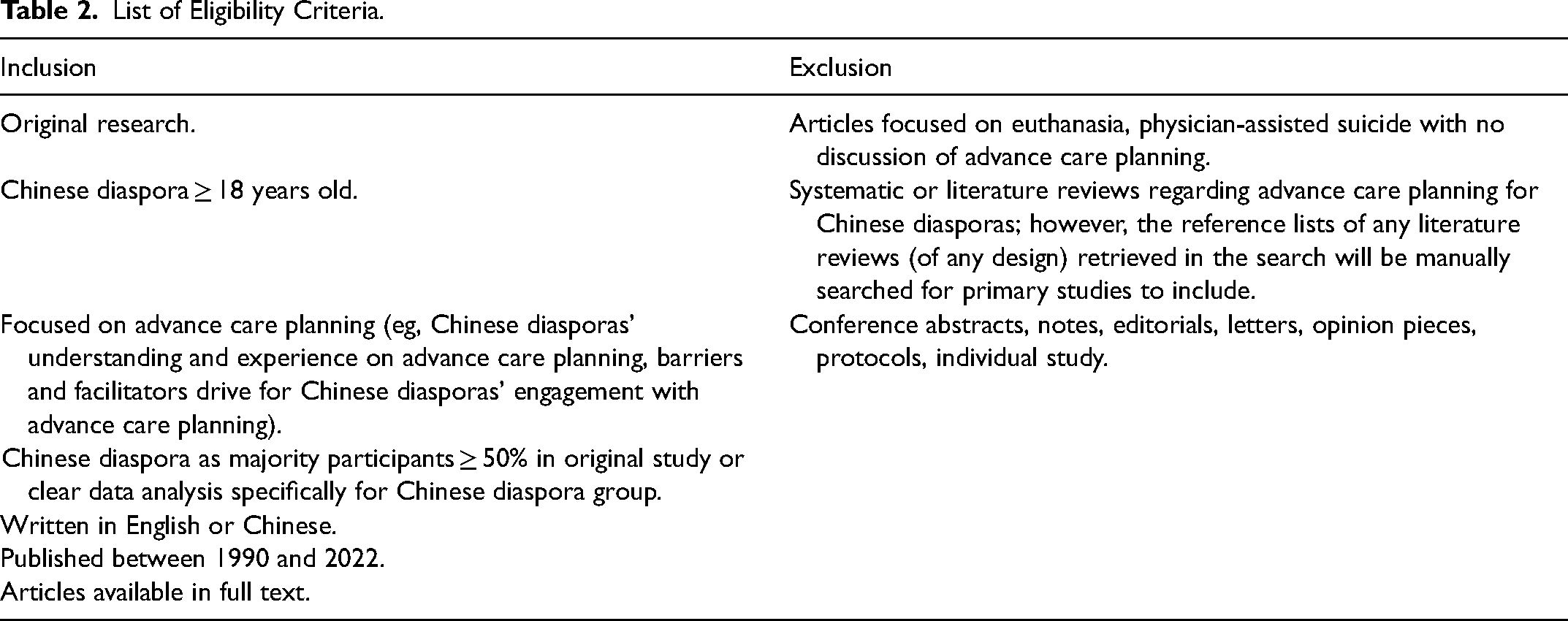
Articles were included if they presented empirical studies about advance care planning among Chinese diasporas. There was no restriction by country. Table 2 provides detailed inclusion and exclusion criteria.
List of Eligibility Criteria.
Selection Process
The results of searches from each database were exported and managed by Zotero software where duplications were removed. A two-step process was used for screening:
two reviewers (ZL & FH) independently read and eliminated studies from the title and abstract based on the identified inclusion and exclusion criteria. All articles that were considered relevant by each reviewer were included in the full text evaluation. two independent reviewers evaluated the full-text studies based on inclusion to identify the final articles included in this review.
Any discrepancies in study selection were discussed by both reviewers and adjudicated by a third reviewer (EB). To enhance rigor, the third reviewer screened a random selection of 10% of the included papers. The Preferred Reporting Items for Systematic Reviews and Meta-Analysis (PRISMA) diagram
22
was used to record the screening process at each of the steps of the review process for visual representation. The search resulted in a sample of 1657 papers, with 27 studies included (see Figure 1).
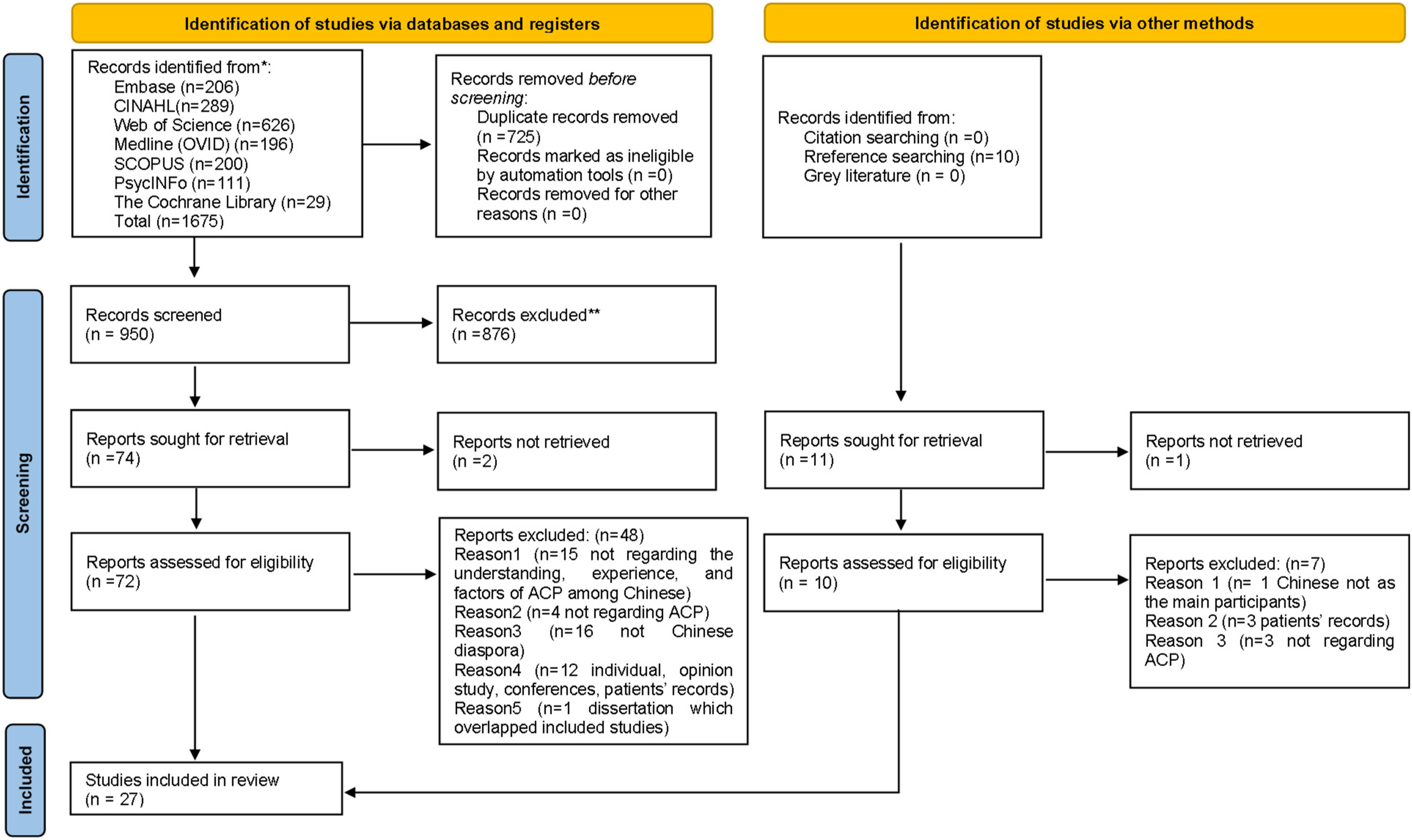
PRISMA 2020 flowchart for study selection.
Critical Appraisal
Articles were assessed for risk of bias independently by two reviewers (ZL & FH) using a range of appraisal tools aligned to the studies24,25 (see Appendix 2). Mixed Methods Appraisal Tool (MMAT) is a 5-item assessment tool that has been widely used in previous studies for its characteristics of ease of use, efficiency, and reliability. Appraisals by MMAT were presented with detailed information on each criterion rather than the total score of the MMAT for each study guided by the tool's developer. 25 Appraisals by Joanna Briggs Institute Critical Appraisal Tools were presented and classified as High (a score below 49%), Moderate (50-74%), and Low (75+%) by accounting for the number of “yes” answers and expressing them as a percentage of questions in the tool. The quality of papers were assessed as “high” in 5 qualitative, 9 quantitative, and 1 mix-method studies, “Moderate” in 7 qualitative and 5 quantitative studies (see appendix 2). All of these 27 studies were included in the synthesis.
Data Extraction and Analysis
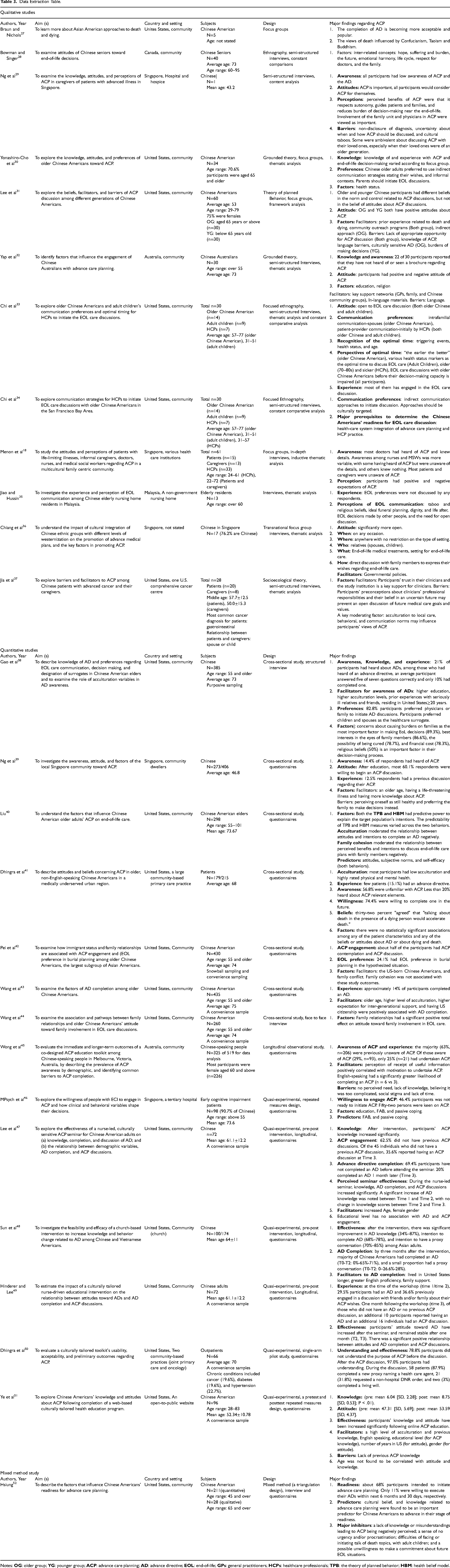
Data were extracted independently by two reviewers (ZL & FH) using a generic data extraction template and disagreements were mediated by a third reviewer (EB) (Table 3). Key extracted information includes (a) author and location of research; (b) year of publication; (c) aims, objectives, and/or research questions; (d) characteristics of study population; (e) methodology; (f) major findings and information relevant to research questions; and (g) limitations. The data extraction process was based on the four stages identified by Whittemore and Knafl 20 : data reduction, data display, data comparison, and conclusion drawing. Given the diversity of methodologies, the data were synthesized using content analysis which facilitates the identification of patterns, commonalities, and finally were contrasted in line with shifting perspectives to allow critical analysis of data. 26 The initial analysis was completed by the lead author and the themes were reviewed for accuracy by the team.
Data Extraction Table.
Notes:
Results
Study Characteristics
A total of 27 studies comprised twelve qualitative studies,18,27-37 fourteen quantitative38-51 and one mixed-method study. 52 Qualitative research design used a combination of in-depth interviews,18,28,29,32-35,37 focus groups,18,27,30,31,36 and informal field observation. 34 Quantitative studies adopted cross-sectional,38-44 longitudinal 45 and non-randomized experimental designs.46-51 The mixed-method research design included both survey and in-depth interviews. 52 Study characteristics and summary are provided in table 3.
While studies were internationally spread they mainly represented the United States (n = 18),27,30,31,33,34,37,38,40-44,47-52 followed by Singapore (n = 4),18,29,39,46 Australia (n = 2),32,45 Canada (n = 1), 28 Malaysia (n = 1) 35 and cross-country included Taiwan, Hong Kong, Singapore, and Australia (n = 1). 36 No studies were undertaken in the UK.
3566 participants were included within the 27 papers, of whom 378 were patients, 39 caregivers of people with life-limiting conditions, and 40 were healthcare professionals. The majority of participants were members of the Chinese general public.
Chinese general public participants were mainly recruited from local Chinese community-based settings (n = 18),27,28,30-34,38-40,42-45,47-49,52 using a mixture of bilingual materials (English and Mandarin or Cantonese). Five papers focused on patients with life-limiting illnesses or early cognitive impairment (n = 5)18,37,41,46,50 and one paper focused on caregivers (n = 1). 29 Three of the twenty-seven papers included Chinese health professionals as one group of participants.18,33,34 The care setting for recruiting patients, caregivers, and healthcare professionals was diverse, including healthcare institution, primary care practice, tertiary hospital, cancer center, and hospice.
Advance directives were the focus of 3 studies, and advance care planning was the focus of the remaining studies. Three advance directive studies27,43,48 addressed a set of outcomes: advance directive related knowledge, beliefs and attitudes, intention, completion, and associated factors. The remaining studies regarding advance care planning were reported in detail.
Two different but overlapping main themes were identified which reflect Chinese diaspora engagement with advance care planning; namely, awareness and knowledge were identified in 10 studies,18,30-32,39,41,45,47,50,51 and engagement with advance care planning in 20 studies.29-42,44-47,49,52
Theme 1: Awareness and Knowledge
Ten studies18,30-32,39,41,45,47,50,51 reported on the levels of awareness and knowledge regarding advance care planning among Chinese diasporas. Combined findings indicate levels of advance care planning ranged from low18,30-32,39,41,45,50 to moderate.47,51
However, levels were influenced by a range of demographic and socio-cultural factors. For example, sociodemographic attributes such as education level, acculturation stage, language barrier, and age group were identified as key influencing variables.32,38,39,41,45 For example, Gao et al 38 in a study of Chinese American elders (n = 385) using a cross-sectional survey, found that participants with higher acculturation levels or with a college education were more likely to know about advance care planning/advance directive. Similar findings have also been noted by Yap et al 32 who undertook a qualitative study adopting semi-structured interviews with 30 Chinese Australian elders, reporting higher levels of awareness among participants who had completed higher education. However, education was not reported as a consistent influencing factor by Ng et al 39 whose cross-sectional study with 273 (67.4%) Chinese diaspora residing in Singapore reported educational attainment had no association with advance care planning. However, the reason for these divergent results was not documented.
Most of the studies retrieved investigated the influence of age on awareness and knowledge levels. Although the majority of papers are focused on the middle (>48 years) to older age participants (>65 years) evidence suggested that as age progresses, higher receptivity toward advance care planning was observed.32,38,39,41,45 For example, Ng et al 39 in a cross-sectional study of the Chinese general public (n = 406) (>21 years) in Singapore reported that about 14% of participants were aware of advance care planning, representing an older cohort (50.8 years vs 46.2 years, p = 0.045, t = 2.0, df = 402). However, the influence of age on awareness of advance care planning was not consistent in some studies.38,41,45 For example, in a cross-sectional study undertaken in the United States of patients (n = 179) aged 55 + recruited via a community medical unit, Dhingra et al 41 reported no statistically significant associations among any of sociodemographic factors, including age and awareness of advance care planning. Age was also not associated with knowledge level with Ye et al 51 and Lee et al 47 reporting moderate knowledge levels in advance care planning/advance directive among Chinese American elders. Furthermore, even among those who report an awareness of advance care planning, misconceptions were common, often associating it with living wills or euthanasia.18,31,32
However, other authors highlighted language among Chinese Diasporas as a factor influencing the awareness and knowledge of advance care planning.30,32 In a study of older Chinese American adults (n = 34) using focus groups, Yonashiro-Cho et al 30 found participants in English-speaking groups had a greater understanding of, and familiarity with, advance care planning than those in Mandarin and/or Cantonese-speaking groups. This suggests that language ability may affect the ease with which participants become aware but also gain information about advance care planning. Both Yap et al 32 and Yonashiro-Cho et al 30 recommended the need for culturally tailored language materials to educate and facilitate the Chinese diaspora's engagement with advance care planning.
Several papers reported on the implementation of culturally tailored educational interventions,46,47,49-51 all of which reported significantly improved outcomes. For example, in a study of Chinese American adults (n = 72), Lee et al 47 provided educational material in both English and Mandarin guided by the Five Wishes, a type of legal advance directive document in the United States, and found knowledge and engagement significantly improved. A similar programme has also been noted in the study conducted by Hinder and Lee. 49 However, all these retrieved studies were conducted in the United States and limited to only quasi-experimental methods, hence questions are raised about the generalizability of the results to other countries.
Theme 2: Engagement with Advance Care Planning
Of the 27 papers, 2029-42,44-47,49,52 reported on the levels of engagement among Chinese diasporas and found low levels regardless of socio-demographic factors.30,38,39,41,42,45,47,49 However, geographical location of the studies, where the legal, cultural, and social system acted as a catalyst, had a significant bearing on engagement with advance care planning. Compared to the sparse studies undertaken in geographical locations such as Australia,32,45 Singapore,29,39,46 and Malaysia, 35 thirteen of the retrieved studies were conducted in the United States30,31,33,34,37,38,40-42,44,47,49,52 where the authors recognized the underpinning legal, financial, and policy frameworks supporting engagement with advance care planning. This is echoed in an international qualitative study by Chiang et al 36 undertaken with Chinese diasporas located across Taiwan, Hong Kong, Singapore, and Australia which reported significant regional variances in participants’ understanding and experience of advance care planning that were attributed to the legal, financial, and policy frameworks in different regions and the culture of westernization.
Acculturation was found by several studies to have an influential role when discussing advance care planning among Chinese living in multicultural countries.30-32,36,40,42,45 Participants who had greater proficiency in English30-32,45 or lived in the host countries longer40,42 were found to be more likely to engage with advance care planning. For example, in a study undertaken in the United States, Lee et al 31 found that older Chinese diaspora generations who lacked English proficiency tented not to engage in advance care planning. However, this was not an issue for younger generations who were multilingual.
Other facilitating factors enhancing engagement were the diagnosis of a health-related problem (ie, falls, hospitalization, the decline in health) and/or a diagnosis of a life-limiting condition which acted as key triggers to engagement. 30 Several authors who undertook their research in America and Singapore33,39,46,52 noted that participants who regarded themselves as healthy did not feel any requirements to engage in advance care planning discussions, regardless of age and geographical location. Only one study by Wong et al 45 contrasts this view. Adopting a cross-sectional design in Australia, findings indicated that there is no significant association between someone suffering from chronic illness or cancer and participating in advance care planning. However, this result was based upon a small (n = 26) sample of whom only seven had engaged in advance care planning.
Culture was also reported to partially affect the promotion and engagement with advance care planning. Jiao and Hussin 35 undertook a small-scale qualitative study in Malaysia, a highly collectivistic society, that reported none of the 13 participants had engaged in advance care planning discussions. Several authors have also highlighted traditional Chinese culture, where a taboo surrounding death, fear of upset, and causing physiological burdens among family members, hindered such topics from being broached.32,35 Discussing dying and making advance care plans were found to be considered taboo subjects regardless of sociodemographic factors.29,31,35,36,38,41,52 Some studies indicated that participants preferred the initiation of such conversations to be led by healthcare professionals or community representatives rather than by themselves or family.28-34,37 Furthermore, Lee et al 31 indicated that both older and younger Chinese Americans expressed concerns about causing burdens to their families that inhibit their behavior to advance care planning. The experience and impact of the family burden on advance care planning conversations are echoed in other studies29,31,36,37,52 that indicated the burden usually tends to be a double-edged sword. Fear of causing upset, facing one's own mortality, and the realization of older person care is the duty and burden of the remaining family members were key barriers to engagement. However, Yap et al's 32 qualitative study of 30 older Chinese Australians found that many participants were open to discussing death, end-of-life, and advance care planning. They suggested that the low uptake of advance care planning among Chinese Australians might not be culturally motivated but rather due to language barriers that prevent access to health information and services.
Several studies29,32,34,39,40-42,44 identified facilitators to advance care planning engagement such as social and health-related networks. The influence of a strong family culture was viewed as the foundation for promoting family involvement in decision-making. Liu 40 reported that family cohesion acts as the moderator. A similar finding was reported by Wang et al 44 who undertook a cross-sectional study of 260 Chinese Americans aged 55 + years and found that family relationships had a significant positive overall effect on the attitude toward family involvement in end-of-life discussions. However, conflicting evidence regarding the family's influence exists. Wang et al 43 previously stated that there is no correlation between family cohesion and the completion of advance directives among older Chinese Americans. Moreover, Pei. et al 42 found that family conflict, not cohesion, was associated with the engagement of advance care planning and end-of-life discussion.
Discussion
Main Findings/Results of the Study
These findings highlight that awareness and knowledge, and engagement with advance care planning in the Chinese diaspora communities are variable. Two factors, geographical context and culture, were found to be particularly important.
Chinese diaspora living in countries where advance care planning is supported by legal, cultural, and social systems are more likely to have awareness and knowledge of it and engage in these conversations. Although knowledge of and engagement with advance care planning remain low internationally, the United States was the country most prominent in the promotion of advance care planning.46,47,49-51 The concept of advance care planning first emerged and was advocated in the United States. 23 Funded hospitals and nursing homes are required through federal legislation to provide an opportunity for the public to familiarize themselves with and complete an advance directive underpinned by the Patient Self-Determination Act of 1990. 53 It is pertinent to note that challenges around the usage of language and terminology in different cultural contexts exist. Across the papers, the terms advance care planning and advance directives are used synonymously yet they have different procedures, focuses, and distinct meanings. The implications of this on the general public, particularly the Chinese diaspora, are unknown. The supportive social contexts that embed advance care planning may help to understand the divergence in findings.13,14,54,55 The importance of geographical context is echoed in McIlfatrick et al's 56 study which highlighted the importance of government-driven policies and a positive social atmosphere to promote advance care planning. However, only one paper in this review indicated the role of policy as the influence. Chiang et al 36 found that the Chinese diaspora assigns great weight and aligns their behavior to national policy. This likely stems from the role of and trust often placed in government in Chinese cultures. The realization of the influence of strong policy initiatives at the health system and institutional level is considered an influential factor in advance care planning's acceptance among Chinese populations. 4
Second, the findings from the review indicated that culture was reported to partially affect the promotion and engagement of advance care planning.32,35 In traditional Chinese culture, common perspectives about death are a pragmatic acceptance of death's inevitability and this is also reported in the Chinese diaspora.57,58 However, as this review confirms death is viewed as taboo, and death-related issues as sensitive topics. They believe conversations regarding death-related topics could result in ominous things and cause burdens on families.32,35 This may help to explain why the Chinese population prefers indirect communication approaches rather than directly discussing end-of-life care plans or advance care planning with family members or healthcare professionals. As Jia et al 13 proposed, effective communication strategies need to be tailored to individuals and culturally appropriate. This is also echoed in other diasporas globally. 16 The Chinese tradition of reciprocal filial piety, in which adult children are expected to look after elders was found to be an influence on engagement with advance care planning.57,59,60 However the evidence of the influence of this is unclear. Some research suggests filial relations in the West are consistent with that supported by the reciprocal aspect of filial piety in Chinese societies.57,59 However evidence from this review suggested that in an attempt to reduce the burden of planning for the future, members of the Chinese diaspora generally prefer others in authority (ie healthcare professionals or community representatives), rather than themselves, to initiate advance care planning.28-34,37
The findings from the review also indicated the influence of a strong family culture in decision-making, reflected in other review 54 which is a characteristic of the Asian culture. This emphasizes the importance of familism in making major decisions rather than individuals’ autonomy and self-determination. 61 It is imperative, therefore, to understand the cultural differences to help inform public health approaches to enhance knowledge and engagement with advance care planning.
This review highlights some gaps in the evidence base with regard to the influence of cross-cultural integration and generational differences on advance care planning engagement.
What This Study Adds?
Advance care planning has been advocated as one way in which to improve the Chinese diaspora's end-of-life care experience. However, evidence suggests knowledge and uptake of it are low across multicultural countries. This study updates previous reviews on components of advance care planning for Chinese diasporas and highlights that Chinese diaspora's awareness, knowledge and engagement with advance care planning is not a linear process. In addition to the socio-demographic factors which have been recognized in previous studies as influencing engagement in advance care planning, two additional considerations were identified. First, in the geographical context and culture within which the Chinese diasporas are living, the legal, cultural, and social systems act as a catalyst to enhance awareness of and engagement with advance care planning. However, most studies, especially those that investigated bespoke culturally tailored advance care planning educational interventions, were conducted in the United States and limited to only quasi-experimental methods. There is a lack of evidence in other multicultural countries such as the UK. Second, Chinese diaspora's original culture has a significant impact on engagement with advance care planning. It is crucial to accommodate their traditional cultural beliefs in the practice of advance care planning. This review indicates the lack of high-quality culturally tailored educational interventions to improve knowledge of advance care planning. It is therefore imperative to conduct more research to address these issues, in turn promoting Chinese diaspora engagement with advance care planning across multicultural countries.
Strengths and Limitations
While this comprehensive systematic global literature review was guided by standard methodology, it has several limitations. First, this review only included English and Chinese language studies, limiting the inclusion of other languages. Secondly, this review included papers published from 1990 to 31st March 2022, and new studies published after this date may not be reflected in the analysis, so the conclusion should be treated with caution. Finally, a plethora of terms are used to denote advanced care planning, and it is possible that some terms were missed.
Conclusion
The review provided an international insight into the Chinese diaspora's knowledge of, and engagement with advance care planning. Overall, the results indicate that Chinese diaspora engagement is not a linear process but is influenced by a myriad of socio-demographic factors. Such findings are not novel and have been reported elsewhere; however, the influence of identity and culture has been neglected in the delivery and engagement with advance care planning among diaspora groups. The realization of geographical context and culture within which the Chinese diaspora are living, as well as their original culture, were found to be key factors influencing engagement. Therefore, a culturally tailored approach should be accommodated in future research and practice for Chinese communities in multicultural countries, especially in the UK.
Footnotes
Acknowledgments
The authors would like to greatly thank Kelly McCoo for her expert advice in generating the review search strategy.
Declaration of Conflicting Interests
The author(s) declared no potential conflicts of interest with respect to the research, authorship, and/or publication of this article.
Funding
The author(s) disclosed receipt of the following financial support for the research, authorship, and/or publication of this article: This work was funded by the UK Department of Employment and learning (DEL) awarded to the lead author to undertake this research as part of a PhD.