




Abstract
The model for the creation of knowledge in Science, Technology, Engineering and Mathematics (STEM) involves the near total career dependence by probationary citizens on senior academics. In this article such probationary citizens include those at the early career stage, mainly but not exclusively post-doctoral researchers (postdocs). Traditionally, the implicit assumption was that senior academics would facilitate their access to a permanent position in return for a time limited period of exploitation as part of an organisational patriarchal bargain. This article is concerned with exploring how these probationary citizens came to access temporary positions, their experience of them and their perception of their future. Drawing on qualitative data from 13 probationary citizens, men and women, on two to five-year contracts in an Irish case study university, it shows that regardless of how they accessed probationary citizenship, their future was uncertain with no guarantee of a permanent academic position. The article raises questions about the valorisation of the highly dependent relationships between probationary citizens and permanent STEM academics as the main model for the creation of knowledge in STEM.
Introduction
The model for the creation of knowledge in Science, Technology, Engineering and Mathematics (STEM) involves the near total career dependence by probationary citizens on senior academics. In this article the concept of probationary citizen (Sümer et al., 2020) refers to those at an early career stage who are on two to five-year temporary contracts on the edges of academia. The most common is the post-doctoral researcher (postdoc). Traditionally, those in such positions could expect to access a permanent position three-to-five years after their PhD (Bryson, 2004), facilitated by the senior academic who hired them. Probationary citizens are differentiated from non-citizens (O’Keefe and Courtois, 2019), who are on much more precarious and hourly paid contracts (see Ivancheva et al. 2019; O’Keefe and Courtois, 2019). This article focuses on probationary citizens: specifically, on how they come to access such positions, their experience of them and their perception of their future.
Drawing on qualitative data from 13 probationary citizens, men and women, on two to five-year contracts in an Irish case study university, it shows that although being “chosen” persists in some cases, as does being in a potentially exploitative work situation, probationary citizenship does not lead to a permanent academic position facilitated by senior academics who have benefitted from their work (NASEM, 2014). A tentative theoretical contribution is the suggestion that this reflects the impact of neoliberalism (Enders and Musselin, 2008) on an organisational “patriarchal bargain” (Kandiyoti, 1988, 1998).
Key concepts are first discussed; then the context and methodology, followed by the patterns emerging and summary and conclusions.
Neoliberalism, academic citizenship, organisational patriarchal bargains
Neoliberalism is defined as a political ideology that favours market deregulation, disaggregation of educational provision (‘unbundling”: Ivancheva, 2020), reduction in government spending and performativity as reflected in a focus on key performance indicators. Lynch (2014: 1) suggested that “New Managerialism represents the organisational arm of neoliberalism” with managerialism remaining “a slippery and under-theorized concept” (Shepherd, 2018: 1668). Under managerialism there is an intensification of the “pace, intensity and moral legitimacy” of the marketisation and commodification of higher education, with global league tables indicating that market values have been incorporated into the sector (Lynch, 2006: 6). These league tables focus particularly on research output, with global rankings becoming part of a new mode of market governance (Lynch, 2015). STEM disciplines in particular are seen as having market value (Lynch, 2006). Thus, the focus is on “the quantifiable use value of knowledge,” particularly research which is “metricized, audited” and used in global rankings (Morley, 2016: 29). Felt (2016: 10) suggests that neoliberalism is linked with “a growing projectification” so that research is mainly done in projects funded by national or international research funding organisations. This kind of entrepreneurial research funding model (Goastellec et al., 2021) creates a market for PhD graduates, postdocs and other temporary academics and is becoming the norm in much of western academia. Thus, the model for the creation of knowledge in STEM involves the near total career dependence by those on temporary contracts on senior academics.
Some form of neoliberal managerialism has become a taken-for-granted reality in most Western higher educational systems (Deem, et al., 2007; Lynch et al., 2012). One of the key characteristics of managerialism is a focus on key performance indicators, particularly research metrics, on the assumption that these are objective and gender-neutral (Felt, 2016; Morley, 2016). This meritocratic myth is still the taken-for-granted norm in STEM although it has begun to be challenged (Van Den Brink and Benschop, 2012; O’Connor and Barnard, 2021).
The concept of academic citizenship was originally developed to refer to a broad range of obligations and activities that can be expected of those in academia, over and above their research and teaching activities (Macfarlene 2007). As such its content implicitly challenged the prioritisation of research output and performativity in managerialism. O’Keefe and Courtois (2019) identified five dimensions of academic non-citizenship focusing on the non-status of those in very precarious positions, as staff, decision-makers, socially, in work, and legally. Sümer et al. (2020) further developed the concept, building on its use by feminists outside academia, and identified three key components of citizenship: membership (giving rights and duties); recognition (giving power, voice and respect) and belonging (giving a sense of identity, entitlement and fitting in). On this basis four ideal types were identified: full, limited, probationary and non-citizenship. In this article the focus is on probationary citizenship which occurs at a particular point in the academic career trajectory viz early career. These probationary citizens are on the margins of academia, with very partial time-limited membership, recognition and belonging. This ideal type is also “potentially internally differentiated by gender and other power relations” (Sümer et al. 2020: 22) since accessing a fuller form of academic citizenship is likely to be affected by these characteristics.
The extent to which probationary citizenship is related to the neoliberal, managerialist character of universities is contested (Ivancheva et al., 2019; Zheng, 2018; Bataille et al., 2017) since there have always been temporary positions in academia. However, neoliberalism coincided in western academia with a reduction in expenditure on front line permanent teaching positions (Acker and Wagner, 2019). Increases in the number of temporary contracts in universities in the past 20 years appear to have occurred partly as a result of this; partly because of the dramatic increase in the number of PhD students; partly because of the entrepreneurial model of research funding involving hiring temporary early career researchers (Goastellec et al., 2021); and partly because of the prioritisation of research performativity and the desirability of freeing up research “stars” from teaching and other devalued tasks (Ackers and Gill, 2005; Carvalho and Santiago, 2010). The existence of these low cost, temporary employees benefit full-time STEM academics who are under-pressure to deliver in research terms. These arrangements are legitimated by the universities' neoliberal agenda, with its managerialist focus on research output and on what purport to be objective, gender-neutral performance indicators.
Historically relationships in universities have been “both hierarchical and patriarchal” (Lynch, 2006). Acker (1990, 1998, 2006) saw organisations as gendered but was little concerned with male hierarchical relationships. Connell (2005) suggested that hegemonic masculinity dominated other types of masculinities but did not explore the benefits of male relationships. Hartmann (1981: 14) stressed the importance of men's hierarchical relationships with other men: defining patriarchy as “a set of social relationships between men, which have a material base, and which, though hierarchical, establish or create interdependence among men that enable them to dominate women.”
A development of Kandiyoti’s (1988, 1998) concept of the patriarchal bargain potentially helps us to understand the situation of probationary citizens. Her concept referred to women's accommodation with patriarchy. Thus, she suggested that women who were willing to accept their subordinate position stood to gain certain rights and privileges within those limits in a patriarchal society. Here the concept is developed to refer to an implicit organisational patriarchal bargain i.e., that senior academics would facilitate probationary citizen's access to permanent jobs in return for their acceptance of a temporary exploitative situation.
It is recognised that it is impossible to eliminate alternative explanations such as the status of jobs in higher education or a “cruel optimism” (Berlant, 2011) that leads probationary citizens to continue to believe in the possibility of a permanent job in academia, despite evidence to the contrary. However, such explanations do not take into account the benefits accruing to those in senior positions from the work of these probationary citizens. This is particularly important since those at the early career stage remain one of the most productive groups in research (Science, 285:1531 − 1532 quoted in Ahmed, 2016: 2).
Informal relationships between men with and without positional power, and characterised by identification, loyalty and affection have long been important in male dominated higher educational institutions. These relationships have been variously described as sponsorship, nepotism, inbreeding and peer acknowledgement (Montes Lopez and O’Connor, 2019; O’Connor et al., 2019; Picardi, 2018). They are valorised in the organisational practices and narratives of STEM (Felt, 2016) but are simultaneously ignored. This “hides the importance of peer recognition, which has been a key element in the science reputation system and still plays a fundamental role in its governance” (Picardi, 2018: 114). These relationships are particularly important in STEM because of its time-consuming devalued laboratory work; the typically longer periods of temporary contracts as postdocs there and the greater stress on collective outputs. With relationships continue to be more widely valued in some higher educational systems (such as Spain: Cruz-Castro and Sanz-Mendez, 2010; Vázquez-Cupeiro and Elston 2006) and although officially denigrated they continue to exist in other countries (Montes Lopez and O’Connor, 2019; O’Connor and Barnard, 2021; Nielsen, 2016). However (with the possible exception of sponsorship) these relationships have tended to fall into official disrepute in the face of neoliberalism's endorsement of what purport to be objective key performance indicators in a meritocratic discourse involving excellence as the basis for recruitment/promotion. Underlying this article is the suggestion that neoliberalism has disrupted the organisational patriarchal bargain so that, regardless of how probationary citizenship is accessed, in the majority of cases it does not lead to a permanent position.
There is a good deal of evidence that the structure, culture, procedures and processes in higher education are masculinist: “historically developed by men, currently dominated by men, and symbolically interpreted from the standpoint of men in leading positions” (Acker 1992: 567). Women's representation in Irish higher educational institutions, as elsewhere (EU, 2019; Brower and James, 2020), decreases as one moves up the academic hierarchy, with women constituting 27% of those in full professorial positions in Irish universities (HEA, 2021a). In such contexts, an organisational patriarchal bargain is potentially a stereotypically gendered arrangement. Female probationary citizens are wrong footed since that bargain fails to take into account either maternity or culturally generated caring subjectivities. It also negatively evaluates women in terms of gendered stereotypes deriving from a masculinist construction of science and scientists (Barnard et al., 2009; White, 2014; Fox, 2020). Hence, although women experience the same negative consequences as their male counterparts in terms of lack of access to permanent positions, their situation is potentially even more fraught because of the gendered assumptions built into the organisational patriarchal bargain.
The possibility of senior women challenging the reproduction of male power is limited, not least because of their scarcity in senior positions in STEM. However even where such women exist, their position of relative advantage in discipline terms (i.e., as STEM academics) and the gender-neutral ideology of STEM discourages a focus on gender.
Probationary citizenship: recruitment, work situation and prospects
Probationary citizenship occurs at a specific point viz early-career. Postdocs are the most obvious category but there are others e.g., those recruited by heads of departments to fill temporary gaps created by the absence, for whatever reason, of permanent academics. Here we are particularly concerned with the dimension of probationary citizenship related to membership (Sümer et al., 2020).
For some, the process of recruiting probationary citizens involves “choosing” or the marking out of juniors by seniors as “special” in some way, even at undergraduate level, and inviting them to do a PhD with them (Angervall et al., 2015) and to subsequently work with them as postdocs. The process can be seen as implicitly grooming them for a career in STEM- although the concept of grooming has become corrupted by its association with sexual abuse. Others may be recruited in more formal ways through for example, international recruitment.
Sheltzer and Smith (2014) found that male Principal Investigators (PIs) in elite labs (like non-elite male PIs) were significantly less likely than elite female PIs to hire female postdocs. This arguably reflects homosociability (Grummell et al., 2009) and may not be unrelated to the fact that male protegees/applicants are more likely to be seen as exceptional (van den Brink and Benschop, 2012). In Ireland, women are more likely than men to be in temporary academic positions in universities, although they are equally likely to be hourly paid (HEA, 2019a, 2020a, 2021a). In Ireland, unlike in the EU, women are less likely to be in precarious research positions (EU, 2019: including those with contracts of one year or less and “other” non-permanent contracts). It is possible that this trend partly reflects the importance of being selected by (predominantly male) STEM academics as postdocs- entering what is in Irish terms, a potentially elite route taken by only one fifth of all research graduates (HEA, 2020b).
Much has been made of the importance of loyalty in influencing decisions to leave jobs. Hirschman (1970) argued that with loyalty, the worse the working conditions, the less likely the person was to leave. Dean and Greene (2017) suggested that seeing work as “a calling” made it possible for poor working conditions to be tolerated. STEM is often seen as such a calling, meaning that working conditions can be ignored (Zheng, 2018). For those who got their present job through being “chosen” by their PhD supervisor/PI (Angervall et al., 2015), leaving would mean that they would have to accept that the potential that that person saw in them no longer existed and they would have “to reconceptualise who they are” (Hoffman 2006: 2327), thus increasing the cost of exiting. That cost also reflects the years invested, the absence of a plan B; and the hope of continuing to do research (Skakni et al., 2019; Wohrer, 2014).
Existing literature has shown that postdocs are expected to “learn their trade” and “prove their worth” by working under a more senior academic “often to his/her personal advantage” (Le Feuvre et al., 2020: 5 and 2019). Within STEM, the PhD supervisor and later the PI have considerable power over the day-to-day lives and futures of probationary citizens. Bozzon et al. (2019: 38) noted that early career researchers typically ended up “doing someone else's job- be it supervising students, reviewing papers, writing projects”. The possibilities this creates for exploitation, gender-based violence and scientific sabotage have only begun to be recognised (Naezer et al., 2019; O’Connor et al., 2019; O’Keefe and Courtois, 2019; Zheng, 2018).
In an entrepreneurial research funding model, the PI typically acquires the research funding, employs them, defines their work tasks (Akerlind, 2005) and affects their future prospects through references and sponsorship. This is a very common funding model in Ireland as elsewhere. The dependence of probationary citizens on the PI is almost total at this stage and is now unpredictable in length, with considerable uncertainty around accessing a permanent position: with consequences in terms of power imbalance and the possibility of exploitation.
Saurermann and Roach (2016) found that the majority of the postdocs in their study identified a non-academic career as their single most preferred career. However, a global study of postdocs' experiences found that two thirds overall, and 80% of those currently working in North America or Europe saw academia as their preferred career destination (Woolston, 2020). Eight out of 10 found satisfaction through their interest in their work; with the proportion who were satisfied being highest among those working as postdocs for less than two years, and declining after that. However, roughly half had been postdocs for more than three years and perceived themselves as having little job security and an uncertain path to a permanent post Furthermore, although these positions were depicted as developmental, they received little guidance or direction from their PI/supervisor, more than half having less than an hour of one-to-one time each week. Some recognised that their long hours, hard work and uncertain future benefited their PI rather than them.
Although probationary citizens may also be recruited by departments into temporary contracts involving teaching and administration, their experiences and their career prospects have evoked even less attention. The issue of where (an increasing number) of postdocs go career wise has been recognised in the United States (Ahmed, 2016), with at most only 15 −20% of US postdocs getting academic tenure-track positions; falling to under 11% for science and engineering PhD graduates (National Science Board, 2016). In the UK only 3.5% of those with science doctorates become permanent research staff in universities. Such trends have prompted the OECD Global Science Forum (OECD 2021) to undertake a project on reducing temporary research contracts.
In summary, it is tentatively suggested that an important element in the situation of the probationary citizen is the breakdown of the organisational patriarchal bargain involving access to a permanent academic position, with the collusion of the funding agencies, to the benefit of permanent academics and at considerable financial and emotional cost to probationary citizens.
National and EU context
Temporary employment in academia is variously defined internationally, with the proportion of the academic labour force on such contracts varying from 70% in the US (Zheng, 2018) to roughly a quarter in France (Bataille et al., 2017). Using head counts, and including data (where available) on hourly staff, the Cush report (2016) found that 45% of those employed in Irish universities in 2015 were not full-time and permanent- but this fell to 26% when hourly paid staff were excluded. Delaney (2020) suggested that the proportion was considerably higher. However, officially 85% of the full-time equivalent academic staff in Ireland are permanent- the majority of these being full time (HEA, 2021a). Loxley et al. (2016) found that 80% of researchers in Ireland in 2011 were on contracts, but there is no recent national data on this. In 2019, there were 2462 people in Irish universities on exchequer funded academic contracts (just under half of the total number of academic core funded staff i.e., 5198). The majority (57 per cent) of those on such contracts were men and were in STEM (72 per cent: HEA, 2021b). It is not clear what proportion of these were early career probationary citizens.
Higher educational institutions in Ireland, as in most western societies, are male dominated. In Irish universities, as in Australia and the UK, there are separate career trajectories for academics (whose role includes teaching and research) and researchers (whose role is meant to be exclusively research). Academic positions in the case study university are mainly publicly advertised at the top (full professor) and the bottom (lecturer) with recruitment procedures typically involving open competitions. An internal promotion system provides access to most of the intermediate positions, with the criteria including teaching, research and service, although in practice priority is given to research. Occasionally, fixed-term academic contracts are given (e.g., to cover maternity leave or managerial assignments) and recruitment procedures for these positions may be less rigorous.
In Ireland the Protection of Employees (Fixed-Term Work) Act 2003, implemented the EU Directive (99/70/EC), that an employee who has contract(s) totalling more than four years is entitled to a contract of indefinite duration (CID). Following the recommendations of the Cush report (2016), this was shortened to two years for academic positions, although specific purpose, fixed-term contracts are used to avoid giving CIDs (Delaney, 2020), including in the case of externally funded posts. The State Employment Control Framework during the economic recession limited the number of permanent staff that could be employed by each university, from 2011, with research positions to be filled only by fixed-term contracts. The permanency of particular researchers can become a matter for local negotiation with Human Resources, with the support from the PI or head of department. Nevertheless, researchers with a CID can still be made redundant if there are no funds to cover their salaries.
Roughly half of the doctoral graduates in STEM across the EU are women and this is reflected in the proportion of those in a first academic post there (EU, 2019). In Ireland, more than two fifths (41 per cent) of doctoral graduates in Science, Mathematics and Computing are women, but only 35% of STEM academics are women (HEA, 2019a). There is no data on the proportion of women in a first academic post in STEM. In Ireland (as in the EU27), researchers' main area of employment is in the higher education sector.
There is a surprising absence of national data on the total number, gender or disciplinary profile of postdocs, their career aspirations, their total length of time as postdocs or what happens to them at the end of that time. Science Foundation Ireland's (SFI, 2021: 28) Strategy to 2025 identified a target of 65% of postdocs: “departing to positions outside of academia after six years.” This implicitly suggests that fewer than this do so now. The Interdepartmental Committee on Science, Technology and Innovation (ICSTI 2015: 42) stressed the importance of the mobility of researchers between academia and industry and required the Higher Education Authority (HEA) and SFI by 2017: “to establish improved system wide tracking of researcher mobility into industry”. No attempt has been made to do this. Impact 2030-Ireland's Research and Innovation Strategy (DFHERIS, 2022: 43) notes that although contract work and a failure to secure an academic position can be “challenging for early-career researchers, intersectoral mobility is a longstanding and accepted element of any researcher's development”. The SFI-IRC Pathway Programme initially involving a total of 24 applicants, but subsequently increased to 40, with roughly two thirds in STEM (DFHERIS, 2021) is the first indication of interest by the research funders in postdocs moving on to lead a research programme or to have an academic career. Since these positions are targeted at those who are at least two years post PhD, having already had short contracts not more than totalling three years and are themselves four-years in duration, SFI implicitly envisages even this small group of elite postdocs remaining on the margins of academia for a long time.
Methodology
The case study university was selected from (at that time) seven public universities because it was a new university established with the specific intention of breaking the mould of Irish universities (Walsh and Fagan, 2011). It was an Institute of Higher Education in the 1970s, before becoming a university at the end of the 1980s. Various titles are used in the case study university as elsewhere (Akerlind, 2005) to refer to those with early-stage temporary contracts e.g., on the research track, these titles include postdocs (typically with two to five-year contracts) and research fellows (contracts of varying lengths); and on the academic track, contract junior lecturers.
No woman headed up an Irish public university prior to 2021. By 2022 women were Presidents of three of the original seven public universities, including the case study university (and of a total of seven of the now 13 universities). There has never been a female Dean of Science and Engineering in that case study university. At the start of the project (2012) there was no woman full professor in STEM and no senior research fellow; with women constituting 27% of post-doctoral researchers, 24% of research fellows and 29% of junior lecturers in STEM.
In that university, recruitment to research positions is typically on an ad-hoc basis for specific projects. Even when the position of postdoc is advertised on a research project, the advertisement may have been drafted by the postdoc themselves, perhaps while they were on hourly paid contracts developing a research funding application. Even if this is not the case the advertisement for the post may well be framed with them in mind, so that it is difficult for other people to meet the criteria. Researchers tend to progress from one research contract to another, depending on the availability of research funding and their relationship with the PI (who is typically a permanent academic). The highest position on the research track is senior research fellow. There is no formal promotion system. Research contracts are funded from various internal, national and European/international sources including (on a short-term basis) research centre funds controlled by PIs. There is no systematic data available on transnational staff mobility in Irish universities (Harford, 2020). In the case study university (unlike universities in Austria: Wohrer, 2014) individuals can stay on indefinitely after their undergraduate degree.
The data in this article are from a wider EU funded study in seven countries, which had a sub-research project on STEM career trajectories. In the case study university those in this study were derived from a stratified random sample involving positions at early, mid- and senior-levels. The focus here is on a subset (n = 13) of these respondents including all academics and researchers in early career contract positions in STEM. Thus, although the numbers are small, the approach was systematic. All of them were current Irish residents, although some had been born outside Ireland.
The data was collected by a female researcher who was recruited on a five-year contract for the duration of the EU funded research project. The project was approved by the university ethics committee and consent forms signed. The identity of the research participants was known only to the researcher, with pseudonyms being immediately assigned by her and no reference being subsequently made to their identity. The interviewees were provided with the interview transcripts and were given the opportunity to edit them so as to further obscure identifying characteristics. The contract researcher and the author of this article (who was a permanent academic involved in the funding application) analysed much of the data. Neither were in a position of power within the organisation at any stage during the project. Both were in a different faculty to the STEM research participants. On the retirement of the permanent academic, the researcher indicated that she was not interested in being involved in research publications during the remainder of the project. Nevertheless, she was included as co-author on any of ideas that had been discussed. The concepts of probationary citizenship and an organisational patriarchal bargain emerged later and the data was subsequently re-analysed by the author in these terms, with the contribution of the researcher in collecting the data being acknowledged.
A constructivist-interpretative paradigm was adopted which assumes a relativist ontology (Denzin and Lincoln, 2013). The semi-structured interview guide contained a combination of open and closed questions. Semi-structured interviews facilitate an understanding of the depth and complexity of individuals' experiences over their career and in their day-to-day work and lives. The data comprise responses to questions relating to respondents' current position within the university; the critical points in their career; what they think their position will be in five and ten years and whether or how gender affected their career progression and the impact, if any, of domestic or caring responsibilities.
All interviews were recorded and transcribed and respondents received transcripts post interview for approval. The methodology was processual and reflexive. A key element in driving the analysis was the paradox between being “chosen”, being in a potentially exploitative work situation and being unwilling to exit. The concepts of probationary citizenship and the patriarchal bargain were retrospectively identified, based on a thematic analysis.
The characteristics of the respondents (n = 13, seven men, six women; 10 on research track, three on academic track) are outlined in Table 1. The majority had current contracts of two to five years. Roughly half had completed their PhD at least seven years before. The majority wanted to remain in the university despite uncertainty about their future situation. Because women are a minority in STEM in the case study university, pseudonyms are used and identifying characteristics are obscured. However, because of the different situations of probationary citizens on the academic and research tracks, the respondents are identified in these terms as well as in terms of gender.
Characteristics of respondents.
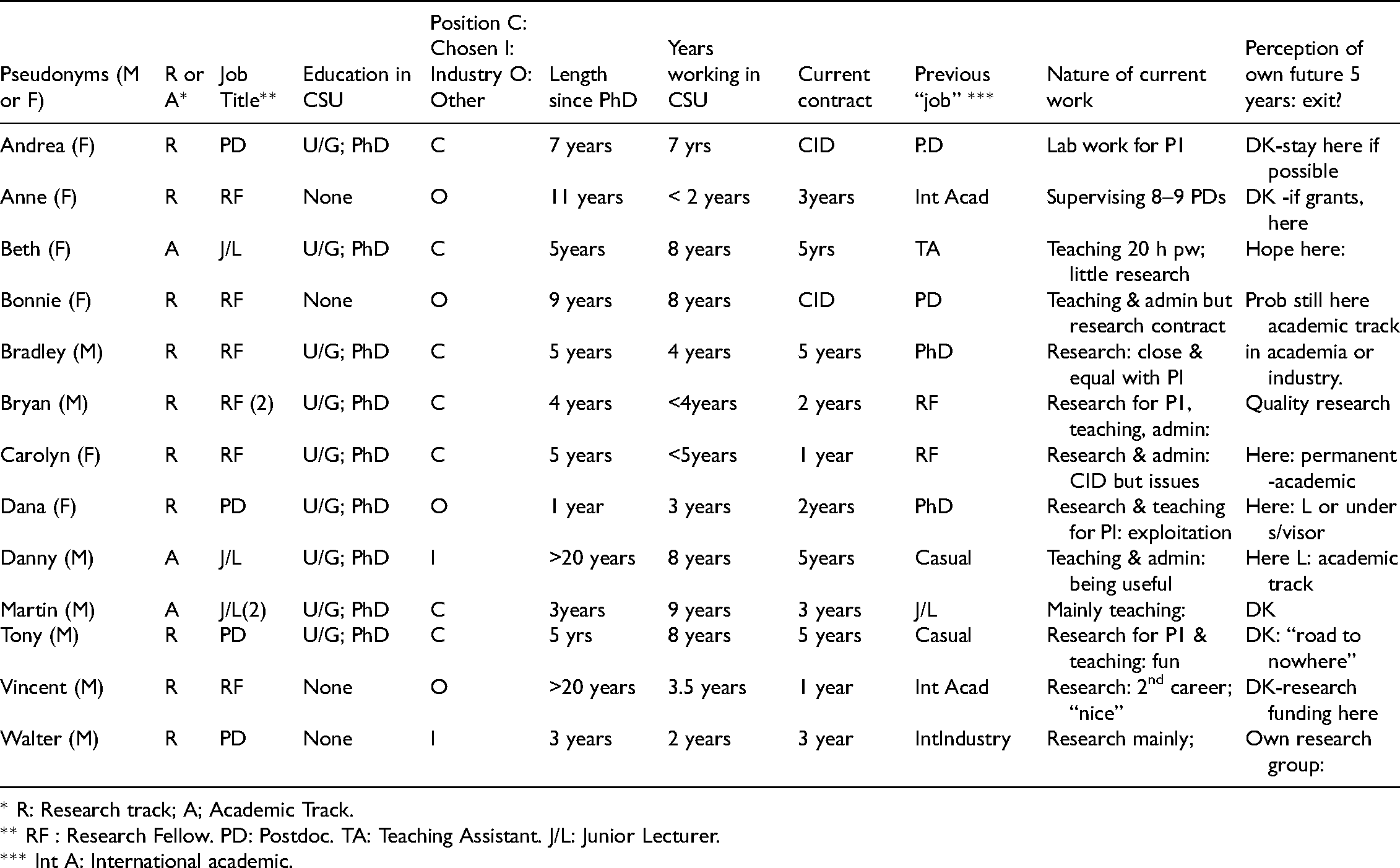
* R: Research track; A; Academic Track.
** RF : Research Fellow. PD: Postdoc. TA: Teaching Assistant. J/L: Junior Lecturer.
*** Int A: International academic.
The patterns emerging in the study
We now look in more detail at their route to accessing probationary citizenship; their work situation and their perception of their future.
Accessing a contract position
Three main routes were identified i.e., being “chosen” by an academic in the case study university, coming from industry or being internationally recruited. Being “chosen” can be seen as the traditional route, although little attention has been paid to it in previous research.
Roughly half of the respondents were “chosen” by their PhD supervisor in that they were invited to undertake a PhD under him/her, and later to work under him/her as a postdoc. These respondents had typically done their undergraduate degree at the case study university, and frequently their PhD supervisor, who subsequently became their P1, had also supervised their undergraduate project (a major piece of independent research), and had encouraged and groomed them for a career in STEM over a long period of time. Being “chosen” had some similarities with sponsorship (Hewlett, 2013; O’Connor et al., 2019b
There were elements of loyalty and indebtedness in the relationship with a PhD supervisor/PI. Tony, a research postdoc did his PhD in one centre and after his PhD, he spent four years being paid at casual labour rates in another centre. He said of it that: “It wasn't a proper job like”. His current five-year postdoc contract is jointly funded by those two research centres. It involves the same tasks as he had been doing on hourly pay viz. lecturing, supervising PhD students unofficially on behalf of his PI and writing funding proposals. However, it is “official” and better paid. In other cases, the initial encouragement to embark on a PhD led to the protégé becoming part of a successful funding application as a postdoc. Thus Bryan, who is a research fellow, was employed by his former PhD supervisor/now PI on a second (two year) postdoc contract that he himself designed.
Relationships with PhD supervisors were also important in accessing temporary positions on the academic track, albeit indirectly. Martin was an undergraduate in the case study university, and then a teaching assistant there while doing his PhD. When a three-year academic contract position came up to replace a permanent male academic seconded to a management position, he got it. His contract has now been extended for a further three years to continue that cover. The head of the department in which he did his PhD and where the post is located was one of his PhD supervisors, with his PhD supervisors being seen by him as “very supportive” in getting him that position.
Men were more likely than women to be STEM academics in the case study university (constituting 83 −100 per cent of those at lecturer to professor level). Given homosociability (Lynch et al., 2012) one would expect that men would be most likely to be “chosen”, although occasionally women were. Thus Beth, a contract junior lecturer on the academic track, said that: “I decided to do a PhD only because I was approached to do it”. Her undergraduate project supervisor rang her and “asked me would I be interested in applying for [external] PhD funding. It was based on my final year project…. So, I decided to apply for it.” That male academic became her PhD supervisor: “he knew that I wanted to end up lecturing. So as part of the PhD process he made sure that I got lecturing hours and he made sure that I got as much recognition as possible for that as well.” His retirement due to ill health created the opportunity for her to access a five-year academic contract. Thus, the patriarchal bargain may under certain circumstances, benefit junior women insofar as they are “chosen” by senior male academics.
There were two main alternative routes to probationary citizenship viz being recruited on the basis of industrial experience and through international academic recruitment. Those coming in through these routes tended to be much older and had at best tenuous connections with the case study university. They were also less likely to be in a subordinate relationship with an individual P1. For example, Danny had done his undergraduate degree and PhD there more than 20 years earlier and then worked in industry before leaving to care for his children. He was asked by a contact in the university to teach an industry related module because he had worked in industry. Over time he was asked to do more teaching, initially paid at hourly rates, then he was on short contracts, followed by a five-year academic junior lecturer contract.
International recruitment was an alternative route. Anne, a non-national with a three-year research fellow contract is on study leave from a permanent academic position in an international university. After her PhD she had a child and did not look for a postdoc position. She regrets that. She has 11 years academic experience and extensive publications, but was willing to take a research fellow position, with supervisory responsibilities, so as to gain access to improved laboratory facilities and new work challenges in a more stable political context.
In summary, roughly half of the respondents were “chosen” by their PhD supervisor, suggesting the persistence of this element of the organisational patriarchal bargain. Most of the others came in through industry or international recruitment, arguably reflecting other manifestations of the impact of neoliberalism.
The work situation: exploitative?
It was suggested that the organisational patriarchal bargain normalises and legitimates the exploitation of probationary citizens: doing their individual PI's or the departments' academic housework (Heijstra et al., 2017) e.g., teaching the courses allocated to the P1; unofficially supervising his/her PhD students and doing his/her laboratory work, with their research contribution not always recognized. In Ireland, with the substantial increase in student numbers and cuts in academic recruitment (Mercille and Murphy, 2017), there were also pressures to “help out” an individual PI or the department by doing (devalued) administrative tasks so that permanent academics could concentrate on research (prioritised under managerialism).
A number of respondents, particularly those who had been “chosen” by their PhD supervisor/PI accepted their work situation. Just one person-- Dana-- a mature woman, on a two-year postdoc contract, whose boss was not her PhD supervisor, identified the situation as exploitative (Naezer et al., 2019). A double outsider (based on gender and age), she highlighted the nature of the relationship between the postdoc and the professor: He [professor] is doing a conference now in (named country) in the next two months, I’ve just done the paper for him and I’ve just done the presentation for him and my name isn't anywhere on it, neither is the guy who did the research. [Named professor] is the key note speaker. So, he might thank us in the presentation but it is in his name. That is not unusual…. it is one of the perks I suppose of being a professor (Dana, F, researcher).
She also identified the gendered dynamics which benefited male postdocs in terms of access to high profile opportunities (similar dynamics were referred to by Le Feuvre et al., 2020). Even though he [male postdoc] might not actually want it [to present a paper at a conference] he is afraid to say no…between me and him, I often say “oh that's a juicy one” and he would say “oh I wish I could stay home….I was away last week, I was away the week before”,… “why he’d say, do you want it? will I say it to him?” and I’d say “no don't say to him that I want it because that looks bad”… They’re just little things but at the same time you know they mount up (Dana, F, researcher).
In this way she highlighted the gendered informal power (i.e., micropolitics: O’Connor et al., 2020; Morley, 2000) that advantages men and disadvantages women.
Others had benefited from their PI's negotiation of an extension of their research contract or funding between grants and so were beholden in a way that made it difficult to assert their rights to increments or a higher salary scale. Carolyn, a contract researcher, said of her PI (and former PhD supervisor) “he's fought the corner for me to stay”. However, almost five years later, she is “on the same wage that I was on when I started.” She feels unable to renegotiate it since she is between grants and dependent on “little bits of funding” including those from the PI led research centre.
There was also evidence of the exploitation of these probationary citizens by departments. As Danny, who has a five-year junior lecturer academic contract saw it, devalued activities “had to be done” and he was “in the right place at the right time, just to help out with a bit of teaching”. He spends 60% of his time on teaching, 30% on academic administration and 10% on research. Junior lecturers are expected to do research, and research output is a key criterion for recruitment/promotion, but as he sees it, his value lies in doing devalued activities. Similarly, Beth, with a five-year junior lecturer academic contract, has a teaching load that is considerably higher than normal for someone at her level i.e., teaching 20 hours per week and supervising two PhD students. She has tried unsuccessfully to renegotiate this. In both their cases, the price of being useful to the department is having no space to develop their research profile, with potential implications for their future academic careers. Through they vary in gender, they share a common situation in that they both lack a senior academic who would advocate for them, in contrast, for example, to Carolyn, whose PI got Human Resources to agree to extend her contract while she was applying for other funding and allowed her to be paid from the funds he controlled.
Some respondents endorsed what Zheng (2018: 214) described as the myth of scientific work as its own reward, failing to see that: “academic work, no matter how lovable, is still work, and deserves to be treated as such”. Thus, Bryan, who is starting out on a second two-year contract as a research fellow, sees curiosity driven research as its own reward: “my aim isn't really to progress up the ladder, it's just to be able to continue doing research and be paid for it”.
Le Feuvre et al. (2020) suggested that there was an institutionalised tension for postdocs between dependency and intellectual autonomy. Bradley, who is currently on a five-year research contract, appeared to have resolved that tension and described his relationship with his PhD supervisor, now his PI, as “very close and equal”: he has always treated me on sort of a peer-to peer basis, even during my final year project, it's not that it was the case that “I am the supervisor and you’re the student”—it's like a kind of collaborative sort of an arrangement and it's worked well (Bradley, M, researcher).
His relationship with his PhD supervisor went back to his undergraduate days. He was his supervisor's first PhD student in a new substantive area, arguably equalising their expertise, and then later worked under him as PI. In that capacity, the PI provided him with introductions, guided him in terms of publications and conferences and enabled him to be seen as an authority in his own right, reflecting the creation of intellectual autonomy which is the hoped-for outcome of a postdoc position (Le Feuvre et al., 2020).
In summary, the majority of the respondents were in work situations that were exploitative in one way or another, although some of them accepted this and only one (a double outsider in terms of gender and age) explicitly identified the work situation as exploitative.
The future: uncertain?
It was suggested that the organisational patriarchal bargain traditionally involved an expectation that the PI would facilitate the access by probationary citizens to an academic position. Most of the respondents did not want to exit the case study university. Almost half had finished their PhD at least seven years before. They were thus well outside the three-to-five-year period after a PhD when a permanent position might have been expected.
Job insecurity was a major concern even among those who had a CID. Andrea, a CID researcher, whose route into STEM involved being “chosen” by her PhD supervisor/PI, and who had finished her PhD seven years before, refers to “the pressure of not having long-term funding” and the possibility that she could still be made redundant. She would like to stay in the case study university but did not know what her position might be in five years' time: “it depends on what kind of positions open up here or if things don't work out here, I suppose what is available elsewhere”. Tony, a postdoc on a five-year research contract who was also “chosen” by his PI, sees it as a: “road to nowhere” “you’re gone after five years”, despite completing his PhD, teaching 14 modules (during his PhD and during his four subsequent years as a non-citizen (O’Keefe and Courtois, 2019) paid at casual labour rates) and despite his unofficial supervision of the PIs' PhD students. No academic appointments had been made in his department from the time he started his PhD nine years earlier. The exit costs for Tony are high after what he sees as an enjoyable but adolescent interlude: “eventually I’ll have to grow up a bit”. In the case of those who had not been “chosen”, but who had spent long periods undertaking disproportionate amounts of devalued work, the sheer length of time in these positions appeared to increase their exit costs.
Other respondents (both men and women) focused on their individual circumstances which, as they saw it, meant that they had to lower their career expectations. Such circumstances included wanting to move countries, being older and working part-time. Anne, a non-national academic, thought that: “career wise it would have been better, for advancement in my career to the professorship” not to have moved. In five and even in ten years' time, she expects to have the same position she now has. Vincent, a research fellow, felt the need to lower his expectations because of his chronological age, having spent time in academia internationally and in industry. In five years: “I don't know. I’d like… to be in a permanent faculty position somewhere but I’m getting to be a bit old to be considered for that”. He is hoping that he will get “soft money” and be able to access a CID on the research track.
Carolyn a research fellow, with an excellent research record, who was “chosen” by her PhD supervisor, who later became her PI, said that in five years: “I’d like to have moved up to senior researcher or at least to have had a pay increase by then”. However, she also hoped: “to have something more permanent”. As she saw it, permanency was only available on the academic track and so: “in ten years” time I would need to be going up that route”. She sees her “choice” to go part-time after the birth of her child as further eroding her future prospects. She has reluctantly put her career ambitions on hold because of the perceived inevitable consequences of that decision: “They’re going to look less favourably on somebody who works part-time than somebody who works full-time”. Maternity and part-time work were associated with being a woman so these experiences were seen as gendered.
Paradoxically, those who had bought into the myth of science as a satisfying vocation despite its work conditions, were more willing to consider exiting. Walter, a mature non-national on a two-year postdoc contract, who had done his PhD part-time, just wanted to be able to pursue research. In five years, he’d like to be “having his own research group, having a decent grant under my belt so that I could run some research at a university here or elsewhere”. Bryan, who is on a second two-year contract as a research fellow, does not know where he will in five years and in ten years: “It's quite possible that I’ll have left academia”. Bradley who was unusual in having had a close and equal relationship with his PhD supervisor (later his PI) said that in five years “I’ll collaborate with him, but I have to get out from under his wing and show my steel… whether it be in academia or industry”.
Most of the respondents wanted to stay “despite atrocious job prospects” (Zheng, 2018: 241). They clung to the hope that they would get a permanent academic job, although most were well outside the three-to-five-year period after their PhD when this might have been expected under the traditional patriarchal bargain.
Summary and conclusions
The model for the creation of knowledge in Science, Technology, Engineering and Mathematics (STEM) involves the near total career dependence by probationary citizens on senior academics. Very little is known about such probationary citizens: with even basic national data about their number, the duration of these experiences and their future careers being unavailable.
It was tentatively suggested that neoliberalism had contributed to the disruption of the organisational patriarchal bargain, which involved a time limited period of exploitation by senior academics, followed by probationary citizens' access to a permanent position. This disruption was seen as reflecting a reduction in the number of permanent academic positions; increased funding related to research performativity and an entrepreneurial research funding model involving hiring large numbers of probationary citizens without any concern as to their access to permanent academic jobs.
Informal relationships between men with and without positional power have always been important in higher educational institutions. However, interpersonal relationships have been officially delegitimised as the basis for recruitment/promotion, although there is evidence that they continue to exist to some extent in facilitating access to probationary citizenship. Thus, roughly half of the respondents came into STEM through being “chosen” by their PhD supervisor who effectively groomed them for a career in science, often supervising their undergraduate project, encouraging them to do a PhD under them, and later to work for them as PI. Those “choosing” and being “chosen” could include men and women, although given the dominance of men in senior positions and homosociability, the “choosers” were most likely to be men. Being “chosen” facilitated getting a contract position, and embarking on what potentially was an elite route, but one which led in the majority of cases to an exploitative work situation and an uncertain future.
Roughly half of the small group of respondents in this study came in through industry or through international recruitment. However, their position in terms of access to a permanent position was no more secure than those who came in through personal relationships. Thus, in the case study university, regardless of the access route, the “paying forward” (O’Hagan et al., 2019) done by probationary citizens was unlikely to yield anything more substantial than a co-authored article, a patent or a reference.
Roughly half of the respondents had finished their PhD at least seven years previously. The cost of exiting was high given their “chosen” status and/or the length of time already spent in the case study university. Those who were most willing to consider exiting were those who saw research as its own reward. Only one of them had a close and equal relationship with their PI, and this may have given him the intellectual autonomy to enable him to consider exiting.
The inclusion of both researchers and academics on two-to-five-year contracts in the concept of probationary citizen can be seen as problematic since the former are typically exploited by an individual and the latter by departments. In both cases, the focus on research performativity creates a demand for those who, for whatever reason, are willing to do the low status work which is essential for the functioning of higher educational institutions. Future research might usefully explore the similarities and differences in their experiences.
Embedded in the model of the organisational patriarchal bargain are assumptions that women should not negotiate around pay; that maternity is irrelevant etc. Where women in this small study had renegotiated some element of that bargain, the price they paid in terms of future negotiations (particularly but not exclusively around salary) was high. Some women had made huge personal sacrifices arising from the inability of the gendered system to cope with maternity, part-time work and/or other indicators of its own gendered bias.
With the initiation of the Pathways programme (SFI, 2021b) a small number of post-docs are potentially destined for future leadership. This suggests that there is beginning to be a recognition of probationary citizens' uncertain future in STEM. It is significant however that the underlying problem of the exploitative situation of hundreds if not thousands of STEM probationary citizens, whose work potentially facilitates both the progression of permanent academics and the ability of universities to deliver on a liberal managerialist research performativity agenda, is effectively being ignored.
The empirical limitations of the study are considerable. The numbers are small and the focus is on one Irish university, with further limitations as regards the current unavailability of national data. Thus, the insights from this small study need to be tested in other universities nationally and internationally. Furthermore, it would be interesting to explore the extent to which probationary citizens conceive of themselves as young entrepreneurs, concerned with the construction of their own individual career, having internalised the managerialist model-and to look at the implications of this for a collaborative construction of science. It would also be interesting to explore the extent to which organisational patriarchal bargains exist in male dominated organisations outside academia.
Its theoretical contribution lies in the application of the concept of probationary citizen and the suggestion that, although elements of a patriarchal bargain persist for some respondents, the possibility of a permanent position has been fractured by neoliberalism. What is novel about the study is the insight it offers into the potential breakdown of the organisational patriarchal bargain which implicitly guaranteed probationary citizens access to permanent academic positions and so legitimated their temporary exploitative work situations. It suggests that both similar and different costs are borne by men and women.
The article highlights the paradoxical situation of probationary citizens who are “chosen” by permanent academics and who thus avoid the rigours of a fully open recruitment process and appear to be initially advantaged, but who end up facing a very uncertain future. It raises questions about the valorisation of the highly dependent relationships between probationary citizens and permanent STEM academics as the main model for the creation of knowledge in STEM.
Footnotes
Acknowledgements
The Irish study was part of a wider cross-national project (FESTA) supported by the European Commission under grant number 287526. The contribution of the colleagues involved in that study, and particularly Clare O'Hagan in terms of the Irish data collection, is gratefully acknowledged. The comments and criticisms of the anonymous reviewers were very helpful and are also gratefully acknowledged.
Declaration of conflicting interests
The author(s) declared no potential conflicts of interest with respect to the research, authorship, and/or publication of this article.
Funding
The author(s) disclosed receipt of the following financial support for the research, authorship, and/or publication of this article: This work was supported by the European Commission, (grant number 287526).
