




Abstract
Based on a series of walks undertaken on the Dingle Peninsula (Chorca Dhuibhne), South-West Ireland, in March 2020 as part of the ‘Walking Conversations’ symposium, a collaboration between Chorca Dhuibhne Creativity and Innovation Hub, Pobalscoil Chorca Dhuibhne and the Department of Sociology & Criminology at UCC, this paper explores walking as a non-conventional method and way of knowing and understanding in both social research and research led teaching; specifically in relation to transitions to sustainability. We argue that walking is an organic approach to research that engages the performative and sensing body; that values the importance of innovative ways of connecting and collaborating in co-productive ways; and offers embodied, relational, sensory, multi-modal ways to reimagine socio-ecological sustainability in current times. Moreover, as we demonstrate, walking, as research on the move, enables us to: access/say the unsayable and open a space for the role of imagination, and creativity that can facilitate a radical democratic imaginary. Indeed, based upon our experiences with co-walkers in Corca Dhuibhne, research-led walking methods offer a radical democratic transdisciplinary pedagogy, that underpins the Connected Curriculum at UCC.
Keywords
Introduction
Depending on your perspective, the Dingle peninsula or Corca Dhuibhne, on the South-West coast of Ireland, could variously be thought of as a liminal space where land meets the sea, tradition meets hyper-modernity and culture meets nature. It is a place that attracts walkers and artists who seek to connect with and experience the natural landscape of the Wild Atlantic Way, with nature, the sea, the mountains and footpaths.
Szakolczai and Horvath (2018) characterise walking as way of life and a culture that was founded, in a taken for granted manner, on the gift-like stability of the world as nature. Alternatively, Slevin et al. (2021: 79), suggest that framing our relationship to nature as ‘gifts’ acts to restrict our understanding ‘within the horizon of a dominant socio-technical imaginary (Jasanoff, 2010, 2015; Jasanoff and Kim, 2013). Drawing on Freire's idea of critical consciousness, we value, or indeed make a virtue of, connecting different types of knowledge in the cultivation of the capacities for social transformation among citizens (Kuepers, 2019; Makrakis and Kostoulas-Makrakis, 2021; Slevin et al., 2021) in relation to socio-ecological sustainability.
Several authors have suggested the importance of making space for creative, imaginative, or renewed methodologies (Kara, 2015; Keohane, 2016; O’Neill et al., 2002, 2015) alongside ‘solutions’-based approaches in both interdisciplinary and transdisciplinary approaches to sustainability (Byrne and Mullally, 2016; Byrne, Mullally and Sage, 2017). Indeed, following Illich (1973) a convivial society is one where creativity and imagination are central to the lifeblood of society and we are not slaves to tools, technology or oppressive systems (O’Neill and Einashe, 2019). Illich's work on conviviality remains relevant, because it informs current thinking about social, environmental sustainability and ‘convivial economy,’ in tension with a neo-liberal focus on the dominance of growth and technological regimes of consumption and productivity (Berg and Nowicka, 2019).
In a globalised world, Corca Dhuibhne could be considered as a peripheral location seemingly disadvantaged by history and geography on Ireland's edge 1 , yet liminality and peripherality have been leveraged and celebrated as a source of social innovation there, and offer a potential for societal transformation where Ireland's edge is repositioned at the cutting edge of socio-cultural innovation (Glatz-schmallegger et al., 2021). As an Irish speaking community or Gaeltacht, located on the Wild Atlantic Way 2 , Corca Dhuibhne bridges a richly textured repository of cultural meaning, the lived experience of striving for sustainability and a reservoir of resources (ecological, social, economic and cultural; including adapted technological innovations) that may endow the local community with the tools for resilience in the Anthropocene. The Anthropocene, a concept that has migrated from geology, archaeology and stratigraphy into the social sciences, suggests that human beings have become a geological force transforming the earth and transgressing thresholds to the point of self-destruction. On the other hand, our encounters with anthropology, archaeology, art, ecology, history, mythology, poetry, and the lived experience on the Dingle Peninsula, suggest that remembering the future (past-present) might just be integral to re-imagining it.
A moveable feast?
Built upon, but transcending creative, collaborative and co-produced research on socio-technical transitions to sustainability, this paper draws on well-established methods in sociology and anthropology as well as more non-conventional methods 3 to explore or rather imagine potential socio-ecological transitions to sustainability from a transdisciplinary perspective. Based on walks (with artists, historians, archaeologists and environmentalists) undertaken in Dingle in March 2020 a week before the Covid-19 lockdown, this paper explores walking as a way of knowing and understanding in sociological research and education, that embraces a passion for transdisciplinary research, coupled with ‘disciplinary humility’ in (re-)imagining socio-ecological sustainability (Byrne, Mullally and Sage, 2017; Tripp and Shortlidge, 2019, 2020). Disciplinary humility means that we acknowledge the significance and importance of recognising the value of multiple forms of knowledge, something already evident in Weber's seminal essay ‘Science as Vocation’ (Radkau, 2008).
Walking as a non-conventional method for research led teaching and learning
We argue that walking is an organic approach to research, teaching and learning that engages the performative and sensing body, that values the importance of innovative ways of consulting, conversing and connecting in critical, convivial and auto/biographical ways (O’Neill, 2020). Following Ambrose (2020), we suggest that walking is social, embodied and embedded in context (both spatially and temporally) and in Aristotelian terms can be productive (Poesis) tapping into situated and experiential knowledge (Phronesis) as a basis for action (Praxis) for sustainability. Walking is also ‘a way to become responsive to place’ and the landscape, in participatory, sensory and affective ways (Springgay and Truman, 2017: 4). Following Keohane (this volume) we understand walking not just as method, but also as pedagogy with ancient and Irish roots outside the walls of the academy as publicly performed culture-in-action with contemporary relevance.
The paper reflects on walking methods as embodied, relational, sensory, multi-modal, that enable us to access/say the unsayable; and involve the role of imagination and politics, to facilitate a radical democratic imaginary and potentially, in reflecting upon the experience with co-walkers, a radical democratic pedagogy (O’Neill and Einashe, 2019; O’Neill et al., 2020). The notion of moving research here is a deliberate double entendre, intended to be promiscuous (open) though not risqué (profane), including mobile methods (research on the move) and the affective turn in social research (moving research) where the capacity for empathy becomes central (Bennett, 2019) to practicing sustainability (Kuepers, 2019) responsibly (Foster, 2011; Makrakis and Kostoulas-Makrakis, 2021).
Mobile methods, enable researchers ‘to be, see or move with research subjects’ (Kowalewski and Bartłomiejski, 2020: 60). When considered within the context of education and sustainability, appreciating the significance and import of Freire's dialogic pedagogy, we acknowledge that: ‘all knowledges are incomplete, both the knowledge of the ‘scientifically informed’ expert/researcher and the knowledge of the researched. Movement towards better understanding, always for Freire as an understanding for praxis – as a basis for action, is based on mutually respectful dialogue among knowledges relevant to a context’ (Byrne and Callaghan, 2014: 208). In neoliberal and postcolonial contexts, where every critical gesture is recuperated or neutralised, it becomes vital to open and keep open space for radical democratic thinking and imagining, including keeping alive repressed elements of the imaginary. Chantal Mouffe 4 (2019: 118) makes two helpful points that support our thinking here, first in these circumstances, it is important for critical thinking to engage the passions and ‘affect’ and second, ‘it is by their articulation with affects that ideas can gain real force and crystallize in desires’ in order to deepen democratic thinking, being and doing.
Later in the paper we share how the walks in Dingle facilitated a transdisciplinary, imaginary process that is collective, convivial and relational, that engaged with affects and the sociological imagination, enabling ‘us to grasp history and biography and the relations between the two in society’ (Mills 2000 [1959]: 7–8). The conversations during and after the walks in Dingle, demonstrate how the imagination or reimagining can transgress established patterns of thinking and acting and re-envision existing power relations and indeed hegemonies. Moreover, as we shall see, the walking conversations enabled insights into how people experience and respond to their social and natural environments, through affect, meanings, concepts and practices and draws out how they understand past and future within the present time and setting.
Walking methods, ‘moving research’, have considerable merit for enabling us to connect with stories in and of the landscape, to see and feel the experiences of another in embodied ways, and opens a dialogue and space where embodied memories, knowledge and experience (biographies) can be shared. Walking as pedagogy rejects ‘the territorialisation of knowledge’ and seeks conversations with other disciplines (Ingold, 2020). However, walking as an embodied, sensory and dialogic approach to critical and convivial pedagogy (Illich, 1973) 5 is not a panacea, since societies learn, but the world is hard to change (Eder, 1999).
Before we explore the walks on the Dingle Peninsula/ Corca Dhuibne we first unpack the importance of education for sustainability in current times, through: University College Cork's ‘Connected Curriculum’ 6 ; and we argue that learning through, in and whilst walking, offers an innovative methodology for transdisciplinary critical pedagogy and praxis for socio-ecological sustainability.
Education and sustainability: a pedagogy of the unimpressed
The neologism of the Anthropocene isn't simply a contested scientific construct demarcating a new geological epoch, but an emergent cultural model (Haraway, 2015; Strydom, 2017). The experience (lived and mediated) of the changing conditions of existence, has prompted human beings to ‘reflect on and rearticulate taken for granted presuppositions, in a way that allows for the reconstruction of guiding cultural models of nature, their sociocultural world and their selves as agents of change’ (Strydom, 2017: 76). While education has a central role to play, we are conscious of Gough's warning: ‘Suffice it to say that the best response to radical uncertainty is never to convince yourself that you know the one right answer, however tempting that may be; and education ceases to be educational when it becomes the vehicle for any such ‘right answer’ (Gough, 2017: 140). Nevertheless we see certain affinities with Gladwin's (Gladwin, 2021) framing of empathy education built on reciprocity and relationships and forged by connection and belonging. Walking side by side opens a space for dialogue, for listening as understanding, it fosters ‘attunement’ (Scheff, 2006) and the potential for solidarity, as part of an ethics of listening, including possible impacts on policy and practice, especially in diverse research and social contexts (O’Neill and Roberts, 2019).
Teaching and learning in the Anthropocene not only have to contend with the ‘wicked problems’ already identified by Rittel and Webber in 1973 (Lotz-sisitka et al., 2015), but also the impatience, anger and opprobrium of a generation, embodied in the distain of Greta Thunberg, towards world leaders who have kicked the can down the road – who have made the problem of the future, a problem for future generations. The challenge posed by the recognition of wicked problems has taken a while to bed-down, but, has found a basis in the focus on cultivating the competencies and capacities for sustainability among learners, that transcends conventional transmissive modes of education and extractive forms of research, to embrace more transformative approaches. While there are ways in which scientists can deal with uncertainty (Diwekar et al., 2021), wicked problems often require adaptive change and creativity, innovation and imagination that in turn require the cultivation of wisdom and judgement in navigating change. Rather than just resolving problems, problems must be resolved justly and facilitating space for this, as educators, in creative, connected, collaborative, convivial ways, is vital.
Sustainability at the crossroads: intersections, transgressions and transformations
Wals in his ‘forward looking retrospective’ on transformative social learning and socio-ecological sustainability has pointed out that under current conditions of unsustainability the ‘essence of sustainability-oriented learning lies in the ability to respond, reflect, rethink and recalibrate – not just once, but repeatedly when changing circumstances demand it of us’ (Wals, 2015: 18). To complicate matters, he suggests that this will vary from place to place, since no two situations are the same. Nevertheless, or indeed because of this, we find the idea of ‘a forward looking retrospective’ very appealing as a way of grounding our engagement with socio-ecological sustainability. We find a related idea in Kuepers (2019: 79) in the call for a ‘return forward’ to praxis and its integrative role for more responsible, wiser and sustainable living.
In our immediate institutional context in University College Cork we have used the journey metaphor to good effect, to explore our experience of and engagement with sustainability (Reidy et al., 2015). Walking can be metaphorical of life as a journey, a path, uphill, down-hill, we may ‘toe the line,’ take ‘firm steps’. A walk takes place within time and can facilitate an understanding of the self and of life as lived in time, with ‘access to memories of experience in the past and the willingness and ability to recount these in some present is central to biographical research’ (O’Neill and Roberts, 2019: 16). Biographies (of people and places) can be described as ‘global constructions by which individuals /groups constitute a defined present in the horizons of the past (retentions) and the future (pretensions)’(Bertaux and Kohli, 1984: 222).
However, the ‘journey’ model of getting from here, from there and there to here (in the context of sustainability futures) ‘misrepresents our creative engagement in emergent change’ (Foster, 2011: 384), especially when faced with uncertainty (Diwekar et al., 2021). Rather than following any predetermined route or way, paths adjust as we go along, new paths or pathways are made and re-made, as we embrace our mission as educators, and facilitate sustainable learning as a critical, convivial, holistic, multi-faceted and transdisciplinary concept (Mapesela et al., 2012). We also acknowledge that this takes place within the broader context of a history of HEI's focus on knowledge specialization, reductionist thinking and education within disciplinary silos (Byrne and Mullally, 2016) and accelerating academia linked to competitiveness and capitalist rhetoric on performativity as a marker of excellence (O’Neill, 2021; Vostal, 2021). Illich (1973) argues that a tool, such as a school, can stimulate conviviality, or conversely can socialise students to be regimented consumers and producers. He critiques the deadening of the imagination that occurs when the focus is upon the acceleration of productivity and the manufacturing of satisfaction and consent.
Several authors (López-lópez et al., 2021; Tassone et al., 2018; Wals et al., 2016) have characterised Higher Education as being at the crossroads. Taking a path towards the well-being of the planet and people requires a profound ontological, epistemological and ethical transformation and a process approach to learning (Lange, 2018). Wals (2017: 20) asks: ‘How can we better understand and support forms of learning that can lead to the engagement of seemingly unrelated actors and institutions in establishing new knowledge, and in taking the actions necessary to address socio-ecological challenges? He suggests that we if we are to move towards more integrative approaches to teaching and learning and capacity-building that can address sustainability challenges, then we also need to move towards more dynamic and holistic conceptualisations of competence as a relational and emergent property that is the result of knowing, learning and being-in-action, that takes place while focusing on an authentic task or meaningful action.
Sustainability: competences, capacities and capabilities
At a glance, competences, capacities and capabilities might be considered as synonyms for the skillsets and dispositions required for sustainability education and citizenship in the 21st century. The term sustainability literacy is in common use in Education for Sustainability (EfS) and at policy level. It signals the aim of helping people to develop their knowledge and capacity to engage effectively with sustainability challenges (Ryan and Tilbury, 2011). This, according to DuPuis and Ball (2013: 65) entails a change in pedagogy from ‘codify and convince’ to ‘creating a community of learners’. Tilbury (2011: 22) characterises these developments as a shift from ‘informing to transforming’. In cultivating sustainability literacy and competencies amongst its multiple stakeholders, Higher Education Institutions can play a role in effecting transitions towards sustainability in partnership with other societal actors. For us, critical, convivial, sustainability competence is facilitated through participatory, relational, creative and imaginative methods.
The discussion about sustainability competencies (Arrobbio and Sonetti, 2021; Caniglia et al., 2018; Cebrián and Junyent, 2015; Wiek et al., 2011) extended by the United Nations has provided a framework for understanding the needs and capacities required by students for dealing with the challenges of the 21st century. The use of certain types of pedagogies and teaching and learning approaches and strategies fosters the competencies or skills necessary to deal with sustainability, such as critical and creative thinking, problem-solving skills, action competence, collaboration and futures thinking, therefore creating empowered and globally-responsible citizens and professionals who can become active change agents (Cebrián and Junyent, 2015: 2771). Nevertheless, sustainability competence can be seen as: ‘a relational, contextual and emergent property. As such sustainability competence refers to a way of knowing, doing, being and transforming in action that leads to a temporary outcome that is considered the most sustainable given what we know, value and strive for at that moment in time while working on sustainability challenges in a concrete setting’ (Wals, 2015: 11).
Although the emphasis on cultivating sustainability citizenship is riven, and driven, by the late modern sensibilities of individuation and neo-liberalism, a praxis perspective that values an action competence, allows us to realise our role in facilitating students to attain sustainability competencies. Given the discussion so far, we want to broaden and deepen the analysis of UCC's commitment to be a ‘connected university’ in our journey towards education for sustainability, drawing upon walking as a critical, creative and imaginative pedagogy. For us convivial, participatory ways of teaching and learning are central to this task and by this we mean: there is an emphasis upon collective learning, developing a subject-subject specific ethos, building trust and collaborative working; we engage in critical recovery of histories and/or biographies (personal, folk, community, and of place) that draws upon community knowledge and transdisciplinarity; and finally knowledge is shared in understandable and meaningful ways, to reach and ‘affect’ broader publics, beyond the university – with ‘the university in the community’- a ‘connected university’.
The connected curriculum in context
The idea of a connected curriculum in UCC is a context specific adaptation of an idea developed in University College London (Fung, 2017). In the forward, we are presented with an ambitious and challenging vision for the university for the 21st century: ‘a sense here of the university coming out of itself to attend to all the many ecosystems in which it is implicated – the economy certainly, but the ecosystems too of knowledge, social institutions, persons, learning, the natural environment and even culture’ (Barnett in the forward to Fung, 2017: vii).
In some ways this is merely a reaction to the dissolution of the previously taken for granted relationship between teaching and learning and research which has progressively become dissociated due to market pressures and a corresponding process of mimesis whereby universities have sought to align themselves to their perception of business through functional differentiation, and the progressive specialisations, subdivisions, separations and silo-ization of disciplines that accelerated through the 20th century (Byrne and Mullally, 2016; O’Neill, 2021; Vostal, 2021). The connected curriculum in UCC, seeks to link research-led teaching, employability, sustainability, inter and transdisciplinarity, global reach and civic and community engagement. While sustainability citizenship resonates with the values imbued by the connected curriculum it also highlights disconnections, discordances and divergences therein.
UCC's connected curriculum has placed an emphasis on both ‘Life-long learning’ (the provision or use of both formal and informal learning opportunities throughout people's lives in order to foster the continuous development and improvement of the knowledge and skills needed for employment and personal fulfilment) and ‘Life-wide learning’ (learning in real contexts and authentic settings). Such experiential learning enables students to achieve learning goals that are more difficult to attain through classroom learning alone. It helps students to achieve the aims of whole-person development and enables them to develop the life-long learning capabilities that are needed in our ever-changing society, resonating with the literature on sustainability competencies.
Participatory, research-led teaching thus assumes a dynamic, iterative and recursive interaction between research, pedagogy and content. From a sustainability perspective: ‘If we think about sustainability as a learning process, life-wide and lifelong learning is essential as the means to learning to know, learning to do, learning to live together and learning to create generative learning communities towards sustainability’ (Cebrián and Junyent, 2015: 2769). When it comes to inter and transdisciplinary approaches to sustainability there has been far more scholarly attention to research (Byrne et al., 2017; Hughes et al., 2021) than to teaching and learning (Di Giulio and Defila, 2017). Di Giulio and Defila argue that the two are indivisible (Di Giulio and Defila, 2017: 645). As such, ‘developing innovative courses that consider sustainability competencies could foster transformative learning amongst students, but also engage stakeholders and the community and, in turn, contribute to generating organizational change in the context of HE by opening up innovative program designs’ (Cebrián and Junyent, 2015: 2772).
Moreover, we argue here, and evidence in our recently developed module based on a walking classroom Walking as critical pedagoy:walking the Anthropocene 7 ‘ that learning through, in and whilst walking offers a renewed methodology for transdisciplinary learning for socio-ecological sustainability, and an exemplar of the connected curriculum and connected university in practice, towards the development of sustainability competencies.
Learning in context as experiential, productive and as praxis
Corca Dhuibhne/ Dingle Peninsula 2030 is recognised as an example of transdisciplinary research where interdisciplinary research intersects with societal engagement (OECD, 2020). The collaboration between community actors, state agencies and University College Cork, has primarily been focused on transitioning to a low carbon economy and society centred on a partnership with Science Foundation Ireland (SFI) Research Centre for Energy, Climate and Marine research and innovation (MaREI) co-ordinated by the Environmental Research Institute (ERI) at University College Cork (Boyle et al., 2021; Watson et al., 2020).
From an interdisciplinary perspective, more conventional quantitative approaches like community energy audits conducted by engineers have been augmented by qualitative research approaches adapted by sociologists like Participatory Research, Social Network Analysis and Community Mapping (Boyle et al., 2021). From a transdisciplinary perspective, cross fertilisation and intersections with other research projects like Imagining 2050, programmatic and pedagogical innovations like the University Wide Module: Sustainability and an interest among staff in the Department of Sociology and Criminology, University College Cork in the development of non-conventional methods and innovative pedagogies converged in the opportunity to broaden and deepen our collaboration. This requires an openness to other perspectives or ways of knowing that could be thought of as a hybrid imagination (Jamison et al., 2011).
We want to be clear that ‘transdisciplinarity does not reject disciplinary knowledge, methods and agendas….it argues instead for the importance of bringing together knowledge that is often dispersed in highly specialized fields and their disciplines’ (Montuori and Donnelly, 2016: 752–3). Knowing in between, across and beyond the scientific disciplines means knowing using multiple ways of connecting and understanding reality. Modern science needs to be complemented with culture, philosophy, art, subjective experiences, spirituality, and wisdom (Dieleman, 2017).
Mobilizing radical democratic imaginaries: Sociology, sustainability, transdisciplinarity
Walking is a diverse practice and a lived experience, a means to an end and a means in itself. As a method for research and research-led teaching on sustainability it is not only embodied and relational but can also be revelatory (O’Neill and Hubbard, 2010). Walking with another or others, ethnographically places co-walkers within the enfolding and unfolding relations between body, space, place, the senses and social relations. Lives are lived and felt in space and place; drawing upon Massey (2005), space is not a surface on which things happen but a meeting of histories. Here we draw attention to the importance of walking in place for telling and sharing stories, our life ‘stories’ as well as the relational dimension of walking as a convivial practice, side by side, sharing a walk as well as our relationship to the landscape. This is a key theme in Morris's work (this volume). Morris (2017: 1) tells us that ‘despite the variety of the ways artists approach walking, artistic walking works consistently to explore the relationship of walking bodies to the landscape’. Morris charts the development of walking art and the rise in cross disciplinary scholarship since 2000, arguing that walking is a set of ‘networked, social and relational processes’ (Morris, 2017: 2).
Walking as a method is becoming increasingly popular in the social sciences and humanities (Bates and Rhys –Taylor, 2017; Edensor, 2010; Evans and Jones, 2011; Pink et al., 2010). In arts practice it is a method for epistemological and creative activity, a means of thinking and making (Billinghurst et al., 2020; Heddon and Turner, 2010; Heddon and Myers, 2014; Ingold and Vergunst 2008). The ‘turn’ to walking is part of a wider concern with mobilities research (Urry, 2007), with biographical lives in movement (O’Neill and Roberts, 2019), what Simmel calls ‘sociation’-the forms and patterns in which people interact, the ‘socio-spatial patterns of mobility’ (Urry, 2007: 21) and the ways we attach to, or make place (O’Neill, 2020; Springgay and Truman, 2017; Szakolczai and Horvath, 2018). For artist Andrew Duggan (this volume) walking can also be ‘a disruptive force, to agitate, to arrest (and contest) perceived structures’ 8 .
As a research led teaching and learning method across a transdisciplinary terrain, walking serves to unsettle, in collaborative and co-productive ways, the dominant hegemonic tendencies behind disciplinary ‘silo's and at the same time facilitates what we have described as disciplinary humility and the value of multiple forms of knowledge. Thinking against the grain, can help to preserve independent thinking-as praxis. In this way walking opens a space for repressed elements of the imaginary and can facilitate a radical democratic imaginary in relation to the environment, ecology and sustainability – as transdisciplinarity in praxis, as we will see in the next section.
O’Neill and Roberts (2019) offer a series of concepts that guide walking methods including embodiment, memory, time, mobility, rhythm and the senses and the various ways to interpret or analyse walking conversations/research such as, thematic, discursive, narrative and grounded theory approaches. Thinking non-conventionally, or non-procedurally they use the metaphor of the ‘constellation,’ a relational method involving an assemblage of sensory as well as cognitive thinking, that criss-crosses binary thinking, and helps us to gain access to the sedimented layers of history. This is helpful to both work through the past and tell and analyse history in the present (O’Neill and Einashe, 2019). Another way of describing constellational thinking is to think of it as a ‘force field’ a ‘relational interplay’ of forces that ‘constitutes the dynamic and transmutational structure of complex phenomenon’(Jay, 1984: 14). Nicholsen (1997) described constellational thinking as ‘exact imagination’ and puts it this way: ‘exact imagination is confined by scholarship and science yet goes beyond the material by reconfiguring the material at hand’ (1997: 38). This is what we aimed for in the walking conversations symposium in Corca Dhuibhne in March 2020. Activating the connected curriculum, using convivial modes of teaching and learning, in non-procedural ways, that foster/facilitate sustainability competencies.
The art of paying attention and learning along the way
Walking Conversations was a collaboration between the Corca Dhuibhne Creativity and Innovation Hub, the Pobalscoil Chorca Dhuibhne 9 and the Department of Sociology and Criminology at UCC. Taking place on the Dingle peninsula we invited participants, postgraduate students from UCC and Dingle Hub participants to join us for a walking symposium on landscapes, pilgrimage, time, the senses and ecology. We started from the basis that walking is a convivial way of teaching and learning and to do both we need to listen, tune in and pay attention through ‘correspondence’ (Ingold, 2020) and ‘attunement’ (Scheff, 2006).
The symposium started on the Friday evening with a round table event and discussions led by UCC academics, Corca Dhuibhne Creativity and Innovation Hub members, transition year students from the Pobalscoil Chorca Dhuibhne, who shared their images and experiences of the Camino Santiago de Compostela, and walking artist Blake Morris (this volume). Anthropologist Tim Ingold gave a keynote the following morning (this Volume) and this was followed by a series of four walks (rather than papers or talks) led by artists and poets Andrew Duggan, David Holden and Maggie Breen (this volume), a historian (Conor Brosnan) and students at the Pobalscoil; an archaeology, history, ecology and geology walk (Micheál O Coileáin) and environmental walk (Kevin O'Shea). The walks were followed by a World Café (Löhr et al., 2020) feedback session led by Gerard Mullally based on the Imagining 2050 Deliberative Futures Toolkit 10 .
As we have discussed above, walking as method for research, teaching and learning is simultaneously social, embedded, embodied and sensitive to the past (Ambrose, 2020). Ambrose suggests that walking offers opportunities for social learning, embedded in specific landscapes, engaging body and mind with an appreciation of the past Further to this, O’Neill (2020) stresses the importance of studying lives in process (drawing upon phenomenology/symbolic interactionism) the importance of feeling our way in ‘moving research’ to both work through the past, in ways that connect theory, experience and praxis, connecting the present to the past and indeed into the future. What we found on our walks is that walking helps us to pay attention (see Figure 1), facilitates conversations between disciplines and other types of knowledge, enabling a deeper kind of engaged sensory and multimodal learning (see Figure 2). We slowed down, tuned into the landscape and environment with our feet, skin, bodies and senses, connecting with nature, the geology, rocks and stones, the weather and each other (see Figure 3).
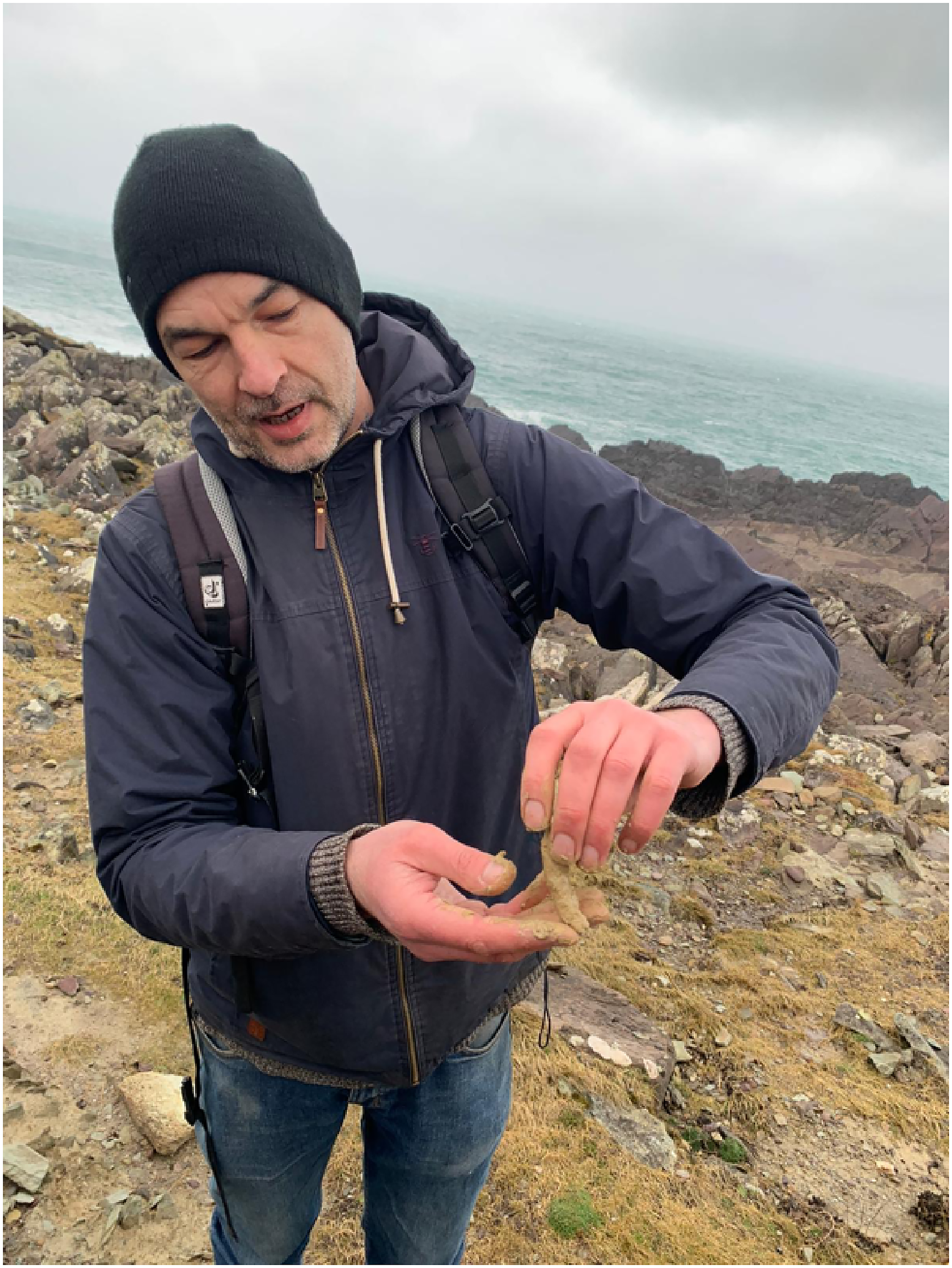
David Holden, artist image: mastoureh fathi (reproduced with permission).
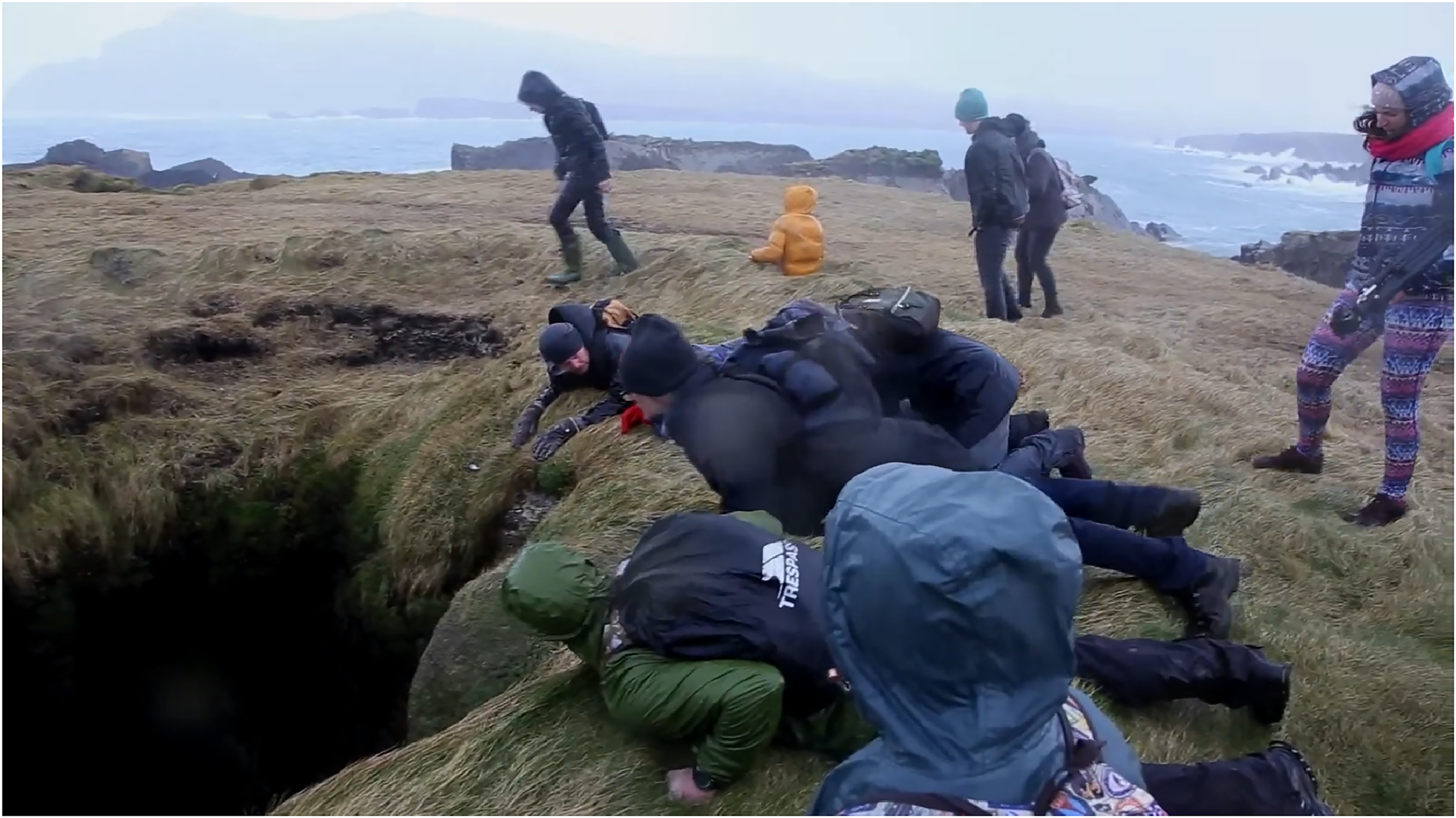
Blow hole. Image: Maciej Klich (reproduced with permission).
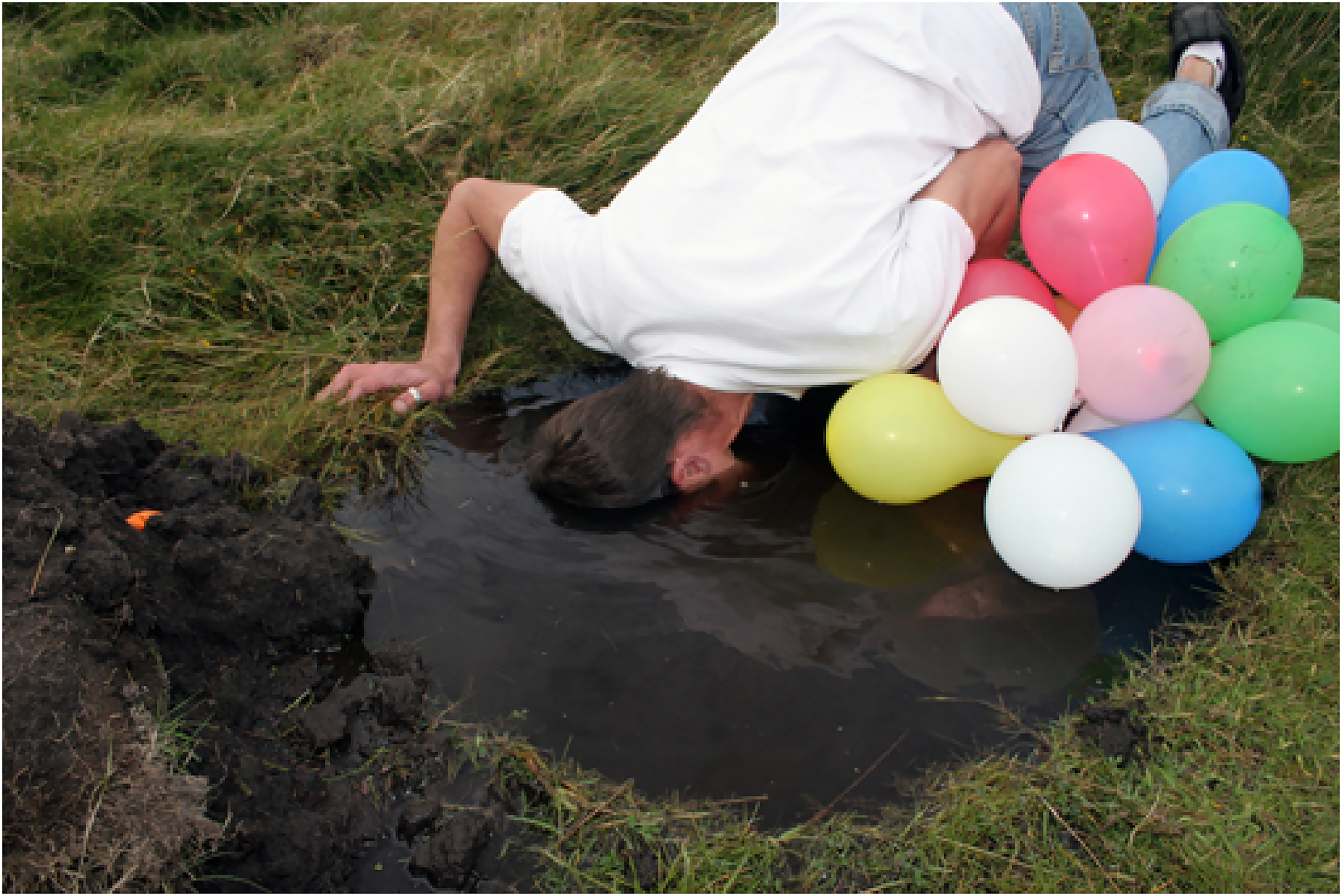
H-O-L-E image: Andrew Duggan (reproduced with permission of the artist).
On Clogher beach David Holden showed us where he found the clay to make his ceramics and we felt, handled and experienced the different textures of the clay, its pliability and viscosity. David shared his appreciation of the geology of the area, the layers of history in the rock and the different properties of the clay that we handled. Along the walk we fell into twos and threes and shared our reflections on the land we walked in and through and also something of ourselves too, our biographies and memories sparked by the landscape and kinaesthetic rhythm of walking. We learnt about one of the students love for his family camping holidays in the Colorado mountains, that he spoke about on our scramble over large rocks, as we left the beach; and the poet Maggie Breen spoke about the lay of the hills we were looking at and the associated myth related to three sisters. Influenced by the Japanese philosophy of Wabi-Sabi 11 associated with Zen Buddhism, David encouraged us to think differently about the landscape we walked in, focusing upon smaller scale details, the texture and colour of the clay, the details in the rock, moss and grasses, alongside the power of the sea, tides and the currents as we lay face down, with our heads peering into a blow hole 12 .
Andrew Duggan's work informed our walks and challenges us to think differently. An image from Andrew's H-O-L-E series (Figure 4) resonates, on the one hand, with the injunction to connect with nature by the artist David Holden, where walkers were encouraged to look into and connect with nature. On the other hand, it playfully invokes the ambiguity and ambivalence of celebrating the Anthropocene, while burying our heads, ignoring our impact on the natural world (Brechin, 2008). Both conjoin experiential, critical and interpretative relationships with socio-ecological constructions of sustainability.
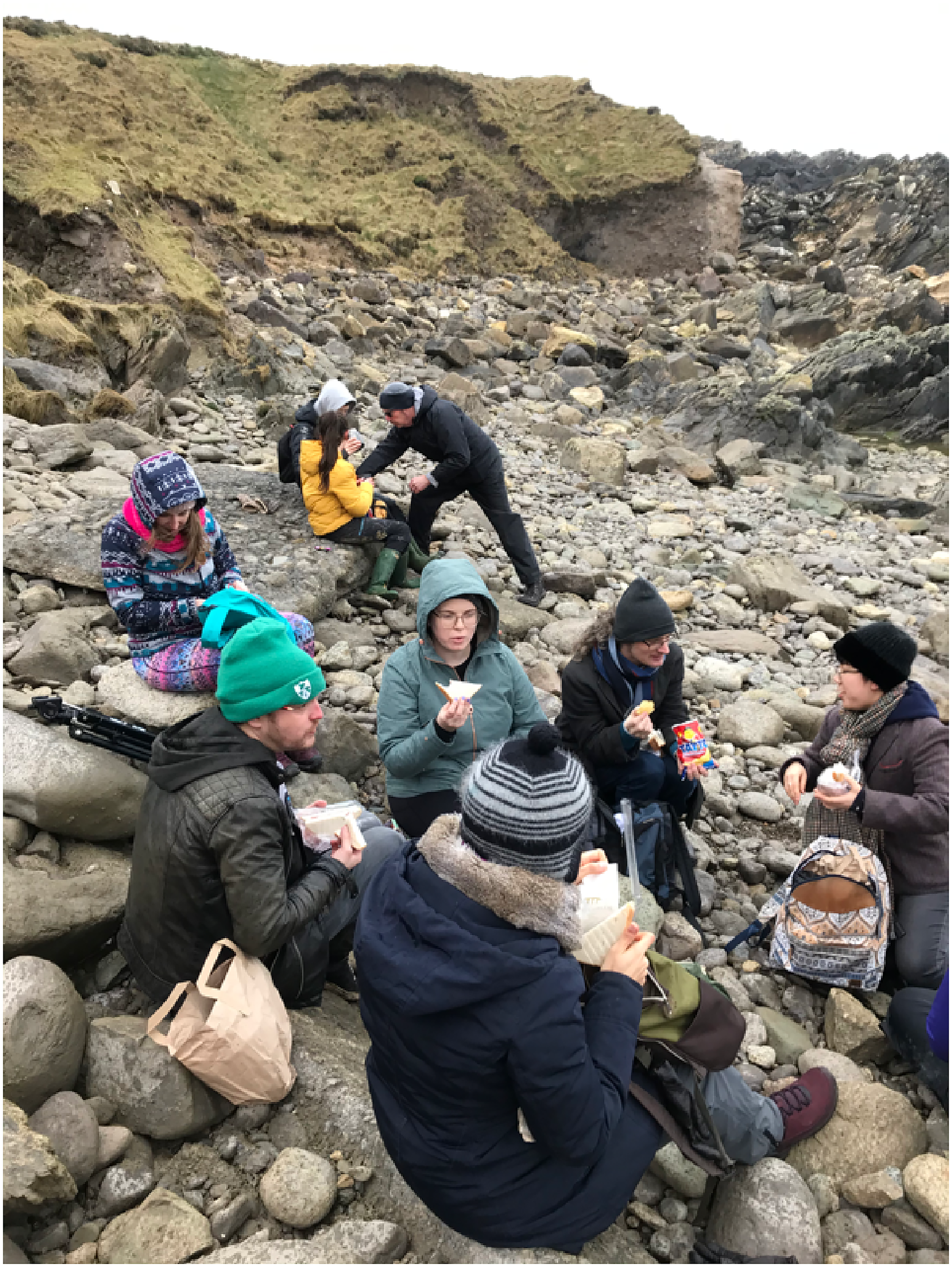
Walking as convivial and relational. Image: Maggie O'Neill.
In the World Café (see Figure 5) following our return from the respective walks, each walking group gathered at round tables and we shared and documented our thoughts and feelings on the template drawn on each table. We moved around each table listening and attending to the shared thoughts and reflections, building a sense of the experiential learning, connecting back to the themes of the shared talks on Friday evening and Tim Ingold's keynote; and importantly what should happen next. Key emerging themes were: the importance of thinking ethically about tourism in the area; walking as a living lab; the ways that walking sparks and precipitates creativity; walking as slow learning for sustainability; walking as pedagogical re-imagining; and walking as pathfinding. It is difficult to capture in this paper, (in the time and space), the shared convivial learning and the openness and warmth towards developing further walking conversations and especially in relation to the themes of sustainability, ethical eco-tourism, socio-ecology and the constellational shapes of the ‘exact imagination’ emerging from our walks.
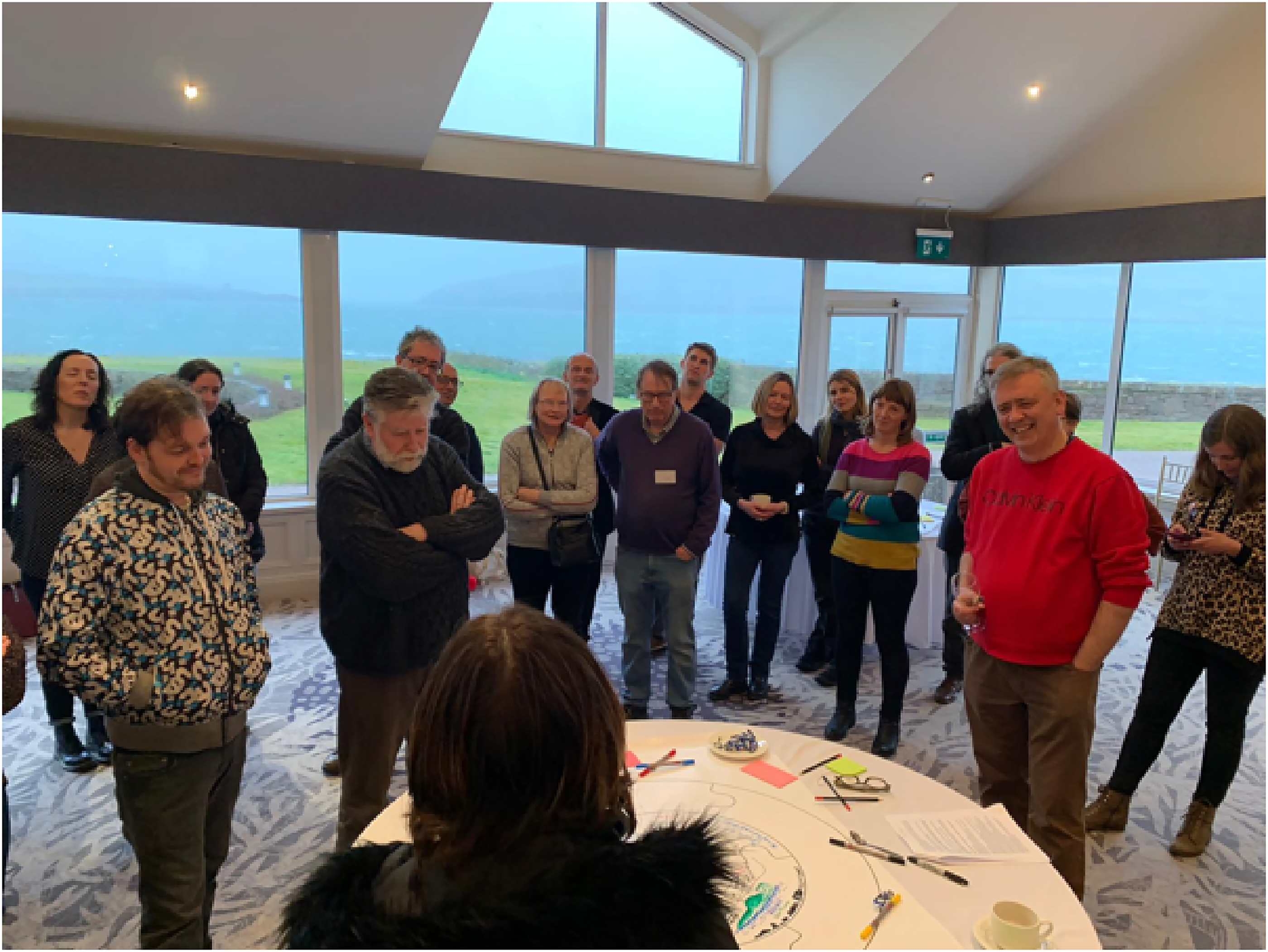
World café conversations. Image: Mastoureh Fathi (reproduced with permission).
In the days after the walking symposium we received feedback from the co-walkers that reinforced for us the transdisciplinary, multi-modal and creative, reimagining of walking as critical, convivial pedagogy; and especially for our journeys towards socio-ecological sustainability and sustainable competencies. To me, it animated the value of walking and [thinking, talking, reflecting and learning] in the co-creation of knowledge and wisdom, while providing necessary contexts of place, people, history and culture. Moreover, the physical flow of walking, in particular if combined with suitable priming, can stimulate attention, the flow of thoughts, and valuable discourse and dialogue, which in a social environment has vast potential in the co-creation of valuable knowledge and wisdom. (Edmond Byrne, Professor of Process and Chemical Engineering, UCC)
For one of the international postgraduate students, taking part reinforced the global/local connections and importance of creative processes and practices. Expectations are always big. As a foreigner your imagination flies to images beyond reality. And yet, these images became very much true. This first encounter with Dingle was inspirational, liberating and definitely unforgettable. People from all over the world and from the area itself, with a common interest in walking and with their own ways of thinking, gathered for a weekend full of words and creations, full of art. Poetry, drawing, walking in nature. Even the rain was a crucial part of the experience, washing away all the worries that the city had imposed on us. The scenery, magical, breath-taking. Accompanied by speeches that opened a door to a new perspective of one of the simplest things of our everyday lives, walking. What an amazing way to spend the last days in Ireland!
The pedagogic and creative benefits of walking are reinforced succinctly by a colleague involved in coordinating the symposium. What a great weekend! I feel heartened by the experience; it reminds me how walking impacts the way we see the world and how it brings new ways of thinking and of relating to the world and one another. It also reinforces for me how art and creative thinking have a very significant place, hand in hand with many disciplines, in solving the big issues of our time together. There's a phrase in Irish, ‘ardaíonn sé an chroí’ meaning ‘it lifts the heart’ and this weekend is certainly worthy of this phrase. (Maggie Breen, Corca Dhuibhne Creativity and Innovation Hub)
Another colleague and participant highlights the power of nature and the landscape, its importance to our very being and worldmaking; and the impact of the symposium on his thinking and being: The schlemp to Dingle, the speil of Ingold brought to mind the John Moriarty quote… ’I went through libraries, I had been to the galleries and been to the concert halls and I was literally glutted with culture, I had to come out and put my head in a stream in a bog in Connemara and let it all washout and start again and remake my mind’. (Ray Griffin, Business - Management and Organisation, Waterford Institute of Technology)
The clarity of Moriarty's philosophy and poetics were introduced to the symposium by Brendan Tuohy, who shared images of the beauty of the natural world in Corca Dhuibhne and Connemara through Moriarty's writings and the significance of Kerry poet Brendan Kennelly's (2002) words in the Little Book of Judas on the current situation for humankind.
That walking inspires creativity as well as connection to the landscape is evident also in the poem created by a postgraduate student who walked with historian Conor Brosnan in the Dingle famine graveyard. (Figure 6)
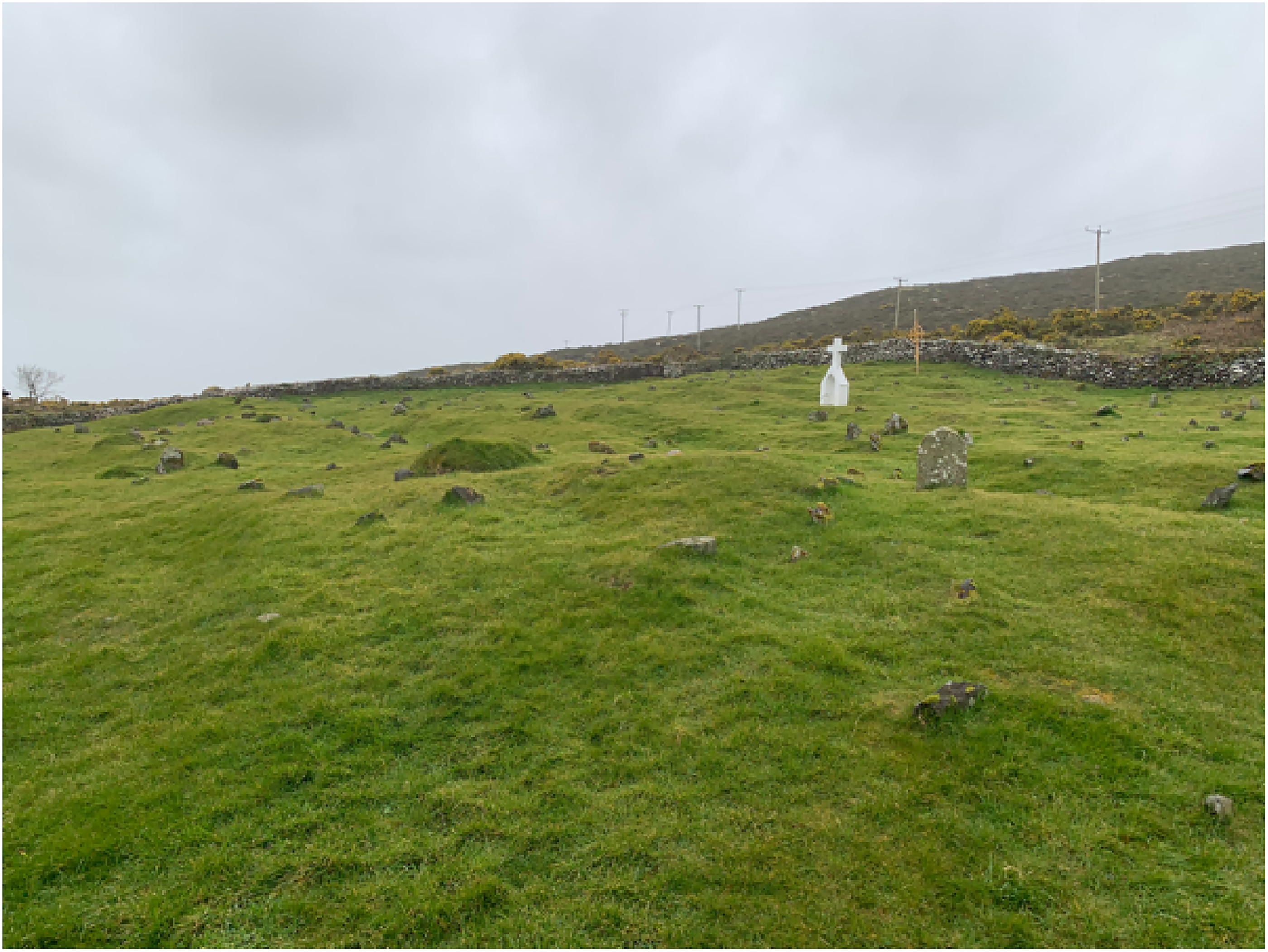
The famine graveyard, dingle. Image: Amin Sharifi Isaloo (reproduced with permission).
From a metaphorical perspective, walking the walk is often regarded as a morally superior form of praxis compared with rhetorical or declaratory commitments to sustainability (Baker, 2007). As we have experienced, from a relational perspective, a more dynamic possibility arises when walking together. The practice of walking and subsequent reflections on our walking conversations, shows that walking can be a way of doing transdisciplinary research and research-led teaching in participatory ways, at the intersections of the social sciences, life sciences, arts and humanities. Ison, Allan and Collins suggest that walking as a practice is a relational dynamic between two systems, a person and a [physical] medium (path or road) entailing a shift in understanding from a linear, causal process to one ‘where walking is relational, systemic and recursive’ (Ison et al., 2015: 1702). As such, walking as method can refer to things we learn along the way, in constellational ways (O’Neill and O’Neill, 2021; O’Neill and Roberts, 2019). Yet the movement shared here in the accounts and responses to the walks, entangles the gathering of ‘varying temporalities across histories, activities, humans, and non-human agents, rather than something solely located in the human body as it walks and talks’ (Powell, 2019: 192). Understood in this way suggests the importance of conceptualising social-ecological systems as structurally coupled social and ecological systems that are mutually adapting in a co-evolutionary dynamic (Ison et al., 2015).
This is captured in the creative works of John Moriarty and Brendan Kennelly; walking can be understood as a method for navigating uncertainty or the cultivating the ‘art of paying attention’ (Ingold this volume). Walking is undertaken through time and movement in near space and place and often in co-presence with others, it attends to the embodied, sensual and ‘more than human’ (Springgay and Truman, 2017) relationalities of place/landscape. Here we connect with, develop, transcend and draw from established qualitative methods, including interviews, participant observation, biographical research and imaginative ethnographies (Hayes et al., 2015). From an educational, and specifically, a pedagogical perspective (Wals et al., 2016) universities can support student learning through a dialogic, critical, participatory, moving/kinaesthetic praxis-oriented learning process that supports students to ‘walk the change’. Central to this approach is a cyclical iterative journey of reflection and action: engaging learners in understanding why things are the way they are (current state), what keeps them from changing (maladaptive resilience), how things should be (more desirable state), what needs to be done to bring about change, trying out new ways of doing things, learning from the experience, and re-entering the cycle until a more desirable state has been reached. (Tassone et al., 2018).
That said, if we are to take Freire's dialogical pedagogy and Illich's convivial learning seriously, we must accept that learning doesn't simply inhere in formal curricula. Building on the work of Giroux, Hickey-Moody, Savage and Windle argue that ‘pedagogical praxis in formal educational institutions needs to be more cognizant of public pedagogies and provide ‘citizens with […] critical capacities, modes of literacies, knowledge and skills that enable them to read the world critically and participate in shaping and governing it’ (2010: 228).
Poetry in motion: collaborations for sustainable futures?
The collaborations that led to the Walking Conversations Symposium were rooted in earlier collaborations with the Dingle Creativity and Innovation Hub, in research and pedagogy (Boyle et al., 2021; Kirrane et al., 2020); the walking scholarship and practices of Ingold (2010), Szakolczai and Horvath (2018), O’Neill and Hubbard (2010), and the central importance of creativity and imagination to reimagining sustainability interventions by reconnecting to nature, restructuring institutions and rethinking how knowledge is created, in organic, participatory and experiential ways, and as a basis for action (Luederitz et al., 2017). In Donna Haraway's words ‘We, human people everywhere, must address intense, systemic urgencies” (2015: 151) through transformative learning, being and doing.
The reflections by those leading the walks and the co-walkers are resonant of the embodied, relational, sensory and multi-modal ways of knowing, understanding and learning as paying attention. Poetry helped us to say what is difficult to put into words, and the role of creativity, the moving, sensing, empathic body and the imagination facilitated a radical democratic imaginary, and indeed radical democratic pedagogy, shared through the World Café, along the walks and after the event. Poetry not only set us in motion (Maggie Breen, this volume), motivating and mobilising us for our journey, it also aided our reflections. An extract from Maggie Breen's poem Things to Believe In, conjoins and captures the reflexive intersection of lived experience and innovative public pedagogies:
The seeds of our collaboration were set some years earlier in a presentation by Brendan Touhy to the University Wide Module: Sustainability (Kirrane et al., 2020), UCC in 2018 drawing on the work of Kerry philosopher and poet John Moriarty. Moriarty reflects on the curve of the backbone of a dolphin, a metaphor for how we might bend to nature, rather than making nature bend to our will: ‘the curve of it was as beautiful as any bars of Mozart's music. It was so beautiful. I have no bone in my body that is shaped to the earth like that’. Long before the language of transdisciplinary research and education became commonplace, he captured its ethos, when he states that on reading Darwin, he ‘fell out of his story’.
In summary, a radical democratic imaginary and pedagogy opens a space for teaching and learning in the Anthropocene that might enable us to navigate change and address problems by building cultures of sustainability, sustainable competencies in transdisciplinary ways, along transdisciplinary paths – working via the metaphor of constellational thinking, rather than in linear tropes; and transgressing current paradigms of teaching and learning towards more sustainable futures. Walking for us is not a panacea, as a non-conventional, pedagogic innovation it extends and advances both the sociological imagination, towards new and creative pathways, that require an openness and attentiveness to transdisciplinary ways of knowing, understanding and acting/doing. This transdisciplinary, hybridization of knowledge creation, sustainable world making, invokes and evokes a radical democratic imaginary, working in and with communities in thinking and feeling ways. Hence learning through, in and whilst walking, offers a renewed methodology for transdisciplinary critical pedagogy and praxis for socio-ecological sustainability. Walking as a non-conventional, collaborative and co-productive means of teaching and learning, enables us to say the unsayable, opens space for dialogue, thinking and feeling, that has creativity and the imagination at its core and facilitates a radical democratic transdisciplinary pedagogy (that zig-zags binary thinking and can thus remain unappropriated) in support of a connected curriculum for re-imagining socio-ecological sustainability in current times.
Footnotes
Acknowledgements
Thank you to all who took part in Walking Conversations: the art of paying attention; to Maciej Klich and Prof. Janice Haaken for filming the artists walk; to our speakers, and to all who guided the walks: Dr. Conor Brosnan; Micheal O Coileain; Kevin O'Shea; Andrew Duggan, Maggie Breen and David Holden. Special thanks to the students from Pobalscoil Chorca Dhuibhne, to Chorca Dhuibhne Creativity and Innovation Hub, Tim Ingold and Blake Morris; Dr Amin Sharifi Isaloo, Dr Kieran Keohane.
Thank you to the reviewers of this paper.
Author’s Note
Maggie Breen is now a writer and creative project consultant.
Declaration of conflicting interests
The author(s) declared no potential conflicts of interest with respect to the research, authorship, and/or publication of this article.
Funding
The author(s) disclosed receipt of the following financial support for the research, authorship, and/or publication of this article: This work was supported by the University College Cork.
