




Abstract
This paper offers a critical reflection on the use of walking and mobile interviews in the context of research with disabled people whose diverse corporealities and cognitions challenge assumptions about walking as a normative bodily act associated with free, autonomous, mobility. While it has been suggested that mobile methods hold out the potential to open up dialogic and participative spaces of inquiry that capture embodied, affectual, and sensory knowledges in place, there has been less discussion of how social and bodily difference shapes the politics and practices of methods on the move. Drawing on research exploring disabled people's socio-spatial knowledges and experiences of urban un/safety in Ireland, we address this lacuna by reflecting on our use of ‘go-along’ interviews with people with diverse impairments and mobilities. Recognising the barriers that mediate disabled people's use of urban space, we interrogate both what go-along interviews can contribute to our understanding of disabled people's embodied encounters with urban un/safety, but also the limits, challenges and politics of mobile interviews as a form of methodological practice. We suggest there is a need to advance interdisciplinary social science scholarship which troubles ambulant research, and writes social and bodily difference into mobility studies and mobile methods.
Introduction
Recent years have witnessed an explosion of literature in the social sciences concerned with the role of mobile methods in exploring everyday encounters of being in place (Bell and Bush, 2020; Carpiano, 2009; Evans and Jones, 2011; Kusenbach, 2003; O’Neill and Roberts, 2020). Emerging out of the ‘new mobilities paradigm’ (Sheller and Urry, 2006) and a growing interest in non-representational theories which foreground situated, embodied and habitual encounters with/in the world, mobile methods have been used to explore the mutually constitutive relationship between the body, place and identity (Macpherson, 2016; Middleton and Byles, 2019). While specific methodological approaches vary, ranging from walking interviews, to ‘go-alongs’ (Carpiano, 2009; Kusenbach, 2003), to wheeling interviews (Parent, 2016), mobile methods are often presented as holding out the potential to open up dialogic, participative, and even emancipatory spaces of inquiry that capture participants’ embodied, affectual, and sensory place-based knowledges in a way that ‘static’ methodologies may not (Butler and Derrett, 2014; Finlay and Bowman, 2017; Macpherson, 2016).
While the mobilities turn has drawn attention to the socio-political relations and situated contexts that shape practices of mobility and im/mobile bodies, a number of authors have called for greater focus on social and bodily difference in terms of interrogating theoretical and methodological approaches to mobility (Feldman et al., 2020; Macpherson, 2016; Warren, 2017). Disabled people, 1 whose diverse corporeal and cognitive capacities challenge normative assumptions about how bodies should move, are one group whose experiences have been relatively absent from debates about mobile methods and mobility studies, with a few notable exceptions (Bell and Bush, 2020; Bonehill et al., 2020; Castrodale, 2018; Feldman et al., 2020; Goggin, 2016; Heddon and Porter, 2017; Macpherson, 2016; Middleton and Byles, 2019; Parent, 2016; Pyer and Tucker, 2017). Scholars within geographies of disability and critical disability studies have long recognised the material and discursive barriers which circumscribe independent movement and stigmatise impaired bodies that fail to meet normalising ideals of free, autonomous, mobility (Imrie and Edwards, 2007; Imrie, 2000). However, much less attention has been paid to the potential or otherwise of mobile methods to explore sociological and geographical understandings of disabled people's movement through space.
In this paper, we address this lacuna by offering a critical reflection on the use of mobile methods in research on disabled people's socio-spatial knowledges and experiences of urban un/safety in Ireland. In particular, we reflect on our use of go-along interviews as part of a wider multi-method qualitative research study which explored how people with a diverse range of impairments perceive and negotiate urban safety in their everyday lives (Edwards and Maxwell, 2021). ‘Go-alongs’ are in depth interview encounters in which researchers and participants move together through places of significance for the participant (Kusenbach, 2003; Parent, 2016; Stiegler, 2021). Drawing on our experiences of using this ‘ethnographic research tool' (Kusenbach, 2003: 456), our aims in the paper are two-fold. Firstly, we seek to explore how the go-along facilitates an understanding of disabled people's diverse embodied, affectual experiences of safety in the city. Secondly, we seek to reflect more specifically on the social and political relations that frame the use of go-along methods in the context of disability. While recognising the enabling potential of walking and mobile methods, we also recognise their limits, challenges and closures for those whose diverse bodily capacities mark them out as other, and who may experience environments and spaces as hostile, whether through thoughtless urban design or exposure to a stigmatising public gaze (Macpherson, 2016; Worth, 2013). We therefore call for a reflexive approach to mobile methods that remains acutely attuned to the interrelations between body and environment, and that focuses as much on points of disconnection, stops and collisions as it does on movement, flow and rapport.
Disability, mobility and the turn to mobile methods
The recent explosion of literature on walking and mobile methods reflects a growing interest in exploring material and sensory knowledges of being in the world (Bell and Bush, 2020). Commentators writing in the arena of critical disability studies and geographies of disability have for many years highlighted how mobility itself is a politicised and contested construct which generates inequities in disabled people's lives (Heddon and Porter, 2017; Imrie, 2000). These inequities become manifest in a number of ways, including discriminatory attitudes and barriers such as inaccessible urban design and transport which circumscribe disabled people's mobility. Disabled bodies and subjectivities are often devalued and stigmatised for failing to move (walk, run, jump) in ways that meet able-bodied norms, leading disabled people to be seen as ‘out of place’ in particular spaces (Kitchin, 1998).
Debates about the politics of disability research, and the place of methods within this, have had a long and sometimes conflictual history within disability studies. Mike Oliver's call in 1992 to change the social relations of research production drew attention to the exploitative dynamic that had shaped much disability research, and opened up debate about the power dynamics inherent in researcher-researched relationships based around medicalised understandings of disability (see also Castrodale, 2018). His work was significant in highlighting the need for more participatory modes of research with disabled people; in the arena of geographies of disability, this led to a growing recognition ‘that researchers need to be aware of diverse mental, bodily and sensory experiences of place and environment in developing research strategies and methods’ (Imrie and Edwards, 2007: 630).
The burgeoning literature seeking to bring walking and mobile methods into disability research builds out of this concern to generate situated, place-based knowledges which capture diverse embodied experiences of impairment in space. These knowledges not only focus on the restrictions and inequities that shape disabled people's movement, but also affordances and practices of resilience in everyday mobility (Porcelli et al., 2014). A significant body of work has used walking or go-along interviews to capture the experiences of people with mobility and visual impairments (Bonehill et al., 2020; Middleton and Byles, 2019; Parent, 2016); more recently, walking methods have also been used in research exploring people with intellectual disabilities’ ‘everyday (im)mobilities’ in the context of urban space (Feldman et al., 2020: 365; Hall and Bates, 2019).
What all these studies have in common is a concern to utilise walking methods as a means of interrogating the multiple dynamics and interrelationships which shape embodied and affectual experiences of (urban) space and mobility. Physical environments, assistive aids and devices, and the reactions of others in public space have all been shown to build into embodied experiences of im/mobility (Hall and Bates, 2019; Bonehill et al., 2020). While these studies draw attention to socio-spatial inequities and hierarchies which striate disabled people's experiences, they also powerfully highlight these experiences as contingent and differentiated and seek to challenge binary categorisations about disabled people's subjectivities (as dependent/independent, for example) (Feldman et al., 2020; Middleton and Byles, 2019). Thus, as Middleton and Byles (2019: 82) note in their study of visually impaired (VI) young people in London, navigating the city might best be understood in terms of moments and practices of interdependence – the engagement with others to orientate oneself in public space, for example - rather than ‘independent mobility’ which is so often strived for in policy discourse and campaigning around disability access. In this context, moments of collision or encounter (with people or objects) when on the move should not necessarily be read as negative or to be avoided, but are part of the complex everyday negotiation of young VI people's wayfinding.
Others have reflected more specifically on the practice and politics of carrying out mobile methods in research with people with disabilities. Parent's (2016) account of conducting wheeling interviews with disabled people as a wheelchair user herself illuminates the challenges of navigating the streetscapes of New York and the practical issues of moving with her participants. Castrodale (2018) too reflects on embodied assumptions about the value and appropriateness of using mobile methods in disability research. Noting that many disabled people in his study were reluctant to participate in a go-along interview, he explains this reluctance in terms of a number of factors, including barriers experienced in the physical/built environment, and concerns raised by participants about being made visible and identifiable as ‘disabled’ in specific spaces. His experiences point to the need for (able-bodied) researchers to check their own socio-spatial positionality and privilege when utilising mobile methods, and to recognise the structures and interrelations that shape, and are shaped by, the spaces through which we move. This is a theme we return to later in the paper.
Relational geographies of urban un/safety and disability
Our discussion of the use of mobile methods in this paper is situated within the context of disabled people's spatial practices of urban safety and security. Securitising the city and creating ‘safe cities’ has become a core part of urban governance practices in recent year (Adams and Ward, 2020). However, understandings of urban safety, the means through which it should be addressed, and the effects this has for diverse groups of urban dwellers are frequently defined around narrow parameters in city development plans and policies (Adams and Ward, 2020; Edwards, 2020). Urban security strategies frequently place prominence on securing public space through technical measures to design out crime, for example, rather than recognising a broader range of spaces (the local neighbourhood, or the home) as sites of un/safety (Brands et al., 2015; Edwards, 2020; Edwards and Maxwell, 2021). Meanwhile, as feminist geographers and sociologists working within the arena of fear of violent crime (FOVC) have highlighted, measures used to delineate places as safe or otherwise – through crime statistics, for example - often bear little relation to city inhabitants’ own feelings about safety in place (Koskela, 1997; Pain, 1997; Seal and O’Neill, 2020).
Our own study builds on work which suggests a need to (re)write diverse city dwellers’ everyday narratives and experiences of un/safety back into debates about urban security. In so doing, relational understandings of safety provide a helpful analytical starting point. Rather than being seen as an objective ‘indicator’, we suggest that safety can be understood as an affectual, embodied state constantly in flux, produced in and through our interactions with places, people, objects, and indeed memories and socialisation (Brands and Schwanen, 2014). Safety thus is experienced in and through the body but is also intimately bound up in and produced through social hierarchies, structures, and perceptions about who belongs in city spaces. In the context of disabled people, for example, the legacy of institutionalised living, and association of disability with dependence and vulnerability, continues to perpetuate ideas about disabled people as risky or unsafe subjects in urban public spaces, despite calls for disabled people's rights to accessibility and participation in the community (Edwards and Maxwell, 2021).
To date, disabled people have been relatively absent from debates about urban safety. However, the growing concern with disability hate crime (Hall and Bates, 2019), and the movement of disabled people out of institutionalised settings into the community (Power and Bartlett, 2018), raises broader questions about the need for disabled people's voices in understanding everyday experiences of safety. To this end, studies exploring disabled people's urban encounters, albeit not explicitly in the context of issues of FOVC or un/safety, provide important insights. Drawing on relational approaches which foreground the emergence of experiences of dis/ability through on-going assemblages and interrelations of bodies, objects and environments, recent studies within geographies of disability highlight affectual and sensory encounters with space which not only form around specific socio-spatial exclusions but also moments of resilience and belonging (Hall and Bates, 2019; Hall and Wilton, 2017; Morrison et al., 2020). A recurring theme in disabled people's engagement with urban space relates to how they navigate interactions with others. Encounters with strangers, whether through being stared at, ignored, laughed at, or alternatively, through being offered assistance, all form a part of the experience of cityscapes, and contribute to feelings of alienation, unease, comfort or belonging (Feldman et al., 2020; McClimens et al., 2014; Hall and Bates, 2019; Wiesel and Bigby, 2014; Worth, 2013). Management of self in the face of a stigmatising gaze has been shown to form a key part of disabled people's urban mobility strategies: Worth (2013), for example shows how VI young people seek to ‘pass’ as sighted, often preferring not to use assistive devices such as white canes, which they perceive may mark them out as different, vulnerable, ‘other’ (see also Wong, 2018).
Physical and sensory access also appears repeatedly as a barrier reinforcing disabled people's marginality in urban public spaces; inaccessible buildings, or crowded, noisy spaces which challenge diverse sensory corporealities contribute to experiences of socio-spatial exclusion (Hall and Bates, 2019). However, what these studies also demonstrate is the emotional labour involved in experiences of environmental exclusion, which go beyond physical objects and barriers. Bonehill et al. (2020: 357) for example, note the feelings of anger, anxiety, frustration and discomfort that can emerge for disabled people as part of the ‘emotional work’ of negotiating inaccessible environments or unwelcoming spaces. Such insights suggest that focusing solely on technical fixes in the built environment in order to address accessibility may significantly downplay the role that affectual relations play in shaping the social geographies of disabled people's urban lives (Bonehill et al., 2020). Building on these analyses, this paper seeks to explore how ‘going-along’ can advance understanding of the intimate interrelations – between the body, emotions, and environment – that give rise to everyday encounters of un/safety in the city.
Methodology
This paper draws on a qualitative, multi-method, two year research project exploring the impact of un/safety on the everyday lives and geographies of disabled people in Ireland. The study's core aim was to investigate how disabled people construct, experience and respond to un/safety in the context of hostility and harassment in different types of spaces, and to utilise disabled people's knowledges to develop responses aimed at promoting safety in the community. The main part of the study focused around research with disabled people in three case study areas: in this paper we draw specifically on our work with disabled people living in two cities in different parts of the country (with populations of approximately 1.2 million and 190,000), to explore the urban dynamics of un/safety that shaped their everyday geographies and socio-spatial identities. Some 54 disabled people with a range of impairments (including visual, mobility, hearing impairments and those with intellectual disabilities), took part in the study in total, either through interviews (30 participants) or focus groups (24 participants). Participants were recruited through local advocacy groups and disability organisations. Supports were put in place to ensure appropriate access and facilitate informed consent. This included using sign language interpreters where appropriate and ensuring all information sheets and consent forms were available in a range of formats, including large print and EasyRead. Ethical approval for the project was sought and received through University College Cork's Social Research Ethics Committee.
In this paper, we focus specifically on our use of ‘go-along’ interviews in the study to reflect not just on what they contributed to our understandings of disabled people's encounters of urban un/safety, but also on the experience and challenges of (not) conducting go-along interviews with disabled people, which bring to the fore assumptions and power relations which shape the research design process. Our initial methodological approach to the study envisioned ‘go-alongs’ as simultaneously a discrete and supplemental element of data-gathering and a means of illuminating ‘aspects of individual lived experience’ (Kusenbach, 2003: 464) discussed in sit-down interviews. Mobile methods and walking interviews can take many forms, from the guided walk around a pre-determined route, to a route selected by participants themselves. We selected the go-along approach for the way in which it enables participants to take the lead in choosing routes or places they deem to be meaningful in their everyday lives, and for its potential to ‘de-centre the ‘expert’ knowledge of the academic’ (Warren, 2017: 795).
Go-along interviews were offered to all 30 individuals who had opted to take part in an initial sit down interview. However, only six people chose to take part in an additional go-along, which raises questions about our own assumptions in selecting the method for the study, as well as barriers to participation. Our go-along participants comprised five men and one woman, who lived in a mix of inner city and suburban locations. All lived in the community, rather than an institutionalised setting. Four of the group had a visual impairment (VI) and used a white cane; one had a mobility impairment (MI) and used a wheelchair, while the sixth person had an intellectual disability (ID). As part of the go-alongs, we accompanied participants on routes of their choosing, and to spaces which they perceived as significant in terms of their experiences and narratives of un/safety: this included public spaces such as city centres, their local neighbourhood in shops, and transport hubs.
Our discussions on the move were guided by the places that participants brought us to but remained focused broadly around how they gave meaning to, and navigated safety. Go-alongs lasted between one and three hours, and often involved stopping at particular points, either on the street or in cafes, where conversation was easier. We chose not to record the interviews whilst moving, in part because of potential concerns from participants regarding what Castrodale (2018: 51) refers to as ‘heightened exposure to surveillance’. We were very aware from the initial sit down interviews of the concentration that is required by many disabled people to navigate spaces shaped by able-bodied socio-spatial norms, and were also concerned that the recording device could be intrusive. Thus, we relied on writing up fieldnotes after each go-along and combined these with photographs of objects and spaces highlighted as meaningful by participants during the walk/wheel. We applied the same iterative analysis of our experiences of go-alongs as we did to focus groups and interview transcripts, organising fieldnotes using NVivo. Our collaborative discussions checked and challenged each other's assumptions about meanings inscribed in participants’ and indeed our own narratives and experiences of go-alongs. In addition, we returned to the sit-down interview transcripts and re-analysed the interview discussions alongside our experiences on the move.
Walking/wheeling the city: Socio-spatial encounters with urban un/safety
Safety is a nebulous concept with diverse meanings for disabled people. As we elucidate in an earlier paper (Edwards and Maxwell, 2021), in the context of policy and/or ‘official’ discourses of disability, safety has often been associated with paternalistic protection from risk. However, disabled people in our study gave meaning to safety in a variety of ways, connecting it with notions of autonomy and independence (of being able to do things by oneself), to feelings of comfort, having trusted others around, and echoing Feldman et al.’s (2020) findings of people with ID's im/mobilities, with having a clear spatial routine.
In using go-alongs in the research, our intention was to explore how these meanings played out in people's everyday lives, through conversations on the move and observation of socio-spatial encounters. Conor 2 (VI, male, 40s), Aoife (mobility impairment, female, 20s), and Robert (VI, male, 40s) all chose to meet us in city centre locations, rather than their local neighbourhoods. Aoife chose the location for its access to and opportunities for shopping and socialising; Robert prefers to be in the city centre rather than his local rural town feeling it provides a less stigmatised environment where he can use his cane; Conor spends more time in the city centre rather than his suburb for ease of navigation and to complete tasks such as shopping and banking. The remaining participants, Michael (VI, male, 60s), Martin (VI, male, 50s) and Daniel (ID, 50s male), asked to meet us near their homes and accompany them on a preferred route that constituted part of their daily routine.
The complexity of factors that build into disabled people's encounters of un/safety in space became clear in our go-along with Martin. Martin is in his 50s, has a visual impairment, and lives alone in a busy inner city area of a large city. In a number of phone calls prior to meeting, Martin explained his interest in participating in the research because of his repeated experiences of harassment living and moving around the city, and his unsatisfactory interactions with the Gardaí. 3 We agreed to meet Martin at a local tram stop near his home on a cold December day. Aware of his conspicuousness (Worth, 2013), Martin said we would have no problem identifying him. We spotted Martin by his white cane, but also because he was wearing a Go-Pro camera on his body, which he later revealed he wore as a deterrent to others in a strategy of ‘pre-emptive security’ (Botterill et al., 2019). Taking the lead with the go-along, Martin said ‘Right, there's some things I want to show you’. We first walked down from the tram stop towards the main road, which was noisy with traffic, and choked with intersecting tram tracks and railings preventing access to the road. Indicating a traffic island in the middle of the road, Martin began to explain about the difficulties he faced in crossing at such busy junctions (see Figure 1). This was something that not only held out potential of danger for Martin but caused him frustration and anxiety.
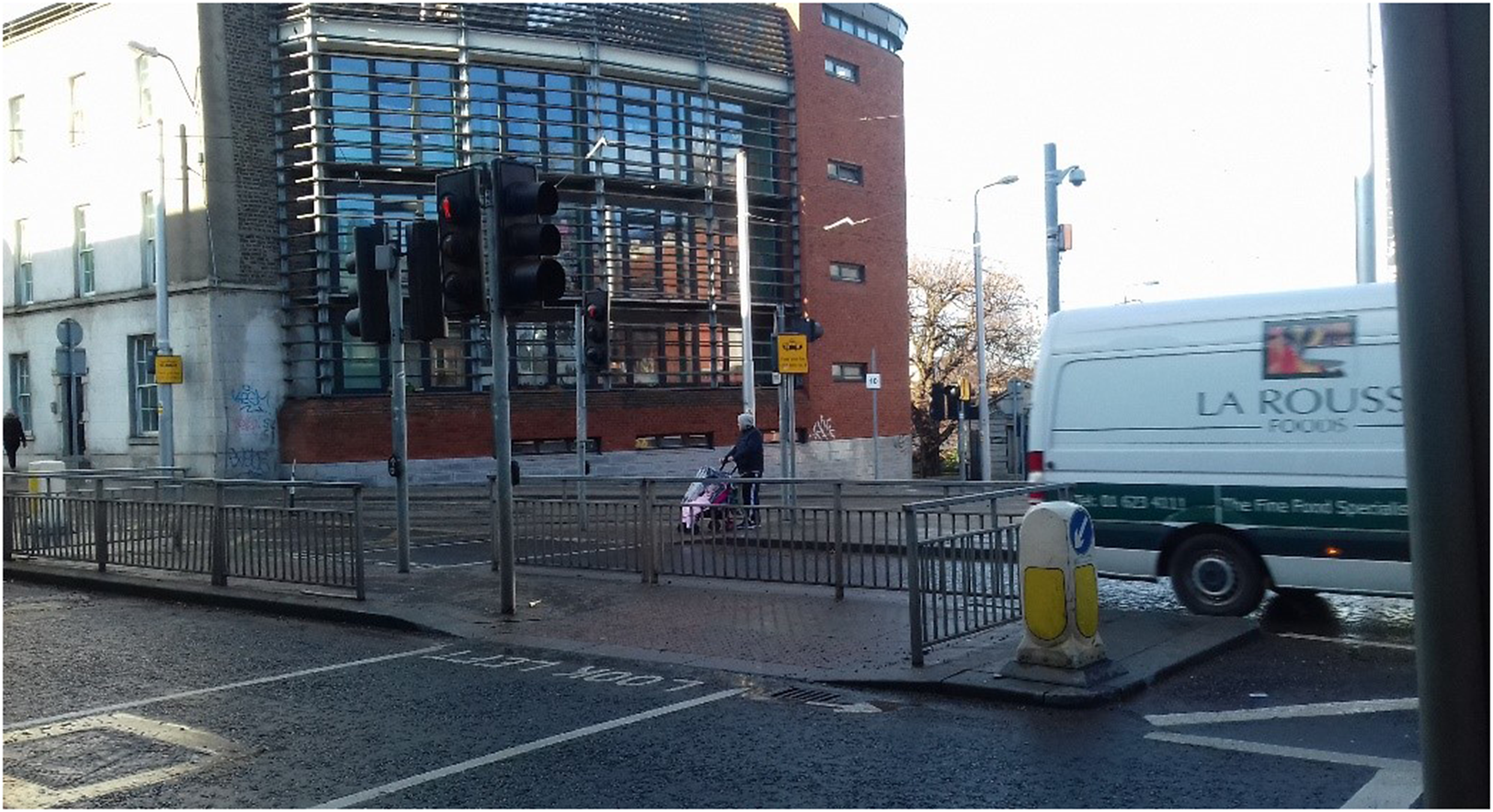
Navigating busy road crossings in Martin’s locality (Image: author).
Physical barriers were therefore a clear facet in creating a hostile environment for Martin in his locality and were raised by a number of other participants in the study. However, these were also held in tandem with the act of engaging or avoiding others as he moved along the street. Asking to hold the researcher's (CE) elbow while walking, Martin spoke about the sheer concentration required to navigate the streetscape, particularly when using a white cane. We moved slowly, and at another street corner turning on to the main road, we stopped, as Martin wished to show us the location of an incident where students who he perceived to be from a nearby college - an assumption he made on account of their ‘middle class accents’ - had teased him as he was trying to cross the road, disrupting his concentration. Instigating memories of previous incidents, this opened into a conversation about people's assumptions about visual impairment. Reflecting the ‘unequal governance of moving bodies’ (Feldman et al., 2020: 375), Martin spoke about moving along the street whilst constantly being bombarded by others’ interventions, or as he described it, ‘diving at you and pulling you, and pushing and pinching you and dragging you’. Describing ableist assumptions from strangers that the white cane was a signal for assistance, he noted that using it was predicated upon bumping into things, upon colliding, as it was an object of ‘detection’ (Middleton and Byles, 2019). Thus, an intervention that others might see as helpful was, for Martin, ‘annoying, but also possibly dangerous’.
It was apparent from our discussions with Martin, that he saw the locality he was living in not as a home or a space of belonging, but rather a functional, transient place to live. Martin connected the area he was living in, which might be described as one of socio-economic disadvantage, to some of the incidents he had encountered, though described not wishing to ‘stereotype’ the place or people who lived there. Martin had lived in many different bedsits around the city and suggested that whilst he might choose to live elsewhere, this was not possible due to the high cost of rents. His narrative reflects the significant financial and housing precarity that shapes the lives of many people with disabilities, and which limit their choices about where they live and how they travel (Bonehill et al., 2020; Feldman et al., 2020).
What becomes clear from our go-along with Martin are the numerous contingent elements and contextual knowledges which feed into senses of un/safety. Walking with Martin, the significance of specific sensory cues – in particular, those predicated on auditory signals – became heightened. Listening through the hum of traffic, from sirens, one had a clear sense of the disruptions that could be engendered by a distracting shout, a call or indeed, an aural absence in the form of traffic signals failing to work. Thus, the physical environment and its associated soundscape, as well as in-the-moment encounters with, and reactions to, others, all built into experiences of un/safety. However, these dimensions also have to be situated within the broader socio-spatial structures and arrangements which shape Martin's, and disabled people's, lives (Hall and Bates, 2019). This includes lack of choice over where to live, others’ normalised assumptions about how bodies should move in public space, and (mis)understandings about the role of assistive devices.
For some of our participants, having a clear spatial routine, built on significant local knowledge of the environment, was a way in which safety could be navigated and planned for. Our walk with Daniel who has an ID, and lives in supported accommodation, replicated his regular route from home to the city centre where he does his shopping. Daniel was eager to show us the sights of his home city and our walk took in an historic landmark with gardens which borders his regular route and culminated in a café which Daniel frequents when his shopping is done. Daniel was very familiar with the café and exchanged greetings with one of the floor staff who he revealed was a peer known from his disability service. What emerged from the walk with Daniel is his sense of safety in his routine, including his knowledge of key landmarks, embeddedness in the disability service which supports him in his living and other arrangements and his pride regarding his home city. Thus, for Daniel, his disability service and its association with his city created for him ‘opportunities for connection, belonging and connectivity’ (Morrison et al., 2020: 62) while simultaneously his very presence and use of city spaces pushes the boundaries of inclusivity within cityscapes (Hall and Bates, 2019).
The walk with Michael also illuminated how experiences of un/safety connect feelings of belonging or exclusion with acute spatial knowledge of the environment. Michael described having retinitis pigmentosa, a deteriorating sight condition which had become progressively worse over the past five years. Michael worked in his local hospital as an administrator, and suggested we walk the route from his home to work. He described his love of walking and despite potential barriers, chose to walk to work every day because ‘it gives the mind and body a kickstart’. We arranged to meet in his lunch hour one day, and the researcher (CE) collected him by car, driving to his home to begin the walk. Michael had lived in his locality for many years. Describing it as a mixed area made up of older housing about half a mile from the city centre, he clearly felt settled in the area. He described having a good circle of friends as well as a personal assistant who supported with shopping for two hours a week.
Starting from Michael's house, we walked along a road with stepped, narrow pavements, and wheelie bins out for collection, which pushed us out on to the edge of the pavement, so that we were walking single file. Using his white cane, Michael highlighted the physical obstructions that unsettled his navigation, and noted how his ‘knuckles could be black and blue’ from colliding with wheelie bins. As we walked, we passed a pub, and Michael suggested we make a detour for a cup of tea. Michael was known to the barman and a conversation ensued. Michael articulated that this was his local and that as he was known, he felt safe coming here. He spoke about how prior to his sight deteriorating, he would have socialised at city centre pubs, but that he now felt less safe. Thus, as with Daniel, Michael's walk was punctuated by spaces of belonging, where he was known by trusted others.
Walking along the busy road leading towards the hospital, Michael described his intimate spatial knowledge of the area, including of audible traffic signals that may not be working, or places where bushes were overhanging on to the street, obstructing his mobility. Explaining that he had preferred routes that he took, he highlighted the significance of orientation, and that he had this part of the city ‘mapped in his head’. We stopped at a crossing on the road to talk, where Michael had identified that the vibrating device on the signal box had stopped working (see Figure 2). He noted that the volume of some of the audible signals had been turned down due to residents complaining about the noise; Michael spoke about his engagements to try and get the local council to address issues such as this, which he constructed as an on-going fight. We can see here how walking and mobility becomes a political act for Michael, and a source of politicisation as he spoke about having joined the local access group to lobby the council.
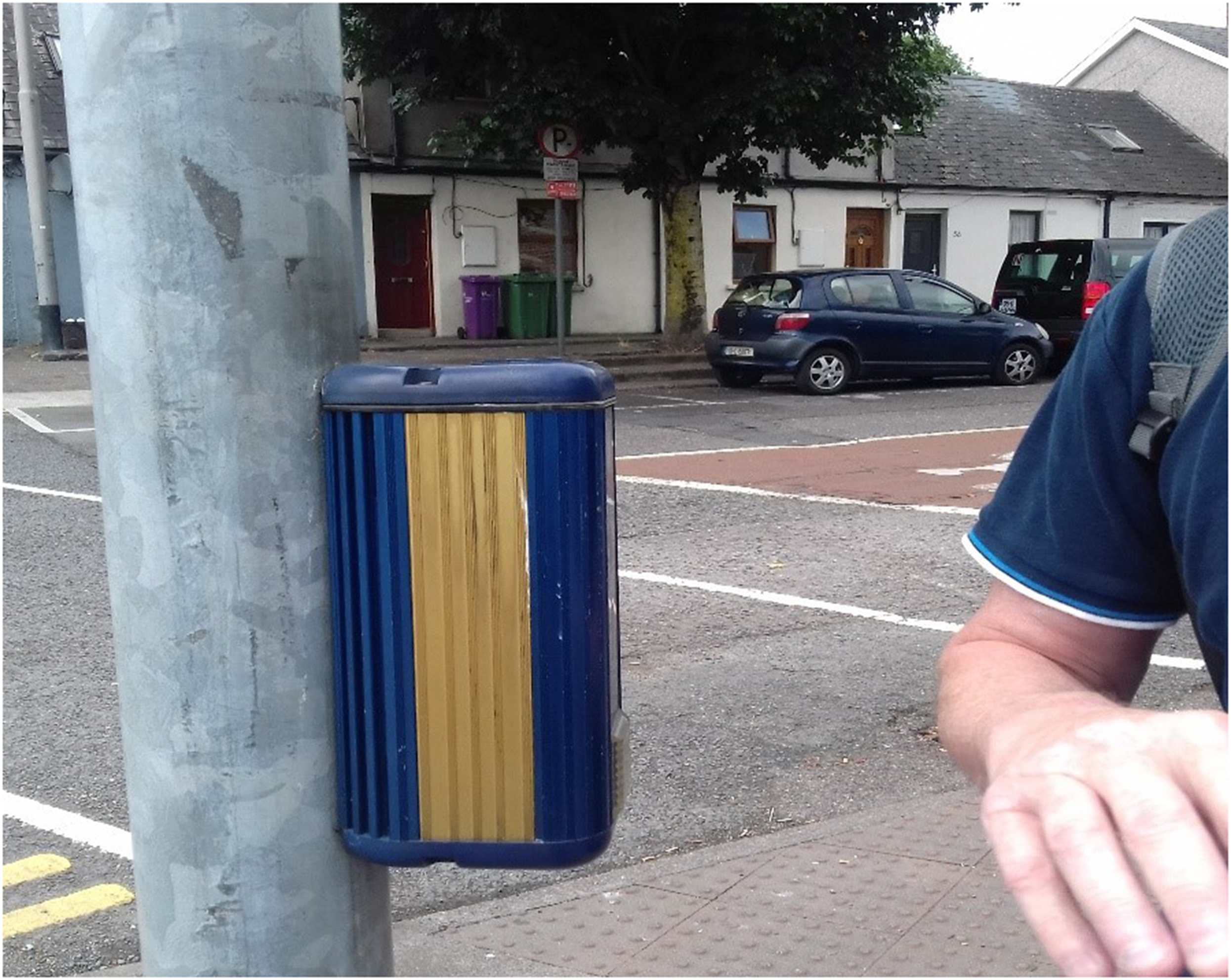
Negotiating broken road signals on the move with Michael (Image: author).
While it was apparent that Michael had a sense of belonging and connectedness rooted in the neighbourhood, the walk was nevertheless punctuated with discussions about feelings of unease, frustration or anxiety experienced in place. As with Martin, challenges in everyday navigation had an affectual dimension: he described sometimes feeling stressed and angry when he reached his work on a morning and would come into the office ‘spitting fire’. Michael also described being circumspect in his interactions with strangers, stating that ‘you can’t always depend on them’. Echoing other studies which highlight the ways in which disabled people seek to ‘pass’ as ‘competent spatial actors’ (Worth, 2013: 574; see also Bonehill et al., 2020; Middleton and Byles, 2019) and the ambivalence felt about using assistive devices in doing so, Michael spoke about his initial fears of using the white cane in public in terms of feeling that he might be victimised; he highlighted a previous incident at a road crossing where he had been approached by a woman offering assistance who had then touched him inappropriately.
Our experiences on the move, then, illustrate how un/safety is experienced and embodied within the city; it is, as Martin, Daniel and Michael speak to, contingent on the ‘the ongoing embodied and emotional interaction of people, non-human others and objects, and environments’ (Hall and Bates, 2019: 101). Our walks with participants provided opportunities for discussions of how they experienced urban spaces, and actively pre-empted and planned for safety. They also prompted memories of incidents and their affective impact. Our participants were keen to show us how important physical barriers were to their senses of safety: these barriers, interwoven with sometimes heightened, other times degraded, sensory cues such as audible signals and tactile surfaces, coalesced to produce not only senses of un/safety but prompted wider questions about feelings of belonging and place (Morrison et al., 2020: Hall and Bates, 2019). This we read in the context of broader social processes and relations which characterise the lives of disabled people such as with Daniel, whose sense of belonging and safety is linked to the support of his ID disability service. In contrast, Martin lives a life characterised by precarity and temporality without known and trusted others in his vicinity, prompting his continued activism and agitation for rights for those with VI.
Disrupting mobile methods: Disability and the socio-political relations of research production
The recent burgeoning interest in mobile methods has been accompanied by a growing body of work which seeks to illuminate the politics and messy practices of undertaking walking interviews or go-alongs (Macpherson, 2016; Thompson and Reynolds, 2019; Warren, 2017). We concur with Thompson and Reynolds (2019: 156) that there is a need to recognise the disruptions which ‘challenge the illusion of certainty and “tidiness”’ in such research encounters. These disruptions can be productive insofar as they provide unexpected insights and avenues for exploration, but may also serve to create limits, closures or barriers to participation. In this section, we draw on our experiences to reflect on some of the assumptions embedded in narratives about the potential of mobile methods to offer richer and more complex insights into the lived realities of people's engagement with space, and alter the researcher-participant relationship (Finlay and Bowman, 2017), particularly in the case of groups such as disabled who have occupied a liminal position in mobilities research.
Dynamics of power and position became readily apparent as we sought to engage participants in go-along interviews. As able-bodied researchers, our decision to undertake go-alongs was borne out of a desire to gain an understanding of the more dynamic and fine-grained encounters with/in place - to experience auditory cues, visual signals, tactile environments, human and non-human interactions – that comprise people's heterogenous embodied negotiations with un/safety. However, in an echo of Castrodale’s (2018) study, the fact that so many participants seemed reluctant to take part in a go-along interview leads us to reflect on the choices we make as researchers about appropriate methods. In some cases, participants questioned why we would need to do a go-along, or what purpose it would serve. For others, the vagaries of the weather was a key issue affecting their participation, as this could affect their ease and comfort of movement (Bell et al., 2019). Others articulated their unease in terms of not wanting to be visible, or ‘seen’ on the street: the topic of the research in itself – experiences of safety and hostility - was also one of heightened sensitivity for some. For others still, the practicalities of finding a suitable time was a challenge. While many of our participants were not in employment, they often led routinised lives, shaped around hours when personal assistants would attend the house, meetings at specific places, or attending places of training and education. As researchers therefore, we were forced to question our assumptions about the suitability of the method in the context of many people's daily lives and routines.
A case in point here is our experience of seeking to engage two participants with intellectual disabilities (ID), Sorcha (aged 60) and Molly (in her thirties) in a go-along interview. In our sit-down interview, Molly and Sorcha revealed their consciousness of having an ID; for example, both recounted how they left mainstream education early because of ‘learning disability’ (Sorcha) and being ‘too slow’ (Molly). As adults, their daily socio-spatial practices were contoured by the spaces of home and supported environments where trusted others were either present and/or had been active in organising their participation in work and leisure activities. Our engagement with Molly and Sorcha tells us about the social relations of disability, and specifically ID, as they looked to an intermediary, their keyworker, to broker and mediate arrangements. Communication with the women following the sit-down interview became a series of short emails attempting to arrange the go-along which never materialised; routine activities and the weather were cited as reasons for on-going postponement, suggesting Molly and Sorcha's social and spatial confidence (Koskela, 1997) appeared to be limited to those spaces and places to which they were accustomed and in which they participated within support arrangements and routinised activities.
In cases where participants were willing to take part in a go-along, the dynamics and challenges of moving through spaces designed around able-bodied norms became very obvious; they also raised questions about how we navigated our roles as researchers, and where, how, when and by whom decision-making, privilege and rapport were enacted on the move. Arranging venues and locations for the go-alongs was the result of considerable time and discussion with participants. We were keen that disabled people themselves select the meeting point and route for the walk, but in doing so, the interdependencies (Middleton and Byles, 2019) that shape the experience of impairment became very apparent. Reflecting Pyer and Tucker’s (2017: 39) observation that young disabled people's reliance on parents and friends for transport can lead to ‘tension between dependence and independence’, for example, Aoife's decision to participate in the go-along involved her mother bringing her to our designated meeting place at an agreed time and her mother being available to take her home afterwards. As a wheelchair user, Aoife spoke in her interview about both the paucity and unreliability of public transport which hinders her independence resulting in Aoife having to rely principally on her mother for transport and ‘getting from a to b’. Weather variations also emerged as considerations: our go-along with Robert took place in January and was postponed on several occasions due to concerns about icy paths. In contrast, we met with Aoife on an unusually warm July day; the heat and its effects on her hydration levels prompted a discussion between Aoife and her mother about continuing the go-along, resulting in Aoife reluctantly terminating the go-along early.
These interdependencies were also evident as we moved with participants through the city. While we adopted the ‘natural’ go-along (Kusenbach, 2003) following or ‘shadowing’ (Warren, 2017: 795) participants to familiar and routinely used places and spaces, like Kusenbach (2003), we acknowledge that such scenarios may not in fact be natural. The very act of being and going there with participants (Stiegler, 2021: 364) affected how participants would usually move. We took our cues and prompts from participants. For example, sometimes participants asked if they could use our arm, or if we could provide oral prompts at road crossings. For the most part however, participants wanted to move independently, to guide and illustrate to us how they moved usually. In our role as accompaniers we could, to a certain extent ‘corporeally experience life through their lens’ (Finlay & Bowman, 2017: 270), although this viewing has to be read in the context of a dynamic in which one party holds ablest privileges (see Parent, 2016).
In our go-along with Aoife, for example, she assumed authority through setting a tone of ‘informal sociality’ (Warren, 2017: 800). In authoring the route to incorporate high street stores, Aoife simultaneously engaged the researcher in an assistive role while demonstrating the difficulties and physical barriers she experienced in shopping. Aoife told us that she ‘loves fashion’ and our go-along presented an opportunity for shopping as a social occasion, an activity that necessitates Aoife going beyond her locality and requires the presence of another whether personal assistant, friend or parent. In the two clothing stores we visited, the researcher (NM) was asked to adopt an assistance role. Aoife chose both stores for their merchandise and because of ease of accessibility to and within the stores: there were automatic doors at the entrance and wide aisles that accommodate her wheelchair. Clothes on hangers present a problem for Aoife due to the height and density of clothes rails, as she can only reach garments that are lower down and at the front of a rack. We therefore assisted Aoife with taking items from the rails.
Accompanying participants on go-alongs also provided us with a view of how passersby and others respond to the pace, tempo and rhythm of going or wheeling along (Parent, 2016; Bonehill et al., 2020). We could observe how others saw our participants and our observances and role as companions made us aware of our able-bodied privileges/assumptions in moving through ableist environments. This was particularly so in our walking with Robert, Conor, Martin and Michael, who all used canes and whose concentration was focused on tapping and feeling their way forward. The very act of ‘performing visual impairment by using a cane’ (Wong, 2018: 86) on busy pedestrian streets causes others to look towards the source of tapping and to actively step out of the way. In some of these instances, passersby made eye contact with the researcher as a proxy for the men. While we, as researchers and practitioners, have long histories of working with disabled people in many contexts, we realised in go-alongs that many of those encounters happened in institutional spaces of services and universities. Few of our encounters happened in such public spaces, bringing with it a sense of being on display due to the necessary step-change (slowing down) in pace required as we moved together.
Moving from static to mobile interviews brings, as Castrodale (2018: 46) notes ‘less controlled conditions and require researcher-participant relationships grounded in ‘reciprocity, cooperation, respect, and trust’ Questions of trust, including knowing if, how and whether to intervene in particular encounters came into sharp focus in the walk with Conor. At the time of our go-along, there had been a long interval between Conor's visits to the city centre and as he led the way towards a tram stop, he kept his left arm outstretched to feel the barrier he expected to find there. As there was no barrier, he strayed onto the tram tracks. This presented an immediate dilemma in terms of whether intervening would intrude into Conor's space, confidence and agency. Instinctively, the researcher (NM) placed her hand under Conor's elbow, told him there was no barrier and guided him back onto the platform. While this may represent a particular moment of affective urgency, such instances led us to question our own perceptions and uses of space constructed predominantly around visual cues and information, and which may devalue other forms of (sensory) spatial knowledges. Indeed, as Parent (2016: 528) rightly points out, ‘Sighted people tend to take for granted that their perception reflects the true nature of space, when, in fact, it simply indicates how they construct space’.
Our experiences also raise questions about the building of rapport that is often attributed to go-along interviews, but which is necessarily shaped by the environment, individuals’ comfort in particular areas and happenings during the go-along (Macpherson, 2016). In undertaking the go-alongs, we already knew our research participants from the sit-down interviews and had established some form of relationship and rapport. However, on the street, establishing flowing conversation was not always easy, due in part to traffic noise but also the act of concentration and need to avoid street furniture which could lead to one person walking in front of the other. In our go-alongs, rapport was more easily established at stationery moments – by stopping and standing still, talking whilst waiting for traffic lights to change, or indeed, sitting down in a pub or café. Moreover, as Middleton and Byles (2019: 82) reference in their discussion of ‘temporal collisions’, slowness of movement sometimes felt out of time with the context of the busy environment, particularly in city centre areas. Thus, mobility was structured by stopping, waiting, and pausing as much as by smoothness, linearity and flow.
Conclusions
In this paper, we have provided a critical reflection on the use of go-along interviews with disabled people, as a way of advancing understanding about how bodily difference shapes the politics and practices of mobile methods. In so doing, we aim to advance interdisciplinary social scientific scholarship at the interstices of mobility studies, critical disability studies, and sociologies and geographies of disability which calls for greater attention to be paid to those bodies that move differently and illuminates the normative (ableist) assumptions framing discourses of mobility (Parent, 2016).
Challenging narratives of walking and movement as, on the one hand, a habitual, mundane, practice, and on the other, an action with liberatory potential (Macpherson, 2016), our go-alongs with disabled people illustrate that there is nothing taken-for-granted about moving, or feeling safe, in the city. As an act of situated knowledge construction, moving with participants revealed disabled people's complex spatial knowledge(s), and the entanglement of human and non-human relations which shape encounters with safety, in which material and affectual dimensions are intimately intertwined; this included the emotional work of safety produced in and through hostile physical environments (Bonehill et al., 2020), the management of self in the context of others’ perception of ‘normal’ bodily comportment and assistive devices, but also the potential of walking as an act to illuminate senses of local belonging and initiate spaces of political resistance.
Indeed, findings from our wider study suggest that while issues of safety serve to circumscribe disabled people's everyday geographies and mobilities, people have highly developed routines and spatial strategies to ensure they feel safe and seek to challenge notions of disabled people's vulnerability by creating self-defined ‘safe spaces’ in their localities (Edwards and Maxwell, 2021). This leads us to suggest that any attempts to address disabled people's community safety in the city need to be considered expansively: that is, they should take account of embodied and emotional encounters with specific places, of disabled people's diverse spatial knowledges, and of the ableist structures and attitudes that de-value disabled bodies and perceive them only as vulnerable or out of place.
Capturing disabled people's experiences and knowledges of urban un/safety requires us to pay renewed attention to the socio-spatial politics and affective relations which shape the dynamics of mobile methods themselves, and the complexities and messiness of implementing go-alongs in practice (Castrodale, 2018; Macpherson, 2016). As Castrodale (2018) and Warren (2017) caution, we should be wary of assuming any re-alignment or equalising of researcher-participant power relations in mobile methods, and this was particularly evident in our own study context where so many people were reluctant to take part, and where attitudinal and physical barriers encoded in urban streetscapes had the potential to circumscribe participation. Our experience leads us to suggest that while mobile methods such as go-alongs offer opportunities for more dynamic, situated understandings of place-based relations (Finlay and Bowman, 2017), they also risk reinforcing affectual encounters of unease, discomfort or anxiety if they are not sensitively attuned to the plurality of corporeal and sensory capacities, or fail to recognise the wider socio-political structures which shape disabled people's lives. There is a need therefore to give critical consideration to the practicalities and dynamics of how go-alongs might be made more inclusive and accessible for disabled people. In some cases, this may be through having an individual's personal assistant (PA) or ‘trusted supporter’ in attendance as a way of promoting confidence; in other cases, going along with a group of peers may provide a way of addressing the power asymmetries between researcher and participant(s).
In seeking to counter what Parent (2016: 528) refers to as ‘uneven methods’, then, we need to further trouble the politics of ambulant research and develop opportunities for interdisciplinary social science scholarship around mobile methods which engages more fully with everyday experiences of impairment and disability. In practice, this means recognising the heterogenous and contingent nature of mobility that emerges from diverse corporeal, cognitive and sensory dispositions as they are enacted in place, but also ableist socio-political contexts (including limited access to resources, services and so on) which can marginalise disabled people's participation in (mobile) research processes. To this end, we would concur with Middleton and Byles (2019: 84) in noting that as much as we need to understand urban encounters themselves as interdependent, so too must we recognise the interdependency ‘between researchers, participants and research tools’ that underpins and assembles our methodological practice. Only by remaining reflexively attuned to these dynamics on the move can we find ways to challenge ableist assumptions which continue to shape discourses of mobility, and foreground differentiated embodied experiences of moving in city spaces.
Footnotes
Acknowledgements
We would sincerely like to thank everyone who took part in the research, for their time and commitment to the study. We would also like to thank the two referees for their very helpful insights. The research would not have been possible without funding from the Irish Research Council (Research for Policy and Society Scheme 2016).
Declaration of conflicting interests
The author(s) declared no potential conflicts of interest with respect to the research, authorship, and/or publication of this article.
Funding
The author(s) disclosed receipt of the following financial support for the research, authorship, and/or publication of this article: This work was supported by the Irish Research Council, (grant number Research for Policy and Society (2016) Scheme).
