




Abstract
Knowledge and wisdom often operate at cross-purposes. In particular, wisdom means turning towards the world, paying attention to the things we find there, while with knowledge we turn our backs on them. Knowledge thrives on certainty and predictability. But in a certain world, where everything is joined up, nothing could live or grow. If a world of life is necessarily uncertain, it also opens up to pure possibility. To arrive at such possibility, however, we have to rethink the relation between doing and undergoing, or between intentional and attentional models of action. I show how attention cuts a road longitudinally through the transverse connections between intentions and their objects. Where intention is predictive, attention is anticipatory. And if the other side of prediction is the failure of ignorance, the other side of anticipation is the possibility of not knowing. The idea that predictive knowledge demands explication perpetuates the equation of not-knowing with ignorance. Education, science and the state are powerful machines for the production of ignorance. I argue, however, that ignorance and not-knowing are entirely different things. In a world of life, not-knowing betokens not ignorance but the wisdom that lies in attending to things.
The man in the moon
This incident from my childhood has always stayed with me, and it surfaced again as I was listening to conversations on walking, at a workshop in the spectacular setting of the Dingle Peninsula, southwest Ireland. 1 Seated in the audience, while I should have been diligently taking notes, I found myself penning this little poem instead. When it was my turn to speak, I began with it. Somehow, it seemed to encapsulate everything I wanted to say, about the wisdom that lies in taking the time to observe, about how the inherent uncertainty and anticipation with which we creep forward in life can nevertheless open to immense possibility, about the correspondence of generations in the meeting of young minds and old, about what it takes for eyes to light up in wonder and astonishment, and about what all this means for an education that – beyond the stultification of the school classroom – truly opens our eyes to the world around us. These are my topics in the paragraphs to follow.
Knowledge and wisdom; self and soul
The poet T S Eliot, in his Choruses from the Rock, included these lines:
Has wisdom somehow dissolved into knowledge? Has knowledge dissolved into information? Could it be possible that we know too much, or that we have too much information? Never in the history of the world, it seems, has such a wealth of knowledge, and such riches of information, been married to such poverty of wisdom. In the land where knowledge is king, and information his castle, wisdom – it seems – is held in contempt. For knowledge and wisdom are not at all the same; they may indeed operate at cross-purposes. To show why they are different, I want to introduce another distinction, between the self and the soul.
The self is an invention of modern thought. Its source lies in the identification of the person I am with an interior intelligence, to which only I have immediate access. This self thinks, reflects, forms its own theories of what might be ‘out there’, or of the thinking of other selves, hidden from me as I am from them. It considers its options, and delivers its intentions. But it cannot, in itself, engage in lively intercourse with the real world. That is left to the body, which furnishes the self with its physical and sensory apparatus.
The soul is an idea of far more ancient provenance, and retains its force among peoples around the world as yet uncrushed by the modernist onslaught. What these peoples tell us is that the soul, far from being locked up within a bodily casing, is – like the air we breathe, the anima – cast upon the current of life. It is a churn or vortex, wherein life's incessant movement is momentarily pulled aside, deflected from its course, wound up on itself. As such, the soul is a site not of intention but of affectation, a concentration of energy and vitality which, like a coiled spring, holds within its torque the memory of its lively formation. As philosopher Michel Serres writes, baring his own soul: ‘I am myself a deviation, and my soul declines, my global body is open, adrift. It slips, irreversibly, on the slope. Who am I? A vortex’ (Serres 2000: 37).
Now as the self is distinguished from the soul, so knowledge is distinguished from wisdom. The self, in carving out a place for itself in the world, seeks the safety and security of established positions. Every increment of knowledge adds another stone to the walls with which it shores itself up against the barrage of physical externality. Thus, knowledge breeds inattention, as the self is driven ever further within a citadel of its own making. The soul, by contrast, since it is radically open to the world, is also defenceless, and therein lies its wisdom.
Whereas knowledge treats the world as its object, for wisdom the world is its milieu. Knowing is about fixing things within the concepts and categories of thought; wisdom unfixes and unsettles. To know is to have things accounted for, explained away or embedded in context so they no longer trouble us; to be wise is to bring things back into the fullness of presence, to pay attention, and to care. Knowing is rational and intellectual; wisdom relational and affective. Knowledge has its challenges, wisdom has its ways; but where the challenges of knowledge close in on their solutions, the ways of wisdom open out to a process of life. Where knowledge protects, wisdom exposes; where knowledge makes us safe, wisdom makes us vulnerable. Knowledge empowers, wisdom does not. But what wisdom loses in power it gains in existential strength. For while knowledge may hold the world to account, it is wisdom that brings it to life.
This not to say that we can do without knowledge. That would be absurd. It is rather a matter of balance. At the present juncture, the scales have tipped precipitously towards knowledge, at wisdom's expense. Our question is: how can the balance be restored? By all means let us investigate the moon, map its features, unlock its materials, speculate on its origins. But let us not seek to take possession of it. We are here on this planet, after all, at the moon's behest The wise course is to open our eyes to it, and bid welcome to its radiance. For we can only experience the moon in the shining of its light.
A turn towards the world
The Scottish poet Andrew Greig has this to say on the matter: ‘Sometimes the more you know the less you see. What you encounter is your knowledge, not the thing itself’ (Greig 2010: 88). Might we, then, see more, experience more, come closer to the truth of things, be a little wiser, by knowing less? Blinded by knowledge, we can often fail to see what is before our eyes. We attend to things only so far as it is necessary to accommodate them within the compartments of thought, so that they can be ticked off, accounted for, understood, laid to rest But truly to attend is to bring things to presence: not to discover the truth about them, but to discover the truth that comes from them, in the experience. This is the truth of wisdom. It lies not in objective fact, or in what scientists treat as ‘data’. Nor will we come any closer to it by gathering more information. For the truth of wisdom lies beyond the facts.
It is hardly surprising that in a world where facts often appear divorced from any kind of observation, where they can be invented on a whim, propagated through mass media, and manipulated to suit the interests of the powerful regardless of their veracity, we should be anxious about the fate of truth. To many, it seems that in this era of post-truth, we are cast adrift without an anchor. We are right to insist that there can be no proper facts without observation. But we are wrong, I believe, to jump to the conclusion that truth is limited to the facts, to what can be objectively ascertained. The facts of a case, for example, may prove the criminal guilty, yet the truth of guilt will ever be tested in the trials of conscience, and in the affectations of the soul. It is, as such, unfathomable; no amount of additional information will get to the bottom of it.
There is more to observation, then, than objectivity. For to observe, it is not enough merely to look at things. We have to join with them, and to follow. And it is precisely as observation goes beyond objectivity that truth goes beyond the facts. This is the moment, in our observations, when the things we study begin to tell us how to observe. In allowing ourselves into their presence rather than holding them at arm's length – in attending to them – we find that they are also guiding our attention. Attending to these ways, we also respond to them, as they respond to us. Study, then, becomes a practice of correspondence, and of care. It is a labour of love, giving back what we owe to the world for our own existence as beings within it.
Wisdom means taking our counsel from the world itself: it is to turn towards the world for what is has to teach us, to attend to it, and to accept in good grace what it has to give. But it is also to refute the division between data collection and theory building that underwrites normal science. In the protocols of science, data are not what the world offers to us; they are what we extract from it, by force or subterfuge. Having filled our bags with data we cut and run, turning our backs on the world in order to construct our knowledge of it. This is deeply unethical. If we are to even begin to address the problems of the world, we need to re-embed science in wisdom.
Let us, then, turn again towards the moon, and allow our attention to be guided by it. Let it stir the soul. Perhaps, then, the moon might help us to recover that sense of enchantment, even of astonishment, which today's science has crushed beneath the heavy boots of astronautical ambition, and which the entertainment industry has branded as a wonder drug. Through all this the moon, supremely indifferent to injury and insult, continues to shine in the sky, while we, earthly beings, are still here, blessed by its light. Life goes on.
Uncertainty and possibility
It is often said these days, in a tone of some regret, that we face an uncertain future. If only we could be more certain, if only we knew what fate awaits us, then we could plan ahead, prepare ourselves, perhaps even change things to weed out aspects of the future we don’t like, and choose those we do. We could subject the future to a kind of artificial selection. In pining for certainty, however, we should perhaps be careful what we wish for! After all, the one certainty we all face is that every one of us will eventually die. Yet even if death inevitably comes to everyone, at least we die in the knowledge that generations will follow, facing their own uncertainties just as we did. Whereas certainty augurs the dead-end, uncertainty opens up the field for life to carry on. For it is a defining property of life that it continually overreaches itself. Far from running from beginning to end, every ending, in life, issues into new beginning. Life is pure excess.
The curse of uncertainty is to present this excess as a deficit. To say that the future is uncertain is to suggest that life is not yet fully destined, that there is still work to be done to determine where it will finally lead. The word conveys a sense of incompletion, of unfinished business, of having not yet gained the full measure of the world that would yield to total predictive confidence. There are still gaps in our knowledge, missing pieces that remain to be inserted. Nowadays we look to science to complete the picture. Yet even science admits to no future beyond the predictive horizons of the present.
Perhaps that's why today's younger generations are less inclined to see the future as a landscape extending indefinitely into the distance, than as a plateau bearing down upon them. No previous generation has been so starkly presented with the prospect of the end of history, even of life itself. The future, to them, seems all too certain. Nor is any relief to be found in a stance of denial, through regression from certainty to uncertainty. Yet what the deficit model presents as uncertainty takes on a quite different hue in the light of excess. Then, uncertainty reappears as possibility.
For science, radical possibility is hard to pin down. The domain of life, according to philosopher Henri Bergson, is characterised by ‘incommensurability between what goes before and what follows’. Science, Bergson (1922: 30–1) argued, is simply unable to cope with this idea of ‘the absolute originality and unforeseeability of forms’. It can work only on what repeats, or on what is precisely replicable. And in the language of replicability, science can only think possibility on a scale of probability. On this scale, what cannot be determined is left to chance. Indeed, the opposition between chance and determination is deeply etched into modern thought. It is an opposition, however, that drains life of its creative impulse, reducing freedom to random variation within a phase space.
What, then, of the moon? Revolving in a clockwork universe, ruled by laws of gravity, it appears to continue on its repetitive course. Yet every time we open our eyes to the moon, it is as if it were for the very first time. Moonshine, at once a phenomenon of the cosmos and an illumination of the soul, never repeats. On the contrary, it brims with miraculous possibility.
Potential and fulfilment
Young people, with their lives ahead of them, are often encouraged to think of the life-course as a process of ‘fulfilling their potential’, that is, as a movement of progressive closure, in which all possible paths are gradually narrowed down to the one actually taken – which itself, at life's end, reaches its ultimate conclusion. As the anthropologist Clifford Geertz (1973: 45) put it, in a now classic formulation, ‘one of the most significant facts about us may finally be that we all begin with the natural equipment to live a thousand kinds of life but end in the end having lived only one’. With one's potential fulfilled, there is nowhere further to go.
But what if, instead of heading towards destinations unknown, we were to push out from places already reached, along a path of renewal that knows no end? Could this be what the Pintupi, an Aboriginal people of Western Australia, meant when they told their ethnographer, Fred Myers, that life is a ‘one-possibility thing’ (Myers 1986: 53)? For the Pintupi, the contours of life are those of the country in which they dwell, a country created by the ancestral beings as they moved around in the formative era known as the Dreaming. Every existing creature, as the incarnation of the ancestral power from which its vitality is derived, effectively finds itself on the inside of an eternal moment of world-creation. And where the ancestors led, life is bound to follow. But this is not a movement from A to B, from a starting-point to a destination. It rather carries on. Life is a one-possibility thing, for the Pintupi, because possibility can only ever be one. The idea that people could initially be presented with multiple possibilities, like a menu of options from which to choose, only to be narrowed down as life proceeds, would make no sense to them. For Pintupi people, as they walk their desert landscape, are not fulfilling their potential but ever replenishing it. They may indeed have more power towards the end of life than at the beginning.
How, then, can we express this difference between possibilities and possibility, between fulfilment and replenishment? Perhaps it is analogous to that between space science and amateur astronomy. Science is on a mission is to reach the moon, and will fire as many rockets as is necessary for the mission to be completed. But the old man, as he gazed at the moon through his telescope, had no such end in mind. His telescope proved, after all, not to be a gun. It is not as though he was shooting a line into space, with his eye at one end and the moon at the other. To observe the moon, for the amateur, is rather to join the arc of his attention, in real time, with the moon's radiance. And this arc – the arc of possibility, ever replenished by the light – follows a line orthogonal to the line connecting the moon and the eye.
Doing and undergoing
It is true, of course, that most of us spend our lives shooting at targets. We do first this, and then that, and as with this and that, there is a degree of certainty in the ends to be achieved. Yes, we know what we are doing! Every deed is an intentional act. Yet in everything we do, there is also an experience we undergo. We are modified in body and mind, perhaps even transformed, by the doing of it. The question is to figure out the relation between the two – between the doing and the undergoing.
This question preoccupied the philosopher John Dewey, most particularly in his essay of 1934 on Art as Experience (Dewey 1987). Do we, Dewey asked, put undergoing inside doing, sandwiched between the original intention and its final consummation? Is undergoing something that happens to us inside the act? If undergoing were thus contained within doing, Dewey thought, there could be no continuity from one deed to the next. Life would fragment into a scatter of disconnected episodes. Blink, and they’re gone. What happens in reality, quite to the contrary, is that undergoing always overflows doing, to the extent that whatever you do takes into itself something of the experience of what you did before, and is in turn carried over into what you do next. With every doing, as Dewey (2015: 35) put it in a later lecture on Experience and Education, you are ‘a somewhat different person’.
In short, undergoing lies precisely in the excess by which life overtakes the destinations thrown up in its wake. We could describe every act of doing, as shown in Figure 1, by a transverse connection between an intention (I) and an objective (O). But the life of undergoing carries on, in a direction orthogonal to these transverse links. In the figure, this is represented by the continuous wavy line (P). Here, P stands for possibility. Possibilities cut across, but life, as a ‘one-possibility thing’, is longitudinal. It goes on through. And a life tracked along this line continually overtakes itself. It is a life of becoming rather than being, yielding up not to objective consequences – for these are but discards left along the way – but to further possibility, not just for itself but for all other lives with which it tangles, including, as we shall see, its generational offspring.
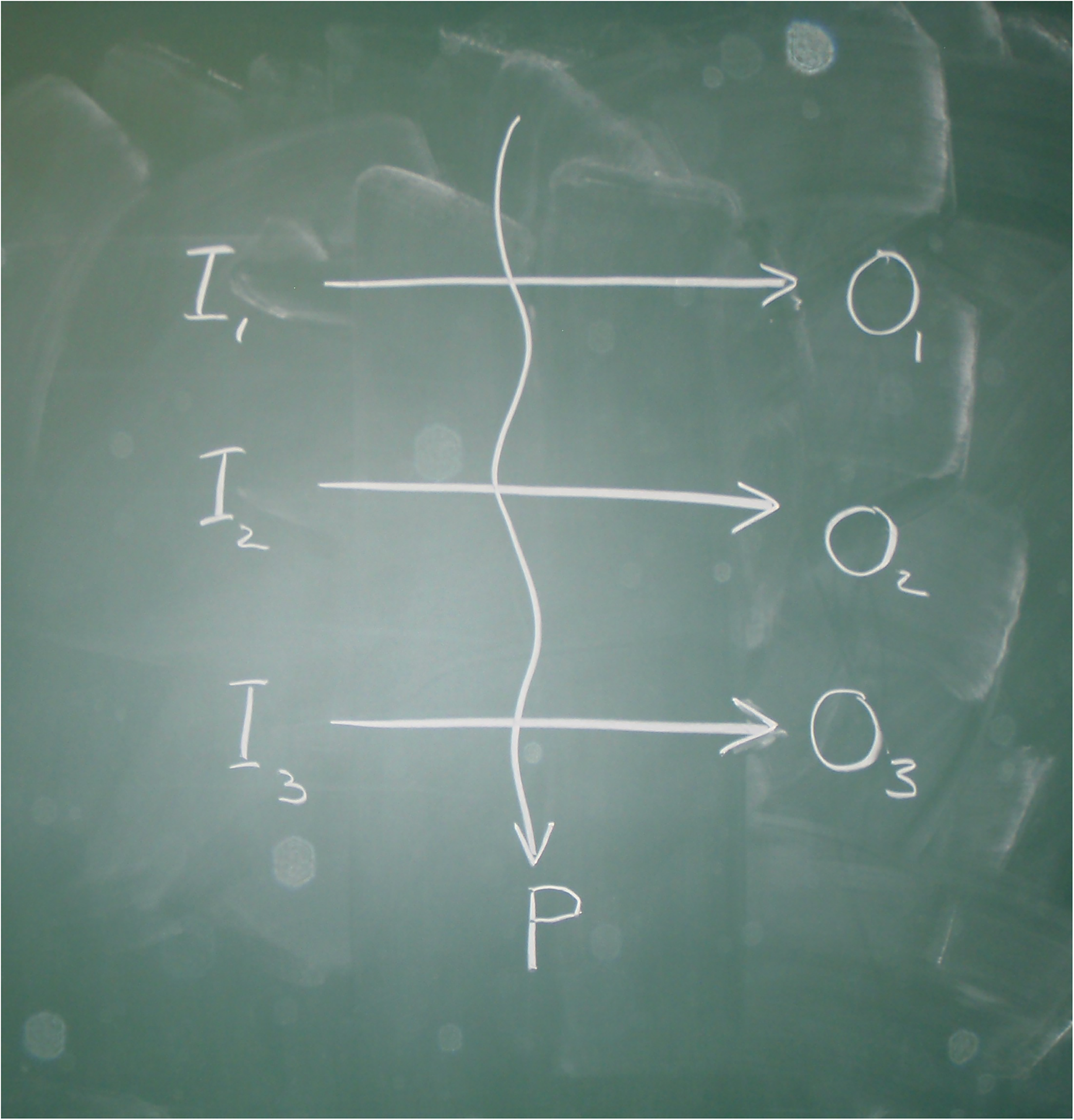
Possibility and possibilities. Transverse arrows connect successive intentions (I) with their planned objectives (O). Through all of them runs the longitudinal arrow of life itself, a ‘one-possibility thing’ (P).
The two sides of attention
Crucially, while every transverse connection denotes a line of intention, the longitudinal trail of possibility is a line of attention. Now there are two sides to attention: exposure and attunement. I take the idea of attunement from the ecological approach to perception pioneered by James Gibson (1986). For Gibson, perception is about noticing things in our surroundings that may help or hinder in the furtherance of our own activity. In a word, it is about picking up information that specifies what these things afford. And it can be learned. ‘One can keep on learning to perceive’, Gibson writes (1986: 245), ‘for as long as life goes on’. In the practice of a craft, for example, skill lies in becoming sensitised to subtle variations in the material that a novice might miss. The carpenter attends to the grain of the wood, the smith to the ductility of iron. The skilled practitioner's perceptual system, in Gibson's terms, becomes ‘attuned to information of a certain sort’. This fine-tuning of perception amounts, he says, to an ‘education of attention’ (1986: 254). Yet in this, the momentum is entirely on the side of the perceiver. It is as if the things to be perceived were already there, laid out in the environment, merely awaiting the practitioner's attention.
But what if everything is not already there? The world, after all, is not set in stone but restless and fluid, bustling with life. Think of the fluxes of the weather, the ever-changing skies, the turn of the tides, the run of the river, the movements of animals and the growth of plants. Immersed in these fluxes, it is the perceiver who must wait upon the world, attending to it in the sense of abiding with it and doing its bidding. This is attention on the side of exposure. As the philosopher of education Jan Masschelein (2010) explains, exposure (from the Latin ex-positio) literally means to be pulled out of position. To be or become attentive, writes Masschelein (2010: 46), ‘is to expose oneself’. In this condition, one can no longer take anything for granted. The sense of understanding – of having solid ground beneath one's feet – is shaken, leaving one vulnerable and hyper-alert, wide-eyed in astonishment rather than narrowly focused on a target. For Masschelein, it is precisely in these moments of exposure that education occurs. It is not so much an understanding as an undergoing, that at once strips away the veneer of certainty with which we find comfort and security, and opens to pure possibility.
And this is just what happens as we gaze at the moon. ‘And in so far as … my gaze knows the moon's light’, observes philosopher Maurice Merleau-Ponty (2002: 370), in his magisterial Phenomenology of Perception, dating from 1945, ‘it is as a certain way of linking up with the phenomenon and communicating with it’. It is a kind of symbiosis, he says, in which we give ourselves over to the light that invades us and saturates our awareness. We find ourselves looking at the moon with moonstruck eyes. And with those eyes, in the moonlight, the world itself takes on a different sheen.
Falling forwards
Yet if there are two sides to attention, of exposure and attunement, of waiting on the world and tuning to a world-in-waiting, then what is the relation between the two? Surely, to embark on any activity means placing one's existence on the line. The safe course would be to stay put. No-one can live like that, however. To live we have to get moving, to push the boat out into the current of a world-in-formation. Thus, all undergoing begins in exposure. But as it proceeds, skills of perception and action, born of practice and experience, begin to kick in.
Let us take as an example one of the most ubiquitous of all human activities, namely, walking on two feet. Every step entails a moment of jeopardy. Falling forwards on one foot, you tumble into the void, only to regain your balance as the other foot comes to land on the ground ahead. Here, the bodily skill of footwork comes to the rescue, just before it is too late. What begins in the vulnerability of exposure ends in the mastery of attunement, providing in turn the ground from which the walker can once again submit to the hazard of exposure, in an alternation that continues for as long as the walk goes on.
This alternation, I believe, is fundamental to all life. Crucially, just as life is a one-possibility thing, it is also unidirectional. In real life, submission leads and mastery follows; never the reverse (Ingold 2015: 138–42). Where submission casts off into a world in becoming, setting us loose to fall, mastery restores our grip so that we can keep on going. The first is a moment of aspiration; the second a moment of prehension. An aspirant anticipation, out in front, feels its way forward, improvising a passage through an as yet unformed world, while bringing up the rear is a prehensile perception already accustomed to the ways of the world and skilled in observing and responding to its affordances. And as submission gives way to mastery, aspiration to prehension, anticipation to perception, and exposure to attunement, there is what we could call a moment of inflection.
I draw this sense of inflection from the writings of philosopher Erin Manning (2016: 117–18). Inflection is not a movement in itself but a variation in the way movement moves, coming at the point where a tentative opening matures, from within what Manning (2016: 6) calls ‘the cleave of the event’, into a firm sense of direction. It marks the turn from undergoing into doing, at which the line of possibility discloses distinct and realisable possibilities. The telescope is poised on that point. The art of moon-watching is to keep it there.
The terms ‘aspiration’ and ‘anticipation’, introduced above, call for some further explanation. Literally, to aspire is to draw breath. It is an active, animated ‘taking in’. And to take in, as Dewey (1987: 59) observes, ‘we must summon energy and pitch it in a responsive key’. With this summoning and pitching, aspiration calls upon the past in order to cast it forward into the future, along a path of attention. Brimming with as yet undirected potential, with possibility, aspiration anticipates the future, but does not predict it. Prediction, as we have seen, belongs to the logic of certainty and uncertainty. Depending on the level of certainty, things may be predicted with greater or lesser confidence, or judged to be more or less probable. But anticipation belongs to the register of possibility. It is the temporal overshoot of a life that always wants to run ahead of itself. According to the philosopher Jacques Derrida, to anticipate is ‘to take the initiative, to be out in front, to take (capere) in advance (ante)’ (Derrida 1993: 4). Far from predetermining the final forms of things, or fixing their ultimate destinations, anticipation opens a path and improvises a passage. It is a seeing into the future, not the projection of a future state in the present; it is to look where you are going, not to fix an end point (Ingold 2013: 69).
The passage of generations
All life, then, is held in tension between submission and mastery, aspiration and prehension, anticipation and perception, exposure and attunement. In every case, the first leads, and the second follows. What leads is an aspiration that wells up in attention. What follows is a precisely directed and skilfully executed manoeuvre. As a one-possibility thing, moreover, this life begins nowhere, and ends nowhere, but carries on for all time – for an ‘everywhen’ that, in Australian Aboriginal cosmology, is identified with the Dreaming. Yet we know that every mortal being will certainly die. How, then, can the infinitude of life be reconciled with the finitude of individual life cycles?
To answer this question, we have to think again about generations. For there is a deeply held belief in many minds today that life is lived within generations, but does not flow between them. What passes between generations, often described as a heritage or inheritance, is a legacy of information and resources, which provides the capital from which successor generations can build lives in their turn. The information may be genetic or cultural, the resources material or ideational. Their sole common denominator is that they are available for transmission independently of their lifetime expression or achievement.
It is easy to see, in this view, a reflection of the idea that life is lived in the fulfilment of potential. This leads, as we have observed, to a dead end. With all potential exhausted, there is no life to be continued in coming generations; only the discards left along the way remain to be passed on. Each generation, occupying its own slice of time, seems fated to replace its predecessor, and to be replaced in its turn, rather like layers in a stack. Indeed, this kind of stratigraphic thinking is deeply seared in modern sensibilities, leading to an easy equation of generational layers with layers of sedimentation in the history of the earth, of deposits in the occupation of a site, of documents in an archive, and even of consciousness in the human mind. It is a way of thinking that feeds directly into a rhetoric of extinction that wonders whether the coming generation, or any after that, might be the last – be it for our own or any other species. It is the reason why we feel ourselves facing a future blighted by uncertainty. To lift the curse of uncertainty, and to restore a sense of possibility, we need to imagine generations differently.
This is shown in Figure 2. We have seen that as a one-possibility thing, life is lived not transversally but longitudinally. Let us, then, compare every particular life to one strand of an intergenerational braid. The strand is only so long, but the braid can continue indefinitely, for even as old strands give out, new ones are paid in. Nothing, here, is inherited, nor does a break in the chain of transmission herald extinction. Rather, it is in the overlap of generations that the life process is carried on. As Bergson put it so vividly, just as the individual feels the swell of the past ‘leaning over the present that is about to join it’, so with life in general, we see ‘each generation leaning over the generation that shall follow’ (Bergson 1922: 5, 135). This leaning over is a gesture of care, even of love. Herein, for Bergson, lies the true mystery of life – to which we would add, its true possibility. How much are our fears of the end of history, of biodiversity loss and final extinction a function of the way we have sliced up the generations, setting them over and against one another, denying both the productivity of their collaboration and the affectivity of their care? We need to bring them together again.
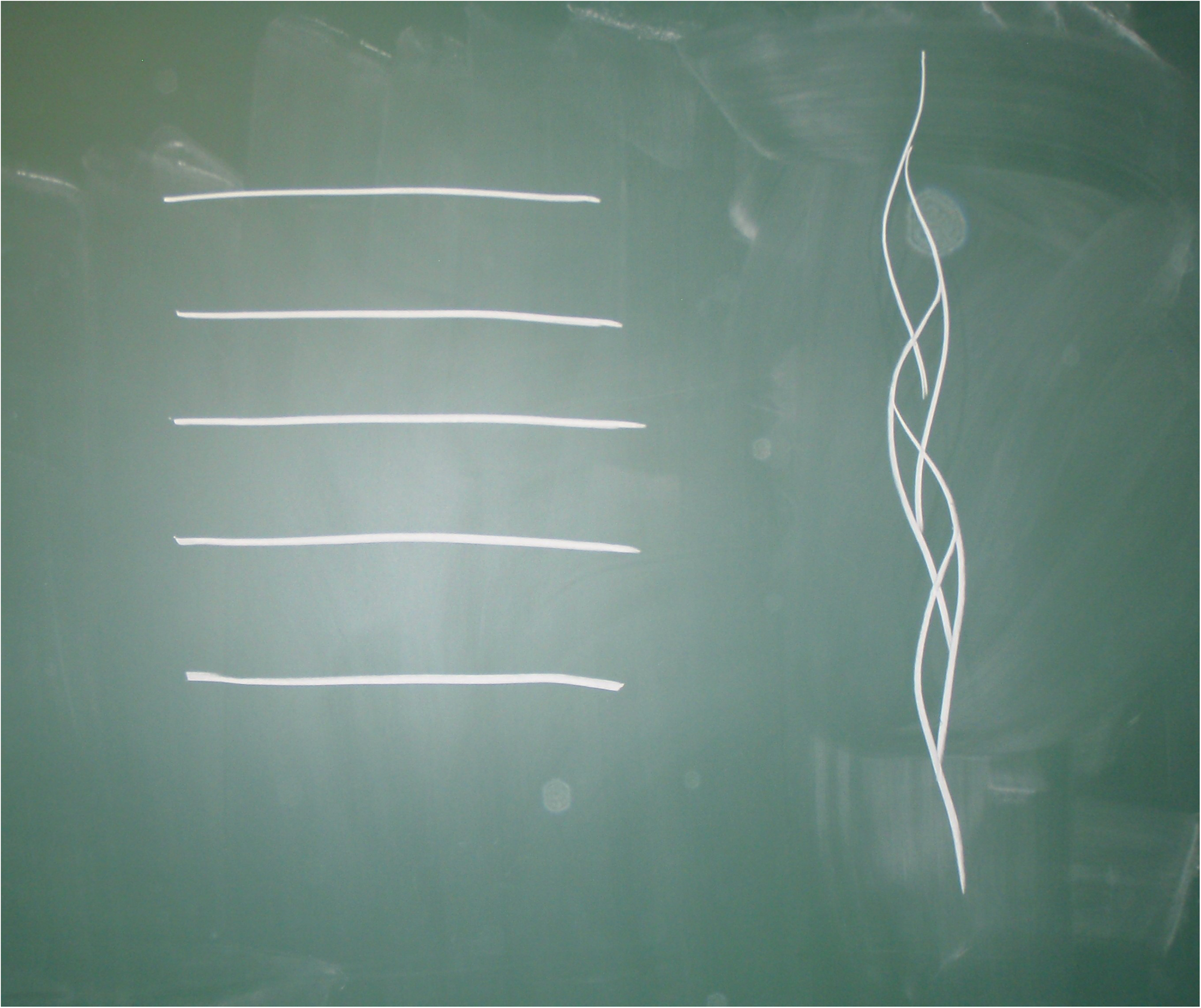
Five generations, as stacked layers (left) and as a woven braid (right).
And that's precisely what happened, albeit momentarily, when I, as a child walking home from school, encountered the aged, bearded moon-watcher. My walk through the familiar terrain of woods and fields unexpectedly fell into line with an observation which coupled the myopia of the peering eye with the intimate immensity of the cosmos. At that very moment, my initial fright gave way to an unforgettable astonishment.
Astonishment and surprise
But astonishment is not the same as surprise (Ingold 2011: 74–5). The distinction parallels one that I have already drawn, between anticipation and prediction. And if the other side of prediction is the failure of ignorance; the other side of anticipation is the possibility of not-knowing. I aim to show that not-knowing and ignorance are entirely different.
The idea of ignorance rests on the presumption that to come into knowledge, things have to be explained to us. The idea of prediction rests on the presumption that things are explicable. Thus, ignorance and prediction are two sides of the same coin, and both are key to the rhetoric of normal science. According to the model of conjecture and refutation, which science owes to the philosophy of Karl Popper (1950), progress in any field of inquiry lies in its cumulative record of predictive failures, which has lifted us from the state of ignorance to one of knowledgeable enlightenment. But for science, the way to know the world is not to open oneself to it, as you would perhaps to another person, but just the contrary, to hold it at a distance. This is done by means of methodology, by which is meant a set of protocols expressly devised to immunise the investigator from any infection arising from too close a contact with the phenomena of his or her investigation.
The aim, then, is to grasp these phenomena within a grid of concepts and categories. Scientists are surprised, but not astonished, when their predictions turn out to be wrong. But prediction rests on the conceit that the world can be held to account. Scientists depend on the unexpected to know that events are taking place and history is being made. By contrast, those who are open and attentive to the world – among them, many so-called ‘indigenous peoples’, but also most children whose minds are yet to be subdued by adult disciplinary oppression – though perpetually astonished, are never surprised. They are not so arrogant as to believe that the world is predictable, even in principle, or that it can be held to account. Their openness, or exposure, renders them vulnerable, but it is also a source of strength, resilience and wisdom. It allows for ongoing responsiveness. Why, after all, should we gaze at the moon when we know so much about it already? Is it not because it is so astonishing?
Correspondence and interaction
An astonished attention is one that goes along with and answers to the movements of things. It allows us to correspond with them. I mean correspondence, here, not in the logico-mathematical sense of matching one set of elements with another by some principle of homology that leads any one element in the first set to equate with one or more elements in the second, and vice versa. I mean rather to invoke the process by which beings or things literally answer to one another over time, for example in the exchange of letters or words in conversation, or of gifts, or even in holding hands (Ingold 2017: 9–10). Correspondence, in this sense, is about joining with rather than joining up. Joining up is connection, as in an optical diagram that connects the eye to the moon. But to observe the moon is to correspond with it. The moon questions the watcher, arouses his curiosity, and he is moved to respond. This response is not just a reaction, as if to a disturbance of vision that irrupts into consciousness, but an answering that prolongs the watcher's own tendency, which lies in a desire, not to know more about the moon, but to become better acquainted with it.
I need to draw a clear contrast, here, between correspondence and interaction. Interaction goes back and forth as agents face each other off, as for example in an interview situation. But correspondence, in my terms, is not face-to-face but side-by-side. It is a matter of going along together. Thus, where interaction is transverse, correspondence is longitudinal. The former is bounded by ends, set in advance by each party. These ends are commonly known as ‘interests’, from the Latin inter (between) and esse (to be). The prosecution of interests, in interaction, is like an oscillation between two points. But correspondence is not a connection of points but a binding of lines. It is not interactive but multilinear. And these lines join not at the ends but in the middle. Ends are not given in advance but emerge in the action itself, and are recognisable as such only in the acknowledgement of new beginnings. Here, beginnings produce endings, and are produced by them. Every end is not a terminal but a moment along the way.
In interaction, participants are positioned alternately as agents and patients. One does, the other is done to; then the tables are turned such that what the latter does is now done to the former. This continues through a series of reversals that goes on for as long as the interaction endures. Correspondence, however, is neither active nor passive but takes place in what linguists call the ‘middle voice’ (Benveniste 1971). In the middle voice, whatever you do is also achieved in you. Or to return to an earlier distinction, every doing is an undergoing. Let me return to the example of walking. I may of course intend to go for a walk. But once on my way, I am my walking, and my walking walks me. I carry on and am carried; I do it, but am equally transformed by it. So it is, too, with the man in the moon. For it is the moon's light that illuminates his seeing and bears the weight of his observations. Walking and looking are both instances of doing in undergoing, neither active nor passive but in the middle voice.
It is precisely in this regard, in its conduct in the middle voice, that correspondence differs from interaction. This does not mean, however, that we can arrive at correspondence simply by an inversion that turns the back-and-forth of interaction outside-in, as in the idea of ‘intra-action’ – an idea originally proposed by philosopher of science Karen Barad (Barad 2003) which many social and cultural theorists have subsequently taken to heart. We arrive at it, rather, by turning from the transverse to the longitudinal. Correspondence is a not just a falling forward; it is a feeling forward, an improvisation, that is continually responsive to the movements of others. It is a responsiveness that goes along. As such, adds philosophical anthropologist Thomas Schwarz-Wentzer (2014: 42), responsiveness ‘precedes responsibility; it is the existential condition to the answer that I am’. If we do things responsibly, it is because they fall to us to do them. They are, in this sense, in the nature of tasks. In correspondence, everything we do is a task.
Understanding and undercommoning
But no task is without risk – the risk of falling for the things that fall to you. Safety and security lie in understanding, in having a firm base, a ground of certain knowledge from which to do what you will. From the stance of understanding, the improvisational falling-feeling forward of correspondence seems laced with uncertainty, unpredictability and frustration. Yet it nevertheless opens to possibility, anticipation and hope. The choice, here, is between understanding and undercommoning. If to understand means finding support in a shared foundation, undercommoning is just the opposite. It is not a reversion to a baseline of what we all have in common to begin with, but rather a way of living together in possibility (Harney and Moten 2013). It means joining with other souls in the adventure of undergoing. You could liken it to the experience you have when walking in the hills, and finding you are lost All at once, the ground no longer feels so certain beneath your feet. Yet at the same time, you become hyper-attentive to everything around you that might possibly afford clues to your whereabouts.
Erin Manning (2016: 112) compares this to the experience of autistic people. For most of us, most of the time, things fall quickly into place, so that after only a moment's hesitation or uncertainty – a moment that passes so quickly that usually we don’t even notice – we know what they are and how to deal with them. Rarely do we linger in uncertainty, instead passing quickly and imperceptibly into categorisation. From the astonishment of ‘I can see’ we slide into the unsurprising normality of ‘I see this, or that’. But for autistic people, Manning suggests, this moment may be prolonged, even indefinitely. Like walkers who are lost, they linger in the fullness of attention, in which things are as yet unformed. This is to see things in their incipience, ever on the point of revealing themselves for what they are. It is a question not so much of being uncertain of what things are, as of opening to the possibility of what they might be. Perhaps it is the same with artists. They are never surprised but perpetually astonished. And for this very reason, we may have much to learn from them, and from their art.
Yet, the stretch of attention, as we’ve seen, is fraught with risk – reaching out from what is already to hand, it forsakes the security of our present position for an unknown future. This is what thinking is: a reaching out beyond the realm of what is already explicable or even conceivable. It lies in the hesitant overflowings that pull us out of certain knowledge. Thinking, in this sense, always unsettles thought. It lies in the excess of imagination over conceptualisation. In just the same way, to gaze through the eyepiece of a telescope is not to take a snapshot but to linger in the realm of astonishment. This is the realm of hopes and dreams, in which experience, as yet unformed, has still to surrender to partition and categorisation. Only when we lower the glass do we say, ‘Oh, so that was the moon!’ But by then, the dream has already faded into oblivion.
Real problems; real freedom
Allow me to make one final distinction. There are real problems, and fake problems. Fake problems include the jigsaw puzzle, the Rubik's cube, the crossword and the maze. These problems already contain their solutions inside them. But real problems have no solutions; rather, one problem leads to another. The path is a real problem in this sense; so also is life.
Likewise, there is real freedom and fake freedom. Just as fake problems contain their solutions, so fake freedom contains its objectives. Fake freedom, offering the choice of multiple possibilities, is opposed to the necessity of mechanical predetermination. Real freedom, however, lies in the singular possibility of the path. This is a freedom that does not already impose a destination or target, or a prefigured outcome. It is instead a freedom that un-destines things, that opens up to new beginnings, that overtakes any objectives that might be thrown in its way. This is the freedom to correspond, to go along with others. This kind of freedom is not opposed to necessity, to determination. On the contrary, freedom and necessity are one and the same. But the necessity of freedom, in this sense, lies not in predetermination but in an attention to things and the ways they want to go. It is the necessity, in short, of constraint – literally of binding together – such that each, along its own way, participates in the fortunes of the others. Is it not about joining up; it is about joining with.
In contemporary liberal societies, the institutions of education, science and the state promise us freedom, but it is a freedom boxed in necessity. It arms us with certain knowledge, and offers immunity, so that we can remain safe and secure, protected from the existential risks of exposure. The predictive certainty these institutions offer, however, is as illusory as is fake freedom. For the very idea that predictive knowledge demands explication also perpetuates the equation of not-knowing with ignorance. Education, science and the state are all-powerful machines for the production of ignorance (Rancière 1991). Children, folk or laypersons, indigenous people – all are made to feel ignorant as a prelude and an excuse for their education. The measure of educational success lies in the reproduction of ignorance in the next generation. And so it goes on.
But it need not be like this. For the world we live in is rich with the possibility of growth and transformation. In this world of life, of souls rather than selves, not-knowing is not a form of ignorance but a form of wisdom: the wisdom that lies in turning towards the world rather than turning our backs on it, in opening to replenishment beyond fulfilment, undergoing beyond doing, astonishment beyond surprise, undercommoning beyond understanding, truth beyond the facts. It lies, in short, in paying attention to things. After all, the moon is still shining in the heavens. Does it not make more sense to welcome it into our lives, and to walk in its company, than to contrive to plant our feet upon the moon itself, only to leave our prints in the dust? ‘Bereft of knowledge before the heavens of my life’, wrote the poet Rainer Maria Rilke, ‘l stand astonished … I will yearn for no closer connections’. 2 Was it Rilke's double whom I met on my way home from school that day?
Footnotes
Acknowledgements
I am most grateful to the organisers of the workshop Walking Conversations: The Art of Paying Attention, or, Non-Procedural Methodologies – Maggie O’Neill, Ger Mullally, Arpad Szakolczai, Deirdre de Bhailis, Maggie Breen, Elaine Ni Loinsigh and Brendan Tuohy – for the opportunity to present the keynote address. This text is composed of fragments, some of which are extracted from previously published works, most notably my books The Life of Lines (2015), Anthropology and/as Education (2018) and Imagining for Real (2022).
Declaration of Conflicting Interests
The author(s) declared no potential conflicts of interest with respect to the research, authorship, and/or publication of this article.
Funding
The author(s) received no financial support for the research, authorship, and/or publication of this article.
