




Abstract
This paper explores the relevance of social capital in shaping Irish immigrants’ reconstructions of their attachment to New York City (NYC) as place. Using extracts from Irish immigrants’ previously unpublished oral histories, I make the case for situational capital, a multi-faceted and dynamic place-based resource which connects people in situ by virtue of their literal and metaphorical positionality. The coalescence of individual and collective memories, including childhood memories, underpinned the network of social relationships which fuelled interviewees’ quest to recreate and reimagine a sense of ‘home’ both in NYC and Ireland. The resultant situational capital created by these relationships fostered a reflexive and sustained attachment to place which served to advance the cumulative economic, cultural, political and social prosperity of Irish men and women individually and collectively over time and space. Situational capital was also instrumental in advancing opportunities for Irish men and women and altering the physical characteristics of neighbourhoods. It shaped the genius loci of NYC as reconstructed by those interviewed pivoting around the fluid and ambiguous notion of real and imagined ‘home.’
Introduction
To date, research regarding social capital and the immigrant experience has foregrounded three key areas: (i) the advancement of economic advantage (Kwon et al., 2013; Turkina and Thai, 2013); (ii) improvement to educational attainment levels (Webb and Alvarez, 2018) and (iii) greater access to health care (Johnson et al., 2017; Rodriguez-Alcala et al., 2019). Yet there is a dearth of published scholarship which explores how social capital shapes immigrants’ individual and collective reconstructions of place in situ. This paper bridges that gap in existing scholarship. Here, I review the importance of social capital in shaping Irish immigrants’ representation of New York City (NYC) as place. Drawing on the oral histories of Irish immigrants who reside permanently in NYC, I make the case for situational capital, a heuristic through which the theoretical interface between social capital and attachment to place may be critically explored. In doing so, I highlight the relevance of temporality, reflexivity and transitions of place in influencing (re)presentations and (re) constructions of place.
Towards a sociology of literal and metaphorical place
In some ways, it is axiomatic to suggest that sociologists have a vested interest in understanding how social capital in situ impacts on representations of place. After all, social networks may be construed as a proxy of the social capital which creates and sustains attachment to place by fostering a sense of belonging (Pooley et al., 2005; Relph, 1997; Tuan, 1974). For immigrants, a strong attachment to place brings with it the creation of a new sociocultural identity/identities (Marcu, 2012) founded on the sense of solidarity and connection (de Shalit, 2019).
Given that this is the case, the palpable absence of place-based critiques which draw explicitly on the relative merits of social capital from the perspective of immigrants is surprising. Using extracts from previously unpublished oral histories of Irish men and women who immigrated to New York City in the 1950s and 1960s, I explore the theoretical intersection between social capital and interviewees’ (re)constructions of place. I characterise the quintessential form of capital which manifests as situational capital, a multi-faceted and dynamic place-based resource which connects people in situ by virtue of their literal and metaphorical positionality. Anchored in aspects of our habitus which (re)create a sense of real and imagined ‘home,’ situational capital traverses time and space. Drawing on the coalescence of individual and collective memories, it helps shape attachment to place at the ontological and physical level. In doing so, situational capital fosters a temporal, reflexive and sustained attachment to place which advances the cumulative economic, cultural, political and social prosperity of specific individuals and groups. It promotes a fluid and dynamic intra/intergenerational sense of sociocultural identity through the performance of shared frames of reference, shifting to reflect the fluid and ambivalent positionality occupied by the Other.
In the section which immediately follows, the ‘sociology of place’ and specifically its ambivalence for immigrants as a means of fuelling the sociological imagination is examined. Four interrelated aspects of place are then critically reviewed in making the case for situational capital. These are: (i) the role of communities in their different guises in facilitating social capital exchange (ii) the relevance of neighbourhoods at the spatial level as sites of ontological security which facilitated resource brokerage, citizen engagement and personal/professional advancement (iii) the immigrants’ perpetual quest for ‘home’ and (iv) the coalescence of individual and collective memories in uniting people and place.
Arguably, what could broadly be characterised as a sociology of place and the social capital contained therein has been hiding in plain sight in existing scholarship. The collective insights of Durkheim, Booth, Simmel and Weber highlight the importance of place in driving the sociological imagination. Furthermore, what we now recognise as the theoretical nexus of space, place and immigration in American society featured in the early work of the Chicago School (Abbott, 2020; Hunter, 1974). By drawing on the Marxist distinction between class-in-itself and class-for-itself, Durkheim’s (1893) early writings on the division of labour focussed on the potential for anomie in any given place. His later critiques of social structures and welfare (Durkheim, 1951) foreshadowed subsequent debates advanced by Coleman (1993) then Putnam (2000) on the social capital implicit within communities. Charles Booth’s (1889) mapping of poverty of London's East End revealed the inherent social stratification at work embedded in the city's terra incognito. Simmel (1908) was amongst the first to foreground how the relative socioeconomic positionality of the Other, notably immigrants, gives rise to sociospatial constructs of place. He spoke of the ‘original centripetal forces of the lone group with a centrifugal tendency that forms bridges with other groups’ (Simmel ibid: 225). Weber’s (1921) preoccupation with the city and specifically the significance of residential mobility in galvanising the capitalist project, gave a mandate to consider how socioeconomic relationships and the diverse forms of capital enmeshed therein have shaped a sense of place.
Decades later, the proposition that literal and metaphorical constructs of place were no longer the preserve of geographers began to emerge in academic scholarship. Gieryn (2000: 464) has pointed to the propensity of sociologists to subdivide place ‘into incommunicado bits: urban sociology, rural sociology, suburban sociology, home, the environment, neighbourhood, workplaces.’ Today, writings which foreground the evolving sub discipline of community geography are testament to recent theoretical advances (Fischer et al., 2021; Shannon et al., 2020). Crucially, however, what has endured over the decades is how place may be understood through our habitus, the complex set of interlocking human dispositions which reflects our individual and collective sociocultural literal and metaphorical positionality (Bourdieu, 1991). At the intra/inter community level, the social capital contained in family ties and close personal relationships are integral to how we construe an attachment to place (Coleman, 1988, 1993; Putnam, 1993, 2000). Nonetheless, the way in which social capital shapes reconstructions of place from the immigrants’ perspective is conspicuous by its absence in published sociological scholarship. In addressing this deficit, the research which informed this paper posed two key questions:
To what extent does the dialectical relationship between social capital and attachment to place help create situational capital? How has situational capital impacted on Irish immigrants’ relative attachment to NYC as place over space and time?
Communities and social capital exchange
Given the relevance of literal and metaphorical place to the sociological imagination, the dearth of scholarship on the dialectical relationship between social capital's efficacy at the local level and attachment to place is perhaps surprising. The fact that Putnam (2000: 21) characterises neighbourhood as community's ‘conceptual cousin’ is a case in point. Bourdieu (1980) and Coleman’s (1993) oft cited micro level characterisations of the social capital contrast with Woolcock’s (1998) contention that community dynamics draw on more macro level economic and community capital. Unlike Putnam, Bourdieu favoured largely a pragmatic stance when cultivating relationships. Social networks, Bourdieu contended, are the product of ‘investment strategies…implying durable obligations subjectively felt (feelings of gratitude, respect, friendship etc)’ (Bourdieu, 1986: 250) shaped by our habitus (Bourdieu, 1991). Other expositions of social capital advanced by Coleman (1988, 1993) and Putnam (1993, 2000) foregrounded family ties or other close personal relationships in cultivating attachment to place at the intra/ inter community level.
Neighbourhoods as sites of ontological security
Few would disagree with the assertion that high levels of ontological security experienced at the neighbourhood level are integral to shaping sustained attachment to place. At the spatial level, given the human propensity to behave territorially, the affinity with place may reinforced by the erection of physical structures which create what Nora (1989) characterised as lieux de mémoire (sites of memories). These sites may evolve to become third spaces where communities of interest gather (Oldenburg, 1989). Additionally, neighbourhood level social capital has been shown to form the bedrock of our emotional, cognitive and functional affinity with place, transcending time and space (Giuliani, 2001; Mesch and Manor, 1998). More specifically, the quality and quantity of social networks are a proxy of the social capital needed to foster a sense of belonging in situ (Pooley et al., 2005). Research undertaken by Weijs-Perrée et al. (2017) highlights the importance of social satisfaction obtained through social activities in creating and sustaining attachment to place. In short, in the words of Portney and Berry (1997: 633), neighbourhoods may be construed as ‘wellsprings of social capital’. Small (2006: 274) characterised neighbourhoods as ‘resource brokers’ which offer an infinite number of opportunities to facilitate personal, educational and professional advancement. Lin’s (2000: 786) network-based conceptualisation of social capital as an ‘investment and use of embedded resources in social relations for expected returns’ shows the significance of these neighbourhood level resources for personal gains. Given its potential to aggregate or diminish material advantage, social capital in this form therefore closely resembles human capital found of economics (Becker, 1994; Robbins, 1991).
Research evidence suggests that the bonding and bridging social capital which emanates from localised networks of inter/intrapersonal and professional relationships influences acts of citizenship which shape community cohesion (Pooley et al., 2005; Putnam, 2000). An innate sense of civic pride may soften the disconnect from home, creating a virtuous circle of sustained individual and collective citizen engagement (Coleman, 1988, 1993; Putnam, 1993) and enhanced intergenerational stakeholdership (Lewicka, 2010). Moxley and Proctor’s (1995: 313) observation that inclusivity engenders an inherent sense of community solidarity is reaffirmed by Wellman and Leighton (1979) who highlight the importance of diverse relationships in providing localised support. Conversely, perceived threats within a given community tend to stimulate higher levels of social capital as a means of self-preservation (Mihaylov and Perkins, 2014).
It is striking that communities of interest based on a sense of belonging may arise from the values implicit in a shared ethnicity traversing space and time. Significantly, in the case of immigrant men and women, local level relationships have an intrinsic value. Oliver and Mendelberg’s (2000: 569) ‘contact hypothesis’ suggests that the more diverse the community, the more likely it is the outsider will be embraced. Ebaugh and Curry's research (2000) demonstrates the importance of ‘fickle kin’ relationships for immigrants i.e. those formed through close cultural affiliation with one specific ethnic group. These relationships occupy an ambivalent position within host communities given that they have become consolidated in anticipation of discriminatory practises but need to function cohesively alongside the established population. In the case of Irish immigrants, the growth of the Gaelic Athletic Association (GAA) in NYC captures this phenomenon well, specifically how Gaelic sport fuelled entrepreneurial activities in the city and vice versa (Lainer-Vos, 2017).
The perpetual quest for home a literal and metaphorical place
Coalescence of individual and collective memories which unites people and place
The quest for home outlined above draws on individual and collective memories to create a symbolic, fluid and metaphorical sense of attachment to place. The interface between individual and collective memory creates a continuum of relationships which shape our attachment to place. Evoking the very essence of habitus, Halbwach (1997: 94–95) contended that our relative positionality when considering place over time and space may be explained by the ‘changes taking place in our relations with various collective milieus.’ Perhaps most significantly is the way in which social actors’ prevailing narratives are formed by marshalling selective accounts of the past to which more strategic meanings are assigned in the present.
Irish presence in New York
Irish presence in NYC is as old as the city itself making it integral to the diasporic imagination. For over four centuries, stories of emigration from Ireland to the USA have impacted on Irish families across the generations. Accounts of how the Irish contributed to the genius loci of NYC may be traced back to the surge in linen exports in the seventeenth century (Truxes, 2004). Moloney (2002: 14) contends that Irish immigrants were the first ethnic group in the USA ‘to carve their future largely from the urban industrial landscape.’ Ulster Presbyterians were the first to make the 3000 mile journey in the 1640 s to the southern tip of Manhattan known as ‘New Amsterdam’ (Bayor and Meagher, 1997; Burrows and Wallace, 1998; Goodfriend, 1994). The Great Hunger (an Gorta Mór or Irish Famine) marked the watershed when 1.5 million largely Catholic Irish men and women fled absolute poverty, starvation and disease precipitating the formation of the global Irish diaspora. Supported by subsequent cycles of chain migration, family members joined relatives already established in the USA.
Irish presence impacted profoundly in shaping the prevailing narrative of the city. The socioeconomic positionality of the Irish community in NYC's urban landscape in the mid to late eighteenth century, largely defined by spatial and occupational segregation, enabled communities to mobilise their collective resources (Anbinder, 2001a, 2001b; Restifo et al., 2013). Unified by Catholicism, a broad disdain for Anglo-Saxon rhetoric and the desire to combat discrimination at the collective level, the Irish community became a compelling force in shaping systems of governance in NYC. The first St Patrick's Day parade in 1772 and its exponential growth since is testament to the growing force of Irish immigrants in NYC and further afield in the USA. From the early days of Tammany Hall, Irish hegemony was in evidence as the social, intellectual and cultural capital exerted by Irish men and women (the latter to a much lesser degree) became enshrined in a wide range of core NYC institutions, notably politics, the judiciary system and law/order enforcement (Anbinder, 2001a, 2001b; Barrett, 2012; Bean, 1994). The Ancient Order Of Hibernians with its strong links to St Patrick's Cathedral, founded a decade before the Great Hunger, reinforced Irish presence in NYC. An integral part of the Order's mission was to improve the social, political and economic positionality of the Irish in the city. By the 1870s, the Catholic Church had become an increasingly powerful force in everyday relations. Irish networks had become a major source of institutional social, political and cultural capital, notably in relation to access to jobs and housing. A further wave of immigration from the ‘Emerald Isle’ to the USA during the 1950s fortified the collective cultural and social capital of the Irish in NYC. Whilst prevailing government discourse fuelled discrimination against the Irish in Britain during this period, no such parallel inflammatory language prevailed in the USA (Carter et al., 1996). Moreover, the Irish in Britain lived in precarious accommodation such as lodgings, poor quality private rents and, on occasion, rough sleeping (Maye-Banbury, 2018, 2021). But their NYC counterparts lived initially with family members thereby occupying a home form home (Bayor and Meagher, 1997). The founding of the Emerald Society of NYC Police Department in the 1950s further fortified the social capital of the Irish (Almeida, 2001). A century later, census data suggests that almost one fifth of the USA population (some 40 million people) defined themselves as having some degree of Irish ancestry (Lieberson and Waters, 1988). Today, the broad category of ‘Irish American’ is far from an homogenous group comprising first generation Irish, second generation and beyond Irish; Anglo Irish and Scots Irish, all of which give rise to a distinctive and fluid Irish American sociocultural identity.
(Re)constructing places of the past in the present: The power of oral history
Oral history provides a rich source of sociological change by emphasising the temporal context of interviewees’ experiences. Personal testimonies feature the voices of those who have become marginalised or eradicated entirely from accounts of the past The innate power of oral history to reveal previously undisclosed insights regarding the Irish immigration experience is evidenced by research undertaken by Casey and Maye-Banbury (2016), Maye-Banbury (2018, 2021). Generally regarded as a bottom-up approach to data gathering, the oral history method places the interviewee as the protagonist in their own storytelling with minimal interruption from the interviewer. In this way, life experiences may be reconstructed and ‘re-presented’ reflexively on the interviewees’ own terms underpinned by the principles of dialogicality. Replicating the approach adopted in Maye-Banbury and Casey (2016) and Maye-Banbury (2018, 2021), the housing pathway model informed the overall research design. Participants were recruited with the support of two leading community organisations who work directly with Irish men and women in NYC. A total of 14 interviews (8 men and 6 women) were conducted by the author in NYC during the summers of 2017 and 2018. All respondents were born in the Republic Of Ireland then moved to NYC as teenagers during either the 1950s and 1960s. In keeping with the oral history method, open ended questions such as ‘How did your move to America come about?’, ‘What was your first impression of New York?’ and ‘What's it like when you go back to Ireland?’ were used to facilitate the dialogue. Each interview was recorded then transcribed verbatim by the author. All personal identifiers were removed to retain the confidentiality and anonymity. The length of interviews varied from 55 min to 2 h and 10 min. Data were then mined inductively with each interview analysed in detail to generate both axial and open codes. During the course of their working lives, those who had immigrated to Britain at the same time occupied, for the most part, a backstage positionality as characterised by Goffman (Maye-Banbury, 2021) or skirted around the shadows of everyday life in Britain (Casey and Maye-Banbury, 2016; Maye-Banbury, 2018). By contrast, the majority of Irish NYC residents whose stories are featured here held public facing jobs such as door men, telephonists and bank tellers where their sociocultural identity was front and centre. Before their retirement, the six women whose oral histories informed this analysis had all held professional jobs over many years in nursing, the banking industry (including accountancy) and teaching. Although three of men began in manual labouring positions with one respondent a butcher for forty years, they all acquired secure and relatively well-paid positions in engineering, telecommunications, customer care, concierge work and security guard services.
Potency of individual and collective memories in (re) imagining home
Childhood memories are critical in shaping an imagined sense of self in later life providing arsenal needed to charter the innate challenges of unfamiliar environments (Marcus, 2012; Vanderbeck, 2005; Weiss, 1991). Long before they emigrated from Ireland, respondents were positively predisposed to living in America despite knowing little about everyday life in the USA. Indeed, several reported that emigration was a foregone conclusion. Significantly, relatives in both Ireland and the USA were complicit in helping several respondents move to the USA. Bridie had never known a time when she did not want to live in the USA: ‘Always, ever since I was a child, I wanted to come to America. My mother had a brother and two sisters and I followed my two sisters. I don't know the reason why. I just wanted to come.’ For some, the desire to move to the USA transcended pragmatism and entered the realms of romanticism. Eileen said: ‘We all knew about America – and that it was beautiful.’ Peter's account resonates strongly with the claim made by Alexander (2017) that comic books neutralised the perceived threat posed by metropolitan life: ‘I read books, travel books and magazines and (DC) comic books and things like that. So I was thinking it was like that. And in a way, it was a little bit like that.’
In contrast to their experiences in Britain (see Maye-Banbury 2018, 2021), respondents spoke favourably about the positive reception they experienced in NYC. Áine said: ‘I never really cared that much for England. But the minute you came to NYC, everybody was so welcoming. It couldn't quite believe I was being so well treated. Everybody loved the Irish. You didn't have to hold back that you were Irish. I mean, total strangers l invited us to their homes.’ Micheál reiterated this sentiment: ‘I thought I was very well received in NYC. Yes, and I got along well with people. People got along well with me.’ Eileen's account evokes Herreros and Criado’s (2009) thesis that immigrants benefit from joining diverse communities: ‘I find American people are very friendly. And everyone in America and especially NYC, they’re not really American, they have someone who comes from some place. We’re all immigrants.’
Although being Irish was seen overwhelmingly as an asset, some respondents felt they were stigmatised by enduring discourses of poverty which, they believed, stemmed from the Great Hunger. Sinéad's recollection of her first days at work evokes Halbwach’s (1997) proposition that shifting contexts shape how we are defined and how we define others. She recalled: ‘I think being Irish was an asset. But I can tell you, in the early days, I know when I started to work first… ‘55 I think it was. There was still…they kind of…I can't really explain it but there was a discrimination. Not outwardly, but they kind of looked at you as though they expected you to bring poverty with you like in the Famine days, as though it was contagious, you know what I mean?’ Regardless of collective unity to be found through the Catholic Church, others felt they had to hide their Catholicism. ‘Don't ever let on that, you know, you’re Catholic, they don't realise it because of your name’ (Bridie). Fickle kin relationships highlighted by Ebaugh and Curry (2000) may have been helped the transition to NYC. But they did not preclude unscrupulous Irish landlords from exploiting their fellow countrymen: ‘You had to tip the landlord under the table to get an apartment. The Irish landlords were very good to their own. But you had to make it worth their while’ (Áine).
It is noteworthy that, in keeping with Fuhrer and Kaiser (1994) and others, NYC as home in the diasporic imagination shaped respondents’ innate sense of habitus over space and time. Bridie reported how the sense of the proverbial ‘grass being greener’ was embedded in her family script: ‘I would say, my father was in the States and this is in our blood. We are travellers, we want to be the immigrant.’ Similarly, Áine's testimony highlighted the enduring relevance of the Irish diasporic imagination with immigration to the USA seen as a rite of passage. ‘I’m sure it's (New York) is better than living in Ireland. I probably would have got a job in Dublin. But you know, the thing was to emigrate even if you didn't have to.’ Eileen, who worked on Wall Street for forty years in a variety financial service companies, recalled: ‘When my first cousin Johnny came home from America, he came to our house. I’d just finished at Cavan school ready to do something. Johnny said: “I think it would be nice to bring Eileen out, she’ll get a job, she’ll become independent.” And here we are.’ Crucially, family members already in situ provided the bridging capital needed so NYC became an extension of her childhood home: Helen explained: ‘It was like coming home, coming to NYC. It was just wonderful, coming here, having my aunts, some of them I never met until I came here. And I was just fascinated with the country, with NYC, the people. Then I got my job. And I was very happy. I made friends. And I knew people from home here too.’ Eileen recalled: ‘When I first came, my brother had an apartment on E91st St in Manhattan. My brother was here before me, my first cousins, my aunt's son. And my other aunties. I have seven first cousins here - they’re all good people…and having them was wonderful.’
It was noteworthy that respondents reported immediate high levels of ontological security towards their adoptive city. Eileen said: ‘I love it. I love being in NYC. I just wouldn't live any other place. You make your life, you make your home.’ Interestingly, interviewees suggested that despite changes in their adoptive city, an innate sense of safety endured. Áine recalled: ‘NYC was lovely then. It was so safe. Oh God, you could go everywhere. There's so much in NYC. Day and night there's stuff going on, yes there is and, it has changed from what it was… You have to be a little more cautious in your surroundings. But it's still wonderful. I love New York - I really do.’ Similarly, Micheál felt affection for the city on arrival: ‘I tell you, I fell in love with it right away. I didn't dislike it at all and I had a lot of friends down there (in Brooklyn).’ Eileen's first-hand experiences of the city's most iconic buildings reinforced the notion that NYC was her home: ‘I’d only been in NYC for a couple of days when my uncle whisked me around the Empire State the very next day. And I also saw the Statue of Liberty. That was it for me - I knew I was never going back to Ireland.’ Seamus has committed himself entirely to life in NYC: ‘I really feel like a New Yorker now. I love it here. I do, I really do.’ Peter, recalling his experience of the St Patrick's Day parade, had underestimated his cultural capital as a first-generation Irish man: ‘I realised that it was important to be Irish and there was always a great welcome. As a matter of fact, the very first St Patrick's day parade that I was in NYC, not too many (first generation Irish) people before me had ever been a first timer in the States carrying the Mayo banner up Fifth Avenue for the St Patrick's Day parade. I can proudly say that I have been to 54 out of 55 parades since I came here.’
Interviewees kept themselves informed with events in Ireland through social media, printed newspapers, letters/emails and telephone calls. But overall, respondents perceived the prospect of moving back to Ireland as regressive with respondents citing reasons such as lack of employment, difficulties with reassimilation and the parochial nature of life. Sinéad recalled: ‘There was some woman from California who moved to Ireland, she had to come back.’ Róisín could not countenance the prospect of moving back to Donegal as her permanent home: ‘My experience living back home in the mountains in Ireland, it was really poor, poverty. There were miles to walk to school.’ Others were counselled by relatives to avoid revisiting a past they saw as regressive: Peter's testimony epitomised this stance: ‘When I was going home the last time, I said to my sister: “I want to go back to my hometown to see how it is.” and she said, “You don't want to stay there,” and I said: “Why not?” she said “Because there's only one hotel in the town and the guy acts like it's the only one. You know what I mean?’ Several interviewees voiced concern for relatives still in Ireland. The inability to take long vacations accentuated this sense of loss. Bridie said: ‘The biggest problem was my poor father…I think of him when I’m older and how sad it was to leave him. And I was really missing him, blaming myself for having put myself in that position.’
Nonetheless, however, powerful memories of Ireland ran below the surface and manifested when least expected. Several respondents still referred to Ireland as ‘home,’ suggestive of an unremitting relationship with Ireland as place. Eileen spoke of the resounding welcome she received on returning to her place of birth was : ‘I like going back to Ireland. A great big céad míle fáilte. They’re lovely.’ Padraig's deep-set emotional connection with Ireland rose to the fore following a seemingly benign encounter with a staff member at Shannon Airport: ‘I hadn't gone back in a long time and two years ago when I went back, the guy at the airport stamped my passport and he said to me” Welcome home” because he saw that I was born in Ireland. I actually cried when he said that.’ For Áine, spending Christmas in her childhood home in North Kerry some 40 years after immigration, enabled her to reconnect with home literally and figuratively: ‘And we’re staying in the house I grew up in. We’ve done that before - but not too many times. Once before, I had a Christmas there 7–8 years ago. It was truly magical. Really special. Being in the house… felt so right - it makes a big difference.’
Social capital in creating communities and neighbourhoods
In keeping with Portney and Berry’s (1997) thesis, the sharing of formal/informal histories were pivotal in creating and sustaining social capital in situ. Although the spatial distribution of the Irish shifted over time, respondents reported an enduring sense of community. Eileen said: ‘You never feel alone - you’re always in an Irish community here.’ Helen also spoke of this sense of togetherness: ‘I think like any nation, we do stick together in Woodlawn and North Bronx. We’d all go to the same dancing and socials.’ Seamus recalled: ‘The biggest Irish group, I guess, would be up in the Bronx, in Woodlawn. There used to be a lot in Brooklyn.’ Peter recalled the large Irish community in Manhattan: ‘The east side was full of Irish people down there.’ Seamus recalled how the locality was associated with physical attributes considered to be stereotypically Irish: ‘I had a two year spell up in Woodlawn. They used to call it “The Land of the Red Heads’’ because of how many Irish there were.’ The sense of Irishness was also built into the very fabric of the neighbourhood: Áine said: ‘It's called the Celtics where I live in Woodside.’ Several of the women highlighted how having children would connect them with other Irish mothers. Bridie explained: ‘I had friends - they were from Kerry. There's more Kerry people here than there are in Kerry…In Inwood (northern tip of Manhattan) where we were, there was my friend from Kerry and one from Roscommon. We all had our babies in the park together and walked around having a bit of an old chat.’
Evoking Lainer-Vos’ (2017) thesis on the relationship between Irish American sociocultural identity, the GAA and the promotion of commerce, several respondents described how the bringing the Irish community together created new opportunities for personal and professional advancement. Helen explained: ‘I had no friends because I didn't go to school. So finally, I heard of the Gaelic League and it was from then on that really I made friends.’ Similarly, Dónal recalls how social networks which coalesced around Gaelic football in Brooklyn were pivotal in enabling Irish men and women to find work: ‘We had Gaelic Park here, football, every Sunday. This was how most people got jobs, they met somebody, you know, and that was that.’
Moreover, the analysis supports Weijs-Perrée et al. (2017) contention that community-based leisure activities foster the social satisfaction needed to create a sense of place. Social events, particularly céilís and other dances, proved fertile third spaces for the cultivation of social relationships. Helen recalled: ‘The dances, all the Irish went. We did the Irish waltz, whatever. We all congregated there.’ Eileen enjoyed the ritual of glamour which came with evenings out: ‘So once Friday night came, Saturday night came, I was out dancing. I loved dancing. At that time, you wore a nice dress, high heel shoes. I still go now…They were in Manhattan. We had a beautiful ballroom - city centre ballroom.’ Jaegar House and other venues were cited by respondents as popular rendezvous points. Micheál recalled: ‘The Jaeger House, and all sorts of other places. They were great meeting places, you know. Well, the Red Mill was all Irish. It was a Kerry man what owned it.’
Although interviewees welcomed the sense of community which came with close proximity to other Irish immigrants, they also valued living in a multi-ethnic community. This supports research undertaken by Oliver and Mendelberg’s (2000) contact hypothesis which contends that outsiders are more likely to be received well in diverse communities. ‘It's pretty good, like. You can mix with people from all the counties’ (Gerard). Seamus spoke fondly about meeting diverse ethnic groups whilst working on the ‘meet and greet’ desk at Pan Am. ‘And then at work, like, at the airlines, there were guys from every country. And I met so many passengers from all over the world.’ Although the Irish (and Polish) Catholics congregated at various churches in the city on Sunday, other ethnicities were present then too. ‘You’d meet people from all over the world at mass’ (Seamus). But for Áine, however, the Irish community had been too introverted over the years: ‘To be honest with you, I think we stayed too much with the Irish. I definitely think we needed to assimilate more’.
Cultural affinity with Ireland was sustained mainly through language and religion. Bridie's account confirms research undertaken by Ó Luain (2020) which highlights the key role played by the Ancient Order of Hibernians in promoting Irish sociocultural identity in NYC: ‘I was at an Ancient Order of Hibernians mass on Saturday and they asked me to read one of the petitions in as Gaeilge (in Irish).’ Similarly, at the request of the local Catholic Church, Áine, a qualified nurse, used her professional expertise as a form of bridging capital to help people with drug addiction problems: ‘There was a priest at our church on First Avenue on 68 Street and we use to help him all the time with this kind of volunteer work…They liked how we spoke’ This positive reception of the Irish in NYC stands in sharp contrast to their counterparts in Britain who often had to moderate Irish cultural signifiers such as their Irish accent in anticipation of being discriminated against (Maye-Banbury, 2021).
Furthermore, the analysis has revealed how physical sites may be construed as lieux de mémoire (Nora, 1989) and third spaces (Oldenburg, 1989). However, some felt that memorials erected to commemorate seminal events in Irish history were inadequate. Pádraig voiced his disappointment in the Great Hunger memorial in Battery City Park: ‘It's not that good really, it's not a wonderful one. I tell you, there's a couple of greater ones. The one in Philadelphia is much nicer.’ Interviewees marvelled at NYC's diners. But they spoke disparagingly about their first impression of American foods, with hotdogs, tea bags, spicy foods and fruit juice being particularly disliked. Retail outlets which provided food for the NYC Irish enabled the community to convene: ‘There's a place around here (41st Street) where we all go to get our Irish stuff. It's called “The Butcher Block.” We all meet up there when we can.’
Advancement of opportunities
The capital implicit in Irish sociocultural identity enabled respondents to take advantage of opportunities which afforded personal and/or professional advancement. Micheál's job as a bar man gave him access to extensive networks. ‘I had a very good following. They’ve really helped me out over the years. You met a lot of people and you meet awful nice people.’ Charles recalled: ‘It was great. There was so many immigrants at that time, you’d get a job with somebody. You’d definitely get a job.’ Peter described similar access to employment: ‘Any Irish getting off the boat could work as a waiter, so that's what I was in. I was there for ten years.’ Pádraig spoke of how he was offered a job by another Irish man five years after his retirement: ‘So low and behold, anyhow, come September 2002, I got an option to work in a residential building in the city. It was run by…well, the superintendent was from County Leitrim.’ Bridie described how a relative helped her find work at a telecommunications company staffed primarily by African American and Irish women where the manager was from Ireland: ‘At that time, it was all Irish folk working there. Yes, and black girls, white Irish. We sat at the big board with our headphones and you would call the operator if you wanted to call- Detroit or wherever. Well, the boss was from Kerry and she would help anyone who came from Ireland. She really was very good.’Áine recalled how she ‘had a friend from Cavan and she got me a job in Manhattan as an au pair.’
Unlike their counterparts in Britain (see Maye-Banbury, 2021), the vast majority of those interviewed occupied ‘front stage’ jobs where their Irish sociocultural identity was posited as an asset. Seamus met several people of influence during his time as manager of the ‘meet and greet’ team for Pan Am at JFK (known then as Idlewild) Airport: ‘I’d helped Cardinal O’Connor when he first came to NYC. We became very, very good friends. Yes, first name and everything. Another person I had the pleasure of coming to know while I was a part of Pan Am was the great Arnold Palmer.’ When Seamus’ younger brother died suddenly in Leitrim, the manager arranged for Seamus and his family to be flown on a cargo passenger flight to Dublin. Pan Am gave Seamus $500 (around $3600 today) for his trip, Seamus recalled: ‘He (the duty manager) says “All right, I’ll have tickets waiting for you.” I was given an envelope of cash by the duty manager at Pan Am. And we crossed that pond in four hours and ten minutes.’ Helen's time as an au pair for the Vanderbilts in Manhattan secured her an excellent reference: ‘I worked for the Vanderbilts and looking back now, having that reference from them really set me up in NYC.’
The research revealed instances where Irish related organisations mobilised their resources in the interests of protecting individuals and Irish related rituals. Almeida (2001) highlighted the power of the Emerald Society in advocating for NYC's Irish. Dónal spoke of this capital in situ when he described how the Society was instrumental in the reinstatement of an Irish telecommunications worker at American Telephone and Telegraph (AT&T) who was dismissed following an allegation of misconduct. Dónal recalled: ‘I remember one instance where this woman was an AT&T long distance operator and they caught her putting calls through to Ireland for her friends for free. So they fired her. The union, apparently, wasn't able to help her. But her brother was one of the founding members of the Emerald Society. So he reached out, contacted her supervisor at the same level and was able to get her job back.’ Evoking O’Donnell (2007), Charles spoke of how one prominent member of the NYC Irish community lobbied to safeguard the inclusion of NYC's LGBT community in the St Patrick's Day parade: ‘He (prominent member of NYC Irish) basically intervened and he was able to oust this guy and take his place and then they were able to allow a gay group into it. He was instrumental in getting that sorted, flexed some muscle.’
The dynamic and multi-dimensional nature of situational capital and relevance to NYC's Irish community is summarised in Figure 1 below:
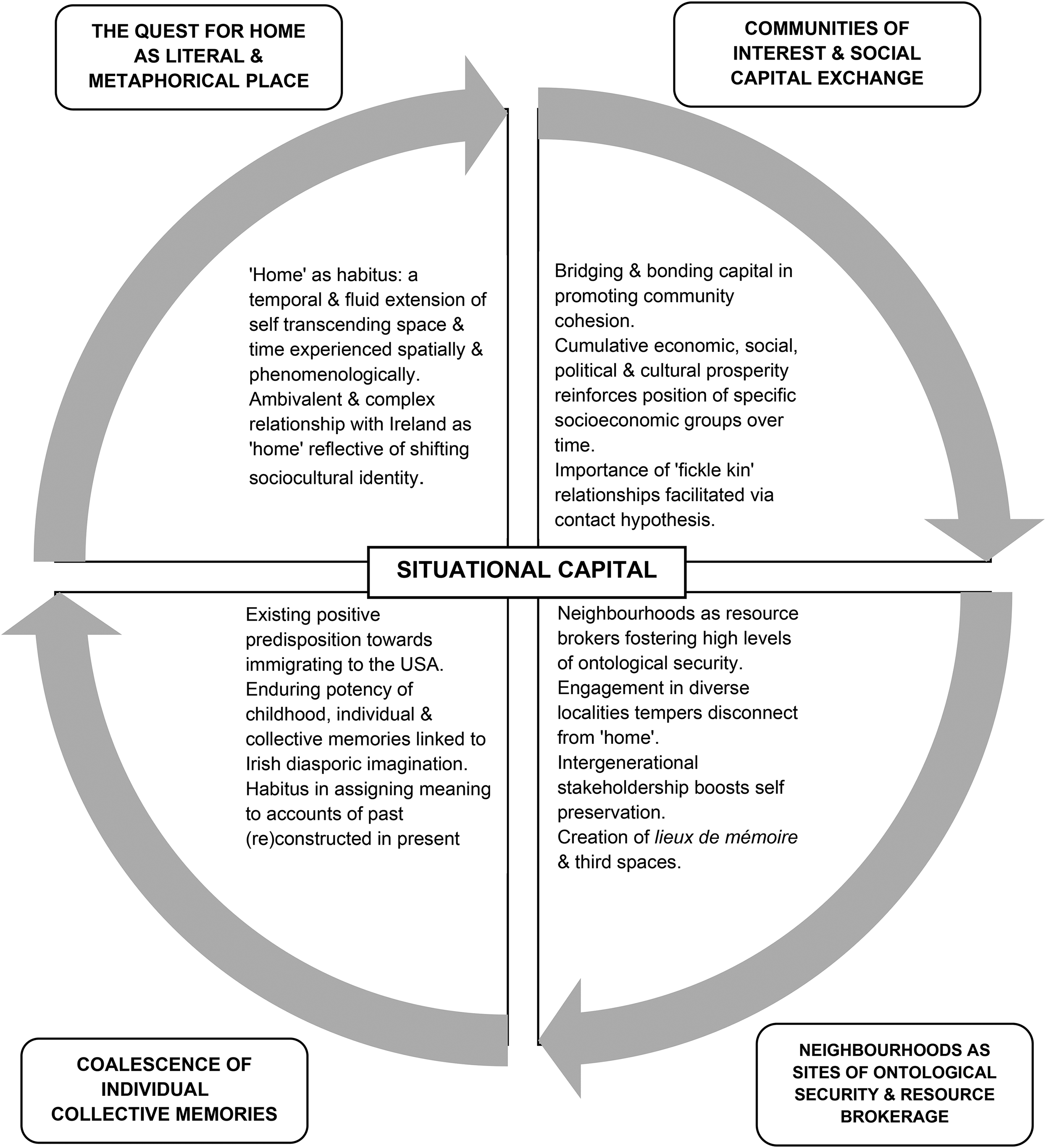
The Irish in New York: The multi- dimensional nature Of situational capital.
Concluding reflections
This critical exploration of situational capital as a heuristic through which Irish immigrants’ attachment to NYC as place may be viewed is, by definition, partial. Nonetheless, the four interrelated themes selected to inform the analysis, both individually and as continuum, have revealed previously undisclosed insights into the relative positionality of Irish immigrants in the city. These themes were: the role of communities in facilitating social capital exchange; the relevance of neighbourhoods as sites of ontological security in which resource brokerage took place; the immigrants’ perpetual quest for ‘home’ and coalescence of individual and collective memories in uniting people and place.
Certainly, the diverse forms of Irish hegemony which had evolved over some four centuries helped augment the diverse material and symbolic interests of the Irish in NYC, shifting over space and time. But perhaps most significantly, the analysis has revealed how interviewees’ accounts of attachment to place formed in situ in NYC transcended spatial boundaries. Rather, it operated as a continuum by fostering a quintessential sustained, reflexive and temporally informed relationship with the city anchored in human experiences. In respect of communities, evoking research undertaken by Weijs-Perrée et al. (2017), close residential proximity and congregating at other gatherings, namely GAA events, dances/céilís and activities facilitated by the Catholic Church, by default gave rise to the situational capital from which the Irish in NYC benefited personally and professionally. At the spatial level, in keeping with Small (2006) and Lin’s (2000) theses, neighbourhoods brokered personal, educational and professional advancement with civil engagement a prerequisite to accessing local level networks. As Herreros and Criado (2009) contended, immigrants are likely to be more easily accepted into diverse communities. Certainly, those interviewed benefited from established Irish networks and the capital contained therein. They also embraced the multiculturalism of NYC. But the conflicted feelings of being both insider/outsider in NYC is suggestive of the universal stranger in search of the utopian ‘no place,’ an infinite placeless place that traverses time and space.
Overall, the genius loci of NYC (re)presented by those interviewed was overwhelmingly positive. But their sense of place pivoted around the fluid, ambivalent and personal sense of real and imagined ‘home’ which extended far beyond the functional and spatial characterisation of home proffered by Benjamin (1995). Instead, respondents reported home was experienced phenomenologically drawing on a complex set of intertwining memories as a form of arsenal used to navigate the realities of their new lives in their adoptive city. Interviewees’ quest for home appeared unrelenting, an unresolved chord waxing and waning according to context with neither a definitive beginning nor end. A powerful emotional connection with Ireland as the essence of home simmered below the surface, rising to the fore when connected physically and emotionally reconnected with their country of birth.
Respondents’ individual and collective memories coalesced allowing for the social framing of everyday life experiences. Being inculcated with positive accounts of life in the USA from childhood created a future imagined home in the minds of interviewees made immigration not just inevitable but desirable. Life in the USA spoke to an agenda of optimism, prosperity and opportunity. Having relatives in situ willing to accommodate them on arrival created a home from home, making the prospect of immigration much less daunting.
The analysis of the interviewees’ narratives shows how perceptions of what Nora (1989) describes as lieux de mémoire (sites of memory) alter over time as they are mediated by evolving individual and collective memories. This profound self-awareness and reflexive quality evidenced in each interviewee's oral history created a ‘mnemonic sense of self’ whereby memories assign meaning to past events recounted in the present. When located in specific communities, these memories becomes distinctive form of capital in situ serving to (re)connect people and place.
The case for situational capital as a conceptual framework presented here would benefit from application to other immigrants’ experiences in urban contexts at the macro and micro level. Given the advance of technology and its ability to transcend spatial boundaries, future research may wish to consider the power of social media to create and sustain the four interrelated elements of situational capital highlighted here. Ultimately, representations of the Irish diaspora's experiences, as with all immigrant groups, are in a constant state of flux. As with all forms of capital, the extent to which situational capital in respect of the Irish in NYC may be construed as an asset or liability is relative, shifting with prevailing ideologically driven policy narratives of the Other.
Footnotes
Acknowledgements
My sincerest thanks to all the Irish men and women resident in New York City who shared their oral histories with me. You were the pioneers who had the courage to make the leap of faith which brought you to the USA. A debt of gratitude also to Paul Finnegan, Centre Piece NY and formerly the New York Irish Centre,-Megan MacDonald and Siobhán Dennehy from the Emerald Isle Immigration Center for their invaluable support and guidance when I was conducting the oral history interviews in New York 2017–2019. I am grateful to Dr Rionach Casey with whom I worked at the beginning of this study when we recorded the oral histories of Irish immigrants in England. This paper is dedicated to Brian O’Neill Mór (1964–2022) musician and beloved family friend who emigrated from Tyrone to New York in 1983.
Declaration of conflicting interests
The author(s) declared no potential conflicts of interest with respect to the research, authorship, and/or publication of this article.
Funding
The author(s) received no financial support for the research, authorship, and/or publication of this article.
