




Abstract
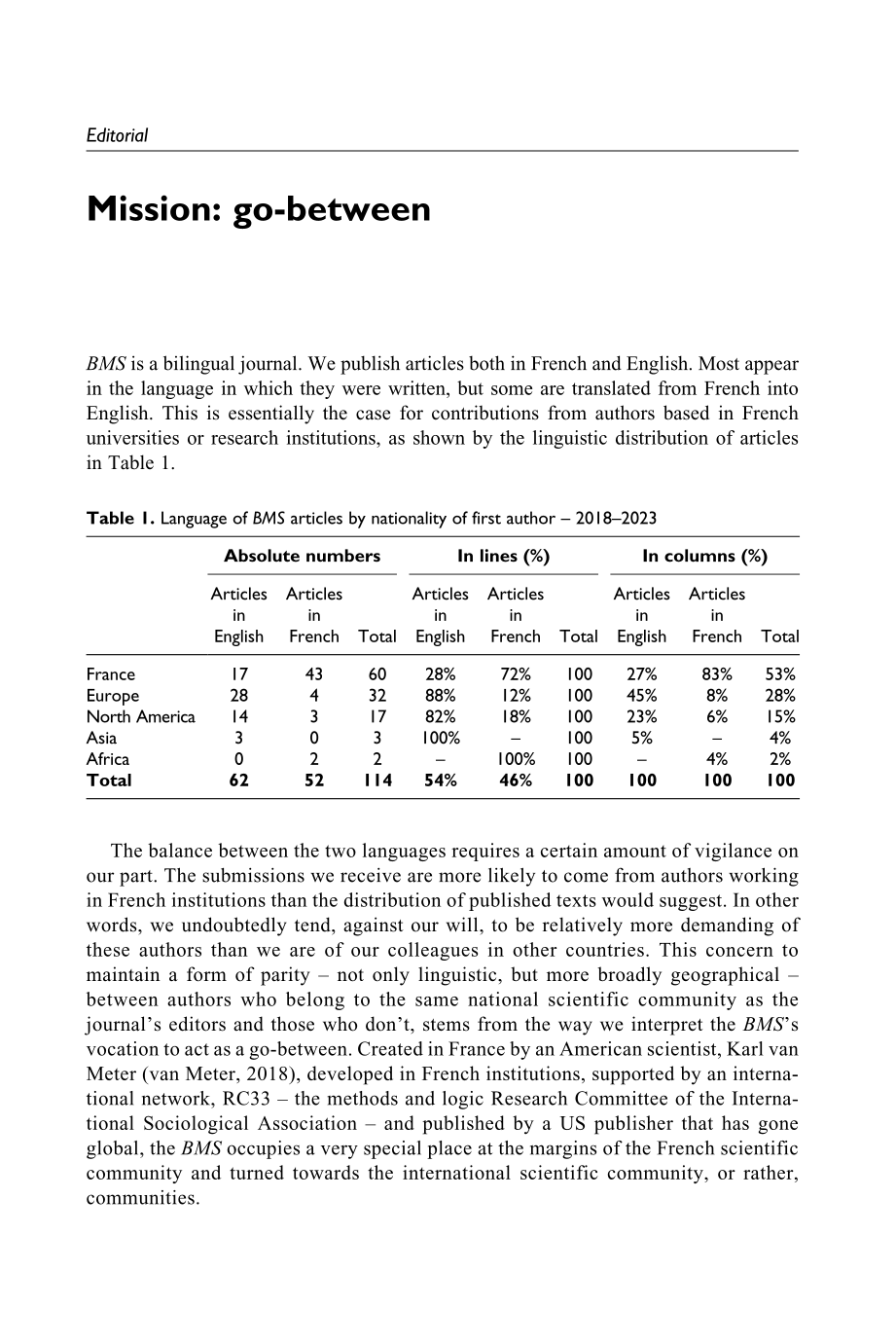
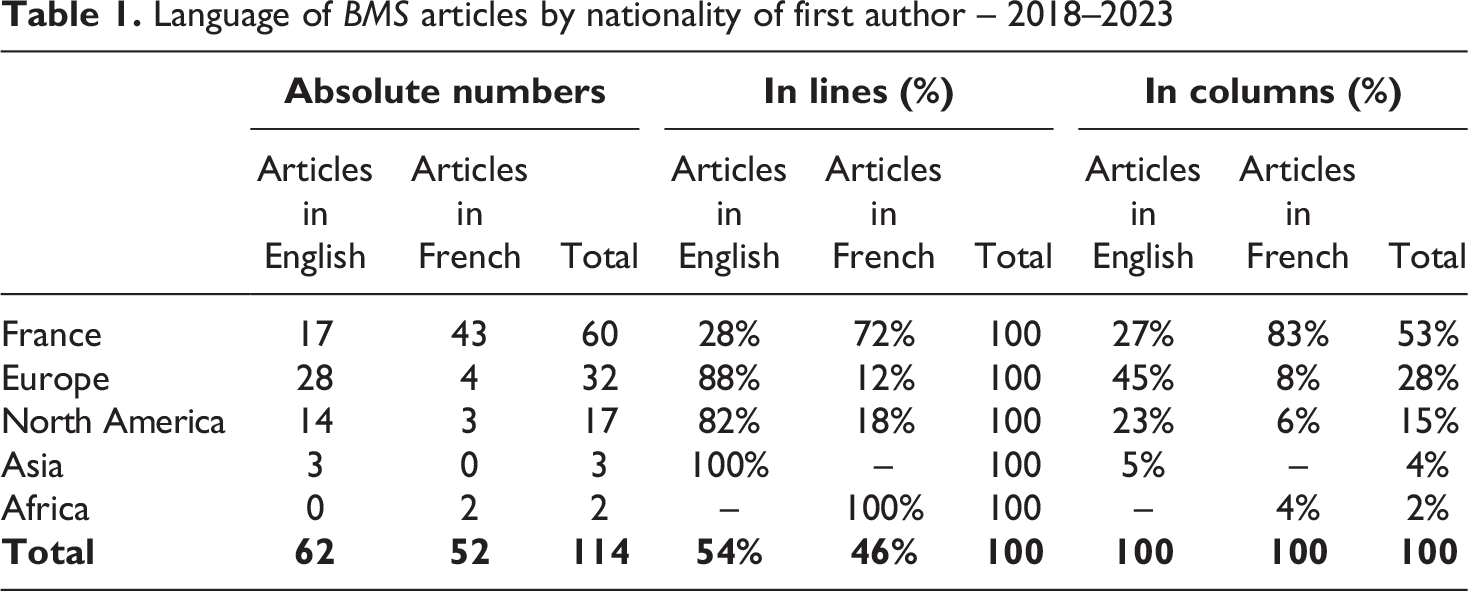
BMS is a bilingual journal. We publish articles both in French and English. Most appear in the language in which they were written, but some are translated from French into English. This is essentially the case for contributions from authors based in French universities or research institutions, as shown by the linguistic distribution of articles in Table 1.
Language of BMS articles by nationality of first author – 2018–2023
The balance between the two languages requires a certain amount of vigilance on our part. The submissions we receive are more likely to come from authors working in French institutions than the distribution of published texts would suggest. In other words, we undoubtedly tend, against our will, to be relatively more demanding of these authors than we are of our colleagues in other countries. This concern to maintain a form of parity – not only linguistic, but more broadly geographical – between authors who belong to the same national scientific community as the journal’s editors and those who don’t, stems from the way we interpret the BMS’s vocation to act as a go-between. Created in France by an American scientist, Karl van Meter (van Meter, 2018), developed in French institutions, supported by an international network, RC33 – the methods and logic Research Committee of the International Sociological Association – and published by a US publisher that has gone global, the BMS occupies a very special place at the margins of the French scientific community and turned towards the international scientific community, or rather, communities.
Vis-à-vis the French scientific community, BMS is marginal in that it is devoted exclusively to social science methods, and first and foremost to those conceived and implemented in sociology and political science. And yet, in general, methods are scarcely valued as such by the scientific community of French sociologists and political scientists. Interested in ways of approaching and measuring a phenomenon, and in processing the observations and readings that can be made of it, methods are sometimes even seen as a form of globalized conformism, or equated with scientistic technique (Neveu, 2021; Roy, 2023). It’s hardly surprising, then, that a French journal specializing in sociological methods should look outwards and seek to increase contacts with colleagues working in university systems more interested in these issues.
This means going beyond reading and writing in French. The propensity of French authors to publish in English in BMS is clear: this represents 28% of articles whose first author belongs to a French academic institution. In fact, we encourage them to do so, as demonstrated by the Guy Michelat Prize we have created. The first article to receive it is published in this issue, in English, since the “reward” attached to this prize is not only a publication in BMS, but also a translation of the article. The fact is that for the first edition of this prize, nearly all the articles were submitted in French. Likewise, we suggest that the experienced colleagues we invite to look back on their careers through the prism of the methods they used, to publish their text in English, when it was written in French. In fact, all the translations we have published since 2018 are French-to-English translations. The French-language articles submitted by authors working (tenured or otherwise) in other countries come from French-speaking regions in Switzerland, Belgium, Canada and Burkina Faso.
Articles in English (translated or not) by colleagues from French institutions also account for a significant proportion – 27% – of the 62 articles we have published in this language since 2018. For BMS to continue to fulfil its vocation as a go-between between different scientific traditions, it is essential the journal continues to receive and publish articles in English from different parts of the world. However, the number of submissions corresponding to the journal’s scientific criteria (which we detailed a year ago in another editorial: “A proudly niche journal”, Duchesne et al., 2023) sometimes slows down, and we find it difficult to ensure parity of French and English texts in the next issue. In fact, this is what led us to this double issue: three months ago, we did not have enough English-language articles ready for publication to bring out issue 161.
What leads non-French-speaking colleagues to submit an article in English to the BMS, when English-language social science methods journals are legion? Some of the submissions come from RC33, with which we continue to maintain a close partnership, via Karl van Meter and the biannual publication of his Newsletter. Another part comes from the extended networks of the members of our editorial board, half of whom are colleagues based in globalized French-speaking institutions which have a more open and pragmatic relationship with the scientific linguistic pre-eminence of English than many French institutions. The latter come directly from the visibility the journal enjoys thanks to its publication by SAGE. By consolidating our editorial policy, we’ve gained a lot in referencing in recent years. We hope this will allow us to attract more and more interest from English-speaking colleagues around the world, who have here the opportunity to access another readership. In keeping with our vocation, we will continue to act as go-betweens between the French and English-speaking scientific communities in the social sciences, on ways of thinking about the use of methods and their evolution.
This double issue opens with the first winner of the Guy Michelat prize in the “seniors” category, Julien Audemard. For the record, we created this biennial prize in partnership with the Association française de science politique, 1 and awarded two prizes: one for senior colleagues, for an article already finalized; and one for young colleagues, in the scientific sense of the term, for a draft article. The second prize, awarded to Sarah Perrin, will be published in the first issue of 2025. Julien Audemard’s article makes an important contribution to the understanding of vote transfer in a two-round ballot. Rather than relying on declarative data collected by survey, which is liable to bias (particularly in a local context), the author shows how it is possible to rely on aggregated data by polling station, enriched by the counting (in electoral registers) of voters who abstained in each of the 2 rounds. By applying a theoretical statistical model to the case of the 2014 Montpellier municipal elections, this text enriches the empirical assessment of the robustness of a model that is ultimately untested and shows how to refine knowledge of vote transfers in electoral sociology.
This article is accompanied by the publication of an original interview by German colleagues with Guy Michelat that took place in 2013, as part of a comparative project on the use of sociological methods in France and Germany, piloted by Reiner Keller and Angelika Poferl. In this interview, Michelat talked about his training, his use of qualitative methods and his inspirations. In many ways, this interview fulfils the function we have assigned to “The design of my work” section of the BMS. We would like to thank our colleagues for authorizing its publication.
This is followed by four articles corresponding to the “Implementation” section. In the first, Tony Orival reflects on the innovative nature of a methodological experiment based on immersive simulation. Based on a survey of digital technologies in healthcare, the contribution of this method to gathering qualitative data by means other than interviews or observation is discussed.
The second article in this section is rather different. In 2021, many recurrent, face-to-face questionnaire surveys were confronted with the question of field feasibility at the time of the Covid-19 pandemic lockdown. This is the case for the Austrian component of the major international survey, the International Social Survey Programme (ISSP). In their text, Matthias Penker and Anja Eder analyze the extent to which the responses to a field survey that started by telephone (due to the ban on visiting people’s homes) and then continued and completed face-to-face (once the ban had been lifted) remain comparable or not.
The third “Implementation” is by Nancy Venel, who returns to the value of surveys based on repeated interviews. The article highlights the benefits of this methodology for studying particularly complex and sensitive dynamics at the crossroads of the individual and the social. Two surveys carried out in religious fields shed light on the subject: the first studies the evolution of prisoners’ relationship with religion during their incarceration, and the second analyzes conversion trajectories from Islam to Christianity.
The last “Implementation” article in this issue reports on Soazig Dollet’s thesis methodology. In this text, she seeks to understand how the relationship of inquiry was established with the people benefiting from international protection whom she interviewed for her thesis, when they were introduced to her through the intermediary of her employer, as part of CIFRE funding. 2 The article examines the docileness and resistance encountered both in the face of the possibility of the interview itself, but also in the quality of the accounts obtained.
The following two articles are also about doctoral research. Manon Veaudor’s article is part of the “Methods of my thesis” section, created specifically to help young researchers reflect on how they conceived and carried out the empirical operations of their thesis. Here, Manon Veaudor reports on a survey carried out in prison, and reflects on the dynamics of a survey under control. The latter naturally influences the conditions of access and the researcher’s positioning in relation to her field, and even her research subject. In particular, she explores the effects of self-restriction that this can induce.
Boris Attencourt could also have submitted his article in the “Methods of my thesis” section, but having taken part in the panel organized by Claire Dupuy and Camille Hamidi on the scales of analysis at the 2019 congress of the Association française de science politique, he pursued the reflection with them and publishes his article in the section they run, “Micro-macro”. In it, he develops the methods of data collection and analysis he had to devise in order to study an interstitial space, a somewhat transgressive object of Bourdieusian theory, here based on the visibility of intellectuals.
This double issue concludes with two articles dealing with methods that have emerged with the growing digitization of our activities, namely systematic literature reviews on the one hand, and the study of Big Data on the other. In the “Tools and instruments” section, Marie Barisaux, Pierre Gasselin, Lucette Laurent and Guillaume Olivier return to the question of literature reviews, discussing the relative value of two methods, the Systematic Literature Review (SLR) and the Scoping Review (SR). This methodological discussion is then illustrated in precise detail by the application of one of the two techniques, SR, to the case of free labor in agriculture.
Conversely, Guillaume Wunsch engages in a more distanced reflection, based on another type of highly intuitive and selective literature review, on the actual and potential transformation of demographers’ work, with the increasing openness of data and the development of increasingly sophisticated statistical tools. In conclusion, he discusses how big data and big data analysis can contribute to improving the explanatory power of models in the social sciences, and in demography in particular.
Our issue concludes with the RC33 Spring Newsletter 2024, edited by Karl van Meter. Enjoy your reading!
February 2024.
Sophie Duchesne, Xabier Itcaina and Viviane Le Hay