



Abstract

Takao Kondo was born in 1948 and received his BS in 1970 and his PhD in biology from Nagoya University in Japan (Figure 1a). His PhD thesis advisor was Professor Yukito Oota. Dr. Kondo was appointed as a Research Associate at the National Institute for Basic Biology in Okazaki in 1978. Because of his superb success in studying the circadian rhythms of cyanobacteria, he was recruited by Nagoya University and became a Professor at the Graduate School of Science in 1995. Dr. Kondo served as Dean of the School of Science from 2006 to 2009 and President of the Institute for Advanced Research of Nagoya University from 2007 to 2013. He also served as President of the Japan Society for Chronobiology. Dr. Kondo died from bladder cancer and pneumonia on 16 November 2023, at the age of 75. He was best known for his discoveries of the molecular bases of the cyanobacterial circadian clock, most spectacularly his laboratory’s reconstitution of the circadian oscillation of cyanobacterial KaiC phosphorylation in vitro (Nakajima et al., 2005), which disproved the universal necessity of a circadian clock having as its core oscillator a transcription/translation feedback loop. For his achievements, he received numerous awards, including the Aschoff-Homma Award, the Chunichi Culture Prize, the Asahi Prize, the Medal with Purple Ribbon, the Japan Academy Prize, the SRBR Director’s Award, the Order of Cultural Merit, and the Order of the Sacred Treasure, Gold and Silver Rays.
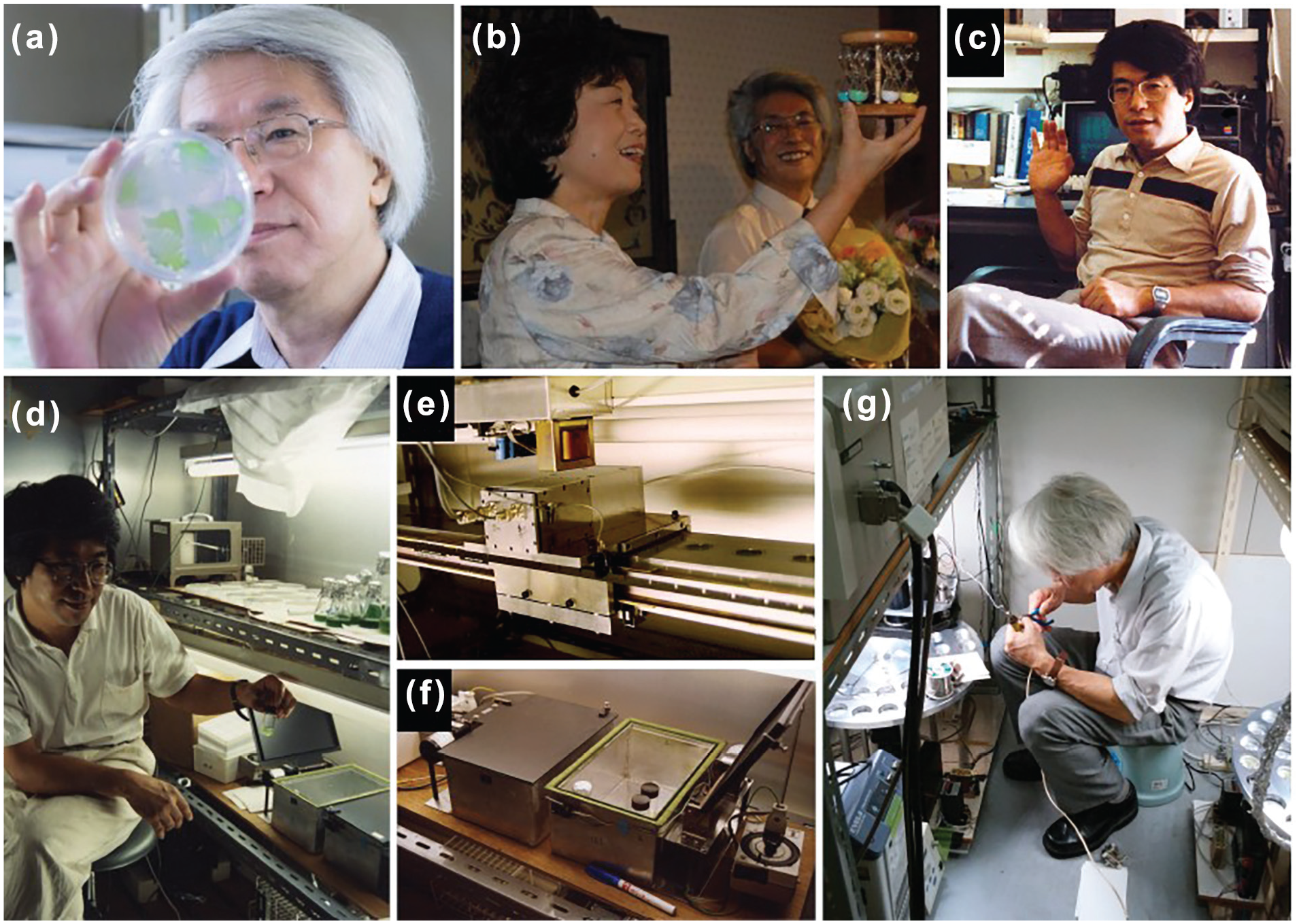
(a) Takao Kondo looking at a petri dish that has been plated with cyanobacteria. (b) Hisayo and Takao Kondo. (c) Takao Kondo sitting at his desk at the National Institute for Basic Biology, Okazaki, Japan (1986). Note the Apple II computer on his desk behind him. (d, e, f, g). “Radio Boy” Takao Kondo with some of his instrumental creations. Takao in a culture room with his automated boxes (d), Takao’s version of the “Taylortron” that was originally invented in the laboratory of Woody Hastings and improved by Takao to enable sensitive photon counting (e), clock-controlled boxes to create light/dark cycles for entraining cultures of cyanobacteria (f), and Takao flanked by two later versions of the “Kondotron” on either side of him (g).
Memories from Takao Kondo’s Elder Daughter, Ayano
I am Ayano Ogihara, eldest daughter of Takao Kondo. I would like to share a few memories to honor my father. When I was a child, I wanted to go to amusement parks such as Tokyo Disneyland, but my father, who did not like crowds, would take us mountain climbing and river boating instead because he loved the mountains very much, and we had a small mountain villa in the Nagano prefecture. My father loved and collected moths and made specimens, but neither my sister nor I were very interested in moths because they seemed so disgusting. To our family, he did not seem like a “great man,” just an easygoing person who liked to listen to loud classical music in the living room. My father did not talk much about his work at home, but I had the impression that he was doing some kind of difficult research. When I did not understand math, science, and other subjects at school, my father would teach me, but he also taught me more than what was in the textbooks. I thought it was enough if I could solve the problems in the textbooks so that I could do well on tests. But my father tried to teach me the fundamentals underlying the answers, and I often found that it was difficult to keep up with him. Now that I am an adult, I understand better how my father cared about us growing up. I am filled with gratitude to my father and my mother. My father was able to devote himself to his favorite research in the field of chronobiology and was surrounded by many warm people, and I think he was truly happy.
Memories from Takao Kondo’s Younger Daughter, Ikuno
My father passed away in November 2023, and my mother passed away soon thereafter (January 2024). I would like to write about both of them. My father was an accomplished researcher, but when he was at home being our father, he was unassuming and kind, but also untidy and laid-back. My mother was a good talker and a good cook, with a cheerful personality that was neat and orderly (Figure 1b). It is nostalgic for me to remember that my father would often take his socks off in our house to relax barefooted, and my mother would scold him when she discovered these socks in strange places; such scenes were common in our home. On the other hand, my mother was supportive of my father in many ways, including working in the lab every day. Because my mother also worked in the lab, when our family ate supper together, we talked about their laboratory personnel as if they were family too. We prepared home parties for the lab members and shared events and activities together with them. I believe that my father was able to continue his research until the end of his life because of my mother. I feel that my father’s life was truly blessed by the people around him. Both my father and my mother loved to make people laugh, and I think they would be very pleased that they are remembered in a fun way so that their stories are told with a smile.
Memories of Takao Kondo’s PhD student and Colleague Hideo Iwasaki (Professor, Waseda University)
My lifelong mentor, Takao Kondo passed away last year on 16 November 2023. Takao consistently faced fundamental questions in chronobiology and left behind an enormous footprint that spanned a wide range of the field. Early in his career, he studied photoperiodic floral induction and ion absorption rhythms in duckweed, later shifting to phototaxis rhythms in green algae and dinoflagellates. Building on this accumulation and collaboration with Carl Johnson, Susan Golden, and Masahiro Ishiura, he turned cyanobacteria into an exceptionally good experimental model for deciphering the basic principles of biological clocks, overturning all the conventional wisdom about biological clocks and opening up new horizons (Figure 1a-1c).
I joined Takao’s lab in 1995 as a PhD student, just as he moved from the National Institute for Basic Biology in Okazaki to Nagoya University. At that time, we were in a small lab with three graduate students, Associate Professor Masahiro Ishiura and Professor Kondo, and one of the two lab technicians was Takao’s wife, Hisayo. I spent 10 years working closely with Takao as a student and later as a colleague, from the cloning of the kai genes to the establishment of the in vitro reconstitution of circadian rhythms, until 2005. He was kind and unpretentious, fostering an open environment where even critical discussions were welcomed. His hypotheses were sometimes disproven, yet he never dismissed differing opinions without careful consideration. The most memorable example for me is the disproof of the transcription-translation feedback loop model (Tomita et al., 2005; Iwasaki, 2021). In the process, there were countless times when, in our youthful enthusiasm, we made frank (and rude) remarks, because we felt that Takao would be okay with our criticisms, and I cannot thank him enough for his tolerance. Even when Takao did not agree with the opinions of others, he would take a long time to listen carefully to their opinions before making a decision.
Takao always focused on the core issues of biological clocks, selecting the best experimental systems and building his own instruments (Figure 1d-1f), including the multichannel bioluminescence measurement system known as the Kondotron (although he never called it that himself). He always emphasized, “The important key is not to try everything you can do, but to look carefully at what not to do and focus on what you should do” (Kondo, 2021), and he surely embodied this principle. His remarkable flexibility allowed him to radically change his lab’s methods when necessary (Iwasaki, 2021). It was most evident after achieving the in vitro reconstruction experiment, as his lab shifted drastically toward biochemistry and structural biology—an area new to him. With unwavering dedication, he pushed the boundaries of in vitro chronobiology, accelerating his research rather than slowing down just before his death. He passionately pursued his cyanobacterial oscillator model (dual-coupled harmonic oscillator hypothesis), striving to complete a paper on it. Although he could not finalize it, his later writings reflect his persistent efforts (Kondo, 2021). He left behind not only groundbreaking discoveries but also ongoing challenges for future scientists. I believe he lived an exceptionally fulfilling research life.
However, I was reminded endlessly of his charming, mild-mannered, and sometimes peculiar personality, even more than of his greatness as a researcher. For example, until a certain point in his life, he was “addicted” to Coca-Cola. There was always a pile of Coke cans in his office, and he always left out a half-drunk can. I do not remember if he did it because it was good for him only when the can was opened, or if he loved Coke that had become tepid and had lost some of its carbonation, but people around him often complained to him in a friendly manner, and he scratched his head with a wry smile. I also remember how he liked to continuously stir his coffee with a spoon. Even after the coffee and milk were well mixed, he still kept stirring. Our long conversations during trips are cherished memories. His passing is a great loss, but I take solace in knowing he is free from his painful battle with cancer. Thank you very much, Takao, for giving us so much. Please rest in peace.
Shortly after Takao’s death, Hisayo, who had been battling pancreatic cancer, also passed away on January 27, 2024, as if following in Takao’s footsteps. As the “mother of the lab,” she provided unwavering support with her warmth, humor, and skill. She had a reserved but sharp wit, often making the audience burst into laughter during Takao’s award ceremonies (Figure 1b). We would like to take this opportunity to express our heartfelt thanks and best wishes to Hisayo. We also extend our heartfelt condolences to the bereaved families who lost their parents and grandparents at nearly the same time.
Memories of Ken-Ichi Honma (Professor Emeritus, Hokkaido University)
I am not quite sure when I met Takao Kondo for the first time, but he participated in the first Sapporo Symposium on Biological Rhythm held in 1984, and I guess that was our first acquaintance. Takao graduated from Nagoya University Faculty of Sciences, having studied the plant circadian clock, whereas I graduated from Hokkaido University School of Medicine, and investigated the mammalian circadian clock (including humans). We regularly met at the Sapporo Symposium, which was a wonderful opportunity for scientists in completely different fields to interact. Afterward, I visited him at the National Institute for Basic Biology in Okazaki where Takao spent his early career.
In the early 1990s, Takao and his collaborators detected circadian rhythms in the prokaryotic cyanobacteria using a novel bioluminescence reporter system and published the findings in PNAS. Based on this breakthrough, he moved to Nagoya University Faculty of Sciences shortly thereafter and performed a number of groundbreaking studies in chronobiology. We used to humorously call him “Radio-boy” because he was good at computer programming and he made many experimental instruments by himself such as the “Kondotron” (Figure 1g and also Figure 2 in Johnson and Xu, 2009). Since real-time measurement of gene expression was a cutting-edge technique, I frequently asked Takao for his advice in applying the technology to mammals (at that time, mammalian circadian systems were analyzed by locomotor behavior, body temperature, and/or laborious sampling of melatonin or neuropeptides in vivo or ex vivo).
Takao liked walking in highlands and climbed many mountains not only in Japan but also in the Himalayas. He also built a mountain cottage in Nagano as his family’s second house. Takao was a member of the Board of Trustees of the Aschoff and Honma Memorial Foundation, which met in Sapporo. Despite being a long distance from his home, he never missed the annual meeting of the Board. Takao attended the Board meeting held on May 2023 (a few months before his death) and despite his deteriorating health condition, he enjoyed the Board dinner at a restaurant that specializes in cuisine prepared with local ingredients from the region around Sapporo (coincidentally, the restaurant’s name is “TAKAO!”). One month later, he visited the Hospital of Hokkaido University with his wife to get an opinion for medical treatment. I accompanied them to that appointment and realized how serious his health condition was. After the medical appointment, he drove a car far into the center of Hokkaido with his wife, which made me pleased because I realized that Takao still had the spirit and energy of an explorer.
One month after the sad announcement of the death of Takao Kondo, I wrote a letter of condolence to his wife. I wrote, “Among a number of memories of him, I still clearly remember our common indecisive attitude about the Transcription/Translation Feedback Loop model. The model is excellent, but too simple from the perspective of physiology.” In contrast, Takao had advanced a molecular oscillation model which, I supposed, made the Nobel Prize laureates’ blood run cold when they first heard it (e.g. laureates Jeffrey Hall, Michael Rosbash, and Michael Young for the 2017 Nobel Prize in Medicine or Physiology).
Memories of Takashi Yoshimura (Professor, Nagoya University)
I first met Dr. Takao Kondo at the annual meeting of the biological rhythms in Japan when I was an undergraduate student of Dr. Shizufumi Ebihara. Dr. Kondo was always a warm mentor. Although I was in a different laboratory and department, I received generous guidance from Dr. Kondo, and I always looked forward to talking with him. He spoke passionately about his own research, but he also asked me many questions about the progress of my research. When I presented my research to him, he sometimes asked me whether it was a fundamental question or not. I started my scientific career by studying circadian photoreceptors in mammals under the supervision of Dr. Ebihara, but it was largely due to Dr. Kondo’s influence that I later moved to studying photoperiodism in animals.
Dr. Kondo enthusiastically promoted the younger generation of scientists and he asked us to organize symposia, including the “Nagoya Clock Club.” He also invited renowned chronobiologists to Nagoya and gave us the opportunity to interact with them. Dr. Kondo served as the Dean of the School of Science and Program Director of the Graduate Student Education Program at Nagoya University, where I was also a member of the Education Program. He taught me about the administration and management of the university. I also had the opportunity to learn from him at board meetings of the Japanese Society for Chronobiology and the Science Council of Japan to promote the development and dissemination of chronobiology in Japan. Dr. Kondo was my guide in research, education, and administration, and I miss him very much.
Memories of Susan Golden (Professor, University of California San Diego)
The collaboration with Takao Kondo, Carl Johnson, and Masahiro Ishiura that identified the cyanobacterial circadian clock transformed my research so completely that I find it difficult to imagine how my career would have unfolded without it. The years of reciprocal lab visits were rich with science and cultural exchange. We and our students met in Okazaki, in Nagoya, at Vanderbilt, at Texas A&M, and at every circadian conference that two or more of us attended, and we sent our students to the others’ labs to keep the collaboration informed. I watched Takao’s program grow from his first tiny space in Okazaki, where he worked on his own and built amazing instruments, to a bustling group full of students in Nagoya. His students would play Rock-Paper-Scissors to decide who had to go first in explaining their recent research to me. Some of these students, shy and reluctant to speak English, later spent weeks in my lab and became dear friends. The fruit of the scientific collaboration is evident for all to see, but I cannot begin to convey the innumerable memories from my friendship with Takao, spanning three decades. The moments I cherish most are the times Takao and Hisayo hosted me in their home, especially when Ayano and Ikuno were children. The descriptions from others in this memoir resonate with the warmth I always felt there. We also went to their mountain house, both for combined lab meetings with the binational collaborators and just to relax with the family. On one of Takao’s trips to the United States, my husband and I took him to the Aransas National Wildlife Refuge in south Texas to see the rare whooping cranes. He struggled to say “whoop” and called them “weeping cranes.” This sweet memory brings tears to my eyes as I mourn my friend, with both fondness and gratitude for the way that getting to know him, his students, and his family enriched my life.
Memories of Carl Johnson (Professor, Vanderbilt University)
Takao Kondo was a special person, who from relatively unremarkable beginnings ultimately had a tremendous impact on the way that we think about circadian mechanisms. When I first met Takao, he was a Research Associate in the group of Professor Norio Murata at the National Institute of Basic Biology in Okazaki (Japan). Although “Research Associates” are often equated to Assistant Professors in the United States, in fact they had limited independence (at least at that time) and were expected to contribute to the research program of “the boss.” Dr. Murata was a “hotshot” on the topic of membrane fluidity and temperature effects, and while he was willing to let Takao pursue some circadian “dilly-dallying,” he also required Takao to devote a significant amount of effort to Murata-san’s research projects. Despite those obligations, Takao was ultimately recognized for his own fundamental contributions that forced all of us to re-evaluate what a clock might be. In time, Takao became an independent Professor at Nagoya University and was awarded the Asahi Prize (in 2006), which is a prestigious award for Japanese who have made outstanding contributions to the development and progress of Japanese culture and society. Even grander, he was granted the honor of a personal audience with the Emperor of Japan in 2011 to explain the significance of reconstituting a circadian oscillator in vitro! (The discovery of the in vitro KaiABC oscillator is delightfully described by Hideo Iwasaki in Iwasaki, 2021).
One key to his success was that he did and saw things differently from everyone else; as the Nobel Laureate Albert Szent-Györgyi was famously quoted as saying, “Research is to see what everybody else has seen, and to think what nobody else has thought.” Although Takao may have appeared to be a “typical scientist,” fundamentally he was a non-conformist. Clues to this characteristic included that he was an early adopter of Apple/Macintosh computers at a time when most Japanese scientists used NEC computers (see the Apple computer in Figure 1c). Also, his car was an all-wheel drive Subaru when the most popular cars in Japan were Toyota, Honda, Mazda, Mitsubishi, or Nissan. Finally, Takao was a mountain climber, not only in the Japan Alps but also in the Himalayas. These personal preferences were all clues that he was not the conformist that he appeared to be. In addition to his non-conformist viewpoint, another key to his success was his talent for designing apparatuses and writing computer programs for data acquisition and analysis (Figure 1d-1f). These characteristics enabled his distinctive scientific approach. As Takao mused in his autobiographical chapter,
I wondered if there was any research field that I could do that was truly interesting and not too crowded with other scientists to compete with. I wanted to study a phenomenon found in many organisms, without being concerned whether it was “useful,” e.g., medically relevant. At that time, I was often advised that it would be bad for my career if I did not do molecular biology and biochemistry, which everyone else was doing. I visited a biochemist and a molecular geneticist whom I secretly respected, and they both agreed that I should not take the view that I should do what everyone else was doing. (Kondo, 2021)
I think this is excellent advice for all young scientists; the final career outcome of researching “popular” topics may be to become a “small fish in a big pond.”
My scientific collaboration and friendship with Takao started with our shared research on the clock of the eukaryotic alga Chlamydomonas in 1985 and thenceforward blossomed into a four-way collaboration including Susan Golden and Masahiro Ishiura on the clock of prokaryotic cyanobacteria (Johnson and Xu, 2009; Johnson, 2021). This collaboration continued productively for a long time; I think our collaboration was of long duration because it was firmly rooted in friendship and shared experiences. Eventually, the demands of finding independent projects for students/trainees in our labs converted our synergistic alliance into a “cooperating competition.” That was a sadness for me, because the new conditions strained our friendship (but our mutual respect continued). C’est la vie. Or, as a Japanese might say, “Kore-ga jinsei desu.”
I cannot speak for Takao, but I think he believed that his unique insights into circadian mechanisms—based on his studies of the in vitro KaiABC oscillator—were generalizable to other systems, and it frustrated him that other chronobiologists seemed to not understand his vision. He endeavored to explain these concepts in his autobiographical chapter (Kondo, 2021), which I encourage you to read so that you can hear him speak for himself. Both in my professional life and in my personal life, Takao Kondo changed my life for the better. Thank you, Takao!
