




Abstract

On February 10, 2023, our field lost a giant, Friedrich (“Fred”) K. Stephan. Fred is best known in the field for a breakthrough study that laid the groundwork for all future research on neural control of behavioral circadian rhythms in mammals (Stephan and Zucker, 1972). He also made seminal contributions that helped to establish the subfield of food entrainment, and that, in turn, laid the groundwork for the study of distributed circadian systems in mammals, which also remains a vibrant research area. Fred infrequently attended meetings or gave seminars. When he reached 65 years of age, he retired to his horse farm in the outskirts of Tallahassee, Florida, and no longer interacted with the science community. As a result, Fred’s outsized influence on our field is underappreciated. This remembrance, therefore, will serve 2 purposes: to introduce the circadian rhythms community to Fred Stephan the person and to his important body of work.
Fred was born in Schweinfurt, Germany, in May 1941, during the early years of World War II. Schweinfurt, a farming town, was also the site of a massive factory making ball bearings, an important component used in German army equipment including tanks and aircraft. As a result, the Allied forces targeted Schweinfurt relentlessly from the air during Fred’s early life. Fred’s childhood home was hit directly with an allied bomb which traveled through the roof and several stories before coming to a rest in the basement, without detonating. It was in the rubble that remained of Schweinfurt that Fred grew up. He had very limited access to educational materials. Having lost his father during the war, the family could not afford secondary school, so he went to trade school after sixth grade and learned tool and dye machine work.
Fred left Germany in his early 20s, emigrating with 2 friends to Western Canada. There Fred worked as a ranch hand and learned to work with, and to love horses. This is where Fred first learned to speak English. After a few years Fred and his friends took a job in the Canadian Northwest Territories tracking migrating animals, which may have been his first direct involvement with science. They earned enough to afford entry to the United States.
Fred returned to school at Riverside (California) Community College in 1965 to study physiology, with the intent of pursuing a medical degree. There he met his wife, Mary, as a lab partner; she was pursuing a nursing degree. In 1967, Fred began his scientific career in earnest at UC Berkeley. It was the only school to which he applied for the completion of his undergraduate degree. After he graduated, Fred began his PhD work, skipping a master’s degree with the blessing of the faculty. Fred said at the time that he thought he was the smartest person at the University because he was the only one not using marijuana and LSD. In 1972, just 7 years after moving to the United States with almost no prior education, Fred graduated with his PhD in biopsychology. His dissertation work in Irving Zucker’s lab included the discovery that lesioning of the suprachiasmatic nucleus (SCN) eliminated circadian drinking rhythms. This discovery was initially met with skepticism by labmates, one of whom wrote in the margins of Fred’s experimental notebook alongside the discovery: “Fred’s Folly.” Fred replicated his findings, and his work was published in PNAS (rejected by Science) nearly simultaneously with Moore and Eichler’s work showing that similar lesions abolished circadian corticosterone rhythms in blood (Stephan and Zucker, 1972; Moore and Eichler, 1972). These independent discoveries and the circumstances in which they arose are well-covered in The Suprachiasmatic Nucleus: A 25-Year Retrospective (Weaver, 1998). We refer the reader to this enjoyable piece, which is based on the stories told by those who made the actual discoveries.
“Fred was a wonderful Berkeley graduate student. Innovative and resourceful. Without his contributions the 1972 paper never would have happened”.
With PhD in hand, Fred moved to Florida State University (FSU) as an Assistant professor without doing a postdoc. There he taught biological psychology to undergraduates and graduate students and began his independent research career. He was the only one working on clocks in a hotbed of research in sensory physiology. This was a robust environment for psychobiology and neuroscience. The psychology department housed a complete machine and electronics shop, and the staff designed and built all of the equipment for studying behavior and controlling stimuli for the neuroscience group. Fred’s lab housed rat enclosures with programmable pneumatic controls for food delivery and removal, and contact lickometers, running wheels, or feeder approach pedals. Whatever he dreamed up, the shop at FSU would build and write control and analysis software. It was an incredibly fertile environment for creativity in observational neuroscience. Curt Richter, the namesake of Fred’s endowed professorship, would have been proud.
Fred’s first R01 at FSU was a logical extension of his doctoral work and focused on retinal inputs and SCN outputs. This work is featured in publications with his doctoral students, Tony Nunez and Cheryl Sisk (e.g., Nunez and Stephan, 1977; Sisk and Stephan, 1982; see also Stephan et al., 1981). Discussions of further directions for the lab at that time included questions about homeostatic regulation in animals made arrhythmic after SCN lesions (such animals, presumably lacking all circadian function, should be “pure homeostats”) and how circadian rhythms in learning and memory would be affected by SCN lesions (Stephan and Kovacevic, 1978). Ultimately, the lab went in an unexpected direction.
Fred’s most cited work is certainly the 1972 PNAS paper, but arguably his most influential contributions concerned SCN-independent rhythms and entrainment by nonphotic zeitgebers, which at that time did not exist as active areas of research. Fred’s interests shifted from questions about the SCN and its efferent connections, to a focus on what rhythmic functions could survive SCN lesions. This shift was triggered by a Science paper (Krieger et al., 1977) claiming that rats made arrhythmic by SCN lesions showed rhythms in temperature and adrenal outputs when exposed to a 24-h feeding schedule. These results suggested that a circadian oscillator outside the SCN was responsible for food-synchronized circadian rhythmicity. Fred was aware of earlier work showing that rats can anticipate a daily meal (Richter, 1922), but only if the food was provided at a fixed time of the 24-h day, and not at variable times of day, even if these were predictable (e.g., once every 19 or 29 h; Bolles and Stokes, 1965). While some lab trainees were very skeptical of the idea of extra-SCN oscillators, Fred was more open-minded and motivated to falsify alternative explanations, such as “exogenous” effects of the light-dark cycle or non-circadian timing mechanisms. Fred and his students (Jennifer Swann and Cheryl Sisk) went on to show that after SCN lesions rats were capable of anticipating food provided at 24-h intervals under constant light and after adrenalectomies, but not at 18-h intervals (Stephan et al., 1979a, 1979b). Similar results were independently reported by 2 other laboratories within the year (Boulos et al., 1980; Phillips and Mikulka, 1979). This must have bolstered confidence that SCN-independent circadian meal timing was a robust phenomenon. The task of describing the properties and anatomical locus of the postulated food-entrainable circadian clock defined Stephan’s lab and his career for the next 30 years.
“Fred’s work was instrumental to my professional career. His willingness to pursue unexpected findings and challenge his own work set a powerful example that has served me well.”
In this pursuit, Fred’s work was both of its time, and ahead of its time. Fred approached the phenomenon of food anticipation through the eyes of a circadian biologist versed in the principles of circadian clock entrainment, as articulated in the seminal papers of Pittendrigh and Daan (1976a). He first probed the oscillatory properties of food anticipation rhythms using non-24-h feeding schedules (“T cycles”), which confirmed circadian “limits to entrainment” (Stephan, 1981; see also Aschoff et al., 1983). He then conducted meal shift experiments to characterize rhythm resetting properties, making the important observation of “transient cycles” between steady entrainment states (Stephan, 1983). After confirming that rats could anticipate 2 daily meals, he used 2-meal T cycle experiments to test a hypothesis that food anticipation was mediated by a circadian clock with a 2-oscillator structure (Stephan, 1983, 1989a, 1989b) such as proposed for the light-entrainable SCN pacemaker (Pittendrigh and Daan, 1976b). These results extended earlier findings from studies in intact rats in constant light (Edmonds and Adler, 1977), and have since been confirmed and extended by others (Petersen et al., 2022).
The importance of food as a time cue for circadian rhythms is now broadly recognized (circadian oscillators throughout the body are tuned to mealtime; Schibler et al., 2003; Stokkan et al., 2001), but through most of Fred’s career, this was not the case. Fred was thus ahead of his time in advocating for the primacy of food as an essential zeitgeber, as exemplified by the bold opening words of his presentation at the SRBR meeting in Florida in 1988, that “Food is more important than light.” Although he initially referred to a “food-entrainable pacemaker (FEP),” he soon modified this to “food-entrainable oscillator (FEO),” which makes no assumptions about whether food entrainment is centralized (as is the case for entrainment by light) or distributed (as we know now is true for food). Fred initially cautioned against assuming that FEOs’ driving behavior would be hypothalamic (personal communication with Mistlberger, 1982), and instead focused on potential peripheral sources of rhythmicity, such as the adrenal gland (Stephan et al., 1979a), the duodenum (Comperatore and Stephan, 1987), metabolic hormones (Davidson and Stephan, 1999a/1999b), autonomic afferents (Comperatore and Stephan, 1990; Davidson and Stephan, 1998), and eventually first-order viscerosensory nuclei in the brain stem (his last R01; Davidson et al., 2000, 2001) This emphasis on the periphery foreshadowed the discovery that food-entrainable circadian oscillators are endemic to gastrointestinal and metabolic organs.
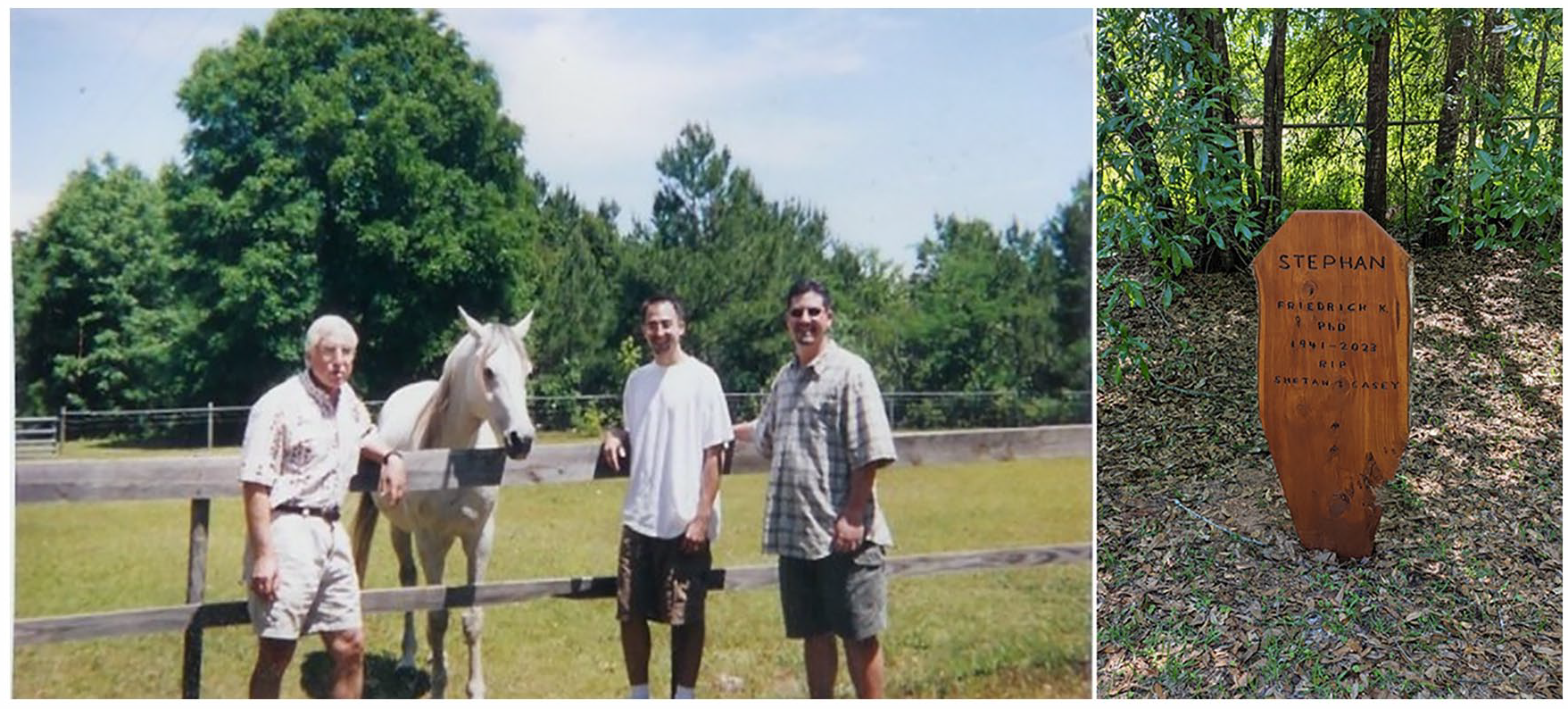
Fred first owned a horse in his 20s, and established his Tallahassee horse farm in the mid 1980’s where he owned (or cared for) 3 more. Here he is pictured with Shatan, and two trainees Bandon Aragona (left) and Alec Davidson (right) in 2006. Photo: Philip W. Davidson
Fred’s ashes were scattered in his horse pasture in Tallahassee. Photo: Alec Davidson

In their first publication on food anticipation, Fred and his trainees cautioned that “If many oscillators exist which are entrainable by food restriction schedules, it may not be possible to abolish anticipatory activity by selective removal of, or interference with, specific organ systems” (Stephan et al., 1979a). Unfortunately, this thought was also prescient. A definitive localization of FEOs necessary and sufficient for food anticipatory activity rhythms eluded Fred and remains a whale of problem for the rest of us (Stephan, 2002; Davidson, 2009; Mistlberger, 2023).
Through most of his career as an independent scientist in Florida, Fred pursued one very specific problem. Outside of the laboratory, his talents and interests were anything but narrow. Fred was a renaissance man in every sense: a person who has wide interests and is expert in several areas. He raised and broke horses, he built all of the furniture in his house, he repaired engines, and he read everything and anything. His emails to colleagues often expounded on political or policy issues of the day, always with a dry but extremely sharp wit. Despite his nature as an introvert, Fred had an irrepressible and sometimes playfully dark sense of humor. While walking Brandon Aragona to his master’s thesis defense, he whispered, “the lamb to the slaughter,” and laughed out loud. Brandon’s nerves vanished and he absolutely nailed his presentation. Fred was also a dedicated father to his 2 sons, Gregory and Michael. He coached their sports, led their scouting groups, and was constantly engaging in outdoor activities with the family on both land and water. He could water ski barefoot. He was a self-taught guitar player. He was also an avid tennis player. During tennis, and another favorite outdoor activity, cigarette breaks on the breezeway that connected FSU’s Kellogg Research Building with Psychology, Fred shared his unbelievable volume of wisdom with his trainees and colleagues, both solicited and not.
