




Abstract
Key differences exist between individuals in terms of certain circadian-related parameters, such as intrinsic period and sensitivity to light. These variations can differentially impact circadian timing, leading to challenges in accurately implementing time-sensitive interventions. In this work, we parse out these effects by investigating the impact of parameters from a macroscopic model of human circadian rhythms on phase and amplitude outputs. Using in silico light data designed to mimic commonly studied schedules, we assess the impact of parameter variations on model outputs to gain insight into the different effects of these schedules. We show that parameter sensitivity is heavily modulated by the lighting routine that a person follows, with darkness and shift work schedules being the most sensitive. We develop a framework to measure overall sensitivity levels of the given light schedule and furthermore decompose the overall sensitivity into individual parameter contributions. Finally, we measure the ability of the model to extract parameters given light schedules with noise and show that key parameters like the circadian period can typically be recovered given known light history. This can inform future work on determining the key parameters to consider when personalizing a model and the lighting protocols to use when assessing interindividual variability.
Circadian rhythms manage the timing of many physiological processes and impact a wide range of health outcomes and real-world applications. These include enabling individuals to better adjust to travel across time zones (Serkh and Forger, 2014; Christensen et al., 2020), allowing athletes to structure their daily schedule to perform at peak capacity (Thun et al., 2015), and assisting shift workers in minimizing their circadian disruption (Mohd Azmi et al., 2020; James et al., 2017). Shift work presents one of the most promising avenues for translational interventions, as working a shift work schedule has been associated with negative health outcomes, including gastrointestinal disorders, mood disorders, and cardiovascular disease (Costa, 1996; Warsame, 2014; Mosendane et al., 2008). Therefore, studying how the underlying physiological characteristics of individuals interact with various shift work schedules can have key real-world impacts in promoting health.
One of the primary manners in which the circadian rhythm of an individual becomes entrained to the typical 24-h cycle is through light input (Pittendrigh and Daan, 1976; Duffy and Wright, 2005; Duffy and Czeisler, 2009). While light is the dominant zeitgeber, research has also explored entrainment through non-photic stimuli such as activity levels, meal timing, and social interactions (Vetter and Scheer, 2017; Mistlberger and Skene, 2005; St Hilaire et al., 2007; Youngstedt et al., 2019). The recent advent of mobile technology allows for easy collection of light exposure and physiological measurements such as heart rate and activity, thus opening the door for large-scale modeling and analysis of wearable data. The prevalence of these data can enable personalized modeling in place of traditional one-size-fits-all approaches, thereby generating more accurate and effective circadian-based interventions. Thus, gaining a more precise comprehension of the factors that determine the circadian state of a given individual is a valuable area of research.
Mathematical models can generate predictions of human circadian state based on inputs of light (or, more recently, activity) time series. Classical versions of these models rely on a van der Pol oscillator framework, modulated by a light intensity input (Jewett and Kronauer, 1998; Jewett et al., 1999; Forger et al., 1999). These models are able to provide accurate assessments of circadian phase in humans, generating model phase predictions with mean errors on the order of 1 h for healthy populations when compared with commonly used phase markers such as laboratory dim light melatonin onset (DLMO) (Woelders et al., 2017; Huang et al., 2021). However, these models generally do not have a cohesive physiological basis, in that there are no direct biological analogues of all the parameters and variables studied.
More recently, a physiologically based model derived directly from modeling the individual neurons in the suprachiasmatic nucleus (SCN), the core circadian clock for mammals, has been developed (Hannay et al., 2019). While this model has been validated for both light and real-world activity data, a systematic evaluation of the effects of the parameter values has not yet been undertaken. Individuals likely vary substantially in several of the parameter values, such as intrinsic circadian period or light sensitivity (Stone et al., 2020; Phillips et al., 2019). For example, interindividual variations in circadian period can manifest in chronotype or sleep timing differences, and, together with light sensitivity, can impact the phase angle between melatonin onset and sleep (Phillips et al., 2010; Wright et al., 2005). Different sensitivities to evening light can additionally contribute to widely divergent DLMO timings and potentially negative health repercussions (Phillips et al., 2019). Hence, it is necessary to understand the impact of parameters on the model outputs in the context of the various light schedules that individuals may be following.
In this work, we analyze the effects of parameter variations on the circadian outputs generated by the physiologically based model. This sensitivity analysis is applied across a subset of common light schedules, and we see large-scale differences in model states depending on the interaction of the schedule and parameter. In particular, constant darkness and shift work schedules yield the highest overall parameter sensitivities, and the most impactful parameter across schedules is the intrinsic circadian period
Methods
We study the single population model for predicting circadian phase in humans. The single population model studied is given by the equations



for the processing of the light input, and


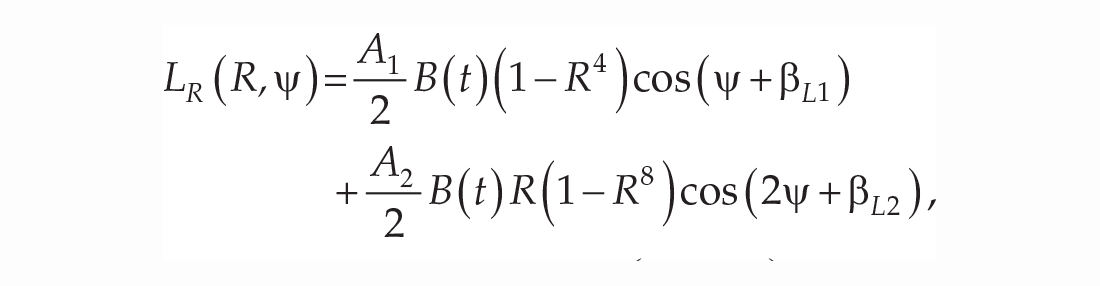
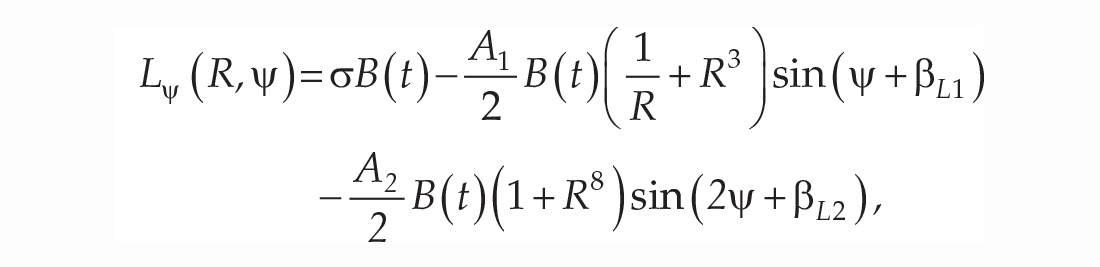
for the phase and amplitude equations (Hannay et al., 2019). In this macroscopic model,
We adopt the default parameters values from the original paper (Hannay et al., 2019), wherein the parameters were fit based on light schedules and phase shifts available in existing experimental protocols (Khalsa et al., 2003; St Hilaire et al., 2012; Czeisler et al., 1989; Zeitzer et al., 2000). In this previous work, the parameters were estimated using a genetic global optimization algorithm and then the distributions of parameters around the optimal values were analyzed using a Markov Chain Monte Carlo (MCMC) algorithm (Hannay et al., 2019). We implement the ordinary differential equation (ODE) model and the rest of the analysis in Python. To determine initial conditions for
In terms of parameter interpretations, we provide a brief summary based on previous work (Hannay et al., 2019; St Hilaire et al., 2007; Hannay, n.d.; Kronauer et al., 1999). In particular, the parameter
We examine 6 synthetic light schedules for the majority of the analysis, given below:
A regular light schedule, given by 16 h of light starting at 8 am and followed by 8 h of darkness, repeating on a daily basis. We abbreviate this schedule as RL.
A first shift work light schedule, consisting of 5 days working a night shift followed by 2 days off. The days working a night shift are defined by waking up at 4 pm followed by 16 h of light, while the days off the night shift consist of the same schedule with a 9-am wakeup. We abbreviate this schedule as SW.
A second shift work schedule, defined by three 12-h night shifts (with a wakeup time of 7 pm and a 16-h workday) followed by 4 days on a regular light schedule (with a wakeup time of 7 am and a 16-h workday). We abbreviate this schedule as SW312.
A social jet lag schedule, wherein light exposure occurs 7 to 12 am for 5 days a week (e.g., Monday-Friday) and occurs between 11 and 2 am two days a week (e.g., Saturday and Sunday). We abbreviate this schedule as SJL.
A slam shift schedule, in which light exposure starts at 8 am and lasts for 16 h five days a week, and then shifts to 4 pm (lasting 16 h still) for 2 days a week. We abbreviate this schedule as SS.
A constant routine schedule, where light exposure is always constant. We abbreviate this schedule as Dark when light is zero, and CR when light may be nonzero.
For light intensity, we set the default to be L = 979 lux, based on previous work assessing typical daytime light levels (Wright et al., 2013). The exception is the constant routine schedule, where the default is a constant darkness schedule, with L = 0 lux (Figure 1b). Since this may be a higher-than-expected constant light intensity level, particularly in the evening, we also study sensitivity results under lower light levels. In particular, we vary the constant light intensity over the range of 0-950 lux in intervals of 50 lux and compare the overall parameter effects (Figure 4) and individual parameter contributions (Suppl. Fig. S3).
As a first assessment of parameter sensitivity, we compute the Hessian matrix of a loss function. This loss is a function of a scaling vector
parameters
Note that by construction
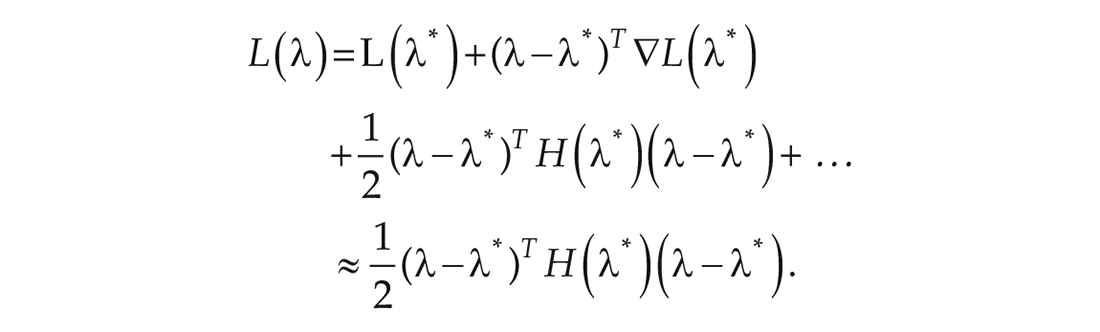
We can compute the Hessian matrix at the default parameter values,
In addition, we systematically vary parameters over realistic ranges to more easily assess the impact of each parameter on the resultant model states visually. Specifically, we use parameter distributions determined from MCMC simulations in previous work to define reasonable sets of parameter values (Hannay et al., 2019). For the cases in which this distribution is available, we draw values from the 5th to 95th percentile, typically in increments of 10 percentiles, where the percentile values are shifted so that the 50th percentile aligns with the default parameter value. Otherwise, we vary each parameter from 91% to 109% of their default value, typically in increments of 2%, while again holding the other parameters fixed. Note that the distributions are available for all of the parameters except for
To measure the extent to which we can determine true parameters in the presence of noisy light or activity inputs, we perform a parameter recovery analysis. Specifically, we simulate the model with perturbed parameter values (systematically varied) and perfectly known (i.e., exact) light levels, storing the resulting model outputs. We vary the parameters in a similar way to the previous analysis, either drawing from the parameter distributions when available or perturbing between 91% and 109% of their default values (here in increments of 1%). We additionally simulate the model with noisy light schedules and known parameter values, also drawn from distributions or perturbed over the same range. This again generates phase and amplitude model outputs, which we store. After comparing the results from the noisy and non-noisy light schedule simulations, we extract the perturbed parameter (with exact light) values that generate the closest result to the given noisy simulation. We determine this based on the

where
Results
After simulating the model (see Methods) with each of the 6 synthetic light schedules (Figure 1a) as input, we examine the changes in model output determined by altering particular parameter values (Figure 1b) or the Hessian-based notions of sensitivity (e.g., Figure 2). The model trajectory with default parameter values is shown in blue, and trajectories with perturbed parameters are shown in gray. We simulate all of the in silico schedules for 7 days (Figure 1a).
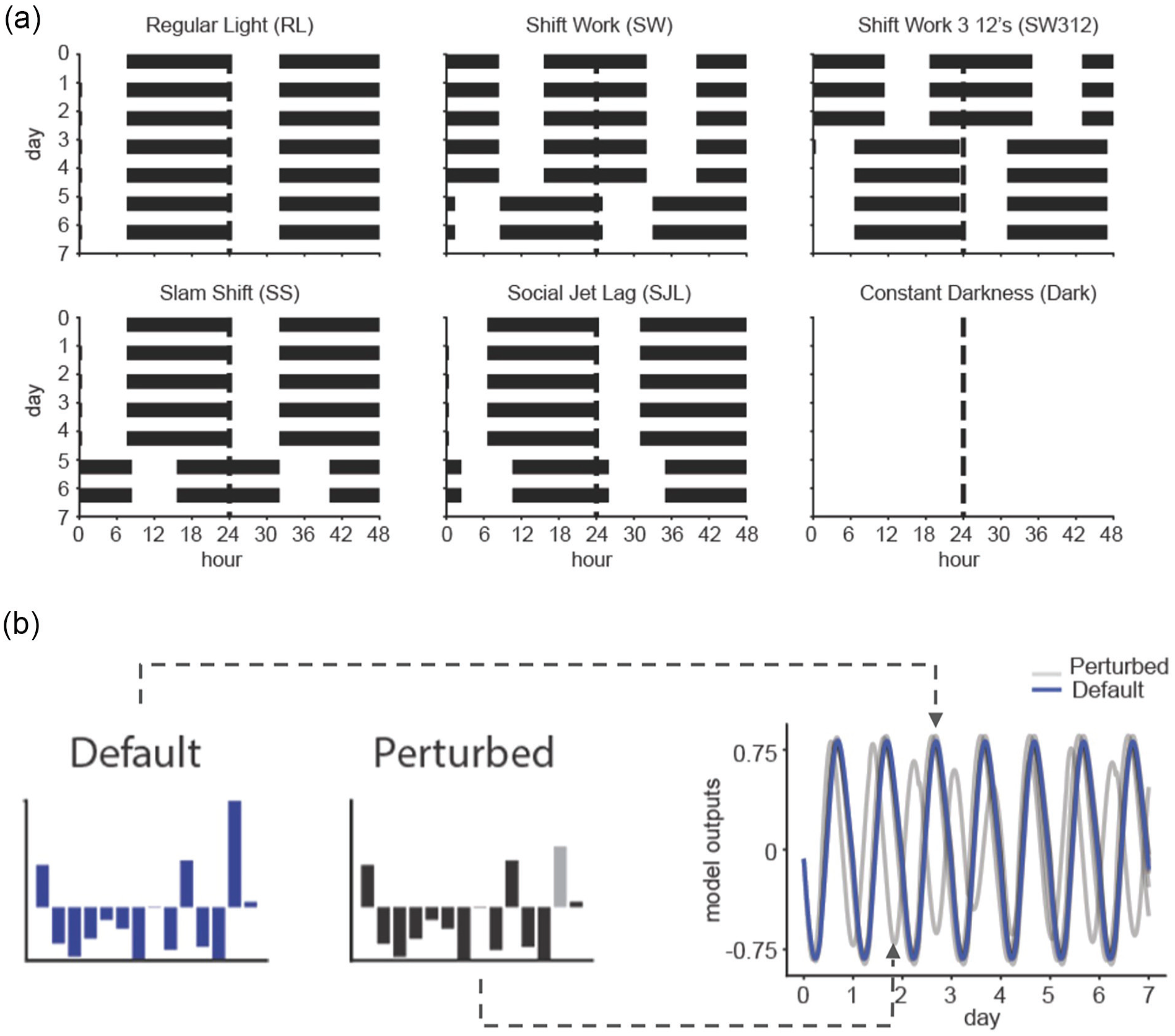
Methodology: Schematic and light schedules. Schematic of the process: the Hannay model is simulated with the 6 different light schedules (actograms, a) as input. Using this framework, we are able to assess the impact of the parameters on the model outputs (b). This can be done by computing the Hessian matrix (see Methods) and by examining the perturbed trajectories of the model (b). The default and perturbed parameter values shown in (b) are not to scale. To generate the perturbed model outputs (gray curves) in (b), we vary the parameters from their default values (e.g., the gray bar in (b), left, corresponds to a particular gray curve in (b), right).
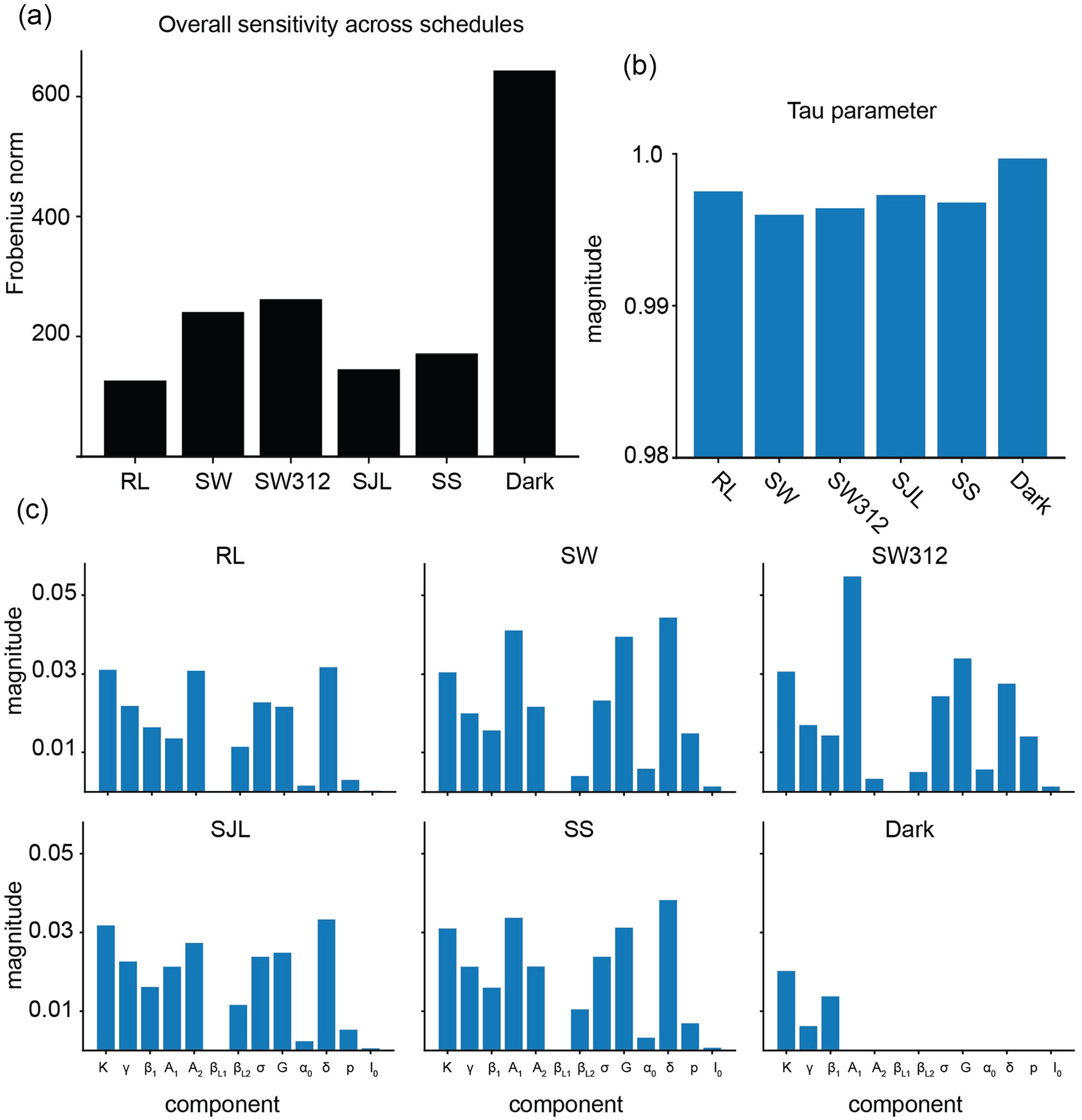
Overall and individual-parameter Hessian-based sensitivity across light schedules. (a): The overall sensitivity for each of the 6 light schedules computed as the Frobenius norm of the Hessian. (b): The magnitude of the first component of the principal eigenvector of the Hessian. The light schedule abbreviations are as follows: RL means regular light schedule, SW means shift work, SW312 means shift work with three 12-h shifts, SJL means social jet lag, SS means slam shift, and dark means constant darkness. The 14 parameter values, in order, are given by
The Frobenius norm of the Hessian matrix, serving as a measure of total sensitivity, varies from 643.60 for the constant darkness schedule to 126.93 for the regular light schedule (Figure 2a). The shift work with three 12-h shifts schedule (SW312) has the second largest Frobenius norm of 262.36, followed by the shift work schedule (240.96), the slam shift schedule (171.52), and the social jet lag schedule (145.83). The principal eigenvector components also vary across schedules: while the largest parameter component corresponds to
While the initial conditions used in Figure 2 are generated via looping until convergence from the individual schedule, we tested other initial condition approaches. Under the assumption that a regular light schedule precedes each of the 6 individual weeks, we can generate new initial conditions and compute the Hessian-based results. In this case, we see that constant darkness remains the most sensitive, followed by shift work, shift work with three 12-h shifts, slam shift, social jet lag, and regular light (Suppl. Fig. S1B). Furthermore, we show the dependence of the Hessian norm sensitivity on more general initial conditions for
In addition, we show the eigenvalues of the Hessian in Supplementary Figure S2.
Amplitude and phase results after performing one-at-a-time parameter perturbations (where parameters are perturbed by drawing from available distributions when available; see Methods) are shown for the 6 light schedules of interest in Figure 3a (default parameters: red, perturbed parameters: gray). Using the loss function
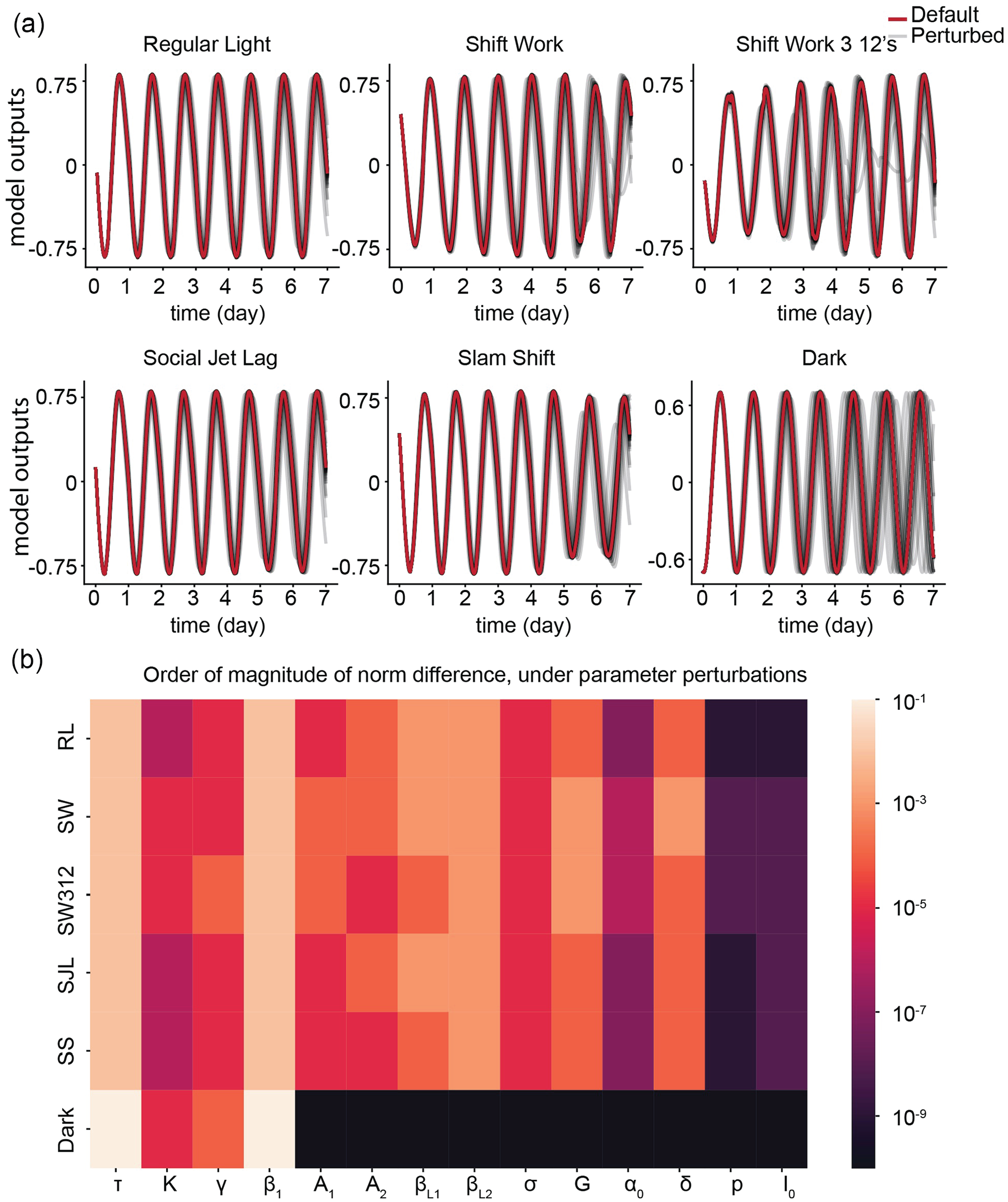
Parameter output schedule differences for 6 synthetic light schedules. We examine the differences in the model outputs for the 2 shift work schedules. (a): Model amplitude and phase (plotted as
In addition, using this perturbation approach, we can quantify changes in the DLMO prediction from the model. For all of the light schedules, the 2 parameters that give the largest variation in DLMO prediction (as measured by the circular standard deviation across parameter perturbations) are again
In Figure 4, we show the norm difference for the Hessian-based overall sensitivity results as a function of lower values of light intensity (varying from 0 to 950 lux in increments of 50 lux). As the light intensity increases, the norm of the Hessian consistently decreases across the regular light, shift work, social jet lag, and slam shift schedules. However, for the shift work with three 12-h shifts and the constant routine schedule, this metric shows more fluctuations across intensity values. The order of the most impacted schedule is also generally consistent across light intensities, with constant routine always having the highest norm of the Hessian. As in Figure 2, the next schedule in terms of this overall sensitivity metric is typically shift work with three 12-h shifts; however, shift work has a slightly higher norm of the Hessian for 100 and 150 lux (422.28 vs 395.71 for 100 lux, and 366.26 versus 331.12 for 150 lux for shift work and shift work with three 12-h shifts, respectively). The schedule with the lowest Hessian norm is always regular light, with values ranging from 430.93 at 50 lux to 127.30 at 950 lux. We further plot the magnitude of the individual parameter components for the schedules and different lighting intensities in Supplementary Figure S3.
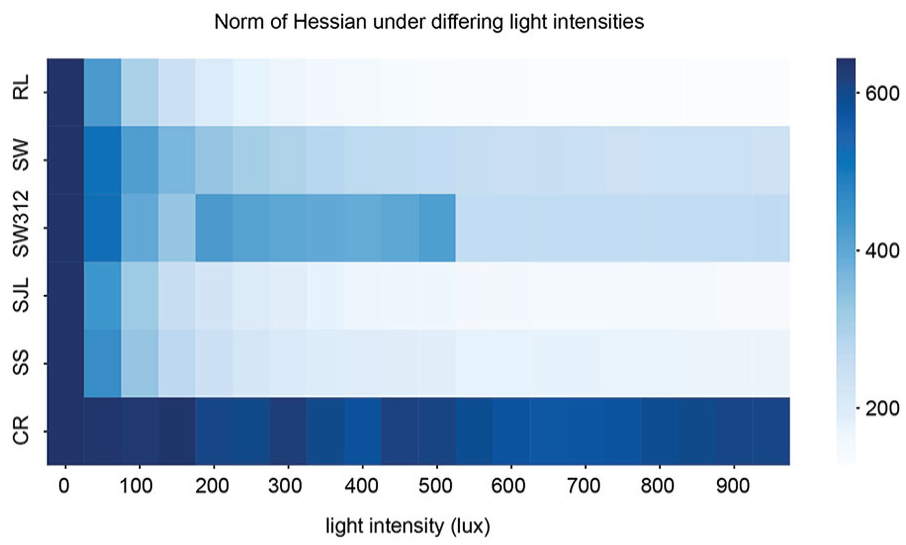
Overall sensitivity under differing light intensities. We vary the light intensity from 0 to 950 lux, in increments of 50 lux, and examine the impact on the overall sensitivity across the 6 schedules of regular light (RL), shift work (SW), shift work with three 12-h shifts (SW312), social jet lag (SJL), slam shift (SS), and constant routine (CR). Darker blue colors denote higher values for the norm of the Hessian, given the particular light schedule and intensity combination.
To determine the extent to which parameters can be determined in the presence of noisy light schedules, we perform a parameter recovery analysis. In Figure 5a and 5b, we determine the parameter percentile or perturbation index where the minimum recovery error occurs. We then plot the number of indices between this index and the theoretical best matching index (at a percentile of 50% or a perturbation of 1.0, meaning no change in parameters), for each light schedule and parameter values. We used a fixed noise level (random noise with standard deviation of 100) in the light schedules, in all places except Figure 5a (random noise with standard deviation of 10). The parameters most frequently recovered across the light schedules are
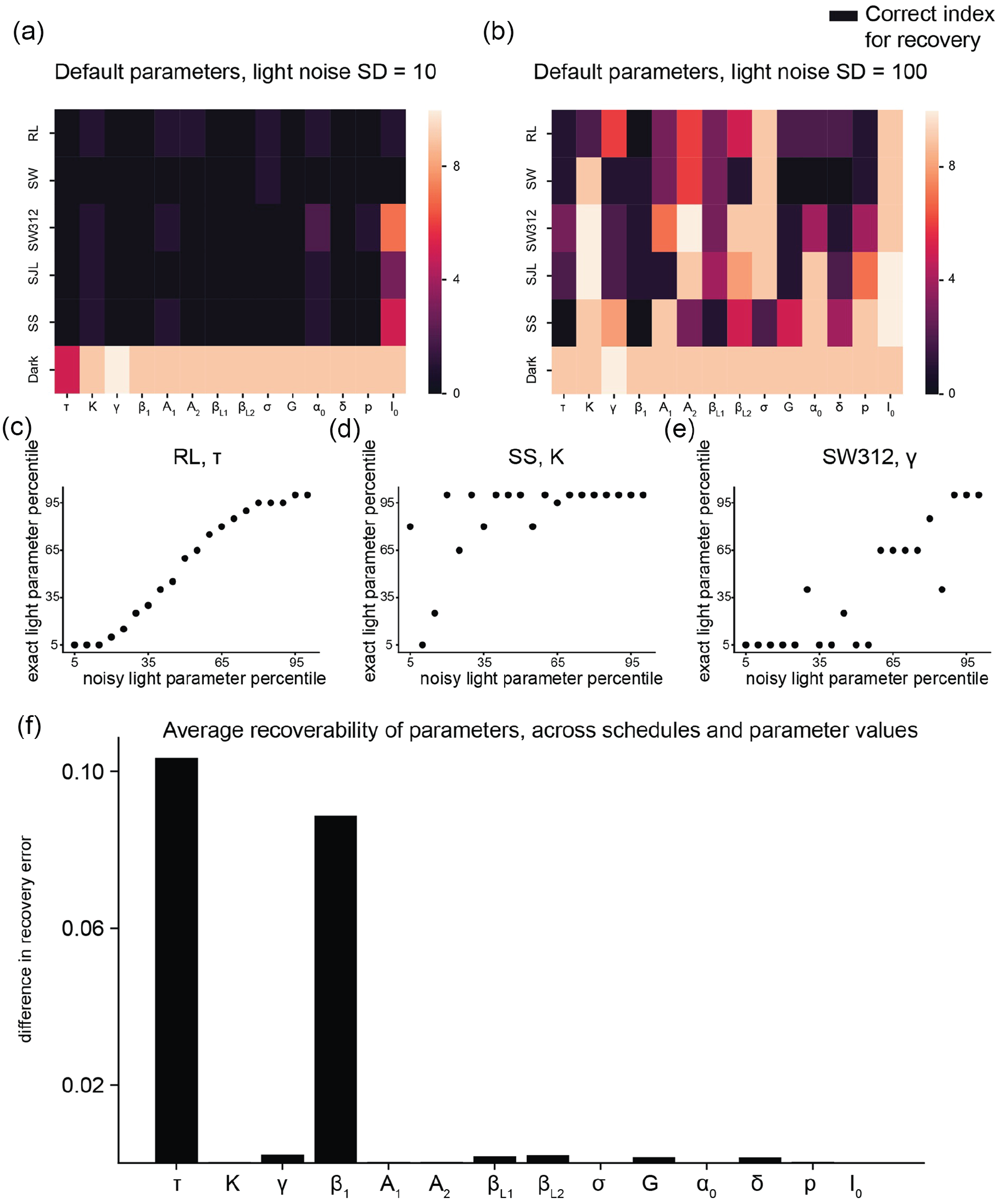
Parameter recovery. (a-b): We show the results of a parameter recovery analysis: after simulating with default parameters and noisy light schedules and perturbed parameters and fixed light schedules, we examine the degree to which the correct parameters can be recovered via a matching procedure (see Methods). The 6 schedules are shown on the vertical axis, and the parameters on the horizontal axis: the heatmap is colored by the absolute value of the distance from the correct recovery index, with an index of 0 corresponding to the correct parameter being recovered. In (a), we consider a low noise level in the light (SD = 10 lux), and we consider a higher noise level (SD = 100 lux) in (b). (c-e): We show examples of recovery error for various parameter and light schedule combinations. Here we consider non-default parameters with noisy light, and for each non-default parameter perturbation with noisy light (vertical axis), we compute the parameter percentile with exact light that generates the lowest recovery error. A perfect parameter recovery at all parameter percentiles would correspond to the diagonal line y = x. We plot this metric for 3 example parameter and light schedule combinations: regular light with
In Figure 5c-5e, we show specific examples of what the differences in the recovery can look like for the higher light noise case. Given a particular parameter and parameter percentile under the noisy light levels, we plot the parameter percentile under exact light levels that provides the minimum recovery error. So if recovery is perfect, noisy light 5th parameter percentile will match with exact light 5th parameter percentile, noisy light 10th parameter percentile will match with exact light 10th parameter percentile, and so on until we get the diagonal line. In Figure 5c, we see an example relatively close to this perfect recovery case with
Discussion
Examining the interactions between model parameters and light schedules can improve our understanding of model personalization and guide future interventions. Indeed, parameter effects and interindividual differences in circadian models have been shown to impact important factors such as phase prediction, chronotype, and effectiveness of social scheduling alterations (Stone et al., 2020; Phillips et al., 2010; Skeldon et al., 2017). Interindividual variations in intrinsic circadian period and light sensitivity have been of particular interest and have been shown to relate to significant changes in DLMO and detrimental health outcomes (Phillips et al., 2019; Stone et al., 2020). In this work, we study several measures of parameter impact in a physiologically derived model for human circadian rhythms and show that key interactions between light schedules and model parameters can drive large variations in phase and amplitude predictions. Indeed, our work shows that the interindividual differences in the intrinsic circadian period can have important repercussions for the model outputs and phase predictions. While previous work has also highlighted the important role of light sensitivity, we find that parameters relating to this sensitivity (e.g.,
When we take a Hessian-based view of sensitivity, we see large differences depending on the particular lighting schedule of the individual. For example, the constant darkness and shift work schedules are the most sensitive to parameter perturbations overall in terms of the Frobenius norm of the Hessian. This means that parameters are particularly relevant for individuals on these schedules and can lead to divergent outcomes overall. It is worth noting that 3 of the most irregular schedules (shift work, shift work with three 12-h shifts, and slam shift) have some of the highest overall sensitivity values both at the chosen default lux value and across variations in light intensity, suggesting that the inconsistent nature of these schedules amplifies differences between individuals. The sensitivity of shift work schedules could contribute to challenges when using this or similar models to predict phase markers in shift worker populations, as lack of parameter personalization may be particularly impactful for these schedules.
Similarly, constant darkness obviously does not generate entraining patterns. Even though many of the light-related parameter variations do not impact the constant darkness results, the lack of entraining signal likely makes this schedule very sensitive to the parameters that do impact it (especially
Interestingly, the initial conditions of the model play a significant role in the Hessian-based sensitivity results. Here, we have focused on an initial condition approach where we loop until convergence for each individual schedule, a method that matches the assumption that individuals maintain their specific schedule on a weekly basis. This is not the only possibility, however, as some individuals likely switch from one schedule to another on an inter- or intra-weekly basis. We also investigated sensitivity results under the assumption that individuals were on a regular light schedule (or various other initial phase and amplitude values) before embarking on their particular schedule, and we see alterations to the results (see Suppl. Fig. S1). The large effect of initial conditions speaks to the importance of accurately determining these when generating phase predictions using the model, which could be facilitated by wearable data collection over longer time intervals.
In terms of the individual parameter sensitivity, the constant darkness schedule only depends on the first 4 parameter values
This work studies the sensitivity of parameters in a model for human circadian rhythms and does not consider the effects of sleep-wake regulation. Indeed, we know that there are bidirectional relationships between sleep-wake processes and circadian rhythmicity, and that sleep-wake regulation occurs via both the circadian system and the sleep homeostatic process (Skeldon et al., 2017; Phillips et al., 2010). Hence, while we assume that the schedules are fixed in this analysis, it is reasonable to expect that the physiological changes and interindividual differences that we capture via the parameter perturbations could impact the sleep schedules themselves. Future work could incorporate this model of the circadian system in conjunction with sleep homeostasis to further analyze parameter effects.
In the parameter recovery analysis, we see that some of the key parameters such as
Overall, this work enables us to gain a better understanding of how light schedules, initial conditions, and parameters interact to determine the model predictions. This knowledge can inform future work on parameter personalization, in that given a particular light schedule, we now have insight as to the expected effect of the parameters and which specific parameters to focus on when incorporating interindividual differences. Indeed, this work helps us quantify the impact that interindividual variations in both parameters and lighting routines can have on the circadian outcomes of individuals.
Supplemental Material
sj-docx-1-jbr-10.1177_07487304231176936 – Supplemental material for Impact of Light Schedules and Model Parameters on the Circadian Outcomes of Individuals
Supplemental material, sj-docx-1-jbr-10.1177_07487304231176936 for Impact of Light Schedules and Model Parameters on the Circadian Outcomes of Individuals by Caleb Mayer, Olivia Walch, Daniel B. Forger and Kevin Hannay in Journal of Biological Rhythms
Footnotes
Acknowledgements
The authors disclosed receipt of the following financial support for the research, authorship, and/or publication of this article: This work was supported by the National Institutes of Health SBIR [R43CA236557].
Author Contributions
C.M., O.W., and K.H. developed and performed the mathematical and statistical analyses. All authors analyzed, visualized, and interpreted the results. C.M., O.W., and K.H. prepared the manuscript. All authors reviewed and edited the manuscript. O.W. and D.B.F. sourced the funding.
Conflict of Interest Statement
The authors declared the following potential conflicts of interest with respect to the research, authorship, and/or publication of this article: O.W. has given talks at Unilever events and received honorariums/travel expenses; she has also done consulting for Gideon Health. She is the CEO of Arcascope, a company that makes circadian rhythms software. D.B.F. is the CSO of Arcascope and K.H. is the CTO of Arcascope. They and the University of Michigan are part owners of Arcascope.

Notes
References
Supplementary Material
Please find the following supplemental material available below.
For Open Access articles published under a Creative Commons License, all supplemental material carries the same license as the article it is associated with.
For non-Open Access articles published, all supplemental material carries a non-exclusive license, and permission requests for re-use of supplemental material or any part of supplemental material shall be sent directly to the copyright owner as specified in the copyright notice associated with the article.
