




Abstract

Along with Erwin Bünning and Jürgen Aschoff, Colin Stephenson Pittendrigh (aka “Pitt”) (Figure 1) is considered to be a founder of the modern field of chronobiology. He is probably most renowned for his work on non-parametric entrainment, aftereffects, temperature compensation, conceptualizing the distinction between the circadian pacemaker and its driven rhythms (e.g., the A/B oscillator model), and the interface between circadian rhythms and photoperiodic time measurement—to name just a few. Inspired by a weinstube meeting of four of Bünning’s former students whose recollections were published in this journal (Honegger et al., 2020), we—six of Pitt’s former colleagues and/or mentees—gathered virtually on 4 August 2021, to share our reminiscences of Pitt and his impact upon our lives and the field of chronobiology.
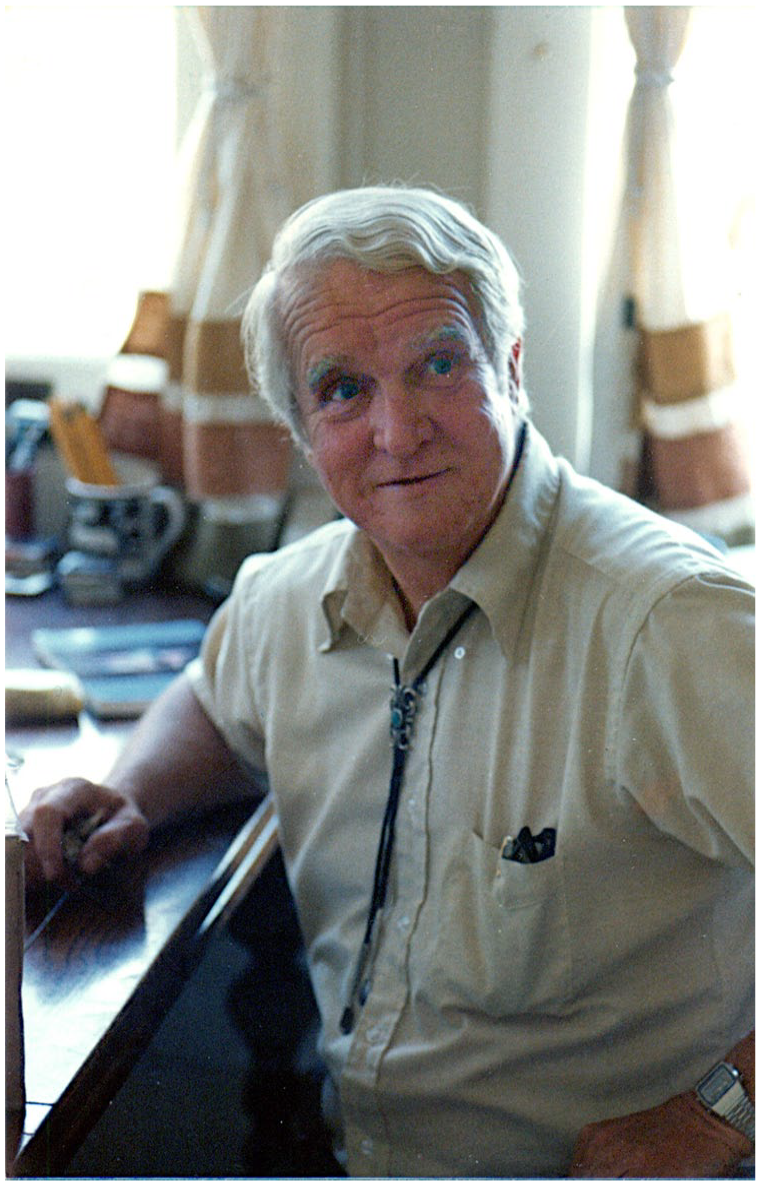
Colin Stephenson Pittendrigh (1918-1996).
Pitt was born 13 October 1918, in Whitley Bay, England (close to Newcastle Upon Tyne in Northumberland). His interest in biology—especially plants—began early. In a 1993 review paper (Pittendrigh, 1993), Pitt recounted the experience of kicking a soccer ball through a very large window in the Town Hall at the age of 15:
The only foreseeable source of the 13 shillings needed to replace the window was a prize offered to local Boy Scouts for the best wildflower collection. In winning that prize, I was seduced into a lasting love affair with plant systematics.
That experience also initiated readings from his high school library that included John Arthur Thomson’s The Great Biologists that led him to Charles Darwin’s The Origin of Species, and then on to F.O. Bower’s The Origin of a Land Flora that had an even greater impact on Pitt in making the historical process of evolution come alive. Another huge influence on Pitt’s decision to become a scientist was a high school science teacher. Pitt had actually considered becoming an Episcopal minister (an astonishing revelation to those of us who knew him later!), but this teacher used Pitt’s interest in botany to convince him to become a scientist instead. That teacher was Jewish, and Pitt’s respect for him led to lifelong respect for Jews and many friendships with Jewish scientists.
Pitt went to college at King’s College of the University of Durham, where he was a Lord Kitchener National Memorial Scholar and graduated with First Class Honors and a BSc in 1940. World War II had begun, and Pitt chose to be a conscientious objector. As alternative service, he was assigned to the Colonial Office for service abroad. During that time (1942-1945), he was jointly employed by the Rockefeller Foundation (International Health Division) and the Trinidad government to attack the malaria problem in Trinidad (including mitigating malaria in army/air force bases on Trinidad) by eliminating/reducing the ability of mosquitoes to breed in bromeliad tanks. Pitt’s experience in Trinidad was pivotal for many reasons (see later in this piece), but one of his realizations at that time was that because he came from a working-class background and because of the persistence of class structure in England, he would never be able to freely advance in academia in England; he therefore resolved to not return to England after the war.
As a result, with the end of the war, he sought graduate education elsewhere and ended up in graduate school at Columbia University studying with the famous geneticist and evolutionary biologist Theodosius Dobzhansky, a connection facilitated by Pitt’s friend from the Trinidad sojourn, Wilbur Downs (Wilbur was a virologist and epidemiologist at Yale School of Medicine who studied malaria in Trinidad and Tobago 1941-1943). Pitt was a graduate student at Columbia (1945-1947) and was awarded his PhD in 1948 but had already started his first position in 1947 as an assistant professor at Princeton University (no postdoctoral fellowships in those days!).
Pitt moved up the academic ranks at Princeton with promotion to Associate Professor in 1949 and Full Professor in 1957, induction into the National Academy of Sciences in 1963, and appointment as Dean of the Graduate School at Princeton (1965-1969). One of his initiatives as Dean was to admit women into the graduate school. At that time, Princeton was an all-male institution and Pitt’s action shocked the Board of Trustees, who fired Pitt for this action! However, Pitt had the support of the then-President of Princeton, Robert Goheen. President Goheen’s response to the action of the Trustees was “If he (Pitt) goes, I go too” and Pitt was reinstated. As Pitt recounted later to his family, “I always thought I’d retire at Princeton, but the ruckus about admitting women to the Graduate School disenchanted me with Princeton.” Therefore, at the urging of his friend Donald Kennedy, Pitt was recruited to Stanford in 1969 (Stanford was coed from its founding in 1891). In 1969, Princeton started to admit undergraduate women; perhaps Pitt had something to do with that decision!
At Stanford, Pitt became Professor of Biological Sciences and the Bing Professor of Human Biology, and his laboratory was established in the Herrin Biological Sciences Building on the Palo Alto campus. Pitt became famous for his lecturing abilities at Stanford and published his seminal series of five papers with Serge Daan in the Journal of Comparative Physiology during this time. In the early 1970s, he served on a committee to select a new Director for Stanford’s marine biology station in Monterey, CA, Hopkins Marine Station. After interviewing several candidates (including circadian neurobiologist Felix Strumwasser), the committee was not able to identify a suitable candidate to become Hopkins Director. At that point, Pitt expressed an interest in himself possibly undertaking the challenge, and he was enthusiastically appointed to the position. There are many stories of Pitt while he was Director (some of which are recalled below, for example, the “60th Birthday Party”), but an important event of those years was his hosting of the 1977 Summer Chronobiology Workshop at the marine station that also was the “springboard” for the generation of the Phase Response Curve (PRC) Atlas.
Pitt retired from Stanford and Hopkins Marine Station in 1984 at the age of 65. Even though he was still very active scientifically, he believed it was important to retire so that academic positions could be freed up for younger faculty. His retirement was celebrated by a retirement party at Timberline Lodge (Mt. Hood, OR) in the summer of 1984, after which he and his wife Mikey moved to Bozeman, Montana, to be closer to their children and the Rocky Mountains they loved. Pitt became a Professor Emeritus at Montana State University (Bozeman) and set up a fly lab in the basement of his home. An independent trucker delivered the research materials from his Hopkins lab to Pitt’s home in Bozeman. The first thing off the truck was seven refrigerator-sized incubators. As the incubators came off the truck, the trucker’s eyes grew large and he asked, “why all the refrigerators?” Pitt replied, “we really like beer here in Montana!”
In later years, Pitt and Mikey split their time between homes in Sonoita, Arizona, and Bozeman. Pitt had chronic asthma which limited his travel in later years, although he continued to attend circadian meetings through 1993. Pitt passed away from cancer on 19 March 1996, in Bozeman at age 77.
What follows is a lightly edited transcript of our virtual meeting:
It’s great that we’ve all been able to get together to reminisce over our memories of Colin Pittendrigh. To start, let’s all briefly identify what the primary connection for each of us was with Pitt.
So, I’ll start off. I was Pitt’s last PhD student. There was another graduate student after me, Kathy Elliott, who got her master’s, but I was his last PhD student, from 1976-1981. I was there during the 1977 Summer Workshop at Hopkins Marine Station, and I also completed the PRC Atlas as a continuation of that 1977 Summer Workshop. So, I was his last PhD student.
Actually, Carl, I was supposed to be Pitt’s last PhD student. I was a PhD student at Stanford from 1969-1973, and I say “supposed” to be his last student because at some point in my last year, Pitt said to me, “Chum, after you, I do not want any more PhD students—too much trouble.” So, Carl, you must have impressed him a lot since he changed his mind and took you on as his last student.
So, Pitt was your official mentor. Didn’t you also have a co-mentor?
No, Pitt was my official mentor—my only PhD advisor. However, Craig Heller and Ron Konopka, who was a postdoc in Pitt’s lab at the same time, were also on my PhD committee.
I was an undergraduate in Pitt’s lab from 1972 to 1974. I ran into him over the years at meetings and at the 1977 workshop at Hopkins Marine Station and visited him a few times. It was, however, as an undergraduate that I interacted with him most, as both a research assistant in his lab and as a teaching assistant for his classes. As a naïve undergraduate, those experiences were impactful.
I was one of the postdocs during the transition of the lab from Stanford to Hopkins Marine Station, I believe I was in Pitt’s lab from 1975 to 1977. I actually started as a postdoc in Donald Kennedy’s laboratory. Don was interested in developing a shared group with Pitt, and he and Pitt were good friends. Terry Page had become a postdoc in Pitt’s laboratory slightly in advance of my arrival in the Kennedy lab, and Pitt and Don thought the two of us might be able to be the start of a collaboration between the two labs. Eventually, Pitt adopted me as his postdoc when Don went off to Washington, D.C., and I went to Hopkins Marine Station with Pitt.
So I got to know Pitt as the “Lion in Winter.” I met him when I was an undergraduate in third-quarter undergraduate sophomore biology at Stanford, where he gave a lecture on bird migration. It was 1983. And then subsequently, through a serendipitous connection with Evelyn Parker, his technician at Hopkins Marine Station who had moved on to Mark Krasnow’s lab at Stanford, where I did my PhD, Evelyn connected us, and Pitt became an informal adviser to me on my PhD from 1989 until 1992. I think I last saw him in 1994.
I met him in the summer of 1978, when I invited myself to Hopkins Marine Station to meet him and share my 2-deoxyglucose (2-DG) results. I remember also meeting Gene and Terry there at the time.
Initial Impressions
OK, so first off, Pitt had this reputation as an “outsized personality.” Notwithstanding our advanced ages and failing memories, what were your initial impressions of Pitt? I wonder if there is a sense that he might have changed over time. Let’s start with the earliest.
That would be me since I started with Pitt in 1970. I overlapped with Fred Davis when he was an undergraduate in the lab, and I was in the middle of my PhD research. I became a student of Pitt’s because, at the time, Ebo Gwinner was doing a sabbatical year with Pitt just about the time Ebo became a young professor at Aschoff’s Institute in Erling Andechs in Germany. I wanted to work with vertebrates; however, there were essentially no faculty members at Stanford working with live vertebrates. I got lucky when over a dinner with a postdoc in another lab, I learned that Ebo was studying circadian and seasonal rhythms in birds (i.e., vertebrates) in Pitt’s lab. So early in my second year, I went to meet Ebo who had hundreds of white and golden crowned sparrows in the basement of the psychology building. I told Ebo I would like to help him with his research with birds, and he said, “I have no money to hire someone.” And then I told him I was free since I was a graduate student. He was very happy I was a “free” student, and we started working together. So I met Pitt through Ebo. I had somebody who was sort of sponsoring me and introduced me to Pitt who really scared me, because I had found out that Pitt was in the National Academy and was this very famous scientist. I was scared to death to work with somebody who would discover that I’m not very bright at all.
Hey, Fred [Davis], do you remember Fred [Turek] as someone who was not very bright?
Not at all. Actually, Fred gave me great advice when I went to the University of Texas for graduate school. Fred was a postdoc there, and we overlapped for a couple of years. I especially remember advice from him then. He said, don’t work at Balcones Research Center; work with mammals, not with birds (Balcones was a satellite research facility at the University of Texas that wasn’t maintained well, and Mike Menaker’s bird research was there, while his rodent research facilities were on the main University of Texas campus).
I think the advice I gave Fred was that if God is a sparrow, you don’t want to work at Balcones Research Center, where we worked with literally thousands of house sparrows.
When I started at Stanford in 1969, soon after Pitt arrived at Stanford, they were just starting a new major, called Human Biology. In the Spring of my freshman year, 1970, Pitt lectured for what I think was the very first class for the major, the introductory class called Man and Nature. The spring of 1970 was an unusual year. It was the Kent State shootings, regular protests on campus, and class boycotts. I think Pitt’s class was mostly uninterrupted. I was awestruck by his lecturing. The way he put the principles of biology in an evolutionary context resonated with me. The following year, the winter term of 1971, I needed to fill out my schedule, and there was a two-credit course called Biological Clocks being taught by Pitt. I didn’t know what biological clocks were, but I wanted to take a class taught by Pitt, so I took it. It was an upper-level undergraduate/graduate course. It was very confusing, I have to say, which also somehow made the subject more intriguing. Despite the confusion, it stayed with me. In the following months, I found and read a book called The Living Clock by a science writer named Richie Ward. It was written for popular consumption and captured well the mystery and excitement of early discoveries in the field. Pitt was of course featured in the book, which put his class in an exciting and historical context. With that as a refresher, I had the courage in the Spring of 1972 to ask Pitt if I could work in his lab. I still have the page of his notes from our first meeting (Figure 2). I remember going into the meeting having found something specific to mention that I had found interesting. It was an article in the symposium proceedings, Biochronometry, about self-selected light cycles in canaries. I mentioned that to Pitt, and he was so quick to dismiss it. I remember it well. That was a first lesson—the paper addressed a cute problem, but where would it go, what’s the evolutionary context of a question like that? So, Pitt quickly laid out a number of projects from the formal properties of rodent wheel running activity rhythms to Neurospora race tubes and genetics. I ended up working on a couple of different projects in my time there, including one for a co-terminal master’s degree.
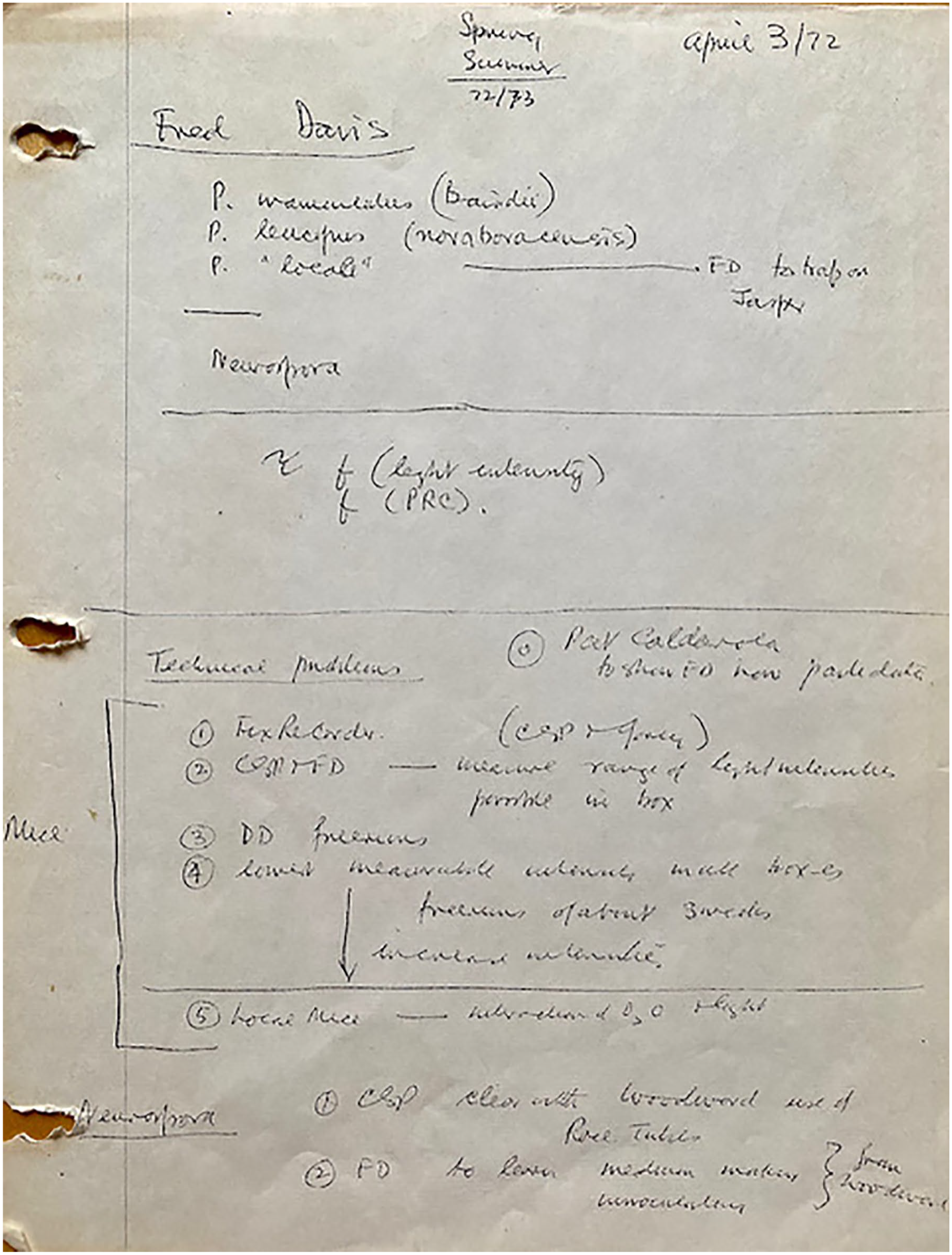
Pitt’s notes of his first meeting with Stanford undergraduate student Fred Davis.
OK—so when I interviewed with him for graduate school—when Pitt was still up on the main Stanford campus (not yet moved to the Hopkins Marine Station campus), he was just very cordial, thinking about it in retrospect. I think he saw me as a person who wasn’t going to come back as a grad student. And therefore, he wasn’t going to spend much time or effort during that initial meeting. But when I DID come back as a first-year graduate student and I met with him for the very first time in his office at Hopkins Marine Station, he said, “So, chum, what are you thinking about doing as your PhD project?” And I was planning on continuing a project that I had started in Menaker’s lab on earthworms. I said, “I want to do this work on earthworms.” And he replied, “Do you mean Lumbricus?” At that time, I had never heard anybody refer to earthworms as “Lumbricus.” So I’m thinking, “It’s all about Lumbricus. So now I’m using Lumbricus, I guess.” And the other thing is that I was nervous. And when I get nervous and even when I’m not nervous, I often will say, “OK,” or “All Right, OK”? And about 10 min into that conversation with Pitt, he said to me, “Chum, let’s play a little game.
Every time you say “all right,” you have to pay me 50 cents.” I was like WHAT? I mean, he was so intimidating, you know, just right from the get-go. He was really just stomping on me. And that was a little bit of what our relationship was the whole rest of the time too.
I think I am next chronologically. My senior year at Stanford was 1970, and as Fred [Davis] remarked, this was really a tumultuous year. I was taking a comparative animal behavior class and the instructor, Charles Hamilton, remarked that he shouldn’t really be talking about circadian rhythms as Stanford had recently recruited from Princeton the world’s expert on circadian rhythms and you should all take a class from him someday. When I arrived back at Stanford in 1975, Kennedy brought me downstairs to the Pittendrigh lab to meet Pitt and his lab. I’ll never forget the first time I met him. He was sitting at his desk, chatting with a technician, and I thought he was straight out of central casting—just a perfect example of a distinguished professor, white hair, gray herringbone sports coat, British accent, and charming. As I got to know Pitt better, I certainly witnessed his sometimes demanding, tough, and occasionally unfair behavior, but I don’t think I ever had a bad interaction with Pitt the entire time I worked in his lab. He was respectful, warm, and generous, although it became clear that he was not entirely fascinated by my work on marine snails.
So it was around that time—1975—that I headed off to the National Institute of Mental Health (NIMH) in Bethesda to try my hand at bench research; I had just completed my medical internship after graduating from medical school at the University of California, San Francisco (UCSF). I was interested in the brain and so in obsessive-compulsive fashion, I had read a series of books called The Neurosciences Study Programs (actually, I think these volumes might have been where the interdisciplinary term “neuroscience” was introduced). Anyway, the third volume (1974) had a section on “Circadian Oscillations and Organization in Nervous Systems,” edited by Pitt, and with a chapter by Bob Moore on lesions of the suprachiasmatic nucleus (SCN). And so in the lab at the NIMH, I remembered that chapter and the SCN when I saw it appear on the 2-DG autoradiographs I was generating—it was so photogenic! In 1978, I was back at UCSF to begin a neurology residency and drove down to Hopkins Marine Station to introduce myself to Pitt and talk about 2-DG and the SCN. I remember presenting to Pitt, Gene, and Terry, and everyone was completely cordial; I figured they were humoring me (you know, here’s an MD who’s not that bright, so let’s all make nice, and he’ll be on his way shortly). But afterward, Pitt sent me a letter on one of those little stationary sheets of his, writing that he had a great idea for an experiment and could we discuss it. Of course, it was about using 2-DG to visualize the SCN during splitting of the locomotor activity rhythm in constant light.
I do remember the meeting with Bill, and I thought it went really well. Pitt was truly intrigued. Pitt appeared fascinated by the 2-DG technology and the experimental possibilities it opened up. And unlike many of the visitors who visited the lab where Pitt would spend about 10 min with them clearly getting bored, you maintained his attention. Unfortunately, when Pitt got bored with a visitor, Terry and I were asked to spend the day hosting the lab guest—those who had kind of failed Pitt’s exam. Bill passed the exam!
Yeah, I was there in the back corner of the room, and no one remembers me being there, but I think I remember Pitt being a little disappointed to find out that the peak of the 2-DG activity was at the trough of the locomotor activity and that antiphase relationship made it a little more complicated to figure out how to interpret the results from a splitting experiment using 2-DG. But Pitt still thought it was a really cool idea.
I don’t know, it’s very hard for me to imagine not remembering Carl Johnson in any room. You know, years later, Nicholas Mrosovsky and I actually did try a splitting experiment with 2-DG in golden hamsters, and it was difficult to interpret for a variety of reasons. The split SCN had to wait until Horacio de la Iglesia and I tried it again using clock genes as the markers.
It’s such a pleasure to be in a meeting where I’m the youngest person. This almost never happens anymore. So thank you all for facilitating that. After I saw Pitt lecture, he retired and disappeared, splitting time between Sonoita, AZ, and Bozeman, MT. I ended up as an undergraduate working with Bill Dement. And in fact, my direct senior mentor was David Welsh, who was a year ahead of me as an undergraduate. We were working on automated EEG analysis in the basement of the anatomy building at Stanford. But when I stayed at Stanford for the Medical Scientist Training Program, I moved over to Jack Barchas’s lab to work on cloning circadianly regulated genes in the SCN. Jack left Stanford in 1989 to go to UCLA and become a dean, briefly serving there before he moved on to become chair of psychiatry at Cornell. That left me high and dry in year three of my PhD studies. It was a challenge. I did a national tour to look for a lab to complete my PhD and visited with Joe Takahashi, Jeff Hall, Jay Dunlap, and Mike Young. So I had exquisite taste in science at the time; they’ve all done OK for themselves. Personal reasons, specifically my now-wife of 27 years, Suzy, kept me in Palo Alto and I ended up joining Mark Krasnow’s lab in the biochemistry department. And Mark very kindly let me work on circadian gene expression, but in Drosophila (I had been working in mice previously). I ended up getting put at a bench across from Evelyn Parker. I think Evelyn spent a good while as Pitt’s technician in Monterey—did she overlap with you Carl?
Evelyn was there for part of the time. I think Kathy Williams was the main technician who went all the way through at Hopkins Marine Station with Pitt and also Diana Page. But Evelyn was there for a while.
Evelyn was terrific. And when she realized I was working on circadian rhythms in Mark’s lab (and Mark was not a circadian biologist), she said, “I should put you in contact with Pitt, I think you would enjoy meeting him. And he might be a good informal adviser for your project.” Pitt used to come back to Palo Alto because his pulmonologist was there. He had advanced asthma and he would need to make regular visits for medical reasons to Palo Alto. And so sometime in the spring of 1990 he came up to visit, and we went and had lunch out on the little patio of the CMGM building on the medical campus. I remember that lunch well. First, Pitt’s reputation at that point was almost as outsized as his personality. You know, he was clearly the God of the field, not a God, but THE God of the field. And here I am, a third-year graduate student with a private audience. It’s like meeting the pope, as the little parish priest. He was very cordial and charming. But he was very troubled at the time with the field. This was at the height of the molecular/formalisms schism, and he did not “speak” molecular biology. I think he had broad understanding of molecular biology, but he did not have boots on the ground. And I remember our first discussion as kind of like being an Italian and a Spaniard trying to converse in their native languages. Some of the words made sense to each other, but most didn’t. Pitt was really interested to understand the Paul Hardin mRNA oscillation experiment, which clearly was a Rosetta Stone of the circadian clock and how the genes actually kept time. But his language was “driving oscillator,” not “transcription/translation feedback loop”; the formalisms that he had worked out in the fifties and sixties. It was an extremely stimulating visit, but we got almost nowhere at that time. And when we come back to later questions, I’ll follow up. But it was a very, very memorable interaction.
You know, that reminds me of a story that Pitt told about an interaction with his good friend Max Delbrück (the Nobel Laureate, 1969). I guess it would probably have been in the 1950s when Max was trying to convince Pitt and everyone else to become more of a “reductionist” in their research; think in terms of biochemistry and molecular biology when approaching research questions. Delbrück argued that eventually, the secrets of life would be revealed at the molecular and biochemical level. Pitt had one of those big pictures of a moth that when it opens up its wings, two large eyes appear to scare away any predator bird that might be trying to make a meal out of the moth. Pitt asked Delbrück to explain to him from a molecular reductionist point of view how such wings with big eyes had evolved. Max responded by saying, “Too early, too early” to explain.
That’s the same Max Delbrück who told Benzer that Konopka’s work was garbage.
As the Consummate Lecturer
Talking about the indelible impression Pitt made brings us to his lectures (Figure 3). By now, all of us have heard plenty of lectures and lecturers. What was it that made Pitt so memorable, even unique, as a lecturer?
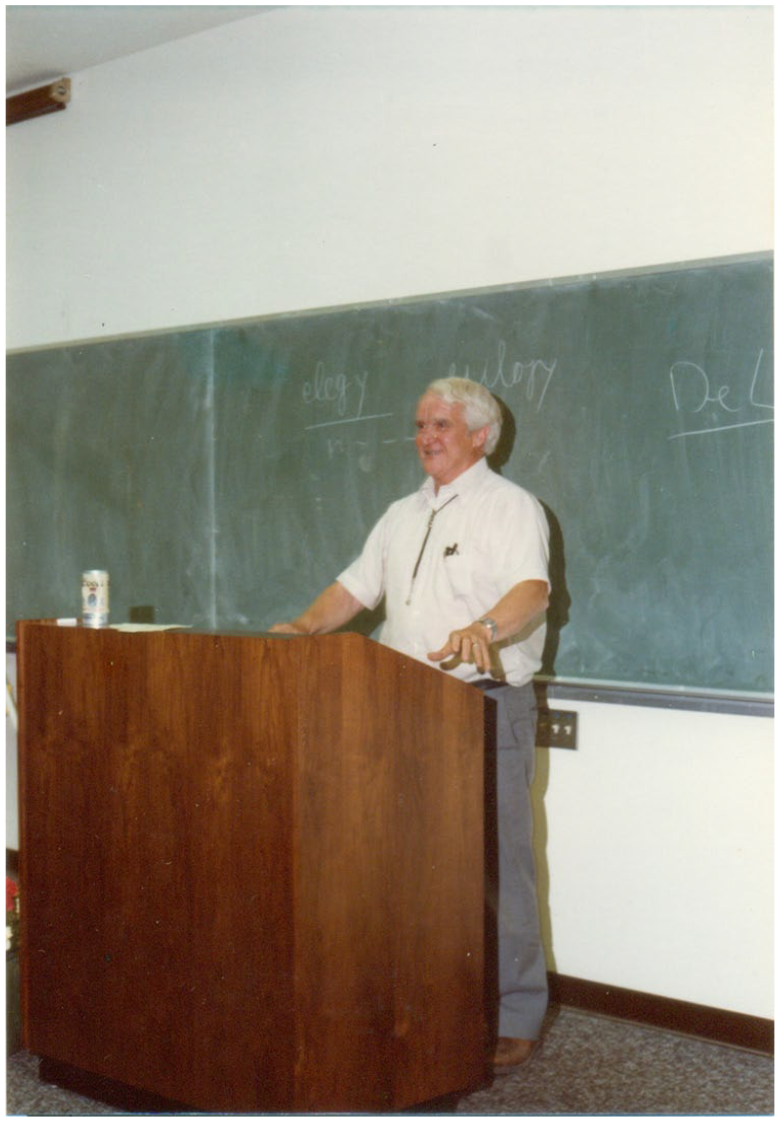
Pitt at the lecture podium.
Times were different then, and as a PhD student, I did not have to take any classes at all, so I didn’t take any classes. However, I did have to pass an extensive qualifying exam at the end of my first year that covered all areas of biology. Since I had just met Ebo and really only learned about circadian (24 h) rhythms for the first time, I thought I would audit Pitt’s course on Biological Clocks. What I remember most was that sometimes, I would leave a lecture very confused as to what he was saying, but I loved the way he said it. He was so passionate as he would walk around in front of maybe 150 students and just be talking about PRCs and entrainment and doing it with such excitement. He probably took his jacket off, and he was sweating, and he was just so dynamic. He made everybody else sort of want to be dynamic like him.
Yeah, exactly, that’s my memory and I saw lots of lectures. In addition to taking Human Bio and Biological Clocks, I later was TA for Human Bio and showed slides for his Biological Clocks class. So I really got it beaten into my head, fortunately. But in addition to how Fred described him, he also would often come back covered with chalk because he was just so enthusiastic with what he was writing on the chalkboard. But when I was a TA for Human Bio, I had to turn the lights off in this giant auditorium where he taught that was also used for theatrical production. So I was up in a little loft behind the curtain. And I remember telling other people at the time (this is not just a thought I have now) that I really should have been up there turning colored spotlights on and off during the whole lecture because it was really like a Shakespearean performance, the grimacing of the face and the pacing up and down the stage. It was really dramatic. And it wasn’t just me. I remember written comments from students at the end of the class, and one that really sticks in mind was simply “Pitt is God.” And they especially loved his introduction to the class, recounting his work on bromeliads and their evolution and their coevolution with mosquitoes. And in one of the classes, students rigged up a bromeliad to dangle from above the stage, you know, as sort of a tribute to him as a surprise. And of course, his lecturing is what changed the whole course of my life. It was his lecturing in Human Bio, leading to Biological Clocks, which led me to his lab and my career. So it really was spectacular.
I remember someone mentioning to me, perhaps it was Terry, that you simply had to hear Pitt lecture as it was a performance. We were at Hopkins Marine Station at the time, but Pitt was lecturing on the Stanford campus a few times a week, I think in a Human Biology class, and I think the lecture was on evolution. If I remember correctly, Pitt and I drove up to campus together where he delivered his lecture. I thought it was just spectacular and displayed his enormous intellectual breadth. I think I remember Alfred North Whitehead being mentioned as well as Medawar’s The Art of the Soluble. I remember at the end of the lecture the students broke out in spontaneous applause.
They may have even stood up, and they appeared “blown away” by the quality of the presentation. I can still see Pitt, pacing back and forth across the room, his volume increasing to make important points, while writing on the board furiously and becoming covered with chalk. And I thought, this is a performance that very few faculty can duplicate—just an extraordinary ability to communicate. And, as many of you know, Aschoff was also an impressive lecturer. He and Pitt both gave lectures at NSF Center for Biological Timing, and at one visit, they were together. They were friends but also very competitive about their research programs and nearly everything else in their professional lives. I remember Pitt complaining about Aschoff’s lecturing saying, why does he need to shout when he lectures? I said, Pitt, you also shout when you lecture! In truth, they were both extraordinary lecturers. They complained about one another and certainly led different types of lives, but there was an endearing deep respect and friendship.
Gene, what you said about their competitiveness reminds me that when Aschoff gave the plenary lecture at the second Society for Research on Biological Rhythms (SRBR) meeting at Amelia Island Plantation in Florida, Pitt was sick in his hotel room and couldn’t come to the lecture. And then at the third SRBR meeting when Pitt was giving the plenary lecture, Aschoff was sick in his room. And it was Aschoff’s son, Andreas, who told me it always happens this way. They are great friends but still very competitive with each other.
Yes, well I have a slightly different take on that; I know what’s been said so far about Pitt lecturing before a large group, and that was absolutely right for the few large lectures that I heard Pitt give. For example, I heard him give a lecture to a large group at the AAAS meeting in Houston (1979); I think it was on a general topic of evolutionary biology, and he was terrific just like all of you have said. However, I was his teaching assistant for the Clocks class at Hopkins Marine Station for several different semesters. That class was a much smaller venue. There were maybe 10 students, max. And in that situation, Pitt couldn’t really perform to the same extent. Because it was a small and more intimate group, he could see the expressions on the students’ faces that looked like, “What the hell are you talking about?” And seeing those expressions also confused Pitt and sometimes he got a little befuddled that he couldn’t give his usual grand performance to a small group like the Clocks class. I also heard Pitt give the prestigious Friday Evening Lecture at Woods Hole (Marine Biological Laboratory, Woods Hole, MA) while I was a postdoc in Woody Hastings’ lab, and it was a similar experience. Pitt gave an incredibly profound lecture about formalisms and clocks, which I mostly understood because of my background with him. But even though the Friday Evening Lecture audience is composed of a lot of very smart people, they were not accustomed to hearing the formalisms that Pitt was “dishing out.” Too abstract for them. Therefore, by the time Pitt was about halfway through his lecture, practically 90% of the Friday Evening Lecture audience was perplexed and confused. And Pitt could see that the audience wasn’t following him, and it upset him that he couldn’t give that grand panorama that he really loved to do, as in the larger lectures that Gene and Fred are talking about.
I actually only saw Pitt lecture three times; that first lecture as an undergrad, which I still remember about stamped sparrow feet and directional migration. I saw him speak at the CBT Circadian Timing meeting in Virginia. And then I saw what I think was his last public lecture, which was at the Gordon Conference, which I think is summarized in the “Reflections of a Darwinian Clock Watcher” (Pittendrigh, 1993). Was that your Gordon Conference, Bill?
The one I organized was in 1993 in New Hampshire.
That lecture that was the “flight from light” hypothesis lecture where he really tried to synthesize his whole career into the evolutionary aspects of the clock. I agree with Carl. Pitt would have been a superstar now in the TED talk circuit. He was such a magnetic speaker, it was just compelling to watch the theater, the art of his talk. He missed his medium by 20 years. He would have been a YouTube superstar! But part of it was because it was so hard to actually understand what he was saying. You knew that there was truth there. And that he was saying something profound and it fully engaged you to try to understand exactly what it was that he clearly knew he was communicating. And it was in a language that was just hard enough that you had to really work to get to the heart of it. And I think that kept people really compelled with Pitt’s lecturing. I have to say, from my time at Stanford, in the firmament of superstars of biology and medicine, I don’t recall any speakers quite as compelling as public lecturers. Not Arthur Kornberg or Lubert Stryer or Jim Rothman or any of the stars who were there for many, many years. None quite competed with Pitt as a performer.
Fred [Davis] has reminded me of Pitt’s use of the chalkboard. Now there’s a lost art. The screeching sound of the chalk, how it would explosively break when making an emphatic point, the flourish—an animated PowerPoint does not have such performative power! Also, as I’ve been listening to everyone’s memories, I’m wondering whether Pitt’s obstructive pulmonary disease contributed to the drama. You know, at intervals, he would pause and look down, gather his breath, and then proceed with renewed determination; the whole presentation would be punctuated this way.
I wonder if all the chalk dust actually accelerated the pulmonary disease!
As the Ultimate Biologist
But beyond Pitt’s style and temperament, what set Pitt apart from other biologists at that time? What distinguished his approach to biological questions?
We have already mentioned how Pitt always thought in terms of biological problems in the context of evolutionary biology. I was always fascinated with his ability to be interested in all of life, from bromeliads to humans and everything in between.
Here I was in the lab doing research on birds, and while Pitt had never worked with birds before, he was open to research on an avian species, even though his first love of flying animals was Drosophila. He really had the sort of breadth that you don’t often see today. One of my sons once said to me, “Dad, I know what I want to do in my life. I want to be a real biologist; however, not like you.” Originally, I also wanted to be a “real” biologist working with animals in the wild, and not a biologist working with laboratory species where one is much more likely to obtain serious grant support. And Pitt was like that. He really was somebody who had very broad interests. You know, he was there in the Sputnik era and he, by the way, chaired one of the first Life Science committees with NASA because of his ability to discuss his research on circadian rhythms in fruit flies and link the importance of his work to humans and how research on flies would be important for humans in the space environment. This is around 1960; Pitt really had the insight and the breadth that you don’t see today in biology. Or in many biologists.
Well, as an undergraduate, when I interacted with Pitt the most, I didn’t have other scientists with whom to compare him. I didn’t know much about science at all at that time. I suspect, however, that his early field work and discoveries in the field contributed to the breadth of his appreciation of biology and of evolution. Pitt was an evolutionary biologist, and I wonder if his enthusiasm for biological clocks derived substantially from the opportunity the new field presented to exercise the power of evolutionary thinking. I imagine a vision of living clocks in an evolutionary context and with a potentially huge impact coming to him, perhaps almost at once, driving his energy and enthusiasm. For all of the enthusiasm for his own research, he was fully engaged with the scientific community. He did not withdraw into his lab to do his own thing. His lab was full of postdocs, graduate and undergraduate students of course, but also visiting scientists. He advanced the field through enormous contributions to the enterprise of science, such as the 1977 workshop. He was engaged with the entire scientific community. And, of course, as Gene alluded to, he was scholarly. He could cite and refer to great scientists in a scholarly way that seemed second nature. It was always impressive.
We all know a lot of bright people who are academics. I thought that Don Kennedy was amazingly sharp with an impressive memory for facts and an overall excellent scientist. However, I think Pitt was in a different league than most. He could visualize and mentally manipulate complex relationships with seeming ease. Terry Page and I would have these intense discussions with Pitt where he would draw with his hands curves going this way and that, plotting with his hands the effects of different temperatures and light conditions—I remember vaguely a session on Kaus curves. I thought his ability to analyze complex sets of data was an extraordinary gift.
Another trait of Pitt that I think was distinguishing was his meticulous collection and storage of data. He had an amazing ability to catalog results and retain experimental details that allowed him to go to the shelf and retrieve ancient data that were still usable because of extraordinary documentation. And there was good reason for his care in storing data. He would often comment that the time was not right yet to accept a piece of data into a model, and it needed to “sit on the shelf.” As his understanding of an issue developed, he was then able to incorporate the data into a new conceptual framework.
Gene, following up on your comment: in 1992, just before the Center for Biological Timing meeting in Virginia where Pitt lectured, he invited me to come down to Sonoita to accompany him to the meeting. In retrospect, I think that was about 50% to be his porter—because he had a hard time carrying his suitcases with his pulmonary disease—and 50% for the chance to mentor an eager grad student.
And so, I spent the weekend at his home in Sonoita. His wife Mikey was an amazing host. And we pretty much had 12-h-a-day practicums in circadian biology. At the time, the field was trying to reconcile these emerging molecular models with the formalisms. My thesis work was involved in that. We were trying to make differential equations for gene feedback loops that might explain phase resetting curves. At one point, when we were discussing differences between phase advances and delays, Pitt perked up and said, you know, I think we have some data that speak to that. And he went to a file cabinet. He had four or five of those old four-level steel file cabinets in his den and immediately pulls out this file folder from 1964 of experiments that Dorothy Minis had done in his lab at Princeton, showing I think that Drosophila pupae, under anoxic conditions under pure nitrogen, would phase delay, but not phase advance. As Gene said, he would make these snap connections, to say the mechanisms must be different for delays than advances because one is oxygen sensitive and one is not. I said, Pitt, you’ve been sitting on these data for 27 years? Are you going to publish them? And he says, “Oh, chum, we’ve never gotten around to it and we couldn’t explain it.” And I remember thinking, there are four of these file cabinets, how much of the future of the field is sitting there? Part of me regrets never having said, “Pitt, can I take those data off your hands and run through them a little bit?” Because I’m sure there is still gold in those data. I don’t know what happened to them with his estate, but his record keeping was amazing and his memory of the experiments that he’d done was just incredible.
I think Carl and collaborators were able to edit and publish some of those papers (Tackenberg et al., 2017).
Yeah, so let me interject here. That’s very interesting what you just said, Russ. I think Pitt was like that about a lot of things at the later phases of his life. He wanted to get things right. I remember exactly those metabolic data. He showed those to me too—in fact, one of the only Drosophila experiments I ever did in his lab was to try to repeat that nitrogen experiment. Basically, in the later phases of his life, I think he really wanted to “wrap it all up.” He wanted all his data in a pretty bow where it was all explained. And that also led him to be inhibited about publishing things that he couldn’t explain. So that metabolic experiment is one example of the phenomenon that you’re talking about. Another example is the PRC Atlas, that wretched thing! You know, I got stuck with it after the 1977 Summer Workshop, and I had to restart the whole tedious project and spent a lot of time during my graduate career drudging through that tiresome task. And when I finally finished converting all the then-published PRCs (and some unpublished PRCs) into a standardized format and completed the PRC Atlas, Pitt no longer wanted to publish it because by that time, his thoughts about entrainment had evolved a little bit away from the strict non-parametric model, and he was thinking about how to explain the “(psi) jumps” and things like that, and he was considering the possibility of a slightly more hybrid approach to entrainment that combined mostly a non-parametric approach with some parametric facets; from that perspective, Pitt realized that the PRC was not going to explain everything about entrainment. OK, well, no, PRCs are not going to explain everything. But people in the field wanted to see the PRC Atlas, because it would be useful. And Pitt didn’t want to do it. He didn’t want to publish it. So I said to him, “OK, look, you know that I’ve invested a good portion of my life at this point in the PRC Atlas, so let’s just put this issue up to a vote of the circadian community,” and he said “OK, chum.” Therefore, at the next Gordon Conference (1989), I got up in the middle of one of the sessions and announced to that critical mass of chronobiologists, “The long-awaited Phase Response Curve Atlas is finally finished. It’s got I don’t know how many hundreds of PRCs; do we want to make it available to everybody? Who says yes?” Everybody in the room held up their hand—except one. And then I said, “Who’s against it?” There was Pitt in the back of the room holding his hand up! So that was the end of the discussion, and I made the PRC Atlas available to everyone soon after that. But the point I wanted to make was that Pitt at the end of his career wanted to get everything perfect. And that was inhibiting for him.
Another point I wanted to make a little earlier was that when Terry and Gene and I were in the lab, Pitt was really focusing in on Drosophila. At that time, he was moderately and politely interested in what Gene and Terry and Jeff [Elliott] and I were doing, but he wasn’t REALLY interested. I would talk to Pitt about the things I was doing, and he’d nod off during the discussion. Of course, that might have been my fault; perhaps my projects WERE that boring. From another perspective, however, and to his credit, he was of the previous generation of mentors where graduate students and postdocs were expected to come up with their own projects. He was happy to advise his students and postdocs, but it was their job to come up with their projects and accomplish them. Then, Pitt wouldn’t put his name on a resulting publication if he hadn’t made what he considered to be a really critical contribution. That was true of Jerry Feldman’s work in the ’60s (Jerry was a graduate student in Pitt’s lab). Jerry came up with the idea of testing the effect of protein synthesis inhibitors on circadian rhythms in Euglena. And when it came time to publish the work, Jerry asked Pitt, “Do you want your name on the paper?” Pitt said, “No, that’s your work, chum. You go ahead and publish it.” And Jerry published that paper (Feldman, 1967) without Pitt’s name on it. And that was true for a lot of other people in Pitt’s lab. And I think that Pitt belonged to that generation just before grants were driving everything. You know, nowadays, we often treat our graduate students and our postdocs as though they are our minions who have the task to finish off the Specific Aims of our grants. But Pitt had the luxury—and the grace—to allow people to flourish independently of his own research projects.
I remember when I first sat down with Pitt to talk about my future project in his lab, I think he said I could work on anything but not on his project. That would be a highly unusual statement to hear today where students and postdocs in laboratories are most often expected to work on a lab-related project.
I also remember fondly that nearly every afternoon, Pitt would come upstairs to the office that Terry and I shared and would ask how things were going. Terry and I figured out pretty quickly that this was Pitt’s pretense for engaging us in chatting with him about a developing theory or some recent exciting data. He would certainly listen to Terry about his recent cockroach work or my work on Aplysia, but inevitably the discussion would turn to Drosophila, and we would experience Pitt’s intellectual horsepower as he described the complex issues he was dealing with. I think we both recognized that this was an extraordinary gift to spend time with a truly great biologist and watch his mind at work. Few mentees get this kind of opportunity. I think Carl is exactly right that Pitt’s mentorship was unusual, even in that era; it was free from the conflicts of interest of students who are working on projects as part of the PI’s research effort or even the complexities of an employer–employee relationship—this was a pure mentorship at its best.
Oh, yeah. This is the exact same experience I had with Pitt when I published a paper in Science as a sole author. Since the research and discovery of how sparrows used the circadian clock to measure daylength was not his idea, he didn’t want his name on the paper; he felt he had not done anything to deserve it. About a year or two later, he did come to me and said he had an idea for an experiment to determine whether internal or external coincidence was the way the circadian clock was involved in photoperiodic time measurement and the control of seasonal rhythms. He asked me to do the study with him. Because he was sharing his ideas with me, if it worked out, we would publish together. He didn’t take anything away from a budding beginner scientist. I have four or five papers together with Ebo and a couple of sole author papers from my PhD research, but regrettably, none with Pitt. He never interjected; that’s amazing. I mean, that just doesn’t happen anymore. And I don’t think it was happening then either or will ever happen again.
On Pitt the Person
This brings up an interesting question, because obviously this group is self-selected for its positive interactions with Pitt and has very fond memories. It was well before my time, but Pitt clearly had schisms with a few of his trainees that were deep.
Well, let me first say I’m not 100% positive about Pitt, OK? Pitt was a person who followed rules—and they were very, very important to him. It really pissed Pitt off when people didn’t follow rules—whether they were grad students using creative hyperbole to imply that they were further along in their careers than they really were, or anyone even rumored to be having an extramarital relationship—any kind of “rule breaking” was something that was simply “verboten” for Pitt. He followed rules. And if you went outside of a certain barrier of accepted rules, he would come after you and be vindictive.
I would agree. Pitt had a strong sense of what constituted integrity both professional and personal, and he had little tolerance if you strayed outside those boundaries. I used to joke with Terry, saying that Pitt was like an operational amplifier with no feedback resistor. He went “rail to rail:” there was either “friend or foe,” and integrity both personal and professional were key determinants of whether you moved to the lower rail. And it was near impossible to move back in his favor after Pitt placed you on the lower rail.
I actually remember at the Irsee Gordon conference in 1991, Pitt couldn’t make it for health reasons. And we signed that giant card for Pitt at the banquet. And I was sitting next to another participant, who maybe had had one or two (drinks) and wrote “up your bum, Pitt” on that card. And when Pitt received the card, he called me and basically said, “What’s the meaning of this?” And I said, “Well . . .”
I remember that event—Pitt was livid. It was very challenging for him to deal with people whom he believed behaved badly. But I have to say, his high-gain evaluations extended to every part of his existence. I used to laugh about Pitt’s experience with buying a new Ford Fiesta. Carl may remember this. For the first few weeks of ownership, Pitt kept remarking that the car was better than a Mercedes, until it wasn’t! A year later, he complained that it was the worst car in the world. As I mentioned, Pitt didn’t modulate his opinions much, whether about people or cars.
So if I remember that story, Gene, Pitt would get so distracted thinking about his research as he was driving his Ford Fiesta into work, that he would drive it in second gear (it was a manual transmission car) and forget to shift it into third and fourth gear.
He would be going 50 miles an hour in second gear, and I can only imagine how loud the noise was. As a result, he “ground out” the transmission on that poor car.
While we’re on the subject of Pitt’s temperament and personality, I want to come back to something Fred [Turek] noted about the breadth of Pitt’s interests and insights; but these were not restricted to biology or even science. A short story: At the conclusion of one of the Gordon Conferences in New Hampshire in the ’80s, can’t remember which, I found myself asking him if he needed a ride back to Logan Airport in Boston. He replied yes, but his flight was the next day. And then I heard myself say, “Well, you could stay overnight with us if you’d like.” As I drove him back to Boston, I began to quietly panic at the thought of hosting God (as Russ has recounted) at dinner and exposing my inadequacies. Well, we had dinner at our condo with my wife, a commercial real estate attorney, and I remember clearly how he led the conversation without a single reference to clocks, biology, or scientists; it was such a lovely, inclusive, cozy, and comfortable discussion that engaged all three of us on all manner of things.
He was the perfect cultured host to an elegant evening!
Just adding to your point, Bill; one of the things that was very magnanimous about Pitt was that he adjusted his response to people based on who they were and that, for example, if a graduate student asked a question in a lecture and it was a stupid question, Pitt would be very supportive. On the other hand, if a peer-colleague asked a stupid question, Pitt would just come right after them; so he would adjust the response. And I think probably all of us do the same thing. But it was so obvious in Pitt’s case because he could be SO scathing to people whom he considered to be his peers if he didn’t think they had a thoughtful question, whereas with people at a lower level in terms of their training, he was much more magnanimous and generous.
Ah, I remember another Gordon Conference, I forget which one, and Pitt and Aschoff were in the back of the room. And as a particular speaker was presenting, they began to whisper, chuckling and giggling, like a pair of seventh graders. Soon they were beside themselves with laughter—if it were a classroom the teacher would have separated the two or sent them to the principal’s office. Not behavior to emulate, for sure, but it was so great to see the pleasure they got from each other.
Embedded in my brain is Pitt’s surprise 60th birthday party at Hopkins Marine Station, when Aschoff showed up. It was a total, total surprise to Pitt. Menaker and I arrived first and Pitt asked, “What are you guys doing here?” “We just thought we’d hang out with you on your birthday.” And then one after another, people came in, including Don Kennedy, who was the director of the FDA at the time. The last guest to arrive was Aschoff, coming in from the Pacific Ocean by sailboat, like Admiral Nelson or something (Figure 4).
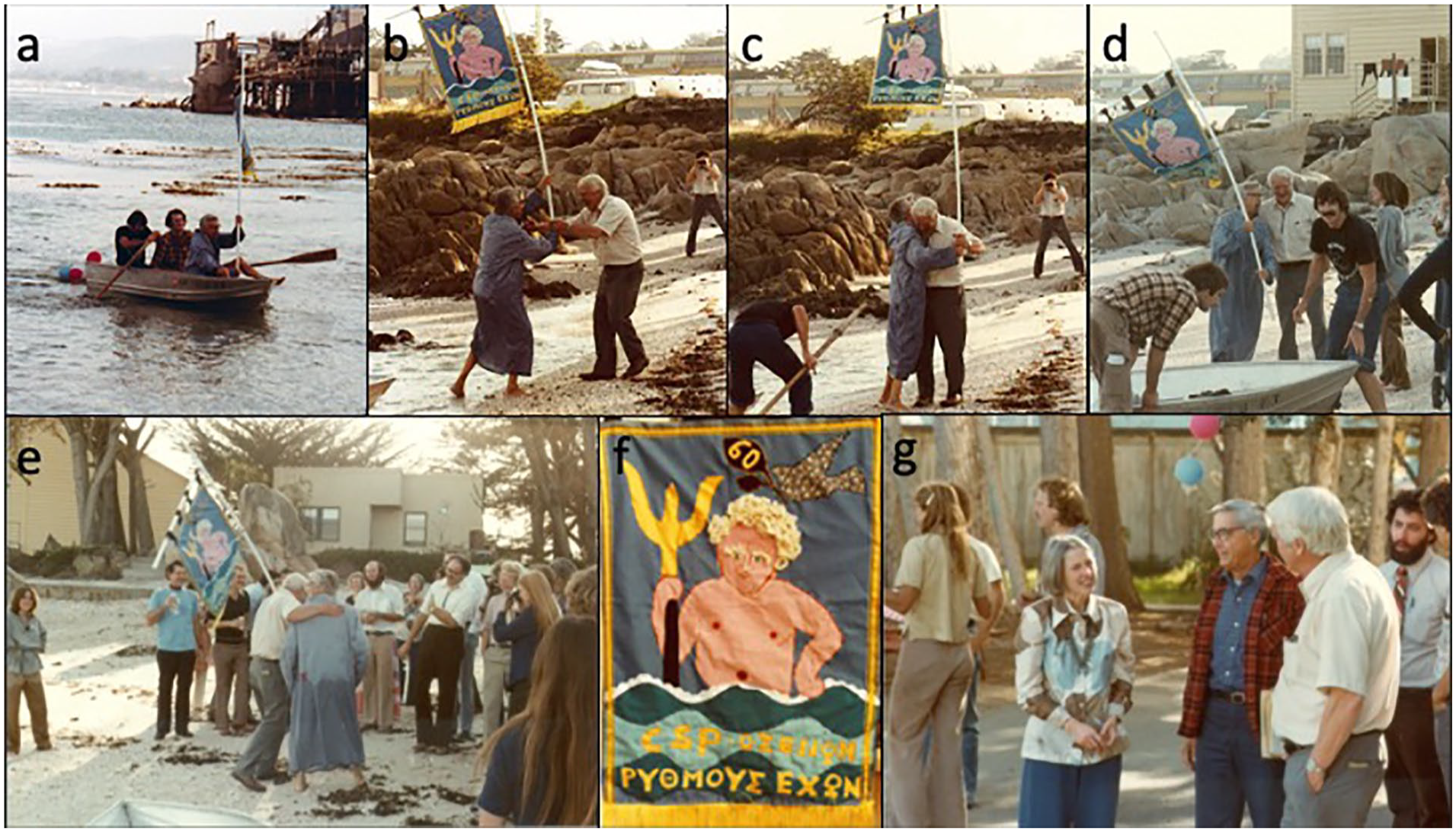
On the occasion of Pitt’s 60th birthday party at the Hopkins Marine Station, with (a) Jürgen Aschoff arriving by sea, accompanied by Carl Johnson and Jeff Elliott; (b-e) Aschoff’s arrival ashore; and (f), Aschoff’s celebratory flag for the occasion. (g) left to right: Mikey, Don Abbott, Pitt, and Master of Ceremonies Arnold Eskin.
I can tell some short stories. As an undergraduate, as Carl noted, Pitt was good to me. There were times when he rolled his eyes a bit, but he never really got after me. He wasn’t too prescriptive about advice, about where to go in my life or about career, but I did meet with him once anticipating a conversation about my future and graduate school. We met in his office and we did not get into a deep discussion. He just picked up the phone and called Mike Menaker in Texas and said, “I’ve got this student here that I think you should take into your lab,” and click, that was it. He hung up. And it’s like, OK, I guess I’m off to Austin. That was how my graduate school was determined.
I also remember a party in the lab for which I contributed a large head of cauliflower from a garden that was part of a class (“Practical Plant Physiology” taught by Peter Ray). Pitt sampled a piece of it, held it up to me and said, “I love raw cauliflower and this is horrible” (or something to that effect). As others have noted Pitt could be blunt and to the point.
But I also have to say this, because it’s meant so much to me over the years.
When I left in June of 1974, Pitt gave me this small book, a Naturalist on the Amazon by Henry Bates, who went to the Amazon mid-1800s. It was a book of Pitt’s that he signed in 1946. His advice, written in the book was, “In science as elsewhere, do what you think is interesting and worthwhile. Clearly Bates did” and then signed “For Fred Davis—on the longest day (PPmax) of 1974—from Pitt with much affection & respect—and all good wishes” (Figure 5). That shows an affectionate and supportive side of Pitt that I just couldn’t leave out. It’s meant a lot.
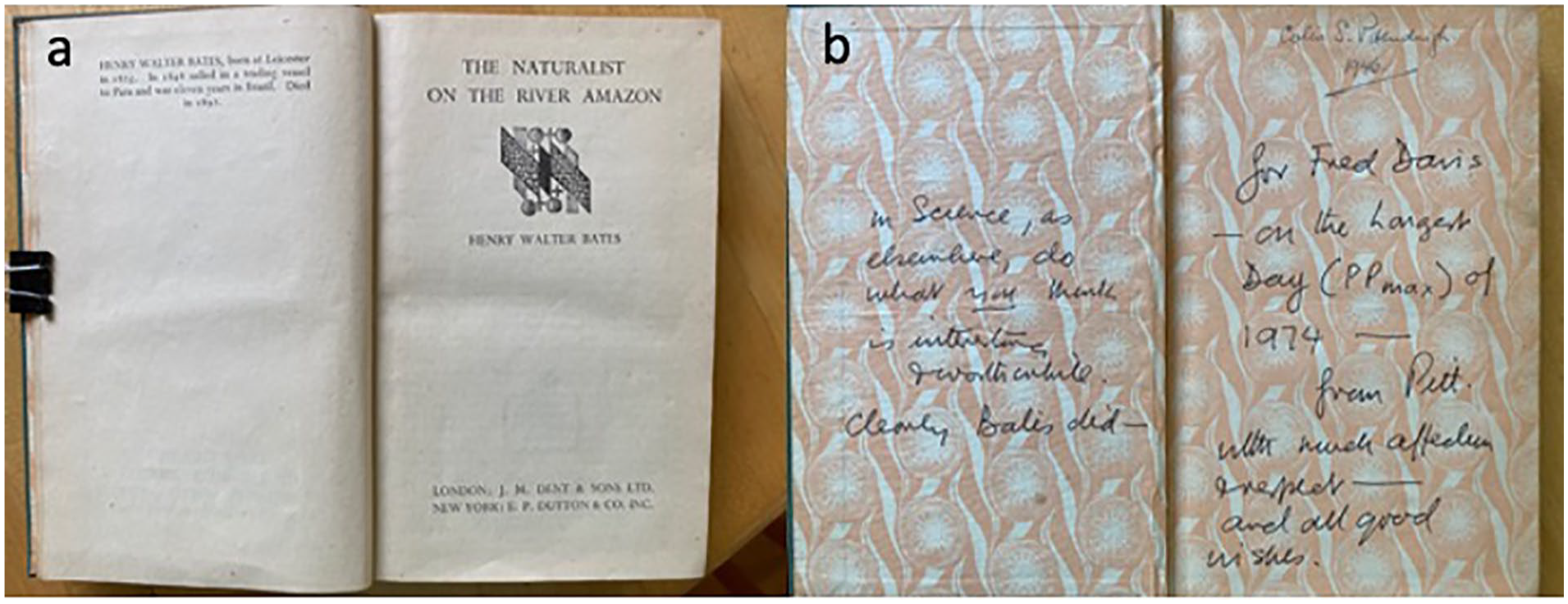
(a) Pitt’s gift to Fred Davis, a copy of The Naturalist on the River Amazon and (b) Pitt’s inscription.
Well, I’ll add something about the affectionate and caring side. During the now legendary Hopkins Marine Station summer course, one evening, a group of us was sitting in a small cottage at the Station drinking and talking about the course when an argument erupted between a former Pittendrigh lab member and his spouse. It devolved into a serious marital dispute that was being played out in a too-public manner. Pitt looked deeply distressed and finally said to them, “I love both of you and this is killing me. You need to stop this right now.” The following day Pitt was still distressed over the incident and mentioned how painful this was to see people he cared about carry on in that manner. His response revealed a side of Pitt that we rarely saw as he was generally very private about his own personal life and almost never spoke about others’ personal situations. He was very fond of his daughter and son, but we rarely talked about them or his relationship with them.
You know, I’ll echo that. Pitt would come to Palo Alto for his medical appointments, and, as you know, he really didn’t accumulate much wealth in his life and lived a pretty modest lifestyle. Pitt’s homes were modest, at least when I knew him. And he would stay with me and Suzy when we were graduate students in our tiny apartment in Menlo Park. We had a little spare bedroom, and he would stay with us, which was just lovely. Same experience as Bill, we wouldn’t talk science at dinner. It would be a broad ranging discussion. He actually once demonstrated how he could balance drinks on the top of his head since he had the “flat top”; I think it was a rare treat that I actually got to see that because it’s pretty apocryphal (Figure 6). When we got married, we had a very small wedding in Canada, and we had a very limited invite list. We invited Pitt, but at that point in ’94, he wasn’t traveling. And so he sent his regrets, but he sent us this most lovely little English silver tea box that was inscribed with his and Mikey’s best wishes. It really was the most touching gift that we got at our wedding. Exactly as Gene was saying: his thoughtfulness was just remarkable because—who were we?—just grad students, you know? I was fortunate to get to see that side of the man as well.
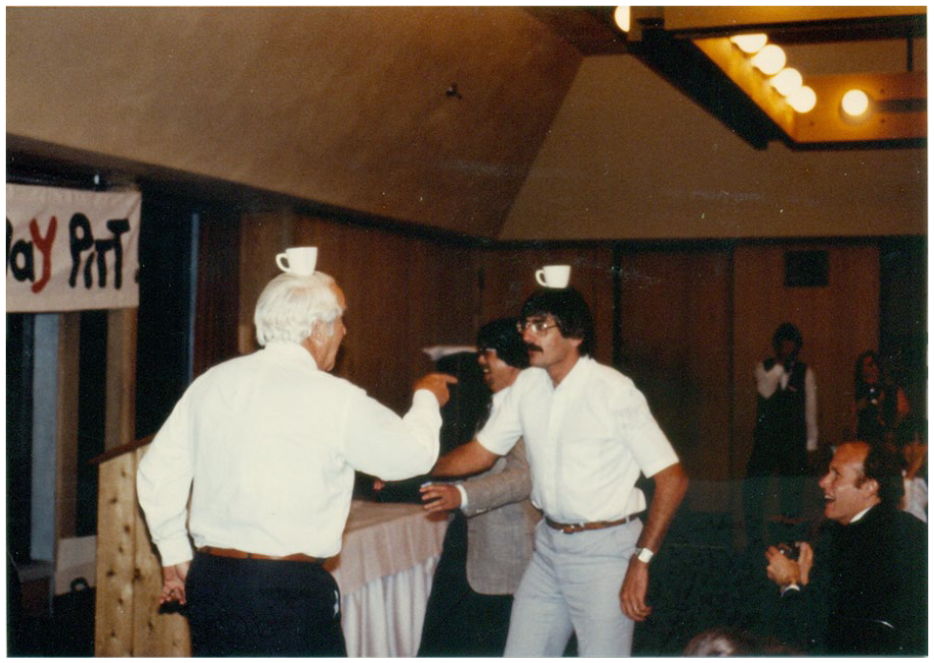
Pitt and Jeff Elliott. Jeff comments on this photograph, “Pitt loved to challenge others to a duel dancing with a cup or glass on our heads until one had to be steadied by hand to avoid falling to the floor! He never lost! His favorite version, glasses of the finest single malt Scotch!”
What Fred and Gene and Russ were saying reminded me of my favorite Pitt story, which has to do with what happened to Pitt during World War II. Pitt was from a poor family in Northumberland (England), and he was a conscientious objector during World War II, which in the United Kingdom being a conscientious objector in World War II was—I’m sure—not a popular thing to be. And therefore, as an alternative service, the government sent Pitt to Trinidad, where they wanted him to use his biological background to figure out how to solve the malaria problem from mosquitoes in Trinidad because they were building a military airfield there. And Pitt determined from his botanical background that the mosquitoes were breeding in bromeliads and that rather than spraying toxic DDT all over the place, it would be much better to simply spray copper sulfate into the bromeliads, thereby killing the bromeliads selectively so that they leaked and then the mosquitoes couldn’t lay their eggs in the bromeliad tanks any longer. But he needed to get some kind of spraying gear. And so he flew up to New York City to borrow some spraying gear from a friend.
On that trip, however, he met his future wife, Mikey, and they had a whirlwind courtship while he was in New York City for the 2 weeks. And Pitt said that one of the things that he did with Mikey in New York City was that they went to the Metropolitan Opera together and he had a flask of rum in his coat pocket. And when he placed his coat on the floor underneath his seat, the bottle of rum broke. And then there was the smell of rum all over, permeating the air everywhere. And other people in the audience were looking around at him and thinking he was a drunkard. But apparently that didn’t bother Mikey. In fact, during that TWO-week visit, Pitt proposed to Mikey, she accepted, and they were married! So then Pitt returned to Trinidad with the sprayer, but at first Mikey wasn’t allowed to join him there because of the war and visas. So they waded through a lot of bureaucratic red tape, but ultimately Pitt was able to get Mikey into Trinidad, and their first child (Robin) was born there. But, you know, those of us who knew Mikey in later life just couldn’t imagine her ever being a person who would have met a man and married him within 2 weeks and then practically smuggled herself into a remote place like Trinidad. I just thought it was a very romantic story and also puts Pitt into a certain context of—I think—being pretty courageous to be a conscientious objector during a war that had such a huge impact in the United Kingdom.
Memories of Pitt at Princeton
Since we haven’t mentioned anything about the Princeton era, I thought I would tell this story about Pitt and Princeton. It turns out I was at Princeton yesterday and at the University of Pennsylvania 2 days ago, so I am reminded of this story. As some of you may or may not remember, Pitt was appointed Dean of the Graduate School at Princeton, and he was promised that he could still keep his laboratory going. While Dean at Princeton, he gave a seminar at the University of Pennsylvania—I don’t know, maybe he was interviewing for chairmanship or whatever, since he had decided he had to leave Princeton or give up doing research. Pitt told me that once you’ve been Dean of the Graduate School at Princeton, which, at the time, I think was the second most powerful administrative position at Princeton, you have to make decisions that may be unpopular. When he found out he really couldn’t keep his lab going while being a Dean, he did not want to remain the Dean. However, by that time, he had made a lot of senior people unhappy with him because of decisions he had made. So, he was interviewing at Penn and eventually Kennedy recruited him to Stanford. But at Penn, after his seminar/interview, he recruited two of the best young biologists at Penn to Princeton.
And then years later, Penn was trying to recruit both Menaker and me at the same time to senior and junior faculty positions. And I still remember the Chair of the Biology department telling me how Pitt stole their two best young biologists and now Menaker and I owed him and Penn to make up for what Pitt did by stealing his best young faculty and recruiting them to Princeton. While Pitt was very powerful at Princeton at the administrative level, he realized he could not keep his lab going and his lab meant more to him than being an administrator, hence he moved to Stanford.
I agree that being an administrator was not a high point in Pitt’s life —it was being a scientist. I remember his wife, Mikey, remarking to me that Pitt was not that happy being Dean, and she added that she was uncertain whether he was really suited for the job.
Say, Gene, could you tell your story about how Don Kennedy talked Pitt into moving to Stanford? You remember that?
Hmm, no, I really don’t, Carl.
OK, well, I think this is your story, but the way I remember it is that they were big buddies and Don kept trying to get Pitt to come to Stanford and Pitt was very resistant. But, you know, Pitt would spend his summers in Wyoming. And what Don showed Pitt was that Wyoming was closer to Stanford than it was to Princeton and apparently Pitt didn’t believe that at first. Don got out the map and he showed Pitt that Stanford was actually closer to Wyoming. In those days, Pitt drove to Wyoming, and so the distance for that long drive was very significant. My understanding was that demonstration of Don’s was one of the reasons why Pitt was persuaded to move to Stanford. And I thought that was your story.
So I’m not sure I remember that it was my story. But I do remember Don saying that he hooked Pitt by offering to go fly fishing together and that California was not so far from Wyoming—so I do remember some of the story.
That reminds me when Pitt was driving from Princeton to his summer home in Wyoming with a couple of his students, they decided they were going to go for the record and make the trip in record time. I guess at the time there was not as much concern about nighttime driving when your biological clock is telling you to “sleep.” To drive nonstop, they had to keep trading drivers. And they got to one stop in the middle of the night when a graduate student took over the car and started going back toward Princeton. He just got mixed up. And of course, they did not break the record getting to Wyoming. I can see where Kennedy would have an advantage. Stanford was closer to Pitt’s summer home and fly fishing.
Well, Fred, let me point out for the readers of this article that in those days, cars were not air-conditioned. I remember traveling across the breadth of the United States in the heat of the summer as a kid in an un-air-conditioned car. Miserable. And that’s probably one of the reasons why Pitt and those students wanted to drive at night if they could.
And What Would Pitt Say about our Field Now?
So, I think it’s about time that we wrap up, but before we do, I wonder what everyone would think Pitt would say about the current state of our field. Would he be pleased with the incredible progress?
I think Pitt would be very disappointed in one aspect of the rhythms field today: its almost exclusive focus on the molecular and genetic basis of circadian rhythms and the molecular interactions with multiple signaling systems in the cell. There are still a lot of unknown aspects of the circadian (and seasonal) rhythms in wild plants and animals at the evolutionary and organismal levels that do not receive much attention from most circadian biologists (including myself), but who instead focus on the biochemical, molecular, and genetic aspects of the regulation of, and by, the circadian clock in a few model organism species. In addition, the field has moved into a direction where one really has to show how the biological clock contributes to health and wellness. If one wants to just ask a question, because it’s really an interesting biology question, that is not good enough today. You have to relate it to human health. And I think he would have felt that biomedical research in general, and in particular, on circadian rhythms, that perhaps we’ve moved too far away from asking “real” biology questions.
I remember once when I was an undergraduate in his lab, he bemoaned the loss of the “amateur scientist,” sort of what Fred [Turek] was saying. He really didn’t like, even at that time, the increased professionalism of science.
I remember Louis Sokoloff, the neurochemist of cerebral metabolism and 2-DG fame, saying the same thing.
And I would add that we have seen a significant reduction in comparative studies in circadian rhythms. Even the number of model systems studied is greatly reduced from a few decades ago. I suspect this has been influenced by the requirement of more disease relevancy for funding from NIH and by the tremendous advances in genetic manipulations in a few model organisms. Although Pitt focused mostly on the Drosophila and rodent models, he was a strong believer in all that can be gained from comparative work. The current dearth of this type of research would have made Pitt unhappy.
You know, by the way, something we should remember, while most old timers were there in the beginning at the first SRBR meeting in 1988, Pitt was not. He was totally against the formation of the SRBR, and he didn’t come to the first meeting. And the reason he was against it was he was worried that the field would become too isolated and not be part of all of biology, including comparative biology and evolutionary biology. And I, of course, argued a different point. It was time for us to still be endocrinologists, still be cell biologists, still be molecular biologists; however, we needed a regularly occurring meeting where the field would all come together. And he said, “We don’t need to come together more than once every 5 or 10 years. That’s good enough.” And I reminded him that the Prolactin Research Society met every year and if the circadian field was going to grow, we had to meet regularly as a group, as a family, so to speak. After the first meeting, he was convinced by other people to attend the second meeting. Because of Pitt’s concerns that the SRBR meeting could be dominated by just a few leaders in the field resulting in the field becoming too isolated from the rest of biology, I bent over backward to make sure that once I was done as the first SRBR president after 2 years, I would vacate the presidency. Therefore, when I wrote the bylaws of the SRBR, I wrote them so that the president could only be elected for 2 years. Now, it turned out that somebody pointed out at the end of the first meeting that I had never been elected. So I was elected to go a second and third term. I really was very concerned that the field would become too isolated and too dependent upon one or a few individuals, and I really wanted the field to remain very broad with respect to SRBR, and it was.
Yeah, actually Pitt had the same attitude about the creation of the Journal of Biological Rhythms as well. Isn’t that correct? Can you speak to that?
Yeah, I think it was the same reasoning why he was against the formation of the SRBR. He did not want circadian biologists only publishing in a journal for the field.
But, you know, maybe some of our imagined notions of Pitt’s disappointment might be assuaged by what seems to me to be a beginning rapprochement between chronobiology and ecology/evolutionary biology. We’ve always claimed that the clock is critical for fitness in the wild, and now, armed with all sorts of devices, investigators are actually able to test these ideas in the field. There’s an increased interest in abiotic and biotic influences on the clock, beyond light and temperature. We are moving beyond the Eskinogram!
I think Pitt came from an era where grand ideas of biology held sway, and there was an aspirational goal to try to prove these huge ideas. This probably came out of his Dobzhansky background and ultimately evolutionary genetics. I keep going back to those papers in the ’50s, the Bruce and Pittendrigh papers (Figure 7). You can read those every year and still get new things out of them. I think his goal largely was to put clocks in an evolutionary context. Mechanism was secondary. If you’ve got a mechanism, great. Or not. But to really say, “here’s the mathematical formula!” I don’t think this part of the field—the “grand theory” part—has advanced much since Pitt’s passing. As a field, we’ve gone down the mechanistic/reductionist path. But I know in the ’90s Pitt was not happy with where the field was going, and the reductionism and the molecular mechanisms were a bit foreign to him. But more than that, he felt we were off target. Unless you could bring it back to the overarching theory.
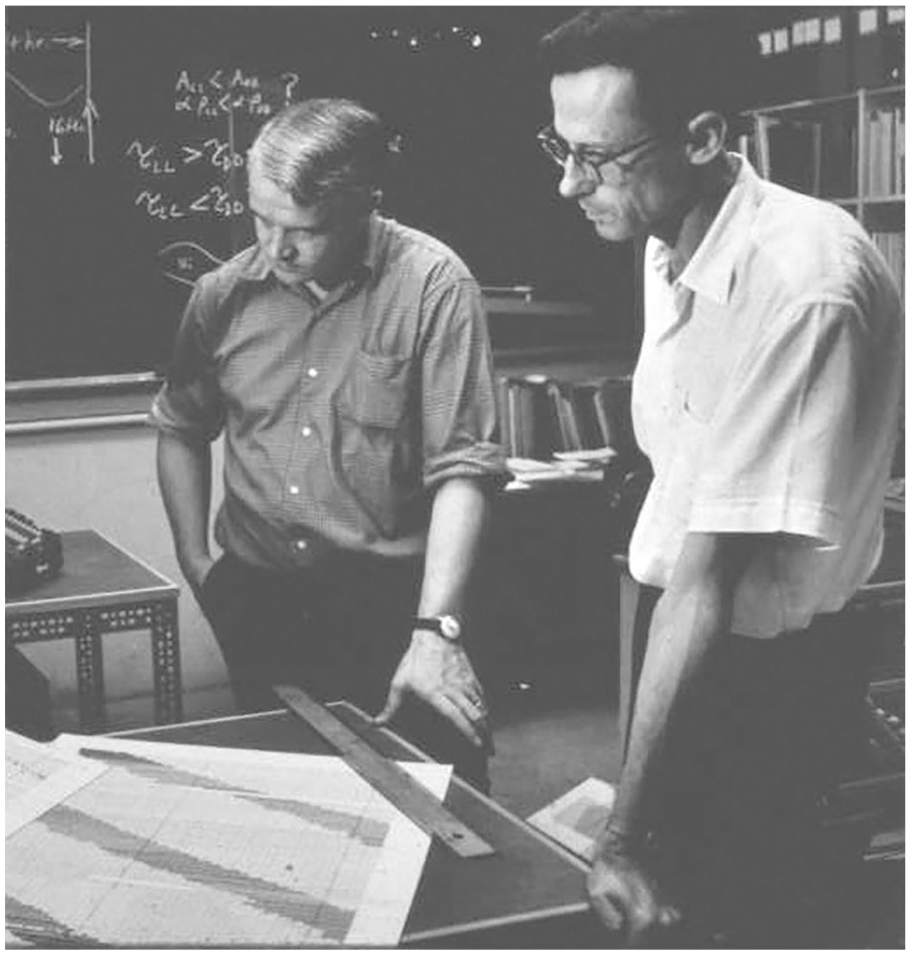
Pitt with Victor Bruce at Princeton.
I would agree with that. I think that Pitt would agree that there are some fascinating questions being addressed about the multi-oscillator organization of mammals; however, with just a few exceptions (and I would note especially the work of Joke Meijer’s laboratory in Leiden), there has not been much formal modeling to help explain the functional relationships among oscillators and how the ensemble controls rhythmic behaviors. I believe this may contribute to shortcomings in achieving a better understanding of the contributions of identified pacemakers such as the SCN on behavioral control.
As mentioned, Pitt was an expansive thinker and seemed to have great respect for philosophers and other “big thinkers.” I don’t know how many of you heard him tell the story about when he met with Einstein. Einstein had become aware of Pitt’s work on biological timing at Princeton and I suspect he was intrigued by the time dimension. Pitt was invited to meet with Einstein. Pitt said that Einstein listened intently but didn’t have too many comments. Nonetheless, Pitt always felt this was a great honor that the elderly Einstein asked to hear from a relatively young scientist in a different field.
One other little anecdote. At one of the dinners that he had with me and Suzy, he mentioned having met Einstein. I asked him who was the most interesting person he had met, and he thought for a second and said, “I think my dinner with Wolfgang Pauli.” It was the grand ideas, the power of theory; someone who could predict the presence of a subatomic particle on theoretical grounds and then have it show up as the neutrino was clearly a hero for him. He also really loved the anecdote that Pauli once took down a colleague, telling him he “wasn’t even wrong.” Perhaps this resonated with the internecine battles with Frank Brown over whether the clock was intrinsic or external.
Russ, I think that the dinner that you’re referring to appears in Pitt’s very cool Annual Reviews of Physiology paper in 1993 (Pittendrigh, 1993). In that paper, Pitt wrote about Pauli and how Pauli first said he didn’t believe in evolution. And then Max Delbrück later told Pauli to shut up and pay attention to things that he knew something about. It’s a great anecdote.
Russ mentions Frank Brown. That reminds me of Pitt’s famous response to Brown at the 1960 Cold Spring Harbor Symposium, following Brown’s taunt that Pitt searching for an “autonomous living clock” was like chasing a ghost. And Pitt replied—it’s in the Proceedings of the Symposium—“the question of the ghost is simple—either it is an aspect of living organization, or an unknown geophysical variable. My taste in ghosts suggests the latter but, as scientist, I must agree that Dr. Brown may prove right; and as scientist he will doubtless agree he may prove wrong” (Pittendrigh, 1960). That response was so typical of how fast Pitt’s brain worked and typical of the elegance of his oratory skills.
I remember a Pittendrigh versus Brown exchange at a banquet dinner in The Hague at a meeting in the Netherlands organized by Wop Rietveld of Leiden University. I think Brown made a toast to Pitt that was snarky, and Pitt was even more snarky in response. Pitt never warmed up to Brown. He was clearly frustrated by Brown’s stubbornness in holding on to his exogenous theories of biological timing (e.g., see Brown, 1960) despite strong evidence to the contrary.
I’d like to follow up and quiz Russ, because it seems to me that Russ is the person who explained molecular biology to Pitt. And I want to introduce this by a couple of things that I remember Pitt saying. One is that part of Pitt’s negative reaction to molecular biologists is that they didn’t give Pitt very much respect either. So, for example, Pitt said that one time Arthur Kornberg (the Nobel Laureate, 1959) heard Pitt give a lecture and afterward Kornberg said, “Pitt, the reason I got the Nobel Prize is because I focused on this one enzyme and I just learned everything about this single enzyme. You know, you should do that with the clock.” And then other molecular biologists told Pitt, “You just clone the Per gene and then you’ve got the clock mechanism.” Of course, those molecular geneticists knew that cloning the Per gene was not the whole story, but it would be the first step as an entry point or whatever. I’m sure that most of them appreciated it would be a long “row to hoe” to understand how the clock worked, but that isn’t what they SAID to Pitt. I think that Pitt perhaps unconsciously misinterpreted those statements by taking them at face value. But Pitt’s perception was that the molecular biologists were really simple-minded reductionists and condescending toward Pitt’s own approach (that would probably be considered “Systems Biology” now!). And it infuriated him. So, Russ—what were your conversations with Pitt about molecular biology like?
That was exactly the era that I got to know Pitt. And as you recall, the molecular biologists were kind of upstarts at that time. If we think back to the 1988 SRBR, the last session of the whole meeting was Rob McClung and Jay Dunlap cloning Frq. And discussion of Paul Hardin’s Per feedback loop. The foundation of the molecular work, and really the work that ultimately led to the Nobel Prize many years later, was still relegated to the last session. Pitt did not understand molecular biology in detail. It was very frustrating to him because the language was not native to him. I remember having to explain to him the difference between a promoter and an enhancer. I think Pitt saw that the Hardin experiment was probably a Rosetta Stone to show how a transcriptional-translational feedback loop would work to keep time. Of course, he’d been thinking about feedback loops extensively for many years. And obviously Gene’s work at that time on membrane feedback was a different feedback loop that was involved in clock mechanisms. But I think Pitt had a very hard time accepting that a perturbation of the central dogma of molecular biology could actually be the mechanism of the clock, for whatever reason. I think that idea rankled him. And in particular, he really wanted to know how that could possibly explain things like the resetting curves and how limit cycle oscillators could be modeled out of that and so forth. So he had this inherent skepticism. I agree with you, he felt that the new generation of molecular biologists—particularly the Drosophila researchers—were sort of interloping into the field without doing their apprenticeships, for the most part, with someone under the Pittendrigh pedigree that we all belong to. How could they solve the problem? I don’t think he was antagonistic to the idea that the mechanisms could be gotten through genetics. Ron Konopka was a postdoc with Pitt and I think was very supportive. I think the schism with the molecular biologists was a mini-tragedy for the field at that time.
By the way, I want to point out that Pitt was actually very well trained in classical genetics and evolutionary genetics, but the transition to molecular genetics eluded him.
Pitt had bred the long and short period Drosophila pseudoobscura strains, which predated Konopka’s work, and kind of gave justification to it. But he never did it as a formal geneticist, he did not identify specific alleles or do mutagenesis. But I think he was very open to the approach.
With that, I’d say our time is just about up.
Yeah, we may be near a stopping point here. I sense that.
This really has been fun! I’m very glad that we were able to arrange it.
This is great.
It’s great. I really appreciate it.
Thank you all for taking us to the finish line.
Fred [Davis], I love the thing about the book and the inscription from Pitt. That’s very touching.
And it’s a real treasure for sure.
Postscript
After this conversation was transcribed and edited, Pitt’s son, Colin S(andy) Pittendrigh, Jr., was invited to review and comment, after which he had a few stories of his own to relate. In the following, Sandy refers to his father as Colin.
The stories I can remember that don’t involve Colin’s academic and research career revolve around his years in Trinidad. I’m not sure when Colin first arrived in Trinidad. Colin, who was a conscientious objector, was tasked by the British government to research anything and everything he could about malaria in the rain forest. In that context, Colin almost immediately ran into Wilbur Downs at a regional virus laboratory there (Wikipedia says Wilbur Downs founded Port of Spain’s virus lab in 1983. But that cannot be right. I was born in 1948, and it was Wilbur who introduced Colin to my mother Mikey, on a quick trip to New York City. Wilbur eventually became my godfather).
Almost everybody else Colin knew and worked with in those early years were local Trinidadian men who worked with Colin out in the bush. Colin told me more than once the friendships he forged with those men were unlike others in his many academic years that followed. And he valued them greatly. Colin loved those guys and spoke of them often. One man in particular, Ronnie Sedena, became like a protective uncle to Colin and helped at every step. Among other things Ronnie taught Colin how to thrash through the thick Trinidadian rain forest while always keeping an eye out for snakes, using a long stick. The mapeebee (bushmaster) was a dangerous snake, although there were others. Colin did step on a bushmaster once, but it was apparently asleep or sick, because it simply slithered off after Colin’s foot rolled on it. Colin’s out-in-the-bush colleagues also taught him how to shuffle dance to calypso music, sometimes with a glass of rum balanced on their heads.
On one morning, Ronnie Sedena knocked on Colin and Mikey’s door. They lived in a group of shacks on the edge of the rain forest, up the Tamana Road from Sangre Grande. That Tamana road connects through to the island’s interior now. But in those days, it simply dead-ended in the jungle. Ronnie had a delicate situation he needed Colin’s help with. Many of the men in the village owned guns of one sort or another, but there was a war going on out in the outside world and ammunition was essentially contraband then. Colin not only owned an old shotgun, he had a few rounds too, and for unexplained reasons sounding a lot like 19th-century British imperialism, Colin was somehow officially to have a gun. Ronnie reported a big mapeebee was coiled up in a tree stump next to a creek, where the village women normally did their laundry. Their daily routine was suddenly at an impossible standstill. Ronnie wanted Colin to come shoot the snake. It took most of the morning but the men eventually pulled the snake out of a small muddy cavern at the base of the tree, and Colin shot its head off with a short range blast from an old double hammer 12 gauge. Colin knew right away this wasn’t a mapeebee. It was a huge constrictor whose skin measured almost 18 feet long. Anacondas were not known to inhabit Trinidad back then (they are now), so Colin concluded it was a boa constrictor of some kind. His official write-up of that day’s adventures somehow became an official world record for the world’s largest ever recorded boa constrictor.
Many years later, I think in the early 1960s, Colin was contacted by a West German naturalist who quizzed him at great length about that snake. They exchanged many snail-mail letters and gradually became good friends. By that time, by the early 1960s anyway, anacondas were known to inhabit the great Coroni Swamp, the edges of which were only a few miles south of Sangre Grande. Colin and his new West German friend agreed that Colin’s snake could not have been any kind of boa. No other boa constrictor example had ever been recorded at longer than 9 feet or so. So Colin’s world record boa constrictor quietly became expunged.
Not every story Colin told about Trinidadian men was as fatherly and angelic as his memories of Ronnie Sedena. Colin spoke of a “young troublemaker” who joined the crew at one point and organized a strike for higher pay. Colin told that guy, and all the men together at one point, that he agreed completely. They were being paid so little it was a disgrace. But there was nothing he could do. He had asked his British Navy superior for more wages from money in the budget and was denied. The troublemaker became angry and shook his fist at my dad. Colin instinctively reached for his machete, but Ronnie Sedena instantly bear-hugged Colin from behind and said, “No boss. He chop you like watermelon, boss!”
Colin loved Trinidad and spoke of it and told stories about it for the rest of his life. My sister Robin, who is 4 years older than me, was born in Trinidad. Mikey kept the four legs of Robin’s crib in cans of kerosene, so snakes, scorpions, and tarantulas would be less likely to visit Robin in the night. Colin learned how to cook tarantula legs and scorpion tails with a kitchen match to have a quick rain forest snack.
The following is a poem that I wrote to Pitt a few years after I finished my PhD, and just before his retirement.
To Colin Pittendrigh (8 April 1984):
You inspire us, you intimidate us. You taught us, you frighten us.
You are proud of us, you are jealous of us.
Many who are most true to you, you consider most maverick. Much of what you built will be destroyed.
We are the sand in which you leave your footprint.
Footnotes
Conflict of Interest Statement
The author(s) have no potential conflicts of interest with respect to the research, authorship, and/or publication of this article.