




Abstract

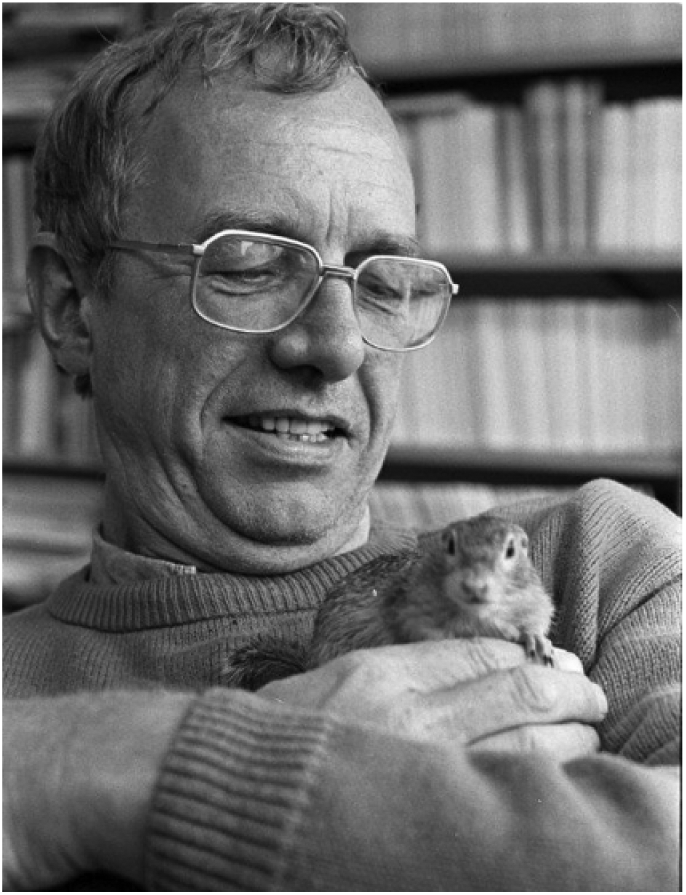
Serge with European ground squirrel (1993) (photo, Joost Tinbergen).
The fields of chronobiology and physiological ecology lost a prominent member when Serge Daan, Emeritus Professor at the University of Groningen, passed away on 9 February 2018. Serge was a clever and critical researcher who inspired and trained many of us. He made seminal discoveries in hibernation research, ecological energetics, behavioral biology, sleep research, and sex-ratio adaptation. Serge was born in 1940, in the historic windmill “De Plasmolen” in Mook, Limburg, the Netherlands. In 1944, during the Second World War liberation, the Daan family fled from the Plasmolen only hours before it was shelled by American troops. After the war, the family moved to the estate “Het Schol” near Deventer, where Serge grew up with seven brothers and sisters. The family had a great interest in biology, and together the children built an impressive collection of skulls for their museum. Many visitors may remember part of this collection displayed in the hall of Serge’s house “Villa Later” in Paterswolde. Serge studied biology at the University of Amsterdam and obtained his master’s degree in 1966. During his studies he worked with evolutionary biologist Dick Hillenius at the Zoological Museum Amsterdam, which was at the time a meeting place of biologists, artists, writers, and poets. Serge expanded the museum collections by catching amphibians in southern Limburg, using his Harley Davidson as a field vehicle. In Greece he collected reptiles, and to his surprise a newly discovered Agama lizard subspecies was named after him: Agama stellio daani (Beutler and Frør, 1980). Unwilling to spend the rest of his life in dusty museums, Serge returned his PhD grant to the Dutch Science Foundation and instead obtained stipends to investigate hibernation with Prof. dr. Punt in 1968 (Daan, 1973a; PhD cum laude, University of Amsterdam). This venture took Serge back to southern Limburg, where he discovered that hibernating bats would save energy by moving to colder parts of the cave (Daan, 1973b). To test whether this behavior was a temperature response, he carried large blocks of ice into the cave to attract hibernating bats. The result of this experiment was that Serge caught pneumonia, but it also represents a landmark: Serge had changed from a descriptive taxonomist to an experimental biologist. Activity patterns during hibernation were further studied in garden dormice in the laboratory. Serge described that euthermic arousals clearly followed a circadian pattern, interrupted by multiday torpor (Daan, 1973c). These patterns were the first free-running circadian data collected by Serge. They sparked his interest in biological rhythms, further boosted by Mike Menaker’s early publication on circadian rhythms in hibernating bats (Menaker, 1959). It was many years later, in 2009, when Serge, as faculty Dean, was able to show his gratitude and admiration to Mike Menaker by awarding him an honorary professorship at the University of Groningen: “For a generation of researchers into the biological clock, including those in Groningen, Michael Menaker is the giant on whose shoulders they stand.”
Serge wanted to learn more about the emerging field of circadian rhythms by visiting Jürgen Aschoff. In one day they wrote a successful Humboldt postdoctoral fellowship application allowing Serge to work with Aschoff at the famous Max Planck Institute in Andechs, Germany (1971-1973). At the time Aschoff was working not only on human chronobiology but also on rhythms in mammals and birds. The concept of circadian adaptation to day length and latitude was studied by comparing calculated solar light intensity curves (using an equation obtained from his brother) with year-round activity patterns of several mammal and bird species at Erling-Andechs and locations on the Arctic Circle (Daan and Aschoff, 1975). These measurements were performed in collaboration with Eino Erkinaro (University of Oulu), who not only taught Serge ice fishing but also raised his interest in annual changes in vole activity patterns from diurnal to ultradian to nocturnal (Erkinaro, 1961). Much later, after Serge established his Chronobiology Group at the University of Groningen in 1990, ultradian rhythms and flexibility in natural activity patterns were further developed by his PhD students Menno Gerkema and Roelof Hut, who continued these themes as independent professors in Groningen.
In 1973, Serge moved to Stanford University (1973-1975), where he worked with Colin Pittendrigh, who did his PhD with the famous evolutionary geneticist Theodosius Dobzhansky. Pittendrigh’s evolutionary view on rhythms, wonderfully described in his oeuvre paper “Temporal Organization: Reflections of a Darwinian Clock-watcher” (1993), greatly affected Serge as a scientist and influenced his following career steps. They published the five famous Daan and Pittendrigh papers (the “bible of chronobiology”), describing fundamental properties of circadian systems (Daan and Pittendrigh, 1976a, 1976b; Pittendrigh and Daan, 1976a, 1976b, 1976c). In an attempt to reconcile Aschoff’s view of parametric circadian entrainment through period changes with Pittendrigh’s view of nonparametric entrainment through phase shifts, Serge calculated velocity response curves from phase response curves. This showed that with increasing light pulse duration, the advance portion of the phase response curve would compress, while the delay portion would expand (Daan and Pittendrigh, 1976b). This was much later confirmed by Serge’s PhD student Marian Comas (Comas et al., 2006), who confirmed that this would eventually lead to lengthening of the circadian period as described by “Aschoff’s rule.” Nonparametric and parametric entrainment was fully reconciled when Domien Beersma modeled natural entrainment of ground squirrels, diurnal burrowing rodents that never see dawn or dusk and therefore could only entrain by tuning intrinsic period to 24 h (Hut et al., 1999; Beersma et al., 1999). Serge was notably proud of this insight and presented the merger of Aschoff’s and Pittendrigh’s entrainment models during the memorable Pittendrigh lecture at the 1998 meeting of the Society for Research on Biological Rhythms. The lecture was a wonderful historic portrait of these “founding fathers” of chronobiology, and from that moment on the series came to be called the Pittendrigh-Aschoff lectures. After his lecture, Anna Wirz-Justice immediately jumped on Serge and hijacked the written text, only to give it back after Serge promised to publish it in the Journal of Biological Rhythms (Daan, 2000). In the biography of Aschoff, Serge further elaborated on the mutual friendship and cross-fertilization between Aschoff and Pittendrigh (Daan, 2017). This biography turned out to be Serge’s last publication, and he was emotionally touched holding its first copy in his hands, only 2 months before he died.
Serge was fascinated by the functional relevance of rhythms, and he contacted Rudi Drent, an expert in field ecology at the University of Groningen. Serge was appointed at the University of Groningen in 1975, where he remained throughout his career despite several external offers. He aimed to quantify costs and benefits of rhythms in the field and to trace selective forces leading to rhythmicity. Drent and his group were unravelling reproductive behavior, quantifying energy income and expenditure of reproducing animals in the field. Drent and Daan teamed up, helped by a small army of PhD students (Tinbergen, Dijkstra, Gerkema, Masman, and many others), and wrote the citation classic “The Prudent Parent” (Drent and Daan, 1980), evaluating the adaptive value of phenotypic variation in clutch size, laying date, and chick growth. Following up on David Lack, they clarified how proximate and ultimate factors intertwine. An important conceptual step that Serge made was that in a seasonal environment, the clutch size decision maximizing fitness must be linked to time of year because offspring fitness declines over the breeding season. Parents building up condition after surviving the winter have to trade off the time it takes to produce an extra egg against the fitness loss of the whole clutch by laying later. This is the reason that animals should breed before and not at the annual food peak, a consequence not often recognized. After Serge became associate professor (1985) and founded his Chronobiology Group (1990), the idea was refined by including seasonal variation in food, replacing time needed to build up condition by an energetic limit of 4 × BMR, and parental fitness cost of foraging based on experimental data of his kestrel system (Daan et al., 1989, 1996; Daan and Tinbergen, 1997). To learn quantification of energy expenditure, Serge and his family visited his friend and collaborator Jim Kenagy in 1982 (University of Washington, Seattle). They developed the theme of “time and energy in behavior,” which became central to Serge’s further work, and named the first Erasmus Summer School in Chronobiology that he organized in Groningen (1991). Because animals have to rely on relevant parameters that they are able to measure, it is important to know their physiological possibilities and ecological situation. Therefore, Drent and Daan introduced the idea of capital and income breeders in the Prudent Parent paper, a concept stimulating many ecologists. Serge’s group tested these basic ideas in kestrels experimentally at the Lauwersmeer area, close to his farmhouse in Morra, which served as a field station (Fig. 2). These kestrel studies are among the most important ecological studies quantifying energy expenditure, time budgets, and fitness consequences of behavioral decisions related to clutch size, sex ratio, and lay date, and Serge’s concepts stimulated the field of evolutionary ecophysiology tremendously.

Serge releasing a kestrel at Lauwersmeer (1980) (photo, Anna Wirz-Justice).
Serge also followed his interest in circadian rhythms. When he joined Drent’s goose expedition on Svalbard, he studied the daily timing of cliff jumping in young Brunnich’s guillemots (Fig. 3; Daan and Tinbergen, 1979). He showed that young guillemots found safety in numbers by synchronizing their jumping. Predators thus promote an evolutionary basis for circadian timing of behavior! Serge further explored similar examples of adaptive daily timing (Daan, 1981). Voles turned out to have a short-term (2-3 h) ultradian activity rhythm, which is synchronized in the field (Daan and Slopsema, 1978; Gerkema and Daan, 1985). Possibly, voles could also profit from “safety in numbers” in regard to their predator: the kestrel! This research marks Serge’s view on science that such hypotheses should not remain “adaptive storytelling” but should be experimentally tested. A large group of researchers from two institutes, including Serge’s wife Ruth Hohe, took on an ambitious project. They observed hunting success of raptors while simultaneously measuring above-ground vole densities every 15 min. The data showed that predators increase their efficiency by synchronizing to the vole rhythm, and hence voles did not find safety in numbers (Raptor group RUG/RIJP, 1982; at the time it was unusual to put many authors on a paper).

Serge at Kapp Martin, Svalbard (1978) (photo, Joost Tinbergen).
In 1980, Serge and Aschoff organized a crucial symposium for chronobiology, at the Ringberg castle (Aschoff et al., 1982). Jürgen Zulley (Munich) presented data on sleep timing under conditions of temporal isolation, and Alex Borbély (Zürich) showed data on increased sleep intensity after sleep deprivation. This symposium inspired intense discussion with Serge’s later collaborators Gerard Groos and Anna Wirz-Justice (Basel), resulting in the basic concept of the two-process model of sleep regulation (Fig. 4). The need for sleep was suggested to increase during waking and to decrease during sleep, and the termination of sleep was thought to be influenced by a circadian clock. Unaware of these developments, the Biological Psychiatry Group of Rudi van den Hoofdakker in Groningen was searching for explanations for the positive mood effects of sleep deprivation in depressed patients. At a meeting in Munich, Anna Wirz-Justice told Domien Beersma, a member of Rudi’s group, that “Serge Daan at Groningen University had a model that could explain everything.” Upon return to Groningen, Domien contacted Serge, and they started intensive collaboration. The Psychiatry Group owned one of the few computers in Groningen, and Serge and Domien had weekly meetings discussing model simulations. The conceptual model was extended with an upper threshold, and many datasets were included. In collaboration with Alex Borbély, Irene Tobler, and Peter Achermann in Zürich, a quantitative two process sleep model was developed (Daan et al., 1984). Anna Wirz-Justice and Rudi van den Hoofdakker saw the possibilities of the model to understand mood responses of depressed patients by sleep restriction and deprivation. Derk-Jan Dijk, a PhD student of Serge, performed crucial experiments to fill in important aspects of the model. Marijke Gordijn worked on clinical aspects of sleep and circadian rhythms and later founded an applied chronobiology company. Annual meetings between Zürich, Groningen, and Basel were feasts of inspiration, but Serge was also known to have strong opinions in the scientific debate. Discussions with the Harvard group of Chuck Czeisler (1 vs. 2 oscillators; strong vs. weak resetting) were good examples of this. These discussions made a long-lasting impression on both Serge and Chuck. In his 2017 European Biological Rhythms Society (EBRS) lecture, Chuck referred to this as an “important learning experience” while kindly reminding the audience of the scholarly capacity of Serge. Although these discussions certainly strengthened the research quality of both groups, they also may have caused considerable discomfort to the people involved.

Serge discusses his first diagram of the two-process model with Gerard Groos in Andechs, Germany, the day after the Ringberg meeting where Alex Borbély introduced the idea (1980) (photo, Anna Wirz-Justice).
The success of sleep research was partly fueled by Serge’s old love: hibernation. At the time, the function of sleep was unknown and some considered it to be just “wasting time.” If one could show that animals pay a large amount of energy in order to sleep, then sleep must serve an important evolutionary benefit. Inspired by Sara Hiebert’s work on hummingbirds, showing a few hours of euthermic “rest” after torpor, Serge hypothesized that the birds might actually be sleeping to recover from sleep deficit during torpor. This idea not only could functionally explain the enigmatic euthermic arousals from torpor but also could show that hibernators are “warming up to sleep.” Brian Barnes (University of Alaska) and PhD student Arjen Strijkstra measured the first EEG during hibernation in Arctic ground squirrels and indeed showed that euthermic arousals were mainly spent sleeping with deeper sleep after longer torpor (Daan et al., 1991). Craig Heller’s group (Stanford University) worked on the same hypothesis independently, which generated many papers and friendships.
To find an evolutionary benefit of circadian organization, Serge worked with Kamiel Spoelstra and his son Moritz and daughter Berte to determine fitness of mice with clock malfunctions. They released hundreds of mice in enclosures in Bubonizi, Russia (Daan et al., 2011) and Princeton, New Jersey (Spoelstra et al., 2016). While the data showed that a functional clock clearly had fitness benefits, the mice also showed temporal niche switching. Serge and Roelof hypothesized that limited food could have triggered diurnality. Could there be a metabolic, sensitive slave oscillator downstream from the SCN? Could there be two oscillators after all? The old data from the Andechs bunker studies, archived in Serge’s office, might contain a clue: Aschoff and Wever always used body temperature as a phase marker but never as an indicator of metabolic rate. It turned out that the human sleep-wake cycle indeed slowed down with lower body temperature, suggesting that metabolic rate may affect human circadian organization (Daan et al., 2013). Serge had reanalyzed those data together with Ken-Ichi and Sato Honma, whom he knew well from the many Sapporo meetings and who became long standing collaborators and friends of Serge and Ruth.
Serge was not only a clever scientist but also a generous person. Together with his wife Ruth, he created a warm atmosphere for his group members by organizing numerous garden dinners. Many colleagues attended, and Serge would thank specific people for their contributions with presents and flowers. In addition, Ruth and Serge invited many colleagues to stay at Villa Later, where rich dinners formed the center of unforgettable scientific discussions. He also served the academic community with endless energy. He was a member of more than 90 boards and committees for journals, societies, funding agencies, and evaluations. He was Associate Editor of the Journal of Biological Rhythms (1986-1994), and he was very grateful to remain on its Advisory Board until he died. For the University of Groningen he served as Director of the BCN-Master Program, Faculty Vice-Dean (2001-2004), Dean (2007-2009), and Prorector (2008-2009). He modernized the university by installing a tenure-track system and the Rosalind Franklin program for women in science, from which Martha Merrow received her appointment in Groningen.
Serge received many awards, but he was notably proud of “Aschoff’s rule” (which he received from Chuck Czeisler in 2002), the University of Groningen Silver Medal (2006), and most of all, the International Prize for Biology (Japanese Society for the Promotion of Science), which he received from the Emperor of Japan. Serge was also very excited when colleagues received prizes. This was especially true when he heard that Rosbash, Hall, and Young received the 2017 Nobel Prize for their work on circadian rhythms. Serge Daan was Professor of Chronobiology and Professor of Ethology and held the Niko Tinbergen Distinguished Chair in Behavioral Biology. He was a member of the Hollandsche Maatschappij der Wetenschappen, Fellow of the Royal Society of Canada, and Knight in the Order of the Dutch Lion. He supervised 42 PhD students and 16 postdoctoral students, most of whom went on to scientific careers. He connected chronobiology and ecophysiology from an evolutionary perspective, including the mutual dependency of mechanism and function. His work created opportunities for many of us and will influence future generations of biologists. The world has lost a great scientist, and many of us have lost a dear colleague, mentor, and friend.