




Abstract
United States Navy submariners have historically lived with circadian disruption while at sea due to 18-h-based watchschedules. Previous research demonstrated that circadian entrainment improved with 24-h-based watchschedules. Twenty-nine male crew members participated in the study, which took place on an actual submarine patrol. The crew were exposed, first, to experimental high correlated color temperature (CCT = 13,500 K) fluorescent light sources and then to standard-issue fluorescent light sources (CCT = 4100 K). A variety of outcome measures were employed to determine if higher levels of circadian-effective light during on-watch times would further promote behavioral alignment to 24-h-based watchschedules. The high CCT light source produced significantly higher circadian light exposures than the low CCT light source, which was associated with significantly greater 24-h behavioral alignment with work schedules using phasor analysis, greater levels of sleep efficiency measured with wrist actigraphy, lower levels of subjective sleepiness measured with the Karolinska Sleepiness Scale, and higher nighttime melatonin concentrations measured by morning urinary 6-sulfatoxymelatonin/creatinine ratios. Unlike these diverse outcome measures, performance scores were significantly worse under the high CCT light source than under the low CCT light source, due to practice effects. As hypothesized, with the exception of the performance scores, all of the data converge to suggest that high CCT light sources, combined with 24-h watchschedules, promote better behavioral alignment with work schedules and greater sleep quality on submarines. Since the order and the type of light sources were confounded in this field study, the results should only be considered as consistent with our theoretical understanding of how regular, 24-h light-dark exposures combined with high circadian light exposures can promote greater behavioral alignment with work schedules and with sleep.
The United States Navy (USN) submarine environment is unique. Submariners have historically operated on 6-h-on/12-h-off, 18-h-based, rotating watchschedules, which is outside the periodicity range required for human circadian entrainment (Keller et al., 2011). As a result, personnel working on submarines suffer from circadian misalignment with their on-watch hours (Kelly et al., 1999). Circadian misalignment leads to sleep deprivation (Gamboa, 2002; Kelly et al., 1996), which has the potential to impair attentiveness and cause performance degradations, including decreased vigilance, alertness, reaction time, and psychomotor performance (Arendt, 2010; Baranski et al., 2007; Barnes and Hollenbeck, 2009; Dijk et al., 2001; Rupp et al., 2010; Wright and Lack, 2001). Other negative effects include increased levels of fatigue, depression, and confusion as well as decreased immunological function and concentration (Belenky et al., 1987; Giam, 1997; Naitoh and Kelly, 1992). Potential chronic health effects include increased risk of gastrointestinal illness, loss of bone mineral density, coronary artery disease, depression, some forms of cancer (Antunes et al., 2010; Dijk et al., 2001; Schernhammer et al., 2001), and alterations in metabolic profile, mood, and appetite (Arendt, 2010; Dijk et al., 2001; Scheer et al., 2009; Schernhammer et al., 2001).
In few other places than a submarine are personnel exposed to constant, low (with respect to daylight) light from fluorescent lamps (Hunt and Kelly, 1995) for as much as 3 to 6 months (Aschoff, 1965; Kleitman and Jackson, 1950). No provision is currently made in the USN submarine environment to provide sources, levels, or patterns of illumination that would help crew entrain their circadian rhythms to their watchsection duties. For 18-h-based watchschedules, exposing crew to this kind of lighting may be, in fact, appropriate because the human circadian system will not entrain to an 18-h day (Wright and Lack, 2001; Wright et al., 2004).
Recently, the USN submarine force has been evaluating and gradually transitioning to 24-h-based watchschedules. A previous study (Keller et al., 2011) compared circadian markers for 3 groups of crew members when they were on 3-shift, 24-h watchschedules and when they were on traditional, 3-shift, 6-h-on/12-h-off rotating, 18-h watchschedules. That study demonstrated that the 24-h watchschedules promoted more consistent melatonin peaks among crew members in each group than when they were on the 18-h watchschedules, suggesting that the 24-h watchschedules promoted higher levels of behavioral alignment with work schedules for the crew members.
A robust 24-h, light-dark exposure pattern is essential for circadian entrainment. Although a spectral sensitivity function is not available for the human circadian system’s phase-shifting response to light, short-wavelength (blue) light appears to be more effective than long-wavelength (yellow and red) light (Brainard et al., 2001; Thapan et al., 2001; Wright and Lack, 2001; Lockley et al., 2003; Warman et al., 2003; Wright et al., 2004; Revell et al, 2005; Rea et al., 2005; Figueiro et al., 2014). Consequently, light sources with spectra dominated by short wavelengths should be more effective for stimulating the human circadian system than those dominated by longer wavelengths at the same measured (photopic) illuminance level. The present field study was undertaken during the summer of 2012 to investigate whether “blue-enhanced” light sources (high correlated color temperature [CCT] light sources) would promote circadian entrainment better than light sources currently used on USN submersible ship nuclear (SSN) (low CCT light sources) when the crew was on 24-h watchschedules. Similar approaches aimed at enhancing circadian light stimulation in Antarctica have been undertaken (Francis et al., 2008; Mottram et al., 2011; Najjar et al., 2014).
Materials and Methods
Watchschedules
Twenty-nine subjects assigned to the ship’s Engineering Department were recruited and provided written informed consent to participate. The study protocol (NSMRL.2011.0004) was approved by the Naval Submarine Medical Research Laboratory Institutional Review Board in compliance with all applicable federal regulations governing the protection of human subjects. The 29 subjects were each from 1 of 3 watchsections: BARB (n = 10), WAHOO (n = 9), and TANG (n = 10). The Engineering Department of a USN nuclear submarine is responsible for the propulsion of the ship; production of electrical power used to operate the ship’s equipment and lighting; operation of high-pressure compressed air and hydraulic systems; operation of air conditioning, air purification, and regeneration systems; and the production of potable water. The 29 subjects recruited were specifically assigned to engine room duties. Engineering Department members assigned to the engine room duties directly control and monitor the nuclear reactor, which is the heat source for the steam turbine propulsion system and the steam turbine electrical generators. The subjects were not informed as to the purpose of the study.
All subjects were male since there are currently no females regularly serving onboard SSNs. The mean age was 26.8 years, with a range from 22 to 35 years. Analysis of variance (ANOVA) indicated that there were no significant differences in age among the 3 watchsections (F2,26 = 0.95; p = 0.400). Furthermore, ANOVA indicated that there were no significant differences in total months previously spent under way on submarines among watchsections (F2,26 = 0.063; p = 0.939).
Immediately following recruitment while the ship was in port, every subject completed medical, demographic, and chronotype questionnaires. Any subject screening positive for circadian rhythm sleep disorders, dyssomnias, parasomnias, or medications and supplements with known chronobiotic or hypnotic effects were disenrolled. Some subjects endorsed using antihypertensive medications and assorted supplements, none with known chronobiotic or hypnotic effects. The Horne-Östberg diurnal preference questionnaire assesses off-duty, lifestyle habits and provides a composite score, with lower scores indicative of the night-owl chronotype and higher scores indicative of the morning-lark chronotype (Horne and Östberg, 1976). The mean ± standard deviation (SD) of the Horne-Östberg score was 51.55 ± 10.22. Chi-square testing revealed no significant differences (p = 0.352) in morning or evening chronotypes among the 3 watchsections.
Light Sources
A different fluorescent lamp type was used in each of 2 sessions. A set of experimental fluorescent lamps provided by General Electric Lighting (GE 384 USN1 F20T12; General Electric Lighting, East Cleveland, OH) with a measured CCT of 13,500 K (high CCT) were installed for a first, 11-day experimental session, and a new set of the USN standard-issue fluorescent lamps with a CCT of 4100 K (F20T12) (low CCT) replaced the high CCT light sources for a second, 11-day experimental session. Figure 1 presents a comparison of the spectral power distribution (SPD) for a high CCT lamp and an exemplar of a low CCT lamp used in the study. Using the SPD of the light sources, an International Electrotechnical Commission 62471 blue light hazard analysis was conducted (International Electrotechnical Commission, 2006). Maximum possible light exposure from both light sources was below the calculated threshold for blue light hazard.
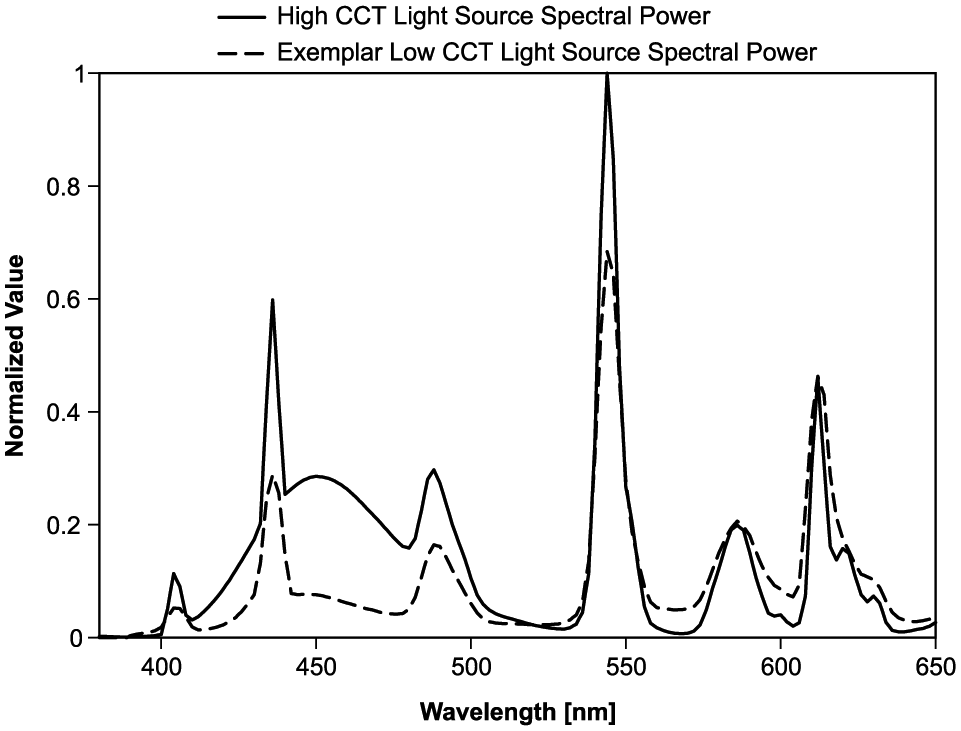
Spectral power distributions of the experimental, high correlated color temperature (CCT) (13,500 K) light source used in the present study and an exemplar low CCT lamp (4100 K), similar to the standard-issue light source used on United States Navy (USN) submarines. The high CCT lamp has a color rendering index (CRI) of 83 and a gamut area index (GAI) of 103; the low CCT lamp has a CRI of 62 and a GAI of 58.
Daysimeter-D Measurements
Personal light exposures as well as static, ambient light levels in the engine room were obtained with the Daysimeter-D (Figueiro et al., 2013). The Daysimeter-D contains a red-green-blue solid-state photosensor package; a 3-axis, monolithic solid-state accelerometer; onboard processor; and memory. Values of photopic illuminance, circadian light (CLA), and circadian stimulus (CS), as well as an activity index (AI), were determined from the raw light and activity data after they were collected using custom programs developed in MATLAB (MathWorks, Natick, MA).
Briefly, illuminance is irradiance weighted by the photopic luminous efficiency function (V(λ)), a measure of the spectral sensitivity of the human fovea, peaking at 555 nm. CLA is irradiance weighted by the spectral sensitivity of the retinal phototransduction mechanisms stimulating the suprachiasmatic nucleus, based on the model by Rea et al. (2005, 2011). CS is a transformation of CLA into relative units from 0, the threshold for circadian system activation, to 0.70, response saturation (Rea et al., 2010), and was used in the evaluations of personal light exposures. Data from the orthogonal accelerometers were used to calculate AI. AI was calculated using the following formula:
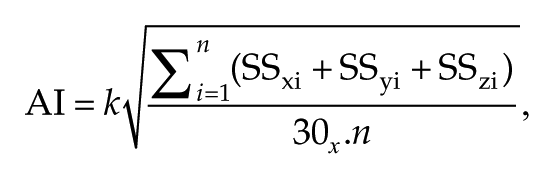
where SSxi, SSyi, and SSzi are the sum of squared differences from the mean over a 30-sec interval; n is the number of 30-sec intervals in the logging period (for a logging period of 3 min, n = 6); and k is the factor equal to 0.0039 g/count. More details about the Daysimeter-D can be found in Figueiro et al. (2013).
Protocol
Figure 2 shows the 24-h watchschedules for the 3 crew watchsections. Crew member compliance to the prescribed watchsection routine was only required when they were on watch. The study followed a mixed, 1-within (light source type: high or low CCT) and 1-between (watchsection: BARB, WAHOO, and TANG) experimental design.
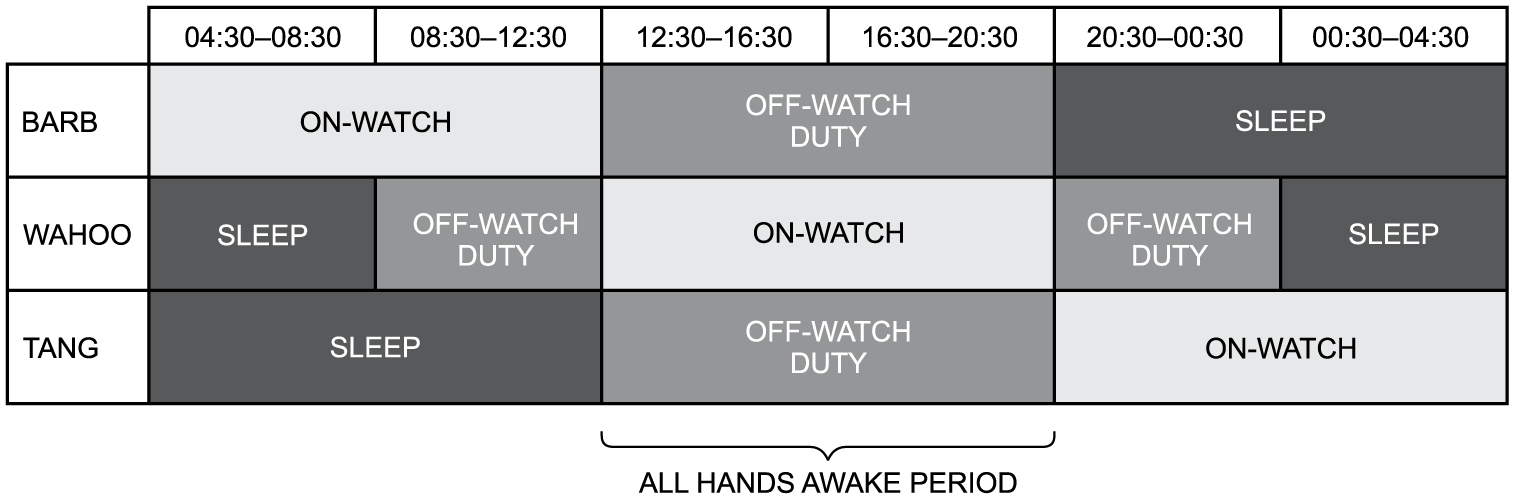
The ALL HANDS AWAKE 24-h-based watchschedule was followed by all subjects throughout this field trial. Of 29 subjects, 10 followed BARB, 9 followed WAHOO, and 10 followed TANG watchsection routines as assigned by the ship’s chain of command. Light exposure occurred predominantly when subjects were on watch in the engine room. Additional high correlated color temperature (CCT) light exposure may have occurred while subjects performed off-watch maintenance and other duties in the engine room. The ship’s forward compartment and berthing spaces, where subjects spent the majority of their sleep and off-watch time, were not relamped.
Low CCT (4100 K) lamps were on board the SSN when it first left port and remained on board throughout an initial 5-day baseline period. At the next port of call, the existing lamps in the engine room were replaced with the high CCT (13,500 K) lamps. After 5 days in port, the crew members participated in the first session for 11 consecutive days before reaching the next port of call where the high CCT lamps were replaced with new samples of the low CCT lamps. Following 4 days in port, the crew participated in the second, 11-day session. During the in-port periods, crew members were on shore leave with minimal on-board duties assigned to them. This allowed them to reentrain to local time and, presumably, return to baseline prior to starting both sessions of the study. The following lighting measures were obtained for each experimental condition (high and low CCT) as detailed below.
Ambient Light Levels
A total of 10 representative light level measurements were taken in each of 11 spaces in the engine room following installation of the high CCT lamps and the low CCT lamps. Of the 10 measurements in each space, 5 measurements were taken with the detector surface oriented parallel to the ceiling, and 5 measurements were taken perpendicular to the ceiling, 5 feet (1.5 m) above the floor.
Personal Light Exposure and Activity
Subjects were asked to continuously wear a Daysimeter-D on the wrist of the nondominant hand, except when showering or performing strenuous exercise. The Daysimeter-Ds were activated with a 180-sec sampling epoch. In other words, raw personal light and activity values were averaged over 3 min and then stored for subsequent processing. This sampling rate was chosen to maximize the recording time of the Daysimeter-Ds, which are limited by on-board memory capacity.
The amount of 24-h behavioral alignment with work schedules exhibited by subjects during the study was quantified by performing phasor analysis on the light-dark and activity-rest patterns recorded by the Daysimeter-D (Rea et al., 2008). Phasor magnitude represents the strength of association between the 24-h activity-rest pattern and the 24-h light-dark pattern; greater phasor magnitudes suggest higher levels of circadian entrainment, although, strictly speaking, phasor magnitudes for the present study characterize behavioral alignment with the light-dark cycle (Rea et al., 2010), not necessarily entrainment of the central oscillator. Phasor angle represents the phase relationship between the activity-rest and light-dark patterns. Positive phasor angles indicate a delay in activity and rest with respect to light and dark (night-owl behavior), while negative values indicate an advance in activity and rest with respect to light and dark (morning-lark behavior).
Other Outcome Measures
In addition to the lighting measures, biomarker, performance, and self-report data were obtained from the crew members during both sessions while the submarine was under way. It should also be noted that to minimize disruption to the submarine operations and to justify the experiment to the USN chain of command, the crew members did not participate in more than 2 types of measurement protocols per day. For example, on a given day, the crew members would provide a urine sample and fill out a questionnaire packet; on another day, they would provide a urine sample and provide saliva samples; and on yet another day, they would provide a urine sample and perform the performance tests.
Karolinska Sleepiness Scale
The Karolinska Sleepiness Scale (KSS) was administered to each subject 5 times during his on-watch period (start of watch, 2 h in, 4 h in, 6 h in, and end of watch) on multiple days (days 2, 5, 8, and 11). The KSS assesses sleepiness over the past 10 min on a 9-point Likert scale, with greater values indicative of greater sleepiness (Åkerstedt and Gillberg, 1990). This self-report measure has been used extensively to assess sleepiness and has been validated with electroencephalography and performance measures (Kaida et al., 2006).
Psychomotor Vigilance Testing
Personal digital assistants (PDAs; Tungsten E2 model; Palm, Inc., Sunnyvale, CA) were used to record 3 psychomotor vigilance test (PVTest; Brain Checkers 2.75; Behavioral Neuroscience Systems LLC, Springfield, MO) performance measures: Simple Reaction Time (SRT) test, Procedural Reaction Time (PRT) test, and Matching-to-Sample (MTS) test (e.g., Cernich et al., 2007). PVTests were conducted on 2 days (3 and 7) during both of the 11-day sessions, just before and just after the 8-h on-watch period.
For the SRT performance test, subjects had to tap the PDA screen with a stylus as soon as a yellow shape (asterisk) was presented on a blue background. The time between the presentation and the stylus tap was recorded and used as the reaction time in the score calculation. Each stimulus presentation, which was not part of the performance score calculation, varied from 1 to 3 sec and was randomly presented to the subjects. A total of 20 SRT targets were presented during each sampling time and took approximately 1 min to complete all trials. For the PRT test, subjects were presented with a single-digit numeral, 2, 3, 4 or 5, for up to 5 sec, followed by a prompt with 2 alternatives, 2 and 3 or 4 and 5. The subject then had to tap 1 of 2 prompts on the PDA screen to indicate the recalled single digit. Response time was defined as the time between the prompt presentation and stylus tap; also recorded was whether the choice was correct. A total of 30 PRT targets were presented during a test interval, and the test took 1 to 2 min to complete. For the MTS test, subjects were asked to view and memorize a grid pattern of red and blue squares. The pattern disappeared and after a random time of 2 to 4 sec, 2 patterns then appeared on the screen, and the subject had to choose the one he believed to have been just presented by tapping the PDA screen with a stylus. Response time was defined as the time between the presentation of the 2 patterns and stylus tap; also recorded was whether the choice was correct. A total of 16 patterns were presented and took approximately 3 min to complete. The PVTest software automatically calculates a throughput score for each performance measure based on accuracy and speed. For a given trial, the numerator in every throughput score is either 1 (correct) or 0 (miss); the denominator is the time, in milliseconds, between the onset of the target on the PDA screen until the subject taps the screen with the stylus or 1 min if the subject does not tap the PDA screen. If a subject failed to respond after 1 min, the display disappeared and a new display was presented. The throughput score for each subject on a given trial represents an average of all the presentations during that trial.
Urinary Biomarkers
During both sessions, crew members provided a morning urine sample collected immediately upon awakening from their scheduled sleep period. Samples were transferred to Vacutainers and placed in freeze storage (–20 °C).
Urine 6-sulfatoxymelatonin (6SMT) was measured using an enzyme-linked immunosorbent assay (ELISA; Bühlmann, Schönenbuch, Switzerland). In addition, urinary creatinine (Cr) was measured using a colorimetric assay (Oxford Biomedical, Rochester Hills, MI). 6SMT/Cr values were determined to account for the subject’s hydration status. The inter- and intra-assay coefficients of variation (CVs) were 9.50% and 5.18%, respectively, for 6SMT and 3.20% and 2.07% for Cr.
Salivary Biomarkers
Every subject provided a series of 5 saliva samples spaced approximately 4 h apart over the course of their waking hours on 3 days (1, 6, and 10) during both sessions. Saliva samples were collected in a salivette, centrifuged, and placed in freeze storage (–20 °C). No special instructions were given to crew members with regard to the ambient lighting conditions during saliva collection. Consequently, melatonin concentrations in those samples collected near circadian nighttime may have been lower than they otherwise would have been because of light-induced suppression. For this reason, the results from the salivary biomarker sampling are not reported here.
Statistical Analyses
Following the experimental design, mixed, 1-within (light source type: high and low CCT) and 1-between (watchsection: BARB, WAHOO, and TANG) ANOVAs were performed on personal and ambient light exposures as well as the sleep, activity, behavioral alignment, and biomarker (urine melatonin) data. For the KSS scores, 3-within (light source type: high and low CCT × day: days 2, 5, 8, 11 × time: start of watch, 2 h in, 4 h in, 6 h in, and end of watch) and 1-between (watchsection: BARB, WAHOO, and TANG) ANOVAs were performed. For each of the PVTest dependent measures, a 3-within (light source type: high and low CCT × day: 3 and 7 × time: start and end of the watch) and 1-between (watchsection: BARB, WAHOO, and TANG) ANOVAs were performed. Where appropriate, post hoc paired and unpaired Student’s t-tests were performed to investigate the significant main effects and interactions. All statistical tests performed were nondirectional, and statistical significance was set at p < 0.05. All statistical tests were conducted using PASW Statistics 18.0 (SPSS, Inc., an IBM Company, Chicago, IL).
Results
Ambient Light Levels
Mean CS and photopic illuminance values in the engine room are presented in Table 1. The experimental, high CCT lamps provided more circadian-effective light in most spaces than the standard-issue lamps. A 2 (sensor orientation, horizontal and vertical positions) × 2 (light source type: high and low CCT) ANOVA with replications of CS revealed, as expected, that there was a significant difference between sensor orientation (horizontal > vertical; F1,40 = 30.35, p < 0.001) and between light source type (high CCT > low CCT; F1,40 = 6.06, p = 0.018); the interaction between the variables was not statistically significant. A 2 × 2 ANOVA with replications of photopic illuminance revealed that there was a significant difference between sensor orientation (horizontal > vertical; F1,40 = 21.48, p < 0.001) and no significant difference between light source (F1,40 = 0.11, p = 0.742); the interaction between the variables was not statistically significant.
Ambient Shipboard Lighting Measurements.

Values are mean ± standard deviation. n = 11 samples per cell. CCT = correlated color temperature.
Personal Light Exposures
On-watch CS values were calculated for every subject as the mean CS value during their scheduled watch times. The ANOVA of the on-watch mean CS values from the Daysimeter-D revealed a significant main effect of light source type (F1,19 = 226; p < 0.001); the mean ± SD of on-watch CS values were 0.31 ± 0.05 for the high CCT light source session and 0.20 ± 0.04 for the low CCT light source session (Figure 3). There were no other significant main effects or interactions.
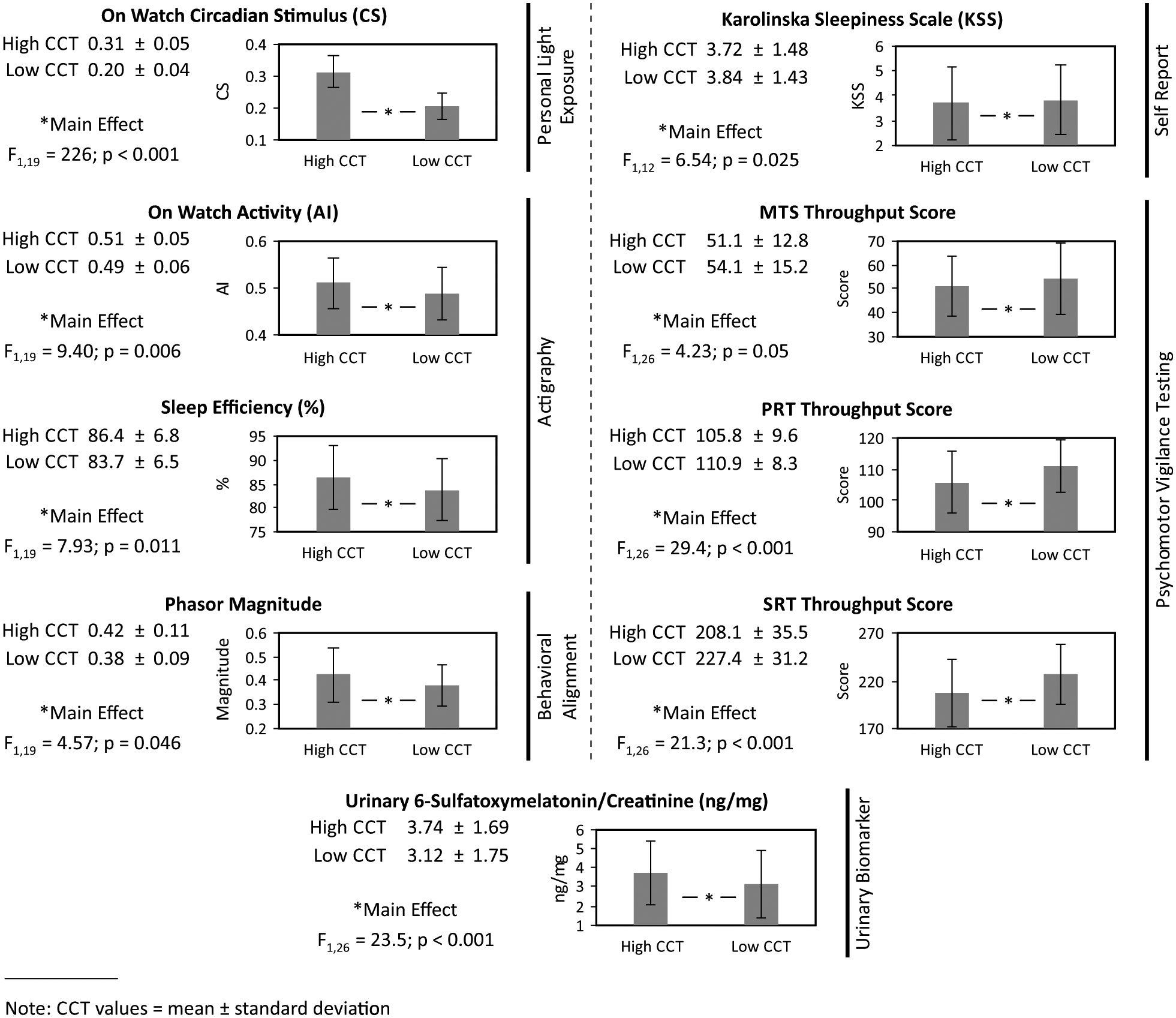
Mean ± standard deviation values for the outcome measures that revealed a significant main effect of light source type. Values for on-watch circadian stimulus (CS), on-watch activity index (AI), sleep efficiency, phasor magnitude, and urinary 6-sulfatoxymelatonin/creatinine (6SMT/Cr) ratios were significantly greater for the high correlated color temperature (CCT) light source session than for the low CCT light source session. Subjective sleepiness (Karolinska Sleepiness Scale [KSS] scores) was significantly lower for the high CCT light source session than for the low CCT light source session. Performance measures (Matching-to-Sample [MTS], Procedural Reaction Time [PRT], and Simple Reaction Time [SRT] throughput) were, however, significantly better for the low CCT light source session than the high CCT light source session, possibly due to practice effect, as discussed in the text.
Actigraphy
AI levels were determined for every subject while they were on watch, and the mean values were used in the ANOVA. The ANOVA revealed a main effect of light source type (F1,19 = 9.40; p = 0.006), but no other term was statistically significant. The mean ± SD on-watch AI was 0.51 ± 0.05 for the high CCT light source session and 0.49 ± 0.06 for the low CCT light source session (Figure 3).
Sleep efficiency and sleep onset latency scores were determined for all subjects, based on their average wrist activity during their self-reported time in bed, which was obtained from the sleep logs that crew members kept during the study. Sleep efficiency was operationally defined for this study as the percentage of the time that the wrist-activity data from the Daysimeter-D were scored as sleep during the reported time in bed. Activity was scored as sleep in a manner directly analogous to that performed by the Actiware-Sleep Version 3.4 (Mini Mitter, Bend, OR) software. Activity levels less than twice the background noise level for that particular subject were operationally scored as immobile and, therefore, as sleep. The start of sleep was defined as being the first 10-min period with 2 consecutive epochs scored as immobile after the reported in-bed time; the end of sleep was defined as the last 10-min period with one epoch not scored as immobile before the reported wake time. Sleep onset latency was defined as the duration from the self-reported in-bed time to the calculated sleep start time.
The ANOVA for sleep efficiency as defined for this study revealed that there was a significant main effect of light source type (F1,19 = 7.93; p = 0.011), but there were no other statistically significant effects. The mean ± SD sleep efficiency was 86.4% ± 6.8% for the high CCT light source session and 83.7% ± 6.5% for the low CCT light source session (Figure 3). No effects were significant with sleep latency as the dependent variable.
24-h Behavioral Alignment
The ANOVA using phasor magnitude as the dependent variable revealed main effects of light source type (F1,19 = 4.57; p = 0.046). The mean ± SD phasor magnitude was 0.42 ± 0.11 for the high CCT light source session and 0.38 ± 0.09 for the low CCT light source session (Figure 3). No other main effects or interactions were significant. There were no statistically reliable effects when phasor angle was the dependent variable. The mean ± SD phasor angle was 0.18 ± 0.65 h for the high CCT light source session and 0.08 ± 0.51 h for the low CCT light source session.
Karolinska Sleepiness Scale
A main effect of light source type (F1,12 = 6.54; p = 0.025) was obtained. The mean ± SD KSS values were 3.72 ± 1.48 for the high CCT light source session and 3.84 ± 1.43 for the low CCT light source session (Figure 3).
Psychomotor Vigilance Test (PVTest)
The ANOVA revealed a main effect of light source type for MTS throughput (F1,26 = 4.23; p = 0.05). The mean ± SD mean MTS throughput score was 51.1 ± 12.7 for the high CCT light source session, presented in the first session, and 54.1 ± 15.2 for the low CCT light source session, presented in the second session (Figure 3).
For PRT throughput, a main effect of light source type was revealed (F1,26 = 29.4; p < 0.001). The mean ± SD mean PRT throughput score was 105.8 ± 9.6 for the high CCT light source session, presented in the first session, and 110.9 ± 8.3 for the low CCT light source session, presented in the second session (Figure 3).
In addition, for SRT throughput, a main effect of light source type was revealed (F1,26 = 21.3; p < 0.001). The mean ± SD mean SRT throughput score was 208.1 ± 35.5 for the high CCT light source session, presented in the first session, and 227.4 ± 31.2 for the low CCT light source session, presented in the second session (Figure 3).
For all 3 performance measures, in addition to the main effect of light source type the ANOVAs revealed main effects of day and of time along with a variety of interactions among these independent variables. In fact, all of the ANOVAs showed statistically significant practice or learning effects throughout the study. Figure 4 illustrates these interacting temporal effects for SRT throughput.
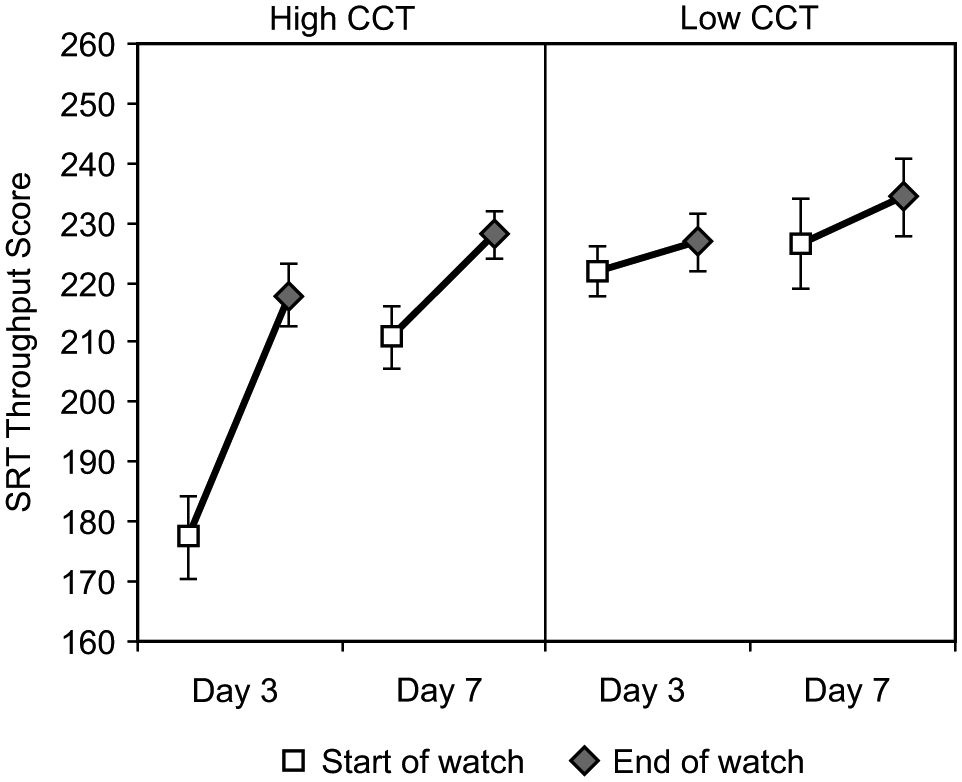
The analyses of variance (ANOVAs) revealed interacting temporal effects for Simple Reaction Time (SRT) throughput, including main effects and interactions between light source type, day, and time. Performance improved throughout the high correlated color temperature (CCT) light source session and the low CCT light source session. All ANOVAs showed statistically significant practice or learning effects throughout the study for every measure.
Urinary Biomarker
The ANOVA using urinary 6SMT/Cr ratios (Table 2) as the dependent variable revealed a main effect of light source type (F1,26 = 23.5; p < 0.001). The mean ± SD 6SMT/Cr ratios were 3.74 ± 1.69 ng/mg for the high CCT light source session and 3.12 ± 1.75 ng/mg for the low CCT light source session (Figure 3). There were significant differences between watchsections (F2,26 = 4.31; p = 0.024), but there was no significant interaction between light source type and watchsection. A post hoc Student’s t-test showed that WAHOO was significantly different from TANG.
Urinary 6-Sulfatoxymelatonin/Creatinine (6SMT/Cr) Ratios (ng/mg).
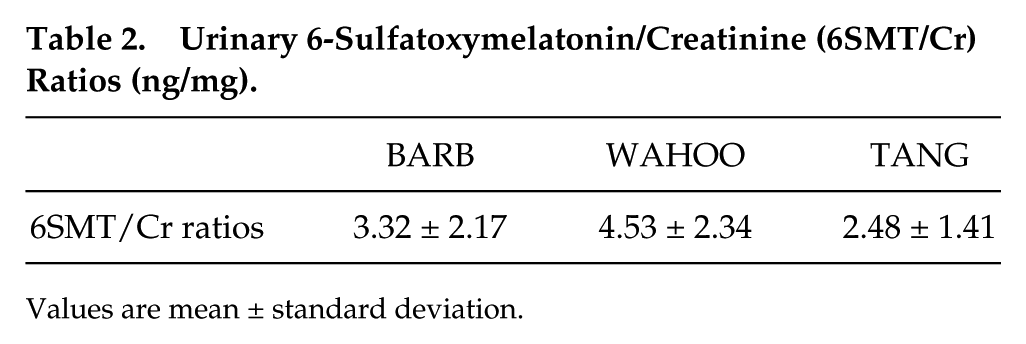
Values are mean ± standard deviation.
Discussion
The primary objective of this field study was to evaluate whether short-wavelength enhanced white light would promote circadian entrainment and thus improve sleep and performance for a USN submarine crew on a 24-h-based watchschedule. The 24-h watchschedule in itself has been demonstrated to improve circadian entrainment in submarine crews relative to the traditional 18-h watchschedule (Keller et al., 2011). Since entrainment of the human circadian system depends on retinal exposure to a regular 24-h light-dark cycle and since short-wavelength light is maximally effective at stimulating the human circadian system, it was hypothesized that the high CCT light source would promote greater entrainment than the low CCT light source currently used by the USN. The results of the present study suggest that exposure to high CCT light sources during the watch, combined with a 24-h watchschedule, improved behavioral alignment, as measured by phasor magnitudes. Other measures also suggest greater entrainment with the high CCT lamps, including higher melatonin concentrations in morning urine, lower self-reports of sleepiness (KSS), and greater sleep efficiency (Daysimeter-D actigraphy).
Phasor magnitudes were significantly greater during the high CCT light source session than during the low CCT light source session because the subjects’ 24-h light-dark exposure patterns were more aligned with their 24-h activity-rest patterns after exposure to the high CCT light source. Consistently, the Daysimeter-D actigraphy data showed that during the high CCT light source session, subjects exhibited greater activity while on watch (when CS was highest) and lower activity while asleep (when CS was lowest) than they did during the low CCT light source session. It should be noted that the greater phasor magnitudes were not simply an artifact of higher activity levels associated with the high CCT light sources. Normalizing the activity levels during the first, high CCT light source session to those in the second, low CCT light source session did not affect the statistically significant difference in phasor magnitudes obtained after exposure to each of the 2 lamp types. Sleep efficiency based on the scoring procedure developed for the wrist actigraphy data from the Daysimeter-D significantly increased by about 3% and KSS scores significantly decreased by 0.12 points after the high CCT light source session, suggesting better nighttime sleep and less daytime sleepiness while on watch. The practical significance of these small improvements is debatable, but these outcome measures were, importantly, consistent with the other activity-related outcome measures suggesting greater behavioral alignment when crew members experienced the high CCT light sources.
Results from these activity-related outcome measures were also consistent with those from the melatonin biomarker measure. 6SMT/Cr levels in the first urine void were 20% greater following sleep during the high CCT light source session than following sleep during the low CCT light source session.
Contrary to expectations, performance on the PVTest was worse for the high CCT light source session than for the low CCT light source session. These contradictory results are likely to have been due to practice; the high CCT light sources were installed before the low CCT light sources. Closer examination of performance revealed that throughput scores increased steadily throughout the study as subjects learned better methods to perform the test. Presumably, then, the performance measures did not converge with the other outcome measures simply because the light source type and session order were confounded. Given that this was a field study on an operational nuclear submarine, complete counterbalancing of the experimental conditions was simply not possible. Consequently, the present study has some limitations. As noted, a dominant practice effect probably explained the nonconverging, poorer performance associated with the high CCT light source. Perhaps another confounding factor, the brief in-port period (5 days) between the short baseline voyage and the first session (high CCT light source), also minimized the differences between the high and low CCT light sources. These potential limitations are, of course, an unavoidable consequence of the military preset operational schedule. In addition, the circadian phases of the subjects prior to the study and during the presumed washout periods were not known. Finally, the high CCT light sources were only tested in the submarine engine room, and the effects were evaluated only on the crew members working in that area. No changes to the lighting were undertaken in the rest of the submarine, so these results may not be strictly applicable to other areas of the ship.
In summary, despite the obvious limitations of a field study performed during military operations, the present results were consistent with fundamental knowledge of the effects of light on circadian rhythms. Notwithstanding the results of the short-duration performance measures, a 24-h watchschedule in combination with high CCT light sources designed to increase circadian entrainment appears to be beneficial to submarine crew members during undersea operations.
Footnotes
Acknowledgements
The authors thank Mr. Tony Reinhold, Mr. David Kerr, Mr. Andrew Way, Ms. Abaigeal Caras, Mrs. Theresa Delgado, Mrs. Gwen Jones, Ms. Barbara Plitnick, Ms. Rebekah Mullaney, Mr. Dennis Guyon, Mr. Andrew Bierman, and Master Chief Darrin Way for their help, support, and technical assistance in completing this protocol. GE Lighting (William Beers) is acknowledged for providing the light sources used in the study. A special note of appreciation belongs to Midshipmen Ethan Hahn, Logan Laporte, Raphael Erie, and Matthew Hitchcock who assisted in underway data collection. Finally, the authors thank Commander, Submarine Force, Submarine Group 2, Submarine Squadron 6, and especially CDR Seth Burton, USN, and the crew of USS Scranton (SSN756) for graciously hosting this research protocol amid a highly demanding operational schedule. Funding for this protocol was provided through a combination of grants from the Commander of Submarine Forces (N0002413WX10137), Navy Bureau of Medicine and Surgery (Form 2189-1 Direct Funding), and Office of Naval Research (N0001411WX21542, N0001408WR20041, and N0001408WR30182).
Author Contributions
CRY, MWK, AMR, MGF, MSR, and SES were the investigative team and oversaw the design and implementation of the study. CRY, GEJ, MGF, MSR, BJL, and SES oversaw data collection and analysis. All authors contributed to data interpretation and manuscript preparation.
Conflict of Interest Statement
GE Lighting provides financial support to Rensselaer Polytechnic Institute’s Lighting Research Center but not in activities directly related to the content of the paper. The authors declare no conflicts of interest.
Copyright Statement
The authors are military service members (or employees of the U.S. government). This work was prepared as part of official duties. Title 17 U.S.C. §105 provides that “Copyright protection under this title is not available for any work of the United States Government.” Title 17 U.S.C. §101 defines a U.S. government work as a work prepared by a military service member or employee of the U.S. government as part of that person’s official duties.
Disclaimer
The views expressed in this article are those of the authors and do not necessarily reflect the official policy or position of the Department of the Navy, Department of Defense, or the U.S. government.