




Abstract
Benzene, toluene, ethyl benzene, and xylene (BTEX) are prevalent pollutants in shoe industry-related workplaces. The aim of this study was to assess exposure to BTEX and their carcinogenic and non-carcinogenic risks in shoe-industry-related workplaces. This study was carried out at different shoe manufactures, small shoe workshop units, shoe markets, and shoe stores in Tabriz, Iran in 2021. Personal inhalation exposure to BTEX was measured using the National Institute for Occupational Safety and Health (NIOSH) 1501 method. Carcinogenic and non-carcinogenic risks due to inhalation exposure to BTEX were estimated by United States Environmental Protection Agency (U.S. EPA) method based on Mont Carlo simulation. Results showed that the concentrations of benzene and toluene were higher than the threshold limit value (TLV) in both gluing and non-gluing units of shoe manufactures. The total carcinogenic risk (TCR) due to exposure to benzene and ethyl benzene was considerable in all shoe industry-related workplaces. Also, the hazard index (HI) as a non-carcinogenic index was higher than standard levels in all shoe industry-related workplaces. Therefore, shoe industry-related workers are at cancer and non-cancer risks due to exposure to BTEX. Prevention measures need to be implemented to reduce the concentration of BTEX in shoe industry-related workplaces.
Keywords
Introduction
The shoe industry has been developing in various countries to the present (Markkanen et al., 2017; Office and Programme, 1991). This development provides employment for many people in this industry (Huang et al., 2008; Martínez-Mora and Merino, 2014). However, workers in this industry are at a risk of exposure to toxic solvent vapors (Gangopadhyay et al., 2011; Mamillapalli and Pasumarthi, 2021).
Exposure to various chemical contaminants is a noticeable health hazard in the shoe industry (Paiva et al., 2016). Benzene, toluene, ethyl benzene, and xylene (BTEX) are prevalent pollutants in shoe industry-related workplaces (Hajrah et al., 2018; Li et al., 2019; Maryiantari and Keman, 2020; Norjannah et al., 2021).
Numerous studies have pointed to the adverse health effects of these solvents (Latif et al., 2019). Benzene has been identified by the International Agency for Research on Cancer (IARC) as a definitive carcinogenic substance (group I) (Cogliano et al., 2010). Benzene could induce toxic effects in blood-forming organs (D’Andrea and Reddy, 2014; Galbraith et al., 2010; Smith, 2010). Toluene is a well-known solvent that can cause different nervous system disorders, hepatotoxic effects, nephrotoxicity, and even immunological changes (Abouee-Mehrizi et al., 2020a, 2020b, 2021; Benignus, 1981). Exposure to ethyl benzene results in different respiratory effects from throat irritation and chest constriction to irritation of the eyes (Huff et al., 2010; Saghir et al., 2009). Moreover, some neurological effects such as dizziness are induced by ethyl benzene (Faber et al., 2007; Li et al., 2010).
Health risk assessment of environmental and occupational pollutants is one of the important methods to identify and prevent diseases that are caused by occupational and environmental exposures (Ghaderpoori et al., 2020; Mohammadian and Nasirzadeh, 2021; Nasirzadeh et al., 2020). The Environmental Protection Agency (EPA) recommended a method for health risk assessment of exposure to pollutants (EPA, 2004; 2011; Means, 1989). The Monte Carlo simulation is an important and widely used modeling method in various fields, including estimation of health risk (Bazeli et al., 2020; Huang et al., 2010; McNally et al., 2012; Péry et al., 2010). This simulation method can be used with acceptable and appropriate accuracy to predict phenomena with uncertainty and systems with a degree of freedom (Raychaudhuri, 2008). The Monte Carlo simulation is very effective and accurate in estimating the risk of carcinogenic and non-carcinogenic effects of exposure to BTEX (Hesari et al., 2022; Mohammadian and Nasirzadeh, 2021; Nazarparvar-Noshadi et al., 2021; Nasirzadeh et al., 2021; Soltanpour et al. 2021).
In recent years, numerous studies have been conducted to examine the importance of chemical risk assessment in various occupations (Fan and Xu, 2021; Landberg et al., 2018). There are limited studies on health risks due to exposure to BTEX in different shoe industry-related workplaces, especially small shoe workshop units, shoe markets, and shoe stores. Therefore, this study evaluated the concentration and carcinogenic and non-carcinogenic risks of exposure to BTEX in shoe industry-related workplaces.
Materials and method
Target population
This cross-sectional study was performed in different small shoe workshops, shoe manufacturing units, the old shoe market of Tabriz, and shoe stores in Tabriz, Iran in 2021. A total of 10 air samples from five small shoe workshop workers, 23 air samples from five manufactory workers, three samples from three old shoe market workers, and three samples from shoe store workers were taken. In shoe workshops, workers assembled and repaired shoes. In shoe manufactories, tasks were last making, pattern cutting, sewing, assembling, and finishing. In the last making stage, based on the comfort and shape of the required shoe, the lasts are made from wood or plastics. At the cutting stage, the leather was cut with special scissors. In the next stage, workers glued the cut pieces to the sole of the shoe and sew. After that, by using glue, the upper part was assembled to the sole. Finally, the shoes were polished and packed. Because of the widespread activities and uses of chemicals in the shoe manufactories, workers were divided into two groups based on the use of glues, including a gluing unit and the non-gluing unit. In old shoe market and shoe stores, the workers all sold shoes.
Personal monitoring process
This study was approved by the ethics committee at Tabriz University of Medical Sciences (IR.TBZMED.REC.1398.546). Personal exposure to BTEX was measured according to the improved NIOSH 1501 method (Mohamadyan et al., 2019; Sciences HDoP, 1994). Briefly, a calibrated personal sampler was located in the respiratory area of the personnel using charcoal sorbent samplers. The flow rate and time of sampling were 0.2 L/min for 45 min, respectively. Afterward, the samples were desorbed using carbon disulfide (CS2) and analyzed by a gas chromatograph (GC) provided with a flame ionizing detector (FID). Standard retention times of contaminants were determined using prepared standard solutions of BTEX in CS2. Finally, the samples were analyzed and evaluated on the conditions of a GC device (the flow rate of helium carrier gas: 30 mL/min, the temperature of injector: 200°C, the temperature of the column: 130°C, and the temperature of the detector: 210°C).
Carcinogenic risk assessment
Carcinogenic and non-carcinogenic risks of pollutants were estimated to determine the health risk of BTEX. Exposure concentration (ECinh) through inhalation was calculated as the below equation (EPA, 2004, 2011; Means, 1989):

Input parameters to estimate inhalation carcinogenic and non-carcinogenic risks.
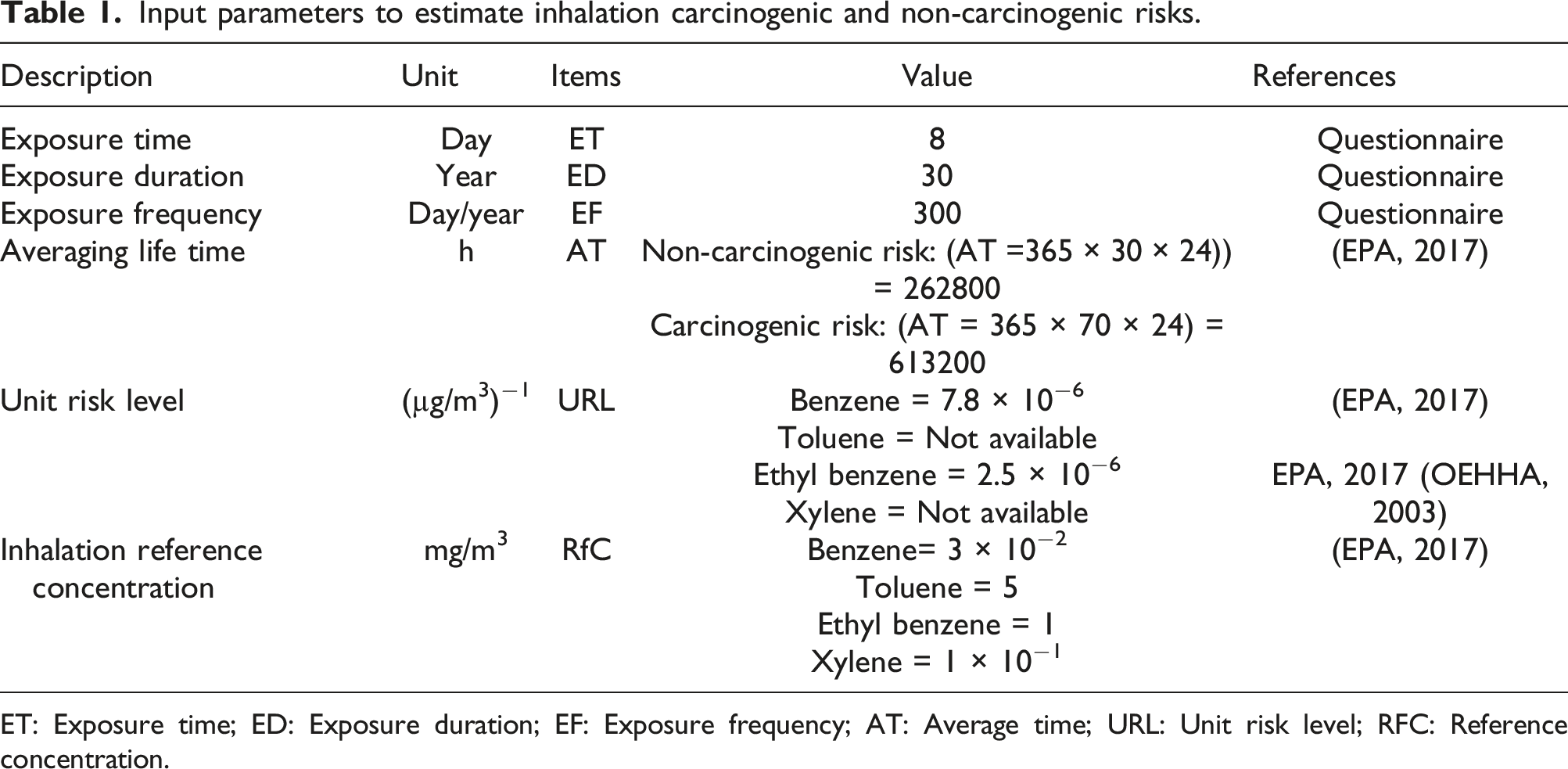
ET: Exposure time; ED: Exposure duration; EF: Exposure frequency; AT: Average time; URL: Unit risk level; RFC: Reference concentration.
Carcinogenic risk (CR) of BTEX was assessed via the below equation (Abtahi et al., 2018; EPA, 2011):
Accumulative effects of air pollutants as carcinogenic hazard were determined through total carcinogenic risk (TCR) as the below equation (EPA, 2004, 2011):
Non-carcinogenic risk assessment
The non-carcinogenic risk assessment was calculated as a hazard quotient (HQ), which is defined in the equation below (EPA, 2011):
Owing to the additive toxicity interaction of combined exposure to BTEX on damage to the central nervous system, additive effects of air pollutants in the non-carcinogenic hazard assessment were calculated via the hazard index (HI) as the equation below (EPA, 2011):
Monte Carlo simulations that are recommended by the U.S. EPA for estimating health risks of exposure to pollutants were used in this study to decrease uncertainty and attain a confidence range of CR and HQ (Dehghani et al., 2019; EPA, 2011). The means and standard deviations of concentration, EC, HQ, and CR equations were used in Monte Carlo simulations, and the simulations were applied with 10,000 replicates using Oracle Crystal ball software (version 11.1.2) (EPA, 2017; Nazarparvar-Noshadi et al., 2021; Rubinstein and Kroese, 2016). Moreover, the criterion to determine the condition risk of the population exposed to the pollutants was percentile 95% of TCR and HI (Fakhri et al., 2019; Nazarparvar-Noshadi et al., 2021).
Statistical analysis
Data were analyzed by SPSS software (IBM SPSS Statistics for Windows, Version 26). Values are presented as mean and standard deviation (SD).
Results
Exposure assessment
Concentration of benzene, toluene, ethyl benzene, and xylene (BTEX) (µg/m3) in air samples of shoe manufactories, shoe markets, shoe stores, and small shoe workshop units.
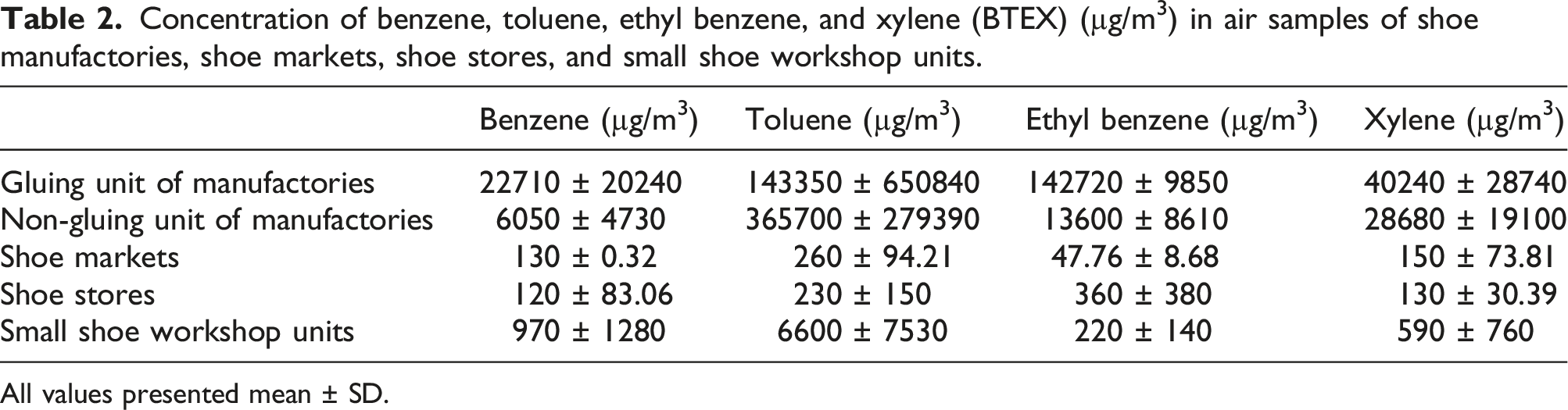
All values presented mean ± SD.
Non-carcinogenic risk assessment
Cancer risk and non-cancer risk due to inhalational exposure to benzene, toluene, ethyl benzene, and xylene (BTEX) in shoe manufactories, shoe markets, shoe stores, and small shoe workshop units.
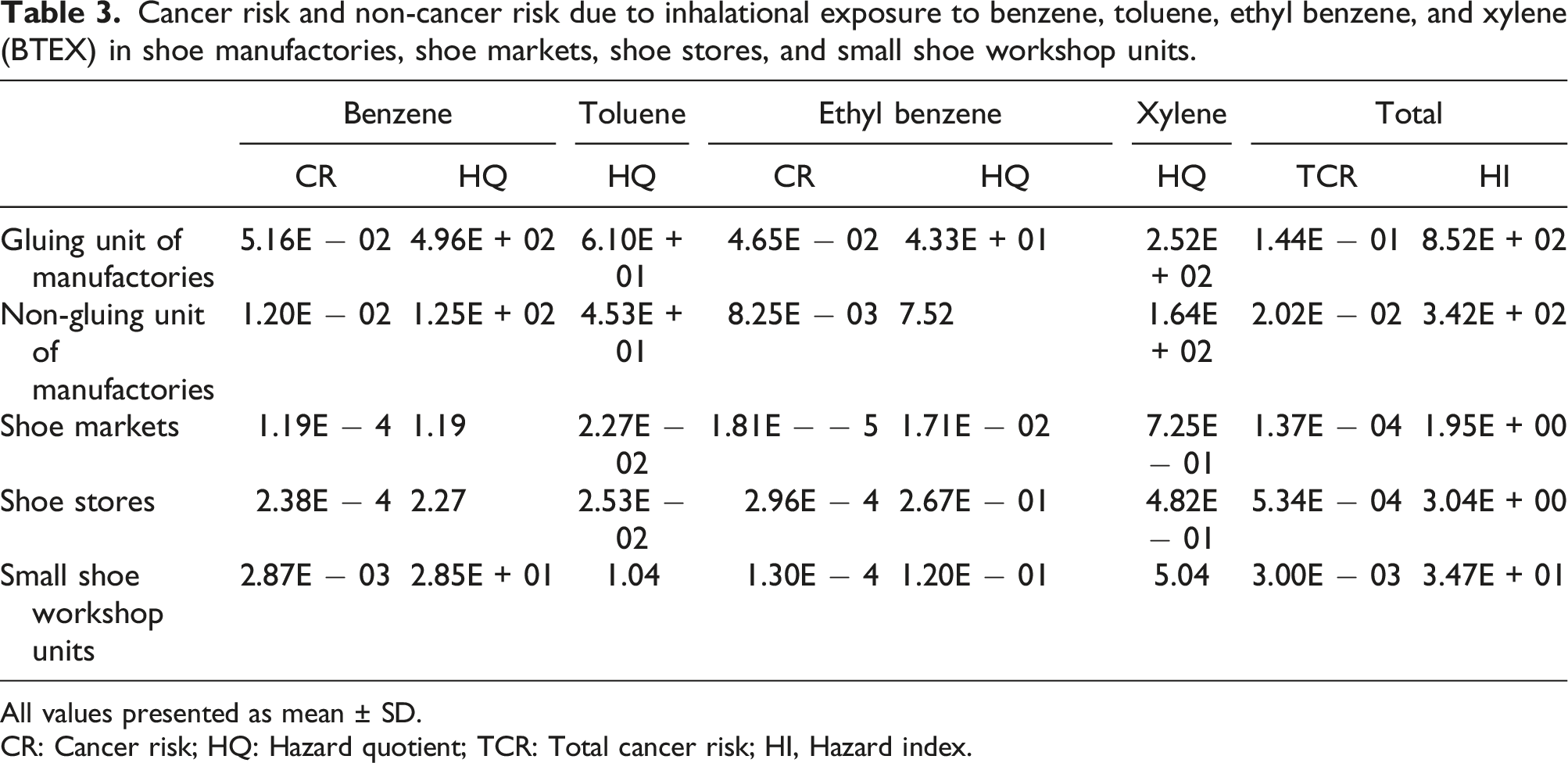
All values presented as mean ± SD.
CR: Cancer risk; HQ: Hazard quotient; TCR: Total cancer risk; HI, Hazard index.
Results showed that HI, as a non-carcinogenic risk index, was higher than the value of “1” (higher than standard level) in all measured workplaces. The non-carcinogenic risk in gluing units and non-gluing units of shoe manufactories was higher than in shoe stores, shoe markets, and shoe workshops.
Probability of CR (cancer risk) and HQ (hazard quotient) exceeding from the standard level in shoe manufactories, shoe markets, shoe stores, and small shoe workshop units.
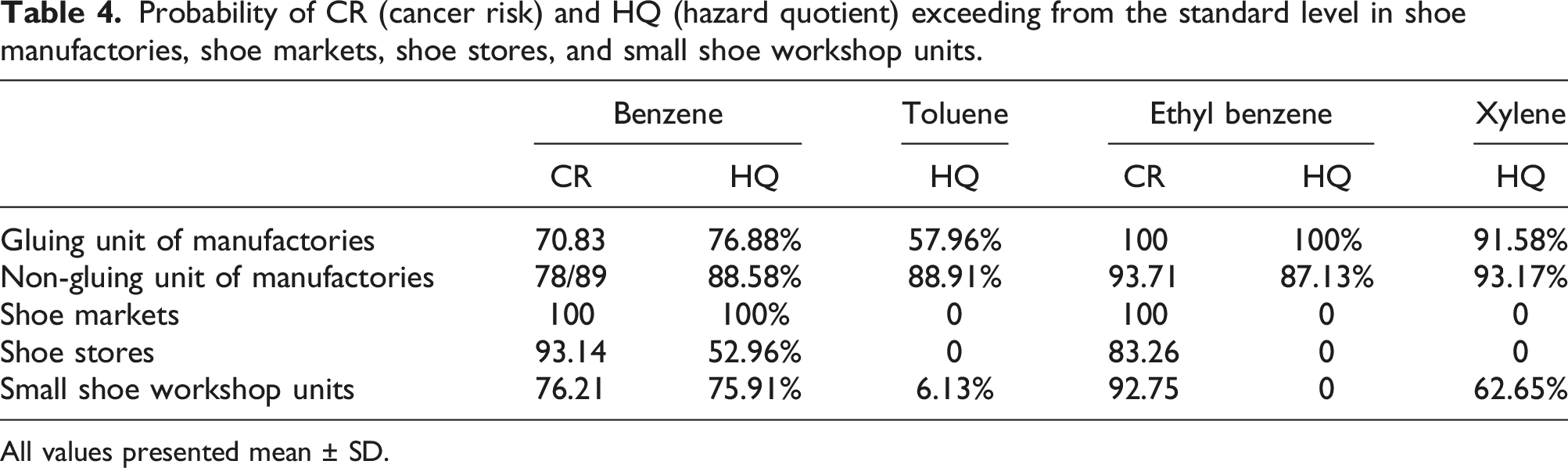
All values presented mean ± SD.
Carcinogenic risk assessment
Table 3 shows the risk of carcinogenic effects caused by BTEX exposure in shoe markets, shoe stores, and small shoe workshop units. Results showed that the total carcinogenic risk (TCR) was greater than the value of “1.00 × 10⁻⁴” in all studied workplaces. Therefore, carcinogenic risk was considerable in all studied workplaces. The cancer risk in gluing and non-gluing units in shoe manufactories was more than in shoe markets, shoe stores, and shoe workshops.
Table 4 shows the probability of CR exceeding the standard level. The probability of CR exceeding “1.00 × 10⁻⁶ was more than 75% for benzene and ethyl benzene in all studied workplaces.
Discussion
Results of the current study showed that the concentrations of benzene and toluene were higher than TLV in shoe manufactories. Maryiantari and Keman (2020) showed that toluene concentration was greater than the TLV value of 20 ppm (138.88 ppm) for some footwear craftsmen in Surabaya (Maryiantari and Keman, 2020). Azari et al. (2012) showed that workers were exposed to benzene greater than TLV (were exposed to 1.10 ± 0.11, 1.37 ± 0.14, and 1.52 ± 0.18 ppm from October to December, respectively) in Tehran (Azari et al., 2012). The variation in the levels of BTEX in each work location can be due to the amount of shoe production, type of raw materials used, quantity of glue used, work methods, inadequate ventilation, and work station either indoor or outdoor (Azari et al.,2012; Farshad et al. 2014).
This study indicated that non-carcinogenic risk was greater than standard levels in shoe workshops, shoe manufactories (gluing and non-gluing units), and shoe stores. In line with results of the present study on non-cancer risk due to exposure to BTEX in shoe stores, Lim et al. (2014) showed that exposure to BTEX via some consumer products, including toys, shoes, shoe polish, leather cleaner, and some other products, exceeded the safe limits; for example, HI for ethyl benzene was 31.1 and for xylene was 12.85, greater than 1 for both substances in 207 consumer products (Lim et al., 2014).
The carcinogenic risk was considerable in all studied workplaces. In line with results of the preset study, Savira et al. (2021) reported that inhalation exposure to benzene and toluene could lead to carcinogenic effects and put a high carcinogenic risk in three small footwear industries in Bogor-Indonesia (Savira et al., 2021). Another study showed that the carcinogenic risk of several volatile organic compounds was greater than 10−4, especially for benzene, bromodichloromethane, ethyl benzene, and 1,1,2-trichloroethane in rubber footwear industries in China (Li et al., 2019). Li et al. (2019) concluded that definite cancer risks should be noticed for personnel in rubber footwear workshops in China (Li et al., 2019). Maryiantari et al. (2016) disclosed that the level of non-cancer risk due to exposure to toluene was greater than the standard level for 10 people in the shoe industry in Tambak Oso Wilangun, Surabaya (Maryiantari et al., 2016). In a previous study in Turkey, leukemia incidence was found in Turkish shoemakers at 13/100,000 (Aksoy et al., 1974). Previous studies showed that some indoor places in Iran such as gyms (Dehghani et al., 2019), printing and copying centers (Rostami et al., 2021), and beauty salons (Baghani et al., 2018) can be potential sources of exposure to BTEX and increase the risk of health problems. Hajrah et al. (2020) demonstrated that in the footwear industry with exposure to benzene, 11.5% of workers had a real-time non-cancer risk as well as a 21.9% cancer risk (Hajrah et al., 2020). The differences in health risk in different studies can be because of the amount of shoe production, type of raw materials used, quantity of glue used, work methods, inadequate ventilation, and work station either indoor or outdoor (Azari et al.,2012; Farshad et al. 2014).
The limitation of current study was financial constraints on collecting large numbers of samples.
Conclusions
This study showed that the concentrations of benzene and toluene were higher than TLV in different shoe manufactories. Furthermore, it was revealed that carcinogenic and non-carcinogenic risks due to BTEX in shoe industry-related workplaces were significant. This study showed that it is necessary to implement prevention measures such as installation of ventilation systems to reduce BTEX-related health risks in shoe industry-related workplaces.
Footnotes
Acknowledgments
We appreciate the Department of Occupational Health Engineering, Faculty of Health, Tabriz University of Medical Sciences.
Declaration of conflicting interests
The author(s) declared no potential conflicts of interest with respect to the research, authorship, and/or publication of this article.
Funding
The author(s) disclosed receipt of the following financial support for the research, authorship, and/or publication of this article: This research was financially supported by Health and Environment Research Center, Tabriz University of Medical Sciences, Tabriz, Iran, with grant number of 62758.
