

Restricted accessResearch articleFirst published online 2023-3
Removal of lithium from aqueous solutions by solid-phase extraction using sawdust loaded with magnetite nanoparticles and study of apoptosis,MDA and 8-OHdG caused by lithium toxicity in fish brain
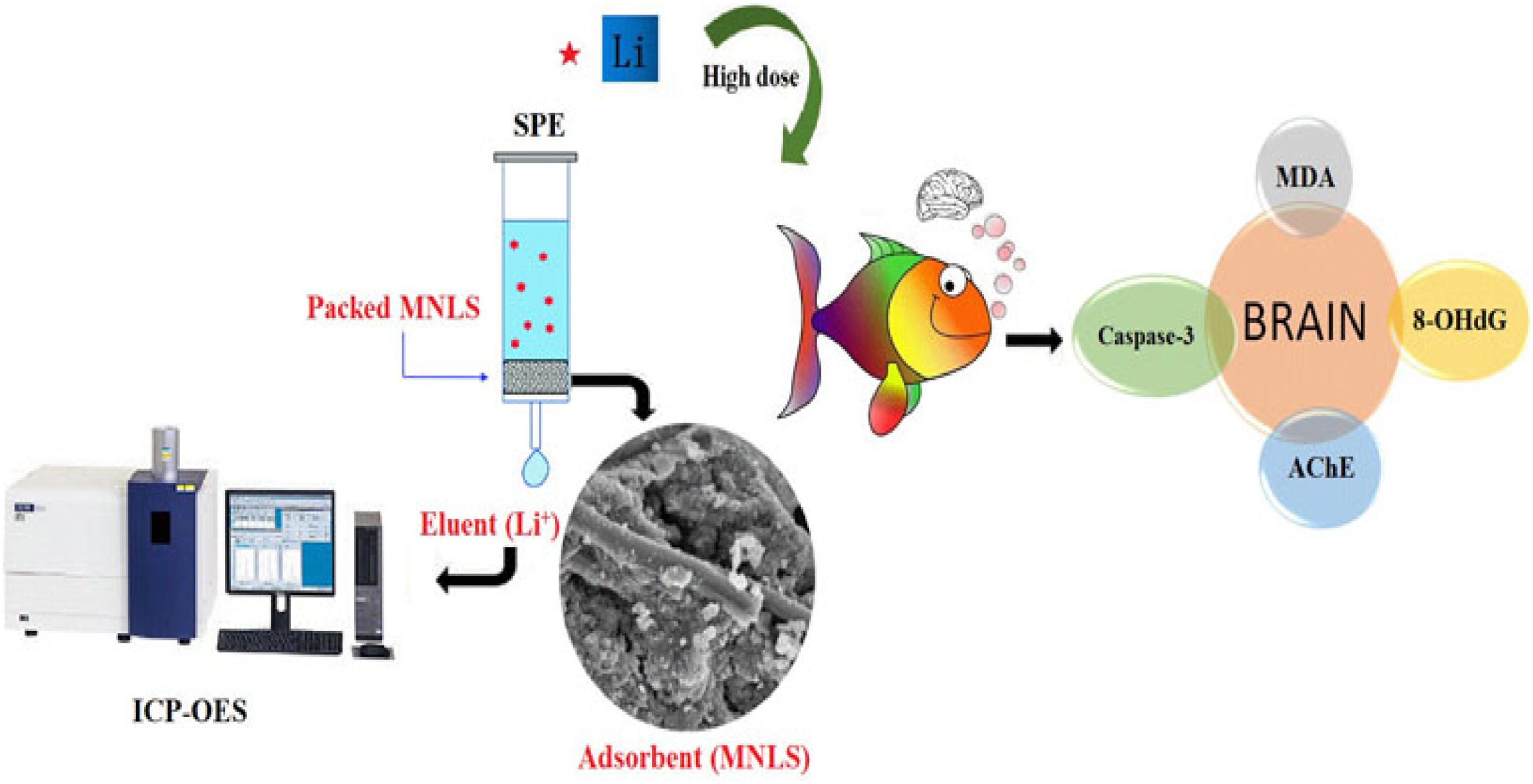
Lithium, which has a high industrial value, is an environmental pollutant of concern to those who work with lithium in industry as well as to the general public. Biological parameters such as MDA, 8-OHdG, apoptosis (caspase-3), and acetylcholinesterase (AChE) were studied to determine the toxic effects on the brain tissue of the model organism (Carassius auratus) exposed to high dose lithium. According to the results obtained, it was found that lithium exposure caused oxidative stress with an increase in MDA level over time and, accordingly, DNA damage and apoptosis occured in brain tissue. It was also found that a decrease in AChE activity was observed, and the high levels of MDA, 8-OHdG, and caspase-3 activity obtained in brain tissue supported this result. The solid phase extraction (SPE) method was used to effectively remove lithium, which has unfavorable effects on living organisms, from aqueous solutions. In this method, a sawdust loaded with magnetite nanoparticles (MNLS) was prepared as an adsorbent for solid phase extraction by a simple method, and it was characterized. Optimal conditions for the SPE process were defined and it was found that lithium could be removed from solution onto the MNLS surface with a high yield of about 96%. The results of the study are crucial for proposing a simple and applicable high performance method.
AlakGParlakVAslanME, et al. (2018) Borax supplementation alleviates hematotoxicity and DNA damage in rainbow trout (Oncorhynchus mykiss) exposed to copper. Biological Trace Element Research187: 536–542.
2.
ArmstrongARBrucePG (1996) Synthesis of layered LiMnO2 as an electrode for rechargeable lithium batteries. Nature381: 499–500.
3.
ArvandMHassannezhadM (2014) Magnetic core–shell Fe3O4@SiO2/MWCNT nanocomposite modified carbon paste electrode for amplified electrochemical sensing of uric acid. Materials Science & Engineering36: 160–167.
4.
ChitrakarRKanohHMiyaiY, et al. (2001) Recovery of lithium from seawater using manganese oxide adsorbent (H1.6Mn1.6O4) derived from Li1.6Mn1.6O4. Industrial & Engineering Chemistry Research40: 2054–2058.
5.
CiftciH (2014) Separation and adsorption properties of poly styrene-graft-ethyl methacrylate copolymer for zinc, copper and cobalt ions in water samples. Polymer Engineering & Science54: 1555–1559.
6.
ÇiftçiHErÇ (2015) Solid phase extraction of lithium ions from water samples using K-birnessite with layer-structure material form (KBRLSM). Desalination and Water Treatment56: 216–222.
7.
Çilingir YeltekinAOğuzAR (2018) Antioxidant responses and DNA damage in primary hepatocytes of Van fish (Alburnustarichi, Güldenstadt 1814) exposed to nonylphenol or octylphenol. Drug and Chemical Toxicology41: 415–423.
8.
DeckbarDJeggoPALöbrichM (2011) Understanding the limitations of radiation induced cell cycle checkpoints. Critical Reviews in Biochemistry and Molecular Biology46: 271–283.
9.
DincerYKankayaS (2010) Comet assay for determining of dna damage: review. Turkiye Klinikleri Journal of Medical Sciences30: 1365–1373.
10.
DonaldDA (1998) Autonomic nervous system. In: EvansDH (ed) The Physiology of Fishes. Boca Raton, FL: CRC Press, Vol. 2, 407–439.
11.
EbenspergerAMaxwellPMoscosoC (2005) The lithium industry: its recent evolution and future prospects. Resources Policy30: 218–231.
12.
EllmanGLCourtneyKDAndresV, et al. (1961) A new and rapid colorimetric determination of acetylcholinesterase activity. Biochemical Pharmacology7: 88–95.
13.
EnsafiAARabieiSRezaeiB, et al. (2013) Magnetic solid-phase extraction to preconcentrate ultra trace amounts of lead(II) using modified-carbon nanotubes decorated with NiFe2O4 magnetic nanoparticles. Analytical Methods5: 3903–3908.
14.
EntringerJReimannMNormanA, et al. (2019) Influence of Cu/Li ratio on the microstructure evolution of bobbin-tool friction stir welded Al–Cu–Li alloys. Journal of Materials Research and Technology8: 2031–2040.
15.
Ferna´ndez-VegaCSanchoEFerrandoMD, et al. (2002) Thiobencarb-Induced Changes in Acetylcholinesterase Activity of the Fish Anguilla anguilla. Pesticide Biochemistry and Physiology72: 55–63.
16.
FernandoIPSSanjeewaKKAKimHSet al. (2017) Apoptotic and antiproliferative properties of 3β- hydroxy-Δ5- steroidal congeners from a partially purified column fraction of Dendronephthya gigantea against HL-60 and MCF-7 cancer cells. Journal of Applied Toxicology1–10.
17.
GaoJDuZZhaoQ, et al. (2021) Enhanced Li+ adsorption by magnetically recyclable iron-doped lithium manganese oxide ion-sieve: synthesis, characterization, adsorption kinetics and isotherm. Journal of Materials Research and Technology13: 228–240.
18.
KazemiEHaji ShabaniAMDadfarniaS (2015) Synthesis and characterization of a nanomagnetic ion imprinted polymer for selective extraction of silver ions from aqueous samples. Microchimica Acta182: 1025–1033.
19.
KhanSTMalikA (2019) Engineered nanomaterials for water decontamination and purification: from lab to products. Journal of Hazardous Materials363: 295–308.
20.
LiWShiCZhouA, et al. (2017) A positively charged composite nanofiltration membrane modified by EDTA for LiCl/MgCl2 separation. Separation and Purification Technology186: 233–242.
21.
LiYDuQLiuT, et al. (2013) Methylene blue adsorption on graphene oxide/calcium alginate composites. Carbohydrate Polymers95: 501–507.
22.
LiuGZhaoZHeL (2020) Highly selective lithium recovery from high Mg/Li ratio brines. Desalination474: 114185.
23.
MadhusudhanBK (2014) Nonconvulsive status epilepticus and Creutzfeldt–Jakob-like EEG changes in a case of lithium toxicity. Epilepsy & Behavior Case Reports (EBCR)2: 203–205.
24.
MadrakianTAfkhamiAAhmadiM (2012) Adsorption and kinetic studies of seven different organic dyes onto magnetite nanoparticles loaded tea waste and removal of them from wastewater samples. Spectrochimica Acta. Part A, Molecular and Biomolecular Spectroscopy99: 102–109.
25.
MohanDSarswatASinghVK, et al. (2011) Development of magnetic activated carbon from almond shells for trinitrophenol removal from water. Chemical Engineering Journal172: 1111–1125.
26.
MoosaviSLaiCWGanS, et al. (2020) Application of efficient magnetic particles and activated carbon for dye removal from wastewater. ACS Omega5: 20684–20697.
27.
NikiEYoshidaYSaitoY, et al. (2005) Lipid peroxidation: mechanisms, inhibition, and biological effects. Biochemical and Biophysical Research Communications338: 668–676.
28.
PanneerselvamPMoradNTanKA (2011) Magnetic nanoparticle (Fe3O4) impregnated onto tea waste for the removal of nickel (II) from aqueous solution. Journal of Hazardous Materials186: 160–168.
29.
PengRLiYSuH, et al. (2020) Experiment and calculation: the Li(Zn, Mn)PO4 solid solution ceramics with low dielectric constant, high quality factor, and low densification temperature. Journal of Alloys and Compounds842: 155709.
30.
PershinaSVAntonovBDFarlenkovAS, et al. (2020) Glass-ceramics in Li1þxAlxGe2-x(PO4)3 system: the effect of Al2O3 addition on microstructure, structure and electrical properties. Journal of Alloys and Compounds835: 155281.
31.
PlacerZACushmanLLJohnsonBC (1966) Estimation of product of lipid peroxidation (malonyl dialdehyde) in biochemical systems. Analytical Biochemistry16: 359–364.
32.
RyuTShinJGhoreishianSM, et al. (2019) Recovery of lithium in seawater using a titanium intercalated lithium manganese oxide composite. Hydrometallurgy184: 22–28.
33.
SwainB (2017) Recovery and recycling of lithium: a review. Separation and Purification Technology172: 388–403.
34.
TomatırAG (2003) Apoptosıs: programmed cell death. Turkiye Klinikleri Journal of Medical Sciences23: 499–508.
35.
TopalAAlakGAltunS, et al. (2017) Evaluation of 8-hydroxy-2 deoxyguanosine and NFkB activation, oxidative stress response, acetylcholinesterase activity, and histopathological changes in rainbow trout brain exposed to linuron. Environmental Toxicology and Pharmacology49: 14–20.
36.
WangSZhengSWangZ, et al. (2018) Superior lithium adsorption and required magnetic separation behavior of iron-doped lithium ion-sieves. Chemical Engineering Journal332: 160–168.
37.
ZhangYHuYWangL, et al. (2019) Systematic review of lithium extraction from salt-lake brines via precipitation approaches. Minerals Engineering139: 105868.
38.
ZhouZFanJLiuX, et al. (2020) Recovery of lithium from salt-lake brines using solvent extraction with TBP as extractant and FeCl3 as co-extraction agent. Hydrometallurgy191: 105244.