




Abstract

Australia has long faced challenges in addressing the aspirations and rights of its First Nations peoples and in leveraging their profound knowledge and skills. We explore issues of equity and justice in this ongoing process, before examining the potential benefits and mechanisms of embedding Indigenous perspectives more deeply into Australia's marketplace and policy frameworks.
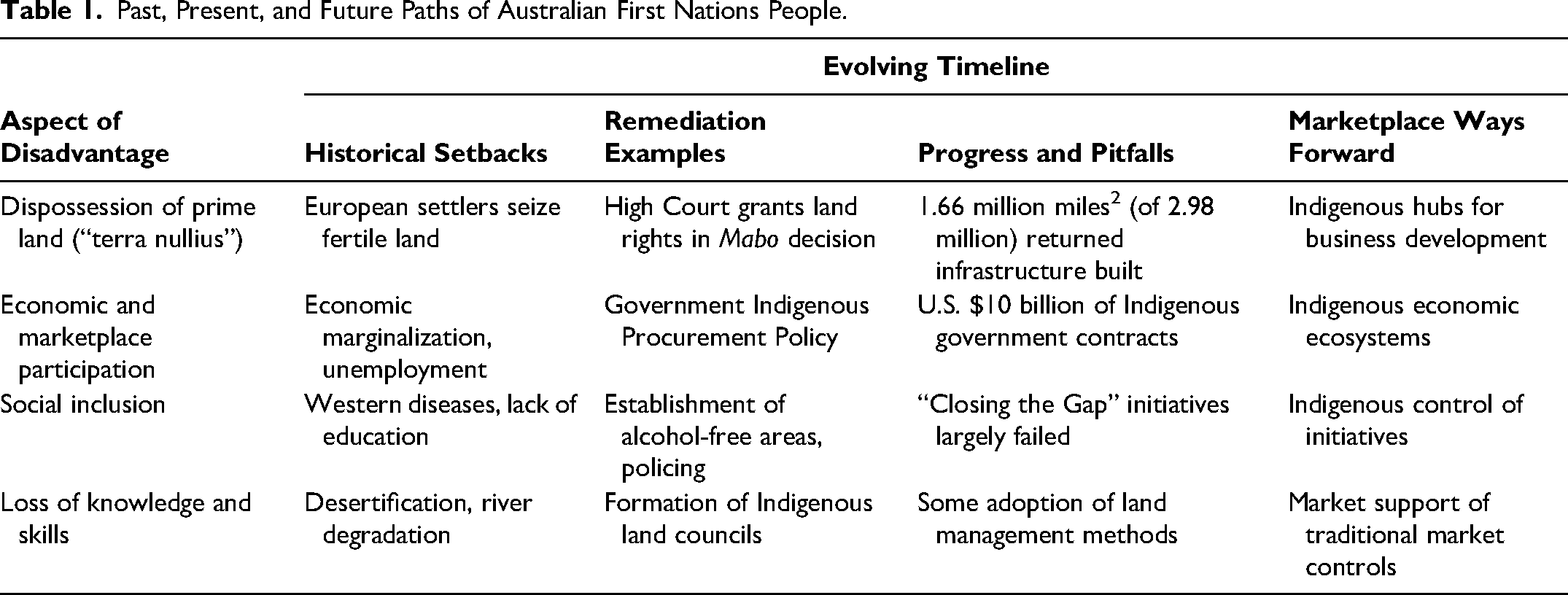
By considering the cultural imperatives of diverse First Nations groups—including their enduring relationships with Country—we identify pathways toward self-determination that offer economic and cultural growth opportunities for all Australians. These issues are of critical importance to Australian society, and they hold relevance for societies worldwide facing challenges of justice, inclusion, and Indigenous rights. The issues are summarized in Table 1, which outlines the development of this article.
Past, Present, and Future Paths of Australian First Nations People.
Historical Context
British colonization in Australia commenced on January 26, 1788, at Botany Bay. Colonizers invoked the legal concept of “terra nullius”—falsely deeming the land unoccupied due to the perceived nomadic nature of Indigenous peoples, thus justifying widespread land dispossession.
Colonial violence took multiple forms, including frontier massacres, forced removals from Country, destruction of food systems and water sources, and use of policing to confine First Nations peoples to reserves and missions. Together with dispossession, diseases to which Indigenous populations had no immunity caused catastrophic population decline.
Progress toward substantive citizenship and equal rights for First Nations peoples occurred through slow, fragmented, incremental legal changes rather than by coordinated reform. The Commonwealth Electoral Act 1962 provided all Aboriginal and Torres Strait Islander people the right to enroll and vote in federal elections. The 1967 referendum enabled the Commonwealth to legislate to assist Aboriginal and Torres Strait Islander peoples and include them in the census. Since the original British colonization, successive waves of immigration have occurred, with Italian, Greek, Lebanese, Filipino, Vietnamese, Chinese, Indian, and other communities often achieving greater economic and social prosperity than many First Nations peoples. In 1992, the High Court's landmark Mabo decision overturned the terra nullius concept and recognized native title, enabling gradual recognition of native title rights, albeit limited by stringent evidentiary and legal requirements. By 2024, 1.66 million square miles (of a total of 2.98 million) had been returned under native title claims (albeit not the most productive land).
Contemporary Landscape
As of 2026, the picture remains mixed. Formal legal discrimination has been substantially eliminated. In 2008, the prime minister delivered a historic national apology in Parliament for past wrongs, particularly the forced removal of children from their families during the Stolen Generations era.
Nevertheless, profound disparities persist in economic, educational, and health outcomes. According to recent data from the Australian Bureau of Statistics (2023) and the Australian Institute of Health and Welfare (2025), the life expectancy gap at birth between First Nations and non-Indigenous Australians stands at approximately 8.8 years for males and 8.1 years for females. Additional challenges include significantly higher rates of incarceration (with targets aiming for a 15% reduction by 2031, yet showing limited progress), lower school attendance, and ongoing health inequities.
Government-led efforts under the National Agreement on Closing the Gap have attracted substantial resources but have achieved only mixed results, with most targets not on track (Productivity Commission 2025).
In summary, the success of current initiatives is at best patchy; many economic and marketplace initiatives (such as programs associated with implementation of the Indigenous Procurement Policy [IPP]) have demonstrated at least some modest success, while the social indicators necessary to support them (such as education and Indigenous incarceration rates) have proven stubborn and even gone backward (Mokak and Siegel-Brown 2024). We argue that this is less a case of insufficient funding and more one of cultural misalignment. Western solutions, no matter how well intentioned, are unlikely to be successful when mandated from afar.
Harnessing First Nations Wisdom
Australia is the world's driest inhabited continent, with a harsh, fragile environment. For tens of thousands of years, First Nations peoples have sustained complex relationships with this land through fire regimes, seasonal calendars, and custodial governance, preventing widespread soil and water degradation. These knowledge systems are increasingly recognized as vital in responding to climate change, drought, bushfires, and water scarcity threats.
Culturally, Indigenous traditions in storytelling, dance, art, astronomy, and seasonal knowledge offer rich insights into collective well-being, contrasting with Western individualism. These perspectives can inform Western responses to rising inequality (evidenced by increasing Gini coefficients) and crises of social cohesion.
Pathways Forward for First Nations Peoples
The need for fundamentally different approaches is evident. Advancing Indigenous-led policy and economic participation is not only a matter of justice but also a strategic investment in Australia's long-term social, economic, and environmental prosperity and resilience. Decades of conventional, externally designed interventions have been costly, yet have delivered limited improvements in outcomes. Tomorrow's solutions must accommodate the heterogeneity of First Nations aspirations: Some communities prioritize living on Country and cultural continuity, others pursue livelihoods in urban and mainstream marketplace contexts, and many seek hybrid models.
Policy design must begin with Indigenous-led governance and definitions of success, rather than Western assumptions about growth, productivity, or profit maximization. For instance, community well-being, employment on Country, intergenerational responsibility, and cultural continuity may outweigh narrow economic metrics. Barriers to participation—such as limited access to education, finance, and infrastructure, and policy settings that fail to accommodate cultural responsibilities—are destined to fail. Social benefits of paying attention to such sensitivities will include stronger regional economies, reduced incarceration and health costs, and improved social cohesion.
Pathways forward must address cultural, legal and economic dimensions. In cultural terms, Australia voted on a history-making change to its constitution to establish a First Nations voice to Parliament in 2023. Called “the Voice,” the referendum unfortunately failed 40%–60%. This is in stark contrast to the 91% of Australians who voted in favor of recognizing Indigenous citizenship in 1967. What this demonstrates in marketing terms is that framing is critical to ensuring broad community support for initiatives to improve Indigenous social and marketplace inclusion. The “No” campaign very cleverly co-opted the uncertain vote with a slogan, “If you don’t know, vote no.”
Marketplace and social inclusion are most effective when they build on existing strengths through aligned education and training, employment-enabling infrastructure, and business models that balance commercial viability with community benefit. Research such as that of Anderson, Chandy, and Zia (2018) demonstrates the value of targeted skill development to enhance entrepreneurial outcomes. In Australia, we see promise in social enterprises such as Muru Mittigar (2026) that demonstrate how culturally grounded business models can deliver employment, skills, and services where imposed Western solutions have often failed. Such initiatives require significant and sustained investment embedded in a complete marketplace ecosystem.
Some positive developments include the IPP, which has expanded market opportunities for First Nations businesses (National Indigenous Australians Agency 2026). As of September 2025, the IPP has generated over $12.9 billion in contracting opportunities for Indigenous businesses, with ongoing reforms increasing targets to 3% (and rising) of Commonwealth procurement. While the policy has opened opportunities, concerns persist about black cladding—arrangements in which non-Indigenous entities indirectly access Indigenous procurement benefits. Well-designed procurement and enterprise policies can reduce long-term fiscal pressure on governments while contributing to more inclusive and resilient growth.
Conclusion
Greater recognition of First Nations peoples’ leadership within Australia's marketplace and economic policy spheres promises mutual benefits: empowerment and prosperity for Indigenous communities, alongside enhanced sustainability, cultural richness, and societal resilience for the nation. Progress demands respectful partnership, Indigenous authority and leadership, and scalable, evidence-based mechanisms that honor diverse aspirations. Failure to reorient the fulcrum of control risks perpetuating inequities and costs, while success could provide a model of inclusive development for the world.
Footnotes
Author Notes
Lexine Solomon comes from Badu Island in the Torres Strait and is a proud Mualgal woman.
Joint Editors in Chief
Jeremy Kees and Beth Vallen
Special Issue Editors
Samantha N.N. Cross, Rebeca Perren, Eileen Fischer, and Anders Gustafsson
Declaration of Conflicting Interests
The authors declared no potential conflicts of interest with respect to the research, authorship, and/or publication of this article.
Funding
The authors received no financial support for the research, authorship, and/or publication of this article.

Data Availability
No data were created or analyzed for this article.