




Abstract

From health care to financial services to public administration, digital platforms increasingly function as infrastructures through which essential goods and services can be accessed (Chimenti, Hagberg, and Araujo 2025). While these technologies promise efficiency and scalability, highly needed in this time of labor scarcity, they also risk excluding citizens lacking the skills, confidence, or access needed to use them effectively (Wilson et al. 2024).
The risks of exclusion are tangible. When digital interfaces are not designed with diverse population segments in mind, many struggle to navigate them and are forced to fall back on scarce human resources to “bypass” inaccessible systems, increasing dependency on others and reducing autonomy (Smit, Swart, and Broersma 2025). Health care illustrates this pattern: Patient portal adoption, for instance, does not always reduce demand on service providers, but can instead increase telephone and in-person inquiries, duplicating work and straining already limited capacity. Moreover, digital health technologies can exacerbate health inequalities, as advantaged groups that are able to navigate such systems disproportionately benefit from them (Metting and Hage 2024).
These examples reveal that exclusion is not only inequitable but also inefficient. Instead of freeing up resources, digital technologies insufficiently designed for inclusion perpetuate hidden costs. Inclusively designed tools, by contrast, extend limited capacity by enabling more citizens to self-serve successfully. At the same time, technology is not only a source of exclusion; it can also be an ally. When designed inclusively, digital systems can complement rather than replace human service providers, offering adaptive support and accessibility features that assist those with poor reading abilities or physical impairments.
Inclusive digital design also provides market opportunities. In 2023, 44% of citizens in the European Union lacked basic digital skills (Eurostat 2023), representing over 200 million potential users currently left out of most digital innovations. In addition, public–private partnerships, particularly in European health care, offer stability and reliability that make inclusive digital investments attractive. Finally, digitalized services improve efficiency in labor-constrained markets; for example, digital health care can help improve disease control, and telehealth can reduce travel time for medical consultations. This commentary advances this argument by offering a dual framing of inclusive digital design: as a market necessity that organizations can no longer afford to overlook, and as an actionable set of principles for building hybrid service systems in which digital and human elements complement rather than undermine each other.
How to Make Technology Inclusive?
While research has identified technology features that drive acceptance, engagement, and boost sales, evidence on how technology can be made more inclusive is scant. As studies often rely on digitally literate, self-selected samples, entire market segments—frequently lower socioeconomic groups—risk being overlooked. This gap is particularly pressing for managers in health care and public sectors, where accessibility is not optional but a public-service mandate. We therefore build on insights in computer science that have suggested design choices for mitigating barriers in technological interfaces and tools (summarized in Table 1), for instance:
Inclusive Design Principles: Barriers, Outcomes, and Responsible Stakeholders.
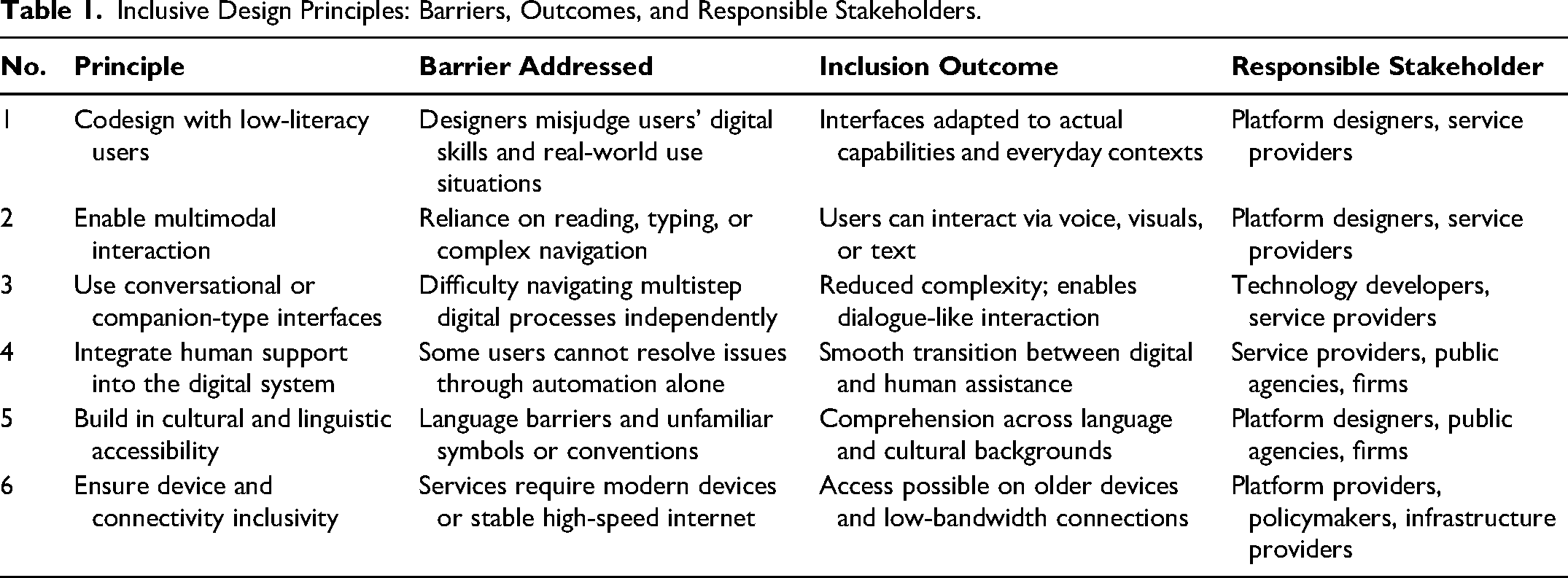
Sole reliance on digital interventions risks excluding individuals with limited digital skills who may be unable to benefit from them. To mitigate this, human support should be an integral element of digital solutions (Wilson et al. 2024). An example of this hybrid approach is remote-care programs for patients with chronic conditions (Altide 2026). In such systems, patients perform routine monitoring at home and contact a nurse through a simple digital interface when questions arise, while periodic in-person care remains available. The digital channel handles stable, repetitive interactions, whereas professionals intervene when interpretation, reassurance, or escalation is required. Rather than replacing human care, the system redistributes work: Technology supports everyday needs, and human expertise is reserved for complex situations.
Inclusive Technology as a Market Necessity—and Opportunity
Ultimately, digital inclusion is not only a matter of generosity but also of expanding the market to less digitally literate consumers. Inclusive technologies use limited resources more effectively, expand access to essential goods and services, and strengthen trust in increasingly automated environments—reflected in measurable indicators such as first-time access, independent task completion, reduced reliance on assisted support, and sustained engagement (World Benchmarking Alliance 2021). Inclusion should be seen not as a moral aspiration, but as a foundation of resilient and legitimate market systems, where uncovering which design elements reduce access barriers and improve inclusion across diverse consumer segments is an important task for scholars and practitioners alike.
Evidence on how inclusive technologies influence business models can help firms recognize the benefits of spending time and effort on improving technology. Digital inclusion requires integrating human and technological resources and links design feasibility directly to market performance and optimal use of limited labor supply, turning inclusion from a liability into a strategic opportunity.
Footnotes
Joint Editors in Chief
Jeremy Kees and Beth Vallen
Special Issue Editors
Samantha N.N. Cross, Rebeca Perren, Eileen Fischer, and Anders Gustafsson
Declaration of Conflicting Interests
The author(s) declared no potential conflicts of interest with respect to the research, authorship, and/or publication of this article.
Funding
The author(s) received no financial support for the research, authorship, and/or publication of this article.

Data Availability
No data were created or analyzed for this article.