




Abstract

A graphic designer at a branding agency is exceptionally strong in pattern recognition, unconventional visual associations, and detailed systems thinking. They often generate highly original conceptual designs but prefer to work alone and are often last with their deliverables. A client hires the agency to rebrand their mid-sized restaurant chain. The client is very detail-oriented and expects an ongoing collaborative brainstorming process involving the opportunity to provide feedback at every stage and ascribes to the adage “if you’re on time, you’re already late,” preferring to receive deliverables well before the deadline. The designer's original ideas are subsequently discounted due to the last-minute submissions, despite significant originality in their designs and a strong link to the client's strategic objectives and future aspirations. In the end, the client decides to go with another, timelier (but less original) agency to meet their need for promptness and iterative feedback. The designer is subsequently reprimanded for the loss of the client.
On the organizational frontlines, firms and consumers often assume that exchanges will follow formal explicit rules, reproduce implicit social norms, and foster emotional convergence between customers and employees (Zablah et al. 2017). As illustrated above, this assumption may not hold; when the customer's and employee's differing communication needs and interaction expectations fail to align with those of their interaction partner, both parties experience unsatisfactory outcomes—creating negative repercussions. In this vignette, we depict frontline employees and customers whose neurotypes differ; the individuals in the scenario may be considered neurodivergent or neurotypical.
Neurodiversity refers to the natural variation in how people think, learn, and process information across the population; everyone is part of neurodiversity because cognitive abilities such as verbal skill, memory, visual processing, and speed naturally differ from person to person. Although typically referring to neurological variations such as autism, attention-deficit/hyperactivity disorder, developmental coordination disorder, or dyslexia (Chapman and Botha 2022), neurodiversity is an acknowledgement that differences in brain functioning naturally occur in the population. A person is considered neurodivergent when their pattern of cognitive abilities shows unusually large differences, meaning some abilities are much stronger or weaker than others, and they differ significantly from the population (either higher or lower than two standard deviations from the mean; Doyle 2020). These differences can result in enhanced innovation, accuracy, and problem-solving, while also including challenges with time blindness, sensory sensitivities (light, sound), social interaction difficulties, high anxiety, or burnout from masking (overriding or altering behavior to minimize the appearance of differences). By contrast, a neurotypical person has a relatively consistent cognitive profile, with any differences in their abilities tending to fall within a relatively similar range, and generally within two standard deviations from the population mean (Doyle 2020).
Because an estimated 15% to 20% of the global population may be neurodivergent (Doyle 2020), mixed-neurotype customer–employee interactions are likely common on the organizational frontline. Firms can benefit from these differences while reducing communication mismatches by designing customer experiences with all neurotypes in mind (Go Jefferies et al. 2025). Rather than framing this only as accommodation, we advance neuroconvergence (Cook 2025) as the strategic goal: a state in which customers and employees with different neurotypes align in communication and perception to collaborate effectively without suppressing their natural cognitive tendencies. Neuroconvergence is not itself an inclusion tactic, but an outcome that can be achieved from deploying such tools as universal design, trauma-informed services, and service scripts. When such mismatches are reduced, neurotype differences can become a source of creative friction and, in turn, a potential competitive asset.
For customers and employees who are neurodivergent, the risk of cognitive and communication mismatches in frontline encounters is exponentially higher—and achieving neuroconvergence more challenging—due to significant differences in their cognitive profiles relative to the majority of the population. By including neurodiversity in customer experience (CX) design, firms can benefit from enhanced creativity as an outcome while mitigating the risk of unsatisfactory interactions for both customers and employees. Herein, we discuss how inclusive consideration of neurodiversity (via the implementation of communication supports) can increase the likelihood of achieving neuroconvergence and facilitate creativity in frontline exchanges.
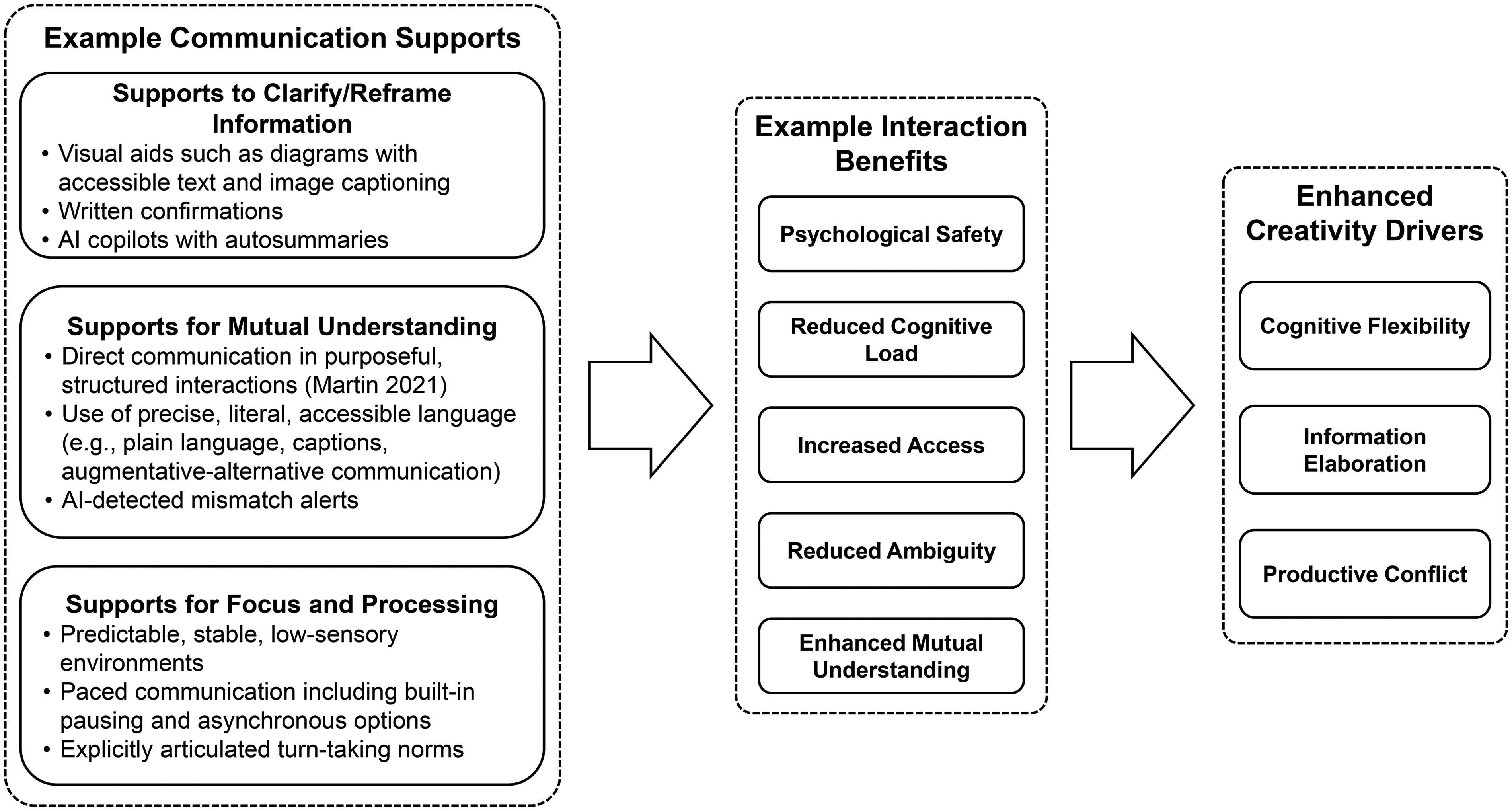
Examples of Communication Supports as Creativity Drivers.
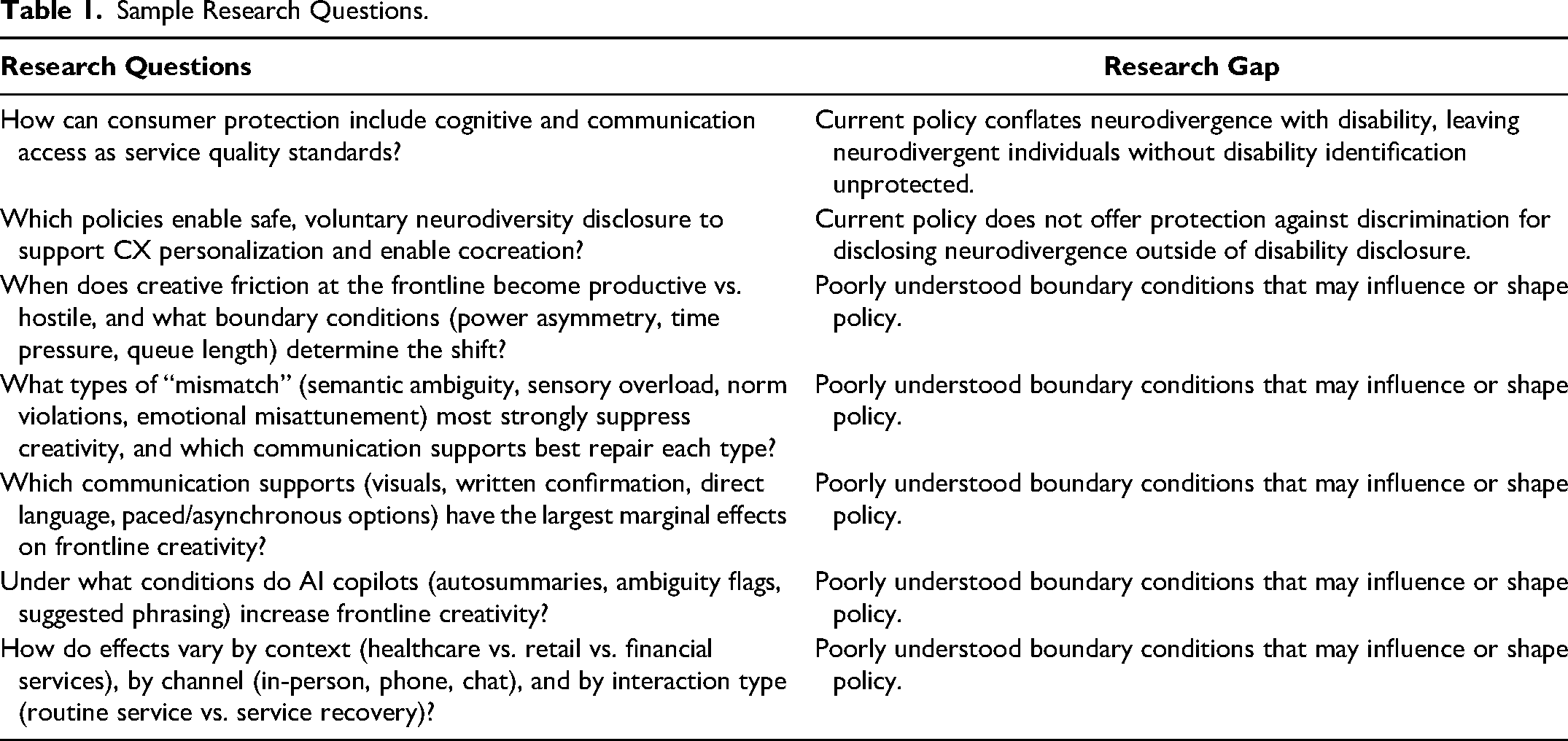
Sample Research Questions.
Creativity in Customer–Employee Encounters
When encounters at the organizational frontline result in creativity, customers are more likely to experience empathy, adaptation, personalization, and problem-solving, which impacts their behavioral responses to firms, including satisfaction, trust, and loyalty. However, enabling creativity depends on mutual understanding; employees must interpret complex customer needs and translate them into meaningful experiences amid sensory, social, and emotional variability. Dominant models in the CX literature often overlook variability in cognitive, sensory, and emotional functioning between customers and frontline employees. In contrast, we conceptualize neurodiversity as a core dimension shaping the customer experience.
Neurodiversity as a Hidden Driver of Creativity
Prior work often treats creativity as an individual trait, but we conceptualize it as relational and contextual, especially in interactions between mixed-neurotype customer–employee dyads (Axbey et al. 2023). On the frontline, neurodiversity can support creative cocreation because people perceive cues differently, bringing alternative frameworks and solution paths. In mixed-neurotype dyads, these differences can strengthen creativity by expanding both generative and evaluative capacity through cognitive flexibility, information elaboration, and productive cognitive conflict. As both parties explain, clarify, and reframe their perspectives, they expand how they think about problems and generate more novel ideas (Dwertmann et al. 2025). Contrasting intuitive viewpoints also surfaces hidden information and intensifies information elaboration, particularly when unexpected needs require improvisation and challenge standard assumptions (Aggarwal and Woolley 2019). For example, a neurodivergent customer might present unexpected needs that require improvisation by the frontline employee, who departs from standard protocols to navigate hidden service constraints and challenging service design assumptions. Repeated exchanges encourage empathy between partners to cocreate novel solutions. Finally, differing interpretations can create productive cognitive conflict that disrupts taken-for-granted assumptions, deepens evaluation, and fosters more robust creative outcomes (Wang et al. 2026).
Neuroinclusive Communication Supports for CX Encounters
When communication supports minimize sensory and social strain and provide external anchors to align cognitive processes (Martin 2021), the creative potential of mixed-neurotype interactions emerges. These supports, coupled with mutual respect for interpersonal differences (e.g., mismatches in eye contact and turn-taking), stabilize and externalize cognitive obstacles by translating implicit meanings into shared understanding and facilitating integration of perspectives in creative ways (see Figure 1).
Recall our opening scenario: The graphic designer and client presented with mismatched communication needs, interaction expectations, and cognitive abilities, resulting in a mutually unsatisfactory experience. Achieving neuroconvergence could foster greater creativity for both parties. For example, firm policy could normalize paced, asynchronous communication with explicit turn-taking norms, allowing the client opportunities to engage in iterative, collaborative brainstorming and detailed feedback while permitting the designer to process the client feedback alone. Acknowledging the designer's processing style would support their recognition of patterns in the client's brainstorming ideas and translation of those details into highly original conceptual designs that creatively meet the client's needs and align with their strategic objectives. At the end of each asynchronous brainstorming exchange, written confirmation and/or autogenerated summaries could be created to confirm mutual understanding, assuring the client that their detailed feedback has been understood and will be systematically incorporated into the rebrand design.
Such assurance could increase the client's willingness to accept a policy of light flexibility with deadlines, with the firm providing a range, rather than an exact time for deliverables. Direct communication of these policies would make interaction norms explicit, further improving mutual understanding and removing the friction caused by work style preferences and timing expectations. Together, these policies would foster neuroconvergence and the psychological safety needed to redirect cognitive conflict into a more creative design. Such neuroconvergent alignment of communication, perception, and interaction embraces individuals’ inherent cognitive tendencies and fosters smoother exchanges that enhance frontline outcomes, including generating more novel ideas.
Implications and Future Research Directions
CX research identifies emotional connection, perceived control, clarity, and meaningful customer-employee engagement as drivers of positive outcomes. Neuroinclusive communication supports strengthen these dimensions by improving transparency, mutual understanding, and customer and employee agency through clearer expectations, explicit processes, pacing, and visual or written supports. This helps create psychologically safe neuroconvergent interactions in which customers and frontline employees feel comfortable sharing information, being cognitively flexible, and working through differences to produce better problem-solving and creative insight. Firms should therefore design CX so that mixed-neurotype creativity emerges by design through built-in clarity, pacing, and external anchors. Clearly labeled neuroinclusive service pathways such as low-sensory appointments, chat-first support, written-first explanations, and step-by-step onboarding can increase fairness, trust, and perceived competence.
If communication design promotes a fair, safe environment, it results in creative collaboration between parties. As such, communication accessibility should be considered a public good, implying that consumer protection should include cognitive and communicative accessibility, supported by standards or certifications for neuroconvergent experience design. Additionally, workforce policies that promote neuroconvergent training should be deployed to mitigate burnout. Together, these implications point to a focused research agenda on how institutions, markets, workforce systems, and AI governance can operationalize neuroconvergence at scale, positioning communication accessibility as a core lever of equitable, creative CX (see Table 1).
Footnotes
Joint Editors in Chief
Jeremy Kees and Beth Vallen
Special Issue Editors
Samantha N.N. Cross, Rebeca Perren, Eileen Fischer, and Anders Gustafsson
Declaration of Conflicting Interests
The author(s) declared no potential conflicts of interest with respect to the research, authorship, and/or publication of this article.
Funding
The author(s) received no financial support for the research, authorship, and/or publication of this article.
ORCID iDs

Data Availability
No data were created or analyzed for this article.