




Abstract
Despite the popularity of multilevel marketing (MLM) companies and their ability to attract many distributors worldwide with the promise of an income opportunity, the financial outcomes for participants are often unfavorable. Many distributors invest more money in internal products and business expenses than they earn. Drawing on the professional and business ethics literature, this article develops a conceptual framework to understand how organizational characteristics collectively create pressure for distributors to overspend on internal products. The framework integrates legal, financial, and social dimensions, emphasizing the dual roles of MLM distributors as both victims and potential offenders. Utilizing this framework, the article discusses the limited effectiveness of current safeguard policies at preventing the problematic effects of the MLM industry, including pyramid schemes. The article proposes new directions for research on MLMs and other distinct areas within marketing and public policy, particularly addressing the broader category of deceptive income opportunity providers.
Keywords
Megan … started selling LuLaRoe in June 2016. “I’m a stay-at-home mom, and was looking for a fun way to make some money. I loved the idea of owning my own boutique. … By the end of 2016 I had $20,000 in inventory.” … She said she was constantly pressured by others in the company to “buy buy buy.”
“It was explained to me that I wasn’t successful because I didn’t have enough inventory. … So I went into even more debt to buy more. There were lots of items that I got stuck with and had no hope of selling. … I’m unsure of how much I’ve lost. … It's been a horrible experience.” (McNeal 2017)
In 2023, more than 102.9 million individuals worldwide participated in multilevel marketing (MLM) companies such as Amway, Neora, Herbalife, and LuLaRoe as unsalaried, self-employed distributors (World Federation of Direct Selling Associations 2024). MLMs attract distributors not only by offering an income opportunity through the retailing of products to end customers but also by incentivizing the recruitment of new distributors whose activities (purchases, retailing, recruiting) generate earnings for their recruiters. These distributors collectively generated revenue of approximately $167.7 billion for the industry in 2023, selling a diverse range of products, such as household goods, nutritional supplements, cosmetics, and clothes (World Federation of Direct Selling Associations 2024).
Prospective distributors are drawn to the MLM business model for a variety of reasons—such as the opportunity to earn a side or full-time income, work independently, and connect with others (Cochran et al. 2021; Direct Selling Association [DSA] 2022)—but this article focuses on the fact that most MLM distributors invest more money in products and business costs (e.g., for travel, training, and rental fees) than they ever earn through retailing products or recruiting new distributors. A representative study on MLM participation in the United States (DeLiema et al. 2018) reveals that only a quarter of participants “made any profit during the time they worked for the MLM” (p. 8), while another quarter did not earn any money and 47% reported financial losses despite investing time (see also Facts About Herbalife n.d.; Taylor 2014).
Megan's experience as a distributor for LuLaRoe exemplifies a central source of financial loss, that is, the pressure to buy internal products from the MLM company, irrespective of their desire, need, or ability to consume or retail them. 1 As previous research on MLMs highlights (Keep and Vander Nat 2014; Koehn 2001), this pressure to buy is exerted through deceptive income and lifestyle representations (Federal Trade Commission [FTC] 2022a; Truth in Advertising [TINA] 2017) or by incentivizing buying to advance in ranks and receive higher commissions (FTC 2024a). Such practices not only are key features of pyramid schemes (Bradley and Oates 2021; Keep and Vander Nat 2014) but also appear to be prevalent in MLMs, including those that have not been determined to be pyramid schemes. These practices are deemed unethical because they undermine and restrict individuals’ autonomy in making informed choices (Groß and Vriens 2019; Koehn 2001). Restricting others’ autonomy is unethical because it entails, for example, breaching “an ethical transparency principle, fail[ing] to respect consumers’ dignity and rights, or coerc[ing] consumers into acting unethically” (Hyman, Kostyk, and Trafimow 2023, p. 841).
This article explores the practice of internal buying in MLMs, aiming to provide a comprehensive understanding of the practice’s dynamics and implications. To achieve this goal, we draw on the professional and business ethics literature (Freidson 2001; Kish-Gephart, Harrison, and Treviño 2010; Trevino and Youngblood 1990) to develop a conceptual framework that offers a comprehensive understanding of when and how various organizational characteristics of MLMs collectively create an unethical pressure on distributors, such as Megan, to “buy, buy, buy.”
With this framework, we contribute to MLM research by moving beyond legal aspects to include nonillicit factors, drawing on both ethical (Koehn 2001) and legal (Bradley and Oates 2021; Keep and Vander Nat 2014) literature. Our framework integrates economic/financial characteristics, like monetary rewards (Bosley and Knorr 2018; Bosley and McKeage 2015), with social characteristics, such as culture (Biggart 1989). It offers new insight into how these factors reinforce each other, creating pressure to buy, and highlights the dual role of distributors as both victims and offenders. Additionally, it offers insight for policy makers and extends research beyond MLMs, particularly to the broader category of deceptive income opportunity providers (DIOPs).
In the next section, we provide a short overview of the MLM industry. We then present the controversy on internal buying. Subsequently, we draw on the professional and business ethics literature to introduce and elaborate our framework before we substantiate it through an analysis of a wide range of sources. In our discussion of the framework, we (1) introduce three propositions highlighting several implications for research and practice, (2) employ our framework to reflect on the effectiveness of current and potential safeguard policies, and (3) provide direction for future research beyond MLMs.
The MLM Industry: A Sketch of the Organizational Context
The MLM industry has roots in “direct selling” (Biggart 1989), a method of retailing products to end customers through self-employed contractors called distributors. In direct selling, distributors are promised an income opportunity through the retailing of products outside traditional retail settings, such as in the homes of clients or distributors (Keep and Vander Nat 2014). However, currently, only a small percentage (4.3%) of all direct selling companies still employ such a single-level marketing approach (DSA 2015). Today, most direct selling companies are MLM companies in which distributors are incentivized to recruit other distributors, resulting in a multilayered network of interconnected distributors: the distributor network. Recruiters create their own “downline,” while those above them in the network are referred to as “upline” (Groß and Vriens 2019).
As self-employed contractors, distributors do not receive a fixed income or social benefits. They are responsible for the time and money they invest and must bear the associated risks. Unlike employees of large corporations, MLM distributors perform various tasks typically handled by company headquarters, paid trainers, or human resources personnel. These tasks encompass recruiting, teaching, motivating, and guiding their downline distributors (Groß and Vriens 2019).
At the same time, headquarters defines the working conditions for distributors in areas related to products (e.g., prices, competitiveness, and attractiveness), income potential (e.g., margins on products, commission systems, and incentives), tasks (e.g., buying, selling, and recruiting), upline/downline structures (e.g., positions in the network and respective rights and obligations), property rights, and operational guidelines for conducting business (Brooks 2023). Consequently, MLM distributors have been characterized as dependent self-employed workers who are part of the gig economy, which is associated with nonstandard and often precarious work arrangements (DeLiema, Bosley, and Shadel 2021; Moisander, Groß, and Eräranta 2018).
Whether dependent self-employed distributors are stimulated in problematic ways to buy (too many) products from their MLM company is a crucial question in the controversy on the ethical and legal qualities of the MLM industry (Groß and Vriens 2019; Keep and Vander Nat 2014; Koehn 2001). We explain this controversy in the next section.
The Controversy on Internal Buying
Industry representatives/advocates and critics differ widely in how they frame, define, and assess the practice of internal buying. To discuss this controversy, we first provide background information on pyramid schemes and inventory loading and then present three core issues of the controversy.
Background: Pyramid Schemes and Inventory Loading
Because of MLMs’ similarities to (illegal) pyramid schemes, most previous authors have discussed the practice of internal buying from a legal perspective (Bradley and Oates 2021; Keep and Vander Nat 2014). 2 In pyramid schemes (FTC 2024b), participants are incentivized to recruit others rather than to sell products. In addition, participants are incentivized to engage in “inventory loading,” which is defined as purchases made “so that a participant in the MLM can qualify for compensation (including payments, rewards, promotions, and discounts), receive increased compensation, or otherwise advance in the marketing program, rather than to satisfy genuine personal or retail demand” (FTC 2024a; see also Keep and Vander Nat 2014). Another key characteristics of pyramid schemes is that retail sales to nonparticipants are often minimal or entirely absent. Most participants lose money because pyramid schemes are structured around recruitment rather than retail sales, leaving only a small minority at the top able to recoup their investments (Keep and Vander Nat 2014, p. 196).
MLMs can display features that are similar to those described previously (FTC 2024a, 2024b), making them potential pyramid schemes. MLMs may, for example, implement compensation structures that explicitly incentivize recruitment over retail sales and compel distributors to make internal purchases primarily to advance in the marketing program. Moreover, MLMs might make it financially attractive for distributors to focus on recruiting others who will make internal product purchases, as upline participants “receive a certain portion of the monies paid by the set of subsequent recruits” (Keep and Vander Nat 2014, p. 196). This creates a scenario in which distributors are incentivized to maintain high purchase volumes “just to meet volume targets that grant multilevel rewards” (Keep and Vander Nat 2014, p. 196) and, in turn, encourage their downline to do the same (FTC 2024a; for an example, see Bosley [2020]). However, when distributors overspend on products and other expenses without earning sufficiently through retail sales, only a few with a substantial downline earn more than they invest. The others—that is, most participants—end up losing money (Bosley and McKeage 2015; Bradley and Oates 2021; Keep and Vander Nat 2014).
The case of Success by Health (SBH) exemplifies an MLM that was officially determined to be a pyramid scheme (FTC 2023a). According to the FTC, “over 95% of SBH product purchases, by value, are by Affiliates” (FTC 2020a, p. 23), not by end customers. Distributors bought significant quantities of products in the hope of advancing in rank and earning more in the future. SBH distributors were told that it is “achievable for the masses” to become millionaires and were encouraged to sign a “Million Dollar Contract,” in which they committed themselves to spending at least $500 on products monthly (FTC 2020a, p. 12). However, in SBH, “less than two percent of the … [distributors] received more money from SBH than they paid to SBH” (FTC 2020a, p. 25).
Although the case of SBH may suggest otherwise, distinguishing between a lawful MLM and an illicit pyramid scheme is complex, largely because there is no U.S. federal statute explicitly outlining and prohibiting pyramid schemes (Bradley and Oates 2021). Instead, MLMs operate in an ambiguous and complex regulatory framework (Wrenn 2023), 3 and each case requires a thorough case-specific examination of the MLM as a whole, “both on paper and in practice” (FTC 2024b).
Three Core Issues of the Internal Buying Controversy
Having outlined some basic characteristics of pyramid schemes and inventory loading, we can now turn to three core issues of the controversy on internal buying: (1) whether internal buying is clearly different from inventory loading, (2) whether existing safeguard policies are effective, and (3) whether internal buying is identical to employee discounts in non-MLMs. Table 1 provides an overview.
The Controversy on Internal Buying.
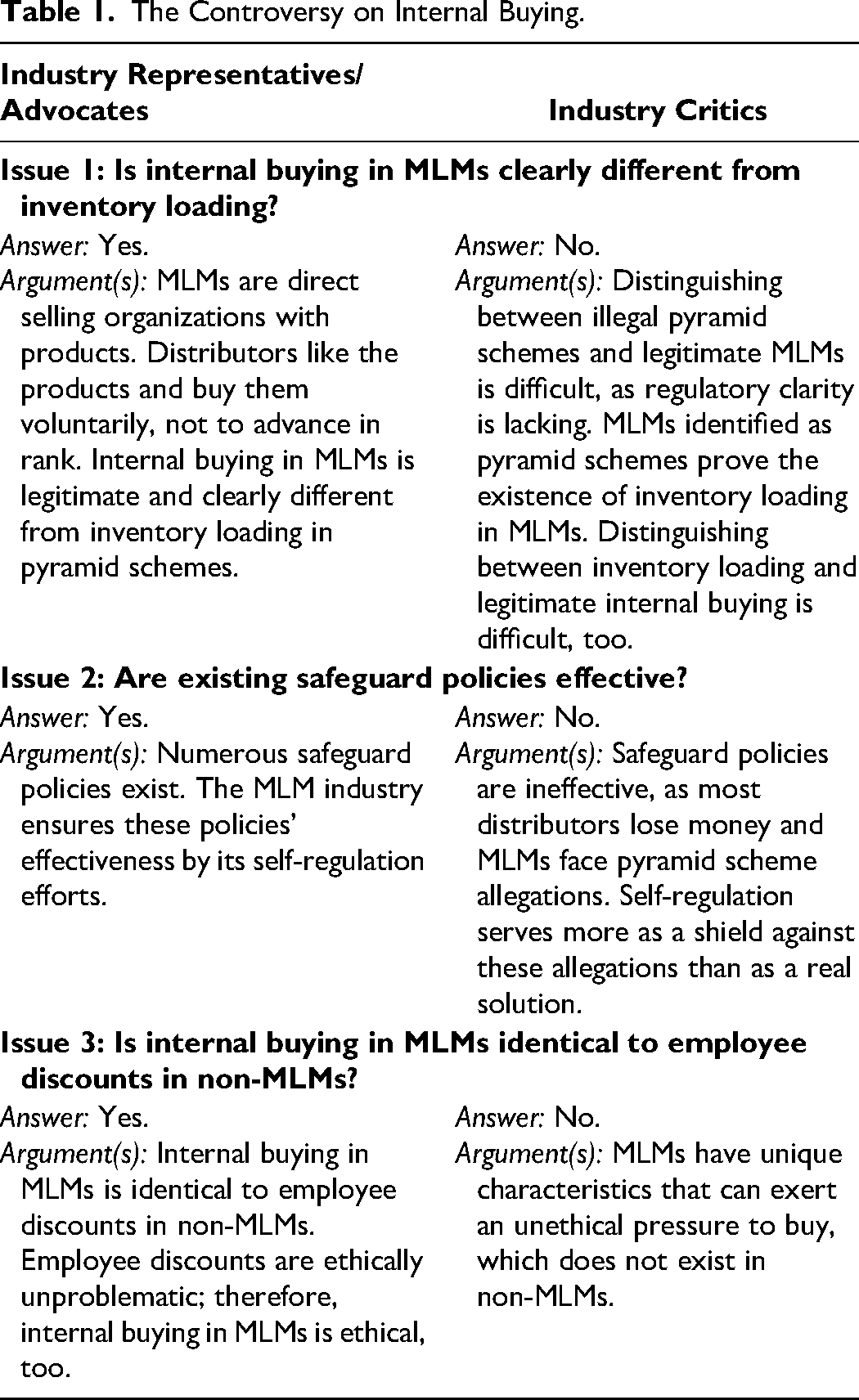
Issue 1: Is internal buying in MLMs clearly different from inventory loading?
From an industry perspective, internal buying, also called personal or internal consumption by advocates (Crittenden and Albaum 2015), is clearly different from inventory loading. Representatives/advocates argue that MLMs are direct selling organizations that serve end customers (Cochran et al. 2021) and that MLM distributors themselves are end customers who do not buy to advance in rank but “commonly enjoy the products they sell and, therefore, voluntarily consume them after becoming a distributor” (Cochran et al. 2021, pp. 36–37). According to this line of reasoning (Crittenden and Albaum 2015; Thompson 2014), internal buying is driven by consumption, not by financial rewards, and thus clearly differs from inventory loading. Because MLMs have end customers, the organizations clearly differ from pyramid schemes (for a critical assessment of this view, see Shields [2021]). In summary, from the industry's perspective, inventory loading (1) is illegal, (2) does occur, but (3) is clearly different from internal buying in MLMs.
In contrast, industry critics argue that it is very difficult to distinguish lawful from unlawful MLMs and to differentiate between legitimate internal buying and inventory loading. Inventory loading is defined based on the motive behind internal buying—specifically, the pursuit of various income opportunity rewards rather than retail demands or genuine consumption needs (FTC 2024a). However, without a federal statute that defines and prohibits pyramid schemes, and with the FTC's guidelines being “widely abused” (Bradley and Oates 2021, p. 347), each case requires a thorough, individual examination, as outlined in the recent FTC (2024b) staff advisory opinion (for the industry's differing view, see DSA [2024]). Given “the quantity, variety, and sophistication of modern MLMs,” a case-by-case approach is “hardly likely to be sufficient” to mitigate consumer harm effectively (Bradley and Oates 2021, p. 347). Critics also point to evidence of inventory loading in MLMs, as indicated by numerous allegations of MLMs being pyramid schemes (TINA 2023) and academic studies highlighting this issue (Bradley and Oates 2021; Keep and Vander Nat 2014). In summary, from a critical perspective, (1) the current regulatory framework lacks clarity, (2) the case-by-case approach is insufficient, and (3) inventory loading is a documented problem in MLMs, making it difficult to distinguish between internal buying and inventory loading.
Issue 2: Are existing safeguard policies effective?
A second set of arguments relates to safeguard policies aimed at protecting distributors from being pressured to buy and from overspending on products (see second row of Table 1). Industry advocates assert that these policies are numerous and that their effectiveness is ensured by the industry's self-regulation efforts, including ethics and compliance programs (Ferrell and Ferrell 2021). As a consequence, the policies are presented as a substantial contribution to distinguishing internal buying in MLMs from inventory loading that also ensures that internal buying is an ethically sound practice (Cochran et al. 2021; DSA 2018, 2024).
In contrast, industry critics argue that safeguard policies have proven ineffective, given the financial losses of most MLM distributors and the pyramid allegations against MLMs (TINA 2023). The reliance on self-regulation leads to several problems: companies can choose whether to implement any safeguards, the language of these safeguards varies significantly and can be weak, and industry enforcement has been found to be inadequate (Bradley and Oates 2021; Groß and Vriens 2019; Keep and Vander Nat 2014). In the absence of external monitoring, the industry's self-regulatory efforts have been criticized as a shield against allegations (FitzPatrick 2000; Roberts 2024; Shields 2021). Further discussion on safeguard policies is provided later in the article.
Issue 3: Is internal buying in MLMs identical to employee discounts in non-MLMs?
A third set of arguments refers to the question of whether internal buying in MLMs is identical to employee discounts in other industries (see third row of Table 1). Here, aligning internal buying with the often-used terms “internal consumption” and “personal consumption,” industry representatives frame internal buying as nothing more than company members receiving a discount from their employer on the company products they buy for their own personal use (Albaum and Peterson 2011; Peterson and Albaum 2007). Such employee discounts are prevalent in many industries, and the situations include “restaurant workers receiving a free or reduced-price meal when working; free flights for airline employees and their families; and price reductions for retail clerks” (Peterson and Albaum 2007, p. 320). According to advocates, internal buying and employee discounts are identical. As employee discounts in other industries are not contested, internal buying in MLMs is “not only … a common business phenomenon, [but] it is ethical” (Peterson and Albaum 2007, p. 321; see also Crittenden and Albaum 2015).
In contrast, some studies critical of the industry have characterized internal buying as ethically problematic (Groß and Vriens 2019; Koehn 2001; Muncy 2004). This literature stresses that MLMs have unique characteristics that contribute to the rendering of internal buying as problematic. Of particular significance are the ways MLMs may pressure distributors to purchase products to advance in rank, regardless of genuine consumption needs or demand from end customers (Keep and Vander Nat 2014; Koehn 2001), and the finding that numerous MLMs encourage distributors to buy internal products through representations of exaggerated income and misleading product claims (TINA 2021b, 2024). From a critical perspective, pressuring distributors to buy is not only different from employee discounts but also deemed unethical (Groß and Vriens 2019; Koehn 2001; Muncy 2004). This holds irrespective of the legal status of an MLM.
Conceptual Framework
In this section, we develop our framework on internal buying in MLMs in two steps. First, drawing on the professional and business ethics literature, we introduce the distinction between individual and organizational ethics as the basis of our conceptual framework. Second, we substantiate our framework empirically by analyzing MLM organizational characteristics that directly or indirectly influence internal buying and create potential pressure to buy.
Individual and Organizational Ethics
In the field of business ethics, a common distinction is made between individual and organizational ethics, often referred to as “bad apples” versus “bad barrels” (Kish-Gephart, Harrison, and Treviño 2010; Trevino and Youngblood 1990; see also Treviño, Den Nieuwenboer, and Kish-Gephart 2014). Although unethical behavior is often carried out by individuals, it is important to understand the context within which individual organizational members act. The term “bad barrel” refers to the institutional or organizational characteristics that together create a context that influences individuals’ (un)ethical behavior (and those individuals may thus become “bad apples”).
Freidson (2001) explicates this distinction. He discusses individual unethical professional behavior that can be caused by the context in which professionals operate. He characterizes this context as “the way practice is financed, administered, and controlled in the concrete places where professionals work, and the social policies which establish and enforce the broader legal and economic environment within which practice takes place” (p. 216).
The distinction between bad barrels and bad apples has mainly been discussed regarding “traditional companies,” in which employees are part of the company as depicted in Figure 1, Panel A. On the left side, the organization is depicted as the barrel that influences its employees—that is, apples—who in turn affect others, such as customers. In this article, we expand this distinction and apply it to MLMs to develop a framework for internal buying, enabling us to understand and explicate what makes MLMs a specific barrel and how they exercise pressure on (independent, self-employed) distributors to buy products and potentially engage in ethically problematic behavior. This framework is depicted in Figure 1, Panel B.
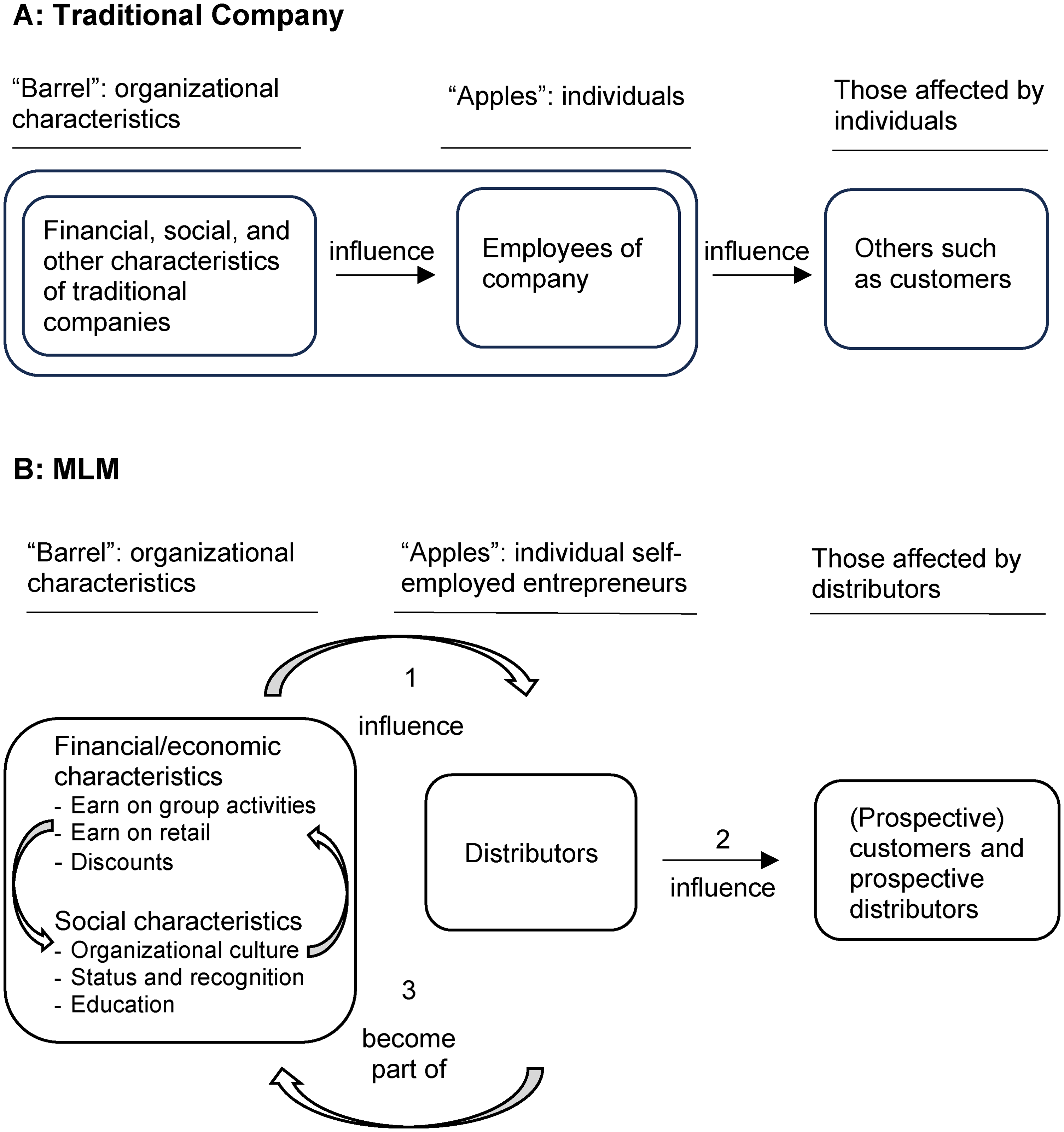
(Bad) Barrels and (Bad) Apples in Traditional and MLM Companies.
For the particular MLM barrel, we follow Freidson (2001) and examine MLMs’ particular ways of organizing—that is, financing, administering, and controlling—and their social, cultural, and ideological characteristics. We will categorize these into financial/economic and social characteristics and discuss how these two sets of characteristics are interrelated.
Arrow 1 in Figure 1, Panel B, depicts how the particular MLM barrel influences individual distributors by exercising an unethical pressure to buy. As a consequence, distributors might become victims of this pressure. In addition, as depicted by Arrow 2, this pressure may prompt them to approach prospective distributors and customers unethically, for example, by pressuring family and friends to join the MLM or to buy products from them. Here, it should be noted that although this unethical behavior has been frequently documented (as we will discuss subsequently), not all distributors engage in it. Arrow 3 represents a unique MLM feature: When distributors recruit others into their downline and, consequently, socialize and educate their downline, they not only are influenced by organizational characteristics but also become part of these characteristics, potentially contributing to the persistence of problematic behavior.
How the Specific Organizational Characteristics of MLMs Relate to and Influence Internal Buying
In this section, we substantiate our framework by exploring, categorizing, and supplementing existing knowledge on the characteristics of MLMs, thereby providing a comprehensive analysis of internal buying. We draw on a wide range of relevant literature, including academic research on MLMs (Groß and Vriens 2019; Keep and Vander Nat 2014; Liu 2018; Pratt 2000b; Wrenn and Waller 2021), governmental publications (FTC 2021b; Ramirez 2016), analyses by consumer watchdog organizations (TINA 2016, 2017, 2023), documents by industry representatives (DSA 2018), and examples from various real-life MLM companies. When the literature does not explicitly mention connections between MLM characteristics and internal buying, we propose potential linkages.
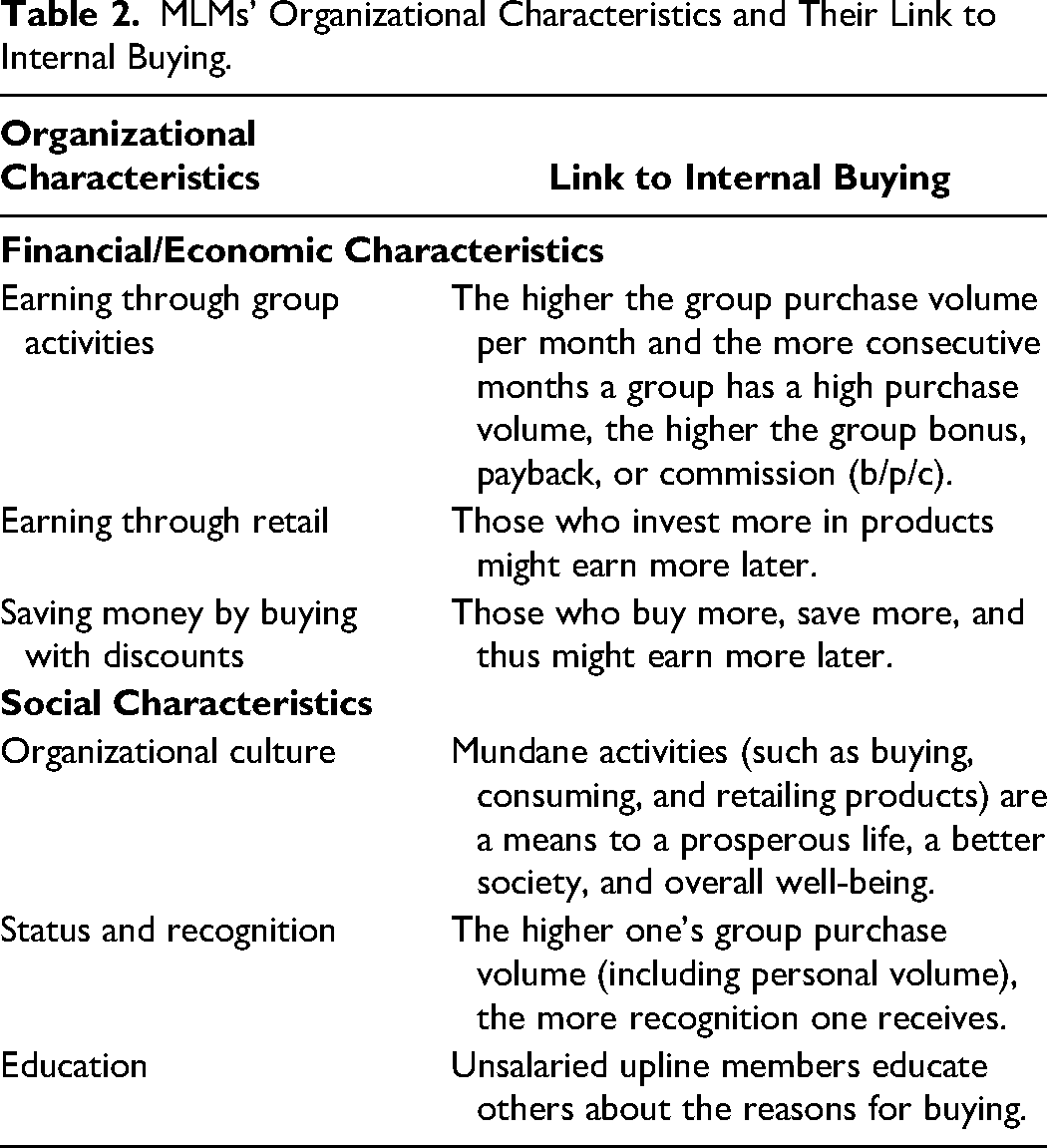
It is important to note that characteristics can vary significantly across various MLMs worldwide. In this article, we focus on frequently identified characteristics. Because MLMs position themselves as offering income opportunities and most distributors join in the hope of earning money (DeLiema et al. 2018), the financial/economic characteristics of MLMs are central to understanding internal buying. Based on our reading of the literature and real-life examples, we identify three central financial/economic characteristics: earning through one's recruits/group activities, earning through retail, and saving through buying with discounts. Freidson (2001) highlights that the organizational context within which individuals act also includes nonfinancial characteristics. We explicate them subsequently as MLMs’ social characteristics—that is, traits that make up a particular organizational culture, a status and recognition system that honors certain behaviors, and a unique educational system. Table 2 provides an overview of typical MLM characteristics and their link to internal buying.
MLMs’ Organizational Characteristics and Their Link to Internal Buying.
Financial/economic characteristics: Earning through group activities
At the core of MLMs’ business proposition is the opportunity to earn money through the recruitment of others (FitzPatrick 2000). Whoever can build up a group—that is, a downline—can earn through the business activities of that group (Keep and Vander Nat 2014). As a famous industry quote states, “I would rather earn 1% of 100 people's efforts than 100% of my own efforts” (Oneindustry n.d.). Depending on the company, various forms of bonuses, paybacks, or commissions (b/p/c) are based on the group purchase volume (i.e., the volume generated by one's group). Adding to the complexity, the group purchase volume can include purchases made both by other members of one's group/downline and by oneself (personal volume).
Earning through the purchases made by one's group (including oneself) instead of the retail sales to end customers lies at the core of pyramid allegations, as previously discussed (Bradley and Oates 2021; Keep and Vander Nat 2014). Without a federal statute on pyramid schemes, no rules specify the proportion of products that must be sold externally to end customers (either directly or through distributors) or the proportion that distributors can purchase internally (for the intricacies of defining a pyramid scheme, see the case of Nerium/Neora [Behind MLM 2023]). As a consequence, MLMs vary in their criteria for paying out b/p/c: Most MLMs do not seem to require their distributors to retail to end customers to receive b/p/c based on the group purchase volume; alternatively, if they require retailing to end customers according to their written policies, they might not monitor these requirements (Groß and Vriens 2019; Keep and Vander Nat 2014).
For instance, at Herbalife, upline members received b/p/c based on what their downline members bought, regardless of whether the products were actually retailed to customers or genuinely consumed (for Success by Health, see FTC [2020b]). Only because of its settlement with the FTC is Herbalife obligated to ensure that “at least two-thirds of rewards paid by Herbalife to distributors … be based on retail sales of Herbalife products that are tracked and verified” (FTC 2016). However, the industry as a whole is not legally mandated to ensure that commissions are based on retail to external customers. Therefore, MLMs’ compensation schemes can incentivize upline members to encourage or pressure their downline to buy products (Martin 2021a, 2022), ensuring that they, as upline members, qualify for higher ranks and rewards in a given period (for an example, see Plaintiffs v. AdvoCare [2018] , p. 93).
Regardless of the legal classification of an MLM as a pyramid scheme, concerns about harmful practices can persist (for example, the case of Neora; see Behind MLM [2023]; FTC v. Neora 2019 ). With respect to b/p/c incentives, for example, empirical evidence demonstrates that MLMs make deceptive income and product claims (TINA 2016, 2024). Such deceptive claims contribute to distributors’ perception that investing in products (and other expenses) is justified by the promise of greater future rewards (Groß and Vriens 2019; Koehn 2001). The widespread phrase “pay for your paycheck” illustrates this: Distributors are asked to pay first (for example, to buy products) so that they achieve a higher rank and, as a consequence, higher earnings in the form of higher b/p/c. For potential distributors, this approach is problematic. First, buying into a higher rank is financially unsustainable when products cannot be retailed and are not necessary for genuine consumption. Second, higher financial rewards (b/p/c) are contingent on repeatedly meeting rank qualification requirements, such as a certain personal or group purchase volume (for example, see Bosley and McKeage 2015; FTC 2016; Keep and Vander Nat 2014). To fulfill these requirements without losing money, distributors must repeatedly be able to retail products or at least genuinely need to consume them. When retailing and genuine consumption are not possible, from an “escalation of commitment” perspective (Brockner 1992; see also Staw and Ross 1989), it becomes plausible that distributors will continue to invest time, money, and effort into a failing course of action. To avoid loss or failure—that is, to maintain or achieve a rank—they buy more internal products and ask or pressure others (customers, friends, family, or downline members) to buy products.
An example from a former It Works distributor illustrates how the various organizational aspects of MLMs collectively exercise pressure to buy products. It Works provides a so-called “$10k diamond bonus” (Martin 2022) that is presented in a way that makes distributors believe that those who qualify receive $10,000. However, as a former distributor explains in an interview, What they don’t tell you is that [the] bonus is paid over 25 months (so works out at just $400 a month), and that in order to keep receiving the money every month you have to keep qualifying at that rank [i.e., ordering $600/month]. If you don’t qualify at that rank, you don’t get your bonus that month. … One girl placed a $600 order through her brother (she paid for the order) to qualify for the $10k diamond bonus. However, to keep getting that money she needed to repeat that every single month. How can you do that? (Martin 2022)
In summary, although investing in one's business by purchasing inventory might be a financially sound practice for entrepreneurs in traditional contexts, the context for MLM distributors differs. In MLMs, financial rewards (b/p/c) depend on group purchase volume (including personal volume), so the context strongly inclines distributors to buy internal products regardless of their genuine consumption needs or ability to retail products.
Financial/economic characteristics: Earning through retail
In addition to the frequently discussed issue of financial rewards tied to group activities, we explore how potential retail opportunities influence internal buying within MLMs. These are relevant because MLMs position themselves as direct selling companies, emphasizing the significance of products in their model (see Table 1).
Distributors who want to retail to end customers typically need to buy products to become familiar with them and to demonstrate and explain the products, for example, during product parties or presentations. In theory, both of these tasks can be performed using a starter kit. Such a starter kit should be reasonably priced, according to the DSA (2018). However, MLM companies may offer a wide range of products, ranging from dozens to even hundreds of options. For instance, Herbalife offers dozens of weight management, personal care, and sports nutrition products (https://www.herbalife.com); Amway offers more than 450 unique products (https://www.amway.com); and companies such as Mary Kay Cosmetics regularly introduce new seasonal products (https://www.marykay.com). Given such conditions, distributors may feel pressured to buy significantly more than just one starter kit to showcase the products to potential customers adequately (Groß 2008; Martin 2021c).
Furthermore, distributors probably need to buy more when customers expect to take the products home directly after a product presentation (rather than receiving them later, either from headquarters or from their distributor). In this case, distributors may regard stocking inventory as a good strategy for increasing their retail opportunities, as illustrated by the example of Megan (see also Martin 2021c; Pink Truth 2022). In addition, distributors might be advised to provide free product samples to potential customers and recruits (Bosley 2020; Holmes 2013). Although free samples might generate higher retail sales or attract new recruits, distributors must first pay for them.
Therefore, although investing only in a reasonably priced starter kit is possible in theory, distributors are given many motives to buy more products.
Financial/economic characteristics: Saving money by buying with discounts
We turn to discounts as a third financial/economic characteristic. Although initially appearing unproblematic, discounts are relevant for understanding the pressure to buy in MLMs (see Issue 3 noted previously in this article). When enrolling as a member, individuals gain the right to receive a discount on company products. According to MLM representatives and advocates, this practice enables distributors to save on products they intend to buy for genuine personal and family consumption. For instance, Valentus distributors can save 25% off the suggested retail price for Valentus coffee. When distributors buy in large quantities, they may receive quantity discounts, saving more money. At Valentus, for instance, they may obtain a discount of 49% (Valentus 2021, p. 3). Industry advocates portray such discounts as identical to employee discounts in non-MLMs, but our focus on MLMs’ organizational characteristics underscores the unique role that discounts might play in MLMs compared with non-MLMs.
For example, distributors may perceive quantity discounts as a strategic investment, especially when they are close to achieving or maintaining a certain rank and the associated financial rewards (b/p/c). Furthermore, compensation schemes might be designed to encourage new distributors to “dream big” and to save money, for example, by investing in products beyond the starter kit or by participating in a monthly auto-delivery program that provides additional discounts (Bosley 2020).
For instance, at Neora, newcomers were encouraged to purchase “Success Packs” priced at $500, $750, or $1,000 “to get your business moving fast” (FTC v. Neora 2019, p. 6). These Success Packs included discounts exclusive to newcomers. In line with such incentives, company data revealed that “purchases by BPs [business partners] in their first three months regularly comprise one-third to one-half of all BP purchasing volume, company-wide” (FTC v. Neora 2019, pp. 9–10). Although Neora was not found to be a pyramid scheme ( FTC v. Neora LLC 2023 ), the case underscores two crucial points relevant to our article: the relevance of nonillicit practices to comprehending internal buying in MLMs and the unique framing of quantity discounts or auto-order programs in MLMs as strategies to enhance one's future financial rewards.
In summary, saving money through discounts plays a unique role in MLMs and can add to the pressure to buy.
Social characteristics: Organizational culture
MLMs have long been characterized as value-driven enterprises that often propagate strong organizational cultures in which “committed distributors see their work as a superior way of life that embraces political values, social relations, and religious beliefs” (Biggart 1989, p. 9). Commonly espoused values include financial and personal autonomy, emancipation, self-responsibility, self-development, spiritual growth, and friendship (Carr and Kelan 2021; Lan 2002; Moisander, Groß, and Eräranta 2018; Pratt 2000b; Wrenn 2023; Wrenn and Waller 2021).
Like other companies, MLMs seek to create and nurture a brand community around their products (Muniz and O’Guinn 2001) in which members form relationships with like-minded individuals. In MLMs, distributors often are not just introduced to selling products; they are invited into a community with shared beliefs, as numerous websites illustrate. For instance, LuLaRoe, the company Megan joined, states on its website, “We believe every individual is beautiful, unique, and most of all—powerful. … These beliefs are why LuLaRoe was created; they bind us together like threads, sewing us into a community of lasting love and fellowship” (LuLaRoe n.d.). With such statements, LuLaRoe propagates aspirations that extend far beyond selling a product to consumers (clothes/leggings, in this case).
In the case of health-related products, MLMs’ product ideologies seem to coincide with distributors’ at various levels, making dubious and sometimes illegal claims during meetings and webinars, and on social media platforms. These claims include assertions that MLM products can cure cancer, lead to effortless weight loss (TINA 2016), and treat COVID-19 (FTC 2023b; Roberts 2024; TINA 2021a). Although such claims may stimulate consumption and reinforce the belief in the potential for demand-driven sales to end customers, it is important to emphasize that distributors must first buy products to consume and showcase them.
Social characteristics: Status and recognition
As previously discussed, MLMs have been characterized as having a particular way to socialize their self-contracted members and to make them believe in the values of their companies (Biggart 1989; Carr and Kelan 2021; Lan 2002; Wrenn 2023; Wrenn and Waller 2021). A relevant mechanism of socialization is the often intricate system of status and recognition. Distributors who achieve higher group purchase volumes not only earn higher financial rewards but also are praised and more admired. It is a common practice within MLMs to have symbols representing various status ranks, such as the red jacket for team leaders in Mary Kay or the Silver, Gold, Diamond, and Founders Crown Ambassador ranks in the case of Amway (Scheibeler 2004).
These ranks not only correspond to monetary rewards but also serve as indicators of internal status. For instance, at Amway, a Silver member presents products during a weekly meeting, a Gold member delivers the main talk, Diamonds host the annual rally, and the Founders Crown Ambassadors, who have extensive downlines of sometimes more than 10,000 distributors, establish their own training systems, including seminars/webinars, weekly online messages, motivational videos, and booklets (Groß 2008; Scheibeler 2004).
Although the existing academic literature does not explicitly establish a connection between the status and recognition system and internal buying, empirical evidence and observations of how MLMs operate lead us to propose such a connection. In MLMs, distributors are often encouraged by slogans such as “Fake it ’til you make it” to purchase into ranks and attract others into their group or motivate their downline (for examples, see Martin 2021c, 2022; Pink Truth 2022; The Dream 2019, minutes 15:46–21:11).
The previous example of an It Works distributor obtaining the $10k diamond bonus by placing an order through her brother also illustrates how a purchased rank can generate social pressure for others to buy. Purchasing into the rank “didn’t stop her boasting about qualifying for the bonus all over Facebook. She just didn’t tell anyone that she possibly only actually received it for one month. … ‘Faking it till you make it’ was rife (it's reframed as attraction marketing to make it seem less like the lying it really is)” (Martin 2022).
Though faking success (by purchasing a rank) might seem to be a financially bad decision, according to the escalation-of-commitment literature (Brockner 1992; Staw and Ross 1989), individuals tend to continue investing in a losing course of action out of self-justification motives and, hence, to avoid admitting failure and losing their earlier investments. Within MLMs, distributors can justify stockpiling products to fake success by deeming the act an investment into attaining social status and attracting recruits, on whom they could potentially earn commissions later. By encouraging the faking of success, together with the practice of excessively celebrating alleged successes—that is, celebrating supposed successes while hiding how they were achieved—MLMs create a unique social context that influences the decision to buy internally.
Social characteristics: Education
A third significant social characteristic is education, which encompasses how MLMs instill their product ideology in members, shaping their thoughts, emotions, and behaviors as “good distributors” (Biggart 1989; Carr and Kelan 2021; Moisander, Groß, and Eräranta 2018; Pratt 2000b; Wrenn 2023; Wrenn and Waller 2021). The first central characteristic of education in MLMs is that it is decentralized and rewarded only by group activities. Most education within MLMs is not centrally organized by headquarters, paid trainers, or human resources officials but is undertaken by self-employed distributors (and their networks; see Groß and Vriens 2019). Distributors are not paid directly for the time they spend educating or motivating others. Instead, their earnings depend on the revenue generated by their team, including a share of both their own internal purchases and those of their downline.
The second central characteristic of education is that it influences distributors’ internal buying behavior through different types of “lessons” that promote internal buying. In this article, we discuss four widespread MLM lessons. As a first example, MLMs promote self-education through product consumption. Distributors are taught to believe that by consuming a product, they achieve expert status (Cardenas and Fuchs-Tarlovsky 2018). For instance, dōTERRA suggests that consuming its products and educating oneself by watching company videos have “profound and lasting effects on your health span and quality of life” (dōTERRA 2023b). The company further explains that consumption serves as “a powerful entry point, benefiting new and existing customers alike!” (dōTERRA 2023a). A second widespread lesson that distributors are taught is to become “a product of the product.” Distributors are asked to demonstrate their commitment and enthusiasm by actively buying and using the products themselves (Bosley 2020, pp. 15, 47; Martin 2022). In addition to becoming members of a brand community (Muniz and O’Guinn 2001), distributors are encouraged to display their connection to “their” MLM through its products. This visible promotion is facilitated in MLMs because the main retail and recruiting locations are not stores or offices but private homes. Distributors are, for example, advised to visibly display products throughout their home (Groß 2008). For beauty, wellness, or health-related products, they might also use their own bodies as marketing tools. Lan (2002, p. 172), for example, analyzes how, in an MLM selling cosmetics, “distributors devote themselves to an intense and constant consumption of [company] products and monitor their physical appearances and conditions to reach the goal of body testimony” (see also Prins and Wellman 2023).
Third, distributors are taught that they become successful leaders when they lead by example. To motivate their own downline to act as they want, distributors first need to display the respective behavior themselves. For example, to encourage one’s prospective downline to buy products in large quantities, one needs to do so first; to motivate a prospective downline to be a product of the product, one needs to forge ahead. With these lessons, distributors are motivated to believe that if they buy, consume, and display the consumption of products, they are on their way to becoming successful.
The last lesson we want to highlight here is directed at motivating self-employed downline members to follow those above them. In a process termed “duplication” (see, for example, MLM guru Eric Worre [Worre 2023]), new distributors are taught that they can become successful business people by imitating how seemingly successful upline members think, feel, and act.
Given that most distributors spend more than they earn (DeLiema et al. 2018), we want to highlight that these four lessons intensify each other, creating a unique circular pattern of reasoning. Those who want to recruit others need to buy products first to self-educate, become a product of the product, and lead by example. Those new to being distributors need to duplicate this behavior to become successful. All of these factors are connected to the previously discussed financial/economic reasons to buy, such as discounts or b/p/c, that are contingent on personal or group volume. However, to behave in accordance with these lessons, distributors must first buy the products.
The Interplay of Financial/Economic and Social Characteristics
As the previously stated lessons already illustrate, MLM characteristics are often interconnected and reinforce each other, as shown by the arrows on the left side of Figure 1, Panel B. During meetings and gatherings, upline distributors can use the stage to promote the belief that their company offers a path to personal and financial freedom while hiding the fact that they might have “paid for their paycheck” to achieve their rank. Supported by an organizational culture that promotes internal buying, bulk buying can be presented as a strategic move to showcase one's commitment and potentially earn more. Additionally, when ranks are determined by group purchase volume (including personal volume) and retailing products proves challenging, distributors aspiring to achieve or maintain a higher rank are motivated by numerous factors to buy internally, regardless of genuine consumption needs or retail opportunities. Furthermore, upline members have many motives to encourage their downline to do the same. From an escalation-of-commitment perspective (Brockner 1992; Staw and Ross 1989), the various reinforcing financial/economic and social characteristics of MLMs create a tightly knit context of factors motivating distributors to continue buying products without genuine consumption needs or retail opportunities. The wish to avoid admitting failure and the hope of eventual success compel them to continue investing time and money and, as we highlight next, to encourage their downline to do the same.
The Dual Role of Distributors as Victims and Offenders
Our analysis reveals that MLMs possess various characteristics that motivate and potentially pressure distributors to buy internal products. In this context, distributors often become victims of pressure to buy irrespective of their genuine need or ability to retail or consume the products (Koehn 2001; Ramirez 2016).
At the same time, our analysis demonstrates that distributors themselves might contribute to perpetuating this pressure, thus becoming offenders. First, faced with the costs of products and other business-related expenses, distributors may feel compelled to pressure others to buy products or to join as downline distributors (see also Arrow 2 in Figure 1, Panel B). Second, when distributors recruit others and start building their own downline, they become more entrenched in the MLM system (see the left side of Figure 1, Panel B). To “educate” their downline, upline distributors may pass on the lessons discussed previously, socializing their downline into the relevance of buying products. By profiting financially from their downline's purchases and by being responsible for educating their downline, upline distributors become integral to the economic and social MLM characteristics that create pressure to buy.
In highlighting this dual role of distributors, our framework explicates a vicious circle: Distributors who are themselves victims of pressure to buy may begin to exert pressure on others, thus becoming offenders. It is important to note, however, that not all distributors engage in such practices. Not every distributor pressures consumers to buy products, recruits others under undue pressure, or forces downline distributors to buy more than they can genuinely consume or retail. Nonetheless, it may prove difficult for upline distributors to earn money on their downline without using the MLM mechanisms discussed.
General Discussion
In this section, we discuss the academic and policy implications of our framework on internal buying in MLMs. We begin by summarizing how the framework extends MLM research, and we follow that discussion with three propositions to guide further MLM research and a reflection on safeguard policies. Next, we propose how our framework may inform future research beyond MLMs, including specific public policy and marketing issues and the broader category of DIOP. Last, we provide an overview of future research directions.
Contribution to the MLM Debate
Our ethical perspective on internal buying enables us to understand what makes MLMs a specific barrel and explicate when and how this barrel becomes bad. As described and analyzed by extensive literature (Treviño, Den Nieuwenboer, and Kish-Gephart 2014), the organizational context influences employees’ (un)ethical behavior, which, in turn, might cause harm to others. Figure 1, Panel B, shows how this ethical perspective is put into a framework on internal buying in MLMs. The framework displays the complexity and dynamics of MLMs’ organizational characteristics, which influence self-employed distributors (Arrow 1), who, in turn, might cause harm to others (Arrow 2) and, as a unique feature of MLMs, might become part of the organizational context themselves when they recruit others (Arrow 3).
Our approach contributes to MLM research in several ways. First, it extends and integrates the fragmented research on the legal aspects (Bradley and Oates 2021; Keep and Vander Nat 2014) and ethical concerns (Groß and Vriens 2019; Koehn 2001). Second, our framework surpasses the legal perspective on inventory loading and explicitly recognizes the role of nonillicit characteristics that contribute to the creation of pressure to buy. Third, in our analysis, we integrate both financial/economic and social behaviors and relationships that are integral to MLMs’ business model (Liu 2018; Wrenn and Waller 2021). Fourth, our framework enables us to explicate the complexity and dynamics of how pressure to buy is created and highlights the dual role of distributors who recruit as both victims and offenders. Finally, the framework also, in a novel way, informs MLM scholars and policy makers about why some policies aimed at countering unethical MLM practices may not work, as we will discuss subsequently.
Suggestions for Extending the Framework: Three Propositions for Further MLM Research
Proposition 1: MLMs have unique organizational characteristics that create pressure to buy products not encountered outside MLMs
There are hundreds of MLMs worldwide with varying characteristics. Despite these differences, MLMs possess unique organizational characteristics. Based on our framework, we argue that practices that might be ethically sound outside MLMs take on different roles and meanings in this unique organizational context. Employee discounts, bonuses, or income that is partially based on commissions all exist outside MLMs. However, these incentives do not impose a requirement for employees to do their work, earn money, earn more, or advance in rank. Supermarket cashiers, for example, are not required to buy the products of the supermarket to perform their job or to receive their payment, and restaurant workers are not told by the owner at the end of the month to eat at the restaurant to reach a certain revenue. These characteristics contrast with MLMs and their unique organizational characteristics that influence internal buying. Thus, we disagree with those who argue that internal buying is identical to employee discounts in non-MLMs and equally ethical (see the section “The Controversy on Internal Buying” and Table 1 in this article; Albaum and Peterson 2011; Crittenden and Albaum 2015; Peterson and Albaum 2007).
Empirical research could utilize, revise, or expand our list of unique MLM characteristics by comparing MLMs with non-MLMs. Using our framework, with its financial/economic and social characteristics, researchers could investigate what most motivates distributors to overspend on products, which characteristics create the most pressure, and what effects current company policies have on internal buying.
In addition, research is needed on how much distributors spend on products or other costs—such as travel, training, or rental fees—to inform better regulatory oversight of the industry. Insights from the brand community literature (Muniz and O’Guinn 2001) might inform research on MLMs by providing a theoretical basis for understanding how products, social ties, and shared values converge to drive motives to buy.
Proposition 2: Reinforcing organizational characteristics intensify the pressure to buy
MLMs can possess a complex web of reinforcing characteristics that not only create but also intensify the pressure to buy. As a result, the context in which distributors operate can become ethically problematic because it restricts their decision autonomy (Hyman, Kostyk, and Trafimow 2023). Distributors may become entangled in a web of motives, values, and financial incentives that, in combination, affect their buying decisions. As the literature on the escalation of commitment explores, manifold causes together lead to a situation in which “individuals … get locked in to the existing course of action, throwing good money or effort after bad” (Staw and Ross 1989, p. 216). For instance, financial characteristics stress that additional investments will pay off, eventually; during their education, distributors are presented with positive information regarding the chances of success, and negative information is downplayed; and the MLM culture and values offer distributors a social identity and a brand community to which they can cling (Moisander, Groß, and Eräranta 2018; Wrenn and Waller 2021). Similar to social media algorithms that create echo chambers or filter bubbles (Bakir and McStay 2018; Mende, Vallen, and Berry 2021), MLMs foster tight-knit communities in which supportive information is amplified and critical perspectives are filtered out. Together, these financial and social dynamics shape the information distributors receive, contributing to an escalation of commitment and entrenching their investment in a failing course of action. Therefore, we reject the assertion that MLM distributors enjoy the same freedom as non-MLM members to “choose to make or not make such purchases” (Peterson and Albaum 2007, p. 321; see the section “The Controversy on Internal Buying” and Table 1).
Future research could also investigate how these intertwined and reinforcing financial and social characteristics vary across MLMs and how these differences affect the pressure to buy. Comparing MLMs that exert more or less pressure to buy could yield valuable insight to mitigate this pressure. Insight from marketing—such as high-pressure sales tactics (Brockner 1992; Kennedy and Kapitan 2022), the workings of echo chambers (Bakir and McStay 2018), or virtue-ethics approaches to marketing (Murphy, Laczniak, and Wood 2007)—could deepen our understanding in several ways.
Researchers could explore how MLM distributors online and offline form echo chambers and the role upline distributors play in reinforcing positive beliefs and spreading mis- and disinformation. Such studies could provide more insight into when and why distributors’ autonomy is restricted and under what conditions commitment is likely to escalate, informing efforts to prevent negative impacts.
Working with insight from literature on disclosures and warning labels (Mende et al. 2024), researchers could explore and further develop guidelines for MLM income disclosures (e.g., Bosley, Greenman, and Snyder 2020; Miller et al. 2023), as well as approaches to educate consumers about MLMs and other income opportunities (FTC 2021a).
Proposition 3: The dual role of distributor and recruiter may force participants to pass on and perpetuate the pressure to buy
Although the distinction between bad apples and bad barrels (Kish-Gephart, Harrison, and Treviño 2010; Trevino and Youngblood 1990) highlights the difference between ethics at the organizational and individual levels, we propose that MLMs create a feedback loop between both levels (Arrow 3 in Figure 1, Panel B). Organizational characteristics influence distributors’ buying behavior (Arrow 1) and their behavior toward others (Arrow 2). As discussed, once distributors recruit others, they become part of the MLM context, potentially contributing to its persistence (Arrow 3). Previous research has described MLM distributors as both victims and offenders (Hock and Button 2023). Our framework conceptualizes how this dual role emerges and how MLMs prompt individuals to pass on ethically problematic practices, such as pressuring others to buy or spreading mis- and disinformation about the likelihood of success, product quality, or product marketability. We regard this feedback loop as a core MLM feature, through which distributors first become trapped as victims but, especially when recruiting others, may perpetuate ethically questionable practices. This replication creates a cycle of internal buying and recruitment of others whom they tell to fake their way to success by investing in products or other business expenses.
This cycle parallels how influencers spread and profit from mis- and disinformation, exploiting the beliefs and needs of their audiences (Bakir and McStay 2018). Alongside marketing research that explores how mis- and disinformation proliferate and can be mitigated (Mende et al. 2024), further MLM research could help policy makers and industry self-regulators develop more effective strategies to protect MLM participants. In addition, integrating this feedback loop into research could enhance our understanding of when and why internal buying resembles inventory loading and when and why MLMs resemble pyramid schemes (see the section “The Controversy on Internal Buying”). This integration also facilitates the development of effective safeguard policies, which we discuss next.
Reflection on Safeguard Policies Based on Our Framework
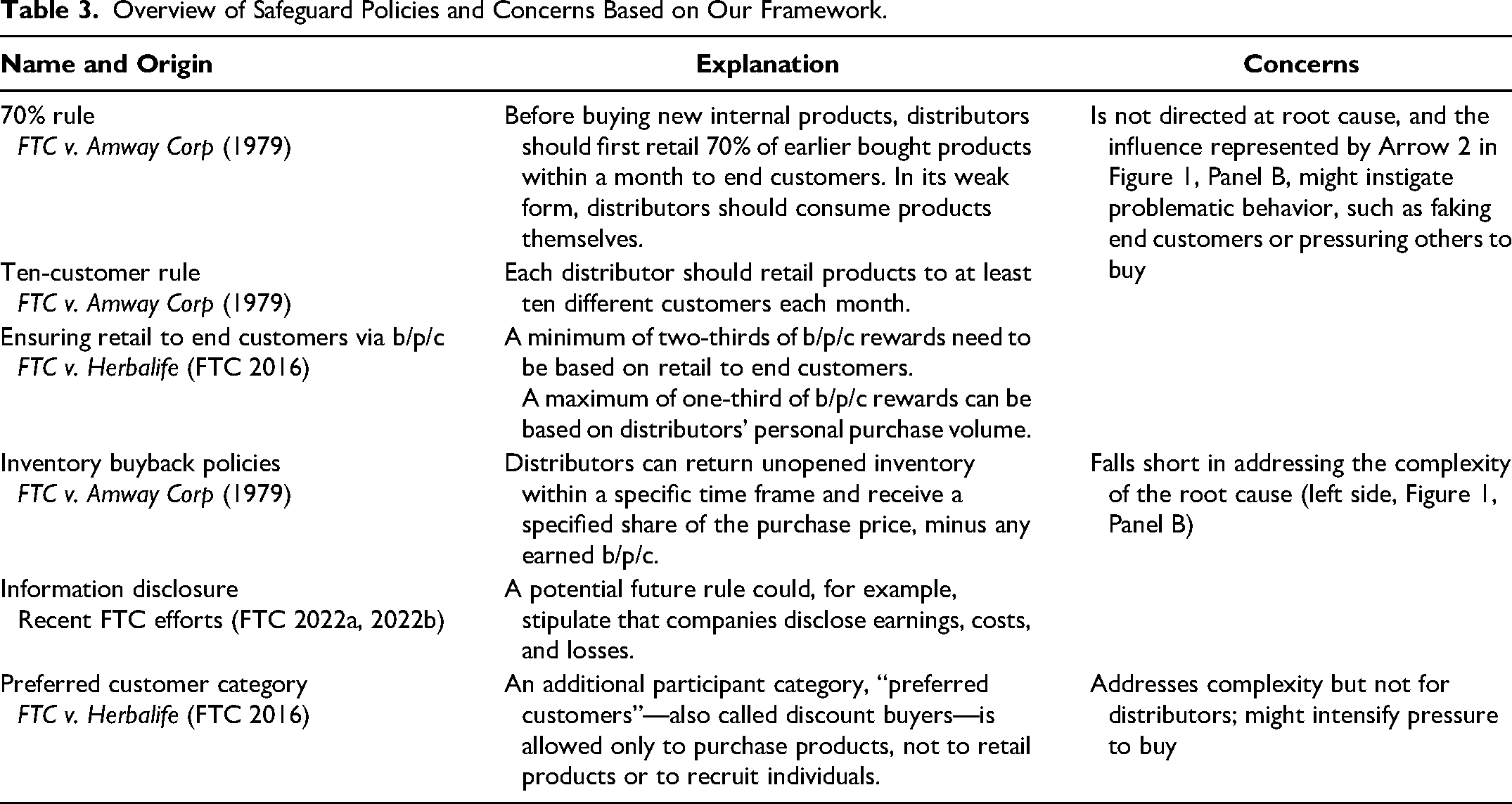
As indicated previously, industry advocates present existing safeguard policies as sufficient and effective, while critics highlight the numerous shortcomings of self-regulation (see Table 1, Issue 2). In this section, we add to this criticism by discussing three concerns based on our framework. Table 3 provides an overview. An elaborate explanation can be found in the Web Appendix.
Overview of Safeguard Policies and Concerns Based on Our Framework.
Concern 1: Not directed at root cause
First, several safeguard policies are directed at ensuring retail to end customers, as depicted with Arrow 2 in Figure 1, Panel B. Although these policies are seemingly valuable, the root cause of the pressure to buy is more complex and stems from the left side of Figure 1, Panel B. An example is the 70% rule (see Table 3). It asks distributors to first retail or, in its weak form, to consume themselves a certain share of products before buying new ones. In practice, this might lead to the following situation. On the last day of the month, a distributor faces the risk of dropping in rank and losing the corresponding b/p/c due to being $200 short of the required group purchase volume. According to the 70% rule, the distributor must first retail or consume products on that day before purchasing internal products to maintain the current rank. This rule might make the distributor aware of the need to retail (or consume). It does not, however, take away the manifold and interrelated financial/economic and social characteristics that exert pressure to buy.
In addition, the 70% rule might even instigate problematic behavior. As illustrated previously with the It Works distributor who placed an order through her brother (Martin 2022), distributors might fake their end customers. Furthermore, they might also pressure others (friends or family members) or their downline to buy products (Martin 2021b).
We believe that similar problems hold for the ten-customer rule, which asks distributors to retail products to at least ten different customers each month, and policies aimed at ensuring retail sales to end customers by requiring retail sales for full b/p/c rewards, as imposed on Herbalife in 2016 (FTC 2016; U.S. District Court for the Central District of California 2016). In both cases, the rules are meant to ensure retail sales (directed at Arrow 2) but do not mitigate or solve the pressure to buy internally (left side of Figure 1, Panel B). As a consequence, the policies might unintentionally lead distributors to fake their end customers or pressure others to buy, to allegedly fulfill the company's requirements.
Concern 2: Fall short in addressing the complexity of root cause
Second, safeguard policies might be limited in their effectiveness because they do not address the complexity of how pressure to buy is exerted. Consider the example of inventory buyback policies (see Table 3). These allow distributors to return unopened inventory within a specific time frame and receive a specified share of the purchase price minus any earned b/p/c. In addition to distributors’ practical problems, such as an inability to return nonrefundable seasonal products and difficulty returning opened bulk packages (Taylor 2014), our framework highlights a psychological aspect. As distributors become part of a close-knit community of believers, they find it hard to return products (Koehn 2001; for a company example, see Pink Truth [2022]) because that would form a manifestation of their failure, which human beings tend to avoid (Brockner 1992).
In addition, refunds for products lead to the reversal of rewards. This reversal negatively affects both distributors and their upline, who need to refund b/p/c on the returned products (Koehn 2001; see also Ramirez 2016).
Although buyback policies address financial harm to some extent, they fail to account for the social, emotional, and psychological factors contributing to the pressure to buy. As a result, they cannot effectively mitigate the pressure.
Although the rule is still in development, we suggest that a similar problem might occur with the FTC's current rulemaking efforts against deceptive income claims (FTC 2022a, 2022b; see Table 3). We note that if headquarters is mandated to disclose truthful earnings and costs, distributors might adjust their expectations, leading to reduced spending on products or business-related expenses (Bosley, Greenman, and Snyder 2020; Miller et al. 2023). However, such a rule cannot address all the other mutually reinforcing factors contributing to the pressure to buy. Regulating deceptive income claims is valuable, but rules directed at a single aspect of how MLMs work will probably remain limited in their effectiveness.
Concern 3: Address complexity but not for distributors
In a third aspect, we reflect on the dual role of distributors in MLMs as victims and potential offenders. To our knowledge, there are no safeguard policies covering both features for all MLM participants.
A safeguard policy that seeks to exclude a share of MLM participants from both features contains the “preferred customer” category (see Table 3). This additional MLM participant category originates from Herbalife's settlement with the FTC in 2016. Unlike distributors, preferred customers are permitted to purchase products solely for personal use and are prohibited from retailing products or recruiting others (FTC 2016; U.S. District Court for the Central District of California 2016). As they have no downline, they do not earn on downline and do not pass on any pressure to buy.
Though this seems to be a promising approach, we want to highlight two concerns. First, the scope of this policy remains limited because it protects only preferred customers and not all participants—that is, not distributors. Exempting a share of MLM participants from an ethically problematic practice does not change the practice itself. Second, as “normal” distributors continue to work under the organizational characteristics analyzed previously in this article, both problematic practices and the feedback loop persist. This persistence might explain why the policy can backfire in practice. An industry observer explains that although the preferred customer category suggests “‘real’ end customers and users; various companies seem to simply reclassify the lowest rung of their distributors to this category” (personal communication to authors; see also Roberts 2024; The Recovering Hunbot 2021). Distributors who do not meet group purchase requirements (including personal purchase volume) are threatened with being downgraded and thus risk losing their group b/p/c. In this case, the distributors’ pressure to buy is not reduced but amplified (Arrow 1, Figure 1, Panel B), and those who recruit are still prone to pass on this pressure to others (Arrow 3, Figure 1, Panel B; for an example, see USANA Watch Dog [2017]).
What should MLM safeguard policies look like?
Considering these aspects, effective safeguard policies aimed at preventing rather than mitigating a share of harm should address the complex root cause of the pressure to buy and include MLMs’ unique feedback loop. This strategy reflects the views of authors who advocate a ban on recruiting as the best solution to the problems caused by the industry (FitzPatrick 2000; Taylor 2014). This approach also implies a shift from organizations operating as MLMs to engaging in single-level marketing, transforming companies into direct selling organizations that generate their revenue through product retailing to end customers.
A less far-reaching change would involve prohibiting all connections (not only a share, as imposed on Herbalife; U.S. District Court for the Central District of California 2016) between group (including personal) purchases and rank qualifications (b/p/c). In this case, distributors would not be required (or pressured) to buy products to qualify for ranks, to ascend to a certain rank, or to receive b/p/c on their downline. Distributors could still earn financial rewards on their downline, but only based on what is retailed to end customers. However, distributors might still feel pressured to buy in large quantities to earn more later or put pressure on their downline to retail, potentially by faking end customers.
In a final point, we want to highlight that regardless of the form that safeguard policies take, as long as they remain self-regulatory, their effectiveness may be limited, as critics have highlighted in the case of current safeguard policies (Bradley and Oates 2021; Groß and Vriens 2019).
Advancing the Academic Debate Beyond MLM
In this section, we discuss how our perspective on internal buying in MLMs may inform the academic debate beyond MLM. To this end, we first argue that the perspective on internal buying in MLMs may provide specific input for relevant debate on public policy and marketing. Second, we illustrate how our framework enables us to better understand the broader category of DIOPs (FTC 2021a, 2022c).
Informing public policy and marketing research
Although we present a framework for understanding a problematic practice in one type of industry, several features of the framework can, in our view, be used to enrich the academic discussion about public policy and marketing issues.
First, our framework and analysis of MLMs highlight how these companies employ financial incentives, emotional appeals, and social pressure to forge a particularly strong organizational community. In MLMs, the strong attachment to the brand is often linked to the spread of disinformation (Prins and Wellman 2023) and the tendency to “encapsulate” participants within a cultlike worldview (Pratt 2000a). Although most research on brand attachment focuses on positive outcomes like trust, satisfaction, or customer loyalty (see the recent literature review by Shimul [2022]), our findings highlight the potential downsides of strong emotional attachment. By considering these downsides, future research could investigate where the boundary between ethical and manipulative marketing practices lies and how various reinforcing practices—when combined—can create a manipulative or ethically questionable ecosystem.
Second, our analysis illustrates how various organizational characteristics together turn MLMs into a form of echo chamber (Bakir and McStay 2018; Mende et al. 2024; Mende, Vallen, and Berry 2021) in which the dissemination of mis- and disinformation on earnings and products seems to be a widespread means to motivate participants to invest time, money, and social relations. Although our framework focuses on MLMs, similar mechanisms that create strong emotional attachments might be in place in other contexts and could inform Mende et al.'s (2024) work on the role of emotions and social factors in misinformation susceptibility and the resistance to corrective information. Indeed, based on our framework, one may propose that a specific cognitive and affective profile (Mende et al. 2024, p. 41) related to the distributor's escalation of commitment to a failing course action may lead them to ignore warnings and disclosures. Indeed, it can be proposed that the system producing disinformation (in this case the MLM company) is successful because this information triggers the drivers of the distributor’s escalation of commitment (Staw and Ross 1989) and may even prompt them to become part of the system spreading disinformation themselves, as we discuss next.
Third, we want to point out the dual role of distributors as victims and offenders. This dual role extends beyond MLMs and could help better understand, for example, how individuals become active spreaders of misinformation they initially fell victim to, informing research on the “social sharing” of inaccurate information (Mende et al. 2024, p. 33), such as vaccine misinformation. Further research could also use the dual role of upline distributors as both victims and offenders to inform studies on social media influencers, for example, in the wellness, lifestyle, and financial sectors. Similar to MLM upline distributors, influencers profit by creating large networks of followers. As with MLMs, mis- and disinformation might be a particularly helpful way to encapsulate (Pratt 2000a) these followers, and our framework might inform research on the manifold elements and dynamics of creating particularly close communities of loyal and strongly emotionally attached followers.
Finally, the regulatory challenges discussed for MLMs might also provide input for the broader policy discussion and the role regulation and self-regulation can and should play to combat mis- and disinformation (Mende et al. 2024). As Bakir and McStay (2018) highlight, spreading inaccurate information has become a business model. To combat the spread of misinformation, they call on readers to address this problem “at its economic heart” (p. 171). MLMs’ economic heart is centered on offering distributors an alleged income opportunity, earning off their efforts and investments, which leads us to discussing DIOPs.
Understanding deceptive income opportunity providers
Although our perspective provides a specific MLM interpretation of the bad barrel versus bad apple distinction, it also has implications for the broader class of income opportunity providers (IOPs) to which MLMs belong (FTC 2021a, 2022c). Subsequently, we explain what IOPs (and their deceptive counterparts—DIOPs) are and what we can learn about this broader class from our analysis of MLMs.
According to the FTC, IOPs encompass employed but mostly self-employed gigs, platform work, MLMs, franchise opportunities, and moneymaking claims related to trainings (FTC 2021a). Though IOPs are diverse in nature, they share several characteristics: (1) There is an organization offering individuals the chance to perform economic activities, primarily as independent entrepreneurs; (2) the organization assists individuals in these economic activities, whether by connecting them to clients/gigs, as in platform work, or providing comprehensive business formats, as in MLM and franchising; and (3) IOPs exercise a certain control over their (often self-employed) workers through unilaterally determined governance rules or performance monitoring and tracking systems (ILO 2021, p. 72).
For a specific subclass of IOPs, the following two additional characteristics apply: Information about the opportunity is incomplete or misleading, keeping participants unaware of the details of the opportunity, and the opportunity frequently turns out to be disadvantageous for the entrepreneur while being beneficial for the organization. These latter two characteristics turn IOPs into deceptive income opportunity providers (DIOPs). The FTC (2021a) seems to have such DIOPs in mind when stating that “all too often, the potential earnings they describe are exaggerated or even flat-out phony, and people who take the plunge instead lose significant time—and money” (see also FTC 2022c).
Our analysis of MLMs, we argue, can aid in understanding three aspects of the broader class—that is, its particular form of harm, why state intervention is minimal, and how formal self-employment enables organizations to shift responsibility for problematic organizational issues to individuals.
DIOPs and the form of organizational harm
In his article “Lawful but Awful,” the criminologist Passas (2005) highlights that corporations might operate within the letter of the law but still create profound societal harm. Passas distinguishes three categories of harmful corporations: those producing inherently harmful products (such as tobacco or gambling venues), those delivering widely accepted consumer goods that create environmental harm (such as animal factory farming or petrochemicals), and those that privatize public functions, converting public decision-making into profit-driven private decision-making (such as healthcare and security firms, armies, and prison operators). We argue that DIOPs represent a new category of harm. By offering “income opportunities,” they exploit individuals’ aspirations and need for income, leading individuals to invest time and money into activities that might not yield the promised returns. This holds for MLMs, as we discussed in our article, as well as for the broader class of DIOPs. For example, an ILO global survey shows that platform workers earn less than those in the traditional labor market (ILO 2021, p. 155). In franchising, the risk of failure, including financial losses, depends on various characteristics of the provider/the franchisor (Alon et al. 2015), giving the franchisee little control over their alleged enterprise.
DIOPs, the free market, and minimal state intervention
In their book Phishing for Phools, the Nobel Prize–winning economists Akerlof and Shiller (2015) challenge the notion of free markets in Western capitalist societies and the inseparable belief in minimal state intervention. Using a broad range of examples, the authors explain and illustrate that competitive markets are a “two-edged sword” (Akerlof and Shiller 2015, p. 167): They incentivize innovation, including harmful innovations, as long as profit can be made. To sell these innovations, whether good or harmful to society, organizations “phish for phools”; that is, they exploit customers’ psychological weaknesses and biases and provide misleading information (p. 19). Although misleading consumers is unethical (Hyman, Kostyk, and Trafimow 2023), organizations (as well as their industry advocates) present self-regulation as sufficient and effective at deterring the practice. Such a context enables organizations, including those that harm society, to flourish.
How DIOPs shift responsibility to self-employed entrepreneurs
We argue that DIOPs have an additional means to shift responsibility for problematic issues—whether they involve financial failure or problematic behavior toward others—onto their participants. Because most participants are self-employed, they are legally independent entities. This self-responsibility aligns with the American dream's ideals of entrepreneurship and hard work leading to success (Waterhouse 2024). In this societal context, self-contracted workers are framed as entrepreneurs responsible for their own success or failure (for MLMs, see Wrenn [2023]). However, from a bad barrel perspective, any corporation is responsible for issues that are inherent in its barrel, whether it operates with traditional employees or self-employed participants. As our analysis of internal buying in MLMs demonstrates, self-employment does not equal decision autonomy. Instead, the organizational context influences individuals’ behavior.
To summarize, our analysis of MLMs’ pressure to buy highlights two avenues for further research beyond MLMs (Table 4). First, organizations that market their products and services with the narrative of “providing an income opportunity” to self-employed participants might form a distinct and intricate form of harm to consumers that is not well regulated yet (Passas 2005). Second, to counter potential harm and improve regulation, a better understanding of the “barrel” is needed. This understanding includes (1) how, why, and when this narrative “phools” consumers (Akerlof and Shiller 2015); (2) why the notion of the self-regulating market comes with limited state intervention, despite consumers being “phooled”; and (3) how the “self-employed” status provides the barrel with a unique means to shift responsibility for issues onto individual entrepreneurs. The value of an ethical perspective for these research directions is that it is broad enough to cover nonillicit issues. As Akerlof and Shiller (2015, p. 19) highlight, “phishing for phools” is not illegal; rather, it “is much more general. … It is about getting people to do things that are in the interest of the phisherman, but not in the interest of the target.”
Overview of Future Research Directions
Our article contributes to the academic and regulatory debate on MLMs. It offers insight for policy makers and extends research beyond MLMs, particularly to the broader category of DIOPs. Table 4 offers a summary of potential directions for future research.
Overview of Future Research Directions Related to Our Framework.
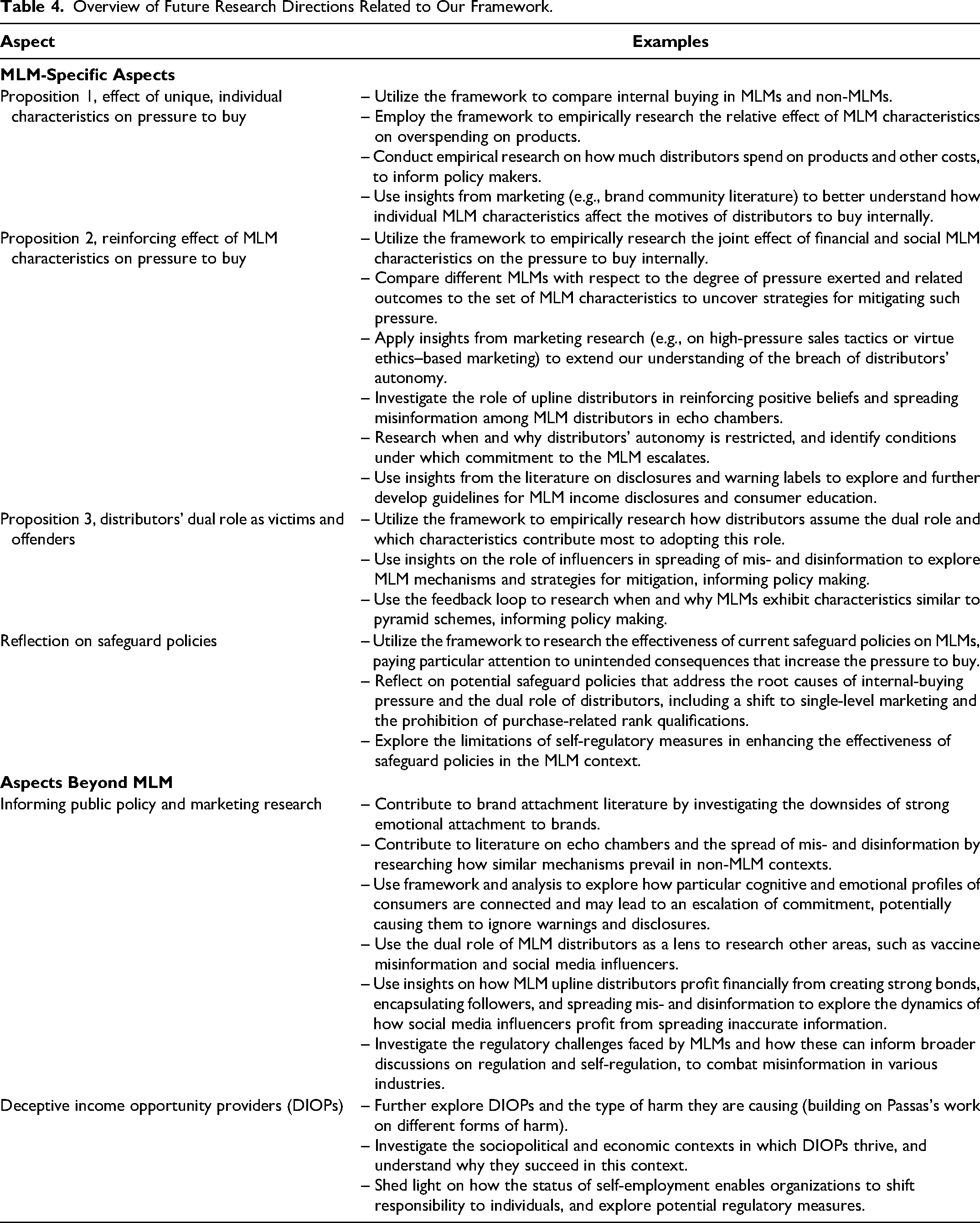
Conclusion
The size of the MLM industry might reflect the quality of its products or the ease of joining this income opportunity (DSA 2022). However, most MLM distributors invest more money in products and business costs than they ever earn through retailing products or recruiting others (DeLiema et al. 2018; FTC 2024b; Taylor 2014). Our study contributes to the academic and regulatory debate on MLMs by introducing a conceptual framework that explicates how the interplay of numerous organizational characteristics exerts pressure to buy, positioning MLMs as a distinct bad barrel. Our framework integrates ethical, legal, financial, and social dimensions, emphasizing the dual roles of MLM distributors as both victims and offenders. We suggest implications for public policy and marketing, including research on MLMs and beyond, and we extend our insights to the broader category of IOPs, particularly focusing on DIOPs. Here, we suggest avenues for future research, to protect consumers from being misled and exploited under the guise of an income opportunity.
Supplemental Material
sj-pdf-1-ppo-10.1177_07439156241301737 - Supplemental material for Buy! Buy! Buy!—How Multilevel Marketing Companies Pressure Their Participants to Buy Their Products
Supplemental material, sj-pdf-1-ppo-10.1177_07439156241301737 for Buy! Buy! Buy!—How Multilevel Marketing Companies Pressure Their Participants to Buy Their Products by Claudia Groß and Dirk Vriens in Journal of Public Policy & Marketing
Footnotes
Acknowledgments
The authors would like to thank the JPP&M review team for their constructive support and guidance throughout the development of this article. In addition, they would like to thank their colleague Matthijs Moorkamp and their former colleague Ine Gremmen from Radboud University for their valuable insight and contributions.
Joint Editors in Chief
Jeremy Kees and Beth Vallen
Associate Editor
Andrea Tangari
Declaration of Conflicting Interests
The author(s) declared no potential conflicts of interest with respect to the research, authorship, and/or publication of this article.
Funding
The author(s) received no financial support for the research, authorship, and/or publication of this article.
Notes
References
Supplementary Material
Please find the following supplemental material available below.
For Open Access articles published under a Creative Commons License, all supplemental material carries the same license as the article it is associated with.
For non-Open Access articles published, all supplemental material carries a non-exclusive license, and permission requests for re-use of supplemental material or any part of supplemental material shall be sent directly to the copyright owner as specified in the copyright notice associated with the article.
