




Abstract
Within an institutional theory framework, this article identifies three interconnected fields of the marketing institution—research, education, and practice—that contribute to advancing the diversity and inclusion discourse in promoting multicultural marketplace well-being. Conducting three studies, one in each field and across contexts in three continents, the authors identify barriers that inhibit effective implementation of diversity and inclusion initiatives in today’s multicultural marketplaces. These barriers exist within and across fields and pertain to cultural-cognitive (shared meanings), normative (normative factors), and regulatory (rules and systems) pillars supporting the existence or transformation of institutions. From the research findings, the authors provide specific guidance for institutional work within marketing’s fields and policy developments needed to advance diversity-and-inclusion-engaged marketing for enhancing multicultural marketplace well-being.
Keywords
The question of how to leverage multicultural diversity and achieve full inclusion for all individuals has become a focal topic among business researchers, educators, and practitioners across many societies (Ferdman 2014). In particular, the last decade has seen the introduction of several initiatives signaling this focus, including Forbes’s annual “Best Employers of Diversity” list (Umoh 2020), Refinitiv’s Diversity and Inclusion Index (2020) for socially responsible investment, and McKinsey (Hunt et al. 2018) and BCG’s (Taplett et al. 2019) reporting on the value of a diverse and inclusive organizational culture for business performance.
In some initiatives, business/management research, education, and practice join forces, as exemplified by The PhD Project (https://www.phdproject.org/our-success/about-us/). This U.S.-based initiative was established in 1994 to instill a greater appreciation for diversity and inclusion (D&I) among corporate and academic leaders, with the ambition of influencing Black/African-American, Hispanic/LatinX, and Native American students. To date, The PhD Project has quintupled the number of racially/ethnically underrepresented professors in business schools (an increase of over 1,200). Similar momentum is evident in other continents. In South Africa, several universities introduced programs to recruit and educate graduates to foster a diverse and democratic society (McKie 2019). Yet emerging initiatives remain isolated and limited in scale, with ongoing criticism leveled at universities for perpetuating “culturally colonial,” discriminatory knowledge (Grosfoguel 2013; Sleeter 2010). Furthermore, across a broad spectrum of industries, improvements to workplace D&I are assessed as slow or inconsistent and not fulfilling objectives (Murgia 2019; PwC 2019).
This ineffective progress is particularly evident from the perspective of external marketplace stakeholders. In recent years, numerous organizations have been criticized for cultural insensitivity and/or discriminatory practices in their marketplace activities. For example, Volkswagen received backlash for releasing an ad depicting an oversized white hand flicking a black man away from a VW Golf into what is labeled the “Little Colonist” café (Somerville 2020) and an ad portraying men as astronauts and athletes, whereas a woman looked after a baby stroller (O’Malley 2019). Starbucks received scrutiny for the arrest of two African American customers in one of its stores, prompting a wider debate on racial profiling in retail spaces (Gabbatt 2018). A growing body of research shows that various consumer populations are still subjected to discriminatory experiences, such as exclusion (Bone, Christensen, and Williams 2014; Kuppuswamy and Younkin 2020), stereotyping (Grau and Zotos 2016; Lee, Kim, and Vohs 2011), or being rendered invisible (Bennett et al. 2016; Gopaldas and Siebert 2018). The year 2020 laid bare the consequences of pervasive inequality and discrimination in the marketplace. The COVID-19 pandemic demonstrated ongoing disparities in access to health information and care for many historically marginalized populations across the world, while the widespread international expansion of the Black Lives Matter protests brought into sharp focus racial stereotypes persisting in marketing activities of many major organizations (Duffy 2020).
In summary, many consumers remain deprived of the benefits of D&I advancement. Extending Demangeot et al.’s (2019, p. 314) argument that multicultural marketplace well-being—“a positive emotional, mental, physical and social state of being experienced by culturally diverse market actors”—requires concerted efforts by marketing research, education, and practice to promote inclusion, we consider D&I-engaged marketing (DIEM) an important well-being-enhancing mechanism that is currently underutilized in the marketplace. We define DIEM as actions in marketing research, education, and practice that proactively and consistently promote advancement of D&I for all marketplace participants.
There are positive steps toward DIEM. In academic research, these include publication of studies on diverse marketplaces in our discipline’s leading journals, examining topics such as binational families (Cross and Gilly 2014), systemic discrimination in the financial services industry (Bone et al. 2014), and faux diversity in gentrification (Grier and Perry 2018). There also are several previous (Crittenden et al. 2020; Demangeot et al. 2015; Ellson 2014; Henderson and Williams 2013) or forthcoming (Williams, Cross, and Dellande 2020; Moorman et al. 2018) journal special issues on these topics. In marketing practice, there are emerging market analytics on the positive impact of advertisements representing diversity and inclusivity on consumer perceptions and share price (Beer 2019) as well as on the remaining gaps and inequalities in the representation of minorities in advertising (Lloyds Banking Group 2018). The U.S. Association of National Advertisers has developed a Cultural Insights Impact Measure to assess the cultural resonance of an advertisement with diverse consumers (Sherwood 2019). Networks of marketers and advertisers also are working to produce training and best practices for promoting workforce diversity in marketing (e.g., Salesforce; Siegel 2019). More recent developments include promoting racial equality in the wake of 2020 Black Lives Matter protests, with individual organizations radically reviewing their C-suites, branding, marketing, and hiring practices and industry associations pledging sustained action (Duffy 2020; Stewart 2020).
Yet efforts to further advance DIEM are facing several major hurdles. First, many initiatives remain fragmented, concerning only one facet of diversity (e.g., gender, disability, race/ethnicity) or one industry segment (e.g., advertising), and are viewed as superficial or publicity seeking (hiring of a chief diversity officer, staff training; Tai 2018). Second, there is a lack of understanding how organizational D&I practices affect marketplace stakeholders (Demangeot et al. 2019). A third hurdle lies in several forms of opposition to D&I. The strongest is the worldwide rise of extreme discriminatory ideologies (Jay et al. 2019). In some current political contexts, these ideologies exert pressures at the state level on D&I initiatives and programs established or being developed by organizations (BBC News 2017; O’Brien and Olson 2020). There also are acts of reactance, such as some men’s reluctance to hiring or placing women in roles for professional advancement following the #MeToo movement (Atwater et al. 2019).
This article contributes to current research and industry endeavors for DIEM advancement by taking an integrated view of how DIEM initiatives across the marketing discipline can be strategically broadened in scope and sustained. We address three questions: (1) What barriers prevent more effective and consistent DIEM initiatives? (2) How can DIEM be more socially impactful? and (3) What policy developments are needed to enable stronger DIEM advancements? We draw on institutional theory to develop a framework that identifies how DIEM actions can be aligned to effect systemic changes, in what we identify as the organizational fields of the marketing institution (research, education, and practice 1 ). Within this framework, we conduct three studies, multicultural in participants and country contexts (United States, United Kingdom, and South Africa). Our findings reveal several barriers, internal and external to marketing, impeding DIEM advancement, as experienced by actors in the three fields. We develop a set of within- and cross-field actions for marketing professionals to strategically coordinate their work for holistic DIEM advancement. We provide policy development recommendations for maximizing this work’s effectiveness and discuss how integrated policies and actions can leverage DIEM’s positive impact on multicultural marketplace well-being.
Institutional Theory as a Lens for Examining DIEM Progress
Institutional Theory
Institutional theory (DiMaggio and Powell 1983; Scott 2001) posits that individual and organizational actors are constrained by prevalent rules, norms, and shared meanings. At the same time, actors work toward changing those rules, norms, and meanings by attempting to legitimize alternative ones. Among the “building blocks” of institutional theory are organizational fields and institutions. Organizational fields are defined as “communit[ies] of organizations that partake in a common meaning system and whose participants interact more frequently and fatefully with one another than with actors outside the field” (Scott 2001, p. 56). Institutions are defined as “those (more or less) enduring elements of social life that affect the behavior and beliefs of individual and collective actors by providing templates for action, cognition, and emotion, nonconformity with which is associated with some kind of cost” (Lawrence, Suddaby, and Leca 2011, p. 53). Institutions form and operate at macro (e.g., political ideologies, sociocultural norms), meso (e.g., systems of health care, industry, labor organization, leisure) and micro (e.g., families, social peer groups) levels of social organization.
The set of rules, norms, and meanings operationalizing how people “live together” (Zapata-Barrero 2015) can be understood as a macro-institution. Two competing discourses currently contribute to legitimizing different conceptions of “living together” in multiculturally diverse societies. First is the discourse of explicit or implicit “dominance” of majority sociocultural groups over minority ones, expressed through cultural bias and discrimination and sometimes extreme forms of supremacist ideologies (Kešić and Duyvendak 2016). The second is D&I discourse promoting equality between people and groups, expressed through prioritizing inclusion as a sine qua non condition for well-being (Nowicka and Vertovec 2014).
The multicultural marketplace is a major social arena of the “living together” macro-institution, where different cultural codes converge and are experienced as bodily (e.g., consumers, frontline staff) and nonbodily (e.g., brands, media) manifestations of cultural origins, heritage, race, ethnicity, religious (non)beliefs, impairments, age, sexual orientation, gender identity, class, immigrant status, and neuro status, among others (Demangeot et al. 2019). The marketplace is also one of the main arenas where meso-level institutions operate, reflecting or attempting to transform macro-institutions. Marketing, a meso-level institution, materializes cultural codes concerned with “living together,” informed by and informing social development (Vorster et al. 2020). It can, through product/service provision and communications, (de)legitimize D&I discourse and affect marketplace stakeholders’ lived experiences (Saren, Parsons, and Goulding 2019).
Research, education, and practice are three organizational fields of the marketing institution, with actors in these fields involved in forming insights regarding lived experiences of the marketplace. Using these insights, they produce offerings, representations, or spaces; guidance for training of marketing professionals; or theories that ultimately affect the value consumers receive from their marketplace and social experience. In turn, actors’ abilities to sense new trends within consumer spheres and develop innovations addressing these trends is key to aligning marketing offerings and actions with consumers’ needs and well-being.
Marketing’s three organizational fields are interconnected through the circulation of ideas, knowledge, and people. Interaction between fields can enable the cocreation of new knowledge and actions or perpetuate existing ones. Grier, Thomas, and Johnson (2018) demonstrate how a lack of critical engagement with the notion of (re)construction of race in consumption by the research field may be interrelated with practices that overlook historically racially discriminated consumers or treat race simplistically as a segmentation variable. Burton (2009) shows how marketing academics socialized into an ideology of Whiteness through Euro-centered education continue to reproduce it in research and teaching. Consumers too can influence and/or accelerate change toward new knowledge and actions in the marketing institution. Through resistance, activism, boycotts, or “buycotts,” they can exert organized or emergent collective power over the practice field and (de)legitimize practices and offerings (Denegri-Knott, Zwick, and Schroeder 2006). Through brand communities and content generation, they can “shape the conversation” by providing researchers, educators, and practitioners with insights and their own framing of salient issues. Yet while the transformative consumer research (TCR) movement is focused on consumers’ voice, and consumer-inclusive methodologies such as participant action research (Ozanne and Saatcioglu 2008) or community action research (Ozanne and Anderson 2010) are promoted, a consumer well-being focus is rarer in the wider marketing discipline, falling behind other management sciences (Mari 2008; Moorman et al. 2018).
Through an institutional theory lens, DIEM represents an emerging subinstitution seeking legitimacy. Advancement of DIEM takes place in a context of “loose coupling” between consumers and the three organizational fields themselves. Although interconnected, fields are distinct communities, animated by different imperatives and meaning systems. Field-specific considerations (impact on the bottom line, teaching effectiveness, societal impact, research rigor, innovation, etc.) motivate different actions. It is, therefore, likely that such “interconnected yet siloed” modus operandi affects translations of D&I discourse and actions on DIEM.
Institutional Work
Institutional work encompasses “the purposive action of individuals and organizations aimed at creating, maintaining, and disrupting institutions” (Lawrence and Suddaby 2006, p. 215). A growing body of literature identifies different kinds of institutional work that individual and organizational actors carry out (see Lounsbury 2001; Zietsma and Lawrence 2010). Lawrence and Suddaby (2006) synthesize these efforts as aligning with three pillars of institutional legitimacy: (1) shared meanings (cultural-cognitive), (2) normative foundations and networks (normative), and (3) rules systems and regulatory support (rules). They identify 18 main forms of institutional work required to legitimize a new institution and disrupt the existing institution where transformation is sought (see Web Appendix 1). Because institutional work is characterized by the intentionality and effort of all actors involved (Lawrence et al. 2011), we argue that a holistic view of actions toward DIEM advancement by actors across marketing’s organizational fields can explain why, how, and where this work is most and least effective. We next report three studies carried out in each of marketing’s fields with this aim.
Methodology
Research Approach and Context
Using a multimethod approach (Morse 2003), we designed three qualitative studies to examine DIEM work by actors operating in marketing’s research, education, and practice fields in the United States, United Kingdom, and South Africa. These contexts, representative of multicultural marketplaces (Kipnis et al. 2013), allow for contrasting different perspectives to “take account of the ideological, historical and structural contexts of cultural diversity” (Demangeot et al. 2019, p. 342). The three contexts are comparable by the multicultural nature of their demographic landscapes and by the ongoing challenges, in their sociopolitical discourses, of the hegemony of historically dominant groups (e.g., White ethnoracial group, male gender group; Nkomo and Hoobler 2014). At the same time, they represent different regional locales (North America, Africa, and Europe), hemispheres (Western: United States, United Kingdom; non-Western: South Africa), and histories of cultural diversity evolution (postcolonial: United States, South Africa; migration: United Kingdom). Thus, these contexts illuminate both contextually unique and cross-contextually similar experiences of actors working toward advancing DIEM. Such a cross-contextual view is important given that actions directly related to advancing D&I are set as global priorities (as reflected, for example, in emphasis on inclusivity in several of the United Nations’ Sustainable Development Goals, including Reduced Inequalities, and Gender Equality; https://www.un.org/sustainabledevelopment/sustainable-development-goals/), as well as the transnational interconnectedness of contemporary markets, research, and education (Demangeot, Broderick, and Craig 2015; Nowicka and Ryan 2015). The studies comprise (1) a heteroglossic researcher introspection (Study 1), (2) a systematic review of D&I agenda and DIEM actions as reflected in universities’ official webpages and marketing curricula (Study 2), and (3) three knowledge cocreation workshops with professionals and marketing practitioners engaged in D&I (Study 3).
Study 1
We examined experiences of marketing actors advocating for DIEM within the research field via heteroglossic (e.g., multivoice) researcher introspection, which uses researchers’ lived experiences as data and allows for conjoining multiple viewpoints on a focal interest (Gould 1995; Wallendorf and Brucks 1993). Through mindful observation(s) on the self and/or external phenomena, introspection enables discovery of paradoxes and resolutions that might not otherwise be accessible (Banbury, Stinerock, and Subrahmanyan 2012; Woodside 2004).
This article’s authors share the lived experience of studying culturally diverse consumers in multicultural marketplaces and their experiences of well-being. Coauthors also have past or current roles as practitioners and educators in business/management schools. Our experiences of academia vary by timeline and career stage; the team comprises five early-career academics (doctoral researchers and/or academics between one and three years after receiving their PhD 2 ) and eight established academics (four at the associate professor level and four at the professor/chair level or above). We cover a range of Western (United States, France, United Kingdom, Italy, Spain, and Belgium) and non-Western (Brazil, South Africa, Kazakhstan, Ukraine, Romania, Poland, China, United Arab Emirates, Malaysia, the Caribbean, the Middle East, and Southeast Asia) national and regional contexts and different focal dimensions of multicultural living (e.g., ethnicity, race, multiracial, multicultural, disability, gender facets, and their intersections), allowing for variation (Banbury et al. 2012).
Our approach was interactive introspection (Gould and Maclaran 2003), whereby one or more researcher-informants introspect while others comment, question, and/or introspect in response. We chose written introspections “to create meaningful contextualised narratives for analysis” (Boufoy-Bastick 2004, p. 4). To balance team power dynamics (Muhammad et al. 2015), early-career academics were first to conduct a written introspective exercise; other academics reviewed and elaborated on these in a subsequent exercise. The first three authors developed an introspection brief, asking team members to consider (1) how to research multicultural marketplaces for transformative outcomes, (2) how to design and implement effective marketing practice interventions for multicultural marketplace well-being, and (3) how to prepare and develop marketers through education and training curricula for effective [multicultural] well-being-enhancing marketing practices. Interactive introspection continued throughout our track’s work at the 2019 TCR conference. Working in smaller groups and then as a whole group, we produced “brainstorm posters” on initial introspections. Team notes akin to “memoing” supported the articulation of analytical observations and clarification of assumptions to arrive at shared interpretations (Miles and Huberman 1984).
Study 2
With Study 2, we aimed to gain insight into the education field. We conducted a review of the D&I discourse and DIEM actions as reflected in corporate communications and marketing curricula for universities in our three chosen contexts: the United States, the United Kingdom, and South Africa. The design followed the systematic review method (Siddaway, Wood, and Hedges 2019) and focused on websites, as “gray” (nonacademic) sources enable discovery of the status quo in areas of public life on which academic knowledge is scarce (Stansfield, Dickson, and Bangpan 2016).
Using a quasirandom sampling procedure, we selected a sample of 48 universities (United States: 20, United Kingdom: 20, and South Africa: 8). The sampling criteria took into consideration specifics of the higher education sector in each context. For the United States, the 65 member universities of the Power Five Athletic Conferences were deemed appropriate to identify a representative view, in terms of geographical location, university ranking, and type (private vs. public). For the United Kingdom, we chose the Complete University Guide, which provides a comprehensive list of 131 higher education institutions from across England, Wales, Scotland, and Northern Ireland. For South Africa, the list comprised all 24 universities in the country. U.S. and U.K. samples were drawn as follows: First, university lists were sorted alphabetically, with each university identified by a number. Next, using an online random number generator (http://numbergenerator.org/), we generated a list of 20 numbers and sampled universities based on their number. The South Africa sample was drawn to comprise eight universities included in the 2018 edition of Times Higher Education World University Rankings list, as we reasoned that this would enhance the data’s cross-comparability.
Drawing on the study objectives, we generated a list of keyword search terms: “equality,” “diversity,” “inclusion,” “multicultural,” “intercultural,” “multi/intercultural markets,” “cultural (in)sensitivity,” and “(inter)cultural competence.” We first conducted searches for the (1) home page of the university’s official website and (2) home page of the university’s business/management school (if existing). The first ten returns of each search were recorded, and subsequent returns were carefully inspected. All returns potentially relevant to our research questions were recorded—including, but not limited to, university/school statements of mission; vision; policies; D&I agenda; plans and procedures; definitions pertaining to equality, diversity, and inclusion; and D&I-related events, research groups/projects, and training. Next, we identified and reviewed webpages with descriptions of marketing courses, seeking programs and modules that include topics related to our keyword search terms in the titles and content outlines, learning outcomes, or syllabi. Given our conceptual focus on marketing as an institution in which DIEM strives for legitimacy, we chose to look for evidence of DIEM embeddedness in curricula. That is, while acknowledging that D&I progress could have been assessed via student and faculty counts as a proxy measure, we reasoned that, for substantial gains in DIEM specifically, demographic diversity needs to be matched with educational content.
Study 3
Study 3 design followed a relational engagement approach, where researchers actively engage with “relevant stakeholders building on their everyday understandings, interests, and expertise” (Ozanne et al. 2017, p. 5). We used knowledge cocreation workshops, recommended for institutional work research, to elicit productive interactions—a form of relational engagement (Hampel, Lawrence, and Tracey 2017; Spaapen and Van Drooge 2011). Productive interactions converge voices, experiences, and skills of researcher(s) and relevant stakeholders (executives, managers, policy makers, consumers, activists, and nonprofits) to cocreate knowledge for societal benefits. The workshops pursued three interrelated objectives: (1) to gain insights into the experiences of actors advancing DIEM in practice, (2) to identify whether and what forms of institutional work can advance DIEM, and (3) to scale up nonacademic stakeholders’ input into the long-term knowledge development agenda of our research network. Objectives 1 and 2 were directly relevant our research’s aims; objective 3 pursued further relational engagement work.
The workshops took place in two locations in the United Kingdom (London and Yorkshire) and one location in the United States (Midwest), two of our chosen contexts with different histories of diversity evolution (i.e., postcolonization [United States] and migration [United Kingdom]). Outside of our author team, the workshops comprised 26 contributors representing a range of backgrounds and professional experiences (8 in one U.K. location; 6 in the other U.K. location, with contributors from across south England, Midlands, and north England; 12 in the U.S. workshop, with contributors from across the United States, including the eastern, southern, and western regions). Contributors were recruited via snowballing from personal contacts and online resources (e.g., companies’ websites, Twitter, LinkedIn). To maximize democratic and outcome validity (Ozanne and Saatcioglu 2008), we utilized a maximum variation sampling strategy to engage a range of contributors for distilling core experiences from “common patterns that emerge from great variation” (Patton 1990, p. 172). Thus, we sought variety in sectors, scope of organizations’ operations (regional, national, and international/global), roles, and seniority among marketing practitioners and other contributors who were involved, through formal (D&I function/department) or informal (activist movements concerned with diversity in media/advertising) structures, in activities intersecting D&I and marketing. Web Appendix 2 presents a detailed contributor profile.
All workshops followed a discussion forum format and, for cross-national equivalence (Belk 2006), adhered to the same protocol comprising broad guideline questions (for question examples, see Web Appendix 2). Three contributors in the United Kingdom, who were unable to attend the workshop, were interviewed by one member of the U.K. research team. Interviews followed the same protocol and were subjected to the same analysis (Patton 1990). All workshops and interviews were audiorecorded with contributors’ consent.
Data Analysis
In all three studies, we subjected data to thematic analysis, following the constant comparative method (Glaser and Strauss 1980) and seven analytical stages by Spiggle (1994). Textual data (introspective pieces in Study 1, systematic review records in Study 2) were analyzed on data collection completion; voice-recorded data (workshops and interviews in Study 3) were transcribed verbatim, then analyzed. Analyses followed a derived etic approach, first conducted within and subsequently across organizational field and national data subsets for Studies 2 and 3, to discern context-informed specificities and differences as well as cross-contextual similarities (Berry 1979). For each data (sub)set, one author independently conducted initial thematic analysis, utilizing meaning categorization to identify emergent descriptive emic themes and condensation to formulate analytical etic themes (Kvale 1996). These were subsequently contrasted with our theoretical framework and literature. Themes were condensed and classified as rules, norms, and meaning-related constraints (barriers), or transformative actions experienced by actors. Emergent themes were audited by at least one other author before being shared with the author team. The three lead authors consolidated and compared emergent themes, identifying themes recurring across and specific to context (organizational field/national). The team met regularly online to discuss and agree on emerging interpretations.
Findings
Analysis reveals that actors across marketing research, education, and practice fields experience a range of challenges in advancing DIEM. Within an institutional theory framework, these challenges manifest as cultural-cognitive (meanings), normative (norms), and regulatory (rules) barriers that inhibit building (legitimizing) DIEM as a subinstitution. Some barriers exist across fields; others are field-specific. Analysis also reveals that harnessing fields’ interconnectedness can aid in overcoming barriers. We report findings via exemplar data extracts and condensed data in Table 1. Web Appendix 3 provides this table with both condensed and noncondensed data.
Barriers for D&I Discourse and DIEM in Marketing Fields.

Barriers for DIEM: Meanings
The first group of barriers represents challenges related to operationalization of the D&I discourse. Specifically, findings reveal confounded conceptualizations of D&I (barrier 1, Table 1) within and across marketing’s organizational fields. This appears to restrict actors’ DIEM activity. Research contributors identified a predominant theoretical focus on “more profitable means of improving reach and return on investment [rather than] impact on consumer well-being” (Researcher Informant 2), obstructing their work on examining marketing’s impact on multicultural marketplace well-being. Within education, data highlighted that business/management schools appear to rely on university-level visions and actions on the D&I agenda rather than comprehensively specifying D&I as a required outlook for future business leaders. Within practice, unclear and varying D&I definitions appear to obstruct organizations’ visions of DIEM social outcomes, resulting in a trivialization of the discourse as “the right language to not get in trouble” (U.K. contributor).
A second barrier is selective operationalizations of DIEM (barrier 2, Table 1), a focus on select stakeholders based on cultural difference marker(s) or on organization’s type/size. In education, findings show within- and cross-national variations in focus on cultural groups (on, e.g., race, LGBTQ, disability, gender) and stakeholders (staff, students). Practice contributors highlighted that DIEM is more prevalent in the agenda of large corporations but “not really a conversation” in smaller organizations (U.K. contributor). These findings corroborate prior academic and industry reports indicating that large private and public organizations tend to “dimensionalize” their approach to D&I, engaging stakeholders who are perceived as relevant to their instrumental objectives through corporate branding and advertising (Berrey 2011; Jonsen et al. 2019). Smaller organizations may find it more challenging to act on or sustain D&I (Cruikshank 2017). Selective operationalizations of DIEM are linked to “traumas of omission” (Bennett et al. 2016, p. 283) and prevent achievement of equity, as articulated by a U.S. practice contributor: “So diversity and inclusion, I think oftentimes the equity piece is left out of it.” Addressing equity is a developing DIEM trend, showcased by the U.S. Association of National Advertisers’ #SeeAll initiative (Schultz 2019).
A third barrier reported by contributors in research and practice encompasses deficiencies in production and diffusion of unified DIEM knowledge (barrier 3, Table 1). Practice contributors highlighted the need for DIEM knowledge developed from standpoints of empathy, compassion, and humanity. Similarly, research contributors highlighted considerations of multicultural well-being, empathy, and “basic human needs for inclusion” (Researcher Informant 3) as an important perspective missing from marketing education and theories. Such observations resonate with emergent notions of “affective marketplace inequality” (e.g., lack of “care” in marketplace offerings and/or communication; Hutton 2019) and of “inclusivity marketing” (e.g., a principle of recognizing all consumers and their [multi]cultural identities; Papandrea 2019). That inclusivity requires active empathetic thinking (Berlach and Chambers 2011) explains the cross-field demand for empathy as one of the core DIEM concepts.
We identified empathy, inclusivity, and equity as components for reinforcing the meanings pillar of DIEM. Significantly, practice and research contributors emphasized the need for connecting silos within and across fields to facilitate DIEM knowledge production and diffusion. Practice contributors reasoned that this can be accomplished by maximizing interactions: “So, there needs to be so much conversation between all the different groups especially the activists” (U.K. contributor); “everyone needs to step out of their comfort zone” (U.S. contributor). Others pointed to the need for closer, more in-depth interaction with professional training, a key form of marketing education in some marketplaces: “Many marketers in South Africa do not complete Master’s or Doctoral degrees” (Researcher Informant 1).
The fourth barrier we identified is the lack of shared language and mutual understanding in construction of DIEM-specific resources and actions (barrier 4, Table 1). Contributors from practice expressed frustrations over a deficit of accessible knowledge resources and/or exchange platforms that consolidate DIEM-specific expertise and best practices. They perceived the research field to offer few relevant forms of DIEM knowledge and a lack of accessible, flexible ways for engagement between large actors in education and research (universities’ business/management schools) and small-size practice actors (regional marketing and advertising agencies). Research contributors acknowledged that work is required to extend the scope of engagement between DIEM-oriented research and other fields. They also expressed concern that their work is “lagging behind” the needs and pace of practice. A similar trend is observable in the education field. Only a minority of universities in our sample offer specific marketing courses dealing with marketplace diversity holistically; while some emphasize an international perspective in regular marketing courses, very few address intranational diversity.
Contributors emphasized the need for joint production of resources and knowledge. A U.S. practice contributor identified “theorizing on the ground” as required joint work: “In real time practice, not so much as a theory. I mean the theory piece could just be, maybe in some type of research and development, but then at a certain point, to actually be on the ground or in a particular environment.” A U.K. practice contributor stressed that research field actors need to do “translational” work to create shared meanings, language, and understandings: “So if you [academia] produced something which marketers want to read, you’re creating some change.”
Barriers for DIEM: Norms
The second category of barriers concerns norms. A first barrier, D&I anxiety (barrier 5, Table 1), indicates that competition between “dominance” and ‘D&I’ discourses within the macro-institution of “living together” is mirrored in the marketplace. It shapes stances of and relationships between marketplace actors, including consumers, brands, marketing academics/practitioners, and organizations. Contributors stated the need to recognize the (at times unintended) consequences of mainstreaming D&I discourse and develop solutions. These consequences encompass reactance from some members of currently dominant cultural groups. For instance, campaigns for inclusion of consumers with disabilities could result in the nondisabled perceiving them as “too able to be on benefits just because they were out shopping” (Researcher Informant 4). Practice contributors indicated that not engaging with dominant groups generates beliefs of “all this [D&I] work [being] subversive and…taking away access [to] an opportunity” (U.S. contributor). They stressed that engaging these groups is not a retreat from the D&I agenda but rather “actually getting them to be involved” (U.K. contributor).
Findings illuminate how D&I anxiety can constrain marketers’ transformative actions for DIEM advancement. This supports prior research proposing a relationship between (multi)cultural meanings conveyed through marketing actions and perceptions of threats from cultural outgroups copresent in a multicultural marketplace leading to reactance (Kipnis et al. 2013; Visconti et al. 2014). Contributors shared reflections on being “stuck” between the ethos of “greater good” and extant norms imposed through client/shareholder/employer pressures. One U.K. practice contributor illustrated client-imposed pressures: “Brands are really terrified of the term diversity and inclusion.…So, there’s a sense that people are trying to just cover their ass as opposed to really engaging with the topic.” Another described pressures from shareholders: “Shareholders are nervous…. They’re quite willing to overlook the diversity angle of the whole thing, where they’re happy to just disregard big sections of the marketplace of which I think is totally foolhardy” (U.K. contributor). A research contributor also detailed employer pressures: “I tried to fight it [leaning toward culture research] for a long time,…fearing that I would be perceived as ‘boxing myself’ in the only thing I knew anything about” (Researcher Informant 5).
The second barrier takes the form of normative pressure “from within” to preserve marketing disciplinary traditions, which Brownlie and Saren (1997) define as myths and rhetoric. We term this barrier dominance of pre-DIEM myths and rhetoric (barrier 6, Table 1). Our analyses identified a prioritized “Westernized” outlook on cultural diversity and the “segmentation-targeting-positioning” (STP) foundation of marketing strategy among the key myths that guide actors’ conduct and pose complex moral dilemmas.
Review of marketing curricula showed that in the education field, aside from single exceptions in the United States and United Kingdom, business/management schools focus on implications of international/global dimensions of cultural diversity for marketing decisions but omit perspectives of colonialism and other sociohistorical trajectories. These findings align with previous observations that business education is yet to fully integrate diversity issues (Jackoway 2014). At the same time, findings highlight that national level perspectives on diversity and intercultural relations can obscure differences among cultural source(s) of discrimination and exclusion in other contexts. For instance, U.S. practice contributors noted that the “American optic” of race relations overlooks “other reasons [for which] people can feel different.” Similarly, Study 2 illuminated that universities’ D&I policies and processes typically interpret the discourse through the lens of national context or are directly motivated by national initiatives. The focus of D&I discourse varies from equal opportunities in the United States, to equality and an end to discrimination in the United Kingdom, and country transformation and power rebalancing in South Africa. U.K. universities appear motivated by the Equality Act 2010 and focus D&I discourse on end to discrimination. South African universities seem motivated by the Broad-Based Black Economic Empowerment Act 2003 and focus on country transformation and power rebalancing. Although no such single motivation is traceable in the U.S. sample, the D&I discourse is focused on equal opportunities. Such contextual variations, coupled with the need for an international outlook on D&I, resonate with concerns over marketing ignoring large proportions of humankind, mostly in non-Western societies (Hill and Martin 2014), and with calls for marketers to sensitively balance intra- and international perspectives when adopting a DIEM stance, particularly considering implications in varying sociopolitical settings (Kipnis et al. 2013).
Contributors highlighted tensions that pre-DIEM myths and rhetoric pose to negotiations between commercial (product/service value delivery) and moral (inclusivity) considerations in professional decisions, given that they currently represent different imperatives. Acknowledging that routinized dominant practices such as segmentation and targeting may produce/perpetuate marketplace exclusion, they indicated the need for critical rethinking: “Segmentation is something that we do in marketing.…So you’re going to chase the money. If the money is primarily in the hands of one particular group, that group is going to get more of your attention,…more of your social affirmation of worth.…And yet I have to wonder…segmentation could actually very well be one of the key contributors to the lack of inclusion” (U.S. practice contributor); “While targeting is a core principle of good marketing, it also by its very nature a form of exclusion. The question then is perhaps whether we need to constantly combine targeting and representation in our considerations” (Researcher Informant 12). These concerns corroborate calls for reexamining what marketing practices act as mechanisms (re)producing and (re)enforcing social (in)justice (Grier 2020). Such reexamination bears urgency as pervasiveness of STP extends beyond human actors. Across digital platforms (business, nonprofit, political, and governmental), micro-targeting algorithms have been constructed based on traditional models. Developed with limited DIEM perspectives, these algorithms can amplify exclusion by limiting access to information and resources (Williams et al. 2020).
A third norms barrier, which we term the gap in marketing-specific evidence that makes a convincing case for DIEM (barrier 7, Table 1), also rests on the tension between commercial and moral imperatives. In education, this barrier manifests as no visible uptake, at the business/management school level, in translating universities’ D&I policies as an imperative to train graduates as future business leaders able to shape societies, marketplaces, and organizations toward inclusivity. Across practice and research, the majority of contributors also noted that a lack of “hard” evidence of the benefits benefits of engaging with D&I via the marketing function raises difficulties in making a “business case” for DIEM. Practice contributors emphasized that business and moral imperatives should be integrated in this “business case” and asserted the key role of a concerted cross-field effort in its development. They noted the absence of metrics capturing DIEM “implications for profit margins” and organizations’ innovation capabilities (U.K. contributor) while stressing that “one thing that [academics] can do is to push back on the…absolute monetization of the [D&I] strategy” (U.S. contributor). Contributors also expressed that marketing is lagging in D&I drive, giving way to functions informed by other business/management disciplines: “Marketing officers have, in my opinion, delegated their responsibility to [human resources] or to social responsibility” (U.S. contributor). This brings into question the sustained relevance of marketing, particularly given that emerging “business cases” for D&I are already driven by law (Fires and Sharperson 2017) and strategy (Hunt et al. 2018).
Barriers to DIEM: Rules
The final group of barriers suggested by our data pertain to formal and informal rules (processes, policies) guiding practices in marketing’s three fields. We label the first barrier methodological deficiencies (barrier 8, Table 1). Findings show that, across fields, procedures (sampling approaches, auditing frameworks) and instruments (metrics, measures) available to actors do not adequately capture the status of DIEM practices. Deficiency in tools to adequately execute and evaluate performance of DIEM initiatives often results in failed outcomes, as articulated by a U.S. practice contributor: “So it’s just a new thing that I think sometimes people just jump onto it because it’s what everyone else is doing.…But then if it’s not actually implemented the correct way, it doesn’t come out with the results that you want.”
Two interrelated barriers also surfaced. The first is what we term lack of applied D&I focus in marketing/business education and training policies (barrier 9, Table 1). Both practice and research contributors suggested that marketing education and training policy development is crucial for overcoming meanings and norms barriers for DIEM. Although D&I discourse is more embedded in the general management, marketing has yet to make these connections, as a U.K. practice contributor illustrates: “[D&I] sits separately from, actually, the [marketing] discipline.…Oftentimes students don’t marry the two up.” In education, we observed an absence of an explicit operationalization in marketing curricula, especially in the U.S. and U.K. data sets, of DIEM as a professional ethos and skill set, aside from a statement by one U.S. university.
Second, contributors identified that applied pedagogical innovations are needed to advance disciplinary understandings both by marketing students and professionals: “I have been an educator and a researcher for more than a decade, but I have only been involved in diversity and inclusion for I think a little more than one year. And I have always been thinking about those roles as kind of separate.…And I can see there’s a lot of connections” (U.S. contributor). Contributors suggested a range of qualities, competences, and skills that should be incorporated in marketing curricula, including empathy and (multi)cultural intelligence, unconscious bias, skills for change making, and qualitative and quantitative evaluations of DIEM effectiveness. Enduring absence of these innovations is surprising given that calls for their development trace back over 15 years (Burton 2005). This may be explained by fact that, until recently, the drive for DIEM was promoted only through efforts of individual academics (Demangeot et al. 2019). Institutional support for DIEM is emerging, as evidenced by the Association to Advance Collegiate Schools of Business (AACSB), a leading international accreditation authority for business/management schools, integrating D&I as an accreditation standard and holding a D&I Summit in November 2019 (AACSB 2018, 2019). However, as our data indicate, more concerted practical developments are required to embed DIEM as a set of competences and skills that constitute a basis for marketing professionals’ training.
The final barrier, which we term lack of self-regulation and “encouraging” governance (barrier 10, Table 1), highlights the need for meaningful implementation of DIEM principles in marketplace-level/organizational policies. Contributors suggested two implementation routes: punitive self-regulation (“I’m thinking corporate America it should have teeth with it, so that if there are violations to diversity and inclusion policies, that there’s a repercussion” [U.S. contributor]) and governance “encouraged” through rewards/awards (“And then the Mayor’s Office in London…did something called The Women We See last year, which was all about awarding” [U.K. contributor]). They also emphasized the value of direct involvement of policy makers and cross-field initiatives, highlighting that complementing scope can maximize impact, as two U.K. contributors articulate: “UN Women and Unilever have a joint global movement called the Unstereotype Alliance”; “So much of the progress that’s been made here is where businesses are partnering with institutions.”
Discussion and Implications
The present research conceptualizes DIEM as an emerging subinstitution aiming to build legitimacy within the wider marketing institution. Through empirical studies across marketing’s three organizational fields (research, education, and practice), we address our previously stated questions: (1) What barriers prevent more effective and consistent DIEM initiatives? (2) How can DIEM be more socially impactful? and (3) What policy developments are needed to enable stronger DIEM advancements? In answer to question 1, a triangulation of the three studies shows evidence of barriers in each field restricting actors’ efforts to institutionalize DIEM. Some barriers are field-specific; many exist across fields. This suggests that lack of concerted effort between fields is hindering collective progress toward DIEM and, consequently, diluting marketing’s potential to positively affect multicultural marketplace well-being. Considering these observations from an institutional theory perspective, we derive two key implications addressing question 2 and recommend a set of policy developments addressing question 3.
Toward a Holistic and Systematic Advancement of DIEM
A first implication arises from the finding that actors’ work toward legitimizing DIEM as a subinstitution within marketing suffers from the existence of “structural holes” (Burt 2004), or silos between actors or fields having complementary knowledge or expertise. Better harnessing of connections between fields is needed for a more holistic DIEM advancement. This points to the potential value of developing bridging capital across fields. Bridging capital, a type of social capital constituting links between heterogeneous actors and communities through participation in voluntary networks and organizations, enables building of consensus and achieving collective leverage (Putnam 2000). The findings also point to several means of developing bridging capital through brokerage. Brokerage—an act of cohesively transferring knowledge and best practices—enables selection and synthesis of ideas that create value for all communities (Burt 2004).
Our research identifies common needs for knowledge (theories, concepts, definitions, frameworks, and indices), arguments (business and moral “cases” and evidence), learning or educational resources (repositories, insights, and best practices), “tools for action” (models, methods, audits, measures, and policies), and contextualization (knowledge of cross-diversity and cross-national conditions). Concurrently, our findings highlight two main issues hindering cross-field actions to address these needs: (1) a lack of “translatability” of each field’s output and (2) a poor conception among actors of the possible contributions that different fields’ actors can make toward advancing DIEM. We propose that actors’ institutional work within their fields and implementation of brokerage and bridging activities can address common needs and lead to a more strategic drive for DIEM. Brokerage would enable coproduction of “translatable” DIEM definitions and principles and capture the impact of DIEM practice on organizations’ financial and social performance. Bridging would build cross-field knowledge sharing and reach critical mass for engaging public, industry, and organizational policy makers.
The second implication stems from the opportunity for a systematic approach enabling actors, within and across fields, to work concertedly at institutionalizing DIEM further by reinforcing its cultural-cognitive, normative, and regulatory legitimacy. Although some work to overcome the barriers identified is occurring within each field, the organically evolving isolated efforts lack momentum required for transformational impact within the marketing institution as a whole.
Adapting Lawrence and Suddaby’s (2006) institutional work typology, we develop a framework for institutionalizing DIEM, presented in Table 2, Panels A–C, that, respectively, delineate the systematic work required to overcome uncovered meanings, norms, and rules barriers. The table shows illustrations of institutional work forms within (table columns) and/or across (cross-column rows) fields. Importantly, for this work to reach sufficient scale, policies are needed to create structures and mechanisms to determine, encourage and evaluate DIEM work. The next section draws from Table 2 to outline required policy development.
Institutional Work for Overcoming Meanings, Norms, and Rules Barriers to DIEM.
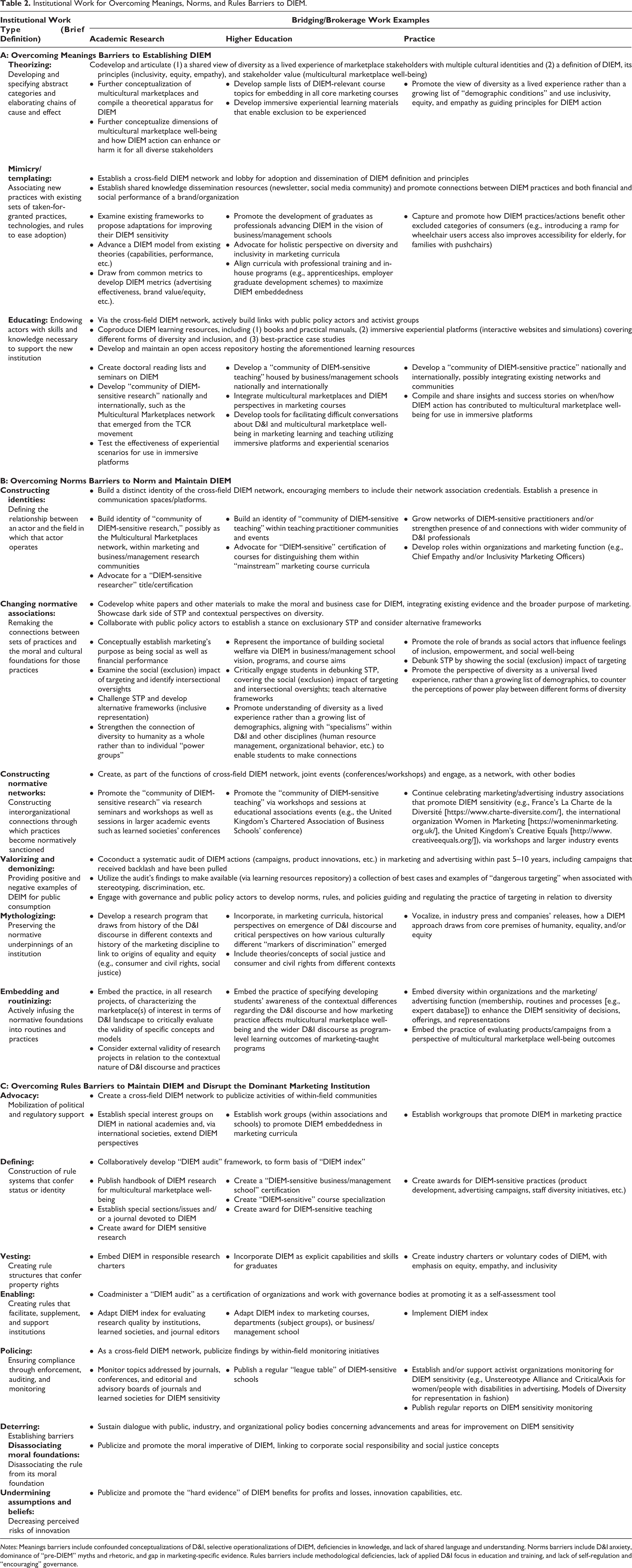
Notes: Meanings barriers include confounded conceptualizations of D&I, selective operationalizations of DIEM, deficiencies in knowledge, and lack of shared language and understanding. Norms barriers include D&I anxiety, dominance of “pre-DIEM” myths and rhetoric, and gap in marketing-specific evidence. Rules barriers include methodological deficiencies, lack of applied D&I focus in education and training, and lack of self-regulation and “encouraging” governance.
Policy Development
To build DIEM’s cultural-cognitive legitimacy and overcome barriers to meanings and language, actors can (1) collectively, and within their fields, develop knowledge that advances DIEM’s understanding and acceptance among actors (theorizing); (2) connect DIEM practices to existing ones to enhance their acceptability and adoption (mimicry/templating); and (3) enhance actors’ skills and knowledge to implement DIEM within their practice (educating). Key in this work is the development of a shared, holistic view on diversity as a lived marketplace experience and a definition of DIEM, its principles and value to stakeholders.
This work can be enabled and stimulated via professional associations within each field (e.g., Marketing Science Institute in Research, Society for Research in Higher Education, Marketing Educators’ Association in Education, The Chartered Institute of Marketing in Practice) introducing policies encouraging DIEM knowledge exchange and integration activities. These policies can include joint funding to support the establishment of national and international cross-field relational engagement platforms (Ozanne et al. 2017), such as a cross-field DIEM network, cross-field peer mentoring (e.g., matching practice leaders with researchers), and development of knowledge-sharing resources (e.g., expert databases, best practice repositories, training materials, specialized reading lists, immersive experiential learning simulations and activities). Within-field association can encourage their members to connect and learn across fields by stimulating cross-field research on DIEM-related challenges, such as discrimination and exclusion in the marketplace and public policies that affect D&I. In this cross-field research, practice actors can identify most pertinent issues, whereas research and education actors can create and disseminate knowledge about these issues to current and future marketers. Publishers of marketing journals, books, and professional magazines can support DIEM resources and new knowledge dissemination via open access.
To build the normative legitimacy of DIEM and overcome barriers related to D&I anxiety and tensions with extant marketing myths and rhetoric, actors should strive for a more widespread establishment of DIEM as a disciplinary standard. This can be achieved by (1) constructing a distinct identity as communities of DIEM professionals within and across fields (constructing identities); (2) challenging taken-for-granted myths, rhetoric, and practice, as well as metrics of social and corporate performance delivery (changing normative associations); and (3) advancing DIEM’s visibility (constructing normative networks). Norms of DIEM should be anchored in the marketing institution through (1) disseminating cases of “good and bad” practice, showcasing the potential harms of currently established models, such as STP (valorizing and demonizing); (2) reinforcing the ties between DIEM practices and their performance outcomes (mythologizing); and (3) establishing blueprints for DIEM-informed decision making, incorporating cross-marker (ethnicity/race, disability, etc.), intra- and international difference considerations, as well as their intersections (embedding and routinizing).
Several policy advancements can stimulate these forms of institutional work. The cross-field DIEM Network can engage with international and national governments, organizations, think tanks and public funding bodies to spotlight marketing’s transformative role in advancing D&I. While these organizations show growing attention to matters of individual and community well-being, few of them have thus far explicitly recognized the potential impact of DIEM. For example, a recent 3 keyword search for “marketing” and “advertising” on the official website of the Organisation for Economic Co-operation and Development did not return results related to D&I, although shaping policies to foster well-being and equality are among the organization’s four priorities. Briefings with policy makers can stimulate development of DIEM research, education, and practice, potentially via funding initiatives targeting international and national D&I-focused goals (such as the United Nations’ Reducing Inequality goal) calling for marketing-led projects.
Within-field institutional and corporate policies can facilitate encouragement of DIEM via codes of responsible conduct. With inclusivity featuring among the top ten 2020 global consumer trends, forecast to increase in significance following COVID-19 pandemic (Angus 2020), implementing these codes will speak to organizations’ triple-bottom-line objectives. Practice actors (managers or organizations) can incorporate in their marketing operations and strategies the United Nations Guidelines for Consumer Protection (https://unctad.org/topic/competition-and-consumer-protection/un-guidelines-on-consumer-protection), particularly consumer needs for access to essential goods and services and inclusivity of vulnerable and disadvantaged consumers. Research and education actors (e.g., learned societies, journals) can assess the extent to which activities in their ecosystems (e.g., research streams, teaching programs development, methodologies) speak to delivery of social change for all humankind and fully recognize stakeholders’ diversity (Community for Responsible Research in Business and Management 2017; Hill and Martin 2014; Ozanne and Fischer 2012). To aid such systems with in-depth insights, future researchers could develop a DIEM audit framework and associated metrics to capture DIEM performance, potentially with input by consumer movements advocating for D&I.
To build regulatory legitimacy of DIEM, actors can leverage within- and cross-field networks to (1) extend scope and reach (advocacy); (2) determine systems for evaluating conduct in campaigns, product development, service processes, and so on along DIEM principles (defining); and (3) implement those systems (vesting). All fields should engage in, and lobby for, development of governance and policy mechanisms that encourage application of these criteria (enabling) while “calling out” practices that have opposite effects (deterring and policing). Furthermore, “norming” of DIEM as an asset for organizational social performance should be supported by demonstrating such effects, to mitigate resistance of other discourses (undermining assumptions and beliefs) and challenge their validity (disassociating moral foundations).
Industry governance and corporate policy mechanisms enabling this work include the specification of DIEM standards for new or existing organizational and individual certifications. Examples of those include business/management schools’ accreditation frameworks (e.g., AACSB, Association of MBAs, European Quality Improvement System, professional bodies’ accreditations), or corporate certification frameworks, such as ISO 26000 for social responsibility. The DIEM audit can become a certification mechanism, coimplemented with consumer movements. Public funding grants to organizations can be offered upon certification to accelerate change. Field leaders can use formal recognition and incentives for encouraging and rewarding individual marketing professionals who are proactively developing DIEM skills. Deans of business/management schools could introduce rewards for marketing research and clinical staff who conduct project(s) and produce outputs advancing a DIEM agenda, including research showing the social and market performance impact of DIEM strategies and practices or pedagogical materials on implementing DIEM. Rewards could take the form of asserting the requirement of DIEM work in recruitment, planning professional development, positively influencing performance review and career progression decisions, or prioritizing the internal financing of such processes and policies. Similarly, industry leaders could reward individuals for attaining professional awards or certification, require evidence of DIEM excellence, and offer training toward these indicators. Implementation of new requirements within fields could be met via cross-field collaborations. For example, education and practice actors could develop a joint framework for assessing training needs and customizing executive education or in-house training; practice actors could offer opportunities for student competitions or placements developing DIEM skills.
Such organizational policies could signal that employees, at a minimum, are free to champion D&I and, as a maximum, will be awarded special recognition. Development and implementation of recognition systems takes time; in this respect, empowering chief diversity officers can make an immediate contribution to the encouragement and promotion of DIEM as well as provide leadership for the development of recognition systems. It is, however, important to note indications from other disciplines that, in some contexts, policies are yet to emerge for elevating the professional clout of diversity officers (Tatli 2011). Thus, appointments of chief diversity officers should not be considered a panacea in absence of DIEM-focused mechanisms.
Conclusion
While there is increased acknowledgment that marketing insufficiently recognizes and serves the diversity of its consumers and other stakeholders (Hill and Martin 2014; Moorman et al. 2018), the drive for DIEM faces many internal and external hurdles, including the fragmented nature of initiatives and the surging reactance. We draw from the concept of institutional work to empirically identify institutional barriers to DIEM advancement, then provide marketing professionals and policy makers with a systematic set of possible actions within and across fields to institutionalize DIEM as a core tenet of marketing research, education, and practice.
There are limitations to our studies, pointing to important future research avenues. The purposive sampling strategy in Studies 1 (introspection) and 3 (knowledge cocreation workshops) aimed to obtain in-depth insights from actors involved with the DIEM agenda rather than observations of possibly contrasting views and experiences, limiting generalizations. Further studies should include experiences by actors with different levels of D&I involvement. Although Studies 1 and 2 covered three geographical contexts, Study 3’s coverage is limited to two contexts (the United States and United Kingdom). Future knowledge cocreation work in additional contexts is necessary. Finally, Study 2 was limited to information in the public domain, which may mean certain practices and initiatives were not considered in the systematic review of universities and business/management schools and require future exploration. There are further action directions in each field. In research, work is needed to flesh out the theoretical and methodological domains of DIEM. Our findings emphasize the need for relational engagement and broader action research approaches for this work to generate impacts beyond academia. In education, curriculum and content development work is required to integrate intra- and international diversity perspectives and provide insights into marketing’s impact on multicultural well-being. In practice, work is needed to ensure that DIEM translates into transformative practices rather than trivial pursuits of a new market segment or satisfying needs of selected stakeholders.
Another important direction for future interrogation is whether one field is better placed to drive change and transformation toward DIEM for multicultural marketplace well-being. Hill and Martin (2014) propose that transforming marketing knowledge and actions for consumer and community well-being requires the research field to initiate, inform, and effect change across the marketing discipline. It could also be argued that the practice field is likely to be the most responsive to consumer-driven demands for inclusivity and social justice, guided by business and/or social performance goals. By being “at the consumer frontline,” practice may be justifiably well placed to drive research and education agendas in DIEM. Taking this line of reasoning further, consumers, through the power they exercise over businesses, could accelerate practice’s influence on education, as practice requires graduates with the skills to operate in multicultural marketplaces. Both fields could then drive developments in research.
Other perspectives suggest that a holistic, integrated effort is required to yield an overall transformation in marketing discipline. Demangeot et al. (2019) showcase how actions in the research, education, and practice fields each play a unique role in the drive for multicultural marketplace well-being. From this perspective, it is essential to avoid a situation in which one field would assume a “reactive” position to actions in other fields. While this article shows progress toward DIEM in all three fields, studies in the higher-education sector alert us to the fact that some institutions view D&I from a “co-optive” perspective, using it merely as a means of mirroring the environment in which they operate, rather than with a transformational purpose (Aguirre and Martinez 2006). Unless curricula are transformed and knowledge for consumer well-being is generated, graduates—irrespective of the diversity of their make up as a group of new professionals—will struggle to develop inclusive marketing strategies and practices (Poole and Garrett-Walker 2016). Our findings reveal similar concerns in the research and practice fields.
Our view is that the drive toward DIEM should be fully co-owned by and coordinated between the three fields. Considerations of each field’s roles and “proactive/reactive” stances highlight the need for future research to trace the diffusion of specific initiatives, perhaps employing longitudinal or archival methodologies. Yet as we interrogate and debate these considerations, further progress should not be delayed. Ultimately, all involved in the marketing discipline owe society the effort to embrace DIEM for multicultural marketplace well-being.
Supplemental Material
Supplemental Material, sj-docx-1-ppo-10.1177_0743915620975415 - Institutionalizing Diversity-and-Inclusion-Engaged Marketing for Multicultural Marketplace Well-Being
Supplemental Material, sj-docx-1-ppo-10.1177_0743915620975415 for Institutionalizing Diversity-and-Inclusion-Engaged Marketing for Multicultural Marketplace Well-Being by Eva Kipnis, Catherine Demangeot, Chris Pullig, Samantha N.N. Cross, Charles Chi Cui, Cristina Galalae, Shauna Kearney, Tana Cristina Licsandru, Carlo Mari, Verónica Martín Ruiz, Samantha Swanepoel, Lizette Vorster and Jerome D. Williams in Journal of Public Policy & Marketing
Footnotes
Coeditors
Martin Mende and Maura L. Scott
Authors’ Note
This article originated at the Transformative Consumer Research Conference hosted by Florida State University in Tallahassee, May 19–21, 2019. Author order reflects the following author involvement: the first three authors, who co-led the conceptualization, empirical work, and writing of this article are listed in order of contribution; all remaining authors, who contributed in equal proportions to all parts of the project, are listed alphabetically.
Dedication
The authors would like to dedicate this article to the memory of Professor Geraldine R. Henderson (https://www.rimnetwork.net/in-memoriam-to-gerri;  ), who passed away as this paper was going through the review process. Through her participation in tracks on diversity and inclusion at prior Transformative Consumer Research conferences and her various collaborations with many members of our author team, she greatly contributed to the development of our thoughts and perspectives on the issues discussed in this paper. We miss her greatly!
Acknowledgments
The authors would like to express their sincere thanks to all contributors to knowledge cocreation workshops: Daniele Fiandaca (Utopia), Miruna Caraba and Lee Menzies-Pearson (Collider), James A. Lyon (Models of Diversity), Sara Chandran (The Unmistakables), Anna L. Kennedy (Fast Thinking), Reshmi Nambiar (Kantar), Karen Correia da Silva (Canvas8), Eline Jeanne (Media Diversity Institute), Nicola (Nicky) Kemp (Campaign), Dan Broadbent (Objective Creative), Jane Evans (Uninvisibility), Fraser McLeay (University of Sheffield), other contributors who chose to remain anonymous, and those who assisted with administration of the workshops.
Declaration of Conflicting Interests
The author(s) declared no potential conflicts of interest with respect to the research, authorship, and/or publication of this article.
Funding
The author(s) received no financial support for the research, authorship, and/or publication of this article.
Notes
References
Supplementary Material
Please find the following supplemental material available below.
For Open Access articles published under a Creative Commons License, all supplemental material carries the same license as the article it is associated with.
For non-Open Access articles published, all supplemental material carries a non-exclusive license, and permission requests for re-use of supplemental material or any part of supplemental material shall be sent directly to the copyright owner as specified in the copyright notice associated with the article.
