




Abstract
Political ideologies of the far-right are gaining ground in world politics and culture, not least by way of market forces. It has therefore become urgent to understand how these ideologies manifest themselves in the fields of marketing and consumption at a sociocultural level. The authors explore the discursive efforts in far-right consumer resistance to advance a political agenda through protests directed at brands’ multicultural advertising and analyze how these consumers conceptualize their adversaries in the marketplace. In contrast to previous framings of adversaries identified in consumer research, where resistance is typically anticapitalist and directed toward firms’ unethical conduct or the exploitation by the global market economy per se, the authors find that the following discursive themes stand out in the far-right consumer resistance: the emphasis on the state as main antagonist, the indifference to capitalism as a potential adversary, and overt contestation of liberal ethics. The article concludes with a discussion of research contributions as well as the public policy and marketing implications in light of a growing far-right consumer culture.
Keywords
Cut it out, Telia! I urge a consumer boycott of your company because of your disgustingly left-leaning ad campaign where a child can see that you are promoting immigration. For God’s sake, do you really think Swedes are as clueless as [our prime minister]? Repulsive propaganda! (@Will_Tell_You, September 30, 2019, https://twitter.com/Will_Tell_You/status/1178790806594957312)
This tweet, addressed to the multinational telecom company Telia, is an apt illustration of how advertising is used as an important venue for consumers’ political commentary and resistance, but it is also an eloquent articulation of an increasingly visible kind of movement: consumer resistance resting on far-right ideologies. While such ideologies are rapidly gaining ground in world politics and culture (Berman 2019), not least by way of market forces (Krastev and Holmes 2019; Miller-Idriss 2017), it is important to understand how these ideologies manifest themselves in the field of marketing at a sociocultural level. Lately, marketing and consumer researchers have indeed displayed a growing interest in consumers’ political affiliation (e.g., Jung et al. 2017; Kin, Park, and Dubois 2018; Ordabayeva and Fernandes 2018) and public policy (e.g., Younghwa et al. 2018), but nevertheless, the far-right development alluded to previously has passed by relatively unnoticed in empirical research. Thus, in line with recent calls (Cambefort and Pecot 2019; Castelló and Mihelj 2018), in this article we aim to further our understanding of far-right movements that advance their political agenda through consumer resistance. We do so by exploring their discursive efforts because, in line with Laclau and Mouffe (1985), we argue that the analysis of discourses (rather than of, say, material-based, practice-based, or psychology-based entities) is of the utmost importance when beginning to gain a sociocultural understanding of a new wave of resistance. Laclau and Mouffe conceptualize political antagonism as being primarily created in the discursive sphere, where political identities are constructed through the dichotomies between “we” and “others.” In other words, the way to reconstitute a social hegemony of ideas is to construct political identities or allies and adversaries through polemic discourses. We argue that while speaking to the masses, contemporary marketing practices simultaneously provide nourishment for such polemic discourses of the expanding fringe of the far right.
To be consistent with Laclau and Mouffe’s (1985) idea about the “antagonist,” we lean upon Žižek’s (2004, p. 722) conceptualization of ideology as a fantasy-construction which serves as a support for our “reality” itself: an “illusion” which structures our effective, real social relations and thereby masks some insupportable, real, impossible kernel (conceptualized by Ernesto Laclau and Chantal Mouffe as “antagonism”: a traumatic social division which cannot be symbolized). The function of ideology is not to offer us a point of escape from our reality but to offer us the social reality itself as an escape from some traumatic, real kernel.
In this article we use Miller-Idriss’s (2017, p. 18) term “far right” as a definition of people “who are either actively engaged or quietly supportive of nationalist or exclusionary platforms that seek to maintain or restore national ethnoscapes to reflect an idealized community based on racial, ethnic, linguistic or national criteria.” The “far” prefix is aimed to prevent any conflation with mainstream conservative ideology, which is usually considered right-wing but does not subscribe to the far right’s more radical ideas. The contemporary far-right movement (re)emerged during seven decades of liberal democracy (Berman 2019) and has been energized by the normalization of “counterdemocratic” resentment and equipped with more advanced technologies and communication opportunities than were available to their far-right precursors (Rosanvallon 2013). Thus, despite its historical legacy, we treat this as a contemporary movement.
Through this research, we aim to contribute to existing literature on public policy in marketing with theoretical and empirical insights regarding political ideologies and the market. For instance, while consumer resistance on the left tends to be explicitly anticorporate, we show how far-right consumer resistance uses the market more as an arena for antigovernment protests. We also contribute to the consumer resistance literature in CCT by challenging previous assumptions that consumer activists typically lean on socialist or social-liberal ideologies, and that they frame their adversaries according to their unwillingness to live up to liberal ethics. Finally, we offer a much-needed society-oriented contribution to marketing research more generally, regarding the increased politicization of consumption and marketing content.
The article is organized as follows: We start by offering a more in-depth account of the consumer resistance literature in relation to our topic. We then account for the methodological procedures of our prestudy and main study, respectively. We continue by analyzing and presenting our findings in the form of discursive themes and finish with a discussion of theoretical contributions as well as implications for public policy and marketing. But first, we begin with a review of what the consumer resistance literature has taught us so far about how consumers conceive of and represent their adversaries.
The Adversaries in Consumer Resistance
In previous empirical consumer resistance research in marketing in general, but CCT in particular, the focus of consumer activists can be categorized into four overlapping, main themes: “anticapitalist,” “anticolonialist,” “antiunethical,” and “antiexclusionist.” These themes differ from each other in that they have their own distinctive ideological and personified adversaries, for which the activists, in line with Laclau and Mouffe’s (1985) theory on political antagonism, use polemic discourse and affect-seeking metaphors (Potter 1996) to frame them as enemies.
For example, the anticapitalist focus ideologically targets the whole economic system per se and includes anticonsumerist activism. Its activists typically conceptualize the mass-producing market as “industrial monsters” and mainstream consumers as “unreflective dupes.” Both Kozinets and Handelman (2004) and Sandlin and Callahan (2009) find that their activists do not frame mainstream consumers as their clients—as Tourain’s new social movement theory would have had it—but as part of the enemy team consisting of consumerism together with hegemonic corporatization. This is echoed in other studies, whether it be coffee consumers (Thompson and Arsel 2004), indie consumers (Arsel and Thompson 2011), Burning Man festival visitors (Kozinets 2002), or devoted music downloaders (Giesler 2008). All in all, although these consumer resisters are engaged in a complex entanglement of codependency with their adversaries—“parasitical” market actors and mainstream consumers—the real adversary is capitalism and its unreflective users.
The anticolonialist focus targets a more specific dimension of capitalism. For instance, Izberk-Bilgin (2012) has studied how the religious ideology of Islamism informs brand meanings among Islamist Turkish consumers who practice a “consumer jihad” against Western, global brands. Aiming to resist the (post)colonialist market expansion of the West and instead recreate the Golden Age of Islam, these consumers conceptualize global brands as “infidels,” “haram,” and threats to this desired restoration. Also in Turkey, Sandikci and Ger’s (2014) fashionable veil (tesettür) consumers navigate in-between and combine Islamist and neoliberal ideologies, to resist a secular, Turkish nationalist, and Kemalist condemnation of Muslim markers. The adversary of these activists coincides with the adversary of Varman and Belk’s (2009) activist consumers who, by appropriating the nationalist ideology of swadeshi, resist global brands colonializing the East. Thus, research in this literature stream focuses on activists who specifically resist the geopolitical dimensions of Western capitalism.
The third conceptualization of adversaries in the consumer resistance stream we call the antiunethical, which is critical of misconduct, adulteration, and misuse of the capitalist system and typically personifies unethical marketplace actors as “corrupt” and “psychopaths.” In line with Holt’s (2002) prediction that consumers in the postpostmodern branding paradigm will stop resisting capitalism per se and instead focus on how companies and their owners act ethically in practice, Gopaldas (2014) finds that ethical consumption activists increasingly collaborate with cause-marketing brands to inspire ethical consumption among mainstream consumers. Moreover, to ethical food consumers (Thompson and Coskuner-Balli 2007a,b; Thompson and Kumar 2016, 2018; Ulver-Sneistrup, Askegaard, and Brogård-Kristensen 2011) the adversary is not typically the free market as such but, rather, how the freedom is used. In other words, in this literature stream the adversary is not the capitalist system and its mainstream consumerist ideology per se but how it is practiced in ethical terms related to human, environmental, and animal rights.
We refer to our fourth category of adversary as antiexclusion. Here, consumers lobby to challenge (what they see as) “discriminatory” capitalist scale–economic principles and market priorities in terms of product alternatives. For example, in the case of plus-size fashion consumers (Scaraboto and Fischer 2013) and mini moto bikers (Martin and Schouten 2014), consumers do not resist fashion or motor bike companies but rather urge these industries not to discriminate against them or, at least, as in the case of mini motos, try to convince them that new fields of consumption are worth investing in. In cases such as Thompson’s (2003) natural health consumers, resistance is perhaps more apparent. These activists see themselves as victims of the structural imperatives of the capitalist marketplace where their adversaries are the Western, orthodox, bureaucratic, conventional medical authorities and the gate-keeping exclusion they enforce. Thus, in this literature stream, consumers’ ideological adversary is the capitalist status quo, which they actively strive to change by protesting against the mainstream priorities of large-scale industries.
In summary, this categorization of consumer resistance predominantly finds consumer conceptualizations of adversaries to revolve around overly capitalist practices that are viewed as greedy, antisocial, unethical, or discriminatory. Although attention has recently been paid to both “consumer nationalism” (Castelló and Mihelj 2018) and ”rightist anticonsumption” (Cambefort and Pecot 2019), these noteworthy contributions rest at the conceptual level. A CCT exception to this that is particularly interesting for our study is Luedicke, Thompson, and Giesler’s (2010) study on Hummer car owners. It empirically broadens the academic scope of consumer activism so it entails more than a single, master ideology that envisions a modification of the market economy more or less radically into the postmodern consensus of what is ethically legitimate. As this section shows, whether consumers want the market economy to end completely, to change in order to be more responsible, or to include everyone, most consumer research assumes that consumer activists, by default, fight for the universalist and liberal values of human, animal, and environmental rights. In contrast, Luedicke, Thompson, and Giesler’s consumers exhibit a hyperconsumerist kind of defense in combination with a conservative, nationalist ideology of “American exceptionalism,” which is enacted through the enthusiastic ownership of the “biggest, ugliest gas-burning monster that will fit on the roads” (Luedicke, Thompson, and Giesler 2010, p. 1021). Their conceptualization of an adversary is the “un-American” and “tree-hugging socialist” typically personified by the Prius car owner (p. 1019). They distinguish between neither classical liberalism and market liberalism nor social protectionism (with its liberal human rights ideas) on “the Left” and neoliberalism (with its free markets and open borders) on “the Right” (Giesler and Veresiu 2014). Instead, these resisters see liberals as any individual or group that is “presumed to support regulatory constraints of all types over personal freedom” or “threaten the nation’s strength and integrity” (Luedicke, Thompson, and Giesler 2010, pp. 1021–22). In this hatred of anything “liberal”—expressed especially against human equality ideals and social aspects of liberalism—we can discern a direct resemblance to our own object of interest, the far-right movement, which, as argued previously, has grown stronger and broader since Luedicke, Thompson, and Giesler’s article on Hummers.
In our view, this paves the way to explore a fifth category of adversaries in consumer resistance—the antiliberal consumer resistance—in which the adversaries are quite different from those in the four more thoroughly researched categories discussed previously. In Table 1, we summarize these four categories and their discursive components according to the ideological and personified dimensions of adversaries that emerged during the literature review process. The quotation marks are used for direct quotes from the texts, either for emic quotes from the respondents or for thematizations by the authors of the articles. Despite the fact that we have, as yet, provided few examples, we include the fifth category in the table as an emerging theme of consumer resistance. Far-right consumer discourse, the object of this investigation, adds and belongs to this fifth category.
Discursive Categories of Consumer Resistance in CCT Research.

Furthermore, the antiliberal theme embraces a strong nationalist narrative, where anyone threatening the national identity, especially liberals and foreigners, is constructed as the enemy. This crusade against the foreign Other is encapsulated in one of the sturdiest conceptual pillars of the contemporary conflict between liberals and the far right in Europe and the United States—namely, multiculturalism (Beirich 2013; Kymlicka 2009, 2013; Miller-Idriss 2017; Pelinka 2013). Therefore, the empirical focus of our study concerns this notion. More specifically, we examine consumer resistance against multiculturalism in advertising, which is a marketing context in which far-right resistance is highly visible. One likely reason for this is that multiculturalism has stirred up notable dimensions of polemical tension in the political landscape during the last decade (Pelinka 2013; Wodak 2013) and has, as a consequence, been absorbed by marketers and integrated into their branding communication, as outlined in Holt’s (2002) postmodern branding paradigm. This is not “conventional” multiethnic advertising targeting ethnic minorities in a specific market with potential buying power (Cui 1997; Korzenny 2008; Makgosa 2012; Peñaloza 2018; Precourt 2014). Rather, it is appropriation of antiracist activism targeting not the represented minorities per se but the liberal factions of the majorities that appreciate the identity-political imperative it professes (e.g., Burton 2002; Crockett 2008; Jamal 2003; Weinberger and Crockett 2018). Here, Veresiu and Gielser’s (2018) work on the market creation of ethnic subjects is relevant, because they focus specifically on the notion of market-mediated multiculturalism and initiate an unusually detailed discussion of the potential societal consequences of various market actors commodifying political movements. However, in contrast to Veresiu and Giesler, we do not explore how this market-mediated multiculturation plays a role in commodifying ethnicities but how it is resisted because non-White people are represented in marketing imagery. In the following section, we describe the research design and data collection procedures used to find, identify, analyze and understand this discursive resistance.
Method
To explore how advertised multiculturalism is resisted in far-right discourse, we chose the specific national context of Sweden as the empirical scope for this article for two main reasons. The first is that, during the 2010s, Sweden, like many European countries, witnessed the rise of far-right movements, especially those opposing migration from Muslim countries (Wodak, KhosraviNik, and Mral 2013). This opposition intensified during the refugee crisis in fall 2015, when more than 160,000 people applied for asylum in Sweden (second only to Germany in the European Union; Eurostat 2016, 2017), which at first challenged the social welfare system enough to ignite the mediatized political debate. In 2016, perhaps in response to the rise of the alt-right, the advertising industry began producing more multicultural advertising than usual, which addressed multicultural integration in general and the new refugees in particular. Media reports on hateful social media reactions—succinctly called “shitstorms” by South Korean philosopher Byung-Chul Han (2017)—against such ads became increasingly common at the same time. Because of these developments, Sweden represents an empirical setting in which polemical tension with regard to multiculturalism has become commonplace (Askanius and Mylonias 2015; Teitelbaum 2017). The second reason for choosing Sweden is due to its high internet penetration and social media usage, which has turned Sweden into one of the most digitally literate and “cyber intelligent” nations in the world (Baller, Dutta, and Lanvin 2016; Eakin 2017). Because political and consumer resistance are increasingly expressed online, Sweden constitutes a particularly suitable context in which to analyze consumer resistance to contemporary political issues.
In our selected empirical context, we first spent one month, in 2018, conducting a prestudy of open social media platforms to get a snapshot of the ways in which consumer resistance against multicultural advertising manifest themselves in the broad social media landscape. This snapshot had three methodological functions: (1) providing a “grand tour” to familiarize us with the empirical landscape (McCracken 1988), (2) presenting relevant forum threads for the main study where the resistance of interest could be explored further, and (3) working as a tentative guide with which to check potential threads for the main study to avoid selecting threads that pointed too widely to other extreme directions. Thus, we carried out our main study, a qualitative netnographic (Kozinets 2019) analysis of social media posts on ethnic diversity in advertising from 2016 to 2019, in a specific forum thread found through the prestudy. Our aim in selecting this thread of relatively long, written posts was to gain culturally rich insights into discursive conceptualizations of adversaries, as recommended by Laclau and Mouffe (1985). Originally inspired by a grand theory on discourse (e.g., Fairclough 1990; Foucault 1972), discourse analysis represents a common methodological procedure in interpretive marketing research, where it is typically used to identify specific constructs and versions of the social world as presented through language in marketing and among consumers (Elliott 1996). By closely examining lines of arguments, as opposed to delineating groups of people, underlying ideologies can be uncovered. Potter (1996, p. 131) calls these lines of arguments, or mini discourses, “interpretative repertoires” and defines them as “systematically related sets of terms, often used with stylistic and grammatical coherence, and often organized around one or more central metaphors. They are historically developed and make up an important part of the common sense of a culture.” Moreover, in our case, the metaphors are especially affect-seeking and polemic, as they are, according to Laclau and Mouffe (1985), there to create political antagonism through dichotomies between “we” and “others.” This means that inside the specific cultural context, it does not matter if some of these posts are artificial or created by, say, bots, because they are still repertoires that give meaning to the debate and in the end may have political consequences. Subsequently, by analyzing such interpretative repertoires we aim to better understand how far-right ideology operates in consumer resistance.
Prestudy
To get a snapshot and an overview of resistance against multicultural advertising in the social media landscape, and to strategically guide us toward a relevant thread for our in-depth qualitative study, we used the interdisciplinary approach social media analytics, which offers a structured framework for collecting and analyzing social media data (Stieglitz et al. 2018). We carried out the social media analytics data collection by collecting all publicly posted user-generated content including the keyword “advertisement” (“reklam” in Swedish) from blogs, Facebook, forums, Instagram, Twitter, and YouTube in real time between May 11, 2018, and June 11, 2018, based on a keyword-related approach as well as the choice of application programming interfaces as tracking method. Over these 32 days, a data set amounting to 18,101 social media posts was captured across these platforms, with a majority of data coming from Twitter (54.1%), followed by blogs (22.3%), Facebook (14.5%), forums (7.9%), and Instagram and YouTube (1.3%).
The data set of 18,101 posts was thereafter iteratively reviewed to identify posts explicitly or implicitly referring to “multiculturalism.” The remaining 1,655 posts were then manually assessed to verify that the identified material indeed referred to multicultural representation in advertising. Out of these, 533 were ultimately verified to explicitly and implicitly refer to far-right views, as defined by Miller-Idriss (2017).
In Table 2, we present the categories of topics around which complaints about multicultural advertising revolved, together the frequency and percentage. We created the category labels on the basis of discovered patterns of emic expressions in the lines of arguments. For example, the many complaints about companies using non-White actors in their marketing were generally accompanied with complaints that this use seemed to be “forced” or “obsessive.” Therefore we labeled that specific category “compulsive non-White representation.”
Complaints about Multicultural Advertising in Social Media Posts May-June 2019.
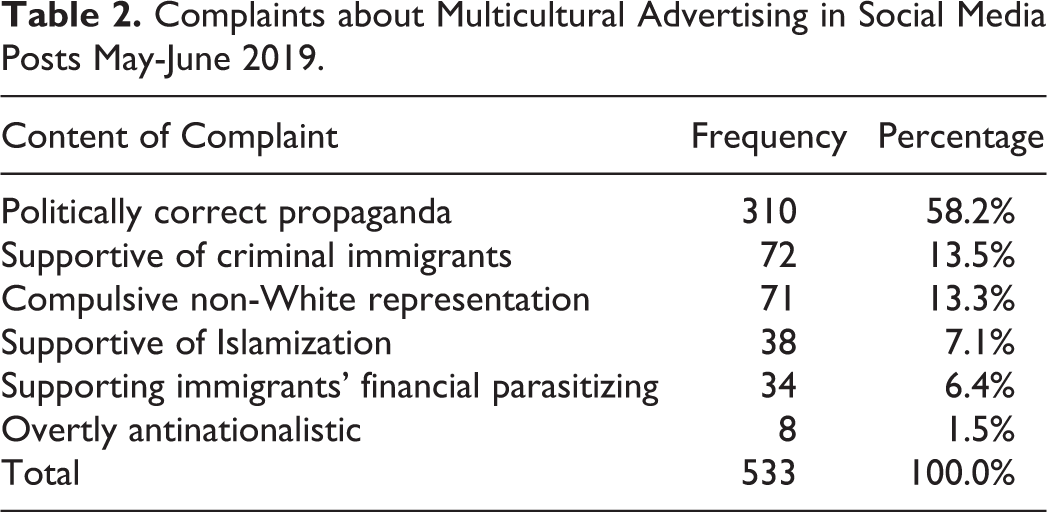
Among the complaints, and as illustrated in Table 2, “politically correct propaganda” (58.2%) was by far the most dominant, followed by “supportive of criminal immigrants” and “compulsive non-White representation” (between 13.5% and 13.3%). These were followed by three less frequent complaints about being “supportive of Islamization,” “supporting immigrants’ financial parasitizing,” and being “overtly antinationalistic” (between 7.1% and 1.5%).
Main Study
Informed by the prestudy, the qualitative, netnographic (Kozinets 2019) main study followed, in which we carried out a detailed analysis of social media posts on multicultural advertising. First, we went through the social media forum threads identified in the prestudy and used Kozinets’s (2019) criteria for selecting suitable online communities to identify a specific thread where discussions on the issues at hand were particularly well represented and did not stray too much outside our scope. Accordingly, the first author closely analyzed the selected thread created by an anonymous user in 2008 on the Swedish forum Flashback. This was done retrospectively from 2016 to 2019, as we consider 2016 to be an important year for the popularization of the contemporary far right in the West. Flashback is one of the largest web forums in the world (Whalström and Törnberg 2019), is open to everyone, and yet is (officially) regulated against hate speech and threats (Blomberg and Stier 2019). It is particularly well-suited for this type of research because it attracts far-right and extreme discourse while at the same time being open to the mainstream (Whalström and Törnberg 2019). Due to Flashback’s reputation, it has also attracted people with antiracist sentiments who engage in these discussions to refute the most extreme posts. In our findings, we refer to such users as “moles.” The participation of moles results in the exposure of counterarguments that are particularly interesting, as they provoke more elaborate far-right counterarguments and thereby show us more in more detail how the far right conceptualizes its adversaries.
To identify such conceptualizations, we first scanned and made screenshots of all 1,030 posts from 2016 to 2019. We then read them carefully and simultaneously coded them. Using a grounded approach (Strauss and Corbin 1990), we discovered patterns in the data through a combination of cross-thematization and triangulation. Following an iterative analysis process customary in consumer culture research (Spiggle 1994; Strauss and Corbin 1990) by iterating between the netnographic data, theory, and previous related research, we settled on three main themes of adversary conceptualizations that represented the data material as a whole and also qualitatively corresponded well with the prestudy findings (i.e., the wider social media landscape beyond the selected thread).
The vast majority of posts were created by anonymous users with politically charged pseudonyms, often accompanied by a typically provocative, digitally altered picture of someone resented by this person (e.g., former U.S. President Barack Obama dressed in a niqab). To address the ethical issue of absence of consent, we provide neither the title of the thread nor the actual pseudonyms used by the posters but instead give the latter food-related pseudonyms. So as not distract from the nationalist theme, we have refrained from using ethnic food pseudonyms and instead used the Swedish names of typically Swedish comfort food dishes and ingredients. In the following section, we illustrate and analyze the key insights from the main study.
Findings
Our general reflection is that our findings are at once ideologically self-contradictory and contradict existing academic consensus. In contrast to the majority of previous research on consumer resistance, we find that the resisting consumers in our research construct market actors as adversaries by portraying them as betraying the free capitalist logic for the benefit of politics, rather than as greed-based “Machiavellian” capitalists (e.g., Kozinets and Handelman 2004). This notwithstanding an otherwise aggressive tone against liberalism. Furthermore, the few voices in our data actually protesting against the racism implied in the far-right discourse defend the market actors precisely on the basis that these companies are indeed free capitalists that just happen to spread “good values” because they want to maximize profit. In other words, private capitalism is the system to defend, not defeat. This despite the historical fascist legacy of the popularized far right, which did not include free capitalism in its authoritarian vision of civilization but, more precisely, a state-controlled economy (Blamires and Jackson 2006), a state capitalism paradoxically denounced in our data. As we illustrate with (what many would consider) offensive quotes and comments, this is done through interpretative repertoires organized around polemic, affect-seeking metaphors portraying the market as intimately close to the state in distinct but deeply entangled ways.
Note that in line with discourse analysis, as well as with the “emic perspective” in qualitative research in general (Denzin and Lincoln 2003, 21), we present the quotes as they are (albeit translated to English), despite their often-offensive content. However, we (not the people who wrote the posts) have used asterisks when applicable to avoid printing racial slurs.
The (Social) Liberal State’s Megaphone for Political Correctness
Flashback becomes a kind of panopticon where the far right can present, analyze, and evaluate their diligent research on multicultural advertising and, just as in our prestudy (see Table 2), “political correctness” is the by far most common argument used for denouncing various market actors. However, political correctness is seldom described as it was presented to academic communities in the 1960s, as an intellectual movement inspired by linguist J.L. Austin’s (1962) groundbreaking theory on performative utterances and speech acts. Instead, political correctness is more frequently used as a generic derogative for collective weakness and neurotic anxiety. In line with this derogative interpretation, we discovered that the typical way to criticize market actors engaged in multicultural advertising is to position them as lackeys to the politically correct state, thereby indicating that the opinions expressed by these companies cannot possibly be honest. We present an excerpt from a 2016 heated discussion about the controversial use of a Black male child by department store Åhléns in its advertising in relation to the Swedish December tradition of Saint Lucia, where the archetypical Lucia is a blonde, long-haired woman or girl with candles in her hair: Kroppkaka: Really. What drives a human being like yourself to be so pathetically politically correct? Do you get the feeling that Daddy the State and Mummy are patting your head every time you ramble on with your politically correct nonsense? Åhléns consciously trashed the Swedes and their traditions in a severely cynical way. Åhléns wouldn’t even think about mocking, for example, Arabic traditions. Never! When you in that context of constant attacks, slandering, ridiculing, spitting, violating, hating and suppressing of Swedes and Swedish culture and Swedish traditions and Swedish history, from politicians, journalists and other lackeys, for decades, once again publicly slander Swedish traditions, then people lose their patience. This is part of a larger pattern, a long smear campaign that the establishment has made the highest priority. Then, on top of that, they lie and say that “people write hateful comments against the n***o boy” when what people are actually writing hatefully about is Åhléns’ cynical scorn of Swedish traditions, that just makes people even more pissed off. They can go to hell. We should all boycott them so that they crash and go under. Pannkaka: Oh, so I am PC. I had no idea. I present my own opinions just like everyone else—I don’t care one bit if I am PC or not. If they happen to coincide with someone else’s opinion, the state’s, or yours or Kalle’s, then it is a coincidence and I don’t give two hoots about what others think when I form my opinions. To really approach racism one needs to show that there are many kinds of people in this country. And that’s done, among other things, through advertising. That some grown-ups can’t handle that is just plain weird. I guess it is that—grown-ups’ hateful comments—one should judge and not that Åhléns has published a picture with their products on a little boy, one of the many similar and diverse people we have here among us. Surely all people in society deserve to be seen and be part of the beautiful whole that is Sweden. I love Sweden with all traditions, customs and history.
Although the criticism on Flashback targets individual market actors who seem to actively encourage multiculturalism, the portrayal of marketers in general is that they are only pawns in a massive propaganda conspiracy larger than themselves. Their advertising is viewed as not only propaganda but dishonest propaganda; that is, the companies are not truly multiculturalists, they just act that way. For instance, when Swedish fast-fashion retailer H&M included a photo in their catalogue featuring a Black boy in a sweater with a print that said “Coolest monkey in the jungle,” the resisters on Flashback were amused by the massive critique from consumers all over the world: It is the height of irony that H&M finally trips on its own tail after having pushed their multicultural propaganda so frantically year after year! (Rotmos, post from 2018) Today it is extremely unusual to see advertising targeting Swedes. It is like a law of nature. And what I find interesting is how a whole industry can be forced to follow this unwritten law. The advertising industry is not like [mainstream media] with basically only one or two owners but there are many actors. Who or what succeeds in governing this industry with such an iron hand? Is it the owners? Are all employees brainwashed? Is it the newspapers that refuse to publish ads that don’t follow the multiculturalist agenda? Is it the companies that demand this? What do the power structures look like in the advertising industry and how have the globalists managed to permeate this whole industry? Can someone who works in the advertising world explain this? (Mjukost, post from 2018)
Thus, the metaphorical framing of the multiculturalist market as a “propaganda machine” tends to revolve around a question of an honest or dishonest commitment to capitalism, autonomous in relation to the state, rather than whether racism is morally right or wrong.
The Market as a Parasite on the State
A related, but slightly twisted, version of the idea that the market is a lackey to the state is that of the market as a parasite on the state. Here, it is common to bundle market actors together with the cultural establishment and the state and to present theories on how their business models are interwoven. As we found in our prestudy (see Table 2), the message is that immigrants are financial parasites on the welfare state and the pretending market in turn systematically makes a lucrative business out of this parasitizing. Thus, this is not pure capitalism but an involuntary state-sanctioned form of capitalism. Echoing the captivity myth in the American Exceptionalism ideology (Luedicke, Thompson, and Giesler 2010), the power is here projected on the many invading immigrants who have “fooled” the “overly empathetic state” (and the market). In the following conversation from 2018, this conspiracy theory—and its complex entangling of overt misogyny, racism, and antiliberalism typical of the far-right milieu (Miller-Idriss 2017)—is presented with reference to the influx of refugees from Afghanistan a little over two years earlier: Vetebulle: Now I see that Dressmann [low-priced men’s mainstream fashion chain] markets T-shirts where one of the guys is Asian. Looks like a Japanese but the target group is of course Hazaras [ethnic group in Afghanistan]. From where do they get their money, given that they apparently have such great purchasing power? I see many Hazaras in great clothes, driving around in pretty nice cars, that’s more than Swedish youngsters do. How have they managed to get that far in only two years? Kalops: They are and remain subsidy tourists and get their money directly via your tax bill. Because Sweden nowadays is the whole world’s subsidy paradise, these people are considered the consumers with the greatest purchasing power. Strömming: Yes. Went shopping today and saw Hazaras buying clothes for 1000–2000 kronor [approximately 100–200 USD]. Who paid, I don’t know. If it was the state or some Green Party, the Social Democratic Party, the Left Party, or some unattractive middle-aged woman with poor fashion taste and leftist opinions who is looking for a living sex toy.
When arguments against views such as those of Vetebulle, Kalops, and Strömming appear, as we saw previously, they seem to attempt to remove the political symbolism in general, and the conspiratorial aura in particular, and to rather point the discussion toward capitalist ideas on rational profit maximization: Let’s not forget that Åhléns is a profit-driven company and they won’t do anything they don’t think will give bang for the buck. It is totally up to themselves to decide who is seen, and how, in their ads. So this “consciously provocative identity politics” you guys are talking about is not consciously provocative identity politics. It is advertising. (Kräftor, in a post from 2016)
Even in the case of advertising with markers of Islam, which, in our data, is a target of hate (both in the prestudy and the main study), the argument for profit is brought up by both the antagonists and the moles. This 2018 conversation was regarding the case of the “shitstorm” against L’Oréal’s shampoo campaign with a model wearing a hijab: Smörgås: L’Oréal runs an advertising campaign where they use a Muslim in hijab. What do you guys think about shopping from companies that start using Muslims with hijab in their advertising? Good or ANUS (that is, Stefan Löfven [the prime minister of Sweden])? Rädisa: Now, it is hair products we are talking about and nothing else. Or are you saying that people with veils are not allowed to wash their hair? How cool is that? Of course, companies want to sell products to these women as well. What is so strange about that? Loads of women have veils and they use hair and skin products. The advertising is targeting them. Indirectly also nonveiled women see this advertising and understand that these products are everywhere and for everyone.
The Market Conspiring with the Feminized Elite
Many researchers on political consumption (e.g., Micheletti and Stolle 2012) have argued that during the end of the twentieth century, the citizens’ attention increasingly began to shift from the courthouse toward the market and its market actors. In this process, the market became politically accountable. At the beginning of most discussions in our data, resentment is directed toward the market as consisting of elitist and powerful institutional actors. However, when specific advertising cases are discussed, loud resentment is also directed against liberal individuals and stereotypically privileged groups representing an overly self-conscious elite. Not surprisingly, a sharp division is made between the rural and periphery, on the one side, and the urban and center on the other. In Sweden, these polarizations exist as symbolic boundaries where the old toll roads around Stockholm were built. The notion is that only “stinking-rich” upper-class people on Östermalm or “tree-hugging,” intellectual, “left-voting feminists” on Södermalm live inside the tolls: “We who live on the other side of the tolls.” VERY good description of us who belong neither to the PC mafia nor to the Östermalm minks or the rest with lots of dough. I live outside the tolls. Of course. (Blåbär, in a post from 2016) I have actually started writing to the advertising agency to complain [about their multicultural advertising]. To my surprise I saw a photo of the people working there. Around 70 people, and 69 looked very Swedish!!! Only one guy was called Ibrahim. Come on! I feel so sick thinking about these Stockholm nancies. They live so protected in their city centers. No wonder they have to compensate with their “virtue signaling.” (Nypon, in a post from 2019) Falukorv: What’s happening with Apple? Their advertising is completely lousy with PC, feminism and n***o junk. The few whites are typical feminine hipsters, very often with curly, ginger-colored hair. Are these and the n***oes such a strong customer group? Isn’t there a risk that Apple scares away other customers? Is it a cynical tactic from Apple’s management to calm the anxiety among all the white, left-wing hipsters who actually buy their overly priced shit products? Like “We know that Trump won, but here are some images of n***oes and minorities to get you in a better mood. Now, wipe those tears and go buy our latest ass dildo [sex toy] iPlug. Only $899. Go Hillary!” Bruna bönor: My Apple prejudice tells me that the target group is urban PC people and of course they can’t complain about such sublime diversity because then they disqualify themselves. “Ethnic diversity” as I see it is another term for the destruction of white men’s psyches. It is a very politically correct perspective to believe that it is about something as harmless as “multiculturalism” or “norm-breaking” or the like. Then, why haven’t we yet seen a “Kalle’s Caviar Swede” and “Middle-Eastern Veil” cuddled up on the sofa with the latest Apple gismo on primetime TV? That would have been the ultimate icebreaker for society, if they are really serious with their message. My God how naive! (Köttbullar, in a post from 2018) Your post is provocative. Learn how to put words together. Lucia tradition. Or use a hyphen. It is hard to take anything seriously when you abuse the Swedish language so violently. I have no problem with this Lucia picture. It is a Swedish kid dressed as Lucia. End of story. (Fläsksida, in a post from 2016)
All in all, the opponents present their respective theories on why multicultural advertising sells, and while doing so, they agree on one thing: that these companies must profit from the attention. While not disputing profit per se, far-right discourse consistently presents this as a “cynical” and “consciously provocative” act against what people and the market itself “really” think, the assumption being that political correctness is deeply inauthentic and only a façade. Its opponents, in contrast, use the capitalist model as a legitimate defense against such attacks. Thus, we see a clear break from previous empirical consumer resistance research, where critique of the capitalist system has, in one way or another, constituted the source of battle. Now, the ideological spring of the battle cultivates other political streams.
Discussion
In this article addressing the relationship between antidemocratic political movements and marketing, we have aimed to show how consumers expressing opinions in line with far-right ideology conceptualize their adversaries in relation to the market in general and multicultural marketing in particular. We have shown that this conceptualization is primarily based on three main notions: that brands (1) are puppets of the (social) liberal state, at the same time as they (2) are economic parasites on that same welfare state, and (3) represent a feminized elite trying to eliminate the already disenfranchised and marginalized male periphery. Next, we discuss our theoretical contributions, as well as implications for public policy and marketing.
Theoretical Contributions
We argue that our findings consist of important theoretical contributions to existing consumer cultural research on consumer resistance. First, our findings contrast with previous empirical research, which generally assumes consumer resistance to be anticapitalist and anticorporate and that consumers oppose brands because they are part of a dishonest, exploitative capitalist system (Arsel and Thompson 2011; Giesler 2008; Kozinets 2002; Kozinets and Handelman 2004; Sandlin and Callahan 2009; Thompson and Arsel 2004). In these works, the adversaries are limited to marketers and other consumers, which, on the one hand, could be said to be exactly what makes this resistance “consumer resistance”; however, in this new consumer resistance, the state is portrayed as an adversary that is at least as important, if not the most important. Furthermore, the market’s only honest raison d’être—capitalist profit-maximization—is not critiqued for being the company’s highest priority but rather for not being its highest priority, now that such companies are perceived as prioritizing (liberal) political propaganda. This would empirically support Cambefort and Pecot’s (2019) theorized “radical right” anticonsumption group. This group is imagined to have a “mixed position on the economy that can even be contradictory to a certain extent,” to “promote capitalism inside the national borders, and at the same time advocate protectionism outside the national borders,” to “engage in a cultural battle against liberal values” and to “put forward ‘undemocratic’ reasons” (pp. 10–11). However, they do not readily overlap in terms of consumption, as members of Cambefort and Pecot’s “radical right” are more likely to see consumption per se as their adversary. Moreover, by giving voice to views that are radically more undemocratic than those of Cambefort and Pecot’s “moderate conservatives” and yet less officially fascist than those of Cambefort and Pecot’s “welfare chauvinists,” the interpretative repertoire of the far right in our research at once falls outside and partly overlaps with these theorized groups. Perhaps this hints that the rise of far-right ideology in consumer resistance is still too much in its early stages to perfectly reflect more ideologically consistent and organized far-right fractions in general but is yet in its molding stage, speaking to them all.
Second, our findings also contrast with anticolonialist consumer resistance research (e.g., Izberk-Bilgin 2012; Sandikci and Ger 2014; Varman and Belk 2009), where the adversaries are conceptualized similarly as in the anticapitalist case but with more focus on the geopolitically territorializing and culturally imperialistic aspects. Here, the apparent opponents are global brands originating from the West, seen as using Eastern/Southern regions for their national cultural identities. This is interesting, as the resisted brands in our study are national brands but apparently not national enough for the far right. It becomes contradictory for the resisters to frame the narrative of struggle when the adversaries are not apparent “outsiders” as in the aforementioned anticolonialist studies but, in many cases, actual national icons famous for their “Swedishness” (e.g., Ikea, Volvo, H&M). Thus, the argumentative focus is on betrayal; that is, the brands’ national roots are presented as betrayed when the brands engage in multicultural advertising. The contradiction is not least found in the fact that the state that was prospering at the time of the birth and expansive growth of these brands (mid-twentieth century) was the modern Social Democratic welfare state, governed by the same political party as today but now subject to hatred. From the far-right perspective, both the state and these successful companies have, in their deference to globalization, betrayed true Swedes and forced them into a society of deep multicultural decay. This presence of the state, in alliance with brainwashed companies, as a clear adversary differs from the more purely brand-focused resistance in previous works, an insight we discuss further next.
Third, the state is not addressed as a clear adversary in work on consumer resistance against unethical conduct (Gopaldas 2014; Holt 2002; Thompson and Coskuner-Balli 2007a, b; Thompson and Kumar 2016, 2018; Ulver-Sneistrup, Askegaard, and Brogård-Kristensen 2011). Thus, the political protests in such activism do not go beyond the marketplace and its actors. In contrast, in far-right consumer resistance, the smearing of the state in protests against multicultural brands could be said to actually politicize, rather than depoliticize, as theorized by Giesler and Veresiu (2014) and Veresiu and Giesler (2018). Certainly, our resisters also speak of brand boycotts and other self-responsibilization practices, but state policies are not taken out of the equation. The brands are used more as symbolic evidence and advertising as an excuse to present (conspiracy) theories against the political establishment. Here, Miller-Idriss’s (2017) work on far-right youth has sensitized us to how far-right commodities and symbols have the potential to attract new members. She claims that such products “concretize abstract and invisible right-wing ideas into tangible, material objects that youth can consume and display, reinforcing their own identification with and understanding of far right ideology” (p. 188). From that perspective, multicultural marketing works in an inverted fashion—that is, to concretize what far-right ideology is not and thereby help far-right consumers delineate and construct materialized symbolic boundaries according to which their group becomes distinct. Advertising serves as the ideal source of evidence for this purpose because it is shareable, made to stand out, and intended to dramatize and trigger emotions, fantasies, and dreams. When such dramatizations and fantasies are radically different from one’s own worldview, in their microstory formats they become particularly suitable targets and “weapons” to use in smear campaigns online.
Finally, our findings add to research on antiexclusionist consumer resistance (Martin and Schouten 2014; Scaraboto and Fischer 2013; Thompson 2003) in that our findings illustrate how far-right consumers more or less directly appeal to brands to be inclusive of members of their group rather than, say, non-White, liberal feminists. Thus, arguments based on discrimination are used by these consumers as well, who are otherwise the ones accused of violent discrimination. This paradox is something Idriss-Miller (2017) frequently highlights in relation to the far-right youth she studies. According to her, these consumers express genuine frustration regarding being disenfranchised from mainstream and urban ideas on what makes up a successful and respectable human being. In turn, this experience of marginalization in many cases serves as both emotional fuel and rational legitimization of violence.
As one of the few examples of far-right consumers in consumer culture research, our findings support the insights of Luedicke, Thompson, and Giesler (2010) on the Hummer consumers’ nationalist discourses on American exceptionalism in that these discourses in many ways resemble the nationalist discourses on White supremacy found among our European consumers. This is curious, given that, according to political historians, the European far right typically resists neoliberalism and advocates a more authoritarian, stronger, and intervening state in relation to the economy (Pelinka 2013). But where Pelinka (2013) talks about this authoritarianism as largely leaning toward socialism, the far-right consumers in our data question the strong ideological leadership of the social liberal state over companies, though this would probably have been different had the governing state been of a more radical right-wing nature. The Hummer consumers in Luedicke, Thompson, and Giesler indeed follow Pelinka’s (2013) portrait of the far-right in the United States as an economically resourceful group that is extreme in its antistate position. It seems as if the far-right consumers in our study have chosen to follow the development of brand advertising for similar reasons. They monitor the freedom of these brands in relation to a social liberal state ideology and thereby resemble the American far-right. Thus, they support the free market dimension but not the open borders and unregulated globalization dimensions of neoliberalism. This is very interesting, as the European far-right—and its consumer culture (Miller-Indriss 2017)—has been inspired by the American far-right (and vice versa) for the last two decades (Beirich 2013). In other words, is what we see here in these data (materialized as consumer resistance against what is portrayed as socially liberal brands) the dialectical synthesis of a typical European far right and a typical American far right? If this is the case, this constitutes pivotal knowledge regarding new ideological formations defying Western democracy, which new ideological content they are based on, and which inherent contradictions they herald.
However, returning to our contributions, in the case of Luedicke, Thompson, and Giesler (2010), conventional consumer resistance critique against capitalism prevails and frames most of the discussions between Hummer and Prius car owners. In their “jeremiad against consumerism,” (p. 1016) the Prius owners’ moral condemnation of Hummer owners frames the latter as embodying the ills of capitalism. However, what our research indicates is that a new polarized opposition has emerged that neither revolves around historically conventional morals against consumption (Hilton 2004) nor construes companies as the chief representatives of an environmentally destructive economy (as the anti-Hummer consumers do). Instead, we show how the values promoted by the state apparatus are the objects of discussion and polarization. Neither side in our data directs its arguments toward an underlying belief or disbelief in the capitalist system, as in the conventional left–right dichotomy, but instead toward the political value system.
In turn, this finding contributes to previous marketing research on political marketing in that it offers new insights and theoretical understanding regarding the polarizing consequences of companies’ increasing political activities. Previous research on political messaging has offered plenty of insights on how political orientations can predict consumer behavior and how companies can use the implicit impact of ideologies in their segmentation and communication (e.g., Fernandes and Mandel 2014; Lee et al. 2018; Ordabayeva and Fernandes 2018). However, there was still limited knowledge regarding the more direct impact of ideological messages from market actors on consumer culture. Our research offers insights regarding the interpretative repertoires used in far-right consumer resistance discourse to sharpen polarization and put brands, as well as consumers, on the other side of the enemy line. It also offers insights regarding symbolic divisions and how consumers from both sides are alert to potential cynicism in companies’ political actions. In that way, what is considered controversial political content in advertising is seemingly changing to include more than we might have thought.
All in all, the previously theorized dividing lines between civic engagement and political consumption are, here, blurring. Consumers merely use the marketplace (and not the other way around) as a platform for serious political activism rather than as the target of that activism. Next, we further discuss public policy and marketing implications of this change in roles.
Practical Implications
We elaborate on potential public policy implications in the light of three analytical categories offered in Berthon, Leyland, and Campbell’s (2019) categorization of public policy strategies (informed by Moorman and Price [1989]): informing (educating and disclosing), guiding (shaping and incentivizing), and restricting (banning and removing). First, in terms of our research’s main focal point, resistance to political content in advertising, marketers have always, both knowingly and unknowingly, used advertising to provoke publicity. But lately, politically infused advertising and its accompanying provocations seem to have escalated, due to both the growth of obscure digital media platforms and the more politicized societal climate in general. In our research, we have learned that broader snapshots and deeper analyses of the content and spread of heated online discussions about companies’ communication will continue to be important for those companies to understand how consumers are using that content to coproduce new brand meanings outside of the companies’ control. However, in terms of initiated interpretations regarding the larger consequences of this resistance (partly provoked by the advertising), we believe that state authorities and nonprofit organizations that work against political extremism should be active in spreading valid research insights and information to companies and the public regarding how politicized advertising, if it goes too far, can contribute to further polarization and societal instability. For example, in terms of multicultural content in advertising, we believe that companies need to learn how to predict, recognize, and address possible racist activism against them and against their models (as was the case in the Åhlens Lucia child case) so that they are not frightened into ceasing to use multicultural diversity in advertising or in their general visions. However, we also believe that it would be fruitful to offer information and guidance about tokenism—when the Other is included only as an accessory that inadvertently confirms the superiority of dominant (White) identities (Weinberger and Crockett 2018)—to companies, and about how tokenism can be prevented through credible company practices of employment diversity or the like.
Second, the rising far-right consumer culture is a relatively untouched topic in marketing and consumer research, not least in relation to public policy implications, which ought to gain more attention given the growth of this culture in Europe and the United States (Daniels 2018; Gilroy 2019). As we have mentioned, the perhaps most contemporary and diligent work on far-right consumer culture is Cynthia Miller-Idriss’s (2017) book The Extreme Gone Mainstream. In terms of public policy, Miller-Idriss is against the banning of far-right symbols and instead advocates the use of informative and guiding strategies to prevent people from becoming politically extreme. For example, Miller-Idriss speaks about the importance of informing about and discussing extremism’s implications for democracy, in education and at work places. Indeed, in our consumer resistance case, we see that many have already learned to resent democracy. Thus, for future public policy, we believe there should be a very strong focus on and many resources devoted to collecting and pedagogically communicating (and then discussing) vivid examples of what people and societies in history have had to live through in nondemocratic contexts. This way, democracy does not become a naturalized cliché, taken for granted and meaningless, not least in marketing, but a concrete choice.
Our third and final public policy implication concerns the digital space in which this consumer resistance takes place. Sunstein’s (2001) “echo chambers” and Pariser’s (2011) “filter bubbles” both serve as apt concepts for understanding how algorithms create self-enforcing political movements through continuous and addictive techniques of self-confirmation, something public policy and marketing researchers have recently begun to study (Banker and Khetani 2019; Berthon, Pitt, and Campbell 2019). As the case of Flashback has shown, moles attempt to challenge such self-confirmation among the far right. Yet the vast majority of posts are indeed self-confirmatory, spurring emotions of hatred and additional posts of fury, and sometimes posing implicit threats against the brand owners and the ad agencies that create these ads. Which types of public policy strategies could curb this development? According to Berthon, Leyland, and Campbell (2019, p. 458), cyber hate requires educating both the population and professionals about “digital hygiene.” In addition, warnings and devices could be displayed in certain digital locations where people at risk of radicalization are present, digitally or physically. In terms of restrictions, Miller-Idriss (2017) argues that banning is often suboptimal but, when it comes to hate language online, one might want to consider stronger legalized restrictions than those presently in place. Frequently, the social media providers themselves maintain an official stance that they enforce restrictions, but these restrictions are highly subjective and arbitrary as evidenced, for example, in the several murder cases inspired by discussions on the social media platform 8chan. Flashback also has “restrictions” on explicit threats and indeed bans certain users, but from what we saw in our research, the hate language that is allowed has, from our perspective, been extremely coarse. Coarseness, which seems to involve emotional performativity in terms of violence, is what could be considered in legal policy discussions. We agree with Miller-Idriss’s assertion that people need spaces where they can express and discuss their frustration and be listened to, but the anonymity and constant self-confirmation on unrestricted social media platforms that fuels frustration and sometimes even violence is becoming increasingly challenging to manage, from a societal point of view.
In marketing practice, and in terms of political advertising content, if the marketplace is increasingly used as a platform and not as the actual target of resistance, it could paradoxically mean that advertising gains importance despite being only the proxy for consumer resistance. In other words, by not being questioned for its existential core (having a commercial, profit-seeking raison d’être) but for what it actually depicts, advertising becomes detrivialized. Subsequently we may say that the marketplace, at odds with previous knowledge, politicizes rather than depoliticizes. This means that companies should carefully reflect on the messages they really want to communicate, as these messages may be used for counterpolitical purposes they never considered.
Another implication in marketing practice relates to the specifically multicultural content in advertising. In our study, consumers with far-right sentiments express outrage, fury, and great frustration over how brands use non-White models in their advertising. A lot of this frustration is, as we showed in our findings, based on the far-right belief that these companies are only concerned with showing “liberals” that they are “good.” Many consumer researchers (e.g., Crockett 2008; Veresiu and Giesler 2018; Weinberger and Crockett 2018) have problematized such advertising strategy where the marketers target people of other ethnicities than those represented by the models and thereby use racial representation as a floating signifier. Thus, in the case of multicultural advertising primarily targeting a White population, the non-White model is said to be used tokenistically. In addition, in line with this critique, there is a risk that the frequent use of non-White models in advertising targeting White consumers exoticizes and fetishizes certain ethnicities (Veresiu and Giesler 2018). Thus, researchers problematizing perfunctory multicultural advertising have something in common with the far-right consumers in our study: they both oppose tokenism, albeit for radically different reasons. Marketing, in its strategic use of signifiers, could be said to always contain tokenism, but human diversity tokenism is especially problematic if the use of multiple ethnicities in a company’s advertising is not matched by its employment practices or by the kinds of consumers they target. This suggests that companies and public institutions using diversity as a keyword in their communication platform should represent diversity not only in their advertising but also in their organizational culture and in the ways that they engage with various societal projects. In doing so, they can highlight that they are truly serious in terms of what they say they stand for.
In conclusion, consistent with most previous consumer resistance research, our study shows that the conceptualization of adversaries is, despite the extreme language used by the far-right consumers examined here, another construction of the “mainstream.” The construction of the mainstream seems to be just as pivotal to all consumer resistance movements, based on previous research, but the definition of this “mainstream” is always shifting. Indeed, Patrick (2011) argues that the “mainstream,” against which subcultures typically position themselves, is a fluid concept, shifting arbitrarily depending on what the subculture stands for or against. The mainstream is thereby the eternal social construction of a constant adversary. So, in light of our study, we may have to get used to a growing consumer resistance conceptualizing liberal defenders of human rights and democracy as the superficially and dishonest “mainstream” and the far right ultimately becoming the new “normal” and “politically correct” in its own right—a thought that would have been difficult to imagine only a decade ago. Then, from Žižek’s (2004, p. 722) perspective that the function of ideology is “not to offer us a point of escape from our reality but to offer us the social reality itself as an escape from some traumatic, real kernel,” there are now multiple social realities coexisting in the market as fantasied escapes from one another. For future research, this shift calls for further exploration across other geopolitical contexts, not only into how these social realities are contested at the marketplace but also into what “real kernels” they may be an escape from.
Footnotes
Guest Editor
Gautham Vadakkepatt
Acknowledgments
The authors would like to thank the JPP&M special issue review team for meticulous and constructive suggestions throughout the review process.
Declaration of Conflicting Interests
The author(s) declared no potential conflicts of interest with respect to the research, authorship, and/or publication of this article.
Funding
The author(s) disclosed receipt of the following financial support for the research, authorship, and/or publication of this article: They would like to thank The Kamprad Family Research Trust and Jan Wallander and Tom Hedelius Research Trust for generous funding.
