




Abstract
Today’s adolescents must find ways to engage in a shared reality, especially in settings marked by intergroup conflict, as a prerequisite for reducing conflict and building collective solutions to societal problems. Polarization processes (epistemic) have been notably overlooked within this critical developmental period. This qualitative case study addresses this gap by identifying key socializing actors and settings within established theoretical frameworks (Ecological Systems Theory, Social Identity, and Intergroup Contact) using in-depth interview data from 45 Catholic and Protestant adolescents living in post-conflict Northern Ireland. Inductive analysis was conducted with the interview data. Findings reveal the importance of family, friends, school, and media as intersecting socializing actors for adolescents. Intergroup contact among peers from different ethno-religious backgrounds disrupted adolescents’ engagement in polarizing and divisive rhetoric. Lastly, adolescents perceived educational actors and settings as less influential than their personal connections to peers and family. Directions for future research leveraging intergroup contact to enhance adolescents’ information networks and educational interventions are discussed.
Humans rely on others to produce, make sense of, and disseminate information (Sperber et al., 2010). Our consumption and transmission of information allow us to participate in a shared reality (Pesch & Koenig, 2018). Yet, in settings of intergroup conflict, cultural, historical, and political narratives are often contested. Individuals from similar locations but different social groups are often exposed to differing messaging and therefore construct distinct versions of reality. These divergent “truths” (also known as epistemic polarization) can reduce society’s capacity for discourse and collective action, as well as overall human flourishing. We define polarization as a state “in which the opinions, beliefs, or interests of a group or society no longer range along a continuum but become concentrated at opposing extremes” (Marshall & Cooper, 2003). Such beliefs are often entrenched, or likely to be stable over time, and resistant to change (Sperber et al., 2010). With regards to intergroup conflict, epistemic dimensions of polarization may hold notable application. Epistemic polarization involves diverging beliefs surrounding what constitutes knowledge or truth (Klaczynski, 2000). Thus, different groups may hold different world views, factual understandings, and/or trust in different sources of information (i.e., news, experts, etc.; Benson, 2023). Epistemic facets of polarization can lead to difficulty in communication, consensus building, and peace building efforts.
Epistemic polarization processes have been notably overlooked during the critical period of adolescent development (Oosterhoff & Wray-Lake, 2021; Tyler & Iyengar, 2023). Yet, there are a host of developmental skills needed to address the problem of polarization (e.g., ability to identify and differentiate between social groups, vet source credibility, and strategically disseminate information) that stress the importance of studying such processes during adolescence to inform intervention programing and educational policy. We focus on adolescence, a key developmental period as it is marked by increased cognitive flexibility, behavioral malleability, and identity formation, as well as the emergence of civic values and commitments (Dahl et al., 2018; Finlay et al., 2010).
In this study, we investigate how Catholic and Protestant adolescents (12–18 years old) in Northern Ireland navigate seeking and sharing information among dynamic polarized relationships and settings within the socio-ecological framework of Northern Ireland. Notably, the region is deeply affected by multigenerational conflict and polarization and thus is a critical setting for exploration with implications for other global contexts. Northern Ireland’s prolonged ethno-religious conflict, primarily between British/Protestant and Irish/Catholic, centers on opposing views regarding whether it should remain within the United Kingdom or reunify with the Republic of Ireland (Connolly & Doyle, 2021). Although the 1998 Good Friday Peace Agreement and the 2007 power-sharing arrangement marked significant steps toward peace, sectarian violence and tensions persist (Wilson, 2016). These historical tensions continue to affect current generations, reflected in divided schooling, communities, sports, and media. Based on the complexities surrounding identity and polarization in this region, we unpack key social-ecological settings and actors influencing adolescents’ perspectives on contentious topics and polarization in Northern Ireland, offering insights relevant for other divided societies.
Below, we highlight three guiding conceptual frameworks—Ecological Systems Theory, Social Identity Theory, and Intergroup Contact Theory—that play a crucial role in shaping our research design, analysis, and interpretation. Next, we explore the role of identity and young people’s environments (school, peers, family, and media) as socializing processes in both sociopolitical development and polarizing discourse. Then, we discuss the context of polarization and adolescent development within Northern Ireland. We then present our findings concerning the intersections of identity, relationships, and contexts in relation to polarization among 45 adolescents within Northern Ireland. Lastly, implications are discussed to inform developmental theory and educational intervention programing.
Guiding Conceptual Frameworks
We offer three guiding frameworks—Ecological Systems Theory, Social Identity Theory, and Intergroup Contact—with which to conceptualize the multi-level factors influencing adolescents’ sociopolitical development and engagement in polarizing discourse. Specifically, we note how such frameworks might help us understand the selection of information processing and polarization among Protestant and Catholic adolescents within Northern Ireland.
Ecological Systems Theory was conceptualized by Bronfenbrenner (1977, 1979), who described the role of multi-level settings in child development by focusing on social location and environmental context (Cunningham et al., 2023). Ecological systems theory describes five systems (i.e., microsystem, mesosystem, exosystem, and macrosystem) that center around an individual and throughout a period of development (chronosystem; Bronfenbrenner, 1977, 1979; Kornbluh, Watling Neal, et al., 2024; Neal & Neal, 2013). Microsystems are proximal settings where adolescents have direct experiences, a role, and interpersonal social interactions with others. An example of a microsystem would be a classroom in which adolescents have a direct role (as a student), central experiences (learning about Northern Ireland), and interactions (answering questions, participating in lessons, reading textbooks on Northern Ireland). Microsystems are embedded within mesosystems. Mesoystems entail social interactions between adolescents’ primary settings. In the context of Northern Ireland, a mesosystemic interaction could occur if a Catholic adolescent’s school (a microsystem) introduced an educational initiative encouraging students to attend cultural events from different religious traditions. If this initiative led to discussions between the adolescent’s teacher (from the school microsystem) and their parent (from the family microsystem) about whether attending a Protestant cultural event is beneficial, this would represent a mesosystemic connection—where interactions between the family and school influence the adolescent’s experiences and development. Exosystems, within which such mesosystems are nested, involve settings that influence the adolescent but in which the adolescent does not directly participate. To illustrate, an adolescent generally does not play a role in educational policy regarding school integration. Nonetheless, such educational policies directly influence the adolescent’s school experiences. For instance, many adolescents within Northern Ireland attend segregated schools that are quite homogeneous in ethno-religious backgrounds (Tam et al., 2009). The most outer system, the macrosystem, involves politics, ideologies, and cultural influences that have a range of impacts on adolescents. For instance, cultural values reinforcing nationalism have implications for how adolescents navigate polarizing information (Barber, 2013). Later, Bronfenbrenner (1977, 1979) proposed the chronosystem, referring to a system of time that influences each of the other systems. For example, within Northern Ireland, intergenerational experiences surrounding the Troubles (a distinct period) continue to influence intergenerational messages. Applied to this study, we will explore the intersecting contexts, policies, and societal values influencing adolescents’ information selection processes in Northern Ireland, such as polarized views that often align with social identity around whether Northern Ireland should remain part of the United Kingdom or become a part of a United Ireland.
Social Identity Theory (Tajfel, 1974; Tajfel & Turner, 2004) posits that individuals derive a portion of their self-concept from their membership in social groups. In addition to self-categorization, individuals differentially evaluate the groups they feel they belong to (in-groups) and groups they do not consider themselves to belong to (out-groups). Research has documented in-group bias in selective information processing beginning in early and middle childhood (Li et al., 2019; Wilks et al., 2018). As such, children are more likely to imitate the behaviors of individuals with whom they perceive to share a social group identity (Flynn, 2022; Watson-Jones et al., 2016). In relation to potential in-group polarization, children are more critical and less open to information that appears to contradict perceived in-group narratives (McDonald & Ma, 2016), and adults are more likely to avoid information from out-group sources and are less likely to alter their beliefs based on such sources (Bauer et al., 2023; González-Bailón et al., 2023; Wojcieszak et al., 2022). In the context of Northern Ireland, adolescents’ ethno-religious identity may influence their openness to information from out-group members, potentially exacerbating polarization.
While social identity is strong, it can be challenged in particular contexts. The Intergroup Contact Hypothesis, proposed by Allport (1954), asserts that positive experiences with members of an outgroup can reduce prejudicial thinking and increase one’s openness to diverse viewpoints. Building off this work, extensive meta-analyses found that intergroup contact continues to reduce prejudicial thinking across various target groups (Pettigrew & Tropp, 2006, 2013). Arguably, adolescence may be a particularly transformational developmental time for developing intergroup relationships with diverse peers (Kornienko & Rivas-Drake, 2022). This period is marked by a heightened social orientation toward peers as well as greater time in the company of one’s peers (Brown & Larson, 2009). Developmental researchers have documented the benefits of intergroup contact among adolescents from diverse groups (S. Graham, 2018; Juvonen et al., 2019; Kornienko & Rivas-Drake, 2022). These benefits with application to polarization include more positive attitudes toward out-group members (Davies et al., 2011), enhanced social skills and competencies (e.g., relational inclusion, leadership, Kawabata et al., 2008), and greater sentiments of safety and belonging to one’s school and community for both ingroup and outgroup members (A. Graham et al., 2014). Prior quantitative survey research within Northern Ireland suggests that intergroup contact in school and out-of-school settings is associated with more positive orientations toward ethno-religious outgroup members (J. Hughes et al., 2013) as well as less extreme social attitudes (Stringer et al., 2009, 2010) and politics (Hayes et al., 2007). Informed by this literature and the Intergroup Contact Hypothesis, we assert that adolescents in integrated schools and communities with more exposure to out-group peers may be less inclined toward polarizing behaviors.
These guiding theories inform our research design, analysis, and study interpretations. Next, applying these theories, we explore further literature on the various social-ecological environments and cultural values in Northern Ireland that shape polarization.
Literature Review
Socializing Environments in Relation to Polarization
A large body of research supports the importance of adolescents’ primary social environments in relation to both attitudes and behaviors with implications for epistemic polarization (Bandura, 1977; Hjerm et al., 2018; Katz & Lazarsfeld, 1955). Research on polarization within the context of adolescent development is limited. Thus, we explore literature on the transmission of information, political socialization, and prejudicial thinking in relation to adolescents’ primary settings (i.e., families, peers, and schools). Regarding familial contexts, socialization research indicates that children acquire their political identity and world views through their parents (Hyman, 1959; Tyler & Iyengar, 2023). Parental figures who hold strong views or political beliefs surrounding social events often transmit such values and attitudes to their children (Jennings et al., 2009; Wolak, 2009). Parents with more polarizing views transfer not only their political views but also their hostility and distrust toward out-group members to their children (Tyler & Iyengar, 2023). With application to our study, we anticipate that adolescents whose parents hold strong world views on the history of Northern Ireland may contribute to their information selection processes.
Parents are not the only socializing agents with whom adolescents engage. Research indicates that adolescents become increasingly susceptible to peer influence (Stewart & Suldo, 2011; Thijs et al., 2016). Reinforcing homophily theory (McPherson et al., 2021), adolescents often form friendships with peers who share similar identities and views. Oosterhoff et al. (2022) found that rural adolescents within the United States tended to select peers who share similar political views. Effects were particularly strong for adolescents who endorsed right-wing authoritarianism, patriotism, and anti-immigrant attitudes. Hjerm et al. (2018) employed longitudinal social network analysis, finding that socializing with prejudicial peers increased Swedish adolescents’ negative outgroup attitudes over time. They also noted that adolescents who were less central within their peer network tended to hold more prejudicial beliefs. Peers may also be able to influence changes in views; in the context of Northern Ireland, Tam et al. (2009) found that exposure to outgroup peers can enhance feelings of trust toward outgroup members, as well as general openness to new information. The beliefs and views of peers may hold notable weight in Northern Ireland adolescents’ information selection processes.
Schools can be critical socializing spaces for young people to both practice and gain civic skills (Dunn, 2021). When facilitated effectively, school-based discussions around polarizing and contested social issues have been found to increase students’ civic efficacy and positive civic dispositions (Dunn, 2021; Geller, 2020). Regarding selective information processing, students prefer information from an individual who is a member of their social group (K. H. Corriveau & Winters, 2019). Such preferences have been studied in the context of an informant with a shared racial identity (Chen et al., 2013), gender (Boseovski et al., 2016), and accent (K. H. Corriveau et al., 2013). In the context of teaching, assignment to a teacher of the same race and gender has been tied to higher educational outcomes for both minority (Gershenson et al., 2017; Lindsay & Hart, 2017) and female (Muralidharan & Sheth, 2016) students. Such benefits may be due to a student’s comfort in having a shared identity with a teacher, or how the teacher interacts with the student in both conscious and unconscious ways (K. H. Corriveau & Winters, 2019). Yet, identity is not the only factor when it comes to information processing. Research has found that children as young as 5 years old prefer a teacher who is unfamiliar but has provided previously accurate information, as compared to a familiar teacher who has previously offered inaccurate information (K. H. Corriveau & Winters, 2019).
Within the context of contested issues, opportunities to be exposed to discourse within the classroom are often restricted for students. In certain settings with active civil conflict, educators often do not feel equipped to facilitate such discussions (Bickmore et al., 2017; Kornbluh, Davis, et al., 2024; Quaynor, 2012). Quaynor (2012) conducted a scoping review of citizenship education in countries that have experienced civil conflict and found across studies that educators expressed a desire to avoid such topics. Bickmore et al. (2017) further noted that social studies curriculum surrounding citizenship tended to emphasize monolithic civic identity within more conflict-ridden countries. Specific to Northern Ireland, Donnelly et al. (2021) found through qualitative interviews that very few teachers engaged in discussions surrounding the country’s contentious past, due to larger cultural norms of avoidance and varying perspectives on the sociopolitical climate for such pedagogy. Critical educational scholars argue that even when teachers avoid discussions around contested issues, they continue to signal their own views and values in the types of discussions and activities promoted within the classroom (Geller, 2020; Journell, 2017). Barton and McCully (2010) noted through qualitative interviews with adolescents in Northern Ireland that while a balanced and neutral educational curriculum was often viewed favorably, students did not feel that it adequately prepared them to engage in alternative historical perspectives. Within the context of this study, adolescents may be more prone to attend to information from teachers who share their ethno-religious identity. They may also be able to identify their teachers’ views on contested issues within Northern Ireland through both overt and covert teaching behaviors. This study explores how the school environment shapes adolescents’ information selection processes in relation to other socializing agents.
Taken together, the evidence suggests that parents, peers, and school contexts (i.e., microsystem) affect information selection and processing with application to both attenuating and exacerbating polarizing discourse. Furthermore, intersecting settings (i.e., mesosystems) where civil discourse is exacerbated or attenuated could instill conflicting or reinforcing messages surrounding a contested social issue. In this paper, we will explore both the information adolescents extract from their environments and how such environments intersect with one another to attenuate or exacerbate polarizing narratives. Next, we turn to potential policies at the exosystem level in relation to segregation with application to polarization.
Policies With Implications for Polarization
In alignment with Ecological Systems Theory, distal influences of local and national policy have been documented to influence the proximal relationships within adolescents’ everyday environments (Bronfenbrenner, 1977, 1979; M. Kornbluh, 2020). Specifically, government policy at the exosystem-level (schooling, housing, transportation) can have implications for polarization. Such policies can further segregation in which adolescents are surrounded by their ingroup and have minimal contact with outgroup members. Segregation can lead to selective learning of ingroup beliefs, behaviors, and attitudes, which can then perpetuate polarizing beliefs. For instance, early childhood experiences of ingroup consensus can have lasting effects on how adolescents both select and process information (K. Corriveau & Harris, 2009). Children have been found to maintain a preference for information gained by a previously formed consensus (K. Corriveau & Harris, 2009) and continue to hold such beliefs even when they are exposed to more diversifying opinions (Tadmor et al., 2012). Segregation has implications for various social processes affecting social development within adolescence (Blatt et al., 2024). For instance, contexts of school segregation before the age of seven play a critical role in the development of ethnic essentialism (Rhodes et al., 2012). To illustrate, children in both Northern Ireland and Israel attending ethnically diverse elementary schools were less likely to essentialize ethnicity, thereby reducing out-group biases, compared to children attending more homogenous schools (Deeb et al., 2011; Smyth et al., 2017). Furthermore, G. Hughes (2010) explored social identity and intergroup attitudes amongst children attending a state-controlled Protestant school. Findings suggested a relationship between children’s experiences of ethnic isolation and developing negative intergroup social intuitions.
Developmental Intergroup Theory posits that children observe patterns of social stratification, such as school segregation (Bigler & Liben, 2007). Children then assign value judgments to groups based on how they are stratified, laying the groundwork for ethnic essentialism and further stereotyping and prejudice (Bigler & Liben, 2007). Conversely, there is evidence that desegregated or integrated schools can reduce prejudice and stereotyping (Blatt et al., 2024). Within the United States, Killen et al. (2010) found that fourth graders attending ethnically diverse schools were less likely to rationalize ethnic exclusion within stereotypical attributes as compared to children in more homogenous schools. S. Graham’s (2018) Conceptual Model of the Psychosocial Benefits of Ethnic Diversity in urban middle schools suggests that middle schoolers in diverse schools are less likely to feel racially or ethnically stereotyped, more likely to have diverse friendships, and have more positive intergroup attitudes.
Within Northern Ireland, a series of educational policies aims to promote cross-community contact, foster mutual understanding, and build social cohesion among young people, though they differ in their approaches and degrees of integration. The Community Relations, Equality, and Diversity Policy (CRED, 2011) encouraged schools and youth organizations to embed topics such as prejudice, diversity, inclusion, sectarianism, and respect for different cultures into the curriculum and school ethos. The Shared Education Act (Acts of Northern Ireland Assembly, 2016) promotes collaborative partnerships between predominantly Catholic and Protestant schools, encouraging sustained cross-community contact by delivering shared classes, activities, and projects involving pupils and staff from different backgrounds (T. Gallagher, 2016). Shared Education does not require structural integration of schools but instead facilitates cooperation between separate schools, often within geographical clusters. In contrast, the Integrated Education Act (Acts of Northern Ireland Assembly, 2011) takes a more structural approach by promoting the growth and development of formally integrated schools, where students from Catholic, Protestant, and other backgrounds are intentionally educated together within a single school environment. Application of such policies has varied in implementation across different school sectors and local contexts, influenced by factors such as community demographics, school ethos, and historical legacies of segregation (Barton & McCully, 2010; Donnelly et al., 2021). Stringer et al. (2010) found that intergroup contact within and outside of school for adolescents in Northern Ireland was more frequent for those who attended integrated schools as compared to those who attended segregated ones. They also found that greater cross-group contacts between Protestants and Catholics within and outside of school were associated with less extreme political attitudes. Together, these policies reflect both pragmatic and aspirational efforts to address Northern Ireland’s divided education system and promote more cohesive and inclusive educational experiences. However, with inconsistent policy implementation support to foster sustained intergroup contact, restricted resources and training for educators to confidently facilitate sensitive conversations in schools, and the ongoing residential segregation that characterizes many areas of Northern Ireland, adolescents’ exposure to outgroup members varies widely.
Societal and Cultural Values Applied to Polarization
The majority of Northern Ireland teens (71% of 12–15-year-olds) and young adults (66% of 16–25-year-olds) report social media as their primary source for news consumption (United Kingdom Office of Communications, 2023). Media (a macrosystemic factor) plays a critical role in both information selection processes and polarization. Viola (2020) found that adolescents predominantly learn habits around information consumption, nuanced social issues, and political affairs online. Social media platforms can offer adolescents opportunities to be exposed to diverse perspectives that are not accessible in their local environments (Middaugh, 2019). M. E. Kornbluh (2019) found that media platforms can help facilitate social networks between diverse adolescents, increasing civic participation, social understanding, and greater socio-political awareness. Exposure to new perspectives can enhance adolescents’ critical consciousness (James & Lee, 2018), conceptualized as an understanding of structural inequities and one’s positionality within such systems, which provides them with the motivation and agency to engage in collective action (Diemer et al., 2021).
On the other hand, media selection and use have also been documented in relation to polarization and, at times, radicalization (Turner et al., 2022). Online algorithms curate divisive information echo chambers, in which adolescent users are fed information, often reinforcing their existing views and connections to peers with shared identities (Housego & Farthing, 2022). Such selective exposure has been found to facilitate the tendency to consume partisan news, limit cross-cutting democratic discourse, and amplify extreme ideological positions (Oden & Porter, 2023). Oden and Porter (2023) found that in the United States, adolescents’ use of Facebook and Twitter was positively related to affective political polarization (i.e., active dislike or distrust of other groups). While research is dated within Northern Ireland, it suggests that adolescents’ online interactions between rival interfaith communities on social networking sites have historically increased polarization and directly undermined peacebuilding efforts within intercommunity relationships (see Center for Young Men’s Studies, 2009; Reilly, 2011; Young, 2014). In application to this study, we will explore how adolescents make sense of and use media to inform their opinions around contentious issues in Northern Ireland. We will also unpack how such sources of information intersect with in-person contexts (i.e., family, peers, school).
Current Study
Informed by these guiding theoretical frameworks, our study explores the following research questions:
1) Applying the Ecological Systems Theory Framework, what key social-ecological settings (microsystem, mesosystem, exosystem, macrosystem) and actors influence adolescents’ perspectives (information selection) on contentious topics in Northern Ireland?
2) Exploring Social Identity Theory, how do constructions of identity (ingroup and outgroup membership) influence adolescents’ views around contentious topics in Northern Ireland?
3) Unpacking Intergroup Contact Theory, what role does intergroup contact play in adolescents’ understanding of and behaviors toward polarization in Northern Ireland?
Study Context
Northern Ireland’s history includes a complex and deeply rooted political conflict. The most recent period of violent conflict is commonly referred to as “The Troubles,” which spanned approximately 30 years (1968–1998). This period involved tensions and violence between Unionists, predominantly from the Protestant community, who generally supported Northern Ireland remaining part of the United Kingdom, and Nationalists, largely from the Catholic community, who generally advocated for a United Ireland (McKittrick & McVea, 2001). The Troubles resulted in the deaths of over 3,000 people, with many more injured (Cairns & Roe, 2003). Although the 1998 Good Friday Agreement marked a significant milestone in addressing the conflict, group divisions and tensions persist (Connolly & Doyle, 2021). Within Northern Ireland, young people develop complex ethno-religious identities reflecting an intersection of cultural, national, and political backgrounds linked to intergroup conflict (Trew, 2004). Many Northern Ireland adolescents grow up in predominantly single-identity communities and neighborhoods (>80% Catholic or >80% Protestant; McAlister et al., 2009a), sometimes even separated by peace walls. Catholic and Protestant adolescents may see different symbols in their neighborhoods, attend different cultural events and schools, worship in different institutions, and be exposed to polarized narratives across diverse contexts, including home, school, communities, peer networks, and social media. This makes Northern Ireland an important setting for studying how polarized information is consumed and evaluated across dynamic social-ecological settings (McAlister et al., 2009a). This study focuses on the “post accord” generation of adolescents in Northern Ireland (i.e., those born after the 1998 Good Friday Agreement). This generation continues to be exposed to polarized historical, political, and cultural narratives that perpetuate intergroup conflict (Bar-Tal et al., 2017; Wilson, 2016). Adolescents have also been a visible group in riots and violence (Reilly, 2011; Young, 2014).
Methods
Interviews
Based on initial pilot interviews and stakeholder input (non-profit youth-serving organizations within Northern Ireland), our international research team developed an interview protocol to explore the experiences of consumption and transmission of polarized information for young people in Northern Ireland. We incorporated an example of transmission of polarized information in order to explore young people’s awareness of potential source and content bias, and to probe young people’s own practices around information vetting and selection processes. First, interviewees were asked to read and recall a narrative on a polarizing topic. The narrative aims to be neutral by providing three points to each side in favor and against the partition of Ireland in 1921, with attention to modern-day consequences (see Appendix 1 for direct prompts). Directly after recall, participants were asked to reflect on their experience participating in this read and recall activity. Next, a series of questions probed further into the individual, interpersonal, structural, and cultural influences on participants’ experience of consuming and transmitting polarized information (see Interview Protocol Supplemental Appendix Online). For example, adolescents were asked what information they had previously heard about this and related topics that are typically polarized in Northern Ireland, from their family, friends, school, or media. Of interest was how adolescents felt and acted in response to hearing contested cultural narratives from various sources, particularly probing whether they believed those sources to be credible, and if their beliefs were open to revision based on new information from those sources. Finally, participants were provided with a biased recall of the original narrative about the partition of Ireland. For the biased narrative, the interviewee was always given a narrative biased in the out-group direction (e.g., a Catholic participant received recall from a polarized Protestant or Unionist perspective, see Appendix 1 for direct examples). Again, participants’ experiences reading the biased narrative were probed, including asking participants if they believed the ethno-religious group membership of the writer influenced the writers’ recall of the original text. Our results and analysis for this paper specifically focused on the responses to the interview protocol around the various social ecological forces influencing interviewees’ experiences consuming and engaging in conflict-related polarizing information.
Sampling Recruitment
Adolescents were recruited through a purposive sampling strategy by working with community-based organizations, Protestant and Catholic schools, and the local research team’s personal networks. Four community-based organizations participated; one served a majority Protestant demographic, two served a majority Catholic demographic, and one served a mixed/integrated demographic. Organizations described their purpose as engaging in different activities to support personal, social, and emotional development of youth outside of school. The organizations selected served lower socio-economic status and conflict affected regions.
Data Analysis
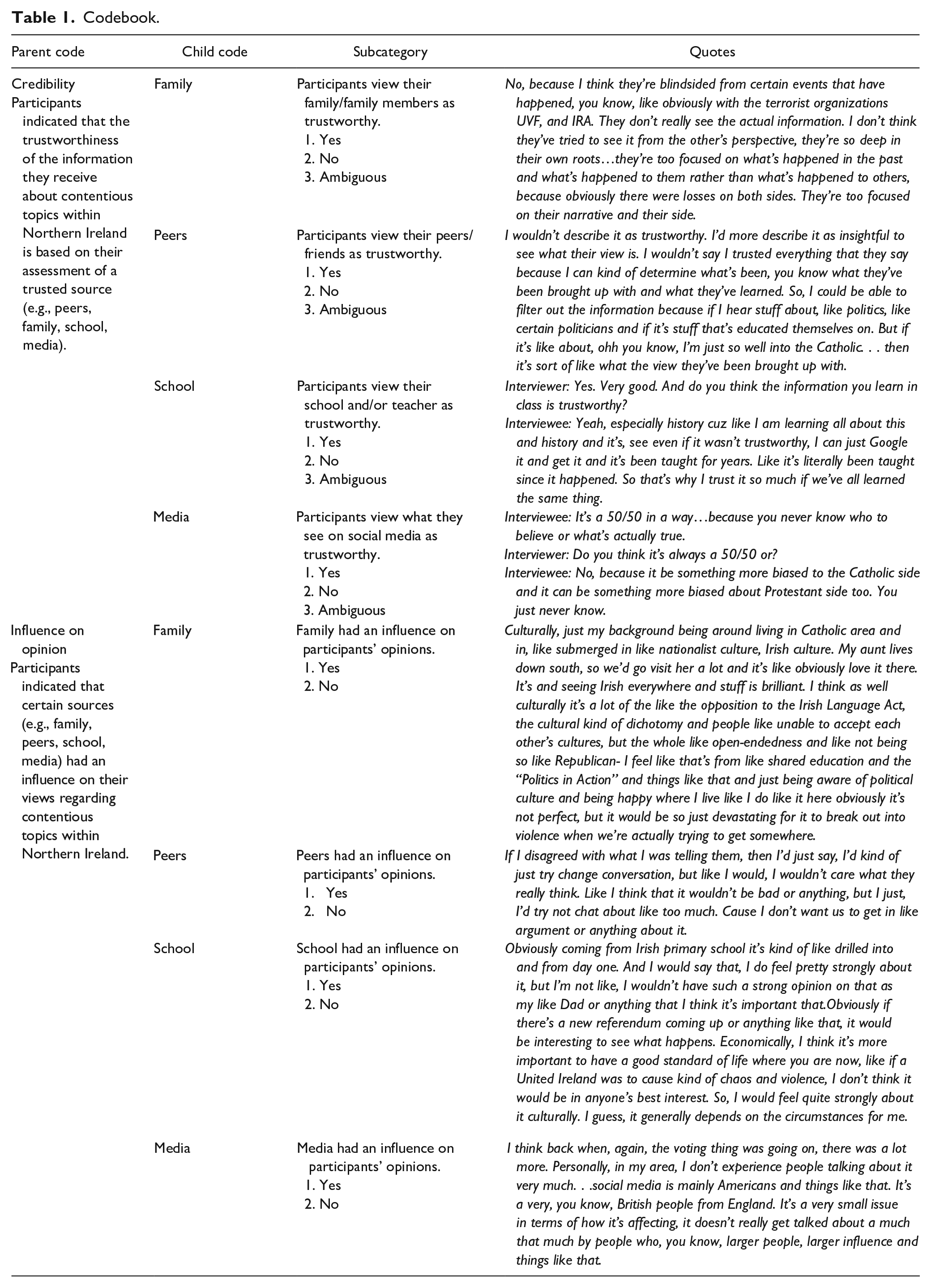
The authors employed an inductive data analysis technique entailing four steps (see Denzin, 1989 for full description): (1) memoing—in which the first and fourth author reviewed the interviews and compiled field notes, developed thematic buckets and codes, and assessed saturation in thematic content, (2) team discussions—which focused on all authors’ reactions to the text and points of discovery, (3) initial development and piloting of the codebook—where codes constructed through the first two processes were then tested by the first and fourth author on 14 interview transcripts, and (4) coding interviews—in which two coders (author 2 and 3) double-coded all the transcripts. Lastly, the first author reviewed each coded transcript to identify any omissions or inconsistencies with regards to code application (Lincoln & Guba, 1985). Coders (author 2 and 3) independently reviewed each text, ensured reliability was above 0.80, and used consensus to finalize any discrepancies. A final selective stage of coding involved organizing the codes by higher level variables informed by Ecological Systems Theory (see Table 1). We referred to Ecological Systems Theory, Social Identity, and Intergroup Contact, to help further ground and make sense of the findings in the interpretation phase. Applying Miles and Huberman’s (1994) approach, we used both numeric frequencies (appearance of themes across interviews) and descriptive content (nature of such discourse) to corroborate our analysis surrounding differences in adolescents’ perceptions of prevalence, role, and influence of varying social-ecological environments in relation to their own opinion formation.
Codebook.
Sample
Forty-five interviews were conducted. Participants ranged in age from 11 to 18 years old (M = 15; SD = 2). A total of 16 adolescents identified as Protestant, 28 identified as Catholic. One adolescent did not report either ethno-religious identity. Regarding gender, 15 adolescents identified as male and 30 identified as female (see Table 2).
Demographics of Study Participants.
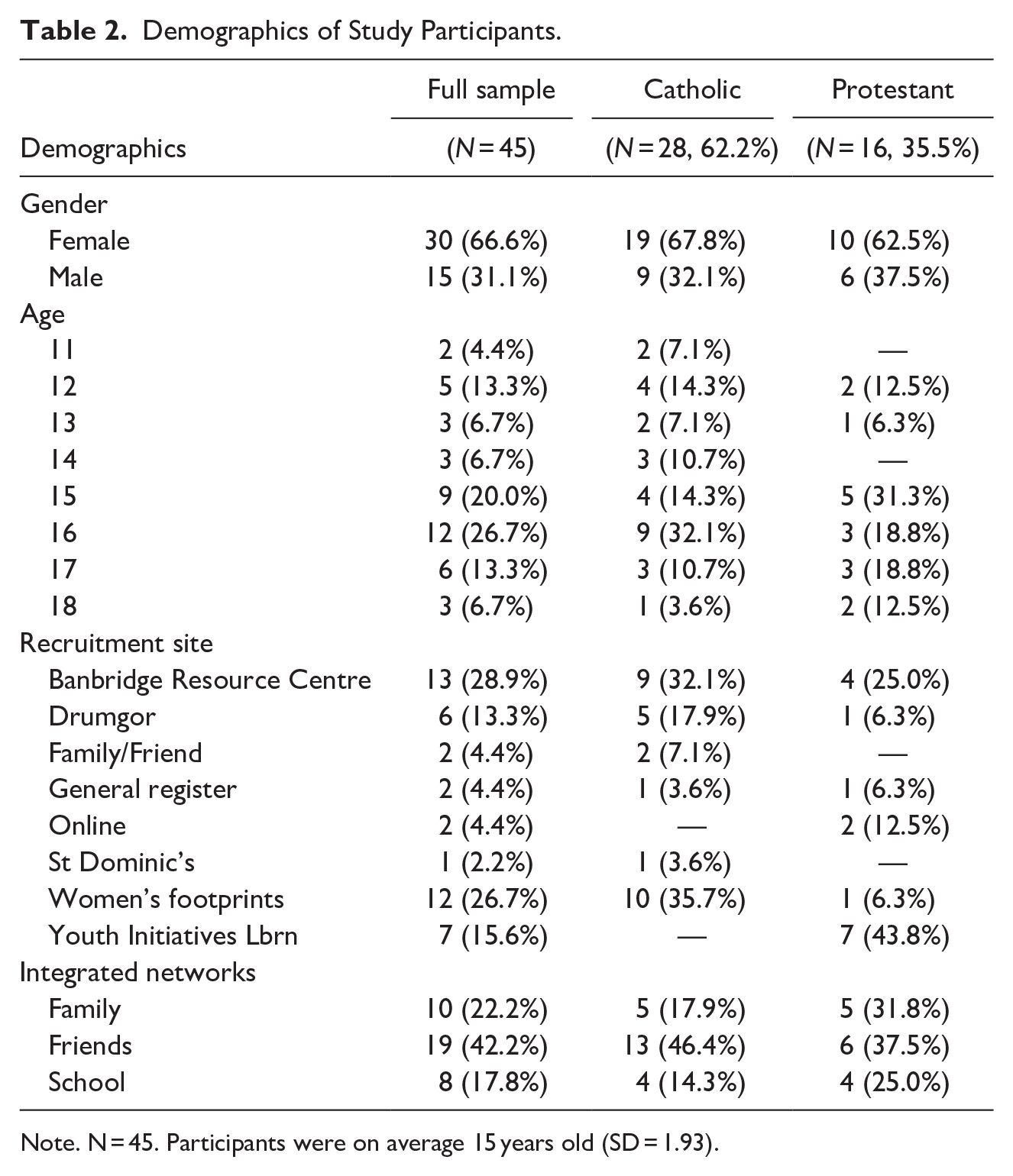
Note. N = 45. Participants were on average 15 years old (SD = 1.93).
Results
Prominent themes across interviews focused on key social-ecological and dynamic environments (i.e., family, peers, school, and media) in which adolescents in Northern Ireland access, process, and make decisions surrounding contested issues (e.g., the Partition of Ireland). Below, we highlight the key environments in which adolescents access such information and explore the unique ways in which they construct their own identities and understandings surrounding contested issues. Findings highlight prominent environments, settings, and relationships that influence adolescents’ understanding of contentions issues. In the discussion section, we reflect on such findings and share ideas surrounding future research and opportunities for intervention policy and programing.
Family
Out of the 45 interviews, 40 adolescents stressed familial members as a key source of information in learning about contested issues in Northern Ireland. Familial figures identified included fathers, mothers, grandads (i.e., grandfathers), and grandmothers. Across 33 of the interviews, adolescents described these family members as trustworthy due to their strong relational ties and lived experience during the Troubles. Fathers were most frequently identified as a reliable source of information (i.e., across 20 of interviews). Illustrated in the following quote, a 15-year-old Catholic male describes his close relationship with his father and the lived experience of his grandad as important factors in determining whether the information they shared around the Partition of Ireland was trustworthy:
I always go to my dad about things. I just rely on him so much, so I feel like I go to him for information, and I do believe anything that he says. My grandad as well. My grandad because obviously he’d grown up in the whole, the fighting and stuff done, so they grew up around the whole political thing.
And what are their reactions?
Well, I know my dad, he’s like . . . a big Catholic and he’s in the, you know, Ireland like free Ireland and all that there.
And would you think that information is trustworthy?
Well yeah, cuz they’re your family and of course you’re gonna believe them.
Interviewees noted that they often referred to family members for information surrounding the history of Northern Ireland (i.e., Troubles, prison riots, Partition of Ireland), especially when such topics emerged in other environments (i.e., school, peers, and media). A 15-year-old Protestant female recalled learning about Bobby Sands 1 in school and seeking out further information on the topic from her father.
We had learned about the whole like Bobby Sands situation, and I hadn’t a clue about that and then obviously going home and asking my dad about it. He was able to tell me more, so that obviously helped a bit. I think he was not happy with it, but obviously he was fine that I was learning about it because like you have to know about the history of your country. So, I think he was just interested that I had questions about the topic. Well, from what I was learning in school, it was just like the basics of it and then my dad was going into the deeper side of it. The school wouldn’t show you, so, it was better to hear from him than it was school. So, I was able to go into school then with that knowledge in my head.
Do you think that that information was trustworthy?
I think so. I mean coming from my dad, like, I’m obviously going to believe him on things.
Unpacking this quote, the interviewee stressed that the school environment offered information around the history of Northern Ireland which had not been discussed at home. Yet, she felt the need to gather further information about the event from her father before forming a final opinion. While her father was not happy about her learning about the event in school, presumably since Bobby Sands was a political leader within the Catholic community, she noted that her father offered more in-depth information and context allowing her to better understand and ultimately form an opinion surrounding the significance of the event. Her relational ties to her father and his opinion on the matter was viewed as more trustworthy than the curriculum in school.
Ten adolescents described coming from families of mixed Catholic and Protestant heritage, in which they discussed experiencing diverse messages surrounding the history of Northern Ireland and engagement in present day cultural events. One 16-year-old male adolescent, reflected on receiving mixed messages from his parents. He noted that his mother (who is Protestant) emphasized more acceptance of both ethno-religious identities and opportunities to engage in both Protestant and Catholic cultural events. The boy’s father (who is Catholic) tended to communicate disapproval when the boy attends bonfires 2 with his mother’s family.
My mum would count herself as a Protestant. My dad is Catholic from up here. Me and my dad would be quite close. However, when it comes to stuff I know, especially growing up, if I ever went to a bonfire with my mum’s side, he would get quiet, and I don’t know bitter about it. But if I was ever going to say a football or Gaelic football game, my mum then would’ve been, “no go ahead.” She’d be more understanding about it. That’s when it came to me going to high school. My mum really strives for me to go into an integrated school where everyone is accepted.
Familial cultural traditions and lived experience informed adolescents’ understanding surrounding the history of Northern Ireland. Yet, adolescents diverged in whether they adopted their family views on contested issues. Nineteen interviewees (10 Catholic, 9 Protestant) affirmed that their family’s opinion impacted their own views on contested issues. These adolescents tended to be females (14 total), and notably younger in age (M = 15 years old). Alternatively, another 19 interviewees (14 Catholic, 5 Protestant) indicated that they were not swayed by their family members’ views regarding contested issues. These adolescents acknowledged their family members’ experiences of violence and persecution but were also critical of polarizing narratives that perpetuated or justified ethno-religious conflict. To illustrate, one 12-year-old Catholic female, described stark differences in her views compared to those of her grandad, who actively voiced disdain for the Protestant community:
He doesn’t really like Protestants. Because it was like when he grew up, like they’re like bad to them, to him. I don’t think he really knows that some Catholics are bad to like Protestants as well, you know what I mean?
How do you feel whenever your Grandad was telling you about that?
I felt bad for him, I understand like, that’s happened more than just my grandad and like different religions. I don’t feel happy if someone who was like Protestant, like got killed or beat up or something. I wouldn’t like to celebrate that. Because it’s someone’s family member. I don’t really care what religion anyone is. I don’t get why other people care, as well.
Here, the interviewee expressed empathy for her grandad’s lived experiences. Yet, she also stressed opposition to violence toward any religious community. While adolescents noted that their family members have valid lived experiences of community violence that shape their views and opinions, they also recognize that such narratives can be biased toward a particular view (i.e., pro-Catholic or pro-Protestant). Another 15-year-old Catholic female highlighted that her family endorses a pro-Catholic view by sharing news on social media platforms (i.e., Facebook) that suggests Protestants are responsible for recent local community violence.
Sometimes, my family, they don’t mean to like they’re, they have good intentions. But sometimes they twist the story so it can come across as biased. Cuz, I’m now thinking I’m back on like the police stories and stuff and I think most of what I’ve heard have been in Protestant areas. So, I’m kind of thinking now, like realizing that that might be a wee bit biased because. I don’t think I’ve ever heard my mom mention a Catholic doing something bad. I don’t know, like say something like my mom goes, oh my God, a Protestant did that. It doesn’t matter. Be like, oh, somebody did that. Because that doesn’t sound right. It sounds like they’re almost like saying that like, oh my God, that Protestant did that. Like they’re downgrading them because they’re Protestant. And like they’re hating on them because they’re a Protestant.
Adolescents who perceived themselves as not being influenced by their parents’ views regarding contested issues typically endorsed a more removed stance. These youth acknowledged the violence and their families’ lived experience but indicated not identifying with the conflict nor viewing themselves as having a direct role. Many of these adolescents stressed a desire to engage in a less polarizing rhetoric. As one 16-year-old Protestant male noted: Everyone kind of has trouble when there is a war and a conflict between both Catholic and Protestant, but like, even today, when, like, as I said, when it comes to burning flags or people disagreeing, I still think stuff like that could be quite bitter. And there’s just no need for it nowadays. Like especially as I said 25 years later, after Good Friday.
A post-conflict identity among Northern Ireland adolescents has been discussed in prior scholarship (Blaylock et al., 2018; McAlister et al., 2009b). Blaylock et al. (2018) stress the importance of studying “other” adolescent identities outside of polarization (Pro-Catholic vs. Pro-Protestant). The generation of adolescents in our study stressed trying to navigate and define a post-conflict identity, which involved attention to relational ties and recognizing one’s family lived experience, while also voicing a desire to move beyond the conflict.
Peers
A total of 35 interviewees perceived their peers as a source of information surrounding the Partition, yet only 14 adolescents identified peers as trustworthy sources. Twelve interviewees (8 Catholic, 4 Protestant) perceived their peers to influence their opinion on contested issues in Northern Ireland. Adolescents who described their peers as trustworthy noted that their peers were more open to diverse views. A 16-year-old Catholic male recalled that he actively sought out peers who he perceived to be educated on contested issues. He further stressed that his peer networks offer him the opportunity to engage in ongoing dialog and that these relationships differ from those with his classmates and family. In such settings, he described feeling vulnerable: The people I choose to associate myself with, they’re kind of, you know, educated themselves too. And they don’t really go with what their family’s thinking necessarily, but they choose to educate themselves like myself. I feel as though that they’re more willing to take in the information and see my view. So, I feel like with my peers and my friends, it’s more of an, it’s more of a discussion, whereas if it’s with my family, I feel like it’s more I’m getting told. In school it’s very different because I don’t feel like I can necessarily speak about it, without stepping on someone’s toes, it’s almost like I’m more willing to talk about it with my friends because I know that it won’t turn into necessarily an argument or like people won’t dislike me because of it. But whereas in school and like Catholic school, you know, everyone’s like “we want a united Ireland this,” I don’t think I would necessarily be able to bring up my views in school because I just know it will get shot down instantly.
In this interview, the relational ties between peers provided him with a safe space to explore contentious issues, whereas weaker ties with classmates made him feel more vulnerable and less likely to speak out. Building off this theme, a notable characterization in peer relationships that were identified as trustworthy and influential on interviewees’ own opinions was the value and trust placed on the social-emotional connection between friends above political orientation. Peer relationships were described as accepting and removed from emotionally laden or polarizing discourse. A 17-year-old Catholic female described her close friendship with a Protestant peer.
One of my closest friends, she’s very Protestant. She would think the complete opposite. I would listen to stuff she said, like even when I don’t agree, I’d let her say it. Like there’s no emotion towards each other. We don’t have a hold on anything. I went to the 12th with her last year, which, well, like secretly my mum would’ve told me off. I’d pretended I was at somebody else’s house.
And why do you think your mum would’ve told off?
I think my mom would look at it more as safety. Like she’d think I’d get hurt.
In this quote, the interviewee highlights her willingness to hear her peer’s perspective, and that political conversations or disagreement do not pose a threat to the friendship. Furthermore, her friend exposed her to Protestant cultural events (i.e., parades) which are prohibited by her Catholic family. Of the 12 adolescents who perceived their peers to influence their opinion surrounding contentious issues in Northern Ireland, a no table 11 reported having intergroup friendships. These diverse intergroup connections played a critical role in adolescents’ exposure to the other ethno-religious community. Such experiences challenged perceived stereotypes and allowed adolescents to understand the struggle and lived experiences of the other ethno-religious community. These gained understandings helped reduce polarizing discourse and unwavering views surrounding polarizing issues. A 15-year-old Protestant female notes a generational shift in her peers being more diverse as well as less likely to engage in polarizing rhetoric.
I think that we all just think similar because like . . . our generation doesn’t . . . it’s not as big of a deal for us as it is for older people, I’ve said that a lot. But like none of us really like, it doesn’t bother us, especially because we’ve got friends that are from different backgrounds, it doesn’t change the person.
Alternatively, 15 of the other interviewees reported having more homophilous ethno-religious ties. Yet, the majority of these adolescents (11 Catholic, 4 Protestant) did not equate their peer groups affiliations with influencing their views on the Partition. Such findings are consistent with the homophily literature around peer networks, in that multiple subconscious processes may be occurring in which adolescents both befriend friends with shared identity and also unconsciously become more similar to their friends over time (Neal & Veenstra, 2021). Interviewees noted being friends with peers that grew up in the same community and school. As one, 14-year-old Catholic female described: We all go to the same school with the same, like we grew up the same, mostly the same places and parents are all around the same ages as well and we all live in the same place. So, all of our opinions are all like, pretty much the same about it.
Interviewees also noted that shared ethno-religious identities with peers helped them avoid controversial or difficult conversations. As one 12-year-old Catholic female reflected:
Do you think your friends would share similar views to you on this topic?
Probably, yeah.
And why do you think that is?
I think I like having them . . . think the same because it would cause fights if we thought differently.
This group of adolescents perceived differences in personal background and ethno-religious identity as risky, as more heterophilous connections might lead to more difficult and challenging conversations. These perceptions notably contrasted with the experiences of adolescents with actual intergroup friends within our sample, in that these interviewees described such conversations as thought-provoking, eye-opening, and non-confrontational.
School
Across 37 interviews, adolescents discussed learning about the history of Northern Ireland in their school environment. Interviewees pinpointed that the school setting provided them with the opportunity to be exposed to information on the timeline and history of Ireland. “It was like deeper information in school from what I learned growing-up” (15-year-old Protestant female). Interviewees also stressed that school fostered opportunities to discuss the history of Northern Ireland, views on the Partition, and the Troubles with their peers as well as at-home with their families. One 14-year-old Catholic female reflected on discussing the history of Northern Ireland with her friends: In school, whenever we’re learning about all of that happened. We’re always talking amongst each other. Like, whenever we have to do it on a test or learn about it just in class, we always talk about it to each other.
Another 11-year-old Catholic female recalled that the information she learned about the Troubles in school reflected the lived experiences of her own family:
I think my primary school might have started talking about it then, I think they stopped because I think they were getting messages from the principal and loads of people getting really scared about it or something. They would just kind of say like how they, how most people died. Right. And how people were like heroes and tried to save Northern Ireland basically.
And do you think that your teacher’s information is trustworthy?
Kind of, because like my daddy has been like talking about that a little bit. When we go on them like car drives kind of thing. I don’t know if my teachers have been through that personal fate. My daddy would know it because my Granny was there to witness it all. And my granny would’ve said the right things to my daddy.
Here, the interviewee perceives that the information shared in school is trustworthy because it corroborates and uplifts the perspectives of her own family (i.e., father, granny). Familial endorsement and lived experience held greater weight in determining trustworthiness as compared to the community backlash the school received in engaging in such instruction.
The majority of interviewees, 31 (22 Catholic, 9 Protestant) out of 37 described the information they received in school as trustworthy. Key factors that influenced this assessment involved information being endorsed by other socializing settings (family, peers, and media). Common phrases across interviews that were often associated with trustworthiness included: historic, factually based, integrated into a set curriculum, and backed by a course textbook. Yet only nine (6 Catholic, 3 Protestant) indicated perceiving the information they received in school as influencing their own opinion on contested issues within Northern Ireland. Eight of these interviewees described their teachers as trustworthy and removed from having a political position. Such sentiments were illustrated in this account by a 13-year-old Catholic female:
So, do you think that the school is biased or could present it differently depending on their background?
No, cuz my history teacher told us this, they’re here to not give their opinion but to give what happened. So, they’re here to tell the truth and not their opinion.
Similarly, a 16-year-old Protestant male recalled that his Catholic history teacher was open to diverse viewpoints and kept her lecture focused on historic information: And even when it came to history, my history teacher would be a Catholic. But when it came to teaching history, she was open to both sides that she never told anyone that their view was wrong. She was very “Here. this is what it was. This is what you’re going to learn. Here’s a test on it next week.”
Across these interviewees, adolescents endorsed the belief that their teachers presented objective facts around the history of Northern Ireland. In contrast, one interviewee noted that the background of the teacher could impact the information they shared with students, as well as the classes’ trust in the credibility of such information. This interviewee (a 15-year-old Protestant male) stressed that having resources and supportive materials helped offset such biases:
If I just heard it coming out of his mouth, and he’s a teacher in a Catholic school, like, you know, it wouldn’t be much reliable. It came out as a hard copy. It was made by someone else.
Do you think that someone is a teacher in a Catholic school, like do you assume certain things about them, or like what they believe?
Well, yeah, I think everyone sort of does.
Thirty-three interviewees indicated that the information they learned in school did not influence their opinion on contentious topics (22 Catholic, 11 Protestant). Many of these interviewees identified family as holding greater weight in shaping their opinion. A 15-year-old Protestant female recalled referring to her sister to provide information on the history of Northern Ireland when such topics came up in school: I would ask like, my sister she’s big on it. . .like looking into all of it. She knows the majority of it more than what I would. So, if I had any questions, I’d probably ask her . . .It’s just like when I did learn about it in school I was coming home and I was telling her. I was coming home and having conversations with her. . .obviously she was giving me more information than what school was.
Other interviewees indicated a post-conflict identity, stressing that they did not feel strongly about contentious topics within Northern Ireland (e.g., the Partition, history of the Troubles). A post-conflict identity was multi-faceted in that for many it involved an expressed desire to move beyond violence and polarizing discourse, but at times feelings of defeat and cynicism around the potential for change were also expressed. As one 16-year-old Catholic female reflected: I don’t get the point, the violence whenever no one’s going to be able to do anything about it. . .But like it’s been going on for hundreds of years, like what’s my opinion on it gonna do now? Cause like I know nothing’s ever gonna be done about it. It’s always going to be the same. You’re in Belfast like no matter what they’ll always find a reason to disagree with each other.
Finally, other interviewees were more critical of the credibility of the information they received in school. This criticism centered around the curriculum and the way such content was taught in school, thus making them hesitant to rely on their school as a credible source of information for forming an opinion on the Partition. A 16-year-old Catholic female expressed the view that the curriculum utilized in school was biased based on the author’s ethno-religious identity.
They’re just told to read from a book. So, I don’t really trust that. Because it’s obviously biased on what religions wrote it. Cause like obviously there’s books for Catholics and Protestants, which would be written for Catholics by Catholics or for Protestants by Protestants.
While school was discussed frequently across interviews as a setting in which adolescents were exposed to information surrounding Northern Ireland, the weight of such information within the setting in shaping adolescents’ opinions was often interconnected with reinforcing narratives from peers and family. Furthermore, interviewees were more critical of teachers as socializing actors as compared to their more long-lasting relationships with peers and family. The theme of school integration was not prevalent across interviews as compared to peers and family, with only one interviewee explicitly reporting attending an integrated school.
Media
Forty-one out of the 45 interviewees identified being exposed to media surrounding contentious topics within Northern Ireland (e.g., the Partition, bonfires). Social media sites were the most frequently identified sources of information, with the top three being: Tiktok (24), Instagram (12), and Facebook (8). Interviewees indicated that they were more apt to access and attend to media posts surrounding contentious topics by individuals they personally knew (i.e., peers, family members), recognized (i.e., celebrities, political figures), or were members of their local community. As one Protestant 18-year-old female reflected: It [Facebook] would just be the likes of people sharing stuff. Or if a day came, like I come up like, like suggested for you, it will come up. . .I wouldn’t really head into them unless somebody did share it, then I would look into it, but I wouldn’t like go in and look through the different accounts and stuff. . . the people that I see anyway, are the ones from my community. They would share it the most. If I see somebody from my community and obviously, they agree with what the rest of us are thinking and if they share something then I’m gonna go in and read it. Because they’re agreeing with what I’m saying.
Social media information seeking behaviors reinforced offline homophily behaviors, in that interviewees often paid attention to and sought out information from peers and community members with a shared ethno-religious background. Yet, interviewees also stressed relational consideration in their own posting, sharing, and circulation of online content. Adolescents stressed the importance of not offending or harming close peer networks from other ethno-religious backgrounds. This is illustrated by one Catholic 16-year-old male:
You’d see jokes online and stuff, but, like, you wouldn’t really make fun of anyone because of it. You’d maybe have a laugh at it. . .like TikTok or Instagram or something like that. . .Just like random ones.
Would you be likely to share, the way you can like repost or put it on your story?
Maybe if it’s not offensive, then yeah, I wouldn’t want to offend anybody.
How would you work out if it’s offensive or not?
I would think like my friend group, any of them Protestant or anything, and maybel wouldn’t sent it to them. I wouldn’t like to make fun of them for being that because it’s not their fault that they’re Protestants so.
Within this quote, the interviewee notes that he may indeed find humor in anti-Protestant content, but did not want to share such harmful content with his Protestant friends. Here, this adolescent demonstrates selective sharing of media content based on relational considerations. Such behaviors may continue to reinforce ingroup identity (sharing denigrating content amongst ingroup members) if the outgroup is not privy to such conversations.
Twenty interviewees openly indicated their distrust and skepticism of social media containing information around the Partition. For these interviewees, distrust of social media focused on the lack of expertise and credibility of content creators, as illustrated by this 14-year-old Catholic female: If there’s kids or just people or teens on Instagram just posting weird photos about it, like I can’t really trust them, whatever they’re posting because they’re my age, I wouldn’t expect them to know much about it. But they’re still acting like they do. See some of the people are posting about it right now on Instagram. They post about it and they act like they know all about it but they really don’t. And like whenever we actually ask them about it, they’re like, yeah, I don’t know anything about that. You know what I mean? Like they’re just pretending they do but they really don’t. . .many people like getting big accounts from spreading misinformation all over the place and some people will believe it and they’ll tell other people and then eventually lots of people believe fake things.
Adolescents often identified age and lived experience during the Troubles as critical characteristics to ensure the credibility of an information source. Thus, younger generations are met with greater skepticism as influential socializing actors. The interviewee further stressed the potential for social media actors to misrepresent themselves, and the potential downstream ripple effects of circulating harmful misinformation and falsities. Another key factor that interviewees noted in their skepticism around social media content was information that emphasized one perspective or was degrading to the other ethno-religious community (i.e., Protestant or Catholic). As one 15-year-old Protestant female noted:
Like Instagram and stuff, you know like over the 12th. . .people would post things and it’s just them just being themselves, just being annoying and it’s like, they’re just shouting things that are offensive to Catholic people.
Would you see that type of content from the accounts that you follow?
Yeah. . .It’s obviously like annoying. . .but it doesn’t annoy me that much, but it’s just cuz I’m not from the Catholic community, so I wouldn’t find it offensive, but it’s obviously annoying when there’s somebody else out there like that could take it offensively and it could annoy them. Same way that situation annoyed my best friend, so yeah. . . I think people like shared things, but I’ve never really focused on it or like tapped into it. I just skip past it.
Do you think that information shared on things like Instagram, Snapchat and things like that, do you think that’s trustworthy?
I think sometimes it can be more one-sided, like if it’s a Catholic situation and they’re talking about something, they’ll make it more personal for them. And then if it’s Protestants, they’ll make it more personal to them.
Here, the interviewee stressed the harm in sharing offensive information. She discussed her intentional digital strategy of skipping and not focusing on offensive media content. Her understanding of the direct harm media can cause is influenced by close relationships with peers within her microsystem (i.e., a Catholic friend who was hurt by an offensive media post). In contrast, only six interviewees indicated trusting the source of information within their social media feed. These sources varied, including TikTok, Google, and YouTube. In unpacking these quotes, interviews did not systematically convey intersecting or at-times clear criterion regarding the trustworthiness of such media. Only one of the interviewees indicated that information they gained from social media shaped their opinion on a contentious issue, the Partition of Ireland.
In regard to adolescents’ social media search habits, 27 interviewees indicated that sources of information they interact with would appear on their social media news feed, thus alluding to potential algorithms influencing their exposure to information surrounding the Partition. This phenomenon is further described by a 16-year-old Catholic female:
You see videos of them joking about other religions, but that’s it and nothing else about anything to do with stuff. . .It’s like suggest pages, you know, they just show up. . .just laugh maybe, not maybe laugh, but you know, and then you’re just scroll by, can’t be getting involved, seeing- other people seeing what you like. . .There was like a video and then so someone talking about it. . .I don’t know if it was a man or woman and then they just put a bunch of different GIFS. . .and then they’re just people just started commenting their opinions all over it. And I was just like, what is going on?
Yeah. And how would you decide if the information was trustworthy or not?
Oh, I’ve no idea.
In contrast, six interviewees reported actively following media accounts that they perceived as credible which included political figures from a specific party (i.e., Sinn Fien) or news-based organizations (i.e., BBC News). Social media was identified across interviews as a prominent social actor and setting for adolescents learning about contentious issues within Northern Ireland. Yet, adolescents indicated greater cynicism and skepticism regarding media sources as compared to social actors with direct relational ties (i.e., peers and family).
Discussion
Adolescents in Northern Ireland encounter numerous socializing actors and environments in relation to their understanding of contested issues. These systems include family, peers, school (microsystems), interactions and cultural messaging across settings (mesosystems), as well as national politics and social media (macrosystem). In alignment with prior literature, familial history and intergenerational experiences of violence had a notable impact on adolescents’ understanding of contentious topics within Northern Ireland (J. Hughes et al., 2013; Jennings et al., 2009; McAlister et al., 2014; Stringer et al., 2010; Tyler & Iyengar, 2023; Wolak, 2009).
Microsystem: Influence of Family on Transmission and Consumption of Polarized Information in Northern Ireland
Applying concepts of Social Identity Theory, adolescents indicated strong trust in their families’ cultural experiences (in-group membership) and views on the history of Northern Ireland. Father figures tended to be more frequently identified as a reliable source of information; however, interviews did not unpack the reasons for such preferences. We reflect on the cultural values and history (a notable male presence in combat and in para-military leadership) within Northern Ireland as well as societal sexism that may have contributed to a form of epistemic sexism (Luningham et al., 2021; Patin et al., 2020). In Northern Ireland, men from deprived areas have historically been seen as community defenders, with many drawn into paramilitaries through transgenerational storytelling from fathers and grandfathers, reinforcing ethno-religious identities and offering both status and protection (E. Gallagher & Hamber, 2015; McAlister et al., 2014; Walsh & Harland, 2021). Alternatively, women have been discussed as a “hidden voice” in the conflict, experiencing the impact differently, often in less visible but distinctly gendered ways (Lucas et al., 2019). As such, fathers were more frequently identified as a trustworthy source in helping adolescents navigate polarizing topics. Adolescent responses also tended to naturalize trust around parental figures in sharing information, even on highly subjective issues. These findings corroborate trends both in Northern Ireland and other contested areas, in which when ethnic-conflict is high, parents tend to play a more powerful socializing role (Aboud & Amato, 2003; Bar-Tal, 1996; Stringer et al., 2010).
Notably, adolescents’ perceived trustworthiness of their families’ experiences and cultural values did not always translate to influencing their own opinions and viewpoints. Half of the interviewees articulated embracing a post-conflict identity, which explicitly did not adopt their families’ views surrounding contentious issues within Northern Ireland. This identity was described as a generational shift (not based on ethno-religious background or in-group membership) that revoked polarizing discourse. McKeown and Taylor (2017) have argued for a focus on post-conflict identity formation during peace-building efforts, that is less reliant on traditional social identity markers (nationality, race, religion, ethnicity) but rather on circumstances, needs, and opportunities. In this study, a post-conflict identity was not consistently described as optimistic, and at times reflected deep-seated feelings of cynicism and low perceptions of self-agency to partake in cultural and social change. These sentiments are troubling in relation to adolescent health and well-being. In a recent scoping review (see Maker Castro et al., 2022), critical motivation (a desire to challenge the status quo and current structures of inequity) was found to be tied to well-being amongst adolescent populations. Further research is needed to explore how adolescents define and navigate a post-conflict identity, and which key experiences facilitate sentiments of optimism and agency as compared to cynicism and apathy.
Microsystem: Influence of Peers on Transmission and Consumption of Polarized Information in Northern Ireland
Peer groups were another socializing environment that many interviewees identified when engaging in discourse surrounding contentious topics within Northern Ireland. A little under half of the interviewees noted being cognitively aware of their friends’ influence on their views and opinions on such topics. These conditions may mirror findings surrounding social network homophily effects (Laninga-Wijnen & Veenstra, 2021; Neal & Veenstra, 2021), which have found that adolescents consciously and unconsciously tend to gravitate toward peers who share similar backgrounds (i.e., religion, culture, politics; Cheadle & Schwadel, 2012; Oosterhoff et al., 2022) and over time alter their behaviors to better align with and uphold the norms of their peer groups (Montgomery et al., 2020). Future research is needed to explore this finding longitudinally. Specifically, whether adolescent peer networks that share polarizing views and beliefs surrounding contentious topics within Northern Ireland exacerbate polarizing information seeking and sharing behaviors over time. Alternatively, interviewees that reported being cognitively aware of the influence of their peers on their views of contentious issues within Northern Ireland often discussed exposure to and strong relational ties with peers from the other ethno-religious community. Interviewees stressed that their diverse intergroup connections with outgroup members enhanced their understanding and openness to divergent experiences surrounding the history of Northern Ireland. Intergroup connections were characterized as disrupting polarizing narratives, allowing adolescents permission to embrace other cultures, and a growing recognition of diverse lived experiences within Northern Ireland. Findings add to literature surrounding the importance of intergroup relations with regards to adolescent social development (see Neal, 2022 special issue), while adding the unique context of intergroup ethnic-religious identity.
While extensive literature supporting intergroup contact theory highlights numerous positive outcomes for social attitudes and prejudice reduction (see meta-analyses Pettigrew & Tropp, 2006, 2013), our findings contribute to this body of work by showing that adolescents with diverse friendships also reflect cognitively on the influence of their peers and gain a deeper understanding of the diverse lived experiences of others. These benefits extend beyond reducing prejudice, to also enhance cultural empathy, foster critical thinking, and enable young people to challenge and reshape divisive historical narratives. Yet, we caution that such integration efforts ought to be conducted intentionally. For instance, shared education programing has typically been found to be not long enough (e.g., often lasting days as compared to the recommended 60 hr, see King, 2009) to allow students to be sufficiently familiar with one another (Donnelly et al., 2024; King, 2009). Thus, time is a critical factor to build the kind of foundation that adolescents require to explore contentious issues in mixed groups, and doing so ahead of time could prove problematic (Donnelly et al., 2024).
Microsystem: Influence of Schools on Transmission and Consumption of Polarized Information in Northern Ireland
While the school environment was a commonly described socializing factor by which adolescents learn about the history of Northern Ireland, it was often less frequently identified and attributed to influencing interviewees’ opinions and views on contentious topics. Prior literature has stressed that schools are critical environments to buffer against polarization and the circulation of misinformation (Hess, 2009; Journell, 2017, 2018). High impact civic learning practices have systematically documented the developmental and educational benefits of pedagogy that promotes critical student-led inquiry, dialog, and debate (Clay & Rubin, 2020; Cohen et al., 2018; Hess & McAvoy, 2014; M. Kornbluh et al., 2015; Savage & Ikoma, 2023). Yet, educators are often not equipped nor feel comfortable discussing contentious topics within their school environment (Donnelly et al., 2021; Journell, 2022; Kornbluh, Davis et al., 2024). Our study suggests that adolescents perceived their teachers as focusing on memorization and factual information when discussing the Troubles and the history of Northern Ireland. As such, adolescents often perceived such lessons as boring and devoid of discourse. Perhaps the ripple effects of educators’ pedagogical decisions may have curtailed the school environment as a less influential socializing factor as compared to peers and family.
Prior research within Northern Ireland has highlighted teachers’ apprehension in discussing the Troubles as well as engaging in alternative historical perspective taking (Barton & McCully, 2010; Donnelly et al., 2021). Teachers, especially those in integrated and shared education settings, often take on a role beyond traditional teaching, acting as intergroup facilitators, a responsibility that is often not adequately supported through training and professional development (Donnelly et al., 2024). Trust of the messenger is an important contributor to information selection and adoption, especially within polarizing contexts (DuMont, 2024). Trust is often facilitated when the messenger is comfortable with the content being shared and connects such information to applicable lived experience (Doucet, 2019, 2021; DuMont, 2024; Kirkland, 2019). Picking up on teacher discomfort, adolescents may have questioned their teacher’s authority and knowledge on such material. Alternatively, parental figures may have had greater comfort in sharing their own perspectives, lived experiences, and views on the conflict and as such may have facilitated greater trust and buy-in. Thus, adolescents identified parents as having a greater socializing force in forming their opinion on the history of Northern Ireland. Future research could build from these findings in identifying teacher perceptions on valuable resources to challenge polarization within the classroom and the organizational conditions (administrator buy-in, local community context) needed to support such pedagogy.
Macrosystem: Influence of Media on Transmission and Consumption of Polarized Information in Northern Ireland
Media (specifically social media) was frequently identified as offering a dynamic and evolving information channel surrounding contentious topics within Northern Ireland. Adolescents indicated skepticism surrounding media sources. They described seeking out and attending to information from media actors with shared identities, thus potentially reinforcing polarizing online information chains documented around other contentious issues (i.e., vaccines, political identities; Blanchar & Norris, 2021; Burgio et al., 2022). Yet, adolescents also expressed authentic relational considerations regarding their own engagement in social media circulation. Specifically, youth expressed a desire to not harm or offend peers from the other ethno-religious backgrounds (i.e., Catholic or Protestant). Relational considerations in the context of social media circulation for civic purposes has been documented amongst adolescents within the United States (Bell & Kornbluh, 2022; Middaugh, 2018; Middaugh et al., 2022). This study offers a unique context for observing similar decision-making factors regarding polarization and ethno-religious conflict.
Summary
Adolescents identified key socializing actors (i.e., family, peers, teachers) and intersecting Ecological Systems (i.e., home, school, online) that both shaped their understanding of the history of Northern Ireland, as well as navigating current day contentious topics (e.g., ritualized bonfires, a Partition for Ireland, etc.). In regard to Social Identity Theory, adolescents’ own beliefs were formatively shaped by their identification with in-group membership (intergenerational history and cultural sharing), as well as out-group memberships (opportunity to connect with outgroup members). These identities were constantly being redefined and challenged as a part of a larger generational desire to move past the conflict that had notably plagued their families and communities. Intergroup Contact offered a relational infrastructure and network approach to not only reduce prejudicial attitudes and beliefs of outgroup members, but also challenge polarizing disclosure and expand opportunities for problem solving.
Implications for Developmental Research and Intervention
Across interviews, adolescents who identified opportunities for intergroup contact with family, peers, and/or schools, tended to be provided with alternative viewpoints, perspectives, and considerations that attenuated polarizing discourse. Opportunity for intergroup contact through community-based programing and school integration may offer unique intervention points for disrupting polarization, shaping adolescents’ sociopolitical development, and reducing feelings of prejudice and distrust of out-group members, as well as contributing to lifelong civic behaviors with implications for nation peace-building efforts. In the context of educational interventions, scholarship has documented the promise of critical consciousness programing (understandings of root causes of social inequality and generating systemic solutions; Seider et al., 2017) as a form of healing from political trauma (Dunn, 2021; Sondel et al., 2018). Training educators in scaffolded pedagogy and the facilitation of critical consciousness for students could support schools in playing a more central role in disrupting polarization, as well as fostering student agency (Kornbluh, Davis, et al., 2024). Our findings highlight the necessity to carry out these interventions in settings that include others from diverse backgrounds to provide opportunity for students to discuss contentious topics in the context of shared and divergent lived experiences. Schools that facilitate integrated or shared education in Northern Ireland, where youth from diverse backgrounds come together, are a great starting point. However, students must also be given the opportunity to discuss contentious topics to foster understanding, empathy, and critical dialog (Hayes et al., 2007)—which is often missing from these shared settings (Loader & Hughes, 2017). McCully (2012) has discussed the power of storytelling within Northern Ireland history as key pedagogical strategy for helping build empathy and perspective taking. Lastly, there has also been a call for educators to both learn from and support students in developing skills to assess the credibility of incidental exposure to polarizing information, as well as understand the implications of online practices (i.e., endorsement, sharing, circulation) in relation to polarization (Middaugh et al., 2022).
Limitations and Future Research
Interviewees were notably recruited from community-based organizations and personal networks. Thus, we are cautious regarding the transferability and applicability of our findings to other settings (Lincoln & Guba, 1985). Adolescents involved in community organizations or with personal connections to the research team might have had greater exposure to out-group members and been less engaged in polarizing behaviors. Furthermore, our sample was not evenly divided among Catholics and Protestants. While we systematically evaluated prominence of codes across participant identities (religion, age, and gender), Catholic perspectives may still have been overrepresented within our analysis and reporting. Greater representation of male perspectives would also allow us to unpack potential gender-based differences in relation to polarization. Future research would benefit from utilizing social network analysis to map out and unpack the various informational actors and relational clusters adolescents navigate when making sense of polarizing topics. Langhout et al. (2014) utilized social network analysis to identify key actors that bridged across children’s social environments (family, peers, school). In application to Northern Ireland, it would be valuable to examine whether adolescents who challenge their family’s interpretation of conflict related histories tend to have more or fewer intergroup friendships. Such scholarship may offer useful insight into the impact of intergroup dialog on familial relationships. Lastly, our analysis solely focuses on adolescents’ perceptions regarding key actors in their environment and how such relationships influence polarization. Multi-stakeholder interviews, observations, and archival documents could allow us to further explore and unpack the perspective of the behaviors of key socializing actors (parents, friends, teachers) as well as their intentions with regards to polarization.
Conclusion
Adolescence is a critical window for both understanding and disrupting polarization. Regarding developmental theoretical implications, our study expands the application of Ecological Systems Theory by illuminating multi-layered, political, and at times competing environments and narratives (amongst family, peers, school, and media) in relation to Catholic and Protestant adolescents’ understanding of the history of Northern Ireland and ongoing contentious social issues. Adolescents discuss intersecting influences of historical conflict and segregation and contemporary opportunities for integration on trust in family, peers, school, and media. As informed by Social Identity Theory, adolescents’ beliefs are shaped by their identification with in-group and out-group memberships. Findings further suggest that forms of epistemic sexism may have emerged with a particular cultural emphasis on fathers as a reliable source of information. Yet, these narratives surrounding identity, beliefs, and group dynamics are also continuously re-negotiated (Lüders et al., 2024) as demonstrated by evolving post-conflict identities. Regarding educational policy and programing, intergroup contact held notable promise as a relational foundation for challenging polarizing discourse, reducing prejudicial attitudes, and expanding opportunities for empathy and perspective, with unique application to ethno-religious conflict. Such findings hold implications for both expanding and enhancing integrated and shared education programing with an emphasis on teacher pedagogical support and training. Findings push back against narratives of adolescents as passive recipients of polarization. Interviews showcase adolescents as thoughtful individuals who understand the potential for violence and harm surrounding polarizing discourse, a growing reality in our global climate.
Supplemental Material
sj-docx-1-jar-10.1177_07435584251344215 – Supplemental material for Exploring Facilitators and Disruptors of Polarization During Adolescence Within Contested Settings: A Case Study of Catholic and Protestant Youth in Northern Ireland
Supplemental material, sj-docx-1-jar-10.1177_07435584251344215 for Exploring Facilitators and Disruptors of Polarization During Adolescence Within Contested Settings: A Case Study of Catholic and Protestant Youth in Northern Ireland by Mariah Kornbluh, Raquel Amador, Sherry Bell, Jennifer Watling Neal, Savannah B. Simpson, Bethany Corbett, Kathleen Corriveau, Emma Flynn, Caitlin McShane, Christin Scholz, Lara Wood, Jing Xu and Jocelyn Dautel in Journal of Adolescent Research
Footnotes
Appendix 1
Acknowledgements
The authors would like to express their gratitude to the adolescents who participated in the study, and the community organizations and schools that helped with recruitment efforts.
Data Availability
We provide our interview protocol and codebook as appendices and supplemental files online. Due to the sensitive nature of the data (interviews with adolescents), we do not provide open access to such transcripts. Interested readers are encouraged to reach out.
Declaration of Conflicting Interests
The author(s) declared no potential conflicts of interest with respect to the research, authorship, and/or publication of this article.
Funding
The author(s) disclosed receipt of the following financial support for the research, authorship, and/or publication of this article: This study was funded by the World Templeton Charity Foundation.
Ethical Approval
This study was approved by the ethical review board at Queen’s University Belfast.
Participant Consent
Parental permission and youth consent were collected for this study.

Supplemental Material
Supplemental material for this article is available online.
Notes
Author Biographies
References
Supplementary Material
Please find the following supplemental material available below.
For Open Access articles published under a Creative Commons License, all supplemental material carries the same license as the article it is associated with.
For non-Open Access articles published, all supplemental material carries a non-exclusive license, and permission requests for re-use of supplemental material or any part of supplemental material shall be sent directly to the copyright owner as specified in the copyright notice associated with the article.
