




Abstract
The period of youth encompasses a myriad of experiences that often elicit a range of emotions from the individual. This study was conducted to understand emotion regulation (ER) among youths, specifically to identify strategies employed by youths to regulate emotions, and to understand the perceived importance and impact of ER. Qualitative data were collected through one-to-one semi-structured interviews (n = 25) and focus group discussions (n = 11; total 70 participants) among youths aged between 15 and 24 years. Interviews were transcribed verbatim and inductive thematic analysis was used to analyze the data. ER strategies engaged by youths in this study were classified into the following themes: (1) developing emotional awareness and acceptance, (2) emotional catharsis, (3) calling for a timeout, and (4) positive thinking and reframing. Youths perceived the importance of regulating emotions as (1) ER contributes to rational thinking and decision-making, (2) poor ER worsens mental wellbeing, (3) ER provides stability in life, and has (4) relevance to current life stage and environment. Findings from this study illustrate the essential role of ER for youth’s healthy functioning and demonstrate the value of strengthening emotional regulatory capacities in them.
Introduction
Youth are defined by the United Nations as persons aged between 15 and 24 years (United Nations, n.d.). While this definition of youth age group is not universally agreed upon owing to varying sociocultural influences across countries, it is however commonly understood as a period of critical growth and development that is distinct from childhood and involves major life transitions, for example graduating from the education system and beginning employment (Patel et al., 2007). The multitude of novel experiences during this period of transitions, while likely to be accompanied with emotional distress as challenges are encountered along the way, can also be a period that presents opportunities for growth and brings about excitement for youths. The ability to effectively regulate emotions is thus a crucial element of wellbeing and functioning, perhaps more importantly for youth given that brain structures involved in regulating behavioral expression of emotions are the last to mature (Bell & McBride, 2010).
Emotion regulation (ER) generally refers to a person’s ability to manage and modulate their responses to an emotional experience. It is a process that involves influencing both positive and negative emotions in terms of its intensity, duration, and quality, and it can occur consciously or outside of one’s awareness (Naragon-Gainey et al., 2017; Webb et al., 2012). Strategies used in regulating emotions have been broadly classified into two ways. In Gross’s (1998a, 2015) process model of emotion regulation, strategies are termed antecedent-focused strategies (occurring prior to an emotional response; e.g., distraction and cognitive reappraisal) and response-focused strategies (occurring after emotional responses are generated; e.g., expressive suppression) based on the time points along the ER process at which they are deployed. Aldao et al. (2010; Aldao & Nolen-Hoeksema, 2012) described ER strategies as adaptive (e.g., cognitive reappraisal and acceptance) and maladaptive (e.g., behavioral avoidance and rumination) while noting that this labeling of adaptiveness is context-dependent.
The way individuals regulate their emotions has an influence on their mental wellbeing and functioning. Problems with ER were found to be associated with impulsivity, risky sexual behavior, and behavioral adjustment problems in adolescents and youths (Hessler & Katz, 2010; Schreiber et al., 2012). Studies have also demonstrated that the type of strategies used in regulating emotions may lead to differential outcomes. Reappraisal is generally argued to be a healthier manner of ER as compared to using suppression, given that it is associated with better social functioning and wellbeing outcomes in studies conducted among young adults (John & Gross, 2004; Nezlek & Kuppens, 2008). A meta-analysis of studies with samples from various age categories found that cognitive reappraisal was positively correlated with positive indicators of mental health, while expressive suppression was negatively correlated with these positive indicators (Hu et al., 2014). At this juncture, it is important to consider the cultural differences in ER that have been studied in the literature. In comparison with Western sociocultural norms, Asian culture places emphasis on social harmony and cohesion, in that it encourages the suppression of emotional expression in social settings (Hsieh & Stright, 2012). Suppression may thus be deemed as a form of cultural expression and may not necessarily represent an ER strategy (Chong & Lee, 2015); the nuanced effects are demonstrated in the study by Hu et al. (2014) which found that the correlations between ER strategies and indicators of mental health were culture-dependent. The habitual use of adaptive ER strategies was associated with less depressive and anxiety symptoms while frequent use of maladaptive strategies was associated with more symptoms among youths (Schäfer et al., 2017). A study by Cairns et al. (2015) identified difficulties with responding to emotions as one of the major functional concerns in help-seeking youth that had impacted various domains in life. Studies have also found that having better ER was associated with lower odds of suicidal behavior among youths (Barr et al., 2017; Pisani et al., 2013), while impairment in regulating emotions was identified as a risk factor for drug abuse (Nawi et al., 2021) and associated with positive smoking expectancies (Dir et al., 2016) among youths.
Youth is the period where most of the high-prevalence mental health conditions, such as mood and anxiety disorders, emerge (de Girolamo et al., 2012; Kessler et al., 2007). Given the growing body of evidence that indicates the transdiagnostic role of ER in the development and maintenance of psychopathology in adolescence (Klein et al., 2022; Sloan et al., 2017), it is of importance and value to youth educators to understand how youths regulate their emotions. While a considerable amount of research has been conducted on ER among youths, many of these studies cited above were quantitative studies that assessed predefined measures of ER using self-report questionnaires and were conducted to understand ER in the context of psychopathology; less is known about common lay approaches adopted by youths to manage their emotions in daily lives. For instance, the study by Schäfer et al. (2017) reviewed 35 studies conducted among youths from the subclinical population to understand the effect of various ER strategies on psychopathology outcomes such as depressive and anxiety symptoms. The study also coded the strategies based on domains derived from assessment tools such as the Emotional Regulation Questionnaire and Difficulties in Emotion Regulation Scale. There is merit in using a quantitative approach to understand the phenomenon, however, it limits the ability to understand nuances in the outcomes of adopting specific ER strategies that may be context-dependent (Aldao & Nolen-Hoeksema, 2012). As highlighted by Aldao and Dixon-Gordon (2014), the bulk of empirical studies predominantly examine covert strategies (which occur within the individual, e.g., suppression) and less is understood about overt ER strategies (e.g., drinking alcohol) which are often not covered in the quantitative approach. Additionally, there is also a need to explore the importance of ER in domains other than psychopathology, for instance social or functioning outcomes which have received less attention. A secondary analysis of data from a study on youth’s mental wellbeing was thus conducted to understand ER among youths using qualitative methods which would allow an in-depth exploration of the topic. More specifically, this study aims to identify common lay strategies that youths engage in to regulate their emotions and to understand the perceived importance or impact of their actions. The study will address the following research questions:
RQ1: How do youths regulate their emotions in their daily lives?
RQ2: In what ways are regulating emotions an important aspect of their lives and what are the impacts of regulating their emotion?
Methods
Data from this study originated from a qualitative study carried out to examine positive mental health and its components from the perspectives of youths in Singapore. The study was conducted between March to December 2020 when COVID-19 social distancing measures were in place. The following section describes the sampling and data collection methods used in the primary study. Ethical approval for the study was obtained from the National Healthcare Group Domain Specific Review Board (DSRB No. 2020/0228).
Sampling
Youths in Singapore aged between 15 and 24 years were recruited through multiple sampling strategies. Purposive sampling was adopted to ensure participants were well represented across gender, age group (15–19 and 20–24 years old), and ethnicity (Chinese, Malay, and Indian). Participants were initially recruited through contacts of the study team and their colleagues, and snowball sampling was then employed where participants referred other potential participants for the study. Recruitment brochures containing details of the study were also disseminated to potential participants via community-based youth welfare services and organizations. Additionally, deviant case sampling was adopted to obtain inputs from youths with unusual or special experiences, including those with experiences of psychological distress, school dropout, or risky behavior (e.g., substance use, gang involvement), so as to develop a richer and more diverse account of youth’s experiences.
Data Collection
Data were collected through a series of one-to-one semi-structured interviews (SI) and focus group discussions (FGDs), which were all conducted online via the Zoom videoconferencing platform, except for four semi-structured interviews, which were conducted in person. A combination of SIs and FGDs was used in order to generate qualitative data that was rich and broad in content (Lambert & Loiselle, 2008); FGDs allowed dynamic discussions among participants and were useful in capturing a broad range of experiences, while one-to-one SIs facilitated detailed discussions of these experiences that might have not been possible in a group setting, and reduced concerns regarding social desirability. Furthermore, as the study was recruiting youths with unique and diverse experiences (e.g., gang involvement), having both SIs and FGDs would present a choice for the youths in the data collection method and hopefully increase their willingness and opportunity to participate. An interview guide was used in all the sessions, and it contained questions related to positive mental health and wellbeing. Some examples of questions that elicited responses related to the present study were: “Why is [positive mental health/wellbeing concept] important for young people? What about yourself, how has this [wellbeing concept] improved your mental health?”; “How can people your age achieve [positive mental health/concepts related to wellbeing]?”. Spontaneous responses surrounding the management of emotions were followed up with probes to clarify and expand on the discussion, for instance, “Why do you think it is important for young people to be in control of their emotions?”, “What kind of strategies can young people use to manage their emotions?”. Participants in the FGDs were also encouraged to discuss or disagree with any of the points raised in the discussion by their peers. All sessions except for five SIs were facilitated by the senior author, who has a background in health services research and epidemiology and is experienced in conducting qualitative research studies. The remaining five SIs were conducted by other team members who were trained in qualitative research and have backgrounds in psychology. Participants completed a simple questionnaire that collected basic sociodemographic information before the interview, and written informed consent was obtained from them and parents of those below 21 years old prior to their participation in the study. All interview sessions were audio recorded and transcribed verbatim with personal identifiers in the transcripts removed before data analysis.
Analysis
Data collected were coded and organized using NVivo software. Analysis of the data was conducted by the coding team composed of five members who were all involved in transcribing the interviews and performing quality checks on the transcripts. Thematic analysis via inductive approach was used to analyze the data and the process was guided by the six phases of analysis described by Braun and Clarke (2006, 2014). In the first stage, team members familiarized themselves with the data by reading and re-reading randomly assigned transcripts and noted down initial meaningful ideas and content in the transcript. Preliminary codes were generated inductively from six transcripts and compared and discussed within the team. These codes were subsequently grouped into broader categories after iterative deliberations and modifications to produce a codebook as a framework to guide the coding of remaining transcripts. At this stage, it is acknowledged that the creation of a codebook departs from the established procedure of the thematic approach by Braun and Clarke (2022a, 2022b) and resembles that of the codebook approach to thematic analysis. The rationale for doing this is owing to pragmatic considerations given that coding was performed by a team working on different sets of transcripts. Next, as the current analysis focused on ER, relevant coding categories were reviewed and potential themes were generated by the lead author (SC) and subsequently refined through an iterative process within the research team where the themes were checked against the coded extracts and data set. These themes were inductively combined based on their interrelation and co-occurrence to produce higher-order themes which were discussed and reviewed by the other team members and are presented in the next section. During the analysis process, differences in the context of data collection were accounted for by understanding if particular themes were more prominent based on the characteristic of the dataset (i.e., SIs vs. FGDs); data derived from SIs and FGDs were similar and complemented each other in understanding youth’s experiences on regulating emotions.
Results
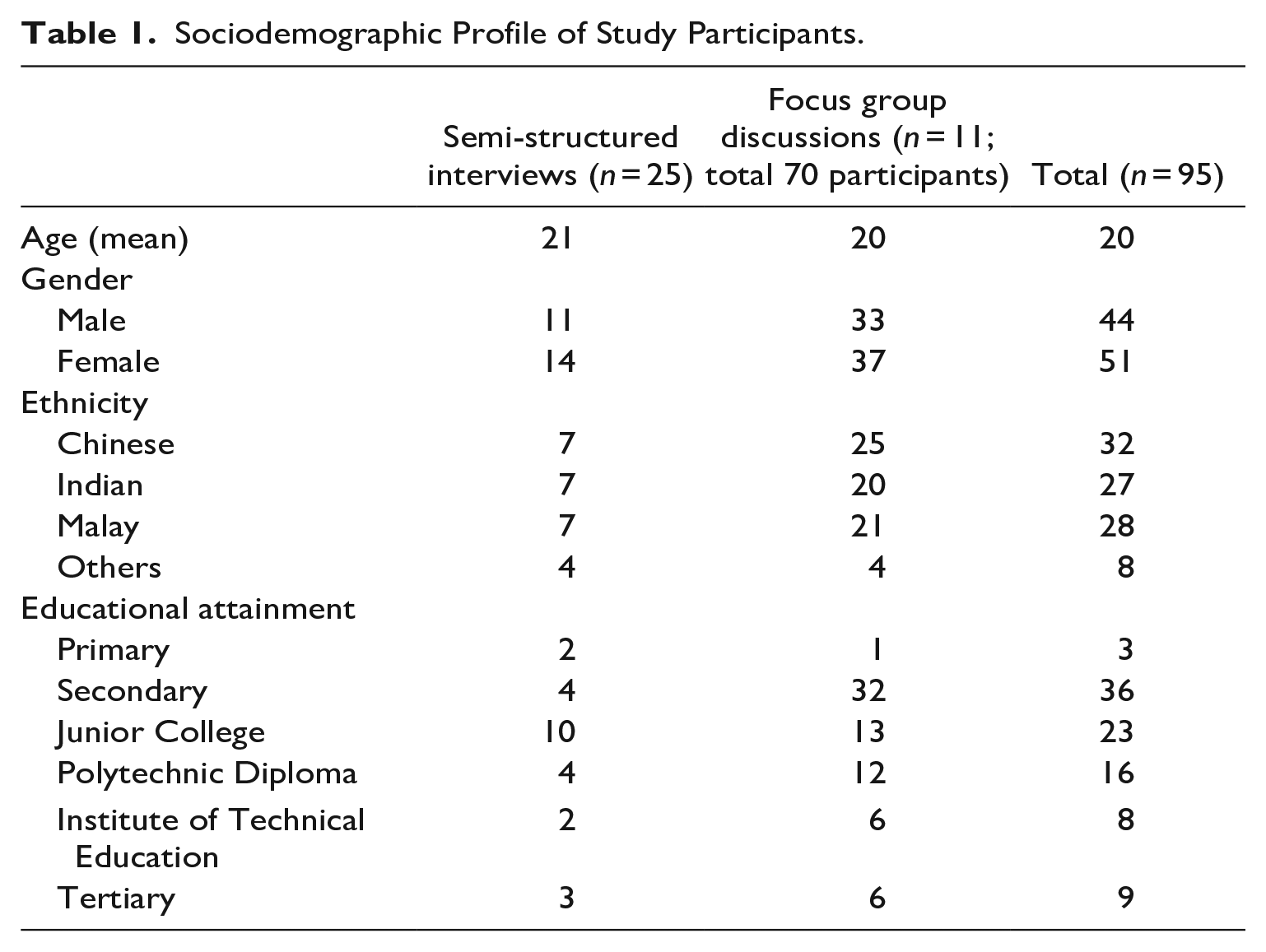
A total of 36 data units (25 one-to-one interviews and 11 FGDs) were analyzed. There were 25 participants who completed one-to-one interviews and 70 participants in total who took part in focus groups. In all, 95 youths with a mean age of 20 years (range = 15–24; SD = 2.5) participated in this study, of which 51 were females and 44 were males, and 8 of them had a history of psychological distress, school dropout or risky behavior (see Table 1 for participants’ profile).
Sociodemographic Profile of Study Participants.
In the narratives of the participants, it was observed that they experienced a range of positive and negative emotions, of which sadness, anger, anxiety, happiness, and gratitude were commonly mentioned. Arguments and disagreements with peers and family members often evoked feelings of hurt and anger; social media consumption was associated with joy and entertainment, but also elicited feelings of loneliness and insecurity arising from social comparison. Other contexts and triggers of emotions included daily life stressors from academic life and work, as well as major life events and transitions (e.g., gaining employment, moving into new school/work environment).
Strategies that participants used to regulate their emotions were categorized into the following four themes: (1) developing emotional awareness and acceptance, (2) emotional catharsis, (3) calling for a timeout, and (4) positive thinking and reframing. In terms of the importance of regulating emotions and its impact, the following four themes were identified: (1) ER contributes to rational thinking and decision-making, (2) poor ER worsens mental wellbeing, (3) ER provides stability in life, and (4) relevance to current life stage and environment.
Strategies in Regulating Emotions
Developing Emotional Awareness and Acceptance
One of the strategies mentioned was to develop an awareness of emotions, which included identifying the specific emotion and understanding what caused it. For some participants, this had the effect of helping them be in control of the emotion and to work through it. For some others, it was also about acknowledging and accepting the entire emotional experience rather than actively controlling or resisting it.
So I kind of tried to make it clear what my emotions are and tried to work through them instead of just avoiding them. – FGD 3 I think it’s about acknowledging that being sad is okay, being uncomfortable with who you are is a part of growing up. It’s not okay to feel this every single day, but sometimes, when it comes, just let it come. And when it goes, just let it go. – SI 16
The participants described a number of specific activities or actions that aided in developing emotional awareness. Introspection in the form of journal writing and performing self-reflection was valuable for some participants as it was an opportunity for them to dissect their thoughts and reflect on the emotions that were experienced, which would not have been possible at the point in time when things occurred. Talking to someone else, particularly adults or a friend, helped some participants to understand their emotions wherein the other party acted as a sounding board to reflect their own thoughts and at times provided insights into their emotions.
Taking the time to do reflections really help. I feel like that’s really important even though it seems very small and insignificant sometimes. But it really helps in sort of like reorganizing my thoughts and just understanding different emotions or like feelings of confusion or frustration. – SI 01 For me personally, I guess when you’re younger, you tend to be very confused by your own feelings. You’re not sure where some things come from. There’s no benefit of hindsight or objectivity. So I used to speak to my counselor in NS and JC. I think that was one very effective way of helping me to understand where my emotions were coming from. One good way of understanding how I come from is really to listen and to ask questions. – FGD 1
Emotional Catharsis
This theme describes a range of strategies that involve a release of emotion, particularly those of negative valence, such as anger and sadness. Emotions were regulated through the act of expressing them in both verbal and non-verbal manner. A common strategy adopted by participants was to engage in a conversation with another individual and, in the process, vent pent-up emotions and stress. Such an act primarily focused on releasing the negative emotions within themselves and in this sense, it differed from the strategy where they talked to someone to seek advice and where emotional awareness could be developed. A non-verbal manner of expressing emotions was through creative means such as art, where one participant highlighted the value of artistic expression through painting for feelings that were hard to pinpoint and convey in words. Participants also narrated experiences of releasing their emotions by crying or engaging in physical activities.
So then every weekend we’ll (referring to friends) just have a call and then we’ll just share how our week was. Like something bad happened, then we’ll just tell it to each other. That’s kind of a way you just dump out all your negative emotion somewhere. – FGD 5 I’ll be like just go out, smoke for a while, I like to be alone for a while. My main thing is when I’m being alone, sometime(s) I will cry. Whenever I’m—I’ll just cry it out, cry it out in toilet, just cry it out until I—because I strongly believe for myself this thing really help me. Because after I let it out on my own, sometime(s) I will talk to my own self when I was crying. So after all these things I let it out already right, yeah you are tired, but at the same time you will feel like you are calm. . . I get a benefit from the way when I release my sentimental(sadness). – SI 25
There were, however, a few participants who were inclined towards not releasing their emotions, but rather preferred to suppress or keep it within themselves.
It was just weird as a teenager to talk about that (managing emotions). Your feelings are not meant to be shared. As a teenager, I felt that if I’m sad, I just have to suck it up, and I shouldn’t be pouring to anyone or stuff like that. – SI 16 I feel like sharing my thoughts and my concerns with someone who has not been through it, is a bit burdening them with my, I don’t know, my sadness, I guess. So I just try to keep it to myself. – FGD 5
Calling for a Timeout
Timeout in this theme refers to having a non-immediate reaction towards triggers or sources of emotional disturbance by getting away from them physically and cognitively. Participants often described calling for a timeout by “walking away” or “taking a step back” to have a better state of mind and to process the situation soberly rather than responding immediately to the situation and arising emotions.
You get into a situation where there is a likelihood of either you getting really sad or really angry, what you can do is first, just walk away from the situation. Because you won’t make good decisions when you are emotional. So the first thing I’ll say is walk away from the situation. And then just take as much time as you need to think about what you’re going to do next. . . – FGD 10
Some participants mentioned taking breaks and using breathing techniques to calm oneself and “disconnect from the world.” Others spoke of giving permission to oneself to have a rest and engage in hobbies to take their minds off things before getting back to handle the situation. For a couple of participants, a non-immediate reaction was achieved by avoiding direct confrontation with the negative emotion or situations that could trigger it, and by distraction or temporarily diverting their attention onto something else that could elicit a positive experience.
I will just escape to my own reality like gaming or a hobby. . . And that’s the only way of how I escape like, escaping from the emotions and at least it makes me feel happier. Doing a hobby makes me feel like I’m achieving something. . . let’s say, if I did badly in class for like a lab test, I will just go home and just [switch] on my console and game it away. Yeah. Because it’s an emotion that I have to overcome, but the way I overcome it, is through finding joy in something else. Because, I had a bad result and I can’t do anything because it already has passed. And for me to overcome in that moment, I just feel like I find happiness somewhere. I’ll find joy in doing something else. And then after that, I will go back to, "Okay, I have to continue to study. I have to improve.” – FGD 9
Positive Thinking and Reframing
Participants regulated their emotions through positive thinking wherein they intentionally focused on positive outcomes and thoughts that could elicit positive emotions. For instance, being optimistic about a situation, believing in the best of people, and also reflecting on things that one could be grateful for. Another way the participants regulated their emotions via cognitive means was to positively reframe the stimulus or experience and to interpret a negative or challenging situation as a positive one. The first excerpt below demonstrated how a participant reframed negative feelings about oneself as a learning experience, and the second excerpt illustrated how a participant reappraised the cause of her anger as an unintentional act by her children.
. . . instead of letting this (a negative event at work) affect you and make you feel all negative about yourself, why not take these as learning points, try to find out, okay, what exactly didn’t go well in the meeting and what could have been better the next time so that you kind of avoid it? So essentially, you’re staying away from, ‘Why am I so lousy?’ to ‘Okay, how can I be better’. – FGD 1 . . . like my kids make me angry or something like that, I just [think] ‘Okay, think positive’ and then. . . I just cool down myself and think, ‘Oh, maybe my son accidentally makes me mad’, so I’ll just cool down and be okay. – SI 24
Perceived Importance and Impact of Emotion Regulation
Contributes to Rational Thinking and Decision-Making
Participants perceived ER to be important in allowing them to respond rationally to arising situations, and the impact being that they are in control and can make sound decisions, rather than simply reacting to them. Not doing so would escalate matters, for example, the intensity of the negative emotion experienced, by blowing it out of proportion and subsequently having to face the negative consequences such as having regrets because of their actions.
When you are emotional, it’s true that you cannot make any sound decisions. Yeah, because your emotions will kind of affect your actions and the words that you say. – FGD 1 If you don’t control anger, then it’s going to make everything worse. So it’s just a small thing, but then if you can’t control your anger, then it’s going to be a much more bigger problem. – SI 24
Some participants demonstrated the awareness that emotions are not inherently detrimental and unwelcomed in the decision-making process, but rather as something that needs to be accounted for to improve the outcomes from the process.
In the past, I used to think that when I’m trying to solve problems, I cannot have any emotions involved because I would make wrong decisions. But I’ve come to realize that being very aware of my emotions and embracing it, even, would help me in decision-making. – FGD 2
Poor ER Worsens Mental Wellbeing
“Bottling up” of emotions was one of the common manifestations of poor ER described by the participants. In such narratives, words such as “outburst,” “explode,” “break down,” and “snap” were used to describe the outcome of suppressing their emotions and the negative impact it had on their mental health. Some participants recounted personal experiences and also of their peers where poor ER led to anxiety attacks and self-harm behaviors.
I see people who don’t talk about their emotions. . . I feel like it creates more damage than people who actually decide to talk things out and express themselves because all that bottling up of their own emotions sometimes just causes them to break down in a sense. Because I don’t think it’s possible for someone to keep in your emotions for a very extended period of time without like resolving it. It will just make things worse and kind of worsen maybe an already bad mental health state. – SI 01
Providing Stability in Life
The importance of regulating both positive and negative emotions to provide stability in life were acknowledged by the participants. Constantly experiencing positive emotions was perceived to be unfavorable in that it creates an imbalance in life and is not an accurate reflection of reality. One participant described the need to deal with and keep his positive emotions in check so as to stay focused on his goals and achievements. Furthermore, balance and stability in life was identified by participants to be essential for them to effectively function in life domains.
I feel that it’s important to have a balance between negative emotions and positive emotions. The world is not a perfect place, so everything cannot always be positive for you. So having negative thoughts once in a while will help you to in a way bring you down to earth. – FGD 5 So I think that having that kind of stability in my life allows me to function as maximally as possible in other domains. So, for instance. . . I’m someone who struggles with anxiety as well. So if I’m able to keep that in balance, then I can really focus a lot more, for example, in my final year project. – FGD 4
Relevance to Current Life Stage and Environment
For some participants, youth was portrayed as a stage in life where new emotions arise, yet unfamiliarity with these novel emotions could lead to unhealthy habits or negative coping mechanisms such as drinking and smoking. It was here where the importance of understanding emotions and managing them were highlighted, and the resulting impact on helping youths to navigate such novel experiences and guide them to respond in a healthier manner.
I think at the age you’re going through puberty, you really don’t understand most of your emotion. I have friends who at that stage when they’re experiencing that emotion, they tend to turn to their coping methods. . . instead of doing something healthy at that point. I know from my friend telling me that it’s a way for her to feel in control of her emotions I guess. So I feel like if you don’t understand why you’re feeling that way and if you don’t find a healthy coping method, then it could really drive into a spiral. – SI 12 Because this is the prime time where you feel new feelings that you probably have never felt before and you wouldn’t know how to cope with it well. So I think that, for young people like us, it’s really important to learn what these feelings are and how to deal with them a little better. – FGD 7
Furthermore, ER was also important in the context of the current environment which youths perceived themselves to be in; it was described by some participants as “fast-paced,” “a lot more stress (compared to previous generations),” and “repressed.” ER was thus needed to deal with the negative experiences encountered in the current environment that they were going through.
I think youth now, in a way, are sort of more repressed I would say. Because there’s a whole new culture where you should, I don’t know, keep your problems to yourself, keep your head low, don’t bother other people, if you have a problem, deal with it. . . many youth[s] will still struggle with the fact that they don’t have a safe space where they can openly talk about their issues or problems. And that has a very detrimental effect on them. – SI 15
Discussion
This study was conducted to explore strategies that youths employed to regulate their emotions in their daily lives. Some of the common emotions that youths experienced included sadness, anger, anxiety, happiness, and gratitude. These emotions were elicited in various contexts, for instance, emotions arising from social interaction with peers and family members, and stressors from academic life and work. Youths in this study engaged in a range of activities to manage their emotions and the following themes of ER strategies were developed from their narratives: developing emotional awareness and acceptance, emotional catharsis, calling for a timeout, and use of positive thinking and reframing. The present study examined some of the less studied overt ER activities (e.g., engaging in physical sports and talking with friends; Aldao & Dixon-Gordon, 2014) and uncovered the underlying intentions. For example, the same act of talking with friends to regulate emotions could form two different types of strategies: to develop emotional awareness if friends acted as a sounding board that helped youths to reflect on their experience; or for emotional catharsis if friends played the role of an “emotion rubbish bin” for youths to vent their frustrations and anger. Results also indicated the importance of regulating emotions from the perspectives of youths in that it is essential for rational thinking and decision-making, has an impact on their mental wellbeing, provides stability in life, and is of particular relevance to youth’s current life stage and environment.
Research in ER generally supports the use of cognitive appraisal strategy to be adaptive and considers the use of avoidance-based strategies (e.g., avoiding situations or persons; suppressing the expression of emotions) to be maladaptive and associated with negative psychological outcomes (Aldao et al., 2010; Webb et al., 2012). It was found in this study that youths engaged in strategies that are considered in the literature to be beneficial for psychological health, for instance, strategies on positive thinking and reframing, and non-suppression of emotional expression via emotional catharsis. Yet there might be concerns about strategies in the form of calling for a timeout which could potentially be construed as unfavorable avoidant or escapism behavior that provides relief in the short term but deemed detrimental when used habitually (De Castella et al., 2018). However, a closer review of the strategies and narratives in this theme revealed that such acts of avoidance were largely intended to be temporary. Youths in this study described walking away from situations for the purpose of giving themselves time to think through and ultimately returning to the problem to resolve it, rather than entirely denying its existence. While the effectiveness of such strategy was not discussed in this study, it nonetheless was employed by youths to regulate their emotions. Such nuances, that is the temporary nature of their avoidance behavior, would be hard to detect in quantitative studies that assessed predefined ER strategies in many of the assessment tools, and thus this is a significant value add of the current study findings to the literature. Future studies could seek to understand how youths perceive the effectiveness or the extent of success in regulating emotions when adopting a specific strategy, at the same time bearing in mind that their beliefs in one’s own ability to control emotions could influence the choice of strategy used and the outcomes (De Castella et al., 2018; Gutentag et al., 2017).
Youths in this study described developing emotional awareness and acceptance as a strategy to regulate their emotions. This finding provides support for the growing evidence on the use of mindfulness-based interventions to improve ER among youths. These interventions are aimed at training individuals to develop an awareness of the present-moment experience and to accept it without being judgmental or attempting to modify it (Perry-Parrish et al., 2016). For example, adolescents who participated in the Learning to BREATH mindfulness-based program reported improvements in ER and observed greater gains in ER skills in terms of emotional awareness, emotional clarity, and access to ER strategies (Broderick & Metz, 2009; Metz et al., 2013).
Some of the ER strategies reported in this study bear resemblance to those identified in other studies and in the ER literature. Similar ER strategies as those reported in this study have been used by adolescents with mental health conditions and in the context of health risk behaviors (Lansing et al., 2019). The study found that when encountering challenging situations, early adolescents perceived leaving the situation, distraction, physical release, expressing oneself to someone, positive thinking, and considering other options to be feasible and beneficial ER strategies. Additionally, the strategies identified in this study are largely comparable with those proposed in Gross’s (1998b) process model of ER. The process of situation selection and attentional deployment from Gross’s model is akin to the strategy of calling for a timeout where individuals deliberately remove themselves from a situation, both physically (e.g., walking away) and cognitively (e.g., distraction). An overlap can be observed between Gross’s strategy of cognitive change and the theme of positive thinking and reframing identified in this study, wherein individuals reappraise personal meanings attached to a situation. Finally, Gross’s response modulation, where the focus lies in modulating emotional responses once they are elicited, is comparable with the theme of emotional catharsis, which describes ER strategies involving release of primarily negative emotions.
As expected, youths described the importance of ER in terms of its impact on their mental wellbeing. But beyond that, the results from this study reiterated the value of ER for domains other than mental health and in the area of general functioning. On the perceived importance and impact of ER, findings from this study suggest that youths account for the effects of emotions when making decisions and thus highlight the importance of regulating it in the process. As acknowledged by participants in the study, emotions ought to be managed to make rational choices and take appropriate actions that will not lead to unpleasant consequences. This is of particular significance in the context of risk-taking behavior; youths in middle adolescence have increased vulnerability towards risk-taking (Steinberg, 2010). Nonetheless, as maturation of neurocognitive systems progresses, so does the capacity for self-control throughout adolescence and into young adulthood. In emotionally arousing situations, for instance, sexual activity, having the ability to modulate both positive and negative emotions may allow individuals to make decisions that are well-informed by healthier knowledge, beliefs, and attitudes (Lansing et al., 2019).
It is generally assumed that human beings strive to obtain pleasure and reduce pain, and thus would be expected to regulate emotions in a manner to promote this hedonic goal. Interestingly, and contrary to conventional wisdom, youths in this study described experiences of regulating emotion that did not seek to maximize positive emotions and downplay negative emotions all the time, but rather they valued the element of balance in life as afforded by ER. This is in line with the instrumental account of ER which considers both pleasure and utility in determining emotional experiences, and argues that individuals would seek to experience even unpleasant emotions if they are considered useful in their goal pursuit (Tamir, 2009; Tamir et al., 2007). In this case, youths in this study deemed ER as instrumental in achieving a sense of stability and effective functioning in life, and thus described instances of regulating emotions in ways that limit positive experiences and also those that promote negative experiences so as to achieve the desired stability and balance in life.
Youths discussed the importance of ER with reference to their present life stage and the current environment that they were in. They described experiencing novel situations and emotions that they did not fully comprehend and identified features of the surrounding environment and associated stressors which made ER indispensable in the current context. This finding has an important implication in that it emphasizes the need to equip youths with ER knowledge and skills that could help them to combat daily stressors and significant life events. Such training programs could include components that introduce concepts related to emotions and its regulation and impart evidence-based techniques for adaptive ER (see intervention by LeBlanc et al., 2017). Furthermore, these programs could be disseminated through digital technology and incorporating elements of virtual reality and serious game (Colombo et al., 2019), in keeping with lifestyle habits of the current generation of youths.
Given that youths spend a significant amount of time in school, it is perhaps the most appropriate and opportune setting to impart ER skills by incorporating ER learning as part of the school curriculum. For example, the RULER is an evidence-based, systematic approach to social and emotional learning developed at the Yale Center for Emotional Intelligence (https://www.rulerapproach.org) that can be implemented in schools. An important aspect of the RULER approach is the emphasis on developing educators’ emotional competencies as a first step towards building students’ ER skills (Hoffmann et al., 2020), and this is something that ought to be highlighted when implementing any programs that aim to teach ER in youths.
There are some limitations of the study to be considered. Firstly, owing to social desirability participants might have been inclined to discuss perceived socially acceptable ways of regulating emotions rather than those that they actually engaged in. To reduce the risk of this bias, all participants were informed at the beginning of discussions that there were no ideal answers to the questions asked in the study and were also encouraged to voice their disagreements on any opinions raised. Next, given that cultural differences exist in ER (De Leersnyder et al., 2013; Miyamoto & Ma, 2011), the generalizability of findings from this study to other cultural contexts may be limited. Future studies are needed to understand if strategies are similarly employed by youths in other cultures and examine the underlying intentions of engaging in specific strategies. Another limitation to recognize is that the findings reported are from a secondary analysis of data, and hence, the analysis was restricted to the data originally collected. It may also be important to note that data collection occurred during the COVID-19 pandemic and the findings are likely to be influenced by the social distancing measures which restricted many of the usual social and physical activities. To limit the unique effects and experiences related to the pandemic, participants were prompted to discuss their “life in general and not just the last few months which have been very different.” Notwithstanding the aforementioned limitations, the strength of this study lies in the large and ethnically diverse study sample that also included youths with unique life experiences, and this thus enhances the generalizability of findings to the wider youth population in Singapore. Furthermore, unlike other studies in the literature which provided vignettes for participants to discuss ER, this study drew on youth’s personal experiences that would be more relatable to them and thus generate findings that are relevant and applicable in their daily lives.
In conclusion, this exploratory study identified a range of strategies employed by youths in regulating their emotions, many of which are consistent with those that have been reported in the existing literature. The present study also examined youth’s beliefs on the importance and perceived impact of such self-regulatory behavior in that it is essential to their overall mental wellbeing and functioning in life and has particular relevance to their current life stage. These findings, taken together, demonstrate the indispensable role that ER plays in the daily functioning of youths and highlight the value of strengthening emotional regulatory capacities for them. Educators and youth workers could aim to develop ER capabilities through evidence-based intervention programs that have incorporated ER strategies identified to be beneficial, and also through dissemination of ER learning materials to youths. Indeed, as commented by a youth in the study, “emotion is what makes us human,” and on this account, so is the need for youths to appropriately manage emotions and navigate the rocky terrains of emotional experiences they typically experience as they emerge from childhood into adulthood.
Footnotes
Declaration of Conflicting Interests
The author(s) declared no potential conflicts of interest with respect to the research, authorship, and/or publication of this article.
Funding
The author(s) disclosed receipt of the following financial support for the research, authorship, and/or publication of this article: This study was supported by the Singapore Ministry of Health’s National Medical Research Council under the Centre Grant Programme (NMRC/CG/004/2013).

Data Availability
Data are not available for online access, however, readers who wish to gain access to the data can write to the corresponding author with their requests. Access can be granted subject to the institutional review board (IRB) and the research collaborative agreement guidelines.