




Abstract
To explore specific responses that sexual and gender diverse young adults (SGD YA) perceive to be supportive and unsupportive of sexual orientation and gender identity by caregivers and other adults following identity disclosure. SGD YA (N = 101), ages 18 to 25 years (M = 21.2) were predominantly White (83.1%), non-Hispanic (89.1%), assigned female at birth (82.2%). The majority (97.8%) were sexually diverse (e.g., queer, pansexual, lesbian, gay, asexual, bisexual) and half (50%) were gender diverse (e.g. transgender, agender, genderqueer, nonbinary). Participants completed an online survey. This analysis is focused on participants’ responses to open-ended questions regarding responses they perceived to be supportive and unsupportive of their SGD identity/identities. Content analysis of participants’ open-ended survey responses was conducted using a combination of inductive and deductive coding. Six themes emerged for both supportive responses (communication, actions, acceptance, open-mindedness, unconditional love, and advocacy) and unsupportive responses (distancing, hostility, minimizing, controlling, blaming, and bumbling). For some themes, different sub-themes emerged based on identity. Parents/caregivers as well as other adults in the lives of SGD YA can implement specific responses to demonstrate support for sexual orientation and gender identity with the potential to improve the mental health of SGD YA.
Keywords
Sexual and gender diverse young adults (SGD YA; e.g., those who identify as lesbian, gay, bisexual, transgender, nonbinary, queer, and other identities) have several known disparate physical and mental health outcomes and risk-taking behaviors that can be influenced by parental support or lack of support for their sexual orientation and/or gender identity following identity disclosure (Bockting et al., 2013; Haas et al., 2014; Rosario et al., 2004; Ryan et al., 2009; Teasdale & Bradley-Engen, 2010). Disclosing one’s sexual orientation and/or gender identity (“coming out”) to others is a process that is crucial to identity formation and integration (Cass, 1979; Devor, 2004; Troiden, 1979). Rather than a discrete point in time, coming out is an ongoing process, often beginning with close, trusted individuals (e.g., close friend or immediate family member), then expanding to others in one’s life (Herek, 1996; Rust, 1993). Whether because of changing contexts, fluidity in one’s identity, or evolution of how an individual understands their gender identity or sexual orientation, identity disclosure to the same person may occur more than once (e.g., first as bisexual, and then as gay or lesbian; first as gay and then as transgender) across the lifespan (Katz-Wise & Hyde, 2015; Katz-Wise et al., 2017; Rosario et al., 2006; Rowniak & Chesla, 2013). Coming out to a particular person, especially for the first time, can be a stressful event for SGD YA, particularly when one is unsure how the other person will respond, has already received negative responses from others, has a high level of internalized stigma, or anticipates rejection (Charbonnier & Graziani, 2016; Grafsky et al., 2018; Pistella et al., 2016).
Parents may have a range of responses to SGD identity disclosure that have been categorized as neutral, positive, negative, and mixed (Chrisler, 2017). Previous research on parental responses to gender identity disclosure has identified responses ranging from explicit rejection to unconditional acceptance (e.g., Koken et al., 2009), with the potential for responding in ways that demonstrate both acceptance and rejection (Catalpa & McGuire, 2018; Pariseau et al., 2019). Parental acceptance and/or rejection of sexual orientation and/or gender identity can either improve or exacerbate health outcomes among SGD YA (Zimmerman et al., 2015). A recent systematic review on risk and resilience factors for gender diverse youth’s (GDY) mental health identified that parent and family connectedness and parental support for gender identity are negatively associated with adverse mental health outcomes (e.g., depression, suicidality, non-suicidal self-injury, despair, and posttraumatic symptoms), and positively associated with life-satisfaction, self-esteem, and resilience (Tankersley et al., 2021). Similar results have been found among sexually diverse youth (SDY) (Newcomb et al., 2019). A critical review that was focused on family strengths (appreciation and affection, commitment, coping ability, positive communication) and health/well-being factors among GDY demonstrated similar associations (Brown et al., 2020). Parental support for sexual orientation and gender identity can also improve health-seeking behaviors and reduce risk-taking behaviors such as substance use/abuse, unprotected intercourse, and self-harm (Haas et al., 2014; Newcomb et al., 2019; Tankersley et al., 2021).
Support for SGD YA can take many different forms. Social support is a broad construct that has been defined in terms of the specific function or categories of supportive behaviors and commonly includes tangible support and emotional support (Barrera, 1986; Pierce et al., 1996; Rueger et al., 2016). Tangible support is the provision of “task-focusing and pragmatic assistance” (Weine & Siddiqui, 2009, p. 426). Tangible support may also be described as “received” support (Glanz et al., 2008) and may include specific behaviors (e.g., provision of money, information, praise, or assistance) (Haber et al., 2007). Tangible or received support is often situational and given in response to a specific event during a specific time frame (Barrera, 2000; Thoits, 1986; Uchino, 2009). Tangible support for SGD YA could include connecting the young adult with community resources, educating others about SGD identities, advocating on their behalf, and using the young adult’s chosen name and pronouns (Chrisler, 2017; Hale et al., 2021; Roe, 2017; van Bergen et al., 2021). Emotional support, which occurs when someone “shows and expresses concern, care, and reassurance” (Weine & Siddiqui, 2009, p. 426), is less tangible than other types of support but equally beneficial. Emotional support for SDG YA may include expressing approval of SGD identities, affection, and unconditional love, being emotionally available for conversations about sexual orientation and/or gender identity, and envisioning a positive future for the young person (Chrisler, 2017; Hale et al., 2021; Le et al., 2016; Roe, 2017; van Bergen et al., 2021).
Though social support is often driven by good intentions (Glanz et al., 2008), it is not always perceived as beneficial by the recipient, particularly under stressful or uncomfortable circumstances (Ingram et al., 2001). Research in the context of other stressful circumstances has identified four themes consistent with unsupportive interactions following a stressful life event: distancing, bumbling, minimizing, and blaming (Ingram et al., 2001). A person may create physical or emotional distancing from the person experiencing stress by avoiding the topic, changing the subject, and refusing requests for help (Ingram et al., 2001). Bumbling interactions are those in which the individual who has been disclosed to subsequently behaves awkwardly toward or displays discomfort interacting with the disclosing individual (Ingram et al., 2001). Bumbling actions may include trying to fix uncomfortable feelings (e.g., forcing optimism), engaging in unwanted physical touch (e.g., hugging), or coming across as not knowing what to say to provide support, being afraid to say the “wrong” thing, or asking intrusive questions (Ingram et al., 2001). A person might also minimize the individual’s experience of stress by invalidating their experience, such as saying they are overreacting or telling them to forget about the experience (Ingram et al., 2001). Finally, one might blame the individual, making them feel responsible for the stressful circumstances they find themselves in (Ingram et al., 2001). Prior research with SGD YA has demonstrated that many experience physical, social, and emotional distancing from parents (e.g., being kicked out, having financial support withdrawn, refusing to discuss sexual orientation and/or gender identity); bumbling (e.g., asking inappropriate questions) due to lack of information about sexual orientation and/or gender identity; minimizing (e.g., telling them “it’s just a phase”) and blaming the SGD YA behavior (e.g., disclosing their identity, gender nonconformity) for negative interactions (Catalpa & McGuire, 2018; Chrisler, 2017; Graham et al., 2014). Regardless of intent, responses such as these can negatively impact SGD YA mental health.
Doty et al. (2010) found sexuality specific support and the provision of advice, guidance, or comfort in responses to sexual-orientation related stressors, contributed to decreased emotional distress in sexually diverse youth (SDY). However, SDY were less likely to get sexual orientation-specific support from family members compared to receiving support from friends (Doty et al., 2010). Gender diverse people may also receive less overall support from family members (Factor & Rothblum, 2007). Transgender women report less family support than gay and bisexual cisgender men (authors) and cisgender women (Davey et al., 2014). Lack of primary parent support compared to support from other adults has been associated with increased psychological distress among GDY (Le et al., 2016). It is possible that family members may not understand SGD-related stressors or know how to provide guidance (Doty et al., 2010). For social support to be effective, the type of support provided must match the demands of the stressor on the receiving individual (Cutrona & Russell, 1990). It is possible that there is a “mis-match” between what SGD YA perceive as needed support regarding their sexual orientation and/or gender identity and the types of support that their parents/caregivers may be providing. Thus, the aim of this project is to better understand the specific responses that SGD YA perceive to be supportive and unsupportive of sexual orientation and gender identity by caregivers and other adults following SGD identity disclosure.
Method
Participants
One hundred one participants (of the original sample, previously described in Bosse & Chiodo, 2016) responded to the open-ended questions. Participants’ mean age was 21.1 years (SD =2.1, range: 18–25). The majority (n = 98, 97.0%) reported diverse sexual orientation identities, with nearly half identifying as pansexual or queer. GD participants (N = 50, 50.0%) identified as transgender, nonbinary, agender, genderqueer, or a gender different than their sex assigned at birth. Participants were predominantly White (83.1%), non-Hispanic (89.1%), and assigned female at birth (82.2%). About a third of the sample were living with a parent at the time of the survey. The characteristics of participants in the sample are provided in Table 1.
Sample Demographics (N = 101).
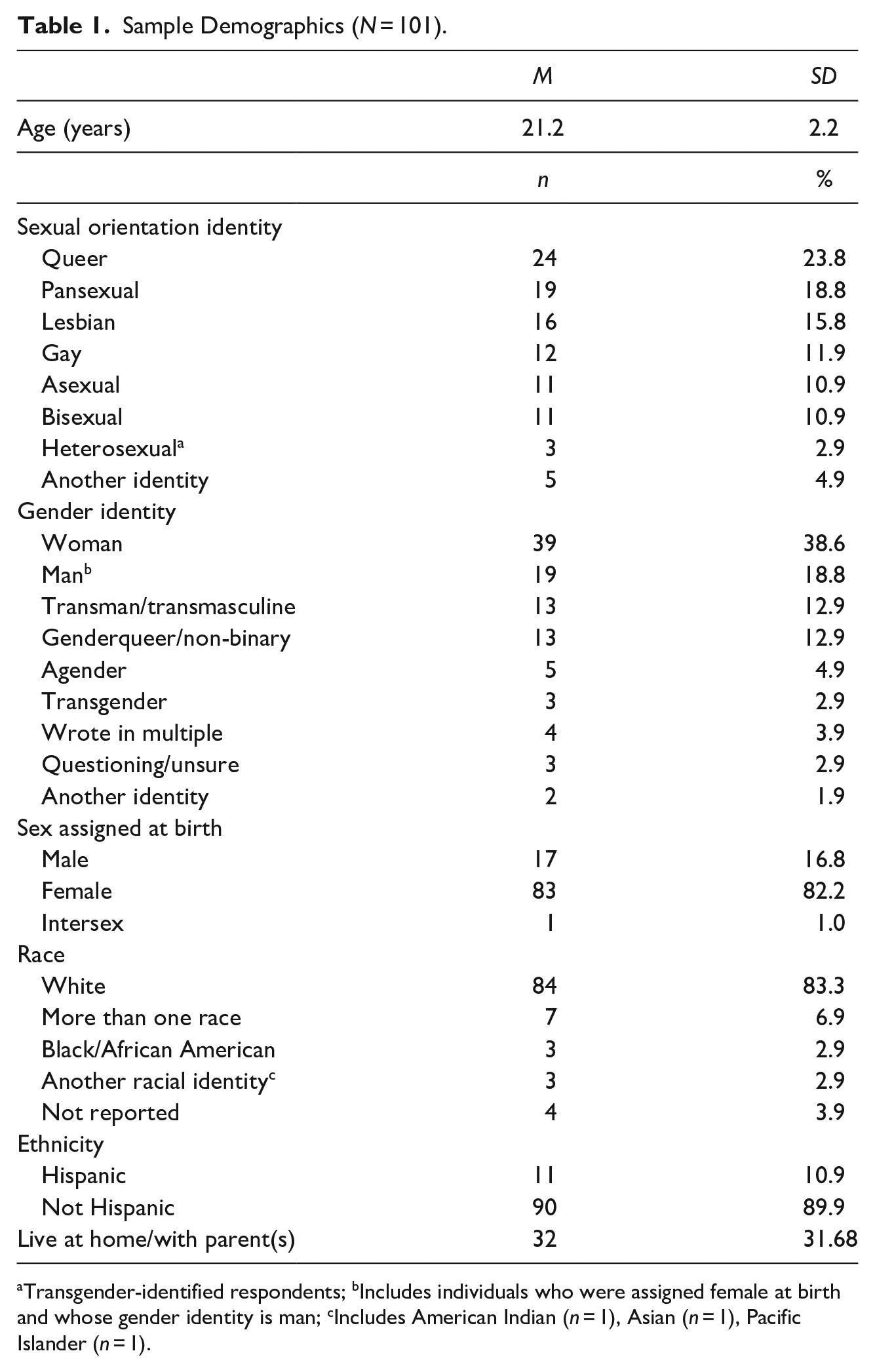
Transgender-identified respondents; bIncludes individuals who were assigned female at birth and whose gender identity is man; cIncludes American Indian (n = 1), Asian (n = 1), Pacific Islander (n = 1).
Data Collection
Data were collected between November 2014 and March 2015 as part of a larger cross-sectional study examining potential predictors of SGD YA perception of parental acceptance-rejection. Printed flyers and wallet-sized cards with a QR code to access the study materials online were sent to community organizations around the US that serve SGD YA. Some community organizations shared study information via Facebook posts in addition to printed materials. Participants were also recruited online via posts in Facebook groups geared toward SGD YA with permission from group administrators; study information was either shared by the group administrator or posted by the first author (in groups in which he was a member). Participants completed an online survey hosted by Survey Monkey. All study procedures were approved by The University of Massachusetts.
Measures
Sex assigned at birth
Participants were asked whether they were assigned the sex male, female, or intersex.
Gender identity
Participants selected a single response from the following gender identity options: man, woman, transman/transmasculine/female-to-male, transwoman/transfeminine/male-to-female, genderqueer, and something else (please describe). Participants who reported a sex at birth that was different than their gender identity (e.g., female at birth, identifies as a man) were also categorized as transgender and asked about gender identity supportive responses as outlined below.
Sexual orientation
Participants were asked how they define their sexual orientation by selecting a single response from the following options: asexual, bisexual, don’t know, gay, heterosexual/attracted to another gender, lesbian, pansexual, queer, something else (please describe).
Supportive responses
The focus of this analysis was the open-text responses to questions in which participants were asked to specify the “top three” behaviors demonstrating support and lack of support for sexual orientation and gender identity. The instructions read: “[B]ecause ‘support’ means different things to different people, I would like to know what behaviors 1 you think show support. Please list 3 things below that show how parents and other adults can be most supportive of your sexual orientation. These can either be things people have actually done, or things you think they could do to support LGBTQ young people.” This question was followed by: “What are three things that parents and other adults have done that have demonstrated that they are NOT supportive of your sexual orientation?” Then, for participants who indicated a transgender or genderqueer identity, the questions were repeated, replacing sexual orientation with gender identity. The questions about supportive and non-supportive behaviors were asked separately regarding sexual orientation and gender identity, allowing participants to provide information about either sexual orientation or gender identity, or both sexual orientation and gender identity. Not all participants listed three responses for each question.
Data Analysis
Each response was copied to a separate index card, and the cards were first divided into supportive and unsupportive responses. Then, they were further divided by sexual orientation and gender identity, resulting in four sets of data: responses supportive of sexual orientation, responses unsupportive of sexual orientation, responses supportive of gender identity, and responses unsupportive of gender identity. Individual responses (n =12) that were not about a parental adult’s responses (e.g., “My wife doesn’t police my gender”) or that did not provide enough contextual information to be categorized (e.g., “remembering”) were excluded from analysis, which left 849 responses for coding.
Data were coded by hand by the first author and a research assistant independently and analyzed using general content analysis with both inductive and deductive approaches (Miles & Huberman, 1994). For supportive responses, words and phrases within each response were coded inductively. Coded items were then grouped into categories and then higher order themes. For unsupportive responses, theoretical codes distancing, bumbling, minimizing, and blaming were applied to the data. Responses that did not fit into any of the theoretical categories were coded inductively, grouping similar items and organizing them into additional themes. Finally, any data that had not yet been categorized by theme, sub-theme, or code was examined to determine if any similarities existed.
There was minimal overlap between responses regarding sexual orientation and gender identity. Five participants who answered both items about sexual orientation and gender identity wrote identical responses for at least one support item (n = 6 items total). Similarly, seven participants wrote the exact same answer for lack of sexual orientation and gender identity support for at least one item (n = 9 items total). Finally, one person wrote in “same as before” for all gender identity responses (supportive and unsupportive) after entering sexual orientation support responses; because we were unable to know what the prior responses were, these were excluded from gender identity-related analyses.
For every set of data, the first author and research assistant met after each step to compare findings and discuss discrepancies; once categories and themes were created, they were sent to the last author for review. After final themes were agreed upon, the individual responses were independently reviewed to make sure they were consistent with the final themes and sub-themes. Discrepancies in coding were resolved through multiple strategies (collective reflection, open dialog, and considering rival explanations and alternative conclusions), which enhanced the credibility and confirmability of the findings, until a consensus was reached on all responses (Cohen & Crabtree, 2008). The coded data were re-entered into the computer in an Excel spreadsheet to facilitate frequency counts of categories (sub-themes) and themes. Any categorical responses that made up less than 1% of the overall responses (n < 3) or responses that mirrored the overarching theme (e.g., “support me”) were counted under the theme but are not listed as specific sub-themes.
Researchers
All of the authors are White, non-Hispanic individuals with diverse sexual orientations and/or gender identities; one author is also the parent of a SD YA. Researchers’ training includes developmental psychology, adolescent health, gender and women’s studies, and nursing. All authors were employed in academic settings when the data were collected. Two authors had experience conducting research with SGD YA and their parents/caregivers. The first author, who was responsible for recruiting participants, had shared identities with some potential participants, which was known by his membership in specific Facebook groups. Having shared identities may have influenced whether some SGD YA responded to the study materials.
Primary assumptions relevant to these analyses are the beliefs that SGD YA are the experts of their own lives and experiences and that it is important to affirm the gender of transgender and nonbinary young adults. Assumptions about parents/caregivers included that they may have a sense of the young person’s identity even before identity disclosure and that they may respond in ways that are both supportive/unsupportive, including having mixed feelings. As such, the researchers anticipated a mix of supportive and unsupportive behaviors being reported. Interpretations of supportive and unsupportive behaviors could be influenced by the researchers’ own experiences of disclosing their SGD identities or responding to the disclosure of a child’s SGD identity. The two coders kept reflexive notes as codes and themes were emerging to document their own thoughts, feelings, and experiences related to the data. The notes were used during code comparison meetings to discuss the ways in which personal reactions may have biased interpretation.
Results
Sample
Most sexually diverse youth (SDY) (82.0%) had disclosed their sexual orientation to at least one parent, on average, at 17 years old (SD = 2.6). About half of GDY (52.9%) had disclosed their gender identity to at least one parent, on average at 19 years old (SD = 2.3). Among those who had disclosed their sexual orientation and/or gender identity, nearly half (47.9%) ranked a parent in their “top three biggest supporters” for sexual orientation and about a fifth (20.8%) as top supporters of their gender identity.
Nearly the entire sample provided at least one response that was supportive of sexual orientation (n =98; 97.0%) or unsupportive of sexual orientation (n =100, 99.0%); 43 (42.5%) responded to at least one question about sexual orientation and gender identity, and 3 (2.9%) responded only about gender identity. In all, participants provided 417 supportive responses (219 for sexual orientation and 118 for gender identity) and 422 unsupportive responses (296 for sexual orientation, 126 for gender identity).
Themes
Supportive responses
From the responses regarding supportive behaviors, participants described responses that fell into six themes: (1) communication, (2) responses, (3) acceptance, (4) open-mindedness, (5) unconditional love, and (6) advocacy. The frequency with which each theme and sub-theme was reported overall and by sexual orientation or gender identity is provided in Table 2.
Supportive Responses by Theme and Sub-Theme for Overall Sample and by Disclosure Type.
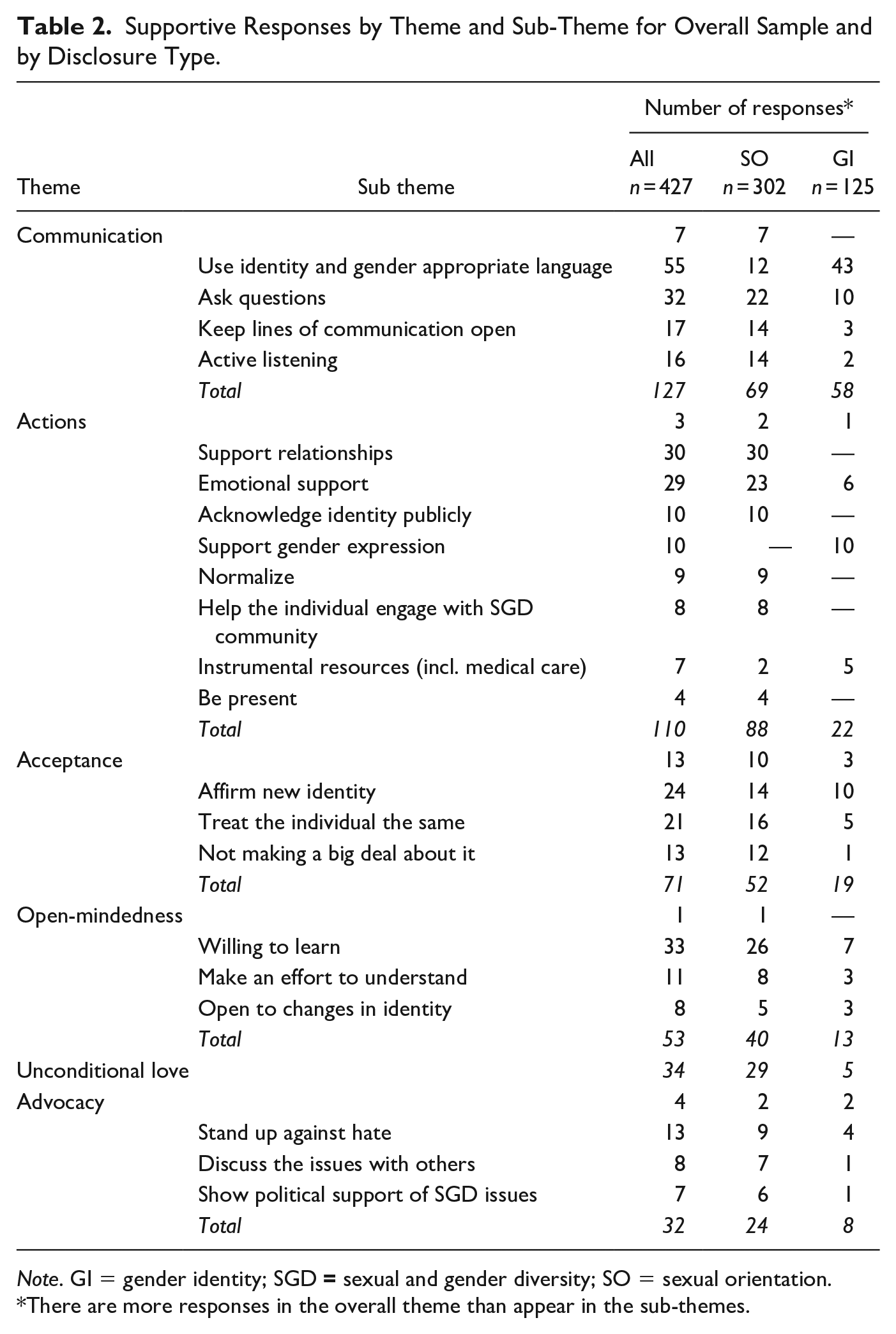
Note. GI = gender identity; SGD
There are more responses in the overall theme than appear in the sub-themes.
Theme 1: Communication
Responses regarding communication made up 29.7% of the total responses regarding perceived supportive responses. There were four sub-themes within communication; (1) use identity and gender appropriate language, (2) ask questions, (3) keep lines of communication open, and (4) use active listening. Use identity and gender-appropriate language accounted for 43% of communication responses. For example, “When they ask if I have a romantic love interest, they use gender neutral language like ‘significant other’ or ‘love interest’ to show I’m not attracted to one gender” (pansexual cisgender man). Among GDY, “Using my name and pronouns” was the main response. Participants also encouraged the parent or adult to ask questions “. . .but in a curious and polite way and without pressing” (bisexual genderqueer person), keep lines of communication open (e.g., “Make themselves available if I ever want to talk” (pansexual agender person) and use active listening (e.g., “Listening to worries and hopes about crushes and relationships” (pansexual cisgender woman). One participant advised: Try your hardest to keep open communication with them, and a space of comfort. If the person would not like to talk about it, then don’t push them to talk. But if they express that they feel comfortable talking about it, then talk! (pansexual cisgender woman)
Communication was the most common theme for gender diverse participants; using identity and gender appropriate language accounted for more than a third of all supportive behavior responses.
Theme 2: Actions
Responses that conveyed support for identity made up about a quarter (25.7%) of the responses in the overall samples and was composed of eight sub-themes: (1) support relationships, (2) provide emotional support, (3) acknowledge identity publicly, (4) support gender expression, (5) normalize identity, (6) help the individual engage with the SGD community, (7) provide instrumental resources, and (8) be present. Support relationships (e.g., “make it known that my significant others are welcome at home” (lesbian cisgender woman) and provide emotional support (e.g., “console when having trouble” (lesbian cisgender woman) combined made up more than half (53%) of the action-based responses. Acknowledge identity publicly (e.g., “Acknowledge my partner to their friends” (gay cisgender man)) and support gender expression (e.g., “buying things that fit their identity or buying things they need to help them pass (e.g., binders, packers, etc.)” (heterosexual transgender man) were the next most common responses. Participants wanted their parents and other adults to normalize their identity (e.g., “point out cute guys, girls, and gender nonconforming people to me” (pansexual transgender man) and help the individual engage with the SGD community. The latter included identifying resources and providing “transportation to. . . youth events [for SGD YA], including queer dances, discussions, and pride parades” (queer cisgender woman). Respondents were looking for their parents/caregivers to provide instrumental resources, which included basic needs like housing (e.g., “Let me live with them” (lesbian cisgender woman) and, for GDY, access to medical care. The final sub-theme in this category was to be present, by physically attending events and/or functions (e.g., pride celebrations, graduations, weddings) that are important to the young person. For example, “volunteering to chaperone field trips for the [Gay-Straight Alliance]” (queer femme).
Responses that conveyed support for sexual orientation identity were the most frequent theme reported by SDY, accounting for nearly a third (30%) of their total responses. Five of the subthemes appeared only in responses from SDY: supporting relationships, acknowledging identity publicly, normalizing, helping individual engage with the SGD community, and being present. One SDY noted, “My mom sometimes will point out girls with rainbow bracelets on, or ask about the people I’m dating, and that makes me feel supported” (pansexual cisgender woman). Among GDY responses, supporting gender expression was a unique response, as was assistance accessing medical care (under the sub-theme of instrumental resources). For example, “telling you they like your hairstyle or complimenting your appearance” (pansexual nonbinary person).
Theme 3: Acceptance
Acceptance of the individual’s newly disclosed SGD identity was the next most frequent response, making up approximately 17% of the total supportive responses. Three sub-themes were identified: (1) affirm new identity, (2) treat the same, and (3) not make a big deal. About a third of the responses reflected a desire to be affirmed in their new identity, which included “believe[ing],” and not “questioning,” “denying,” or “trying to change” the individual. They also wanted to be treated the same as they were pre-disclosure and treated the same as others (e.g., “Treat me like anyone else and not. . . like some rarity to be examined” (human, pansexual person). The remaining responses in the theme of acceptance were proposed to not make a big deal of it; one participant suggested, “non-reaction would be perfect” (bisexual cisgender woman).
Theme 4: Open mindedness
The theme of being open-minded made up 12% of the total response and included three sub-themes: (1) willing to learn, (2) make an effort to understand, and (3) be open to changes in identity. Willingness to learn included learning specific language/terminology while making an effort to understand included self-education (e.g., “go to PFLAG [Parents and Friends of Lesbians and Gays]/support groups” (queer transgender person). Be open to changes in identity responses included recognition that identities may change. For example, “Recogniz[e] gender as fluid and not fixed as society has made it to be” (pansexual genderqueer person). Two responses included recommendations for being an ally to SGD YA. For one young person, this included “never use offensive language and do your best to educate others on being a good ally as well” (queer transgender man). The other advised, Do not remain uneducated on [lesbian, gay, bisexual, transgender, and/or queer] LGBTQ issues and stereotypes. Learn to work through your biases. I’d also recommend that people research LGBT issues, to understand their loved ones feelings, and complications better. I’d recommend The Trevor Project (pansexual cisgender woman)
Theme 5: Unconditional love
Nearly at 10th of the responses (8%) indicated the need for love that is unchanging and without limitations. Some examples included, “Say that my sexuality matters, but does not change their opinion of me as a person” (pansexual agender person) and “Offer reassurance that one’s gender has not changed the relationship” (queer agender person). One participant provided guidance to parents/caregivers on how to best demonstrate unconditional love even in the presence of mixed feelings: Be honest and explain the reasons why you may have mixed feelings about it, but in the end, say you support them because of who they are, not because you need to. Tell them that you care for them, and that you love them, and that nothing could change that. (pansexual cisgender woman)
Theme 6: Advocacy
The remaining supportive behaviors (7.5%) participants identified were focused on advocating on behalf of the SGD young adult through action. Three subthemes were identified: (1) standing up against hate, (2) discussing issues with others, and (3) providing political support of SGD issues. Standing up against hate primarily referred to behaviors defending the young person’s SGD identity/identities to others, including immediate and extended family members. One participant specified that defending could be demonstrated by a person wrote, “mak[ing] an effort to correct people who misgender me, use the wrong name, or police me in the restroom” (transgender, queer, asexual person). Discussing issues with others was focused on educating others about issues relevant to SGD populations. Lastly, providing political support of SGD issues as advocacy included acts like “. . .voting in favor of equal rights legislation” (gay cisgender man).
Unsupportive responses
Participants’ descriptions of unsupportive responses fell into six themes, which were developed from the four theoretical codes and two emergent codes (in order of frequency: (1) distancing, (2) hostility, (3) minimizing, (4) controlling, (5) blaming, and (6) bumbling. The two emergent themes were hostility and controlling. The frequency with which each theme and sub-theme of unsupportive responses was reported overall and by sexual orientation or gender identity is presented in Table 3.
Unsupportive Responses by Theme and Subtheme- Overall and by Disclosure Type.
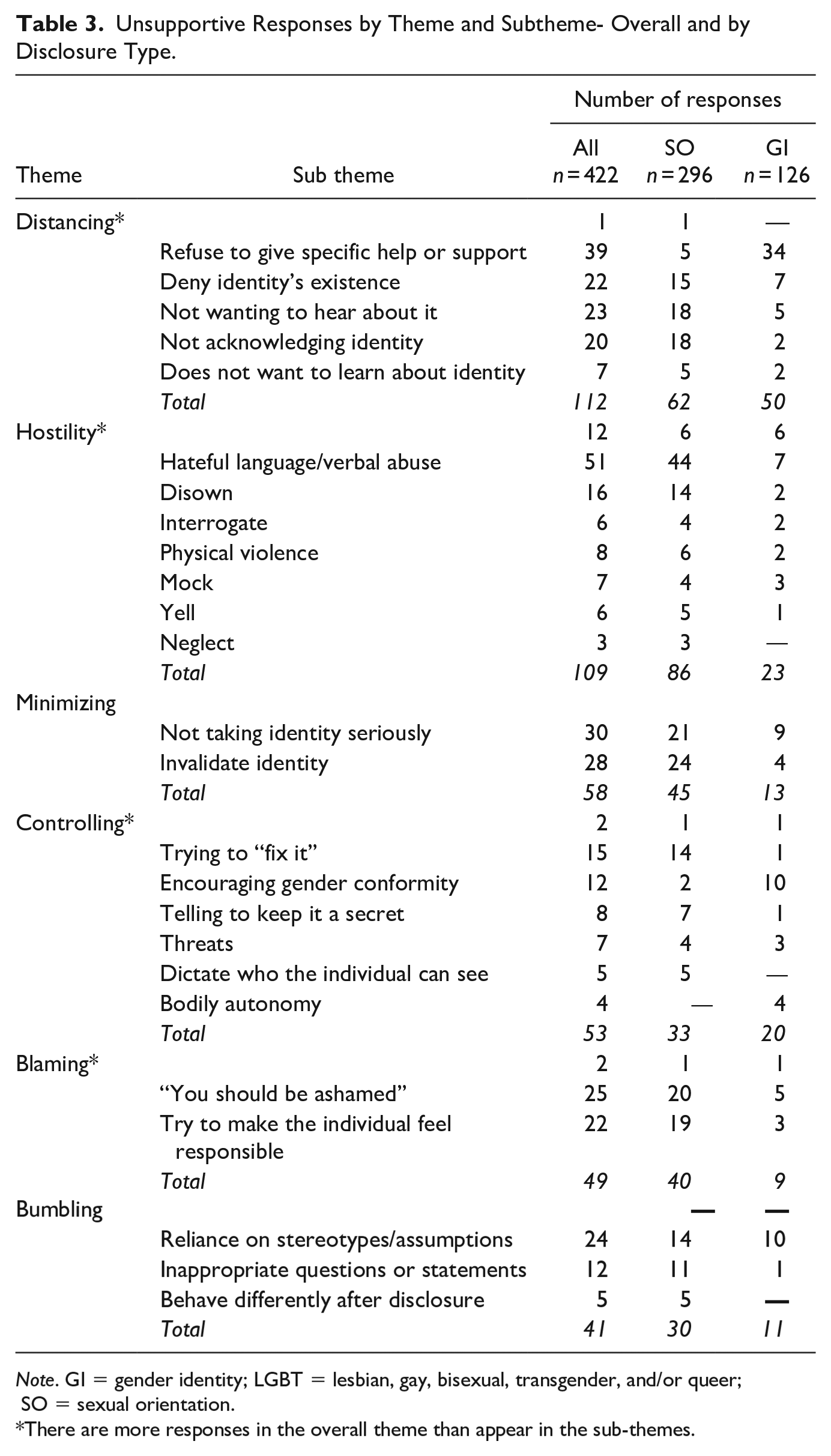
Note. GI = gender identity; LGBT = lesbian, gay, bisexual, transgender, and/or queer; SO = sexual orientation.
There are more responses in the overall theme than appear in the sub-themes.
Theme 1: Distancing
The most common theme (26.5% of responses) among all participants was the act of creating physical, social, or emotional distance with the SGD young adult. This theme had five sub-themes: (1) refusing to give specific help or support, (2) denying of identity’s existence, (3) not wanting to hear about it, (4) not acknowledging identity, and (5) not wanting to learn about the new identity. Refusing to give specific help or support included physical distancing (e.g., “refus[ing] to come to my house when I live with a same sex partner” (gay agender person) and, among GDY, not using the individual’s chosen name and/or pronouns accounted for 97% of their responses in this sub-theme. Denying of identity existence was indicated by statements that expressed disbelief (e.g., “Not believe[ing] my orientation exists (asexual cisgender woman).” Not wanting to hear about it involved actions such as changing the subject or avoiding discussions related to SGD identity (e.g., “Shut down conversations that have the potential to talk about [being] queer” (queer transgender man). Not acknowledging identity was enacted by responses such as “Pretend[ing] they didn’t hear and still ask about partners of opposite sex (lesbian genderqueer pereson)” and statements such as “You’re still biologically _____, so that’s what you are to me (asexual agender person).” Not wanting to learn about the new identity included responses in which the person declines to learn about the identity (e.g., “Stated that they didn’t understand, but didn’t want to try to” (pansexual cisgender woman).
Theme 2: Hostility
About a quarter (25.5%) of the participants described unsupportive responses that were categorized under the theme hostility, which consisted of seven sub-themes: (1) hateful language, (2) disownment, (3) interrogation, (4) physical violence, (5) mocking, (6) yelling, and (7) neglect. Hateful language included the use of derogatory comments, slurs, and hurtful “jokes” to or about [SGD] people. Disownment included responses such as “cutting off communication for an extended period of time (lesbian cisgender woman)” and “kicking me out of the house” (gay cisgender man). Interrogative responses were those that required the young person to “defend” their identity or actions through “intrusive questions” in ways that “violated privacy” (e.g., “Print[ing] excerpts from my blog, highlight what is problematic and put it on the kitchen table to discuss as a family” (cisgender lesbian woman). Physical violence included hitting the young adult with hands or throwing objects (e.g., “the Bible”) at them. Mocking included “mocking [SGD] people” (asexual queer cisgender woman) and responses such as “making faces” (pansexual transgender man). Yelling included raising one’s voice when talking to the youth. Neglect, a sub-theme found in only responses specific to sexual orientation included “ignoring me” (lesbian cisgender woman) and “neglecting my life from adolescence forward (pansexual transgender person).”
Theme 3: Minimizing
Responses that were classified as minimizing (14%) were statements that belittled the SGD young adults’ identity/identities. This theme had two subthemes: (1) not taking them seriously (52%) and (2) invalidating them (48%). Not taking them seriously included asserting the young adult was “too young.” For an asexual cisgender woman not taking her seriously also included, “keep asking if I ‘have a boyfriend yet’ or ‘when’ I’m going to get married.” Invalidating statements expressed doubt about the young adult’s SGD identity, suggested the identity was “a phase” or “a fad” or “failed to acknowledge the. . . bravery of coming out to them (pansexual agender person).” Another participant was invalidated when their parents did not “[recognize] my son my wife carried as my own (lesbian cisgender woman).”
Theme 4: Controlling
This subset of responses indicated that participant’s parents/caregivers were attempting to control the person or situation, which made up 12.5% of the total responses. This theme had six sub-themes: (1) trying to “fix it,” (2) encouraging gender conformity, (3) telling the individual to keep their identity a secret, (4) threatening, (5) dictating who the individual can see, and (6) controlling the individual’s bodily autonomy. Trying to “fix” the young adults’ identity included efforts attempting to change their sexual orientation or gender identity through therapy (“to make me straight”; cisgender gay man) or other programming (e.g., “sent me to church”; queer nonbinary person). Behaviors encouraging gender conformity included “gender policing,” “criticizing your appearance and shaming you for not [sticking to gender norms regarding body hair, makeup, etc.] (bisexual cisgender woman)” and “forcing me to wear . . . clothes I’m not comfortable wearing” (genderqueer asexual person). One respondent advised: Do not push gender norms, even on trans people. For example, if a trans male likes to paint his nails and get his hair did, then don’t . . . tell him he does not line up with his gender. He should be free to express the way he wants to (queer transgender man).
Parents and other adults also tried to control who could know the young adult’s sexual orientation and/or gender identity by telling the individual to keep their identity a secret from other family members or friends or telling them to “wait to tell people” (gay cisgender man). They also threatened to withhold financial support or emotional support (e.g., “said my family would turn their back on me” [bisexual cisgender woman]), or suggested harm would come to others (e.g., “told me that my father would lose his job if his employers found out I was gay” [lesbian cisgender woman]) as a means of minimizing identity disclosure and preventing sociomedical gender transitions. Dictating who the individual can see was unique to responses regarding sexual orientation and included actions such as restricting access to the individual’s significant other and “telling me to stay away from LGBTQ people” (bisexual genderqueer person). Restricting bodily autonomy was unique to GDY and referred to refusal to support gender affirming medical care and “offering me bribes to not get surgery” (bisexual transgender man).
Theme 5: Blaming
The act of blaming the individual for their identity or hardships related to the disclosure of their identity made up 11.6% of the total responses. Blaming included two subthemes: (1) “you should be ashamed” and (2) making the individual feel responsible. “You should be ashamed” was indicated through examples such as “telling me that I’m sick or wrong” (queer genderqueer participant). As an example of making the individual feel responsible, one participant wrote, “said anti-nonbinary things like ‘you just need to pick one’ and ‘stop making everything so complicated for everyone’” (queer, asexual, transgender, and genderqueer person).
Theme 6: Bumbling
Responses that were deemed bumbling (10% of responses) exhibited lack of information, awkwardness, and discomfort with the sexual orientation or gender identity without being hostile. Bumbling included three sub-themes: (1) relying on stereotypes/assumptions, (2) inappropriate questions/statements, and (3) behaving differently after disclosure. Relying on assumptions/stereotypes included responses such as “assum[ing] I was romantically interested in my female friends” (lesbian cisgender woman) and young people being told they are “gay and hiding it” (bisexual cisgender man) or “just hadn’t found the right person yet (asexual cisgender woman).” Inappropriate questions/statements included “but you seem so female all the time” (asexual genderqueer person) and “calling my relationship my ‘lifestyle’” (queer cisgender man). Lastly, behaving differently after disclosure, which only arose as a sub-theme in the responses of SDY included actions such as “being weird about sleepovers with girls” (lesbian cisgender woman).
One person advised parents and other caregivers against multiple responses that have been classified as unsupportive and made recommendations for an alternate approach: Do not try to change them or accept them in hopes that it is just a phase. Most times it is not, and people deserve to be believed and respected. Don’t. . .guilt them, or shame them, for they may already hold their own guilt and shame still. If you need some time to work through it, let them know that so you don’t hurt them in the time that it takes for you to make peace with it. (pansexual cisgender woman)
Discussion
The goal of this analysis was to gain an understanding of what specific responses SGD YA perceive to be supportive or unsupportive of their sexual orientation and/or gender identity from parents/caregivers and other adults. SGD YA identified a range of both global and specific actions demonstrating support or lack of support for their sexual orientation and/or gender identity.
Supportive Responses
Communication was important for both groups and highlights the importance of parents and other adults stating and demonstrating that they are interested in hearing about the young person’s experiences by asking questions and actively listening, which is consistent with themes found in previous research (Manning, 2015). Communication was the focus of nearly half of the supportive responses from GDY, and in prior research, positive family communication was associated with decreased depression, anxiety, and self-harm (Katz-Wise et al., 2018). Using GDY’s chosen name and pronouns was the most common response for ways in which parents/caregivers and other adults can demonstrate support, which is consistent with previous research (Hale et al., 2021). However, for parents, using the young person’s chosen name and pronouns may be one of the most difficult adjustments following the disclosure of a gender diverse identity (Hale et al., 2021). Given the potential for gender affirming communication to act as a resilience factor for mental health (Tankersley et al., 2021), it is critical that adults who are parents/caregivers of GDY or work with this population honor the young person’s gender through use of the correct name and pronouns. Adults who work with GDY can also provide support to parents, caregivers, and other family members who may be having a difficult time adjusting to changes in name and/or pronouns.
Actions were the second most common theme across the sample, but there was only overlap in SDY and GDY responses in two sub-themes: emotional support and instrumental support. Among SDY, responses that described actions were the most common, accounting for nearly one-third of their responses. Unique sub-themes that arose for SDY included supporting relationships, acknowledging identity publicly, normalizing SD identities, helping the individual engage with the SGD community, and being present at events that are important to SDY. These unique subthemes point toward an interest in more public demonstrations of support for SDY and their relationships. This could be because sexual orientation, specifically marriage equality, was in public conversation when these data were collected (Human Rights Campaign, n.d.). GDY, on the other hand, primarily identified actions that support their gender expression, which may help the GDY to express themselves publicly. Within the sub-theme of instrumental support, helping the GDY access gender affirming medical care and navigate the healthcare system was unique to this group, and is consistent with another recent study (Johnson et al., 2020). Though both SDY and GDY may experience challenges obtaining inclusive healthcare, access to gender affirming treatment has been identified as lifesaving for GDY (Green et al., 2022; Tyler & Abetz, 2022).
SGD YA also wanted parents and other adults to advocate for them in situations that were unjust through interpersonal (e.g., defending the youth against another family member’s negative ideas) or more public (e.g., social media post, bumper sticker) actions. Results from other studies with GDY have identified parental advocacy being interpreted as supportive (Hidalgo et al., 2017; Johnson et al., 2020). Advocacy may be especially salient today as the rights of GDY to access gender affirming healthcare, play sports in their affirmed gender, and use restrooms in accordance with their affirmed gender are under attack across the US (Ronan, 2021). Parents of SGD adults in one study understood the importance of support that extends beyond the home environment, adding: “It also means advocating for them [in other environments] . . . All daily mundane interactions add up to something larger in scope and highlight parents’ effort to confront societal level bigotry and intolerance” (Tyler & Abetz, 2022, p. 318).
SGD YA also identified demonstrating open-mindedness by being willing to learn and make an effort to understand through self-education and interacting with other parents (e.g., peer support groups) as demonstrations of support. Participants’ responses indicated that SGD YA understand that, for some parents and other adults, acceptance can be a process that takes time (Phillips & Ancis, 2008). This was emphasized in one respondent’s advice to let the SGD YA know “if you need some time to work through it. … make peace with it.” Indeed, prior research has identified that asking questions of the SGD YA (communication), seeking out information and support from others (open-mindedness), and attending LGBTQ-related events (actions) are responses that support the young adult, as well as reducing stress among parents (Chrisler, 2017; Johnson et al., 2020).
For social support to be deemed helpful, it must match what the person receiving support perceives they need in that situation (Cutrona, 1990). It is possible that parents and SGD YA will prioritize supportive responses differently. In one study with parents and GDY, for example, parents primarily highlighted their connecting the GDY to gender affirming services as demonstration of support, whereas GDY more frequently mentioned the use of their chosen name and pronouns (Hale et al., 2021). Similarly, types of support can take on different priorities, expressions, and meanings given different sociocultural contexts of families; what appears to be negative behavior in one family might be perceived as positive by members of another family (McGolddrick et al., 2005). As such, asking SGD YA whether or not they perceive a specific behavior to be supportive in the context of their own family situations could be helpful.
Unsupportive Responses
Unsupportive responses from caregivers created emotional or physical distance between the SGD YA and their parent(s), minimized feelings, blamed the young person, were violent, attempted to gain control over the young person or their behavior, and those responses for which the young person perceived the parent was uncomfortable with the youth’s sexual orientation and/or gender identity.
There were three subthemes that were unique to SDY, which were responses that reflected neglect, dictating who the individual can see, and behaving differently after disclosure. Dictating who the individual can see largely referenced putting limits upon when and where the individual could be with their significant other, which participants perceived to be domineering of the caregiver. The sub themes of neglect and behaving differently after disclosure may have only arisen in responses from SDY in this sample because the sample was small and there were more SDY than GDY participants. Prior research suggests SGD YA report adverse childhood experiences such as neglect more frequently than their cisgender, heterosexual counterparts (Craig et al., 2020). Encouraging gender conformity arose twice within the sexual orientation responses, which indicates some potential overlap between sexual orientation and gender identity, though these are separate constructs. Avoiding and negative communication and responses such as refusing to talk about or acknowledge identity, interrogating, physical violence, inappropriate questions or comments, and shaming statements, were also similar to themes identified in previous research (Chrisler, 2017; Johnson et al., 2020; Manning, 2015; van Bergen et al., 2021). Given the established association between unsupportive parents and increase in risk responses (e.g., binge drinking, illicit substance use, sexual practices) and worse mental health outcomes, it is critical to discourage responses communicating lack of acceptance for sexual orientation (Rothman et al., 2012; Ryan et al., 2009, 2015).
Consistent with prior research, GDY in this study identified unsupportive responses such as verbal abuse, physical violence, disownment, shame, and distancing, all of which have implications for GDY mental health, self-esteem, and ability to form relationships as adults (Johnson et al., 2020; Koken et al., 2009). There was only one subtheme unique to GDY, which was the parent or caregiver trying to gain control of the individual’s bodily autonomy. These responses suggest that individuals who disclose a gender identity may have unique social support needs, as well as unique responses that should be avoided. Parents’ attempt to control or alter gender expression/related behavior, for example, by refusing to provide clothing reflective of the youths’ gender has been identified in other research with GDY, and like other unsupportive behaviors, may contribute to worse mental health (Johnson et al., 2020).
Responses that May be Supportive or Unsupportive
One category of communication—asking questions—was described by participants as both supportive and unsupportive, depending on the context. Among questions participants deemed to be supportive were those that communicated genuine interest and were related to their (actual or potential) relationship(s) or partner(s), including extended interest in getting to know one’s partner. Recognizing that disclosure can be a stressful process, participants were also open to questions about their well-being during the process and how others have responded to them. Seeking to clarify understanding about a particular identity and what it means to the young person, rather than making assumptions, was deemed supportive. Questions about how best to provide support were also welcomed; among GDY, this included specifically asking about their name and pronouns. On the other hand, questions that cast doubt on SGD YA’s identity or required them to defend their identity (e.g., “are you sure?”) were viewed as unsupportive. Similarly, questions viewed as unsupportive were those that were not in line with youths’ identity (e.g., asking a SDY if they have a partner of the “opposite” gender) or that used hurtful or outdated language (e.g., “phase” or “lifestyle”).
The idea of “asking too many” questions came up in both supportive and unsupportive responses. How many is “too many” may vary from individual to individual. Similarly, participants, responses indicated that, while they were willing to educate caregivers and other adults about their own identity, they did not want to be the sole source of knowledge about SGD people; instead, they encouraged others to seek out resources and information to educate themselves. In both cases, taking cues from the young person may be helpful. One common point was a desire for adults to demonstrate interest in or availability to discuss sexual orientation or gender identity-related subjects (“keep lines of communication open”), but not to pressure or force the young person to respond.
Strengths and Limitations
One of the strengths of this study is that the participants were diverse in terms of sexual orientation and gender identity. This contribution fills a gap in the current knowledge, as most literature on SGD YA focuses solely on SDY or GDY. In addition, nearly half of the GDY participants have gender identities outside the woman/man gender binary, a population less frequently represented in existing literature. The number of open-ended responses allowed for the identification of numerous specific responses that are perceived by SGD YA as supportive or unsupportive, expanding on what was already known.
There were only three participants who disclosed their gender identity and reported a heterosexual sexual orientation identity, which may be due to recruitment methods or limited interest in engaging with the larger LGBTQ + community. Thus, these results may not accurately reflect the needs or experiences of heterosexual-identified GDY. Similarly, this convenience sample was recruited predominantly through social media and snowballing was somewhat limited with regard to sex assigned at birth, race, and ethnicity. The survey was administered electronically, so it was only available to individuals with access to the Internet and a computer or other electronic device. Thus, the experiences of participants in this sample may not represent the experiences of those who may have been better reached using face-to-face methods (Reisner et al., 2014).
The survey did not include a query about the location of the participants, so it is unclear whether the data is representative of experiences across the US, or if it includes responses from urban, suburban, and rural participants. Future research should include questions about location, as previous research has demonstrated that individuals’ experiences with interpersonal violence and discrimination may be influenced by geographic location and environmental contexts, such as state-wide policies regarding SGD individuals (Craig et al., 2020; Swank et al., 2013).
The brevity of some participants’ responses was a limitation in this study. In some cases, it was difficult to identify which theme might be best as the participants did not always provide context for their responses. A few short responses (n = 3) without context (e.g., “remembering” as a supportive caregiver behavior) were not able to be classified with an existing theme and were excluded from analysis. In most cases, however, abbreviated responses became their own code. Because these individual codes (e.g., “help”) occurred so infrequently (<1% of responses), they are captured under the larger themes only and not specific sub-themes. The anonymous, online nature of the survey may have allowed participants to feel more comfortable providing responses to these questions (Gates, 2011; Wood & Kerr, 2006), but it meant that the researchers could not follow up with participants to clarify their responses.
There were a few sub-themes in the original coding that were not included in the final list of sub-themes when they occurred fewer than three times. It is unclear if these responses (e.g., the parental caregivers blaming themselves for their child’s identity) were not reported more frequently because they are not common experiences for SGD YA in general or were only uncommon among the participants in this sample. Future research could specifically ask SGD YA if they have experienced those parental responses to provide a better understanding of the prevalence of such responses.
Suggestions for Future Research
It could be important to explore the association between the provision of direct (received) and indirect (perceived) support using responses outlined by young adults here with conditions and factors known to be related to support (e.g., mental health, engaging in risk behaviors, self-esteem, etc.). Subsequent research should continue to take into consideration the experiences of different subgroups, as well as individuals with intersecting identities, such as those who are both SGD and people of color, as this will provide more information about the unique needs of SGD YA on the basis of these identities. Knowing more about this area will allow us to develop effective family-centered interventions that could increase resources and feelings of support for SGD YA and their family members.
Conclusion
SGD YA who receive support for their sexual orientation and/or gender identity from parents and other adults report better mental health and quality of life compared to SGD YA who do not receive support. Parents and other adults, regardless of their level of support, communicate their amount of support through different responses. Words and actions meant to demonstrate support may be misinterpreted by SGD YA if not aligned with the youth’s perceived support needs. Parents and other adults can demonstrate support for sexual orientation and gender identity by engaging in communication and responding in ways that demonstrate acceptance, open-mindedness, and unconditional love. Support can also be demonstrated through willingness to learn about the SGD YA identity and advocating for the SGD YA inside and outside the family. GDY find use of their chosen name and pronouns a specific means of demonstrating support for their identity and may also benefit from support accessing and navigating the healthcare system for gender affirming treatment.
Footnotes
Acknowledgements
The authors would like to thank the undergraduate honors student who assisted with the analysis of these data, as well as all the study participants who provided responses to the additional (optional) study items that made up this analysis.
Declaration of Conflicting Interests
The author(s) declared no potential conflicts of interest with respect to the research, authorship, and/or publication of this article.
Funding
The author(s) disclosed receipt of the following financial support for the research, authorship, and/or publication of this article: This study was funded by a research grant awarded to the first author by the Beta-Zeta-at-Large chapter of Sigma international nursing honor society.
