



Abstract
Responses to trauma can involve complex meaning-making processes and the perception of ambiguous threats. This study sought to explore response trajectories to a nuclear disaster and their intertwining courses with ecological factors (Trajectories intertwining with Life—TiL) from adolescence onward among a non-evacuated population. Four women and four men (mean age 20) who were adolescents during the 2011 nuclear accident in Fukushima (mean age 14), and who grew up outside the restricted zone participated in the study. Semi-structured life story interviews were conducted in the form of in-depth qualitative inquiries. A holistic analysis was employed to identify the TiL patterns following the Fukushima nuclear disaster in the overall context of the stories and to reveal important themes throughout adolescence. Four TiL patterns were found: three trajectories corresponding with those identified in prior research and one newly identified trajectory. The perceived, distal, and continuous threat of radiation played a central role in all patterns and exerted secondary impacts throughout the lives of non-evacuated adolescents. The study’s implications shed light on rarely studied response trajectories to ambiguous Potentially Traumatic Events (PTEs) throughout adolescence and point out the benefits of using a life story approach to this end for the first time.
Keywords
Introduction
Different types of mass disasters affect millions of adolescents worldwide. However, we still need to gain a better understanding of how such seminal events influence adolescents as they grow up (Franks, 2011). While natural disasters are relatively familiar events defined as involving powerful and sudden climatic and meteorological assaults, technological disasters are less familiar and are defined as reflecting a breakdown in the technology employed in the use or storage of highly toxic substances (Baum et al., 1983). Despite their growing number, the effects of technological versus natural disasters on adolescents have been less studied (e.g., Lai et al., 2017; Norris et al., 2002). Nevertheless, and particularly throughout adolescence, reactions to trauma can involve complex meaning-making processes and the comprehension of ambiguous technological threats (Salmon & Bryant, 2002; Wroble & Baum, 2004). The present study examines response trajectories to a technological disaster from adolescence onward as part of retrospective life stories, focusing on the 2011 Fukushima nuclear accident.
Trauma and Disaster Studies of Adolescents
Disasters can exert various impacts on adolescents, both directly and via multiple levels of influence on the ecological systems that interconnect with the process of growing up (Weems & Overstreet, 2008). However, a recent report has mapped gaps in disaster studies of children and adolescents from an Ecological-Developmental (ED) perspective (Taube-Dayan, 2021), defined as focusing on the interconnections between a range of disaster responses and multi-level ecological factors throughout development. This report has revealed that disaster studies tended to focus on pathological and adverse responses (e.g., Bonanno et al., 2010; Norris et al., 2002), be carried out in the first year after disasters (e.g., Furr et al., 2010; Wang et al., 2013), consider micro-ecological factors (such as family and peers) rather than also include macro ecological factors (such as cultural and social practices) (e.g., Fernando et al., 2010; La Greca et al., 2002), and agree that disasters’ effects of on children and youth depend on complex interactions between multi-level ecological factors over time that should further be studied (Masten & Narayan, 2012).
As research on the effects of mass trauma on children and adolescents advanced, various pathways of risk and resilience were reported. While developmental psychologists have shown that resilience is common throughout growing up in disadvantaged conditions (Masten, 2014), in the trauma field, resilience was often underestimated and misunderstood (Bonanno, 2004). However, there is increasing proliferation of studies on an array of response trajectories to Potentially Traumatic Events (PTEs), defined as events suggesting that the commonly used term “trauma” downplays or ignores the role of variability in adaptation. An important review study (Galatzer-Levy et al., 2018) revealed that there were three common response trajectories identified across studies. The most common trajectory is resilience (persistent low symptoms over time). The second most common trajectory is recovery (initial elevated symptoms that later decrease), with chronic distress (persistent elevated symptoms over time) being the least common trajectory of the three. Nonetheless, and in light of these being basic human reactions to hardship, there is still a need to explore the nature of these trajectories over and above category memberships.
Scholars who study social-ecological resilience (Ungar, 2011) have pointed out that more place-based studies taking an ecological approach, particularly with young people, are needed to better identify the relationships between social-ecological systems and well-being. Recent studies of adolescents in the field of trauma have also shown that theoretical conceptions have moved away from both a narrow focus on the individual and toward wider ecological perspectives as well as from a narrow focus on negative responses to trauma toward a focus on positive prosocial responses (Nuttman-Shwartz, 2019). Yet, there are also limitations arising from the scarcity of research on disaster response trajectories. A recent review of the eight disaster trajectory studies conducted with children and adolescents thus far (Lai et al., 2017), revealed that only one study focused on adolescents exclusively (Fan et al., 2015), and another on a technological disaster (Osofsky et al., 2015). Notably, the review reported similar trajectory patterns to those found after various types of PTEs among children and adults, however, also with shortcomings that accord with those mentioned above regarding child disaster studies from an ED perspective. As such, it revealed that all studies used standardized measures of clinical criteria (mainly related to PTSS) to determine the trajectory type over a few points in time, only up to 4 years after disasters on average, and with a prevailing focus on windstorms in Western countries. Thus, there is still a need to explore the meanings of various disaster responses throughout development in different ecological contexts (Franks, 2011).
The limitations in the study of adolescents’ disaster responses in various contexts over time call for innovative research approaches. More specifically, researchers have raised the need for qualitative approaches that can explore the in-depth meanings ascribed to disaster responses throughout the process of growing up (Cairns & Dawes, 1996; Pfefferbaum et al., 2013).
Life Stories
A life story approach focusing on the meanings of a past event as part of the overall context of life (Rosenthal, 2004), may offer unique benefits to the study of adolescents’ disaster response trajectories. More specifically, the core features of life stories address current needs in child and adolescent disaster studies from an ED perspective (Taube-Dayan, 2021). For one thing, as stories follow mental processes and outcomes through life (Gergen & Gergen, 1988), they reveal different disaster response trajectories throughout the process of growing up. For another, as stories are embedded in an ecological context (Bruner, 2004), they present micro and macro factors of the disasters and their secondary impacts. Moreover, by following a temporal plot relating to developmental and social processes (Polkinghorne, 1988), stories shed light on response trajectories throughout growing up and at various post-disaster stages. Altogether, and as the stories arrange all their components to form a unique meaningful whole (Spector-Mersel, 2010), they yield the integrative outcome of Trajectories intertwining with Life (TiL), defined as networks of meanings connecting multiple ecological factors and disaster responses throughout development.
Only a few narrative and life story studies were reported in the adolescent disaster literature thus far, and most of them have focused on war and conflict situations. These studies revealed various aspects of adolescents’ lives in the wake of mass PTEs, such as sociopolitical involvement, identity formation, and meaning-making processes (e.g., Daiute, 2010; Hammack, 2006; Jones, 2002). Nevertheless, most of these studies have also focused on recent events in the lives of adolescents and lacked a significant temporal perspective on the PTEs. As such, none of these studies focused on the PTEs’ response trajectories and on their relation to ecological factors throughout development. Furthermore, the meanings that adolescents ascribe to wars and disasters are not necessarily similar (Franks, 2011), and, moreover, it seems that no life story studies of technological disasters in adolescence have been conducted thus far.
Nuclear disasters and the Accident in Fukushima
Hundreds of nuclear power plants (NPP) are currently operational worldwide to meet ever-increasing energy demands, and some have been the locus of severe accidents over the years. The most recent accident occurred in the Fukushima Daiichi NPP, located in the Tōhoku region in the northeast of Japan’s major island, in 2011. The accident was part of a triple disaster that also included a massive earthquake and a destructive tsunami. The effects of the accident alone were extraordinary in both scale and form and especially in Fukushima prefecture. Initially, the danger of radiation caused more than 150,000 Fukushima residents to evacuate (Hasegawa et al., 2015). Moreover, while the nuclear energy sector has developed extensively and with little civic involvement throughout modern Japanese history, the accident in Fukushima elicited unprecedented civil discourse and protests challenging the use of nuclear power (Aldrich, 2013). Notably, and as is the case after nuclear disasters in general, the radiation’s effects on children and adolescents in Fukushima were especially worrisome (Bromet, 2016).
Nuclear spills can produce unique psychosocial responses related to the uncertainty associated with a mysterious chemical agent. The literature on nuclear disasters has taught us of the possible mental health impacts of such events, including anxiety, depression, and PTSD (Morganstein et al., 2015). Among families of children and adolescents, there are also reports of stress, feelings of powerlessness and lack of control, isolation, and stigmatization (Wroble & Baum, 2004). While children and adolescents were not found to suffer from constant negative effects after nuclear events (Bromet, 2016; Takebayashi et al., 2017), there may be age differences in the disaster’s processing. As such, adolescents may already be aware of invisible threats and understand abstract concepts related to danger. Moreover, the experience of an historical event such as a nuclear disaster can also exert various implications throughout adolescents’ life course (Elder, 1998). Nevertheless, there have only been a few studies on the influences of nuclear disasters throughout adolescence and little is known about how adolescents perceive, interpret and cope with these events over time (Wroble & Baum, 2004).
The case of Fukushima also raises the need to examine time-related changes and causality in factors while differentiating between demographic groups (Takebayashi et al., 2017). The prefecture was officially recognized as safe after the accident apart from a restricted zone of about 30 km that was evacuated. Nuclear disaster studies tend to focus on the evacuated populations that were exposed more directly to the incident (Hasegawa et al., 2015). However, the many residents who live near the restricted zone may cope with the potential radiation hazard on a daily basis on account of such measures as restrictions on outdoor activities among children and adolescents that can affect their physical, emotional and social development (Kinoshita & Woolley, 2015). Moreover, there are a range of interpretations relating to nuclear threats (Maeda & Oe, 2015), that may also be especially common among those who remained in the area. In the terms used by the disaster literature on children and adolescents, this situation emphasizes a perceived threat of a distal physical nature with continuous secondary impacts on daily life. While such threats can exert significant effects on adolescents after disasters over time (e.g., Fernando et al., 2010; Furr et al., 2010), the trajectories of responses to nuclear threats throughout adolescence among non-evacuees remain understudied thus far.
The understanding that life events are interpreted as part of narration also develops across adolescence and into early adulthood. This understanding is based on an awareness of inferential processes that evolve during this developmental period, including the recognition of the uncertainty of knowledge (Habermas & Bluck, 2000). Thus, when enriched by a retrospective along with a processed view (Freeman, 2006), a life story approach can contribute to an exploration of the complex responses to an uncertain radiation threat across adolescence.
Questions and Aims of the Present Study
The present study is concerned with which patterns of response trajectories to a technological disaster are present in adolescents’ life stories and how these patterns can be understood from an ED perspective. More specifically, this narrative study aims to explore how disaster response trajectories intertwine with various ecological factors throughout life (TiL) among young women and men who grew up in Fukushima in the 6 years following the nuclear accident.
Materials and Method
Participants
The study included eight participants, four women and four men, who were adolescents during the nuclear accident (mean age 14 at the time of the disaster and 20 during the study). All participants grew up in Fukushima within a radius of 45 to 80 km from the NPP, while two had recently moved to a nearby prefecture for their university studies. The participants were single and from low to middle class families. Six were college and university students and two were university graduates working for a living (See Table 1 for Participants’ Details).
Background Details of the Participants.
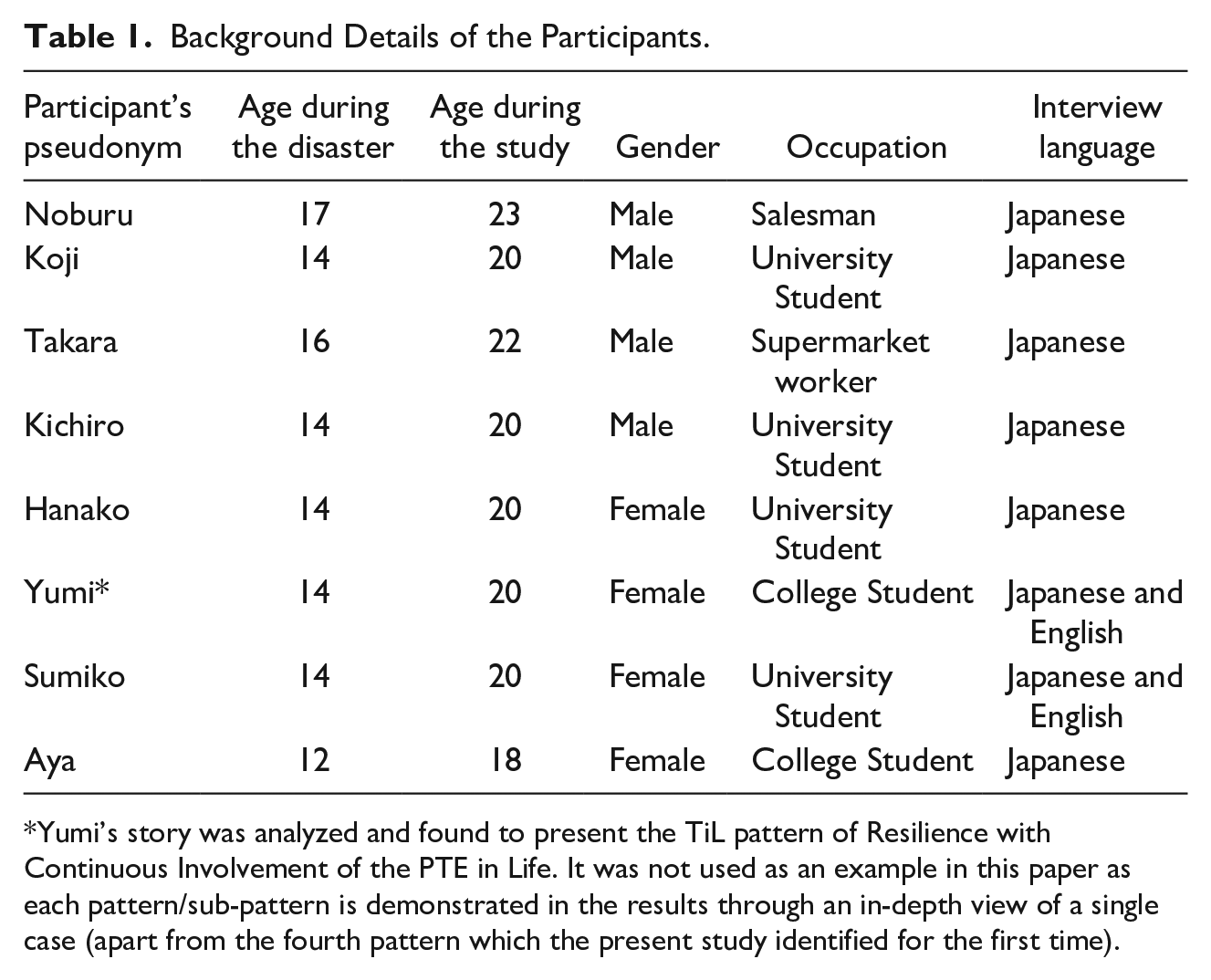
Yumi’s story was analyzed and found to present the TiL pattern of Resilience with Continuous Involvement of the PTE in Life. It was not used as an example in this paper as each pattern/sub-pattern is demonstrated in the results through an in-depth view of a single case (apart from the fourth pattern which the present study identified for the first time).
The present study was conceived with an original focus on the Tōhoku triple disaster. Recruitment was aimed at local young people who were affected by the disaster in adolescence, without a specific emphasis on the nuclear accident. Participants were voluntarily recruited by way of a nonprobability sampling that included the publication of the study in community centers, campuses, and local organizations, and by using contact persons and word of mouth. Without prior guidance as to which of the events of the triple disaster participants should refer to, all their stories exhibited response trajectories to the nuclear accident, an event that did not officially place their lives in danger. As qualitative studies do not follow a linear path and can continuously involve new research questions, the rarely documented stories of adolescence after a nuclear disaster in a non-evacuated population became the focus of the present study.
The recruitment process was also required to address the traditional Japanese reticence toward discussing personal affairs and the difficulty of addressing the nuclear disaster directly (Maeda & Oe, 2015). It somewhat overcame this double challenge by focusing on young people and not foregrounding the accident in the recruitment process. However, the final sample size might still have been smaller than ideal, due to the pioneering nature of the study among a hard-to-reach and understudied population. More importantly, the adequacy of qualitative data does not refer to a simple “magic number” of participants, but rather to how it allows us to gain access to the comprehensiveness of and variations in the subject matter (Levitt et al., 2017). Accordingly, the final sample size was determined after reviewing the collected data to gauge theoretical and thematic saturation. This process revealed that the life stories provide comprehensive data regarding the main trajectory patterns identified in earlier research plus an original pattern, as well as include variations in ecological themes and sub-patterns, and all with an emphasis on adolescence in less-studied social and disaster contexts.
Procedure
All participants completed a semi-structured life story interview (e.g., Rosenthal, 2004) according with the principles of an in-depth qualitative inquiry and incorporating a relational approach (Josselson, 2013). The interview sought to identify trajectories of responses to the nuclear disaster alongside their intertwining courses with ecological factors from adolescence onward in the overall context of life stories. In the first part of the interview, participants were asked to relate their life stories in a free and elaborate manner. As the interviewer, I largely served as an empathetic listener supporting the spontaneous construction of the stories. In the second part of each interview, I posed complementary questions regarding the story and the disaster if not otherwise mentioned (e.g., about the personal and environmental impacts of the disaster or changes over time). At the end of the interview, participants were also invited to give their story a title to stress its message.
The interviews took place at different locations according to participants’ choice (e.g., at coffee shops and community centers). They were conducted in Japanese, except in the case of two participants who also used English. In the interests of supporting the translations’ trustworthiness, the interviews were assisted by a native Japanese interpreter, in addition to the researcher’s knowledge of Japanese. The translations largely quoted the participants verbatim, and a few Japanese terms related to the disaster were also noted in the process. All interviews lasted between 1 and 3 hours as was necessary and were audio-recorded. To gain a better familiarity with the context of the life stories, I conducted additional fieldwork in Fukushima and Tōhoku included meetings with the local population, NGO activists, professionals and scholars, visits to disaster-damaged sites, and data collection in community centers and local archives.
Analysis and Quality Standards
I employed a holistic narrative analysis (Lieblich et al., 1998) to explore the nuclear disaster response trajectories throughout adolescence as part of the life stories. The analysis focused on each narrative as a whole and addressed its content and form. Its first stage thus included the establishment of familiarity with each narrative by listening, transcribing, and re-reading it. To support the transcriptions’ trustworthiness, notes made by the researcher during interviews were also used and points needing clarification were once again discussed with an interpreter. In the second stage of analysis, an in-depth, line-by-line reading with the underscoring of significant sections was used to identify the story’s main message in relation to the study’s focus. The process was also facilitated by the identification of mechanisms of selection (Spector-Mersel, 2011), which are techniques used by narrators, whether consciously or sub-consciously, for conveying a story’s message (e.g., elaboration or condensation of parts in the story). Finally, the narratives were organized in TiL patterns and sub-patterns to reveal the intertwining courses of disaster trajectories with ecological factors throughout the participants’ adolescence.
Several strategies were used to ensure the analysis’ trustworthiness (Guba & Lincoln, 1985). These involved the triangulation of the narratives in relation to each other, to data collected from the fieldwork and to diverse literature (developmental, cultural, trauma, and disaster studies); consultations and reviews in external forums; the use of thick and rich descriptions for results; and a consideration of the researcher’s positionality and reflexivity (Creswell, 2007).
Positionality and Reflexivity
Being an outsider researcher is an issue referred to in qualitative literature (e.g., Dwyer & Buckle, 2009) and was a significant factor in the present study. Initially, my interest in this study was prompted by participation in academic and professional forums concerned with the 2011 disasters, as a developmental psychologist with additional expertise in Japanese studies. During the study, the fact that I am not Japanese and that I was not personally involved with the nuclear disaster led to a greater degree of openness by participants, as many of them stated. For most participants, the interview was the first time they talked about experiences related to the nuclear disaster. In my case, the process also required me to acknowledge and proceed from the assumption that these stories provide us with new data as there was almost no similar literature on non-evacuated adolescents after nuclear disasters, that is, those who were not officially acknowledged as being in danger. In this respect, being an outsider provided me with a greater space for reflexivity, which helped me identify the distinct nature of the stories of growing up after a nuclear accident and adjust the study’s original focus accordingly. In addition, self-reflection promoted an understanding of the role of outsiders after nuclear disasters, an issue which is another point the present study seeks to illuminate.
Ethics
The overall study procedure was approved by an IRB. Participants’ rights were explained before they consented to the research and the audio recording of their interviews. My practical experience as a psychologist was aimed to assist the participants in case disaster-related distress was detected in the interviews and contact details of local mental health services were also prepared to provide if needed. Furthermore, participants were invited to discuss the interview experience after it ended and were provided with the researcher’s contact details in case they had later inquiries. Particular care was also taken in ensuring the protection, privacy, anonymity, and confidentiality of participants throughout the results’ presentation.
Results
A holistic analysis of the life stories revealed that all eight participants who grew up in Fukushima exhibited response trajectories to the nuclear accident throughout their adolescence despite not being officially exposed to danger. Four TiL patterns were found, three that corresponded with previously identified trajectories and a previously unidentified new pattern.
More specifically, analyzing the forms of the narratives revealed overall regressive, progressive, and stable response trajectories that also relate to recognized forms of life stories (Gergen & Gergen, 1988), and one new pattern that involved a sharp split in the stories. Analyzing the content of the narratives revealed the trajectories as possessing stratified layers of meanings that are embedded in the stories, including thoughts and feelings involved in connecting events and actions with consequences (e.g., Chase, 2005). The salient ecological context of the stories (e.g., Bruner, 2004) further anchored the response trajectories to the nuclear disaster with respect to various ecological factors over time. Finally, all these were integrated into the stories as holistic units of meaning (Lieblich et al., 1998) and thus conveyed the roles various TiL patterns play in the overall context of life. Altogether, the TiL patterns and sub-patterns presented the in-depth nature of both familiar and new response trajectories with respect to applicable ecological factors throughout development.
The four main TiL patterns found are: (1) Ecologically accelerated distress (Trauma-Paradox) (n = 1); (2) Recovery alongside identity achievement with a social orientation (“Restart”) (n = 3); (3) Resilience with a continuous involvement of the PTE in life (n = 2); (4) Context-dependent (In-Out): Resilience/distress (n = 2). These results are presented below with rich examples from the interviews (using pseudonyms) and the incorporation of relevant literature with a view to exposing the unusual experiences of adolescents in the shadow of a nuclear disaster.
Ecologically Accelerated Distress (Trauma-Paradox) (n = 1)
One participant exhibited chronic distress that was accelerated by ecological conditions in the 6 years following the nuclear disaster. This pattern revealed that the possible influence of an ongoing obscure threat can involve a Trauma-Paradox (continuous distress even without an officially recognized danger) across adolescence. The findings also accord with the research on secondary disaster stressors as accelerating distress throughout adolescence (e.g., Fernando et al., 2010), revealing that these stressors can involve distrust in the authorities and radiation-stigma among non-evacuated adolescents after nuclear disasters.
Noburu grew up in one of Fukushima’s main cities, located about 80 km from the NPP. He was 17 years old when the nuclear accident occurred and worked as a salesman during the study. Noburu began his story by talking about his life before the disaster, mostly referring to domains that he later described as changing dramatically after the event. Similar disturbances or splits were reported between life before and after a natural disaster in the narratives of adult survivors (Cassim et al., 2015). In the case of nuclear disasters, while anxiety pertaining to the radiation’s impacts on health was mainly reported in evacuated populations (e.g., Maeda & Oe, 2015), these findings also stress its influence on adolescents who remained in the area.
I used to go to the fields with my parents and grandparents to grow vegetables and peaches. . . I was an athlete and entered the football team in junior high school. . . since the disaster, me and my friends stopped touching the ground and plants or eating local products due to a fear of cancer. . . I also don’t practice sports anymore because it produces dust that is not healthy. . . my parents stopped practicing agriculture. . . they got divorced. . . even now I can’t stop thinking that this food exerts radioactive impacts on my body. . . for young people it’s even worse because radiation has more time to exert an effect. . . I thought about leaving Fukushima, but I can’t. I’ll feel guilty leaving my family, and it’s my home and I cherish it.
Noburu’s story also reveals that distrust in the authorities due to unreliable data regarding radiation levels can accelerate distress while growing up. While such distrust has been previously reported after nuclear disasters (Bromet, 2016), the current findings stress how this distrust can make it difficult for non-evacuated adolescents to be reassured that an ongoing threat is, or will ever be, gone.
We didn’t hear anything about the accident and only recognized that the situation was critical two or three months later. . . the government was hiding the real situation. . . I have been very worried since. . . I still search for information on the TV and the internet.
Noburu’s story also points out how social isolation and radiation-stigma, found to accelerate distress after nuclear disasters (e.g., Hasegawa et al., 2015; Maeda & Oe, 2015), can be influential among adolescents even if they were not officially exposed to danger: Since the accident, we suffered from very bad rumors. . . not many Japanese are empathetic to Fukushima. . . outsiders do not eat Fukushima food. . . and when locals go outside, their cars are vandalized. . . it’s very sad. The top priority of Japanese from outside Fukushima is themselves, even in emergency situations. . . though they remember the disaster, we gradually become an image to them.
Altogether, this TiL pattern revealed that distress due to a non-officially acknowledged threat can influence life throughout adolescence, as was also indicated in the title Noburu chose for his story: “Fear.” As this distress was exhibited in an area that is far enough from the NPP as to be in another prefecture altogether, these findings stress the effects of a perceived threat with low physical exposure and secondary impacts throughout adolescence.
Recovery alongside Identity Achievement with a Social Orientation (“Restart”) (n = 3)
Three participants exhibited recovery after the nuclear accident via different routes, revealing that this response may not be as generic and as unified a process as implied in trajectory literature, especially throughout adolescence. As such, the different routes also involved an accomplishment of the main developmental task of adolescence (Erikson, 1968), that of identity achievement with a search for and an obligation toward a new identity status (Marcia, 1980). As part and parcel of this, the recovering non-evacuated adolescents were also found to develop a social orientation toward contributing to their damaged communities. I identified three, novel recovery sub-patterns in the data relating to the different routes to this social identity.
Fight for recovery
One participant exhibited recovery after the nuclear accident alongside an inner fight relating to the event’s uncertain and continuous impacts. This shows that recovery is not necessarily as full or as complete a process but can involve inner struggles during adolescence.
Koji was 14 years old during the accident and lived in a town about 50 km from the NPP. During the study, he was a first-year university student in a nearby prefecture. While looking somewhat withdrawn, Koji began his story by referring almost directly to the accident: I come from a family who practices agriculture. . . it was hard for me to communicate with others as a child. . . when I finally made a friend the accident occurred. . . we stayed inside the house because of the radiation. . . my grandfather lost his energy and became ill. . . my father had to relocate himself to get a job. . . I was a burden to my parents besides their other problems and didn’t do well in school. . . I finally managed to get into university and then my young uncle got ill and died, it was shocking. I want to return his investment in me at university. . . and also get along better with my parents.
Koji’s narrative reveals that the influences of nuclear disasters on life routines, family relations, and health (Hasegawa et al., 2015) can also occur among non-evacuated adolescents. They further point out that recovery can involve significant changes in social attitudes as part of identity achievement throughout growing up, as implied by Koji’s words: I used to be a person that waits for instructions from someone else, but, after the disaster, I started thinking on my own about how to live my life. . . I can now pay something back to my family. . . my parents are coping with bad rumors about local products through agriculture and I hope to help them and my community. . . I want to get involved with people. . . I also thought of working in a toy factory that can facilitate healing in children.
With clear indications of a meaningful post-disaster change, I also sensed a gap between the recovery story’s explicit content and the implicit narration form that involved closed body language, insecurity, and hesitation throughout Koji’s interview. When I asked Koji whether he also had any concerns about the radiation, he shed light on his inner fight through recovery: I am determined to refrain from having negative thoughts related to the disaster. . . it’s like a person who gets sick. . . after the accident, we had periodic medical checkups for cancer. . . in one test they found a problem in my throat. . . I wonder if it was because of the accident. . . I try not to think about it, it’s useless. . . the results of the university medical check-up did not mention cancer, so it might be OK now. . .
Thyroid cancer is one of the most serious concerns which may affect children and adolescents after nuclear disasters (Hasegawa et al., 2015). The findings stress that the uncertain health impacts of radiation can also trigger an inner fight among non-evacuated adolescents. Moreover, the holistic analysis revealed images of illness throughout the story (from relatives who get ill or die, to the wish to heal children, to comparing thoughts of the disaster to sickness, and to Koji’s personal medical state). The illness was thus a kind of implicit leitmotif facilitating the delivery of the story’s message as a new mechanism of selection.
Altogether, the findings point out that there can be implicit struggles alongside explicit expressions of recovery. The implicitness itself, more than the mere medical facts, indicated the inner fight through recovery, which, in turn, brings out the complex coping that local recovering adolescents may experience after nuclear disasters.
Recovery with growth
One participant exhibited a recovery with Post Traumatic Growth (PTG), as in positive mental changes relating to the self, others, and a life philosophy that led to higher functioning (Calhoun & Tedeschi, 2006). This supports the preliminary research on PTG in adolescents exposed to disasters, and addresses the need to better understand the relations between PTG and various factors while accounting for cross-cultural sensitivity (Bernstein & Pfefferbaum, 2018).
Takara was 16 years old at the time of the accident and lived in one of Fukushima’s main cities located about 80 km from the NPP. Shortly after he began his story, Takara described his recovery alongside the seminal changes in his life perceptions and identity: After the disaster I used to worry all the time and thought about living elsewhere. . . then I realized that ‘tomorrow’ may not always come and that I should stop being negative. . . I found that I have special feelings toward my birthplace and became determined not to leave even if another disaster occurs. My perception of life changed completely. . . I got a job at the supermarket’s fish department, but if the disaster hadn’t occurred, I might still be in college without real goals. It was a turning point for me. I want to contribute to my hometown. . . before the disaster, I didn’t communicate with others, I was bullied at school and liked being alone. . . after the disaster, I realized that there are many social networks (online), but real-life friendships and community ties are most important.
For Takara, selling fish in the supermarket was not an ordinary job but part of his post-disaster recovery and personal growth, one which also supported his community in times of concern regarding Fukushima’s natural products. Takara’s use of the term kizuna (Jpn. a community’s social ties) also illustrates non-evacuated adolescents’ post-disaster connection to their community. This traditional concept was publicly promoted after the disaster to encourage the recovery of Tōhoku in general (Tokita, 2015), and is also demonstrated here as relating to the complex social aftermath in Fukushima. Furthermore, the use of the concept in and of itself can reflect on adolescents’ connection to the discourse surrounding their communities.
All in all, and as narratives involve both personal and social aspects (e.g., Bruner, 2004), recovery with growth from adolescence onward was found to not only be an inner process but also one that was related to public occurrences throughout the process of growing up.
Recovery from a cascading disaster
One participant presented recovery after the nuclear accident while referring to the event as an inseparable part of a cascading disaster. Cascading disasters are extreme events with increasing effects that generate unexpected secondary events (Pescaroli & Alexander, 2015). The trajectories of responses to such disasters seem to have been hardly studied thus far in general, let alone those involving nuclear accidents experienced in adolescence.
Kichiro grew up in one of Fukushima’s main cities, some 80 km from the NPP. He was 14 years old when the disaster struck and a university student living in his hometown during the study. Kichiro was eager to talk about the disaster and the recovery that played a central role in his life, as is also expressed in the title he chose for his story: “Restarting life.”
It was a fine day that day and me and my friend went to buy chocolate. . . after the earthquake, it suddenly started snowing. . . I think the earth moved about 30 meters. . . I thought it was the end of the world and that I would probably die soon. . . we didn’t have electricity for a while and only ate two pieces of bread a day. . . we heard about the tsunami on the news. . . (but) the most terrible news was about people evacuating; they were blamed for terrible rumors. . . it affected all Fukushima people the same. . . I heard of trucks with food supplies that refused to enter my area. . . I didn’t know how far the radiation could reach and only stayed at home. . . after two weeks, the electricity returned, and I read a lot about Chernobyl. . . I became determined to never leave the house and wore a face mask indoors too. . . this continued until the new school year. . .
The story reveals that each event in a cascading disaster may be perceived as an integral part of an adolescent’s experience, and at the same time, ascribed with distinct meanings. The starting point of the cascading disaster was indicated by its first chronological event. With its tangible nature, the earthquake was stressed as a transformative event between life before and after the disaster. The integrative image of a cascading disaster in which one event would not exist without the other was implied in Kichiro’s brief reference to the tsunami although he did not experience it in person. The accident’s impacts were then described gradually, addressing “other” Fukushima people first and then proceeding to the uncertainty surrounding the radiation and other personal distresses. The meanings of each seminal event in the cascading disaster and their connections were also expressed in the implicit leitmotif of food (illustrating pre-disaster naïveté, physical difficulty following the earthquake, and fear of radiation). The narration form also involved rapid speech, as in a cascading pace, and only slowed down in the narration of the last event of the accident, a possible indication of its persistent impacts.
The findings also reveal how the processing of a cascading disaster by adolescents within their communities, including the prolonged impacts of a nuclear disaster, can promote recovery and identity formation: When we studied how to reactivate regions, I focused on my community. . . the most important thing for survival is people’s cooperation. . . after the disaster, I volunteered in my community and became interested in social welfare. . . I became aware of the importance of social ties and gained a broader perspective on life.
All in all, the intricacy of recovery from a cascading disaster was also implied in Kichiro’s final note based on his experience of living without electricity while realizing the danger in producing it: “The earthquake and the disaster cannot be separated. . . we must learn to produce electricity without nuclear power, but until then we need one in order to use the other.” These words convey the notion that recovering young people in Fukushima can express a complex position in the post-disaster discourse of nuclear power: objecting to the use of nuclear technology, but realizing that, at least at present, they need it to continue life as they know it.
In sum, the second TiL pattern revealed that recovery can proceed in several routes across adolescence, with each involving mental, developmental, and social aspects. The sub-patterns, each according to its own route, enhanced adolescents’ self-efficacy (Masten & Narayan, 2012) in terms of realizing their power to change and affect their lives and environments. The findings further reveal that also after nuclear disasters, identifying with one’s community in tough times supports better outcomes in adolescents (Punamäki, 1996) and, in turn, in their communities too (Tanner, 2010). This observation in particular should be foregrounded in light of the fact that youths in Japan, as in other affluent societies, can be socially uninvolved outside social media (Kawanishi, 2004), as the participants themselves were before the disaster. Thus, the findings stress that a disaster can constitute a seminal event for recovering adolescents who experience social disillusionment along with the understanding that home is more than a physical place and is made up of people.
Resilience with Continuous Involvement of the PTE in Life (n = 2)
Two participants presented resilience after the accident even as the event’s aftermath was meaningfully involved in their growing up in Fukushima. This pattern reveals that resilience does not simply mean bouncing back to life as it was before a disaster and can also include the continuous secondary impacts of a nuclear disaster on the lives of non-evacuated adolescents.
One of the participants, Hanako, grew up in a city located some 65 km from the NPP. She was 14 years old during the accident and a college student in her hometown during the study. Hanako provided an elaborate description of growing up in the accident’s context: There was so much information, and I couldn’t distinguish between what was right and wrong. . . finally school started. . . we were asked to avoid going outside, especially for club activities. . . the parents were split about the issue and the relationships among them were not good. . . my parents were not strict and let me do whatever I wanted. . . (but) the teacher didn’t know which data was trustworthy. She also couldn’t completely ignore the parents while the children only wanted to do sports together, so she overreacted. . . children were in the harshest situation because they couldn’t decide what to do. . .
These findings reinforce the uncertainty and confusion surrounding the nuclear threat and reveal its meaningful involvement in the lives of resilient adolescents. Furthermore, they depict the threat as an inseparable part of growing up in post-disaster Fukushima over time: Face masks were supplied to protect us from radiation. . . me and my friends wondered why, because we felt healthy. . . until I graduated high school there were routine medical checkups for cancer. . . the government gave us a strap to attach to our bags to measure contamination. . . today there are still electric displays around public places in my town displaying the radiation levels and these are also reported alongside the weather. . .
The findings also convey the contradictory official messages provided to non-evacuated communities. On the one hand, they were not regarded as being in danger and were encouraged to proceed with life as usual. On the other hand, multiple follow-ups, cautionary measures, and radiation monitoring became part of their daily life. In such conditions, the resilience of non-evacuated adolescents related to the dismissal of the radiation threat by their close environment: The situation seemed very serious, but I felt healthy. . . many of us didn’t use the radiation-measuring strap. . . some people moved away and became active in warning about the danger of contamination. . . but people here that have an ordinary life think they shouldn’t do that. . . my parents continued with life as usual and that was important. . . I felt there was nothing wrong and just had a normal life. . .
All in all, the third TiL pattern reveals that adolescents can maintain resilience even when secondary impacts of a nuclear disaster continue to be meaningfully involved in their daily life as well as develop personal and socio-political stands in times of social conflict and uncertainty.
Context Dependent (In-Out): Resilience/Distress (n = 2)
Two participants exhibited resilience and distress alternately after the accident as they went on with life as usual, except when confronted with the views of outsiders on the situation in Fukushima that evoked distress. While outsiders’ attitudes toward Fukushima locals were also significant in other TiL patterns, this pattern reveals these can direct the nature of a response trajectory to a nuclear disaster throughout adolescence, a particularly socially sensitive period.
Sumiko was 14 years old during the accident and a college student at the time of the study, living in a city located 45 km away from the NPP. Her story was mainly concerned with her life and development regardless of the disaster: My parents wanted me to be a socialized person. . . I also started studying English when I was three or four, and, indeed, I am a very talkative person and interested in people. . . I had significant life experiences with foreigners too (elaborating). . . I hope to travel the world and then use my skills to work in something that can benefit my hometown. . .
Just as she describes herself, Sumiko was open, confident, and talkative (in English) during the interview too. Yet, all that changed as she referred to the accident toward the interview’s end, when her behavior became hesitant and her speech laconic (in Japanese) and defensive.
Sumiko began talking about this issue quietly and employed few words: “When the accident happened, I was scared and asked my family to evacuate.” I tried following her words with a few questions as I became increasingly aware of her behavioral change. For instance, I asked: “Is your hometown close to the accident area?” and Sumiko replied sharply: “No. It’s far!”, and as I continued: “And when you came back. . .”, her reaction seemed defensive: “Our school started. All was normal!”, and when I tried presenting a general question: “That’s good. . . I never met anyone from your city, although I’ve visited several places in Fukushima, can you tell me about it?” she was still engaged with the issue and conveyed unease: “My city is not dangerous! We still measure the radiation level, but the places you visited had higher radiation levels than in my city!”
It was as if the two parts of the interview were delivered by a different person. While Sumiko’s story suggested that she went on with life and was resilient after the accident, the direct discussion of the event with an outsider seemed to evoke distress.
Another participant who exhibited this pattern was Aya. 12 years old at the time of the accident and a university student during the study, Aya came from a city located about 70 km away from the NPP. Aya also related a positive life story which she entitled “Bright and fun image of life,” until she began referring to the disaster: The accident was not near my hometown. . . but if we travel outside Fukushima, people identify our car’s license plate and react awkwardly. . . we didn’t even know that the plant exploded because of the earthquake; only those living nearby had to leave immediately, but people from the outside don’t know that. . . all the natural products from Fukushima also go through strict inspections but outsiders still spread terrible rumors. . . I’d like to ask them not to look at people from Fukushima in a bad way.
While Aya herself dismissed the radiation threat, she could not do the same with public opinion. As such, the distress developed throughout her adolescence was not due to the accident or its threat per se but was rather associated with situations involving outsiders’ views.
Altogether, the new TiL pattern was revealed in circumstances emphasizing social context and in multiple and under-studied manners pertaining to adolescence after a nuclear threat in a society with collectivist traditions. These circumstances, in turn, can stress the role of context in trauma and disaster studies which lack it and make it easier to detect this pattern elsewhere.
Summary of the Results
Through a holistic analysis of the participants’ life stories, I identified four TiL patterns that represented the unique aspects of adolescence after a nuclear disaster within a given ecological context. Initially, subjective interpretations of the uncertain nuclear threat and adolescents’ ability to experience closure with respect to the PTE were central in determining the trajectory type in each life story. As part of this, the distress pattern perceived the nuclear threat as actual and continuous, while a central factor in the recovery pattern was the ability to clear the vagueness surrounding the threat and “restart” life. In the resilience pattern, the dismissal of the elusive nuclear threat took place shortly after the disaster and despite public uncertainty. The new context-dependent pattern, in turn, presented a meaningful gap between resilience associated with a personal dismissal of the threat and distress associated with dangers perceived by outsiders. Moreover, the TiL patterns point out that nuclear disasters are another case where indirect threats, or low levels of exposure, can induce significant responses throughout adolescence. In addition, and in line with contextual approaches, the TiL patterns stress that response trajectories throughout adolescence may not only relate to the one-time disaster event but also to its continuous secondary impacts. Altogether, over and above the actual, direct, and immediate threats that are frequently studied, the view across the four TiL patterns underscores the various effects of a perceived and indirect threat with secondary impacts through adolescence.
Moreover, and with the unique analysis focusing on stories as holistic units of meaning, central ecological themes were also found across the TiL patterns. The themes included distrust in the authorities and confusion, social impacts and stigma, a strong connection to hometowns, and others. These themes were analyzed within the TiL pattern in which they stood out to understand them in the context of the specific response that evolved with the passage of time. Supporting the identification of the distinct TiL patterns, the more negative or positive nature of these themes, as well as their cumulative effect, played different roles in each pattern. For instance, distrust and stigma accelerated distress over time, motivated self-agency toward recovery, were acknowledged throughout resilience, or had a crucial impact depending on context. Notably, identifying these ecological themes points out not only what is distinct across adolescents’ various response trajectories to a nuclear disaster but also what is common among them. In turn, these highlight significant factors in adolescents’ coping in rare and understudied circumstances and reinforce the importance of an ecological view on development.
Discussion
Growing up in the shadow of a disaster characterized by extreme uncertainty is a daunting task. This study focused on the life stories of young women and men who were adolescents during the 2011 nuclear accident in Fukushima and grew up outside the restricted zone in the six following years. While not officially recognized as being in danger due to the radiation and thus not evacuated, all the participants were found to exhibit an array of response trajectories to the nuclear disaster that intertwined with ecological factors throughout adolescence.
Main Findings
The four TiL patterns found should be viewed in light of the meanings they may offer to adolescents and emerging adults in their environments after disasters, and in light of the new knowledge they may provide to researchers and practitioners working with this population.
Ecologically Accelerated Distress: Given the absence of a life-threatening event, the distress found throughout adolescence in Fukushima did not accord with the classical criteria of post-traumatic response (American Psychiatric Association, 2013), but rather emphasized the role of a perceived threat. This also underscores the fact that the lack of knowledge after trauma in adolescence can increase vulnerability to misinterpretation and distress (Salmon & Bryant, 2002). Moreover, the identified hardship intensified due to distrust in the authorities, which can be especially meaningful through adolescence, and in an environment in which expressions of distrust are uncommon, as is the case in Japan (Aldrich, 2013). In addition, radiation stigma was revealed as influential in adolescence, a period in which social sensitivity reaches its peak and can affect reactions to trauma (Salmon & Bryant, 2002). In the Fukushima case, the adolescents’ environment, and Japan’s emphasis on harmony and homogeneity in particular (Kowner & Befu, 2015), may have also intensified their feelings of discrimination. These feelings may also relate to implicit connotations of collective traumas, such as the atomic bombings during World War II and the complex attitudes toward its survivors (Maeda & Oe, 2015). Altogether, the first TiL pattern provides important data on the distress caused by a perceived threat and on its ongoing and wide-ranging impacts through adolescence, as well as voices the hardships of local young people who grew up coping with an obscure nuclear threat.
Recovery alongside Identity Achievement with a Social Orientation: The second TiL pattern relates to one of the three most common responses to PTEs, albeit one of the least studied among them, and further reveals three sub-patterns throughout adolescence for the first time. The fight for recovery sub-pattern points out that after a nuclear accident, non-evacuated adolescents may find it hard to admit, both inwards and outwards, that radiation may not only threaten their lives but also the fight waged by their close environment against “bad rumors.” This may also relate to the ecological context of growing up, as is the case with Japanese educational values that stress efforts to overcome hardships (Jpn. Gambaru) and restraint (Jpn. Gaman), which were also part of a national campaign encouraging Tōhoku’s post-disaster recovery (Okada, 2012).
The recovery with growth sub-pattern accords with the assertion of seldom-studied relations between PTG and recovery (Bonanno, 2005), and further presents their connection to adolescents’ identity formation. More specifically, this sub-pattern reveals that seemingly ordinary actions throughout growing up can also be perceived as part of seminal post-disaster life changes that include social involvement. Furthermore, this observation also contributes to our limited knowledge of the connections between the mental and actual processes associated with PTG (Bonanno, 2005).
The recovery from a cascading disaster sub-pattern sheds light on the complex data processing involved in reactions to trauma from adolescence onward (Salmon & Bryant, 2002) with a focus on a rarely-studied chain of events. In this respect, and while a nuclear disaster may not pose as tangible and as immediate a threat as earthquakes or tsunamis, the elusive and prolonged nature of the threat it poses was found to play a meaningful part in the overall impacts of the cascading disaster throughout growing up within a given person’s environment.
Altogether, the second TiL pattern reveals various meaning-making processes related to disaster recovery throughout adolescence. It further points out that also after a nuclear accident, youths may express a desire and capacity toward contributing to their families and communities after disasters, which, in turn, supports their sense of belonging, identity, and well-being (Cox et al., 2017; Fletcher et al., 2016). Thus, beyond a mere emphasis on social support as a protective factor arising from the predominant focus on individual needs (e.g., Norris et al., 2002), the findings also highlight the recent emphasis on adolescents as contributors to their environment and add information to the body of research about understudied communities with collectivist traditions (Bernstein & Pfefferbaum, 2018).
Resilience with Continuous Involvement of the PTE in Life: This pattern reveals the intricate connection between trauma and developmental literature in the case of resilient adolescents after a nuclear disaster. In this respect, and while resilience is known as a major response trajectory to disasters among children and adolescents (Lai et al., 2017), the meanings ascribed to disasters by resilient adolescents over time are relatively unknown (Franks, 2011). Notably, the findings reveal that adolescents’ resilience is not simply a non-pathological or a “neutral” response, but a response that can involve active processing and coping as well as the development of socio-political stands. Furthermore, a developmental reading of the findings suggests that post-disaster adaptation is conceptualized as a dynamic process involving children and adolescents and their many interactions within complex and changing contexts (Ungar, 2011). Accordingly, the findings reveal that resilience can also be maintained in the unique case of a nuclear disaster with continuous secondary impacts and at multiple ecological levels throughout adolescence. Moreover, and in conditions that also involve social conflict and uncertainty, the third TiL pattern stresses that a close supportive environment can promote resilience in adolescents (Bonanno et al., 2010), and that parental attitudes can affect adolescents’ responses after a nuclear disaster (Maeda & Oe, 2015).
Context Dependent (In-Out): Resilience/Distress: The systematic alternating distress and resilience finding demonstrates a new TiL pattern. More specifically, this relates to the fact that social contexts become central in adolescence when self-representation typically includes comparisons with others, which, in turn, may contribute to increased distress after trauma (Salmon & Bryant, 2002). Insofar as the adolescents’ environment is concerned, and although the social context is less central in the individualistic cultures that dominate trauma and disaster research, the study of responses in cultures with collectivist traditions underlines its importance (de Jong, 2004). In Japan, the in-out context (Jpn. uchi-soto) is meaningful in almost every domain of life (Bachnik & Quinn, 1994), and especially in human relationships, where in-group and out-group patterns of meaning making and behavior can play a central part (Markus & Kitayama, 1991). Furthermore, the findings reveal that particularly after nuclear disasters, social context can play an important role in local adolescents’ response due to outsiders’ attitudes. This accords with previous reports, especially among young women (Maeda & Oe, 2015), as were the participants who exhibited this pattern. All in all, the new pattern echoes adolescents’ sensitivity to outsider attitudes during crises, and thus the outsiders’ responsibilities toward the adolescents in return.
Altogether, the four TiL patterns also point out the various ways in which disasters can impact adolescents’ first steps into society as emerging adults. In this respect, one important finding across the narratives is the strong connection of non-evacuated young people to their hometowns after the accident. This is particularly noteworthy, given that adolescents are affected by social media and globalization in our hyperconnected world and by depopulation in such rural and remote areas as Tōhoku. In this respect, understanding adolescence in post-crisis communities can also shed light on the preservation of traditional values in modern times. For instance, the natural disasters Japan has suffered throughout history are thought to have shaped some of Japan’s socio-cultural features, such as persistence and collectivism, that were also mentioned as revived by the participants. Moreover, and while the nuclear accident was claimed by some to have possibly damaged interpersonal bonds among local communities (Maeda & Oe, 2015), the findings stress the unique roles that adolescents may play also after disasters with conflictual nature. Finally, the four TiL patterns also illustrate the multiple voices of young people in the important socio-political discourse on nuclear power that was evoked by the accident, a discourse that has already spread outside the borders of Japan.
Implications
This life story study offers several contributions to the study of adolescents in disaster situations. For one thing, it overcomes ethical, practical, and methodological challenges in the commonly practiced study of children and adolescents shortly after disasters (Masten & Osofsky, 2010). For another, it addresses the difficulties of quantitative studies in revealing meaningful inter-relations between various ecological factors throughout growing up after disasters (Pfefferbaum et al., 2013) and implements an ecological needs-based perspective on children and adolescents (Weems & Overstreet, 2008). Furthermore, the stories illustrate how adolescents can become sources of resilience and recovery and assets to their communities after disasters (Rinaldi & Kabick, 2011). Notably, the stories of adolescents in Fukushima also address the need to reveal local populations’ views, opinions, feelings, and desires after nuclear disasters, which, in turn, can help governments and policymakers (Takebayashi et al., 2017).
With its focus on adolescence, the present study also offers more general benefits to disaster and trauma research. For one thing, the study focuses on the socially sensitive period of adolescence through its exploration of adolescents’ response to a threat with differentiated impacts in a community with collectivist traditions. In this respect, it illustrates the importance of the social context in a trauma discourse that tends toward individuation. For another, the study focuses on adolescents’ complex meaning-making processes regarding an uncertain threat in a less-studied ecological context. In this sense, it underlines the significance of interpretation in a trauma discourse that is inclined toward generalization. The study also stresses the fact that trauma has no single clear definition and may involve basic uncertainties pertaining to its affected parties, objective threats, and spatial and temporal boundaries.
Altogether, the study reinforces the benefits of a life story approach to the study of PTEs and their TiL outcomes that integrates multiple ecological factors throughout development as inseparable from responses to the events and as found throughout adolescence in rarely studied circumstances. The new TiL outcomes thus represent the conceptual, methodological, and practical benefits that life stories can offer to the study of trajectories. Bearing all the above in mind, the study hopes to promote advances in disaster and trauma research and in research-based interventions in adolescents and emerging adults.
Limitations
The present study also possesses some limitations. For one thing, the passage of time or a traumatic experience may possibly be seen as disturbing the memory of the events. With this in mind, the context of narration, that is always taken into account (Spector-Mersel, 2011), in this study included a focus on a PTE. In this respect, there was an awareness of disturbances and splits in narratives that can serve as indicators of distress (Neimeyer et al., 2006), as was the case in the first TiL pattern. Notably, the study relies on a basic distinction between a life history, which is the factual events in a chronicle of life, and a life story, which is the meanings ascribed to the past in a personal narrative (Rosenthal, 2004). In other words, the present study was less interested in objective reports of a PTE but rather in the different subjective perceptions of the event which developed throughout adolescence.
The sample size may be a further limitation that should be discussed in relation to the study’s questions, methods, and results. For one thing, the study’s questions were meant for a relatively modest sample from the very outset and with a view to making use of the analytical depth of a qualitative inquiry (Guba & Lincoln, 1985). For another, and unlike a common thematic analysis in-between multiple sources of data, the study’s holistic analysis focused on exploring a few individual life stories as a whole in a manner akin to case studies (Lieblich et al., 1998). Eventually, the results obtained from the eight participants related to the three most common trajectories identified in previous research plus a new pattern. These results also provided an in-depth elaboration of these patterns’ nature and related ecological factors throughout adolescence in the rare case of nuclear disasters. As a qualitative study aims to be detailed rather than general, and life stories seek to expand the understanding of a phenomenon through individual cases (Spector-Mersel, 2010), the study also endeavored to identify TiL patterns (old and new) and sub-patterns among one or two participants in this rarely studied population. In addition, the ecological themes that were analyzed within the pattern in which they stood out the most were also identified across patterns, and thus further strengthen the new findings and saturation of data. Altogether, and given their pioneering nature, the overall results seem to provide a theoretical and thematic saturation, as they provided access to the comprehensiveness of and variations in the subject matter (Levitt et al., 2017) and addressed the need for going over and above general categories of trajectories with a focus on adolescence. Having said that and bearing in mind that it was the first study of its kind to be conducted among a hard-to-reach and understudied population, the sample size might have been smaller than ideal. Thus, and while the study revealed an array of response trajectories and highlighted the voices of young people from outside both the restricted zone and the disciplinary discourse, it also hopes to nonetheless form the basis for future studies.
Future Research Venues
This study leaves room for future life story studies which could explore TiL patterns related to adolescence in various contexts. For example, these studies could focus on different time perspectives on disasters, and thus also involve a wider developmental view (such as from childhood to adulthood), as well as on different disaster stages (such as during reconstruction and recovery). Another possible venue is studies which could thoroughly explore the stories of populations considered vulnerable to disasters and whose voices are missing in the field, such as young women in economically developing countries. Furthermore, future studies should also explore adolescents’ connections to their hometowns after various disasters or PTEs. Such studies could also focus on adolescents that were evacuated, whether by mandate or voluntarily, and on those who returned to live in their communities. With this in mind, such future life story studies could expand the predominant research focus on pathological reactions and the use of outside interventions, and shed light on ecological circumstances that support adolescents after PTEs in ways that may also facilitate their contributions to their communities’ rehabilitation.
Conclusion
This first known life story trajectory study of adolescence after a nuclear disaster also reflects broader issues related to this developmental period. These include the relations between adolescents and social and technological environments, meaning-making processes involving subjective handling of uncertainty after a PTE, the intersection of contemporary and traditional values, and the transition between times of crises and routine throughout growing up. The study further reveals how disasters can be seminal events for both adolescents and their environments and affect adolescents’ assimilation into society as emerging adults. It also illustrates the tensions involved in this process through the development of socio-political stands. Reflected through the inside stories from Fukushima is also the role of outsiders in supporting adolescents after crises, a point that shall hopefully attract further public and scholarly attention, and action.
Footnotes
Acknowledgements
I would like to express my profound gratitude for the devoted support and guidance throughout the study of Prof. Rotem Kowner at the Department of Asian Studies at the University of Haifa, Israel. I am also deeply grateful to Prof. Tachibana Ken’ichiro at the Tōhoku Bunka Gakuen University for his assistance during my stay in Japan. I am also thankful to the anonymous reviewers of this paper and to Dr. Nancy Deutsch the Action Editor of the Journal of Adolescent Research for their important comments and suggestions. Most importantly, I am indebted to the cooperation of the young women and men who shared their stories with me and allow us to learn from their experiences.
Declaration of Conflicting Interests
The author declared no potential conflicts of interest with respect to the research, authorship, and/or publication of this article.
Funding
The author disclosed receipt of the following financial support for the research, authorship, and/or publication of this article: The study was supported by “The Asian Sphere,” a joint excellence program between the University of Haifa and the Hebrew University funded by the Humanities Fund of the Planning and Budgeting Committee of the Council for Higher Education in Israel (VATAT) and Yad Hanadiv.
