




Abstract
This study analyzes how emerging adults negotiate their relation to alcohol in the context of declining youth drinking and how this relationship changes over time. The sample consists of longitudinal qualitative interview data (N = 28) with 9 boys and 19 girls aged 15 to 21. The participants were recruited through schools, social media and non-governmental organizations from mainly the Stockholm region and smaller towns in central Sweden to reach a heterogeneous sample in terms of sociodemographic factors and drinking practices. We interviewed the participants in-depth three times between 2017 and 2019. Thematic coding of the whole data with NVivo helped us select four cases for more detailed analysis, as they represented the typical trajectories and showed the variation in the material. We used the master narrative framework and Bamberg’s narrative positioning analysis to examine the data. The analysis demonstrates what kinds of narrative alignments in identity development encourage heavy drinking, moderate alcohol consumption, and fuel abstinence. The results suggest that the decline in youth drinking is produced by a co-effect of multiple master narratives that intersect and guide the identity development away from heavy drinking.
Keywords
Introduction
In Sweden up to the end of 1990s, drinking to intoxication used to be a major rite of passage among adolescent boys and girls signaling entry to adulthood (Sande, 2002). Since then, alcohol consumption has been challenged by competing activities. Between 2000 and 2012 consumption among 15- and 16-year olds fell more than 50% (Norström & Svensson, 2014) and their abstention rates increased from about 30% to more than 50% (Henriksson & Leifman, 2011). This trend of low alcohol consumption among adolescents has continued to this day (Guttormsson, 2020). It is not only a Swedish phenomenon. Similar trends have been observed in many European countries (e.g., Finland, Norway, Iceland, Germany, Portugal, UK, and Italy), North America, Australia, New Zealand, and Japan, thus making the trend global (De Looze et al., 2015; Hibell et al., 2012; Livingston et al., 2016; Oldham et al., 2020; Room et al., 2020; Vashishtha et al., 2020).
Recent studies have proposed multiple explanations for the decline of youth drinking (Pape et al., 2018; Törrönen et al., 2019). Some studies indicate that parents today are more concerned about their children’s drinking and have developed more restrictive parenting styles (Carlson, 2019; Raitasalo et al., 2021). The current generations seem to consider their parents as friends with whom they want to spend time, thereby responding to their parents’ views and values in a conformist way instead of rebelling against them (Øia & Vestel, 2014). When young people spend more time at home, this reduces their opportunities to drink with their peers. The studies further suggest that changes in gendered identities may explain the downward trend in drinking. Heavy drinking is not probably as important a building block for young people’s performances of masculinity and femininity as it was to earlier generations (Törrönen et al., 2020a). Some studies also suggest that there may be a growing health consciousness among young people (Törrönen et al., 2020b). Health-oriented adolescents drink much less (Pennay et al., 2018), are interested in “beneficial” food products (The Nielsen Company, 2015) and value ideals of fitness more than previous generations (Tiggemann & Zaccardo, 2018). It is also possible that the changes in patterns of sociability from the widespread use of social media have led to a diminished role for alcohol in young people’s social life (Norström & Svensson, 2014; Törrönen et al., 2020c). As young people’s online practices have become a continuous, seamless, and routine part of their physical and social worlds, these changes may have facilitated the rise of competing activities that are more rewarding than drinking (Bhattacharya, 2016). On the other hand, in the environments in which intoxication is valued, social networking sites may also contribute to opposite ends and increase young people’s drinking by spreading a “culture of intoxication” (Measham & Brain, 2005) to online realities (Bailey & Griffin, 2017; Griffiths & Casswell, 2010).
From a structural perspective, the decline in youth drinking may be related to a growing “performance culture.” In contemporary neoliberal society, young people are expected to behave in ways that maximize their future value, making them entrepreneurs of themselves (Brown, 2015, p. 22). In neoliberal circumstances young people’s relation to school, family, leisure, social media, and the labor market becomes organized around demands in which the individual responsibility to exercise self-control, gain self-knowledge and continually work for self-improvement are highly appreciated (Lupton, 2013). In this kind of environment, excessive, unhealthy, irresponsible, or undisciplined drinking may become categorized as a moral failure of the self (Goodwin & Griffin, 2017). Moreover, when young people are encouraged to enhance their abilities and competences to compete, lead healthy lives, avoid unnecessary risks, and organize their everyday life to serve the pursuit of success, this may dampen their desire to binge drink (Törrönen et al., 2020c).
While the above review of the literature shows that there is a growing body of literature on why young people today drink less than before, we lack knowledge of how drinking is tied to their personal identity development and how the relation changes over time. Some studies propose that the decline of drinking among emerging adults will not continue into adulthood (e.g., Lintonen et al., 2016). In particular, researchers who interpret the downward trend in adolescents’ drinking in terms of the hypothesis of “childhood lasts longer” tend to think that heavy drinking is just postponed to later years (e.g., Twenge & Park, 2019). We find the hypothesis of delayed adolescence problematic, because it assumes that the trajectory to adulthood is a uniform, linear, and predestined process through which all young people move at their own pace (Törrönen et al., 2019). In contrast, we approach young people’s developmental paths to adulthood as being flexible and unpredictable. We pay attention to how young people describe their personal development in relation to alcohol as a dialogical process, in which they—in negotiating with master and counter narratives—make sense of who they are, how they have changed, and what plans they have for the future (McLean & Syed, 2015). Master and counter narratives embody cultural values, moral stances, and storylines from which young people can adjust various elements in their personal identity development. We define young people as emerging adults (Arnett, 2000) at a specific point in their life course: they are balancing between adolescence and adulthood and are relatively free from the normative expectations and responsibilities of adulthood (Dahl & Demant, 2017). This makes “emerging adulthood” a period in which young adults explore their identities and possible pathways to maturity (Månsson et al., 2020).
In following emerging adults’ developmental paths, we use longitudinal qualitative interview data. Our previous cross-sectional analysis with the same data demonstrates that both the drinkers and the abstainers present themselves as competent, responsible, and self-reliant actors in their navigation toward adulthood by emphasizing agency and authenticity and by developing an understanding of the complexities of life (Månsson et al., 2020). Equivalent characteristics in emerging adults’ navigation to maturity have also been identified by other studies (Badger et al., 2006; Macmillan, 2006; Törrönen & Maunu, 2011; Caluzzi et al., 2020).
These studies provide a good starting point for this paper, as they illustrate the importance of authenticity, responsibility, agency, and control for emerging adults’ trajectories toward adulthood. However, as they are based on cross-sectional analysis, they are not able to trace how the meaning of these elements may change and become linked to diverse cultural values, moral orders, and developmental paths as emerging adults grow older. This is the knowledge gap that we address.
Theoretical Framework
In examining how the emerging adults in our sample negotiate their personal maturing trajectories in the context of drinking, we draw on the master narrative framework (McLean & Syed, 2015). Master narratives, in the words of McLean and Syed (2015, p. 323), can be defined as “culturally shared stories that guide thoughts, beliefs, values, and behaviors.” They articulate what is meaningful in life, demonstrate what kinds of life courses are possible, and exemplify what kind of morals, norms, and identities emerging adults need to embody in order to become good members of the communities to which they feel a sense of belonging (McLean & Syed, 2015).
Each culture provides its members with a repertoire of master narratives (Schwab, 2020). Identity development and the construction of a personal narrative is a process in which emerging adults negotiate by aligning with some master narrative(s) and by distancing from others. Distancing oneself from certain master narratives amounts to questioning their dominance in social life. It also means that the emerging adults evoke and articulate a counter narrative to modify or replace the values, norms, and identities promoted by these master narratives (McLean & Syed, 2015). Master narratives and counter narratives can exist at multiple levels (McLean & Syed, 2015): they may seek dominance in global, national, regional, institutional, or field-specific arenas.
The literature review above helps us make a preliminary map of the master narratives that act as important cultural storylines for emerging adults’ negotiation of personal narratives in relation to drinking. The first is associated with the age of being an emerging adult. Based on what we have described above, this master narrative emphasizes the importance of developing social skills and sensitivities to authenticity, responsibility, agency, and control while exploring diverse possibilities in the maturing process (Badger et al., 2006; Caluzzi et al., 2020; Macmillan, 2006).
The second is related to emerging adults’ traditional subculture of heavy drinking that used to provide for emerging adults the major rite of passage to adulthood. This master narrative promotes a storyline that drinking together is an important social activity to revitalize bonds of friendship, to increase one’s standing among peers, and to show maturity (Ander et al., 2017; Törrönen et al., 2020b). Even though the decline of drinking indicates that there is a growing number of counter narratives among emerging adults that challenge the master narrative of heavy drinking, getting intoxicated is still an activity in which many teenagers aim to engage. For example, in Sweden around 40% of adolescents prefer to binge drink (Zetterqvist, 2018). Moreover, the urban night-time cultural economy and leisure scene is increasingly restructured so that it promotes heavy drinking (Kavanaugh & Anderson, 2017).
The third master narrative is related to the hegemony of neoliberal governance in the practices of society, encouraging emerging adults to commit themselves to a storyline in which their character development is shaped by the expectation of becoming an individualistic, achievement-oriented “competitive unit” (Brown, 2015). In this master narrative, emerging adults are reminded that for succeeding in school, social media, leisure activities, and future employment markets, they need to develop early on competencies, responsibilities, and disciplined lifestyles that increase their competitive edge.
The fourth master narrative is related to health in various storylines, some of which emphasize appearance, others physical performance, and yet others holistic well-being. Drawing on a healthism discourse (Wiklund et al., 2019), this narrative aligns with neoliberal trends and encourages emerging adults to shape their diet, physical activities, and exercise toward healthy lifestyles as an individual responsibility (Crawford, 2006; Törrönen et al., 2020b).
The fifth master narrative concerns the traditional gender order and risk. As a master narrative, this is liberating for men in connecting masculine drinking with freedom to transgress the norms of everyday life but controlling for women as it takes a negative view to feminine drinking by associating their intoxication with storylines that expose them to wanton sexual harassment and the risk of rape (Crawford, 2006; Törrönen et al., 2020b).
Moreover, the studies propose that different forms of competing activities are increasingly acting as counter narratives against heavy drinking, such as playing computer games, doing elite sports (soccer, biking, gymnastics, riding, etc.), or participating in organizational activities (Törrönen et al., 2019). These competing activities may function as storylines that guide emerging adults to develop habits and practices that reduce their drinking or keep them away from drinking.
This is a mapping of some of the most relevant master and counter narratives for the analysis below. Many of the master narratives, as previous research suggests, can assume the role of a counter narrative against the practices of heavy drinking. For example, it is likely that the storylines which are related to performance culture, gender, ethnicity, parental control, health, and other competing activities, and which guide emerging adults’ life choices and identifications in many areas of life as master narratives, may turn into counter narratives to heavy drinking and encourage emerging adults to construct alternative identities.
In this study, we analyze how emerging adults relate to the master and counter narratives described above and will also identify other narratives that have a stake in identity formation. These are introduced below in conjunction with the analysis of how our participants in their “narrative engagement” navigate various master and counter narratives, identify with certain elements in them, and make them meaningful for their personal identity development (Hammack & Toolis, 2015; McLean et al., 2020).
Data and Methods
Purposive Sample
The study is based on 84 interviews with 28 participants, 9 boys and 19 girls aged 15 to 21. The participants were recruited through contact with various secondary and upper secondary schools in the Stockholm region and smaller towns in central Sweden. Moreover, social media and non-governmental organizations were used to contact youth with the purpose of reaching a heterogeneous sample in terms of sociodemographic factors and drinking practices (for more information on this purposive sample, see Törrönen et al., 2019). Altogether, 56 participants were recruited, of which 28 participated in all three waves of interviews. No systematic differences were found regarding age, gender, or drinking habits between the 28 complete and the other 28 non-complete cases excluded from this analysis. In our sample, 9 of the 28 were born abroad or had parents born abroad, mainly in Middle Eastern countries such as Irak, Iran, or Turkey. The participants came from different socioeconomic backgrounds in terms of neighborhoods and parents’ occupations (see Table 1).
Participants.
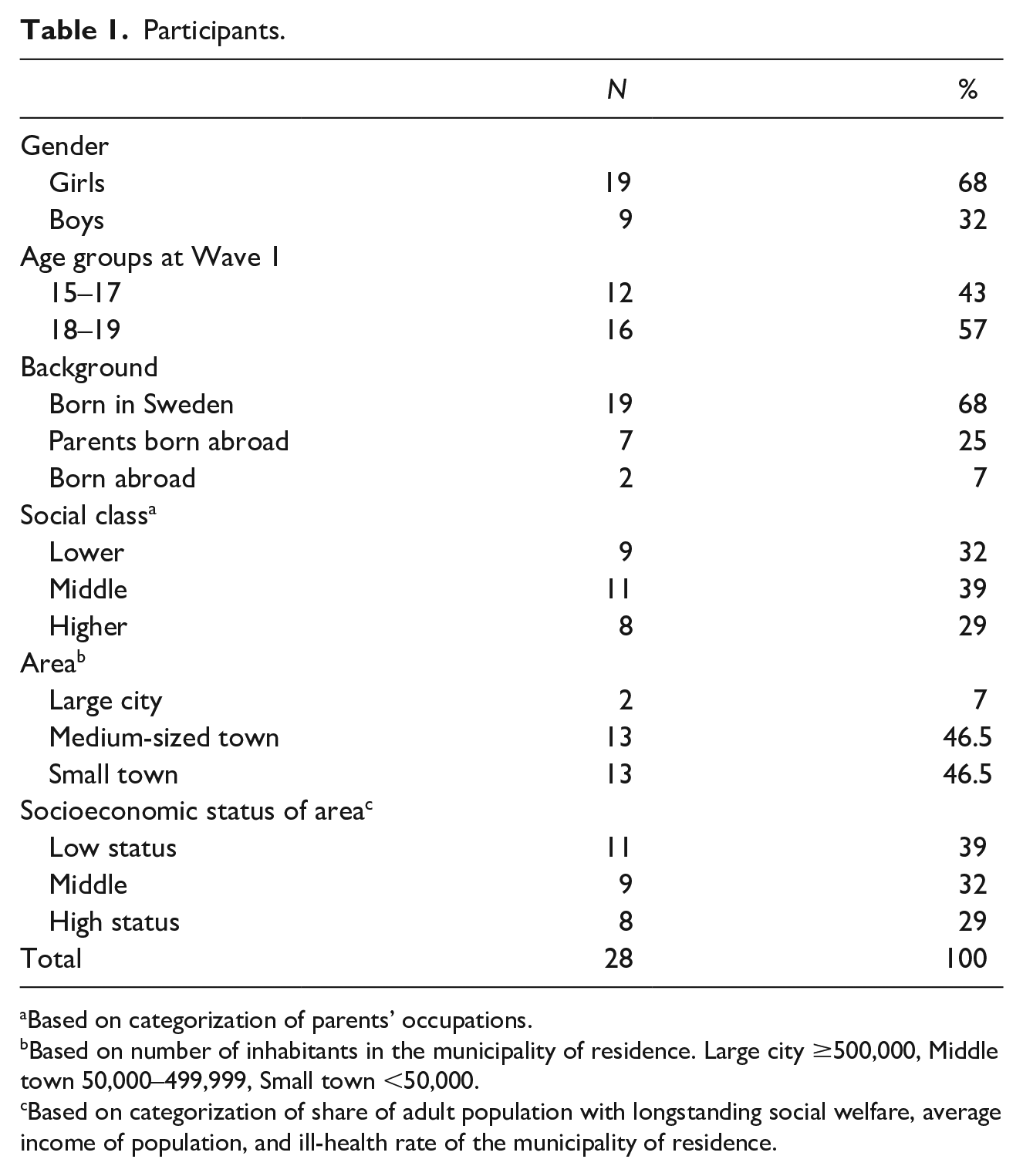
Based on categorization of parents’ occupations.
Based on number of inhabitants in the municipality of residence. Large city ≥500,000, Middle town 50,000–499,999, Small town <50,000.
Based on categorization of share of adult population with longstanding social welfare, average income of population, and ill-health rate of the municipality of residence.
We interviewed the participants three times, first in 2017, then a year later in 2018, and the last interview was conducted in 2019 about 2 years later than the first one. In waves 1 and 2, some interviews were held in pairs, if the participants preferred. In wave 1, almost all interviews were conducted face-to-face, whereas in waves 2 and 3, the majority of interviews were done over the phone or Skype.
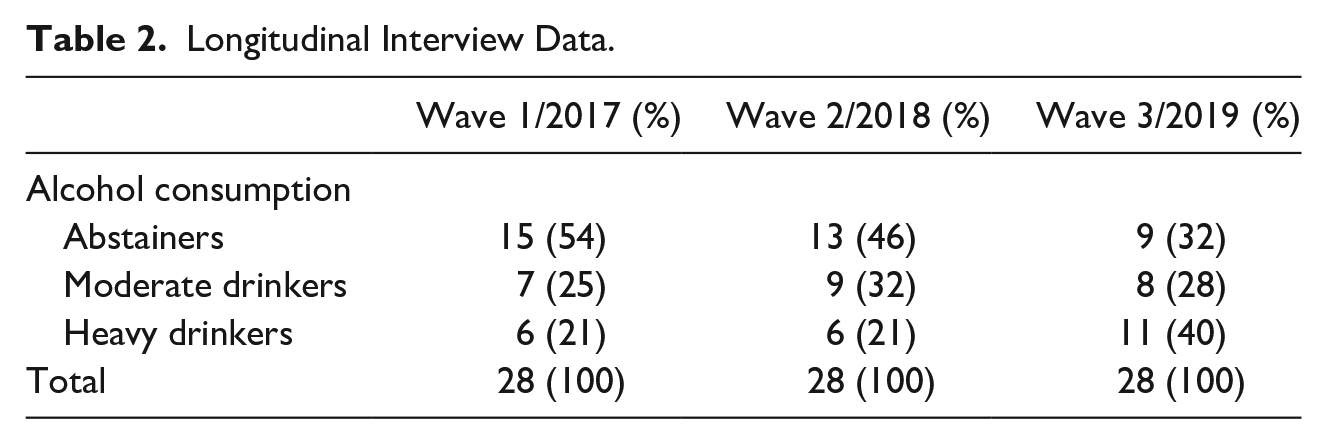
In wave 3, when the participants were 2 years older than at wave 1, eight interviewees were still in upper secondary school, 13 had started university studies, and 7 worked full-time, part-time, or were unemployed. In each interview, the participants were categorized according to their drinking practices into abstainers, moderate drinkers or heavy drinkers. A participant was categorized as a moderate drinker when s/he drank only a little and avoided intoxication and as a heavy drinker when alcohol was used for intoxication and drinking resulted in drunkenness at least once a month or more often. As shown by Table 2 below, the participants’ relation to alcohol changed during the study period from 2017 to 2019. The most significant change in relation to alcohol is the decreasing share of abstainers from first- to third-wave interviews.
Longitudinal Interview Data.
Interviews
We conducted the interviews (lasting between 20 and 90 minutes) face-to-face or over Skype or phone between 2017 and 2019. In the first wave, the interviews were based on semi-structured open questions. We asked the participants to tell us how they spent their leisure time, understood health, carried out healthy practices, used social media, had fun through drinking or abstinence, and dealt with parental rules about drinking. Furthermore, we asked the participants to describe similarities and differences in boys’ and girls’ drinking and why emerging adults may choose to drink less or abstain from alcohol. In the second wave of interviews, we focused on how emerging adults identify with heavy drinking or oppose it with competing activities. To cover all the important aspects in these issues, we used pictures as vignettes that represented emerging adults drinking heavily in diverse private or public contexts or practicing competing activities in family life, leisure time, social time, exercising, and using social media situations (Pennay et al., 2018). Together with the vignettes we posed questions such as whether a particular situation was familiar to them or among their friends; whether they could identify with the characters; what was going on in the situation; and how the events could continue. The vignettes and questions evoked our participants to tell in detail and in context-sensitive way how their everyday life practices were related to drinking or opposed it by competing activities (see Rose, 2016). In the third wave of interviews, we mapped the ways in which our participants’ practices of drinking or competing activities had stayed the same or changed from the time of the earlier interviews, and what their expectations were for the future. The interviews were conducted by the second, third, and fourth authors. The interviewers were around 40 years of age, which might have influenced what the participants wanted to share in the interview situation.
Analysis, Limitations, and Strengths
The analysis progressed through two phases. First, we read the transcriptions several times and developed a coding paradigm that captured the main themes of the interviews. We then used this paradigm and the NVivo software program to analyze the whole data in order to identify typical identity trajectories that represent the variation in our data. By proceeding this way, we identified four common longitudinal trajectories. In the second phase, four cases that were representative of these trajectories and comprehensively covered the variation and richness of the sample were selected for in-depth analyses, drawing on the master narrative framework described above (McLean & Syed, 2015) and on Bamberg’s (2020) narrative positioning analysis. The coding was done by the first and the second author and the selection of the four common trajectories was based on agreement between the coders.
Of these four typical identity trajectories, Oliver’s personal narrative exemplifies an identity trajectory in which heavy drinking continues throughout the study period and functions as an important activity for maintaining, intensifying, and expanding social relations and for self-realization. It demonstrates the various reasons with which the emerging adults in our data justify their heavy drinking, also including those who start to drink heavily later (N = 11). Olivia’s and Alice’s personal narratives, again, typify drinking-related identity trajectories in which abstinence is over time replaced by moderate drinking. In Olivia’s case this change is guided by the need for self-control, whereas in Alice’s case it is led by the aspiration to organize one’s life around an activity and to become successful in it. These two trajectories capture the main reasons with which the emerging adults in our data negotiate their moderate drinking against heavy drinking or abstinence (N = 9). Besides self-control and the aspiration for success, they are related to gendered vulnerability, health, competing leisure time activities, and studies. Esther’s personal narrative, lastly, demonstrates an identity trajectory in which abstinence continues throughout the study period as a family-related political, ethical, and personal positioning. It exemplifies the principal explanations for abstinence in our sample (N = 8) by showing how abstinence is typically negotiated in relation to religious or alcoholic family background, the temperance movement, political values, or concerns with one’s mental health.
In our sample we did not have any trajectories in which drinking was reduced over time. This is one limitation of the study. Another limitation is that the interviewees were not selected based on a representative sample. Therefore, the trajectories we analyze below cannot be generalized to refer to Swedish youth in general. Thirdly, the personal narratives were produced in an interview situation where emerging adults shared them with adult interviewers. This may have affected their nature so that the participants downplayed the importance of binge-drinking practices and overemphasized the responsible and adult-like aspects in them. However, we tried to eliminate this problem by using open questions in the interviews and by asking the participants to elaborate their storylines to be more detailed in terms of contextual aspects, circumstances, characters, events, and time.
In analyzing how Oliver, Olivia, Alice, and Esther negotiate with master and counter narratives their emerging adulthood in relation to drinking, we focus on three elements: storylines, justifications, and value identifications. We first ask to what kinds of storylines our participants in the personal narratives relate their drinking or opposition to drinking and how they in these storylines navigate the similarities and differences between “me,” “us,” and “others” (Bamberg, 2020). Secondly, we trace what kinds of viewpoints our participants use to rationalize their drinking-related storylines to the interviewers (Bamberg, 2020). Thirdly, we track what kinds of master and counter narratives these drinking-related storylines comment on, make use of, and embody, and what this conveys of the participants’ sense of who they are and about their values, norms, and beliefs (Bamberg, 2020). What elements do they adapt from these master and counter narratives in their personal narratives to make their action morally respectable? How do their identifications with these elements clarify the continuities and changes of their identities over time? Overall, the analysis of these three elements—storylines, justifications, and value identifications—reveal what kinds of narrative alignments typically guide these emerging adults’ identity development in relation to drinking as well as demonstrate that longitudinal qualitative research provides a productive tool to deepen our understanding of the complexities in youth drinking practices over time (see Pennay et al., 2018).
Ethics
The project follows the ethical standards for qualitative social science research. The recruitment of the participants was based on informed consent. In the findings section, the participants have been anonymized by giving them cover names and omitting sensitive information. In the translation of extracts from Swedish to English, the original wording has been retained as exactly as possible. Ethical approval for the study was obtained from the Regional Ethical Review Board in Stockholm, Sweden (ref. 2016/2404-31/5).
Findings
Oliver
First interview
At the time of our first interview, Oliver is 19 years old. He lives at home, is doing the last year in high school and works part-time on Sundays. He is interested in movies and movie production and spends a lot of time with his girlfriend. He is a heavy alcohol consumer, partying with friends and relatives during weekends and special holidays.
Oliver habitually drinks to intoxication several times a month. On a typical night out, he and his friend first drink together at home, then visit a bar before heading to a party. He comments that his friend is “like me . . . we can both drink a lot and still function like normal . . . we both are influenced by others, so we follow how other people drink too.”
Oliver justifies his heavy drinking to the adult interviewer from many perspectives, citing various reasons and adapting multiple master narratives into his personal narrative. First, he rationalizes his drinking from the viewpoint of a student and in relation to the achievement-oriented storyline of neoliberalism. For him, intoxication provides a good counterforce against the stress caused by the studies: “As a student when I have to study a lot and I’m really very stressed (. . .) then I feel that this stress disappears all of a sudden when I get drunk.”
Secondly, by drawing on a storyline that stems from a medical narrative of ADHD, Oliver explains that heavy drinking functions as a medicine against the symptoms and hardships of having ADHD: I drink because in a sober state I’m so (. . .) control freak and I think too much (. . .). I have a typical ADHD brain (. . .) all this disappears when I’m drunk, it’s like a vacation from my mind.
Thirdly, he negotiates his heavy drinking in an age-related storyline of being an emerging adult: Sometimes I think I live in this typical teenage image that one feels immortal . . . you know, I think [that even if I drink a lot] I won’t get cancer when I get old, or Parkinson’s disease.
Moreover, Oliver endorses his heavy drinking with the traditional master narrative of gender by explaining how drinking is a liberating activity to him as a man but a control-filled concern to his girlfriend: [S]he feels she can’t really let go as I can at the pub, because she must always be aware of what’s going on behind her (. . .). I’ve always been able to drink and be inside my own world while she’s always been on the alert for what goes on around her.
Thus, at 19, Oliver aligns with the master narrative of heavy drinking by justifying it with a constellation of other master narratives. However, his alignment with heavy drinking is ambivalent, as in certain periods and situations he also distances himself from it. This ambivalence is also reflected in how he negotiates the master narrative of academic success, which either increases or reduces his drinking. Heavy drinking functions as a resource against performance anxiety, but also disturbs his studies: Studies are always a big reason why I don’t drink so often (. . .). I have noticed that, if I drink on a Saturday, so I’ll have a very hard time to fall asleep next Monday, Tuesday, and Wednesday.
He also refers to the master narrative of health as a reason to reducing his drinking: “If I drink every weekend, then my body starts to be filled with fluid.”
Second interview
A year later, when Oliver is 20 years old, he continues to negotiate his personal narrative of drinking in relation to the same storylines and master narratives as a year before. He now works full-time and thinks that he has become a more responsible actor and is more aware of the complexities of life. However, he is not studying at the moment.
Oliver still appears to have an ambivalent relation to heavy drinking. It is now complicated by a dilemma that some of his friends use only cannabis and other drugs whereas others use only alcohol. He feels that when he goes out with his drug user friends, he is forced to have a sober night and when he goes out with his drinking buddies, he indulges in drunkenness.
It’s like this (. . .). Either I’ll take it easy and have a very quiet night [with my drug- using friends], or I go out [with my drinking buddies] and indulge in drunkenness. So that’s my little dilemma.
He has no difficulties to stay sober in the social context of drug use but feels powerless in the social situation of drinking: “My problem is that I can’t say no to social invitations (. . .). Especially if there’s alcohol involved (. . .), then I rarely say no.”
He recognizes that when he drinks a lot, he gains weight and “that’s what stops” him. If he “had a high metabolism,” he “would drink a lot more.” In this way, as a year earlier, Oliver’s fear of obesity keeps his drinking in control. He also confesses to the interviewer that he feels “anxiety all the time” and is worried that he is in danger of developing an addiction to alcohol. Here Oliver aligns with the storyline of emerging adults’ mental ill-being that has lately become a considerable concern in Sweden.
At the same time, Oliver does not want to present himself as a loser but underlines having a fairly balanced life and being a person who is interested in multiple possibilities in life. His identification with the master narrative of an emerging adult is further nuanced by his sharing an occasion of “drinking a lot of Russian vodka,” which did not end well and shattered his belief that he could drink a lot without any negative effects. This experience led him to lose his belief of being immortal.
Third interview
In our third interview, Oliver is 21, still works but is now single. He drinks more than a year before but explains that his drinking has a more mature character: “It’s not any more like it was when I was younger. Then I just got drunk and didn’t understand anything. Now it feels more like it’s something I need.”
He emphasizes that intoxication makes him happy, increases his “social competence” and “self-confidence,” and keeps his emotions more balanced. In particular, intoxication helps him approach girls successfully. He summarizes that drinking “has had a positive effect” on him and made him more mature: By drinking I have encountered a lot of new experiences through which I have learnt a lot. I’ve noticed that many things I’ve said when I’ve been drunk have been charming and I’ve also used them in my work when I’ve communicated with my bosses. Weird (. . .). I also get a better sense of physical balance when I drink (. . .). So, alcohol has helped me both mentally and physically.
Thereby, as Oliver gets older, his identification with the master narrative of heavy drinking becomes less ambivalent. Moreover, he is no longer afraid of developing an addiction to alcohol. He understands that he can get his “hunt for dopamine” by other means too, such as by exercise, food, or sex. All the same, he continues to be worried that frequent heavy drinking makes him obese.
Olivia
First interview
At the time of our first interview, Olivia is 16 years old. She plays football in a team, does not drink at all and likes to spend her time with her sober friends. She opposes the master narrative of heavy drinking with the storyline that emphasizes self-control. She does not want to binge drink, because intoxication causes unpredictable behavior, which, in turn, may lead to accidents and feelings of shame: OLIVIA: [By intoxication] you get a little lost and (. . .) may not behave as usual, make impulsive decisions (. . .) you don’t really think about what you do (. . .) and you can end up wrong. Interviewer: Wrong? OLIVIA: Well, accidents may happen, and you might do something you regret.
She also opposes heavy drinking by storylines of competing activities. She thinks that it is more fun to do things such as “play football together and go to the amusement park (. . .) and eat together” than to engage in binge drinking.
Second interview
In the second interview Olivia is 18 years old. She still identifies with the storyline of self-control and is against heavy drinking but her relation to drinking has become more complex. She has started to drink moderately: I think that if you (. . .) drink in moderation, this may make you a little happier, but you still have control over your body, over the situation and what you say and do, and so on. When you drink too much, then drinking becomes harmful.
She negotiates her self-control in drinking as gendered. She believes that girls in general “maintain control” over their drinking and if they drink too much, they feel “more shame” than boys. In this way she rationalizes her moderate drinking by aligning with the traditional master narrative of gender.
Furthermore, by underlining that she “usually drink[s] a glass of wine on Fridays” with her family or when she “goes out” with her friends, she relates her drinking to a master narrative of civilized European drinking habits that especially the middle class has promoted in Sweden (Olsson & Törrönen, 2008).
Third interview
When we meet Olivia the third time, she is 19 years old. She has graduated from upper secondary school, and like a year before, drinks in moderation.
I think it’s okay to have a glass of wine, and then I can think it’s cozy to sit in places and just talk. I don’t usually drink a lot: it’s probably happened twice that I’ve gotten drunk (. . .). It wasn’t fun to be so influenced (. . .). I probably drink because it’s good and because it’s nice to just have a glass of wine, or maybe two.
However, her relation to drinking has become more relaxed and she has even been drunk a few times. Otherwise, her drinking continues to align with the storyline of self-control. She wants to have “a clear mind and control over everything.” She says that her drinking is not related to having fun but to taste and sharing a coffee-like moment with others. Drinking is a side activity in “socializing and talking,” to becoming present for the here-and-now moment.
Olivia rejects the achievement-oriented neoliberal storyline. She criticizes her friends who are in a hurry to graduate and eager to become economically successful. Instead of serving the purposes of the master narrative of neoliberal effectiveness, her storyline of self-control is embedded in a therapeutic, mental health-related trajectory. She confesses to the interviewer that she has suffered from the “perfect girl syndrome”: In school (. . .) I wanted to get the highest marks in everything, and not to do anything wrong or say anything wrong. And in the end, I just felt a lot of anxiety (. . .) got stressed and finally thought about quitting (. . .). This made me realize that I don’t need to be the best at everything (. . .) that my health and mood are more important. And after that I’ve gotten better and better.
By taking care of herself—such as having a break from her studies, not planning her future too much, trying to “take every day as it comes,” focusing more on the present, and getting to know her own boundaries—she has made some progress. Thus, as Olivia gets older, her opposition to the master narrative of heavy drinking becomes intertwined with the opposition to the gendered expectations of the neoliberal master narrative and transformed into a counter narrative in which “finding her true self,” maintaining mental health, and living in the “now” act as the main protagonists.
Alice
First interview
At the time of our first interview, Alice is 18 years old. She is an elite-level athlete. During the week she studies in upper secondary school and works weekends in a flower shop. She has a health-oriented, regularly exercising family, and wants to become a doctor. When she turned 18, she could have started to drink a little, but chose to stay sober. She justifies her abstinence by aligning with various storylines that oppose drinking or intoxication.
Before competitions we have a ban on alcohol a month before, as alcohol affects your performance (. . .). I don’t want to lose control either (. . .), I think it feels unpleasant (. . .) Then I like to do other things more.
She also motivates her soberness by arguing that drinking is harmful to your liver and disturbs your studies. Moreover, she thinks that in her neighborhood most of the emerging adults drink too much and she wants to stand out from them.
Second interview
A year later, at 19, Alice still abstains from alcohol. She has completed her studies in upper secondary school and is working in a hospital as a department assistant. The main reason for her soberness comes from her continued dedication to being successful in sports, which as a competing activity sides with the values of neoliberal society and influences powerfully her other storylines in life. She has been in some situations where she has felt a desire to drink but she has not done it because she has needed to go to “work early the next day” and she has also had her “training the day after.” She further justifies her soberness by arguing that drinking is harmful to health, as she did a year earlier.
Currently, succeeding in elite sports efforts is her chief goal in life. Her main problems are also related to this: I tend to set the bar too high (. . .) by thinking that “if I want to become part of the national team, I must do everything perfectly.” Then I also reason that goals should be reasonable (. . .) it’s inhuman to have too high goals.
Third interview
In the third interview Alice is 20 years old. She has achieved her goal of sporting success on elite level and started her studies at the university. Her attitude to drinking has changed. She explains that she is now more permissive toward alcohol and considers the boundary between drinking and non-drinking “less oppositional” and less one-dimensional than before.
She drinks moderately with a male friend and with her team members. She reckons that moderate drinking helps her get to know her boyfriend better. She thinks that drinking not only enhances social relations. A drink is good “to have with the food as well. Then (. . .) it feels a bit extra luxurious (. . .) you get a little this relaxed air (. . .) and things may become a little more fun.”
Also, Alice is now less judgmental toward heavy drinking and less afraid of situations in which her peers drink a lot. For example, she often experienced panic in parties where people’s behavior changed as they got drunk. She felt that “I need to leave, this isn’t fun, I don’t want to be here,” even if she also had a strong desire to stay and dance. Then one day, with the support of her sister she stayed and started to dance. At first, dancing felt “uncomfortable” but then she started to “enjoy it a lot.” This event in which she “managed to overcome” her “poor self-confidence” was very liberating to her, a kind of turning point by which she gained self-confidence to relish new experiences.
Thus, as Alice gets older, her relation to the master narrative of elite sports—that sides with the values of neoliberal society—becomes more flexible. This expands her life spheres and diversifies her experiences. She is willing and more confident to negotiate with other storylines in life. Her master narrative of elite sports becomes influenced by other popular master narratives among emerging adults. This empowers her to gather social capital to party, to deepen her romantic relationship, and to live more in the moment.
Esther
First interview
In our first interview Esther is 19 years old. She has many hobbies and is politically active: she likes board games and belongs to board games clubs; does climbing, running, and badminton; plays in an orchestra; and is active in a youth sobriety association. She says that early on already, when her most popular classmates started to binge drink at the age of 13, she “did not want to be part of it”: I looked down on them (. . .). I made it clear that I didn’t want to be the stereotypical teenager (. . .) We were four people who didn’t really fit into that. One of us was raised with punk parents who listened to Ebba Grön (Swedish punk band) (. . .). We became an alternative group.
Because of her opposition to heavy drinking, she faced a lot of peer pressure to drink. Some of her peers thought that she had been “brainwashed” to regarding as abnormal something that is normal for being young. But there were also peers who aligned with her opposition. In her experience, boys contested the practices of heavy drinking by referring to the “health-oriented” master narrative of building “perfect muscular bodies” while girls’ disapproval was based on the traditional master narrative of gender according to which girls have to avoid intoxication as it makes them vulnerable to a masculine “culture of rape.”
She further justifies her soberness by identifying with the political values of the left. She argues that capitalism, which includes the alcohol industry, exploits “the third-world countries” and “the weak.” She maintains that in the third-world countries “many alcohol companies target very hard, like, 10-year-olds because they don’t have the same alcohol laws” there.
Esther also relates her soberness to her parents’ soberness. She says that her grandfather was an alcoholic and her mothers’ family struggled with poverty, which she thinks has pushed her toward soberness and leftist values.
Second interview
In the second interview Esther is 20 years old. She studies at the university to become a dentist. She still identifies with her counter narrative against emerging adults’ heavy drinking and opposes the master narrative of neoliberalism that, according to her, promotes unethical entrepreneurship. Moreover, her identification with the storyline of leftist political action remains strong.
However, her connection to the youth sobriety association has weakened. She thinks that the members of the association are “nerds” whose relation to alcohol is too one-sided because of their unhappy childhood with drinking parents or because of their own addiction. At the same time, her attitude toward drinking has become more nuanced. She no longer thinks that “all drinking” is bad for you but understands that alcohol can contribute to “fun” and “positive” things, too—especially when you “take a glass of wine” and become only “a little influenced.” She also goes to drinking parties more than she used to but leaves them when “people cross the border from being fun to becoming annoying,” which is around 11 pm.
Furthermore, she believes that religion provides a good and legitimate reason not to drink. She describes being happy to meet people in parties who abstain for religious reasons because they are easy to “bond with.”
Esther has a desire “to be a role model for the world.” She had a friend who drank so much that her liver was damaged and to whom the doctor said that she had to stop. The friend came to her and asked her to teach her how to live soberly. She enjoyed doing this, but not as a campaigner: “I would never want to go around advocating soberness, but I just want people to have it in their subconscious that there are alternatives. Drinking doesn’t have to be normal.”
Third interview
At the age of 21, Esther continues her dental studies. She is still sober, lives together with a non-drinking boyfriend, and opposes heavy drinking by identifying with the same constellation of counter and master narratives as earlier. She still likes to participate in drinking parties but instead of leaving them at 11 pm like the year before, she now stays in these parties until 1 am.
She confesses to the interviewer that besides political and family reasons her soberness is based on psychological and health reasons. She does not want to start to drink because she believes that it would make her “a less stable person” and would complicate her “sleeping problems,” aggravate her “periods of depression,” and increase her “anxiety.” Because of her grandfather’s alcoholism, she also believes that she has a genetic predisposition to dependence, which increases her fear to experiment with alcohol. She thinks that as her life as a student is already lived in a “stressful environment,” she does not want to complicate the situation by taking “unnecessary risks” that could lead to a “misuse of alcohol.”
Thus, as Esther gets older, her counter narratives against the master narrative of drinking become more dialogical and nuanced. She no longer opposes drinking exclusively for ideological, political, and family-related reasons but also for personal reasons, and her storyline of soberness opens up to interaction with diverse social, psychological and health-related master narratives.
Discussion and Conclusions
The analysis shows that our emerging adults negotiate their drinking-related maturing trajectories in relation to multiple master and counter narratives (Smith & Dougherty, 2012). As relational patterns of diverse narrative storylines, justifications, and value identifications, they are typically ordered around an overarching storyline that as a red thread and a cohering contextual space provides continuity to the participants’ maturing process, and affects how they understand their drinking-related responsibilities, agencies, and identities.
In our data, Alice’s personal narrative is a typical example of a relational pattern of master and counter narratives that excludes heavy drinking and keeps drinking in moderation. In her personal narrative, the goal to achieve success in sports functions as a master narrative that creates the primary storyline to her maturing process in relation to alcohol. It aligns this process with the values of neoliberal society. Alice’s storyline of becoming successful in sports first intersects with health- and control-related storylines so that she chooses to stay sober in opposition to the majority of her binge-drinking peers. Later, her identification with the storyline of elite sports loses its strict opposition toward drinking, making room in her life for the storyline of moderate drinking. Guiding Alice’s identity development, these narrative identifications do not allow any agency for heavy drinking, and when Alice starts to use alcohol, they channel the responsibilities, activities, and identifications in drinking toward moderate consumption.
Olivia’s personal narrative is another characteristic example of a relational pattern of master and counter narratives in our data that excludes heavy drinking and favors drinking in moderation. In Olivia’s developmental identity trajectory, the governing master narrative is related to self-control that provides the principal storyline to her maturing process. In her personal narrative, she first opposes both heavy and moderate drinking and engages instead in competing storylines of having fun. Later she realizes that moderate drinking is not a threat to her need for having control over her body and circumstances, but rather makes her feel a little happier and contributes to a sense of coziness in intimate interaction. Moreover, she relates her storyline of self-control to the middle-class values of civilized drinking habits and personifies it toward a therapeutic quest for mental well-being in opposition to the achievement-oriented neoliberal storyline. These narrative identifications weave in her an agency which foreground responsible, controlled, and adult-like drinking.
In contrast to Alice and Olivia, Oliver’s personal narrative in our data illustrates a typical example of a relational pattern of master and counter narratives that promotes heavy drinking. Oliver’s trajectory of identity development demonstrates the maturation process in which heavy drinking forms a dominant storyline to adulthood. In his personal narrative, the storyline of heavy drinking intersects with the storylines of studies, health, friendship, masculinity, and self-knowledge. Through heavy drinking Oliver discovers his full potential, medicates his AHDH, strengthens his friendship ties, takes care of his stress, and fortifies his masculine identity. However, because Oliver also knows that heavy drinking is a risk-taking activity and harmful to health, his identification with the master narrative of heavy drinking is tempered by the alignments with the neoliberal and health-related master narratives. Overall, in Oliver’s identity trajectory heavy drinking acts as a resource that increases his agency in romantic and social relationships, and helps him discover his authentic identity.
In turn, Esther’s personal narrative in our data is a characteristic example of a pattern of master and counter narratives that supports soberness. Esther’s developmental identity trajectory epitomizes a maturation process in which opposition to heavy drinking forms a central storyline to adulthood. Esther motivates her counter narrative against the practices of heavy drinking with political, ethical, and family-related storylines. Through soberness she opposes her peers’ binge drinking, resists the mainstream values of capitalism, and expresses loyalty with her parents. Later her storyline of soberness is also endorsed by mental health-related worries. On the whole, in Esther’s identity trajectory, the practices of heavy drinking represent an enemy. By fighting against this, her agency is empowered and activated toward sobriety and leftist identity politics.
Besides representing typical trajectories in our data, the four cases analyzed also illustrate the common sets of master and counter narratives from which the participants who belong within the same trajectory usually draw when negotiating their identity development in relation to alcohol. Our participants who prefer to binge drink throughout the study period or become heavy drinkers, are inclined to emphasize its importance for maintaining, intensifying, and expanding social relations, for providing fun against the stress and for facilitating self-realization. The participants who turn from abstinence into moderate drinkers tend to negotiate their opposition to heavy drinking with counter narratives of self-control, gendered vulnerability, legal age of drinking, (mental) health, and mature sociability, as Olivia does, or by developing their everyday life practices around storylines of competing activities, such as computer gaming, studies, fitness, or elite sports, as Alice does. Lastly, the participants who continue to be abstinent throughout the study period typically negotiate their opposition to heavy drinking by identifying with religious or alcoholic family background, by participating in the temperance movement, by relying on political values that are critical toward alcohol industry or by being concerned with one’s mental health or genetic disposition to addiction.
In line with the earlier studies, our results show how in the maturing process emerging adults’ relation to drinking becomes more nuanced (Kloep et al., 2001; Macmillan, 2006). As they get older, they become familiar with their authentic selves and learn to make better-informed independent choices (Caluzzi et al., 2020). Their understanding of the complexities of life deepens, and they turn to developing competencies and skills to carefully manage their diverse social networks, goals, and projects (Månsson et al., 2020). Moreover, in line with the existing research, our results confirm that there are multiple master narratives that may act as powerful counter or alternative narratives against heavy drinking and contribute to the decline in youth drinking. In our data these master narratives are related to neoliberal performance culture, individualization, health, gender, competing activities, fitness and sports, political values, temperance ideology, religion, and parental relations (Pape et al., 2018; Kraus et al., 2020).
As a contribution to the existing body of literature, our results demonstrate how responsibility, authenticity, agency, and control in drinking mean different things among emerging adults depending on what kinds of patterns of master and counter narratives they are embedded in; to what kinds of values, norms, and identifications they are then linked; and how they then guide emerging adults’ identity navigation over time. Further studies are needed to establish at the population level how prevalent the trajectories we have identified here are among emerging adults and in what way they intersect with gender, social class and ethnicity. Further studies are also needed to examine how the identified trajectories function across different youth drinking cultures and geographical contexts. Moreover, the drinking trajectories of emerging adults who attempt to reduce their alcohol consumption after running into problems with heavy drinking provide an important topic for further research.
Footnotes
Declaration of Conflicting Interests
The author(s) declared no potential conflicts of interest with respect to the research, authorship, and/or publication of this article.
Funding
The author(s) disclosed receipt of the following financial support for the research, authorship, and/or publication of this article: This work was supported by the Swedish Research Council for Health, Working Life and Welfare, under Grants no. 2016-00313 and 2020-00457.
