




Abstract
Perceptions and experiences with biological father absence might vary depending on the extent to which father absence constitutes a common family form, like it does in many Caribbean countries. The goal of this qualitative study was to better understand what it means to grow up without a father for Curaçaoan (n = 19; 15–24 years), Curaçaoan-Dutch (n = 15; 14–29 years), and Dutch (n = 16; 16–26 years) young men and women. Findings from thematic analyses of ethically approved in-depth interviews revealed that most interviewees from all three cultural groups perceived no bond with and upbringing from their absent father. The interviewees noted emotional pain, but also mentioned that (m)others compensated for their father’s absence. Dutch interviewees were more negative about their absent father, and both Dutch and Curaçaoan-Dutch interviewees experienced more difficulties with respect to their father’s absence compared with Curaçaoan interviewees. Studying the similarities and differences between perceptions and experiences with father absence enriches our knowledge of what it means to grow up without a father. Doing so from young people’s point of view and across cultures has important practical value by providing a fuller understanding of the meaning of father absence for young people across cultures.
Ever since Draper and Harpending’s (1982) attempts to explain the role of deliberate physical absence of a biological father as antecedent of variation in life history, father absence has been of interest to researchers. Usually defined as significantly reduced contact between father and child and decreased father involvement in providing care and education through parental divorce—not paternal death—father absence has been portrayed as disadvantageous for a range of child developmental outcomes (see, for example, McLanahan et al., 2013).
Although Draper and Harpending (1982) already highlighted a distinction between normative and contra-normative father-absent societies, most research has focused on Western societies and lacked comparisons with societies where father absence is more common, like in many Caribbean countries. Moreover, research into father absence is mainly quantitative, lacking systematic information about how father absence is perceived and experienced by their children.
Given that the development of social and personal identity and the building of interpersonal relationships intensifies through the teens and early to mid-20s, the periods of adolescence and emerging adulthood are key in young people’s development (e.g., Arnett, 2014). Challenges around identity formation are prominent during these times and might be associated with mental health problems such as anxiety, depression, and substance use (Arnett, 2007; Erikson, 1950). Father-absent adolescents and young adults might be an especially vulnerable group, because they are often less well able to draw on their father as a role model for identification, and their relationship formation models are influenced by their parents’ separation (Grusec & Hastings, 2014).
What is unclear, however, is whether such effects of father absence on adjustment and well-being of adolescents and young adults are universal or culture-specific. Much of what we know about father absence comes from studies in societies where father absence is relatively uncommon, while young people’s perceptions and experiences might be different in cultures where father absence is more common and where other family members are more involved in child-rearing. The present study addresses this gap in knowledge by qualitatively comparing how young people perceive and experience biological father absence across three cultural contexts that differ in terms of how normative father absence is: the Netherlands, Curaçao—historically linked to the Netherlands—and Curaçaoan migrants in the Netherlands.
Father Absence as a Family Form
Although most children in Western societies grow up in a nuclear family with a primary caregiver mother and a secondary caregiver father, this family form is not universally common (see, for example, Abraham & Feldman, 2018). Many other child-rearing forms and types of families can be found across cultural communities around the world, and cultural diversity exists within and between societies regarding father involvement and involvement of the extended family network in child-rearing. An example of a society with a high occurrence of father-absent homes and extended family involvement is the Caribbean island of Curaçao.
Curaçao is a Lesser Antilles island in the southern Caribbean Sea that is a constituent country of the Kingdom of the Netherlands, and counts approximately 150,000 inhabitants with an Afro-Caribbean majority (Central Bureau of Statistics [CBS] Curaçao, 2014). Throughout history, fathers on Curaçao have played a marginal role in the upbringing of their children. The normativity of father absence on Curaçao is thought to have originated during the slavery period (Marcha & Verweel, 2005), when male slaves were not allowed to act as fathers for their children (Allen, 2009), but continued after the abolition of the slavery in 1863 when many former male slaves migrated from the Dutch Caribbean islands due to their poor economic situation. Despite punitive measures of the Catholic Church and rewarding measures of multinationals such as the Shell Company trying to impose the ideals of the nuclear family on the Afro-Caribbean population, still to date, fathers are absent in a substantial segment (about 40%) of Curaçaoan families (CBS Curaçao, 2014). Yet, most single mothers accept that fathers play a marginal role in the upbringing of their children and are proud to raise their children alone (University of the Netherlands Antilles, 2010). In addition, involvement of the extended family consisting of grandmothers, aunts, and other (female) relatives in the upbringing of children is common on Curaçao (Abraham, 2013).
The Netherlands counts approximately 17 million inhabitants, and father absence occurs in only one in 10 of Dutch families (CBS, 2015). Even though 30% of the Dutch children under age 18 witness the separation of their parents, most fathers stay closely involved in the upbringing of their children (e.g., Bakker, 2015). What is more, over the last decade, more and more divorced Dutch parents have continued to live close to each other, and, increasingly, many children live with both parents alternately on an equal or nearly equal basis, which is also encouraged by Dutch legislation (CBS, 2020).
Because of ongoing migration processes since the 1960s, Antilleans from the Lesser Antilles Aruba, Bonaire, Curaçao, Saba, Sint Eustatius, and Sint Maarten are now the fourth largest migrant group in the Netherlands (n = ~170,000), with most of them from Curaçao and with almost half of fathers absent (CBS, 2015). Once in the Netherlands, extended family networks that provide role models and help raising the children have become less common due to individualization and migration (Abraham, 2013). Besides, even though separation and father absence have increased in the Netherlands, they are still stigmatized by traditional views (Van Dijke et al., 1990).
Effects of Father Absence
A large body of quantitative literature on predominantly Western societies has linked biological father’s absence to a broad range of implications for young people’s physiological and psychological development, often focusing on facets of reproductive development and on girls. For instance, father absence has been associated with earlier age at menarche, earlier age at first intercourse, and earlier age at first birth among young women from the United Kingdom and the United States, Bangladesh, and South Africa (Anderson, 2015; Culpin et al., 2015; Schlomer & Cho, 2017; Shenk et al., 2013).
Other studies found no consistent link between father absence and facets of reproductive development among young people from Curaçao, Malaysia, the Philippines, and the United States (Kyweluk et al., 2018; Sheppard et al., 2014; TenEyck et al., 2019; Van Brummen-Girigori & Buunk, 2015). Moreover, some of the differences found in Australian, North American, and South African samples were explained by country and ethnic or racial background (Anderson, 2015; Barbaro et al., 2018; Boothroyd & Cross, 2017; Sear et al., 2019; Yermachenko & Dvornyk, 2014).
Although the body of literature is less voluminous, father absence also has been related to other indicators of sexual behavior, such as higher number of sexual partners, higher intrasexual competitiveness, and higher jealousy among young people from the United States and Curaçao (Salmon et al., 2016; Schlomer et al., 2019; Van Brummen-Girigori & Buunk, 2016; Van Brummen-Girigori et al., 2016). Furthermore, father absence has been linked to lower educational attainment, more negative social-emotional outcomes such as increased externalizing problem behavior, and more financial hardship while growing up among young people from the United States (McLanahan et al., 2013). Yet, also for these correlates, results are mixed (see, for example, Van Brummen-Girigori & Buunk, 2015).
In balance, the quantitative literature to date points to a relationship between father absence and reproductive development as well as other, largely negative, outcomes. Mixed results and the focus on a limited set of outcomes, quantitative research methods, and single societies, which impede comparative conclusions, however, call for a more diverse and culture-sensitive perspective. Surprisingly, little cross-cultural comparative research has yet been conducted. Only one study compared Creole-Surinamese with Dutch adolescents in the Netherlands and found that both groups showed decreased well-being, but that Creole-Surinamese adolescents’ academic performance and externalizing problem behavior were less strongly related to their father’s absence compared with Dutch adolescents (Distelbrink, 2000).
To better understand differences in antecedents of father absence that might be explained by country and ethnic or racial background, the present study qualitatively compared young people from a cultural context in which father absence is more common (Curaçao) with a cultural context in which father absence is relatively uncommon (the Netherlands). In addition, young people living in the Netherlands but with a Curaçaoan background were studied. Since knowledge of father absence across societies is scarce, and, therefore, formulating assumptions for straightforward associations is difficult, a qualitative approach was deemed suitable.
Qualitative Accounts of Perceptions and Experiences With Father Absence
In contrast to the wealth of quantitative research on father absence, there is limited qualitative research examining perceptions and experiences with father absence. The few available studies are mainly retrospective and identified a broad range of negative perceptions and experiences with father absence. For instance, with respect to perceptions, absent fathers were perceived undedicated to their children in studies among adult men and women from Colombia, Jamaica, South Africa, and the United States (Ávila-Navarrete et al., 2017; Green et al., 2019; Marote, 2011; Peyper et al., 2015). Also, adult men and women from Australia, Jamaica, South Africa, Tobago, and the United States perceived their father’s absence had hurt them and described feelings of abandonment, anger, grief, and loss (Atwell, 2018; Buckley, 2018; Dillon, 2015; East et al., 2014; Makofane, 2015).
Importantly, contextual variation appeared to influence how absent fathers were perceived among adult men and women from Jamaica, South Africa, Tobago, and the United States (Arditti et al., 2019; Dillon, 2015; Green et al., 2019; Makofane, 2015). Familial complexities such as re-partnering, moving, and fathers having children in multiple households seemed to connect with less perceived involvement of absent fathers but adaptive strategies on the part of family members to fill fathering roles (e.g., Arditti et al., 2019). Moreover, positive as well as negative messages passed down mainly by mothers also affected how father absence was perceived (see, for example, Marote, 2011).
With respect to experiences with father absence, several responses to father absence emerged across studies. Studies among adult men and women from Jamaica, South Africa, Tobago, and the United States found alternative male role models and other supports, such as mothers, stepfathers, grandparents, aunts/uncles, to help in redefining families and children becoming resilient to negative effects of father absence (Dillon, 2015; Green et al., 2019; Land et al., 2014; Makofane, 2015). Notably, only maternal extended families were of importance and specifically within Caribbean matrifocal societies, women were expected to fill gaps left by an absent father, indicating that cultural normativity exists in this regard (Dillon, 2015). Another response to father absence was found among adult men and women from Jamaica and the United States, who forgave their fathers and tried to reconstruct their relationship (Buckley, 2018; East et al., 2007).
Even though many studies reported that father-absent children became resilient to the negative outcomes of father absence, several studies found that the status as father-absent child had influenced their life courses and decisions in several ways. Firstly, commitment and attachment issues and “promiscuity” in relationships with men were mentioned by father-absent adult men and women from Australia, Colombia, Jamaica, South Africa, and the United States (Ávila-Navarrete et al., 2017; Boyd, 2018; Buckley, 2018; East et al., 2014; Peyper et al., 2015). Secondly, father-absent children from the United States planned to make a better life for their own children (e.g., Brown, 2018; Wilson et al., 2016). Thirdly, father absence negatively affected childrens mental health, such as resulting in identity and self-esteem issues and depression among men and women from Australia, Jamaica, South Africa, and the United States (Buckley, 2018; Dickerson, 2014; East et al., 2014; Peyper et al., 2015).
Contributing to a body of work on father absence that is, thus far, predominantly quantitative, retrospective, and based on female samples lacking cross-cultural comparisons, the present study aimed to investigate whether young men’s and women’s perceptions and experiences with biological father absence vary with respect to the occurrence of father absence in their cultural context. To this end, we included Curaçaoan, Curaçaoan-Dutch, and Dutch young people in their teens and early to mid-20s. The inclusion of Curaçaoan-Dutch young people contributes to the strength of the present comparative design, because this group may experience conflicting sociocultural norms regarding father absence and involvement.
Method
Participants
The study reported here was approved by the ethics committees of the University of Curaçao and the University of Groningen, and conducted on Curaçao and in the Netherlands. The final sample consisted of 19 Curaçaoan (58% female), 15 Curaçaoan-Dutch (60% female), and 16 Dutch (81% female) young people between 14 and 29 years old. Except for one, parents of all Curaçaoan participants were born on Curaçao, all Curaçaoan-Dutch participants had at least one parent born on Curaçao, and parents of 13 of 16 Dutch participants were born in the Netherlands. Table 1 summarizes participants’ sex, mean age, mean age of father absence, and self-reported socioeconomic status (SES) and ethnicity.
Young People’s Demographic Characteristics.
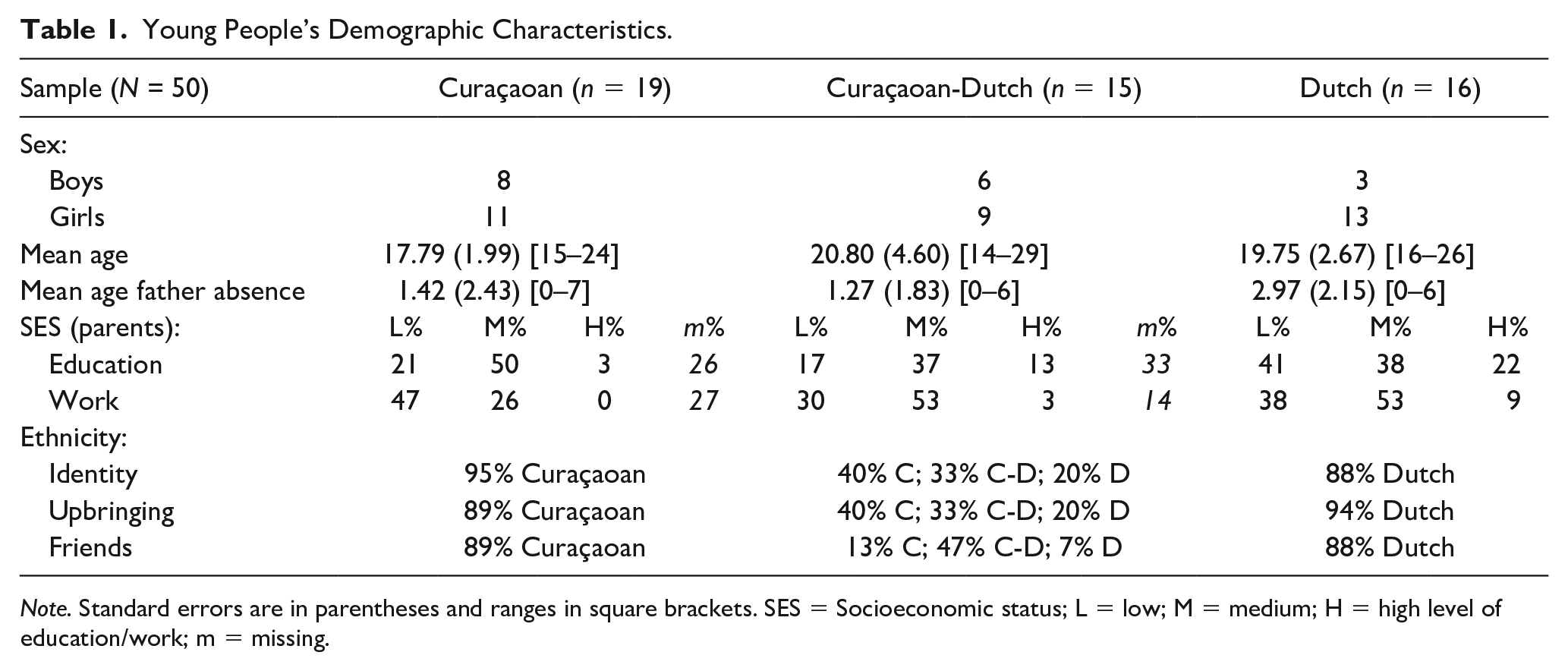
Note. Standard errors are in parentheses and ranges in square brackets. SES = Socioeconomic status; L = low; M = medium; H = high level of education/work; m = missing.
We assessed participants’ SES by their parents’ highest completed level of education and work situation or level and divided both measures into low, medium, and high (Volksgezondheidenzorg.info, 2019). With low, we refer to primary school education, respectively, unemployment or employment with simple routine tasks. With medium, we refer to higher general secondary-, pre-university-, or intermediate vocational education, respectively, employment with moderate to complex tasks. With high, we refer to higher professional education or university, respectively, employment with complex and specialized tasks. We determined ethnicity by asking participants whether they felt their identity, upbringing, and friends were rather Curaçaoan, Curaçaoan-Dutch, Dutch, or otherwise.
Procedures
We recruited respondents using multiple offline and online strategies: through advertisements, community centers, gatekeepers, schools, and snowballing. Recruitment flyers asked respondents: “Are you between 16 and 20 years old and did you (partly) grow up without your father at home?” and provided researcher contact details. When potential respondents contacted the researcher, we provided them with an information letter and informed consent form and invited them for the interview at a place of their choice. Most interviews took place in a café or at the respondent’s home. All respondents gave their written consent to participate.
Respondents were included in the study when they had grown up without their biological father present at some point before the age of 8, an often-proposed age cut-off (see, for example, Gaydosh et al., 2018). Father absence had to be due to separation or divorce of the parents and not due to, for instance, paternal death or labor migration. We initially sought to only recruit respondents between 16 and 20 years old, whose grandparents had also been born on Curaçao and in the Netherlands alternatively, but these criteria hampered recruitment too much and were loosened. Each interviewed young adult received 20 Antillean Guilders (Curaçao) or €10 (the Netherlands currency approximately equivalent to US$12) cash compensation.
Inclusion in the study started in the spring of 2018 and lasted for 1 year. The first author interviewed all but two Dutch respondents, and trained six Curaçaoan and three Curaçaoan-Dutch interviewers to conduct the interviews with Curaçaoan respondents on Curaçao, and Curaçaoan-Dutch respondents in the Netherlands. Since all Curaçaoan and Curaçaoan-Dutch interviewers were fluent in both Dutch and Papiamentu, we evaluated and adjusted the interview questions during interview trainings and pilot interviews to ensure cross-cultural equivalence as much as possible. Interview duration was between 16 and 121 minutes, with an average of 50 minutes. Curaçaoan interviews lasted on average 37 minutes, Curaçaoan-Dutch interviews lasted on average 55 minutes, and Dutch interviews lasted on average 62 minutes.
Interviews consisted of three sections and started with questions on place and year of birth, parents’ highest completed level of education and work situation/level, and participants’ household composition from age 1 to 15 to assess whether and when participants cohabited with their biological parents and potentially other (family) members. Next, we asked participants to describe their absent biological father by asking, “What kind of person is/was your father?” We continued with questions about their bond with him (i.e., “What is the contact/bond between you and your father like?” and “What do you think of this contact/bond?”) and the upbringing by him (i.e., “How would you describe the upbringing by your father?” and “What do you think of this upbringing?”). We asked the same questions with respect to the biological mother. We also asked participants what it was like for them to grow up without their biological father, what they think of themselves growing up without him, and the potential role others played in their upbringing. Finally, we asked additional background questions about participants’ ethnic identity and network, their school experiences, and, if applicable, their migration history.
Coding and Analysis
The first author transcribed all recorded interviews in Dutch using F4Transkript and trained and monitored research assistants on Curaçao and in the Netherlands in transcribing and translating recordings in Papiamentu. The first and second authors organized, coded, and analyzed the interview data in ATLAS.ti 8 and identified initial codes both deductively and inductively (Braun & Clarke, 2006). More specifically, we developed a coding scheme based on, on the one hand, the interview questions from the topic list. An example of a deducted main analytical category was “Bond between respondent and absent father,” coming from the verbatim interview question, “What is the contact/bond between you and your father like?” In addition, the coding scheme consisted of inducted codes based on responses of respondents. An example of an inducted code was “Respondent knows little about absent father,” which was identified based on responses showing that respondents hardly knew any details or characteristics about their father.
Based on the first five interviews, the first author proposed a preliminary coding system to the second author. After some adjustments based on feedback from the second author, the first author trained the second author and a third coder in using this pre-agreed coding system. Subsequently, all three coders independently coded the three same interviews and met on several occasions to discuss their codes and to resolve discrepancies. After all three coders coded the third interview, we measured intercoder agreement for all our semantic domains (Krippendorff’s α = .803; Friese, 2020). Since codes overlapped in the vast majority of cases (80%), the first author continued to code individually. When the first author had coded all transcripts, the second author reread several of them to check whether they agreed to the coding. In the few cases where the second author disagreed, the first author carefully reexamined the coding and made a final decision.
We ordered all statements of respondents belonging to a specific code corresponding to the frequency of occurrence and systematically compared, weighted, interpreted, contrasted, and eventually synthesized them (Silverman, 2006). Based on the constant comparison method (Corbin & Strauss, 2014), we synthesized these codes into themes, which we describe as follows. See Tables 2 to 5 for the code-occurrence per cultural group. Codes that were mentioned less often than once per cultural group were excluded.
Young People’s Perceptions of Their Absent Father.
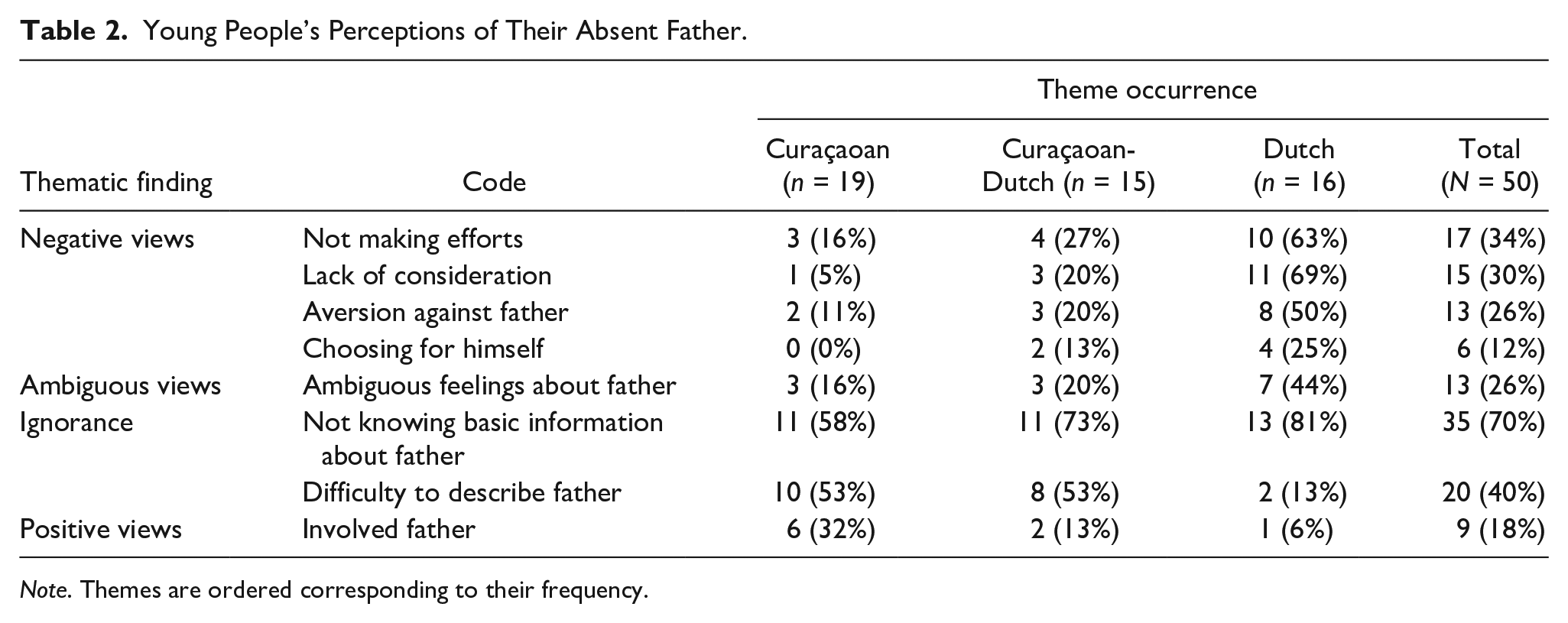
Note. Themes are ordered corresponding to their frequency.
Young People’s Perceptions of the Bond With Their Absent Father.
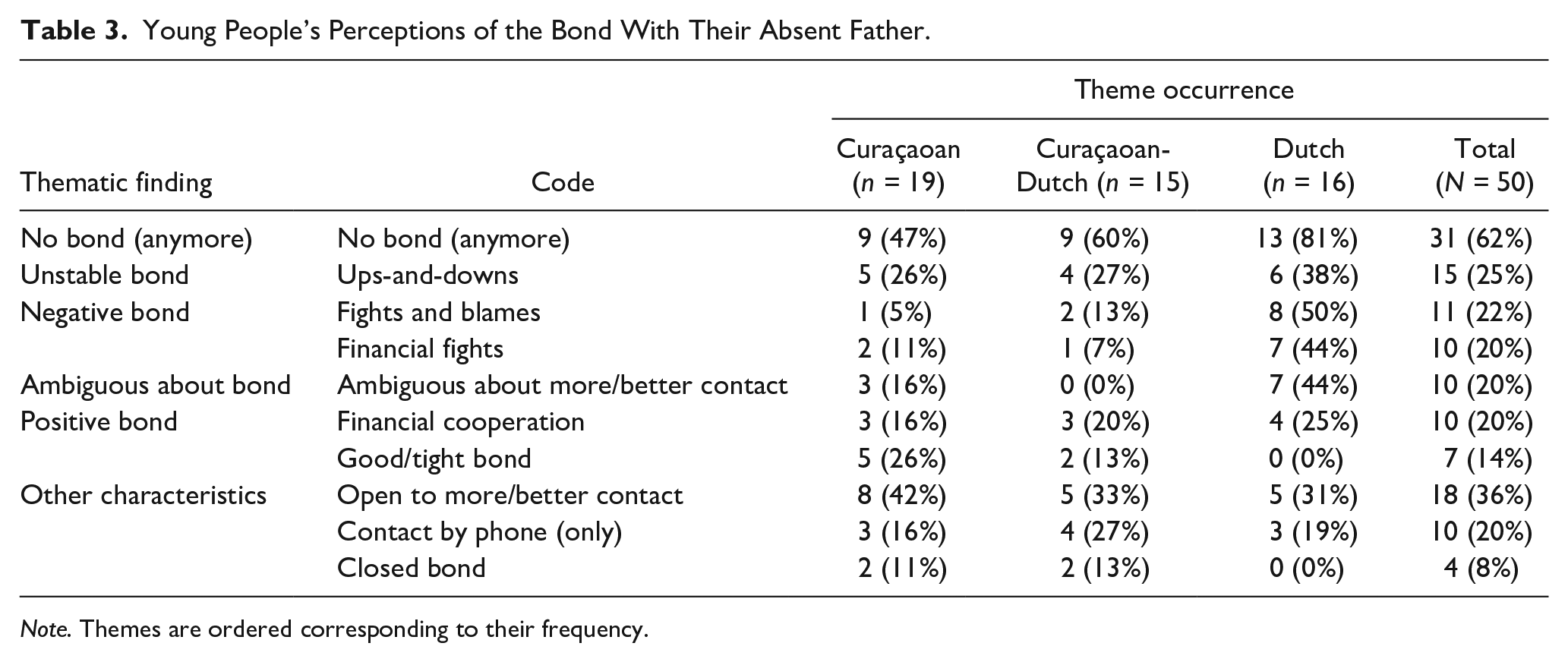
Note. Themes are ordered corresponding to their frequency.
Young People’s Perceptions of the Upbringing by Their Absent Father.
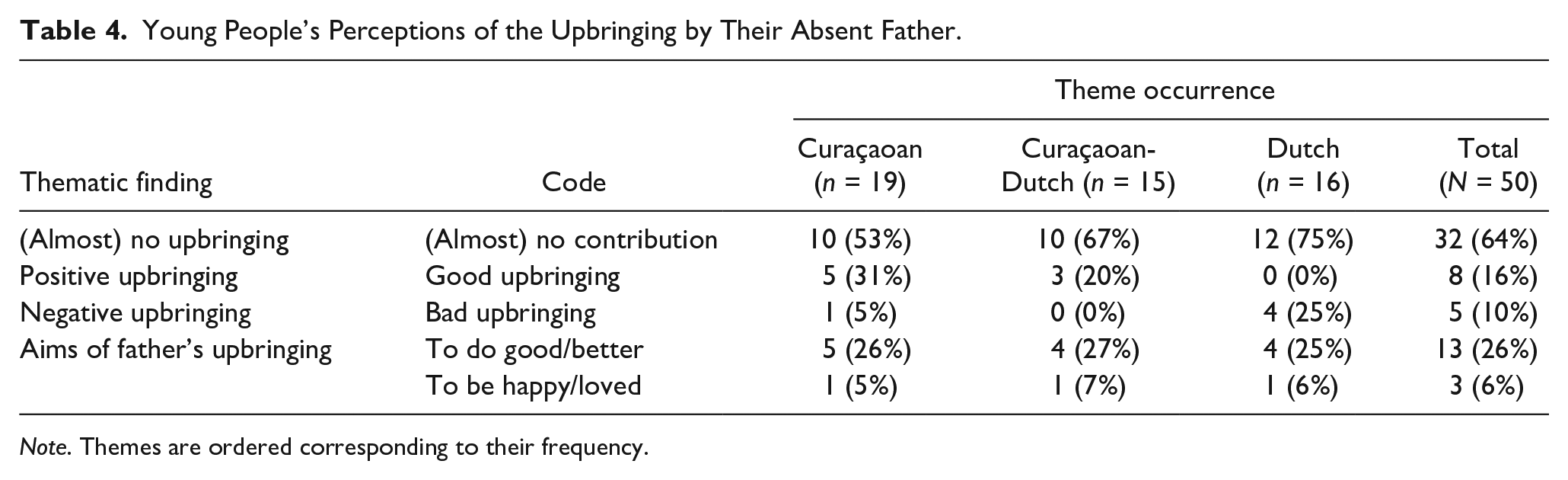
Note. Themes are ordered corresponding to their frequency.
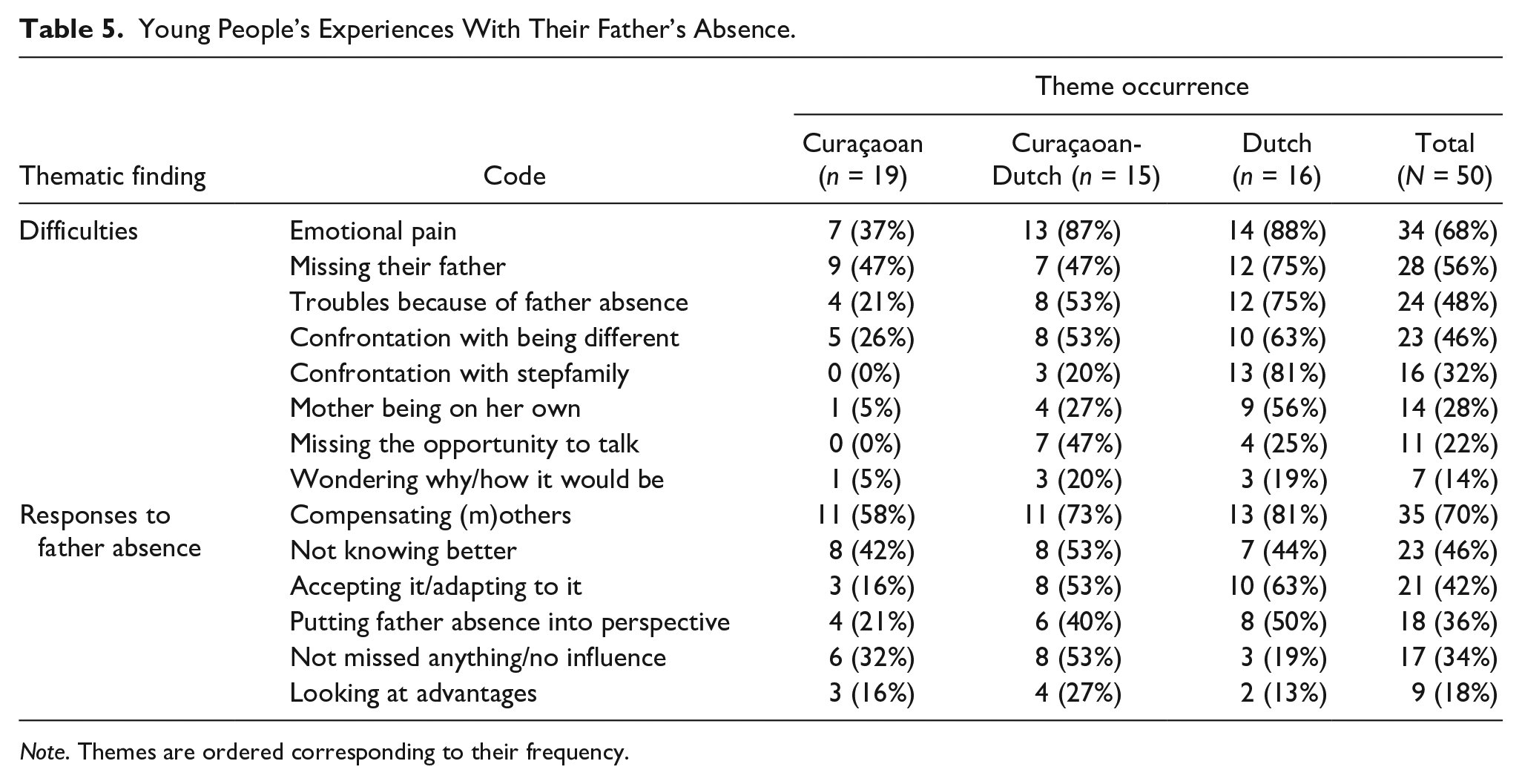
Young People’s Experiences With Their Father’s Absence.
Note. Themes are ordered corresponding to their frequency.
Results
Perceptions of Absent Fathers: Failing Fathers Versus Protective Men
Table 2 shows key findings regarding young people’s perceptions of their absent fathers. Almost all Dutch young people in our sample shared a negative view of their absent father. For instance, they described a lack of paternal efforts to see their children (n = 10; 63%), lack of consideration toward them (n = 11; 69%), or choosing for himself or his new family (n = 4; 25%). Relatedly, many Dutch interviewees showed aversion against their father and their contact with him (n = 8; 50%), or had ambiguous feelings about their father and their contact with him (n = 7; 44%). Maneuvering successfully through high school is of high importance for young people, and some of the ambiguous feelings of young people toward their fathers were related to this context. As a 19-year-old Dutch girl stated, When I had obtained my high school diploma and he was also there at the award ceremony, he would be very proud of me, but somewhere I have a very ambiguous feeling. Because then I think like: My mother has pushed me through all these ups and downs throughout my secondary school career and you actually contributed nothing or hardly, so it really frustrates me a lot.
For Curaçaoan (n = 10; 53%) and Curaçaoan-Dutch (n = 8; 53%) young people in our sample, it was often difficult to describe their absent father and express their view of him. Many interviewees from these two cultural groups mentioned that they hardly knew their father, because they had never lived together or because they still did not spend much time together. Most young people in our sample could not answer background questions about their father’s date of birth, education, and work, whereas they did know this information about their mother.
Several Curaçaoan (n = 6; 32%) interviewees held a positive view of their absent father. For instance, some of them described their father as involved and noted that he had called them, shown interest, helped them out, or protected them. A 17-year-old Curaçaoan girl, for example, shared how her father showed his involvement and concern: My father always calls me, daily on school days. Every day after school he calls me and asks me if I am in the school bus or if I have arrived at my aunt’s, if there are people at home etc. I think that’s good of him . . . Yes, he always calls me. Since he has left, he calls me.
In sum, most Dutch young people in our sample perceived their absent father as undedicated. For most Curaçaoan and Curaçaoan-Dutch interviewees, it was difficult to describe their absent father and express their view of him, as they hardly knew their father.
Contact and Bonds With Absent Fathers: Superficial Encounters but Longing for More
Table 3 shows key findings regarding young people’s perceptions of the bond with their absent fathers. In spite of some positive views from Curaçaoan young people of their absent father, many young people in our sample (n = 31; 62%) perceived they did not have a bond with their father, or not anymore. While most Curaçaoan and Curaçaoan-Dutch interviewees described they never had built a bond with their father, most Dutch interviewees stated they did not have a bond anymore, due to conflicts and lack of perceived efforts from their father. Moreover, young people from all three cultural groups described ups and downs in the relationship with their father (n = 15; 25%), portraying it as an unstable bond. For instance, a 24-year-old Dutch boy reflected on the time when he was an adolescent: The contact is quite alright. There have been times when I didn’t speak to him at all, because we were fighting, but now it’s just alright . . . A few years ago we [interviewee and his mother] had another lawsuit with him. I really notice that I have suppressed that, that I really thought like, it just has been a hard time . . . And he had actually kind of won the lawsuit and then he just invited me back to his house after not really speaking for six months or something. Yes.
Regardless of their cultural background, interviewees illustrated the nonexistent or deteriorated bond with their absent father by pointing at their own alienation from him: In fact, the bond is just bad of course, yes. It’s more like he is my biological father but he is not really my dad. So you can actually best describe our bond that way. (Dutch girl, 20 years old)
In addition, interviewees from all three cultural groups compared the relationship they had with their father with the relationship they had with their mother and then reached the conclusion that the bond with their father was comparably poor: You know, for me it’s not . . . What I have with my mother, is not what I have with him so to say . . . I often say this. If my mother gets sick and dies, I will feel more pain than when my father dies. Of course you feel it, but not so much what you feel for your mother. (Curaçaoan-Dutch girl, 24 years old)
In line with a negative view of their absent father, most Dutch young people mentioned negative aspects of the bond with their father that had emerged over the years; for instance, financial fights (n = 7; 44%) and blaming between themselves and their father and between their mother and their father (n = 8; 50%). As such, some of the Dutch interviewees appeared ambiguous or skeptical about whether they would be open to more and better contact with their father in the future (n = 7; 44%). As a 19-year-old Dutch girl noted, I don’t really need it [more or better contact], but I am open to it, only, uhm, I realize very well that I will never get that father back from the past. And that’s why I am afraid that I will be disappointed when I will have such a semi-fatherly contact that’s just not it and that’s like a bit forced and I would prefer not to. I’d rather not have contact than forced contact.
A smaller group described a positive relationship with their father characterized by, for instance, financial cooperation (n = 10; 20%): His salary is not much, but when I see a shirt or whatever I like, he will make sure that I get it. Not this week, nor the next week, but he will buy it in a month. (Curaçaoan girl, 18 years old)
Only Curaçaoan (n = 5; 26%) and Curaçaoan-Dutch (n = 2; 13%) young people specifically mentioned to have a good or tight bond with their father around the time when the interview took place. A 19-year-old Curaçaoan-Dutch girl shared why she felt her bond with her father was close-knit and of high quality: In fact a very good bond. I was really, uhm, a father’s child. Sometimes I had a fight with my mother and I always went to my father to cry. He was always there, he would come to me and so on, yes I just really had a very good bond with my father. Actually, I can hardly describe it; it was just very good, very good. Just like the Antilleans always say: “pret’i wowo” (apple of an eye) of a father, that was me, that was me.
Several young people from all three cultural groups expressed to be open to more and better contact with their father (n = 18; 36%). This openness to more and better contact often resulted from their perception of having only superficial contact with their father, for example, by phone only (n = 10, 20%). Regardless of their cultural background, young people felt the contact with their father could be improved especially by talking more with him, for instance, about his absence.
Altogether, most young people in our sample perceived no bond with their absent father. Nevertheless, most Dutch interviewees perceived a negative bond with their father, whereas Curaçaoan and Curaçaoan-Dutch interviewees also perceived positive bonds.
Upbringing by Absent Fathers: No Contribution but Wanting the Best for Their Children
Table 4 shows key findings regarding young people’s perceptions of the upbringing by their absent fathers. Many young people in our sample perceived their father had hardly contributed to their upbringing (n = 32; 64%). As a 28-year-old Curaçaoan-Dutch boy stated, Yes, a lack of it [upbringing], I think. Because he was never there at all the important moments in my life. So in terms of upbringing, what did he actually do . . . My mother and stepfather did the major part; I took over their norms and values, not his.
Similar to how young people in our sample quickly thought of a comparison with their mother when talking about the perceived nonexistent bond with their father, they were apt to refer to the upbringing by their mother when they reflected on their father’s role in their upbringing: You know, upbringing did not come much from my father. Upbringing came more from my mother. My mother was always the one who disciplined us. (Curaçaoan boy, 18 years old)
Several Curaçaoan and Curaçaoan-Dutch young people shared, however, that their father did contribute to their upbringing. Moreover, whereas some Curaçaoan (n = 5; 31%) and Curaçaoan-Dutch (n = 3; 20%) young people evaluated the upbringing by their father as “good,” some Dutch interviewees evaluated their father’s contributions as “bad” (n = 4; 25%). Only one Curaçaoan and none of the Curaçaoan-Dutch interviewees evaluated their father’s upbringing as bad. With a good or bad upbringing, interviewees referred to showing interest and helping them, or otherwise not caring for them.
Young people from all three cultural groups had difficulties describing their father’s parenting aims and often referred to what they said their mother’s aims were. Nevertheless, some were able to identify their father’s unique aims and shared their father wanted them to “be happy and loved” (n = 3; 6%) or to “do good” (n = 13; 26%), and specifically “better than he did himself.” With the latter statement, interviewees referred to their father’s “difficult past” since some fathers had a history of alcoholism or imprisonment.
In short, most young people in our sample perceived no upbringing from their absent father, while they seemed aware that their father wanted the best for them. Although Curaçaoan and Curaçaoan-Dutch interviewees perceived a positive upbringing, Dutch interviewees had negative perceptions of their father’s upbringing.
Experiencing Father Absence: Painful Memories That Leave Long-Lasting Marks
Table 5 shows key findings regarding young people’s experiences with their father’s absence. As can be seen in the top half of Table 5, the majority of the young people in our sample shared their father’s absence was difficult for them, especially during childhood and early adolescence. Most Dutch (n = 14; 88%) and Curaçaoan-Dutch (n = 13; 87%) interviewees gave narrations of emotional pain due to missing their father. As a 17-year-old Dutch girl shared, It was very difficult for me. And, uhm, yes, I always had . . . I have always missed a father figure. And I really noticed that at times . . . If I ever went to do something with friends, for example, I remember that we went to the swimming pool once and those two friends had brought their fathers and then I really realized, because I didn’t have a father, that I missed that contact very much.
In addition, mainly Dutch (n = 12; 75%) but also Curaçaoan-Dutch (n = 8; 53%) young people related a variety of negative experiences in their lives to their father’s absence, even unprompted. Firstly, they felt confronted by being “different” to peers, in a negative way, underpinning young people’s need to identify with or be part of a social group. Secondly, after seeing that peers grew up with both their parents, Dutch and Curaçaoan-Dutch interviewees wondered why they grew up without their father and how their lives would have unfolded if they would have grown up in a “normal” family. Thirdly, mostly Dutch and Curaçaoan-Dutch interviewees linked their father’s absence to fears about being disappointed and potentially abandoned by others, self-doubts about being good enough, troubles in relationships with men, and mental health problems, including depression and loneliness.
Moreover, since mainly Dutch interviewees’ mothers and fathers tended to re-partner, some of those participants (n = 13; 81%) described they were confronted with stepmothers, stepfathers, and stepsiblings, who often influenced the bond with their father or mother in a negative way. On the other hand, when mothers had not re-partnered, Dutch young people (n = 9; 56%) shared it was difficult for them to see their mother on her own, resulting in an urge to help or protect their mother.
Briefly, mainly Dutch and Curaçaoan-Dutch young people in our sample experienced emotional pain and missing their father, and related their father’s absence to a variety of difficulties they met in their lives.
Responses to Father Absence: Mothers Are Both Mother and Father and Time Is a Healer
As can be seen in the bottom half of Table 5, interviewees from all three cultural groups talked about several ways of responding to their father’s absence and the troubles they experienced from it. Firstly, most young people in our sample stated that their absent father was “replaced” or “compensated for” by others (n = 35; 70%). Mothers were perceived most important, but also grandparents, step-, and godfathers, brothers(-in-law), aunts and uncles, and good male friends of mother played an important role in their father-absent child and adolescent years. A 19-year-old Curaçaoan girl shared, What do I think about growing up without the presence of my father . . . I would say my mother did a very good job. Because she filled all the gaps that my father could not. So I did not lack, I do not miss a father. I do not miss a father at all in my life, not at all. Because my mother made sure to fill all the gaps my father had to fill; my mother did it herself.
While young people from all three cultural groups described their mother as “both mother and father” and others as a “second father” or a “second mother,” variations in who exactly replaced or compensated for absent fathers occurred. Whereas Dutch interviewees foremost mentioned both of their grandparents, Curaçaoan and Curaçaoan-Dutch interviewees mentioned their grandmother, but not their grandfather, possibly hinting at a family history of father absence, as explained by an 18-year-old Curaçaoan boy: It’s like this: My father’s father also did not live in the house, so . . . There you can see that my father did not know better how to deal with this. He knew . . . He did not know how to raise me.
What is more, only maternal grandparents were present in Curaçaoan and Curaçaoan-Dutch young people’s narratives. Stepfathers and social workers seemed of importance for Dutch interviewees, while Curaçaoan and Curaçaoan-Dutch interviewees more often mentioned their aunts, uncles, brothers, and sisters as important figures in their upbringing.
Next, young people from all three cultural groups responded they “did not know better” (n = 23; 46%) or “had not missed anything” (n = 17; 34%) with respect to their father’s absence, for instance, because their father had been absent since they were young and that it had always been like that. As a 21-year-old Curaçaoan-Dutch girl reflected, At first, for the first 5/6 years, I didn’t really know any better. But as I grew older and went to visit friends and so on, then I thought hey, yes, I, why can’t my father live with me, so to say. So, uhm, then I had some trouble with that, I was a bit sad about that. But that passed off quite quickly.
Mainly Dutch (n = 10; 63%) and Curaçaoan-Dutch (n = 8; 53%) interviewees indicated that they accepted or adapted to their father’s absence as time passed. Most difficulties took place during childhood and early adolescence, whereas they had learned how to live with their father’s absence and to put this experience into perspective when they were older. As a 15-year-old Dutch girl shared, I mean, I just accepted it. I turned out pretty okay . . . I have learned to be satisfied with the time I have with him. And that when I see him, that I really have to make the best of it. And not fill it with any arguments or discussions and just be happy with it.
Yet, it seemed that not all young people in our sample had already accepted and adapted to their father’s absence. Some were highly emotional during the interview and cried or were furious, and others seemed to have cut themselves off from negative feelings. As a 24-year-old Curaçaoan-Dutch girl shared, I am able to very quickly . . . I can often put my problems aside quickly to do what I have to do. I never let it influence me, because I know that if I let it influence me, I wouldn’t achieve what I want to achieve . . . You know, so that’s how I feel about it until today, out of habit, so to say. But to this day, it is, it is, it can be very tough. Because, for example, at night, when you are quiet, then everything comes up again, and you still have to deal with it again the next day.
A few interviewees from all three cultural groups explicitly shared a positive stance in response to their father’s absence (n = 9; 18%). That is, young people noted that their father’s absence had made them stronger and more independent, that they had grown up faster, and been able to handle difficulties. Some of them believed their father-absent situation was better than growing up with both parents, for instance, because they now only had one parent to tell them what to do or because they were less often confronted with fights between their parents.
In essence, young people from all three cultural contexts experienced (m)others compensated for their father’s absence. Nevertheless, both Dutch and Curaçaoan-Dutch interviewees had to accept or adapt to their father’s absence, while for Curaçaoan interviewees, this seemed more normal from the beginning.
Discussion
In this study, we explored whether young people’s perceptions and experiences with father absence varied across cultural contexts and compared adolescents and young adults from a society in which father absence is relatively common (Curaçao) with one in which it is relatively uncommon (the Netherlands). Curaçaoan-Dutch young people were also included and formed a particularly interesting group since their families migrated from a context with a high occurrence of father absence to one with a low occurrence. To our knowledge, this study is the first to directly investigate and systematically compare perceptions and experiences with father absence among father-absent young people from cultural backgrounds with variations regarding the occurrence of father absence.
From the long tradition of quantitative research in predominantly Western societies, we know that biological father absence has been negatively associated with multiple domains of child development, including pertaining to reproduction, maturation, family relationships, and mental health (e.g., McLanahan et al., 2013; Webster et al., 2014). However, most of this research lacked comparisons with societies where father absence is more common, such as in many Caribbean countries, which is unfortunate, given that Draper and Harpending in 1982 already highlighted a distinction between normative and contra-normative father-absent societies. To tackle the absence of cross-culturally comparative research into father absence including both men and women, we explored father absence as perceived and experienced by adolescents and young adults in three contexts, that is, the Netherlands and on Curaçao, and among Curaçaoan migrants in the Netherlands.
Our interviews corroborate findings from both quantitative and qualitative studies as they show how father absence often goes hand in hand with negative perceptions and experiences, especially during childhood and adolescence. In line with, for instance, Green et al. (2019), most young people in our sample perceived their absent father as undedicated, described their bond with him as nonexistent or unstable, and described that he had hardly contributed to their upbringing. With regard to experiences, many of our interviewees felt emotional pain and missed their father, and related their father’s absence to a variety of difficulties they met in their lives, such as being different, troubles with relationships with men, and mental health problems. These specific difficulties show how challenging it can be for father-absent young people to develop their social and personal identity and build interpersonal relationships through their teens and early to mid-20s (Arnett, 2007; Erikson, 1950) and were also reported in other studies (e.g., Atwell, 2018; East et al., 2014).
Furthermore, like for instance Arditti et al. (2019), we found that young people from all three cultural groups in our sample have non-parental support networks who at least partly compensated for their absent father and played an important role in becoming resilient to negative effects of their father’s absence. Members of these non-parental support networks served as a role model for identification and relationship formation models, and might have prevented them from disadvantages of being less able to draw on their father as a role model (Grusec & Hastings, 2014).
Interestingly, the composition of non-parental support networks in our sample differed by cultural group. For instance, grandfathers were absent in Curaçaoan and Curaçaoan-Dutch interviewees’ narratives but not in those of Dutch interviewees. At first sight, this seemed to relate to intergenerational continuity of father absence, but another explanation might be that in daily Papiamentu language, the word grandparents is substituted by grandmothers, as grandfathers (like fathers) culturally play a minor role. The sole importance of (grand)mothers, to family life and the upbringing of children, which outweights the role of any possible partners, is known as matrifocality. Signs of the influence of matrifocality in the Papiamentu language had already been outlined and found, for instance, by Abraham (2013) and Dillon (2015).
A number of other cultural differences seemed apparent in narratives of Curaçaoan, Curaçaoan-Dutch, and Dutch young people in our sample. Curaçaoan and Curaçaoan-Dutch interviewees were less negative compared with Dutch interviewees in perceptions of their absent father, their bond with him, and his upbringing. It might be that father absence being highly common in Caribbean cultures, held expectations low for Curaçaoan and Curaçaoan-Dutch young people in our sample. Also, as many mothers accept and are proud of being able to raise their children on their own, and extended family involvement is common, Curaçaoan and Curaçaoan-Dutch interviewees might have had (m)others compensate for the lack of bond with and upbringing from their absent father (e.g., Green et al., 2019), rendering perceptions of their absent father less negative.
With regard to experiences, mainly Dutch and Curaçaoan-Dutch young people in our sample had difficult times growing up without their father and had to accept or adapt to their father’s absence. This process of responding to difficulties and confrontations was also outlined in other qualitative studies (e.g., East et al., 2014; Makofane, 2015; Marote, 2011), but was not visible in Curaçaoan interviewees’ narratives. It may be that for the Curaçaoan young people in our sample, their father’s absence had seemed more normal from the beginning and not something they needed to accept or adapt to. Conversely, many Dutch interviewees mentioned that they have suffered from deviating from the cultural norm in their social environment. The Dutch young people in our sample were also more likely to have felt supported by friends or siblings in a similar “not normal” situation of father absence.
The Curaçaoan-Dutch young people in our sample seemed ambivalent when it comes to perceptions and experiences with father absence, as perceptions of their absent fathers were quite positive, but still they experienced many difficulties. This is in line with a previous study including both Dutch adolescents and migrants from the Caribbean region (Deković et al., 2006). As Curaçaoan-Dutch young people historically belong to a cultural context where father absence is normative, this might explain Curaçaoan-Dutch interviewees’ relatively positive evaluations of their absent father, the bond with him, and his upbringing. Yet, due to their history of migration and as a result of conflicting sociocultural standards, they might have lost compensating (f)actors such as extended family involvement that protected them from negative consequences of father absence.
Altogether, this study has shown that what it means to grow up without a father varies a great deal cross-culturally, corresponding to the normativity of father absence. Therefore, when attempting to explain the role of father absence as antecedent of variation in life history, it is important to take into account the occurrence of father absence in one culture. In other words, Draper and Harpending’s (1982) distinction between normative and contra-normative father-absent societies and the critique on the literature on father absence to date for its lack of accounting for heterogeneity across subgroups (e.g., Kalmijn, 2017; McLanahan et al., 2013), seem well founded. There is no a priori reason for the current bias in much of the developmental research in the West that father absence has adverse consequences for all young people across the globe. Depending on the social, cultural, and economic circumstances into which children are born, father absence comes with its own perceptions and experiences. Congruent with a cultural-developmental perspective, our findings stress how powerful culture may influence child development through providing the settings of daily life from which children abstract the social rules of the culture (Super & Harkness, 1986). However, as our findings also indicate similarities in perceptions and experiences across the three cultural groups, theories should be neither one-size-fits-all nor one-for-every-culture. Instead, they should bridge what is universal and what is culturally distinct to be able to improve the lives of children and families in ways that have relevance to local conditions (Jensen, 2012a, 2012b).
Limitations and Future Research
Our study used bilingual and same ethnicity interviewers, a strategy that is known to reduce nonresponse during the recruitment phase, increase comfort levels, participant satisfaction and disclosure, and effective communication (e.g., Mizock et al., 2011). Nevertheless, using bilingual interviewers meant that some interview audio needed translation before analysis and, therefore, some information and nuance might be lost. We reduced this potential bias by cross-checking translations with bilingual and same ethnicity interviewers, transcribers, and the Curaçaoan third author of this article.
The use of bilingual and same ethnicity interviewers might also elicit more socially desirable responses and traditional views, particularly with respect to family ties for participants of former Antillean origin (Kappelhof, 2015). What is more, as our sample consisted of three cultural contexts, it is also possible that culture influenced whether certain themes emerged in the interviews, especially since discussing difficult topics and being openly critical of parents is considered taboo in the Caribbean (Marcha & Verweel, 2005). To reduce these potential biases, we had interviews on Curaçao conducted by interviewers who were not only trained in the interview technique but social workers in training. Given that our interviewers were trained in communication and interaction styles, we are optimistic that problems and negatives were more substantially pronounced than what participants in Curaçao were willing to discuss. Quantitative research that compares if the different groups use instruments to assess emotions in the same way could be helpful in determining whether group differences are substantive or due to how people respond to interview questions.
Our sample consisted of more girls than boys, especially among the Dutch group (n = 13; 81%). Previous studies suggested variations in experiences with father absence between girls and boys and found that father-absent girls usually are more likely to internalize their loss and to suffer from depression and anxiety, while father-absent boys are usually more inclined to externalize and have behavioral problems (e.g., McLanahan et al., 2013). This might have caused an overrepresentation of emotional problems and underrepresentation of aggression and substance use in our sample. Although there has been some attention to how boys and girls may respond differently to father absence, interactions with gender need more attention. That said, the vast majority of studies on father absence include girls only, and there is a much smaller number of studies on boys only, allowing for comparisons only across but not within studies. Our study explicitly included boys and girls to increase the variability of experiences and, as such, is an important step toward studying gender-specific experiences more rigorously.
Even though all young people in our sample came from similar socioeconomic backgrounds, a relatively high number of Curaçaoan and Curaçaoan-Dutch young people were enrolled in a humanitarian service program aimed at financially and practically helping single mothers. Considering families in those programs had multiple problems, this could have led to more negativity in these two cultural groups. Still, overall, Curaçaoan and Curaçaoan-Dutch young people in our sample were more positive about their absent father and his absence, possibly suggesting a high level of resiliency.
Despite the aforementioned limitations, our study contributes important and valid knowledge due to its distinct cross-cultural comparative character. For future research, it might be worthwhile to follow up with respondents when they are older in order to get more insight into developmental aspects in perceptions and experiences with father absence. By interviewing respondents at several time intervals during childhood, adolescence, and young adulthood, it becomes possible to understand whether perceptions and experiences with father absence change over time, and if so, for what reasons. Future emphasis on factors that might mediate or moderate perceptions and experiences with father absence might also be of importance, since gender and contextual factors might also have their influences.
Conclusion
This study offers important contributions to the father absence literature by providing a cross-cultural perspective on young men’s and women’s perceptions and experiences with father absence. While it is widely believed that father absence has negative consequences for child development, we questioned their universality and shed light on culture-specific perceptions and experiences with father absence. Altogether, our results show that compensating (m)others and normativity of father absence tempered negative perceptions and experiences with absent fathers. What can be learned from this cross-cultural comparison is that local cultural norms and values should be taken into account when we want to understand experiences with father absence. To better support father-absent families and increase adolescent well-being, it is necessary to take a culture-sensitive perspective instead of blindly believing universal generalizations. Taking such a perspective can further contribute to our understanding of how some young people suffer from father absence whereas others do not, and how each of them can be supported in an appropriate way.
Footnotes
Acknowledgements
The authors thank Linda van der Zwaan, Saffira Dorand, Kimberly Jake, Sharitee Servanie, Daymaris Marchena, Tiffany Virginia, Zinaita Concencion, Christel Cineus, Milusca Flaneur, Alice Plate, Damaries Plate, Eunies Plate, Chiara Enters, Maria Ochoa, Xavier Bennett, Shanouska Martinez-Cannegieter, Anne-Marijke Huisman, and Atty Schouwenaars for their assistance with data collection and analysis.
Declaration of Conflicting Interests
The author(s) declared no potential conflicts of interest with respect to the research, authorship, and/or publication of this article.
Funding
The author(s) disclosed receipt of the following financial support for the research, authorship, and/or publication of this article: This work is part of the Caribbean Research Program with project number OND1362735, which is financed by the Dutch Research Council (NWO). The fourth author is supported by an European Research Council (ERC) Starting Grant under the Horizon 2020 research and innovation program (grant agreement number 757364, title: “Ghosts From the Past—Consequences of Adolescent Peer Relations Across Contexts and Generations”).
