




Abstract
This study explores how the Family Envisioning Meeting (FEM), a person-centered planning (PCP) process for transition-aged students in Singapore, can be adapted to better meet the needs of stakeholders. Using the Cultural Adaptation Checklist, qualitative data from 17 individuals (i.e., four parents, eight school personnel, and five transition planning coordinators) across four special education schools were analyzed across six domains: language, persons, content, goals, methods, and context. While participants valued FEM for promoting collaboration and amplifying student and family voices, both cultural and practical barriers were identified. Culturally, these included unfamiliar terminology, discomfort with abstract goal setting, and norms around parental authority. Practically, challenges included limited staffing, unclear roles, and facilitation skills. Findings underscore the need for culturally responsive and contextually feasible adaptations of FEM and highlight the importance of systemic investment in training, infrastructure, and sustainable models of delivery.
Transition planning is a critical component in the education of students with disabilities, supporting their progression from school to post-school environments such as employment, further education, and community living. Quality transition planning emphasizes meaningful student and family involvement, alignment between goals and educational experiences, and preparation for post-school outcomes (Lee & Kim, 2022; Rehfeldt et al., 2012). Active, ongoing participation by both students and parents is critical to ensuring the transition plan is individualized, comprehensive, and results-oriented (Sigstad & Garrels, 2023), as well as to support positive post-school outcomes for students (Mazzotti et al., 2020).
Scholars have increasingly emphasized the importance of culturally responsive transition planning. Suk et al. (2020) argue that transition practices grounded in culturally normative assumptions may unintentionally disadvantage families whose values, expectations, and communication styles differ from those embedded in dominant models. Similarly, Lindsay et al. (2022) highlight how transition planning processes often reflect Western norms around independence and self-advocacy, which may not align with family-centered decision-making practices in collectivist contexts. As Shogren et al. (2025) emphasized, inclusive and effective transition planning must be contextually grounded, recognizing that students’ goals and opportunities are influenced not only by individual strengths but also by family priorities and broader social and cultural systems.
Person-centered planning (PCP) has been widely promoted as a best practice for supporting transition-aged youth with disabilities. PCPs emphasize collaboration among students, families, and professionals to develop individualized plans aligned with students’ strengths, preferences, and aspirations (Claes et al., 2010; Ratti et al., 2016). However, PCP frameworks were largely developed in Western contexts and may not fully reflect the cultural norms and family dynamics of non-Western societies. Black et al. (2003) note that transition planning approaches emphasizing individual choice and independence may conflict with collectivist values, where decision-making is often shared within the family unit. Achola and Greene (2016) similarly argue that culturally diverse families may view transition planning as a family responsibility rather than an individual endeavor, underscoring the need for culturally responsive adaptations.
Transition Planning in Singapore
In Singapore, education operates within a dual system comprising mainstream and special education schools. While the existence of separate special education schools may appear inconsistent with broader inclusion agendas, this structure reflects policy decisions aimed at ensuring that students with higher support needs receive access to specialized and resource-intensive services within a coordinated framework. Special education schools are operated by social service agencies but funded and regulated by the Ministry of Education and serve students with moderate to high support needs. Depending on student profiles, these schools implement either the national curriculum—allowing access to national examinations—or a customized curriculum focused on functional academics, daily living, and vocational skills (Ministry of Education Singapore, 2024).
As part of Singapore’s broader disability policy framework, the Enabling Masterplan has guided reforms in education, employment, and community participation. The 2012–2016 Enabling Masterplan identified post-school transition and employment pathways as national priorities (Enabling Masterplan Committee, 2012). Building on these priorities, transition planning was formally introduced in special education schools in 2017, alongside the designation of Transition Planning Coordinators to support implementation (Enabling Masterplan Committee, 2017). Within this policy context and recognizing the importance of PCP in transition planning, the Ministry of Education engaged Helen Sanderson Associates, based in the United Kingdom, to provide consultancy support in 2021, and convened a multiagency PCP Working Group comprising representatives from special education schools, government agencies, post-18 service providers, and community organizations. This collaboration led to the development of the Family Envisioning Meeting (FEM)—a person-centered transition planning review meeting conducted when students turn 15. FEM brings together the student, family members, educators, and other key professionals to envision post-school goals and develop an action plan. FEM was first piloted in selected special education schools in 2023 and is, at the time of writing this manuscript, being progressively rolled out across the sector. In the pilot phase, FEM sessions were facilitated by trained school personnel, typically transition planning coordinators, who received consultancy support and training from Helen Sanderson Associates prior to implementation. More details of FEM can be found on the Ministry of Education’s website (Special Education Branch, 2025).
FEM represents a significant shift toward person-centered practice within Singapore’s special education system. However, its structure and implementation have been influenced by PCP frameworks developed in Western countries such as the United Kingdom and the United States. These frameworks are grounded in values such as self-determination, direct advocacy, independence, and personal autonomy (Ratti et al., 2016)—principles that are strongly emphasized in Western educational and disability discourse. However, these values may not fully align with the cultural norms and family dynamics in Singapore, where collectivism, deference to authority, and interdependence within the family unit are often more salient (Chernyak et al., 2019; Krishna, 2012). In many Asian cultures, including Singapore’s multiethnic society, decision-making for individuals with disabilities is commonly viewed as a family responsibility (Krishna, 2012), and expectations for student-led advocacy or independence may be less culturally normative or developmentally prioritized. Indeed, Black et al. (2003) emphasize that for families from collectivist cultures, decision-making is often a shared responsibility, and individualistic transition practices may inadvertently marginalize culturally and linguistically diverse (CLD) families if not adapted to reflect these values. Achola and Greene (2016) similarly argue that CLD families may hold different expectations regarding family roles, post-school outcomes, and definitions of student success, which are not always reflected in existing transition practices.
The communication styles embedded in Western PCP practices—such as assertive self-expression and open discussion of individual preferences—may not be culturally intuitive for all families in Singapore. Research on intercultural communication suggests that families from more high-context and collectivist cultures may be less accustomed to direct self-advocacy in group settings and may experience discomfort when asked to openly articulate individual preferences, particularly in formal interactions involving professionals (Hall, 1976; Ting-Toomey, 1999). In Asian contexts, family decision-making is often relational and parent-driven, with greater emphasis on deference, harmony, and protection (Krishna, 2012). Prior research in transition planning similarly indicates that such mismatches in communication norms can reduce family comfort and participation in professional meetings (Achola & Greene, 2016). Therefore, there is a critical need to examine whether FEM, as currently implemented, is sufficiently responsive to the cultural, linguistic, and relational expectations of Singaporean stakeholders and how it might be meaningfully adapted to better meet the needs of stakeholders.
The research question that guided the study was: How do parents, school personnel, and transition planning coordinators view the cultural appropriateness of FEM, and what adaptations are needed to better fit the local context?
Method
Participating Schools
This study was conducted across four special education schools in Singapore that were selected by the Special Education Branch of the Ministry of Education to participate in the initial pilot of FEM. All schools utilize a customized curriculum and serve students aged 7–18. Schools A (N = 176), B (N = 511), and C (N = 273) serve students on the autism spectrum and with intellectual disability, while School D (N = 264) serves students with cerebral palsy and multiple disabilities.
The selection of these schools was intentional and guided by several key criteria established by Special Education Branch: (a) inclusion of schools serving students across the major disability categories recognized in Singapore’s special education system, (b) schools had a strong transition planning coordinator with relevant experience and capacity to support the implementation of FEM, (c) schools had already initiated school-wide efforts or structures related to transition planning, and (d) school leaders expressed commitment and support for person-centered approaches to transition planning.
Participants
We invited transition planning coordinators from the four schools to participate in this study. Once informed consent was obtained from the transition planning coordinators, we asked them to assist with the identification of parents and school personnel who had directly participated in FEM and could provide insights into its implementation. We provided a study information sheet to each transition planning coordinator, who then shared it with eligible parents and school personnel. If a parent or school personnel expressed interest in participating, the transition planning coordinator obtained permission to share their contact details with us. We then scheduled an online meeting with each potential participant to explain the study in detail, answer any questions, and obtain informed consent.
Participants included four parents from three families, eight school personnel, and five transition planning coordinators. Parent participants were recruited from three of the four schools. No parents who participated in FEM at School D chose to take part in the study. Demographic information for study participants can be found in Tables 1 and 2.
Parent and Child Demographics.
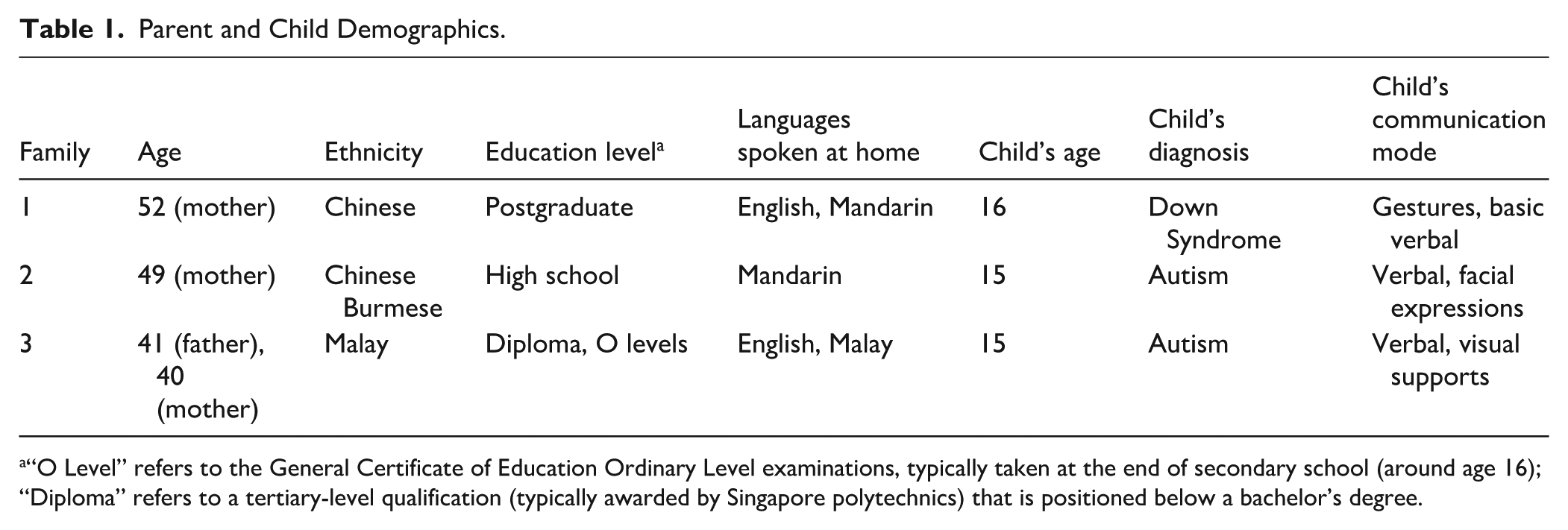
“O Level” refers to the General Certificate of Education Ordinary Level examinations, typically taken at the end of secondary school (around age 16); “Diploma” refers to a tertiary-level qualification (typically awarded by Singapore polytechnics) that is positioned below a bachelor’s degree.
School Personnel and Transition Planning Coordinator Demographics.
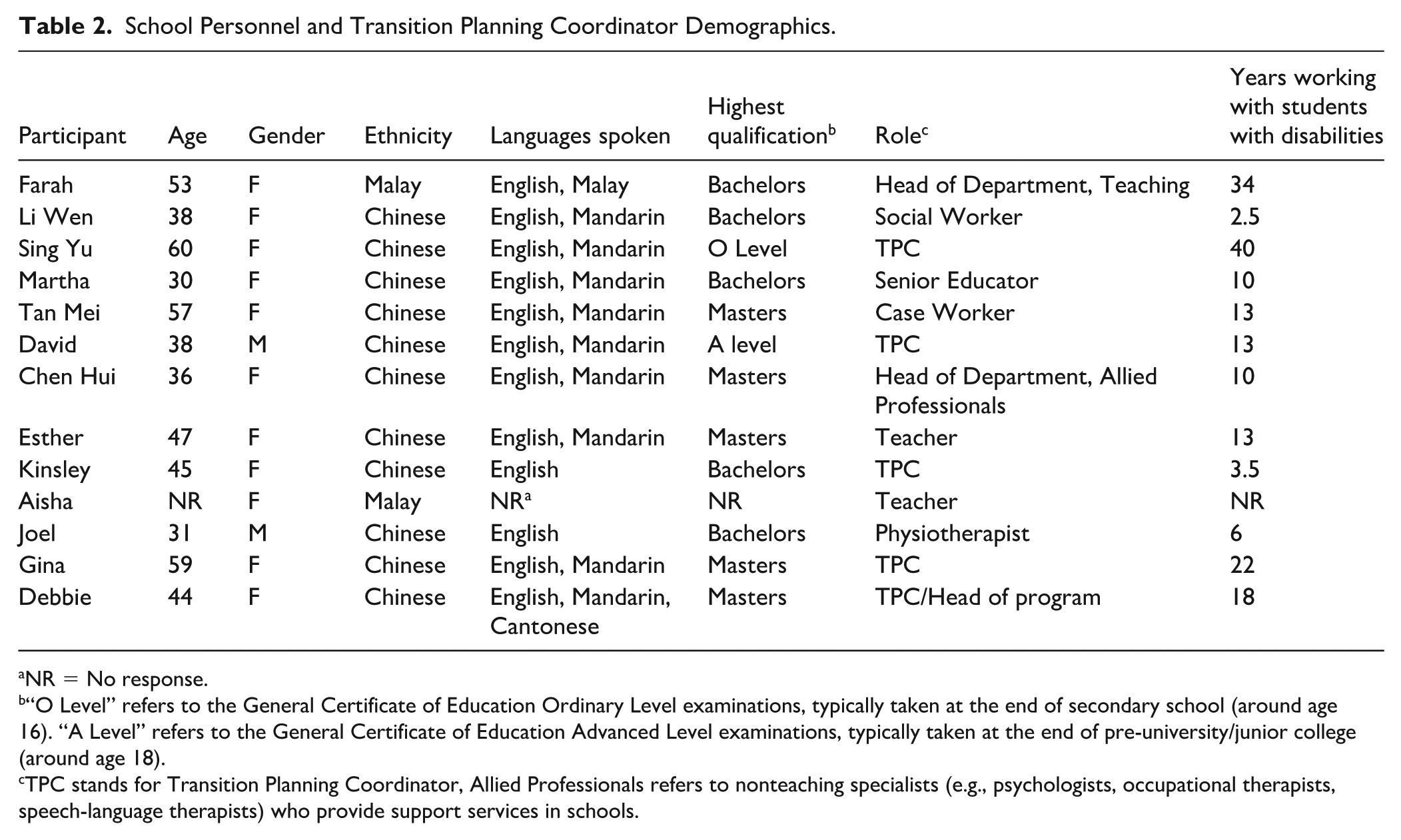
NR = No response.
“O Level” refers to the General Certificate of Education Ordinary Level examinations, typically taken at the end of secondary school (around age 16). “A Level” refers to the General Certificate of Education Advanced Level examinations, typically taken at the end of pre-university/junior college (around age 18).
TPC stands for Transition Planning Coordinator, Allied Professionals refers to nonteaching specialists (e.g., psychologists, occupational therapists, speech-language therapists) who provide support services in schools.
Procedure
This study received approval from the Institutional Review Board of Nanyang Technological University, Reference No. 2024-468. Informed consent was obtained from all participants prior to their involvement in interviews and focus groups.
Instrumentation
We used the Cultural Adaptation Checklist (CAC; Lee et al., 2024) as a conceptual framework for both data collection and analysis. Drawing on implementation science and grounded in the Ecological Validity Framework (Bernal et al., 1995), the CAC provides a structured lens for evaluating and guiding cultural adaptation across seven dimensions: language, persons, content, goals, methods, context, and process. These dimensions are further operationalized into 32 quality indicators that help ensure adaptations go beyond surface-level changes and are meaningfully aligned with the cultural, contextual, and relational realities of the target population. The process dimension, which focuses on the iterative strategies used to culturally adapt interventions, was not included in the question design of the current study. As this study represents an initial effort to examine and inform the cultural adaptation of FEM, incorporating “process” as a line of inquiry was considered premature and potentially circular. Instead, questions were aligned with the six remaining dimensions—context, language, persons, goals, content, and methods—which reflect core structural and cultural features of FEM that participants could meaningfully speak to. Please refer to the supplemental file for a definition and a sample question of each dimension.
Data Collection
We collected data via semi-structured interviews and focus group discussions. Parallel versions of semi-structured interview and focus group guides were developed for each stakeholder group (i.e., parents, school personnel, and transition planning coordinators). To enhance contextual relevance and accuracy, guides were reviewed and edited based on feedback from team members from the Special Education Branch who had been involved in the development and rollout of FEM. Prior to conducting interviews and focus groups, we observed FEM implementation at each of the four participating schools and took detailed observation notes. This preparation enhanced our familiarity with both the procedural and cultural aspects of FEM, contributing to more informed and sensitive facilitation.
Individual interviews were conducted with parents, including one interview conducted in Mandarin. All interviews were between 45 and 60 minutes. Two focus groups were conducted with school personnel (n = 8) and one focus group with transition planning coordinators (n = 5). All focus groups lasted around 120 minutes. All interviews and discussions were conducted in the second year of the FEM pilot for schools, between October and December 2024. For parents, interviews were conducted within 1 month of having their FEM meeting. The first author facilitated the Mandarin-language interview to ensure clarity and comfort. As both authors are bilingual in English and Mandarin, the Mandarin transcript was analyzed in its original language to preserve meaning and contextual nuance.
All interviews and focus groups were video- and audio-recorded with participants’ consent on Zoom. Zoom’s automated transcription function was used to generate initial transcripts, which were then checked and corrected against the recordings by a trained research assistant. Identifying information (e.g., names) was removed during transcription, and pseudonyms were assigned to maintain confidentiality.
Data Analysis
We adopted a deductive approach to data analysis with the CAC dimensions functioning as sensitizing constructs (Fife & Gossner, 2024). Transcripts were imported into MAXQDA, and we independently coded all transcripts using an initial codebook derived from the CAC dimensions. Following the coding of each transcript, we met to discuss code applications, clarify interpretations, and refine code definitions.
This collaborative approach extended beyond independent coding. After all transcripts were coded, we jointly reviewed the coded data within each CAC dimension to ensure coherence, consistency, and fidelity to the data. This process involved iterative discussions to verify how coded segments reflected participants’ perspectives and suggestions for cultural and contextual adaptations. Because the CAC dimensions were used to both structure the codebook and report the findings, we did not generate new themes beyond these dimensions. Instead, the analysis focused on identifying patterns within and across dimensions that illuminated the cultural appropriateness of FEM.
Trustworthiness
To enhance trustworthiness, we employed several strategies, including collaborative analysis and participant validation. The involvement of both authors throughout coding and interpretation served to enhance analytic rigor by incorporating multiple perspectives and reducing individual bias (Patton, 2015). Member checking was conducted at two stages (Birt et al., 2016; Lloyd et al., 2024). First, a summary of each participant’s responses was sent to them for verification. All parent participants, four school personnel, and four transition planning coordinators responded. One transition planning coordinator provided feedback on portions of her summary, requesting clarification and minor changes, which were incorporated before formal analysis. Second, after coding and interpretation, a summary of the findings organized by CAC dimensions was shared with participants for feedback and validation.
Positionality
Both authors are assistant professors of special education in Singapore. As Singaporeans trained in Western contexts, we recognize that many special education practices and tools are developed based on Western research with limited cultural adaptation. This awareness shaped our critical lens in examining how FEM operates within Singapore’s multicultural and multilingual environment. Our perspectives are also informed by prior work in Singapore’s special education schools and by our shared commitment to inclusive, strengths-based, and disability-affirming practices that center the voices of individuals with disabilities. We acknowledge that our professional backgrounds and advocacy orientations influence how we interpret and represent the findings.
Findings
The findings are presented according to six dimensions of the CAC. Each section summarizes stakeholder perspectives related to their experience of FEM within each dimension. Participant quotes are included to illustrate key findings and support interpretation.
Language: “What is this Question Trying to Tackle?”
Several parents and school personnel highlighted challenges related to the terminology used in FEM preparation booklets and meeting discussions. Specifically, terms such as “aspirations,” “important to/important for,” and “what’s working/not working” were perceived as abstract or ambiguous, particularly among parents unfamiliar with such terminology in educational or planning contexts. One parent explained her confusion about the prompt ‘what’s not working’: “I said, what is this question trying to tackle? Is it going to ask what it didn’t work in school, or what it didn’t work in the family, or what it didn’t work for him? So I really do not know what the question was trying to aim at.”
In addition to vocabulary concerns, low literacy levels among some parents created additional barriers to participation. Participants suggested that the written materials may be inaccessible for some parents and proposed the use of alternative formats like audio recordings. Others emphasized the need for simplified language and more concrete examples or prompts within the booklets to clarify what kind of responses were expected.
Language accessibility was also a concern in multilingual settings. While some school personnel provided ad hoc translation support, participants noted the limitations of such arrangements. One transition planning coordinator described the effort involved in facilitating a meeting with Mandarin-speaking parents: “The class teacher . . . translated each one of it to the parents . . . solicit their answers and then they write back inside the booklet. So-so when we were conducting the FEM, it was also conducted in Mandarin. It was quite challenging lah . . . So I guess if having the booklet in different languages, it will help.”
Across parents and school personnel, participants recommended translating materials into Malay, Tamil, and Chinese, the three other major languages in Singapore, to improve accessibility.
Persons: “Having a Buddy Helps”
Parents and school personnel consistently emphasized that familiarity with school personnel present during FEM was crucial, particularly for students with higher support needs. For many students, especially those with limited verbal communication, the presence of a teacher who had an established relationship with the student significantly improved their comfort and participation. One parent described how her child, who is minimally verbal, was only able to engage because of the presence of a teacher who had worked with him for 4 years: “With Ms. T around, I thought [it] was really good, because he knows Ms. T very well, and Ms. T knows him . . . She can encourage him to voice out, to talk, to even give answers . . . If we change to someone else . . . you may not have the kind of positive result.”
The same parent emphasized that family members, even those close to the child, were not appropriate substitutes for this support role: “We cannot play that role of a buddy. . . because the parents will have our own views. And certain things that we try to prompt, the child may not be reactive or may not even want to answer questions.” These sentiments were echoed by school personnel, who observed that assigning a trusted “buddy” teacher—often someone familiar but not necessarily the current classroom teacher—helped maintain student engagement and reduced anxiety during the meeting.
Furthermore, parents shared that the involvement of teachers who know the student well is critical for providing insight into the child’s long-term development. One set of parents expressed that they wished former teachers who were deeply familiar with their child’s strengths and needs were present at the meeting: “If we have their input too, that will be very nice, because they see how [he] grew and what he needs in the future.”
At the system level, school personnel discussed the challenges of determining who should attend FEMs. One school experimented with broad participation in the initial pilot, including class teachers, therapists, caseworkers, and even external professionals like speech therapists. However, this approach revealed limitations: “Some of them didn’t quite know what to share . . . for example, the caseworkers . . . they don’t really see the students day in, day out . . . they actually had to take time out of their schedule to meet with the students or observe them in class . . . just to have a sensing of how the students were like.”
Another system-level challenge relates to role clarity and accountability in the implementation of FEM. While FEM is designed to be a collaborative, team-based process, in practice, the added responsibilities often fall on an individual member, particularly the transition planning coordinator. Although schools may have multidisciplinary teams formally assigned to support transition planning, the lack of clearly defined roles and distributed leadership has resulted in uneven ownership. A transition planning coordinator shared that although she had a multidisciplinary team on paper, in practice, other members deferred responsibility to her: “I have a team. . . but everything falls back on me. If I don’t push it, nobody does it . . . there’s no ownership.”
Content: “I Truly Didn’t Know”
A central aim of FEM is to bring together the focal student, family members, and school personnel to collaboratively develop personal life goals for the student. Participants generally felt that this objective was met, with FEM enabling a more comprehensive and future-oriented understanding of the focal student’s needs and future long-term goals. Compared to existing school-based meetings, such as parent–teacher conferences (PTC), which often center on short-term academic or behavioral goals, FEM provided the time and space to foster a more holistic and future-oriented understanding of the child. However, some school personnel felt that certain content covered in FEM overlapped with other school processes, leading to duplication of work.
The preparation booklet was seen as an essential component and a valuable tool for gathering information, leading to a better understanding of the student’s needs and preferences. However, it was challenging for some parents, students, and school personnel due to unfamiliarity with the questions and the abstract nature of certain prompts. Identifying aspirations was highlighted as being highly challenging for parents and students. One parent shared:
“他就问我想说,以后你要你要对孩子的要求怎么样咯?你的目的,你的一个标准在哪里?这样子咯。然后我就没有办法回答这些东西,因为我真的是抓不到” (Translation: He (teacher) asked me what expectations I had for my child in the future, what my goals or standards were, and I just couldn’t answer—because I truly didn’t know).
Despite these limitations, school personnel felt that it was still important to include this component in FEM: “I feel that even though our students have may may have limitations in understanding that question, but I feel like it’s still a good question to put out there, because . . . it reminds all of us that people with special needs also can dream.”
While school personnel appreciated the person-centered nature of FEM—particularly its emphasis on bringing the needs of the student to the forefront of planning—they reported difficulties with the goal-setting and support-planning stages (Steps 4 and 5 in FEM). Some school personnel who had acted as facilitators during FEMs reported feeling constrained in their ability to propose relevant strategies, citing limited awareness of available supports or a lack of disability-affirming knowledge.
School personnel also raised concerns about students’ abilities to access and meaningfully engage with FEM content. They attributed this to three main factors: limited exposure to life possibilities, lack of relevant preparation or training, and students’ cognitive abilities. As one school personnel shared, “Majority of our students do not have the cognitive capability to actually set their own goals.” These barriers often resulted in students being unable to complete the preparation booklet or participate actively in the meeting, ultimately leaving their voices out of the process. To address these factors, some school personnel and parents suggested starting FEM at an earlier age (e.g., before 15) to allow more time and opportunities for preparation and exploration.
Goals: “Real Needs of the Child”
Goals in the context of FEM refer both to its overarching aim—to support PCP in which students and families take ownership of post-school trajectories—and to the specific priority goals identified for the student during the meeting. Regarding the overarching aim of FEM, some school personnel expressed concern that student voices may be inadvertently overshadowed by adult perspectives—whether from parents or service providers—who may assert their views of what constitutes the “real needs of the child.” This dynamic can compromise the authenticity of the planning process, particularly when cultural norms place strong emphasis on adult authority or caregiving roles in decision-making.
In the case of student priority goals, conversations often focused on preparing students for predetermined outcomes such as employment or transition to specific and narrow pathways (e.g., vocational schools or adult day centers). These pathways, while practical, did not always align with the interests or strengths of students. As one parent shared,
“这虽然他们讲说去那个另外一个学校叫X School他可能只有四科了,孩子他都不喜欢那这四科了. . .” (Translation: At the other school, called X School, there might only be four subjects—the child doesn’t like any of those four subjects).
Some school personnel felt that this reliance on standardized options contradicted the purpose of PCP, which is meant to foreground individual strengths, preferences, and aspirations. They called for greater flexibility and creativity in imagining what meaningful engagement might look like for students post-18.
Conversely, other school personnel described feeling ill-equipped to support highly personalized or ambitious goals, particularly when they perceived them as unrealistic or lacking a clear implementation pathway. One transition planning coordinator recounted, “A parent was very insistent that we try our very best to get her child to work in the police force for work experience . . . and also her ideas are very big, like . . . the child must go to NUS (a local university) . . . but we don’t know for sure whose goal that is.”
These reflections illustrate the tension educators face in navigating differing stakeholder expectations while contending with systemic limitations and available supports.
Further challenges emerged when aligning FEM-derived goals—which tend to be broad, long term, and aspirational—with structured, school-based frameworks and curricula. Teachers expressed concern about the wide variation in goals across students, which made it difficult to determine what and how to teach in classrooms with multiple students. As one teacher shared, “In a class with seven graduating students . . . there’s only that number of hours we have in class . . . if every student has such varied goals, how are we going to even finish teaching?”
Some school personnel also questioned whether the current framing of post-school goals for students with disabilities adequately reflects the extended timelines and developmental needs these students may have. They observed that students with disabilities are often expected to transition into the workforce by age 18, in contrast to their neurotypical peers, who typically pursue further education into their early to mid-twenties. As one school personnel reflected, “Sometimes I feel like our students, they think about work when they’re so young and and bearing in mind that actually they have special needs. Our students . . . maybe require a longer runway, they have to kind of switch their mind towards thinking about work at a relatively young age.”
Another added, “For able body or normal . . . teenagers . . . they go to Poly, then Uni . . . so they actually go to the workforce around 24, 25. So for the students with special needs, we are aiming them to work at about 18 . . . there’s a huge difference between the 2 group.”
These reflections point to a need for transition planning that not only reflects students’ strengths and preferences but also challenges normative assumptions about readiness, success, and the support available for post-school life.
Methods: “Time and Buy-in”
In Singapore’s context, where decision-making is traditionally parent-driven, early exposure to the concept of PCP and centering student voice in the decision-making process is key to a fruitful meeting. Pre-meeting briefings, which involved sharing about the flow and content, were seen as critical to preparing parents for meaningful participation and sharing during the meeting. However, concerns related to “face” were raised as potential deterrents to parent involvement. One parent shared: “. . . what I realized is that some of the parents they are very shy. And to them it feels like . . . they’ve done something wrong to have a child with special needs. But you have to try to get them, you know, like, try to make them know that this . . . is okay. Our children are okay . . . We are not just going through this alone.”
Parents suggested parent-to-parent sharing sessions and leveraging social media platforms as strategies to build trust and normalize participation based on their experiences in parent social circles.
Participants also highlighted facilitator readiness and capacity as central to the success of FEM. School personnel who facilitated the meetings emphasized the need for deliberate strategies to engage students, including drawing on their interests and addressing them directly during discussions. They also shared struggles in engaging with students with higher support needs (e.g., short attention span, low language/cognitive ability) during the meeting itself. Many also reported a lack of formal training in facilitation skills and in articulating individualized, meaningful goals, highlighting a gap in professional development necessary for effective delivery.
Implementation of FEM was also hindered by limited buy-in beyond the core transition team. One school personnel shared: “the biggest challenge that I see will of course, be time and the buy-in of everyone . . . So like, like, you know all the teachers. They are fixed in a certain mind-set already in doing transition planning.” Another school personnel reflected on the need for whole-school understanding of PCP principles, noting that FEM should not be “fragmented or targeted only at senior students” but embraced more holistically: “I thought that maybe on a whole school culture it may be helpful for the entire school, whether or not you are involved with FEM, to understand what person-centered planning is . . . even if they are not the senior teachers right . . . junior teachers can also see how the work or the foundation that they are building . . . actually starts when the student is still in their junior years . . . So it doesn’t come across as ‘I have to do an extra piece of work,’ but actually, this is just a conversation . . . to identify and build towards the goals of the student.”
This perspective suggests that educating and embedding the principles of PCP across grade levels and school personnel roles may foster greater ownership and alignment.
In addition, the logistical demands of FEM, including its extended duration compared to traditional meetings like PTCs, posed scheduling difficulties and contributed to participant fatigue. Facilitators reported feeling that they “lost steam” during longer sessions, and several advocated for co-facilitation models to sustain engagement and manage the flow of meetings more effectively. To improve feasibility, transition planning coordinators also emphasized the value of digitizing FEM materials, such as using editable PowerPoint slides or interactive digital boards, to reduce administrative burden and streamline the documentation process.
In addition to these constraints, school personnel highlighted a temporal misalignment in goal-setting processes. While IEP (Individualized Education Plan) or Individualized Transition Plan (ITP) goals are typically established early in the academic year, often during the first term, FEM is carried out across the school year. This misalignment in timing can complicate instructional planning and progress monitoring, making it difficult for teachers to meaningfully integrate FEM goals into ongoing teaching cycles. Finally, across multiple sites, staffing constraints were consistently cited. Transition planning coordinators highlighted the need for dedicated personnel to handle FEM preparations and facilitation if the model was to be followed for all transition-aged students.
Context: “Angmoh”
Face-to-face meetings were generally preferred by most stakeholders as they allow for more direct communication, foster stronger interpersonal relationships, and facilitate clearer understanding through nonverbal cues. Many participants value the opportunity to engage in real-time discussion and collaboration. However, organizing in-person meetings presents logistical challenges, particularly when it comes to aligning diverse schedules of multiple individuals. Finding a mutually agreeable time can be difficult, especially when navigating work and caregiving responsibilities of family members. In addition, securing a suitable physical space that accommodates the needs of the meeting (e.g., accessibility, privacy) can further complicate the organization of in-person meetings, particularly in environments with limited room availability and no dedicated room for such meetings.
To address some of these challenges, online or hybrid meeting formats were proposed as practical alternatives. These formats may be particularly important for engaging parents who face difficulties attending meetings on-site and for including external stakeholders such as community-based therapists or service providers. For online or hybrid meetings to be effective, however, careful planning and proper equipment are essential. This includes the thoughtful use of interactive tools such as polls, Padlet, or shared documents to foster meaningful participation and maintain engagement. School and home environments also need reliable internet connections or adequate audio-visual equipment to support real-time, clear communication and collaboration.
In terms of setting up the physical space, involving students in the preparation of the meeting space—such as selecting snacks, beverages, and music they prefer for the meeting—can serve as an effective way to “break the ice” and create a more relaxed and welcoming atmosphere. This participatory approach may help shift the tone of the conversation from formal to collaborative, which can be especially valuable in settings where parents and students might feel anxious or unsure about the meeting. One transition planning coordinator shared: “We love food right? So. . .that was an icebreaker.” However, not all agreed with such practices. One participant expressed that music and snacks might be seen as “a bit distracting” or perceived as overly Westernized—described as “angmoh” in the Singapore context. Moreover, implementing such practices requires resources. Some transition planning coordinators noted that they were paying for snacks out of pocket, raising concerns about sustainability and the need for institutional support if these efforts are to be continued or implemented widely.
Discussion
This study sought to examine how FEM—a PCP process developed for transition-aged students studying in special education schools in Singapore—can be adapted to better meet the needs of parents, school personnel, and transition planning coordinators. Using the CAC as an analytic framework, six domains of cultural relevance were explored: language, persons, content, goals, methods, and context. Participants viewed FEM as a platform for collaborative goal setting, fostering open communication among stakeholders, and prioritizing the voices of students and families in transition planning. Findings revealed that while cultural adaptations are essential to ensuring the relevance and accessibility of FEM, practical and systemic adaptations are also needed to support its feasibility and sustainability within the local special education context.
Cultural Adaptations
Across several CAC domains, stakeholders identified the need for culturally relevant adaptations to increase stakeholder engagement. In the language domain, terms such as “aspirations” and “what’s working/not working” were perceived as abstract or unfamiliar. Participants proposed simplifying language, translating materials into Mandarin, Malay, and Tamil, and offering examples or audio-recorded prompts to aid comprehension, echoing recommendations from Lee et al. (2024).
The person’s domain highlighted the importance of familiar and trusted school personnel—particularly teachers who have been with the student for many years—to serve as “buddies” for students with higher support needs. This practice, while potentially viewed in Western PCP discourse as overly professional-driven (O’Brien & O’Brien, 2002), was seen by participants as culturally appropriate in Singapore. The social constructs surrounding educational authority in many Asian contexts favor a model in which teachers, more than family members, are seen as experts on their children (Yamamoto et al., 2022). Consequently, parents may view teachers as being more attuned to the developmental needs and capacities of children within educational settings. Indeed, a parent in the current study emphasized that family members were not effective substitutes for the role of a buddy during FEM, as she felt that her child was more responsive to his teacher than to family members.
In the content and goals domains, participants underscored a cultural unfamiliarity with discussing personal “aspirations” and imagining futures beyond established pathways such as vocational training or Day Activity Centers. While a central aim of PCP is to lead to life-oriented—not merely service-oriented—action (Ratti et al., 2016), findings suggest that such aspirational thinking may not be intuitive in a context like Singapore, where pragmatism is deeply valued (Tan, 2012). To facilitate more meaningful life-oriented goal setting, participants recommended deliberate priming strategies—such as introducing these conversations well before the age of 15—so that students and families are gradually prepared to explore aspirations beyond conventional post-school options during the FEM process.
Analysis of the methods and context domains also revealed culturally specific tensions in the implementation of FEM. Consistent with broader patterns observed in other Asian societies (Damas & Kurniawati, 2025), participants noted that decision-making in Singapore is often parent-driven, reflecting cultural norms that prioritize parental authority and protection. This contrasts with one of the core aims of PCP—to promote student agency and self-determination in transition planning (Wells & Sheehey, 2012).
While these tensions are well-documented in the literature, what stood out in this study was how entrenched and structurally embedded they were in school practices. This was evident not only in participant accounts but also in observations conducted by the authors prior to data collection. For example, during one FEM session, we observed a facilitator invite a student to share her input, but the discussion allowed little time for her responses, and other participants did not meaningfully engage with her ideas. When she expressed a post-school goal of becoming a jewelry designer, she was the only one who supported it, and none of the adults in the room acknowledged or built on her aspiration. This illustrates how student voice may be included procedurally in the meeting but not actively centered in decision-making processes, especially when student goals diverge from adult expectations. More broadly, this raises the question of whether students with disabilities in Singapore can exercise self-determination in transition planning contexts, given cultural and structural dynamics that may privilege adult authority. Research has highlighted the central role of self-determination in promoting positive post-school outcomes and a higher quality of life for people with disabilities (Kim, 2019; Shogren et al., 2015; White et al., 2018). If opportunities to exercise self-determination are constrained, PCP risks becoming a formal rather than transformative practice, potentially limiting the relevance and effectiveness of transition goals. At present, there is little empirical work that examines how self-determination is understood or enacted for students with disabilities in Singapore, pointing to an important gap for future research.
Another layer of complexity arises from the cultural construct of “face,” which may discourage parents from speaking openly in group settings for fear of embarrassment or judgment. To address these challenges, participants recommended strategies such as early engagement with parents, pre-meeting briefings, and opportunities for parent-to-parent sharing. These approaches were seen as helpful in building trust, increasing comfort with the PCP process, and ultimately fostering more authentic participation.
In terms of context, practices such as playing music and offering snacks during the FEM were viewed with mixed reactions. Some participants perceived these elements as culturally incongruent or even distracting, describing them as “angmoh”—a colloquial term in Singapore referring to Western customs that may feel out of place in local settings. However, other participants found these same elements to be helpful in setting a welcoming tone, reducing anxiety, and “breaking the ice.” As Lee et al. (2024) pointed out, familiarity with the cultural values, expectations, and preferences of the targeted population is essential. When it comes to the physical and social environment of FEM, flexibility and responsiveness to the individual needs of participants may be key to fostering engagement and comfort.
Logistical and Structural Considerations
Beyond cultural adaptations, the study identified practical and systemic challenges that affect the feasibility and sustainability of FEM in Singapore’s special education schools—challenges that mirror barriers to PCP reported in other contexts. Prior research has consistently identified time constraints as a major obstacle to PCP implementation (Robertson et al., 2007). Similarly, participants noted that FEM meetings are substantially longer than routine meetings such as PTCs, making scheduling difficult and contributing to staff fatigue.
Staffing constraints and role clarity also emerged as key concerns. As reported in previous studies, staffing shortages and turnover can undermine PCP implementation (Robertson et al., 2007). In the present study, responsibility for FEM frequently rested with a single transition planning coordinator, who managed FEM-related tasks alongside existing duties. This concentration of responsibility limited opportunities for task-sharing and increased the risk of burnout, particularly during periods of high workload. Although some schools had transition teams in name, participants described unclear role delineation and insufficient time to support effective execution.
Participants also highlighted the need for more structured training and guidance. Consistent with prior findings that inadequate facilitator preparation constrains PCP delivery (Robertson et al., 2007), school personnel emphasized the importance of support not only in facilitation strategies but also in translating life goals into actionable plans. Implementation science literature similarly underscores that sustained adoption of person-centered practices depends on leadership support, ongoing professional development, and adequate resourcing (Aarons et al., 2014; Stanhope et al., 2021). Without coordinated investment in staffing, role clarity, and capacity building, FEM may face challenges in achieving its intended impact.
Limitations and Future Research
This study has several limitations that should be considered when interpreting the findings. First, the sample size was small and drawn from only the four special education schools in Singapore that piloted FEM. Within each school, only some families were invited to participate in FEM, and parents were given the option to opt in. As a result, the parent participants in this study may represent a more engaged or proactive subset of the population, potentially introducing self-selection bias. Their perspectives may not reflect those of parents who declined participation or who face greater barriers to engagement.
In addition, this study focused on exploring adaptations needed to improve the relevance and feasibility of FEM. However, it did not examine the outcomes of the FEM process itself. As emphasized in previous research (Claes et al., 2010; Ratti et al., 2016), understanding the impact of PCP requires linking planning processes to measurable outcomes, such as goal attainment, post-school transition success, or improvements in student agency and participation.
Future research should examine whether adapted versions of FEM lead to more individualized and meaningful transition goals, and whether those goals are more likely to be achieved post-graduation. Longitudinal studies tracking implementation fidelity, quality of facilitation, sustainability, and follow-through, as well as long-term student outcomes, would offer critical insight into the effectiveness of person-centered reviews in special education contexts. In addition, further investigation is warranted to identify scalable models of FEM implementation that address existing staffing constraints and provide sustained support for facilitators. Future research should also explore how individualized, person-centered goals can be meaningfully integrated with structured school curricula to form cohesive and instructionally relevant lessons.
Implications for Practice
The findings of this study suggest several practical implications for improving the implementation and cultural responsiveness of FEM in Singapore’s special education context. These implications are organized by stakeholder group.
Students with Disabilities
For students with disabilities, especially those with complex communication needs, FEM should be structured in ways that authentically support student voice. This includes providing pre-meeting preparation, such as visual tools or conversations with trusted adults to help students reflect on their goals (Wells & Sheehey, 2012), as well as assigning the student a buddy for the meeting. During the meeting, facilitators should allocate dedicated time and space for students to share, ensure their input is acknowledged and valued, and avoid overriding student preferences unless necessary for safety or support needs. Scaffolded supports and alternative communication modes (e.g., visuals, sentence starters, choice boards) are essential to ensure that participation is meaningful, not merely symbolic (Gregory & Atkinson, 2024).
Importantly, even students with higher communication abilities often lack exposure to diverse post-school pathways, which limits their ability to participate meaningfully in FEM. Schools should intentionally provide students with structured opportunities to explore post-school options (e.g., career talks, exposure visits, and workplace simulations) to help them make informed choices and engage more confidently in FEM discussions (Mazzotti et al., 2020).
Families
For families, particularly those from high-context and collectivist cultures, meaningful participation in PCP may require more than an invitation to attend. Pre-meeting briefings or orientation sessions can help clarify the purpose of FEM, the roles of each participant, and how family input will be used. In addition, opportunities for informal parent-to-parent sharing may reduce discomfort associated with speaking in front of professionals or voicing disagreements. Schools can also provide translated materials, culturally relevant examples, and visual supports to help parents prepare. Importantly, these supports should affirm the family’s cultural values (Suk et al., 2020) while gradually building comfort with more participatory planning roles.
School Personnel
For facilitators of FEM, findings highlight the importance of developing facilitation skills. This includes recognizing when student voice is being procedurally included rather than genuinely centered, and providing flexible supports (e.g., alternative communication, visuals, and role-plays prior to FEM) to encourage student participation (Gregory & Atkinson, 2024). This is especially critical when student preferences differ from adult expectations. School staff should be mindful of power dynamics between professionals, parents, and students and work to create safe, inclusive spaces for all participants to contribute. Ongoing professional development (Stanhope et al., 2021) and reflective practice (Suk et al., 2020) can help school personnel critically examine their assumptions about students with disabilities—particularly regarding their capacity to participate meaningfully despite complex communication needs—regardless of whether they are facilitating or contributing to the FEM process.
School Leaders and Policymakers
At the system level, implementation of FEM must be supported with attention to resourcing, integration, and long-term sustainability. Participants highlighted that facilitators need adequate time, staffing support, and access to funding to personalize the FEM process for diverse students and families. Without such resources, the quality and consistency of implementation may be compromised (Stanhope et al., 2021).
In addition, special education system leaders should work collaboratively with schools to explore how FEM processes can be better integrated with existing structures and timelines, such as PTCs and the annual development of IEPs and ITPs. Unlike IEP/ITP reviews, which typically occur during fixed windows in the school calendar, FEM is conducted on a rolling basis throughout the year. This misalignment can lead to duplication of effort or fragmented planning. Aligning FEM processes with existing school practices can help schools streamline efforts, reduce redundancy, and increase coherence across planning systems.
To support this, special education system leaders should consider providing schools with flexible planning tools, culturally responsive facilitation resources, and ongoing professional development to strengthen implementation fidelity (Stanhope et al., 2021; Suk et al., 2020). Investing in scalable, contextually appropriate FEM practices will be key to ensuring that person-centered transition planning is both sustainable and impactful in Singapore’s special education context.
Supplemental Material
sj-docx-1-rse-10.1177_07419325261418602 – Supplemental material for Person-Centered Planning for Transition-Aged Youth in Singapore: Lessons in Cultural Adaptation and Implementation
Supplemental material, sj-docx-1-rse-10.1177_07419325261418602 for Person-Centered Planning for Transition-Aged Youth in Singapore: Lessons in Cultural Adaptation and Implementation by Nataly Lim and Delia Kan Dang Dang in Remedial and Special Education
Footnotes
Acknowledgements
This study was supported by the Special Educational Needs Branch (SEB) of the Ministry of Education (MOE), Singapore. The authors would like to express their sincere gratitude to all the caregivers and school personnel who contributed their voices and generously shared their experiences as part of this research.

Funding
The authors received no financial support for the research, authorship, and/or publication of this article.
Declaration of Conflicting Interests
The authors declared no potential conflicts of interest with respect to the research, authorship, and/or publication of this article.
References
Supplementary Material
Please find the following supplemental material available below.
For Open Access articles published under a Creative Commons License, all supplemental material carries the same license as the article it is associated with.
For non-Open Access articles published, all supplemental material carries a non-exclusive license, and permission requests for re-use of supplemental material or any part of supplemental material shall be sent directly to the copyright owner as specified in the copyright notice associated with the article.
