




Abstract
This study examines school-based Pre-K (SBPK) versus center-based Pre-K (CBPK) settings, focusing on subsequent access to disability supports, an underexplored area. Specifically, we examine whether attending SBPK is associated with difference rates of disability diagnosis or receiving an Individualized Education Program (IEP) in elementary school, grades K through 5. Using data from the Early Childhood Longitudinal Study—Kindergarten Class of 2010–11 (ECLS-K: 2010–11), we analyzed 8,990 children who attended either SBPK or CBPK. Results indicate that SBPK attendance is associated with higher rates of disability diagnosis and IEPs in early elementary grades (K-2), suggesting that SBPK settings may offer better resources for identifying and supporting children with disabilities. Implications are discussed.
Early childhood is a critical period for physical, cognitive, and socio-emotional development (e.g., Carneiro et al., 2013; Galende et al., 2011; Shonkoff & Phillips, 2000). Thus, children’s early educational environments matter, whether at home or in informal and formal care settings. Regarding formal care settings, research shows that attending high-quality pre-kindergarten (Pre-K) programs can improve kindergarten readiness and later educational outcomes (Gray-Lobe et al., 2021; Iruka et al., 2020; Phillips et al., 2017). While some studies show that children who did not attend Pre-K are able to catch up over time with Pre-K attendees, research nonetheless finds that for those in Pre-K, it provides important and stable programming for young children (Griffard et al., 2022; Bai et al., 2020; Whitehurst, 2018). In other words, what is clear in the literature is that for those children in Pre-K and comparing those children to others in Pre-K, those in high quality early formal settings have higher outcomes.
Comparing children in different Pre-K programs, as just mentioned, is critical because pre-K program quality, while demonstrably important, is also highly variable across different types of programs. Part of that variability is attributable, at least in part, to the “mixed delivery system” that comprises the Pre-K sector in the United States (Garver et al., 2023; Ryan et al., 2011). The formal Pre-K sector includes private community programs, publicly-funded state and municipal programs, and the federally-funded Head Start program (Atchison & Diffey, 2018; Kauerz & Kagan, 2012). While these programs are often housed in stand-alone centers (i.e., center-based Pre-K, “CBPK”), national data show that 35% of all children who attend formal Pre-K programs today do so in public school-based prekindergarten (SBPK) settings (Little et al., in press). In fact, as of 2021, six out of 10 public elementary schools have at least one Pre-K classroom—a figure that has steadily risen over recent decades (Little, 2021).
While the COVID-19 pandemic reduced rates of Pre-K participation and exacerbated inequities in Pre-K access (Friedman-Krauss et al., 2022), the percentage of 3- and 4-year-olds who were attending state-funded preschool were at all-time highs in 2022–2023 (Friedman-Krauss et al., 2024). Some states (e.g., CA, CO, NV), and municipalities have invested heavily to expand their Pre-K sector. There is emerging evidence that SBPK, in particular, may be expanding (Gonzalez et al., 2024). In Chicago Public Schools (CPS), for example, the district’s pre-K capacity started to rebound from the COVID-19 drop-off in 2021–22 and, by 2023–24, there were nearly 16,000 free, full-day pre-K seats in CPS, or about twice the number as in 2017–18 (Sabol & Schanzenbach, 2023). Recent positive outcomes of a randomized lottery design used to estimate the effects a full-day universal Pre-K program in New Haven, CO may further encourage states and municipalities to invest. During children’s pre-kindergarten years, researchers show, enrollment increases weekly child care coverage by 11 hrs and parents’ earnings by 21.7%, with parents’ earnings gains persisting for at least 6 years after the end of pre-kindergarten (Humphries et al., 2024).
As the shift toward SBPK continues, we are interested in contributing to the emergent literature base comparing programs located within public schools with Pre-K programs in other settings. To date, research has explored how program setting influences instructional alignment (Cohen-Vogel et al., 2021; Griffard et al., 2022; McCormick et al., 2022, 2024), time students spend in status as English Language Learners, and whether and how student data is shared (Little et al., 2019). Some studies have also examined how program setting influences child outcomes (Forry et al., 2013; Magnuson et al., 2007; Winsler et al., 2012). Here, in this article, we focus on children with disabilities to explore whether SBPK might reduce some of the complexity associated with transitions and providing continuity of services and of personnel who are familiar with the needs of the children who have been in their care. Specifically, our research questions are:
Research Question 1: What is the association between attending SBPK, compared with CBPK, and being diagnosed with a disability during elementary school?
Research Question 2: What is the association between attending SBPK, compared with CBPK, and having an Individualized Education Program (IEP) in elementary school?
To answer these questions, we rely on a nationally representative dataset of children who were followed by the U.S. Department of Education beginning in their kindergarten year, 2010–11. As described in our Method section below, these data include an immense amount of detail about children, their families and schools, and what type of Pre-K they attended, if at all. While somewhat dated, the Early Childhood Longitudinal Study Kindergarten Class of 2010–11 (ECLS-K: 2010–11) remains the most up-to-date nationally representative survey of children that includes information about Pre-K setting and student experiences throughout elementary school. No other national panels connect Pre-K setting experiences with later educational outcomes throughout elementary school. Therefore, understanding the population of kindergarten children in 2010–11 and their disability diagnoses and IEPs in elementary school will provide future researchers with the opportunity to explore these relationships over time, when data on the next cohort of ECLS-K participants are released.
Importantly, much of prior work has only used blunt administrative reports of IEP status. Our current study asks research questions that address two different components of disability (diagnoses and IEP). This is intended to capture a wider range of children. More so, studying both disability diagnosis (from a doctor) versus IEP (at school) in the same study is under-researched yet is compelling, as it highlights the overlay of our educational and medical systems with regards to schooling contexts and systems. Examining these distinctions separately allows for an analysis of how each system conceptualizes disability, and whether disparities emerge based on the assessment criteria. Given the lack of research in this area, however, our hypotheses about whether differences emerge remain non-directional. Hence, this line of inquiry, in an under-examined area, is particularly relevant for evaluating the effectiveness of special education programs, practices, and policies, ensuring equitable access to resources, and understanding the broader implications of disability classification on academic trajectories.
SPBK versus CBPK and the General Student Population
All work on SBPK versus CBPK is derived from studying children in the general population, and therefore we begin with what is understood about these programs based on this subset of the literature. There are several key differences between SBPK and CBPK. Research to date has described differences in classroom resources, teacher qualifications, and teacher turnover. Specifically, compared with center-based programs, SBPK has been shown to be associated with higher-quality resources, such as instructional materials and classroom space (Little, 2020). In terms of staffing, SBPK tends to have teachers who have higher educational attainment and who are paid more than their counterparts in CBPK (Clifford et al., 2005). Furthermore, SBPK programs often have lower teacher turnover rates than CBPK (Bellm et al., 2002).
Another difference between SBPK and CBPK is that school-based settings are more similar to the environments that children will experience when they enter kindergarten. The transition from preschool to kindergarten will arguably involve less change, especially when children remain in the same school building (Griffard et al., 2022). Beyond the physical location, the continuity of familiar faces may make for more stable parent-school relationships and fewer problem behaviors for the child (Powell et al., 2010). Moreover, given that the early education and K-12 systems are highly siloed from one another (Griffard et al., 2022; Ryan et al., 2021), SBPK presents an ideal opportunity to improve vertical alignment between the systems (Cohen-Vogel et al., 2021). Studies have demonstrated that in some cases, teachers coordinate instruction between Pre-K and kindergarten; however, in other cases, the SBPK program is not well integrated into the larger school community (Little, 2023; Desimone et al., 2004; Little, 2020; Wilinski, 2017).
Along with these higher resource inputs, SBPK may also lead to better child outcomes—although research in this area remains limited to two studies. An early study by Magnuson and colleagues (2007) found positive associations with academic achievement for children who attended SBPK and kindergarten in the same building. Recent evidence suggests that the benefits of SBPK may support stronger socio-emotional outcomes and students’ approaches to learning (Little et al., in press). Clearly, more research needs to be conducted, given the dearth of information about SBPK compared with CBPK.
SBPK versus CBPK for Students With Disabilities
Given this rise in SBPK programs, there has been some growing research evidence on the role that SBPK over CBPK might play in supporting outcomes for children in the general population—as described in the previous section. Yet, mostly absent from this understanding has been the role of SBPK in supporting special education and students with disabilities (SWDs). We propose that SBPK can arguably make for a smoother transition to kindergarten compared with CBPK—especially when students stay in the same school building (Little, 2020). Thus, SBPK, instead of CBPK, could potentially benefit SWDs and their families, who generally face more challenges at transition points. Namely, parents of SWDs in preschool are more likely to have concerns about the transition to kindergarten than parents of non-SWDs (McIntyre et al., 2010), and parents and preschool teachers of SWDs are likely to be more involved in the transition process (Welchons & McIntyre, 2015). Thus, SBPK, as opposed to CBPK, may be a way to alleviate some of the complexity of transition points for this population, providing continuity of services and of personnel who are familiar with the needs of the children who have been in their care. Good practice dictates that preschool teachers and kindergarten teachers collaborate on transition plans for SWDs (Sands & Meadan, 2022), which is made easier when the physical location is the same (Little, 2020).
Despite these hypotheses, research on whether SBPK or CBPK can support disability outcomes remains sparse. For example, one study of children who attended SBPK in Oklahoma found that SBPK was associated with improvements in early literacy, and that these benefits were seen not only for typically-developing children but also for SWDs (Phillips & Meloy, 2012). However, the comparison group consisted of children who had not yet attended Pre-K, which, in the scope of this study, is not the appropriate comparison group of other types of Pre-K attenders. In this vein, studies that directly compare SBPK and CBPK outcomes are rare, and nonexistent when considering SWDs. With all of this in mind, examining the experiences of SWDs in SBPK versus CBPK and whether and how SBPK or CBPK may serve SWDs represents a fruitful area of investigation.
In this way, our research questions focus on potential differential rates in diagnosis and IEPs from kindergarten to fifth grade. From the literature, we know that high-quality Pre-K can support SWDs. However, our study is the first to explore whether there are differences between SBPK and CBPK with regard to disability diagnosis and access to services at school. We consider several plausible hypotheses. First, we propose that attending SBPK over CBPK leads to fewer diagnoses as well as fewer children with IEPs in school. On the other hand, SBPK programs may have better resources for referring children for testing compared with CBPK, such that SBPK leads to more diagnoses and IEPs. Yet a third hypothesis accounts for more diagnoses and IEPs initially, with a tapering off as children eventually might exit from having an IEP.
Method
Source of Data
To address our research questions, we relied on the ECLS-K: 2010–11. This dataset was created by the U.S. Department of Education, National Center for Education Statistics (NCES). Information about the dataset is publicly available and can be found at the NCES website (https://nces.ed.gov/ecls/). Briefly, NCES created this dataset to be nationally representative, and hence children in the dataset reflect public and private schools as well as diverse racial and ethnic groups and socioeconomic levels. The study tracks a nationally representative sample of children selected from both public and private schools who attended both full-day and part-day kindergarten in 2010–11.
Kindergarten children participating in the ECLS-K were followed through elementary school through fifth grade. In each year, data were collected through direct child assessments as well as surveys administered to their families, teachers, and schools. The measures in this study allowed us to examine children from kindergarten through fifth grade, which was the extent to which the outcome measures were collected.
Overall, our sample included children who attended formal pre-K either in a school-based setting (SBPK N = 3,160) or a center-based setting (CBPK N = 5,830). Our sample did not include students who did not attend Pre-K, as the purpose of our study is to compare students in Pre-K settings. To arrive at this sample size, we used multiple imputation to account for nonrandom missing data (Royston, 2004). Following standard imputation practices particularly for using ECLS-K data (e.g., Griffard et al., 2022; Little, 2021), missing values were imputed back to the sample for which there were nonzero weights. We estimated 20 sets of plausible values to resemble the distributions of the original variables (Royston & White, 2011). Sample weights provided in the dataset were used in both the imputation and the analysis.
Measures
Disability Diagnosis and IEP Outcomes
Table 1 describes our dependent and independent variables in this study for the sample when they were first included into the study in kindergarten. We explored two different disability outcomes: disability diagnosis and IEP status. The first outcome was parent-reported. In the spring of kindergarten through fifth grade, parents were asked questions regarding their child’s developmental challenges, therapy services, and diagnoses by a professional. From these, a composite variable was derived and included in the dataset, which indicated whether the child had an official disability diagnosis. For the second outcome, the dataset included a binary variable indicating whether the child had an IEP currently on file with the school. This information was obtained in the spring of every school year.
Descriptive Statistics for Kindergarten (Full Sample).
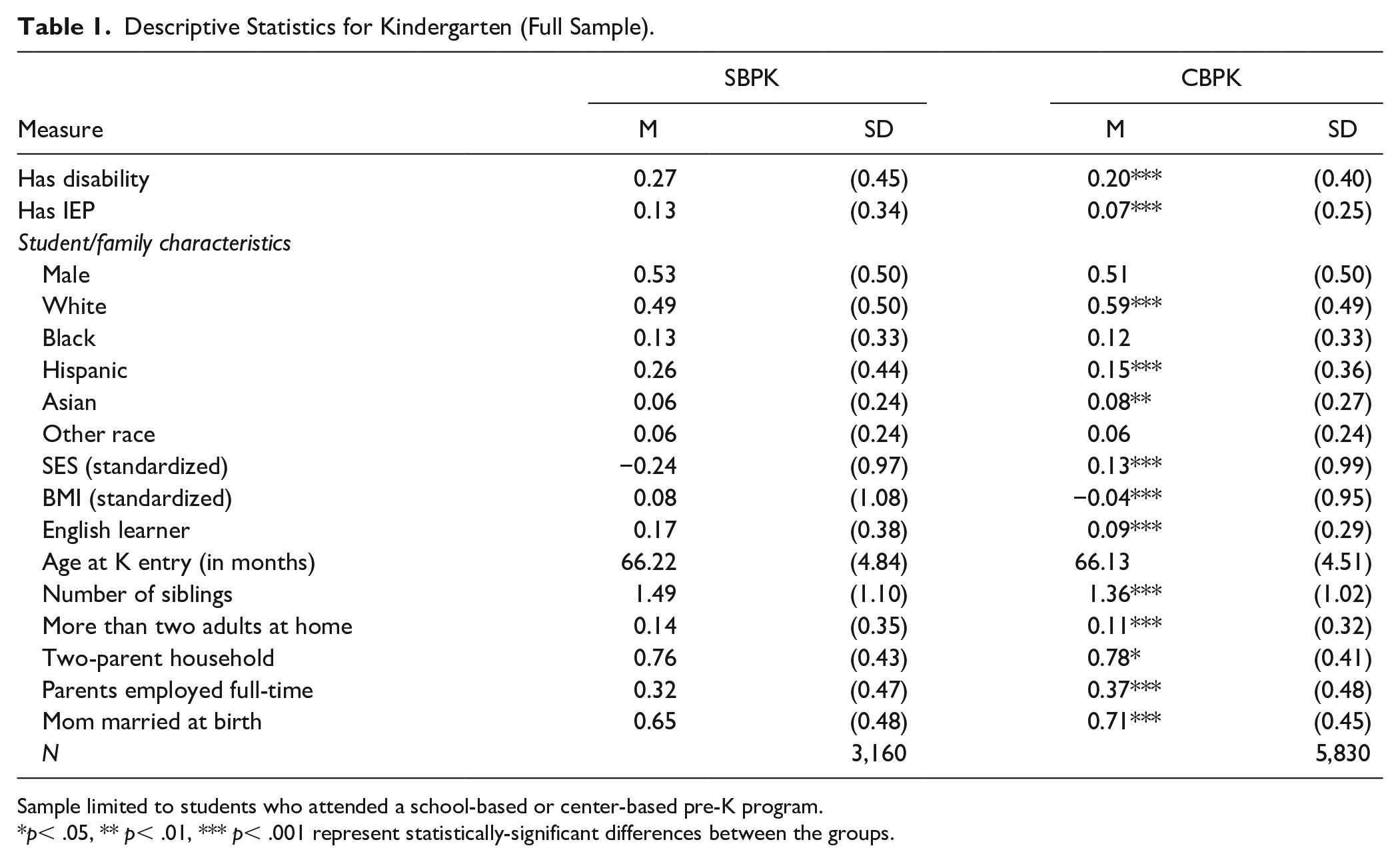
Sample limited to students who attended a school-based or center-based pre-K program.
p< .05, ** p< .01, *** p< .001 represent statistically-significant differences between the groups.
Pre-K Setting
ECLS-K collected information from parents on whether the child attended Pre-K before kindergarten. This survey item asked parents “Did your child attend a daycare center, nursery school, preschool, or prekindergarten program on a regular basis the year before they started kindergarten?.” In conjunction with this question, parents were asked the physical location of Pre-K (i.e., in a school vs. otherwise). From this, we were able to determine which students attended SBPK versus CBPK. Recall that CPBK is a formal Pre-K setting but not located physically at an elementary school.
Control Variables
Following the limited research on SPBK that indicates systematic differences in the populations of students that attend SBPK and CBPK (Little et al., in press), we included a range of student and family background measures as controls. For students, this includes gender, race/ethnicity, socioeconomic status (SES), body mass index (BMI) (as a proxy for physical health), English learner status, and age at kindergarten entry. We also included variables pertaining to the child’s family—namely the number of siblings, parental structure, parental employment, and mother’s marriage status at child’s birth.
Differences in SBPK versus CBPK Attendees
Before running our analysis, we inquired whether there were differences in children with disabilities who went to SBPK versus CBPK. To do so, we divided those children who had a diagnosed disability in kindergarten into two groups—those who went to SBPK versus those who went to CBPK. Recall that our sample includes children who went to either. Recall that children who did not go to Pre-K at all were excluded from all analyses, so that our comparison groups are those who went to Pre-K at an elementary school site versus those who did not but nonetheless went to Pre-K.
Looking across the disability sample in Table 2, even when there are statistically-significant differences, there are in fact only a few practically-meaningful differences between the groups. Children with diagnosed disabilities in SBPK were more likely to have an IEP, to be Hispanic, lower income, and have higher BMIs. All other characteristics were similar. Importantly, all family characteristics between groups were similar. Hence, the types of families with children with disabilities in SBPK were not different than those with children in CBPK.
Descriptive Statistics for Kindergarten (Students With Disabilities).
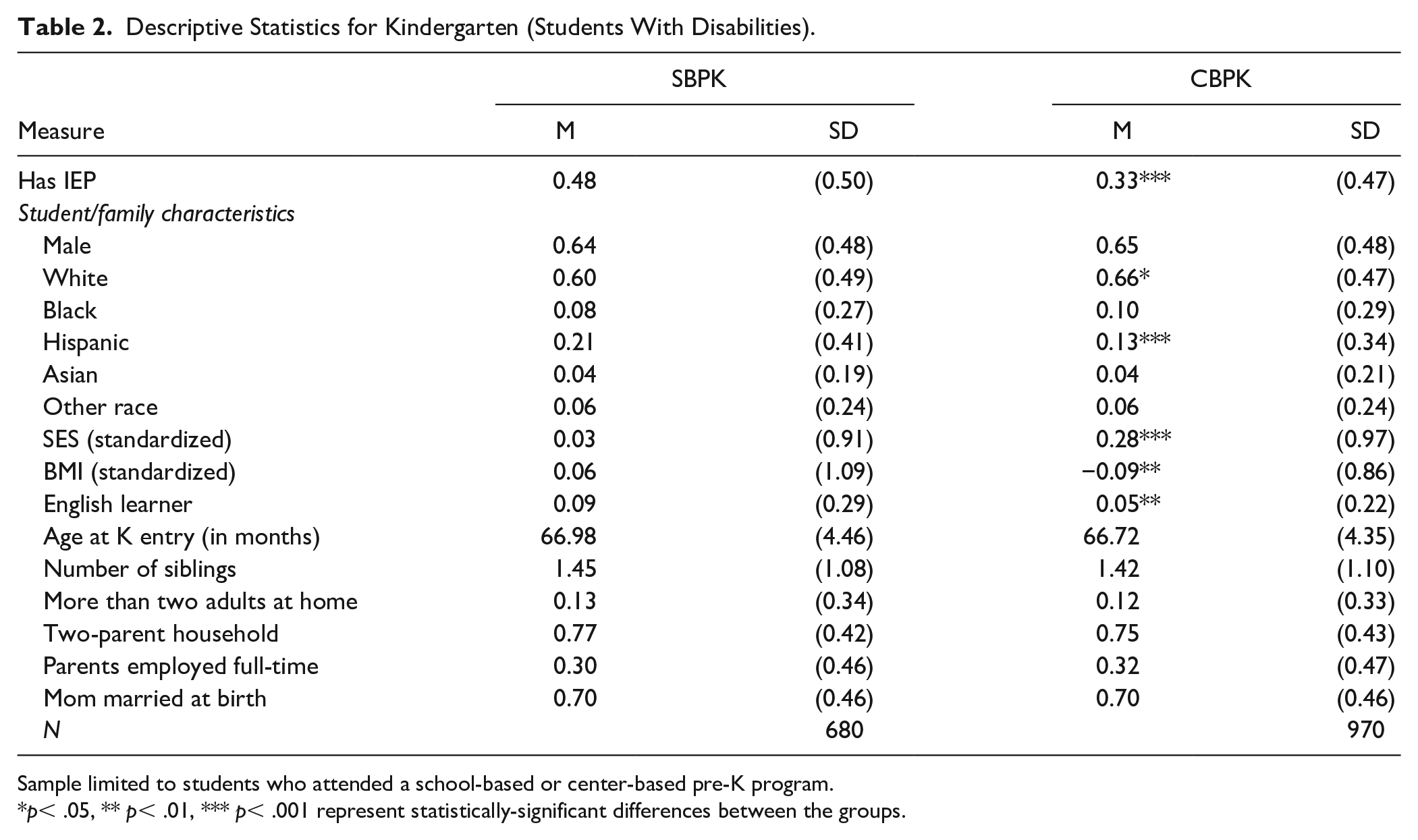
Sample limited to students who attended a school-based or center-based pre-K program.
p< .05, ** p< .01, *** p< .001 represent statistically-significant differences between the groups.
Analysis Approach
The goal of our study was to examine whether children in SBPK had different diagnoses and IEPs compared with those in CBPK. To do this, we rely on a classroom fixed effects model. However, to understand the logic behind this approach, we start with the following baseline model:

where Y represents one of the two disability-related outcomes mentioned above for student i in classroom c in school s in state k in year t. Continuing through the model, SBPK is the key term in our study and tells us whether there were differences in disability outcomes for students in SBPK versus other CBPK. The vector X represents all control variables described previously. The last term in the equation is our error term, which is clustered at the classroom level. In this baseline model, we included indicators for states—that is, state fixed effects—leaving out one state as the reference group. By including indicators for state, we made all comparisons of children within, rather than between, states.
As a second model, we replaced state fixed effects with school fixed effects for a child’s school in year t. Analogous to state fixed effects, school fixed effects are a series of indicators for school that the child attended leaving one school out as the reference group. Now, when we run the equation, the comparison between children occurs within the same school—that is, some children in the school went to SBPK and others went to CBPK.
Our most robust model, however, is our third and final model, in which we replaced school fixed effects with classroom fixed effects for a child’s classroom in year t. Now, we have included indicators for the students’ classroom each year. Analogous to the previous two fixed effects models, classroom fixed effects control for a child’s classroom, thereby making all comparisons between SBPK and CBPK for children within the same classroom.
The logic behind this third model being the most robust is as follows. If children who went to SBPK were assigned to a particular teacher because that teacher was different in some way than their colleagues, then the findings would be biased if we compared children who had different teachers. Put another way, if teachers had different practices for referring children to receive an IEP and if children who were in SPBK were assigned to these teachers differently than other teachers, then the results would be biased. Thus, a fairer comparison would be to examine children with the same teacher (who thus would be under the same teaching practices). Hence, this model is the most robust, as classroom fixed effects allow a comparison between children with the same teacher. In doing so, classroom variables drop away as they did with school of state fixed effects, and as a result they were not included in the analysis. In essence, then, classroom fixed effects inherently subsume school and state factors in that year.
Findings
Research Question 1: Disability Diagnosis
Our first research question asked whether children in SBPK had different disability diagnosis outcomes (as reported by the parents), and a sub-question asked whether this changed over time. The findings are presented in Table 3. In the table, three regression models are presented for each year of data—kindergarten through fifth grade. Each model represents a fixed effects model as described in the previous section—state fixed effects, then school fixed effects, then classroom fixed effects. Coefficients and standard errors are presented for all measures, with the key input, SBPK, found in the first row.
SBPK Attendance and Disability Diagnosis.
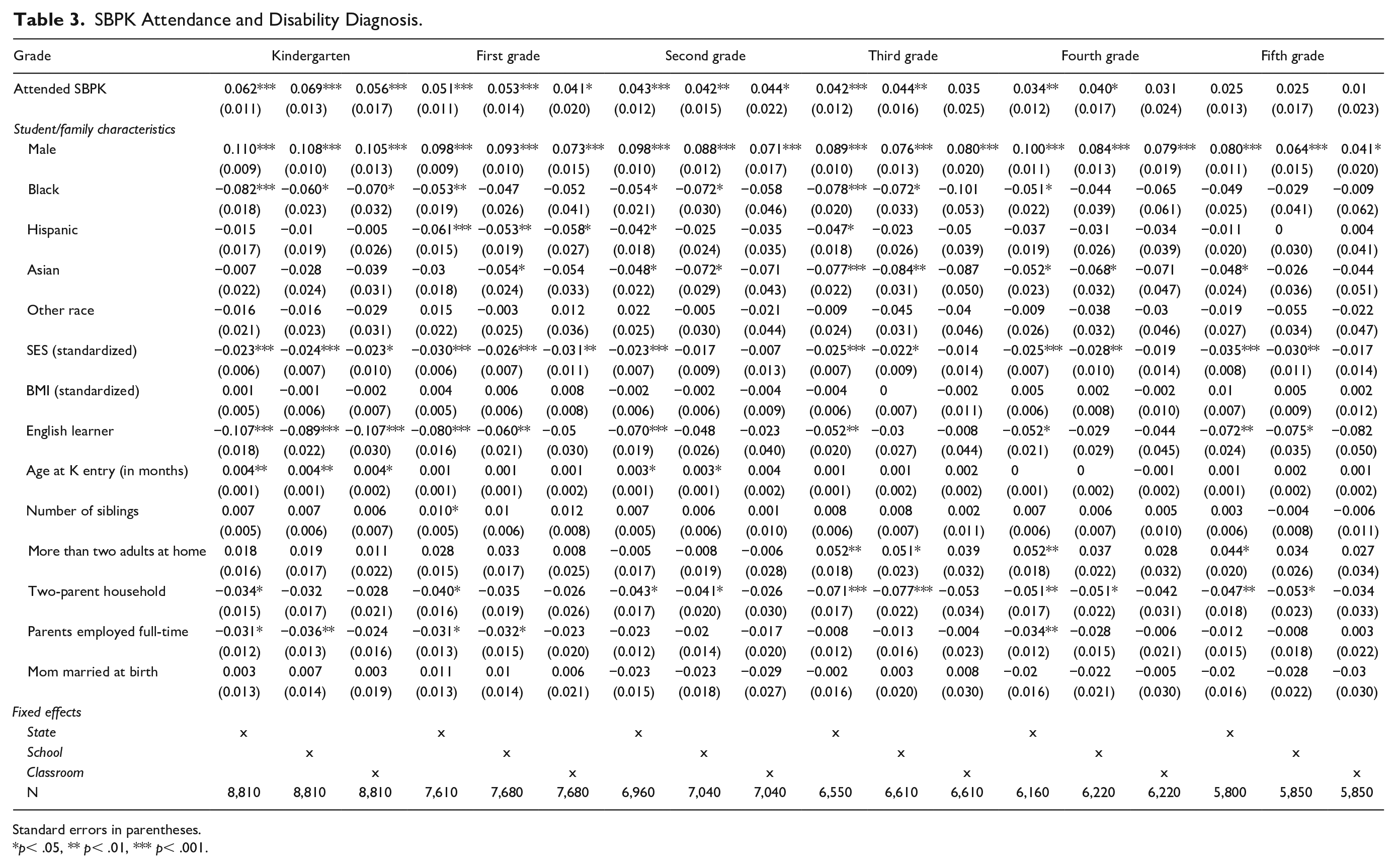
Standard errors in parentheses.
p< .05, ** p< .01, *** p< .001.
Looking across the table, the results generally suggest that children who attended SBPK had a higher probability of being diagnosed for a disability in the early elementary school grades. For example, the results suggest that when children were in kindergarten, those who attended SPBK had a higher likelihood of having parents report their children as being diagnosed with a disability in the spring.
Across the three fixed effects models, the most robust is classroom fixed effects, where we are only comparing children in the same classroom to one another—in which some had gone to SPBK and some had gone to CBPK. When relying on classroom fixed effects models, we can focus on the final column within each grade in the table. The results suggest that it is really mostly in the early elementary school portion of the table (i.e., grades K-2) where the results are the most robust (i.e., the final model is statistically significant). The classroom fixed effects models are not significant in grades 3 to 5. Thus, if we were to support the use of our most robust model, our results still suggest that having gone to SBPK is linked to receiving a disability diagnosis, but that this may be present only in the early elementary grades.
Research Question 2: IEP
Our second research question examined whether children had different rates of having an IEP based on SBPK attendance, relative to CBPK attendance. The findings can be found in Table 4. Much like in Table 3, here we present all three fixed effects regression models and for kindergarten through fifth grade. Coefficients and standard errors for all regression models can be found in the table, and SBPK runs across the first row of results.
SBPK Attendance and IEP.
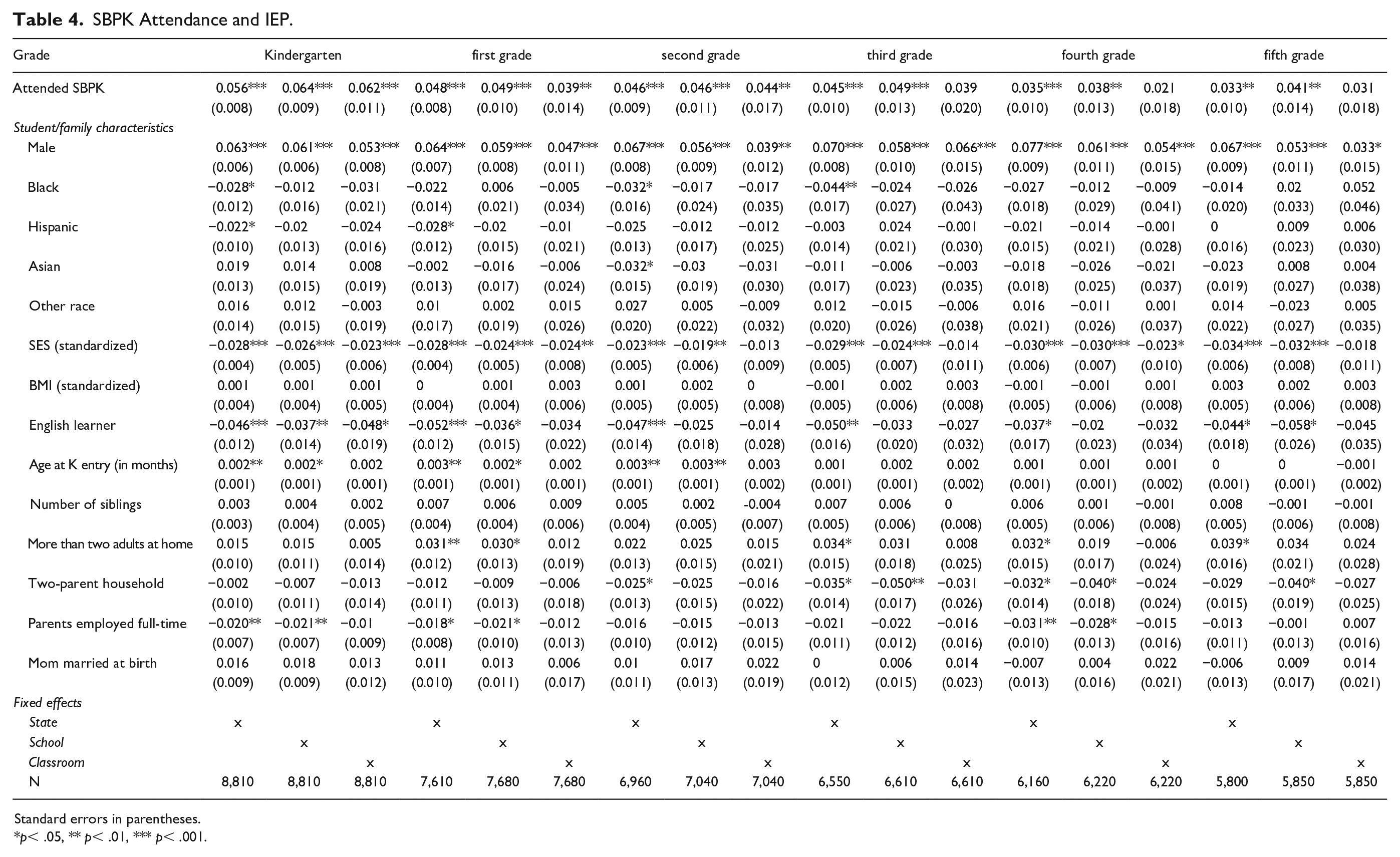
Standard errors in parentheses.
p< .05, ** p< .01, *** p< .001.
The findings here run parallel in statistical significance and interpretation to those from the prior table. Children who attended SBPK had a higher probability of receiving an IEP. But just like in Table 3, the statistical significance on our most robust models—classroom fixed effects, the final column within each grade—only shows statistically-significant effect in grades K-2. The classroom fixed models are not significant in grades 3 to 5. Thus, like with disability diagnosis, the importance of going to SBPK is linked to early elementary school disability outcomes, K-2. Importantly for this IEP outcome, given that this is a teacher-reported measure, the classroom fixed effects models are statistically significant, thereby showing that even when comparing children who had the same teacher, those who were in SBPK have different IEP outcomes compared with those who were in CBPK.
There are two additional findings between Tables 3 and 4. First, the sizes of the SBPK coefficients are remarkably similar. This provides a robustness in our analysis, given that these are two different outcomes, but both attempting to capture a similar process of diagnosis and support. The second point is that in both models, the classroom fixed effects coefficients on SBPK are no longer significant by third grade. If this model is the most robust, then perhaps this does suggest a tapering off effect by third grade and that the importance of SBPK on disability outcomes is more proximal—that is, early elementary school.
Discussion
School-based Pre-K remains an understudied area that has garnering increased scholarly attention in recent years (e.g., Little, 2023). However, much of this budding scholarship focuses on SBPK settings in general and its associations with a host of student outcomes among the overall student population. This study marks an important extension of this literature into the population of SWDs. As noted in the introduction, this population of students may stand to differentially benefit from the various physical settings in which Pre-K programs are offered, making descriptive evidence on students with disabilities and SBPK critical (Sands & Meadan, 2022) and an important precursor for future studies. As a first step toward building this evidence, we have focused here on understanding how programs vary in terms of the students they serve, and how the setting of Pre-K that students attend may be linked to disability diagnosis and IEP services throughout elementary school. In the following paragraphs, we review our key findings for these questions and discuss their implications for policy, practice, and future scholarship, where applicable.
Implications
First, our descriptive statistics from Table 2 indicate that SWDs who attend SBPK are more likely to be Hispanic and come from families with lower socio-economic status compared with SWDs in CBPK. Relating this finding to other descriptive research on SBPK, these findings are largely consistent with analyses of the ECLS-K for the general student population: Little (2023) found that Hispanic students and lower-SES students were more likely to attend SBPK compared with CBPK, although they did not examine the BMI measure.
Given this consistency across studies, it is likely that the demographic differences in SBPK attendance among the general student population is simply mirrored among SWDs rather than there being some SWD-specific difference. The differential rates of lower-SES students attending SBPK, relative to CBPK, is likely the result of the policy design of many publicly funded Pre-K programs, which are more likely to be sited in school buildings than in centers (Little, 2023). Publicly funded Pre-K programs often target their eligibility and outreach efforts to lower-income families, which would yield these unequal distributions (Merrill et al., 2020). While these differences make sense from a policy design perspective, policymakers and program administrators focused on income and racial-based equity should keep a close eye on these metrics and consider efforts to minimize isolation of systematically disadvantaged students in specific Pre-K settings.
Our second key implication is that students with disabilities that attend SBPK (as opposed to CBPK) are more likely to have a disability diagnosis and/or an IEP in kindergarten through second grade—when relying on our classroom fixed effects models. Consistent with prior research focused on the sample of students from the general population, we found a similar finding at kindergarten entry (Little et al., in press). It is likely that this phenomenon is driven by a combination of supply and demand factors, although more research into potential mechanisms is certainly warranted.
From a supply perspective, certain funding mechanisms—such as special education Pre-K funded through Part B, Section 619 of the Individuals with Disabilities Education Act (IDEA)—are primarily managed and administered through public schools (Early Childhood Technical Assistance Center, n.d.). Anecdotally, we are also aware that some counties choose to site their special education students in public schools to facilitate the efficiency of deploying support systems (e.g., speech language pathologists). Relatedly, from a demand perspective, parents/guardians of SWDs may perceive school districts as having more resources available to support their children than stand-alone centers. Alternatively, they see the value in reducing transition points, which are particularly disruptive for SWDs (McIntyre et al., 2010). Research into specific state and district policy designs, as well as parental preferences, would help to illuminate the specific mechanisms that drive differential rates of SWDs in SBPK compared with CBPK.
A final implication is related to the fact that our results taper after the second grade, when relying on the classroom fixed effects models. The attenuation of the observed short-term effects of Pre-K on outcomes in the long term can be hypothesized to be related to several factors. For instance, the early advantages conferred by Pre-K may be tapered by more proximal experiences in later grades. This may be exacerbated by alignment, or lack thereof, between Pre-K programs and later elementary school outcomes; if the early educational experiences are not effectively integrated with the later stages of education, the benefits of Pre-K may not be sustained. That is, while Pre-K provides an essential foundation for early development, the diminishing long-term effects that we find highlight the need for continuous, high-quality educational interventions and supportive environments throughout a child’s educational trajectory to sustain and build upon early experiences.
On the other hand, the fact that our results demonstrate tapering after second grade may indicate that the SBPK attendees (vs. CBPK attendees) no longer required special education services. Indeed, research shows that SWDs may exit special education altogether when symptoms have sufficiently improved (Daley & Carlson, 2009; Dodge et al., 2017). Our findings could thus imply that the CBPK attendees eventually caught up in their rates of disability diagnosis and IEP, suggesting that SBPK attendees were able to receive their services earlier compared with those in CBPK. In either case—whether through early receipt of services or early exit from special education—SBPK could be an avenue for improving the schooling experiences of SWDs.
The heart of the matter lies in the paradox of special education. While access to special education services is a necessity for most SWDs—who should get the support they deserve—it is also desirable if SWDs improve to the point that they no longer require special education, or never need it in the first place. This trajectory is highly dependent on each individual student. From the lens of Bronfenbrenner (1986), a child is profoundly shaped by the complex interplay of the environments they are in. Thus, for disabilities that are somewhat more malleable or preventable, the developmental course of the disability may be greatly impacted by the care settings and schools they attend. Ultimately, while further research is required to unpack our findings, our study provides evidence for the potential benefits of SBPK for SWDs.
Study Limitations
It is important to note that our analysis should not be interpreted as suggesting that SBPK causes students to have higher or lower rates of disability diagnosis or IEP services compared with being in CBPK. Our analysis is purely descriptive and should be interpreted as such. It is possible that SBPK attendance does indeed generate higher rates of disability identification due to schools having more resources available for such discovery. However, it is also possible that students with existing identified disabilities and/or those at more risk positively select into SBPK as opposed to CBPK for the reasons outlined above. Future research using data on student disability status prior to Pre-K and using causal designs should interrogate this open question.
Another limitation of the present study to be addressed is related to the diversity of different types of disabilities. In the present study, we focus on disability diagnosis as reported by parents and IEP status as reported by teachers. Under IDEA, there are 13 different classifications of disability—including speech/language impairment and deafness, for example (Rothstein & Johnson, 2009). It is important to understand how the relationships examined in this study may vary based on the specific disability type. It is likely that some more difficult to detect disabilities, such as emotional disturbance or learning disability, may be shaped differentially by SBPK attendance, but other more fixed disabilities, such as visual impairment, may be stable since they were identified prior to Pre-K enrollment. As another perspective, the rate of identification for some disabilities declines around Grade 3, and other rates increase at that time juncture (Georgan et al., 2023). In our study, Grade 3 was where we began to see the classroom fixed effects no longer revealing significant findings for children in SBPK. Therefore, future research should examine how SBPK, versus CBPK, may differentially support the specific needs that SWDs have based on their specific disability diagnosis—and should do so by grade level.
A third limitation is that this study focuses on disability outcomes. Yet, there is an opportunity to focus on additional student outcomes for SWDs that attend SBPK beyond disability diagnosis and IEP. While there is suggestive evidence that SBPK may benefit student achievement or social-emotional outcomes in the general student population (e.g., Magnuson et al., 2007), it is unknown how these associations operate among SWDs, specifically. Building this evidence will be critical for policymakers and program administrators making decisions about quality improvement.
Footnotes
Associate Editor: Erin Barton
Declaration of Conflicting Interests
The author(s) declared no potential conflicts of interest with respect to the research, authorship, and/or publication of this article.
Funding
This study was funded by a research grant from the U.S. Department of Education, Institute of Education Sciences. All work represents the authors and not the granting agency.
