




Abstract
Vocational English as a Second Language (VESL) is a form of adult language education that teaches communicative skills in the context of preparing learners for a particular vocation. Despite their pedagogical and logistical benefits for adult language learners, such programs are uncommon today. This literature review traces the emergence and disappearance of VESL in the United States through a corpus study. It then explains these trends by analyzing second language acquisition research and policies related to adult education. It finds that VESL remains a promising approach that fell out of favor due to welfare and workforce policy reforms in the 1990s. It concludes by arguing for the continued relevance of VESL today and the need for adult educators to be vigilant of unintended policy impacts on their programs.
Transnational migration has become increasingly widespread and complex in recent decades (Schiller, 2018). These changes have required adult educators of newcomers to “re-think social inclusion and reflect on the current policies and practices of adult education” in order to better meet the needs of adult learners (Kamisli, n.d.). Despite these efforts, U.S. federal adult English as a Second Language (ESL) programs have poor outcomes, with only 36% of participants making measurable skill gains in 2019 (U.S. Department of Education, 2021).
This underperformance has been attributed in part to the programs’ high levels of absenteeism, low completion rates, and standardized curricula that fail to respond to participants’ communicative needs (Kennedy & Walters, 2013; Norton, 2013; Wrigley, 2013). Adult learners may play various roles and balance responsibilities as parents, spouses, citizens, community members, and employees, yet most newcomer education programs focus on citizenship or survival English (Anatska, 2017; Wrigley, 2013). These one-size-fits-all curricula have been criticized as “not sufficiently focused on the specific demands of different contexts for English learning to make a significant difference in the lives of participants” (Wrigley, 2013, p. 223). As a result, general adult ESL programs may fail to validate and empower learners, while also remaining inaccessible to many (Imel, 1998; Ketzenberg, 2010). Given that language proficiency is an important predictor of other markers of newcomers’ social inclusion, financial self-sufficiency, and overall wellbeing, it is essential to address these shortcomings (OECD, 2013). A solution would need to reduce barriers to participation and align instruction with the demands of students’ daily lived realities. One promising approach that could accomplish this is vocational ESL (VESL), which allows learners to develop their language skills while learning a particular vocation (Center for Applied Linguistics, 1983; Ketzenberg, 2010). It typically focuses on the communicative skills needed for technical and manual work and in the United States falls under the umbrella of adult basic education (Anthony, 2018; Center for Applied Linguistics, 1983).
VESL offers numerous pedagogical and practical advantages over general ESL. From a pedagogical standpoint, it offers highly contextualized language instruction that is immediately relevant to learners’ daily lives (Center for Applied Linguistics, 1983; D’Amico, 1997). Additionally, given the diversity of backgrounds and experience that adults bring into the classroom, it offers a shared context for learning to which all participants can relate, and it provides immediate opportunities to practice new language on the job (Center for Applied Linguistics, 1983; Norton, 2013). From a practical standpoint, VESL, particularly if based at the workplace, can minimize logistical barriers to participation, such as transportation and scheduling difficulties (Center for Applied Linguistics, 1983). It can also give employers input into program content, thereby reducing potentially dangerous on-the-job mistakes (Stapp, 1998). Finally, by inviting collaboration among worksites, vocational trainers, and ESL specialists, it presents opportunities for advocacy both by and for English language learners in the workforce. Overall, VESL can promote participants’ long-term financial stability while providing a rich learning context that empowers them to engage critically with workplace relations, advocate for themselves, and pursue their personal and professional goals (Auerbach, 2005; Hull, 2000; Norton, 2013).
Beyond these practical and pedagogical advantages, VESL aligns with current newcomer integration policy, which prioritizes work readiness, financial self-sufficiency, and the development of language skills needed to find stable employment (Bok, 2004; Fortuny & Chaudry, 2011; U.S. Department of Education, 2013). Even so, the approach is relatively uncommon today; Ketzenberg's (2010) ethnographic study of a community college VESL program describes it as one of only a few nation-wide. Yet there is no discussion in the literature of why these promising programs are so rare. In order to address this gap, the present review was guided by the following question: What pedagogical and societal factors contributed to the development of VESL and its scarcity today?
First, I will trace the historical trajectory of VESL through a corpus study of print media. Then I will analyze the theoretical, social, and political circumstances that led to the introduction of VESL in the mid-20th century and its disappearance just a few decades later. I will analyze historical documents show that VESL programs emerged in the 1970s and 1980s to meet the demands of adult language learners, employers, and policymakers at once. However, by the early 2000s interest in these programs waned, and VESL suddenly disappeared from the adult education literature. I will proceed by explaining this decline as an unintended—and largely unnoticed—consequence of changes to US welfare and workforce development policy. Finally, I will discuss the implications of these findings for adult ESL education today.
Corpus Study
In this section, I will describe a corpus study documenting the rise and fall of VESL using three corpora: The Google Books Corpus of American English, the Education Resources Information Center (ERIC), and News and Newspapers (ProQuest). Together, these corpora offer a comprehensive view of the topic's prominence in books, scholarly literature, and journalism. I searched each of the three corpora for three tokens, or search terms: “VESL,” “vocational ESL,” and “workplace ESL,” coding search results manually for country of publication and excluding results from outside the United States from further analysis. Each token revealed the same general trend over time. However, Figure 1 features the results only for “Vocational ESL,” the least ambiguous search term.
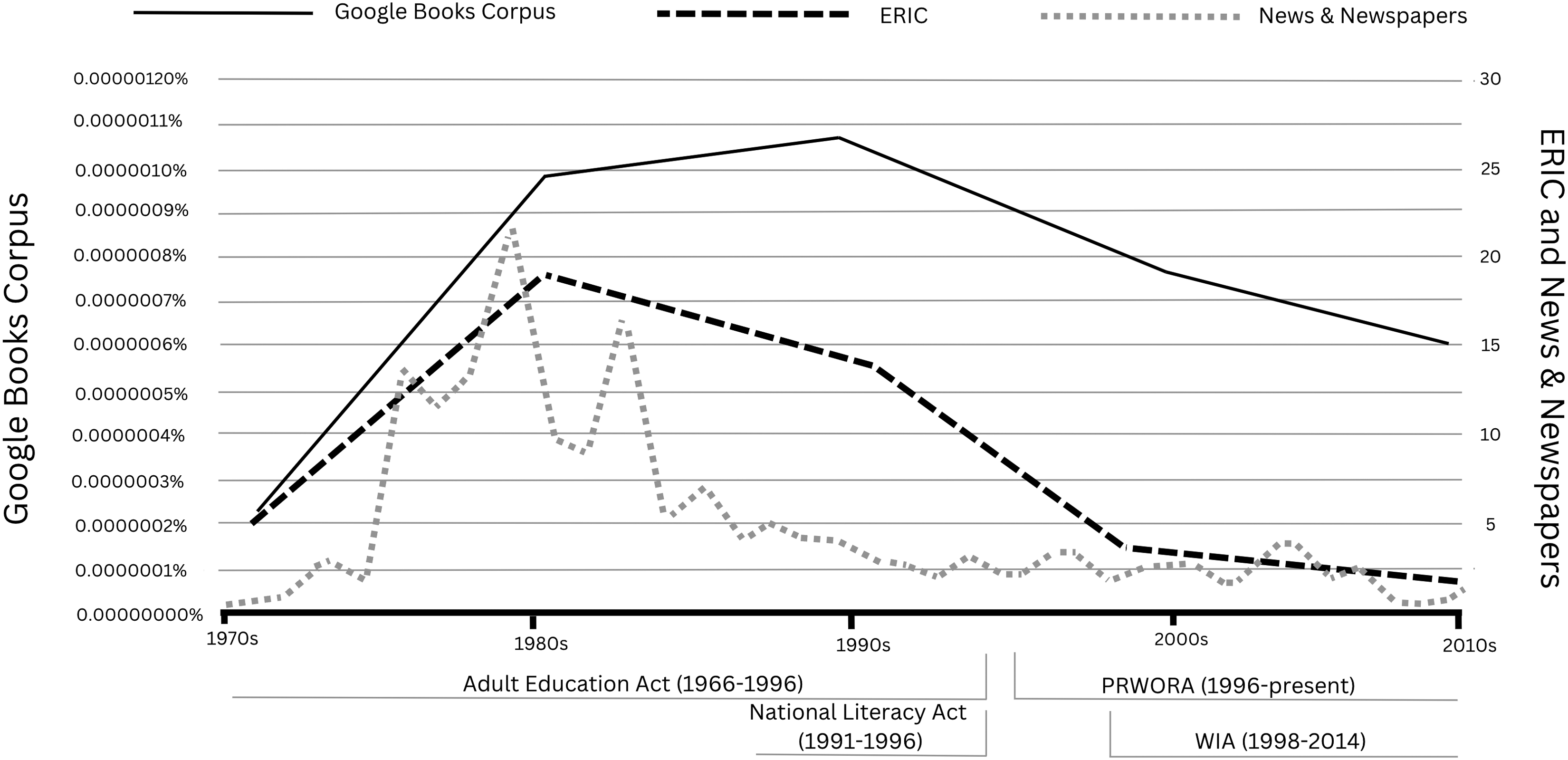
Corpus results for “vocational ESL” and adult education-related policies.
In Google Books and ERIC, the earliest reference to vocational ESL occurred in the late 1970s, and the topic gained considerable popularity through the 1980s and into the mid-1990s. Further analysis of the search results showed that most of these references were in large-scale reports rather than smaller research works such as journal articles, indicating a high degree of institutional support for this area of study outside of the traditional university-based research infrastructure. However, in the late 1990s, references to vocational ESL rapidly declined, ultimately all but disappearing from both research and published books by the year 2000. The rapidity of this change suggests that the disappearance is more likely to have resulted from a sudden adjustment of policy priorities rather than new pedagogical practices, which would have produced a more gradual shift.
The data from the News and Newspapers database echo the explosive growth of VESL in the 1980s and 1990s and a decline in the late 1990s, although the drop was less dramatic than in the other corpora. Examination of individual tokens revealed that some VESL programs continued to operate into the 21st century, but that many of the recent journalistic references were to now-defunct programs. For example, an article written in 2006 referenced a VESL program that an individual had participated in 10 years prior. Notably, throughout the 1990s, most references to VESL in the News and Newspapers corpus (45 out of 66 tokens) were classified listings and advertisements seeking VESL students and teachers. After the turn of the century, however, only one such listing appeared. Of course, this may be partly attributed to web-based advertising supplanting print-based classifieds during that time. As such, the lack of newspaper advertisements since 2000 cannot be exclusively attributed to the decline of VESL. All the same, the high proportion of classifieds from the 1970s to the 1990s indicate that during this period, VESL programs not only existed, but were actively seeking out new students and staff, and that this growth stopped at the same time that VESL disappeared from other kinds of print publications.
Taken together, the corpus data suggest that across different print media genres, VESL experienced a dramatic drop in popularity in just a few years. The next section will provide context for this trend by analyzing developments in the understanding of second language acquisition and the structure of American society that contributed to the short-lived but intense support of these programs.
The Emergence of VESL
The second half of the 20th century was a period of major changes in US demographics and labor market needs, as well as exponential growth of immigration and participation in adult education. Between 1970 and 1990, enrollment in adult basic education, of which ESL was the largest sector, increased by nearly 900% (Buchanan, 1990; U.S. Department of Education, 1991; Wrigley, 2013). In the same period, the labor market was shifting away from production and manufacturing toward service industries. For example, the number of people working in agriculture, previously a major employer of adult English language learners, dropped by 75%, and more immigrants found employment in fields that required specialized vocational and language skills (Buchanan, 1990; Friedenburg et al., 1988).
As the country's demographics and labor needs changed, so, too, did understandings of second language acquisition. Until this point, language instruction had been dominated by structuralist approaches that framed language learning as the accumulation of a repertoire of memorized patterns. However, in the 1970s, communicative and task-based approaches emerged that emphasized the teaching of language that applied directly to learners’ real-life needs and experiences (Center for Applied Linguistics, 1983; Crandall, 1985). Instruction became more contextualized and specialized, with some applied linguists going so far as to call general ESL instruction “inappropriate” and “insufficient” (Crandall, 1985, p. 4).
VESL rapidly gained prominence thanks to its potential to respond to these societal and pedagogical developments (Center for Applied Linguistics, 1983). Adult educators described it as “highly successful” and “a magnificent opportunity” for adult learners and employers alike (Levitan & Mangum, 1981, p. 41; Lozada, 1998). Numerous reports and handbooks, many funded by federal grants, touted the potential advantages of VESL and offered guidance for establishing successful programs (see Averitt, 1993; Bradley et al., 1990; Buchanan, 1990; Center for Applied Linguistics, 1983; Crandall, 1985; Smith, 1984; Stapp, 1998; Weinberg, 1992). VESL flourished in diverse fields such as welding, accounting, data processing, food services, and clerical services (Crandall, 1985; see also Fortuny & Chaudry, 2011). In fact, workplace literacy and language education became so popular that the Adult Education Interest Section of TESOL International dedicated its entire November 1991 newsletter to it. The editor noted that “the topic elicited more submissions than any other that we’ve had”—more than the newsletter could print—including first-hand accounts of successful programs, advice for program directors, and contributions written by VESL students themselves (Teachers of English to Speakers of Other Languages, 1995, p. 21).
To summarize, VESL emerged in the United States as a means to weave emerging understandings of language acquisition together with the country's changing labor demands. On all sides, it was hailed as a promising approach worthy of investment, and for several decades, it appeared to be the teaching approach of the future for adult learners. Yet despite this enthusiasm, political changes in the 1990s brought VESL's development to a sudden halt.
Competing Approaches to Workforce Development
The development and demise of VESL can be understood through two contradictory approaches to labor force development: the human capital development approach and the labor force attachment approach. The former considers education “a key element for ensuring that people have the skills necessary to make money and contribute to the economy” (Levitan & Johnson, 2020, p. 202). Programs that employ this approach emphasize long-term interventions that develop individuals’ basic skills, such as English, literacy, and numeracy, as well as their vocational and professional qualifications (D’Amico, 1997). VESL programs that last months or years and target participants’ overall language proficiency are one example. Such programs can improve individuals’ qualifications and earnings long term, but their administrative costs can be double those of less intensive programs (D’Amico, 1997; Hamilton et al., 1997). In contrast, the labor force attachment approach seeks to place individuals in jobs—even low-paying or undesirable ones—as quickly as possible under the assumption that workers will continue to develop their skills and qualifications on the job (D’Amico, 1997). Labor force attachment approaches result in short-term savings on program administration, but they have been criticized as “low-road” strategies that expand the low-wage labor supply without improving workers’ living standards (Baldwin, 1998, p. 60; see also Hamilton et al., 1997). Thus, the choice of one approach over the other hinges on a trade-off between short-term government savings and long-term individual outcomes. The development of VESL was made possible by a human capital development approach, which faded when federal policy transitioned to the labor force attachment approach that persists today.
Origins in Human Capital Development
The US government introduced various adult basic education programs during World War II to combat illiteracy among army recruits (U.S. Department of Education, 1991, 2013). These early programs employed a human capital development approach, seeking to enhance participants’ long-term employability as well as their basic skills (Brice, 1961). The resulting patchwork of programs saw some success, but it failed to reach many marginalized individuals. In consequence, illiteracy remained high, especially among minorities and English language learners (U.S. Department of Education, 2013). A few years later, the Adult Education Act (1966) sought to address these shortcomings, unifying adult education under one federal policy while maintaining its predecessors’ emphasis on prolonged, intensive skill development (Hettinger, 1998; U.S. Department of Education, 1991). Over the years, numerous amendments to the Adult Education Act enhanced offerings for marginalized populations, including English language learners (U.S. Department of Education, 2013). However, the law's emphasis on the link between adult education and the labor market remained constant (Cruikshank, 2002, p. 56).
In the subsequent decades, the persistence of illiteracy and the growing population of multilingual Americans made adult literacy and language development a central issue in federal policy (Buchanan, 1990; U.S. Department of Education, 2013). In 1988, an amendment to the Adult Education Act established the National Workplace Literacy Program, providing an unprecedented level of federal support for adult ESL education and funding over 300 VESL programs (Burt, 1997; U.S. Department of Education, 1991). In 1991, the National Literacy Act established the National Institute for Literacy to fund adult education programs and conduct research on adult literacy development (Teachers of English to Speakers of Other Languages, 1995). Among the Institute's major contributions was the Equipped for the Future Initiative, which collected 1,500 adult learners’ answers to the question, “What is it that adults need to know and be able to do in order to be literate, compete in the global economy, and exercise the rights and responsibilities of citizenship?” (Imel, 1998, p. 3). These responses were used to develop three learner profiles—worker, family member, and citizen—and differentiated learning standards for each (Imel, 1998; Marshall, 2002). This initiative demonstrated an awareness of the importance of tailoring instruction to adults’ real-life needs and goals—professional or otherwise—while remaining responsive to the demands of the labor market.
The Shift to Labor Force Attachment
In the 1990s, the chair of TESOL International's Adult Education Interest Section warned of difficult times ahead due to “mistrust of government, anti-tax sentiment, and anti-immigrant sentiment” (Teachers of English to Speakers of Other Languages, 1995, p. 56). Indeed, in this decade numerous reports questioned whether the participant outcomes of human capital development programs justified the expense (see e.g., D’Amico, 1997; Friedlander & Burtless, 1995; Grubb, 1995; Hamilton et al., 1997). These studies confirmed that programs employing a human capital development approach produced positive effects in the long term, even if short-term studies rarely captured these gains. For example, Freeman and Freedlander's (1995) three-year longitudinal study found that human capital development programs only began to show participant growth in the second and third years. In comparison, D’Amico (1997) concluded that the labor force attachment approach resulted in a savings of 22% for welfare budgets, but that participants in these programs “experienced a statistically significant reduction in total measured income” even compared to those whose welfare program included no training or job search support at all (p. 15). Despite the positive impacts of human capital development programs on participants’ living standards, concerns over the programs’ cost began to drown out evidence of their efficacy.
As opposition to immigration and taxpayer-supported programs grew, the intense investment in research on adult education and welfare that had created programs like the Equipped for the Future Initiative began to fade. In 1993, the federal government failed to renew funding for ESL demonstration projects, and just a few years later, the National Literacy Act was repealed and replaced entirely (Elliott, 2003; Teachers of English to Speakers of Other Languages, 1995). The fact that this stream of research relied so heavily on federal funding helps to explain the sudden disappearance of VESL from adult education research agendas, as well as why the disappearance went unremarked for so long.
In the wake of these policy shifts, the Adult Education Act was nearing its 30th anniversary, at which point it would be eligible for reauthorization. Educator-researchers Heidi Spruck Wrigley and Danielle Ewen argued that the year 1995 would present “unique opportunities” to transform federal education policy (Teachers of English to Speakers of Other Languages, 1995, p. 52). Educators saw a chance to carve out more space for adult programming, which they said had “received almost no attention” from policymakers (Teachers of English to Speakers of Other Languages, 1995, p. 52; see also Chisman et al., 1993). These efforts are documented in TESOL International newsletters (Teachers of English to Speakers of Other Languages, 1995). Contributors explored numerous ways that the Adult Education Act could better serve adult language learners, for instance by improving program accountability and supporting special projects, including “funded programs at worksites, across generations, etc.” (Teachers of English to Speakers of Other Languages, 1995, p. 21). The newsletters show that this was a time of optimism and collective organization on the part of adult ESL teachers as they mobilized to shape the new law through a prolonged, multifaceted advocacy campaign.
In the end, change to adult education policy did come, but not in the form that educators had hoped for. In 1996, the Personal Responsibility and Work Opportunity Reconciliation Act (PRWORA), popularly known as the Welfare Reform Act, introduced sweeping changes to the administration of federal and state welfare programs. Close behind it was the Workforce Investment Act (WIA, 1998), which replaced both the Adult Education Act (1966) and the National Literacy Act (1991) (U.S. Department of Education, 2013). These policies introduced a labor force attachment approach that prioritized short-term savings on both welfare and adult education. Together, these policies would significantly reduce support for adult basic education and workplace partnerships, marking a turning point in the history of VESL.
PRWORA aimed to minimize individuals’ use of welfare by replacing the Aid for Families with Dependent Children (AFDC) program with Temporary Assistance for Needy Families (TANF) (Ben-Ishai, 2010). It introduced a 5-year lifetime limit on welfare receipt and imposed work activity requirements on welfare users; these work activities included paid employment, unpaid community service, work readiness training, and, in limited cases, adult or vocational education (Ben-Ishai, 2010; Tumlin & Zimmerman, 2003). While PRWORA did not prohibit states from incorporating VESL into approved work activities, a variety of measures discouraged them from doing so. For instance, both the number of clients that could participate in vocational education and the duration of an individual's participation were restricted (Tumlin & Zimmerman, 2003). In addition, states were penalized for enrolling welfare users in programs beyond a small subset of approved work activities (Ben-Ishai, 2010; Tumlin & Zimmerman, 2003). In 1997, only six states had acquired permission to include ESL or adult basic education in the approved offerings (D’Amico, 1997).
Two years later, the WIA extended PRWORA's emphasis on efficiency to adult education overall. Title I established “one-stop shops” to administer all programs funded by the Department of Labor, including career counseling, job readiness training, case management, and adult education (“The Year in Review,” 1999; Wonacott, 2000). Title II, the Adult Education and Family Literacy Act, addressed educational programs outside of the welfare system, establishing partnerships between federal, state, and local governments to provide adult education and family literacy training. Although many of the organizations involved in these partnerships had been offering job development and adult education for years, the new law required some of them to dramatically restructure, and they “[struggled] to retain their traditional character and mission” (McDonald & Reisch, 2008, p. 49).
The impact of these changes was immediate. Within a year of PRWORA's introduction, D’Amico (1997) cited literacy educators’ reports that “education [was] no longer encouraged—and in fact [was] often actively discouraged” (p. 58). Enrollment fell as program administrators scrambled to survive under the new regulations by restricting class sizes, reducing course offerings, and limiting program durations (D’Amico, 1997). ESL educators in Los Angeles and New York City reported that the new policies forced them to shift to work-readiness oriented curricula, which they felt impeded learners’ progress (Tumlin & Zimmermann, 2003). The new trainings designed under PRWORA were described as “wasteful and misguided,” with unrealistically short timelines (Bok, 2004, p. 46; see also Tumlin & Zimmerman, 2003). Over the years to come, these problems would persist: An ETS Policy Note (Coley, 2008) found that on average, adult education participants spent less than 100 hours per year in class, and only one-third of them made measurable progress in that time, a figure that has not significantly improved since (U.S. Department of Education, n.d.). These findings suggest that current adult education programs are not sufficiently intensive to promote language development.
Compounding these curricular and programmatic changes were the restrictions on welfare users themselves, with many learners forced to drop out of programs in which they were already enrolled (D’Amico, 1997). In Oregon, in the years after PRWORA came into effect, the number of welfare users pursuing two-year degrees at community colleges fell from 50% to 5%. Similarly, enrollment of welfare users at City University of New York dropped by over 80% over a five-year period (Bok, 2004; Hettinger, 1998). In fact, by 2001, only 5% of TANF users participated in education and training programs (Bok, 2004).
Although neither PRWORA nor WIA were immigration policies, they disproportionately impacted immigrants and English language learners, whose language and professional skills may not be valorized on the labor market (Fortuny & Chaudry, 2011; McDonald & Reisch, 2008). Wrigley (2013) observed that the system established by WIA was not “effective for those most in need: individuals who speak little English or have no levels of literacy and need access not just to ESL but to technical programs” (p. 236). PRWORA fast-tracked English language learners into work and community service positions that did not require English proficiency, thus preventing them from taking ESL classes or improving their language skills on the job (Tumlin & Zimmerman, 2003). In their analysis of welfare users in California's six largest counties, Tumlin and Zimmerman (2003) found that over half of individuals who timed out of welfare—that is, who reached PRWORA's five-year limit without earning enough money to stop receiving financial support—were English language learners working full-time jobs.
Consequences of Policy Reform for VESL
In a digest produced for the Education Resources Information Center (ERIC), Wonacott (2000) acknowledged that the WIA “appears to offer a range of services…that would coincidentally meet the English language instruction and literacy needs of the LEP [limited English proficiency] population” (p. 5, emphasis mine). However, an apparent, coincidental response to the needs of adult language learners was not enough to save VESL. WIA marked the end of special funding for workplace-based education (Adult Learning and Literacy Clearinghouse Fact Sheets [Revised], 1999), and VESL was rarely offered under PRWORA. Once federal support for VESL disappeared, companies, schools, and state governments did not often seek out new funding sources to keep programs going (Tumlin & Zimmerman, 2003). As a result, having flourished from the early 1980s to the mid-1990s, VESL programs disappeared swiftly and silently after the new policies were introduced.
This disappearance is apparent in Techniques, a professional magazine for vocational educators (Hettinger, 1998; Lozada, 1998). While the publication occasionally reported on VESL program closures, many contributors seemed unaware of how widespread these closures were. Two years after PRWORA, a teacher at a community college-based VESL program that had operated for 10 years expressed only mild concern about the recent policy changes before ultimately confirming, “Right now we’re feeling not great, but maybe comfortable is a better word” (Hettinger, 1998). Similarly, the coordinator for a VESL-secondary school hybrid admitted that all but one of her program sites had closed down after funding had been “allocated elsewhere, especially for technology…but it was a valued program” (Lozada, 1998). Lozada (1998) follows up on Platt's (1992) survey of VESL programs in five states; while she notes that “some healthy aspects of VESL and vocational collaboration still exist,” at least three of the five programs she discussed had closed by the time the article was published.
In many ways, VESL is compatible with PRWORA's and WIA's emphasis on connecting adult education to the demands of the workplace. However, these policies enforced a labor force attachment approach that discouraged welfare users from taking time to improve their skills, instead requiring them to begin searching for work as soon as their welfare eligibility was approved and to take the first job they were offered (Tumlin & Zimmerman, 2003). This had sudden and severe consequences for adult education in general and VESL in particular.
Just a decade after WIA came into effect, Heidi Spruck Wrigley, a leading voice in adult ESL for decades, called not for a return to the VESL models of the past, but to “a new model” of education that would integrate ESL and job skills (Wrigley, 2013, p. 25). Wrigley had been prominent in adult language education in the early 1990s and was well aware of the history of the field. Wrigley's demand serves to underline the profound impact of the rupture in the trajectory of VESL. The few VESL programs that survived had to rely on a hodgepodge of funding streams and partnerships that contrasts starkly with the strong institutional support that they once enjoyed. Ketzenberg (2010) demonstrates how even well-managed VESL programs may fail to provide long-term benefits under these conditions.
Discussion
After the tumult of the 1990s and early 2000s, the last decade has offered new hope for those wishing to revitalize and improve the VESL model. In 2014, WIA was repealed and replaced by the Workforce Innovation Opportunity Act (WIOA), which explicitly provides for integrated education and training programs such as VESL (Workforce Innovation Opportunity Act, 2014). The need for this programming is clearer today than ever before. Norton (2013) highlights the potential of the workplace to support newcomers’ language learning but finds that this potential often goes unrealized due to a lack of support from supervisors and coworkers. She also found the workplace to be a site of struggle and frustration where individuals negotiate their social positions and identities from the marginalized status of English language learners. VESL remains uniquely positioned to offer the language instruction and advocacy opportunities that many language learners in the workforce struggle to access.
Although English language learners may face similar barriers to education and professional advancement, it is essential to remember that their needs are diverse. Adult language education research has consistently emphasized the importance of tailoring instruction to adults’ learning goals, which are not necessarily work related (Adult Learning and Literacy Clearinghouse Fact Sheets [Revised], 1999; Wrigley, 2013). Effective implementation of VESL would leverage the offerings of the vocational context to empower learners in the professional sphere without neglecting other facets of their identities. In addition to improving the quality of instruction for language learners in the workforce, this would also free up other programs’ resources to expand beyond the survival English and work readiness programs typical today (Wrigley, 2013). This could allow for more differentiated ESL offerings that meet learners’ needs not only as workers, but also as family and community members.
This vision of diverse, accessible, and transformative education is possible under current conditions but far from guaranteed. Cherewka and Prins (In press) criticize WIOA for neither helping participants to become financially self-sufficient nor to advance their non-work-related goals. This adds to the preponderance of research showing that trainings employing a labor force attachment approach typically fail to benefit individuals long term (Bok, 2004; D’Amico, 1997; Tumlin & Zimmerman, 2003). Cherewka and Prins (In press) also argue that WIOA places more power in the hands of industry partners than of adult educators or learners, a concern that is shared by critics of vocational education programs in general (Down, 2020). In consequence, VESL programs may run the risk of entrenching an instrumentalist view of immigrants as a disposable source of cheap labor, “socializing them into passive acceptance of subservient roles” (Jasso-Aguilar, 2005, p. 127). Additionally, these programs may reinforce xenophobic demands that newcomers somehow prove that they are worthy of basic support, professional fulfillment, and social inclusion. Without due caution, VESL educators could exacerbate the very marginalization that they seek to combat.
While these are serious concerns, they are not unique or specific to VESL. As Ettore Gelpi, former head of lifelong learning at UNESCO, stated, “Lifelong learning policies are not neutral” and can be either emancipatory or oppressive (Gelpi, 1979, p. 2). Any adult education program, workplace-oriented or not, has a responsibility to educate not only for financial independence, but also for the development of community and civic engagement. Similarly, any adult education program can either fulfill or fall short of this responsibility (Cruikshank, 2002). While VESL's apparent compatibility with labor force attachment makes these concerns particularly obvious, it does not negate the transformative potential of making adult language education more relevant and accessible. It merely highlights the delicate balance that adult educators must maintain if they are to leverage existing resources and opportunities without compromising their professional ideals.
Several successful programs already exist that can serve as examples for revitalizing VESL and maximizing its transformative potential. For example, Couch et al. (2018) provide a review of programs based on the I-BEST model, finding that these programs owe their success partly to the integration of basic skill and vocational content and to the collaboration among education specialists, vocational trainers, and employers. Most directly related to the VESL programs of the past, I-BEST @ Work partners with service industry companies to combine basic skills, including ESL, and workplace training (Washington State Board Community and Technical Colleges, 2019). Down (2020) describes a vocational program that encourages participants to “identify the kinds of lives they want to lead, acquire the skills and knowledge to achieve these goals, and then understand the conditions that enable or impede them” (p. 8). Developing this understanding of external conditions—in essence, grounding instruction in the critical analysis of learners’ lives—is crucial for transformative learning (Mezirow, 2018). The Philadelphia Community Women's Education Project, which operated from 1977 to the mid-2010s, used federal workforce development funding to offer vocational training from a critical pedagogical approach (Community Women's Education Project, 2012; D’Amico, 1997). Similarly, Auerbach and Wallerstein's (2004) Problem Posing at Work: English for Action presents a VESL curriculum based on Freirean critical pedagogy. Crucial to the success of programs such as these is the involvement of adult educators who have the support to balance the needs of students with the interests of funders, as well as the expertise to refuse unequal social relations (Imel, 1998).
A VESL model that empowers and emancipates participants would require creative partnerships and organizing on the part of ESL professionals. While government funding structures may be able to support VESL programs, they are vulnerable to the whims of the changing political climate. The College & Career Readiness and Success Center (CCRS) provides information on establishing career and technical education programs with this unpredictable funding (American Institutes for Research, 2019). However, partnerships with the private sector may be better positioned to provide continuity. Past experience shows that it may be a challenge to convince companies to invest in developing employees’ language skills, but it is possible to do so. Burt (1997) offers guidance on transitioning from government funding to a fee-for-service model, where companies would contract with ESL educators to offer language classes as an employee benefit. Additionally, organizing VESL through unions and professional organizations could help to establish stable programs that are attuned to the needs of their members and could continue across multiple generations of workers.
Conclusion
The present analysis illustrates the profound impact that policy decisions can have on educational practice even without educators’ knowledge or policymakers’ intent. It is essential that rather than accepting prevailing educational practices at face value, educators engage critically with recommendations and stay vigilant of political and ideological influences on their work. Only through staying informed can education practitioners prevent undetected political forces from shaping their decision making in ways that may undermine their missions.
In addition, the findings in this review reveal the danger of overreliance on centralized program development and funding resources. Adult education research has repeatedly emphasized the importance of diversifying programs in order to meet participants’ wide-ranging needs (Kennedy & Walters, 2013; Morgan et al., 2017; Wrigley, 2013). However, this analysis shows that programs often find their ability to pursue their missions shaped less by evidence-based practice, professional experience, and participants’ needs than by the constantly shifting political climate. Offering a variety of programs not only improves the quality of instruction, but also can mitigate instability and shield promising practices from competing political interests.
Although VESL has significant practical and pedagogical advantages over general adult ESL teaching, it has suffered under policies that discourage long-term, specialized language programs in favor of those that offer immediate savings. These policies push workers with complex needs, such as English language learners and those with limited U.S. work experience, into low-paying, unstable jobs with limited possibilities for advancement, thus perpetuating an underclass of workers who cannot access the educational and professional opportunities they need and want (Bok, 2004; Ketzenberg, 2010). While many of the factors responsible for the decline of VESL are still relevant today, it remains a promising method that could be revitalized and improved through the creative collaboration of adult educators with the public and private sectors. By enabling partnerships between adult educators and employers, VESL offers an opportunity to integrate language learning more fully into other domains of participants’ lives. For adult language learners who often find educational and professional advancement to be an uphill battle, a return to VESL could be a form of liberation.
Footnotes
Declaration of Conflicting Interests
The author(s) declared no potential conflicts of interest with respect to the research, authorship, and/or publication of this article.
Funding
The author(s) received no financial support for the research, authorship, and/or publication of this article.
