



Abstract
This conceptual article deals with components and concepts of transformative learning, emphasizing the organization-level perspective on critical reflection. The discussion leans on the concept of transformative authorship and it is argued that it enables authoring processes through which professionals can recognize and recreate their routinized work practices. The aim of the research is to explore how professional experiences are integrated with reflexive, theoretical knowledge through critical dialogue. The authoring process of transformative authorship is illustrated with two complementary case studies from postgraduate health care education. In both cases, the learning tasks were designed as constructed objects by various instructional interventions where organizational contradictions or dilemmas were used as an inspiring premise for transformation. Transformative authorship was realized as the professionals’ reflexive awareness of their capacity to influence the intentional variation in their modes of action.
Keywords
Introduction
In the professional development field, transformative learning theories have become an important topic of research. However, there is no clear consensus on the nature of transformative actions; hence, diverse conceptualizations have been presented. Terms such as, reflective practitioner (Mezirow, 2000), critically reflexive practitioner (Cunliffe, 2016), and relationally reflexive practice (Hibbert, 2013) have been used in approaches favoring either individual introspection or dialogic exploration. Alternatively, scholars emphasizing the relationships between individuals and their institutional cultures have favored terms such as authorial agency (Matusov et al., 2016), transformative agency (Kramer, 2018), and organizational authorship (Gorli et al., 2015; Sannino et al., 2016). It nevertheless appears that the transformative process of organizational authorship can converge with notions of an individual reflective practitioner constructed through critical reflection, in the manner advocated by Mezirow (1991, 2000) and his followers (Brookfield, 2009; Cranton, 2016; Cunliffe, 2016; Kreber, 2012).
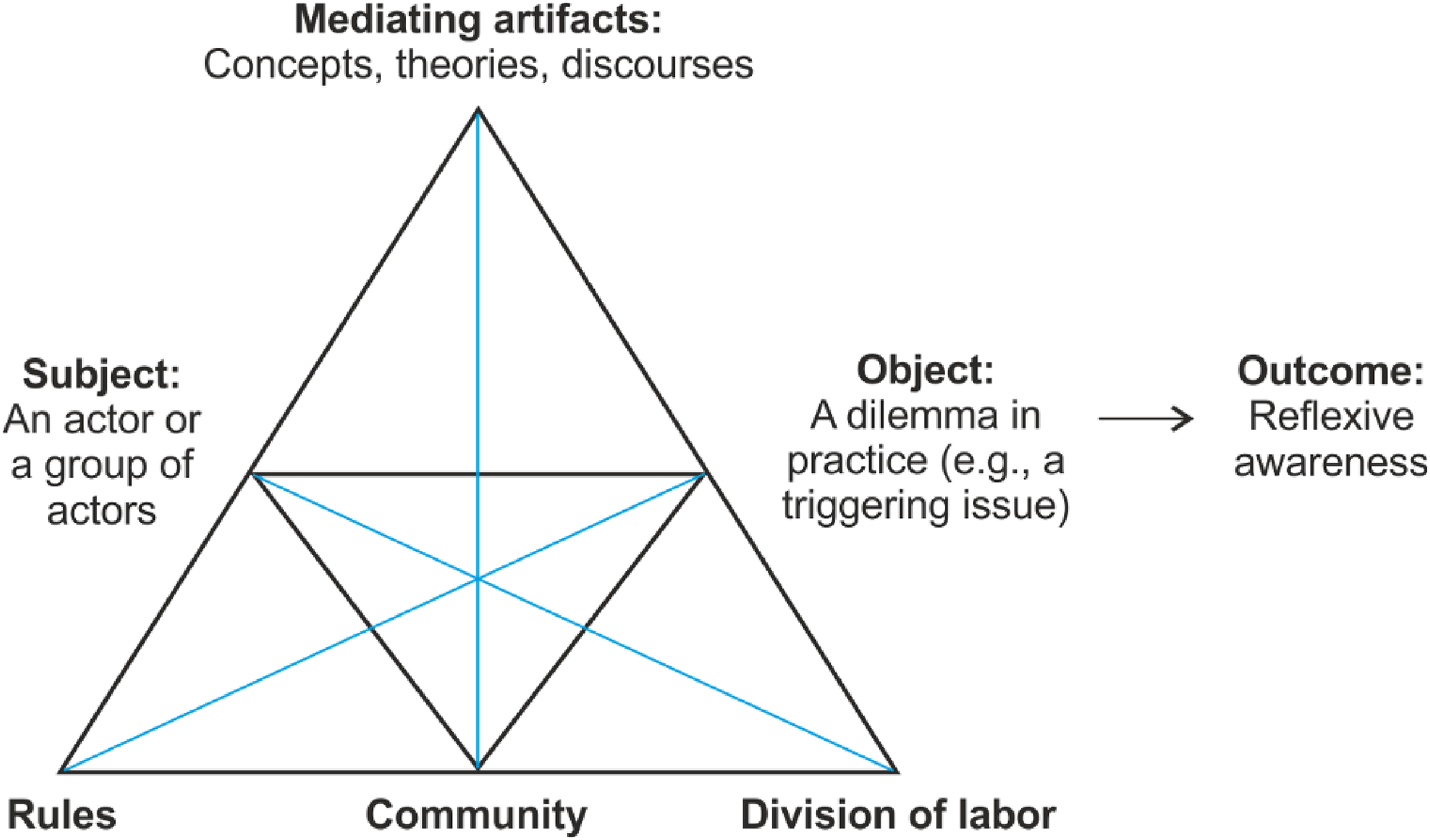
The modeling framework of an activity system (adapted from Engeström, 2015).
In considering how professionals can purposefully change their workplace activities (Kramer, 2018, p. 219), scholars have developed the notion of transformative authorship, which involves critical reflection and organization-level reflexive awareness of the wider social and material structures directing our everyday work practices (Allen, 2014; Gorli et al., 2015; Sannino et al., 2016). In educational contexts, transformative dialogue has been acknowledged as the main tool for constructing new understanding. In a discourse-based paradigm, transformative dialogue mainly focuses on one’s reflections on professional experiences in a certain situation (Gergen et al., 2001), while a practice-based paradigm involves an orientation towards work practices and a skeptical perspective (Bakhtin et al., 1987; Miettinen, 2000). A central feature of learning of this kind is going beyond a local context, made possible by a communicative competence acquired in professional practice (Sarja & Janhonen, 2009; Tynjälä et al., 2003) 1 .
This paper addresses the ways in which the various modes of critical dialogue can bring about a more holistic orientation to an organization's structural features, thereby addressing barriers to the transformation of professional authorship (Allen, 2014; Dyke, 2009; Gorli et al., 2015). Although it is not always easy to change one's personal modes of action, such transformations can be successful via collaboration with others. In educational contexts, transformation – both individual and collective – calls for instructional interventions of the type outlined in this paper, to adapt organizational processes, and to address tensions through social interaction and critical dialogue (Engeström, 2015; Matusov, 2011). The conceptual framework constructed in this article relates to our previous empirical studies (Arvaja, 2015; Sarja & Janhonen, 2009). We illustrate the process of transformative authorship via two cases from postgraduate healthcare education. In both cases, learning tasks were assigned, using dilemmas or contradictions as a basis for transformation.
Transformative Authorship
Transformative authorship has been defined from various perspectives depending on the paradigm chosen. In the context of social constructionism, Cunliffe (2016) considered authorship from the viewpoint of a critically reflexive practitioner who seeks to question taken-for-granted practices. She proposed an “inside-out” approach, i.e., making sense of situations from within the activity itself, and acting reflexively within it. In the same vein, Matusov et al. (2016) applied a personal responsibility perspective in their definition of active authorship.
In Matusov et al.’s (2016) definition of authorial agency, learning is defined as the personal transcendence of the given. This concept has its roots in both sociocultural and cultural-historical activity theory, though it also builds on notions that are critical of such theoretical approaches. Authorial agency is said to stem from the dichotomy between the given and the innovative; hence, “the given past is the material for agentive creativity” (Matusov et al., 2016, p. 437). This means that a person is not free from the existing culture (as manifested in workplace activities, knowledge, and norms); rather, the person uses these, more or less consciously, as resources for change or transcendence of the self – and thereby of the given. In Matusov's line of thinking, authorial agency changes the person and hence also social relationships and communities. In terms of authorship, Matusov's notion of authorial agency emphasizes the importance of the individual perspective, and of change at the discursive level of sense-making.
By contrast, Gorli et al. (2015) and Sannino et al. (2016), criticize what they view as a “conversation centered understanding of authorship” on the grounds that it excludes the concrete aspects of work. Gorli et al. (2015) argue that in order to gain authorship, the new awareness or sense-making has to be turned into action at the collective and organizational level. It is widely agreed that if the emphasis is placed on the purely discursive aspect of reality, some of the material aspects of activities and their historical development will be lost to view. The contrast was also drawn by Nardi (1996, pp. 79–80), who noted that while “situated action models emphasize the reflexive nature of actions the organizational models emphasize the mediated nature of practice and focus on object-oriented activities, because they precede and motivate the collective activities.” Along similar lines, adopting an activity-theoretical perspective, Sannino et al. (2016, p. 246) asserted that organizational authorship is constructed through “deliberate focused experimentation with the object of activity involving specific meaning-making efforts, including, but not limited to [our italics], conversations.”
In elaborating the notion of organizational authorship, Gorli et al. (2015) distinguish between the concepts of authorship and authoring. This is done in order to include both the discursive and the concrete aspects of work activities and practices in any move towards professional transcendence. Authorship refers to the normal processes whereby practitioners create and recreate their organizational reality. It is based on everyday (often unconscious) activities. Authorship exists even if the practitioners do not pay any deliberate attention to the activity. Authoring, by contrast, refers to a special condition in which authorship comes into critical consciousness, as something “accessible to discursivity and open to reframing” (Gorli et al., 2015, p. 1368). When we become critically aware of authorship it becomes discursively accessible, and therefore renegotiable, in line with our beliefs, desires and goals. Organizational authoring may be deliberately influenced (as in the cases presented below) or it can occur naturally in the face of dilemmas in organizations. However, shifting from (discursive) authoring to authorship means a concrete change toward the collective level of activities. In point of fact, changes in the personal and organizational level occur through shifts between authorship to authoring.
In this study, within the framework of the transformative learning approach, instructional interventions were planned and carried out with the aim of questioning dilemmatic working practices. For the purposes of the study, we present data on the emergence of an authoring process from two post-graduate health science courses. Each case focused on different aspects of the process, while nevertheless keeping the concept of authorship at the center of our analysis. The main objective was to make visible the reflexive processes, i.e., the relation between theory and practice (involving reflexive knowledge and professional experiences) that enhance professionals’ capability to renew their organizational realities. Our research question concerned knowledge transformation processes, and was formulated as follows: How is practical (local) knowledge integrated with theoretical (reflexive) knowledge through critical dialogue, as part of the authoring process?
Methods
Description of the Cases
We selected one sample student from each of two teaching contexts, as persons who critically reflected on the organizational activities that prevented them from improving their workplace practices. The practitioners were qualified professionals with several years of work experience. Case 1 exemplifies questioning of the compulsory work routines in client work. Case 2 exemplifies questioning of the cooperative professional practices in the activity system of a healthcare organization.
Case 1 was based on a three-month online science philosophy course for 11 healthcare professionals at a Finnish university (see Arvaja, 2015). The students’ authoring process (involving reflective writing) was guided by six learning tasks, five of which dealt with historical approaches to the philosophy of science (e.g., positivism, realism, and constructivism). For the (writing) assignments, the students read a given text (or texts) including thematic articles or chapters of books in the field of science philosophy, after which they answered a number of questions associated with their professional experiences. The questions included, for example: “So far, the focus has been on the traditional view of science. What problems are related to this approach? Why is it reasonable to think that this approach is insufficient? Consider this from the perspective of your own field of science and/or your own work practice.” Hence, the idea was that the reflective practice would enable reflexive exploration of the conditions and basis of the subjects’ everyday actions. The reflective writings arising from each task were shared and discussed in an asynchronous online forum.
Case 2 involved a teacher trainee group of three healthcare professionals. They were engaged in implementing an entire 6-month study course for undergraduate nursing students (Sarja & Janhonen, 2009). The authoring process was structured via supervisor/trainee collaboration within group discussions, the aim being to create a common object of transformative learning. The group used system modeling as a tool, representing relations in a “material, graphic, and symbolic form” (Engeström, 2015, p. 149). Modeling provides a holistic approach to analyzing the core organizing processes through which commitment to collective activities is supported (Blackler & McDonald, 2000), since it emphasizes the interaction between the various elements within the system (Engeström, 2015) (Figure 1).
The modeling facilitated the design and evaluation of the thematic content, related to (i) individual and group elements of the activity system (actor-mediated artifacts, object, and outcome), and (ii) collective elements (involving rules, the community, and the division of labor) of the organization.
Data Analysis
The data analysis was theory-driven, and was based on abductive reasoning (see e.g., Walton, 2001). For this purpose, we used key theoretical concepts of transformative learning (see Table 1), applying them to our own experience as researchers in collaborative learning (cf. Paavola et al., 2006). This allowed an in-depth exploration of transformative authorship in a given context. The analysis progressed through several steps of reading and re-reading the transcripts 2 of the two example cases, i.e., persons who could be classified as breakers of professional boundaries in their work practice. We identified the differences and connections across them, observing how the data related to the paradigmatic framing of the study.
Diverse Paradigms of Transformative Learning.
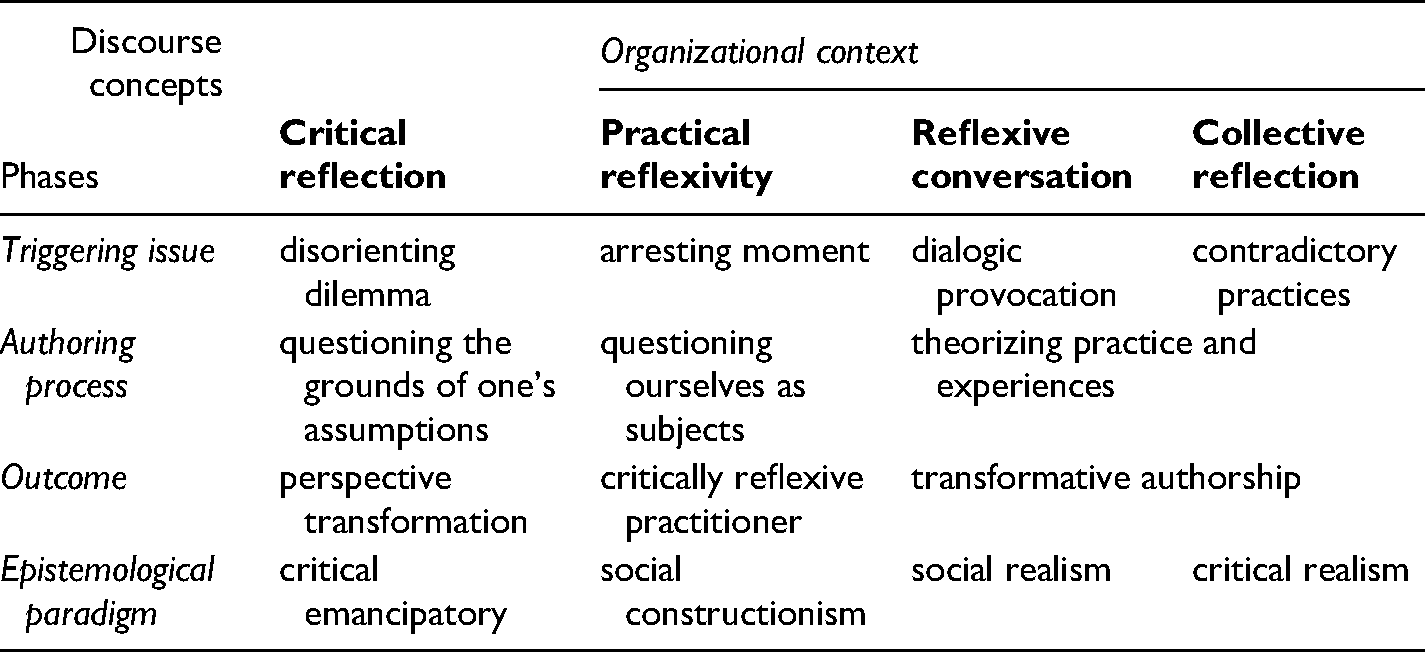
Later in this article, we shall analyze the authoring process belonging to two phases. The orientation phase involved the outlining of certain triggering organizational issues, which formed the object of critical dialogue (involving notably internal reflexive conversation and collective reflection). In the subsequent phase, the different institutionalized cultures and practices were conceptualized through reflexive questioning.
Triggering Issue as an Object of Critical Dialogue
Within organizations, conflicts that occur in social actions can stimulate critical dialogue. Hence, conflicts can form an integral element of transformation (Miettinen, 2000; Nicolini, 2012, p. 109). Often the discursive manifestations of contradictions involve emotionally charged, real-life dilemmas (Sannino et al., 2016). The critical points or striking events in question have been defined as disorienting dilemmas (Mezirow, 1991), arresting moments (Cunliffe & Easterby-Smith, 2016), or dialogic provocations (Matusov, 2011). The arresting moment can itself be fruitful in allowing exploration of how new understandings may be dialogically created between professionals.
In both case studies, the learning tasks were constructed as anchored objects intended to orient the professionals to possible contradictory practices within their organizations. Case 1 involved Aino, a physiotherapist, who reflected on her professional experiences through theory-based writings. In Case 2, a teacher trainee, Tina, was designing with her colleagues a holistic model of palliative care. The model was meant to work as a tool for collective reflection.
Case 1: Alternative Philosophical Discourses
Case 1 was based on an online course in the philosophy of science. The learning tasks were related to the notion of dialogic provocations (Matusov, 2011), i.e., of exposing the students to contrary discourses. The idea was that this would facilitate reflexive exploration of the foundations underlying professionals’ everyday actions. Below, we follow Aino's critical reflection process. Through it she was able to question the power structures controlling the enhancement of her professional modes of action.
The practitioners were expected initially to reflect on “the meaning of science” as it related to their profession. At this point, no material was provided. Initially, Aino viewed society, her field of science, and current organizational practices as scientifically oriented: Our society is scientifically inclined, and the truths rest on scientific facts. All thorough and credible studies are highly significant in my work. For instance, I always seek to find an explanation for my actions so that I am able to give reasons from studied knowledge. Thus, I really trust in research. We can consider that in physiotherapy, for instance, the reliability of the therapies performed must be proven scientifically before they can be used.
Her writing also highlighted the role of institutional education in the construction of the professional self: “In our training, the evidence-based approach was emphasized so heavily that it may have become an obsession to physiotherapists.” She saw reliance on evidence-based research as a culturally correct practice. Thus, the ideas prevalent in her training had become part of her professional authorship. Her orientation to organizational reality was based on an authoritative voice, representing the beliefs and values that were taken for granted by professionals (Matusov, 2011).
From the second task onwards, the learning tasks were based on a range of texts on the philosophy of science. Following critical reflection, based on (contrasting) theoretical texts and on Aino's own professional experiences, the question “What is science?” created an emotional conflict within Aino's professional authorship. In her writing, she described the inner confusion she faced on reading the course material. This critical reflective experience led to questioning her taken-for-granted frames of reference (Brookfield, 2009): I have always considered myself a type very much oriented to natural science, and to be somehow schematic and mathematical. It feels somehow overwhelming to question everything now. What's hard for me is that one can keep elaborating the idea endlessly and never reach a solution.
The learning object, the texts that offered alternative conceptions on science, challenged Aino's interpretative premises, or the meaning perspectives pertaining to her natural science-oriented professional authorship (Mezirow, 1991). The internal conversation (which subsequently initiated transformative authorship) can be identified as an arresting moment (Cunliffe, 2016). Within it, alternative perspectives prompted Aino to see a new possibility to transcend her current work practices, having challenged her own professional orientation in relation to various conceptions (Bakhtin, 1981). As part of this process, she allowed herself to challenge the dominant voice of western medicine: Oriental medicine treats a person as a whole and takes the psyche more intensely into account than western medicine. The effect of the psyche cannot be measured or questioned, still it is a fact. How much is getting well based on what our society considers appropriate treatment? In western countries we are used to thinking in a different way as compared to the Orient. However, along with globalization, sciences and pseudo-sciences are mixing and changing. In my opinion, we should remain open to taking into consideration matters that we regard as pseudo-science, and look at them with the same interest as we are able to show toward “our own science”.
Case 2: Modeling Organizational Structure
Case 2 involved a group of teacher trainees who used system modeling as a tool for the critical analysis of contradictory organizational practices. The modeling method worked as an organizer of the object-oriented activities enabling the design, evaluation and (if required) variation of the thematic content of the course of palliative care. Through collective reflection Tina began to question those practices and rules (organizational structure) preventing the transformation of a nurse's agency in the healthcare community.
The practitioners began by identifying tensions that evoked conflicting viewpoints and mixed emotions. These experiences were associated with hierarchical division of labor (power structures) and with the rules in healthcare communities that limit nurses’ autonomy in their work arrangements, and in their professional orientation towards their practice (Allen, 2014). One triggering organizational issue involved when to shift a patient to palliative care – since officially, the doctor is responsible for the decision to change the patient's care. The group decided to stress this final phase of palliative care because of the contradictory practices of the cooperating disciplines (medicine and nursing) in this particular situation. What do you think; is it a good starting point to stress exclusively this final
phase of palliative care? Yes, it is. Is there freedom and responsibility to care for the patient without
being, at every turn, limited to medical methods? Why does the responsibility arrive only then? How do you do your work as a nurse in accordance with
certain routines and rules, the organizational structure? Yes, it is talking about this contradiction [that is important]. The conflict
arises precisely from the different perspectives of medicine and nursing
bringing it into the open.
The final phase of palliative care as a common object of learning triggered the group's collective reflection. However, the group were not in agreement regarding whether the nurse or the patient should be the main actor in palliative care. Tina emphasized the nurse's professional responsibility for the holistic care of the patient. In this regard she saw that it was necessary to offer nursing students conceptual tools, so that they would be able to realize their potential to work as agents of change. Her colleague (Iris) and the supervisor challenged Tina's perspective, placing the emphasis more directly or exclusively on the patient's wellbeing. In connection with Tina's forthcoming teaching practice in the nursing college she also considered the possibility of questioning the nurse's modes of action in relation to prevailing organizational power structures. Her proposal (involving the expression of personal emotions and experiences) further underlined the possibility of internal reflexive conversation (Archer, 2003; Bakhtin, 1981; Cunliffe, 2016). In my view, the core question in this kind of care is that the nurse
should be professionally responsible for ensuring that the patient
receives proper care. We should invest in bringing out the nurse's
perspective so that students would be able to understand their own
position as an agent of change, a developer, and reformer,
introducing their own feelings, and questioning their own actions,
including what they’ve seen and done. [Here I’m thinking of] times
when you don’t bring up the real conflicts that occur in practice, and
which we see as vitally important. Isn’t the patient an important agent here? After all, it's the patient,
who is dying there. That's right, [but] who is it who sets the rules? Is the nurse just a
facilitator, a supporter, and a helper? What about the idea of self-care? How could the nurse recognize her
own position and coordinate the entire caring system, even to the
extent that the patient could be his/her own best nurse? The nurse
solves problems together with the patient. I’d rather reflect on concrete primary care, on what it really
means. … The nurse's responsibility is to take care of the particular
characteristics [in the situation]. For instance, what does individuality
mean in this hospital organization? What if we were to sort work
practices out, along a temporal continuum, for example?
According to Tina, health care professionals should work as reformers of their work practices and institutional cultures. In so doing, they will adopt the voice of holistic, stimulating nursing, emphasizing the professionals’ role in organizing their own work and the sensible division of labor (Allen, 2014; Janhonen, 1992). In contrast, her colleagues adopted the voice of the patient's comprehending self-care, within which the autonomy of the patient is the prime focus of concern. Tina was here focusing on the rules of the healthcare organization, insofar as these positioned the patient's authorial agency (Matusov et al., 2016) as the only guiding principle, and seemed to limit the professional nurse to being “just” a facilitator, supporter, and helper.
Here, the notion of “voice” involves the broader historical dimension of personal perspectives, intentions, and world views within a social milieu (Bakhtin et al., 1987). Actually, different historical phases of nursing have emphasized different aspects of everyday work, and these aspects are present in current work in the form of parallel tendencies or conceptual horizons. Within the group, these cultural voices arose from the various modes of thought and action adopted historically in healthcare institutions. As an outcome of collective reflection, Tina drew together the conflicting voices embodied in comprehending and stimulating nursing (Janhonen, 1992, p. 47), within the concept of a temporal continuum. While operating within such a continuum, students might transform the diverse knowledge base that exists within the structural system of the healthcare organization.
Theoretical Knowledge as a Mediator of the Authoring Process
Through critical engagement with theoretical knowledge, and through linking theory and practical experiences, the authoring phase (which forms part of a transformative learning process) creates possibilities to enhance professional authorship within organizations. Note, however, that reflective skills are necessary to enhance reflexive awareness (e.g., Cunliffe & Easterby-Smith, 2016; Dyke, 2009). In dealing with a (shared) learning task, collective reflection involves an outward orientation, encompassing the dynamics of organizational reality (Engeström, 2015; Raeithel, 1983). For its part, reflexive conversation – with its self-referential questioning of our own knowledge creation in relation to institutionalized practices – also acts to promote a transformative stance towards society (Archer, 2003).
In both sample cases, reflexively-considered theoretical knowledge worked as a potential resource for the transformation of professional practice. Aino (Case 1) was reframed as an authorial agent (Matusov, 2011), insofar as she became aware of cultural modes of action in the human sciences that were mediating her client approach. In the same vein, Tina (Case 2) arrived at a cultural concept of appropriate care that worked as mediating artifact, capable of reforming the institutionalized exercise of power. This kind of transition is described, for instance, by von Krogh et al. (2000, p. 57): “You shift from looking at the concept to looking with the concept.” This illustrates how, in the mediated authoring process, concepts can work as artifacts for interpreting and transforming organizational activities (Vygotsky, 1978, p. 57). The transformation in organization-level awareness made it possible for both practitioners to become conscious of the systemic or framed nature of their collective activities.
Case 1: Human Sciences and Client Encounters
During her authoring process, Aino and some of her colleagues questioned the prevailing frames of their professional practice as physiotherapists. Gradually, they became aware of the tension between the institutional power structures that had set the guidelines for their therapeutic actions and the practice-based know-how they had gained through their experiences with clients (Tsang, 2007). You are discussing the utilization of the perspectives of human and natural sciences in your own work on the basis of Raatikainen's article. I see this issue largely in the same way. At work one often just comes across with what, for example, the referring body (doctors) values and appreciates (adherence to research consistent with natural science). Yes, indeed, the problem lies specifically in that. For example, within the work people have too high a regard for the views of natural science. We use a four-step scale for outcome grading, on the basis of which the success and effectiveness of a physiotherapy period is evaluated. The scale only takes into account the improvement in the patient's physical attributes. I have also tried to add things to the goals, such as identifying motivation, or the patient's experience of success, etc., but scientific assessment of these aspects is impossible, and I cannot substantiate my gut feelings in any way. Another issue I face at work is the compilation of statistics. If I spend time in the ward discussing with a patient their goals and motivation, listening to the person, and evaluating her emotional state without performing actual physiotherapy, i.e., muscular or mobility or functional exercises, can I then record the visit as a physiotherapeutic visit? I didn’t actually perform any therapy, so just as much time was spent in discussion with the patient, who is then more likely to be motivated to engage in rehabilitation and be more cooperative when we start the actual training. The problem is that I can’t really mark on my daily nursing record sheet that we just discussed the patient's therapy. So then you have to cheat and have them do some stretching or do a quick inspection at the end. The emphasis is too much on natural science.
For Aino, the theoretical text served as a cultural artifact through which she was able to question her current working methods as a physiotherapist. It seemed that in the current reality of working with clients, certain routinized practices and related cultural tools (measuring mobility, outcome grading, compilation of statistics, and the daily nursing record sheet) and reliance on certain authoritative modes of action were in adequate. The organizational context in which Aino had operated dealt with practices pertinent to research, based mostly on the physiological and physical perspective of the natural sciences. At their worst, these routinized practices (e.g., categorizing physiotherapeutic activities) could lead to false and even unethical actions, within which the practitioner could not take full ethical responsibility for her professional authorship.
As the practitioners became conscious of the guiding institutional frames (or organizational rules) of their activities, they were led to criticize the prevalent technical-rational model (Tsang, 2007). It was increasingly seen as important to take into account the client as a whole – hence to consider not only the body, anatomy, or physiology, but also the mind, motives, and values operating in interpersonal client encounters. Reflexive awareness led to incorporation of the client's subjective personhood as an essential part of physiotherapy. Through her critical questioning of the systematic nature of her work organization, Aino's authoring process led to self-transcendence (Matusov, 2011). Crucially, the internal reflexive conversation enabled her to utilize the theoretical knowledge of her discipline as a resource – but one that could be questioned and modified.
After questioning herself as a routinized professional actor (Cunliffe, 2016), Aino conceptualized herself as an authorial agent, acknowledging her ethical responsibility as a potential transformer of organizational realities (cf. Gorli et al., 2015). Her writing confirmed the process of her own personal transcendence beyond the given organizational context: For me, this course has taught a different way of thinking about doing research and broadened my approach to science in general. Actually, really significant science is by no means about angle degrees and gauges, but rather about causal relationships more broadly, and consideration of humans and interaction.
In this case, the philosophical texts worked as cultural artifacts mediating certain theories, concepts, or phenomena; thus, they offered dialogic provocations to which the practitioners were asked to present justified alternative responses (Matusov, 2011). It is notable that by becoming more aware of (socially constructed) organizational reality, Aino became, potentially, an author rather than a follower of current authoritative practice (Gorli et al., 2015).
Case 2: The Concept of Appropriate Care and Holistic Nursing
In relation to the phase of palliative care, Tina used the system model of holistic nursing as a tool to explore organizational relations, and especially the division of labor, positioned (in her case) between two disciplines. A contradiction in the health care community prompted her to question the core organization surrounding the working relations of healthcare professionals, and to highlight the issue of how far they should work as agents of change and developers of a more holistic system of care. So, let's take the concrete example of a patient with burns who had no chance whatsoever of surviving. … He was given active care because of the organization – nobody made a care decision because there was a change of doctor. … I am taking up this particular example here because it should help deepen our insight into what the role of medicine actually is. This care was intended to maintain the vital functions. … The special characteristic of care in this terminal stage should include the patient's appropriate care, including a dignified and humane death. In this area of care, appropriate care means recognizing what is essential about caring for this patient. Do you think that this wasn’t appropriate treatment in a situation of this kind? From the perspective of both care and the patient, there is no appropriate treatment if we know that the patient will die. Now we should emphasize these special characteristics of care, aiming at appropriate care … This has the aim of comprehensive alleviation of suffering, in accordance with the holistic approach of Erikson. This is the most independent area of care, giving a nurse freedom but also responsibility. But when you define care of this kind, should it be described in terms of a confrontation? For me, appropriate care means distinguishing essential things from inessential ones. I think that this is a good illustration of how things can go in that organization. In such cases, there are not many nurses with the authority to make decisions for the patient, to be that patient's advocate. It starts from the content of care in the sense of what is the core from the perspective of learning in this situation. Appropriate care was one particular characteristic. … Yet, if one thinks about the normal situation at a hospital, whether the patient care there is really appropriate. In care issues, we talk a lot about ideal things. But what kind of care do the patients really receive?
Importantly, Tina generated her authoring process via the concept of appropriate care. This cultural artifact offered an explanatory theoretical principle to distinguish essential from non-essential organizational activities in a particular dilemmatic situation. The reflexive nature of this concept of appropriate care can be seen in terms of the implementation of ethically justifiable decisions for the holistic care of the patient in question. Note also that the reciprocal nature of collective reflection was indicated in the supervisor's final remark (“whether the patient care there is really appropriate”), indicating doubts about the regulations of the healthcare system as applied to everyday practices. For Tina, the reflexive concept of appropriate care facilitated a transformation in her professional authorship. At the same time, it yielded awareness of the dynamics of the organization as a whole, involving also the potential to influence its conscious restructuring (Blackler & McDonald, 2000; Raeithel, 1983).
Reflexive awareness was also illustrated in Tina's statement in which she underlined the ethical responsibility of the professional nurse. Here, she crystallized the possibilities of transformative authorship within an organizational context: I considered that this theoretical knowledge helps us to observe the patient as a whole, giving a broader perspective on nursing. So that one finds essential features for nursing the patient that could otherwise remain unobserved. A nurse who acts professionally will dare to consider her own authority, to set it aside, and also question doctor's authority. [In general] people do not question their own work, but tend rather to follow certain routines all the time. We have the power and opportunity to make changes in ethical rules and everything else, but we do not use it.
From Individual- Toward Organization-Level Transformation
Broadly speaking, the main differences between the various approaches to transformative critical reflection lie in their views on human behavior in relation to the cultural context. While emancipatory, discursive-based theories emphasize the critical reflection of individuals and groups in relation to the actual situation, socio-cultural theories underline the broader organizational context surrounding our everyday actions.
Our both case studies exemplify the different modes of critical dialogue. Basically, as Mezirow (1991) and his followers have demonstrated, the starting point of professional development is the questioning of taken-for-granted processes, on the basis of our experiences through critical reflection. For her part, Cunliffe (2003) has presented the notion of reflexivity via two approaches or metaphors from organizational research, each rooted in different philosophical assumptions, namely constructionism and deconstructionism. While constructionists emphasize discourse or “betweenness” in creating meaning between practitioners, deconstructionists prefer “otherness” in their more contradiction-centered approaches. In our study we have adopted this latter approach to reflexivity in aiming to analyze how professionals transform their organizational realities – in preference to exploring how a new understanding is created mutually in a certain situation.
In his emancipatory social theory, Mezirow (1991, 2000) defined authoring as a rational and individual knowledge-creation process in which critical reflection forms a basis for transforming one's taken-for-granted frames of reference. Critical reflection is triggered by a disorienting dilemma which provides an opportunity to consider new perspectives (Mezirow, 2000). The transformation of perspectives represents a total change in one's personal life perspective, i.e., in the structure of the assumptions and expectations (beliefs, values, and feelings) through which one interprets experiences. Contemporary critical theorists (e.g., Brookfield, 2009; Cranton, 2016; Kreber, 2012) have expanded the theory by paying more attention to the social context of reflective practice. Brookfield (2009) in particular demanded that – as a context-bound concept – critical reflection should “call into question the power relationships that allow, or promote one particular set of practices over others” (see also Kreber, 2012).
For her part, Cunliffe (2016) operationalized critical reflection through reflexivity and the notion of a critically reflexive practitioner. As a socio-constructionist scholar, she has defined reflexive practice at the levels of both self- and organizational reflexivity. While the former concerns “the impact of our assumptions, values, and actions on others,” the focus of the latter remains on the context, in which we also “question and examine the assumptions underpinning organizational policies and practices and the intended and potentially unintended impact on us” (Cunliffe, 2016). In other words, while critical reflection draws on assumptions of the existence of objective reality, critically reflexive questioning – involving the unsettling of conventional practices – pays attention to the relational and dialogic nature of the reality, according to its socially-constructed context (Cunliffe & Easterby-Smith, 2016).
Finally, the mediated nature of social reality offers a more organizationally-focused perspective on transformation. An essential point within this deconstructionist approach is how people consider themselves in relation to their institutional cultures and social context (Dyke, 2009; Miettinen, 2000; Nicolini, 2012). The key principle in Dyke’s (2009) “outside-in” reflexive learning framework is the theory-ladenness of experiences, as determined by prior conceptualizations and cultural expectations. Building on Archer's realistic social theory, Dyke (2009, p. 295) considered reflection to be either a precondition for reflexivity, or a consequence of it, within the process of transforming our experiences into new knowledge. Overall, as noted by Dyke (2009), authoring can be seen as a theory-based knowledge-creation process, involving “the constant transformation of information, the creation, construction and renewal of knowledge in relationships with others.” In emphasizing the historical, cultural, and social context of the practice and interaction, the reflexive learning approach is consistent with cultural-historical activity theory, while being oriented broadly towards a practice-based approach.
It should nevertheless be noted that in activity theory, the basic unit of analysis is an organization as a holistic system and its object-oriented activities. In particular, the mediating tools or artifacts that are present enable, simultaneously, the transformation of both the practitioners and their material culture (Engeström, 2015; Miettinen, 2000; Vygotsky, 1978, p. 57). More specifically, activity theory emphasizes the collective activities through which (i) cultural artifacts (such as concepts, models, scripts, etc.) are accepted or rejected, (ii) individual practices are enforced, and (iii) certain organizational rules are followed (Engeström, 2015; Nicolini, 2012, p. 109, p. 225). Collective awareness is particularly likely to emerge when the group creates the kind of social knowledge for which there are no absolute or universal answers (Blackler & McDonald, 2000). Collective reflection yields a new perspective, because it directs attention to a shared object of work (including its social and historical context) in order to bring about change (Engeström, 2015, pp. 122–123; Raeithel, 1983). Hence, collective reflection leads to a reflexive awareness of the systemic or hidden character of human action.
Table 1 above gathers together the complementary epistemological approaches of transformative learning.
Discussion and Conclusions
In this paper, we have emphasized the need to become conscious of organizational realities if we are to gain insights into the practices, strategies, and structures that guide professional activities. From analysis of our cases, we found (i) that a practical understanding of situations, (i.e. local knowledge of organizational contradictions and dilemmas) was integrated with theoretical knowledge (via texts, concepts, scripts) regarding historical and institutional cultures – this taking place through the generative critical dialogue activities we presented; (ii) that the authoring process was manifested as transformative authorship, meaning reflexive awareness of the frames of organizational relations; and (iii) that professionals were able to question different modes of action and to enhance new collective knowledge for their working routines. Traditionally, transformative reflexive processes have been conceptualized in terms of the ability of individuals to consider themselves in relation to the situated context (Cunliffe, 2003, 2016; Hibbert, 2013). Our cases led to a more elaborated understanding of the mediated nature of practice and of object-oriented activities, and illustrated ways in which individual and collective reflective processes can operate.
In the study from which we drew our two case examples, we set out to initiate the process of transformative authorship through pre-designed learning tasks that were meant to work as anchored objects of critical dialogue. The intention was that the activities should enhance the integration of culturally-mediated knowledge with practice. Our organizational approach to transformative learning complements the methodological choices of other approaches in which various reflective strategies and tools are used to encourage equal participation in discursive practices. Working along these lines, Cunliffe & Easterby-Smith (2016); Cranton (2016, pp. 137–139), and Kreber (2012) provoked critical reflection by stimulating dialogue from different perspectives as in fact, we have done also. It is true that the tasks assigned could involve controversial statements, reading texts with contradictory points of view, critical questioning, and so on. Nevertheless, we would argue that these have tended to be disconnected from the surrounding institutional context. We believe that it is via awareness of the organizing practices that one can optimally develop a deeper understanding of the phenomena surrounding the immediate learning situation.
The development of authoring process was manifested in the form of professionals becoming aware of the wider historical frames of the institutional cultures guiding their collective activities. In other words, we took note of how professionals questioned routinized modes of action, power structures, and controlling rules. We saw the modes of critical dialogue – internal reflexive conversation and collective reflection – as capable of promoting both self-transcendence and the emergence of agents of professional change. It should be noted that in this article, critical dialogue does not refer to any coordination or consensus in which the exercise of power would hinder the progress of conversation. We addressed in particular settings in which institutionalized practices have tended to control professionals’ internal conversations and knowledge-creation processes (cf. Archer, 2003; Brookfield, 2009). Furthermore, collective reflection on contradictory work practices was found to promote a more in-depth understanding of different organizational conditions and processes, thus facilitating also the emergence of reflexive awareness (Dyke, 2009; Gorli et al., 2015).
It is nevertheless difficult to identify the kind of mediated artifacts and tools that will drive transformative authorship in different contexts within western cultures. Given that many of the values and norms in societies are hidden, implicit, and unwritten, research on transformative learning requires deep cultural knowledge, and also familiarity with current practices and system relations. There is always a risk of misinterpretation, due to diversity in the contrasting perspectives that researchers have offered within various frameworks. This means that in order to draw strong conclusions, a larger body of empirical data would be required, pertaining to the discursive patterns occurring within cultural contexts. However, on the basis of our previous studies on this data (Sarja & Janhonen, 2009), it was apparent that commitment to the ideals of expansive transformative learning was not very common among the students taking part in the studies.
As far as transformative learning discussions and future research are concerned, it would be important to have the authoring process guided by some external facilitators. In this regard, our finding of students’ weak engagement in learning tasks (constructed as the shared object of learning) (Sarja & Janhonen, 2009) in the absence of pedagogical guidance is consistent with earlier research (cf. Gorli et al., 2015). Nevertheless, irrespective of how it is achieved, we would argue that once we recognize the underlying frames of contradictory practices – which stem from and are bound to power structures – we shall be better able to respect a plurality of perspectives, including those constructed differently from our own. Overall, we see a particularly valuable professional competency as consisting of an internalized reflexive awareness to conceive how to revise and reform the practices of our work, and to conceptualize the systemic nature of our organizational activities. In a multivoiced world, professionals should become conscious of opportunities to influence the intentional variation in their modes of action.
Footnotes
Declaration of Conflicting Interests
The authors declared no potential conflicts of interest with respect to the research, authorship, and/or publication of this article.
Funding
The authors received no financial support for the research, authorship and/or publication of this article.
