




Abstract
Second chance education (SCE) has been established to offer adults the opportunity to catch up on higher qualifications, for instance the eligibility to study. SCE often suffers from high dropout rates, but little is known about the reasons. This article investigates whether dropout rates depend on family background and age, and if so, why. Data from 3278 students at an institution of SCE in Germany who entered this institution between 2000 and 2016 are analysed using logistic path modelling. The results show that the higher dropout probability of socially disadvantaged students can be traced back completely to poorer academic performance in SCE, partly associated with an unfavourable previous school career. Older students are – irrespective of their family background and despite a better academic performance – more likely to drop out than younger students. If SCE aims to reduce these dropout risks, strategies should vary for different groups of students.
Young people who graduate from university are more likely to get better paid jobs than those who do not, and for them there is also a lower risk of being unemployed (Organization for Economic Co-operation & Development [OECD], 2013). In many European school systems, pupils are sorted into different tracks in secondary education, at least one of which does not lead to a qualification enabling higher education entry (see Orr et al., 2017, p. 28ff, for an overview of admission systems to higher education in Europe). It is in particular those from disadvantaged family backgrounds who are less likely to finish schooling with the eligibility to study (ETS; Hadjar and Gross, 2016) and are therefore less likely to enter higher education (Orr et al., 2017). For this reason, an opportunity such as second chance education (SCE) that makes it possible for adults to acquire the ETS and enter higher education later in life is crucial (European Commission/EACEA/Eurydice, 2018). SCE is therefore considered to be “important, and valuable” (OECD, 2013, p. 31; Orr et al., 2017, p. 63). However, SCE suffers from high dropout rates, particularly among disadvantaged students (Bellenberg et al., 2019; Raymond, 2008, p. 26).
In this article the reasons for this group-specific dropout risk among SCE students are analysed, and this contributes to existing research in the following ways: 1) Although some research has been done on the dropout risk in compulsory education (e.g Vaughn et al., 2013), at university (e.g. Reisel and Brekke, 2009), and in further education (e.g. Hofmann et al., 2020), this is not the case for SCE, where dropout behaviour has only rarely been investigated empirically (Bellenberg et al., 2019; Darkenwald & Gavin, 1987; Garrison, 1988; Raymond, 2008). 2) The aim of our study is to analyse the extent to which there is a connection between dropout behaviour, family background ( = socioeconomic status of parents) and age. Age is an important characteristic as well, because its relationship with participation in adult education has often been confirmed (Boeren et al., 2010). Since the benefits of SCE decrease with age (Boeren et al., 2010), the dropout risk may increase (e.g., Reisel and Brekke, 2009) and that may interact with social background (Bozick, 2007). Although age and social background have been investigated in previous studies on adult education, this has mostly been done in qualitative descriptions of small numbers of participants (e.g. Alheit, 2009; and for further education Bremer, 2007). We give quantitative insight (Boeren, 2018) by using a rich database from an institution of SCE with N = 3278 students. 3) We base our analyses on a rational choice approach (Boudon, 1974) that allows us to distinguish between different reasons for group-specific dropout. Unlike other studies that use this approach and deal with adult students (e.g. Hällsten, 2017; Schindler & Lörz, 2012), we use a more integrated approach (Boeren et al., 2010) and take into account the special situation of adult participants in SCE. We do this by linking social background and age to the previous educational and occupational career.
For our analysis we use data from Germany. Germany is one of the countries where there are upper secondary bridging programmes that offer adults who have been out of schooling for some time an opportunity to gain the ETS 1 and thus acquire access to higher education (European Commission/EACEA/Eurydice, 2018, p. 174). In the 2016/2017 school year, 29,000 learners in Germany participated in SCE leading to the ETS, and 15% of all eligibilities to study acquired in general education were obtained via SCE (Bellenberg et al., 2019). Despite this relatively low percentage, SCE has great symbolic significance in Germany’s highly selective general education system because it offers adults the opportunity to upgrade their school qualifications irrespective of their age, previous school career and economic situation.
In the following, SCE in the context of the German school system is first described in more detail. Second, the theoretical and empirical background of inequality dropout structures in SCE is discussed and hypotheses are developed. In a third step, these hypotheses are tested. Finally, the results and their practical implications are discussed.
Theoretical and Empirical Background
SCE in Germany in the Context of the German School System
In Germany, in secondary level I education (years 5–9/10; Sekundarstufe I) early selection takes place based on performance into distinct secondary school types that lead directly to the ETS ( = academic school types) such as the Gymnasium, and school types that do not such as the lower secondary school (Hauptschule) and the intermediate secondary school (Realschule) ( = non-academic school types; see also Figure 1). In some federal states, pupils have a third option and can choose a comprehensive school, which offers senior classes leading to the ETS for those pupils who perform well. For this reason, we classify the comprehensive school as an academic school type. In the non-academic school types, pupils can obtain either a lower secondary qualification ( = minimal educational requirements, Hauptschulabschluss) or an intermediate qualification ( = intermediate educational requirements, mittlerer Schulabschluss). In most federal states, pupils who perform well can acquire an advanced intermediate qualification (erweiterter mittlerer Schulabschluss) that allows direct transition to senior classes in an academic school type. These qualifications can also be obtained at the end of the 10th school year by low-achieving or less motivated pupils at academic school types (comprehensive schools and Gymnasiums). Pupils who have a non-academic qualification may later be motivated after finishing general education to catch up and obtain a higher qualification in order to gain access to better vocational training options or improve their prospects in the job market. Motivated individuals can catch up on all the qualifications mentioned above – including the ETS – at a vocationally oriented school at secondary level II (e.g. a Berufliches Gymnasium; a Berufsfachschule; or a Fachoberschule; see Orr and Hovdhaugen, 2014). Since they can do this directly after leaving general education, and often before completing compulsory education 2 , these options formally belong to the “first chance pathways” (Schuchart, 2013) and are not part of adult education. Adults with a minimum age of 18 who did not make use of these “first chances” to obtain the ETS and left the educational system with a non-academic school qualification have a final opportunity to upgrade their qualification via an institution of SCE (Harney, 2016; Harney et al., 2007).
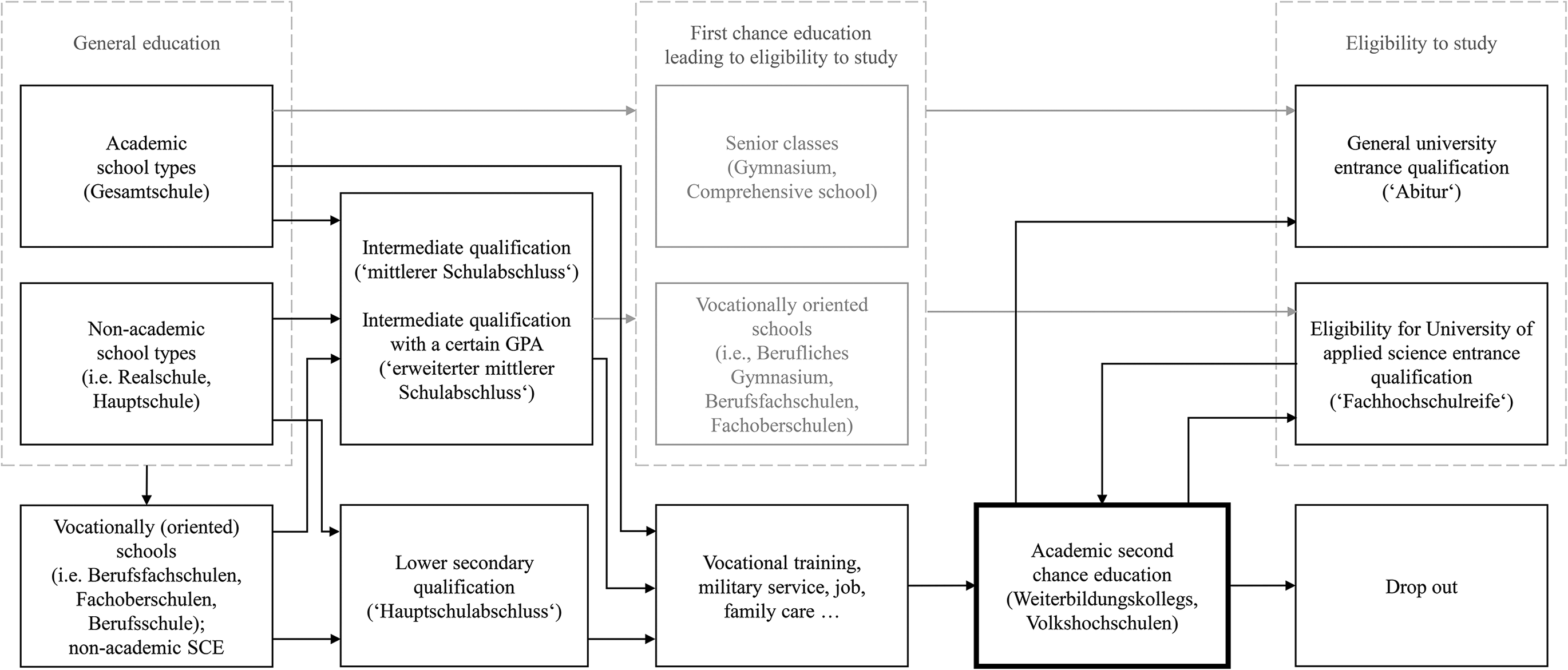
Pathways To the eligibility to study.
This article focuses on institutions of SCE that award the ETS. Adults who have completed a course of vocational training and/or taken up employment, served in the military or cared for a family for at least two years can study for the ETS at an institution of SCE. In some federal states, students who obtained a non-academic qualification ( = Hauptschulabschluss, mittlerer Schulabschluss) at an institution of second chance education can enter academic second chance education directly, without first having completed vocational training or been in the labour market. Academic SCE offers day programmes and evening programmes, and those who attend the former are eligible for financial assistance from the state (see for further information https://www.bafoeg-rechner.de/Rechner/). However, this covers only what they need to live on. Those who attend evening programmes can have a job during the day but face the double burden of school and work.
The curriculum and the final central exams in SCE are the same as those in secondary level II education (grades 10–12/13) at academic school types such as the Gymnasium. However, there are considerable differences regarding the student body. The selection of pupils for the Gymnasium is based on ability and learning behaviour at primary school, whereas access to SCE depends neither on a certain grade average nor on the acquisition of a certain school-leaving qualification. As a result of increasing numbers of students who have acquired their ETS in first chance education, a large and growing number of learners in German SCE have inadequate learning prerequisites, broken school careers and come from unfavourable family backgrounds (Bellenberg et al., 2019; Harney, 2016; Harney et al., 2007). A similarly problematic student body has been observed in other countries as well (Bushnik et al., 2004; Looker & Thiessen, 2008; Marcotte, 2012; Raymond, 2008; Ross & Gray, 2015).
Dropout Risk in SCE
In the following, there is first a consideration of how academic performance and the decision to drop out of SCE could be directly associated with a student’s family background and age. Adults in SCE have already gone through school and vocational education, and many of them have already been in employment. These characteristics are associated with age and family background, and also with academic performance and dropout decisions in SCE. It is therefore important to consider the relationship between these aspects.
Dropout, Family Background and age
Following Manski (1989, p. 305), it is argued that enrolment in SCE is non-compulsory, and for this reason enrolment as well as graduation are determined by two conditions: The student must have the academic potential to be able to complete the programme chosen, and he or she must be convinced that the benefits of completion – for instance in terms of future income – are greater than the costs. In order to explain social inequalities in educational attainment, Boudon (1974) calls these two conditions primary and secondary effects of social origin. We use this differentiation to explain why adults drop out of SCE instead of completing SCE and graduating (Hällsten, 2017).
Within the framework of Boudon (1974), academic performance varies according to social background as a result of different socialisation practices in families (see also Bourdieu and Passeron, 1964). Although students in post-compulsory education are adults and adults are more autonomous and less influenced by their parents than children (Müller & Karle, 1993), parents contribute to the educational success of their adult children financially, but also by providing emotional support and counselling (Roksa & Kinsley, 2019; Settersten & Ray, 2010). Therefore, the literacy and numeracy skills of adults are nevertheless associated with parental socioeconomic status (Grotlüschen et al., 2019; OECD, 2019), even if these adults have achieved their own socioeconomic status themselves.
Socially-based differences in academic performance are important to explain social inequalities in educational attainment at post-compulsory level (Neugebauer & Schindler, 2012). However, even if academic performance is controlled for, young adults from disadvantaged family backgrounds are still less likely to graduate from higher levels of education such as universities than socially advantaged young adults (Bozick, 2007; Gury, 2011; Neugebauer & Schindler, 2012). Following Boudon (1974), these differences can be traced back to secondary effects of social origin, i.e. social differences in the educational choices, given the same level of academic performance. One of the reasons could be a desire for status maintenance (Breen & Goldthorpe, 1997): By choosing higher levels of education, individuals from socially advantaged backgrounds want to ensure that their socioeconomic status is not lower than that of their parents. In contrast, the motivation of individuals from disadvantaged backgrounds is negatively affected by the fact that dropping out of academic post-compulsory education does not result in a lower social status than that of their parents. However, other decision factors are also perceived differently by different social groups, for instance the costs of continuing in post-compulsory education (Bellenberg et al., 2019; Daniel & Watermann, 2018; Eller & DiPrete, 2018; Schnettler et al., 2020) and the perception of family support (Roksa & Kinsley, 2019).
If these theoretical assumptions are transferred to students in SCE, students from disadvantaged family backgrounds should be more likely to drop out of SCE (Hypothesis 1, see for a summary Figure 2), and this should partly be accounted for by their poorer academic performance in SCE ( = primary effects, H2). Given the same academic performance in SCE, they should still be more likely to drop out of SCE, and this should be due to a socially-based decision effect ( = secondary effects, H3).
Age has been shown in some studies to be a predictor of dropping out of academic adult education. For instance, older students are more likely to drop out of higher education than younger students (Müller & Schneider, 2013; Reisel & Brekke, 2009; Smith & Naylor, 2001), and this may be true for SCE as well. Manski’s (1989, p. 305) differentiation of the conditions for successful graduation from non-compulsory education may also be related to age. We transfer to this differentiation the terms of primary and secondary effect introduced by Boudon (1974), which we understand here simply as the effects of a characteristic – in this case age – on performance and decisions as conditions for successful graduation from SCE. The primary effect would then be the direct effect of age on academic performance, which is for instance due to the decline in cognitive functions with increasing age (Tucker-Drob et al., 2014). However, since a decline is more likely to occur in middle and late adulthood (Tucker-Drob et al., 2014.) and most students in second chance education are young adults (Bellenberg et al., 2019; Marcotte, 2012), we neglect these primary effects of age.
The secondary effect in terms of the effect of age on decisions seems to be more relevant for the following reasons. Age is a structuring principal of a person’s life course (Kohli, 1985). Institutional rules define when to start school, when to start vocational or higher education, and when to enter the workforce. In particular, compulsory education and the obtaining of school qualifications is strongly regulated by age requirements. Adults who re-enter school to obtain the ETS deviate from the institutionally defined periods for education, and this can influence the evaluation of the costs and benefits of continuing in SCE. The older a student in SCE is, the more likely it is that most of his/her peers have already completed their education, started their occupational career and are ready to align with the social expectancies of adulthood (Settersten & Ray, 2010). Older students may also have responsibility for a family, and they may be more sensitive to “extrinsic factors” (Garrison, 1988) such as the standard of living restrictions associated with re-entering school education (Smith & Naylor, 2001). There can thus be a secondary ( = decision) effect of age. Older students may consider more carefully the social, familial, psychological and financial costs of continuing in SCE than younger students, and this could lead to a higher dropout rate. At the same time, older students have fewer long-term prospects in the labour market, and this reduces their benefits from SCE (Boeren et al., 2010). To sum up, older students should be more likely to drop out of SCE (H4), and this should not be accounted for by their lower levels of performance (H5) but by a less favourable evaluation of the costs and benefits of SCE (H6). Finally, age and social background may interact with each other. For many students from disadvantaged backgrounds, financial pressures increase with age since these students cannot be supported financially by their families and since responsibilities – for instance for a family of their own – also increase (Bozick, 2007). Students from privileged backgrounds receive better financial support from their families (Bozick, 2007), and for disadvantaged students the financial pressures may therefore increase with age to a greater extent. This could lead to a stronger age effect on the dropout probability of students from disadvantaged backgrounds compared to students from privileged backgrounds (H7).
Earlier Stages in the Life Course
Since we are dealing with adults, performance and decisions in SCE may not be entirely direct effects of age and family background but could be at least partially mediated by earlier stages in the life course such as the previous school and/or occupational career:
Second chance students in Germany have passed through general education in different school types which are selective in terms of the social composition of their pupils. The sorting into school types in Germany is based on ability and learning behaviour in primary education, and students from socially disadvantaged backgrounds are more likely to be sorted into less demanding school types (Stubbe et al., 2017) with lower learning requirements than more demanding school types. For this reason, we assume that the poorer academic performance of students from disadvantaged family backgrounds in SCE should at least partly be explained by a more unfavourable previous school career (H8).
Adults in SCE are expected to have completed a vocational training course and/or to have been in the workforce (see 2.1, also for exceptions). This could be associated with secondary effects, since a vocational training qualification and job market experience make alternatives to SCE more accessible. In particular, the fact that an individual has worked before returning to school increases the perceived costs of SCE, since the standard of living that has been achieved must be abandoned or can only be maintained under the double burden of school and work (Marcotte, 2012). Students from disadvantaged family backgrounds may be more likely to have completed vocational training or to have worked than students from more advantaged social backgrounds (Hillmert & Jacob, 2003), and this could partly explain their higher dropout probability (H9). Older students should also be more likely to have completed a vocational training course and to have job experience than younger students, and this could at least partly explain their lower motivation to continue with SCE (H10).
Methodology
Data
In Germany, rich data on second chance students are very difficult to collect, firstly because this group is comparatively small and thus underrepresented in the common datasets, and secondly because access to this group is very difficult due to high absence and dropout rates (Bellenberg et al., 2019). The present study is based on a quantitative case study of an institution of SCE in a medium-sized town in the federal state of North Rhine-Westphalia (NRW). In this study, school administration data on students who enrolled between 2000 and 2016 were linked to information from student applications to this school. 3 The final database consists of information on N = 3278 students (graduates and dropouts). The school data include final grades in each subject for each semester of attendance. Detailed information about the previous educational and occupational career as well as information about each student’s family background was collected from the applications.
Variables
In the following, the variables used for the analyses are described. For the calculations, the statistical programme Stata is used. All the distribution measures stem from an imputed dataset with 30 imputation cycles (see analysis strategy). See Table A1 for the general distribution of all the dependent variables and the distribution according to family background and age.
Dropout
The database gives information on whether a student dropped out of SCE. 58% of all the students in the database dropped out without completing SCE 4 .
Academic Performance
Academic performance is measured by the grades obtained during SCE. The following grades are taken into account: (a) Final grades for the first semester in the main subjects mathematics, German and English. Grades ranged from 1 to 6, whereby higher values indicate a poorer performance.
Parental Socioeconomic Background and age
Students reported their parents’ occupation in their application, and this information was transferred into the highest international socioeconomic index of occupational status (HISEI; Ganzeboom and Treiman, 2003). Age was measured in years.
Previous School Career
Vocational Training and job Market Experience
We considered whether students had completed a vocational training course. Since in Germany vocational training courses are highly specific and completion of the appropriate course is required for the corresponding occupation (Shavit & Müller, 1998), the average socioeconomic status (ISEI; Ganzeboom and Treiman, 2003) was generated for each vocational training course. The data do not make it possible to identify the students who worked during their SCE.
Control Variables
The year of enrolment is controlled for since it must be assumed that the students’ ability prerequisites and job market characteristics such as the employment rate changed during the period under study. To ensure that age effects are not confounded with cohort effects, we checked the robustness of our results by running the models with two different sets containing the cohorts 2000–2010 and 2011–2016 (Table A5). The results confirmed the results calculated with the whole sample.
The programme of SCE attended – evening classes or the daytime programme – is considered a control variable. Finally, since sex and immigrant background are theoretically associated with dropout, and immigrant students (at least one parent and/or student were not born in Germany) are more motivated to achieve higher levels of education than non-immigrant students with the same social background (Salikutluk, 2016), these variables are controlled for.
Analysis Strategy
Missing data
Our data have missing values (see Table A2 for an overview of variables with missing values). Although the proportion of missing values is large for some variables, multiple imputation (MI) is by far the best procedure to handle them in view of the various mechanisms that can drive item-nonresponse, and we consequently decided to handle the missing data by MI (see Table A2 for further explanations on the decision process). Incomplete variables were imputed in 30 datasets using a fully conditional specification approach (van Buuren et al., 2006). The results presented in Table 1 are based on the imputed sample (N = 3278). All the analyses were done for each imputed dataset separately, with estimates and standard errors combined afterwards using Rubin’s Rules (Rubin, 1987). (See for robustness checks with the complete cases Tables A3, A4, A5; further explanations under Table A2).
Main Results Referring to the Hypotheses (Imputed Dataset; N = 3278).
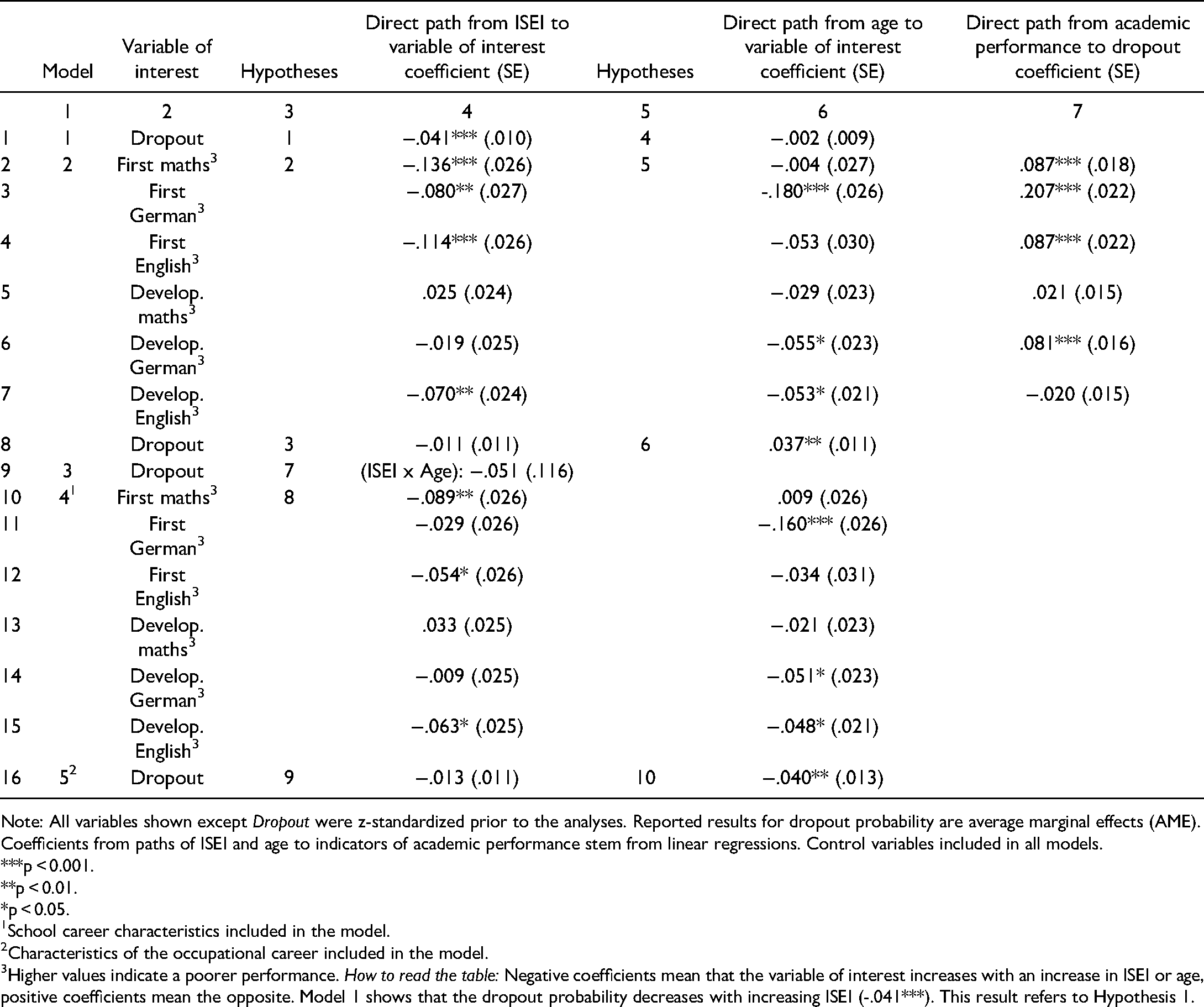
Note: All variables shown except Dropout were z-standardized prior to the analyses. Reported results for dropout probability are average marginal effects (AME). Coefficients from paths of ISEI and age to indicators of academic performance stem from linear regressions. Control variables included in all models.
***p < 0.001.
**p < 0.01.
*p < 0.05.
School career characteristics included in the model.
Characteristics of the occupational career included in the model.
Higher values indicate a poorer performance. How to read the table: Negative coefficients mean that the variable of interest increases with an increase in ISEI or age, positive coefficients mean the opposite. Model 1 shows that the dropout probability decreases with increasing ISEI (-.041***). This result refers to Hypothesis 1.
Multivariate Analyses
The hypotheses are tested via path models calculated with the program Stata 14.2 using its gsem routine (Rabe-Hesketh et al., 2004). Path models are special cases of structural equation models in which all the included variables are observed. This multivariate technique is appropriate to evaluate our hypotheses since it can be used to test complex relationships between multiply dependent and independent variables simultaneously (Acock, 2013). Our final model contains linear path models for all the indicators of academic performance and a logistic path model for dropout from SCE. We decided to calculate average marginal effects (AME) for the nonlinear parts of the model (Breen et al., 2018).
Results
Information on fit indices is not provided by Stata for estimates based on imputed data. The main results for the hypotheses can be seen in Table 1, and the full model is displayed in Table A6. Calculations proceed step by step (see also Figure 2).
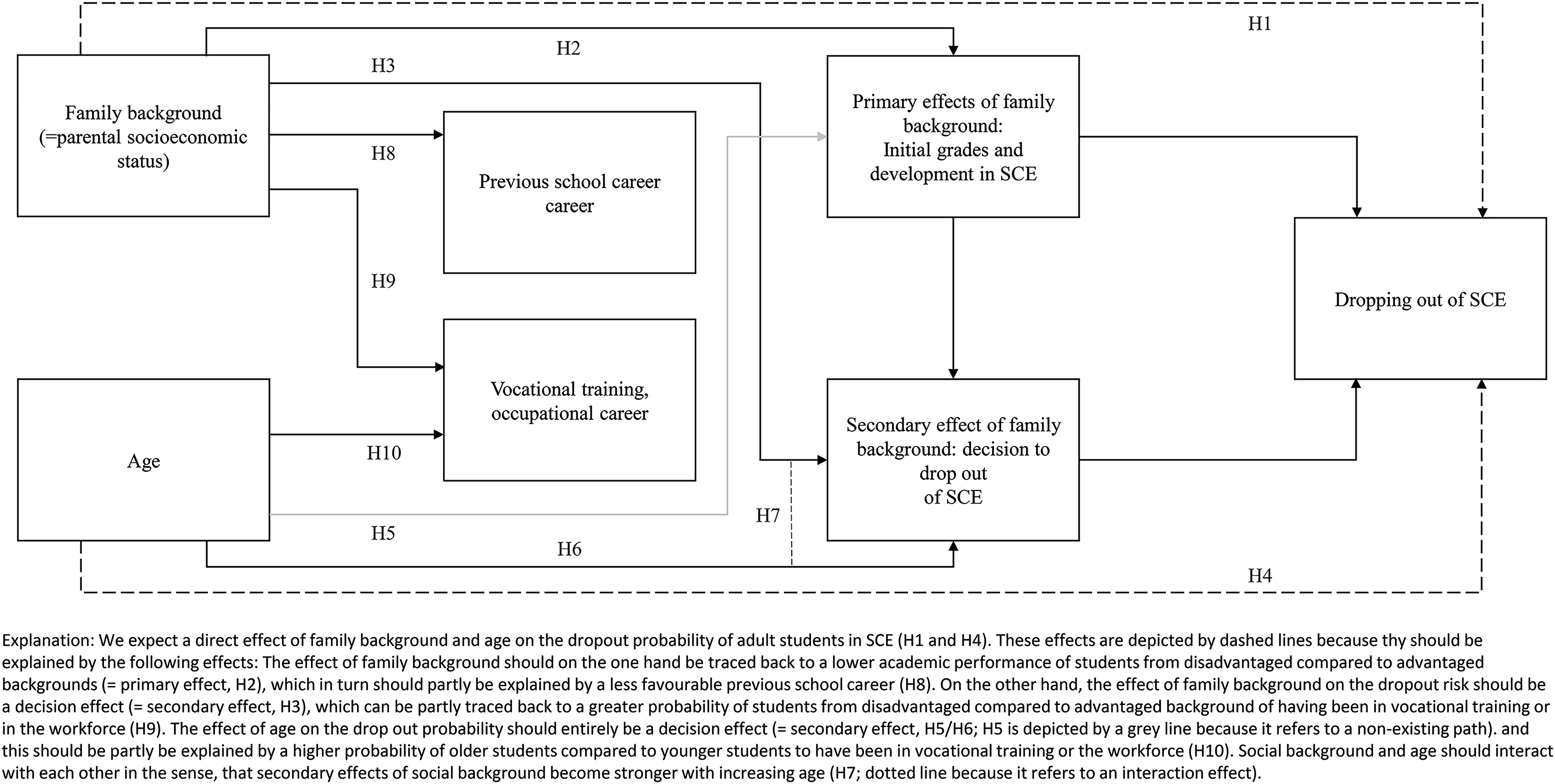
Explanatory model on the effects of social background and age on dropout probability.
In a
In a
However, with increasing age, students achieve better grades in German, and they even show an improvement in their grades in German and English (Table 1, column 6, rows 2–7). A significant effect of age on the likelihood of dropping out of SCE can now be observed (column 6, row 8). The older students are, and despite the fact that they perform better than younger students, the more likely they are to drop out. Since higher dropout is not associated with a lower level of academic performance, this result confirms Hypothesis 6.
In a
In a
Finally, in a
Discussion
The aim of this article was to analyse differences in the dropout rates of students in SCE according to their family background and age. It was assumed that the effects of these demographic variables on dropping out of SCE can be traced back to corresponding differences in a) academic performance and b) the consideration of the risks and benefits of SCE.
As expected, students from disadvantaged backgrounds were more likely to drop out of SCE than students from more privileged backgrounds. This effect is rather small, which could be due to a socially rather homogeneous student body as a result of previous selection processes (Mare, 1980) and to decreasing parental influence on academic skills with increasing age (Müller & Karle, 1993). However, this effect could be completely traced back to differences in performance, since these students had already achieved lower grades in the first semester, and the development of their grades was poorer than that of the corresponding reference group. This result is not in line with the findings of studies on the development of the composition of primary and secondary effects during an individual’s life span, which indicate that at higher educational levels primary effects are usually smaller than secondary effects (Neugebauer & Schindler, 2012; Scharf et al., 2020). Our result may therefore suggest that theories that assume a class-specific decision-making situation for students should be adapted for adults in SCE.
Direct primary effects were partly mediated by the previous school career, since students from less privileged family backgrounds were more likely to have attended less demanding school types and to have finished general education with lower qualifications than students from privileged backgrounds. Primary effects of social origin in SCE seem to be partly the result of social background effects that led to a less favourable previous school career and, additionally, are a result of previous school affiliation itself (Holm et al., 2013). However, the database did not make it possible to analyse any further the contribution of the previous school career to the performance and the dropout risk of socially disadvantaged students in SCE.
Differences in the dropout risk of students according to age only appeared after including academic performance in the model. Given the same academic performance, older students were more likely to drop out than younger students. Older students also achieved higher grades in their first semester and showed a better performance development than younger students. This differs from the results of Canadian studies on SCE, where younger students were psychologically more stable and had a more stable previous school career than older students (Marcotte, 2012; Raymond, 2008). The fact that in the present study younger students were more likely to enter academic SCE without vocational training experience may indicate that they had not been accepted on a vocational training programme due to poor school performance or an unfavourable school career, and may have chosen SCE for lack of alternatives. Older students may also be more likely to have chosen SCE if they had good academic prerequisites, as they may have evaluated their risks and benefits more carefully than younger students.
It has been hypothesised that older students are more likely to drop out of SCE because their vocational training qualifications and job market experience provide them with more alternatives to SCE (Smith & Naylor, 2001). This could not be confirmed by our results. Although older students were more likely to have higher status vocational qualifications and jobs than younger students in SCE, their overall status values are rather low compared to the distribution of these values in the population overall (Stanat et al., 2016). This situation should be a reason to continue with SCE rather than to abandon it. Other motives such as financial burdens or aligning with the requirements of adulthood – for instance having a stable job, supporting a family (Settersten & Ray, 2010) – may be more important to explain the higher dropout probability among older students. It is also possible that older students increasingly realise that they are still far from being able to expect the desired returns on their educational goals because in order to do so, they will have to enter higher education or take a high-status vocational training course after completing SCE. Research shows that older students often do not invest the time necessary for this, and returns to SCE therefore decrease with age (Sterrenberg, 2014). However, it was not possible with our database to investigate concrete student dropout motives, and this is an aspect for further investigation by future studies.
It was assumed that the effect of family background on dropout probability increases with age. This was not confirmed. Age and family background appeared to be two independent factors. Moreover, other than expected, the decision-making situation in which students from disadvantaged family backgrounds in SCE find themselves did not seem to be structured differently from that of other social groups. A possible explanation is that adults who enter SCE may feel – independently of their family background – that non-academic school-leaving qualifications limit the range of occupations accessible to them. The socioeconomic status of students’ vocational qualifications and previous jobs was on average lower than that of their parents. They were all striving to improve their standard of living – the motive most often reported by participants in a recent study on SCE in Germany (Bellenberg et al., 2019) – and most of them were probably still striving to achieve their parents’ socioeconomic status. From this point of view, students may all be highly motivated to complete SCE, but some of them – more likely those from less privileged family background – lack the necessary prerequisites in terms of ability.
However, these conclusions must be treated with caution since the database suffers from some limitations. First of all, no ability measures in terms of standardized tests were available, and therefore the contribution of individual ability to primary effects could not be identified and the significance of primary effects may have been overestimated (Scharf et al., 2020). Second, the data are from only one school of SCE, and differences from other schools in terms of student composition could only marginally be investigated. This disadvantage was tolerated because access to rich data on students in SCE in Germany is very difficult to obtain due to high absence and dropout rates. Since comparisons with data available from school statistics (gender, qualification obtained at the end of general education) suggest that the school in our study does not differ from other schools in NRW, and the structure of SCE that leads to ETS is similar in the other federal states of Germany (Bellenberg et al., 2019; Harney, 2016), our results can, with due caution, be applied to other schools in this or any other federal state.
Overall, the following can cautiously be concluded: In countries such as Germany, where access to higher education is restricted to a minority of students, the problem of social inequality in the participation in higher education is particularly worrying (Orr et al., 2017). If SCE aims to at least partly compensate for this, strategies should vary for different groups of students. The poor academic performance of students from disadvantaged family backgrounds that leads to a higher dropout probability seems to be partly generated during SCE, and this could be addressed by means of a greater emphasis on an academically challenging yet learner-oriented practice (Schuchart & Bühler-Niederberger, 2020; Athanases et al., 2016). In contrast, the higher dropout probability among older students (holding family background constant) seems to be due to a decision against continuing in SCE despite positive performance development. This could be addressed by special support, guidance and counselling during SCE, perhaps in cooperation with universities (Alheit, 2009), and perhaps right from the beginning of SCE. Whether or not the same conclusions can be drawn for other countries where SCE shows similar characteristics (see European Commission/EACEA/Eurydice, 2018) must remain a topic for future studies.
Supplemental Material
sj-docx-1-aeq-10.1177_07417136211046960 - Supplemental material for Age and Social Background as Predictors of Dropout in Second Chance Education in Germany
Supplemental material, sj-docx-1-aeq-10.1177_07417136211046960 for Age and Social Background as Predictors of Dropout in Second Chance Education in Germany by Claudia Schuchart and Benjamin Schimke in Adult Education Quarterly
Footnotes
Declaration of Conflicting Interests
The author(s) declared no potential conflicts of interest with respect to the research, authorship, and/or publication of this article.
Funding
The author(s) received no financial support for the research, authorship and/or publication of this article.

Supplemental Material
Supplemental material for this article is available online.
Notes
References
Supplementary Material
Please find the following supplemental material available below.
For Open Access articles published under a Creative Commons License, all supplemental material carries the same license as the article it is associated with.
For non-Open Access articles published, all supplemental material carries a non-exclusive license, and permission requests for re-use of supplemental material or any part of supplemental material shall be sent directly to the copyright owner as specified in the copyright notice associated with the article.
