



Abstract
Using multilevel modeling, the current study examined student-level predictors of compositional quality and productivity in Grade 2 Australian children (N = 544), including handwriting automaticity, literacy skills, executive functioning, writing attitudes, and gender; and classroom-level (n = 47) variables predicting students’ writing outcomes, including the amount of time for writing practices and the explicit teaching of foundational (handwriting, spelling, grammar) and process writing skills (planning and revision strategies). Multilevel analyses revealed that student-level factors, including gender, general attitudes, and transcription skills (handwriting automaticity and spelling), were key predictors of writing outcomes. Interaction analyses showed that spelling and word reading influenced writing outcomes, with effects varying by gender. At the classroom-level, time spent on planning had a positive effect on students’ compositional quality, and time spent on spelling instruction had a negative effect on students’ compositional productivity. Implications for research and education are discussed.
Introduction
The development of writing skills is shaped by the individual writer’s cognitive architecture and by contextual-level factors (Graham, 2018), including formal instruction through schooling (Kellogg, 2008). Cognitive studies of writing confirm that the process of acquiring and learning school-based writing skills relies on the development of student-level factors, including lower and higher-order writing skills, reading skills, and affective aspects of writing (Graham, 2018). Since writing is a social activity, students’ writing proficiency is typically shaped by the context of schooling, including implemented classroom writing practices and instruction in writing (Graham, 2018, 2019). While there is a relatively strong body of research examining the writing component skills in early writing development (Kent & Wanzek, 2016), less attention has been given to the contributions of multiple student- and classroom-level factors in explaining the writing performance of beginning writers (Grades 2 and below).
For a more comprehensive understanding of factors explaining the writing performance of beginning writers, it is critical to examine both cognitive and affective aspects of writing (Graham, 2018). Research confirms the unique contribution of handwriting automaticity and spelling in explaining the writing achievement of young writers, even after controlling for variance due to other student-level factors as well as for variance due to classroom and school factors (Malpique et al., 2023b; Skar et al., 2023). The highly cognitive demands of writing, however, also require the development of higher-order skills to craft texts, including planning and goal setting (Berninger & Winn, 2006). Executive functioning (EF) is particularly critical in supporting the challenges of managing the lower and higher cognitive process of text composing (Kim et al., 2013), with research showing that executive processes facilitate the transcription skills of beginning writers, freeing cognitive resources to produce higher quality texts (Valcan et al., 2020). Reading proficiency is another student-level factor impacting children’s writing performance, with research showing that reading and writing influence each other throughout schooling, and that these relations may differ by developmental stages and linguistic grain size (Kim et al., 2024). Motivational variables, including attitudes toward writing, also contribute to explaining student’s writing performance (Skar et al., 2023; Troia et al., 2012), with research showing that students who hold more favorable attitudes often produce higher quality texts (Ekholm et al., 2018). Researchers have placed less focus, however, on studying these cognitive and affective factors together.
In the present study, we examined multilevel predictors of Grade 2 children’s written compositions (quality and productivity). More specifically, we checked the contributions of child-level factors, including transcription skills (handwriting automaticity and spelling), reading skills (word reading and reading comprehension), executive functioning, attitudes toward writing (general and specific writing attitudes), and gender in explaining children’s writing performance. We further investigated the extent to which classroom factors, including the amount of time for writing practice and for teaching foundational and process writing skills, predicted children’s writing outcomes.
Writing Achievement in Primary Education: Student-Level Variables
Transcription skills play a critical role in explaining children’s writing. Supported by the capacity theory of writing (McCutchen, 1996), developing writers who fail to automatize transcription skills are said to be constrained in their ability to focus on higher-order aspects of writing, including using specific strategies to plan, organize, and revise texts (Reutzel et al., 2019). Findings from Kent and Wanzek’s (2016) meta-analysis investigating relationships between transcription skills and students’ writing performance (K-12) show an effect size (ES) of 0.59 for the relationship between handwriting fluency/automaticity and compositional quality and an overall ES of 0.48 for compositional productivity of beginning writers (K-3). In a large-scale study (n = 4,950 students in Grades 1-3), Skar et al. (2022) report that handwriting fluency accounted for 7.4% of the variance in students’ writing quality after controlling for variance due to student-level factors (e.g., attitudes toward writing, grade, gender) and for variance due to the nested nature of the data structure of students within classes and schools. In a longitudinal study, Malpique et al. (2020) also reported that, after accounting for gender and word reading skills in kindergarten, handwriting automaticity predicted the compositional quality of the texts children produced 1 year later. Research examining the role of spelling fluency for beginning writers showed significant relationships between spelling and children’s written composition (Graham et al., 1997; Puranik & AlOtaiba, 2012). However, Graham et al. (1997) found that, when compared to spelling, handwriting fluency had a stronger and more direct relationship to the compositional quality and fluency of beginning writers (Grades 1-3). More recently, multilevel analyses showed spelling significantly predicting Grade 2 children’s compositional quality but not compositional fluency, even after controlling for variance due to other student-level variables (i.e., gender and reading skills) and nesting due to classroom (Malpique et al., 2024).
Another student-level factor predicting writing performance is gender (Graham, 2018). National high-stakes tests across countries recurrently report gender differences in writing across grades, with female students outperforming their male counterparts (Reilly et al., 2019; Thomas, 2020). Empirical findings also report gender differences in primary students’ writing, with females typically producing higher quality text (Cordeiro et al., 2018; Lee, 2013) with higher handwriting automaticity (Skar et al., 2022) and spelling scores (Malpique et al., 2017) than males, and showing more favorable attitudes toward writing (Graham et al., 2012a).
Bidirectional relations between reading and writing have been proposed for quite some time (Shanahan & Lomax, 1986). Theoretically, since reading and writing share meta and domain knowledge, textual attributes, and procedural knowledge, reading may influence writing throughout schooling and vice versa (Fitzgerald & Shanahan, 2000). Longitudinal research, however, shows stronger reading-to-writing effects in comparison to writing-to-reading effects at the word, sentence, and text levels in Years 1 through 4 (Ahmed et al., 2014). Kim et al.’s (2024) meta-analysis revealed that reading-writing relations are moderated by developmental stages and the magnitude of such relationships depends on reading and writing subskills. More specifically, findings show strong relations between word reading-spelling (r = .82) and moderate relations between reading comprehension-written composition (r = .44) for primary-grade students. With reading and writing relationships potentially varying across developmental phases, understanding the unique contributions of word-reading and reading comprehension in explaining the writing performance of beginning writers is warranted.
The educational implications associated with children’s EF has become a phenomenon of interest among writing researchers. A set of higher-order cognitive processes related to intentional goal-directed behavior (Brydges et al., 2012), EF has been commonly understood to comprise three key cognitive processes, namely working memory, inhibition, and shifting (Miyake et al., 2000). Working memory refers to the ability to mentally retain and manipulate incoming information. Inhibition refers to the ability to withhold responses that are dominant and/or automatic, including managing emotions. Shifting refers to the ability to flexibly switch attention among different tasks and/or mental processes. While the relation between EF and writing is commonly accepted, according to Limpo and Olive (2021), its roots are more theoretical than empirical. The “not-so-simple-view” of writing (Berninger & Winn, 2006) hypothesizes the importance of EF in writing, more so as the complexity of writing increases throughout development. Recent research has established a linear relation between EF and handwriting performance (Drijbooms et al., 2015; Valcan et al., 2020), with results from the Drijbooms et al. (2015) study showing that EF directly and indirectly (via handwriting automaticity) can predict handwritten composition of Grade 4 children.
Research examining the contributions of attitudes toward writing in explaining the writing performance of beginning writers is scarce (Skar et al., 2023), with conflicting findings reinforcing the challenges of understanding the role of writing attitudes in the early years (Ekholm et al., 2018). As Troia et al. (2012) propose, it is plausible that children who hold more favorable writing attitudes may produce higher-quality texts since writing is an effective motivational state. In one of the few systematic reviews on writing attitudes research, Ekholm et al. (2018) report that students’ attitudes may make a significant contribution in explaining text quality and length. The authors were only able to locate, however, four studies examining Grades 1-3 students’ attitudes (Graham et al., 2007, 2012a; Knudson, 1992; Olinghouse & Graham, 2009). These studies report conflicting findings: two show that children with more favorable attitudes toward writing wrote longer and higher quality texts (Graham et al., 2007, 2012a); Olinghouse and Graham’s (2009) multiple regression analyses, however, show writing attitudes not predicting Grade 2 students’ writing achievement, and in Graham et al. (2012a), writing attitudes predicted Grade 3 students’ writing achievement but not that of Grade 1 students. In one of the few studies investigating the contributions of writing attitudes in predicting Grade 2 students’ writing quality, Skar et al. (2023) controlled for variance due to student-level factors (e.g., age and handwriting fluency) and for variance due to the nested data structure of students within classes and schools. While Grade 2 children had very favorable attitudes toward writing, this contributed only 1% in explaining text quality. In a similar study with Grade 2 students (Malpique et al., 2024), writing attitudes did not make a statistically significant contribution in explaining compositional quality and productivity after controlling for variance due to other student-level variables (handwriting automaticity, spelling, reading skills) and nesting due to classroom. Since both cognitive and affective student-level factors seem to contribute to explaining the writing performance of beginning writers and writing development is shaped by the context in which writing happens (Graham, 2018), it becomes critical to examine the contributions of multiple student- and classroom-level factors in explaining the writing performance of beginning writers.
Writing Achievement in Primary Education: Classroom-Level Variables
Cumulative evidence from meta-analytic studies shows that writing development is a result of deliberate writing practice and explicit teaching of foundational (e.g., handwriting and spelling) and process writing skills (e.g., planning and revision strategies) (Graham et al., 2024). Concurrently teaching foundational and process writing skills supports writing acquisition and development in primary education (e.g., Graham et al., 2024). Providing adequate time for writing practice and instruction of foundational and process writing skills may increase opportunities for children to learn how to use them effectively, maximizing proficient writing (Graham et al., 2012b). However, three decades of research on writing instruction show that primary school teachers may not allocate enough time to promote writing development in their classrooms (Graham, 2019). Findings from both national surveys (e.g., Cutler & Graham, 2008; Malpique et al., 2023a ; Veiga-Simao et al., 2016) and observational studies (e.g., Coker et al., 2018) report teachers typically spend less than five hours per week teaching writing in primary classrooms. The focus of writing instruction in primary classrooms is also often placed on teaching spelling skills, downplaying time to teach other foundational writing skills, including handwriting, and process writing skills (Cutler & Graham, 2008; Dockrell et al., 2016; Malpique et al., 2023a).
However, the few studies investigating the contributions of writing practice and instruction in early primary outside the context of an intervention report unexpected findings. Kim et al. (2013) investigated unique student-level predictors (e.g., language skills, spelling, reading) of Grade 1 children’s writing performance and instructional quality, with findings showing overall instructional quality uniquely related to students’ written compositions, but not instructional quality on writing and spelling. In an observational study with Grade 1 children, Coker et al. (2018) also reported no direct positive effects of writing instruction on students’ writing achievement (writing quality and text length) and two surprising negative effects of writing instruction. Specifically, multilevel modeling analyses found negative effects of teaching writing skills on the quality and length of children’s texts and negative effects of teaching text composing on children’s compositional spelling outcomes. Olinghouse (2008) investigated student and instruction-level predictors of Grade 3 students’ writing achievement, with hierarchical linear modeling (HLM) results indicative of no main effects of instructional variables impacting students’ writing. Student-by-instruction interaction effects, however, revealed significant interactions between the amount of time spent teaching planning skills and students’ Full-scale IQ and word reading abilities. In other words, teaching planning skills seemed to be particularly important for students with lower Full-scale IQs and for students with higher word reading skills. When examining the contributions of writing motivation and classroom-level variables in explaining Grade 4 and 5 students’ writing achievement, Wang and Troia (2023) found two teaching practices impacted students’ writing. More specifically, HLM results showed a positive impact of teaching tactics (e.g., modeling, explanations, and summarizing) and a negative impact of frequent use of class management practices in explaining students’ compositional quality. Given the complexity of potential individual and contextual factors impacting students’ writing achievement, expanding knowledge on the unique contributions of multiple student- and classroom-level factors in predicting children’s writing performance is critical to inform educational practices that facilitate effective writing development (Wang & Troia, 2023).
The Current Study
Considering the criticality of examining student- and contextual-level factors explaining the writing performance of beginning writers, the following research questions were addressed:
Research Question 1: Do transcription skills (handwriting automaticity and spelling), reading skills (word reading and reading comprehension), writing attitudes, executive functioning, and gender contribute to predicting Grade 2 writing outcomes (i.e., compositional quality and productivity), after controlling for classroom-level factors (amount of writing practices and of teaching foundational and process writing skills)?
Research Question 2: Do relations between student-level factors and Grade 2 writing outcomes (compositional quality and productivity) depend on classroom-level factors (amount of writing practices and of teaching foundational and process writing skills)?
We hypothesized that transcription skills (e.g., Skar et al., 2022) and gender (e.g., Cordeiro et al., 2018) would make a significant contribution to explaining children’s compositional quality and productivity. We further aimed at examining the unique contributions of gender in explaining students’ writing outcomes and whether relationships between transcription skills, reading skills, writing attitudes, and executive functioning with Grade 2 students’ writing outcomes differed by gender, aiming to provide insights into these associations. Given the presence of ambiguous findings in the literature (e.g., Graham et al., 2012a; Malpique et al., 2024; Olinghouse & Graham, 2009), we adopted an exploratory approach, and no hypotheses were formulated for the specific contributions of children’s writing attitudes, reading skills, and executive functioning. Considering Kim et al. (2024) meta-analysis investigating reading-writing relations, we hypothesized that word reading would make a significant contribution in explaining children’s writing performance, but we were less confident in the unique contribution of reading comprehension skills. Finally, previous studies reported direct and indirect effects of EF in predicting students’ writing performance (Drijbooms et al., 2015; Valcan et al., 2020). Hence, we were also less confident to hypothesize that EF would make a unique contribution in explaining children’s writing performance after controlling for other student- and classroom-level factors.
Given the large body of work and meta-analyses on writing instruction in primary education (e.g., Graham & Harris, 2017; Graham et al., 2024), we expected positive effects of teaching foundational and process writing skills on children’s compositional quality and productivity. However, the unexpected findings from the nonintervention studies previously reviewed (Coker et al., 2018; Kim et al., 2013; Olinghouse, 2008; Wang & Troia, 2023), which emphasized the complexities of examining the unique contributions of specific teaching practices, restricted us from formulating specific hypotheses regarding the contributions of amount of writing practice and of time for teaching foundational and process writing skills.
Method
The empirical work in this study utilized data from a larger research project, which investigated Grade 2 children’s writing achievement and instruction. All measures were piloted with a sample of 49 Grade 2 children (Malpique et al., 2024).
Participants and Setting
For the current study, 309 government-funded primary schools, 79 independent primary schools, and 9 catholic primary schools in the Perth metropolitan area, Western Australia, were invited to participate via email, resulting in 17 participating schools. The participating schools represented different levels of socio-educational advantages as per the Index of Community Socio-Educational Advantage (ICSEA). The ICSEA is calculated based on student factors, including parents’ occupation and education, and school factors, including geographical location and proportion of Indigenous students, with an ICSEA value set at an average of 1,000 and a standard deviation of 100. ICSEA scores for the participating schools ranged from 962 to 1,184 with a mean of 1,070 and a standard deviation of 51. Six schools scored within the average range (950-1,050) and 11 above the average range (>1,050). One-sample t-test results suggested that the schools’ ICSEA scores were significantly higher than the national average, t(16) = 5.67 (p < .001). Similarly, the participating schools represented different levels of writing performance as per national and state results collected in the Australian National Assessment Program, Literacy and Numeracy (NAPLAN; Australian Curriculum and Assessment Reporting Authority [ACARA], 2019), with three schools scoring below and 14 schools scoring above the national average (422.5); and two schools scoring below and 15 schools scoring above the state’s average (419.4). Participating schools’ writing scores (M = 436.7, SD = 21.1, range = 402-482) were significantly higher than the national average of 425.5, t(16) = 2.78, p = .013). The proportion of Indigenous students ranged from 0% to 12% (M = 2.8, SD = 2.9), and the proportion of students who speak a language other than English ranged from 7% to 47% (M = 18.3, SD = 10.3).
Five hundred forty-four Grade 2 children (54.2% female), with a mean age of 7 years (SD = 0.27 months; range = 6-8 years), across 47 classrooms, participated in this study. Both parent and child consent were obtained. In addition, 46 teachers (100% female), ranging from one to seven teachers per school, also participated in this study. Overall, 84.8% of the participating teachers held a bachelor’s degree while 10.9% held a graduate degree, varying in their professional experience (M = 12.89 years, SD = 10.86, range = 1-42 years).
Student-Level Measures
During the second semester of the school year (July-December), student-level data were obtained in two separate testing sessions. Session 1 consisted of one-on-one (participant-researcher) assessment of children’s handwriting automaticity, literacy skills, attitudes toward writing, and EF (45 minutes). Session 2 consisted of a group of three children, assessing their handwritten compositions (15 minutes). Data collection was executed during school hours in a quiet room outside the classroom. Tasks were administered by the first and fourth authors, along with three trained graduate research assistants (GRAs). Standardization was ensured across task administration via established protocols.
Handwriting automaticity
Handwriting automaticity was assessed via the alphabet writing task (Berninger & Rutberg, 1992). Children were required to write via pencil in alphabetical order all the lowercase letters of the alphabet, as quickly and accurately as possible. The alphabet writing task assessed the ability to access, retrieve, and write letters, automatically and accurately. For each correctly formed and sequenced letter, a score of 1 was given. Handwriting automaticity was indicated by the number of letters correctly written at 15 seconds (range 0-26). A GRA trained to use the alphabet writing task to assess students’ handwriting automaticity in the pilot study of this project scored all protocols (GRA1). The first author rescored 50% of the protocols. Interrater reliability (measured by the intraclass correlation coefficient [ICC]) was conducted to assess the degree of agreement between the first author and one RA, yielding a score of 0.99.
Spelling and Reading Skills
Spelling was assessed via the spelling subtest of the Wechsler Individual Achievement Test (WIAT-III; Wechsler, 2016), which assesses the written spelling of single sounds and words from dictation, as indicated by the total number of correctly spelled sounds and words. Reading was assessed via the word reading subtest, measuring the speed and accuracy of single-word reading, as indicated by the total number of words accurately read. Reading was also assessed via the comprehension subtest, measuring literal and inferential reading comprehension skills via a range of passages and questions, as indicated by the total number of accurate responses. Raw scores were standardized and interpreted according to age. Interrater reliability (i.e., ICC) was conducted between the two RAs, yielding a score of 1.0 for spelling, 1.0 for reading comprehension, and 0.99 for word reading. Overall, the validity of the WIAT-III is well established in the literature, with each composite and subtest measuring the intended construct (Pelling & Burton, 2017).
Attitudes Toward Writing
Semistructured interviews combining closed and open-ended questions were used to assess children’s general attitudes toward writing and specific attitudes toward writing stories using paper and pencil. Interviews were conducted during individual assessment sessions. The instrument included three closed-ended questions adapted from the Writing Attitude Survey (WAS), a validated survey assessing Grades 1-3 children’s attitudes toward writing (Kear et al., 2000). The semi-structured interview included three closed-ended questions (5-point Likert scale), and students were asked to circle their answers using face emojis ranging from 1 (awful) to 5 (fantastic) (i.e., Question 1: How much do you like writing? Question 2: How much do you like writing using paper and pencil? Question 3: How do you feel when you are asked to write a story using paper and pencil? Additional open-ended questions prompted students to explain the reasons for their choices (i.e., Why so?). Interviews were conducted by the first author and two GRAs. To cater to the developmental needs of this cohort, questions were read aloud by the researchers and open-ended responses were audio-recorded. A pilot study with Grade 2 students was developed to assess and streamline the assessment instrument (Malpique et al., 2024). A factor analysis of the three attitudes questions produced a one-factor solution with an eigenvalue greater than 1.0 explaining 56% of the variance. Questions 2 and 3 loaded at 0.75 and 0.78, respectively (coefficient alpha = .73), and Question 1 factor loading was below 0.61. Question 1 diverged conceptually from the two remaining questions. Since the use of single items is preferable when a construct is unambiguous in nature and theoretically relevant (Allen et al., 2022), we kept Question 1 to evaluate children’s general attitudes toward writing and Question 2 and Question 3 to evaluate children’s attitudes toward paper-based writing (average score measure). Two members of the research team rescored 50% of protocols, and interrater reliability was high (ICC = 0.98).
Executive functioning
The Head-Toes-Knees-Shoulders (HTKS; Ponitz et al., 2008) task was conceptualized as a measure of EF (working memory, inhibition, and shifting) in the form of a game, requiring children do the opposite of the action instructed. If children were instructed to touch their heads (or their toes), they were required to touch their toes (or their head), respectively. The task comprises three parts (consisting of 10 items each) with a different set of instructions. EF is represented by the sum of scores across the three parts (range 0-60). The HTKS requires children to inhibit the dominant response of imitating the examiner, to switch between the rules of the task, and to remember the rules of the task. There is a moderate to strong correlation between the HTKS task and other well-established EF measures, and good interrater reliability (k = 0.90; Ponitz et al., 2009).
Written composition
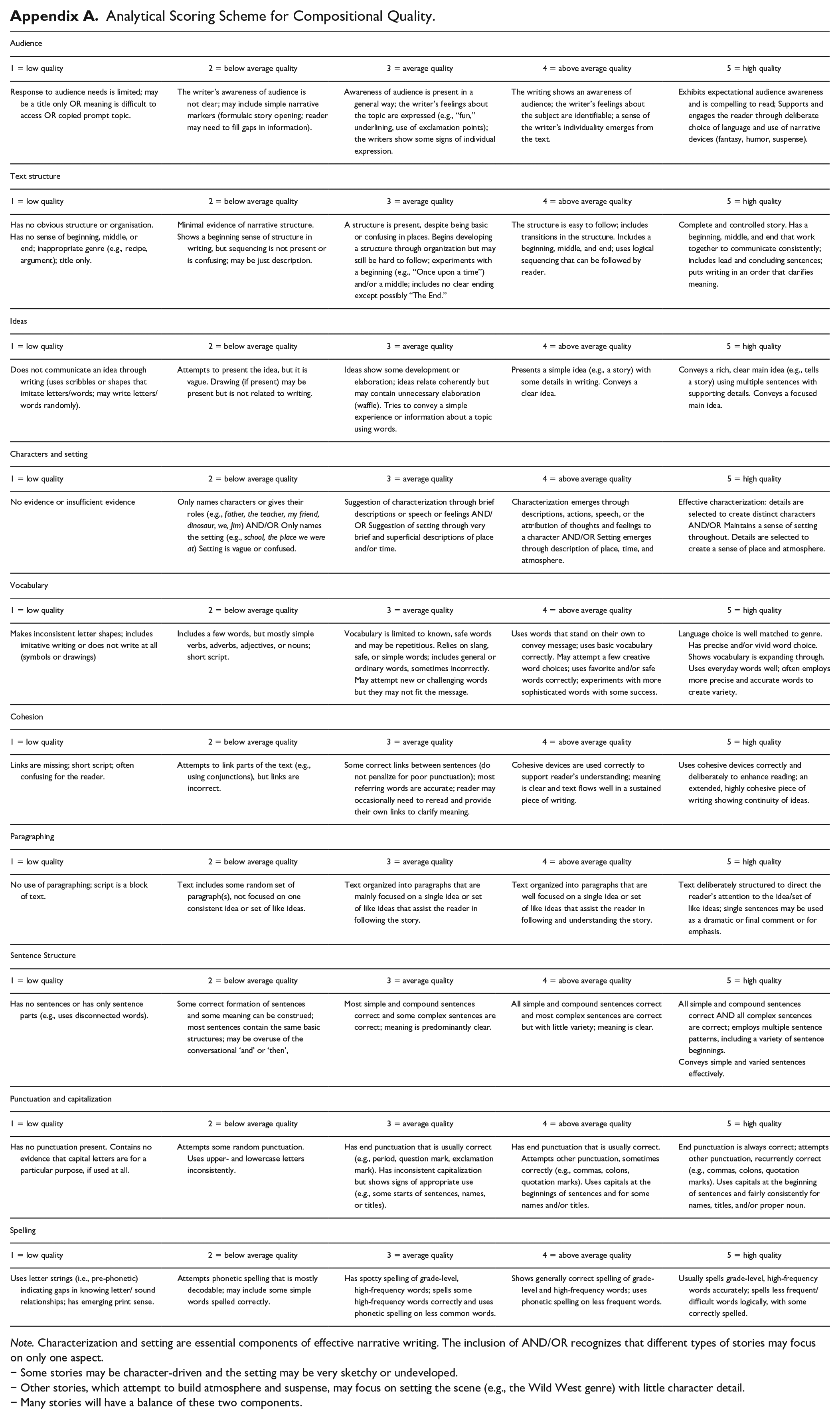
Students were asked to compose a text in response to an examiner-presented prompt. Children were asked to write a story beginning with “On my way home from school, I found a robot” and given 10 minutes to complete the writing task. Compositional quality and compositional productivity were assessed. Regarding compositional quality, we followed an analytical scoring scheme, which included 10 assessment criteria (see Appendix A for a description of the scoring scheme). This assessment protocol is aligned with the Australian National Assessment Program, Literacy and Numeracy (NAPLAN) narrative writing marking (ACARA, 2016), and the 6 + 1 Trait® Writing rubric for Primary Grades (Northwest Regional Educational Laboratory, 2011) and was adapted to follow the judging standards for writing and creating texts set in the Western Australia English curriculum for Grade 2 (School Curriculum and Standards Authority, 2016). To assess compositional productivity, we used the total number of words (TNW) students were able to produce, counting each word that was an attempt to represent an actual English word in use, regardless of spelling (e.g., Graham et al., 2016).
A primary school teacher who was unaware of the purpose of this study scored all written compositions, and the first author rescored 50% of randomly selected written texts. Before that, raters discussed the distinguishing features of each criterion and then practiced using the rubric with a series of compositions that varied in overall quality (i.e., texts from high-, middle-, and low-scores texts produced by Grade 2 students that participated in the pilot phase of this study). After independently scoring each practice story, raters compared their scores and resolved any differences through discussion. Scores for each criterion were allocated from 1 (low quality) to 5 (high quality) and the final scores for compositional quality reflected the average of the 10 marking criteria (maximum of 50 for final score). Interrater reliability measured by the ICC was 0.93 for compositional quality and 0.98 for compositional productivity.
Classroom-Level Measures
Following data collection of student-level measures, the 47 teachers of the 544 participating students were invited to complete a Likert-type survey assessing the instructional practices for writing that they implemented in their classrooms during the school year. The survey was adapted from a national survey investigating writing instruction in Australian primary classrooms (Grades 1-6, typically aged 6 to 12 years) developed by Malpique et al. (2023a). The first section of the survey included demographic information (e.g., gender and highest educational level) and two items in which teachers were asked to evaluate the quality of their pre- and in-service preparation for teaching writing using a 5-point Likert-type scale ranging from 1 (inadequate) to 5 (exceptional). To address the current study’s research questions and subsequent multilevel analyses, we used data from one scale in which teachers were asked to report on the amount of time they allocated for writing practice in their classrooms during an average week (including time students spent planning, drafting, revising, and editing text that was a paragraph length or longer; i.e., During an average week, how many minutes do your students spend writing?), and the time they spent teaching foundational (handwriting, spelling, and grammar) and process writing skills (planning and revising) per week in their classrooms (i.e., During an average week, how many minutes do you spend teaching each of the following?). The reliability coefficient of the items examining the amount of time for teaching foundational and process writing skills, as assessed by Cronbach’s alpha, was .79 and .81, respectively (Malpique et al., 2023a).
Data Analysis Strategy
In the present study, students (N = 544) were nested within classrooms (n = 47), which were further nested in schools (n = 17). To account for the clustering effects in this design, we employed a multilevel modeling (MLM) approach (Raudenbush & Bryk, 2002). To address our research questions, we analyzed the data with a two-level hierarchical structure, with students constituting the lower level of analysis (Level 1) and classrooms representing the upper-level clustering variable (Level 2). Mean imputation was carried out to replace the few missing data at Level 1 (four missing values on compositional quality and productivity). There were no missing data at Level 2.
The literature (Lee & Hong, 2021; Maas & Hox, 2004) suggests that accurate MLM parameter estimates and variance components typically require approximately 30 groups at the highest level of analysis. Given that this study includes only 17 schools, we opted for two-level MLM models instead of three-level models. This decision is further supported by the small school-level variance (ICC = 0.06 for compositional quality; ICC = 0.02 for compositional productivity) and nonsignificant school-level random effects from the likelihood ratio tests (p = .09 and p = .72, respectively). These findings indicate that most variation occurs at the classroom level, and adding a school-level random effect does not significantly improve model fit.
Separate random effects MLMs were employed for each outcome variable: one for compositional quality and another for compositional productivity. The analyses were conducted using Jamovi 2.5 software (The Jamovi Project, 2024) with maximum likelihood estimation (MLE) to accurately estimate both fixed and random effects. Student-level variables were group-mean centered while classroom-level predictors were grand-mean centered. To disaggregate between- and within-person effects, group means are entered as predictors at Level 2 (Bell et al., 2019; Raudenbush & Bryk, 2002). Random slope models were used in our analyses to investigate the extent to which student-level factors predicted Grade 2 writing outcomes and to assess whether the relationships between these factors and writing outcomes varied depending on classroom-level factors, such as the amount of writing practices and teaching foundational writing skills. A significant random slope indicates that the relationship between a Level 1 predictor and the outcome variable differs significantly across the higher-level units (Level 2).
The data analysis proceeded in four steps:
1. Null Model: We first fitted intercept-only models (unconditional or one-way random effects analysis of variance) with no predictors, separately for compositional quality and productivity. This step provided the ICC, quantifying the proportion of variance attributable to classroom-level differences.
2. Gender-Only model: A Level 1 model incorporating gender as the sole predictor was then fitted to evaluate its effects on Grade 2 writing outcomes.
3. Student model: Student-level variables were added to the model alongside gender to investigate their influence on compositional quality and productivity. Interactions involving gender were included to examine whether relationships between transcription skills, reading skills, writing attitudes, and executive functioning with Grade 2 writing outcomes differed by gender, providing important insights into these associations.
4. Classroom Model: Finally, a full model was constructed to examine the effects of both student- and classroom-level predictors. Cross-level interactions were included for Level 1 variables with significant random slopes. By controlling for teachers’ pre-service and in-service preparation for teaching writing, this model aimed to disentangle the combined effects of Level 1 and Level 2 predictors and explore the moderating influence of cross-level interactions.
The adequacy of the tested models was evaluated using the Akaike information criterion (AIC), Bayesian information criterion (BIC), log-likelihood values, and the proportion of variance explained by the fixed and random effects. For AIC and BIC, smaller values indicate a better model fit, while higher log-likelihood values suggest improved fit.
Results
Descriptive Statistics
Table 1 displays descriptive statistics and bivariate correlations for student-level (Level 1) measures, while Table 2 presents descriptive statistics and bivariate correlations for classroom-level (Level 2) measures. Most teachers were positive about their pre-service (M = 2.70, SD = 0.84) and in-service (M = 3.61, SD = 0.81) preparation to teach writing. Survey responses showed that 61% of participating teachers found their pre-service preparation adequate (43.9%) and very good (17.3%); and 88.5% found their in-service preparation adequate (19.9%), very good (62.7%), and exceptional (5.9%).
Descriptive Statistics and Bivariate Correlations for Student-Level (n = 544) Measures.
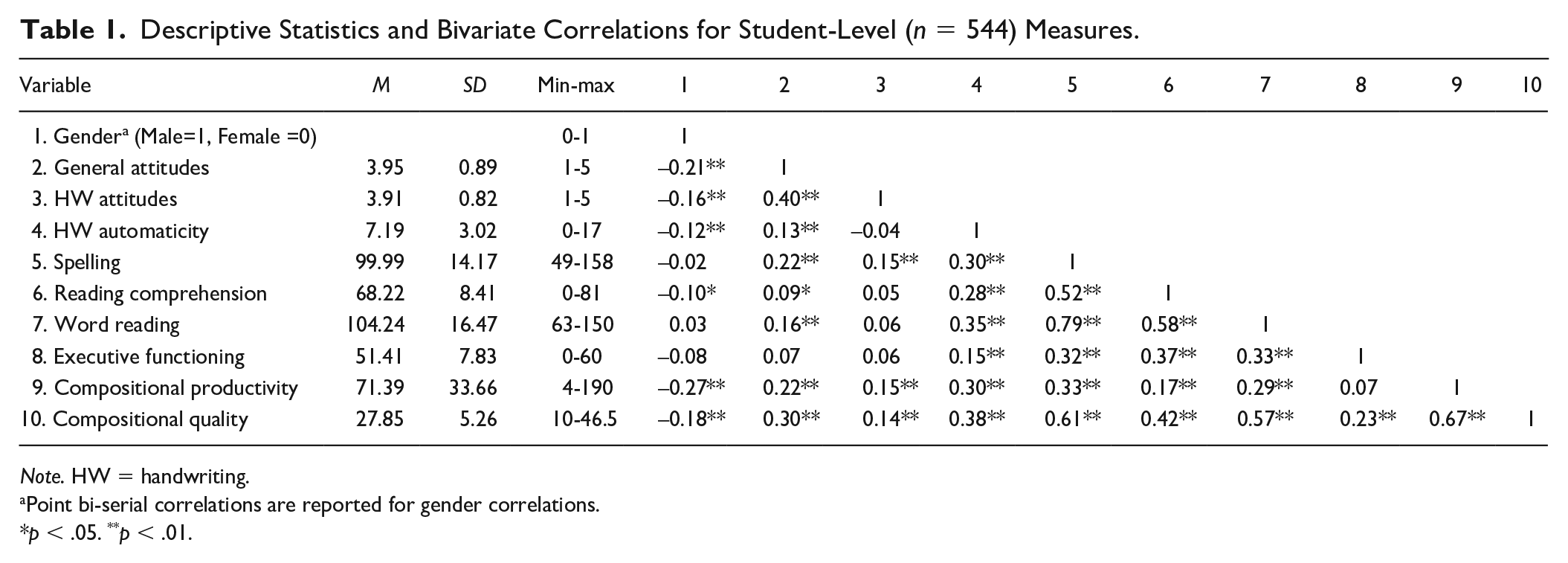
Note. HW = handwriting.
Point bi-serial correlations are reported for gender correlations.
p < .05. **p < .01.
Descriptive Statistics and Bivariate Correlations for Classroom-Level (n = 47) Measures.
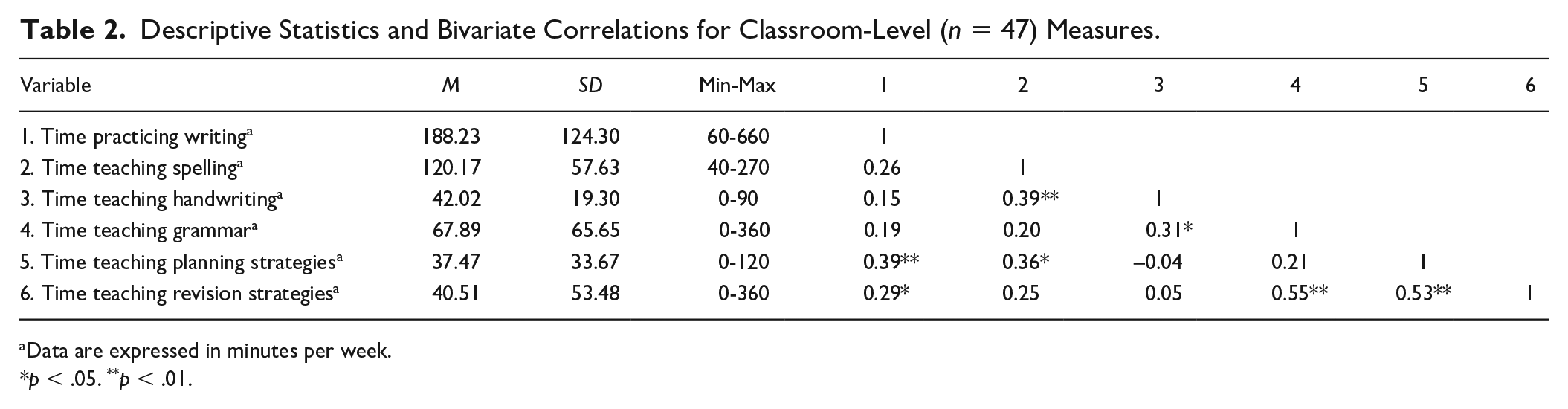
Data are expressed in minutes per week.
p < .05. **p < .01.
Multilevel Results
Results of multilevel models are presented in Tables 3 and 4 for the two outcome measures. The findings from the null (intercept only) models revealed significant variations in intercepts, indicating that mean compositional quality (27.75, SE = 0.38, p < .001) and compositional productivity (71.47, SE = 2.55, p < .001) scores differed significantly across classrooms. The student-level variances (compositional quality: σ² = 23.49; compositional productivity: σ² = 924.15) were much larger than classroom level variances, meaning that most of the variability in quality and productivity were attributable to individual student factors rather than classroom-level factors.
Multilevel Results Predicting Compositional Quality.
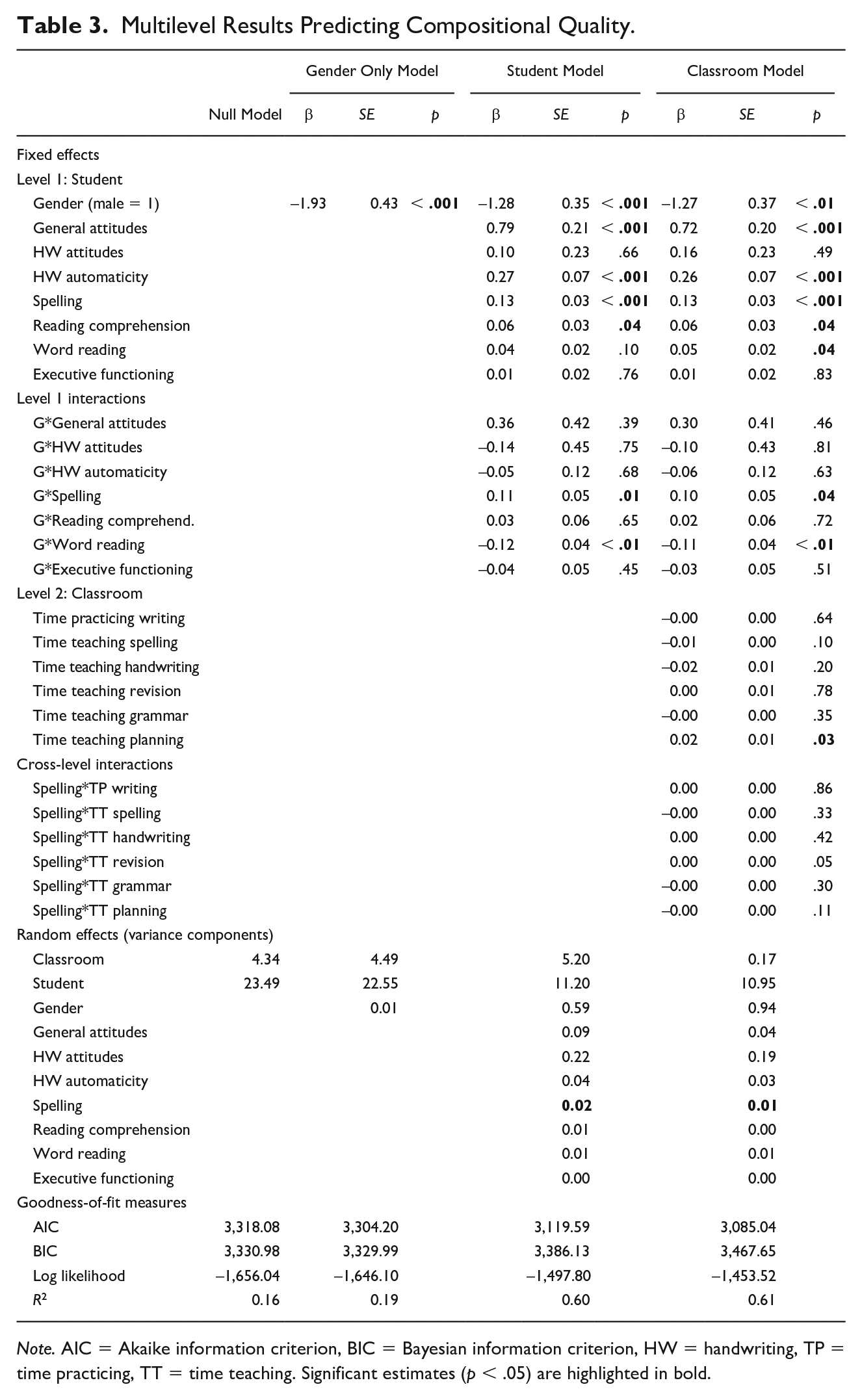
Note. AIC = Akaike information criterion, BIC = Bayesian information criterion, HW = handwriting, TP = time practicing, TT = time teaching. Significant estimates (p < .05) are highlighted in bold.
Multilevel Results Predicting Compositional Productivity.
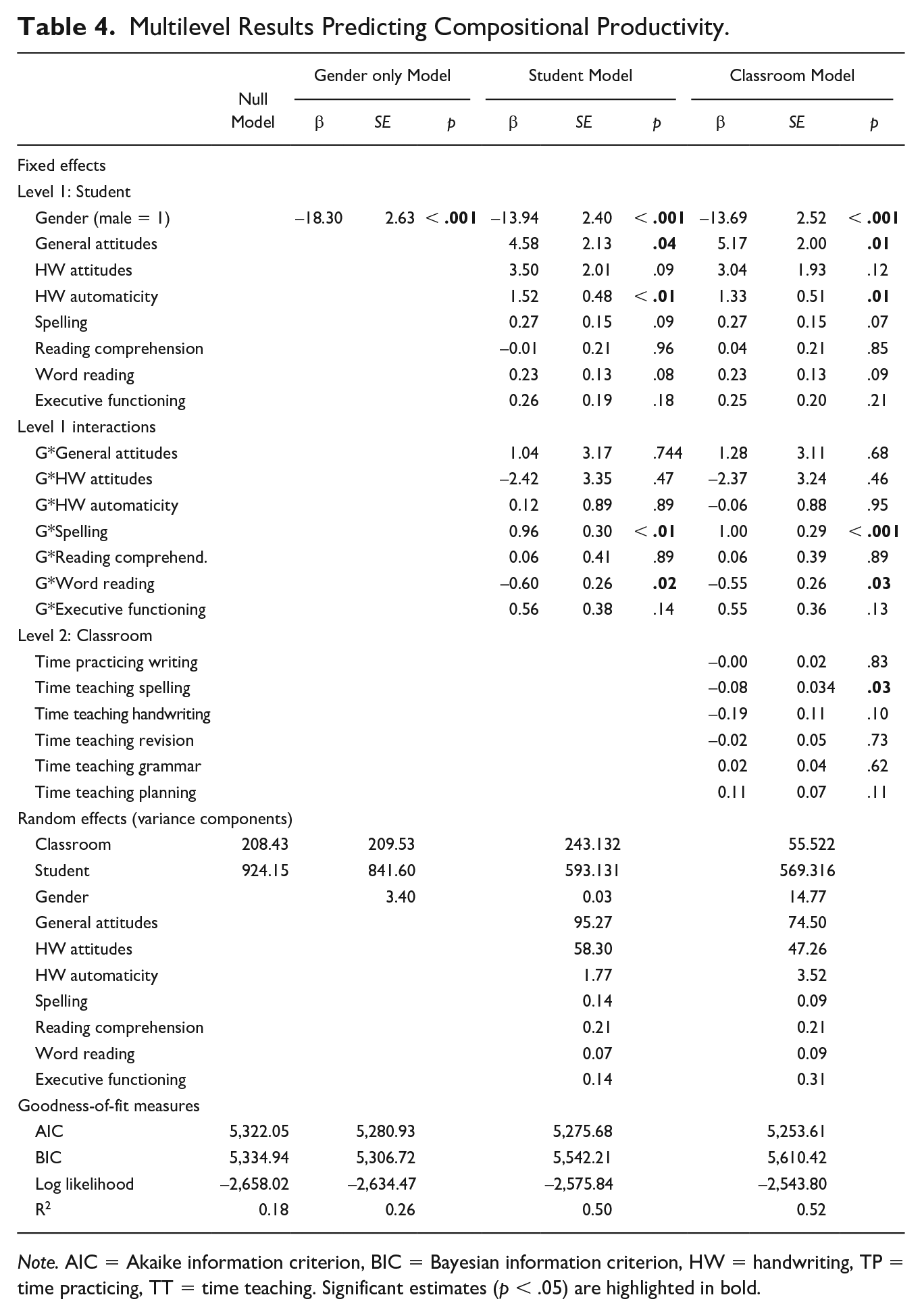
Note. AIC = Akaike information criterion, BIC = Bayesian information criterion, HW = handwriting, TP = time practicing, TT = time teaching. Significant estimates (p < .05) are highlighted in bold.
The calculated ICCs revealed that 16% of the variance in children’s compositional quality and 18% of the variance in children’s compositional productivity could be attributed to differences among classrooms. Notably, there was slightly more variation observed in compositional productivity compared to compositional quality. The ICC results indicated that MLM was an appropriate method for analyzing our data.
Compositional Quality
The results from the multilevel models examining compositional quality revealed several significant findings. At the student level, gender emerged as a significant predictor of compositional quality. Male students scored significantly lower on compositional quality (β = −1.93, SE = 0.43, p < .001), a finding consistent across all models. General writing attitudes were also found to be a strong positive predictor (β = 0.79, SE = 0.21, p < .001), with students who reported more favorable attitudes toward writing producing higher-quality compositions. Among transcription skills, handwriting automaticity (β = 0.27, SE = 0.07, p < .001) and spelling (β = 0.13, SE = 0.03, p < .001) were positively associated with compositional quality. Reading comprehension (β = 0.06, SE = 0.03, p = .04) also showed a small but significant positive effect on compositional quality, indicating that students with better reading comprehension skills wrote higher-quality compositions. All of these effects were also significant in the final classroom model. Word reading was only significant in the classroom model (β = 0.05, SE = 0.02, p = .04) but had a marginal effect in the student model. Executive functioning did not have a significant effect on handwriting quality.
In terms of interactions, the relationship between spelling and compositional quality was moderated by gender (β = 0.11, SE = 0.05, p = .01). Additionally, a significant gender and word reading interaction was found (β = −0.12, SE = 0.04, p < .01). Both interactions remained significant after incorporating classroom-level variables, suggesting gender differences moderating the impact of spelling and word reading on compositional quality. A significant random slope was observed for spelling (σ² = 0.02, p = .02), suggesting that the relationship between spelling and compositional quality varied across classrooms. The effect of other student-level variables on compositional quality did not differ across classrooms.
At the classroom level, time spent on writing practice (β = −0.00, SE = 0.00, p = .64), spelling instruction (β = −0.01, SE = 0.00, p = .10), handwriting instruction (β = −0.02, SE = 0.01, p = .20), revision (β = 0.00, SE = 0.01, p = .78), and grammar (β = −0.00, SE = 0.00, p = .35) were all nonsignificant. However, time spent teaching planning emerged as a significant positive predictor of handwriting quality (β = 0.02, SE = 0.01, p = .03). No significant cross-level interactions were found, although there was a trend for the interaction between spelling and time spent on teaching revision (β = 0.00, SE = 0.00, p = .05).
The model fit was evaluated using several measures, including AIC, BIC, log-likelihood, and R². The AIC and BIC values decreased across the models, indicating that adding predictors improved the model’s fit, although the increase in BIC in the classroom model suggests a trade-off between fit and complexity. Log-likelihood values also showed improvement, from −1,656.04 in the null model to −1,453.52 in the classroom model, indicating better model fit. R² increased significantly, from 0.16 in the null model to 0.61 in the classroom model, demonstrating that the inclusion of student-level and classroom-level variables greatly improved the explanatory power. Overall, the classroom model best captured the factors influencing compositional quality.
Compositional Productivity
The results from the multilevel models examining compositional productivity revealed several significant findings. At the student level, gender was a strong predictor of compositional productivity. Male students wrote significantly fewer words compared to female students (β = −18.30, SE = 2.63, p < .001). This result remained consistent across all models. Handwriting automaticity (β = 1.52, SE = 0.48, p < .01) and general writing attitudes were positively associated with compositional productivity (β = 4.58, SE = 2.13, p = .04). These findings remained consistent in the classroom model as well. Although spelling (β = 0.27, SE = 0.15, p = .09) and word reading (β = 0.23, SE = 0.13, p = .08) had marginal positive effects, they were not significant. Reading comprehension and executive functioning did not significantly contribute to compositional productivity.
In terms of interactions, significant interactions were found between gender and spelling (β = 0.96, SE = 0.30, p < .01) and gender and word reading (β = −0.60, SE = 0.26, p =.02). These interactions remained significant after incorporating classroom-level variables. No significant random slopes were found for student-level variables, indicating that the effects of student-level factors on compositional productivity did not vary by classroom practices.
At the classroom level, time spent on spelling instruction was a significant negative predictor of compositional productivity (β = −0.08, SE = 0.03, p = .03). Other classroom-level variables, such as time spent on handwriting instruction (β = −0.19, SE = 0.11, p = .10), revision (β = −0.02, SE = 0.05, p = .73), and planning (β = 0.11, SE = 0.07, p = .11), were not significant.
The AIC and BIC values indicated improvements in model fit as additional predictors were added, with the classroom model showing the best fit. The log-likelihood values improved from −2,658.02 in the null model to −2,543.80 in the classroom model. R² increased from 0.18 in the null model to 0.52 in the classroom model, indicating that the inclusion of both student-level and classroom-level variables greatly improved the explanatory power of the model.
Discussion
In the present study, we examined the contributions of multiple individual- and classroom-level factors in explaining the written composition of beginning writers. This is the first study to our knowledge examining these individual- and classroom-level variables concurrently to explain young writers’ compositional quality and productivity. Specific student-level factors such as gender, general attitudes, and transcription skills (handwriting automaticity and spelling) were key predictors of writing outcomes, and student- and classroom-level interaction effects offered important nuances about specific contributions to inform research and educational practices.
Student-Level Factors Explaining Children’s Written Composition
Current findings confirm the critical role of handwriting automaticity and spelling in explaining the writing performance of beginning writers (Malpique et al., 2024; Skar et al., 2022), well-aligned with theoretical models of writing (e.g., Graham, 2018; McCutchen, 1996) and previous studies confirming the importance of automatizing transcription skills (e.g., Graham et al., 1997; Skar et al., 2022). Findings from our multilevel models showed that children with higher HW automaticity wrote longer and higher-quality texts even after controlling for the other student- and classroom-level predictors included in our final classroom model. Children’s spelling abilities, however, contributed to explaining only compositional quality. These findings are aligned with the Graham et al. (1997) study in which handwriting fluency contributed more than spelling to the compositional quality and fluency of beginning writers, confirming results from one of the few studies examining the contributions of handwriting and spelling after accounting for other children-level factors and nesting due to classroom (Malpique et al., 2024). While automaticity of transcription skills frees cognitive resources to allow children to focus on ideation and on other higher-order text-composing processes (McCutchen, 1996), handwriting automaticity seems to be particularly relevant for beginning writers in allowing them to compose longer and higher-quality texts.
MLM analyses further showed gender as a significant predictor of children’s compositional quality and productivity across all models. Aligned with previous research (e.g., Cordeiro et al., 2018; Thomas, 2020), female students were able to write longer and higher-quality texts. Interaction effects, however, offered additional information regarding associations between student-level factors. Indeed, findings showed that the relationship between spelling and compositional quality and productivity was moderated by gender differences, with results indicating male students benefited more than girls from having stronger spelling skills. Additionally, MLM analyses revealed a significant gender and word reading interaction, suggesting that female students benefited more than male students from having stronger word reading skills. Interaction effects remained significant even after incorporating classroom-level factors. Current results suggest that spelling abilities may play a more important role in explaining the writing performance of male students when compared with female students, while word-reading abilities might be more critical for female students than for male students. Research consistently reports female students outperform their male counterparts in spelling performance tests across all grade levels, even after controlling for other cognitive abilities (Cordeiro et al., 2018). In the current study, and aligned with previous national (Malpique et al., 2023b) and international studies (e.g., Cutler & Graham, 2008, US; Dockrell et al., 2016, England), teachers reported allocating on average more time to teaching spelling (120 minutes) on a weekly basis than to the remaining instructional practices. Hence, participating teachers could be structuring their instructional practices toward male students’ spelling needs. From an educational perspective, while current interaction results reinforce the need to differentiate writing instruction to respond to gender differences, they also highlight the need not to overemphasize spelling instruction at the detriment of other writing and reading skills that may be beneficial for both female and male students.
Students’ general attitudes toward writing also contributed to explaining the writing outcomes of Grade 2 students across all MLM tested models. Consistent with previous research with beginning writers (Skar et al., 2023), children expressed a highly positive general attitude toward writing (average score of 3.95 on a 5-point scale). Children who hold more general attitudes toward writing wrote longer and higher quality texts, reinforcing the role of motivational aspects of writing for beginning writers. Given research suggesting young writers first perceptions about writing are mostly focused on neatness rather than on the quality of their texts (Beck & Fetherston, 2003), we also examined children’s specific attitudes toward paper-and-pencil writing. Findings suggested that children also hold positive attitudes toward writing using paper and pencil (average score of 3.91). Multilevel analyses revealed, however, that specific attitude toward writing did not contribute to explaining children’s writing outcomes. Since initial correlation analysis suggested positive associations between these variables, further research is needed to replicate current findings and potentially offer more nuanced insights about the role of general and specific attitudes toward writing. Our MLM findings reinforce the need to support the development of motor, cognitive, and affective aspects of writing in the early years. For educators, they highlight the significance of providing beginning writers with opportunities to develop transcription skills to a point where these foundational skills become automatic, and of including engaging writing activities to foster positive writing attitudes in early education (Young & Ferguson, 2020).
MLM results further showed that reading skills made a significant contribution in explaining children’s compositional quality, indicating that children with better reading comprehension and word reading skills wrote higher-quality texts. Previous meta-analytic results report stronger word reading–written composition relations than reading comprehension–written composition relations (Kim et al., 2024). While our findings showed a small but significant positive effect of reading comprehension on compositional quality, the effect was also significant after controlling for other student- and classroom-level factors in the final Classroom Model. While these findings reinforce reading-to-writing connections and the need for educators to integrate reading-writing instruction in their weekly literacy instructional practices, more research is needed to investigate specific aspects of these relations and effective instruction.
Findings also revealed that, after controlling for the remaining student- and classroom-level variables, EF did not make a statistically significant contribution to explain children’s writing outcomes. While Drijbooms et al. (2015) found both direct and indirect (via handwriting automaticity) links between EF and writing performance, they focused on an older sample of fourth-grade children. Until letter writing is fluent or automatic, children must rely heavily on cognitive processes, such as EF, consuming the executive resources needed for more complex writing (Valcan et al., 2020). Hence, in beginning writers, handwriting automaticity seems to be a stepping stone for proficiency in written composition. It is also important to mention that the HTKS task (Ponitz et al., 2008) is a unitary measure of EF, limiting opportunities to assess the specific contributions of working memory, inhibition, and shifting. This is something that future studies should address.
Classroom-Level Factors Explaining Children’s Writing Composition
Considering that students’ motor, cognitive, and affective aspects of writing may be shaped by the writing community in which writing takes place (Graham, 2018), we examined classroom-level factors predicting the writing performance of beginning writers. Incorporating classroom-level variables explained only an additional 1% of the variance in compositional quality and 2% in compositional productivity beyond the student-level models. MLM results at the classroom level showed that the amount of writing practice did not make any significant contribution in determining children’s compositional quality and productivity scores. A relatively straightforward explanation for this could be the little amount of time teachers reported allocating for writing practices in their classrooms. Indeed, a critical recommendation for primary school instructional programs is providing daily time for children to write and for children to spend at least 1 hour a day practicing writing (Australian Education Research Organisation Ltd, 2022; Graham et al., 2012b). However, in a review of meta-analyses examining the effects of writing interventions on students’ writing achievement, Graham et al. (2024) argued that “increasing how much students write does not make them better writers” (p. 4), substantiated by a recent meta-analysis showing small effects of increasing young students’ opportunities to write (aged 5-11) in predicting written compositions. Coker et al. (2018) found that the more Grade 1 children engaged in generative writing practice, the higher the quality and the length of their texts. Generative writing practice required students to create content while managing foundational and process writing skills simultaneously, and it was found to be the only writing practice predicting children’s writing outcomes. Hence, Coker et al. argue for the criticality of developing writing activities that allow students to integrate both processes for text composing instead of focusing on less cognitively demanding tasks only (e.g., correct or copying writing). Considering our findings, we argue that it might not be the amount of writing practice that matters, but the nature of the writing activities that teachers develop in their classrooms and that more attention must be placed on investigating the quality of writing instruction.
Anticipating that the amount of time devoted to teaching foundational and process writing skills would contribute to predicting children’s writing outcomes, we asked teachers to report on the weekly time they allocated to teaching these skills. MLM results at the classroomlevel and cross-level interactions offer information to evaluate the contributions of the classroom-level variables included in our study. Random slope results showed that the relationships between spelling and compositional quality varied across classrooms. In other words, the impact of spelling proficiency on compositional quality differed depending on the classroom context, possibly reflecting differences in instructional practices, classroom environments, or other unmeasured factors that may influence how spelling skills affect compositional quality. Findings from our full Classroom Model showed that time teaching planning made a significant positive contribution to compositional quality, suggesting that in classrooms where more time was dedicated to teaching planning strategies, students produced higher-quality written compositions. While we did not find significant cross-level interaction in the full model, results revealed a trend for the interaction between spelling and time teaching revision strategies. This result suggests that the effect of spelling on compositional quality could be slightly enhanced in classrooms where more time is dedicated to teaching revision strategies, although the effect was not large enough to be statistically significant. MLM analyses further revealed a negative effect of time spent on spelling instruction on compositional productivity, suggesting that more time dedicated to teaching spelling was associated with students producing shorter texts. Several potential reasons may explain these findings: in classrooms where spelling instruction was more common, teachers may not have prioritized teaching composing skills, affecting students’ productivity scores; and in classrooms prioritizing text composing, there may have been less attention to spelling instruction, resulting in lower spelling scores.
As previously noted, our findings indicate that teachers allocated more time to teaching spelling than to the remaining instructional practices examined. Teachers reported spending, on average, only 37 minutes on teaching planning and 40 minutes on teaching revision strategies, the lowest average scores allocated to the instructional practices examined. Interestingly, cross-level analyses showed positive effects only for time teaching planning and a marginal interaction effect (p = .05) for teaching revision strategies. National surveys examining writing instruction in primary education in Australia (Malpique et al., 2023a) and in other educational contexts (e.g., Cutler & Graham, 2008: United States; Dockrell et al., 2016: England) recurrently report that, especially in the lower primary years, teachers allocate more time teaching lower order skills, especially spelling. Current classroom-level results offer additional arguments for the criticality of following an integrative approach to teaching writing in the early years (Graham, 2019), in which focus is placed on teaching both transcription skills and process writing strategies to support children in developing compositional writing skills.
Limitations and Future Research
While this study provides critical information on the contributions of multiple student- and classroom-level factors in explaining the writing performance of beginning writers, several limitations should be acknowledged when interpreting findings. First, children were asked to complete only one writing task to assess compositional quality and productivity. Future studies should include multiple samples of children’s texts to confirm these findings and increase measurement reliability. Second, we did not include direct observation of classroom writing practices. Thus, difficulties in estimating the time spent on writing practices and on specific teaching practices could have influenced teachers’ responses to our survey. While we asked teachers to complete the survey immediately after collecting data with their students to enhance the validity of the reported data, direct classroom observations would provide an avenue for triangulation. Future studies should focus not only on understanding the effects of time for practice and instruction but also on the nature and quality of the implemented teaching practices to gain a more comprehensive understanding of the contributions of classroom-level variables in explaining the writing performance of beginning writers. There is a clear need for observational studies to understand the nature and quality of writing instruction and practice, and the subsequent development of assessment instruments to inform and guide research and educational practices. Considering that writing development is shaped by other members of the community in which writing takes place (Graham, 2018), future research should also seek to examine the contributions of home-based factors. Indeed, while children’s first experiences with writing are often at home, less focus has been placed on investigating the extent to which home contexts and home-based writing practices contribute to explaining cognitive and affective aspects of writing in the early years (Alston-Abel & Berninger, 2018; Kelso-Marsh et al., 2025; Malpique et al., 2023b).
Conclusions
In the last two decades, evidence-based recommendations for teaching writing foregrounded the importance of cognitive factors impacting text production and the need to explicitly teach children transcription and process writing skills to promote writing development. Addressing a gap in the literature, we used multilevel analyses to examine the contributions of multiple cognitive and affective student- and classroom-level factors to explain the writing performance of beginning writers. Confirming well-established and more recent theoretical models of writing (Graham, 2018; McCutchen, 1996), our study offers empirical evidence for the criticality of considering both cognitive and affective factors for writing research and instruction, emphasizing the roles of handwriting automaticity, writing attitudes, and gender in explaining the writing performance of beginning writers. Multilevel results also reinforce and expand previous studies on gender differences in writing, offering additional arguments for the importance of differentiated instruction to respond to gender differences in cognitive and affective aspects of writing. Furthermore, classroom-level findings revealed positive contributions of allocating time for teaching process writing skills to support compositional quality. This finding has important educational implications and provides further empirical validity for following an integrative approach for teaching writing in the early years of schooling.
Footnotes
Appendix
Analytical Scoring Scheme for Compositional Quality.
| Audience | ||||
|---|---|---|---|---|
| 1 = low quality | 2 = below average quality | 3 = average quality | 4 = above average quality | 5 = high quality |
| Response to audience needs is limited; may be a title only OR meaning is difficult to access OR copied prompt topic. | The writer’s awareness of audience is not clear; may include simple narrative markers (formulaic story opening; reader may need to fill gaps in information). | Awareness of audience is present in a general way; the writer’s feelings about the topic are expressed (e.g., “fun,” underlining, use of exclamation points); the writers show some signs of individual expression. | The writing shows an awareness of audience; the writer’s feelings about the subject are identifiable; a sense of the writer’s individuality emerges from the text. | Exhibits expectational audience awareness and is compelling to read; Supports and engages the reader through deliberate choice of language and use of narrative devices (fantasy, humor, suspense). |
| Text structure | ||||
| 1 = low quality | 2 = below average quality | 3 = average quality | 4 = above average quality | 5 = high quality |
| Has no obvious structure or organisation. Has no sense of beginning, middle, or end; inappropriate genre (e.g., recipe, argument); title only. |
Minimal evidence of narrative structure. Shows a beginning sense of structure in writing, but sequencing is not present or is confusing; may be just description. |
A structure is present, despite being basic or confusing in places. Begins developing a structure through organization but may still be hard to follow; experiments with a beginning (e.g., “Once upon a time”) and/or a middle; includes no clear ending except possibly “The End.” | The structure is easy to follow; includes transitions in the structure. Includes a beginning, middle, and end; uses logical sequencing that can be followed by reader. | Complete and controlled story. Has a beginning, middle, and end that work together to communicate consistently; includes lead and concluding sentences; puts writing in an order that clarifies meaning. |
| Ideas | ||||
| 1 = low quality | 2 = below average quality | 3 = average quality | 4 = above average quality | 5 = high quality |
| Does not communicate an idea through writing (uses scribbles or shapes that imitate letters/words; may write letters/words randomly). | Attempts to present the idea, but it is vague. Drawing (if present) may be present but is not related to writing. | Ideas show some development or elaboration; ideas relate coherently but may contain unnecessary elaboration (waffle). Tries to convey a simple experience or information about a topic using words. | Presents a simple idea (e.g., a story) with some details in writing. Conveys a clear idea. | Conveys a rich, clear main idea (e.g., tells a story) using multiple sentences with supporting details. Conveys a focused main idea. |
| Characters and setting | ||||
| 1 = low quality | 2 = below average quality | 3 = average quality | 4 = above average quality | 5 = high quality |
| No evidence or insufficient evidence | Only names characters or gives their roles (e.g., father, the teacher, my friend, dinosaur, we, Jim) AND/OR Only names the setting (e.g., school, the place we were at) Setting is vague or confused. | Suggestion of characterization through brief descriptions or speech or feelings AND/OR Suggestion of setting through very brief and superficial descriptions of place and/or time. | Characterization emerges through descriptions, actions, speech, or the attribution of thoughts and feelings to a character AND/OR Setting emerges through description of place, time, and atmosphere. | Effective characterization: details are selected to create distinct characters AND/OR Maintains a sense of setting throughout. Details are selected to create a sense of place and atmosphere. |
| Vocabulary | ||||
| 1 = low quality | 2 = below average quality | 3 = average quality | 4 = above average quality | 5 = high quality |
| Makes inconsistent letter shapes; includes imitative writing or does not write at all (symbols or drawings) | Includes a few words, but mostly simple verbs, adverbs, adjectives, or nouns; short script. | Vocabulary is limited to known, safe words and may be repetitious. Relies on slang, safe, or simple words; includes general or ordinary words, sometimes incorrectly. May attempt new or challenging words but they may not fit the message. | Uses words that stand on their own to convey message; uses basic vocabulary correctly. May attempt a few creative word choices; uses favorite and/or safe words correctly; experiments with more sophisticated words with some success. | Language choice is well matched to genre. Has precise and/or vivid word choice. Shows vocabulary is expanding through. Uses everyday words well; often employs more precise and accurate words to create variety. |
| Cohesion | ||||
| 1 = low quality | 2 = below average quality | 3 = average quality | 4 = above average quality | 5 = high quality |
| Links are missing; short script; often confusing for the reader. | Attempts to link parts of the text (e.g., using conjunctions), but links are incorrect. | Some correct links between sentences (do not penalize for poor punctuation); most referring words are accurate; reader may occasionally need to reread and provide their own links to clarify meaning. | Cohesive devices are used correctly to support reader’s understanding; meaning is clear and text flows well in a sustained piece of writing. | Uses cohesive devices correctly and deliberately to enhance reading; an extended, highly cohesive piece of writing showing continuity of ideas. |
| Paragraphing | ||||
| 1 = low quality | 2 = below average quality | 3 = average quality | 4 = above average quality | 5 = high quality |
| No use of paragraphing; script is a block of text. | Text includes some random set of paragraph(s), not focused on one consistent idea or set of like ideas. | Text organized into paragraphs that are mainly focused on a single idea or set of like ideas that assist the reader in following the story. | Text organized into paragraphs that are well focused on a single idea or set of like ideas that assist the reader in following and understanding the story. | Text deliberately structured to direct the reader’s attention to the idea/set of like ideas; single sentences may be used as a dramatic or final comment or for emphasis. |
| Sentence Structure | ||||
| 1 = low quality | 2 = below average quality | 3 = average quality | 4 = above average quality | 5 = high quality |
| Has no sentences or has only sentence parts (e.g., uses disconnected words). | Some correct formation of sentences and some meaning can be construed; most sentences contain the same basic structures; may be overuse of the conversational ‘and’ or ‘then’, | Most simple and compound sentences correct and some complex sentences are correct; meaning is predominantly clear. | All simple and compound sentences correct and most complex sentences are correct but with little variety; meaning is clear. | All simple and compound sentences correct AND all complex sentences are correct; employs multiple sentence patterns, including a variety of sentence beginnings. Conveys simple and varied sentences effectively. |
| Punctuation and capitalization | ||||
| 1 = low quality | 2 = below average quality | 3 = average quality | 4 = above average quality | 5 = high quality |
| Has no punctuation present. Contains no evidence that capital letters are for a particular purpose, if used at all. | Attempts some random punctuation. Uses upper- and lowercase letters inconsistently. | Has end punctuation that is usually correct (e.g., period, question mark, exclamation mark). Has inconsistent capitalization but shows signs of appropriate use (e.g., some starts of sentences, names, or titles). | Has end punctuation that is usually correct. Attempts other punctuation, sometimes correctly (e.g., commas, colons, quotation marks). Uses capitals at the beginnings of sentences and for some names and/or titles. | End punctuation is always correct; attempts other punctuation, recurrently correct (e.g., commas, colons, quotation marks). Uses capitals at the beginning of sentences and fairly consistently for names, titles, and/or proper noun. |
| Spelling | ||||
| 1 = low quality | 2 = below average quality | 3 = average quality | 4 = above average quality | 5 = high quality |
| Uses letter strings (i.e., pre-phonetic) indicating gaps in knowing letter/ sound relationships; has emerging print sense. | Attempts phonetic spelling that is mostly decodable; may include some simple words spelled correctly. | Has spotty spelling of grade-level, high-frequency words; spells some high-frequency words correctly and uses phonetic spelling on less common words. | Shows generally correct spelling of grade-level and high-frequency words; uses phonetic spelling on less frequent words. | Usually spells grade-level, high-frequency words accurately; spells less frequent/difficult words logically, with some correctly spelled. |
Note. Characterization and setting are essential components of effective narrative writing. The inclusion of AND/OR recognizes that different types of stories may focus on only one aspect.
− Some stories may be character-driven and the setting may be very sketchy or undeveloped.
− Other stories, which attempt to build atmosphere and suspense, may focus on setting the scene (e.g., the Wild West genre) with little character detail.
− Many stories will have a balance of these two components.
Declaration of Conflicting Interests
The authors declared no potential conflicts of interest with respect to the research, authorship, and/or publication of this article.
Funding
The authors disclosed receipt of the following financial support for the research, authorship, and/or publication of this article: This research was funded by The Ian Potter Foundation (ID20190465).
