



Abstract
High school students for whom English is a second language (L2) often struggle with effective text revision because of limited ability to self-regulate their writing, that is, to manage the subprocesses of writing and to use writing-related knowledge and strategies. To help students in China acquire effective text revision skills for English persuasive essays, self-regulated strategy development (SRSD) revision instruction was applied both with and without peer interaction targeting knowledge of six writing dimensions. An experimental design involving 120 Chinese 11th-grade students in three conditions, that is, SRSD revision instruction with and without peer interaction (two treatment conditions) and conventional instruction without SRSD (control condition), was applied to examine the instructional effects on students’ writing and text revisions. Analyses of covariance revealed a statistically significant increase in text length and improvement in students’ text quality regarding higher-order content-level writing dimensions in both treatment conditions compared to the control condition in a post-intervention test. Notably, the most substantial improvement regarding both text length and text quality was observed in the SRSD plus peer interaction condition. Further, students in both treatment conditions made more text revisions involving longer text segments aimed at improving quality and changing meaning compared to those in the control condition. Among these, the students in the SRSD plus peer interaction condition exhibited the highest frequency of high-quality text revision during the posttest. The findings provide new insights into the effectiveness of SRSD revision instruction and peer interaction in developing L2 high school students’ self-regulation in revising English persuasive essays.
Keywords
Introduction
Text revision is considered a critical practice that distinguishes skilled from lesser-skilled learners of writing (Graham & Alves, 2021; Graham & Perin, 2007; Graham et al., 2013; Graham, Harris, & Santangelo, 2015; Graham, Hebert, & Harris, 2015; Harris & Graham, 2018). Empirical studies focusing on empowering students to independently employ learning strategies in writing and text revision tasks have shown that instruction in self-regulated strategy development (SRSD) is an effective approach to improving writing (e.g., Graham, Harris, & Santangelo 2015; Graham et al., 2011, 2023; Harris et al., 2008; MacArthur & Philippakos, 2013; MacArthur et al., 2015). Individuals with highly developed self-regulation skills can adeptly monitor and control their text revisions, adjust to the changing demands in their writing environment (Harris et al., 2015), and strategically revise higher-order writing dimensions of their essays, including content, organization, logic, audience awareness, and words or phrases within and between sentences (Ferretti et al., 2009; Graham, 2018). Strategic self-regulated writers may also possess more extensive knowledge about analytical writing rubrics than lesser-skilled writers (J. A. Butler & Britt, 2011; Cho & MacArthur, 2010, 2011). Thus, their text revisions can improve the meaning of their texts as they consider various rhetorical and organizational issues when using genre-focused knowledge to evaluate their essays. In contrast, lesser-skilled or unskilled writers tend to concentrate on lower-order writing dimensions, such as grammar and word use, while neglecting higher-order text revisions (Chen et al., 2022; MacArthur, 2015). This limitation may stem from their limited ability to assess their writing critically, a skill vital for the effective revision of their work, and can also be attributed to the writers’ working memory capacity becoming overloaded with concerns about lower-order mechanical issues, such as spelling (Graham & Santangelo, 2014; Graham et al., 2002).
As a complex social learning process, text revision requires considerable self-regulation to manage the underlying processes and subprocesses that draw on writing-related knowledge from learning agents (e.g., teachers, peers, and books) (Cho & MacArthur, 2011; Cho et al., 2006; Graham, Hebert, & Harris, 2015; Li, 2022; Li & Hebert, 2024; F. Zhang et al., 2023). Effective text revision calls for students to keep their writing goals in mind and critically evaluate their texts when faced with challenges or possibilities (Ferretti et al., 2000, 2009; Li, 2022; Li & Zhang, 2021; Song & Ferretti, 2013); however, lesser-skilled learners, particularly some second-language (L2)/multilingual writers and struggling writers with specific learning disabilities, may not be able to self-regulate sufficiently to manage the complexity involved in writing and revising academic texts (Berry & Mason, 2012; Chen et al., 2022; De La Paz & Sherman, 2013; Graham et al., 2013; Harris et al., 2006; Li & Zhang, 2021). Incorporating peer interaction into the text revision process, which involves students discussing with or receiving feedback from their peers about their text revision practices and strategies while sometimes using genre-focused analytical writing rubrics (J. A. Butler & Britt, 2011; Chen et al., 2022; De La Paz & Sherman, 2013), may provide knowledge that helps such writers develop self-regulation skills for effective text revision of their academic texts (Harris et al., 2006, 2008; MacArthur, 2012). Accordingly, investigating the effectiveness of SRSD revision instruction both with and without peer interaction appears timely.
Improving Text Revision Through SRSD
As a strategy-based instructional approach, SRSD has undergone extensive investigation over the past four decades (e.g., De La Paz, 1999; De La Paz & Graham, 2002; Graham, Harris, & Santangelo, 2015; Graham, Hebert, & Harris, 2015; Graham et al., 2005, 2011, 2013, 2017, 2023; Harris et al., 2003, 2006, 2015, 2023; MacArthur & Philippakos, 2013; MacArthur et al., 2015). It serves as a method to assist students to independently apply learning strategies to their writing and text revisions, ultimately enhancing the quality of their writing. Specifically, strategies used in SRSD instruction entail task planning, text revision, and the requisite knowledge and self-regulation procedures for effectively managing students’ use of strategies and writing behavior. Studies have consistently shown that SRSD instruction enhances writing knowledge and students’ self-regulation, encompassing both native and nonnative speakers of English (e.g., De La Paz & Graham, 2002; De La Paz & Sherman, 2013; Harris et al., 2023; Teng, 2020). Importantly, this positive impact extends to students with specific learning difficulties (e.g., Berry & Mason, 2012; De La Paz, 1999; Chen et al., 2022; Graham et al., 2013; Harris et al., 2006).
Studies on SRSD instruction for text revision have also yielded positive results. For example, in a pioneering study, Stoddard and MacArthur (1993) offered strategy-based support to seventh- and eighth-grade U.S. students with learning disabilities. They included writing instruction on self-regulation strategies, providing students access to genre-focused analytical writing rubrics and incorporating peer feedback. Results revealed a statistically significant increase in the number of students making meaning-changing text revisions, and substantial improvement in students’ writing quality across multiple drafts over time. Similarly, Song and Ferretti (2013) demonstrated that modifying SRSD text-revision instructions using an analytical writing rubric with critical questions for evaluation improved the overall persuasive quality of college-level students in the United States. These findings suggest that using SRSD revision instruction may improve the quality of argumentative academic essays among students in middle schools and colleges. Additionally, meta-analyses of both true and quasi-experimental studies have shown with moderate to large effect sizes that SRSD instruction can improve students’ writing quality and text revision quantity (Graham, Hebert, & Harris, 2015).
SRSD studies using experimental designs have typically focused on teaching students integrated planning and text revision strategies; however, SRSD instruction specifically for developing students’ text revision has not been comprehensively conducted. For example, in a study that evaluated the effectiveness of SRSD for writing, although MacArthur et al. (2015) found that their college student participants improved their overall text quality, text length, and self-efficacy, the researchers did not report students’ text revision quality. Because the effects of text revision have not been isolated in SRSD studies, further investigation is needed to fully understand its effectiveness and to identify ways to improve its implementation.
While studies have revealed the efficacy of SRSD revision instruction to native speakers of English, only a small number of studies have investigated its potential in L2 contexts. De La Paz and Sherman (2013), for example, examined the effectiveness of 1 month’s SRSD instruction in an L2 context and found that sixth-grade English learners in the United States exhibited increased revision activity and generated overall improvements in their writing with more and lengthier revisions of text segments. Using a similar SRSD revision instruction approach, Chen et al. (2022) conducted an exploratory study on Chinese university L2 students’ academic writing revision skills over six weeks of SRSD instruction and found that the students produced more reader-oriented, meaning-changing, and quality-enhancing text revisions. However, few, if any, studies have investigated the impact of SRSD instruction on L2 high school students’ text revision. Accordingly, in the present study, the effects of SRSD revision instruction on Chinese 11th-grade students’ English persuasive writing and text revisions are investigated.
Peer Interaction and SRSD
Regarding social learning theories that emphasize sharing and collective thinking when undertaking a demanding task, studies and reports have revealed that peer interaction supports students’ writing and text revision, which leads to improved writing performance (e.g., Cho et al., 2006; Graham, 2018; Graham & Perin, 2007; Graham, Hebert, & Harris, 2015; Harris et al. 2006, 2015; Li, 2022, 2023; Li & Hebert, 2024; Y. Zhang, 2024). The peer support component in writing instruction has typically involved two peers “working together to support strategy use, maintenance, and generalization” in the writing and text revision process (Harris et al., 2006, p. 299). For example, Graham et al. (2005) conducted an experimental study showing that adding a peer-support component to SRSD instruction for third-grade students in the United States enhanced their knowledge about planning, boosted their persistence in writing informational texts, and increased the number of basic story elements they included in their narrative essays. Harris et al. (2006), in another notable experimental study, investigated the impact of incorporating peer collaboration during SRSD writing instruction and concluded that integrating a peer support component into the SRSD model was beneficial for U.S. second-grade students. The students, when supported by peers, not only produced longer and better narratives but also included more fundamental elements than the students in the SRSD-only condition. Peer interaction not only helped students apply newly learned strategies but, more importantly, facilitated them when discussing and evaluating their writing.
Among existing SRSD studies involving peer interaction, the primary focus has usually been on developing writing skills. However, very few studies have explored the effects of SRSD instruction with peer interaction on students’ text revisions, particularly for L2 learners aiming to improve their persuasive writing. Thus, implementing postwriting peer interaction to support students’ revision strategies (while also using an analytical writing rubric) may contribute to the L2 students’ text revision skills development.
The Present Study
Building on the reviewed research, it is hypothesized that SRSD revision instruction would yield meaningful and substantial intervention effects, and that the integration of peer interaction within the SRSD revision instruction would lead to positive outcomes. The present study is guided by three research questions:
Research Question 1: Does the implementation of SRSD revision instruction lead to better writing of English persuasive essays, including text length and text quality, for L2 high school students in China?
Research Question 2: Does the implementation of SRSD revision instruction lead to a greater number of higher-quality text revisions in their essays?
Research Question 3: Does the integration of peer interaction within the SRSD revision instruction lead to better writing in terms of text length and text quality and a greater number of higher-quality text revisions in their essays?
Method
Participants
At the end of September 2022, a total of 136 eleventh-grade students from six classrooms in a public high school in Beijing, China, were invited to participate in the study. The students, 58 females and 62 males, were given permission by their parents to participate. All students (n = 120) had Chinese nationality and were native speakers of Mandarin. The average age of the students was 15.9 years (SD = 0.55), and they had been learning English for about 10 years (SD = 0.35). All students received English test scores ranging between 86 and 95 in the entrance examination for public high schools in Beijing with a full score of 100 (upper-intermediate level across the country). Their prior learning experiences of English writing were confined to writing notices, short letters, and emails of about 50-80 words.
Using an experimental design, the students were randomly assigned to three conditions (clusters of classes): SRSD revision instruction only (n = 40); SRSD instruction plus peer interaction (n = 40), that is, the two treatment conditions; and regular text revision instruction without SRSD or peer interaction (the control condition) (n = 40). Instruction for all groups was conducted during regular class hours. The remaining 16 students who did not participate in the study were assigned to two regular 11th-grade English language classes within the school. Table 1 presents the descriptive statistics for students’ characteristics, which did not differ in terms of age: F(2, 117) = 0.05, p = .95; years of learning English, F(2, 117) = 0.19, p = .83; and gender, χ2(2, N = 120) = 2.47, p = .29.
Descriptive Statistics for Students’ Characteristics.
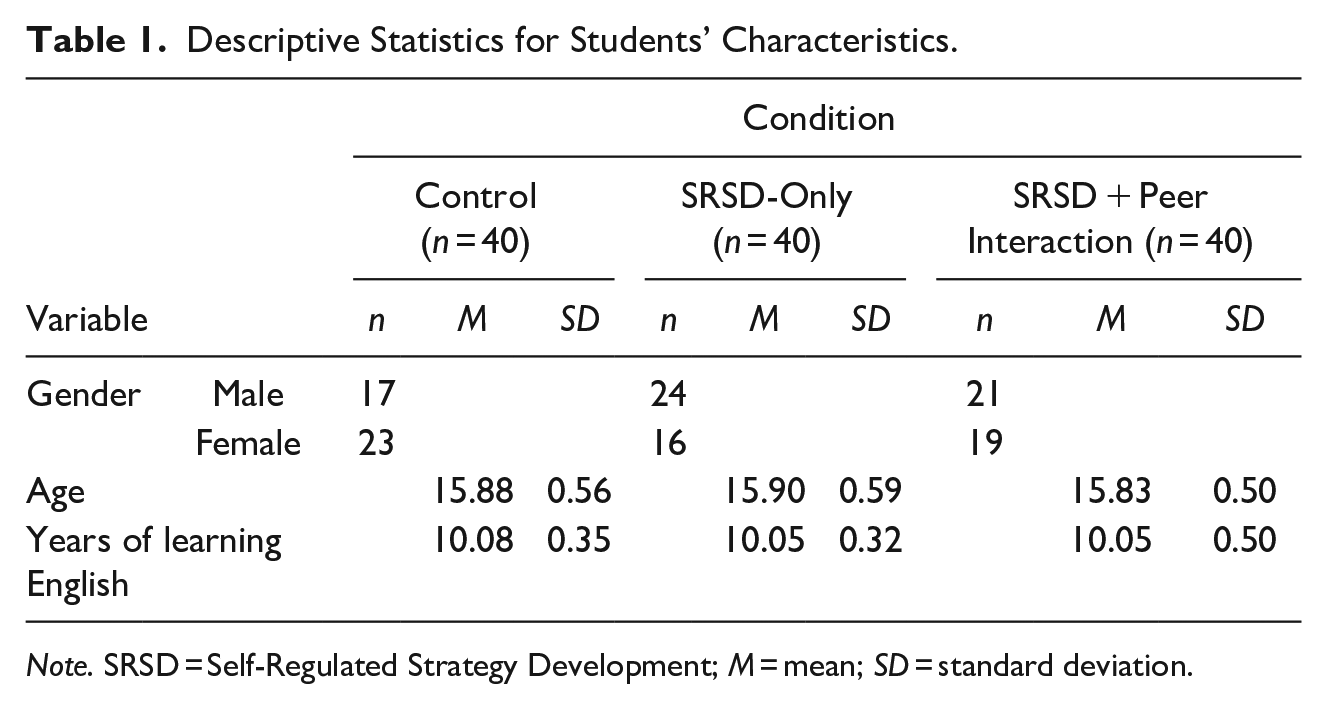
Note. SRSD = Self-Regulated Strategy Development; M = mean; SD = standard deviation.
Three 11th-grade English teachers currently working in the school were recruited to serve as instructors of persuasive writing for the study. Originally from China, they averaged 29 years old and held master’s degrees in teaching English as a second/foreign language from universities in the Anglosphere. They had an average of five years of experience teaching English (reading, writing, speaking, and listening) to Chinese high school students at the time of the data collection. The instructors were then randomly assigned to teach one of the three conditions in the study.
Measures
Pre- and posttest writing prompts
To align the writing prompts (Appendix A) with the educational context of Chinese high school students, a comprehensive exploration of online databases and literature related to the persuasive prompts was undertaken. Contentious topics, defined as themes that provoke debate by involving divergent views or opinions concerning the students’ social and educational contexts, were identified. Instructors compiled a list of such topics and disseminated it to students across all three experimental conditions before the pretest. Then, the students collectively ranked the prompts that most stimulated their curiosity and for which they had adequate background knowledge. The theme that garnered the highest ranking was designated as the writing prompt for the pretest and the second highest ranked one was selected for the posttest.
Analytical Writing Rubric for Persuasive Essays
The analytical writing rubric used in the present study 1 (Appendix B) for the persuasive essay comprises six key writing dimensions: Thesis and Purpose, Reasons and Support, Organization and Sequencing, Attention to Audience, Language Resources, and Grammar and Mechanics. The rubric provides a definition for each dimension, along with questions for evaluators to consider when scoring the element, and a scoring guide on a 7-point scale.
The analytical writing rubric was implemented in three ways. First, printed on A4 size paper, it was distributed to every student across all three conditions at the initial classroom instruction to help students understand the dimensions of persuasive writing. Then, the instructors used the analytical writing rubric as a tool in the two treatment conditions for students to assess a model persuasive essay, their own essay, and their peers’ essays. Subsequently, researchers (i.e., the author and two research assistants 2 ) applied the analytical writing rubric to assess the quality of students’ writing and text revisions.
Procedures
The students in the three conditions completed one writing task (pretest) prior to receiving any writing instructions. The pretest (Appendix A) consisted of composing an essay of at least 100 words within 40 minutes using a black pen and a piece of A4-size paper without access to any spelling, grammar, or word-processing aids. Students were told to not conceal any revision marks during the writing task. The completed scripts were then collected by their instructors. During the class following the pretest, the essays were returned to the students, and they were provided with an additional opportunity to revise the essays, using a red pen. Students were advised to strike through any words, phrases, or sentences they wished to remove during the writing process instead of erasing them. One additional A4-size paper was supplied to each student to allow for additional text to be added. The instructors of all three conditions did not provide either written or oral feedback on the students’ writing during the text revision process. Students then submitted their original and revised drafts (Pre.R1) to the instructors.
The students in the two treatment conditions then received SRSD revision instruction for 5 weeks, consisting of two 40-minute lessons a week. The students in the control condition received conventional persuasive writing instruction for 10 lessons over 5 weeks as mandated by the high school, without the SRSD instruction or peer interaction. After 5 weeks of persuasive writing instruction, 3 students in all three conditions completed a posttest writing task on a topic requiring persuasion (Appendix A) and a posttest revision task (Post.R1) with the same instructions as the pretest. Students’ original and revised drafts for the posttests were also collected by their instructors. For ethical reasons, the SRSD revision instruction materials (in the form of online video lectures) used by the two treatment conditions were made available to the students in the control condition after the data collection phase of the study.
The 10 lessons in all three conditions were primarily conducted by the instructors as lectures that addressed content knowledge pertinent to persuasive writing in English. These lectures incorporated discussion questions to enhance student engagement, and featured revision activities spanning six dimensions of persuasive writing. Additionally, two revision assignments (i.e., Pre.R2 and Pre.R3) helped students to refine their second drafts from the pretest. Table 2 outlines the instructional procedures for each condition.
Instructional Procedures for Three Conditions.
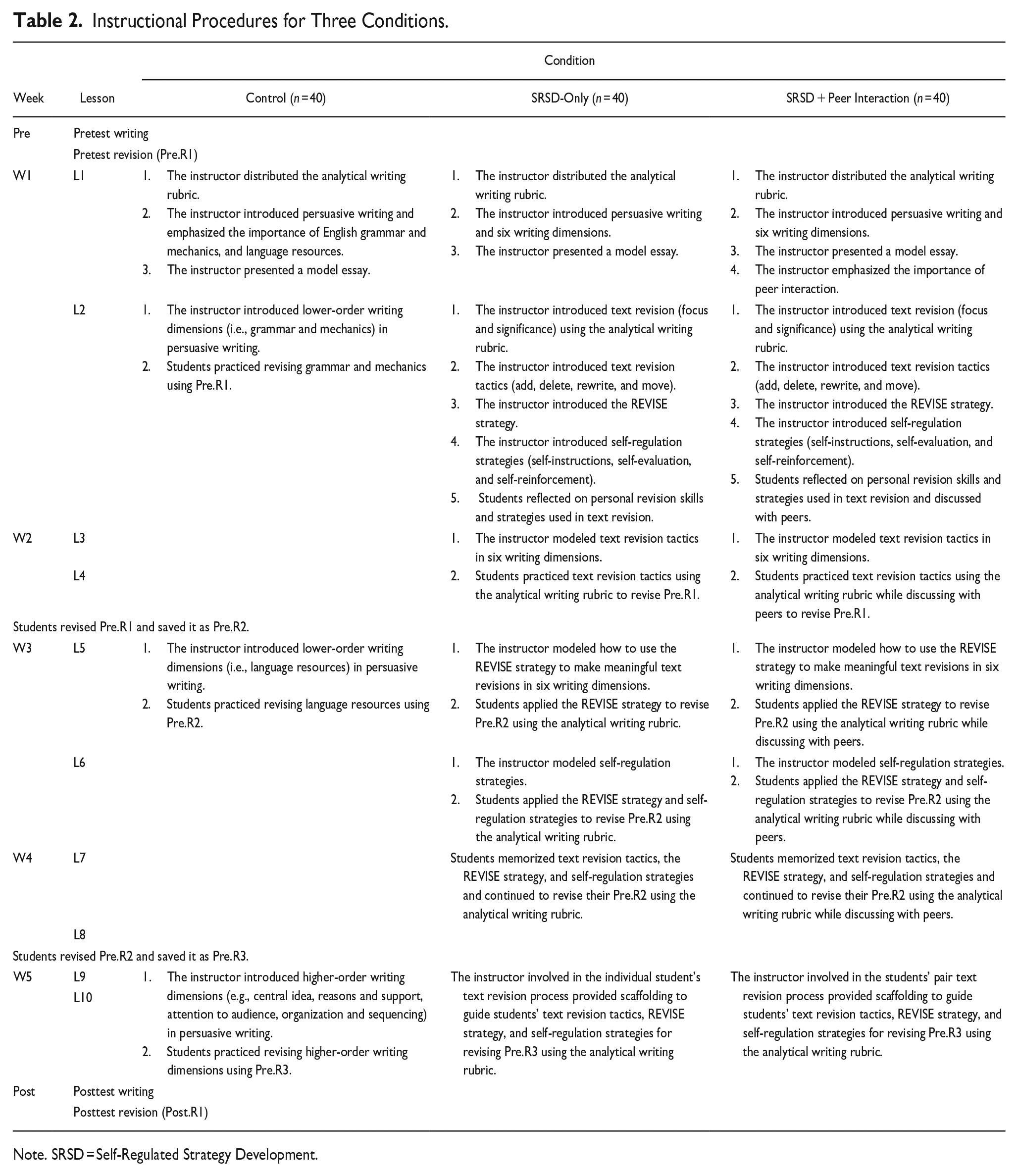
Note. SRSD = Self-Regulated Strategy Development.
SRSD revision instruction
The instructional design of SRSD revision protocol was predicated on the fundamental principles of the SRSD writing instruction (Harris et al., 2015), with adaptations tailored to the task of teaching text revision within the context of English persuasive writing to Chinese high school students. The SRSD revision instruction guided the creation of the instructional modules for both treatment conditions, which included the cultivation of background knowledge, discussion of strategies, modeling, memorization, support, and independent performance. The six recursive stages of the SRSD revision instruction 4 are shown in Figure 1.
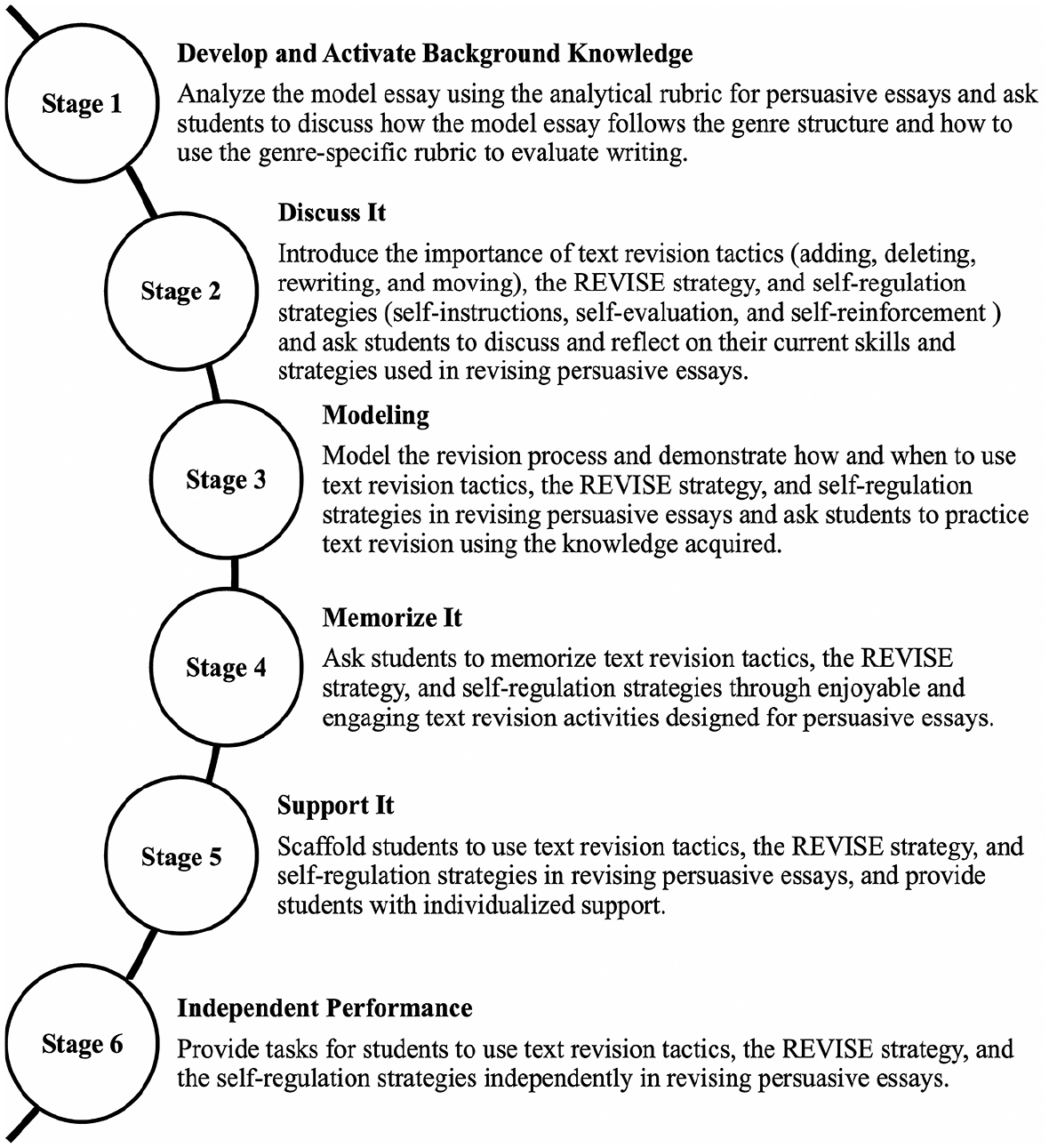
SRSD revision instruction.
In Stages 3 to 6 of the SRSD revision instruction, the REVISE strategy (Harris et al., 2008) was applied as follows: (1)
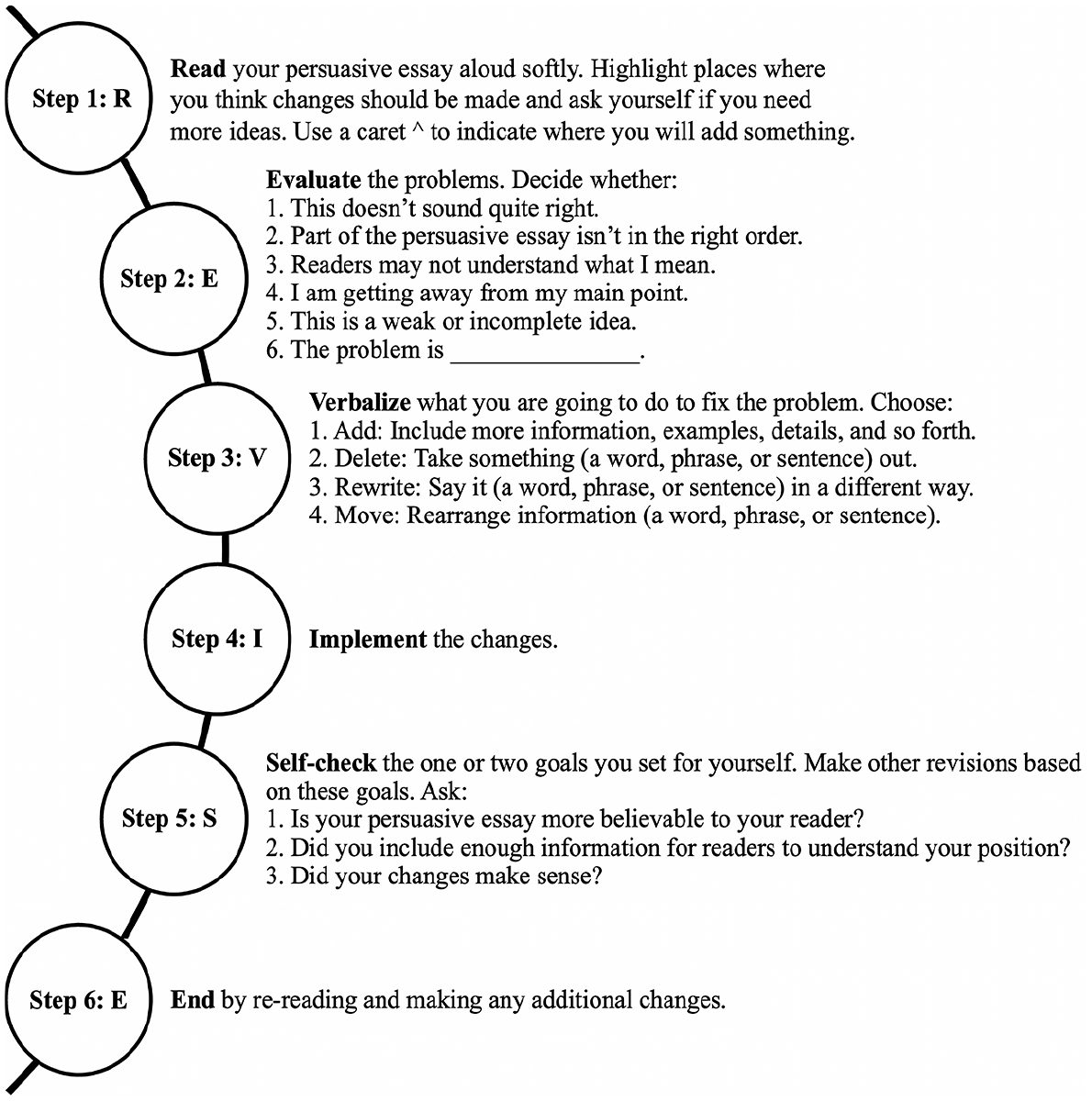
REVISE strategy instruction.
SRSD-only condition
The first and second 40-minute lessons began by activating students’ background knowledge of persuasive essay writing, including its text features and purposes; the instructor then analyzed a model essay in front of the students. The students were also taught about genre-focused dimensions using the analytical writing rubric for persuasive essays (Appendix B). These included the central idea, reasons and support, attention to audience, organization and sequencing, language resources, grammar and mechanics. The instructor presented the analytical writing rubric, discussed with students whether the model persuasive essay met these writing dimensions, and introduced text revision tactics (adding, deleting, rewriting, and moving), the REVISE strategy, and self-regulation strategies (self-instructions, self-evaluation, and self-reinforcement).
The third and fourth 40-minute lessons focused on understanding text revision tactics, while also highlighting the significance and goals of text revision in English persuasive writing. The instructor first explained to the students how to effectively revise their writing by emphasizing higher-order writing dimensions (i.e., meaning and substance) and by showing examples of text revisions that improve argumentation. Students were guided to evaluate the comprehensiveness and quality of writing elements, the persuasiveness of language and writing style, the effectiveness of content management, and other dimensions in line with the genre-focused writing rubric. The instructor modeled meaningful text revisions, such as increasing the number of argumentative elements, and encouraged students to reflect on their text revisions. The instructor also asked questions to help students scrutinize their current text revisions in the interest of promoting the development of self-regulation strategies. Students were required to practice text revision tactics using the analytical writing rubric to refine their second drafts from the pretest (Pre.R1) and save them as Pre.R2.
In the fifth and sixth 40-minute lessons, the instructor described the REVISE strategy and explained the steps to facilitate students’ understanding, evaluation, and revision of their essays. The instructor then told students to apply the REVISE strategy and text revision tactics, while using self-regulation strategies including self-instructions (e.g., I should revise the body of the essay to attract the readers.), self-evaluation (e.g., Is the second paragraph of the revised essay more coherent?), and self-reinforcement (e.g., I believe that the revised thesis statement is better than the original one.).
After students in the two treatment conditions acquired and memorized the text revision tactics, the REVISE strategy, and the self-regulation strategies through the instructor’s guidance and practices, the instructor continued to support the students’ use of these strategies in the remaining weeks (i.e., the seventh to tenth lessons). The students were encouraged to monitor their use of the tactics and strategies, to revise their Pre.R2 and save it as Pre.R3, to keep a record of their text revisions, and to modify their list of self-instructions wherever needed. The instructor also provided individualized support for several students who had difficulty with the tactics and strategies.
SRSD plus peer interaction condition
During the initial 40-minute session, students in the SRSD plus peer interaction condition received instruction on the same material covered in the SRSD-only condition, along with an introduction to the concept and advantages of peer interaction. Starting from the second 40-minute lesson, they were told that they would be working in pairs to assist each other in revising their persuasive essays. The SRSD plus peer interaction condition involved collaborative efforts in understanding dimensions within the analytical writing rubric, identifying the appropriate application of text revision tactics, utilizing the REVISE strategy, and employing self-regulation strategies to support each other in the text revision process. Students also engaged in discussions about their experiences in using the knowledge acquired during the text revision process.
Under the guidance of the instructor, pairs of students 6 worked together in subsequent lessons to practice text revision tactics (Lessons 3 and 4), the REVISE strategy (Lesson 5), and self-regulation strategies (Lesson 6). They were tasked with memorizing the acquired knowledge, discussing the benefits and challenges encountered while revising their persuasive essays (Lessons 7 and 8), and identifying situations where text revision tactics and self-regulation strategies could be applied, along with any necessary modifications, in collaboration with the same peer. Throughout each lesson, students provided reminders, suggestions, comments, and support to each other while revising the second draft from the pretest. They were encouraged to also follow their own advice when revising their pretest essays. Students maintained a record and reported instances in which they supported their peers while revising their pretest essays.
Control condition
The 40 students assigned to the control condition underwent a 10-lesson instruction using traditional error-focused English writing practice commonly employed in Chinese high schools. The instructor adopted a process-oriented approach in teaching fundamental persuasive writing skills in English, focusing on the importance and application of correct language mechanics (e.g., grammar, spelling, and punctuation), as well as the use of language resources (e.g., wording and sentence structure).
Over the 5 weeks of instruction, seven 40-minute lessons in the control condition addressed topics such as sentence structure, word usage, grammatical principles, and common errors found in student writing. Although explicit instruction on text revision tactics was not provided, students were still required to revise the second draft from the pretest in class, with a primary emphasis on enhancing grammar and language resources. Only in the 9th and 10th lessons did students receive guidance on understanding and revising higher-order dimensions in persuasive writing (e.g., central ideas, reasons and support, attention to audience, organization, and sequencing). Throughout the 10 lessons, all key dimensions of the analytical writing rubric were briefly introduced to students, and they completed two revision assignments focused on refining their pretest essays. However, students were not required to apply text revision tactics, the REVISE strategy, self-regulation strategies, or peer interaction; they also did not receive any detailed instructions or classroom-based practice on using the genre-focused analytical writing rubric when evaluating and revising their essays.
Fidelity of treatment implementation
The writing instructors teaching in the two treatment conditions underwent a rigorous series of four workshops before the start of their instruction. Each workshop consisted of a single 2-hour session held on consecutive Saturdays. In the first workshop, they were taught the theoretical underpinnings of self-regulation strategies and the SRSD instruction for enhancing writing and text revision skills. They were also provided with a detailed explanation of the concepts and processes of SRSD revision instruction, highlighting characteristics of flexibility, individualization, collaboration, and explicitness essential for its effective implementation. In the second workshop, the instructors were provided with all necessary materials, such as classroom writing activities, the analytical writing rubric, teaching slides, and lesson plans, to model the SRSD revision instruction and teaching processes. The mediating effect of writing instructors was underscored as the instructors were expected to help students activate their genre-focused background knowledge, and to assist their understanding and learning of new strategies for text revision and self-regulation. The instructor of the SRSD plus peer interaction condition was also taught to emphasize peer support and classroom peer instruction. During the third and fourth workshops, the instructors gave a presentation of one SRSD class to the author and two research assistants, while reflecting on their teaching of persuasive writing using the SRSD revision instruction. They also discussed their lesson plans, teaching procedures, classroom activities, potential difficulties and solutions, and their personal beliefs and understandings of the SRSD revision instruction. The two instructors prepared and reviewed upcoming lesson plans on a weekly basis and were supported by the author and two research assistants during their 5 weeks of teaching.
To ensure that all elements of the SRSD revision instruction were comprehensively practiced in each treatment condition, the instructors were equipped with a checklist providing step-by-step directions for each lesson. As instructors completed each step, they noted it with a check mark. Examination of these checklists at the end of the study revealed a high level of adherence, with instructors completing 95% and 94% of the steps in all lessons during the SRSD-only condition and the SRSD plus peer interaction condition respectively. Further, the author and two research assistants closely observed the teaching process, video-recorded all lessons in the two treatment conditions, and confirmed that the instructors executed the lesson plans with high fidelity, as evidenced by a 95% completion rate of the steps correctly across lesson plans by the two instructors. Lastly, using a 5-point Likert scale where 1 indicated low quality and 5 indicated high quality, the overall quality of the video-recorded lessons was assessed by an experienced practitioner-researcher in English writing, who held a doctoral degree in literacy education. This evaluation yielded high average quality ratings of 4.97 across video-recorded lessons for each condition.
Data Collection and Analysis
The students’ essays for the pre- and posttests were collected and assessed in two ways: (1) students’ writing performance as measured by text length and text quality as measured by a 7-point analytical writing rubric across six dimensions and (2) the quality and quantity of students’ text revisions as measured by syntactic complexity (word, phrase, and t-unit), and impact on meaning (surface-level/meaning-preserving and semantic-level/meaning-changing) as well as impact on the overall text quality of the persuasive essay.
Writing performance
Two measures, assessing the impact of the SRSD revision instruction and peer interaction on the students’ writing performance, were used for each writing task of the two tests. First, the text length was determined by calculating the mean of the word counts provided independently by the two research assistants who evaluated the 240 handwritten essays. The consistency of their word counts was evaluated using Cohen’s kappa for both the pretest (κ = .98) and the posttest (κ = .97). Second, the text quality was assessed by scoring the pre- and posttests using a double-blind review mechanism. The two research assistants used a 7-point analytical writing rubric (Appendix B) for persuasive writing to rate the text quality across six writing dimensions: Thesis and Purpose, Reasons and Support, Organization and Sequencing, Attention to Audience, Language Resources, and Grammar and Mechanics. They began by independently scoring 20 essays that were randomly selected from both the pre- and posttests without differentiation, on a single writing dimension. After completing the task, they compared their scores and discussed areas where they differed and resolved areas of disagreement; thereafter, they independently evaluated the remaining essays on the single dimension and calculated the mean of their ratings for each of the three conditions to determine the students’ text quality for that dimension. A similar procedure was applied to the remaining five writing dimensions. Interrater reliability was calculated using Cohen’s kappa for the pretest text quality: Thesis and Purpose (κ = .91), Reasons and Support (κ = .94), Organization and Sequencing (κ = .90), Attention to Audience (κ = .92), Language Resources (κ = .92), and Grammar and Mechanics (κ = .95). The posttest text quality Cohen’s kappa results were as follows: Thesis and Purpose (κ = .93), Reasons and Support (κ = .95), Organization and Sequencing (κ = .92), Attention to Audience (κ = .91), Language Resources (κ = .93), and Grammar and Mechanics (κ = .94).
Text revisions
Using a text revision taxonomy adapted from Faigley and Witte’s (1981) revision classification scheme and De La Paz and Sherman’s (2013) revision quality criteria (Figure 3), the two research assistants analyzed the quantity and quality of text revisions made by students in the pre- and posttests. Specifically, all text revisions were categorized by syntactic complexity (word, phrase, and t-unit), and impact on meaning (surface-level/meaning-preserving and semantic-level/meaning-changing). Revisions coded at the surface/semantic level were further classified as quality-improving, neutral, or quality-weakening according to their impact on the overall text quality of persuasive essays. To account for the variations in text length, the frequencies of text revisions were adjusted to obtain text revisions per 1,000 words following Faigley and Witte’s (1981) revision analysis.
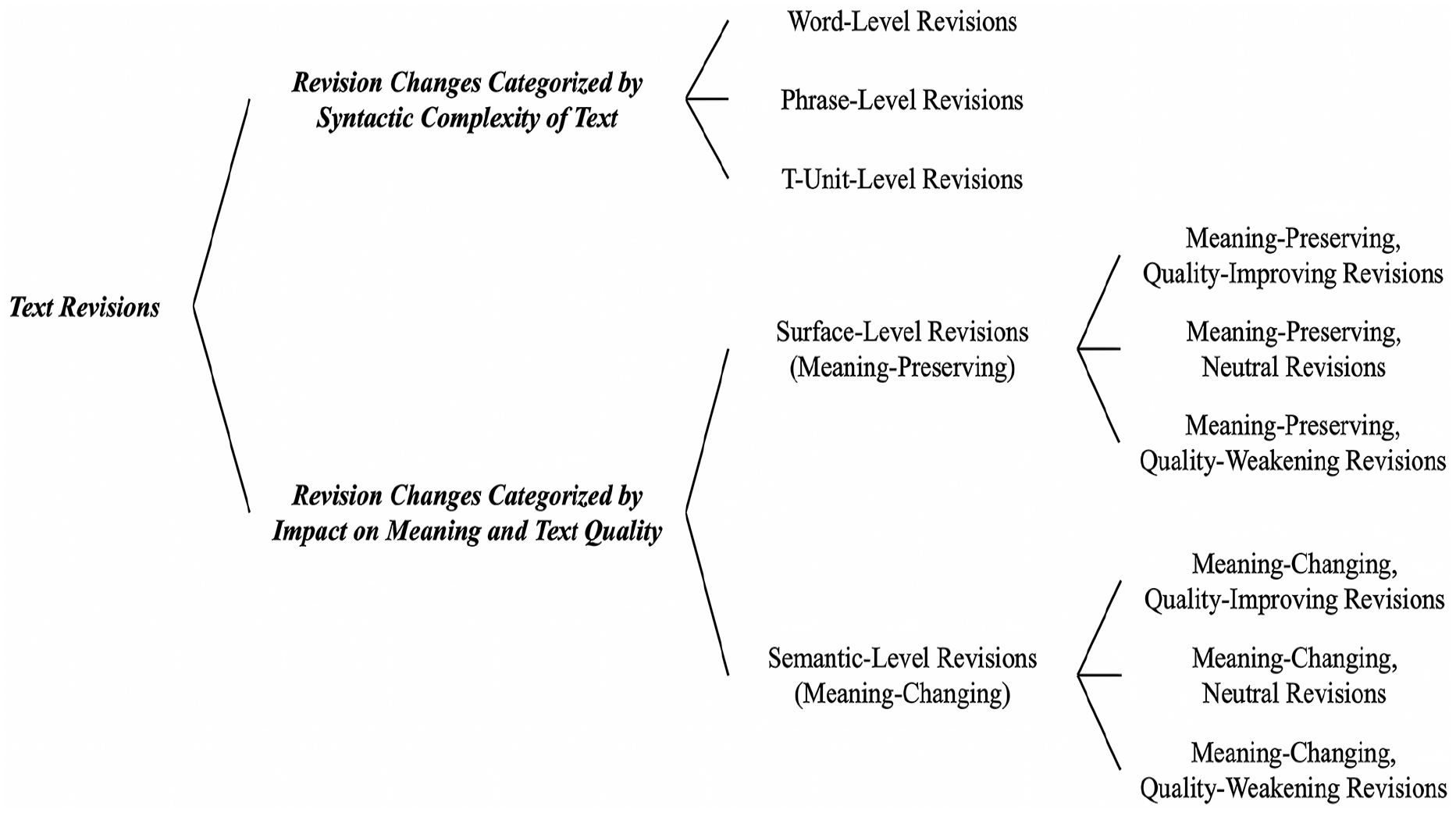
Taxonomy of students’ text revisions.
To ensure coding reliability, the two research assistants coded text revisions in 20 essays randomly selected from both the pre- and posttests. After completing the coding task, they compared their codes, discussed areas where they differed, and resolved areas of disagreement; thereafter, they independently coded the remaining revisions in the students’ essays and calculated the number of text revisions in each category. Interrater reliability was calculated using Cohen’s kappa for the pretest text revisions: word-level revisions (κ = .94), phase-level revisions (κ = .93), t-unit-level revisions (κ = .94), meaning-preserving quality-improving revisions (κ = .92), meaning-preserving neutral revisions (κ = .91), meaning-preserving quality-weakening revisions (κ = .92), meaning-changing quality-improving revisions (κ = .95), meaning-changing neutral revisions (κ = .90), and meaning-changing quality-weakening revisions (κ = .91). For the posttest text revisions, the levels were as follows: word-level revisions (κ = .93), phase-level revisions (κ = .92), t-unit-level revisions (κ = .93), meaning-preserving quality-improving revisions (κ = .92), meaning-preserving neutral revisions (κ = .91), meaning-preserving quality-weakening revisions (κ = .93), meaning-changing quality-improving revisions (κ = .94), meaning-changing neutral revisions (κ = .92), and meaning-changing quality-weakening revisions (κ = .94).
One-way analysis of covariance
IBM SPSS Statistics (version 29.0.1) was applied to analyze the quantitative data. Initially, the distribution of all variables was assessed to determine whether parametric procedures were appropriate. Specifically, the skewness and kurtosis values at less than an absolute value of 3.0 and 10.0, respectively, were considered indicative of no severe departures from normal distribution (Kline, 2005). To examine differences in posttest writing performance and text revisions between conditions and to enhance statistical power by minimizing error variance, a 1-way analysis of covariance (ANCOVA) was applied to compute the between-condition differences for text length, text quality, and text revisions. For example, considering students’ text quality on the Attention to Audience dimension in the pre- and posttest experimental design involving the three conditions (control, SRSD-only, and SRSD plus peer interaction), the independent variable was the three conditions, the dependent variable was students’ posttest scores on the Attention to Audience dimension, and the covariate was students’ pretest writing performance on the same dimension. Before performing a series of ANCOVAs, the homogeneity of the covariate regression coefficients (i.e., the slopes of the regression lines) across three different conditions was analyzed by testing the interaction between the three conditions and students’ text length, text quality, and text revisions in the pretests.
The effects observed between conditions were considered statistically significant at an alpha level of .05 and followed up with post hoc pairwise comparisons using Bonferroni corrections to adjust for multiple comparisons. Partial eta squared (η2 p ) served as the effect size measure in the context of three-condition comparisons conducted using ANCOVA. The interpretation of η2 p values followed Cohen’s (1992) guidelines, where values of .01, .06, and .14 denote small, medium, and large effect sizes, respectively. Post hoc pairwise comparisons using Bonferroni corrections were conducted to determine which pairs of conditions were different from each other. For statistically significant differences identified in these pairwise comparisons, Cohen’s d was manually computed to quantify effect sizes. Interpretation of Cohen’s d adhered to established benchmarks (Cohen, 1992), with values of .20, .50, and .80 indicative of small, medium, and large effect sizes respectively. Similar to the analysis of students’ text quality on the Attention to Audience dimension, a series of one-way ANCOVAs were computed for other writing dimensions, text length, and text revisions in the three conditions.
Results
This section presents the quantitative results for the students’ text length, text quality, and text revisions over time to examine the impact of the SRSD revision instruction and peer interaction. Descriptive statistics indicated that all variables maintained a normal distribution, evidenced by skewness and kurtosis values remaining below the absolute values of 1.49 and 2.01, respectively. The homogeneity of covariate regression coefficients was examined, and the results showed no significant statistical differences among the three conditions in terms of text length, text quality, and the text revisions students made in the pretests (all ps > .05).
Text Length
The descriptive statistics for students’ text length in the pre- and posttests (Table 3) revealed that students in all three conditions wrote an average of 110 words (SD = 12.83) in the pretest; however, following 5 weeks of persuasive writing instruction, the average text length for students in all three conditions significantly increased to 140 words (SD = 18.65). After controlling for the initial pretest text length, the one-way ANCOVA showed that there was a statistically significant between-condition difference in the posttest for the text length, with a large effect size: F(2, 116) = 13.97, p = .02, η2 p = .19.
Descriptive Statistics for Text Length.
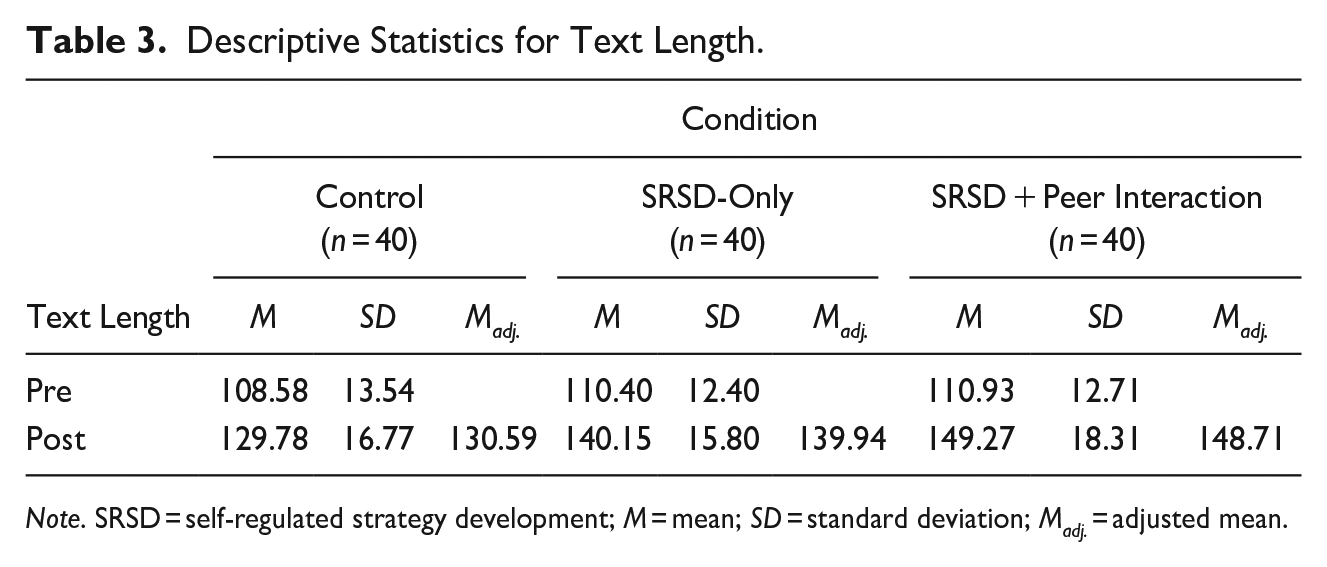
Note. SRSD = self-regulated strategy development; M = mean; SD = standard deviation; Madj. = adjusted mean.
Post hoc pairwise analyses with Bonferroni corrections indicated that students in the SRSD-only condition produced longer texts than those in the control condition in the posttest, with a medium effect size (p = .02, d = .57). The students in the SRSD plus peer interaction condition produced more words in the posttest than the students in the SRSD-only condition with a medium effect size (p = .03, d = .51) and students in the control condition with a large effect size (p < .001, d = 1.02).
Text Quality
The descriptive statistics for students’ writing scores across six writing dimensions in the pre- and posttests are shown in Table 4. After controlling for initial pretest writing scores, the one-way ANCOVA revealed statistically significant between-condition differences in the posttest, with large effect sizes, for higher-order writing dimensions: Thesis and Purposes, F(2, 116) = 31.27, p < .001, η2 p = .35; Reasons and Support, F(2, 116) = 38.57, p < .001, η2 p = .40; Organization and Sequencing, F(2, 116) = 23.79, p < .001, η2 p = .29; and Attention to Audience, F(2, 116) = 50.70, p < .001, η2 p = .47). However, there were no statistically significant between-condition differences in the posttest regarding the other two lower-order writing dimensions: Grammar and Mechanics, F(2, 116) = 2.60, p = .08, η2 p = .04, and Language Resources, F(2, 116) = 2.39, p = .10, η2 p = .04.
Descriptive Statistics for Writing Quality.
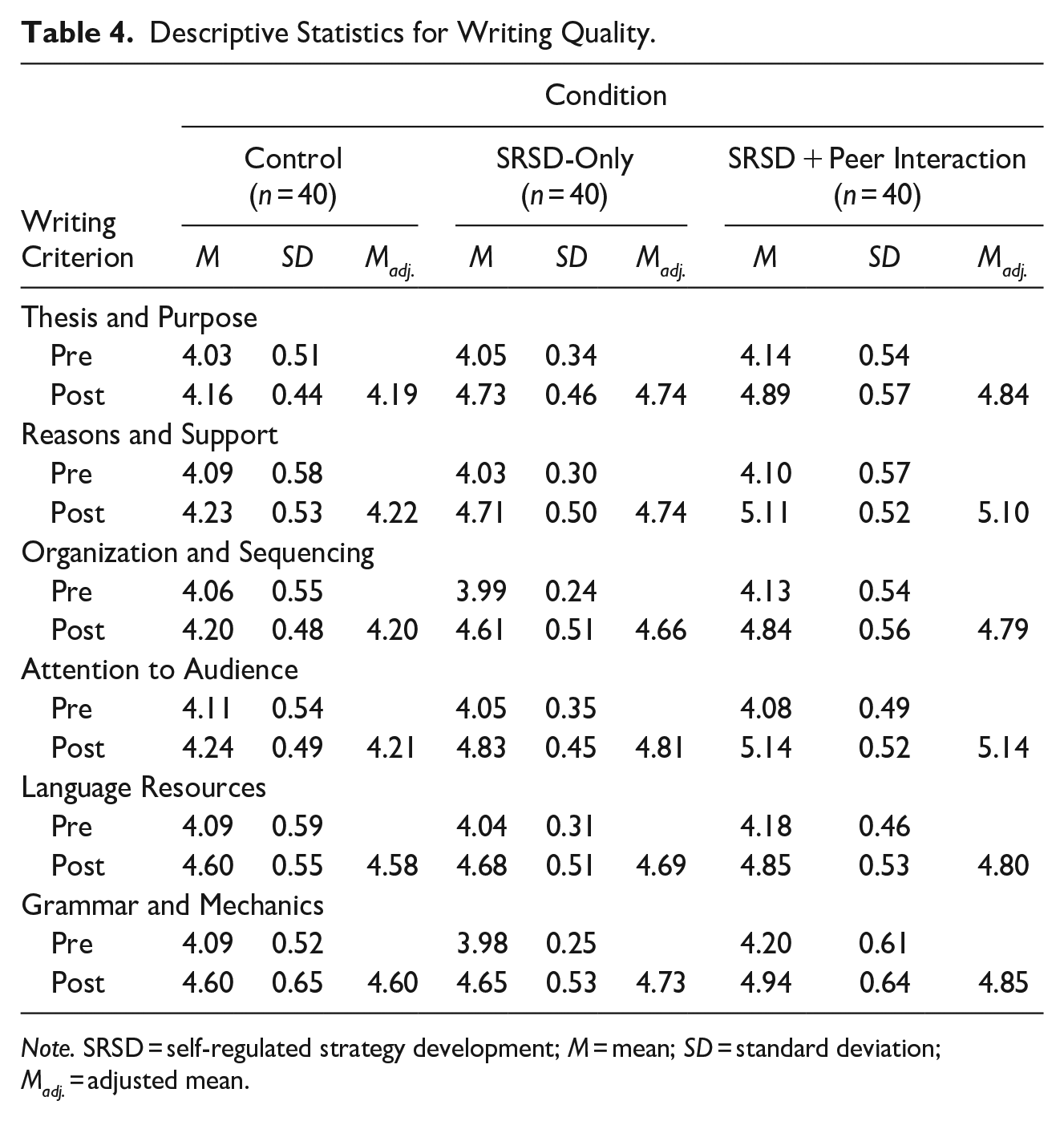
Note. SRSD = self-regulated strategy development; M = mean; SD = standard deviation; Madj. = adjusted mean.
Post hoc pairwise analyses with Bonferroni corrections indicated that the students in the SRSD-only condition performed better than those students in the control condition in the posttest with large effect sizes on four higher-order writing dimensions (all ps < .001): Thesis and Purposes (d = 1.21), Reasons and Support (d = 1.00), Organization and Sequencing (d = .92), and Attention to Audience (d = 1.26). Similarly, students in the SRSD plus peer interaction condition performed better than those in the control condition in the posttest with large effect sizes on the four higher-order writing dimensions (all ps < .001): Thesis and Purposes (d = 1.26), Reasons and Support (d = 1.67), Organization and Sequencing (d = 1.12), and Attention to Audience (d = 1.82). The students in the SRSD plus peer interaction condition also scored higher than those in the SRSD-only condition with medium effect sizes regarding the quality of two higher-order writing dimensions: Reasons and Support (p = .002, d = .70) and Attention to Audience (p = .005, d = .67).
Text Revisions
The descriptive statistics for students’ text revisions per 1,000 words categorized by syntactic complexity, impact on meaning, and text quality in the pre- and posttests are presented in Table 5. After controlling for initial pretest text revision quantity, the one-way ANCOVA showed that there was a statistically significant between-condition difference in the posttest for the t-unit-level text revisions with a large effect size, F(2, 116) = 70.51, p < .001, η2 p = .55. Similarly, statistically significant between-condition differences with large effect sizes were observed regarding quality-improving text revisions, F(2, 116) = 53.42, p < .001, η2 p = .48, and neutral meaning-changing text revisions, F(2, 116) = 35.14, p < .001, η2 p = .38. No statistically significant between-condition difference was detected for all three conditions in the posttest on word-level text revisions, F(2, 116) = .42, p = .66, η2 p = .01, and phrase-level text revisions, F(2, 116) = .63, p = .54, η2 p = .01. Also, there was no statistically significant between-condition difference in the number of meaning-preserving—quality-improving, F(2, 116) = 0.39, p = .68, η2 p = .01; neutral, F(2, 116) = 0.86, p = .42, η2 p = .02; quality-weakening, F(2, 116) = 0.84, p = .44, η2 p = .01—and meaning-changing quality-weakening text revisions, F(2, 116) = 0.45, p = .64, η2 p = .01) among all three conditions in the posttest, which indicates that the three conditions developed text revisions similarly in these four aspects over time.
Descriptive Statistics for Text Revisions.
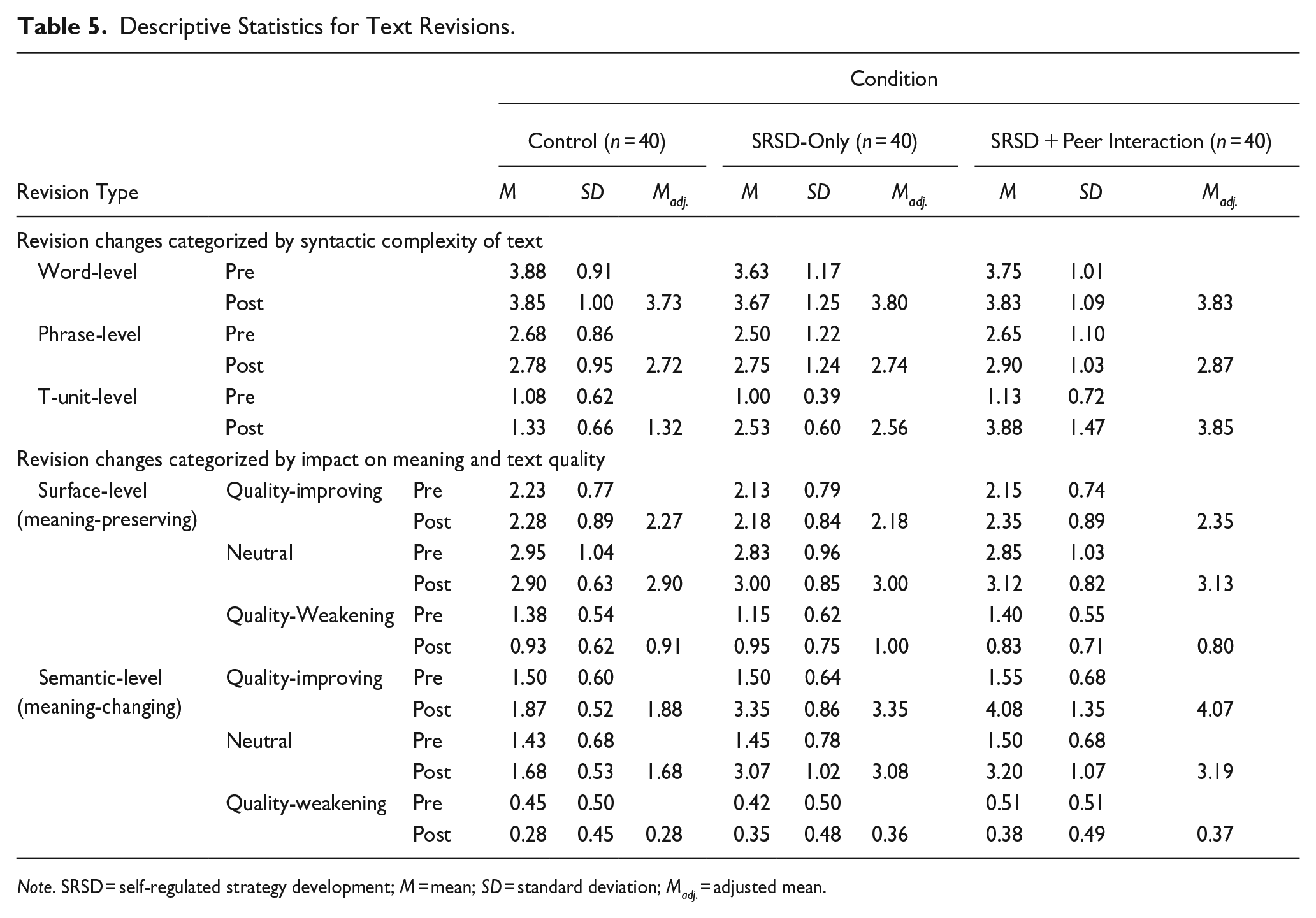
Note. SRSD = self-regulated strategy development; M = mean; SD = standard deviation; Madj. = adjusted mean.
The results of the post hoc pairwise analyses with Bonferroni corrections suggested that students in both the SRSD-only condition (p < .001, d = 1.94) and the SRSD plus peer interaction condition (p < .001, d = 2.19) outperformed those in the control condition in the number of t-unit-level text revisions in the posttest with large effect sizes. The SRSD plus peer interaction condition created more t-unit-level text revisions than the SRSD-only condition, with a large effect size (p < .001, d = 1.13). When comparing the text revisions for the three conditions in the posttest regarding the impact on meaning, students in the SRSD-only condition generated more meaning-changing quality-improving text revisions (p < .001, d = 2.04) and meaning-changing neutral text revisions (p < .001, d = 1.70) than those in the control condition with large effect sizes. The students in the SRSD plus peer interaction condition produced more meaning-changing quality-improving text revisions than those in the SRSD-only (p = .004, d = .63) and the control condition (p < .001, d = 2.11), and they had more meaning-changing neutral text revisions than the students in the control condition (p < .001, d = 1.77), with large effect sizes.
Discussion
Supporting the initial hypothesis, the overall results suggest that both SRSD revision instruction and its integration with peer interaction had a positive impact on students’ writing performance and text revisions. This impact included the generation of longer texts with more robust higher-order supporting evidence, the creation of persuasive essays tailored to the audience, and the facilitation of more quality-improving and meaning-changing revisions compared to students in the control condition.
Effects of SRSD With and Without Peer Interaction on Students’ Writing Performance
Analysis of pre- and posttest text length revealed that both treatment conditions resulted in longer academic persuasive essay texts than the control condition in the posttest writing task. Notably, the SRSD plus peer interaction condition produced longer texts than the SRSD-only condition, consistent with findings from previous SRSD studies conducted at the elementary (MacArthur et al., 2015) and college levels (Chen et al., 2022; De La Paz & Sherman, 2013). These results indicate that SRSD instruction using the REVISE strategy and peer interaction augmented by SRSD revision instruction can increase L2 high school students’ text length when writing persuasive essays.
Regarding text quality across six persuasive writing dimensions, the results revealed that both treatment conditions improved students’ scores for Reasons and Support more than those in the control condition, with the SRSD plus peer interaction condition outperforming the SRSD-only condition. This finding indicates that the treatment helped the students revise the content of their writing and add more reasonable evidence to support their arguments. The findings, in line with previous SRSD studies (e.g., Chen et al., 2022; Harris & Graham, 2018; Song & Ferretti, 2013), provide experimental evidence supporting the positive impact of the REVISE strategy augmented by the SRSD revision instruction on the ability to argue and the effect of peer support in content development (Harris et al., 2006). The intervention may have been effective because the first stage of the SRSD revision instruction focused on developing students’ background knowledge through reading and discussing examples of persuasive texts (Harris & Graham, 2018; Harris et al., 2015), while following the core principles of SRSD that include an analysis of arguments, argumentative elements, and good persuasive essays (Harris et al., 2006; Song & Ferretti, 2013). Students in both SRSD conditions were taught the text features, as well as the purpose of persuasive writing, by reading and understanding the six dimensions in the analytical writing rubric. More importantly, students in the SRSD plus peer interaction condition had enough time to share their knowledge of persuasive writing and to discuss how to write and revise persuasive essays with good supporting details. Moreover, they did not progress into the next stage until they had fully understood the topic content. In this sense, students who received SRSD revision instruction and participated in peer interaction were able to familiarize themselves with the features of persuasive essay writing including the core argumentative elements because of the dimension-based and genre-focused instruction in the exemplar persuasive texts. In contrast, students in the control condition, who were not exposed to the practice of using an analytical writing rubric that explained various writing dimensions for revising and evaluating their essays, showed comparatively less improvement in their writing, specifically in the Reasons and Support aspect.
Similarly, the results of between-condition comparisons in the posttest showed the positive effects of SRSD revision instruction and peer interaction in improving another important dimension of persuasive writing: Attention to Audience. All three conditions were equivalent at the outset regarding audience awareness. After the SRSD revision instruction, however, students in both treatment conditions included more audience-oriented features than those in the control condition. This result suggests that the students who received the SRSD revision instruction developed a keener sense of academic audience awareness and produced more reader-oriented texts than students who received traditional grammar-and-language-focused instruction. This finding is consistent with previous studies (Chen et al., 2022; Lee, 2017; Song & Ferretti, 2013) showing that the introduction and inclusion of an analytical writing rubric for persuasive essays in strategy-based text revision instruction enhances students’ sensitivity to the readers’ perspectives. Specifically, students who were taught to use argumentative schemes in the SRSD writing instruction included more counterarguments, alternative standpoints, and rebuttals in their essays after instruction, indicating a higher level of reader awareness (Song & Ferretti, 2013). Counterarguments are important in persuasive writing because they anticipate a potentially unsympathetic audience.
The findings also support previous empirical studies (Boscolo & Ascorti, 2004; Chen et al., 2022) showing that strategy-based instruction improves students’ writing when they use analytical writing rubrics to increase their sensitivity to the readers’ perspective. Similar to other studies demonstrating the effectiveness of using analytical writing rubrics to improve writing and encourage audience awareness at the elementary school level (Boscolo & Ascorti, 2004), middle school level (Stoddard & MacArthur, 1993), and college level (Chen et al., 2022), this study yielded similar findings at the high school level. Students in the SRSD plus peer interaction condition who were learning in pairs had better progress than those in the SRSD-only condition, indicating that peer interaction plays a facilitating role in students’ production of reader-oriented writing (Chen et al., 2022; Harris et al., 2006; Lee, 2017; Li & Hebert, 2024).
Regarding other higher-order writing dimensions, the results show that students in the two treatment conditions outscored the students in the control condition concerning the dimensions of Thesis and Purpose, and Organization and Sequencing, suggesting that SRSD had positive effects on the students’ revision of higher-order writing dimensions. Although the students in the two treatment conditions had noticeable posttest gains, and the students in the SRSD plus peer interaction achieved higher mean scores on these two writing dimensions than those in the SRSD-only condition, the posttest score differences between students in the two treatment conditions were not statistically significant. This finding supports previous SRSD research on developing the structure and central argument of an essay, that is, the Thesis (Berry & Mason, 2012; Chen et al., 2022; MacArthur & Lembo, 2009). Specifically, the students in the two treatment conditions experienced statistically significant improvement in their text-structure scores, indicating that the SRSD revision instruction had a positive effect on organizing the structural elements of the students’ persuasive writing, such as the introduction, body (position, reasons, evidence, etc.), and conclusion (MacArthur & Lembo, 2009). This finding also dovetails with studies conducted by Berry and Mason (2012) and Chen et al. (2022), who demonstrated that SRSD revision instruction conditions were more effective than conventional instruction in enhancing undergraduate L2 students’ text revision quality regarding organization, structural components, and idea generation. Building on the positive findings of experimental SRSD studies, the present findings further demonstrate the usefulness of SRSD revision instruction in helping L2 high school students revise and organize their English persuasive writing.
Regarding the two lower-order writing dimensions—Grammar and Mechanics, and Language Resources—students in all three conditions improved their writing scores in the posttest with no statistically significant between-condition differences, which may indicate that applying the SRSD revision instruction and peer interaction had no advantage over traditional grammar-and-language-focused writing instruction (Lee, 2017; Tsui & Ng, 2000). Other SRSD studies have also failed to find any advantage of strategy-based instruction in teaching language resources such as wording and sentence structure or making revisions on mechanics-related lower-order writing dimensions (Chen et al., 2022; Harris et al., 2008; Li & Zhang, 2021; MacArthur et al., 2015). Students in the two treatment conditions were taught to revise lower-order writing dimensions during the final step of the SRSD revision instruction (i.e., independent revision process) without receiving any additional text revision instruction on mechanics and language resources, except for basic knowledge about lower-order writing dimensions provided in the analytical writing rubric used by students for text revision or editing practice.
Effects of SRSD With and Without Peer Interaction on Students’ Text Revisions
Based on the analyses of the students’ text revisions in the posttest, both SRSD conditions improved students’ syntactic complexity (word, phrase, and t-unit), impact on meaning (meaning-preserving and meaning-changing), and text quality (quality-improving, neutral, and quality-weakening). Students in both treatment conditions produced statistically significant meaning-changing, quality-improving, and longer text revisions in the posttest, while students in the control condition exhibited no statistically significant improvements in these aspects. The results demonstrate that teaching English writing using a genre-focused analytical rubric within SRSD revision instruction (while involving peer discussion about text revision tactics and the REVISE strategy) is effective in helping L2 high school students generate more quality-improving, meaning-changing revisions.
Regarding the syntactic complexity of text revisions, statistically significant between-condition differences of t-unit-level revisions were detected in the posttest. This finding underscores the positive impact of SRSD revision instruction for facilitating improvements in longer text segments, as supported by prior research (Chen et al., 2022; De La Paz & Sherman, 2013). The SRSD revision instruction motivated students to engage in text revisions, resulting in longer text segments in their persuasive essays. This aligns with De La Paz and Sherman (2013), who claimed that SRSD instruction can lead to increased text revisions and enriched content. Interestingly, involving peer discussions about text revision tactics, the REVISE strategy, and self-regulation strategies can help students produce revisions that involve extensive segments of text within their persuasive essays.
Regarding students’ text revisions categorized by their impact on meaning and quality, the findings support previous SRSD studies (Chen et al., 2022; De La Paz & Sherman 2013; Graham, Harris, & Santangelo, 2015; Harris et al., 2006; Song & Ferretti, 2013). Students in the treatment conditions produced meaning-changing text revisions, especially text revisions involving argumentative elements, while students in the control condition did not progress in this area. This finding indicates that L2 high school students’ text revision quality and quantity may be improved through strategy-based text revision instruction. Comparing the two treatment conditions, students in the SRSD plus peer interaction condition produced more meaning-changing and quality-improving text revisions in the posttest than those in the SRSD-only condition, which suggests that peer interaction is an additional effective dimension for developing students’ high-quality, meaning-focused text revisions.
Limitations and Future Research
The present study contains several limitations that may affect the claims regarding the effects of the two SRSD treatments on L2 students’ persuasive writing and text revisions. Although the instructors had similar educational backgrounds and teaching experience and were randomly assigned to three conditions, varying instructor effects may have occurred. Furthermore, the small sample from only one public high school in northern China limits the generalizability of the findings to larger or different populations.
These limitations highlight the need for further investigations in various learning contexts to better understand how to integrate strategy-based and peer-mediated text revision instruction into the teaching of writing. More studies are needed to discover the effectiveness of SRSD revision instruction on high school students in various L2 writing contexts. Previous studies have demonstrated the powerful impact that SRSD instruction (e.g., Graham, Harris, & Santangelo’s meta-analysis, 2015) and peer interaction (e.g., Graham, Hebert, & Harris’s meta-analysis, 2015) have on the writing skills of students for whom English is a first language, as well as on struggling writers with specific learning disabilities (e.g., Berry & Mason, 2012; Graham & Perin, 2007; Graham et al., 2013; Harris et al., 2006); however, L2 studies have mainly focused on elementary school (e.g., De La Paz & Sherman, 2013; Teng, 2020) and college level (e.g., Chen et al., 2022; Li & Hebert, 2024; Li & Zhang, 2021) text revision instruction. Thus, studies on such instruction at the middle and high school levels are needed. Future investigations should replicate, or extend, the scope of the study with a larger sample size or explore its effectiveness for teaching other strategies such as task planning and drafting with L2 high school students. Writing teachers’ professional development also plays an important role in the effectiveness of instructional interventions as noted in studies showing successful outcomes on student learning (D. Butler et al., 2004; Chen et al., 2022; Graham & Perin, 2007; Timperley et al., 2009). Accordingly, future investigations should also examine how much professional development for SRSD revision instruction is needed. Finally, studies have shown that instruction using writing rubrics, such as genre-focused analytical writing rubrics or generic rubrics, can improve students’ text revision quality and quantity (J. A. Butler & Britt, 2011; Chen et al., 2022; De La Paz & Sherman, 2013; Graham, Hebert, & Harris, 2015). L2 writing researchers should, therefore, explore the impact of using different types of writing rubrics embedded in SRSD revision instruction, both with and without peer support, to provide a more nuanced understanding of how to effectively apply SRSD to help students understand genre-focused writing knowledge and use the writing rubrics for self-evaluation and writing skills development.
Implications for Educational Practice
High school students in L2 contexts need to be made aware that producing a high-quality written composition in English entails a process of writing and rewriting. This process highlights the importance of text revision. The present study’s findings bear significant pedagogical implications for L2 high school writing teachers in China and beyond. By implementing SRSD revision instruction with peer interaction using a genre-focused analytical writing rubric, the SRSD treatment effectively enhanced the revision process of the students’ persuasive essays leading to a better final product. This approach, which breaks down the text revision process into specific steps using the REVISE strategy coupled with SRSD revision instruction and peer interaction, not only provides procedural but also crucial social support. As a result, a statistically significant increase in both the quantity and quality of students’ revisions was observed over time, leading to improvements in higher-order writing dimensions such as thesis development, content, organization, and audience awareness. Considering these outcomes, writing teachers in diverse educational contexts should consider the application, assessment, and fine-tuning of the REVISE strategy integrated with SRSD revision instruction and peer interaction.
However, it is essential to acknowledge the difficulty of introducing new teaching strategies such as the ones performed in this study, particularly given entrenched pedagogical norms in China and other L2 contexts. Successful integration may require adjustments in L2 English teachers’ methods, classroom resource allocation, and professional development. Nevertheless, the potential benefits of SRSD, as shown by the results of this study, present an encouraging avenue for further exploration and adaptation. Educational practitioners and policymakers are encouraged to collaborate and seek innovative ways to effectively incorporate SRSD into the high school English language curriculum.
Footnotes
Appendices
Acknowledgements
The author thanks the coeditors of Written Communication, Drs. Dylan Dryer and Mya Poe, for their invaluable suggestions and guidance, which greatly facilitated the revisions. The author is also grateful to the two anonymous reviewers, Drs. Paul Stapleton, Ling Shi, and Michael Hebert, for their constructive and incisive feedback on the initial drafts of the article. Special thanks are extended to the participating teachers and students, to Dr. Yao-Wu Zhang for his helpful assistance with data analysis, and to Dr. Deborah Butler for her insightful input on self-regulated learning and writing development.
Data Availability
The data that support the findings presented in the article are not publicly available due to the inclusion of minors’ data and compliance with data protection regulations. However, an anonymized data set is available upon reasonable request, exclusively for scientific purposes, from the author until April 2025.
Declaration of Conflicting Interests
The author declared no potential conflicts of interest with respect to the research, authorship, and/or publication of this article.
Funding
The author disclosed receipt of the following financial support for the research, authorship, and/or publication of this article: The preparation of this study was supported in part by the LLED Research Grant (H21-00163) from the University of British Columbia, Canada, an institution with which the author was previously affiliated. Views and opinions expressed in the article are those of the author and do not necessarily reflect the positions or policies of the funding agency, and no official endorsement by it should be inferred.
