



Abstract
With the Trump administration, we witnessed a hardening of border security policy and practices. Trump used his leadership and celebrity to explicitly attack and criminalize “undocumented” migrants with a discourse of threat, danger, invasion, crisis. Policywise, he took steps to further securitize the borderlands. In this paper, we examine how public opinion has differed with regards to the support or opposition to these hard security policies, especially in borderland areas when compared to the overall national population. The aim of this paper is to examine this difference by directing our attention to the Rio Grande Valley (RGV), a borderlands region which does not appear to receive adequate attention when compared to the San Diego or El Paso border regions. Drawing upon a critical political sociology perspective, we analyze how the framing of “undocumented” or “unauthorized” migration as a threat affects public perception and opinion. However, using survey data collected in 2018, we provide suggestive evidence that despite these negative political frames which have been disseminated through the media, the population in the RGV (despite living day-to-day in a “border crisis”) appear to hold more liberal attitudes with regards to immigration and border policies when compared to the national population. This highlights how the narrative of “transboundary crises” is used to justify draconian policies and practices against migrants, despite the lack of a “crisis” on-the-ground.
Introduction
Border security and immigration policy hardened during the first Trump administration. The politically divisive and contentious relationship around immigration and borders has been present since the mid-1970s when the immigration narrative began to shift from a procedural, administrative labor issue to a national security issue (Nevins, 2010). Following the events of September 11, 2001 (9/11), and the restructuring of multiple agencies of the federal government into Department of Homeland Security (DHS), drug and immigration enforcement increasingly merged with new counter-terrorism efforts (Andreas, 2003; Garrett, 2010).
This political narrative set the stage for the heightened securitization that occurred along the borderlands in the early 2000s, especially with the passage of the Secure Fence Act in 2006. Renewed emphasis was placed on constructing a barrier as a political symbol of sovereignty, to show that the United States (U.S.) was securing its borders. In the process, the conflation between migrants and terrorists became increasingly accepted and justified by the government and public alike under this new reality (Angulo-Pasel, 2023). Therefore, when President Trump was elected in 2016, he already had at his disposal an infrastructure and border security narrative in place to advance his policy objectives. One main difference was that he would use his leadership and celebrity to explicitly and aggressively attack undocumented migrants. Trump’s discourse on the threat of “unauthorized” migrants and “invasion” and “crisis,” was shared through and relayed by media, influencing how the population conceptualized immigration and border security. Indeed, Trump would spend most of his presidential campaign speaking about the “problem” of “illegal” immigration, promising to fix the broken system and build a border wall. Once in office, he quickly introduced a battery of executive orders that would constitute the “Zero Tolerance” policies that began in 2017 but would not be formally introduced until 2018.
However, despite the vocal and political assault on the immigration system in the U.S. by the Trump administration, public opinion has not reacted to these hard-line security policies as a homogenous block. Among other factors, local conditions play a role in public opinion receptiveness. The aim of this article is to examine this difference by directing attention to the Rio Grande Valley (RGV) in the borderlands of South Texas. Specifically, this article seeks to analyze why the population in the RGV appears to hold more liberal attitudes with regards to immigration and border policies vis-à-vis the national population. Drawing from a critical, political sociological approach, we surmise that since the majority of the national population do not witness and experience the situation in the borderlands firsthand, it is unsurprising that they may believe the political framing of “undocumented” or “unauthorized” migration as a threat, regardless of the actual situation. Relying on vicarious information from the media and its coverage of Trump’s alarmist rhetoric may contrast with the lived experiences of residents of a borderland community. In this sense, we also contribute to the discussion of the relationship between public opinion on immigration and geographic location (Wallace et al., 2014).
Using survey data collected in 2018, our analysis found meaningful differences between the RGV and the national population in their perceptions of border and immigration policies. Overall, the RGV population holds more liberal attitudes on the issue than the rest of the U.S. population. This suggests an alternative influence of lived experiences on their views compared to the indirect experiences, images, and speeches prevalent among the general U.S. population.
This article consists of three main sections. The first section offers a background on the RGV community and the Trump administration’s “Zero Tolerance” policies to show differences between lived realities and national policies that criminalized migrant “others.” The following section presents a framework for understanding how migrants are othered and criminalized, which in turn helps to sustain “crisis” framing used to achieve a particular political agenda and desired policy outcomes. The last section provides the findings and discussion on the main differences between the public opinion of populations living in the RGV compared to the broader national population. This section highlights these differences through survey data and the role of the media in complementing and enhancing those differences.
Background Context: The RGV Borderlands Versus the Border Security “Threat”
This section provides background context about the RGV and the policies initiated by the “Zero Tolerance” initiative to highlight the differences between these two populations and how the border “crisis” and “migrant-as-threat” narratives are (re)produced. First, the RGV consists of Cameron, Hidalgo, Starr, and Willacy counties. Located along the U.S.-Mexico border in South Texas, these are Latinx-dominant counties with a sizable immigrant population and high, daily, cross-border mobility. As of 2021, of the approximately 1.4 million people residing in the RGV, 92% identify as Hispanic and 22% are foreign-born residents (compared to 13.5% nationwide; U.S. Census Bureau, n.d.). Moreover, according to the Migration Policy Institute (MPI), there were approximately 1.7 million “unauthorized” immigrants in Texas based on their 2019 data analysis; 36,000 and 100,000 “unauthorized” immigrants are estimated to live in Cameron and Hidalgo Counties respectively. 1 In terms of northbound movement, many “unauthorized” immigrants remain in the RGV due to internal immigration checkpoints, such as the Falfurrias checkpoint, located 70 miles north on a major highway which leads to other metropolitan areas of Texas. Nationwide, the U.S. Border Patrol has encountered 474,597 individuals at the border in 2018. Of these encounters, 38.9% occurred in the Rio Grande Valley sector. In 2019, the total was 807,483 encounters and the RGV represented 37.8% of the total. Press releases about the RGV in 2019 represented 8.9% of the national agency’s total number of press releases and 25.4% of its releases about Texas. Furthermore, 38% of the “unauthorized” immigrants in Cameron County (13,000) and 40% of the “unauthorized” immigrants in Hidalgo County (37,000) reside with at least one U.S.-citizen child under 18, forming mixed-status families. Likewise, another report suggests that approximately 75,000 children in the RGV live in mixed-status families (Human Impact Partners and La Lucha del Pueblo Entero, 2018). Therefore, many young people in the RGV intimately experience the contrast between legality and illegality and live under the threat of deportation of their loved ones.
In short, the RGV represents a “community in stress” due to the high potential threat of deportation as well as the excessive presence of Border Patrol and the state apparatus to implement immigration policies (Altema McNeely et al., 2022). Furthermore, although they live in the U.S.—in the “American dream”—the RGV is one of the most surveilled areas in the U.S. due to Customs and Border Protection (CBP) and Border Patrol, where the policing of mobility and the policing of the border coalesce into everyday forms of intimidation and harassment. Additionally, this area is unique in that the border “presumably separates Mexican poverty from the American dream,” but there are “social borders that separate those living in the borderlands” (Vega, 2019, pp. 104–105) especially as Hidalgo county is one of the poorest counties in the U.S.
Equally important in this context is the spatial fluidity of this borderlands region. The U.S.-Mexico border in the RGV experiences high daily trans-border mobility. For instance, in 2021, in the Brownsville, Hidalgo, and Rio Grande City ports of entry (POEs), 153,443 people entered through buses, 12,201,179 through personal vehicles, while another 7,743,552 entered on foot (The Bureau of Transportation Statistics Border Crossing Data). 2 Thus, unlike many regions in the U.S. interior, there are “deep economic, historical, and cultural connections” as well as “strong business partnerships and family ties spanning both sides of the border” (Human Impact Partners and La Lucha del Pueblo Entero, 2018, p. 6).
Akin to other borderland regions, these reports and data suggest a vibrant and close-knit community of people and families where both sides of the border line are one in culture, history, and experiences. The borderlands are fluid and socially complex spaces with a transnational border culture that has been divided by a territorial line, which is now ripe with human-made political differences based on fear of the “other.” However, Mexican heritage in the region pre-dates the border and it existed long before there was a U.S.-Mexico border (Vega, 2019). As Bejarano and Hernández-Sánchez (2023) aptly note, when discussing the Paso del Norte borderlands, if it were not for that border which makes people carry different passports, “we could have attended the same schools and shared the same friends.” This distinct borderland culture and solidarity may be witnessed when we refer to the relationship of sister cities such as McAllen and Reynosa or Brownsville and Matamoros with ceremonies and festivals that exist between them. Simultaneously, however, Reynosa and Matamoros are in the state of Tamaulipas, which for the past two decades has experienced an increase in violence due to organized crime, especially with former President Calderón’s “War on Organized Crime” (Correa-Cabrera, 2019). Theoretically, this security situation could lead RGV residents to be receptive to a hard security discourse. Yet, overall they appear to hold less restrictive attitudes on immigration.
On the other hand, with respect to the national discourse on border security and immigration, the year 2018 represented a harsh turn vis-à-vis undocumented immigration. Although these immigration policies began to be formulated in 2017 with former Attorney General Jeff Sessions (Kirk, 2019), policies under the broader rubric of the “Zero Tolerance” initiative would not be formally announced until April 2018. The so-called “Zero Tolerance” policies enacted by the first Trump administration would ostensibly detain, in federal criminal facilities, and criminally prosecute—without exception—any migrant who attempted to cross the U.S. border anywhere other than an official POE, regardless of whether or not he/she was an asylum seeker or was traveling with children (Refugee International, 2018). This policy of deterrence would systematically separate adults arriving at the border from any children who accompanied them without a meticulous process in place of associating children to parents (Kirk, 2019). Due to the criticism shown when this policy was implemented, the Trump administration stopped family separation and instead detained families together, which resulted in its own legal challenges (Gelernt, 2018). In all, the total reported number of separated children ranges from 5,300 to 5,500 (CRS, 2021). Beyond these most visible measures, 2018 also marked a rise in the propensity within the Trump administration to enact opaque agency-level guidelines that burdened migrant interaction with law enforcement and the legal system (Moynihan, 2022; Wadhia, 2019).
“Zero Tolerance” is important for several reasons. First, it underlined the extent to which the Trump administration was politically willing to go with respect to the hardline border security policies to stop unwelcome, “unauthorized” migrant others, a position that was already resonating with Trump’s base on the campaign trail. Although his administration eventually stopped this family separation policy, it was not until national and global outcry and political pressure. Second, the effects on the immigration system were long-lasting. Not only did this policy go against human rights norms, but it dismantled legal rules and procedures in the national immigration systems and caused a bureaucratic nightmare. The Department of Homeland Security (which was in charge of detaining parents) and the Department of Health and Human Services (HHS; which was responsible for the children) did not communicate effectively (Burnett, 2019), resulting in children being kept in the U.S. while parents were deported back to their home countries, and authorities being unable to reunite parents and children. Lastly, regardless of the validity of such claims, the political rhetoric used to justify these “Zero Tolerance” policies concentrated on the “crisis” at the border as well as the “bogus” asylum claimants who were using the system by bringing their children as a strategy. These enforcement methods appeared to be used to gauge how much cruelty the public would tolerate and accept when discussing supposed “criminals” and “murderous thugs” coming to “invade” the country. This narrative added to the “othering” and criminalization of migrants, and was shared through national media coverage.
Theoretical Framework
For this article, we use a critical analysis of migration and security to understand how certain migrants have been “othered” and represented as a “threat.” We are aware that migrants have been othered as feminized “victims”; for instance, through various state discourses surrounding human trafficking/smuggling (Andrijasevic, 2009; Zhang et al., 2018). Nonetheless, for the purposes of this article, we focus on an alternative framing where migrants coming into the U.S. have been primarily framed as a “threat” in this threat/victim false dichotomy. The migrant “threat” and the nexus of migration and security have a complex history. The connection between migration and security issues began to emerge as a nation-state concern post-Cold War when there were not only geopolitical shifts but changes in the nature of migration (Adamson, 2006; Huysmans & Squire, 2009). Intra-state conflicts and destabilizing socio-economic effects associated with post-colonialism and globalization produced a population of migrants, many of which were seeking asylum and were from the “Third World” or “developing” countries. Increasingly, this migrant population was portrayed negatively and would be framed as a challenge to internal security, the welfare state, and societal homogeneity (Huysmans, 2000).
In the U.S. context, “othering” is accompanied by the creation and maintenance of a “crisis” narrative. The securitization and criminalization of immigrants began in the 1960s, first with the Chicano civil rights movement, followed by immigrants taking U.S. jobs during the economic downturn of the 1970s, and finally, with President Nixon’s “War on Drugs,” which conflated immigrants to drug traffickers. Prior to this time period, immigration through the U.S. Southern border did not garner much political or national security attention, although xenophobia and racism were always present in the borderlands (Walia, 2021). During this time period, the perception of “crisis” began to emerge among government officials and the public claiming the U.S.-Mexico border was dangerous and out of control (Nevins, 2010). According to Mountz and Hiemstra (2014, p. 383), the discourse of “crisis” is repeatedly used by nation-states especially when “migrants attempt to cross between regions of great economic disparity,” to sow fear, which promotes the perception of insecurity. This narrative is used to (re)produce this perceived space (Lefebvre, 2013), a representation that is maintained, in part, due to its relationship with the media. This relationship between criminals and immigrants continues to this day and, since 9/11, has included the label of “terrorist” too.
Overall, the complex relationship between this type of migration and national security concerns is where we see the definitive line between “self-other” come to light. Certainly, the population coming from the nation-states of the Global South were not associated with the Western, Eurocentric vision of the self. Post-colonial/Decolonial theories (Lugones, 2010; Mignolo, 2012; Mohanty, 2003; Said, 1979; Spivak, 1988), have further helped us understand the racialized history of “othering.” We show how these “othering” discourses are used to frame the perception of migrants as national security threats to be controlled, managed, and deterred from reaching the Global North. “Othering” discourses thus become a useful tool in the management and control of irregular migrants, as scholars inform us that through the “Us versus Them” narrative, nation-state governments are able to objectify the “other” with the intention of creating difference and dividing “them from the rest of us.”
By examining post-colonial logics and histories, we can also observe how race is an element within the politics of “othering” and the migration-security relationship (Sampaio, 2015; Walia, 2021). This racialized element does not necessarily have to signify only biological differences of skin pigmentation, for example, but also cultural differences. Socio-cultural incompatibility among different people is advanced by earlier works like Huntington’s (1993) “Clash of Civilizations” and which Balibar and Wallerstein (1991) refer to as “racism without races.” Overall, the process of “othering” was a colonial project, where the goal was to create colonial difference and maintain power hierarchies through dichotomous relationships (i.e., superior/inferior; civilized/savage; dark-skinned/light-skinned). As Lugones (2010, p. 747) notes, “the process of colonization invented the colonized and attempted a full reduction of them to less than human primitives . . . in need of transformation.” Thus, it is unsurprising that this embedded narrative has been (re)produced nationally in security discourses associated with irregular migration where the very presence of immigrants (aka “foreigners”) is discussed as a challenge to the nation-state, whether it be a cultural, an economic, and therefore, an overall security threat due to their perceived differences.
Perceived and Lived Realities
For the purposes of our article, this process of “othering” has been used nationally. Lefebvre’s (2013) concepts of living space versus perceived space provide a valuable framework here where self-other dichotomies found in current immigrant tropes are shaping “a dominant way of seeing.” The perceived reality portrays the border as “a shadowy abyss . . . a significant social and cultural divide,” where the Border Patrol are always “under ambush” (Fojas, 2021, p. 2). As Fojas (2021) notes, the “Borderveillant media” help push this national discourse by (re)producing immigrants as dangerous people, typically enemies of this war, which in turn, shapes the perceptions of the border. In contrast, as discussed above, the population in the RGV lives in a different social space, a different geographic location and, embody a distinct positionality. It is different than what is portrayed nationally. Their everyday experiences are shaped by their lived realities, their historical and cultural connections, which in turn influence the way they think and act. It is this concept of difference, which runs through various social spaces, that transforms our understandings. In this sense, the spaces we occupy influence our embodied experiences. The lived reality on the ground in the RGV is not an episode of “Border Wars,” a region in constant crisis and invasion. Media framing can contribute to that perceptual disconnect by providing “internal structures of the mind” that we can adopt or resist to conceptualize an event (Iyengar & Kinder, 2010; Scheufele, 1999, p. 106).
Now, Couldry and Hepp (2018, p. 15) emphasize, “the degree of media’s interweaving in the social varies in different regions of the world.” At the time our surveys of interest were conducted, national media attention to immigration was particularly high (Papakyriakopoulos & Zuckerman, 2021) and ambivalent. On the one hand, the deployment of the National Guard and the continued arrival of immigrants at the border offered opportunities for a national security and crisis framing. The potential impact of security, crisis, and crime frames on public opinion are more likely to fuel anti-immigrant attitudes and support for restrictionist policies. Trump wielded the image of the “border in crisis and under invasion” as a means of alerting the public about a debilitating threat of “otherness” (Fleuriet & Castellano, 2020) and partially succeeded in moving public opinion in a more restrictive direction through the public discussion of key words such as “chain migration” or “sanctuary cities” (Alamillo et al., 2019). The echo that this representation found in media depictions and public opinion can be conducive to moral disengagement about the fate of the “other” (Antony, 2019). Alternatively, family separation provided an opening for a more humane depiction of the problems at the border and belongs to a list of frames that are underused in media depictions to attempt to shift public opinion in a more welcoming direction (Alamillo et al., 2019).
Given that a large part of the media landscape is segmented into partisan niches that favor perceptions of reality along partisan lines (Flynn et al., 2017; Iyengar & Massey, 2019; Levendusky, 2013) and that selective exposure to different realities is more common nowadays (Peterson et al., 2021; Taber & Lodge, 2006), national “perceived realities” must be described in the plural. All in all, these dynamics create a border imaginary that justifies a border industry of surveillance infrastructure against the migrant “other” (Fojas, 2021, p. 4). The media assists in the optical illusion of an “out of control border” along with the migrant invasion narrative for which enhanced enforcement is the only solution (Inda, 2006).
Data and Descriptive Analysis
To compare immigration and border attitudes between RGV residents and the national population, this study relies on various survey data. For the public opinion in the RGV, we use the 2018 RGV Our Voice/Nuestra Voz (RGV OVNV) Survey conducted in the spring of 2018 by the Center for Survey Research and Policy Analysis at the University of Texas Rio Grande Valley (Kim et al., 2020). This dataset has a sample of randomly selected RGV residents, aged 18 years or older, in three U.S.-Mexico border counties in South Texas: Cameron, Hidalgo, and Starr counties. The sample of respondents is 660. 3 For the national population’s opinions, we use multiple waves of the American National Election Studies (ANES, 2018), but primarily the 2018 Pilot Study (2018) and the 2018 Pew Political Survey (Pew Research Center, 2018).
Since immigration and border security re-emerged as major national issues during the 2016 presidential election and received unprecedented attention nationwide in the course of the first Trump administration, the perceived importance of such issues among the electorate significantly increased during this period. Graph 1 shows that according to a Gallup Poll, the percentage of U.S. adults who named immigration as the top problem remained about 7% to 8% on average before 2017. 4 However, it soared to 14% in 2018, peaked at 22% in July of that year, and sustained its saliency to approximately 19% on average in 2019. The increased level of recognizing immigration as a problem was accompanied by more criminalized views of immigrants. In the 2016 ANES and 2018 ANES Pilot Study, respondents were asked, “Does illegal immigration increase, decrease, or have no effect on the crime rate?” Responses were measured on a scale of 1 to 7, with 1 indicating “much increase” and 7 indicating “much decrease.” The numbers reported reflect those who answered 1 “Increase a lot,” 2 “Increase a moderate amount,” and 3 “Increase a little” combined to measure the level of criminalized views of immigrants. According to the ANES, 27.48% of U.S. adults thought that illegal immigrants increased the crime rate in 2016, but that percentage rose to 53.86% in 2018 (Figure 1).
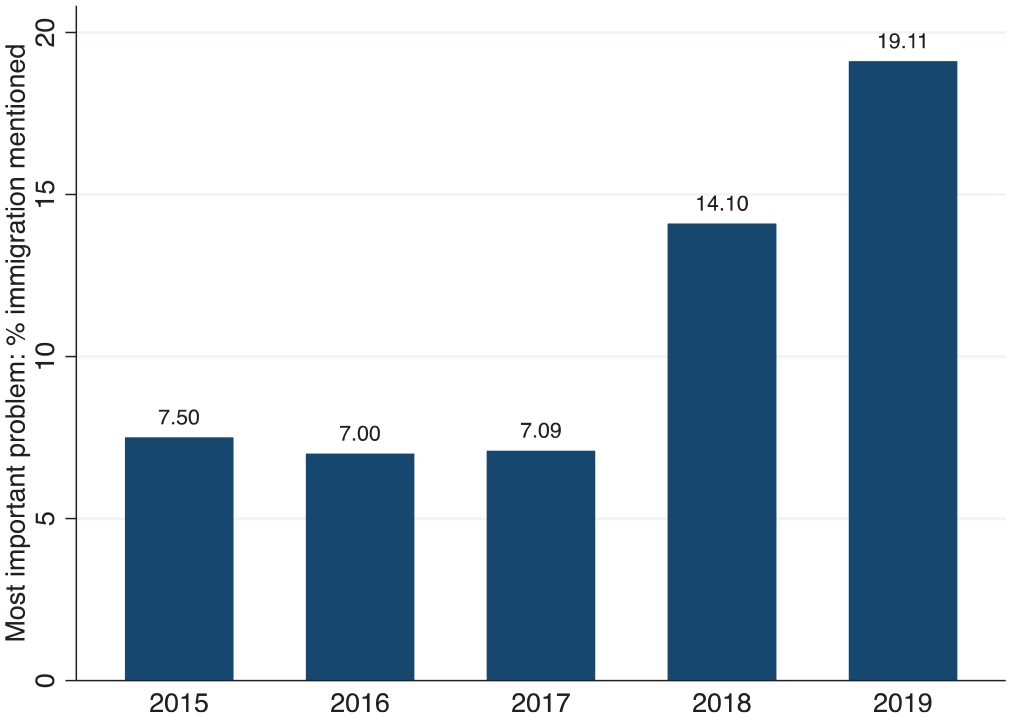
Percentage of individuals who consider immigration and border security to be the most important problem facing the country today, 2015 to 2019.
Turning to the examination of immigration attitudes of the RGV and the national population, both populations show a clear difference in what they believe should be a priority for U.S. immigration policy: reinforcing border security, providing a pathway for legal residency, or citizenship for those who meet certain requirements, or both. In general, the RGV residents show more liberal attitudes than the national population. About half of respondents (46.95%) in the RGV sample said providing a pathway for legal residency or citizenship should be the priority of U.S. immigration policy, while only about one-third of respondents (31.25%) in the Pew Political Survey said it should be. In addition, twice as many individuals in the national sample as in the RGV agreed that strengthening border security should be a priority, indicating an overall more restrictive attitude toward immigration.
As previously noted above, we hold that the considerably higher support for providing a pathway for legal residency or citizenship found among the RGV residents reflects the sizable presence of mixed-status families in the region as well as RGV residents’ frequent acquaintances with precarious immigration statuses in their own personal networks. This view is further supported by the high proportion of respondents who expressed deportation threat in our RGV dataset. In our sample, we identified 65 non-citizens, approximately 10% of our total sample. However, 53% of the respondents expressed a fear of deportation for themselves or a loved one like an immediate family member or a close friend. Approximately 13% of the respondents in our total sample reported they personally know someone who has been detained or deported in the past year. In these communities, the rhetoric that criminalizes “illegal” immigrants and emphasizes the crisis on the border is less likely to resonate with the residents because it is not perceived to accurately depict the lived reality. Therefore, people are less likely to prioritize reinforcing border security for the U.S. immigration policy.
Furthermore, we found a divide over building a border wall between the national and RGV populations. Similar to the pattern of immigration policy priorities discussed above, RGV residents show significantly more lenient attitudes than U.S. adults in the 2018 ANES Pilot Study. The vast majority of the RGV population (75.67%) opposes building a wall along the U.S.-Mexico border, whereas only 48.2% of the national population opposes the idea. In contrast, 39.08% of the respondents in the ANES survey favored building a border wall, while that number drops to 16.17% in the RGV sample. This finding may reflect documented concerns shared by RGV residents about the impact the proposed border wall would have on families and communities in the border region. For example, the construction of the border wall would result in the disruption of private property and land and the restriction of access to it. The proposed wall would run 162 miles through Southern Texas, 144 miles of which are privately owned (Kanno-Youngs, 2019). In fact, since the beginning of the first Trump administration in 2017, more than 570 landowners in Hidalgo and Starr counties received right-of-entry letters from the government asking to survey their land for possible border wall construction (Leaños, 2019). In addition, the proposed wall would restrict access to family members living in Mexico, and others raise concerns that the construction of a wall would affect the ecosystem of the RGV, such as the loss of natural habitats for endangered animals like ocelots and jaguars (Ryman et al., n.d.).
Testing the Effect of Perceived Versus Lived Experiences on Border and Immigration Attitudes
While assessing the differences between the national population and the borderlands population, we focused on the role of rhetoric as well as the information created through the media and Trump as a factor to account for these differences. We expect that those who pay more attention to political news media are more likely to hold negative views on border security and “crisis,” thus supporting restrictive policies among the national population. However, the same relationship is not expected to exist in the RGV population because residents’ everyday lived experiences inform perceptions of the border and immigration, which in turn may differ from how the news media describes the issues. We test these expectations by focusing on opinions about building a border wall and increasing border security as an immigration policy priority.
We have two dependent variables, both of which are binary. The first one from the 2018 ANES Pilot Study measures whether individuals favor building a border wall while the second measures from the Pew Political Survey whether individuals believe that reinforcing border security should be the priority of U.S. immigration policy rather than providing legal pathways to citizenship. In both cases, 1 indicates the restrictionist views. The independent variable is how closely one follows politics. Both the ANES and RGV datasets have a question that measures this, although the variables were operationalized on slightly different scales. In the ANES, responses are on a 1 to 4 scale where 1 means following politics “Most of the time” and 4 means “Hardly at all.” In the RGV data, responses are coded on a 1 to 5 scale where 1 means “Always” and 5 means “Never.” We recoded these variables so that higher values indicate higher attention given to political news. Unfortunately, however, the Pew dataset does not have the exact same question. Instead, it has a question asking how closely the respondent has followed news about candidates and election campaigns. The responses are on a scale of 1 to 4, where 1 indicates “Very closely” and 4 indicates “Not at all closely.” We have recoded this variable so that higher values illustrates more attention to news about candidates and campaigns.
In addition, we include a set of control variables that may affect individuals’ opinions on the construction of a border wall and immigration policy: political ideology, party ID, education, income, ethnicity, gender, and age. In the RGV, 2018 ANES, and 2018 Pew surveys, respondents were asked to place themselves on a liberal-conservative ideological scale. Thus, ideology is measured as an ordinal variable, with higher values indicating conservatism. In all three surveys, respondents were asked to indicate their party identification by selecting one of the options Democrat, Republican, Independent, or Something else. We created two dichotomous variables for Democrat and Republican. The education variable measures the respondent’s highest level of education. The income variable measures each respondent’s household income. For respondents’ ethnicity, we use a binary variable where Hispanic takes the value 1 and otherwise 0. Gender is coded as a binary variable with women taking the value 1 and otherwise 0 across all surveys. Finally, age is measured as a continuous variable.
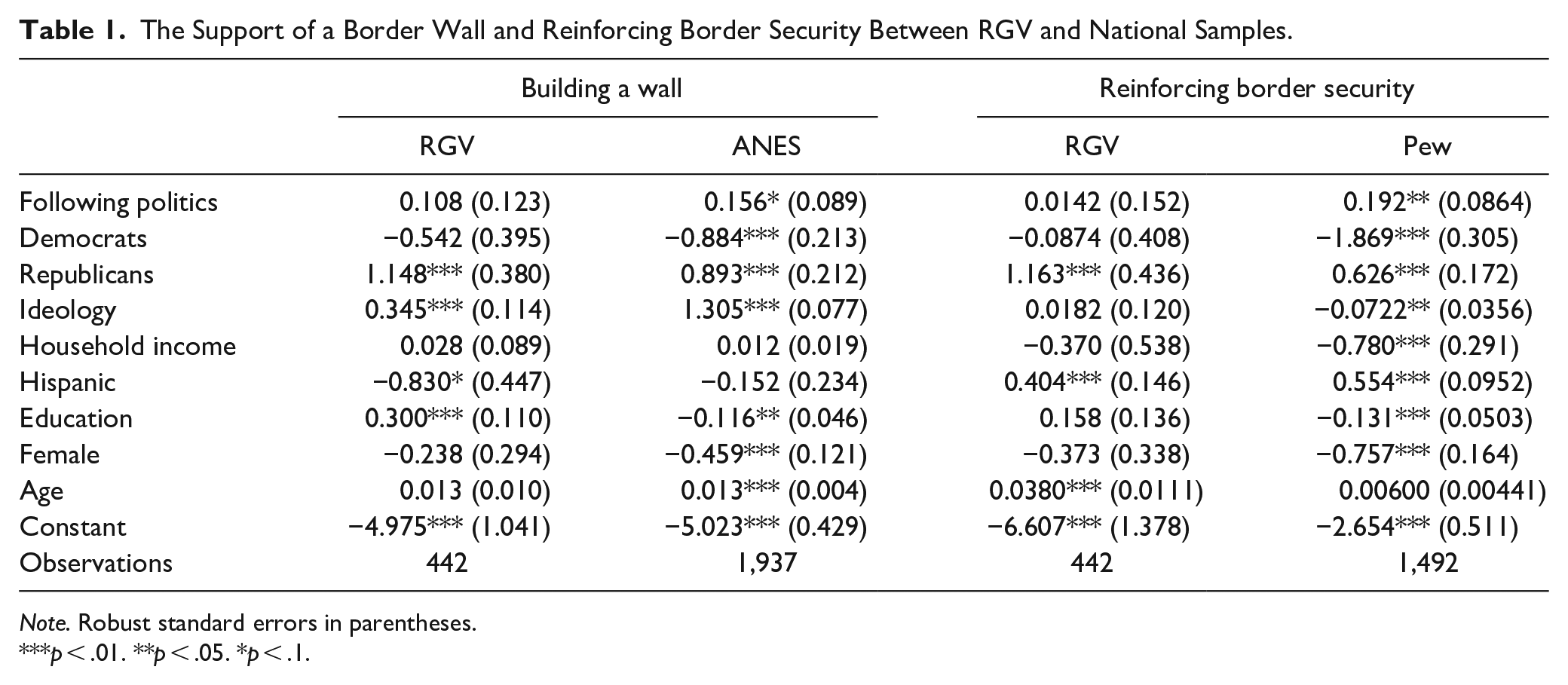
As the dependent variables are dichotomous, we employ a logistic regression analysis with robust standard errors. The focus of the estimation is to compare the effect of paying close attention to political news on the level of support for building a border wall and for prioritizing reinforcing border security over providing legal pathways to citizenship in the U.S. immigration policy between the RGV and the national samples. Table 1 presents the results. First, our theory that the media’s effect on immigration attitudes is larger in the national population than in the borderland population finds some support. The coefficient of the variable, “Following Politics,” indicates that following political news closely is likely to lead individuals to be supportive of building a border wall in the national sample. Although the relationship is not as strong as the coefficient is statistically significant at the .1 level, which is below the conventional .05 level, this result does suggest that the more individuals pay attention to political news, the more they become supportive of building a U.S.-Mexico border wall. However, the same variable turns out to have no statistically significant impact on the RGV population. Put differently, paying close attention to political news does not influence RGV residents with regards to their support for, or opposition to, the construction of a border wall.
The Support of a Border Wall and Reinforcing Border Security Between RGV and National Samples.
Note. Robust standard errors in parentheses.
p < .01. **p < .05. *p < .1.
Similarly, the fourth column shows that in the national sample, individuals who follow political news closely are more likely to believe that increasing border security rather than providing legal pathways to legal residency and citizenship should be the priority of U.S. immigration policy. Again, this pattern is not discernible in the RGV sample, suggesting that the negative effects of media framing on immigration do not necessarily affect people’s immigration policy preferences in the RGV border community.
Second, we found that immigration policy is highly partisan at the national level in the U.S., whereas its partisan division over this issue is somewhat blurred in the RGV. For example, in the ANES sample, Democrats are significantly less likely to support the border wall construction than independents, whereas Republicans are more likely to support it. Both coefficients are significant at a .01 level. In the RGV sample, however, Democratic Party identification has no discernible impact on individuals’ views on a border wall, although the coefficients suggest negative signs. It is only the Republican Party ID that significantly increases the level of support for the border wall construction. Similarly, in the Pew sample, Republicans are significantly more likely to support that the U.S. immigration policy should prioritize border security over providing a pathway to legal residency and citizenship than independents, whereas Democrats are more likely to oppose it. However, Democratic Party ID in the RGV sample does not have any statistically significant effect. This finding is in line with Monforti and McGlynn (2016) who argue that attitudes over immigration policy in borderland communities are less partisan driven but more homogeneous than elsewhere because the geographic proximity to the border provides their residents with shared experiences.
Third, the role that education plays in shaping opinions over a border wall varies between the populations examined. Education tends to make individuals more liberal in the national sample, as noted in column 2 and column 4 of Table 1: The more education individuals have, the more they oppose building a border wall and prioritize increasing border security over providing legal pathways to citizenship. But, it has opposite or ambiguous effects on the RGV sample: As individuals get more education, they tend to hold more conservative immigration attitudes in the RGV. Column 1 indicates that education makes RGV residents more supportive of building a wall. In contrast, column 3 shows that education does not make people in the RGV more or less supportive of reinforcing border security, although the sign of the coefficient is positive. This finding reaffirms what Kim et al. (2020) found, which is counterintuitive given that education in the literature is known to be associated with liberal ideology and policy attitudes.
We believe that it is crucial to consider geographic and temporal specificity in order to properly understand the role of education in the RGV relative to non-border regions. Geographically, the RGV is a borderland region where residents live the divisions between the U.S. and Mexico, us and foreigners, whites and non-whites, affluence and poverty, and so on (Silva & Murga, 2021). In terms of time, in the Trump era, the RGV received much political and media attention in the discussion of border security and immigration. In short, RGV residents, most of whom share the ethnoracial markers targeted by Trump’s anti-immigrant rhetoric, reside in the targeted region. In this context, education in the RGV may be an indicator of acculturation and assimilation, capturing the time individuals have spent in the U.S., while also being an indicator of upward social mobility. Among individuals, many of whom belong to a stigmatized demographic group, residing in a stigmatized geographic area, those with higher educational attainment, who tend to be assimilated and upwardly mobile and thus conform to the “American Dream,” are more likely to engage in boundary-making, distancing themselves from the unassimilated, undeserving, or “illegal” immigrants. Cadena (2023) refers to this attitude as “assimilated consciousness” and contends that it provides the mechanism for conservative Latinos to justify their anti-immigrant attitudes and denial of systemic racism. We believe this explains the effect of education associated with more conservative attitudes toward immigration and border security in the RGV population found in our analysis.
Another ambiguous or counterintuitive result we found relates to the Hispanic variable. First, intuitively, Hispanics in the RGV tend to be less supportive of a border wall when it comes to opinions on building a border wall, but the same variable has no effect at the national level. Second, interestingly, when it comes to opinions on immigration policy priorities, Hispanics in both the RGV and national samples uniformly show more support for prioritizing reinforcing border security than other racial or ethnic groups. This is puzzling because the Latino politics literature suggests that Hispanics tend to hold more lenient views on immigration than other groups, particularly Anglo whites (see e.g., Rocha et al., 2011 among many). We believe that this ambiguity is due in part to a lack of information about the source of mass media on which each population relies. Our data limit our ability to examine the extent to which individual-level news intake in the RGV overall and Hispanic populations differs from the national overall and Hispanic populations, and the extent to which the RGV population’s news intake conditions their perceptions of events. Future research should address this point.
An additional implication of this result is that Hispanics in the RGV and the national population appear to behave similarly. With respect to building a border wall, Hispanics in both datasets show less support than non-Hispanic populations, and in both samples they show more support for prioritizing the reinforcement of border security than non-Hispanic counterparts. This suggests that the difference between RGV and national attitudes is explained by something other than some form of “ethnic” solidarity, one of which we argue in this study is the effect of media. 5 Other variables such as ideology, gender, and age yield results that are generally consistent with conventional wisdom.
In light of these findings about media attention, one explanation that may account for the differences across the RGV and national surveys is the gap between lived and reported experiences of the border. The physical distance from the events at the border involves a greater reliance on media narratives. While RGV residents are exposed to the issues through the lenses of daily life with networks of friends and family, national coverage of the border typically focuses on the actions of actors who are far removed from the daily realities of the border and have incentives to dramatize the issues for their partisan bases and political gain. Trump was instrumental in pushing this negative rhetoric, differentially excluding irregular migrants by claiming they were “thieves,” “drug traffickers,” and/or “rapists.” Fleuriet and Castellano’s (2020) analysis of 11 major mainstream media outlets in national markets from 2010 to 2017 confirms that the U.S.-Mexico border and the RGV were primarily described as a threat to national security. This is where violent criminals or “bad hombres” (Silber Mohamed & Farris, 2020) and drugs easily enter the U.S. due to the porous and uncontrolled border. The political framing used by Trump and disseminated by the media repeatedly used racialized and dehumanizing language of the migrant criminal to stoke national fear of the “other,” which may be conceptualized as a continuation of colonial tropes where foreigners are criminalized, subjugated, and racialized (Walia, 2021). This media narrative makes the border appear more chaotic and violent than reality, leading people far from the border to support more restrictive and punitive immigration and border policies.
At first glance, this mechanism may seem difficult to reconcile with the evolution of voting behavior in the counties of interest since the RGV survey was conducted. All four counties in the RGV have drastically shifted in a Republican direction. 6 Beyond county-level dynamics, both the 2020 and 2024 election cycles have seen attitudinal shifts among Hispanics nationwide in a more conservative direction (Fraga et al., 2025). Several explanations have been advanced to explain this shift nationwide. First, the shift has been attributed to nagging yet erroneous expectations of a monolithical identity-based group behavior among Hispanics (Arana, 2024; Soto-Vásquez & Gonzalez, 2022). Not all Hispanics hold the same intensity of ethnic self-identification (Gutierrez et al., 2019) and the myth of the monolithical block could have led Democrats to neglect the process of reinventing their appeal to Hispanic voters. Second, among other subgroups within the Latino category, working-class, Catholic, and voters of Mexican ancestry saw the greatest increases in support for the Republican Party between 2016 and 2020 (Fraga et al., 2025, p. 520)—following a trend already documented between 2012 and 2016 (Corral & Leal, 2020). This speaks to inherent trends within the Hispanic community to be receptive to social conservatism (Corral & Leal, 2024; De la Garza & Cortina, 2007). A case in point in framing Latinos as an allegedly “captured” partisan constituency comes from Ramos’ (2024) book about the growing number of far right Latino activists. In her account, partisan “defection” among Hispanics can be explained by the tribalism of some older generations of migrants seeking to assimilate by dissociating themselves from people they deem lower on the social hierarchy (such as more recent newcomers; Geiger & Reny, 2024), the trauma of ardent anti-communism in the countries they or their parents left (Blitzer, 2024; Soto-Vásquez & Hazelton, 2023), and the natural traditionalism that Catholic (or increasingly Protestant) identity instills in Hispanic voters (Espinosa, 2022). Finally, Trump himself is a political figure that may fit the mold of Latin American strong leaders with which some voters of Hispanic descent may sympathize.
All in all, we also see the evolution of Hispanic voting behavior as a confirmation of our theoretical framework. Between 2018 and 2024, realities on the border objectively evolved and lived experiences may paradoxically account for the hardening of borderland public opinion. Local events such as the Del Rio bridge encampment in 2021, the record numbers of incoming migrants and increasing backlog of asylum cases in the RGV during the Biden administration (TRAC, 2025), have contributed to the evolution of the lived versus vicarious experiences dynamic. Local voters may be more receptive to anti-immigration appeals against a backdrop of continuous national (Eshbaugh-Soha & Barnes, 2021) and local (Moreira & Soto-Vásquez, 2024) political messaging due to their lived experiences. Besides, the effects of such rhetoric were more likely to depress the turnout of voters directly impacted by immigration compared to other Hispanic residents (see Altema McNeely et al., 2022; Israel-Trummel et al., 2025). For these reasons, it would be worthwhile to examine how public opinion in the RGV has changed since 2018 and compare the change to the national population. This will provide a clearer picture of how lived versus perceived experiences shape individuals’ perceptions of immigration and the border. We leave this for future research.
Conclusion
This article compares the public opinion on border and immigration policies between the Rio Grande Valley (RGV) in the South Texas borderlands and the overall national population and explores a potential cause for the difference between the two. By analyzing survey data collected in 2018, we found that despite increased media coverage of border security or crisis and immigration issues during the Trump administration (Fleuriet & Castellano, 2020; Silber Mohamed & Farris, 2020), negative cues from the media, which “other” and criminalize irregular migrants, did not have an equal impact on people’s attitudes across the country. Instead, the media appears to have had a greater impact on the general national population than on the population in the RGV. Specifically, people in the national sample tended to have more conservative views as their exposure to the media increased. However, this was not necessarily the case for the RGV population. The exposure to the media did not affect RGV residents’ views on immigration and border issues.
We contend that this can be accounted for by the fact that the commonality of lived experiences can serve to bridge a reality gap that the rest of the population is hard-pressed to overcome through mediated information. Respondents in the RGV sample showed that their lived experiences interfere with the type of information cues they may receive from the media. The findings of this study suggest that the reality on the ground is much different than the performance, polarization, and politicization of the border security threat framing the media may suggest.
We conclude by suggesting some future research to further corroborate our findings and to more rigorously examine the differential media effects on public opinion about immigration between border and non-border communities. First, we could glean more insights by analyzing media coverage of immigration and the border during the time period of the study. In addition to traditional media, social media could be an important site to investigate especially since Trump used Twitter (currently X) extensively to disseminate his anti-immigrant rhetoric during his first presidency. This effort can quantify the intensity and volume of hostile immigration and border narratives that were prevalent during this period.
Second, it is important to more thoroughly examine and compare the media consumption or behavior of border and non-border residents. For example, do RGV residents rely on similar news outlets as those outside the RGV as their primary sources of political information? Relatedly, how do local news outlets in the RGV cover immigration and border issues? Do they use similar narratives that are reflected in national news outlets? It is possible that the types of news outlets and the types of immigration narratives that people are predominantly exposed to differ between RGV residents and the rest of the population. In order to accurately analyze the gap between lived and reported experiences, a more thorough examination of media coverage and media consumption of people between the RGV and non-border areas should be conducted.
Third, as discussed above, it would be worthwhile to examine how this gap between the RGV and the national population has evolved since 2018. Given that immigration has consistently received a great deal of attention from major parties, candidates, and politicians leading up to the 2024 presidential election, it would be interesting to explore how this political atmosphere has affected people’s attitudes toward immigration in the RGV. This is especially so given that since Trump’s election in 2016, conservative candidates and the Republican Party in general have gained more traction among RGV voters. It is important to examine whether this is due to a shift in RGV voters’ attitudes toward immigration and the border or some other factors. This has important implications for understanding Latinx public opinion in border communities.
Footnotes
Declaration of Conflicting Interests
The author(s) declared no potential conflicts of interest with respect to the research, authorship, and/or publication of this article.
Funding
The author(s) received no financial support for the research, authorship, and/or publication of this article.
