




Abstract
Social comparison processes can affect academic and interpersonal outcomes for minoritized college students. However, the literature has not addressed how these processes play out for Hispanic students who attend Hispanic Majority Institutions, in which Hispanic students comprise more than 50% of the population. In this study, such students (N = 191) completed online assessments for social comparison orientation (SCO), belongingness, academic self-concept, and perceived stress. Results showed that, regarding belongingness, SCO was positively correlated to rejection/exclusion, but not acceptance/inclusion. Regarding academic self-concept, SCO was positively correlated to self-doubt, but not self-confidence. Mediation analyses showed that perceived stress fully mediated the relationship between SCO and rejection/exclusion, and partially mediated the relationship between SCO and academic self-doubt. In other words, SCO was associated with increased stress, which was then associated with increased feelings of rejection/exclusion and self-doubt about academic abilities. These findings offer additional insight into Hispanic college students’ experience.
Keywords
Social comparison (Festinger, 1954) guides how people determine their own social value relative to a target (e.g., relevant peer, a family member, a celebrity). Social comparison within an educational context has been connected to outcomes such as academic self-concept (Bong & Skaalvik, 2002; Wang & Zhao, 2020), academic performance (Herrmann et al., 2016), and career aspirations (Rudman & Phelan, 2010). Importantly, people are mostly likely to compare themselves to others in their immediate environment (Kesici & Erdogan, 2010). As such, studying this relationship with Hispanic students may be particularly important given the growing demographic and changing landscape of education with Hispanic Serving Institutions (HSIs) and, more specifically, Hispanic Majority Institutions.
There are more than three million Hispanic undergraduate students, making up approximately 22% of all undergraduate enrollment in the United States. Over 60% of Hispanic students are enrolled at one of 600 Hispanic Serving Institutions (i.e., at least 25% of enrolled students are Hispanic) in the U.S (Santiago et al., 2024). As Garcia (2019) illustrates, enrollment alone does not indicate if an institution is adequately serving its Hispanic students. For example, some institutions may have programs specifically celebrating Hispanic culture and heritage or involvement in the local Hispanic community, while other institutions may not.
Hispanic Majority Institutions (HMIs), a special case of HSIs in which 50% of the full-time enrolled student population identify as Hispanic, offer a unique context to investigate these phenomena (e.g., Huynh et al., 2024). Unlike typical investigations of Hispanic student experiences in which they represent the minority on campus (e.g., N. M. Garcia et al., 2021), we focused specifically on Hispanic students who belong to the numerical majority on campus. Social identity theory explains how students derive a sense of identity and self-worth based on their membership in social groups (Tajfel & Turner, 1979, 2004). Students categorize themselves and others into various social groups (e.g., Hispanic or not) to make sense of the world. These categories help define in-groups (groups they belong to) and out-groups (groups they do not belong to). Once students categorize themselves, they adopt the identity of the group they belong to. This process influences their self-concept and behavior, as they internalize the group’s norms, values, and characteristics. As such, social identity theory suggests that comparison processes may affect Hispanic students in unexplored ways within this context (Tajfel & Turner, 1979, 2004). In particular, the changed status from minority to majority marks a social recategorization for these students, which may change their social identification and affect their social comparison processes.
Therefore, the current study examines social comparison orientation (SCO) and its relationships with students’ belongingness (exclusion/inclusion) and academic self-concept (self-doubt/self-confidence). Additionally, we explored stress as a potential mechanism to explain these associations. Below, we define and briefly review literature on these constructs.
Social Comparison Theory and Social Comparison Orientation (SCO)
Social comparisons are bi-directional; people can evaluate themselves against someone who is more successful (i.e., upward comparison) or less successful (i.e., downward comparison). Moreover, people can direct their attention to the differences (i.e., contrast comparison) or the similarities (i.e., identification comparison; alternatively referred to as assimilation) between themselves and the target. Consequently, people may adopt one of four approaches arising from these combinations: upward identification, upward contrast, downward identification, and downward contrast (Buunk et al., 2005; Dijkstra et al., 2008; Smith, 2000).
In addition to differences among types of targets for social comparison, people also differ in how often they engage in social comparison more generally. Social Comparison Orientation (SCO; Gibbons & Buunk, 1999) describes a person’s inherent tendency to actively compare themself to others, using these comparisons as a standard for self-evaluation. SCO may affect multiple categories of goals such as self-evaluation, self-improvement, or self-enhancement (Vogel et al., 2015; Wood, 1989; Yang, 2016). This propensity to compare exists on a spectrum, with people exhibiting varying degrees of comparison frequency and emotional sensitivity to the results.
People high in SCO are more likely to experience heightened sensitivity to the outcomes of their comparisons as they may be motivated by the need to reduce uncertainty (Collins, 1996; Festinger, 1954). Although certain types of social comparisons can bolster self-confidence, some research suggests more frequent comparisons driven by high SCO are linked to higher stress levels (McCarthy & Morina, 2020). These comparisons can highlight shortcomings that fuel feelings of inadequacy, envy, and anxiety, especially when the gap between oneself and the comparison target feels large. Another potential consequence of high SCO is a decreased sense of belonging.
Belongingness
Belongingness refers to the fundamental human need to feel accepted, connected, and valued by others (Baumeister & Leary, 1995). An individual may feel motivated to be accepted by, involved with, and fit alongside others in order to achieve a heightened sense of belongingness (Hagerty & Patusky, 1995). This fundamental need applies across a range of different scales (e.g., contact with one-to-one pairs, affiliation with small groups, and connectedness to a grander social context; R. M. Lee & Robbins, 1995) and modalities (e.g., online and offline interactions; Ahn & Davis, 2020). Although the strength of relationships may vary by context, belongingness plays a crucial role in well-being and mental health (Malone et al., 2012). It is associated with a range of both positive outcomes including increased self-esteem, improved emotional regulation, and enhanced resilience to stress (Kaur, 2023; Rehman et al., 2023; Zhang et al., 2020) and negative outcomes including social anxiety, loneliness, and even depression (Arslan, 2019; Moeller et al., 2020). Sense of belonging is an important component of nonacademic outcomes for students attending HSIs (Garcia, 2019), as Hispanic student enrollment alone does not demonstrate that an institution is serving its students to the best of its ability.
Nevertheless, belongingness is not a static state; it can be fostered or challenged by various factors such as stress (Lingat et al., 2017). Stress may reduce a sense of belongingness by exacerbating feelings of isolation and hindering the ability to establish and maintain meaningful social connections (Samadieh & Tanhaye Reshvanloo, 2023). For example, membership in social or community organizations and discussing course content with classmates outside of class can be associated with Hispanic students’ sense of belonging (Hurtado & Carter, 1997). Additionally, Hispanic college students may experience changes in how they conceptualize their identities depending on specific contexts (Torres et al., 2023). Although previous research has focused on the documented inequities in sense of belonging experienced by minority groups (e.g., Hispanic students) in higher education (Gopalan & Brady, 2020), additional investigation is needed to explore how belongingness is affected when this population belongs to the majority instead of the minority, especially regarding academic self-concept.
Academic Self-Concept
Academic self-concept refers to an individual’s perception of their ability and effectiveness in academic settings within a larger theoretical framework of self-concept (Marsh, 2014; Shavelson et al., 1976). It encompasses beliefs about one’s intellectual competence, academic skills, and overall potential for academic success. Reynolds (1988) created a measurement (Academic Self-Concept Scale; ASCS) of this construct to assess students’ confidence in their academic capabilities and perceptions of their academic achievement compared to peers. Students with high academic self-concept also had higher grade point average (GPA), general self-concept, and internal locus of control (Choi, 2005; Reynolds, 1988).
Academic self-concept has significant implications for student outcomes beyond academic performance. Whereas students with a strong academic self-concept exhibit positive behaviors like goal setting and perseverance, those with a negative perspective may lack motivation and engagement (Omolade & Adeleye, 2021; Prince & Nurius, 2014). This cycle can be exacerbated by stress and social comparison (Huh, 2015). Understanding how factors like social comparison orientation and sense of belonging may influence academic self-concept can provide valuable insights into supporting student success. This knowledge can then inform strategies to mitigate the negative impacts of stress on students’ academic performance and overall well-being.
Stress
Although college can be a time of growth and success for many students, the college environment brings unique challenges that are often sources of stress for college students (e.g., pressure to perform, increased time restraints, high workloads, and changes in self-perception regarding academics; Bedewy & Gabriel, 2015). Additionally, college students, like most adults, experience interpersonal and environmental stressors, such as changes in romantic relationships and difficulties with transportation (Ross et al., 1999). Stress levels of college students are not trivial, as almost half of students surveyed reported that they experience more than a “normal” amount of stress (Beiter et al., 2015). This frequency indicates that the students believe themselves to be stressed to higher levels than is optimal, and their perception of this stress as detrimental is well supported with research. For example, stress levels of college students are associated with incidence of depression and anxiety, lack of sleep, poor diet, and lower student satisfaction (Beiter et al., 2015; Britz & Pappas, 2010; J. Lee & Jang, 2015).
Although stress is a pervasive part of every college student’s experience, college students from underrepresented backgrounds often face additional obstacles while trying to complete their degree, which can lead to increased stress levels. Students from lower socioeconomic status (SES) backgrounds experience higher levels of stress (Karimshah et al., 2013) and are often required to work more, which directly impacts their sleep and mental well-being (Peltz et al., 2021). Students from historically underrepresented ethnic or racial groups may also experience additional stressors (i.e., Minority Stress Model, Frost & Meyer, 2023; Meyer, 2003), such as acculturative stress (Castillo et al., 2008), perception of low public regard for their ethnic identity (Chee et al., 2019), racial discrimination and work conflict (Le & Iwamoto, 2022), and chronic role strain (Myers & Harrell, 2024). Examining one or more of the factors predicting student stress can lead to an informative, albeit sometimes complicated, discussion of intersectionality. For example, being a Latina woman from a low-SES background (Sy, 2006) brings challenges that are in some ways similar but in other ways different to a Black man from a low-SES background (Strayhorn, 2010).
Even though stress varies for different demographics and the intersectionality of identities, quantifying predictors can support arguments for compensatory resources (e.g., increased funding, implementation of culturally-informed practices). For example, research shows that first-generation college students (FGCS), students whose parents have not earned a 4-year college degree, often experience more stress than their counterparts (Amirkhan et al., 2023). For students who attend an HMI, Hispanic identity and SES predicted levels of stress, but first-generation college student status did not (Huynh et al., 2023). This relationship could be due in part to the robust programming for first-generation students at the university. Studies have suggested that in addition to mentorship programs (Everett, 2023; Laiduc et al., 2021), other factors associated with lower levels of stress for college students include social support (Alvan et al., 1996; Goodwill et al., 2022; Roche & Kuperminc, 2012), expressing or embracing one’s identity (Clayton et al., 2019), and introductory courses that address the hidden curriculum and important academic skills (Frankel & Smith, 2022). As such, documenting helpful interventions, such as mentorship programs for FGCS (Everett, 2023), could result in benefits that are far-reaching. Knowing if and where there are gaps in support services is essential to closing gaps in achievement and success. Therefore, the literature could benefit from investigations into the relationships between social comparison processes, belongingness, academic self-concept, and stress, particularly for Hispanic students at HMIs, who have not been well-represented in prior work as it is important to avoid assumptions that the relationships between variables is the same across contexts (Núñez et al., 2015).
Summary of Frameworks and Hypotheses
Social comparison theory suggests that people tend to derive their sense of self from comparing themselves to others, particularly to others in their immediate environment. In this case, Hispanic students attending a Hispanic Majority Institution may be more likely to compare themselves to other Hispanic students and identify with being in the ingroup. Furthermore, social comparison orientation represents people’s general inclination to compare themselves to others. Therefore, students who are higher in social comparison orientation tend to compare themselves to others more frequently than students who are lower in social comparison orientation. Based on this framework, we proposed that Hispanic students who often engage in social comparison would be more frequently reminded of their place at the university, as such they would report increased feelings of rejection and exclusion, and decreased feelings of acceptance/inclusion. Additionally, increased frequency of social comparison would create more opportunities to question one’s self-worth which may bring about increased self-doubt and decreased self-confidence. As such, in Hypothesis 1, we predicted that social comparison orientation would be related to belongingness (negatively to acceptance/inclusion, and positively to rejection/exclusion) and academic self-concept (negatively to self-confidence, positively to self-doubt).
Similarly, students’ increased frequency in self-evaluation (i.e., higher social comparison orientation) could result in more thorough reviews and frequent reminders of their stressors. As such, in Hypothesis 2, we predicted that social comparison orientation would be positively related to stress. Furthermore, students’ increased stress levels and assessment of whether they can adequately manage the stress could prompt thoughts about whether they belong and are equipped to succeed in the college environment. As such, in Hypothesis 3, we predicted that stress would be related to belongingness (positively with rejection/exclusion) and academic self-concept (positively with self-doubt). Finally, our framework suggests that the frequency in which students compare themselves to others may give rise to increased stress, and this stress is ultimately the reason why students negatively feel like they do not belong in college and doubt their academic abilities. As such, in Hypothesis 4, we predicted that stress would mediate the association between social comparison orientation with belongingness (rejection/exclusion) and academic self-concept (self-doubt).
Method
Participants
Undergraduate students received a recruitment email via their university address. Students (N = 405) opened the survey link, 32 did not proceed beyond the consent page, and 102 answered some questions but failed to complete at least 67% (2/3) of the survey. A final sample of 261 complete responses was considered for analysis. Of the complete responses from these participants, 191 self-identified as Hispanic (138 as Hispanic singularly, 41 as Hispanic and White/Caucasian, and 12 as Hispanic and Black/Asian/Native American). Remaining participants were not included in further analyses. Of participants who self-identified as Hispanic, 37 self-identified as male, 145 as female, 7 as non-binary/third, and 2 selected “prefer not to say.” There were 68 students who identified as Hispanic and low SES (selected 1–4 on the subjective SES scale; see more information about the scale in Demographic Information section below). The average age was 26.32 years (SD = 9.37; range = 18–65). Participants reported majors in Psychology (47), Business/Marketing (23), Biology (23), Education (17), Criminology (14), and other (67). All participants were recruited from Texas A&M University-San Antonio to which all authors were affiliated at the time of data collection. This arrangement made the research ethics approval process more streamlined and increased feasibility of data collection.
Materials
We describe the assessments and questionnaires pertinent to this manuscript below. The study variables were assessed with peer-reviewed, published, and validated scales. We would like to note that the variables reported in this report are part of a larger data collection effort. All measures for that effort are posted on the Open Science Framework (OSF).
Social Comparison Orientation
Participants rated their agreement with items on the Scale of Social Comparison Orientation (Gibbons & Buunk, 1999) on a 5-point Likert scale (1 = I disagree strongly, 5 = I agree strongly). The original published scale had two subscales distinguishing abilities and opinions. However, Gibbons and Buunk suggested that researchers use the scale as a singular measure of SCO. The original scale had 11 items, but Qualtrics input errors reduced the scale to only 8 items (items 5, 10, and 11 from the original scale were excluded due to our error setting up the survey). Item 5 displayed the word “reverse” at the end of the item, which was supposed to be internal as a reminder to reverse code the item after data collection. Items 10 and 11 were inadvertently merged into one item. The 8-item measure nevertheless had good reliability (α = .86). Sample items include: “I always pay a lot of attention to how I do things compared with how others do things”; “I am not the type of person who compares often with others” (reverse scored). Higher scores indicate higher social comparison orientation.
General Belongingness Scale
The General Belongingness Scale (Malone et al., 2012) included 12 items in which participants answered on a 5-point Likert scale (1 = I disagree strongly, 5 = I agree strongly). Six items assessed the acceptance/inclusion subscale (α = .88). Examples include: “When I am with other people, I feel included”; “I feel accepted by others”; “I have a sense of belonging.” Higher scores indicate a greater sense of belongingness (i.e., higher feelings of being accepted and included). Additionally, six items assessed the rejection/exclusion subscale (α = .89). Examples include: “I feel as if people do not care about me”; “When I am with other people, I feel like a stranger”). Higher scores indicate a weaker sense of belongingness (i.e., higher feelings of being rejected/excluded).
Academic Self-Concept
Two subscales of academic self-concept (Reynolds, 1988) assessed self-confidence and self-doubt in academic ability. Participants rated their agreement on a 5-point Likert scale (1 = strongly disagree, 5 = strongly agree) for each of the 11 relevant items. The self-confidence subscale (α = .68) has three items (i.e., “Most courses are very easy for me.”; “Most exams are easy for me.”; “Most of the time while taking a test I feel confident.”). Higher scores indicate more self-confidence. The self-doubt subscale (α = .88) has eight items (e.g., “I feel that I do not have the necessary abilities for certain courses in my major.”; “I have doubts that I will do well in my major.”). Higher scores indicate more self-doubt.
Perceived Stress Scale
Participants rated their stress on a 5-point Likert scale (0 = never, 4 = very often) using 14 items (α = .75) of the Perceived Stress Scale (Cohen et al., 1983). The scale contains eight items that were scored normally (e.g., “In the last month, how often have you felt that you were unable to control the important things in your life?”; “In the last month, how have you found that you could not cope with all the things that you had to do?”). Additionally, six items were reversed scored (e.g., “In the last month, how often have you been able to control irritations in your life?”; “In the last month, how often have you felt that you were on top of things?”). Higher scores indicate more stress.
Demographic Information
Participants self-reported information about their age, sex, levels of education, major, and race/ethnicity. In addition to these sample characteristics, participants also reported their first-generation college student and socioeconomic status (SES). For first generation college student status, participants indicated their status with the following definition, “You are considered a first-generation college student if neither of your parents completed a bachelor’s degree. If your parent(s) and/or guardian(s) attended college but do not have a bachelor’s degree (i.e., did not graduate), you are considered to be first-generation.”
For SES, participants completed the single-item version of the MacArthur Scale of Subjective Social Status-Adult Version (Singh-Manoux et al., 2005). Alongside a drawing of a ladder with 10 numbered rungs, participants read, “Imagine a ladder that shows how your society is set up. At the top of the ladder are the people who are the best off–they have the most money, the highest amount of schooling, and the jobs that bring the most respect. At the bottom are people who are the worst off–they have the least money, little or no education, no jobs or jobs that no one wants or respects. Now think of your family. Please tell us where you think your family would be on this ladder by selecting the corresponding number below.” Responses range from 1 to 10, with higher values indicating higher subjective SES.
Procedure
Participants completed all procedures online using Qualtrics. After reading the information page and providing their consent, participants answered the various questionnaires, which were presented in random order to minimize order effects. Then, participants provided demographic information and read a debriefing statement. Participants could skip questions, as all questions were optional. After completing the survey, participants could use a separate link to type their email address to enter a drawing for one of eighteen $50 gift cards. All study materials and procedures were approved by Texas A&M University-San Antonio’s Institutional Review Board (IRB).
Data Analysis Plan
We used bivariate correlations to test the first three hypotheses, then used PROCESS Macro in SPSS to test Hypothesis 4 (mediation). PROCESS is an observed variable ordinary least squares (OLS) and logistic regression path analysis modeling tool (processmacro.org). This modeling tool is widely used throughout the social and behavioral sciences for estimating direct and indirect effects in single and multiple mediator models. As such, it is well suited to handle the proposed multivariate analyses necessary to test our hypotheses (Hayes, 2017). Using Model 4 of the PROCESS Macro, we tested two separate models, one with academic self-doubt as the main outcome and another with exclusion/rejection. In both models, we had social comparison as the primary predictor, with participant SES, sex, and first-generation college student status as covariates.
Results
Bivariate Correlations
Regarding belongingness, bivariate correlations revealed that social comparison orientation was positively related to rejection/exclusion, r = .24, p < .001, but was unrelated to acceptance/inclusion, r = −.02, p = .75. Regarding academic self-concept, social comparison orientation was positively related to self-doubt, r = .31, p < .001, but was not related to self-confidence, r = .01, p = .87. Additionally, analyses showed that social comparison orientation was positively related to stress, r = .30, p < .001, which was also associated with belongingness, negatively with acceptance/inclusion, r = −.44, p < .001, and positively with rejection/exclusion, r = .54, p < .001. Stress was also associated with academic self-concept, negatively with self-confidence, r = −.20, p = .002, and positively with self-doubt, r = .53, p < .001. See Table 1 for correlations between study measures.
Descriptive Statistics and Correlations for Study Variables.
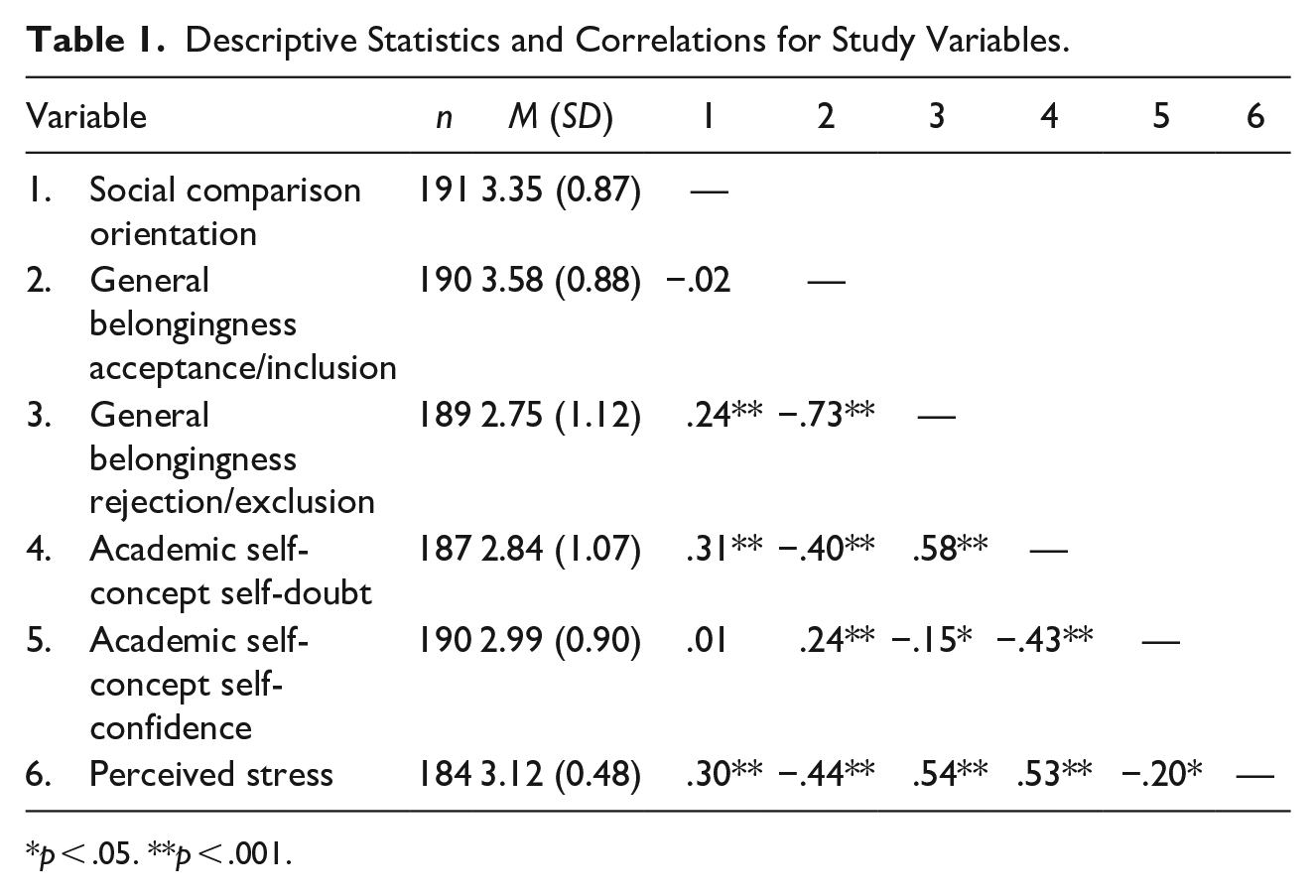
p < .05. **p < .001.
Mediation Analyses
Bivariate correlations demonstrated that social comparison orientation was not related to self-confidence and acceptance/inclusion, but was related to rejection/exclusion and self-doubt. As such, we proceeded with our mediation analyses using only rejection/exclusion and self-doubt as outcomes. Below, we organize each analysis by outcome.
Rejection/Exclusion
Multiple regression analyses assessed each component of the mediation model (see Figure 1). The results supported a significant association between the variables of interest, F(5,176) = 19.73, p < .001, R2 = .36. Controlling for students’ SES, b = −0.15, t(182) = −3.93, p < .001, and first-generation college student status, b = 0.38, t(182) = 2.42, p = .02, we found that students’ social comparison orientation was positively correlated with rejection/exclusion, b = 0.23, t(182) = 2.60, p = .01. We also found that social comparison orientation was positively correlated with stress, b = 0.15, t(182) = 3.93, p < .001. Additionally, we found that stress was positively correlated with rejection/exclusion, b = 1.15, t(182) = 7.51, p < .001.
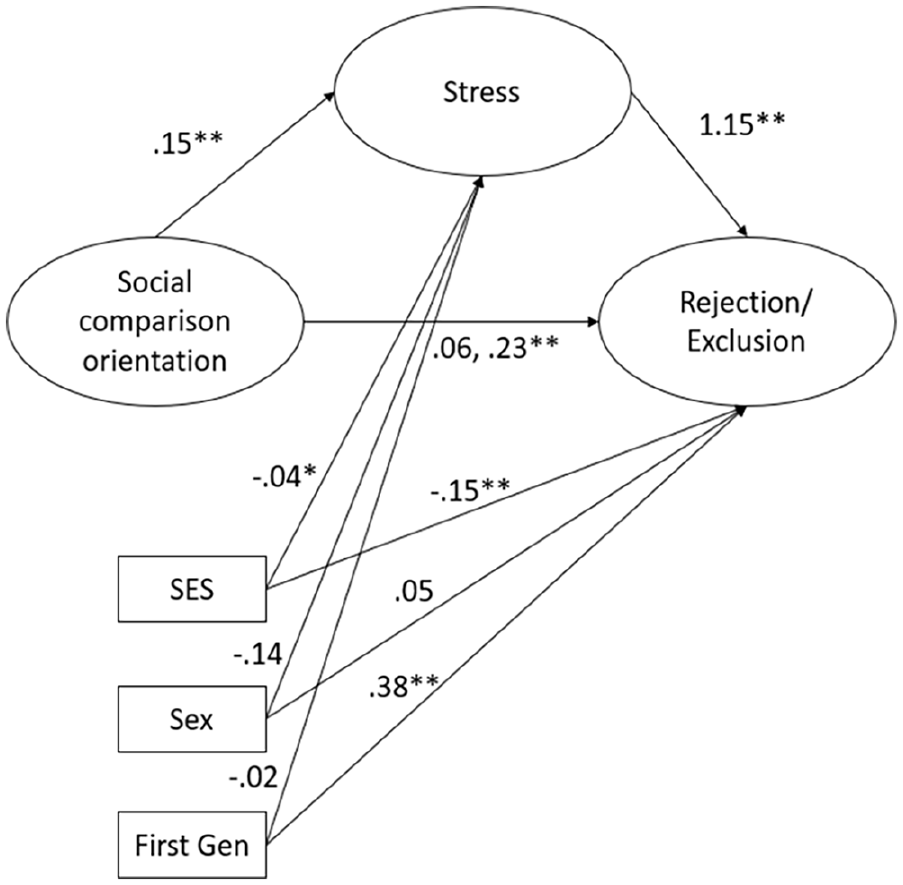
Mediation analysis of associations between social comparison orientation, stress, and rejection/exclusion.
Results from the mediation analyses confirmed the mediating role of stress in the relation between social comparison orientation and rejection/exclusion, b = 0.17, 95% CI [0.08, 0.26]. Moreover, results indicated that the direct effect of social comparison orientation on rejection/exclusion became insignificant, b = 0.06, t(182) = 0.74, p = .45, when controlling for stress, thus suggesting full mediation.
Academic Self-Doubt
Similar analyses were conducted with academic self-concept–self-doubt (see Figure 2). The results supported a significant association between the variables of interest, F(5,176) = 15.36, p < .001, R2 = .31. We found that students’ social comparison orientation was positively correlated with academic self-doubt, b = 0.38, t(178) = 4.19, p < .0001. We also found that social comparison orientation was positively correlated with stress, b = 0.16, t(178) = 3.98, p < .001. Additionally, we found that stress was positive correlated with academic self-doubt, b = 1.08, t(178) = 6.96, p < .001.
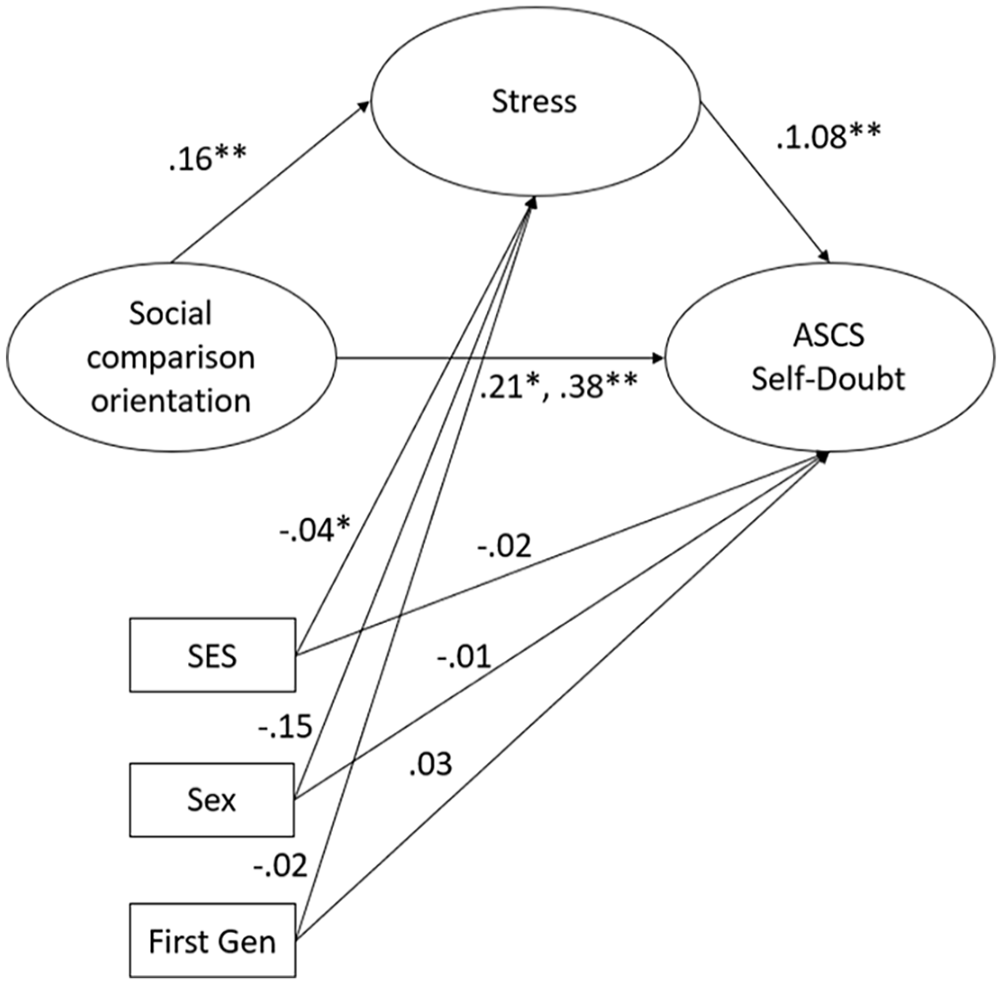
Mediation analysis of associations between social comparison orientation, stress, and academic self-doubt.
Results from the mediation analyses confirmed the mediating role of stress in the relation between social comparison orientation and academic self-doubt, b = 0.17, 95% CI [0.09, 0.26]. Moreover, results indicated that the direct effect of social comparison orientation was reduced, b = 0.21, t(178) = 2.52, p = .01, when controlling for stress, thus suggesting partial mediation.
Discussion
Our study focused on social comparison orientation’s association with belongingness, as it pertains to perceptions of acceptance/inclusion and rejection/exclusion, and academic self-concept, as it pertains to self-confidence and self-doubt. We were particularly interested in the experience of Hispanic students attending Hispanic Majority Institutions (HMIs; in which Hispanic students represent the numerical majority on campus). This membership in the majority group counters the trend for social comparison research, in which Hispanic students are usually studied as belonging to the minoritized group. In short, membership in the majority group may affect social comparison processes in ways that the literature has yet to explore.
We found mixed support for our hypotheses. Regarding Hypothesis 1 on belongingness, we found support for the hypothesis that social comparison orientation would be positively related to rejection/exclusion, but there was no association between social comparison orientation and acceptance. Similarly, when it came to academic self-concept, we found that social comparison orientation was positively related to self-doubt, but we did not find an association between social comparison orientation and self-confidence. We discuss these findings below, which may have implications for researchers and practitioners who work with students at Hispanic Majority Institutions.
Importantly, social comparison orientation significantly predicted the negatively valanced perceptions (i.e., rejection/exclusion, self-doubt), but was unrelated to the positively valanced perceptions (i.e., acceptance/inclusion, self-confidence). These findings held true even when we controlled for students’ subjective socioeconomic status, sex, and first-generation college student status. This pattern suggests that for Hispanic students at HMIs, the frequency of social comparison may be associated with feelings of being rejected or excluded within their academic environment, and to feelings of self-doubt about their academic abilities. However, the tendency to compare oneself to others does not necessarily decrease or increase feelings of acceptance/inclusion or confidence. These findings corroborate the idea that rejection/exclusion is not simply opposite of acceptance/inclusion (Malone et al., 2012). As such, programs and interventions focused on increasing belongingness and academic self-concept based on changing social comparison processes need to be mindful of whether the goal is to increase positive feelings of belonging/inclusion or to decrease feelings of rejection/exclusion. Based on our data, shifting social comparison orientation may be effective for lowering feelings of rejection/exclusion but ineffective for boosting feelings of inclusion/acceptance. G. A. Garcia (2017) highlighted that institutions classified as HSI should focus on several components to “serving” Hispanic students including a positive campus climate, community engagement, and support programs, in addition to the numerical outcomes such as enrollment and graduation rates.
In addition to demonstrating these associations, we examined stress as a potential mechanism to explain why social comparison orientation was associated with feelings of rejection/exclusion and academic self-doubt. First, we demonstrated that stress was related to both social comparison orientation and belongingness and academic self-concept, which supported Hypotheses 2 and 3. Then, we showed that stress fully mediated the relationship between social comparison orientation and rejection/exclusion, and partially mediated the relationship between social comparison and academic self-doubt, which supported Hypothesis 4. In other words, we found that higher social comparison orientation is associated with more stress, which is then associated with increased feelings of rejection/exclusion and academic self-doubt. These findings suggest that Hispanic students who are more prone to comparing themselves to others may face worse outcomes related to their academic experience, and this may be driven by stress.
Taken together, these findings may be best explained within the framework of minority stress theory (Frost & Meyer, 2023; Meyer, 2003). When thinking about what it means to be a Hispanic student attending an HMI, students may experience mixed sentiments. In one sense, students might find more comfort in the fact that their typical targets of social comparison are other Hispanic students. On the other hand, Hispanic students may experience distal (e.g., discrimination, harassment) and proximal stressors (e.g., feelings of stigma, expectation of rejection) that affect their well-being simply because they belong to a traditionally minoritized group (Frost & Meyer, 2023; Huynh et al., 2023). As such, perhaps sharing a space with many other Hispanic students can lead to reminders about their Hispanic identity within the broader societal context, and those students who are more prone to engaging in social comparison may be most likely to remind themselves of this context and experience the associated negative consequences.
Limitations and Future Directions
The study data were from a survey using previously validated scales with demonstrated robust reliability in previous studies and with our current study sample. However, given the cross-sectional nature of our approach, we did not directly influence participants’ social comparison orientation or other measures. Without experimental manipulation of one or more of these constructs, caution must be used to interpret these results as correlational and not causal in nature. Future research can aim to influence social comparisons in ways that may lower self-doubt and increase self-confidence, which can then lead to longitudinal research examining whether these changes can affect student success (e.g., persistence, retention, graduation) over time.
In order to maximize our sample size, we did not have any controls in place to limit participation by certain demographic factors. That is, we did not stratify our recruitment by any specific group (e.g., by sex). As such, we were not able to control for response bias or other forms of bias that could be introduced by this type of convenience sampling. For example, in our study, 75% of our participants identified as female, whereas 65% of the student population of Texas A&M University-San Antonio identifies as female. As such, future researchers with access to larger participant pools may elect to stratify their recruitment to ensure that the study sample represents their intended population to which they want to generalize their findings (e.g., to match with specific university settings).
Additionally, the data included in this study were from a specific demographic of mostly Hispanic, first-generation college students. Although findings based on these data can be helpful to institutions with a similar student population, it may not generalize to other universities such as Historically Black Colleges and Universities (HBCUs). The cultural and historical contexts of different universities where traditionally minoritized students are in the majority need to be closely examined alongside the demographic composition in of itself. As G. A. Garcia (2019) highlights via several case studies, each educational institution is different and may find different ways to support its students. Culturally engaging campuses are typically associated with a higher sense of belonging but understanding how other variables such as living conditions and employment situation are also important directions for future research (Museus et al., 2017). Regardless, it is important to conduct research that centers race (G. A. Garcia, 2019) in order to contribute to the literature on institutions other than Primarily White Institutions.
Importantly, our framework did not account for Hispanic students’ culture, identity, or experiences in shaping their mental health, well-being, or stress. Future works can fill in this gap, for example, by not only asking about whether students identify as Hispanic or not, but also about the degree to which they feel that identification and the degree to which they subscribe to cultural norms and values associated with being Hispanic. Finally, there are likely additional factors that may contribute to stress and self-doubt that we did not assess in our data collection. Stress can accumulate from many different sources based on both the external environment and interpersonal differences. Future research should continue exploring various contributors to stress for college students to better understand how to moderate and alleviate stress and improve the academic outcomes and overall well-being of students.
Conclusion
Our study examined associations between social comparison orientation with belongingness, academic self-concept, and stress in a sample of Hispanic students who attend Hispanic Majority Institutions. We found that students’ general inclination to compare themselves to others predicted stronger feelings of rejection/exclusion and self-doubt about their academic abilities, and that stress likely explains this relationship. These findings offer important insight on college students’ experiences and their quest for achievement within this landscape. This research may be particularly poignant for this population of students, who are underserved and under-studied, yet may continue to grow in numbers in the years ahead.
Footnotes
Acknowledgements
The authors thank two anonymous reviewers who provided constructive feedback that has helped to improve this manuscript.

Declaration of Conflicting Interests
The author(s) declared no potential conflicts of interest with respect to the research, authorship, and/or publication of this article.
Funding
The author(s) disclosed receipt of the following financial support for the research, authorship, and/or publication of this article: This project was supported by funding from the National Science Foundation Grant: 2222219.