



Abstract
In the United States, smoking rates increase with greater acculturation among Mexican-origin women, but not among men. Conversely, greater acculturation is associated with higher likelihood of quitting among Mexican-origin men who smoke, but not among women who smoke. Long-standing speculation is that adoption of smoking social norms in the U.S. that are less restrictive for women and more restrictive for men compared to smoking social norms in Mexico may account for these patterns. However, it is unknown whether persons who smoke actually perceive such differential norms. The current study characterized smoking social norms in the U.S. and Mexico among Spanish-speaking Mexican-origin persons who smoke. Two hundred and ninety Mexican-origin persons who smoke were surveyed on descriptive and injunctive norms for men and women in the U.S. and Mexico. Estimated means for smoking social norms in the U.S. and Mexico were compared separately among men and women. Among men, mean descriptive and injunctive norms in Mexico were significantly higher than those for the U.S. Among women, neither mean descriptive nor injunctive norms were significantly different between the U.S. and Mexico. Mexican-origin women who smoke perceive smoking among women as equally common and similarly unacceptable in the U.S. and Mexico. Findings do not support speculation that differential social norms may explain the acculturation-smoking relationship among Mexican-origin women. Mexican-origin men who smoke perceive smoking among men both less common and less acceptable in the U.S. compared to Mexico. Social norms should be investigated as a mechanism of the acculturation-cessation relationship among Mexican-origin men. Understanding direct and indirect influences of social norms on cessation among Mexican-origin men stands to inform tailoring of interventions.
Introduction
Although the smoking prevalence rate among Latinos is lower compared to their non-Latino White counterparts (9.9% vs. 15.9%; Cornelius et al., 2023), four out of five of the leading causes of death among Latinos are related to commercial tobacco use (Dominguez et al., 2015). On average, Latino persons who smoke are less likely to smoke on a daily basis (Sakuma et al., 2016; Trinidad et al., 2009) and more likely to smoke <10 cigarettes per day on the days they smoke compared to non-Latino White persons who smoke (Rodriquez et al., 2016; Zhu et al., 2007). This less severe smoking pattern is particularly common among Latinos of Dominican, Mexican, Central American, and South American descent (Kaplan et al., 2014), and is indicative of lower average levels of physical dependence on nicotine. Thus, one might logically predict that Latino persons who smoke should be more successful at quitting, but in fact they are no more successful (or less successful) at quitting compared to non-Latino white persons who smoke on average (Babb et al., 2017). What is more, the evidence supporting the efficacy of existing smoking cessation interventions among Latinos indicates modest effects at end of treatment and no long-term effects (Webb et al., 2010). Together, these data suggest physical dependence may not be a strong determinant of cessation among Latinos. As such, current interventions, which generally place a large emphasis on coping with symptoms of dependence, may not sufficiently address those factors that are relevant to maintaining smoking among Latinos. Unfortunately, the development of effective smoking cessation interventions for Latinos who smoke is hampered in part by the paucity of research that seeks to understand the factors that influence smoking and cessation among Latinos (Castro, 2016).
Though research on determinants of smoking and cessation among Latinos is relatively limited, one variable that has been extensively studied is acculturation, or the psychological process of selectively adopting and maintaining the beliefs, values, identities, and practices of host and heritage cultures (Schwartz et al., 2010). It has been consistently demonstrated that acculturation impacts smoking differently for Latino men versus women. Specifically, greater acculturation (as measured by place of birth, language fluency or preference, as well as composite scores on self-report scales of acculturation) is associated with greater likelihood of smoking among women, but there is no association between acculturation and smoking among men, and this holds true across multiple Latino heritage subgroups (Bethel & Schenker, 2005; Kaplan et al., 2014). Only two studies have examined gender differences in the association between acculturation and smoking cessation. Both found that greater acculturation is associated with greater odds of quitting among men, but found no association between these variables among women (Castro et al., 2009, 2019). The mechanisms accounting for these associations have not been studied, but in both cases, speculation has implicated social norms about smoking (Bethel & Schenker, 2005; Castro et al., 2009).
Much of social norms theory and its application focuses on two components: (1) descriptive norms and (2) injunctive norms (Lapinski & Rimal, 2005). Descriptive norms refer to one’s beliefs about how commonly a behavior is practiced within a group or society. Injunctive norms refer to one’s beliefs about the acceptability or appropriateness of a behavior within a group or society. With regard to the observed gender-differentiated associations of acculturation with smoking and cessation, it has been speculated that smoking among Latinas may increase with greater acculturation due to the adoption of social norms that portray smoking among women as more common and/or more acceptable in U.S. culture relative to Latino cultures (Bethel & Schenker, 2005; Castro et al., 2009). Similarly, social norms that portray smoking among men as less common and/or less acceptable in U.S. culture relative to Latino cultures may explain observed associations between acculturation and cessation.
Research generally supports social norms as determinants of smoking and cessation (Dono et al., 2020), including among Latinos (Echeverría et al., 2015; Rodríguez-Bolaños et al., 2021). Though no work has examined changes in perceived social norms as a function of acculturation, the notion that social norms are personal beliefs that could change while an individual navigates and interacts with a second culture is highly consistent with current acculturation theory (Schwartz et al., 2010). However, speculation about the role of social norms in explaining the observed associations between acculturation and smoking behaviors rests on one very basic assumption which has not been empirically tested. Namely, it is not known whether Latino who smoke actually perceive such differences in smoking social norms between U.S. and Latino cultures. As such, the purpose of the current study was to characterize Mexican and U.S. descriptive and injunctive smoking social norms among Mexican-origin persons who smoke, and examine differences by gender. Such data is needed to evaluate the viability of long-standing speculation on social norms as a mechanism of the relationships between acculturation and smoking among Latinos, which can in turn guide the identification of culturally relevant targets of intervention for Latinos who smoke.
Methods
Participants
Data for the current study comes from a larger data collection project aimed at examining the psychometric properties of self-report measures of dependence on commercial tobacco (Castro et al., 2022). The priority population for this study was Spanish-speaking persons of Mexican origin who smoke cigarettes. Inclusion criteria were: (1) self-identification as Mexican or Mexican American; (2) at least 21 years old; (3) possess valid contact information; (4) self-report of Spanish as the only or preferred spoken language; (5) identification as a current smoker, defined as (a) having smoked at least 100 cigarettes in one’s lifetime and (b) currently smoking every or some days. Exclusion criteria were: (1) current use of any smoking cessation aide or (2) current participation in a smoking cessation intervention.
Procedures
Data for the current study were collected in March and April of 2019. Participants were recruited via community health fairs or other in-person outreach events, social media advertisements, and through a survey panel service. All study procedures were conducted in Spanish by bilingual members of the research team who identified as Latino. Eligibility status was determined via telephone, in-person, or online screening. All questionnaires were administered in Spanish, and all had validated Spanish-versions publicly available-thus no translations of these scales by the research team were necessary. Participants completed traditional paper/pencil or online questionnaires. Upon completion of questionnaires, all participants received $40 in the form of cash or an online gift card, or a compensation agreed upon between the participant and survey panel service. Study procedures were approved by the Institutional Review Board of the University of Texas at Austin.
Measures
Demographics
Sociodemographic variables used in the current study were age, gender, educational attainment (less than or equal to a high school diploma/GED vs. more than a high school diploma/GED), daily smoking status (i.e., whether or not the participant smokes on a daily basis). Proportion of one’s life spent residing in the U.S was used as a sociodemographic proxy of acculturation.
Social Norms
U.S. and Mexican descriptive and injunctive smoking norms were assessed through a set of eight questions adapted from existing survey questions on societal injunctive and descriptive norms (East et al., 2017). Four questions focused on descriptive norms, where participants estimated smoking prevalence among men and women in the U.S. and Mexico (e.g., “Out of every 10 men in the U.S., on average, how many do you think smoke cigarettes?,” “Out of every 10 women in Mexico, on average, how many do you think smoke cigarettes?”). Participants rated their response on a scale from 0 (none) to 10 (all). Four questions focused on injunctive norms, where participants rated their perceptions of the appropriateness of smoking for men and women within the U.S. and Mexico (e.g., “In your opinion, how much do people in the U.S. generally approve or disapprove of men smoking cigarettes?,” “In your opinion, how much do people in Mexico generally approve or disapprove of women smoking cigarettes?”). Participants rated their responses on a scale from 1 (extremely disapprove) to 5 (extremely approve). Each question was used as a single-item measure of its respective social norm.
Data Analysis
Descriptive statistics were calculated for all variables used in the current study. Wald tests of parameter constraints were used to test differences in mean ratings of injunctive and descriptive norms for the U.S. versus Mexico. Full information maximum likelihood estimation was used to account for missing data. Analyses were stratified by gender. Analyses among women examined norms for women, and analyses among men examined norms for men. Thus, a total of four tests of mean differences were conducted. Age, educational attainment, proportion of life in the U.S., and daily smoking status were used as covariates. Analyses were conducted with Mplus Version 8 (Muthén & Muthén, 1998).
Results
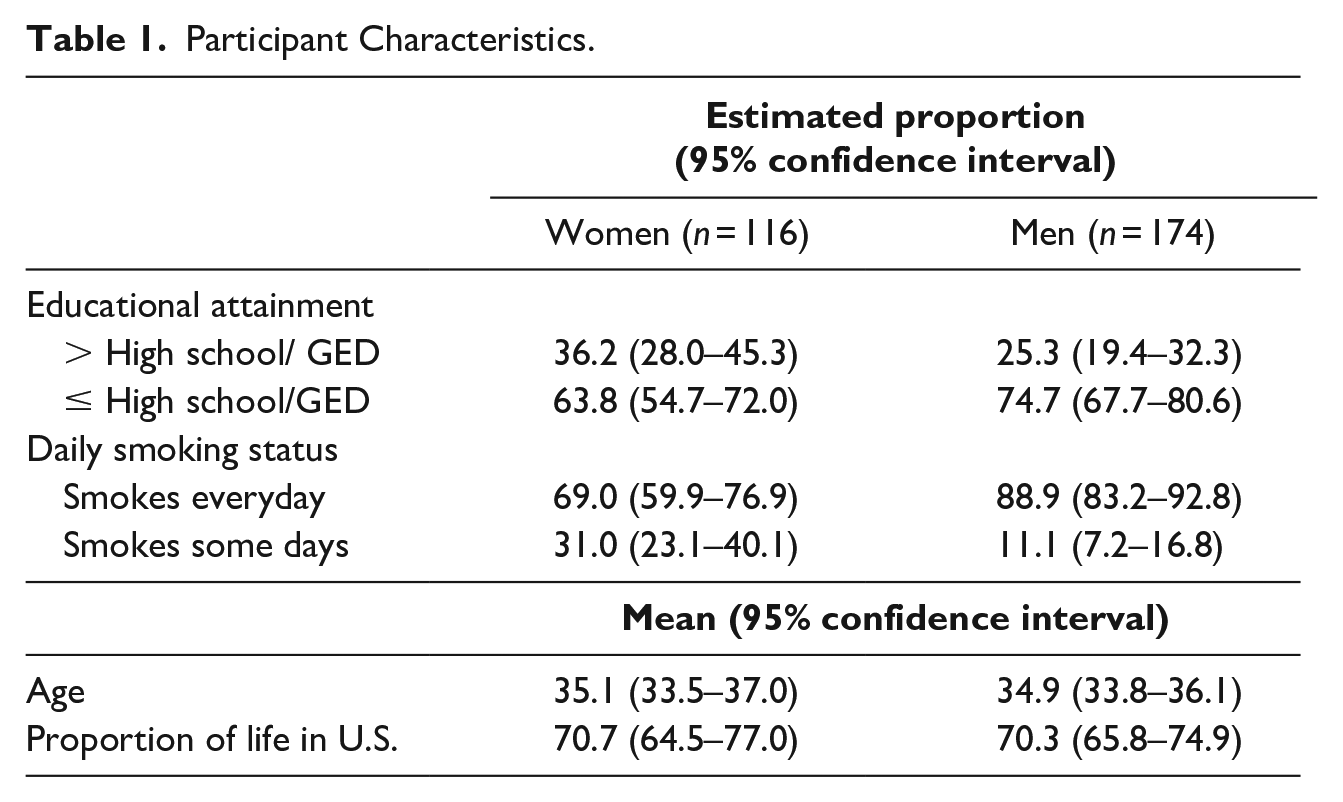
A total of 290 Mexican-origin persons who smoke participated in the current study (174 men and 116 women). Missing data rates were low, ranging from 0% for age and gender to 2.1% for daily smoking status. Participant characteristics are summarized in Table 1. The majority of participants had at least a high school education and smoked on a daily basis. On average, participants were 35 years old and had spent approximately 70% of their life residing in the US. Men and women were similar in mean age and mean proportion of life spent in the U.S. Men were significantly more likely to smoke on a daily basis (odds ratio = 3.59, 95% confidence interval = 1.93–6.68) and to have completed at least a high school education (odds ratio = 1.67, 95% confidence interval = 1.01–2.79) compared to women. Table 2 summarizes mean social norms ratings adjusted for covariates and stratified by gender. Both men and women consistently rated each social norm for women significantly lower than the respective social norm for men (all ps < .001).
Participant Characteristics.
Adjusted Mean Norm Ratings.
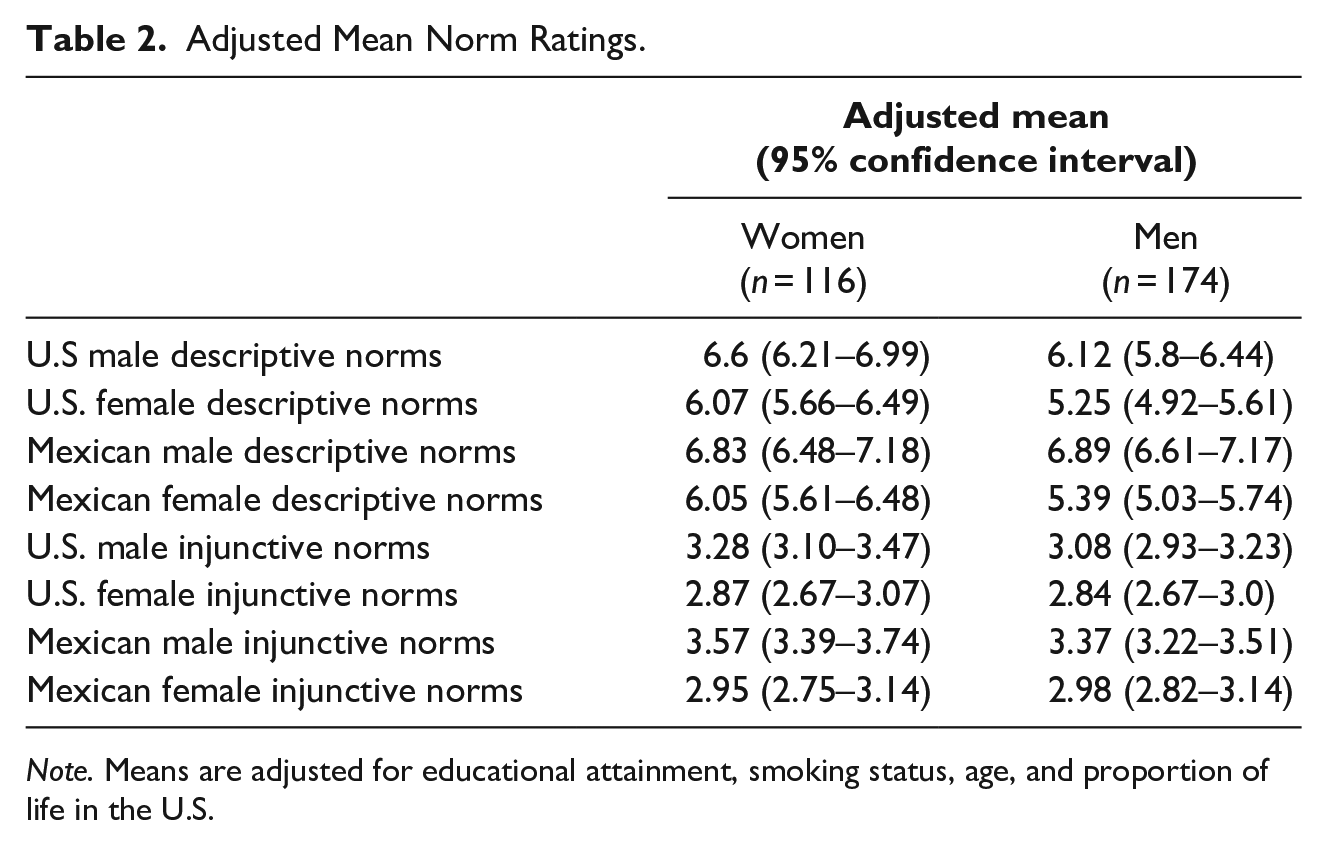
Note. Means are adjusted for educational attainment, smoking status, age, and proportion of life in the U.S.
Comparisons of U.S. versus Mexican mean social norms ratings, stratified by gender, are summarized in Table 3. Adjusting for covariates, men perceived that 6.12 out of 10 men smoke in the U.S., and that 6.89 out of 10 men smoke in Mexico on average. These mean ratings were significantly different (Wald [df = 1] = 32.58, p < .0001). Adjusted mean ratings of injunctive norms among men were 3.08 for the U.S. and 3.37 for Mexico. These mean ratings were significantly different (Wald [df = 1] = 15.3, p < .001) and indicate that, on average, the men perceived that smoking among men is slightly more acceptable in Mexico compared with the U.S.
Summary of Comparisons of U.S. Versus Mexican Norms.
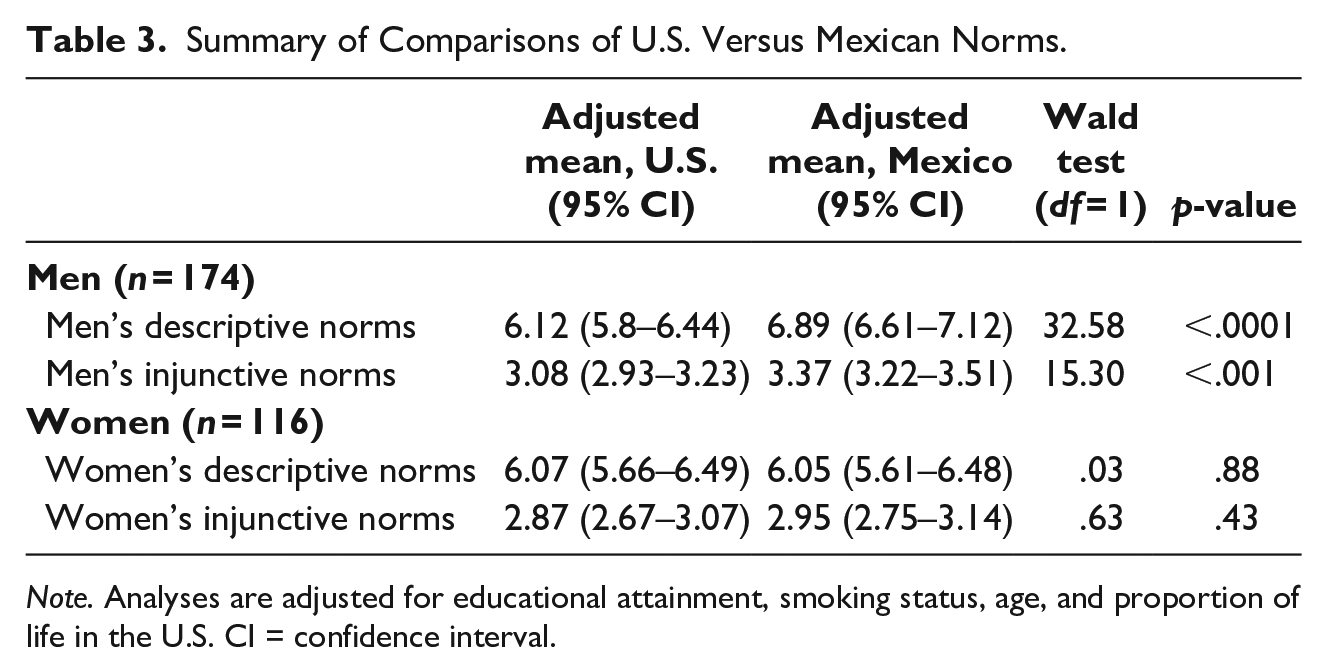
Note. Analyses are adjusted for educational attainment, smoking status, age, and proportion of life in the U.S. CI = confidence interval.
Adjusting for covariates, women perceived that 6.07 out of 10 women smoke in the U.S., and 6.05 out of 10 women smoke in Mexico on average. These ratings were not significantly different (Wald [df = 1] = .03, p = .88). Adjusted mean ratings of injunctive norms among women were 2.87 for the U.S. and 2.95 for Mexico. These ratings were not significantly different (Wald [df = 1] = 0.63, p = .43) indicating that, on average, the women perceived that the acceptability of women smoking was similar in the U.S. and Mexico.
Discussion
The purpose of this study was to characterize smoking social norms among Mexican-origin men and women who smoke. To the best of our knowledge, this is the first study to empirically test the speculation that Latino women and men perceive different smoking norms between U.S. and Latino cultures. Among Mexican-origin men, male smoking was perceived as significantly more common and more acceptable in Mexican culture compared to U.S. culture. Among Mexican-origin women, neither the perceived prevalence nor perceived acceptability of female smoking was significantly different between Mexican and U.S. cultures.
Results provide mixed support for the argument that selective adoption of social norms accounts for the association between acculturation and smoking behavior among Latino men and women. The lack of a significant difference in perceived social norms between Mexico and the U.S. among women contradicts the assertion that adoption of more permissive U.S. norms explains the higher smoking prevalence among Latinas with more time in the U.S. In contrast, the observation of more restrictive U.S. norms for men versus Mexican norms, lends credence to the possibility that adoption of U.S. norms may at least partly explain the increase in quitting among Latinos with more time in the U.S. Pursuit of knowledge on how to capitalize on the direct influence of social norms, as well as understanding their indirect influences, on quitting among Latino men is a promising avenue for research that can inform tailored interventions for this important population of persons who smoke.
The less restrictive Mexican smoking norms for men observed here could be related to differences in regulations and enforcement of anti-smoking policies between the U.S. and Mexico. It is only relatively recently that tobacco control programs and policies have been intensively implemented in Mexico to decrease smoking prevalence (Thrasher et al., 2010), and yet remain to be as strictly enforced as they are in the U.S. (Reynales-Shigematsu et al., 2019; Thrasher et al., 2008). It is important to acknowledge that given this reasoning, one should expect similar differences in U.S. versus Mexican norms among women, which were not observed here. One possibility is that pressure to conform to gender-role expectations may have a similarly strong influence on the suppression of women’s smoking behaviors in both cultures, leaving little variation to be explained by other factors. This is consistent with the higher smoking prevalence rates among groups of women who are perceived as not conforming to traditional gender-role expectations (e.g., lesbian, bisexual, or women who have sex with women; Conron et al., 2010; Gruskin et al., 2007). This is not to say that conformity to gender-role expectations should be encouraged; rather it is merely a testament to the critical—but still too often ignored—influence of cultural factors on smoking behavior. Results of the current study underscore the importance of continued examination of cultural factors as determinants of smoking and cessation.
Given the current findings among men, it remains to be reconciled why Latino men’s smoking prevalence rates do not decrease with greater time in the U.S. One possibility is that smoking social norms in the context of acculturation may only be relevant to smoking behaviors among those who already engage in smoking, whereas prevalence rates consider persons who currently smoke, formerly smoked, and have never smoked.
Current findings should be considered in light of some limitations. The study sample consisted of a convenience sample of entirely of Mexican/Mexican American persons who smoke. Although recruitment was limited to Spanish-speaking Mexican-origin persons who smoke to allow for meaningful examination of within-group differences and respect the heterogeneity of the broader Latino population, this approach limits the generalizability of current findings to the larger population of Latinos who smoke. Future research should examine smoking social norms among English speaking Mexican persons, as well as Latinos from other subgroups as these characteristics may influence social norms. This study aimed only to characterize smoking social norms among the study sample. Thus, while it may provide insights into predictions about the relationship between smoking social norms and smoking behaviors among Latinos of Mexican decent, study findings cannot speak directly to those associations. Research that leads to a better understanding of smoking social norms among Latinos who smoke will be important to informing interventions that attempt to change perceptions about smoking among these populations. Finally, this study does not account for recency or frequency of contact, exposure, or return to Mexico, which could influence perceptions of smoking norms.
More generally, research that examines other more specific values, beliefs, practices, etc., that are thought to explain observed associations between the broader construct of acculturation and smoking behaviors among the Latino population is warranted. Greater knowledge about cultural processes among Latinos who smoke may inform the development of more effective tailored smoking cessation interventions, and overall help minimize disparities associated with smoking.
Footnotes
Acknowledgements
Authors Y. Castro and Z.C. Guerra contributed equally to this manuscript.
Declaration of Conflicting Interests
The author(s) declared no potential conflicts of interest with respect to the research, authorship, and/or publication of this article.
Funding
The author(s) disclosed receipt of the following financial support for the research, authorship, and/or publication of this article: This project was funded by grant R21MD011431 from the National Institute on Minority Health and Health Disparities. Preparation of this manuscript was additionally supported by grants T32HL140290 from the National Heart, Lung, and Blood Institute, K01AA029473 from the National Institute on Alcohol Abuse and Alcoholism, and K01MD017631 from the National Institute on Minority Health and Health Disparities. The contents of this manuscript are solely the responsibility of the authors and do not necessarily represent the views of the National Institute of Health.
