




Abstract
This study sought to understand the contribution of repeat adolescent summer camp experiences within the larger landscape of adolescent faith formation. Using a qualitative approach with a sample of former, multi-year attendees of Christian camps in Wisconsin and Michigan, this study demonstrated that Christian summer camps may help facilitate the development of owned faith and foster affiliation with the body of Christ.
Introduction
The faith of the next generation has long been a concern for Christians. Beginning with the nation of Israel and biblical commands to teach and guide children (Deuteronomy 6:7, 11:19), the importance of forming faith in young people is evident. From the Didache—a highly structured guide to faith formation used in the first and second centuries (Milavec, 2003)—to the development of confirmation classes and the emergence of modern youth groups, it is clear that cultivating a strong and lasting faith from a young age is an essential task of Christian education. In the last two decades, as the tides of culture have shifted, significant time and money have been dedicated to understanding faith formation, specifically in the 21st century, in hopes that parents, communities, and ministry leaders might enhance and ensure faith formation in this population (Dean, 2010; Kinnaman, 2016; Kinnaman & Matlock, 2019; Powell & Clark, 2011; Setran, 2013; Smith & Denton, 2005).
More broadly, in the last century, many authors have attempted to unpack and describe the process of faith formation by integrating theology, psychology, sociology, etc. and presenting a framework for thinking about how people come to faith. Although each is unique, one thing they all seem to have in common is that they identify a transition point where a person's faith becomes their own. Fowler's (1981) theory of faith development, for example, identifies eight stages of faith formation, and his fourth stage, individuative–reflective faith, describes the beginning stages of faith internalization—the process undertaken when someone begins to make their faith their own. More recently, Maddix et al. (2020) also used the language of stages to describe the process of faith formation and identify four stages of faith—converging, consolidating, conforming, and contagious. The third stage, conforming faith, describes an equipping stage of faith formation where people connect with others and begin to live out the commands of the gospel with personal conviction. To offer one more perspective, Westerhoff (2012) proposed four styles of faith—experienced, affiliative, searching, and owned. His description of the fourth style, owned faith, shared points of connection with Fowler (1981) in terms of differentiation, as well as with Maddix et al. (2020) in terms of conviction and lived faith that come because of both cognitive advancements and personal experiences of faith. For Westerhoff (2012), owned faith ultimately describes people with a personal identity that is deeply connected to faith and who are committed to embodying that faith. Taken together, it is clear that in all three views of faith formation, there is an important step related to the development of a sense of personal (i.e., owned) faith. At some point, faith needs to be internalized and incorporated into ones’ sense of being for it to remain relevant.
It is evident from these studies and theories that faith formation for young people is ecological—multiple factors play a role in the process, and there is no single source of faith formation. However, although a fairly common experience for children and youth in church communities, one potential component of the ecology of faith formation that is rarely if ever included in these studies is Christian camping ministry. In 2016, Sorenson noted that “the curious thing is that camp is almost entirely absent from the youth ministry literature” (p. 58). Sorenson (2016) goes on to explore how when camp is included in the literature, it is often included in a negative light as an example of an emotionally charged, shallow, and short-lived faith (p. 59–63).
Since the early 1900s, Christian camping has existed as a ministry to contribute to the faith formation of young people (Graendorf, 1979; Sorenson, 2021). The concept of camping as a ministry context in general can be traced back even further in history to the early 1800s and the Second Great Awakening when people began gathering in outdoor contexts for an extended period of time to pursue God in community (Sorenson, 2021). From there, the development of youth societies, such as the Young Men's Christian Association, as well as the development of training programs, such as the Chautauqua movement, all contributed to the growth of Christian camping (Sorenson, 2021). In more recent history, it was the development of the Christian Camp and Conference Association (CCCA) and the professionalization of Christian camp leadership that solidified Christian camping as one of many faith formation efforts within the broader Christian world. Worldwide, the Christian camping movement is led and supported by Christian Camping International (CCI), an organization that, in 2018, reported having over 25,000 members across 90 countries (cciworldwide.org). In the United States specifically, today, there are nearly 1000 Christian camps (ccca.org).
Despite its continuous growth and strong faith-formation purpose, there is a surprising lack of studies on the faith-related impacts of the Christian camping ministry. Highlighting this issue, Ribbe (2010) noted that “for too long, camp leaders have run their ministries with wonderful hearts, compelling vision, and undying effort, but with little qualitative and quantitative understanding of how camp experiences actually change lives” (p. 159). Since 2010, a few dissertations and a handful of scholarly articles have explored the nature and impact of Christian summer camp experiences, all demonstrating strong evidence of a unique pedagogical method and impacts that last long after the last day of camp. For example, Brandes (2018) utilized a narrative inquiry method to explore Christian summer camps as an alternative model for spiritual development and suggested that these experiences provide a new and different narrative of faith formation that focuses on identity, integrity, purpose, belonging, sense of worth, capacity to care, and reflectiveness. Additionally, several projects led by Dr. Jacob Sorenson (2016, 2018, 2021) have indicated that Christian summer camps foster growth in both rational and relational elements of faith, with the most lasting impact in engagement with Christian communities and living out one's personal faith. While Sorenson (2016, 2018, 2021) has made great strides in advancing our understanding of Christian summer camp experiences, an understanding of where Christian summer camps fit in the landscape of faith formation and what they offer in terms of long-term faith formation is needed.
This study sought to address this need by exploring the experiences of former, repeat attendees at Christian summer camps in Wisconsin. Specifically, it sought to answer the following research question: What are the distinct faith-formation outcomes and processes of repeated evangelical Christian camp experiences during the adolescent years? Acknowledging that everyone's experience of summer camps is different, it intentionally sought to identify the power of camp when the return rate was high, and when participants held onto their faith into young adulthood. Ultimately, it gives a picture of the possible impact that summer camp experiences can have when used to the fullest extent and experienced positively.
Method
This section will provide an overview of the research design, sample selection and demographics, and data collection/analysis procedures. The study was completed as a dissertation in a Doctor of Philosophy program, and this publication will focus only on the methods and results associated with the research question identified above.
Research Design
This study utilized a qualitative research approach. Data were collected through interviews with former repeat campers at evangelical Christian camps in Wisconsin that met the specified criteria for participation. A semi-structured interview protocol was developed that addressed the research question while allowing room for participants to expand beyond the boundaries of the question and enhance the researchers’ understanding of the topics being explored (Merriam & Tisdell, 2015, p. 110; Patten & Newhart, 2018, p. 161; Taylor et al., 2015, p. 102). Interviews were conducted over video conference, recorded, and transcribed.
Sample and Participants
A combination of stratified and purposive sampling was used for this study. First, evangelical camps within Wisconsin were identified using the Christian Camp and Conference Center database. At the time of the study, there were 23 camps affiliated with the organization in Wisconsin. Each of these camp's program offerings was then reviewed to identify camps that met the following criteria:
The camp represented evangelical, theological commitments or traditions. Program offerings existed for adolescents ages 12–18 that are residential, overnight, at least 5 days in length, and not sanctioned by church/youth organizations, such that participants came as part of a pre-established group. The mission statement provided clear evidence of a desire to foster spiritual formation, discipleship, connection with God, or personal spiritual growth. Between the ages of 18 and 25 Attended camp for two or more years between the ages of 12 and 18 Considered themselves practicing Christians Had a relationship with at least one Christian person who influenced their faith outside of camp (one or more of the following: family member, peer, or non-parental mentor)
After reviewing each of the 23 camp webpages, 17 were identified that fit the criteria for inclusion. One additional camp on the border of Wisconsin and the Upper Peninsula of Michigan was also purposefully invited to participate when response to the screening questionnaire slowed, but more participants were needed. The researcher contacted the director of each of these sites with information about the study and invited them to collaborate in the identification of possible participants. A total of 12 camps were willing and able to collaborate and were then asked to use their camp management software or database records to identify individuals who attended camp for two or more years between the ages of 12 and 18 and that were currently between the ages of 18 and 25. Each camp then sent a screening survey created by the researcher to those individuals to collect basic demographic data and identify people who met the following individual participation criteria:
The screening questionnaire confirmed their camp attendance history (criteria 1 and 2, above) and identified participants who could speak to the experience of camp as it relates to other faith formation efforts to help clarify not just the outcomes of camp, but how camp fits within the larger landscape of faith formation (criteria 3 and 4, above). A fifth criteria, lack of summer camp staff experience, was initially included, but later dropped because many camps only had contact information for those that had also worked at camp in some capacity. A total of 153 people from 10 camps completed the questionnaire, 42 of which were ineligible based on their responses to the screening questionnaire. Email lists were not collected from the camps; therefore, it is not known how many people received the invitation to the screening questionnaire. As a result, it is not possible to calculate a response rate for the survey. Initially, the researcher randomly selected participants from each camp in an attempt to gather balanced representation, but slow response rates led to everyone that completed the screening questionnaire receiving an invitation for an interview. In the end, a total of 29 individuals were interviewed and included in the study. Interviews ranged from 17 to 45 min in length, and the data collection process lasted a total of 5 weeks.
Analysis
After completing the interviews, the grounded theory approach to qualitative data analysis was used to allow themes related to the research question to emerge from the interviews themselves (Corbin & Strauss, 1990, p. 61). A multi-stage axial coding process was undertaken to move from codes to themes that provide a response to the research question (Creswell & Poth, 2018, p. 85; Saldaña, 2016, p. 15). Participant feedback through followup conversations with six participants to discuss the initial findings was used to ensure validity of the data and refine the findings.
Results
This publication reports on the results related to the first research question of a larger dissertation. The research question explored was as follows: What are the distinct faith-formation outcomes and processes of repeated evangelical Christian camp experiences during the adolescent years? In the end, a total of 29 former summer campers from eight Christian summer camps in Wisconsin were included in this study. The sample was predominantly female, and the majority had worked at a Christian summer camp as a staff member as well. A full overview of the sample demographics is presented in Table 1. In addition to the demographics in Table 1, each of the participants reported having both familial and non-familial influences on their faith outside camp, and none of them reported professing faith or receiving salvation for the first time while at camp. In other words, the participants in this study all come from Christian backgrounds, and their summer camp experiences were part of an ecology of faith influence.
Participant Demographics.
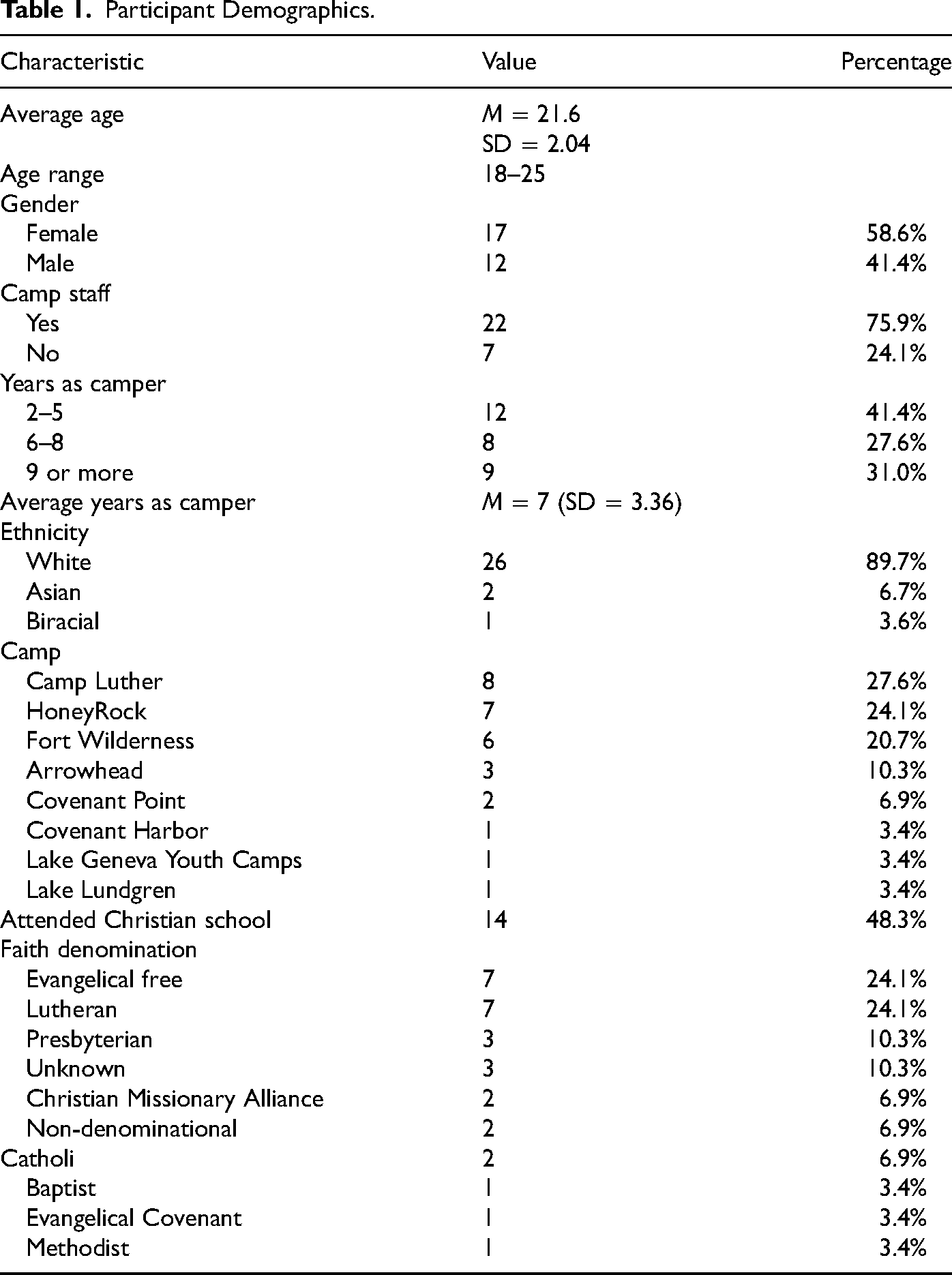
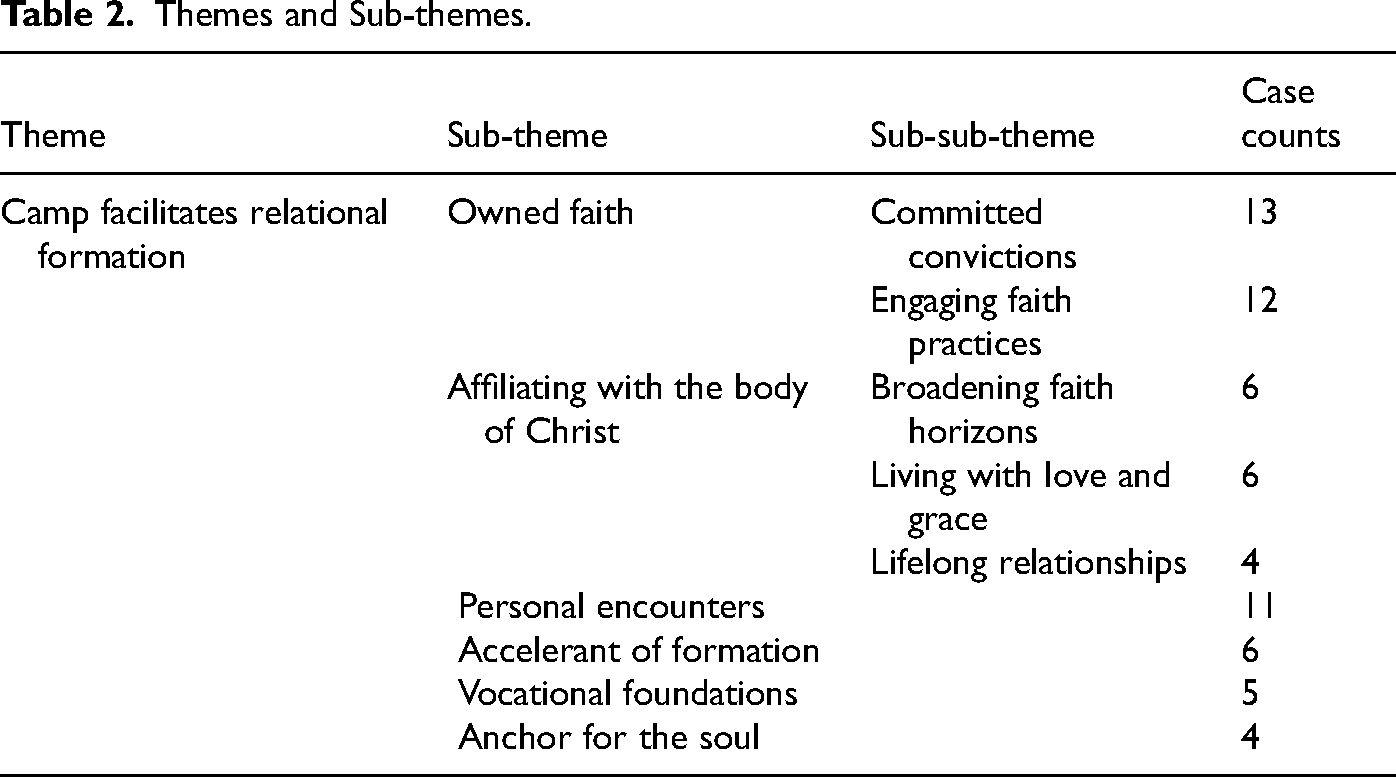
Using the grounded theory coding process described previously, several themes and sub-themes were identified related to the research question. An overview is provided in Table 2, and each of the themes and sub-themes will be explored in the rest of this section. All names given are pseudonyms.
Themes and Sub-themes.
Camp Facilitates Relational Faith
When analyzing data axially and identifying a thematic structure, there was strong evidence that Christian summer camp experiences helped to facilitate the formation of essential faith relationships, specifically, relationships with God and others. Ultimately, three strong sub-themes emerged: owned faith, affiliating with the body of Christ, and personal encounters with God. In addition, three weaker sub-themes also emerged that are worth noting: camp provides an anchor for the soul, camp accelerated formation, and camp influences vocational foundations. Each of these will be discussed in turn in the remainder of this section.
Owned Faith
By far, the strongest outcome of repeated Christian summer camp experiences during the adolescent years was a sense of owning one's faith. A total of 18 participants referenced this concept. The language of “owned faith” is borrowed from Westerhoff's (2012) four styles of faith and effectively summarizes the ways in which adolescents took hold of their faith and claimed it as ‘theirs.’ Two primary sub-themes describe what happened: engaging faith practices and developing committed relationship.
Engaging Faith Practices. One of the core components of owning faith was the development of and engagement in habits and disciplines of faith. For the participants in this study, camp introduced them to faith practices that they continued to practice outside of camp. Bible reading, Sabbath, solitude, journaling, prayer, worship, and participating in community were all mentioned within this subtheme. While most participants in the study were aware of these practices conceptually, camp was a place where they were given guidance on their value and on how to actually engage in them. Christine shared that camp helped her understand that faith requires engagement beyond just knowing things. She said: “I think realizing that it was more than just knowing and like I needed to, personally, like, dig into the Word but then personally also, learn to love others.”
Laura said that camp taught her the “…value of [spiritual practices] even though she was doing them before.’
Leah shared similar sentiments and talked about how the staff at camp were also talking about the importance of Bible reading. Seeing their commitment to that practice led to her feeling a sense of conviction about the need to integrate it into her own life, and she returned home and developed a practice of Bible reading that continues today.
Ashley and Marci both talked about Sabbath and solitude and the ways that camp helped them develop and appreciate the habit of slowing down for rest and time alone with God. Marci said: “I take a Sabbath on Sundays because of that solo time that I had at camp, and I valued that and I was like, I want to take a Sabbath. I don't do homework. I get it all done Saturday. That way I can just spend time with God on my Sunday afternoon. And so like things like that, like that's not a habit that I would have had at home. That's not something that I was shown at home.”
With regard to worship and weekly community gatherings, Melissa developed love and appreciation for worship at camp: Rebekah learned that worship is something that allows us to connect with God and authentically praise him; and Nate developed a conviction that he needed to commit to finding and contributing to a church community on a weekly basis. Elaina was the only participant that talked about journaling specifically, but her story was powerful because it illustrated how God used camp to provide her with a way to engage faith that fit her personality and needs. It was actually one of my camp counselors who recommended I start journal praying, which I guess that's one of the things that now I still do and even like, I have a whole bookshelf of all my journals. And so for me, like that was something that was again just like revolutionary of like, oh my gosh, I can write whatever I want…and so like for me, like it's so funny now, like, looking back at journals where it's like, you know, just like, very raw emotion and I'm so thankful that I felt the freedom to be able to do that. It seems so simple, but it's like, until someone like, told me that was a thing, I didn't even know I could pray that way. So yeah, I think that was like pretty revolutionary for me.
Committed Relationship. A second component of owned faith was the development and affirmation of a committed relationship with Jesus Christ. Thomas explained the basic idea behind this theme well. He said: “I would say most kids become a Christian just because of their parents telling them to be a Christian…[but] the more years I went [to camp] it became my faith.”
Donna offered a similar reflection. She said that camp solidified “that I wanted my life to be dedicated to Jesus.” For Korey, being at camp ushered in self-reflection about his commitment to God. He said: You just think about your faith, you start to actually start to think about it more. You start to pray more. You start to question it more. You start to think like, hey, are you actually committed into doing this? Like, are you ready for this journey? Are you ready to just take that leap?
Some people like Scott and Rebekah talked about finding their identity in Christ and how camp helped solidify that self-understanding and connection with God. Rebekah talked about finally realizing and accepting the fact that she was a “child of God.” Others like Leah said that camp helped them move beyond rote actions to real faith. Using slightly different language, Marci felt that camp played a crucial role in helping her develop “a personal relationship with God.” She commented that she did not think she would be personally committed to Christ today if it were not for camp, despite growing up in a Christian home. She said, “I am just really fortunate that I got to know God at a young age, but I wouldn’t have followed him—like made the personal decision myself—if it weren’t for camp.”
For all of these participants, camp provided the space and connections they needed to make personal commitments to faith apart from their family. This, along with the development of spiritual practices, helped to solidify owned faith.
Affiliating with the Body of Christ
The second theme related to outcomes and impact was affiliating with the body of Christ. In addition to developing a sense of owned faith, participants began to affiliate with and contribute to their community at camp. Two primary sub-themes as well as one weaker sub-theme emerged in this section. The stronger sub-themes included broadened faith horizons, which describe participants growth in understanding of and appreciation for other backgrounds and approaches to faith, and the second, loving with love and grace, describes how participants developed specific skills and traits associated with serving others in their community.
Broadened Faith Horizons. Since most participants attended camp on their own or with a few pre-existing friends, at camp, participants had the opportunity to meet and interact with people from very different backgrounds. This experience broadened the participants’ understanding of how faith is experienced and practiced in other cultures and sub-cultures. Emily described the experience clearly. She said: “I think meeting new people that don't come from your same community at home can really afford you the opportunity to learn about other people, about other cultures, about other races, about other ethnicities, about how God is way bigger than our one expression and our home church and how different people practice, how different people do things, is all pointing to how big and expansive God is, and creative God is kind of, so that is another real benefit.”
Living with Love and Grace. In addition to expanding faith horizons, some participants talked about learning to extend their own personal faith into their interactions with others specifically by serving, leading, and loving others. George reflected that he did not feel that his church did a very good job of challenging him to “live out his faith.” He felt like he knew a lot about God and faith, but his “hands and feet were idle.” For him, camp provided a place to engage his faith on a practical level, especially through opportunities for him to “lead in a faith setting and grow into a leadership role.” June also learned about leadership. She said that without camp, she would not have “fallen in love with servant leadership.” Others talked specifically about service. Elsa said that camp was where she “learned to serve and learned that she is supposed to serve others.” Similarly, during one of Alan's camp experiences, he served in the kitchen for several weeks and said that he learned how to “work well” and “serve God well” in that space.
Learning to love others within their community was also a component of this sub-theme. As they lived in community with others for an extended period of time, they learned how to love those around them, even those that were different from them or those they did not get along with. Nate said that he learned that “love is expanded to everyone, and I need to love everyone in my faith.” Similarly, Alan talked about learning basic social skills as he dialogued with others that had different beliefs. He talked about learning how to be happy for people and how to deal with conflicts with people all from a Christian lens. Learning how to be like Jesus in all of these situations was a second important outcome related to the body of Christ.
Lifelong Friendships. Although only true for four participants in this study, this sub-theme simply highlights that some participants reported gaining lifelong friends that have remained part of their experience of Christian community long after camp ended. For them, camp added people to their supportive community that have continued to impact them to this day. Ashley reported that some of her camp friends are still some of her “best friends from the past ten years.” Wendy said that her friends from camp still help hold her accountable and “check in” on her. George left camp with friends whom he ended up rooming with in college and who participated in one another's weddings. Finally, June mentioned that when compared with church, her friendships with people from camp are long lasting and deep.
Personal Encounters with God
In addition to owned faith and affiliating with the body of Christ, over one-third of the participants described personal encounters with God as a primary outcome and impact of their repeated Christian summer camp experiences. Within this theme, participants often shared vivid stories and memories about experiences they had, often in outdoor locations, where God felt real and present to them. For Korey, camp helped him move beyond knowledge of God and the Bible and develop a stronger emotional connection with God. He recalled that “you might know everything about the Bible, but you don't know how to feel about it or interpret it.” For him, camp helped him develop an “emotional understanding of what [he] knew.” Donna's story provides a vivid example:
“I was at camp once and we were in the outdoor chapel, which is this wonderful like, almost like a bowl in the earth with a bunch of seating and we do a lot of our main worship style services there and it's a really great place. And I was there as either an older middle schooler or really young teenager and we were worshiping, we were having devotions, and then all of a sudden, this storm picked up out of nowhere. And like I said, we're in this like bowl in the woods. And so these trees were just like waving like crazy and it was getting really, really scary. And we actually had to leave the chapel to go seek shelter in in the changing house but I can just remember right before we decided to get out of the outdoor chapel and seek shelter that we were singing “Mighty to Save” and they kind of got to that part where they cut out all the instruments and we were all just like singing as a group. And I remember very, very specifically singing the words to “Mighty to Save,” looking up at these trees above me that were like swaying, that looked like they could break down on us any moment. And I just felt God's power just resonating through that experience. And so you know, at first it was that raw power of, wow, look at what He can do. But then it was those same words that were [reminded me] He's here for me and He will comfort me and so that core memory has created a stable line for me within my faith of you know, through those moments where everything is overwhelming and overpowering, there is still that powerful God that won't let this overcome me but then too, that calming, comforting, best friend that's there to walk through it with me and so that's a huge piece of my faith.”
As is evident in her quote, for Donna, one of the outcomes of camp was a personal encounter with God that helped her better understand God's attributes, and she continues to hold onto that encounter as an example to this day. Similar to Donna, Laura shared a story about star gazing on the basketball court. She said that as she looked up at the stars she felt “so small, but in a good way.” For her, the experience assured her of God's existence—“there's no way God's not real,” she recalled thinking.
For June, being at camp expanded her understanding of God's presence and helped her realized that God is “not just in a building.” She said: “Like God's presence exists, again, not just in the building, but like, in the woods, at Lake Superior, and between me and this group of people sitting around the fire and just seeing the dynamic of that I think was really, really impactful and still is important to me today.”
Accelerant of Formation
In addition to a space of encounter, some participants (four) described camp as something that accelerated their faith formation. Words like “catalyst,” “jump start,” and “miracle grow” paint a picture of what this theme is about. For participants listing this as an outcome of camp, there was a sense that camp helped them grow in their faith more quickly, and that, without camp, it would have taken much longer to get to where they are. Talking about how faith forms at camp, Robert said that “the dosage and the intensity of [faith formation] comes so much faster. Nicole talked about how “camp planted a seed…and was a catalyst for change and growth.” She explained further that “what happened in a week at camp would have taken a year of going to Bible study every Wednesday night so I think that it was more of an accelerant.” Donna felt similarly. She said that camp “spurred” her on to learning more and later used the language of “ignition.” She said: “Camps also provide that spark or the ignition because sometimes you know kids can be influenced by a friend to go to a summer camp because that's like one week and most of it's gonna be like super, super fun and then God can work his magic right there with the Holy Spirit. And then, you know, spark them to have questions or to want to learn more things like that.”
Vocational Foundations
One additional, but still weaker, theme in terms of the impact and outcome of repeated camp experiences was vocational foundations. Five of the participants in this study (all of whom also worked at camp as staff members) mentioned that camp had a significant influence on their vocational decisions. Donna currently works at a church and credits camp for the interest and desire to be involved in the church ministry. Because of his experiences at camp, Nate is currently pursuing a ministry degree so that he can work at a camp in the future. Robert's camp experience helped peak his interest in counseling and psychology, which has led to him pursing training in mental health care. Jackie decided to pursue public health so that she could “serve God's people” and has said that her passion and drive emerged while serving others at camp. June is pursuing social work because of what she learned at camp. All of these participants had their life trajectories impacted by repeated summer camp experiences and are now impacting others as a result. The fact that all of them also worked at camp as a staff member may create some confounding variables to consider, but given that not everyone that worked at camp reported vocational foundations, it is still an important finding to consider. Thus, although only mentioned by five participants, it is worth noting that for some, camp contributes to vocational formation in profound life-changing ways.
Anchor for the Soul
Finally, with four references, it was interesting to note that for some, camp provided an anchor that kept them grounded as they lived the rest of their life outside of camp. The metaphor of the anchor describes how participants continued to look back on their experiences and look forward to next year's program as they walked through the ups and downs of life. For these campers, recalling lessons learned and the promise of returning to camp in the future gave them strength throughout the year. Christine recalled how much she looked forward to camp every year. Donna was blessed to feel the support of her camp community throughout the year as she wrestled with being herself at home and at school. She said: “Then I would go home, and that excitement would kind of get stored it up and built in and then I would like use that as my superpower throughout the rest of the year. Not only for myself to be confident in myself, because as we know, being a middle schooler and a teenager is hard work, but also using up that knowledge that I have the support team rooting for me and praying for me at camp, as well as people that I will be able to go back to, you know, in a year, in less than a year, you know, counting down as people can do, and so it'd be like my superpower that I'd have this extra confidence where it's just like, it's okay if these people think I'm a little strange or unique or whatever the word they want to use, because I know that there are people that have seen this version of me and who love it so much.” “I think camp, frankly, is what allows me to continue my faith in that, like, I'm able to, like, pretty consistently think back to what that experience was like, like, even though this is like, maybe not great right now. I know that that goodness existed and they kind of exist again.”
Discussion
This study was designed to explore and identify the distinct faith-related outcomes of repeat Christian summer camp experiences during adolescence. The results of this study suggest that Christian summer camps may provide important opportunities for adolescents to make the transition from affiliating with the faith of their family to owning faith for themselves and affiliating with the larger body of Christ in the world. This is an important contribution to the field of both Christian camping and youth ministry, especially in light of the recent scholarship on declining engagement in Christian faith communities among young adults (Dean, 2010; Kinnaman, 2016; Kinnaman & Matlock, 2019; Powell & Clark, 2011; Setran, 2013; Smith & Denton, 2005).
In terms of research on Christian camping, this study extends and builds on a previous scholarship and suggests that from a retrospective point of view, the faith-related impact of camp is associated with the important transition to personal ownership of faith. While Sorenson's (2014) study suggested that the primary influence of camp is on the long-term commitment to communal faith practices, this study suggests that the primary impact is deeply personal and, in some senses, less about practice and more about deep conviction and belief. Sorenson's (2018) study, which measured change in vertical faith (core beliefs) and horizontal faith (lived faith), offered similar findings to his 2014 study—growth in vertical faith is seen over the course of camp experiences, but does not last beyond camp, while growth in horizontal faith lasts 2 to 3 months beyond camp. While participants in this study certainly reported long-term impacts associated with elements that would fit Sorenson's (2018) definition of horizontal faith and vertical faith, it also revealed another element of personal faith related more to non-cognitive convictions and a sense of personal identity in Christ that was influenced by Christian camp experiences and lasted well into their young adult years. This could reflect differences in the sample—with this study focusing on adolescents who attended camp as individuals and incorporating a majority of evangelical camps. Nevertheless, it offers important additional perspectives on the role of Christian summer camp experiences in faith formation.
In terms of the larger field of youth ministry and adolescent faith formation, the results of this study are important to consider in light of existing scholarship on the process of faith formation and the role that Christian summer camps may play in faith formation during the adolescent years. As was unpacked in the Introduction section, theoretical perspectives on faith formation all share a common belief that, at some point, faith must be owned by an individual in order for them to continue to grow. For participants in this study, Christian summer camps played an important role in that transition to owned faith. They spoke of developing habits of faith engagement for themselves, independent of their family or church. They spoke of the difference between “becoming a Christian” (which for most of them happened as a young child) and actually committing themselves personally to being in a lifelong relationship with God that went beyond cognitive affirmation of the reality of God and involved a shift in their personal identity. In all these cases, there was strong evidence that Christian summer camps were the place where they could make that important shift to owned personal faith.
The other outcome of affiliating with the body of Christ is closely associated with the development of owned faith. Adolescence is known to be a season of life focused on self-differentiation and identity formation (Balswick et al., 2005; Estep & Kim, 2010; Hall, 1904). In terms of their faith formation experiences, adolescents are exploring new ideas, evaluating the belief structures they inherited from their family, and beginning to develop their own set of convictions and morals. While there is strong evidence for the continued influence of parents during this phase, especially when it comes to faith formation (Bergler & Rahn, 2006; Brown, 2013; Choi, 2012; Gane, 2014; Powell & Clark, 2011; Schwartz, 2006; Smith & Snell, 2009; and Tighe, 2014), there is also evidence that adolescents are exploring their own personal beliefs and also highly influenced by peers as they attempt to solidify a sense of individuality within the community (Brown, 2013; Schwartz, 2006; Tighe, 2014).
Essentially, what adolescents are doing in this season of life is examining their inherited family faith affiliation and discerning whether or not they will continue to affiliate with the faith of their family. If recent research on declining young adult engagement in the Christian faith is true (Dean, 2010; Kinnaman, 2016; Kinnaman & Matlock, 2019; Powell & Clark, 2011; Setran, 2013; Smith & Denton, 2005), there is evidence that many adolescents choose not to continue to affiliate with the faith of their inherited from their family as they move out of adolescence and into emerging/young adulthood.
In this study, participants described affiliating with the body of Christ as one important outcome of their repeat Christian summer camp experiences. In the context of this study, the phrase “affiliating with the body of Christ” describes the participants’ sense of affiliation with the worldwide body of Christ, not the local church specifically. Considered in light of the previous discussion, it appears that Christian summer camps offer an opportunity to expand adolescent faith horizons in a way that helps them to engage the adolescent developmental task of detachment while also helping them to stay attached to the larger body of Christ. In other words, they are able to experience faith outside of their family and, through that process, realize that they can be their own person, with their own faith beliefs and convictions, and still remain committed to the Christian faith they inherited from their family. While this does not mean that they affiliated with a local church, the sense of connection and commitment to Christianity is evident in this theme. Additionally, while it is unfair to assume that this is the case for all Christian summer camp participants, this finding suggests that Christian summer camps may provide a helpful space for adolescents to engage normal developmental processes without completely losing their moorings.
Conclusion
The purpose of this study was to explore the distinct faith formation outcomes of repeat Christian summer camp experiences during adolescence. Using a qualitative, retrospective methodology, this study gathered data from 29 former Christian camp participants as they reflected on the role that Christian summer camps played in their faith formation. The results of this study suggest that attending Christian summer camps for multiple years during the formative adolescent years may help adolescents make the transition to owned faith and encourage them to affiliate with the larger body of Christ, further solidifying their sense of owned faith and providing an opportunity to retain faith, even while they detach from their families and develop their own sense of identity and autonomy in the world. Based on this finding, church leaders and parents may consider prioritizing summer camp experiences, especially during the middle and high school years. Church leaders may benefit from designing specialized youth programs that help adolescents build on the owned faith they develop at camp, such as encouraging involvement in church and leadership activities. Additionally, camp leaders would be wise to foster intentional conversations about owning faith, and then provide campers with tools and resources to continue to build on their faith after camp.
To my knowledge, this study was the first to explore the impact of repeat Christian camp experiences in a retrospective way using a sample that represented camps from a large geographic region instead of focusing on a single camp or a few camps in the same area. Additionally, it is one of few that explored questions of faith formation in the Christian camp context in a qualitative manner, allowing for more detailed descriptions of experiences to emerge and shape the development of theory. This study expands research on Christian camping and suggests that in addition to contributing to the development of cognitive beliefs and experiential connections with God, Christian summer camps, especially during adolescence, may provide an important opportunity to solidify personal faith and engage Christian community apart from one's family. It also contributes to current conversations about youth and family ministry and suggests that Christian summer camp experiences may need to be more seriously considered in terms of their value for faith formation, especially, again, during adolescence.
Although this study had a relatively large sample with 29 participants, it is limited by several important factors. First, a high percentage of participants comprised former summer staff with the potential for an overly positive bias. Second, it was focused on individuals that were still practicing their Christian faith and came from Christian families. Thus, it does not tell the stories of people that met Christ for the first time at camp and/or came from non-faith-based households. Third, it was limited to Christian camps in Wisconsin, where socio-cultural realities may be different than other locations throughout the US. Fourth, the sample was predominantly white and female and, thus, does not represent the gender or racial diversity that exists in the Midwest or across the United States.
While this study does offer some important contributions to the field, it also raises several additional questions that could be explored in the future. First, it would be helpful to replicate this study on a national scale to better understand the impact of any socio-cultural or geographic factors on the results. It would also be pertinent to explore similar questions with a sample of participants that did not grow up in Christian homes to understand how family dynamics may play a role in the camp experience. Additionally, it would be interesting to explore the experiences of people who went to Christian camps, but ultimately left their faith anyway, to understand how their departure from faith and their Christian summer camp experiences may or may not be related. As an extension of that study, it would be pertinent to understand the experiences of people who had negative experiences at Christian summer camps. Finally, one unique area of study that has received minimal attention in scholarly literature is the formative influence of the Christian family camp. Further research could explore the impact of Christian family camps on both youth and family faith formation.
