



Abstract
Intergenerational (inherited) trauma is relational in nature. Basically, it is the transmission of physical, emotional, psychological, cultural, and historical wounds from one generation to another. Understanding the impact of intergenerational trauma on relationships, particularly parent–child relationships, has implications for promoting functional and positive intergenerational connections. The study will examine the effects of intergenerational trauma on an individual's well-being and suggest approaches for best practices in formal and nonformal contexts of teaching for discipleship.
Keywords
Introduction
Intergenerational (inherited) trauma is relational in nature, having continuous adverse effects on individuals. Basically, it is the transmission of physical, emotional, psychological, cultural, and historical wounds from one generation to another. In simple terms, trauma has a wounding impact; it is “any experience that is emotionally distressing enough to overwhelm an individual's ability to cope, often leaving the individual feeling powerless” (Rogers, 2019, p. 340). It is the body's natural response to disturbing or distressing circumstances. Lived trauma left unaddressed can become compounded and have lasting impacts on individuals and generations. While the embodiment of intergenerational trauma is rooted in the theological ramification of humanity's fallen nature (Deut 5:6, 7, 9, 10; Lam 5:7), this phenomenon over the years has gained significant attention through the psychosocial lens as researchers and mental health practitioners have recognized the far-reaching impact it can have on the existential well-being of individuals, families, and communities.
Intergenerational and lived trauma has had negative effects on individuals, families, and nations. However, studies have shown that healing from the impact of any form of trauma is a viable path to a resilient life. Despite its complexity and pervasive negative impacts on individuals and families, there are protective factors that can mitigate the effects of lived traumatic experiences and inherited or intergenerational trauma. Because most trauma happens in relationships, it is necessary for the healing of intergenerational trauma to take place through relationships that are nurturing and restorative. Crucial factors that contribute to the healing of complex traumatic experiences, including intergenerational trauma, are the healing of parental inherited trauma, understanding, and applying forgiveness, the formation and reformation of secure attachments within parent–child relationships, and social support.
Functional parent–child relationships provide a secure and nurturing environment (e.g., a secure base) in which children can explore the world and find needed comfort (a safe haven) throughout the developmental years (Bowlby, 1958, 1988). Such environments and conditions foster healing and mitigate the adverse effects of lived and inherited trauma. Studies have outlined the importance of parent–child relational encounters and the need to nurture and strengthen these relationships (Lamb & Lewis, 2004). The matter of forgiveness also plays a vital role in individuals’ healing and contributes to the formation and reformation of healthy attachment within parent–child relationships. Through the process of discipleship, communities of faith can create conditions for healing while providing social support that empowers resilience in individuals.
Understanding the impact of intergenerational trauma on relationships, particularly parent–child relationships, has implications for promoting more functional and positive intergenerational connections (Seegobin, 2014). Through a theoretical exploration of the subject, this study will examine the limiting effects of intergenerational trauma on individuals’ and families’ existential well-being and suggest some approaches for best practices in formal and nonformal contexts of teaching and learning.
A Biblical Framework for Understanding Intergenerational Trauma
The New Testament Scripture identifies traûma (τραῦμα) as the act of wounding or, a wound, as seen in Luke 10:34 (“bandaged his wound”). Yet, in many cases, trauma wounds are not visible and are marked by psychoneurological phenomenon that affects the total well-being of an individual. At the foundation of trauma is sin, and in its basic form, sin is separation from God, a phenomenon that has had far-reaching effects in every area of human existence. Separation from God results in brokenness and the marring of the image of God in individuals. In revisiting the creation narrative, we are confronted with the divine utterance and act to create humanity in the image and likeness of God (Genesis 1:26–28). The exact nature of the image of God is an ongoing theological discussion, but the general understanding is that to be made in God's image means that every human being possesses inherent worth and dignity simply because they bear the mark of their Creator. To be made in the image of God also means that individuals (unlike the lower animals) have unique qualities that reflect aspects of God's character (e.g., creativity, stewardship, leadership, the capacity to reason or rationalize, and being in relationships with others).
The image of God also has moral implications. Created in the image of God, humans in the beginning, like God, were untainted by sin. They were entrusted with moral character and the capacity to make moral choices and exercise free will, a process that lends to uninterrupted physical, mental, emotional, and spiritual wholeness. The entrance of sin (Genesis 3) disturbed the expression of God's image in individuals. The immediate effect of sin tarnished the trusting relationship between God and humanity and with one another. It is true that the foundation of any healthy, loving relationship is built on trust and transparency. However, sin tampered with this foundation, erecting fear, mistrust, and blame on a framework of lies. Because of sin, the relationship between God and humanity was marred by mistrust that led to disobedience that further contributed to fear and hiding (Gen 3:1–6, 8). At the same time, mankind's relationship with one another was marked by blame, suspicion, and contempt of each other (vs. 9–13). These effects of sin evoke traumatic outcomes on individuals’ existential reality and have since been passed on from generation to generation.
The transference of ongoing, compounded, and unaddressed trauma from generation to generation (intergenerational trauma) evidence the disfiguring effects of sin on God's image in us. Traditionally, the concept of intergenerational trauma has been related to the idea of generational curse found in the second commandment, when God said that He visits “the iniquity of the fathers upon the children to the third and fourth generations” of those who hate Him (Ex 20:5, KJ21). In lamenting the cause of his fate and that of the people he served, pleading to God for mercy, Jeremiah pointed out that “our fathers sinned and are no more; it is [the children] who have borne [the parents’] iniquities” (Lam 5:7). Although God also stated that children shall not die for the sins of their parents (Deut 24:16), both history and scripture demonstrate that children suffer the consequences of the actions of their parents and, oftentimes, repeat their mistakes. It is necessary to note that after stating that He visits “the iniquity of the fathers upon the children to the third and fourth generations,” God declared that He shows His loving mercy to a thousand generations of those who love Him and keep His commandments (Ex 20:6, NIV; emphasis added).
In attempting to understand the ramifications of intergenerational issues throughout history, the message of hope embedded in verse 6 of Exodus 20 is often overlooked. Yet, it is important to note that even with the consequence of sin, there is hope. God balances His judgment with grace. He counteracts the initial pronunciation of judgment—the generational transference of sin with the promise to “show lovingkindness” in the presence of obedience. The promise to show lovingkindness is predicated on a personal relationship with God. Hence, the juxtaposition of judgment and mercy implies that individuals and families can break the cycle of intergenerational trauma through obedience to and relationship with God.
Later in Deuteronomy 6, right after a retelling of the commandments, Moses pronounced the well-known Shema: Hear, O Israel: The L
Additionally, Shema points out that parents are to teach their children the love of God through ongoing relational encounters. Parents are instructed to talk to their children when they're in their house, on the way, in the morning, and in the evening (verse 7). In essence, the mandate for parents to teach children about God's love requires communication and involvement in everyday life. This process fosters the formation of secure attachments and functional parent–child relationships, both of which are crucial elements in the prevention of the transmission of generational trauma (Isobel et al., 2019). At the same time, the Shema invites God's words to be a sign on the hand and forehead (verse 8, NIV), indicating that it has an effect on the way one acts (hand) and thinks (forehead), both of which are affected by trauma (Laricchiuta et al., 2023).
The declaration of the Shema also highlights how the covenant of God with Israel was intergenerational. We see Moses reminding Israel as they are about to possess the land that God promised to their “fathers, to Abraham, Isaac and Jacob” (Deut 6:10). The promise was given to Abraham and passed down through generations, and now, they were going to receive the land promised to their fathers. They, who had experienced ongoing generational trauma; who had been slaves and who wandered through the desert after their deliverance, are now told that their children do not have to suffer the same fate and can instead inherit the promise. This indicates that although trauma can have long-term or lasting effects across generations, God has provided a way for individuals to heal and the prevention of further transmission of trauma (Graff, 2014). He has promised “to circumcise [parents’] heart and the heart of [their] descendants” that they may love Him with heart and soul and experience life (Deut 30:6). Ultimately, God's promises and involvement in our experiences promote and perpetuate the transmission and fulfillment of blessings that fosters generational healing.
Transmission of Intergenerational Trauma
While studies have shown the historical trajectory of intergenerational trauma in phenomena such as wars, slavery, genocides, and the holocaust, the transmission and impact of inherited trauma are also observable through other factors. Such factors include epigenetic changes, cultural and familial norms, socioeconomic issues, family climate, and parenting styles and behaviors (Diamond et al., 2021, pp. 286–295). It is necessary to note that the transmission of intergenerational trauma has physical and relational ramifications that impact individuals’ mental, emotional and spiritual well-being. Much of the research on intergenerational transmission of trauma focuses on the relational aspects of transmission. At the same time, studies on social learning theory (Bandura, 1971), family systems theory (Bowen, 1961), and attachment models (Bowlby, 1958) broaden our understanding as to how trauma is transmitted relationally within systems (e.g., institutions, race, ethnicity, culture), particularly within family systems during the developmental years.
It is important to note that unaddressed intergenerational trauma can be decontextualized and normalized, and transferred in culture and family through beliefs, behaviors, and attitudes. Often, what is considered as personality, family traits, and cultural norms can be intergenerational traumatic experiences decontextualized in individuals, families, and cultures (Menaken, 2017, p. 9). Essentially, unaddressed trauma is at the foundation of much of the social-relational struggles and incompetencies in family climates and parenting styles and behaviors.
With an understanding of family systems theory (Balswick et al., 2021; Bowen, 1961; Bowen & Butler, 2013), it is easy to see how the entire family is affected if one of its members has experienced trauma. Furthermore, a person can suffer the effects of trauma without having experienced it first-hand (Berger, 2014; Hesse & Main, 2000). This “second-generation effect” comes rather as a reaction to the parent's frightened “ideation surrounding experiences of trauma,” and it can cause the children to develop a disorganized attachment to their parents (Hesse and Main, 2000, p. 1103). Tenets of social learning theory also provide a lens to better identify and understand the residual trauma in an individual, focusing on the effect the environment has on a person's behavior. Social learning theory highlights the role of modeling as part of the learning process (Corey, 2017). The emotional stability of individuals who have experienced trauma is often affected, diminishing their ability to empathize, the emotional quality of their dialogue, and their parenting skills (Visser et al., 2016). Subsequently, their children, in turn, mirror that instability and, thus, continue the transmission of trauma (Reese et al., 2022). Both the social learning and family systems theories point out that family members are interconnected and interdependent, suggesting that a person's problem “might be a symptom of how the system functions, not just a symptom of the individual's maladjustment,” and that a problematic behavior might even be passed down across generations (Corey, 2017, p. 404). Family systems theory also implies that a family member's well-being can affect the other members of the family, a fact confirmed by research on the assessment of factors influencing family health (Reese et al., 2022).
Protective Factors Relating to Intergenerational Trauma
Having looked at the biblical framework and the psychosocial implications of intergenerational trauma, it is necessary to discuss approaches to mitigate its impact on individuals and families. It is essential to consider protective factors and best practices as tools that are likely to buffer and reduce the negative outcomes of intergenerational trauma, ultimately promoting resilience and well-being in individuals and families. In this context, we suggest four factors that can mitigate the impact of intergenerational trauma: (a) the healing of parental inherited trauma, (b) the understanding and application of forgiveness, (c) the formation and reformation of secure attachment, and (d) the need for social support.
The Healing of Parental Inherited Trauma
Understanding the biblical ramifications of sin and the transference of blessing and curse is foundational in the healing of parental inherited trauma. We cannot heal what we are not aware of. Neither can we heal if we are oblivious of the antidote to health and well-being. Hence, awareness is pivotal in the process of healing. The awareness of the gift of healing wrapped in the promise to “show lovingkindness to generations” who love and obey God brings hope and assurance. Healing of parental inherited trauma is also predicated on awareness of the presence and impact of trauma. Awareness ignites a desire for change or transformation.
The Understanding and Application of Forgiveness
Resolving parental trauma is not a magical solution that makes all negative aspects of life disappear. Instead, it is a process in which people walk through at their own pace. The first step toward healing is to recognize and acknowledge that trauma exists. For many, this is the most difficult part of the journey toward healing. When one admits to one's own trauma, that person is admitting to trauma which existed within the family unit. It means others are involved in the trauma. Thus, since many people have lived with secrets and shame, it is difficult to bring these issues to light. Mark Wolynn in his book, It Didn’t Start with You: How Inherited Family Trauma Shapes Who We Are and How to End the Cycle, shares that we inherit trauma from multiple generations through the care we received from our own mothers (Wolynn, 2016, pp. 40–41). Our mothers were mothered by our grandmothers and that means our grandparents’ trauma was passed onto our mothers. Our mothers, in turn, passed on trauma to us. It is an inherited trauma pattern that is passed on to the next generation. Children become exposed to inherited stress. The child growing into adulthood may begin to make sense of their pain as they review the pain of their trauma along with the trauma their parents and grandparents have endured (Wolynn, 2016, pp. 44–45). The entire family needs a new beginning. How does one move beyond the inherited trauma and together proceed to a new future? It is through the act of forgiveness.
Forgiveness does not come easily and some never forgive, dying with bitterness in their hearts and spirits. In addition, they experience a range of physical ailments due to trauma. Bessel van der Kolk, a medical doctor, shares that neuroscience has shown the connection of trauma to the physical body, and the effects that trauma has on the body in his book “The Body Keeps the Score: Brain, Mind, and Body in the Healing of Trauma” (van der Kolk, 2015, pp. 317–138). Trauma changes the brain waves of an individual, and special training and healing exercises can provide the person relief by slowing down brain activity (van der Kolk, 2015, pp. 325–326). But if a person is not willing to address the trauma, then healing cannot come to the individual who suffers from PTSD and other related issues of trauma. Without emotional and spiritual healing, the physical body is also affected.
However, if a person is willing to walk the pathway of forgiveness, then forgiveness provides the healing moment for the person looking for relief from the trauma. Individuals may not know forgiveness is what they are looking for, but in the end, it becomes the lifesaving process to move the person to a healthy future. Once a person takes that first step to practice forgiveness, then healing for the family can come, provided that other members of the family also want to practice forgiveness. Forgiveness can be described as a spiritual practice necessary for the emotional and spiritual growth of an individual. It is a pathway that sets a person free from fear, and the torture of the mind, and has an effect on the person that is healthy and long-lasting. Many people pray for relief, but nothing happens. Ruth Haley Barton shares, “If we let go of what's not working, we can begin to acknowledge that wordy prayers fail to capture the depths of our longing for God, the emptiness we feel in the absence of the soul's normal consolations, the darkness of not knowing” (Barton, 2009, p. 67). To step into forgiveness is to surrender to God, leaving empty prayers behind. It is letting go of what did not work and embracing a new life without the burden of trauma.
People need support as they wrestle with their own trauma, and it is through this support that healing begins to take place. As a child, the person may have never felt a sense of safety or protection. However, parents who are loving can assist their children to have healthy boundaries. Clara Mucci shares that the “major stress hormone, can be reduced by touch, love, physical closeness and emotional connectedness, creating positive feelings including those triggered by religious faith and spirituality” (Mucci, 2022, p. 123). As children experience stress, it is naturally reduced when the parents are loving and protective. However, when the child experiences stress and does not have that natural nurturing provided, the child can carry the concerns into their adulthood, never having a resolution for the trauma.
Many people struggle to forgive due to anger and fear of the outcome. What complicates the problem is the object of forgiveness may no longer be alive or they are not able to be present with that person who has hurt them. There is a fog of unforgiveness. It is a haze of oneself. In many ways, the person is grieving because they cannot find a solution to their trauma. The person needs a process to grieve the loss of childhood or the loss of a relationship with an important figure in their life. Terra McDaniel shares that we “have forgotten how to lament” (McDaniel, 2023, p. xv). It is good that we grieve what has been lost, discarded, or left behind. “If we are going to survive and move forward in healthier, freer ways, we must lament” (McDaniel, 2023, p. 13). We must give people a space to lament the loss in life experienced by trauma. One exercise is to practice “Breath Prayer”—(example) “Breathe In: Here I am and Breathe Out: Healer, meet me here” (McDaniel, 2023, p. 15). As breath was taken away through the trauma endured, breath can be restored. People are allowed to experience a new breath of peace and comfort in life. While the person may never be able to speak to the person who harmed them, the loss can be lamented. Lamentation prepares the person to forgive. Without lament, forgiveness seems shallow and difficult. Lament is a natural process of letting go of what was lost in the process of trauma. Not all relationships are healed on this earth and many people suffer because they have not learned how to forgive parents and other caretakers, who may no longer be living. Through the spiritual practices of lament and forgiveness, the person can find wholeness in life.
Only God's forgiveness can heal a broken relationship. Confession and vulnerability are pathways to the presence and peace of God. When we confess our unforgiveness toward others, we place ourselves as vulnerable to being rejected or ignored. It is a raw moment within the person's emotional and mental process. For example, a father dying of cancer may not have loved ones around because of the abuse he inflicted upon them. Through lament and forgiveness, a daughter may hold the hand of the father who abused her as a child. There may have not been a good parent–child relationship even into adulthood, but God's forgiveness can heal the broken relationship. This frees the father to ask for forgiveness and to accept forgiveness from a Father in heaven as he is ready to transition into eternity. It is a vulnerable position for both individuals in the process of forgiveness. Another example would be that an adult standing at a hospital bed saying, “I forgive you for what you did to me as a child.” In either example, there is an act of forgiveness, which can set free the one entangled in unforgiveness. The person who forgave is now set free from the pain of unforgiveness. Scripture declares, “bear with each other and forgive one another if any of you has a grievance against someone. Forgive as the Lord forgave you (Colossians 3:13).” While this is not easy to do, it is commanded to do as believers. No matter the harm or injury, Christians are called to forgive others, even when trauma is present in life. Discipleship is the process where people are set free to grow in their spiritual life with God. But the body holds on to trauma unless the person can be walked through to the other side of freedom, then they can experience a new walk with God. People need to “flourish, not only physically, but also psychologically, ethically, and spiritually” (Porter, 2019, p. 41). Trauma immobilizes the person and prevents the flourishing into a spiritually developed disciple of Jesus.
Formation and Reformation of Secure Attachment
One contributing factor to children's wholistic well-being is the caregivers’ (mothers in particular) attentiveness and positive response to their core needs—their needs for love, belonging, security, understanding, purpose, and significance—during early development (Shaw, 2013). Studies have indicated that how caregivers respond to children's needs determines the level or quality of attachment they experience with caregivers (Ainsworth, 1985; Bowlby, 1988). Every infant at birth has the innate need for food, warmth, and comfort, The extent to which core needs are met in each child determines the type or style of attachment (e.g., insecure or secure). While an insecure attachment style is marked by chaotic, ambivalent, and avoidant behaviors in relationships, secure attachment serves as a foundation for emotional well-being and is characterized by a sense of safety, trust, and comfort in relationships. As the child grows and engages socially in relationships with caregivers these styles of attachment are also evident in other relational encounters.
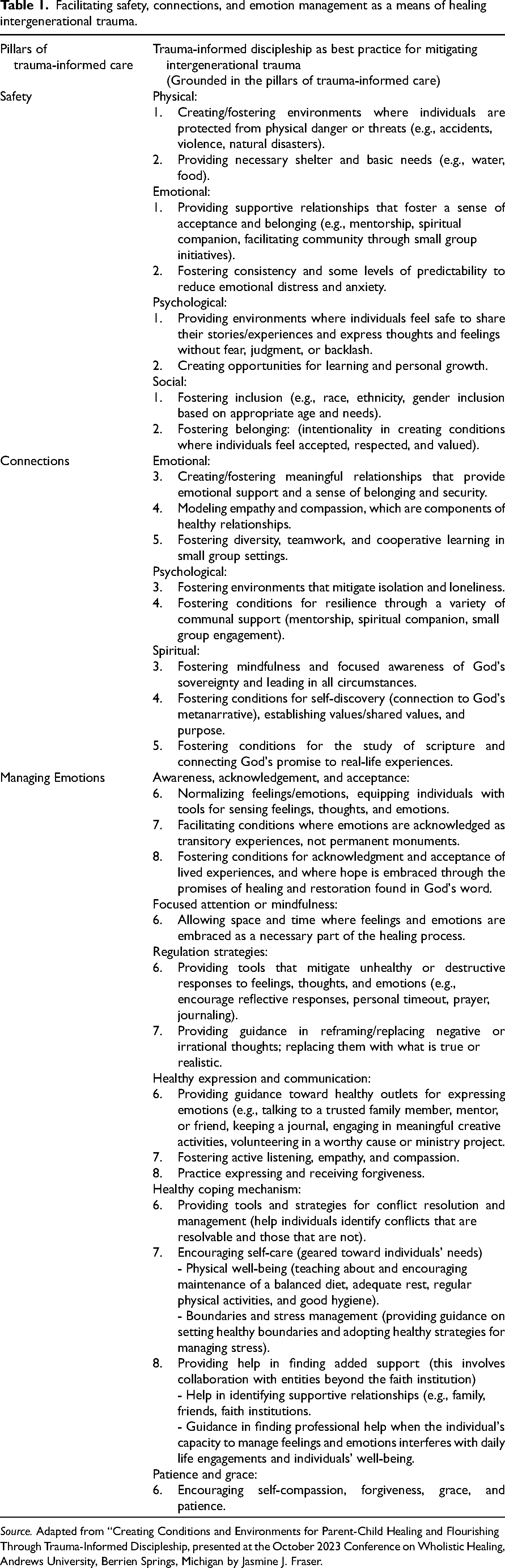
Through intervention, parents and children exhibiting insecure attachment styles perpetuated by their experience of inherited or lived trauma can experience reformation and formation of healthy or secure attachments with each other. Through the experience of attachment-based family therapy and emotionally focused therapy children and their caregivers may engage in reparative relationship practices (Fraser, 2018). Under the guidance of a mental health professional, these theories provide approaches through which parent and child can heal from attachment wounds, foster healthy attachment, develop functional emotional expression, and build trust. Parent and children attachment styles can also be formed through trauma-informed discipleship initiatives (see Table 1).
Facilitating safety, connections, and emotion management as a means of healing intergenerational trauma.
Source. Adapted from “Creating Conditions and Environments for Parent-Child Healing and Flourishing Through Trauma-Informed Discipleship, presented at the October 2023 Conference on Wholistic Healing, Andrews University, Berrien Springs, Michigan by Jasmine J. Fraser.
The Need for Social Support
Innately, we are social beings, and for this reason, having a social support system is a significant factor in the healing of any form of trauma. Individuals healing from intergenerational trauma need support systems as they address emotional wounds and experience mental turmoil. Support systems help individuals function and become resilient. Social systems may include family members, friends, faith community, health professionals, and other varied networks of individuals and communities. Through social support systems, individuals and families experience empathy, understanding, validation, and a sense of belonging—factors that are conducive to healing and transformation. In essence, social support systems contribute to the process of healing in the short term while creating a base for ongoing healing and transformation.
Best Practices in Mitigating Intergenerational Trauma
Several institutions, including the health care systems, have become proactive in their approach to trauma and their encounters with trauma-affected individuals. Subsequently, it is necessary for faith institutions to also think and act proactively regarding the effects of lived and intergenerational traumatic experiences of individuals within the church and the academy. The table below is an attempt to summarize and contextualize the original three pillars (safety, connections, and managing emotions) of trauma-informed care as discussed by Bath (2008) into a practical discipleship tool for facilitating one-on-one and small group encounters.
Individuals’ basic need for safety is fundamental to physical, emotional, and psychological well-being. To be safe is to be in a state of being free from harm, danger, or the threat of harm. Safety contributes to the general quality of our lives and affects how we behave and make decisions. Safety in the context of trauma-informed discipleship embodies physical, emotional, psychological, and social factors that contribute to individuals’ wholistic well-being. At the same time, individuals’ need for connection encompasses the innate desire to form meaningful relationships with others and establish a sense of community and belonging. Meaningful connections and a sense of belonging also contribute to emotional, psychological, and spiritual well-being. Creating safe environments where individuals experience healthy, supportive connections that contribute to their psychosocial well-being is a viable means through which educators and ministry leaders provide tools that help individuals manage or regulate emotions in chaotic or adverse situations.
The chart below outlines a framework for creating trauma-informed environments where individuals and families (particularly children and parents) in faith institutions may experience safety and connections and be equipped to regulate or manage challenging emotions.
Conclusion
Intergenerational trauma is a pervasive phenomenon that is predicated on the consequence of sin and disobedience which affects the total well-being of individuals, families, and society. It disrupts the stability of relationships within and across generations, even within the church, preventing the development of mature disciples. Yet it is heartening to know that God's promised demonstration of lovingkindness provides the foundation for healing and transformation from the effects of generational trauma. As educators and ministry leaders, let us all help individuals and families overcome inherited and lived traumatic encounters by emphasizing God's promise to heal and guiding them to available resources that contribute to their health and well-being. As we serve in our various capacities, let no added distress and hurt come to others through us. Instead, let us create conditions and environments conducive to growth and transformation. Let us be mindful that our words, attitudes, and actions can be the conduits of the healing and growth that is necessary for individuals to experience mental, emotional, social, and spiritual well-being, and in so doing enjoy the freedom Christ promised. As we invest in services to individuals, families, and society, we endeavor to promote the message of hope and contextualize available resources to mitigate the adverse effects of intergenerational trauma. It is judicious to also invest in ministry to parents, helping them grow in Christ and becoming models through which, their children emulate Christ. It is necessary to foster a culture of safety and connections that facilitate dialog, empathy, and compassion, allowing individuals to share their stories while finding the support they need. It is the assumption that trauma-informed conditions and environments will facilitate awareness and be means and places where individuals are committed to attending to children's immediate needs, empowering them as well as parents with tools to create further trauma-informed living conditions and environments. Creating such conditions involves intentionality, awareness, and thoughtful responses to the impact of trauma and inherited dysfunctions. Ultimately, awareness and thoughtfulness contribute to better understanding and approaches to trauma-informed discipleship. Subsequently, the process of trauma-informed discipleship simultaneously recognizes the impact of trauma on the lives of children and parents while creating ways to promote healing, resilience, and flourishing for them.
