




Abstract
In June 2022, the U.S. Supreme Court dissolved federal protection for a woman’s right to an abortion and gave each individual state control over abortion laws. The ruling caused a media frenzy, with news outlets across the United States and the world reporting on the ground-breaking decision. The present study employs a textual analysis of this news coverage in the New York Times and the Wall Street Journal, paying special attention to the people interviewed as news sources. News sources were placed into categories based on occupation and gender and the frequency by which the sources were cited was recorded. Findings suggest that while many of the news sources were women, male politicians’ voices still dominate the narrative of women’s reproductive rights in the United States. Practical implications for journalism, policy and law are discussed as are pathways for future research.
The ground-breaking court case, Roe v. Wade, decisioned by the U.S. Supreme Court in 1973, offered federal protection for a women’s right to have an abortion. The court decided the right to an abortion was included under the right to privacy as protected by the 14th amendment to the Constitution of the United States (Roe v. Wade, 1973). The decision effectively legalized abortion, to some extent, in all 50 states, and the ruling remained intact for almost 50 years, despite multiple attempts to challenge the ruling in court.
On June 24, 2022, the U.S. Supreme Court ruled on Dobbs vs. Jackson’s Women’s Health Organization, stating that the U.S. Constitution does not confer a woman’s right to abortion. The ruling essentially overturned Roe v. Wade, stating the right to an abortion was no longer federally protected, but up to each individual state (Dobbs vs. Jackson’s Women’s Health Organization, 2022). As soon as the Supreme Court’s decision went public, lawmakers in some states, like New York and California, vowed to keep a woman’s right to abortion intact. Other states, like Texas and Oklahoma, moved to immediately ban or limit abortion with no exceptions. Most of these decisions fell along party lines, with Democratic states in favor of abortion rights and Republican states against them. Although in some swing states like Pennsylvania, abortion laws were thrust into uncertainty, especially given many important mid-term elections occurring in 2022.
The decision to overturn Roe v. Wade ignited a media frenzy, and the decision made headlines in local, regional and national media outlets in the United States and beyond. While most journalists were quick to point out how state lawmakers’ reactions to the court ruling fell along party lines, there were also cultural politics involved in how news organizations were reporting on the court’s decision and its aftermath. As such, the current study investigates media coverage of the Supreme Court’s decision to overturn Roe v. Wade through an analysis of newspaper articles immediately after the court’s ruling and in the following news cycle. This study is particularly interested in analyzing and understanding the news sources used in coverage of the decision. News sources were coded and analyzed for demographics, including affiliation and gender, to better understand which voices were amplified and which voices were stifled in news narratives of the most recent abortion debate in the United States.
Significance of Study
There have been few published studies on U.S. news of abortion since the turn of the 21st century (Woodruff, 2019). Yet, research shows that “the portrayal of abortion onscreen, in the news, and online through social media has a significant impact on cultural, personal and political beliefs in the United States” (Conti & Cahill, 2017, p. 429). This is especially relevant given the latest Supreme Court decision to overturn Roe v. Wade, an event so recent that research on the impacts is still unfolding. Given there is little to no research on this topic, the current study aims to fill an important gap in the literature by analyzing news coverage of the overturning of Roe v. Wade, paying special attention to the potential impacts of news coverage of the court decision on public opinion and public policy.
Literature Review
News Coverage of Abortion in the United States
Abortion has been a politically charged hot topic in the United States since the Supreme Court’s Roe v. Wade decision in 1973, with some scholars saying abortion has been “defining fault lines in U.S. politics” since then (Sullivan, 2022). However, it is also one of the most difficult topics for journalists to cover (Conti & Cahill, 2017; Sisson et al., 2017). Sisson et al. (2017) interviewed journalists experienced with reporting on abortion. Journalists in their study cited specific challenges of reporting on abortion, including maintaining neutrality, lack of editorial knowledge of abortion and harassment at protests. Similarly, Wallington et al. (2010) explored challenges faced by journalists covering health disparities in their local communities. Through qualitative interviews with local journalists, Wallington et al. (2010) found that the biggest challenges in covering health news were the extensive research required for accurate reporting, difficulties in covering sensitive health topics like abortion, the inability to identify interviewees who could describe complex health information in an understandable way and the absence of “a face” to help personalize complex information.
In addition to the practical challenges of reporting on abortion, there are issues with the way abortion stories are told in the media. Research shows that more often than not, abortion is framed politically, and this framing has impacts on how abortion is perceived in culture. Through an analysis of abortion coverage in U.S. newspapers, Woodruff (2019) found that abortion was written about as more of a political issue than a women’s health issue and that there was a lack of women’s voices and personal stories included in news coverage. Similarly, Nixon et al. (2016) suggested that by not including women’s personal stories and by framing abortion as a political debate, news organizations added to the stigma of abortion in U.S. culture.
Race, age and income are all factors that influence abortion rates in the United States. According to a 2019 study by the Centers for Disease Control and Prevention (CDC), reported rates of abortion were highest among Black women (38.4%), followed closely by White women (33.4%), with Hispanic women having among the lowest rates at 21% (Kortsmit et al., 2018). However, research suggests that news coverage of abortion skews these demographics. Miao et al. (2022) analyzed news coverage of abortion across broadcast news and newspapers. They found that the news media often linked “the poor” and “people of color” when discussing abortion; findings also showed that the more stigmatized details of abortion, such as rape, were more connected to women of color than White women (Miao et al., 2022).
Abortion in the United States is not only a political and health issue, but a legal issue as well. Research on news coverage of legal actions surrounding abortion, similar to the study at hand, provides an insight into the connection between personal health issues and broader legal issues. Harp et al. (2017) analyzed news coverage of the Wendy Davis filibuster in Texas. In 2013, Texas State Senator Wendy Davis performed a filibuster in an attempt to block a Senate Bill that would ban abortions after 20 weeks of pregnancy. The filibuster made national media headlines and sparked the interest of researchers.
In their analysis of news coverage of the Davis filibuster, Harp et al. (2017) found that media outlets focused on Davis’ shoes, clothes and personal history as a teen mother, rather than the actual Senate Bill or Davis’ role as a State Senator. They claimed that this type of media coverage made the event a gendered political spectacle rather than a serious news story about health care and women’s reproductive rights (Harp et al., 2017). Corrigan and de Saint Felix (2022) conducted their own analysis of news coverage of the Davis filibuster. They suggested that Davis’ media depiction as “Abortion Barbie” served to undermine women’s rights, especially as pertaining to abortion laws, and sexualized and criminalized women’s bodies. The authors suggested this ultimately led to the downfall of Davis’ political career while acting as a rationale for sexist policies to limit women’s access to reproductive health care (Corrigan & de Saint Felix, 2022).
Armstrong and Boyle (2011) also studied the intersection of gender with news coverage of abortion. They analyzed news coverage of abortion protests from 1960 to 2006 and found that male sources significantly outnumbered female sources, both before and after the original Roe v. Wade decision. They concluded that “journalists continued to seek out men as sources despite the uniqueness of the issue to women, to the feminist movement, and to the fact that women played a significant role as participants on both sides of the issue” (Armstrong & Boyle, 2011, p. 170).
Gender and News Sources
Sourcing is one of the most important aspects of the news production process (Van Leuven et al., 2018). The American Press Institute set forth the most critical elements of good journalism, as adopted by the book “The Elements of Journalism” (Kovach & Rosenstiel, 2021). One of the key elements is: [Journalism’s] essence is a discipline of verification. As such, a journalist should seek our multiple sources, disclose as much as possible about sources and ask various sides for comment. According to the American Press Institute (2024), this is what separates journalism from other forms of media, like propaganda, advertising, fiction or entertainment.
Source analysis plays a critical role in understanding journalistic practices and the impact of those practices on audiences and on society. According to Lecheler and Kruikemeier (2016), how journalists choose their sources is the “single most defining aspect of news reporting” (p. 158). The relationship between journalism and democracy is complex, and news sourcing is an important component of that relationship. For example, if more politicians or government officials are used as news sources, the procedural model of democracy is emphasized; in contrast, if more citizens or community members are used as news sources, the participatory model of democracy is emphasized (Strömbäck, 2005). This has tangible impacts on society-at-large as these different models each offer their own positives and negatives for different groups.
The news media can be very powerful. Journalists choose which voices are amplified and which are silenced, and these choices have political, cultural and societal impacts (Thorbjørnsrud & Ustad Figenschou, 2016). As such, journalists are held to a higher ethical and professional standard than media creators, including commentators, opinion writers, bloggers and social media influencers. Banjac and Hanusch (2022) found that audiences hold a boundary between their expectations of journalists and their expectations of other media content creators. Through focus groups with media consumers, the researchers found that audiences hold journalists to the traditional standards of journalism, including accuracy, truth and neutrality. Meanwhile, audiences did not expect this from other media content creators; instead, the expectations focused on audience engagement and high-quality content (Banjac & Hanusch, 2022). As such, the present study will focus on traditional print news articles, rather than opinion pieces, blogs or social media content.
Examining the role of gender in news sourcing is important to better understand the influential role news sourcing plays in broader societal and cultural issues. Research on gender and news sourcing dates back decades, but more recent research on the topic highlights the inequalities still present in the news industry. Desmond and Danilewicz (2010) analyzed 580 news stories in local television news programs. They found that men were significantly more likely to be quoted as expert source than women, and men were also more likely to be shown in a professional capacity, regardless of the story topic (Desmond & Danilewicz, 2010). Baitinger (2015) also analyzed the role of gender in broadcast news. Findings suggested that female journalists, elected officials and political activists appeared significantly less than their male counterparts. Baitinger (2015) argued that not only is this a result of sexism in news, but the result of sexism in the public sphere as there tends to be less women in these roles in general. Similarly, Khuhro et al. (2019) found male sources, especially government officials, dominated the news narratives on climate change, while female voices were widely underrepresented.
The difference between news sourcing for experts and news sourcing for ordinary citizens is also influenced by gender. Sjøvaag and Pedersen (2019) analyzed news sourcing across 75 different newspapers. They found that larger newspapers interviewed more elected officials and government leaders, the majority of whom were men. Smaller local newspapers interviewed more ordinary citizens, and as such produced a more equal amount of men and women sources. However, within this premise, the topic of the news story influenced the ordinary citizens who were interviewed; men were more likely to be interviewed about hard news issues like crime and politics and women were more likely to be interviewed about soft news topics like lifestyle and family issues. Instead of analyzing newspaper coverage, Artwick (2014) analyzed tweets from newspaper reporters. Findings showed that men accounted for 80% of news sources, suggesting that even on social media, a typically more progressive news medium, there was still a significant gender gap among news sources (Artwick, 2014).
While content analysis is a highly used and effective method to study gender and news sourcing, mixed-method approaches can allow for a unique understanding of the topic at hand. Ross et al. (2018) employed a mixed-method approach of both qualitative and quantitative methods to better understand how women were represented as sources in the news media. Findings suggested that overall the number of women news sources was low compared with men, with women in older demographics almost non-existent as sources. In addition, when women were used as sources, they were almost exclusively used as ordinary citizens and not experts. Results of this study suggest that news sourcing still “privileges men’s voices, actions and views” (Ross et al., 2018, p. 824).
Recent research suggests that the gender gap in news sourcing is not bound by U.S. newsroom culture, as studies in countries outside of the United States produced similar results. Vu et al. (2018) conducted a content analysis of the news media in Vietnam and found that female community leaders were often underrepresented and misrepresented. When they do appear as news sources, female leaders are often asked about traditionally feminine issues such as family, lifestyle and fashion (Vu et al., 2018). Niemi and Pitkänen (2017) conducted a similar study in Finland. They found that expert sources appearing in the news media continued to be overwhelmingly male. The researchers pointed out the uniqueness of these results as pertaining to Finnish culture, explaining that Finnish women have an “active participation in politics, notably high level of academic education, and wide participation in the labour market” as compared with most other countries (Niemi & Pitkänen, 2017, p. 355), suggesting that even in more progressive countries such as Finland, there still seems to be looming gendered inequality in the media industry.
Research on gender and news sources is critical to better understanding the role of women in broader society, as the effects of media representations on public opinion and mainstream culture have been noted time and time again. After drawing up data from numerous countries as part of the 2010 Global Media Monitoring Project, Ross and Carter (2011) argued that the significance of [research on gendered inequality in news representation] is stark, since by privileging issues seen to be in both the interest and purview of men and privileging their views and voices over those of women, news discourse contributes to the ongoing marginalization of women’s participation as citizens. (p. 1148)
Based on the previous literature, this study addresses three main research questions:
What types of people (i.e., politicians, citizens, celebrities) are frequently quoted in news coverage of recent legislation on abortion?
What role does gender play in the news sources chosen?
Is there a difference in news sourcing between the New York Times and the Wall Street Journal?
Method
The goal of this study is to analyze news sources in newspaper coverage of the U.S. Supreme Court’s reversal of Roe v. Wade. To accomplish this goal, an article search was conducted on the digital version of the New York Times and the Wall Street Journal. The New York Times is the newspaper of record for the United States. According to the Alliance for Audited Media, the Wall Street Journal is the newspaper with the highest circulation in the United States. In addition, the New York Times falls just to the left on the AllSides Media Bias Chart, while the Wall Street Journal falls just to the right.
A Boolean search “abortion OR Roe v. Wade” was conducted during the date range of June 24, 2022, and July 2, 2022, for each newspaper. June 24, 2022, was the day the U.S. Supreme Court announced the decision to overturn Roe v. Wade. July 2, 2022, marked 1 week of news coverage since the event. Most breaking national news stories receive consistent, continuing news coverage for about a week until interest starts to wane and other stories take precedent (Owen, 2019).
This study is particularly interested in news articles so opinion pieces, letters to the editor and podcast links were filtered out. The Society of Professional Journalists’ code of ethics calls on journalists to “act independently” and “be accountable and transparent,” and so there is a journalistic standard that news coverage be unbiased, balanced and fair. However, this is not always adapted in practice. As such, this study is interested in how journalists are framing news coverage via the kinds of news sources used.
Each headline and lead were quickly analyzed for relevancy. Articles without interviewed news sources were also filtered out. This left a total sample of 104 news articles. The sample size was consistent with similar research on news coverage of legal issues surrounding abortion (Harp et al., 2017; Nyathi & Ndhlovu, 2021).
A textual analysis of the 104 articles in the sample was conducted by the research team. This was done by conducting a thorough reading of each newspaper article and looking for news sources. A news source was defined as an individual with a directly attributed statement, fact or quote within the news story.
A similar study by Dimitrova and Strömbäck (2012) was used as methodological guidance for this study. Dimitrova and Strömbäck (2012) analyzed news sources in political news coverage in the United States and Sweden, noting the different types of sources present. Sources were coded as: domestic politicians; campaign or party operatives (such as consultants, pollsters, campaign/party managers); ordinary citizens; and journalists/media analysts (Dimitrova & Strömbäck, 2012). Given the specific topic at hand, additional coding categories were added for the current study, including medical professionals/experts; advocacy groups (such as spokespeople for Planned Parenthood); and celebrities. The gender of each news source was also coded as woman or man based on the pronouns used in the article. The number of times a particular type of source was used within each news story was then recorded.
Findings
The textual analysis revealed interesting findings among the use of news sources in coverage of the U.S. Supreme Court’s reversal of Roe v. Wade. The first finding is news coverage of this event was mostly framed politically, with domestic politicians quoted the most. Specifically, male politicians’ voices dominated the conversation. The distribution of source categories demonstrated a preponderance of male politicians quoted over other sources. For the New York Times, male politicians were quoted significantly more (n = 99, z = 2.43, p < .01) than other key groups such as female citizens (n = 70), and the overall distribution was significantly different from chance when accounting for all quotations, χ2 (13, N = 375) = 445.63, p < .01. Similarly, for the Wall Street Journal, male politicians were also the most frequently quoted category (n = 52, z = 2.75, p < .01), eclipsing others such as female advocates (n = 25) in a distribution that differed significantly from chance, χ2 (11, N = 168) = 172.57, p < .01.
The second finding is gender influenced how often different news sources were used. Paired samples t-tests examined the relative gender representation by category of source quoted in both newspapers. In categories other than “politician,” females were generally quoted more frequently than males (see Table 1), with the differences in means being significant. In the case of politicians, however, male politicians were significantly more likely to be quoted across stories from both newspapers by greater than a 2:1 ratio.
Paired Samples t-Test for Quotes by Gender of Source
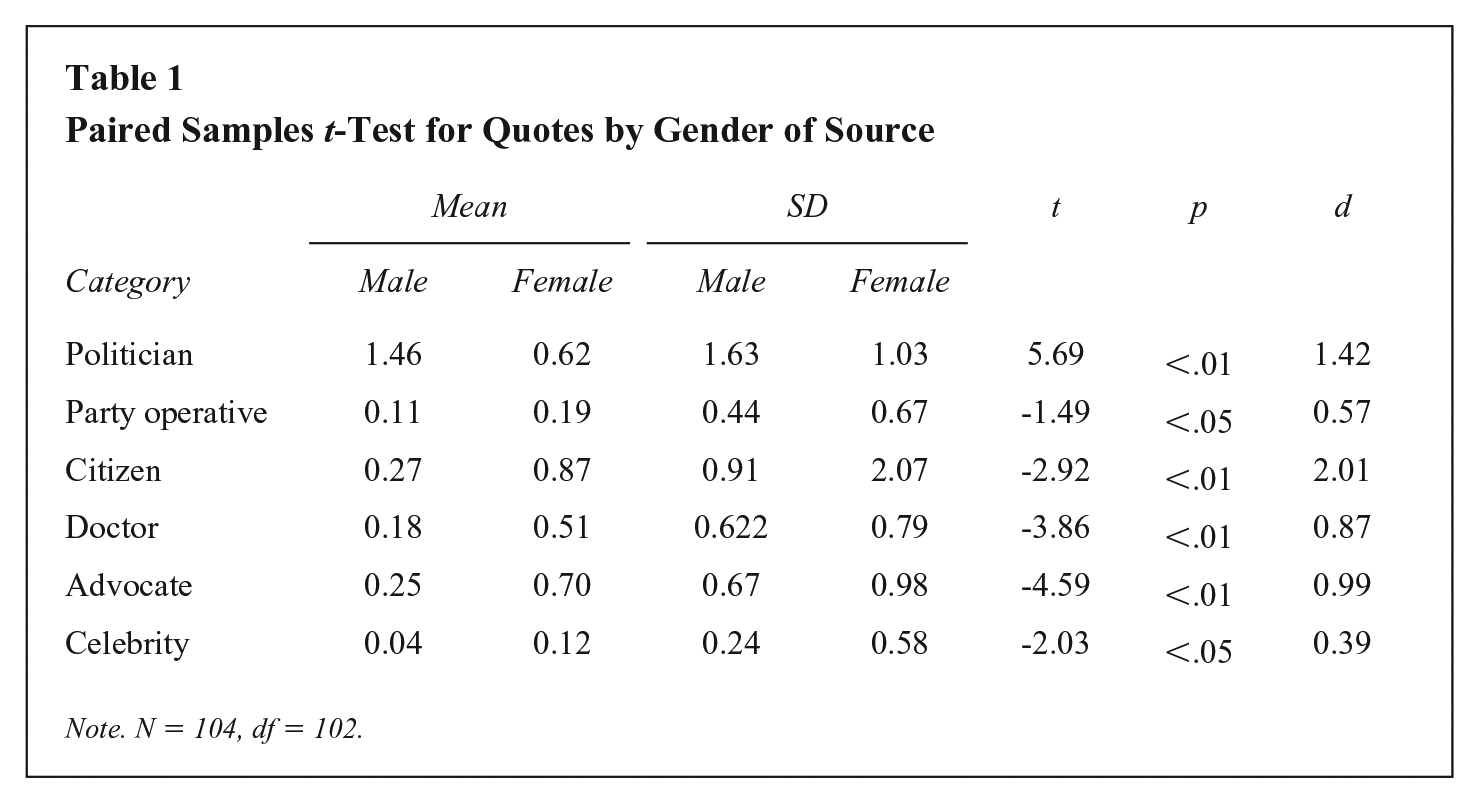
Note. N = 104, df = 102.
News sourcing between the New York Times and the Wall Street Journal fell along similar themes. The observed difference in means was not statistically significant. Observed differences between newspapers in average numbers of quotes were also not statistically significant among all categories except male medical professional/expert. The Wall Street Journal was more likely to quote male medical professionals/experts than the New York Times. This difference was statistically significant and demonstrated a moderate effect size, t(33.25) = −2.51, p < .05, d = 0.59.
Discussion
Findings of the current study suggest that male politicians still largely dominate the narrative of women’s reproductive rights in the United States. The U.S. Supreme Court’s recent reversal of Roe v. Wade gave journalists an opportunity to change the narrative; however, as this study suggests, newspaper coverage remained tied to the political and misogynistic roots that the topic of abortion has been strapped with for decades in the United States. Interestingly, both newspapers, though situated on different sides of the political spectrum (AllSides Media Bias Chart, 2023), used similar sourcing techniques.
This study found that, overall, news coverage of the most recent abortion debate in the United States was framed politically. The majority of news sources used were domestic politicians, and government officials were given ample space to have their opinions heard. Even though abortion is a women’s health issue, health professionals were given little voice in these news narratives. This finding compliments previous research that suggests that abortion in the United States is discussed as a political debate rather than as a private health matter (Nixon et al., 2016; Woodruff, 2019). Framing abortion as a political topic allows this critical women’s health issue to be used as a political pawn and undermines women’s lived experiences.
Gender was also an influential factor in whose voices were given preference in news coverage of the recent changes to federal abortion protection. Findings of the current study showed that women were generally quoted more than men in most categories except “politician.” This is positive because it suggests that women medical professionals, women advocates and women citizens are being given a platform to share their experiences and expertise on reproductive rights. Still, findings suggest that male politician’s voices were amplified over all others, supporting previous research on news coverage of abortion in the United States (Armstrong & Boyle, 2011).
Allowing men’s opinions to be the dominant ones in news narratives of abortion, even when women’s voices are also present, suggests that men hold power on a topic that is so innately tied to the female body and the female experience. Women are the ones who conceive, endure 40 weeks of pregnancy and fight through the extreme pain of childbirth. Women are also expected to be the primary caregivers of their children and their bodies physically nourish their children through breast feeding. Yet, as findings from this study suggest, men’s voices are still overwhelmingly loud on the topic of women’s reproductive rights.
Findings from the current study are important because they show how little progress has been made since Roe v. Wade in 1973. Although the movement for women’s empowerment in the United States has grown tremendously since then, and women are given more opportunities now than ever, abortion is still a topic that remains largely in the hands of male politicians. Armstrong and Boyle (2011) analyzed news coverage of abortion protests from 1960 to 2006 and found that even as time progressed, the focus on men as sources over women remained consistent. Findings of the current study compliment the findings of Armstrong and Boyle (2011), showing just how little the needle has moved. Even when journalists and news organizations were given an opportunity to change the narrative, many still defaulted back to the male-dominated, politically charged narrative that has plagued the conversation surrounding abortion in this country for over 50 years.
Research is clear that news narratives influence public opinion and public policy, and foundational research showing this dates back decades (Zucker, 1978). More recent research focuses on the impacts of news narratives on women’s issues in particular. While studying news narratives of violence against women, Carll (2003) argued “the news media plays a major role in shaping public opinion and public policy, with stereotypes even becoming embedded in the judicial system” (p. 1601). Through a comparison of local news coverage of paid maternity leave and actual political discourse on the topic, Tait et al. (2021) found that “television news reflected paid leave policy activity,” suggesting the existence of a coordinating relationship between news narratives and public policy. Terman (2017) argued that U.S. news coverage of Muslim women “shape public attitudes toward Muslims, as well as influence policies that involve Muslims at home and abroad” (p. 489).
Given previous research, it is important to understand the potential impacts of the findings of the current study. If news coverage propagates the idea that men, especially men in politics, hold the most valuable opinions on abortion laws, then it is of no surprise that these are the people creating and implementing public policy on abortion, even if their opinions are the minority or if the issue does not impact them directly. For example, after the reversal of Roe v. Wade, 15 states in the United States had new or impending laws banning abortion with no exception for rape or incest, even though recent polling suggests that 75% of the American public are against this (Jacobson, 2022).
The practical implications of this research include insights into how the journalistic processes surrounding coverage of abortions could change. Journalists and news organizations can make more mindful efforts to include more diverse voices when interviewing sources on the topic of abortion in the United States. Amplifying women’s voices in news coverage can shift the conversation to those who are more directly affected by abortion laws in this country.
Although considerable thought was invested in the planning and execution of this study, there are limitations that should be noted. While these limitations should be discussed, they do not invalidate the findings of this study. Rather, they should be used to better understand the findings and inform future studies.
The New York Times and the Wall Street Journal were used as samples for this study. Perhaps if different newspapers were used to source articles, different data regarding news sources would have emerged. Future research would benefit from analyzing other national newspapers like the Washington Post or comparing local newspapers of different locations and demographics. A specific time frame was used to collect the data for this research project. While there were valid reasons for the time frame chosen, perhaps a different time frame would have yielded different results.
Future research could focus on news narratives after more time has passed and more impacts of the Roe v. Wade reversal are known. It would also be interesting to analyze the news reports of other mediums like television news broadcasts, podcasts and social media pages to see if the medium itself affected news coverage of the reversal of Roe v. Wade.