



Abstract
We conducted two surveys (in 2016 and 2022) to measure the work satisfaction of Chilean female journalists and applied a face-to-face version of the questionnaire to 146 male journalists. Conducting t-tests to compare means, we found that during these 6 years, work satisfaction by Chilean female journalists decreased soundly and was significantly smaller than that of male journalists. We also found that female journalists are more willing than men to quote sources of their gender and feature them as newsmakers in the news media. Conducting a regression analysis, we found that three independent variables were highly significant as they had a clear effect on the work satisfaction declared by female journalists. They were “perceived autonomy,” “gender equality at work” “and having enough female editors or supervisors in their newsrooms.” On the contrary, annual wage, work promotion, marital status, age and job status did not appear as relevant variables for women to assess their work satisfaction. Our results confirm that women are more satisfied when they work in an equal workplace, with a low perception of gender discrimination and having enough female editors or supervisors in their newsrooms.
Gender inequality in the world’s newsrooms has been stubbornly enduring (American Society of News Editors, 2018; D. H. Weaver, 2012; D. Weaver & Willnat, 2013; Women’s Media Center, 2022), and it has been identified as a crucial variable affecting the job satisfaction of women journalists (Cepeda Robledo, 2020; Everbach & Flournoy, 2007; Kelly, 1989; Walsh-Childers et al., 1996). If women feel less satisfied in newsrooms, it is not surprising that they leave the news media, as “being a woman reduces the probability of wanting to work in journalism and increases the interest in having a position in PR” (Mellado & Sherman, 2017). Consequently, this could diminish the already low representation of women in news content, devaluing women’s contribution to society and limiting the recognition of women’s work by audiences, affecting how they are viewed and perceived (Cantrell & Bachmann, 2014; Krefting, 2002). The fewer women in the newsrooms, the fewer women in the news as sources and newsmakers (Gallagher, 2015).
According to the seminal cross-country survey of Weaver and Willnat (2013), the average proportion of women journalists barely surpassed 40% in the former decade, eight percentage points more than in 1998. These low numbers have not changed in some biggest and developed nations as the United States and have not evolved either in some developing countries as Chile, despite the increasing ratio of women enrolling in journalism programs (Lagos & Mellado, 2013; Mellado, 2020; D. Weaver & Willnat, 2013). Indeed, the latest Women’s Media Center report confirmed that American female journalists got only 41% of bylines in print, online, TV and wire news in 2021, against men’s bylines reaching 57% during the same time (Women’s Media Center, 2022). As it was highlighted, these unbalanced ratios have been extraordinarily long-lasting: The share of female employees was 37% versus 63% of men in all U.S. newsrooms in 1999, and it was 42% in the latest year measured by the American Society of News Editors (2018). The ratio in favor of women increased by barely five percentage points in two decades.
The situation of Chilean women journalists is like that described internationally: most Chilean journalists are men, as they “outnumber women in all media, with the exception of news magazines” (Mellado, 2020, p. 388). The latest Global Media Monitoring Project (GMMP) report confirmed that news presenting Chilean women as anchors and reporters in newspapers, television channels and radio stations reached 37% in 2020. This predominance of men over women is observed in all Chilean media outlets. For instance, only 36% of print reporters were women in 2020. Female radio anchors were 38%, and female radio reporters were 33%. Female anchors in television were 35% and reporters 41% (Macharia, 2020). This feminine handicap in newsrooms could be substantially impacting news content, as it is directly associated with an unbalanced proportion of subjects and sources appearing in the news media: On average, Chilean female subjects and sources exhibited and cited by the news media represented only 24% compared with 76% of men in 2020 (Macharia, 2020). It is a male-dominated labor showing a masculine symbolic world, while Chilean women suffer from some invisible formal and symbolic mechanisms of discrimination that preserve gender inequality (Lagos & Mellado, 2013).
Variables Affecting Work Satisfaction
Work satisfaction in journalism has been extensively researched and reported in developed nations as the United States (Barrett, 1984; Beam, 2006; Everbach & Flournoy, 2007; Kelly, 1989; Mellado, 2020; Reinardy, 2009, 2012; Samuelson, 1962; Seely, 2019; Shaver, 1978; Stamm & Underwood, 1993; Walsh-Childers et al., 1996; D. Weaver & Willnat, 2013; Willnat et al., 2013). On the contrary, in some developing Latin American countries such as Chile, there have been no updated censuses of journalists or studies regarding those issues for many years (Mellado & Ovando, 2019). “Despite the important role that the media have played in the country’s political, economic, and social development, empirical studies of Chilean journalists are quite limited” (Mellado, 2020).
Researchers have linked job satisfaction in the newsrooms to a large set of variables: “job status rank,” “leadership,” “newsroom policies,” “organization size,” “equity at status distribution,” “achievement,” “job security,” “organizational commitment,” “control coping,” “perception of job quality,” “work conditions,” “possibility of growth,” “annual salary level,” “freedom,” “perceived autonomy,” and “flexibility” (Barrett, 1984; Beam, 2006; Everbach & Flournoy, 2007; Kelly, 1989; Mellado, 2020; Reinardy, 2009, 2012; Samuelson, 1962; Seely, 2019; Shaver, 1978; Stamm & Underwood, 1993; Walsh-Childers et al., 1996; D. Weaver & Willnat, 2013; Willnat et al., 2013).
Gender discrimination, as described above, has been positively associated with lower levels of job satisfaction among women journalists (Kelly, 1989; Walsh-Childers et al., 1996; Willnat et al., 2013). Marital status, motherhood and family issues have been also identified as relevant factors affecting women journalists’ satisfaction at work (Barrett, 1984; Everbach & Flournoy, 2007; Shaver, 1978).
Age is another critical indicator to compare job satisfaction between female cohorts, as “very few women over the age of 50 years still work for the Chilean media” (Mellado, 2020, p. 388). When Chilean journalists become older, significant gender differences arise. In the segment under 29 years (primarily junior journalists, who commonly earn lower salaries), women journalists are more numerous than men in the newsrooms. However, as journalists age and compete for the top jobs, the share of women declines, and the proportion of men rises to more than 70%. “Although there has been a considerable increase in the participation of women within the Chilean media, they do not have high-ranking positions, and they retire from journalism earlier than do men” (Mellado, 2020, p. 396). Following a global trend, the average age of Chilean journalists has decreased in the last decades. Nowadays, four out of five Chilean journalists are under 40, and only 7% of them are over 50 (Mellado, 2020). As Chilean journalists are getting younger, their experience has decreased quickly, going down from an average of 11.69 years in 2011, to 8.46 years in 2017 (Blanco-Herrero et al., 2020).
Comparing data from 22 countries, Weaver and Willnat (2013) reported that Chile had the worst job satisfaction in newsrooms among the Western nations: only 7.4% of Chilean journalists were “very” satisfied with their job compared with the overall media of 27.5%. Chilean journalists were also the less autonomous among the Western countries. Only 17.3% of them expressed a great deal of freedom, compared with the 59.4% of a very similar Latin American country as Colombia. The strongest predictors of job satisfaction in Chile were pay, the chance for journalists to use all their abilities and knowledge, and the conciliation of work and family life (D. Weaver & Willnat, 2013). Based on these data, Mellado (2020) described the typical Chilean news media journalist “as male, less than 40 years old, working as a full-time reporter without a specific beat, poorly paid, and leaning toward the political left” (p. 396).
Historically, journalism has been a masculine job in Chile. “The gendered pattern is that of women’s marginalization at nearly every occupational level in Chilean newsrooms” (Lagos & Mellado, 2013, p. 230). This pattern is illustrated most dramatically at the top, where women are all but completely absent in corporate governance (8.6%) and in senior management (7.3%). This small female representation in the newsrooms and especially in the highest positions of editorial responsibility has been linked to the scarce participation of women in executive positions within Chilean companies (Lagos & Mellado, 2013).
The first wave of our survey was conducted in 2016 when Michelle Bachelet was leading the country for a second term. Bachelet’s “rise to power was a milestone in the fight for equal rights among men and women in Chile” (Lagos & Mellado, 2013, p. 226). Bachelet became not only the first woman to assume the presidency of Chile, but also the first female president in South America, and her term was highly significant for being the only government establishing equal representation of female and male ministers (Lagos & Mellado, 2013).
Assuming that gender discrimination was decreasing in Chile with time due to the historical and political legacy of Bachelet, and based on conclusions reached by former research analyzing job satisfaction in journalism and newsrooms, the following hypotheses and research questions are proposed:
H1:
Chilean female journalists will express higher work satisfaction in 2022 than in 2016.
H2:
Chilean men journalists will express higher work satisfaction than women journalists.
H3:
Chilean women journalists will express a higher willingness than men journalists to quote women sources and feature female newsmakers.
RQ1:
What variables could be influencing a higher/lower job satisfaction of Chilean female journalists with respect to the previous measurement?
Method
Participants and Procedures
Data were collected through a survey of women listed as associates by the Chilean National Association of Women Journalists (ANMPE), following the criteria of Barrett (1984) and her study with the National Federation of Press Women and the Association of Women in Communications. The ANMPE is a professional organization created in 1962 and is the Chilean branch of the World Association of Women Journalists and Writers. As the database of the ANMPE is increasing and updating every year, the sampling frame in 2022 included all women listed then—859 women journalists. The survey was completed then by 363 people, reaching a response ratio of 42%. In 2016, the survey was responded to by 156 women journalists from a total of 566 women journalists enlisted then.
Surveys were sent through personal emails signed by the President of ANMPE. Emails were sent three times in September and October 2022. Emails led to an informatics program that permitted every associate to answer the survey only once. The questionnaire had 31 questions and four sections: (a) job characteristics, routines and roles, (b) perceptions of women about gender representation in the Chilean media, (c) factors affecting their work satisfaction and (d) demographic questions as age, location, marital status, income range and people in charge. In the second and third sections, we used 7-point Likert-type scales validated by Goetz et al. (2011) to quantify the high or low satisfaction/agreement with all requested statements. Adapting scales validated by Barrett (1984), “strongly agree” was ranked with seven points by respondents, and “strongly disagree” was rated with one point. A high numerical score (close to 7) indicated higher satisfaction/agreement, while a lower numerical score (close to 1) expressed a lower satisfaction/agreement. “Undecided” responses were not scored.
Replicating the criteria by Kelly (1989), we measured job satisfaction (the dependent variable), with a single question: “All things considered, how satisfied are you with your present job? (Being 1 = You are very dissatisfied; 7 = You are very satisfied).” Gender equality at work was measured with a single question replicated from Walsh-Childers et al. (1996): “Would you say that, in general, men and women are treated equally in your workplace? (Being 1 = You strongly disagree; 7 = You strongly agree).” Fairness of work promotion was measured with this question also adapted from Walsh-Childers et al. (1996): “Would you say that, in general, men and women have equally good chances of being promoted? (1 = You strongly disagree; 7 = You strongly agree).” Perceived autonomy was measured with a single question taken from Weaver and Willnat (2013): “Would you say that, in general, you enjoy a great deal of job autonomy? (1 = You strongly disagree; 7 = You strongly agree).” We finally asked women if their news companies had recruited a proper number of women as leaders and bosses: “Would you say that in your news media or company there is a fair proportion of male and female editors, coordinators and supervisors? (1 = You strongly disagree; 7 = You strongly agree).”
We conducted a version of the same survey to 146 male journalists working in Chilean newsrooms in 2022 to compare their data with that obtained from women journalists. Three independent pollsters applied this face-to-face study. They were undergraduate and PhD students at a private university in Santiago, Chile. The authors gave precise instructions on how to run the study based on a protocol. Researchers trained pollsters about the protocol in 2-hr sessions to guarantee unbiased responses. The survey was previously tested with 20 undergraduate journalism students, who made comments and suggestions to improve the questionnaire. All respondents gave explicit consent to participate in the surveys.
Like Mellado (2020) and Reinardy (2012), we ran regression analyses to measure how the mentioned validated variables affected work satisfaction and whether gender played a significant role. We also ran t-tests to compare averages and observe how work satisfaction, perceived autonomy and gender equality at work could change based on variables such as age, marital status, job status and income rank.
We grouped some scales to discriminate easily between groups. For instance, we created three dummy variables. As marital status has been considered a potentially relevant variable for women climbing the job hierarchy (Barrett, 1984), the first dummy variable was “marital status.” This differentiated between journalists living alone (0 = single, widow, divorced, separated or without a partner) and journalists living with a partner (1 = married or living with a partner). Following criteria validated by Beam (2006), we created a second “job status dummy variable” to separate between rank-and-file journalists with no people in charge (0) and female coordinators, beat editors or news supervisors with at least one person in charge (1). To assess if there were significant differences by age, with the third dummy variable, we divided between junior journalists (0 = under 39 years old) and senior women journalists (1 = 39 years old and above). We set up 39 years old as the age edge, following the generational criteria by the Pew Research Institute (Dimock, 2019).
In 2016, the average age of women respondents was 35 (SD = 32). Most (41%) worked at print outlets; 2% in wire services; 19% at TV; 16% at radio; and 21% at online outlets. Most of them (48%) had an annual income of US$75,000 or less; 30% had a yearly income of US$75,000 to US$200,000; 17% had an annual income of US$200,000-US$400,000, and 4% had a yearly income of US$400,000. The average number of years working was 10 (SD = 13). Seventy percent of women respondents worked as “journalist, reporter or freelance with no person in charge,” 19% described their role as “coordinator, supervisor or section editor with people in charge,” 3% were a “news producer,” and 4% described her role as “editor in chief or person in charge of the newsroom.” We asked these professionals about their marital status to know if this variable could be affecting their professional career: 31% of women journalists were legally married, 20% had a legal or formal partner without being married, 4% were widows, 7% were legally divorced or separated and 38% were singles or without a partner.
In 2022, the average age of women respondents was 36 (SD = 34). Most of them (33%) worked at print outlets; 17% worked on TV, 17% on the radio and 20% on online outlets. The remaining respondents described a large set of occupations. Most of them (13%) had an annual income of US$75,000 or less; 38% had a yearly income of US$75,000-US$200,000; 36% had a yearly income of US$200,000 to US$400,000, and 13% had an annual income of US$400,000. The average number of years working was 17 (SD = 12). Sixty-one percent of women respondents worked as “journalist, reporter or freelance with no person in charge”; 36% described their role as “coordinator, supervisor or section editor with people in charge”; and 4% were “editor in chief or person in charge of the newsroom.” Forty-two percent of women journalists were legally married; 13% had a legal or formal partner without marriage; 2% were widows; 15% were legally divorced or separated; and 28% were singles or without a partner.
The average age of men respondents was 36 (SD = 33). Most of them (33%) worked at print outlets. Twenty-five percent worked on TV; 16% worked on the radio; 20% on online outlets; and the rest worked in various occupations. Most of them (17%) had an annual income of US$75,000 or less; 36% had a yearly income of US$75,000 to US$200,000; 35% had an annual income of US$200,000 to US$400,000, and 12% had a yearly income of more than US$400,000. The average number of years working was 17 (SD = 12). Their marital status is described next: 36% of men journalists were legally married; 13% had a legal or formal partner without being married; 4% were widows; 20% were legally divorced or separated; and 27% were singles or without a partner. Seventy-four percent of men respondents worked as “journalist, reporter, or freelance with no person in charge”; 18% described their role as “coordinator, supervisor or section editor with people in charge”; 2% were a “news producer”; and 6% was “editor in chief or person in charge of the newsroom.”
Results
Descriptive Data
To evaluate hypothesis H1, which states that Chilean female journalists will express higher work satisfaction in 2022 than in 2016, we compared annual satisfaction averages and conducted a t-test. In 2016, work satisfaction declared by Chilean female journalists was 5.79 (n = 164; SD = 1.217), and in 2022 was 5.43 (n = 352; SD = 1.323). The difference was highly significant t(514) = −2.884, p < .001. The effect size was small r = .13, according to the benchmarks set up by Cohen (1988, 1992) During these six years, work satisfaction by Chilean female journalists decreased significantly. Therefore, hypothesis H1 was rejected.
Hypothesis H2 states that Chilean men journalists will express a higher work satisfaction than women journalists. To prove it, we conducted a t-test comparing means between the sub-sample of men with that of women journalists in 2022. The average work satisfaction by female journalists was 5.43 (n = 352; SD = 1.323), and the average work satisfaction by male journalists was 5.77 (n = 146; SD = 1.155). The difference was highly significant t(496) = −2.701, p < .001, and represented a small effect size r= .12. The evidence supported hypothesis H2.
Next, we evaluated hypothesis H3, which proposed that Chilean women journalists will express a higher willingness than men journalists to quote women sources and feature female newsmakers. Again, we conducted a t test to compare the means between female journalists and male ones and found a higher willingness by women journalists than men at the time to quote sources of their gender and feature them as newsmakers in the news media. The female media was 3.86 (n = 355; SD = 2.217), and the male one was 2.79 (n = 145; SD = 2.092). The difference was highly significant t(498) = 4.977, p < .001, and represented a small effect size r = .21, according benchmarks set up by Cohen (1988, 1992).
Although the evidence supported hypothesis H3, both male and female journalists did not seem very interested in considering the gender of sources and newsmakers. Then, we tried to find differences in 2022, based on female journalists’ job status and age. First, we compared the willingness to quote women sources and feature female newsmakers between rank-and-file female journalists without people in charge and female coordinators, editors and supervisors. On average, rank-and-file female journalists declared a lower willingness to quote women sources and feature female newsmakers (n = 243; M = 3.13; SD = 2.135) than female coordinators, editors and supervisors (n = 166; M = 3.96; SD = 2.228). This difference was highly significant t(407) = −3.795, p< .001, and the effect size was small r = .18.
We also compared the willingness to quote women sources and feature female newsmakers between junior female journalists (under 39 years old) and senior female journalists (39 years old and more). On average, junior female journalists declared the same willingness to quote women sources and feature female newsmakers (n = 180; M = 3.87; SD = 2.375) as female coordinators, editors or supervisors (n = 170; M = 3.89; SD = 2.125). The difference was not significant t(348) = −.091, p > .05.
To evaluate our research question, we ran multiple logistic regressions. The dependent variable was work satisfaction by female journalists (1–7, where 1 = lower work satisfaction and 7 = higher work satisfaction). As independent variables, we introduced the next elements:
(a) Annual income range (1–4, where 1 = annual income equivalent to US$75,000 or less, 2 = annual income between US$75,000 and US$199,999, 3 = annual income between US$200,000 and US$399,999, and 4 = annual income over US$400,000)
(b) Perceived autonomy as you enjoy a great deal of job autonomy (1–7, where 1 = you strongly disagree; 7 = you strongly agree).
(c) Fair work promotion as men and women have equally good chances of being promoted (1–7, where 1 = you strongly disagree; 7 = you strongly agree).
(d) Dummy variable marital status (0-1, where 0= single, widowed, divorced, separated or without a partner and 1= married or living with a partner)
(e) Dummy variable employment status (0–1, where 0 = journalist without a managerial position or without people under your responsibility and 1 = coordinator, editor, editor-in-chief or supervisor with at least one person under your responsibility)
(f) Age dummy variable (0–1, where 0 = less than 39 years old and 1 = 39 years old or older)
(g) Gender equality at work as men and women are treated equally (1 = strongly disagree; 7 = strongly agree)
(h) Perceived fairness of male/female share of editors, coordinators and supervisors (1 = You strongly disagree; 7 = You strongly agree).
Results presented in Table 1 confirmed that our model fits well and that the effect size is robust (R2 = .298, p < .001). Three independent variables were highly significant as they had a sound effect on work satisfaction declared by female journalists: perceived autonomy, gender equality at work, and having enough female coordinators, editors and supervisors in the newsroom. On the contrary, annual wage, work promotion, marital status, age and job status did not appear as relevant variables for women to assess their work satisfaction. Collinearity statistics confirmed that the variables analyzed did not overlap, as tolerance and variance inflation factor (VIF) displayed acceptable levels according to benchmarks by Field (2009).
Variables Affecting Work Satisfaction by Chilean Female Journalists
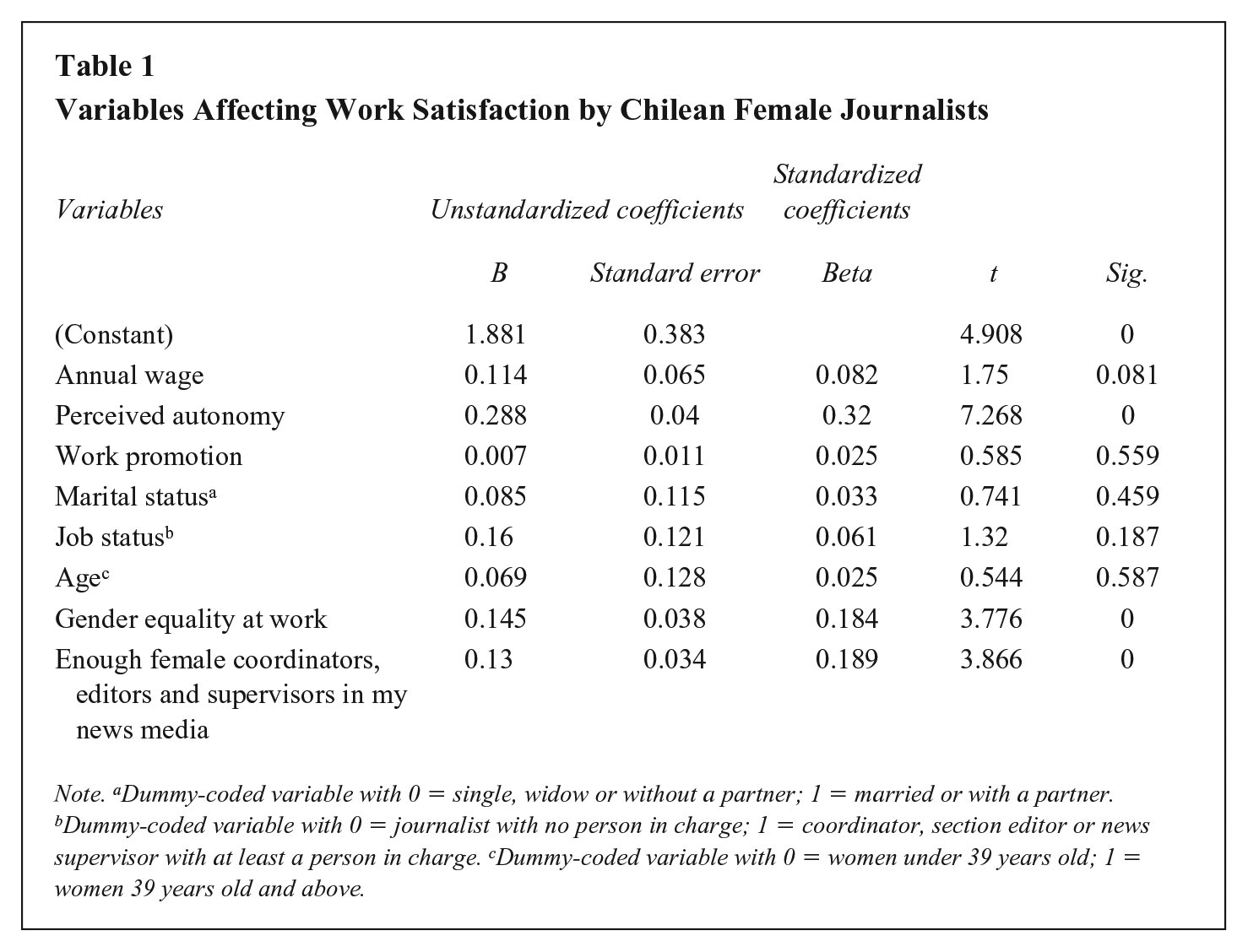
Note. aDummy-coded variable with 0 = single, widow or without a partner; 1 = married or with a partner. bDummy-coded variable with 0 = journalist with no person in charge; 1 = coordinator, section editor or news supervisor with at least a person in charge. cDummy-coded variable with 0 = women under 39 years old; 1 = women 39 years old and above.
In consequence, we can assure that the perception of higher gender equality at work is positively and significantly associated with higher job satisfaction by women journalists. We can also observe that having more female editors or supervisors in newsrooms is positively and significantly associated with higher job satisfaction by female journalists. And we can also affirm that autonomy is positively and significantly associated with higher work satisfaction by female journalists. On the contrary, we did not find a positive link between work satisfaction declared by female journalists and these four variables: work promotion, marital status, professional status and age.
Conclusion
It is often assumed that female professionals and leaders are reducing the gender gap with male ones—at a plodding pace but progressively—and that at some point in the far future, gender equality should be reached. Based on this “optimistic” assumption, we expected women journalists were working in 2022 in a friendlier, fairer and more satisfying job environment than 6 years ago. Our data challenge that optimism. Nowadays, Chilean female journalists seem less satisfied and more demanding to acquire those work conditions they consider the bottom line today. As expected, they are less gratified than men.
Recent work environment reports confirm that women professionals prefer hybrid jobs with higher self-dependence and prioritize “flexibility, employee well-being, and diversity, equity, and inclusion” (Lean In & McKinsey & Company, 2022, p. 2). This could explain why work satisfaction by women journalists is decreasing today and not expanding as was first expected. This could also explain why a higher annual range income is not enough for women, as they favor autonomy and flexibility instead of more money to continue working as journalists.
Women are still dramatically underrepresented in leadership (Lean In & McKinsey & Company, 2022). And they continue to be underrepresented in the media and the symbolic world, as our study and previous reports confirm. Women are still the absent half, as men still command the newsrooms, capture the bylines, and grab the microphones and the camera lens. For this reason, having more women in the newsrooms as newspersons and leaders is highly relevant. Rank-and-file and female coordinators, editors and supervisors pay more attention than men journalists to have a “gender perspective,” reaffirming that women journalists are more conscious than men about the pertinence of quoting and featuring more women as news sources and news protagonists. This approach is more assertive between leader women journalists—news editors, supervisors or coordinators with people in charge—as female coordinators, editors and supervisors surpass rank-and-file women journalists when they prefer quoting and featuring relatively more women as news sources and newsmakers. Our data confirm this inclusive thumb rule: More women are needed in the newsrooms, especially in the C-Suite and the editor-in-chief office. Indeed, our findings support the idea that having more women journalists in the newsrooms is critical to face the pervasive underrepresentation of women featured by the media across time and different countries (Macharia, 2020; Women’s Media Center, 2014). As it has been strongly stated by some scholars (Peiser, 2000; Rodgers & Thorson, 2003; Zeldes & Fico, 2005), the more women in the newsroom and especially in top positions, the more salient the women’s representation in the media.
As we confirmed with our regression analysis, women are more satisfied when they work in an equal workplace, with a lower perception of gender discrimination and enough female editors or supervisors in their newsrooms. They also feel more satisfied when they perceive themselves as more independent and autonomous. On the contrary, they do not associate a more significant gratification with a higher annual income. More money does not seem to compensate for their need for leadership and sovereignty. Women’s work satisfaction is more related to taking command of their newsrooms and managing their time. As it was so plainly asserted by Everbach and Flournoy (2007): “Newspapers need to do a better job of persuading women to stay in newsrooms.”
Most research has its limitations, and this paper is not an exception. First, it would be an excellent contribution to compare the Chilean situation with that of other Latin American or European countries. Second, more research is needed to understand how to promote a more intense “gender perspective” between rank-and-file and junior women journalists, less willing than expected to promote more female sources and newsmakers.
