




Abstract
This study investigates the impact of citizen journalism in Kazakhstan, utilizing quantitative and logical methods, drawing on both foreign and local insights. Findings reveal trust in mainstream media, concerns about bias and recognition of citizen journalism’s value for diverse perspectives. Media professionals acknowledge its significance and express varied opinions on credibility and future development.
Keywords
The role of citizen journalism in the life of modern society is extremely important. As noted in modern studies (Nascimento & da Silveira, 2017; Shiryaeva, 2011, p. 116; Zhezhko, 2013), the media perform the function of generating attention to emerging civic initiatives, promising civic organizations and fully inform society about the problems that already exist in the life of public organizations. How to determine the role of citizen journalism in modern media? In this aspect, examples from the sphere of television are most characteristic, as it is difficult for ordinary citizens to have a significant impact on its activities. On the channel “Khabar 24,” which broadcasts news information around the clock, there is a television program called “Bloggers.” “Bloggers” almost completely consists of the review of records of Kazakhstani bloggers and social network activists. The host of the program during each broadcast selects opinions on the topics discussed and also cites passages with valuable information. This program assumes the possibility of expressing opinions by any citizen who actively works in a social network. It is advisable to conclude that citizens responded to the urgent problem with the help of new media. Programs of exactly this format have been already broadcasted on TV channels such as “Astana” and “Eurasia 1.”
Recently, issues of citizen journalism have been actively discussed in the West. The extensive development of the internet has contributed to the formation of this area of journalistic activity, and new digital technologies and means of capturing visual information, widely available to almost everyone (tablets, cameras, mobile phones), also played a significant role. Citizen journalism began to have a significant impact on the foreign and domestic policies of many countries. Alternative media convincingly demonstrated that they can not only independently create news, but also raise acute social issues ignored by traditional media (Zhezhko, 2013, p. 161).
Citizenship journalism is a kind of journalism that involves complicity, collaboration and cooperation. Approximately at the turn of the 20th and 21st centuries, it appeared “in numerous varieties, incorporating many forms of various communications” (Pustovalov & Berezina, 2012: 194). This type of journalism contains many forms of interaction as well as a new understanding of the audience of journalism and approaches to interacting with it. Citizen journalism is characterized by the active participation of the journalist himself in the process of creating news (Boronchyk, 2022). He shows constant social activity not only gives publicity to existing social problems, but also takes a direct part in resolving them.
At the same time, as mentioned above, the development of the internet was of tremendous importance for the development of citizen journalism. Its entry into the everyday life of citizens contributed to the introduction of many innovations and the progress of the technical and technological approach to the system of relations in various fields. Various areas of social activity are rapidly progressing, thanks to the internet and new communication systems. The communicative industry is gradually moving to a digital technology system, which significantly accelerates interactions and makes them more accessible (Cointet, 2022, p. 37).
Foreign theories on citizen journalism have long recognized the potential for alternative media to disrupt traditional journalism and bring a new level of accountability to the media landscape. Scholars like Jay Rosen have argued that citizen journalism has the power to break the monopoly on news held by professional journalists and allow for more diverse perspectives to be heard in public discourse. Similarly, theorists like Stuart Allan have emphasized the potential for citizen journalism to serve as a counterbalance to government propaganda and corporate interests in the media. In the context of Kazakhstan, these theories take on added significance, given the country’s history of state control over the media.
The news media landscape in Kazakhstan is dominated by state-controlled media outlets, although there are some independent media outlets as well. The state-controlled media, including television, radio and print, tend to present a positive image of the government and its policies. Independent media outlets, on the contrary, are often critical of the government and its actions. In terms of citizen participation, there is some scope for it through social media platforms (Zaki et al., 2021). Many Kazakh citizens use social media to express their opinions and share news and information. However, there are also reports of government surveillance and censorship of online content, which can limit the extent of citizen participation. Rinat Tukhtaryuly, Gulnara Alpasbayeva, Balzhan Daribaeva and Marat Turgumbaev can be considered representatives of the media landscape in Kazakhstan as citizen journalists. They have made notable contributions by actively engaging in the dissemination of information and expressing their perspectives on various social, political and human rights issues within the country. As representatives of the media, they have utilized platforms such as blogging, activism and investigative reporting to shed light on matters related to transparency, governance, corruption and social equality in Kazakhstan. Their work has aimed to raise awareness, encourage public discourse and contribute to a more informed and engaged society. These citizen journalists have played a role in diversifying the media landscape by providing alternative viewpoints and amplifying voices that may not receive significant coverage in traditional media outlets. Through their efforts, they have made notable contributions to the media environment in Kazakhstan and have helped foster a more vibrant and dynamic media landscape.
In terms of media coverage, the domestic politics of Kazakhstan tend to receive more coverage than world politics. The state-controlled media tends to focus on positive news about the government and its achievements, while independent media outlets often report on corruption and human rights violations. As for world politics, Kazakhstan’s relations with major powers, such as Russia and China, tend to receive more coverage (Karasayev et al., 2023, p. 187). Overall, the media landscape in Kazakhstan is complex, with a mix of state-controlled and independent media outlets. Citizen participation is somewhat limited by government surveillance and censorship, and media coverage tends to focus more on domestic politics than world politics (Otar, 2014, p. 267).
The media space of Kazakhstan includes numerous information portals, government media sites, as well as resources on which users have the opportunity to actively exchange information and express their opinion on certain issues of public life. The largest discussion platform in the country is the portal “KerekInfo” (2023), on the pages of which users of both large cities and remote regions can communicate. All this has a significant impact on the development of citizen journalism in the country, allowing citizens to form their own opinions in communication on a number of issues and actively express them (Bolysbaeva, 2013, pp. 103–104).
The experience of the Republic of Kazakhstan and many Western countries testifies to the development of citizen journalism and the significant opportunities that open up for this media branch. The study aims to investigate and analyze the impact of citizen journalism in promoting transparency, accountability and citizen participation in Kazakhstan, with a focus on its effectiveness in addressing social issues and promoting democratic values. The research questions that this article seeks to address include:
Research Question 1:
What is the role of citizen journalism in modern society?
Research Question 2:
How can citizen journalism contribute to the dissemination of information through the media, especially with the active use of the internet?
Research Question 3:
What are the main aspects of citizen journalism identified through a combination of quantitative and logical methods of analysis?
In addition, this article seeks to explore the practical implications of citizen journalism, including how it can be utilized to solve complex social problems in Kazakhstan.
Literature Review
Studies of the role of citizen journalism in the life of modern society are given great attention in the works of domestic and foreign authors. This topic is gaining popularity, due to the widespread introduction of the internet in everyday life. So, Bolysbaeva (2013) notes that today in Kazakhstan “most bloggers are concerned about social news and topics, while the main topics of discussion in the network in Kazakhstan are cultural traditions, issues of religion and language.” At the same time, the author draws attention to the fact that in the conditions of the dynamic development of the media space in Kazakhstan, there are many problems, among which there are difficulties with translation, low attendance of internet resources of Kazakhstan, and low literacy in the field of IT in the whole country (Bolysbaeva, 2013, p. 105). On the whole, this not only complicates the development of citizen journalism in the country, but also attaches particular importance to this branch of the media.
In turn, Zhezhko (2013, p. 161) notes that “Citizen journalists began to exert a significant influence not only on the domestic politics of their country, but also on world politics as a whole.” The author admits that the new media very sensitively reflect the mood of the civilian masses, dissatisfied with the current state of affairs in the country and prone to express protest moods.
Journalistic activities are mainly aimed at supporting public associations and initiatives. In this regard, Shiryaeva (2011, p. 116) notes,
The support of the press is of great importance in creating an appropriate atmosphere in society and creating conditions for the development of public initiatives and associations. Without the support of the press, civic initiatives would remain at the local level.
The author draws attention to the fact that “cooperation with public organisations should be a normal, natural, everyday practice of citizen journalists” (Shiryaeva, 2011, p. 120).
The significant role played by citizen journalism in the life of modern society is much said in the studies of foreign authors A. Lindner and Larson (2017). In a joint scientific paper, they write that “with the expansion of the Internet and the introduction of technological innovations, the attendance of information sites has increased significantly, which contributed to the development of journalism, the failures of which are not so noticeable against this background” (Lindner & Larson, 2017, p.41). Researchers (Lindner & Larson, 2017) determine the role of citizen journalism in the life of modern society as system-forming in the aspect of the formation of freedom of expression of citizens’ own opinions. In the researcher`s opinion, it is citizen journalism that can objectively evaluate the degree of development of public technological innovations and their impact on society.
Coe (2021) examines the importance of citizen journalists, whose newsgathering and publication activities have made them crucial to public discourse and central actors in the communication revolution. The work examines how the internet and social media have enabled citizen journalism to flourish, and what this means for the traditional institutional press, the public sphere and media freedom. Goyanes and Gil de Zúñiga (2021) examine how social and traditional news use and users’ perceptions of professional journalism affect citizens’ news content creation. This study contributes to current conversations on the potential symbiotic association between professional and citizen journalism, arguing that citizens’ perceptual appraisals of professional journalism are key in fostering public participation through news content creation. The results of the study of Taibi and Na (2020) indicated that changes occurring in the media landscape are due to several reasons namely instant gratification of the news; changed mode of transmission; new styles of news writing; open and freer media environment and change of gate-keeping process. Threats posed by citizen journalism to traditional media are commercial impact, stealing of credits and stiff competition. It was concluded that newsrooms and journalists have to change to face the challenges posed by citizen journalism.
Changes in the forms of modern journalism with the development of the internet are evidenced by research data from other foreign authors. In particular, Ruotsalainen (2018, p. 14) notes that
the growth of citizen, conversational journalism is due to the development of analysis methods in the context of modern technological progress. This form of journalism serves the needs of society, suggesting a transition from an isolated field to a more open practice and culture.
Zhezhko (2013) believes that citizen journalism should be analyzed as a “social action.” The author writes,
every social action is a system in which elements are distinguished: the subject and object of the action, the actioning individual or society, the means and methods of action. Social action should be studied by retrospective analysis using the doers themselves. In this case, sociological information can be drawn from the works of citizen journalists themselves, which will help to identify and state the main components of the organisation of social action. (Zhezhko, 2013)
In other words, in order to objectively evaluate the impact of citizen journalism on society, it is necessary to study the very concept of citizen journalism, its basic principles and methods, and the degree of their impact on society.
Therefore, the diversity of researchers’ views on issues of citizen journalism contributes to the highest qualitative, objective disclosure of the topic and creates the prerequisites for further research on the issue. One of the significant contributions of this paper is its emphasis on citizen journalism as an attempt to involve ordinary citizens in solving complex social problems. This paper also contributes to the existing literature by providing insights into the role of citizen journalism in the context of Kazakhstan.
Materials and Methods
The methodology of this research is based on a combination of quantitative and qualitative methods for studying the issues of the role of citizen journalism in the life of modern society. A significant amount of information was taken from studies of foreign authors who conducted scientific research in the field of analyzing the role of citizen journalism: scientific publications, papers and books. The studies of foreign (Coe, 2021; Fast & Haworth, 2020; Meneses-Fernández et al., 2017; Taibi & Na, 2020; Yang et al., 2016), as well as Kazakhstani authors (Bolysbaeva, 2013; Kozhemyakin & Popov, 2012), give a qualitative evaluation of both the very concept of citizen journalism and its role in social activities and the development of society as a whole. Most of the materials were taken from foreign scientific papers of the last few years, which allows us to get the most objective picture of the evaluation of scientific research conducted by foreign authors within the framework of the subject. A thorough analysis of all the material collected contributes to the development of the main criteria for evaluating the study and identifying key points in the evaluation of the role of citizen journalism in public life, taking into account Kazakhstani experience and theoretical insights gained abroad. Based on the performed quantitative analysis of all the collected information, a logical analysis of the collected data is performed, the results of the study and conclusions on the work done are formed. The primary criteria that specify the role of citizen journalism in society are determined, and an objective, logical analysis of the journalistic activity under consideration is given, especially in the context of the impact on the life of society of the internet expansion and the latest technological developments.
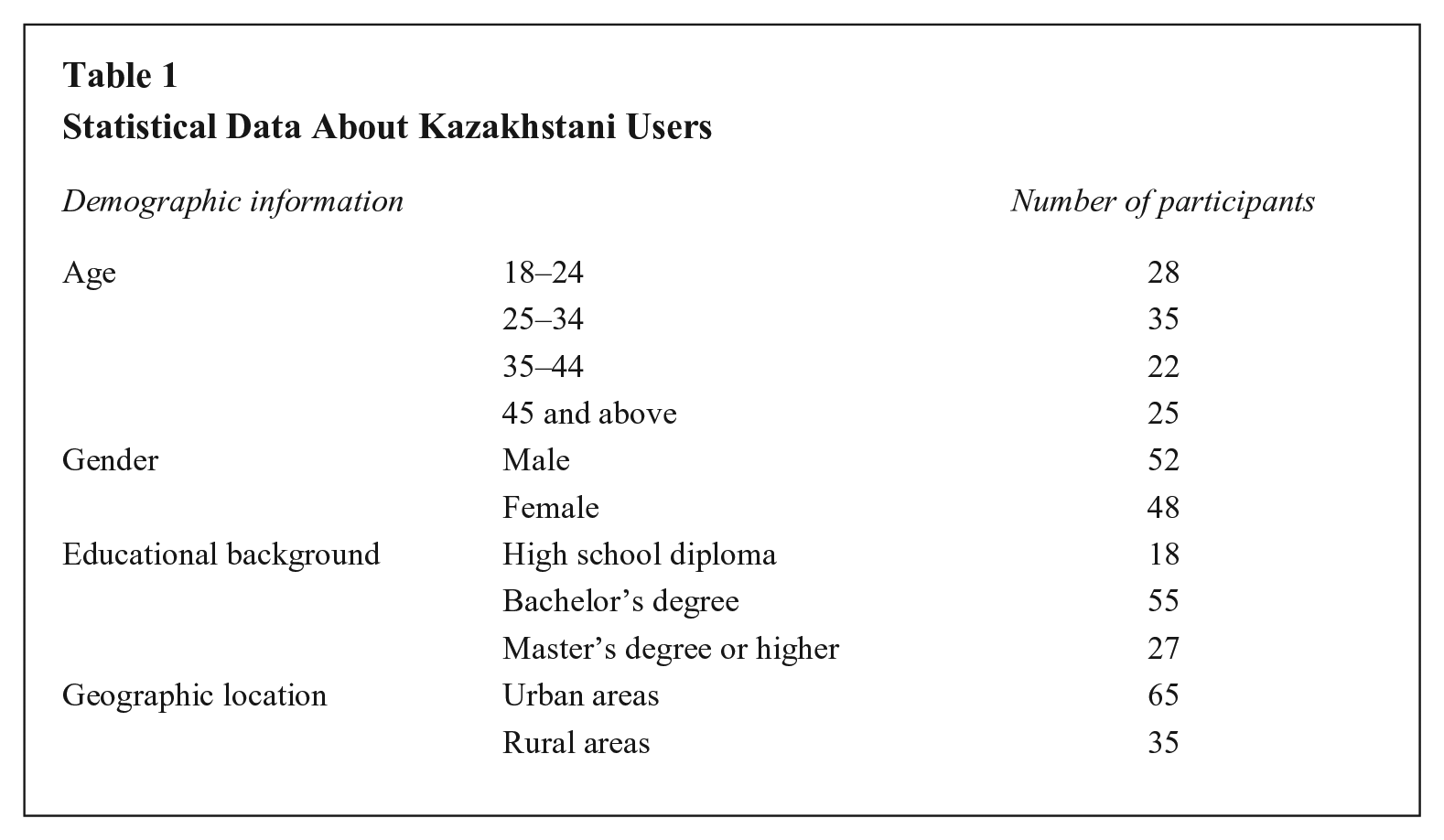
To achieve the goal of the article, the authors also conducted interviews with readers/audience members (Appendix) to understand their views on the coverage of mainstream and alternative media. A total of 100 participants were interviewed (Table 1), and the data were analyzed using both quantitative and qualitative methods. The selection of participants was based on criteria such as age, gender, educational background and geographic location to ensure diversity and representativeness of the population. Interviews with readers/audience members were conducted using a semi-structured approach. The participants were asked open-ended questions to gather their opinions and perspectives on the coverage of mainstream and alternative media. The interviews were conducted either in person or through video conferencing platforms to accommodate participants from different locations.
Statistical Data About Kazakhstani Users
In addition, the authors also surveyed media representatives in Kazakhstan using an anonymous online survey (Appendix). The authors used Google Forms for the online survey. The selection of participants aimed to include a variety of professionals from different roles within the media industry, such as journalists, editors and media managers. The survey was sent to a total of 50 media professionals working in both mainstream and alternative media outlets, with a response rate of 80%. The survey consisted of both closed-ended questions, which allowed for quantitative analysis, and open-ended questions, which provided qualitative insights. The survey was distributed electronically to the selected participants, and they were given a specified time frame to complete and submit their responses. The quantitative data were analyzed using descriptive statistics, while the qualitative data were analyzed using content analysis to identify key themes and patterns. The insights gained from the media professionals provided valuable perspectives on the challenges and opportunities for citizen journalism in the Kazakhstani media landscape.
The qualitative data collected from interviews (verbatim transcriptions) and open-ended survey questions were analyzed using content analysis. This involved systematically categorizing and coding the responses to identify key themes, patterns and recurring ideas. Initially, a coding framework was developed based on the research objectives and the themes that emerged from the data. This framework provided a structure for organizing and analyzing the qualitative data. The coding process was conducted by hand and involved assigning appropriate codes to different segments of the data based on their relevance to the identified themes. Multiple coders have been involved to ensure intercoder reliability and minimize bias. Once the coding was complete, the coded data were analyzed to identify commonalities, differences and noteworthy findings.
The results of the research work may be of great importance for the formation of criteria for evaluating the role of citizen journalism in society and also prove extremely important for subsequent scientific developments in this direction. This is especially important in the context of the significant development of the media in the era of the internet, digital television and adoption of the latest technological developments into everyday life. The conclusions and practical results obtained in the course of this study will help expand ideas about the role of citizen journalism in society in the context of Kazakh experience and foreign theoretical developments and provide a guideline for subsequent developments on this issue. The topic is of particular significance because the inevitable further development of modern technologies in the field of media determines the strengthening of the role of citizen journalism in public activities and the expansion of the capabilities of this media industry, with an increase in its impact on society as a whole.
Results
Today, citizen journalism plays a huge role in society, especially with the development of the internet and new communication methods. Several criteria exist to evaluate its significance on modern society, including the creation of an alternative point of view on important issues, allowing citizens to express their opinions freely, developing the media sphere through new information portals and increasing social activity among citizens. The principles of citizen journalism development were formulated in the mid-1990s in the United States. In theory, they suggest that journalists and alternative publications should play an active role in society instead of just observing public life. Newspapers should become platforms for discussing pressing issues, and topics relevant to most citizens should take center stage. Discussions and debates between community members should shape public opinion, and citizen journalism can help increase social trust and capital (Pustovalov & Berezina, 2012, p. 196).
Citizen journalism has been widely developed abroad, in the era of the development of the internet and digital communications, starting in the mid-1990s. Alternative media in the United States have a significant impact on the formation of public opinion, being an “information counterbalance” to the existing state media. Alternative media achieved this by responding rapidly to breaking news, encouraging large-scale public participation in discussions, reporting on public events that traditional media ignored and including non-professional authors in gathering, processing and submitting information. The last paragraph is of particular importance, as it determines the main difference between citizen journalism from public and mainstream media, where the main role in covering news is assigned to professional journalists (ascimento & da Silveira, 2017). At the same time, foreign experience clearly demonstrates that the advantage of citizen journalism lies precisely in the possibility of using the internet and modern information technologies to create information and disseminate it massively, to verify the authenticity of information provided by traditional media, and all this with the participation of journalists without professional training. Efficiency in this case is much higher.
In general, the functions of journalism are characterized by a combination of its duties, the nature of the tasks facing it and the way of conducting social activities. The goal of journalism as a whole is to predict the optimal result, which is achieved through certain means used in the functioning. As the result determines the outcome of the activity, then the final result should be pictured during planning. In citizen journalism, the key difference is at the level of means and methods. Citizen journalists do not have special, professional training, and this largely determines the final result and features of the functioning of this sphere of journalism.
The experience of journalists in the media space of Kazakhstan emphasizes the importance of the role of citizen journalism in creating conditions and opportunities for citizens to openly express their opinions on key issues of public life. New blogs, internet sites and information portals appear in the Kazakh-speaking internet space on a daily basis, and communication takes place in the Kazakh language. The Kazakh-speaking internet audience has long been successfully formed and is growing and developing daily. Users conduct active communication, discuss topical issues and openly express their own opinions on the pressing issues of public life in the Republic of Kazakhstan. A similar phenomenon has been called “online journalism” in the Republic, considered one of the manifestations of citizen journalism. In this case, the activity of the audience is fuelled by the opportunity to observe all the opinions and comments expressed under the published materials.
Figure 1 presents the number of articles in Kazakhstan, Kyrgyzstan and Uzbekistan in the period of 2002–2020. Data demonstrate the pace of development of journalism in Kazakhstan in comparison with the other two former Soviet republics.
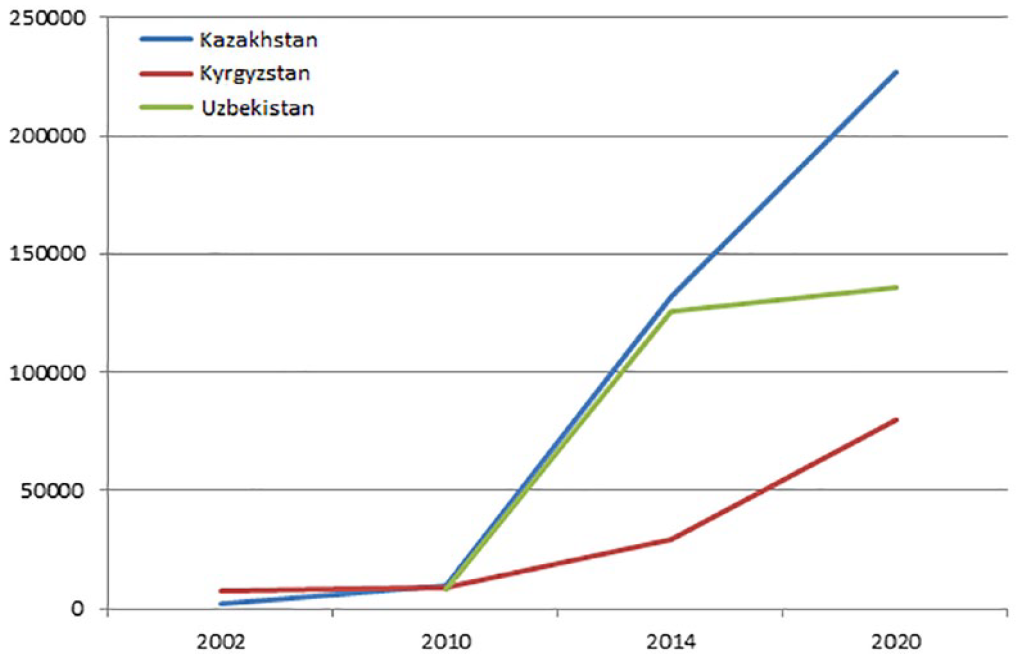
Change of the Number of Articles Over the Years in Kazakhstan, Kyrgyzstan and Uzbekistan
In recent years, with the development of the internet and the latest media technologies, the principles of citizen journalism, based on the active use of blogging, have made a significant contribution to the development of journalism as a whole. Today, many professional journalists have started blogging on the internet, where they openly express their own opinions on various issues of public life. This situation is characteristic not only of the Republic of Kazakhstan, blogging is widespread in many countries in Europe, Asia and America, with the formation and discussion of news from various areas of public life, often completely unrelated. The discussion is in the form of creating posts on various internet sites or social networks. Today especially popular in this regard is the “Facebook” social network (Fast & Haworth, 2020; Kozhemyakin & Popov, 2012; Krasnoyarova, 2013; Meneses-Fernández et al., 2017).
According to a survey conducted by the Internews media agency “New Reporter” among representatives of the media community of Kazakhstan (journalists, media experts and editors of mainstream media), there are five main problems of journalism in the republic. In this context, citizen journalism has a significant advantage. According to the information of the same media agency, in only half of 2020, 58 civil journalists covered about 400 most important events in the life of the Republic, and this information was published on 12 media sites. The majority of these journalists had no previous experience of working in the media. These people were previously trained in separate editorial offices, but in 2018 a special “School of Citizen Journalism” was opened in the country, where a special educational base was prepared for teaching the journalistic trade with its practical application in specific activities of the media.
Based on the interviews with readers/audience members (Appendix), several key findings emerged regarding their perceptions of mainstream media, alternative media and citizen journalism:
Trust in mainstream media: Participants generally exhibited a higher level of trust in mainstream media outlets. They perceived these sources as more credible and reliable compared with alternative media. The established reputation and professional standards associated with mainstream media contributed to this trust.
Concerns about bias and sensationalism: Despite trust in mainstream media, participants expressed concerns about bias and sensationalism present in their coverage. They felt that certain mainstream media outlets may have specific agendas or lean toward particular political or commercial interests, which could affect the objectivity and accuracy of the news.
Unique perspective and diverse voices: Participants acknowledged that citizen journalism offered a unique perspective on events and societal issues. They appreciated the opportunity to hear from diverse voices that might not be prominently featured in mainstream media. Citizen journalism was seen as a platform for individuals to share their experiences, opinions and perspectives on various topics.
Varied quality and verification challenges: Participants noted that the quality of information provided by citizen journalists varied widely. While some considered citizen journalism as a valuable source of alternative viewpoints, others expressed concerns about the accuracy and reliability of the information presented. The absence of traditional editorial oversight in citizen journalism raised challenges in verifying the accuracy of reported facts and ensuring responsible journalism practices.
Importance of accuracy and reliability: The findings underscored the significance of accurate and reliable information in citizen journalism. Participants emphasized the need for fact-checking and ensuring that the information shared by citizen journalists is trustworthy. They recognized the potential value of citizen journalism but stressed the importance of maintaining high standards of accuracy and accountability.
Overall, the interviews highlighted a nuanced perspective among readers/audience members regarding mainstream media, alternative media and citizen journalism. While trust in mainstream media prevailed, participants acknowledged the benefits of citizen journalism in providing unique perspectives and amplifying diverse voices. However, the varying quality of citizen journalism content and challenges in verifying accuracy underscored the need for responsible and reliable reporting within this sphere. These insights contribute to a deeper understanding of how readers/audience members perceive and engage with different media sources.
Based on the responses from media professionals in the survey (Appendix), several key findings emerged regarding their perceptions and experiences with citizen journalism:
Educational background and work experience: The majority of media professionals surveyed (60%) did not have a journalism or related educational background. This suggests that a significant portion of professionals working in the media industry in Kazakhstan have gained experience and expertise through other means, such as on-the-job training or alternative paths.
Challenges faced in media roles: The most commonly reported challenges faced by media professionals included limited resources (such as funding and equipment), time constraints and pressure to meet deadlines. These challenges can impact the quality and depth of reporting in both mainstream and alternative media outlets.
Perception of citizen journalism’s role: Media professionals generally recognize the importance of citizen journalism in the media landscape. While opinions varied, a significant number considered citizen journalism to be either very important or somewhat important. This suggests an acknowledgment of the role citizen journalism plays in providing alternative perspectives and engaging the public in discussions on social issues.
Collaboration with citizen journalists: A notable portion of media professionals reported collaborating or engaging with citizen journalists in their work. This suggests that there is some level of interaction and integration between traditional media and citizen journalism, possibly through sourcing information or featuring citizen-contributed content.
Credibility and reliability of citizen journalism: Media professionals expressed diverse opinions on the credibility and reliability of citizen journalism. While some perceived it as highly credible and reliable, others were more skeptical. This variation in perception reflects the mixed quality of citizen journalism content and the need for careful verification and fact-checking.
Future development of citizen journalism: When asked about the future development of citizen journalism, opinions were divided. While some professionals believed that citizen journalism would significantly grow in importance and influence, others felt it would remain relatively unchanged or even decline in importance. This disparity suggests uncertainties regarding the future trajectory of citizen journalism and its impact on the media industry.
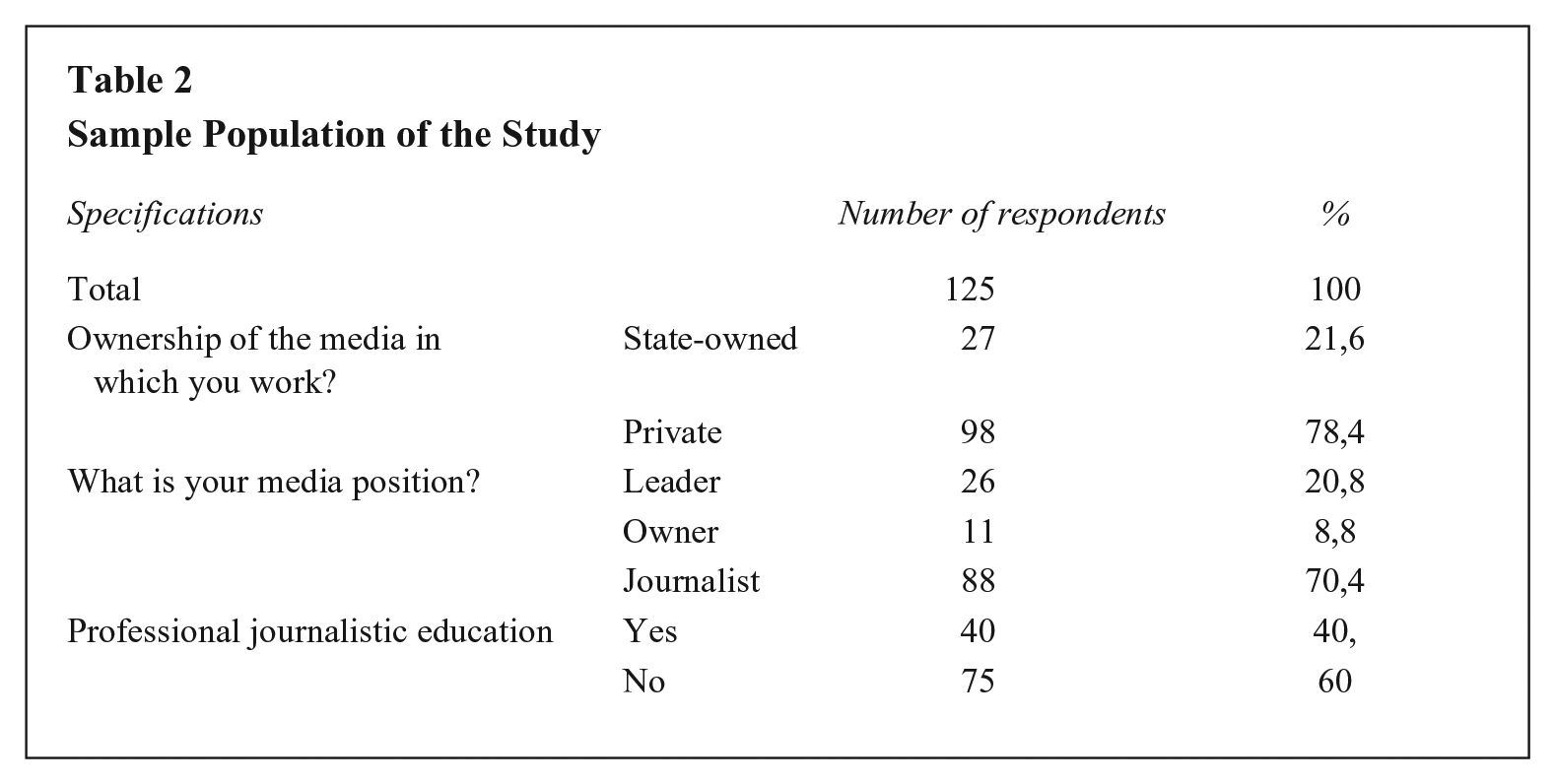
The respondents of the survey were media professionals working in both mainstream and alternative media outlets in Kazakhstan. The respondents represented various forms of ownership in the media industry in Kazakhstan, including privately owned, state-owned and international media outlets. This indirectly testifies to the potential of citizen journalism and its social status. Sample data from the survey is presented in Table 2. Overall, the survey results indicate that media professionals in Kazakhstan recognize the role and significance of citizen journalism in the media landscape. The diverse opinions on credibility and the challenges faced in media roles highlight the importance of maintaining high journalistic standards in both traditional and citizen journalism. These findings contribute to a better understanding of how media professionals perceive and engage with citizen journalism in the evolving media landscape of Kazakhstan.
Sample Population of the Study
The impact of citizen journalism on the government in the Republic of Kazakhstan is expressed in the creation of alternative coverage of events from various spheres of life in the republic, the formation of versions of these events that are different from the generally accepted ones. According to the statistical research conducted by the Center for the Study of Public Opinion in the country, about 80% of the population prefer to double-check the official information by visiting internet portals, independent news sites, where public discussion of significant events in the life of the country takes place. Thus, the role of citizen journalism in the country is increasing in terms of creating a counterbalance to mainstream journalism, the population’s trust in which is declining. Figure 2 presents the data of a comparative analysis of dynamic pattern of the Republic of Kazakhstan population’s interest in information provided by state media and alternative information sources. The data was collected as a result of an anonymous survey by the Center for the Study of Public Opinion in the Republic of Kazakhstan and submitted over the past 4 years.
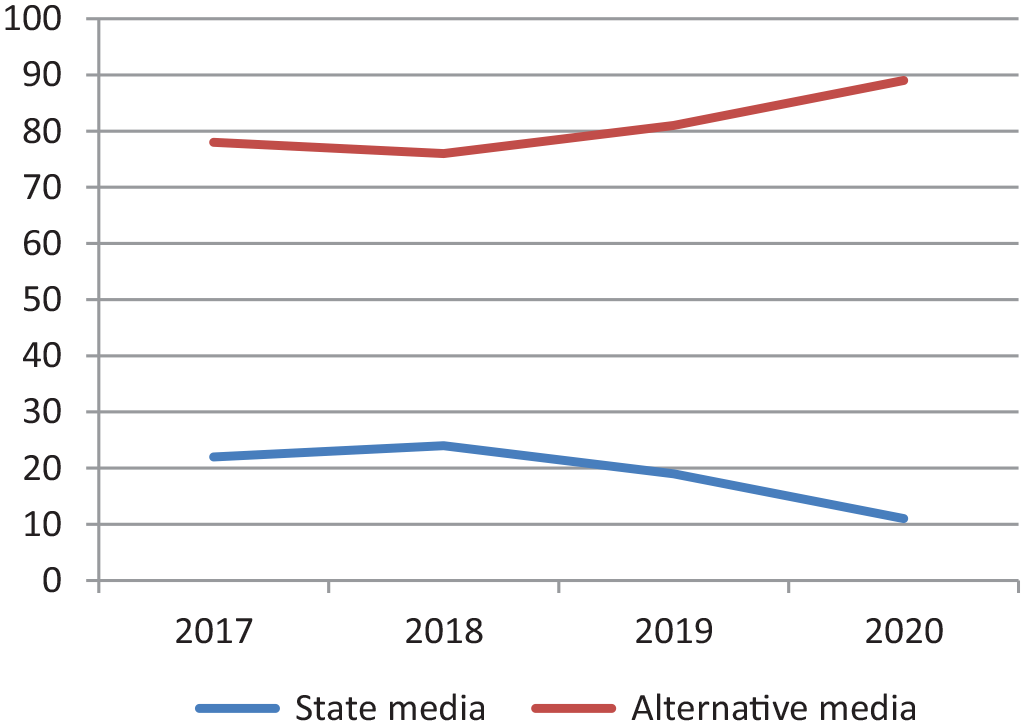
Results of an Anonymous Survey of the Credibility Level of Citizens (in % of the Total Number of Respondents) in the Provision of Information by State and Alternative Media in Kazakhstan for the Period 2017–2020
A survey conducted anonymously by representatives of the Center for the Study of Public Opinion in the Republic of Kazakhstan in the period from 2017 to 2020 convincingly proves that the overwhelming majority of the country’s residents trust the information provided by alternative media much more rather than what is broadcast by the state media. These data eloquently demonstrate the role of citizen journalism in the modern media space in Kazakhstan.
An example of the real work of citizen journalism in Kazakhstan is the situation that happened in 2018. Citizen journalists, such as Ainur Kurmanova and Myras Kuanysh, revealed the case of pollution of the Esil River in the city of Astana (now Nur-Sultan). They documented the illegal dumping of toxic substances into the river, which caused serious water pollution and a negative impact on the river’s ecosystem. Citizen journalists collected photos, videos and eyewitness accounts showing the release of harmful substances into the river. They published this information on social media, including their blogs and specialized online platforms. This attracted the attention of the public and forced the authorities to act. In the end, thanks to media pressure and public mobilization, the authorities of Kazakhstan are forced to take the situation under control. Measures were introduced to stop the pollution of the river and bring the guilty parties to justice. This specific case study demonstrates how citizen journalists are able to identify and document issues occurring in Kazakhstan and use various media platforms to draw attention to them. As a result of media pressure and public mobilization, the authorities are forced to take responsibility and take measures to solve the problem of river pollution (Shabdenova et al., 2022). This example illustrates that citizen journalism can influence changes in government policies and practices, contributing to the improvement of the state of affairs in society. Such an example indicates the importance of citizen journalism in the context of the article and its potential to promote transparency, active civic participation and support of democratic values in Kazakhstan. Research that focuses on such examples and their impact on society helps reveal the significance of the citizen journal.
The role of citizen journalism in modern public life is gaining importance and significance because for representatives of this sphere there are essentially no forbidden discussions that cannot be said about the traditional media, as a rule, controlled by certain socio-political circles. This greatly expands the possibilities of citizen journalists, creating all the necessary conditions for an objective discussion and assessment of the events of everyday public life. Almost complete absence of censorship on the internet only emphasizes the importance of the work of citizen journalists in this aspect. This means that citizen journalism at present and in the future will continue to be an option for solving the pressing issues facing society as a whole and citizen journalism in particular. It is interesting that from the point of view of modern society, under the names of citizen journalism, civil society we mean the opportunity to go against the state system, relying on the opposition. The opinion that citizen journalism will certainly work against the executive branch of the government is superficial. The further development of citizen journalism will only add objectivity to the evaluation of events within the framework of modern society and will provide an opportunity for citizens to express their opinion on issues of public life.
Discussion
The dubitability of issues of citizen journalism and its role in the life and work of modern society is largely due to the difference in evaluations of the activities of citizen journalists by representatives of traditional media, citizen journalists themselves and other representatives of society. So, we can often hear the opinion that citizen journalists are mainly chasing scandalous news, trying, and thus, to shock the public. In his research, Zhezhko (2013), with reference to representatives of the American corps of citizen journalism, refutes this opinion. According to his research, citizen journalists are not hunters for absolutely all the “hot” news. He points out that “for a civil journalist, his conscience should be the only thing standing between himself and the way of communication in the future” (Zhezhko, 2013, p. 166). At the same time, foreign researchers of the phenomenon of citizen journalism note a much greater audience coverage by representatives of alternative media when covering news compared to traditional ones. So, Groshek and Tandoc (2017, p. 202), examining the effect of covering controversial political issues based on an analysis of tweets on the “Twitter” social network, note that “outdated news organisations were present in the discussion in a much smaller amount compared to representatives of alternative media.” At the same time, researchers have noted the global problem of traditional media related to their corruption. On this occasion, Trifonova-Price (2019, p. 118) writes in their study:
From a normative point of view, the media are usually considered as one of the pillars of the national integrity system, which is charged with identifying and preventing acts of corruption and educating the public about the harm caused by corruption. Nevertheless, corruption not only in public institutions, but also in the media itself continues to be one of the most serious problems that Europe faces, undermining citizens’ trust in democratic institutions and weakening the responsibility of the political leadership.
In this regard, many researchers note the advantage of citizen journalism over traditional media, associated with the practical impossibility of corruption in an environment where everyone has the opportunity to openly and fearlessly express their own opinions on any issue (Volkov, 2022, p. 137). In this regard, Shiryaeva (2011, p. 118). notes that in the 1990s, at the dawn of the very concept of citizen journalism, the journalists themselves believed that the most important area of their professional activity should be “promoting the development of democratic structures, establishing a rule of law and democracy.”
Pustovalov and. Berezina (2012, p. 199) emphasize that “the opposition of various types of journalism has ceased to be in the activity of renegades, now they are ascertained by representatives of academic science and studied by them.” At the same time, researchers pay attention to the fact that
consumers of information themselves are now directly involved in the selection of publications, the selection of news and their commentary. This approach differs sharply from what took place in the previous media era, with journalism, which was strictly defined by editors.
Bolysbaeva (2013, p. 103) notes “to date, the “Wikipedia in Kazakh” project has made a significant contribution to the development of media space in Kazakhstan, which has contributed to the fact that in the ranking of Wikipedia languages the Kazakh language has risen from 127th place to 25th. Over the year and a half of the project`s existence, the number of articles on Wikipedia increased from 7,000 to 200,000 or more, the number of authors, at the start of the project, numbering 4 people, now exceeds 230. All these users are actively involved in writing articles, editing and searching for new materials for the project. A large amount of information increases the attendance of the project.” This is a spectacular example of the importance of collective creativity, which forms the basis of citizen journalism and determines the success of projects developing with the participation of citizen journalists (Zhakupov et al., 2020, p. 527).
A number of researchers in their articles pay attention to evaluating the professionalism of citizen journalists and their compliance with the standards of morality adopted in society. In this regard, Yang et al. (2016 pp. 147–148) in a joint study note that “in the field of citizen journalism, core values, such as professionalism, experience and moral standards, are relevant. Codes are consistent with individual qualities that encourage professionals to act ethically.” Researchers further note, “Citizen journalists continue to emphasize the obligation to society in their codes of ethics, while many public relations codes focus on duty to the client or organisation.”
Thus, studies by foreign, as well as Kazakhstani authors emphasize the critical importance of citizen journalism primarily as an alternative to traditional media in matters of objective presentation of information. Further research in this area will help expand the understanding of citizen journalism, its capabilities and role in the media space of modern society.
Limitations and Call for Future Research
The research has limitations due to its small sample size. In addition, relying heavily on foreign sources may overlook unique aspects of the Kazakhstani context, and there could be subjectivity in interpreting qualitative data. So, the study’s scope might not fully capture the broader impact of citizen journalism.
In general, it is possible to predict the further development of alternative media, one of the branches of which is citizen journalism, which only emphasizes the importance of the role that it will play in future in public life. Further research on this subject can significantly enrich the body of knowledge on this issue and help highlight the main trends in the development of citizen journalism in relation to the changing conditions of society. As the activities of non-traditional media are directly related to the development of the internet and the latest information technologies, the further development of the IT sphere will certainly entail the growing role of citizen journalism in the life of modern society. Foreign theory and experience of the media space of Kazakhstan only confirm this.
Conclusion
The study of the role of citizen journalism in society, based on foreign theory and experience of Kazakhstan, led to the following conclusions. Citizen journalism has been rapidly developing over the past 20 to 25 years in the era of the internet and the latest media technologies, as an alternative to traditional media. The development of citizen journalism is determined by the following factors. First, citizen journalism forms alternative views on topical issues that are widely discussed in society and have a public outcry. Citizen journalists have the opportunity to openly express their own opinions on all issues, which cannot be said about representatives of traditional media. Second, citizen journalism forms all the necessary conditions for involving citizens in the discussion of topical social issues, without fear of public censure and persecution by government officials. This state of affairs became possible precisely with the help of development of the internet and modern technologies, which is expressed in the creation and launch of numerous alternative news sites, information portals, the ability to conduct open discussions in social networks and so on. The ability to post comments on blogs, on internet forums, as well as get acquainted with the opinions of other users, allows citizens to often hide their real name under a nickname, which makes such communication relatively safe for users.
Third, (and this is a consequence of the second provision), citizen journalism contributes to the emergence of numerous internet information resources where news is formed, discussions and broadcasts are conducted, which positively affects the development of the media sphere of an individual state. The internet and citizen journalism are closely related, because of the fact that they are actively interdependent in matters of formation and development. Fourth, the social activity of citizens thanks to citizen journalism is growing—citizens get the opportunity to participate in public life independently, which is expressed not only in the discussion of vital social and public issues, but also in the development of the information space as a whole. An important factor in the role of citizen journalism in society is the lack of the need for a citizen journalist to have a professional education, without which activities in the field of traditional journalism are impossible in the first place. In addition, a significant factor that distinguishes activities in the field of citizen journalism from working in traditional media is the potential corruption of the latter, their dependence on the policies of their owners. The possibility of citizens expressing their opinions openly on almost all issues of the life of modern society is the main factor that distinguishes citizen journalism against the background of traditional media.
Footnotes
Appendix
Author Contributions
All authors contributed to the study conception and design.
Data Availability
All data generated or analyzed during this study are included in this published article.