




Abstract
The study explored the usage, frequency and prominence of placements of propaganda devices by All Progressives Congress and People’s Democratic Party in select Nigerian newspapers during the 2019 electioneering campaigns. Content analysis design was used. Sample size of 288 was drawn from a population of 1,096 daily and weekly editions of four national newspapers in Nigeria between July 2018 and March 2019. Systematic sampling technique and intercoder reliability of 92% were used. The study found that propaganda devices were effectively used by political parties with grave implications for the processes of political communications in Nigeria. The most used propaganda devices were name-calling and bandwagon while the least used was transfer. These appeared more daily, placed in the front and inside pages, and helped to advance the tenets of agenda-setting and propaganda theories. It concluded that the usage, frequency, and prominence of placements of propaganda devices are effectually important in the entire process of electioneering, coverage, and mobilization, but recommended a professional use of propaganda to mitigate its reference as a negative tool of communication.
Introduction
Political communication concentrates on clearly defining political electioneering processes. It serves as an index of participation in election or nonelection activities; and finds expression in media forms such as news stories, advertorials, illustrations, opinion, editorials, and features. Participatory communication invigorates participation in election activities which include registration, campaigns, meetings, funding activities, contesting, and voting. Nonelectoral participation involves contacting political leaders, expressing opinions and related community development activities. The Nigerian political space allows for both forms of participation.
Political communication, as conveyed during political campaigns, are organized efforts that seek to influence the decision-making process within a specific group or environment. Every campaign is a unique attempt ultimately focused on winning elections (Bertolotti et al., 2013), and it extensively utilizes the use of propaganda tools to share meanings. Propaganda essentially seeks to attract and keep followers rather than win converts. Propagandists attempt to shield their victims away from other realities by somewhat blanketing them toward one area of human activity, giving the illusion that only the “allowed-way” is the best. Hence, “communication intended to influence belief and action, whether true or false” is regarded as propaganda (Narasimha-Reddi, 2009). A common denominator of electioneering campaigns in Nigeria is the overt use of propaganda devices, such as name-calling/labeling, bandwagon, glittering generalities, card stacking, plain folks, transfers, logical and illogical fallacies, testimonials, fear, distortion of facts and sometimes omission of facts. It could even take the forms of black or white propaganda as well (Ross, 2002).
Several of these have been frequently deployed within the Nigerian political and media spaces, either knowingly or not, and with varying intensity. The 2019 electioneering campaigns in Nigeria provided a charter to revisit and explore the extensive use of these devices again, and what implications it holds for reportage and political communication. This article provides an exploration of the use of propaganda devices as political communication within the Nigerian context and, by extension, the larger African contexts by using the following research questions by using the following research questions:
What are the propaganda devices commonly used in the select newspapers on All Progressives Congress (APC) and People’s Democratic Party (PDP) in the 2019 electioneering campaigns in Nigeria?
What is the frequency of the various commonly used propaganda devices employed in the select newspapers on APC and PDP in the 2019 electioneering campaigns in Nigeria?
How is prominence given to the various propaganda devices by the select newspapers on APC and PDP in the 2019 electioneering campaigns in Nigeria?
From the research objectives above, we tend to establish the fact that within the Nigerian and African milieu, the use of propaganda as the standard form of political communication is on the increase. Although it is safe to assert that not every political communication is propagandist in nature, we cannot extricate the fact that propaganda are the dominant elements for use by political communicators to leverage certain parochial gains, most times away from global best practices (Obukoadata, 2010). We know, for sure, that deployment of propaganda in political communication in Nigeria is akin to the way politics are carried out. It is inherently manipulative of the communication engagement (Howard & Woolley, 2016), transformative in similarities and application (Zhang, 2011), and leveraging propaganda techniques as political communication (Min & Luqiu, 2021). At the risk of generalization, the same political culture is obtained along the African matrix as far as political communication is concerned (Okigbo & Onoja, 2017), hence the need for this exploration.
Two key participants in the 2019 Nigerian electioneering campaigns were the APC and the PDP. The APC had President Muhammadu Buhari as its presidential flag bearer while PDP fielded the former vice president, Atiku Abubakar, as its presidential candidate.
Several media concerns were used to drive the propaganda mission of the various political parties. However, this study focuses on the newspapers, because they are documented and as such, could be used for content analysis. Four daily newspapers—the Sun, Punch, Guardian, and The Nation, were selected based on several orientations, which include partisanship, neutrality, consistency on the newsstand, followership, objectivity and availability. The Nation has a great followership among the APC faithful; Guardian owes allegiance to no political party, ethnic community, religious or other interest group; Punch is a nonpartisan medium with bias for news content in South-Western Nigeria; and Sun serves the needs of all classes of reader, especially the young and mobile upward segment. These newspapers contain some of the propaganda devices by virtue of their affiliation, business or ideological points as are injected by politicians, commentators, and journalists. Due to their wide acceptability, they were very prevalent in the 2019 electioneering campaigns. These provide justification for their use in this study.
Conceptual Framework
Propaganda and Political Communication
Propaganda, as a concept and subject of inquiry, has been viewed with mixed feelings, sometimes dreaded as an emotive discourse, taking several meanings that, by application, rightly or wrongly have been ascribed to it. Wilson (2005) notes that by viewing propaganda as an activity of changing people’s mind raises some technical, psychological, moral, and social questions. He sees the technical, ethical, and psychological implications of deploying propaganda as a tool on several fronts and provides polysomic dimensions to discussions on propaganda. Among the dimensions, he proffers are that the politician sees every information emanating from the opposition as negative propaganda, while the political activist sees information from the government and her agencies as mere propaganda. Inherent in Wilson’s claim is that political communications are tapered variedly on the propaganda sand glass. Also, propaganda is seen as a legitimate tool by the politician to advance his interests which he, rightly or wrongly, assumes coincide with the needs of the ordinary people.
Propaganda is the “intentional control, manipulation and communication of information and imagery in order to achieve certain political objectives” (O’Sullivan et al., 1983, p. 56) and “the deliberate, systematic attempt to shape perceptions, manipulate cognitions, and direct behavior to achieve a response that furthers the desired intent of the propagandist” (Jowett & O’Donnell, 2014, p. 125). These definitions would amount to improper, narrow, and simplistic views of propaganda and what it stands for, but also allude to the operations of propaganda which are distinguishable within the frame of political communication. Most aspects of communication had benefited from the discourse of propaganda. Watson and Hill (2015) offer a much broader perspective in defining propaganda, by dislodging it from the overt political discursive plane and locating it in all aspects of human endeavor and communication, and contending that it is “usually deliberate manipulation of means of symbols (words, gesture, images, flags, movements, music, etc.) of other people’s thoughts, behavior, attitudes and beliefs.” They add that propaganda is a deliberate aspect of effecting changes in attitude and behaviors, a tool for social and behavioral changes, deployed toward emotional manipulation.
Manipulation is at the heart of the propaganda process and could lead the propagandist to “consciously suppress the truth” when such is akin to the mission to be accomplished, and thus give flames to the notion that propaganda is “all about staggering the truth” (Wilson, 2005). On the positive side, the enlightening characteristic scores high. When it enlightens, it provides succinct clarifications on issues and, by extension, creates new orientations for the people. As a suggestive mechanism, propaganda activities are conducted through an indirect way that are subtle yet capable of awakening certain sensation and stimulating the minds in a particular way. Its intentional characteristic denotes a conscious activity of spreading bias or rumor to win the convert to an argument point.
The intentionality of propaganda implies a control of the minds of the people, thus drawing similarity to the agenda-setting and hypothermic needle theories (Croteau & Hoynes, 2003). Controlling is argued to be the prime efforts of all propaganda efforts with Wilson (2005) maintaining that the extent of control is beyond the primary phase but gets to the point where after the propagandist has the victims in his hands, he continuously deals with their minds in a manner that leaves them very helpless. The propagandist must, therefore, be systematic, methodological, orderly, explanatory, and exploratory in achieving any of these identified characteristics.
Propaganda uses available media to achieve its set goals (Ross, 2002). These media could include press and electronic forms, and several above- and below-the-line media forms. For the purpose of this article, the focus is on the newspapers and how they covered the 2019 electioneering campaigns. The conceptualization of propaganda above and the identification of certain elements within the definition such as intentional, manipulative, controlling, and the likes aligns with the same diatribe obtainable within the confines of political communication.
Propaganda Devices, Newspapering, Functionality, and Pattern of Coverage
Propaganda usage in Nigerian political space predates independence, and does not seem to abate at the moment, but contributes to building and defining her people (Uche, 1989) as well as being a tool preponderantly used during the independence struggle. The victory of Nigerian independence struggle was won on all fronts on the pages of littered with bloodied inks that wrote from wounded hearts, and not on the streets. It had continued to be used during the different military and civilian administrations in the country.
Propaganda employs several strategies that revolve along “suggestion” and “stimulation” as key ingredients in driving the process. The propagandist uses stimulation to suggest an idea that sometimes the recipients do not have any logical grounds to accept or reject. Such suggestions could come in the guise of making positive statements in familiar languages, or even refusing to accept there is a second side to the coin (Robert, 1995). Suggestions could also dovetail with the use of hints, insinuations or indirect statements.
Name-calling propaganda occurs when complementary or pejorative words are used to purposely describe a person or group to subliminally manipulate or influence public opinion to generate conformity with the opinions of those producing the propaganda (Baran & Davies, 2009; Wilson, 2005). Within the 2019 electioneering campaigns, we saw the use of such terms as dictator, poverty, clueless, witch-hunting, corruption campaigns, figurehead leadership, and phrases as “PDP are looters,” “APC is a terrorist party,” “Atiku is a thief,” “Buhari is a tribalist” and so on (Onyenze, 2017).
Bandwagon is a psychological propaganda technique that allows people to follow a trend irrespective of their beliefs, culture, and norms just in a bid to score a point. It is a form of herd’s mentality, and this is well manifested in the “change” and “looters” mentality (Ross, 2002). Glittering generalities involve the use of undue praises and commendation-driven terms to describe the activities or nature of an individual or a party, it is a form of stereotype used to create good impression or image, bragging-ability to gain massive support (Bolaji, 2018). Card stacking involves a ploy to latch on something new, strong and valuable to help market a set of activities that are no longer tenable among the people.
Transfer is the use of symbols, quotes, or the images of famous people to convey a message not necessarily associated with them (Bolaji, 2018; Onyenze, 2017). Testimonial employs, albeit deceitfully or manipulatively, the use of celebrated personalities to promote the candidates or activities of a political party. Repetition occurs when a propaganda item is repeated many times while emotional words are used as propaganda techniques to generate positive feelings in the minds of the masses. Others include the half-truth, omission of facts and staggering of certain facts and the “black-and-white fallacy.” All political parties in the 2019 electioneering campaigns used at least one form of these propaganda devices.
Newspapers, through their strong, fair, dedicated, responsible, equitable, balanced and conflict-sensitive reporting, have been covering electioneering activities over the years, and helping the process of representative democracy and legitimization of the political system (Oyesomi & Oyero, 2012). Minimal visibility and coverage of certain gladiators in the electioneering process are sacrosanct on one hand, and lack of visibilities are function of the kind of newspapers and newspapering business, ownership pattern and editorial philosophy on the other (Okon & Ekpe, 2018; Uche, 1989).
The Nigerian political space has seen so many bashes, accolades, and condemnations of the roles that media play during electioneering with scholars documenting how major Nigerian newspapers fanned the embers of religious sentiments and elevated ethnic/tribal/regional/tendency attacks and hate vanguards (Batta et al., 2015), how majority of the advertisements dealt with nonissues, while those that attempted to look at issues, preoccupied themselves about socio-cultural issues (Obukoadata, 2009), and how personal-attacks-advertisements were seen as the main thrust of the advertisements, which no doubt raised the banner of religious, ethnic and sectional sentiments and violent/hate messages as against development-oriented messages (Obukoadata, 2018). This has been the pattern of newspaper coverage of electioneering activities over the years in Nigerian political space despite the several billions of naira spent in print-media-advertising-expenditure (Esuh & Umanah, 2019).
Batta et al. (2015) and (Okon, 2018) confirm the marked influence of corporate media owners over news content, with the financial interest cum political affiliation of the owners playing the main gatekeeping decider. It is, therefore, safe to assume that the financial interests of the media owners and players are the key index in the gatekeeping roles they play.
In newspapers’ coverage of electioneering, “political processes affect both protest and news coverage of protest” (Oliver & Maney, 2000), implying that despite the positive orientation of the media people and the owners, the political process and other political gladiators would influence the way elections are covered. In Nigeria, this is a pointer to the role that Independent National Electoral Commission (INEC) should be playing in regulating electoral coverage over the years.
Ownership is key to how newspapers cover stories during electioneering campaigns. Mordi and Ogbu (2017) examine the “impact of politician-businessperson-owned (PBO) newspapers on the objectivity of the reportage of the 2015 presidential election in Nigeria, by some selected media organizations” in a bid to establish their level of objectivity in terms of coverage of political events and political parties as well as their level of compliance with professional ethical considerations. The paper found out that in the Nigerian context, media owners, and not the editors, appear to be the gatekeepers. This tends to downplay the defining roles of the editors as canvassed by Croteau and Hoynes (2003) in filtering media contents. Consequently, in all the arguments presented, one would agree with the notion that the media, especially newspapers in Nigeria, have a share of the tides and trends in the creation, escalation, and resolution of crises as pushed through several propaganda devices.
Theoretical Framework
Agenda-setting theory and theory of propaganda are used to guide this research. The agenda-setting theory, proposed by McCombs and Shaw between 1972 and 1973, was based on Cohen’s (1963) theorizing that the “media may not be successful much of the time in telling people what to think, but it is stunningly successful in telling its readers what to think about” (p. 13). The theory assumes that the mass media do not reflect social reality because news is filtered, chosen, and shaped by newsroom staff or broadcasters; that people get their news from limited sources, such as the mass media, because they do not pay attention to all outlets; and that few media agenda, which were chosen by professional gatekeepers, lead people to perceive given issues as important (Anaeto et al., 2008; McCombs & Shaw, 1972).
These assumptions, with various dimensions, have received greater attention from scholars than most other communication theories because of its vast applicability in explaining communication phenomenon. In discussing the processes of the agenda-setting model, Anaeto et al. (2008) mention that agenda setting is achieved through frequency of reportage of events, strategic use of headlines and picture displays to report events, and, the use of reports that give room for points and counterpoints in the daily presentations of news. These processes were studied in this work, knowing that frequency of use of propaganda devices would increase the propensity and effectiveness of propaganda, either positively or negatively.
The theory of propaganda, propounded in 1927 by Harold Lasswell, borrowed extensively from the ideals of behaviorism and Freudianism. His work focused on how to apply psychological theories to the understanding of politics. One foundation of the theory is that ‘the power of propaganda was not so much the result of the substance or appeal of specific messages but, rather, the result of the vulnerable state of mind of average people”; and that propaganda is not negative in approach (Baran & Davies, 2009). Propaganda, according to Lasswell, is only effective if the recipient of the propaganda messages is vulnerable. The question, therefore, is: what will be the state of the propaganda elements if the recipients are not vulnerable? This, though not the focus of this study, would interest further researches and comments.
The take from this theory is that frequency or multiplication of the propaganda stimuli was seen as key to making propaganda work. This bears affinity with the agenda-setting theory. The theory also helps to explain and prove that not only the vulnerable, but every segment of the public is susceptible to negative propaganda messages. Another gain from the use of this theory is that propaganda has slant, that is, it could either be negative or positive, and that positive propaganda is synonymous to development agenda while negative propaganda destroys the fabrics of society. Consequently, this study, from the premise of this theory, defines the slants predominantly used in the 2019 electioneering campaigns in Nigeria.
Research Methodology
This study adopted the content analysis design (Wimmer & Dominick, 2011) because it helped to study and analyze the propaganda devices by describing the frequency of occurrence, the prominence given, and the directions of the propaganda devices in an objective, systematic and quantitative manner. The population of the study comprised daily and weekend editions of four national newspapers in Nigeria, namely, the Sun, Guardian, Punch, and The Nation, from July 2018 to March 2019, making up a period of 9 months. This period is significant because it witnessed intense political activities, such as party primaries that held on August 18, 2018 and the national and state elections rescheduled for February 23 and March 9, 2019 respectively. The start date for the study was a month before the primaries and ended after the elections.
The sample size of 288 editions of the select newspapers was decided using Krejcie and Morgan (1970) table. It was arrived at using 95% confidence level (α) and ±5% margin of error. Therefore, each of the select newspapers had 88 issues as its sample size. The study used the systematic sampling technique with a random start of July 2 for the Sun, the Guardian and the Punch and July 3 for The Nation. A skip interval of 3.114 (approximately 3) was used in picking each sampled issue of the select newspapers.
The instrument used for the study was coding sheet and guide, with the units of analysis being news stories, editorials, illustrations, advertorials, and features/opinions. The content categories used were propaganda devices (i.e., all strategic textual elements intended to either positively or negatively influence the electorate, electioneering campaigns, and political process. These included name calling and labeling (which involves the use complimentary or pejorative words by stakeholders to manipulate or influence subliminally the opinion of others, either for a positive or negative course); bandwagon (a psychological propaganda technique or a form of herd’s mentality that allows people to follow a trend irrespective of their beliefs, culture and norms just in a bid to score a point); transfer (the use of symbols, quotes or the images of famous people to convey a message not necessarily associated with them); glittering generalities (the use of undue praises and commendation-driven terms to describe the activities or nature of an individual or a party); and card stacking (a ploy to latch on something new, strong and valuable to help market a set of activities that are no longer tenable among the people). Other propaganda devices used were distortion of facts, plain folk, logical and illogical fallacies, fear, and omission of facts. Attention score for the study was on prominence (the placement and positioning of the unit of analysis in the select newspapers on front page, inside page, back page, central spread, opinion-editorial [op-ed] page, page three and any other page), frequency of stories on the use of propaganda devices, and direction or slant of the stories as to their positive and negative inclination or neutrality.
Validity and Intercoder Reliability
Wimmer and Dominick (2011) view coding as placing a unit of analysis into content category, and see intercoding reliability as level of agreement or sameness among independent coders who code the same content using the same coding instruments. To, therefore, measure the reliability of this study’s instrument, face validity was used and ascertained by subjecting it to a critical examination.
For intercoder reliability, which is the extent to which there is consistency among the three coders who selected this work, the Holsti formula: Reliability=2MN1+N2, was adopted,
Where M is the number of coded decisions on which coders agree
N1 = the number of coded decisions for coder 1
N2 = the number of coded decisions for coder 2
and M = 11; N1 = 12; N2 = 12.
Therefore, 2MN1+N2
= 21112+12
= 2224
= 0.92.
The Sun, Guardian, Punch, and The Nation newspapers had agreement value of 0.92 or 92%, which is deemed excellent (Wimmer & Dominick, 2011). This implies that the instrument so designed was consistent, valid and, therefore, useful for the study.
Findings and Discussion
Coding sheet was used to extract data from a sample of 288 editions of the select newspapers. As expected, some of the editions content-analyzed had more than one news items that bother on propaganda devices and the political parties under study. In all, there were 859 stories that focused on the studied political parties (APC and PDP) for the period under study, and used propaganda devices which either favored or disfavored the two major political parties or helped them to garner attention. The Sun had 178, The Guardian had 167 stories, Punch had 246, while The Nation had the highest of 268 entries. This, again, is expected as the fewer entries of the Guardian aligned with its editorial policy and perception of being an elitist and independent newspaper, while the high number of entries for The Nation newspapers attests to its partisan approach as the proprietor is more sympathetic to one of the political parties under study—the APC. Also, the entries show that the Sun newspaper, despite having close affiliation to an APC stalwart, who incidentally is the proprietor, showed some significant level of objectivity and nonpartisanship.
Several propaganda devices were identified and evaluated in this analysis, and their use in the select newspapers as they affected the APC and PDP are presented. The variables used were frequency, prominence, and direction. These were done first for each of the newspapers, then for all the newspapers collectively, and finally for the political parties.
In all the select newspapers, it was observed that some of the sampled editions had no records of propaganda devices used as related to the APC and PDP. They were included in the overall analysis because they were part of the sample size. In the case of The Sun, 10 (5.6%) of the total sampled editions had no record of propaganda devices used; Guardian, 17 (10.2%); Punch, 9 (3.6%); and The Nation, only 3 (1.1%). In all, 39 (5.1%) of the total sampled editions had no evidence of propaganda devices used. This is shown in Table 1.
What Are the Propaganda Devices Commonly Used in the Select Newspapers on APC and PDP in the 2019 Electioneering Campaigns in Nigeria?
Distribution of Propaganda Devices for Select Newspapers
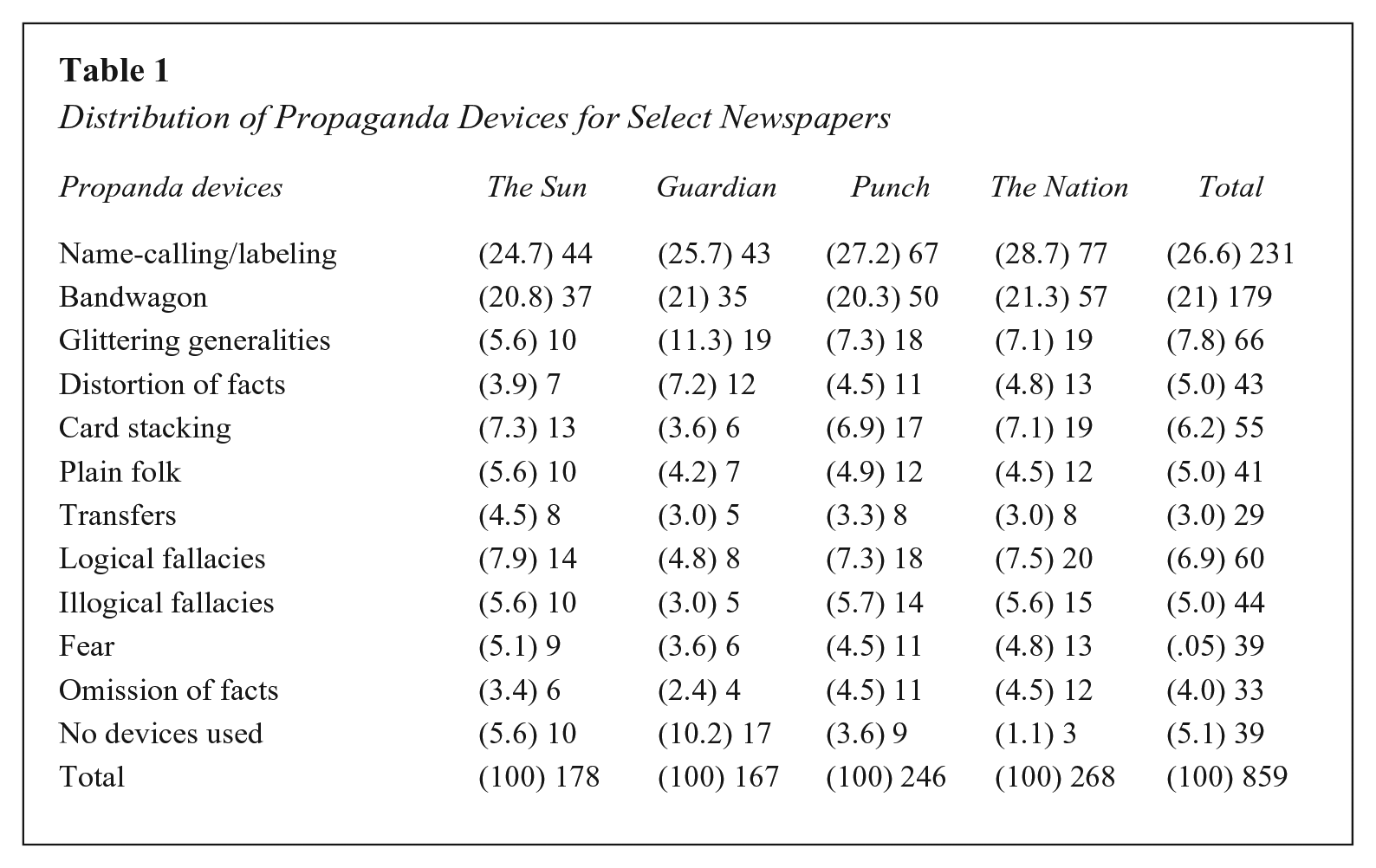
The five most common propaganda devices identified in the select newspapers during the 2019 general elections which focused on the APC and PDP are name-calling (26.6%), bandwagon (21%), glittering generalities (7.8%), logical fallacies (6.9%), and card stacking (6.2%). Interestingly, for all the studied newspapers, name-calling and bandwagon types of propaganda devices were most commonly used—The Sun (24.7%, 20.8%), Guardian (25.7%, 21%), Punch (27.2%, 20.3%), and The Nation (28.7%, 21.3%).
Name-calling or labeling, being the most used, confirms the position of Ewi (2015) that name-calling technique brings the audience closer to the discussions when pejorative and symbol are used to convoke meanings. For instance, when APC labeled Sowore, PDP, and Atiku as cowards that must be resisted, the message was that they had no solution to the bedeviling security challenges facing the country, or when Buhari was declared “king of the north” in Game of Thrones meme, it surprisingly painted him the messiah with the right credentials to deal with the monumental problems bedeviling the country. Also, “Nigeria is not a colony of the United States, the United Kingdom and the European Union—Oshiomole,” ‘Buhari—Nigeria’s “new broom” president,’ and “Atiku-lated, which is a subtle campaign message showing that Atiku Abubakar was more articulate and has better grasp of the issues plaguing Nigeria than his major challengers,” were some instances of name-calling. Some other labels include figureheads, corruption-infested party, etc. Another interesting aspect of name-calling is the connection with frequency of use, along the tenet of the agenda-setting theory (Anaeto et al., 2008; Baran & Davies, 2009) and its subsequent effects of generating conformity with opinions of those producing the propaganda (Clay, 2011), especially when deployed through a friendly press (Adesoji & Alimi, 2012).
Bandwagon as the next commonly used device in the select newspapers on APC and PDP involves making the political players to be seen as insiders, and presenting a psychological phenomenon in which people act regardless of their beliefs, especially during high dissonance, and when silence had spiraled (Johnston, 2013). The study maintained bandwagon was clearly used by both political parties irrespective of the dissonance level in the polity, resulting in massive effects on both sides. For instance, in the South-East, the PDP leveraged on its acceptability and personality of Peter Obi with the Obi-diently bandwagon effect, and despite the security uncertainty at the time, there were high voters’ turnouts for PDP. For the APC, the “next level” catch phrase was the magic that created the bandwagon for it. The PDP capitalized on that and kept taunting the APC, mimicking the catchphrase with a moniker, “next level of promises not met and excuses.”
The change mantra by the APC is a classic example for glittering generalities with the party and all its hirelings sparing no opportunity to remind Nigerians of the impeccable credentials of Buhari, and how he had fought corruption and insecurity to a standstill while bettering the lives of Nigerians by lifting over 100 million people out of poverty (though there are no substantiated facts to support the claims of improved security conditions and lifting of 100 million persons out of poverty). The APC glittered several achievements including “completion of the second Niger Bridge,” ‘technically defeating Boko Haram’ and so on, to the chagrin of The PDP who came up with the “change the change” mantra. Most of these pejoratives used are common with political communication tirades within African contexts, even as recent as the Kenyan elections, where a soul-searching moment was convoked to achieve a sort of closure. But to what effects?
The least used propaganda device among the lot is “transfer,” which accounted for only 3% of the total sampled stories containing propaganda devices. This again, is not unexpected as most of the political campaigns in Nigeria hardly provided solutions to identifiable problems, but their focus had been promissory and deceitful (Obukoadata, 2018; Okon, 2018).
Name-calling and bandwagon propaganda devices helped to entrench the place of the agenda-setting model in political campaigns in Nigeria (Batta et al., 2015) since the frequency of use likely swayed opinion either favorably or unfavorably. The use of these common propaganda devices also gives credence to the place of ownership in the overall media-politics interplay in Nigeria (Bolaji, 2018; Esuh & Umanah, 2019; Oyesomi & Oyero, 2012). Also, along the line of the propaganda theory as postulated by Lasswell (1927), the effects were noticeable because of the level of vulnerability of the Nigerian populace, which is not unconnected with the spate of insecurity, poverty level, socioeconomic trauma and displacements. There were widespread psychosis, and rather than see the use of these seemingly propaganda devices as merely intended to sway opinion, interpretations were given to the master symbols based on social conditioning that were not favorable to either of the political parties, thus creating voter and political apathy. It is within this argument that scholars have often than not reflected political communication and propaganda in the same mirrored prism. The import is that frequency and multiplicity of the propaganda stimuli can help make propaganda work in a particular direction (Baran & Davies, 2009) whether or not there are psychosis, depression and conflicts.
What Is the Frequency of the Various Commonly Used Propaganda Devices Employed in the Select Newspapers on APC and PDP in the 2019 Electioneering Campaigns in Nigeria?
To answer
Frequency of Usage of Propaganda Devices
Frequency of Political Parties Use of Propaganda Devices
Note. PDP = People’s Democratic Party; APC = All Progress Congress.
Direction of Usage of Propaganda Devices
Direction of Political Parties Use of Propaganda Devices
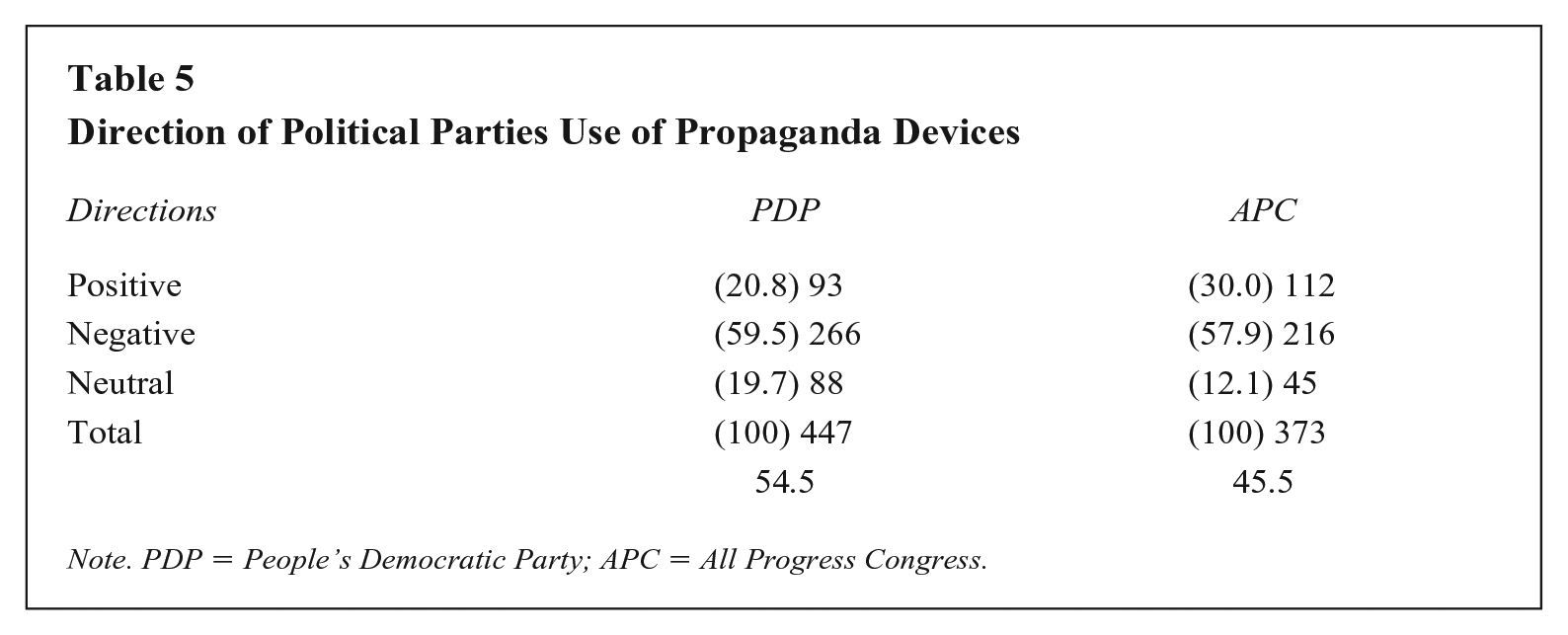
Note. PDP = People’s Democratic Party; APC = All Progress Congress.
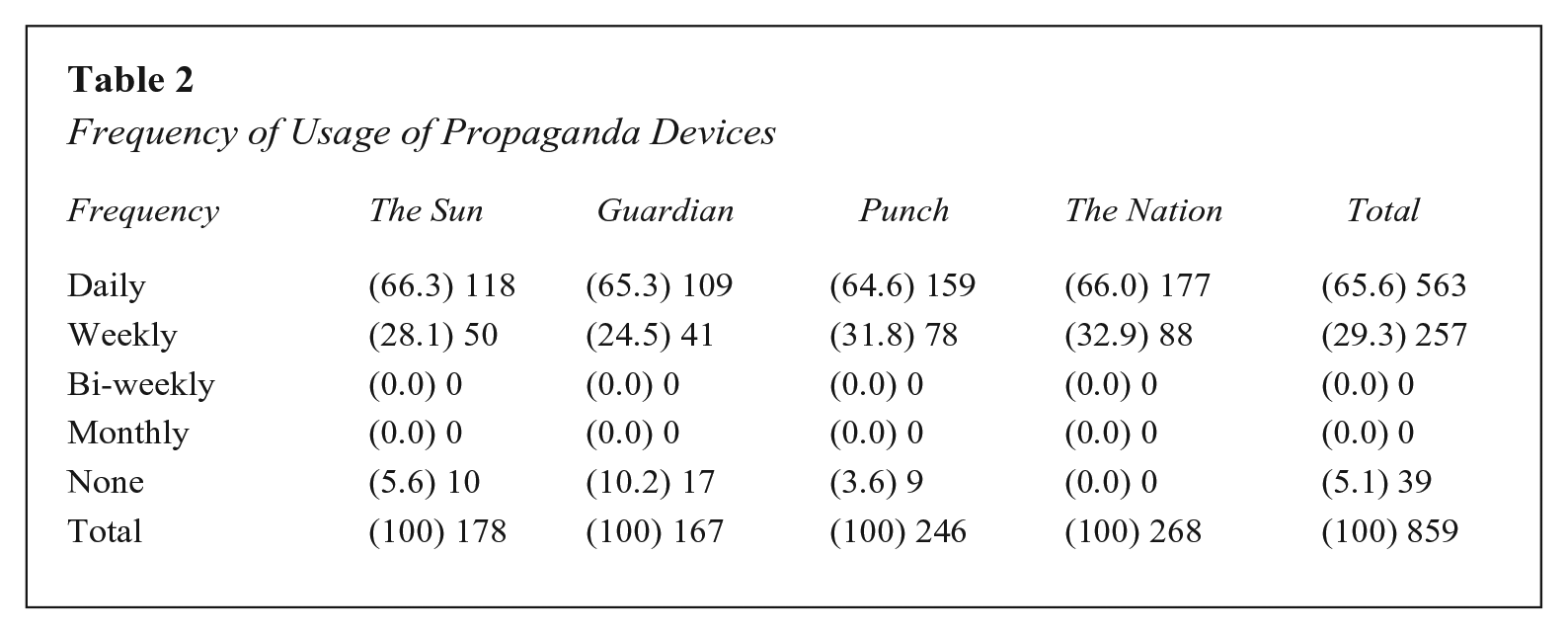
Most of the propaganda devices, as seen in Table 2, appear daily (65.6%) as compared to weekly (29.3%). This was expected as the use of systematic sampling techniques with a skipping interval of three meant that most of the sampled editions were from weekday rather than weekend editions.
In the case of the Sun, 118 (66.3%) of the number of stories sampled occurred daily as compared to 50 (28.1%) that occurred weekly. For the Guardian newspaper, 109 (65.3%) occurred daily and 41 (24.5%) weekly; 159 (64.6%) occurred daily and 78 (31.8%) weekly in the Punch newspaper, while for The Nation newspaper, 177 (66%) occurred daily as compared to 88 (32.9%) weekly. These data support the position that when used daily, the media can play functional roles in deescalating misconception through daily reportage (Onyebadi & Oyedeji, 2012) as opposed to weekly reportage when these misconceptions had gained measure of tractions. Daily coverage also up the ante in terms of who receive the message and when the message is received as canvassed in the epistemic merit hypothesis (Ross, 2002).
The study found out that bandwagon propaganda device was more daily used. It had a total occurrence of 179 sampled stories with propaganda elements, with 125 of such occurring daily and 54 weekly. In this category, The Nation newspaper had the highest daily count of bandwagon devices than the other newspapers in the 2019 electioneering campaigns with 39 sampled stories with propaganda elements as against 33 for Punch, 28 for Guardian, and 25 for Sun. In The Nation, also weekly had more of bandwagon devices than the other studied newspapers as it affects the studied political parties.
For card-stacking propaganda device with 55 total occurrences, 42 were daily and only 13 weekly. The Nation (16) had more of this device daily than the other newspapers, while the Sun (4) slightly had it more on weekly basis when compared to the other newspapers. Surprisingly, the Guardian (7) had distortion of facts propaganda device more than the others on a daily basis as compared to The Nation (9) that had it more than the others on a weekly basis. Name-calling had 231 total occurrences, with 171 daily and 60 weekly; while glittering generalities had 66 total occurrences, with 26 daily and 40 weekly. Those newspapers that had high use of certain propaganda devices on a daily basis somewhat correlate positively with the weekly usage of such propaganda devices. For instance, while The Nation had high use of bandwagon devices on a daily basis, they also had high usage on a weekly basis.
The findings further confirm that daily use of newspapers for strategic electioneering campaigns that are laced with propaganda devices are becoming more commonplace and effective to set agenda for political public discourse during electioneering periods (Esuh & Umanah, 2019; Etika et al., 2018). The findings further support the position by Kaal (2016) which maintains that daily dosage of media content using varied propaganda devices can help negotiate and renegotiate the political plane as well as maintain political communication to counter lack of involvement and alienation by the electorates. The very essence of daily deployment of propaganda devices during electioneering in Nigeria as seen in the data presented suggests that it has now been regarded as the very standard form of political communication. These findings gave support to the need for regular multiplicity of positive stimuli if propaganda is to be effectively used for good, and to achieve the desired effects advanced by Lasswell’s (1927) theory of propaganda.
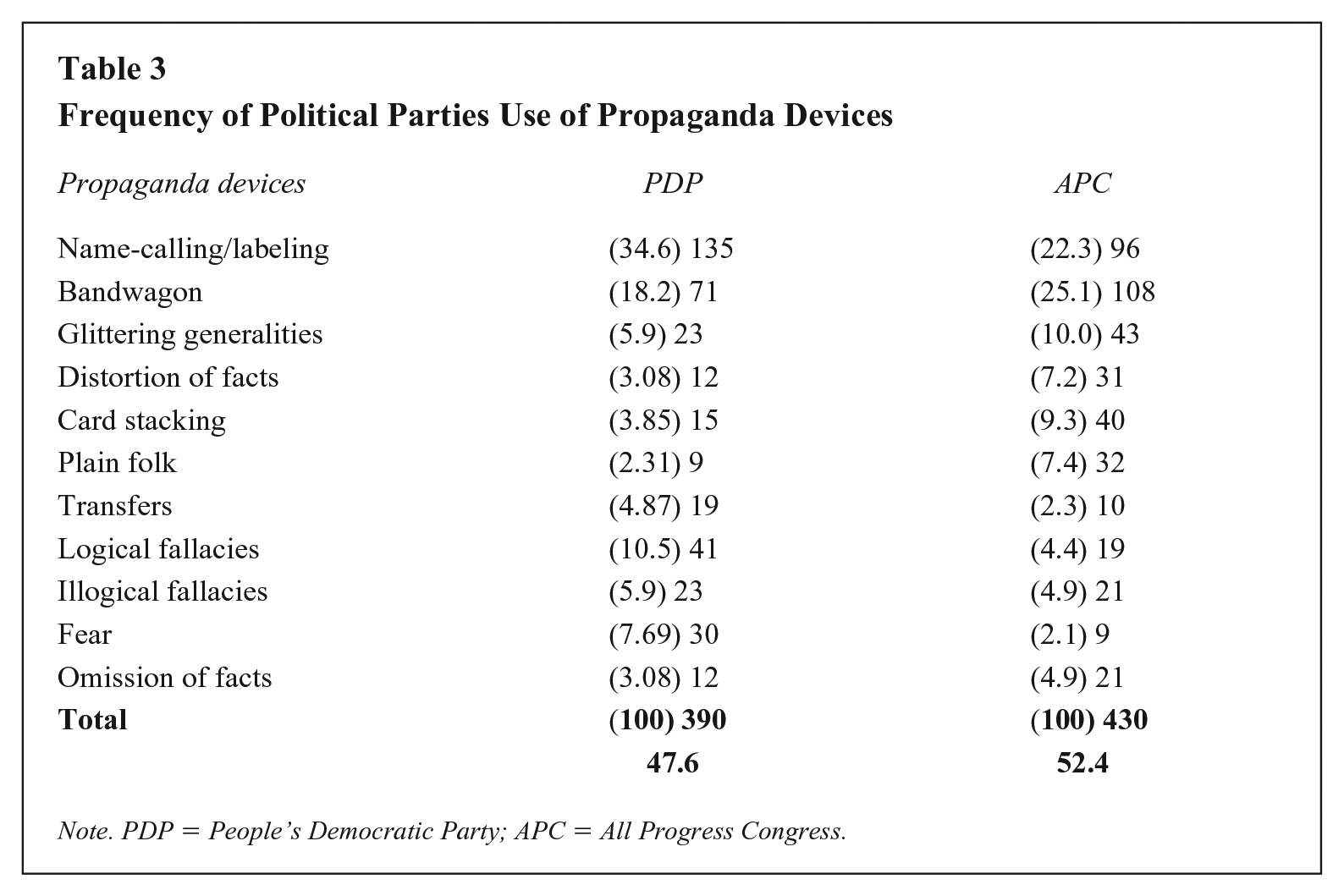
Overall, as shown in Table 3, APC accounted for 52.4% of the propaganda devices as opposed to PDP that accounted for only 47.6%. Drawing from the ±5% margin of error, one can conclude that there is no significant difference between the frequencies of use of propaganda devices by both political parties.
PDP used more of name-calling propaganda device daily (34.6%) as compared to APC that used more of bandwagon propaganda device daily (25.1%). Nonetheless, both political parties used name-calling more than the other propaganda devices. The least used propaganda device by PDP is plain folk (2.3%) while the least used for APC is fear (2.1%).
One could assert from the data that PDP was defter at using name-calling, transfers, logical fallacies, illogical fallacies and fear propaganda devices in driving their political campaigns as compared to the APC who relied more on bandwagon, glittering generalities, distortion of facts, card stacking, plain folks, and omission of facts.
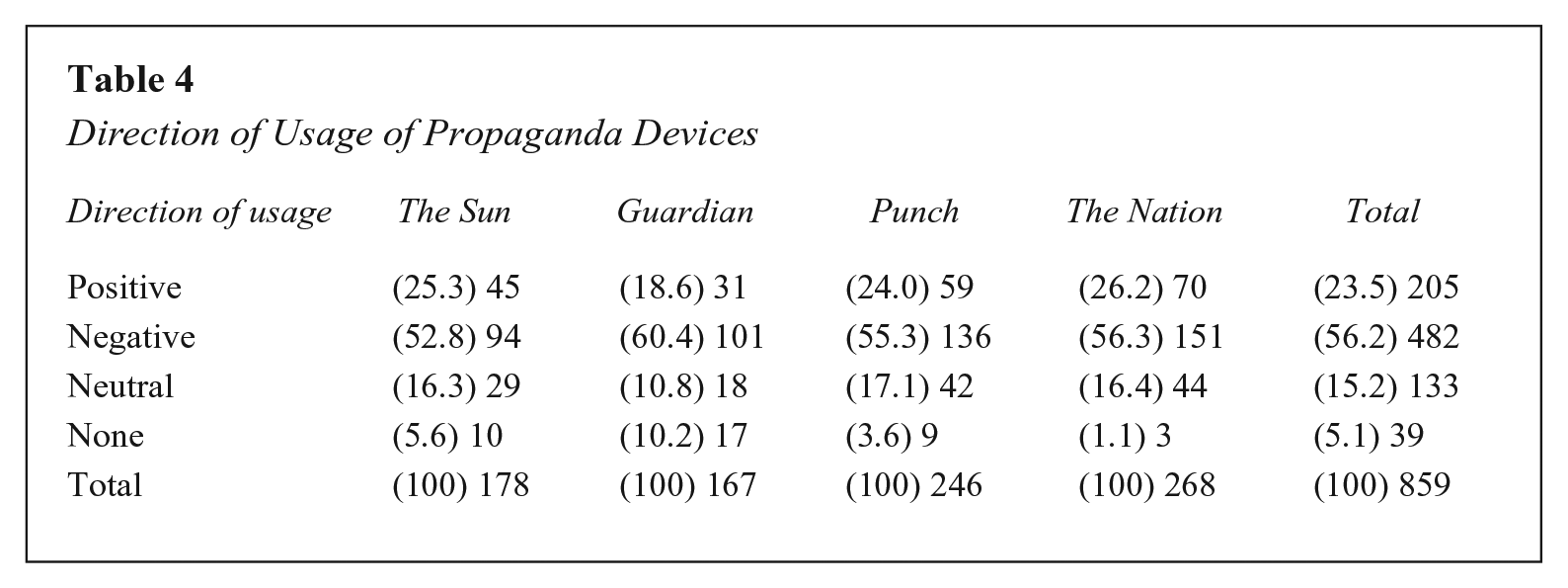
In regards to the direction or slant in the use of these propaganda devices, and as presented in Table 4, we discovered that more than half of the propaganda devices used in the stories were negative; this is 56.2% (482) of the entire content-analyzed stories across all four newspapers for PDP and APC; 23.5% (205) were positive and 15.2% (133) had no direction. Specifically, Guardian had more content-analyzed stories that were negative (60.4%) than the other newspapers for the political parties, while The Nation had more positive stories (26.2%) than the others. Also, Punch newspaper had more content-analyzed stories with no direction (17.1%) than the other newspapers. The distribution tends to support the held assumptions that propaganda devices are used more in the negative than in the positive, and that ownership of media concerns are either subtly or overtly connected to the direction of news stories. The Nation collection of more positively slant stories is in tandem with her connection to the APC, and its use to gag off perceived negative reports by opposition of the ruling party. Similarly, the Guardian’s share of more negative stories also connects to her nonpartisan nature, but openness to accommodate shades of ideas and thoughts that are expected to better the society. The nondirectional or neutral approach of the Punch newspaper is indicative of her purely objective and nonpartisan stance in political activities beyond her region of operations. However, as pointed out earlier, the content-analyzed stories were more of name-calling and bandwagon, which are naturally skewed in the negative than in the positive. The positive propaganda devices such as glittering generalities, card stacking, plain folks, and transfers were rarely used. Therefore, this distribution cannot fully support assumptions that the use of propaganda devices creates positive or negative perceptions since these propaganda devices were not proportionately or evenly used and analyzed.
Also, as shown in Table 5, APC used propaganda devices more in the positive (30.0%) than the PDP with 20.8%. On the contrary, PDP used propaganda devices more in the negative (59.5%) and neutral (19.7%) than the APC with 57.9% and 12.1%, respectively. Invariably, both parties recorded heavy percentile values for negative uses of propaganda devices (59.7% and 57.9%). What the data implied were that the APC’s use of bandwagon, glittering generalities, distortion of facts, card stacking, plain folks and omission of facts were more in the positive than PDP’s use of same. In the same vein, PDP’s use of name-calling, transfers, logical fallacies, illogical fallacies, and fear propaganda devices were more in the negative and neutral levels than the way APC used them.
How Is Prominence Given to the Various Propaganda Devices by the Select Newspapers on APC and PDP in the 2019 Electioneering Campaigns in Nigeria?
For
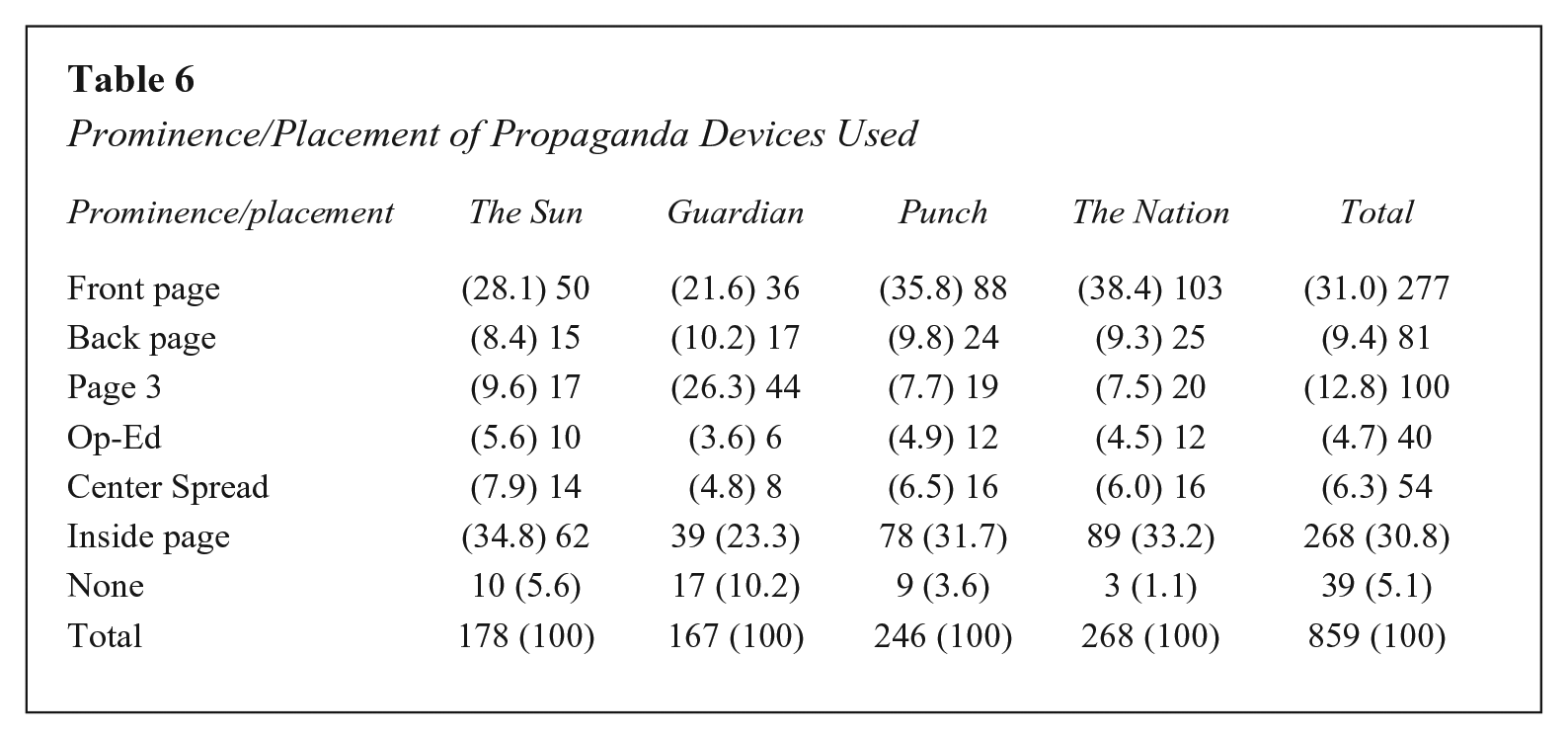
Prominence/Placement of Propaganda Devices Used
Story Placement and Political Parties Use of Propaganda Devices
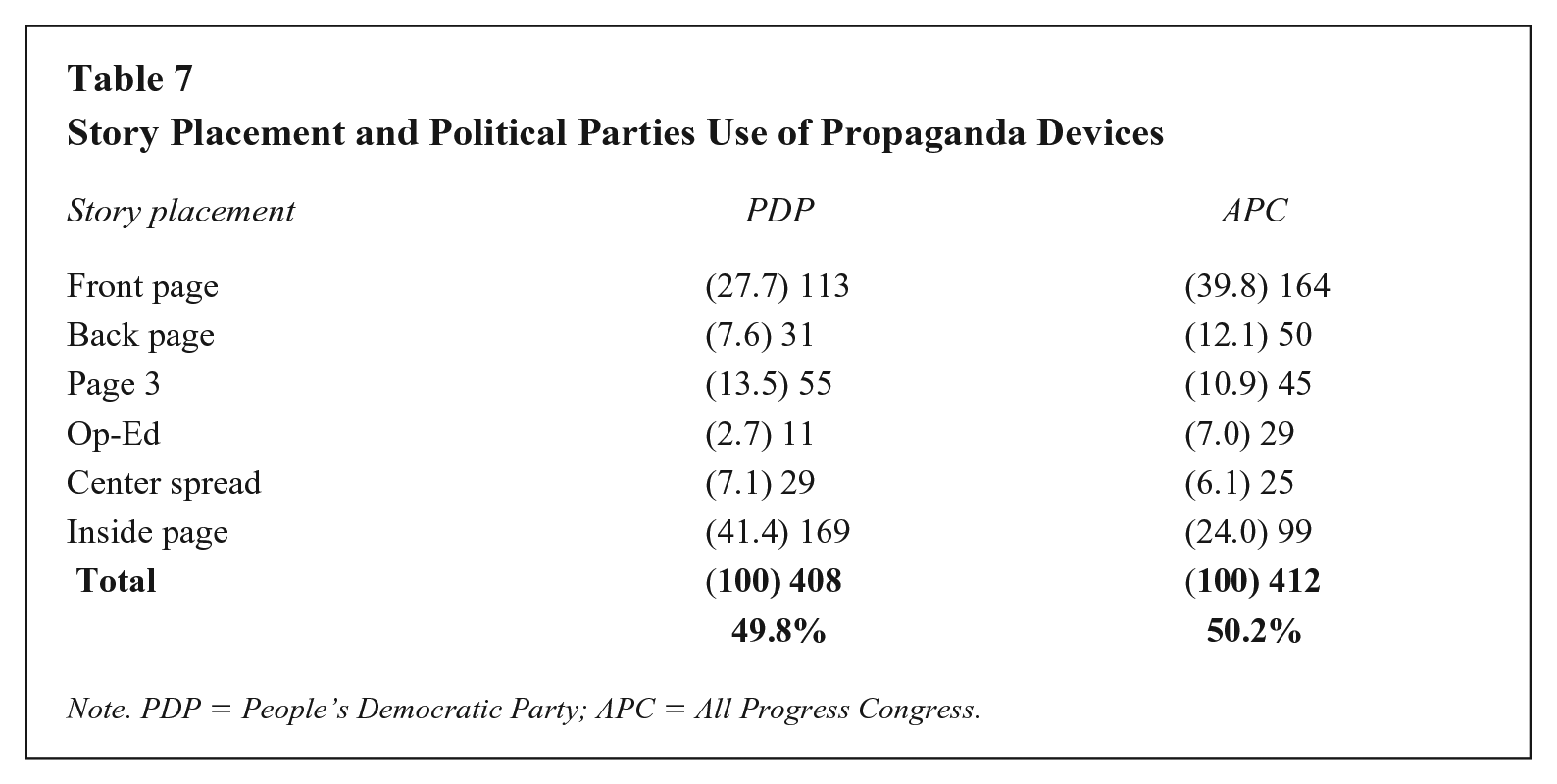
Note. PDP = People’s Democratic Party; APC = All Progress Congress.
Ordinarily, prominence and placements given to stories are influenced by several variables among which are the importance of the story item, the editorial philosophy, management objective and ideologies, and degree of partisanship (Oliver & Maney, 2000; Richardson, 2006). Prominence is a strong premise of the agenda-setting theory and the epistemic theory of merit which are core theoretical oscillation. The front page stories are usually considered as more important to the newspapers than the other pages. Other pages, in order of prominence, are back pages, page-3, opinion-editorial page, central spread, and inside pages. The study showed that the front and inside pages contained more of the content-analyzed stories that used propaganda devices while the opinion-editorial page contained the least. Generally, 31.0% of the content-analyzed stories were identified in the front pages as compared to 30.8% in the inside pages.
Specifically, prominence for each of the propaganda devices varied according to type of devices and the newspapers under study. Bandwagon (73), card stacking (34), distortion of facts (15), fear (14), and transfer (10) propaganda devices were more in the inside pages than any other pages across the select newspapers; while glittering generalities (22) and illogical fallacies (15) were in the back pages. Name-calling (110) and plain folks (46) as propaganda devices were predominant in the front pages across the select newspapers.
Having name-calling in the front page continues the narrative of news as oddity and conflictingly novel. Name-calling allows for meanings to resonate faster since people readily identify with the symbol used in the labeling. The preponderance of hiding other positive propaganda devices like transfer and card stacking in the inside pages only helps to explain how media people tend to play down the importance of good news and upscale the value of negative news. Name-calling is a common negative propaganda device used in Nigerian and African political space and, therefore, it was not surprising that almost half of the entries were in the front page. These, probably, were ignorantly classified as normal political communication to engage the reading interests of the readers without any underlying meanings, but to which, when suggested to the meta-verse of communication, one finds the allure of propaganda too tempting to ignore. Besides, the popularity and ease of use of name-calling ensured that they are seen as big news and therefore flagged off in the front pages of the select newspapers. The Nation had more entries of name-calling propaganda devices in the front page (47), the Guardian had the highest entries in the back page (7) and page-3 (11), while the Sun had the highest entries in the inside pages (12). The Punch and The Nation had the highest entries in the opinion-editorial pages and center spreads.
For the select newspapers, as depicted in Table 6, the inside pages of the Sun newspaper accounted for 34.8% of the content-analyzed stories. The front page had 28.1% of the content-analyzed stories, while the op-ed page had the least with 5.6%. In the Guardian, the front and the inside pages had 21.6% and 23.3% of the content-analyzed stories respectively. There were 35.8% of content-analyzed stories in the front page of the Punch newspaper and 31.7% in the inside pages, while The Nation had 38.4% of content-analyzed stories in the front page and 33.2% in the inside pages.
Generally, the study revealed that The Nation had the highest percentage of content-analyzed stories in the front page (38.4%) as compared to the Guardian with only 21.6% in its front page as the least. In the back page, the Guardian had the highest percentage of content-analyzed stories with 10.2%, while the Sun had the least with 8.4% because the back pages of the Sun are usually used for opinionated stories by columnists. Similar reason explains the low value for The Nation with 9.3%. In page-3, the Guardian had the highest percentage of content-analyzed stories with 26.3% while the Sun had the highest percentage of content-analyzed stories in the opinion-editorial section (5.6%), center spread (7.9%) and inside pages (34.8%).
In terms of story placement and political parties’ use of propaganda devices, as shown in Table 7, APC seemed to strategically use story placements (50.2%) slightly more than PDP (49.2%). PDP had more of inside pages (41.4%), center spread (7.1%) and page-3 (13.5%) than APC that had more of front pages (39.8%), back page (12.1%) and opinion/editorial pages (7.0%).
The newspaper pages that the APC used in leveraging their propaganda devices are professionally seen as more strategic than the ones used by the PDP (Lim, 2017; Mordi & Ogbu, 2017; Obukoadata, 2018). Whether this was deliberate or not, the import is that the front page news items, back page, and opinion editorials are more likely to influence the reading public than the inside pages (which might not even be seen or read) and center spread, although page-3 had equal strategic value.
Conclusion
The study concluded that propaganda devices were used in the 2019 electioneering campaigns by both political parties to the extent that they suit their electioneering needs, and that these may have grave implications for the processes of political communications as it could be deployed as amplifying the already accepted “standard.” Propaganda was discovered to be a vital tool of politics as demonstrated in the array of data presented. However, such usage was not analyzed to find out if they were predetermined or happen-chance, even though the theory of propaganda suggests that all propagandist efforts can only be effective when it is planned for, while the epistemic theory canvassed for the use of propaganda to go through the knowledge process.
The narratives inherent in the argument suggest that political communication within the Nigerian and, by extension, the African milieu is gradually being viewed as a recourse to the tactic deployment of propaganda devices. The supposition is that without the use of these devices, the essence of political communication is not met by the political actors. Although previous studies of the Nigerian political communication space indicate a fair use of these devices, this study shows dominant deployment of these devices, and would be within normalization principles to state that the oncoming electioneering activities will witness heightened deployment of these devices to not just sway opinion but confuse the electorate. Name-calling would be invigorated while bandwagon would also see some infusion as already noticed in the precampaign era when candidates are showing off their fitness levels, simplicity, and astuteness in their various social media handles.
