




Abstract
We reflect on the current state of participatory planning pedagogy and observe that neither teaching participation as a set of techniques nor as a critical philosophy of inclusion adequately prepares planners to attend to the inherent context-specificity, questions of equity and justice, and profound epistemological differences in engagement settings. We propose that planning educators recognize classrooms as contexts for dynamic, participatory engagement and use this setting to model and teach an integrated set of practices for calling out, calling on, and calling in to respond to the emerging demands for our profession’s active role in democratic decision-making.
Introduction
For over half a century, planning professionals have adopted participation as an opportunity for democratizing planning and engaging with different forms of situated local knowledge (Day 1997; Fagence 1977; Lane 2005). This long-standing commitment is reflected in our curricula, with planning theory courses in Canada and the United States endorsing participatory planning as a foundational value of our profession (Pokharel 2024). Organizing and facilitating such participatory approaches are core competencies for planners according to the Professional Standards Board for the Planning Profession in Canada (2018) and the American Institute of Certified Planners (2017). However, the modes and legitimacy of participatory planning have been contested for decades (Day 1997) and plagued by crises (Legacy 2017). Concerns have been raised about whether participatory practices have shifted away from the normative goal of democratizing planning toward a more instrumental aim of simply gaining public support (Woltjer 2002). State-led processes are increasingly viewed as rigid bureaucratic exercises (Haughton and McManus 2019; Innes and Booher 2004; Legacy 2017), with the participating public becoming disenchanted and experiencing high emotional costs (Inch 2015; Legacy 2024; Lyles and Swearingen White 2019). Many of these challenges became more pronounced during the COVID-19 pandemic, with the shift to an online environment (Boyco 2024; Milz, Pokharel, and Gervich 2023) and increased awareness of anti-Black and anti-Indigenous racism and colonialism embedded in participatory processes (Beebeejaun 2024; Quick 2024).
Consequently, many scholars have turned their attention to community-led engagement processes that exist without the sanction of, and often in direct opposition to, state-led public participation (Beebeejaun and Vanderhoven 2010; Laskey and Nicholls 2019; Miraftab 2009). While we understand and empathize with this position, we also recognize that a majority of planning graduates will likely work for governments or consultancies where they have the responsibility to be designers and facilitators of traditional participatory planning: planner-convened processes of gaining participation of those influenced by or interested in a decision, which are often required by policy and are used to frame and decide on the direction of fairly well-defined policies or projects. 1 Given the aforementioned critiques of public participation in these government-centric contexts, we strongly believe that we have a moral and professional responsibility to teach our students to engage in this work thoughtfully.
We therefore approach training students for participatory planning as both a set of methods for engaging the public in planning processes and a philosophy of democratic inclusion for organizing and empowering marginalized and oppressed groups. As educators, we have learned that the critical reflection needed for responsible participatory planning demands a parallel set of classroom practices that we frame as calling on, calling out, and calling in. The profession inherently will call on planners to have a nuanced understanding of diverse approaches and respond to the considerable challenges that emerge when facilitating public participation. As we describe below, many participatory planning classes call on students by training them in these techniques. However, students need to be provided with the critical theories and frameworks to call out the myriad ways public participation produces and reproduces structural inequalities. Indeed, many planning educators routinely communicate those critiques to their students. What we want to see more of—and thus what we emphasize in this paper—are pedagogies that call in students to act as agents of inclusive and empowering planning by bringing their methods, training and critical perspectives to bear in practice.
We begin by discussing our starting points and approach to developing the paper. We have deliberately avoided terming this section our methodology, as our intent is not to advance an empirical assessment of student learning. Instead, our goal is to provide tools to support the community of planning educators’ ongoing reflection-in-action as we develop, test, and revise our approaches to teaching participatory planning. We then set our evolving approach within the pedagogical literature, highlighting how emerging trends in participatory planning practice signal the need for reflection and innovation. The latter half of the paper elaborates on how a framework of calling on, out, and in may support pedagogical innovation in teaching participatory planning as both a methodology and a critical philosophy of planning processes.
Starting Points
Our starting points include a literature review and an informal scan of how public participation is taught at accredited programs in Canada and the United States. The authors’ experiences of teaching public participation in both countries are also a critical resource. Across the three of us, we have taught public participation to students in planning, public policy, and public administration at various levels (undergraduate and graduate) across multiple institutions, and in diverse social, political, and physical landscapes. We also draw on our involvement in a workshop on participatory planning pedagogy.
Our classrooms
For the past six years, Janice has taught a core course on public participation for third-year undergraduate planning students. Before that, she spent five years at another institution instructing a graduate-level, community-based studio involving three to six Indigenous partners with ten to fifteen students per year. The undergraduate course focuses on planner-led participation, as opposed to the community-led initiatives explored in the studio, and has a large and growing class size of 100 to 130 students. Teaching assistant-led tutorials of approximately twenty-five students allow for some hands-on activities, but not with the depth that might be achieved in smaller classes.
Kathy has taught participatory planning for ten years with class sizes of thirty-five to fifty planning and other graduate students. She utilizes the class size to transform the classroom into an immersive laboratory, where she pairs critical frameworks and critiques of democracy with practical, experiential instruction in ten methods for organizing stakeholder participation. Kathy coaches a group of students to design a class session using each method and then all students debrief on how the exercise felt to them as participants, what worked and did not, and the purposes for which they would—and would not—use it.
Dan’s class is offered as a “practice method” elective in participatory methods since 2019. Enrollments are typically between ten and twelve master’s students and include an equal mix of planning and non-planning students. His students are often acutely aware of the racial and colonial tensions inherent in any participatory planning or policy-making processes. Many students have directly experienced the conflicts that frequently occur at these meetings and are highly motivated to develop skills that can broaden participation and embrace conflict constructively.
In comparing experiences, all three authors identified a similar set of ambitions related to participatory planning pedagogy. We all have adopted, perhaps tacitly at first and more explicitly over time, a philosophy of inclusion paired with the idea that participation is also a method for making plans. Through coauthoring, we have developed a language for describing our practices for engaging students in terms of calling on, out, and in. As this is an emergent framework, we have not attempted to gather student perceptions specifically on these teaching approaches, which would be a possible direction for future work.
The Toronto workshop
In 2022, Janice and Dan organized a scholarly workshop after the ASCP Conference in Toronto, intending to reinvigorate a critical pedagogy for participatory planning. 2 The workshop included twenty-five participants at various career stages, from PhD candidates to full professors. Most were from the United States and Canada, with some from Australia and Europe. All were actively writing about and/or teaching courses on participatory planning and identified through our networks and the book of abstracts from past ACSP conferences. Kathy was invited to give some opening comments. This talk introduced the language of calling on, calling out, and calling in, which the co-authors subsequently developed further in collaboration. Our preparations for the workshop also included a quick scan of the 118 accredited planning programs in Canada and the United States. 3 Our goal with this exercise was not to generate defensible research findings, but rather to gain a better understanding of how public participation skills are taught. We found that over 40% of programs do not offer a specific course on public participation, community engagement, facilitation, and/or conflict resolution, either including these subjects in other classes or not teaching them at all.
This paper is not a report on the outcomes of that workshop, but our preparations and the discussions catalyzed many of the ideas we share in this paper. First, our informal scan of accredited planning programs aligns both with earlier work by Shipley and Utz (2012), who also found few dedicated courses and suggest that at least some planning schools are exposing students to these issues through community-based studios, and work by Pokharel (2024), who suggests participation is taught in planning theory courses. We began wondering whether exposure to the philosophical and practical foundations of participation happens in parallel but separate classes in some planning programs. Finally, the conversations with colleagues enabled us to reflect more deeply on our teaching practices and the reasons behind our pedagogical choices. Brainstorming activities at the workshop sometimes revealed alignments between our approaches and those of other participants, and at other times, they opened our eyes to alternative activities that could be used to achieve similar goals. We present some of these suggestions throughout the paper, both in the spirit of knowledge sharing and as a means to triangulate our own experiences.
Tensions in teaching public participation
The general issue of how educators prepare students to engage in the more challenging aspects of professional practice has been with us for some time. Planning educators have long been concerned with establishing a “core curriculum” (Edwards and Bates 2011; Friedmann 1996) that addresses the skills and competencies needed for planning practice at all levels. At issue are the skills, sensibilities, and substantive knowledge base that enable a planner to fulfill their overlapping roles, with one of those roles being a negotiator and facilitator (Baum 1997) who draws on the skills of social interaction, community organizing, oral communication, original information gathering, and social media (Greenlee, Edwards, and Anthony 2015), all of which are relevant to participatory planning practice. These discussions about the core competencies for planning education essentially revolve around what we teach. As planning educators, we also need to focus on how we teach these skills. Performing these methods reflexively, rather than reflectively, may reinforce power imbalances and structural inequalities that participation is meant to rectify (Arnstein 1969; Legacy 2024). Teaching so that students are instead encouraged to think and reflect in action (Schön 1983) not only deepens their learning but also prepares them to adapt in the moment of dynamically unfolding, complex participatory environments, a capacity that is particularly salient in the face of social, political, and technological changes that are polarizing public debates and deliberations.
Often, this reflection-in-action is achieved through studios (Edwards and Bates 2011) in which students work directly with a community partner on a real-world project, and the instructor acts as a mentor or coach. This type of service-learning offers significant benefits to students and community partners (Forsyth, Lu, and McGirr 2000), particularly groups that may not otherwise have access to planning support (Agnotti, Doble, and Horrigan 2011). It is a well-established pedagogical method for training students to engage in thoughtful partnerships with community groups (Pinel and Urie 2017) and the methods of participatory action research (Reardon 1998; Sletto 2010), guided by thoughtful mentors who protect both community residents and students. The planner-convened process that are the focus of this paper can learn reflection-in-action lessons from these models, though community-engaged studios are likely best suited to teaching students about community-led participatory processes. Moreover, there can be unintended consequences for student learning, for example if they experience a crisis of confidence and become burdened by the fear of “getting it wrong” with community partners (Barry et al. 2023). These challenges can be addressed through studio or service-based learning models that hold space for students and their instructors to debrief, reflect, and potentially re-group after unexpected challenges (Sletto 2010). These challenges also suggest the value of a broader repertoire of pedagogical approaches. Buizer and Lata (2021) describe their success with having students prepare, perform, and critically debrief small theatrical performances of different planning approaches. Natarajan and Short’s (2023) edited volume on engaged pedagogy provides additional approaches for developing students’ capacities for critical reflection through guest speakers, ethnographic methods, and role-playing activities.
Teaching Participation as Technique
Numerous models and frameworks for conducting public participation have been developed through careful study of practice (Hofer and Kaufmann 2023; Nabatchi and Leighninger 2015; Schively Slotterback and Lauria 2019). Scholars and practitioners offer strategies for determining whether participation is merited (Hurlbert and Gupta 2015), designing participatory processes to suit purpose (Bryson et al. 2013), mediating among conflicting interests (Forester 2006), collecting and collating input from the public (Eriksson, Fredriksson, and Syssner 2021), utilizing social media and mobile technologies to promote participation (Afzalan and Muller 2018), and evaluating outcomes (Rowe and Frewer 2000). The prevalence of such “how-to” guidance is associated with growing efforts to provide a recognizable standard for public participation (Legacy et al. 2023) and streamline its implementation through planning technology. Both these efforts create challenges for teaching public participation.
Technology is saturating every corner of planning practice (Wilson and Tewdwr-Jones 2021), and now planners use information and communications technologies for all phases of planning work, from data gathering and analysis to plan production and, increasingly, public participation (Potts and Webb 2023). This long co-evolution of practice and technology reached its pinnacle with the Covid-19 pandemic when planning became a universally digital practice (Milz and Gervich 2021; Milz, Pokharel, and Gervich 2023). One of the confounding experiences of this period was that planners were prepared for the change (Milz, Pokharel, and Gervich 2023; Mualam et al. 2022), perhaps because most students come to planning school with a predilection for using technology (Boland et al. 2025). Most students learn about planning technology (plan-tech) first in analytical planning methods courses, such as in quantitative analysis and geographic information science, in which a primary focus is learning how to operate software.
We assert that teaching participatory planning techniques in a similarly decontextualized manner, without critical perspectives, is not the most effective way to learn when and how to use and adapt these methods. Yet acquiring techniques is valuable because they are useful. After all, the impetus for professionalization is to promote the consistent application of high-quality practices. However, to the extent that participation methodologies are being bureaucratized and institutionalized (Legacy 2017) through a cookbook approach, they also come with risks. Leaning into technique to emphasize process efficiency may eliminate meaningful dissent (Pokharel, Milz, and Gervich 2021). Focusing on mastering techniques or “best practices” invites a loss of context-specificity (Legacy et al. 2023), reducing participatory planning skills to a kind of expert knowledge that overwrites local knowledge and other ways of knowing. Instead, alongside learning concrete tools and methods, practitioners need to develop the reflective capacity to adapt them to fit the unique circumstances of each context (Quick and Sandfort 2014).
Teaching Participation as a Critical Philosophy of Inclusion
To the extent that participatory planning serves as a container for planning as usual, it is a practice that reproduces structural inequality, re-traumatizes equity-seeking groups, and reinforces Whiteness as a form of power that flattens experiences against a single hegemonic frame of reference. When we recognize participation as a means of both exclusion and inclusion of non-dominant groups (Quick and Feldman 2011), it becomes even more important to question established methods of teaching and conducting participatory planning. Scholarship has pointed to the detrimental effects on inclusion and decision-making outcomes of overwriting differences in culture, language, norms, and power dynamics (de Souza Briggs 1998; Umemoto 2001). Teaching participatory planning as a critical philosophy of inclusion is crucial within the context of ongoing struggles to call out and challenge racism within planning (Bates et al. 2018; Williams 2024), recognize planning’s implication in colonialism (Escobar 2010), and promote Indigenous justice (Porter and Barry 2016). It requires resetting the space of planning engagement to move beyond “including” Indigenous people in White-centered spaces to respect their inherent sovereignty and rights to set the agendas (Porter and Barry 2016; Porter et al. 2017). It demands recognizing Black placemaking history and methods (Bates et al. 2018) and actively decentering Whiteness in public engagement settings (Quick 2024).
More critical sensibilities toward power are difficult to capture and learn from a technique-focused pedagogy. Engaging pluriversal methods of community engagement is a way to minimize speaking “on” or “for” communities and instead to plan with them or cede space for planning by them through listening and taking their lead (Vasudevan and Novoa 2022). For example, embracing the role of storytelling in making plans is a tangible expression of decolonization (Ortiz 2023). However, much of the critique of the damage done by participatory planning is learned through theory classes. Sharing stories of oppression and cautionary tales about power abuse and complexity in a classroom is essential and can give the students the foundations to “call out” inappropriate and damaging processes. Yet it may never adequately prepare prospective practitioners for encountering oppression directly in practice because they are not reckoning with these tensions by working through the nitty gritty, practical choices of how to implement planning. Once on the job, students may struggle to bridge the gap as they attempt to apply concepts from one set of lessons with practices from another, or be too anxious to even try participatory methods.
Toward a Pedagogy of Calling on, out, and in
Our response to the tensions just described is to teach participatory planning simultaneously as both a set of methodologies for making plans that come with an array of engagement practices and a philosophy of democratic inclusion for organizing and empowering marginalized and oppressed groups. Just as it is insufficient to limit the pedagogy of participatory planning to teaching basic methods, tools, and technologies of public participation, it is insufficient to advance only the more critical theories that expose and problematize the failings of contemporary participatory practice. We do not recommend one mode over another. Instead, we suggest that educators utilize a framework of calling on, out, and in so that they recognize and engage a full palette of pedagogical practices to teach students both methods for engaging the public and a philosophy of democratic inclusion through participatory planning.
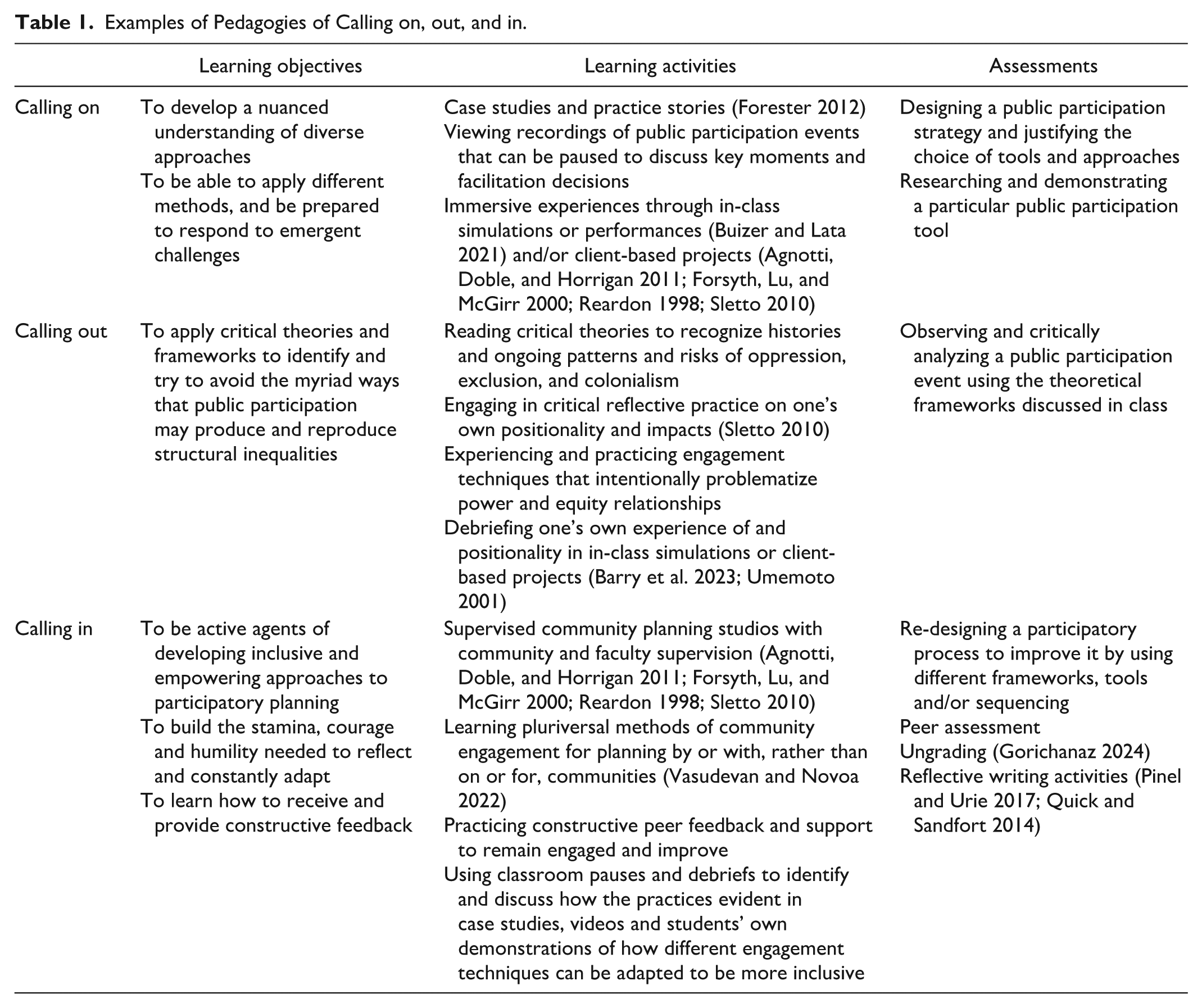
We considered creating a suggested syllabus for a class that would call on, out, and in. However, that would be contrary to the context-responsiveness we mean to teach through our pedagogy on participatory planning; there cannot be a canonical approach to teaching participatory planning because it must be responsive to emerging issues and sensitive to the power dynamics in the moment and setting of the classroom and field of its practice. Instead of a week-by-week outline, we present key considerations and examples related to three core elements of course design: (1) learning objectives, (2) learning activities, and (3) assessments. For each of these elements, we provide examples of calling on, out, and in, based upon our own teaching experiences and some insights shared at the Toronto workshop (Table 1).
Examples of Pedagogies of Calling on, out, and in.
Calling on
Teaching participation as technique is a method of calling on students to have an understanding of what it means and how it feels to be the person designing and leading a participatory process using different tools. This aim can be translated into learning objectives that seek to expose students to techniques and long-standing principles for designing effective public participation. Part of their training needs to include sensitizing them to the various participatory tools available, including emerging technologies, as well as developing their capacity to consider the merits and limitations of each and make context-specific choices that are also highly attentive to issues of equity, diversity, inclusion, and justice.
Pedagogies of calling on include reading materials, case studies, and practical exercises that expose students to methods for designing and facilitating community engagement. In our classrooms we include short hands-on activities to demonstrate and practice facilitating a discussion or to gain exposure to common participatory tools (e.g., dotmocracy, affinity diagrams, world cafe, circle process), as well as some longer activities on how to do a stakeholder analysis or thematically organize the qualitative information generated through participatory processes. Students need to be supported to learn in and on participation as a relative newcomer, meaning that they need to be put in situations where they can apply established participatory tools and techniques while recognizing that the work of being a planner engaged in participatory processes is as much of a stance of ongoing design, reflection, and adaptation as it is the application of specific skills. Community-based partnerships and studios, we suggest, will continue to be valuable tools for teaching students how to engage in co-production. But, for planner-convened participation, there is a need to get students as close to actual community engagement practice as possible without using communities as a “lab” for testing their skills (Schramm and Nye 1999, cited by Reardon 2006). Instructors also need to create “safety nets” so that students can be permitted to fail and develop the reflective capacity and habit to question the field’s existing practices and their own professional habits. We expand on this idea below, as reflection is also an integral element of a pedagogy of calling in.
To assess students’ learning and preparation to be “called in” to practice, we have shifted emphasis away from simply demonstrating proficiency in a technique and toward their ability to contextualize, adapt, and mix specific skills or particular forms of knowledge to suit a given purpose and context. For example, Janice uses an assignment where students design a public participation strategy to respond to a specific scenario. Kathy does something similar in her course, allowing students to design something relevant to their professional work and, in a separate document, to justify their choice of techniques, steps, and sequencing relative to the process objectives and parameters. These assignment structures normalize the idea that there is no “right” way to “do” public participation, but rather a whole series of judgment calls practitioners make when engaging with communities.
Calling out
In parallel with the popular meaning of “calling out” or interventions that name and interrupt harmful or oppressive power relations, the approach we describe as calling out is a method of teaching public participation so that students can both have critical theories and frameworks to identify the myriad ways that public participation may have negative impacts and recognize their own potential complicity in reproducing those dynamics in their own practice. We draw inspiration from scholars who offer strategies for convenors and facilitators of public participation processes to not only name, but also avoid, minimize, or attempt to remedy exclusionary and oppressive power dynamics (de Souza Briggs 1998; Umemoto 2001).
Exposure to critical theories is an essential activity in pedagogies of calling out. Exposure to theories of democracy, community organizing, organizations, and group dynamics provides students with frameworks for observing, reflecting on, and challenging participatory practices (Hoch 2017). Attuning students to power dynamics requires engagement with theories of anti-racism, anti-colonialism, and other dynamics of prejudice. We suggest this needs to be an explicit part of teaching about participation, integrated alongside learning participatory techniques, rather than siloed in a separate theory class. Essentially, students need to learn to “call out” themselves in their own participatory planning work, when merited, without going so far as to “cancel” themselves when they err, and to learn to act with sustained attention to power and equity that keeps them attuned without paralyzing them from any action at all.
Course content and modules to engage with these issues include revisiting themes around diverse ways of knowing (Sandercock 1998) previously introduced in planning theory courses, this time making explicit connections to participatory practice. Janice added a lecture and case study on trauma-based approaches to public participation. Dan uses video recordings of facilitated planning meetings, stopping them at key moments for discussion around questions such as, “What do you think about what that planner just said or did? What would you do next?” which is an opportunity to call out what planners are—and are not—doing, propose alternative actions, and compare their choices with the actions of seasoned professionals. Toronto workshop participants used related methods for “trying on” different planning decisions in a safer, simulated environment through role-playing, perspective-taking, or modifications of Forester’s (2012) model of learning through other practitioners’ stories of practice. Some also teach arts-based methods for participation, a pluriversal approach to planning discussed by Vasudevan and Novoa (2022).
However, students should not be attuned to the complex power dynamics solely through a position of critical distance and observational and analytical learning activities. It is also vital for them to have a structured experience in which they encounter and work with these dynamics in practice, and in a low-stakes environment where they are not so concerned about the risks that they are hesitant to act at all. This is essential to teaching emerging practitioners to use the given public participation techniques with care and sensitivity and to think beyond them. This kind of “imagining otherwise” (Bates et al. 2018) is part of challenging the Whiteness and coloniality of the formal spaces of public participation. Kathy leads students in a conversation about a contemporary racialized planning issue, such as gentrification of immigrant neighborhoods or policing on university campuses, using Glenn Singleton’s protocol for courageous conversations about race. White students find the protocol useful for raising their self-awareness of their own racialized positionality in planning topics, the class has the opportunity to try out and critique one way to engage in racialized policy deliberations. 4 Anytime power relations are particularly salient in the course of classroom discussions, the instructor can say, ‘Time out, let’s unpack this issue.’ However, while there are times in participatory settings when it is constructive to call out and immediately shut down a harmful dynamic, shame is not helpful to learning. An educational space can become stifling if people feel on edge about being called out for missteps, suggesting that extra care may be needed to ensure that students appreciate the difference between safety and comfort (Barry et al. 2023). It is for precisely this reason that we have added calling in as the third mode of teaching and learning participatory planning.
Calling in
To “call in” is to note issues of power or problematic practices and actions and to invite the individual(s) involved into a conversation to discuss the impact of those actions, to challenge biases or assumptions respectfully, and to engage in working together on the issue (Verduzco-Baker 2018). It is a stance of inviting students and instructors to be active agents of developing inclusive and empowering approaches to participatory planning, by recognizing every moment of engagement, including the classroom environment itself, as a space ripe for constructive engagement with and transformation of power relationships.
A core pedagogical activity of calling in involves sustaining and building the stamina to remain attentive and engaged and not take—or expect—a pass on shared responsibility for an environment that actively promotes inclusion and equity. Community-engaged and studio-based learning are well-established methods for calling in students, but they are particularly demanding for students and faculty alike because of the responsibility of preventing harm. Coaching and course correction may be difficult to achieve when community partners are in the room, so multiple channels and iteration are needed. We instead prefer to expand on our earlier suggestion to intentionally and thoughtfully frame the classroom as a space of learning “in”/“on” participation, inspired by Schön’s (1983) influential work on reflective practice. Planners (and others) learn most effectively through engagement in action, reflection on that experience and its lessons for practice, and ongoing application of those lessons. As Schön emphasizes, skilled practice requires observation and adaptation in real time. The classroom is an environment for this practice, provided educators exercise opportunities to call in students to be co-producers of that space, including by encouraging students to call in the instructor, who can take responsibility and model humility in taking in guidance, learning, and adapting accordingly.
We have attempted to achieve this by structuring our classes so that students take turns practicing their skills in designing, implementing, and evaluating participatory processes, while being coached and supported by the instructor in these methodologies. They practice the skills in the classroom with their peers playing the roles of participating stakeholders. Kathy expands on this practice by introduces students to the uneven distribution of power that exists in many participatory processes in which those who are most likely to experience harm because of their identities also tend to be burdened with the labor of educating others, which only serves to replicate the harm (Linder et al. 2015). Kathy then uses Glenn Singleton’s courageous conversations about race to get students to consider how much “courage” they need to raise issues of race when practicing different facilitation skills and public participation techniques. Throughout the class, privileged students practice a stance of not demanding explanations of less privileged students, recognizing their positionality, taking responsibility for their own learning, and sustaining their stamina for ongoing adaptation and growth.
One of the workshop participants shared an example at her university where trained actors are used to simulate a contentious public meeting. 5 Students prepare for the simulation by learning the rules of order that guide public meetings and attending meetings with their peers and instructor. They then take turns as the planner facilitating the meeting while actors play the roles of key stakeholders. The instructor is responsible for initiating and terminating the simulation when students require regrouping or when specific incidents or interactions during the simulation necessitate additional discussion. While many educators will not have access to trained actors to run this kind of simulation, this unique learning approach offers valuable lessons on creating challenging environments for students to practice their skills while maintaining a sense of safety. Students learn essential content beforehand and observe the actions of practicing planners before being asked to try out their developing skills for short periods, with the ability to step in and out of character to engage in personal and group reflection.
When it comes to assessing students’ performance, there is tension in asking students to engage with the messiness of public participation and learn in part by failing when their work is graded. Students may be instrumental when approaching their course assignments, focusing solely on meeting the grading rubric. To encourage students to take risks and embrace some level of discomfort, educators need to assure them that “getting it right” is not the key metric for success. In our classrooms, we employ reflective activities that we evaluate based on how much a student learns from an experience. This grading approach shifts attention away from simply assessing how well students performed the role of facilitator (which might encourage them to try only things that they are confident will “work”) toward a more holistic assessment of their capacity to learn from their successes and failures. Reflective activities help even the playing field between students who learn more through what Kolb (2015) has described as active experimentation and those who learn through reflective observation, providing opportunities for both types of learners to excel. For instance, Dan selects three students to participate in a role-playing simulation and assigns the remaining students the role of observers (i.e., fishbowl exercise). The role-playing students complete the simulation live and uninterrupted while observers take notes. Afterward, the instructor facilitates a class discussion of the simulation, including the experiences of both participants and observers, as well as the lessons that everyone can apply to their future practice. During in-class simulations, Janice encourages students to take risks and try to adapt so long as they then analyze what did and did not work and why. We also find that there is an equity dimension to this, with students who suffer from social anxiety often being challenged by public participation courses that include hands-on activities. Modes of assessment that deemphasize actual performance, along with clear ground rules and expectations for constructive peer feedback, can support their success. There was considerable interest among the Toronto workshop participants in less instructor-centered approaches, such as peer assessment and “ungrading,” which refers to a range of practices from eliminating grades entirely to only requiring a minimum number of graded assignments (Gorichanaz 2024).
The suggestions in this section regarding possible topics, learning activities, and modes of assessment do warrant a word of caution. Public participation is a broad area of inquiry and practice, and instructors may be tempted to overload their courses with content. As discussed at the Toronto workshops, students are often not well-served by too much course content. There is a need to “go slow to move fast,” meaning that students require time and space to reflect on their developing practice and gain confidence.
Conclusion
If public participation and community engagement are to remain essential elements of contemporary planning practice, as we believe they should, then our approaches to teaching these core competencies must evolve so that future planners are equipped to respond to emerging tensions in the field. Public participation should be recognized as both a method for making plans and a philosophy of inclusion, leading us to propose a both/and approach that is grounded in the integrated practices of calling on students to develop nuanced and grounded understanding of different public partition techniques, approaches, and methods, calling out the myriad ways these methods can fail, and calling in students to become active agents of change and to approach this role with courage, stamina, and humility. It is our impression that many faculties do already call on and call out, though often in separate classes. We are both calling for sustaining those approaches, preferably integrating them more, and for adding the pedagogies of calling in students to act as agents of inclusive and empowering planning by bringing their methods training and critical perspectives to bear in practice. A pedagogy of calling on, out, and in requires students to be aware of the practical considerations involved in selecting between various participatory tools and technologies, while also maintaining a space for in-depth engagement and critical examination of issues related to equity, diversity, and inclusion. Throughout the paper, we have offered specific examples of how this pedagogy of calling on, out and in could be translated into specific learning objectives, learning activities and assessment. Many of these examples will already be familiar to planning educators (e.g., case studies, practice stories, and community-based projects or studios). But, we have also found that the practices of calling out and in may necessitate additional approaches. When the participatory planning classrooms is re-framed as a space of learning “in”/“on” participation, or a process of learning and practicing participatory planning that is itself participatory, we need to think about activities and assessments that allow students to feel, but that also challenge them to step out of their comfort zones and to give and receive feedback in ways that support a culture of continuous reflection, adaptation and learning. We have shared how we have used classroom pauses, debriefs and reflective writing activities to achieve some of these goals, as well as innovations like “ungrading” that we are interested in but have not yet experimented with. Together, these practices will encourage students to be prepared for and sustain a commitment to supporting thoughtful democratic engagement throughout their careers, based upon a habit of continuous learning through reflection in and on participatory planning.
Footnotes
Acknowledgements
We would like to thank the editorial team and four anonymous reviewers for their helpful comments on earlier drafts of the paper. A special thanks also goes to all those who participated in the Toronto workshop and to the Social Sciences and Humanities Research Council of Canada for providing the funding that enabled this workshop. We are appreciative of this space and support to reflect on our teaching practice, both as a team of co-authors and in collaboration with a wider community of public participation scholars and educators.
Declaration of Conflicting Interests
The authors declared no potential conflicts of interest with respect to the research, authorship, and/or publication of this article.
Funding
The authors disclosed receipt of the following financial support for the research, authorship, and/or publication of this article: Barry and Milz received funding from the Social Sciences and Humanities Research Council of Canada Connection Grant (Grant 611-2022-0047) to host the workshop that was one of the starting points for this paper.
